The Swedes are feeling the heat of Russia’s expansionist actions. They’ve already begun the process of joining NATO and now the Swedes are considering expand the draft to assure they have enough troops to meet the threat Russia right now presents to them.
The Swedes reinstated the draft in 2017 but so far have not fully acted on it. They only have 5,000 conscripts. They plan on doubling that by the end of the year to 10,000, with more expansions expected. The move sends a message to the Russians that the Swedes are resolved to resist any efforts by the Russians to expand their borders into Sweden.
How the Media lies to the American People – and why that is more dangerous than you think…
As of mid-November of 2022, the American Electorate remains as divided as ever, if not more than at any time since the Civil War. The “mainstream media” continually highlights the chaos of the recent mid-term elections, appearing to inadvertently present the truth of a lie, while trying to ‘spin’ those facts to represent their diametric opposite. Simultaneously, the same body ‘amps up’ hysteria over social media giant Twitter’s impending demise, despite its record growth since being bought out by billionaire businessman Elon Musk, while partisan senators threaten a private business if Musk refuses to bow to their will, regardless of the legality of their claims and threats.
Along with these “amplifications,” the mainstream media leaves unspoken the greater fear: the silence of the armed American public. In a word, America is “too” quiet: in many other countries, actual armed rebellion would have already broken out…but not within the United States. And yet…a quiet, yet palpable tension is building; whispers of a call to arms from a once quiet “American Street” are slowly beginning to grow louder. This is not a potential that should be ignored – unlike most countries in the world, the population of the United States is among the most well-armed in history; the closest analogies in recent times are Yugoslavia and Rwanda.
Let that sink in.
What the media is not talking about, what it is diligently avoiding talking about at all costs, are the massive protests around the world, protests rivaled only by the Russo-Ukrainian War in their potential to destabilize – if not potentially overthrow – the current world order.
In Brazil, the United States’ closest analog in the Western Hemisphere, tens of thousands of protesters have been marching across the country in protest for nearly two weeks over the razor-thin defeat – well within the margins of error – of right-wing President Jair Bolsonaro by disgraced left-wing former President Luiz Inácio Lula da Silva. Many of these protesters are calling on the Brazilian Armed Forces to intervene to keep Bolsonaro – who has not conceded defeat – in office, claiming that the elections were rigged. The calls for the military to intervene in the country’s political process are not to be taken lightly – the Brazilian military has done so in the past – four times, in fact – sometimes lasting decades. Such an economic destabilization would threaten a US$280billion export market, at a time when global supply chains have not recovered from the jackhammer blows of Covid-19 and the logjams caused by the grounding of the massive container ship MV Ever Given.
But, if Brazil and the Russo-Ukrainian War (as well as the many ongoing terrorist campaigns and guerrilla wars around the world) were the only issues at hand, those would present only minor disruptions to the world. However, this is very much not the case.
The populations of the “Western World” are extremely unhappy as many, if not most, nations identified as “Western” are seemingly making insanely self-destructive policy decisions, attempting to conform to the pronouncements of the World Economic Forum (WEF). The WEF, founded by German engineer and economist Professor Klaus Schwab, is a self-appointed, international organization of lobbyists who promote the concept of “The Great Reset” and a reformation of the social contract, concepts that are wholly and completely embraced by the administration of Joe Biden. Schwab has alluded to promoting ideas of forcing people to accept controversial Covid-19 vaccines (YouTube link), despite their highly questionable efficacy versus side effects. Criticisms of the WEF are rampant, not least because it is, colloquially speaking, about as transparent as a granite block. One of its main criticisms is the formation of a detached elite, believing themselves to have no national loyalty whatsoever, with some observers going so far as to describe them as a “mafiocracy” of bankers, industrialists, oligarchs, technocrats and politicians.
As a result, it should not be surprising that such detached views lead to the promotion of insane policies by adherent of this hydra that are embedded in national governments to whom they hold to no loyalty. As a result, tens of thousands of Germans are protesting over being forced to turn to firewood as a frigid winter begins to take shape; Frenchmen and Italians march in the tens of thousands against the skyrocketing cost of living in those nations; and many worry that increasing tensions between Greece and Turkey could erupt into an actual shooting war.
Likewise, these economic woes are being exacerbated by government’s toadying to the shrill demands of the globalist “climate change” movement, demanding that draconian climate controls be enforced, regardless of the fact that not a single proposal for alternative energy production such groups have advanced has proven to be in any way viable.
A quick perusal of the sources of the above sources show that the latest substantive results do not come from “first reference” news sources. There are plenty of international news agencies around the world that are outside the mainstream, yet that present quality reporting…Not that you, the Reader, are going to see their stories carried by mainstream outlets. You have to go looking for them.
And that is the point.
There is a war going on, a war – if a certain dramatic license can be allowed – over your minds and bodies. You, personally, as well as your families, are the product and the goal of bodies like the WEF.
But, it is not simply the West that is being battered by the whims of detached billionaires thinking that they can play at being God. In fact, the ongoing low-key holocaust in Africa is also playing its part. The endemic interference – both by First World states and corporations – which keeps generational quarrels oozing blood is contributing to a building tension across the continent, a tension that if it snaps on its own will rival the consequences of the United States “cutting loose.”
The danger lies not in the “Snap” itself. Tensions happen in societies all throughout history. The problem lies in the deliberate nature of forcing ever-increasing tension on a structure that was already stretched to its limits. “Just in time delivery” and “offshore outsourcing” proved economically profitable for the globalist ideal – if catastrophic to local economies – but its cultic devotion to economic efficiency and profitability left the world’s economy unusually vulnerable to supply chain disruption, as was amply demonstrated in 2020-2021. The response of the WEF-elite, however, was not to pause and rethink their strategy. Instead, the WEF and its adherents in various governments have continued to push their agendas forward, despite the wider dangers that are being revealed.
Historians, archaeologists and anthropologists have wondered for decades about a period known as the “Late Bronze Age Collapse”, a period of about 300 years, beginning in c.1100BC, where the advanced civilizations of the Eastern Mediterranean seemed to implode and collapse. Dr. Eric Cline, PhD has described this event as a “systems collapse”, where a highly interconnected system vulnerable to a combination of threats – each individually insignificant, but collectively devastating – collapsed completely (YouTube link), not in a period of centuries, but in a period of one or two decades, at most…in a time when it could take weeks to cross the Mediterranean.
It is a truism, that the speed of communications – via faster ships, aircraft and the internet – have made the world smaller and faster. This being so, when detached, elitist billionaires play with a house of cards that they do not understand, they will not be the only ones who pay the price.
You will.
The Freedomist — Keeping Watch, So You Don’t Have To
PUTIN WANTS OPPOSITION TO UKRAINE WAR STRIPPED OF CITIZENSHIP – In a move reminiscent of the desires of the DNC in America, Vladimir Putin is pushing a bill that will cancel your Russian citizenship if you oppose the party’s policies, specifically its policy regarding the invasion of Ukraine. Without a bill of rights, the bane of DNC existence, the DNC-wannabe is sure to get the bill passed and codified into law, thus outdoing the possible source of Putin’s inspiration, the DNC’s method for dealing with dissent in America (by declaring the opposition seditionists while supporting the death of the republic themselves).
President Vladimir Putin has put forward legislation that would allow authorities to revoke the passports of naturalized Russian citizens who oppose the invasion of Ukraine, state media reported Sunday.
Putin proposed amendments to Russia’s law on citizenship that would make “discrediting” and spreading “fake news” about the Russian military grounds for denaturalization, according to the RIA Novosti news agency.
Russia passed laws against “discrediting” and spreading “fake news” about the army shortly after it sent troops into Ukraine in late February, a move Kremlin critics say has been used to silence most anti-war voices.
DESPITE US INTERVENTION, HAITI’S GOVERNMENT CONTINUES TO COLLAPSE – The current prime Minister of Haiti, Ariel Henry, has dismissed Justice Minister Dorcé days after he had the Minister fire Government Commissioner Jacques Lafontant. Interior Minister Liszt Quitel was also fired by the embattled PM, who promptly appointed himself to be both Prime Minister and Interior Minister of Haiti.
Prime Minister Ariel Henry has dismissed Haiti’s justice minister, interior minister and its government commissioner in a fresh round of political upheaval.
Former Justice Minister Berto Dorcé first fired Government Commissioner Jacques Lafontant on Henry’s orders before being ousted himself days later along with Interior Minister Liszt Quitel, according to documents that The Associated Press obtained on Monday.
In previous articles, we have touched on the ideas for building “DIY” ground- and air-combat forces. Today, we will take a look at the naval aspect of this idea.
Water-based travel is not new. In fact, for the majority of human history, travel further than 100 miles in any direction was usually faster, cheaper and safer than overland travel, even if wide detours were necessary. Without getting into the physics of fluid dynamics, movement is a lot easier when nature is helping you along, especially when friction resistance is determined more by shape than by weight. It was not until the advent of railroads in the early 19th Century that land travel became faster and comparatively safer than travel by water.
River Landscape with Man in Rowing Boat and Tree-Lined Shore. Johannes Hermanus Koekkoek (1778–1851). 1800-1850. Public Domain.
However, when looking at the military dimensions of water travel, while there were early examples of purpose-built warships, such as the Greek and Roman “triremes”, the vast majority of ships were perfectly suitable for both military and commercial use. Mostly, this consisted for transporting troops, animals, equipment and other supplies. Because of the ships’ designs of these eras, most vessels were also capable of going fairly far upriver; this was the main tactic of Viking raiders, from the 8th-11th Centuries, whose “Karvis”, “Snekkjas” and “Drakkars” drew as little as 30in/762mm in draft.
Gokstad Ship, late 9th Century, Viking Ship Museum, Oslo. CCA/2.0 Generic.
As previously noted, however, after about 1860, a dramatic divergence began to open between purely military and purely civilian merchant vessels. Without restating those points here, by the end of World War 2, it seemed that the divide was complete and unbridgeable: “Warships” fought in wars, and civilian vessels supported the warships, while remaining mostly unarmed.
But, there lurked an exception: the PT Boat.
Patrol Torpedo Boat (PT) 658 transits past U.S. Navy ships at the Portland Rose Festival. US Navy photo. Public Domain.
Developed just as WW2 was starting, the “Patrol Torpedo Boat” quickly became famous as the heavily armed war vessel of WW2, on a weapon-to-tonnage basis. Not much larger than most commercial yachts, the PT’s were fully capable of sinking full-size warships – as long as their torpedoes worked. If there weren’t enough enemy warships around to sink, the PT’s could easily remove their torpedoes, and bolt on heavier cannons to destroy lightly armored barges and lighters, as well as extra machine guns, turning them into floating anti-aircraft batteries.
While the US Navy seemed to have forgotten the lessons of PT Boat warfare after the end of the war, that turned out to not be the case. While light-armed craft more or less vanished from the Navy’s inventory after WW2, that was due to the savage budget cuts and vicious organizational fights of the post-war years, more than because the Navy didn’t want the boats. Indeed, the Navy had to burn significant political clout just to help prevent the Marine Corps from being disbanded by an Army and Air Force that were battling for scarce funding.
As soon as the Vietnam War began to heat up, it was discovered that North Vietnam was supplying the Viet Cong and its own troops in the South by smuggling arms and supplies down the coast in civilian sampans. The solution to this were the “Swift Boats” – small, high-speed, aluminum-hulled boats, heavily armed with machine guns. With very shallow drafts, these fast craft were able to chase down almost any watercraft, and usually outgunned whatever they could catch. As well, they could land small parties of US and Vietnamese Marines or SEALs deep in enemy territory, doing great damage to areas the enemy had thought to be relatively safe.
Fast Patrol Craft (PCF, Swift boat) during riverine operation in Vietnam. US Navy photo. Public Domian.
After the war in Vietnam ended, the US Navy once again had to struggle for funding, and small combat craft went onto the back burner. But not completely. As funding improved in the 1980’s small combat craft came back to prominence, leading to the expansion of the Special Warfare Combatant-craft Crewmen (SWCC) career field in the Navy, and the development of the SOC-R. NATO partners took note, at least to some extent.
Like naval warfare and transport in general, small craft-based warfare is not new. In the modern era, say from 1800 to today, military raids against pirates operating from swampland bases with open canoes and boats was far more common than fighting large ships, à la Hollywood pirate films. Indeed, in World War 1, the “Battle for Lake Tanganyika” was fought and decided by a handful of small boats that barely qualified as life rafts; the largest vessel, the SMS Graf von Goetzen, was barely 235ft long; that’s short for a warship.
German steamship Goetzen before its warship conversion in 1915. Public Domain.
Likewise, Filipino guerrillas fighting the Japanese in their archipelago after Japan’s conquest of the island group in early-1942 made good use of small-boat smuggling tactics to make amphibious raids throughout the islands for three years, until the war ended. The Philippine government continued this successful strategy in the Huk Rebellion that followed the war, and both government and anti-government forces continue to use boats for the same purposes to this day.
Starting from essentially scratch in 1976, the LTTE quickly showed – much as the Islamic State would do, decades later – that all that was required for an insurgency to grow exponentially, was intelligent, cunning and quick-witted leadership…Even if they end up using straight-out terror tactics.
In its 25-year history, the LTTE’s “Sea Tigers”, with no more than 3,000 personnel at any given time, not only fought the Sri Lankan Navy to a standstill, sinking nearly 30 vessels, while also conducting amphibious raids, it conducted widespread “strategic support operations”, until the Sri Lankan military got serious, got its collective act together, and ground the LTTE down by mid-2009.
Slovenian fast patrol boat HPL-21 Ankaran (Super Dvora MK II class), 2009, of a type used by the Sri Lankan Navy. CCA-3.0
But – what about other groups?
While the LTTE managed to create a ferociously effective “commando navy,” the “Navy of the Islamic Revolutionary Guard Corps”, has taken the direction of using masses of small “Boghammer”-type speedboats. Based on a design from the Swedish company Boghammar Marin AB developed in the 1980’s, the modern “Boghammer” has taken on the moniker to describe any improvised naval fighting vessel.
A speed boat (used in a terror attack attempt on 5 May 1990) in the Clandestine Immigration and Naval Museum, Haifa, Israel. CCA/3.0
As used by the IRGC-N, the Boghammer is armed with a variety of weapons, including RPG-7 type rocket launchers, as many as three 12.7mm heavy machine guns, recoilless rifles and 107mm multiple rocket launchers based on the Type 63 MRL. And these craft do pose a threat to major-nation warships, when used in swarms. After nearly ten years of study, it remains a problem that major-state navies – including those of the United States and Great Britain – don’t talk about in public.
That’s all well and good…but, what about “modern guerrillas”? The above examples, including the LTTE, were all either formally organized navies, or were at least funded on a regular basis. What about a small guerrilla force? What can they do on the water?
Quite a bit, actually.
While large, ocean going vessels are going to be mostly out of a small group’s reach, at least initially, acquiring civilian pleasure craft (through theft or “under the table” deals) that can be modified to carry weapons is not at all difficult. While craft as large as Boghammers are uncommon, they are not so unusual that they would be noticed.
There is, however, another class of vessel normally associated with major states that most people would not associated with guerrilla warfare: long-range submersibles – i.e., submarines…Specifically, drug-running “narco-subs”.
Narco-submarine captured by the Peruvian Navy in December 2019. Ministerio de Defensa del Perú. CCA/2.0.
While “combat submersibles” in the modern era begin with David Bushnell’s Turtle in 1775-1776, submarines have only played a pivotal role in naval warfare since WW1, and the first “Battle of the Atlantic”. Submarines have always been complicated and dangerous craft – there is always a solid chance that something will go catastrophically wrong while submerged. Survival rates when things like that happen at sea are never good.
Submarines are also expensive, in the extreme. As a result, few people imagine a threadbare guerrilla army being able to operate something as technically complex and ridiculously expensive as a submarine. Sure, there are “vanity” submarines out there, used to excursions by cash-rich vacationers, but surely no one is actually building submarines intended for combat.
Established navies, however, beg to differ – which is why they are spending significant amounts of money designing advanced harbor-protection systems…specifically to counter small combat submarines.
But, for our purposes, narco-subs are not that. Narco-subs are generally thought of as “semi-submersible”, in that they cannot “deep dive,” like a conventional submarine. Instead, they are designed to run at or just below the surface. And these craft are not small – narco-subs with cargo capacities of up to 17,000lbs have been captured. That’s a significant capacity for a “guerrilla shipyard”.
And, as hard as the militaries of North and South America try, they cannot catch them all; at best, one in ten are estimated to be intercepted. Worse, the drug subs are being much more sophisticated, diving deeper, becoming less detectable, carrying more, and extending their range, with some now being able to cross the Atlantic, to bring drugs into the waters of Spain and Portugal.
This is a serious concern, and not from the narcotics angle. While infiltrating “operators” into a nation (even the United States) is relatively easy, importing weapons and explosives is not. And 10-17,000lbs of weapons, ammunition and explosives at a time provides significant capacity for an attacker.
Indeed, since 2000, abandoned narco-subs – true deep-diving models – have been discovered in South America that have cargo capacities in the range of 20,000lbs or more, and with ranges of c.3,700km, more than enough to reach New Orleans from most of the South American Caribbean coast.
A fully-operational submarine built for the primary purpose of transporting multi-ton quantities of cocaine located near a tributary close to the Ecuador/Colombia border that was seized by the Ecuador Anti-Narcotics Police Forces and Ecuador Military authorities with the assistance of the DEA in 2010. Public Domain.
Making matters much worse, these craft are very difficult to detect at sea, because their hulls are made mostly of fiberglass and Kevlar; are painted sea-blue; and vent their engine exhaust along the bottom of their hulls before releasing it to the atmosphere, cooling it to the point of being indistinguishable from the surrounding water. Coupled to them running just below – or well under – the surface, this makes them virtually invisible to radar and sonar. In fact, the vast majority of the narco-subs captured were spotted by aircraft, running on the surface.
So – why is this important? It’s “just” drugs, right?
Well, “cargo” covers a very broad scope. Narco-subs don’t have to carry drugs, after all. Coupled to this, is the fact the fact that the South American and Mexican cartels operate these subs in alliance with guerrilla groups such as the FARC, among others. It requires no great leap of imagination to picture a scenario of a group like Revolutionary Iran or the I.S. infiltrating two- to four-hundred trigger-pullers into the US, hidden among the masses of illegal immigrants being allowed into the country by a criminally – if not deliberately – incompetent political establishment so arrogant, that they believe that the Rules of War do not apply to them.
Why is the author so vehement about this?
In 1974, R&D Associates – a think tank in Santa Monica, California – working under contract for the Department of Defense, produced a document titled A Soviet Paramilitary Attack on U.S. Nuclear Forces – A Concept (PDF link). The paper sketched out a threat concept to US strategic nuclear forces, wherein Soviet Spetznatz special forces could potentially infiltrate sabotage teams into the US to attack ICBM, bomber and nuclear submarine bases, simply by walking in over the borders from Mexico and/or Canada. It goes into detail of then-current estimated numbers of illegal aliens crossing the US border, who were not intercepted by the Border Patrol, and pointed out that enough four- to six-man teams could be infiltrated and housed by ‘illegal’ KGB agents just long enough to sabotage US nuclear forces in preparation for a Soviet first strike.
Very James Bond, yes?
This paper remained classified until 1995.
ISIS fighters execute Taliban fighter In the city of Jalalabad, December 2021. CCA/4.0
A threat – a clear and present one – exists against the United States, and its citizens. While some would argue that this author is “letting the cat out of the bag” by speculating on this in public, none of the information in this article is classified; there is no “whistle-blower” information here. If this author can find it, anyone can. You, the Reader, simply aren’t being told any of this. I will let you speculate as to why that is the case. The author, here alone, is unable to take corrective measures against this threat – it is the job of the Reader to do so.
All I can do, is warn you.
The Freedomist — Keeping Watch, So You Don’t Have To
CHAIRMAN XI WARNS PAKISTAN TO STOP TERROR ATTACKS – Chairman Xi met with Pakistani Prime Minister Shehbaz Sharif to discuss his “concerns” over the recent spate of terror attacks on Chinese nationals. The meeting reveals growing tensions between the two current allies. They share 370 miles of border with one another.
Chinese President Xi Jinping hosted wide-ranging bilateral talks on Wednesday with Pakistani Prime Minister Shehbaz Sharif and “expressed his great concern” about the security of Chinese nationals in the long-time South Asian allied country….
“President Xi expressed his great concern about the safety of Chinese nationals in Pakistan and conveyed his hope that Pakistan will provide a reliable and safe environment for Chinese institutions and personnel working on cooperation projects there,” a Chinese Foreign…
NETANYAHU COALITION WINS ISRAEL ELECTIONS- The former Prime Minister of Israel Benjamin Netanyahu is now expected to regain his position after the 5th election in four years. He was projected to be coming up just short of a coalition majority leading up to the election but ended up gaining 65 of 120 seats.
With Netanyahu and his allies projected to win more than the 61-seat majority needed to form a government, the country’s protracted political crisis may be headed toward a conclusion, but the country remains as divided as ever.
Tuesday’s election was Israel’s fifth in less than four years, with all of them focused largely on Netanyahu’s fitness to govern. On trial for a slew of corruption charges, Netanyahu, who has always denied wrongdoing, is seen by supporters as the victim of a witch hunt and vilified by opponents as a crook and threat to democracy.
No matter how you consume your news, whether from the “mainstream” or from more “alternative” sources, recent months have been all abuzz about the “mighty HIMARS“; and the HIMARS is, indeed, a very capable system…for those who either have friends, or who can afford it. But — what about us? What about the “poor’s“? Every weapon has a development cycle, and HIMARS is no exception. In this article, we will take a (very) brief look at the history of rocket artillery, and a singular weapon that is everything the HIMARS is not: cheap, simple, flexible, and readily available for anyone or any group with even a modest mount of cash.
Rocket artillery is far from ‘new.’ In fact, rockets were arguably the first practical use for gunpowder when it was invented in China, in the 9th Century AD. As gunpowder migrated westward, however, the idea of rocketry largely disappeared, until the late 18th-early 19th century, when rocketry began to reappear, most famously in the form of the Congreve Rocket. These early attempts were wildly unreliable, including having a nasty habit of exploding on their own, or returning to their owners in the most unpleasant of manners. Thus, it should not be surprising that rockets mostly disappeared from European-style warfare after about 1850 or so.
Fireships firing rockets and details of storage and launch. Colonel Congreve, 1814. Public Domain.
As a result, it would take until World War 2 to resurrect rocket artillery in a meaningful way, with the German introduction of the “Nebelwerfer” (or, ‘smoke mortar’) multiple rocket launcher (MRL) system. The system fired a variety of rockets, normally 5 – 7 at a time, depending on their exact size and weight. While initially intended to deliver chemical weapons, the distaste – and fear – from all sides outside of Asia about using such weapons caused the Germans to quickly develop high-explosive rounds for the various calibers. These were used to devastating effect by the Germans, initially…not so much for their raw destructive power, but for their terrifying psychological effects on troops who had never imagined the sound the rockets produced.
Nebelwerfer crew in action, Soviet Union, 1944. German Federal Archives.
All of the major Allies quickly copied the concept, and by the end of the war, were deploying far larger and more capable designs. However, the love affair with short-range multiple rocket systems wouldn’t last. By the mid-1950’s, most “First World” nations had largely begun to abandon the battlefield MRL; the notable exception was the Soviet Army and it’s subject armies, who maintained the devastating BM-21 ‘Grad’ into the present day. The reason for this abandonment of MRL’s was that, despite the MRL’s decided advantages (they were cheap and lightweight, compared conventional artillery, and were capable of firing truly impressive amounts of rounds in a time far shorter than regular artillery when grouped into batteries), they had significant disadvantages: their range tended to be shorter; they took far longer to reload; they were nearly impossible to use in “direct fire”, a feature of conventional artillery; and their rockets’ velocity was far too low to actually penetrate dug-in shelters or tank armor.
Nebelwerfer crew moving into action, France, 1944. German Federal Archives.
The reason the Soviet Bloc hung on the BM-21, was that while it had all of the disadvantages cited above, it had a very powerful warhead, a long range, was simple and easy to maintain, and was far cheaper and easier to build than conventional artillery. The Soviets accepted the downsides of the MRL idea, and found a way to incorporate it into their artillery fighting doctrine.
BM-21 Grad on display at the Karen Demirchyan Complex, Armenia. CCA/4.0
The Chinese Communists, following their disastrous – if effective – intervention in the Korean War (1950-1953), had a terribly disorganized arsenal. As China had spent the previous fifty years alternating between civil wars and hellish foreign invasions (WW2 actually begins in 1937, in China, instead of Poland in 1939), the PLA was stuck with a hodge-podge of weapons from at least six or more sources, they were badly in need of a complete rearmament strategy, literally from the top, down.
The immediate problems for the CCP was that their manufacturing base had to be completely rebuilt – which, being fair, was a problem for most of the active participants of the war, although Mao Tse Tung’s “Great Leap Forward” almost destroyed the country wholesale – but, more cripplingly, they had very little money to buy foreign equipment. Unable to pay even the Soviet Union for enough field artillery, the PLA went looking for an alternative.
And, in 1963, they created one of the most important, but least-known, pieces of artillery in modern history: the 107mm Type-63 MRL.
Type-63 107mm MRL. 2016. CCA/4.0
A 12-shot launcher mounted on a 2-wheeled trailer, the system weighed in at about 1,300lbs/602kg, and only needed a crew of five. It was capable of firing a wide variety of ammunition (albeit limited to HE-types, as well as incendiary and smoke rounds) to (initially) c.5mi/8km; ranges were quickly improved. Some models could be broken into 2-tube loads for transport through rough terrain, by either people or mules. Eventually, a variety of single-tube launchers were developed for the rocket ammunition. The PLA realized that they had a good thing, and eventually equipped each infantry division with 18 units.
It was also quickly realized that the unit’s light weight made it easy to mount on small vehicles, giving the launcher the ability to quickly fire its rockets, and quickly relocate to avoid counter-battery fires.
IRGC Ground Force Commandos loading a Type-63 type MRL. 2017. CCA/4.0
As word got around, and the units began to be used by Communist guerrillas and regular armies, the system became a source of hard currency through exports and licensing; at least seven countries would eventually obtain legal production licenses for both the launchers and their ammunition.
Naturally, the advantages of the Type-63 became apparent to every rebel, guerrilla and terrorist group in the world, and those entities quickly began competing with small armies to buy, steal or beg units on both the legal and black markets.
The Type-63 has proved itself to be a significant game-changer in “low intensity conflicts” because it allows small forces operating on a shoe-string budget to seriously threaten adversaries who cannot afford the advanced systems, like battlefield radars or C-RAM (which are fantastic to have, if you can afford or get them, somehow), to counter the fast-moving artillery. As a result, lightweight, highly mobile “technical” units can add a significant punch to their operations.
While susceptible to well (and expensively) equipped Western armies, the Type-63 remains a significant threat to anyone without powerful “friends” willing to commit to their aid.
The Type-63 has been reshaping battles for nearly 65 years, at this writing. There seems to be no end in sight for this venerable weapon…not least, because it is now being deployed on high-speed inshore craft…Newer may often be better, but old weapons will still harm you.
BIDEN ADMIN ALLOWS CCP CELLS IN US SCHOOLS THROUGH “CONFUCIUS INSTITUTES” – Less than one week after being appointed the mass mailer President of the DNC “Republic” the Biden administration reversed Trump’s order to end the CCP’s terror cells, Confucius Institutes, being allowed to openly operate in our American schools. Now, a study by the Brits makes it clear these “groups” are CCP invasion points inserted into enemy states like Britain and the US.
Only four of the 30 Confucius Institutes set up within British universities by the Chinese Government are solely providing “cultural and language” education, according to a report.
The majority of the institutes are conducting other activities, which in some cases include political lobbying and in other instances, the facilitation of technology partnerships, research has found….
The report identified that the institutes had engaged in activities that included hosting pro-China receptions in Parliament; expanding China’s reach into UK advanced manufacture; hosting diplomatic functions; publishing political pamphlets; flying politicians to China….
As any sane person in the world nervously watches the continuous back-and-forth between Russia and the West over Ukraine, wondering if they are going to see mushroom clouds start sprouting over their cities, Emperor Joe and his deranged courtiers are doing their absolute best attempt at impersonating Emperor Nero (or, perhaps, Elagabalus). With the potential of World War 3 looming (not that the dissolute Imperial Swamp Court believes that it could really happen, so why not play with nuclear toys?), the Imperial Court (I could call them the “Legion of Doom,” but they’re not cool enough) have decided that they need to continue the geopolitical game – the one they should have been paying more attention to, that is – by plotting to be invited to invade, of ALL places…Haiti.
…What?
Oh, yes. Haiti.
Haiti has long been ranked as one of the poorest nations in the world. With a low-end economy based on minuscule agricultural and mining sectors, the country’s only real manufacturing sector involves pennies-on-the dollar clothing manufacture; in fact, the country’s only real claim to economic fame, is that it supplies around half of the world’s supply of “vetier oil” (an essential oil used in high-end perfumes). Otherwise, the country is, almost literally, a “banana republic.” As a result, Haiti can’t even capitalize on a tourism industry, although it is well-suited to one, since most vacationers dislike chilling on the beach while the country literally disintegrates around them.
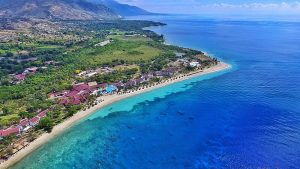
Royal Decameron Indigo Beach Resort & Spa, Cote des Arcadins, Haiti, 2015.
The main reason for this disintegration, is the political instability that followed the demise of the Duvalier dynasty in 1986. After “Baby Doc” was forced to flee the country, Haiti tried to recover from the depredations of that regime, but it suffered from continual economic decline, political instability, repeated coups d’état, and a wave of major earthquakes.
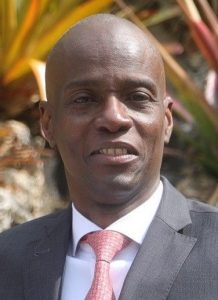
Haitian President Jovenel Moïse, 2019. US Dept. of State photo.
Elected to the Presidency of Haiti in early 2017, Moïse had started out as a local businessman. His ideas earned him the attention of a center-right political policy, that would catapult him into the Presidency of the island nation. Despite accusations of a corrupted election, Moïse did make notable progress in developing both infrastructure projects, as well as launching new initiatives to expand Haiti’s agricultural sector, by improving rice production.
However, continued controversy over when Moïse’s actual term of office was supposed to end continued to simmer. Then, seemingly out of nowhere, a group of what can only be described as “hitmen” stormed Moïse’s residence in the early morning hours of 7 July 2021. Like many rulers in the world, Moïse’s residence had little real security; in fact, only six police officers were present that night – two were active informants to the attackers and the other four did their best to do nothing at all.
What followed could be favorably described as a “Keystone Kops” caper, had no one actually died. The survivors of the 26 actual attackers would later claim that they had been hired – via WhatsApp, of all things – to be security for Moïse…who were then informed that the mission was actually to kidnap the president, although several of them apparently knew well in advance that the real plan was to assassinate him. Video and audio evidence showed the attackers shouting via a bullhorn that the operation was a US Drug Enforcement Administration (DEA) operation, which at least help to momentarily confuse Haitian authorities.
Port Au Prince, Haiti, 2012
There followed a wild chase through the capital of Port-au-Prince, as police and civilians tried to hunt down the suspects who were now fleeing in panic, as it seems that no one had thought through what might happen afterwards. Eleven of the suspects broke into the Embassy of Taiwan, apparently seeking sanctuary, but were promptly arrested after Taiwan waived the embassy’s extraterritoriality status to allow the attacker’s arrest.
Bookmark that last – we’ll come back to it.
The subsequent investigation revealed a tangled web of conspirators, spanning Haitians, Americans, Colombians, among others, who seemingly accreted out of thin air, on a jumble of ideas about what kind of operation they were running: Were they seizing power in a coup? Were they launching a revolution? Were they arresting the president? Were they simply hitmen? The answer to all of these questions, at one point or another, was “Yes”. In this regard, the planning and execution of this operation make 2020’s “Operation Gideon” look like D-Day.
Venezuelan authorities detaining Operación Gedeón militants, 2020. Venezuelan Government photo.
As a result, Haiti began to spiral out of control. That descent continues a year later, as certain parties are now calling for international – and specifically American – intervention…Which is odd, given Haiti’s history of intervention with the United States…Doubly so, when the United States is currently “eyeball to eyeball” with Russia, in an international confrontation that is more serious than anything since the early 1980’s.
So — why Haiti? Why the push for intervention? Haiti’s politics aside, who would be behind such an attack? There are only three real possibilities:
Christian Emmanuel Sanon, an over-60 year old Haitian-American doctor from South Florida, who was identified as a possible front-man for the operation.
The US government of Joe Biden.
The government of Communist China.
The first case, of the 60-something doctor, is more than a little bizarre. An operation like this requires a lotof money, and the rewards need to balance out the risks. While it has never been illegal (mostly) for Americans to travel to a foreign country to fight in a war, it has always been illegal to plan and conduct such operations from within US borders. As in, serious and very real jail time to those involved. In this regard, it is not really credible to assume that this came solely out of a Florida office complex.
The second case is more interesting, but verges into “4-D Chess“. It is barely – just barely – possible that Joe Biden’s administration may have set up a deliberately bungled operation to send Haiti over the edge. Why? Because that would please the Communist Party of China, who were very upset about the strengthening ties between its claimed ‘province’ of Taiwan and Haiti, while giving the US an excuse to play the White Knight, riding to Haiti’s rescue, yet again.
On Communist China’s part, they could have easily concocted the same plot, for mostly the same reasons, and ran such an operation with the help of Venezuelan dictator Nicolás Maduro’s intelligence services, who were actually embedded into the aforementioned “Operation Gideon” from basically the start. For Communist China, implying tacit Taiwanese support to the operation (recall some of the plotters fleeing to the Taiwan embassy compound) could give Taiwan a black eye, locally inside Haiti. On Maduro’s part, getting the United States to launch another intervention into a Caribbean nation would be a spectacular win, that he can make hay from for the next decade or so, while burnishing his image with Russia’s Vladimir Putin, of general purposes.
My own assessment? The sordid affair is most likely a combination of #2 and #3, because of the confused nature of planning, and the byzantine levels of actors involved. The US has to maintain the image of being in control of its own back yard, and with fires burning all around it, Imperial Joe’s Court of Jesters needs to distract its populace from evermore ridiculous gaffe’s and disasters…
…Until, of course, scary noises and bright lights commence.
Which, naturally, does nothing for the long-suffering people of Haiti.
Back FREEDOM for only $4.95/month and help the Freedomist to fight the ongoing war on liberty and defeat the establishment's SHILL press!!
Are you enjoying our content? Help support our mission to reach every American with a message of freedom through virtue, liberty, and independence! Support our team of dedicated freedom builders for as little as $4.95/month! Back the Freedomist now! Click here