June 19, 2026

World

As The Wheel Turns – Modern Ersatz Armies


Previously here, we have reported on various aspects of warfare, both ancient and modern. The tools change all the time. Sometimes, the specific techniques to employ that technology changes, the better to employ the new sets of hardware that come out of inventor’s workshops and laboratories. But the basic rules, as the saying goes, do not change over time.

The proverbial “rag-tag band of rebels” – or revolutionaries, or guerrillas, as the reader prefers – have been a feature of warfare from the very beginning. In fact, a strong argument could be made that such groups were the very first “fighting forces” to appear on the battlefield; “organization” is the basic requirement for “organized warfare,” and that organization had to start somewhere.

But that is lost in the mists of eons.

Organized warfare, as such, waxes and wanes. The Mediterranean Basin and the European continent – south of the Danube, west of the Rhine, and north of Africa’s Mediterranean coast, and even extending into the Black Sea – was dominated by Rome and its army. This was, for the time, the best organized, regularly supplied and funded army in recorded history; the only real comparisons known are the armies of Sargon the Great and Alexander of Macedon…and yet, Rome “collapsed” (at least in Western Europe) in the 5th Century; the final destruction of Rome in the east – what is now better known as “Byzantium” – would take another thousand years.

That Rome collapsed (both times) was not the fault of either form of its armies (that’s a long discussion). There were numerous factors involved in both series’ of collapses; in both cases, the ultimate failures of the Roman armies were merely the final acts. Indeed, it is no stretch of the imagination to say that the highly professional, disciplined and minutely organized Roman and Byzantine armies are what kept their respective states alive as long as they did.

Infantry wins wars, and the more professional your infantry, the faster and more decisively you win, all other things being equal. But, continuing with this historical digression, the battle of Adrianople in 378AD ushered in a perception of the superiority of mounted horse cavalry over professional infantry; whatever the actual historical truth of the battle (the arguments of Oman and Burns aside), the perception held true, and those ideas would lead directly to the rise of the mounted knight as the main military component of the medieval period. Horse-using elites were certainly not new, but they were never truly decisive, no matter how diverse the mercantile and military (YouTube link) trade networks were.


Full-size replica of the Uluburun shipwreck, St. Peter’s castle, Bodrum, Turkey, 2004. Photo credit: Georges Jansoone. CCA/3.0


In the aftermath of those Roman collapses, warfare reverted to a more localized and tribal form of organization. Even in the Levant, where the First Caliphate and the later Ottoman Sultanate largely ruled from the 7th Century onwards, government regulation and control were not what they had been under either Roman or Persian rule. Warfare was largely thrown back at least a thousand years, each time.

Technology played a large part in this seesaw. Spears, swords, bows and arrows, and metal armor are all relatively easy for a blacksmith to turn out. As long as armies were small, and some form of “hard tack” (to use the modern term) was set back in a castle of some sort, small armies could maneuver cross-country without too much trouble. Bands of what we would now call “guerrillas” could also maneuver easily, as they generally operated in their native areas, and knew where watering holes and useful resources were located.

The advent of gunpowder changed all of this, however. While developed in Song Dynasty China in the 9th Century AD (on the European calendar), the first use of the formula as a weapon dates to the early 10th Century, in use against Mongol tribes. Once gunpowder became dominant as an infantry weapon in Europe, in the late 15th to the early 16th centuries, the scales that had been tipping slowly back towards infantry dominance slammed down decisively on the infantry’s side: now, as gunpowder weaponry rapidly progressed from the matchlock through to the flintlock, it became comparatively cheap and easy to recruit and train infantry en masse to a level sufficient to return cavalry to their nominal roles of scouting and decisive shock action.


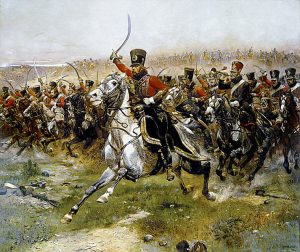
Vive l’Empereur!, 1891. Édouard Detaille (1848–1912). Charge of the 4th Hussars at the battle of Friedland, 14 June 1807. Public Domain


But, that tipping of the scales had consequences, as gunmaking was a very specialized skill, as its requirements were very different from making simple metal objects like blades or horseshoes.

Likewise, the advent of motor vehicles changed the factors of “battle calculus” yet again, by replacing the horse with the motor engine. While the automobile has a host of limitations, those drawbacks are minimal in comparison to those of horse cavalry…

Which brings us, at last, to our core topic: “Ersatz Armies.”

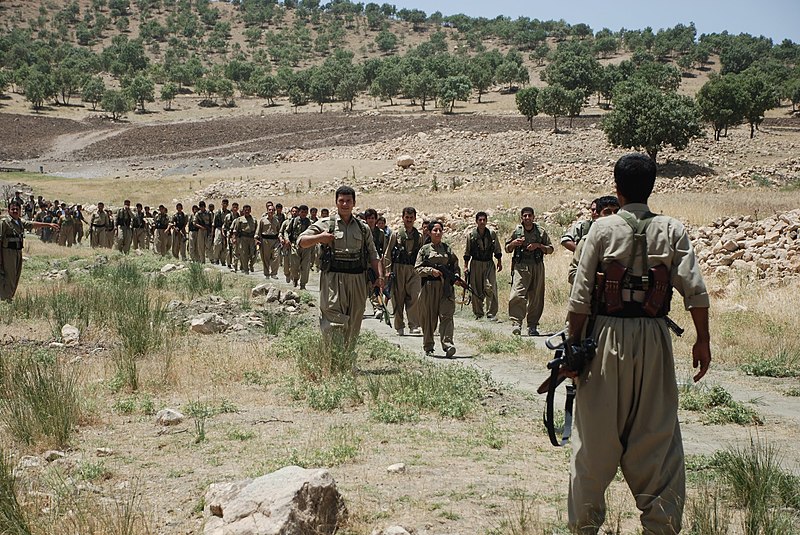
As noted above, “irregular” forces – rebels, guerrillas, etc – have frequently struggled to compete with better-organized and supported “regular” armies. Such groups have to improvise methods of supplying not simply weapons, but food, medicines and other basic needs of a military force. In the past, these services and products were generally stolen from an enemy government, or were supplied directly by a foreign government, supporting the guerrillas. More infrequently than is generally assumed, a guerrilla force might purchase arms from “black market” arms dealers; in those cases, the guerrilla forces were teetering dangerously on the edge of being a criminal gang, more than a “heroic band of fighters for the people.”

But, with the sudden and rapid anarchy taking place in Sudan, another factor has once again reared its head: a deliberately created ersatz army.

In 2003, the Sudanese government in Khartoum recruited a group of tribal militias that coalesced into what is now known as the “Janjaweed”. This grouping of tribal militias went on to commit a host of terrible crimes, encompassing all the worst categories of criminal activities. So bad were these events, both the Sudanese dictator of the time, as well as one identifiable leader of the group, have been formally indicted for war crimes.

In the aftermath of the worst parts of the Darfur Conflict, the Janjaweed was not paid off and stood down by the government of Omar al Bashir – instead, it was expanded, given better training and weapons, had its name changed to the “Rapid Support Force” (RSF) (YouTube link) and was then used a force of “shock troops” to fight in regional wars, such as Libya and Yemen, where they proved willing to do the dirty jobs no self-respecting and –disciplined military would touch.

In effect, al Bashir created his own version of Adolf Hitler’s SA or SS – a powerful armed force, separate from the regular military, willing to do whatever was asked of them. Unlike Hitler, however, al Bashir lost control of his non-Army force; this resulted in the RSF collaborating with the regular Sudanese military to remove him from power. And, as these things almost always do, this resulted in a falling out among thieves, leading to the current disaster in the country.

What makes the RSF different from similar groups in the past, however, is its size and equipment. The RSF is estimated to number around 100,000 men (YouTube link), and have been equipped comparatively cheaply, with the most basic of infantry weapons and gear, as well as the ubiquitous “technical” vehicles. A hundred thousand troops, even if poorly trained, is nothing to scoff at, even if you intend to engage them directly.

Sudan is not unique: while other states may not have armed groups to the extent of the RSF, it is a far cheaper thing to do, than most people think…But these types of forces – with little or no control, nor moral training, but with effective weapons and training – are growing in number.

Ponder that, the next time you hear about drug cartel armies on the south side of the Rio Grande (YouTube link).


The Freedomist — Keeping Watch, So You Don’t Have To
The Battle for Khartoum Rages On

SUDAN CIVIL WAR THREATENS TO SPILL OVER ITS BORDERS – 18 months after taking over Sudan in a military coup, the two Generals that led the coup are now vying for supreme power. The war is for control of the country by either the General of the Rapid Support Forces (RSF), Mohamed Hamdan Dagalo, and the General of the Army, Abdel-Fattah al-Burhan. Now the fighting is leading border countries like Chad and Libya to shut their borders down for fear of seeing the fighting spill into their countries.
The United States has evacuated its embassy, as have most other nations. Control for the capitol of Khartoum rages on, with the state media center switching hands at least twice so far in the fighting. The number of killed has not been generally reported, but it appears to be at least in the hundreds, so far, with no hope of a cease fire on the horizon.

The war began after the power-sharing agreement reached in 2021 broke down.  Dagalo wants to integrate his paramilitary group, the RSF, into the regular army gradually, over the course of a decade.  While al-Burhan wants a more rapid integration into the regular army he controls.

Secretary of State Antony Blinken tweeted about the conflict, “Deeply concerned about reports of escalating violence between the Sudanese Armed Forces and Rapid Support Forces. We are in touch with the Embassy team in Khartoum – all are currently accounted for. We urge all actors to stop the violence immediately and avoid further escalations…”

A UN envoy, Volker Perthes, said “The two sides who are fighting are not giving the impression that they want mediation for a peace between them right away.”

Conflict Update – Sudan Unravels, As Its Crows Come Home To Roost


Conflict monitoring is an odd field: You try to monitor the world, and eventually specialize out of necessity. The recent descent into chaos in Sudan, Africa’s third-largest nation by size, is no different.

Beginning on April 15th, a series of armed clashes began in Khartoum, the capital of the African nation. The opposing sides are the regular Sudanese Army, and a paramilitary force called the “Rapid Support Force (RSF)“. The two forces had united in 2019 to oust Omar al-Bashir, the country’s long-time dictator, in a military coup d’etat; two years later, in 2021, the two parties staged another coup to derail Sudan’s return to a democratically elected government.

The situation has deteriorated, in barely a single week, to the point that the United States and other powers  (YouTube link) are rapidly deploying forces to Camp Lemonnier, located in the state of Djibouti, on the Red Sea coast, in preparation for a possible evacuation of various embassy’s and foreign nationals – a daunting prospect, given that Khartoum’s international airport is not currently usable, and because the capital city is nearly 800 miles inland.

The source of the current “lover’s quarrel” is the Regular Army dragging its feet over formally integrating the RSF into its force structure, as well as delays in payroll to the paramilitary force, with its leadership claiming that they want to return al-Bashir to power.

Who are the RSF?

In 2003, fighting erupted in Western Sudan as non-Arab (i.e., “black African”) tribes united against the al-Bashir government’s continued campaign of oppression and discrimination against them. The result was the Darfur War (sometimes called the “Land Cruiser War” because of the extensive used of ‘technicals’), a genocidal conflict that killed hundreds of thousands, and created between two and three million refugees.


Map of Darfur within Sudan, July 2011. CCA/3.0


The RSF began life as the so-called “Janjaweed”, a Sudanese Arab tribal militia assembled by al-Bashir’s government to suppress the Black African inhabitants of the region. Supporting this, were the remnants of Libyan dictator Muammar Gaddafi’s “Islamic Legion”, an openly racist and pan-Arab organization intended to unite the Saharan region by force.

As the Darfur war reached a stalemate (that would ultimately result in a nominal ceasefire agreement in 2020), al-Bashir’s government began using a now-experienced and capable Janjaweed – under their commander, Mohamed Hamdan Dagalo – as extra muscle throughout the region, especially in places where the dirtiest of atrocities were needed.

Oozing to life in 2013 as an outgrowth of the Janjaweed, the RSF was quickly used by al-Bashir as a kind of “expeditionary force”, sending significant numbers of troops into both Chad and Libya (in the latter case, supporting the Libyan National Army of Khalifa Haftar), and a stunning 40,000-strong corps-sized unit into Yemen to fight against the Iran-backed Houthi rebels. The main difference between the RSF and the Janjaweed, is in the level of formal support and arms provided to them by the Sudanese government, with uniform weapons and vehicles.

The RSF is not simply large, with over 100,000 men under arms, but is also highly mobile, with an estimated 10,000 ‘technical’ trucks (YouTube link)…and it has developed an impressive economic infrastructure to support itself, thanks to the business chops of its leader and his family.

Mohamed Hamdan Dagalo (known as “Hemedti“, locally), who dropped out of primary school in 3rd grade to work to support his family, started out as a well-respected camel herder in the Darfur region. As he positioned himself as the chief commander of first the Janjaweed, and then the RSF, he used the forces loyal to him to help is company, Al Junaid, to corner the gold mining industry within Sudan, as well as a host of other industries, ultimately controlling up to 40% of Sudan’s exports.

And, like most warlords with sufficient resources, he has made life well for his loyalists in the RSF, who now follow his orders without question, helped by him polishing his speaking skills. This, along with a “charm campaign” managed by Western public relations firms to improve Hemedti’s image, has combined to form a kind of “mercenary micro-state” of a type that is highly unusual in the modern day…In many ways, the RSF is the nightmare scenario that world security analysts have been dreading since the rise of the “corporate terror group” model, when al Qaeda appeared in the late-1990’s.

In a very real sense, the leader of the regular Sudanese armed forces and Hemedti’s rival in the power struggle, Lieutenant General Abdel Fattah al-Burhan, have created a monster they can no longer control.

But, ultimately…who cares? Why should you care?

The current fighting in Sudan will almost certainly determine who will be the next ruler of the nation. As well, major powers – both global powers, and up-and-coming regional states seeking to expand their influence – are all jockeying for position, and that kind of jockeying can swiftly lead to an expanding conflict.

And all of this is happening literally on the banks of the Nile, Africa’s ancient major river system. No matter who wins this conflict, this will pose significant issues to Egypt and its population of over 100 million, already alarmed over Ethiopia’s dam building project that seriously threatens the downstream ecology and climate of the region.

Lastly, is the serious potential for major-power involvement, up to and including combat: Russia’s Wagner Group mercenary company has significant ties to the RSF, and in the region, generally. The Wagner Group has been reportedly guarding some gold mining areas for the central government since at least 2019, with speculation that Wagner-defended gold is being using used to fund Russia’s war in Ukraine. Numerous foreign corporations have major investments throughout the region, and the expansion of the “private military company” market in the last twenty-five years means that there is little incentive to not hire lots of ex-military guns to guard their investments.

And, looming over the regular Western military commands’ psyches is the shadow of 1993’s “Battle of Mogadishu”, but on a far larger scale, with far fewer advantages for the Western powers.

The future does not look sunny.


The Freedomist — Keeping Watch, So You Don’t Have To


The Future of Intelligence


With the recent arrest of an Airman of the Massachusetts Air National Guard, the United States’ defence and intelligence establishments are once again under fire for apparently lax information security. In fact, this is the second time in less than a year that this has happened.

At first glance, this seems like a very bizarre thing…until you realize, sadly, that it is not.

In both cases, the leakers involved were not leaking classified intelligence – including casualty reports, battle plans, friendly agent identities, strategic concerns from and about allies, and technical intelligence, to name but a few – because they had been “honey trapped”. Likewise, the leakers were not employed by foreign state intelligence agencies, nor were they crusaders trying to expose crimes committed by the US defense and intelligence apparatus.

Instead, incredibly – or, sadly, not so incredibly – the leaks were the result of rabid video game players trying to prove how cool and ‘edgy’ they were.

While some of the leakers may be older, this is the result of the programming of the so-called “Generation Z”. This is the first generation to grow up with social media as a main facet of their lives. When “social media” as we would now recognize it, first arose in 1997, no one had any real idea of what its impact would be. Whatever the imagined intent, what it has evolved into, is a sort of electronic version of an elementary school playground at recess, with no adults present to regulate it.

Where older generations who entered the various defense and intelligence services would never, in their wildest nightmares, have taken classified materials to their local watering hole and deliberately passed them around to score social points, this is becoming increasingly common for a deliberately infantalized generation of youth. While there certainly were, and are, spies and informants stealing and passing on information for money, ideology or “love”, those reasons were at least tangible and understandable. Scoring social media points is, to be blunt, pointless in the extreme.

Coupled to the insanity of the RESTRICT Act (deliberately misconstrued as the “TikTok Ban” bill), this works to sweep away all the foundations of legality of the Rule of Law, in the fleeting hope of gaining some sort of security.

And, like the hysterical attacks from the music industry against services such as Napster and Grokster, idiocies like the RESTRICT Act are guaranteed to have exactly the opposite effect, as outraged online activists will find ways to send out increasingly large amounts of classified material – not for the older reasons, nor even the newer reasons, but simply out of anger at such tight restrictions. The fact of facing heavy penalties for doing so, are irrelevant once the information is “out in the wild,” as the saying goes: the damage will have already been done.

But the above does not address the real question: Why are these kinds of leaks so dangerous?

For those not familiar with intelligence gathering, as a discipline, the short answer is that, in the “old days,” obtaining intelligence – meaningful intelligence – on a hostile target was hardvery hard. An intelligence agency – from East or West – had to insert “non-official” (or “illegal”) agents into the target country; those illegal agents would then have to either infiltrate a facility, or suborn an intelligence worker (assuming that they could identify them). Conversely, they could hang out in bars, nightclubs or restaurants (good for staging a honey trap) outside the gates of military facilities, or take menial jobs at establishments outside the gates such as working as a barber or as a waitress, in an attempt to glean nuggets of information from random conversations…Not very flashy, and not very James Bond, but such methods did work.


An example of a one-time pad. Credit: Mysid, 2007. Public Domain.


(My favorite intelligence warning in the mid-1980’s, was an order that came down, telling service personnel to stop…”liberating”…large bottles of Tabasco® sauce from restaurants outside base main gates in preparation for going to the field or “rapidly redeploy strategically”, to make the early Meals-Ready-to-Eat (MRE’s) at least somewhat palatable. The problem had gotten so bad, those base-local restaurants developed their own internal intelligence networks, and were suddenly “out of Tabasco” when they learned of a local unit deployment…thus giving hostile agents a dead giveaway that large unit movements were afoot.)


With the rise of online gaming and their associated forums and chat servers in the early 2000’s, however, intelligence agencies quickly grasped that their agents could sit behind Virtual Private Networks (VPNs), in the comfort and security of their home nations. They could then “lurk,” monitoring boards silently, while not communicating very often, waiting to pounce on discussions where people who should know better would often drop bits – or entire files – of classified data…and those agents wouldn’t even have to hound the leaker, because the rest of the forum or chat group would do that for them, unwittingly.


This kind of thing came naturally to intelligence agencies, as it was a form of OSINT [https://en.wikipedia.org/wiki/Open-source_intelligence]. OSINT, or “Open-Source Intelligence,” is a method, or discipline [https://en.wikipedia.org/wiki/List_of_intelligence_gathering_disciplines] of intelligence collection where a person meticulously (some might say, “obsessively”) scours every publicly available source of information on a subject they can find, and attempt to collate and boil-down the resulting information into a general picture.

OSINT differs from more expensive, technological or hazardous methods of information collection – like finding human sources of information, satellite reconnaissance, radio signal interception, etc. – in that it simply requires an illegal agent to buy multiple piles of newspapers and magazines, and inhabit libraries relentlessly. While also not very flashy, OSINT analysis often leads to very clear pictures of a nation’s defense strategies. As well, it lends itself very well to crowdsourcing [https://en.wikipedia.org/wiki/Crowdsourcing].


So…Where does this leave us, in mid-April of 2023?

Unfortunately, there are serious problems within the information security apparatus in the West, as a whole. With the need to bring in a new generation of intelligence workers, the West – as opposed to Russia and Communist China – is finding that the “Woke” agenda that has been allowed free rein over the last decade has badly polluted the potential recruiting pool, as people who have been raised in a culture where ephemeral “electronic cred” is as important, if not more important, than being a “quiet professional”.

And, as those who promoted that social context are discovering, there is no putting the toothpaste back in the tube.


The Freedomist — Keeping Watch, So You Don’t Have To
Canada’s Foreign Minister Hints at Russian Regime Change

CANADA PUSHES REGIME CHANGE IN CHINA – Canada’s Foreign Minister, Melanie Joly, recently made statements regarding Russia that are sending shock waves throughout the international community. Joly said, “We’re able to see how much we’re isolating the Russian regime right now — because we need to do so economically, politically and diplomatically — and what are the impacts also on society, and how much we’re seeing potential regime change in Russia.”

The Russian Ambassador to Canada, Oleg Stepanov, attempted to give the minister some cover, saying that her remarks may have been an “awkward slip of the tongue.”  Experts worry the comments could give Putin more power at home as he will be viewed as the one man standing up to western bullying, connecting the war in Ukraine with Russia’s existential fight with the West simply to survive.

China Double-Billed Fauci Millions for Work Done to Create Covid-19

CHINA GETS MILLIONS FROM U.S. TO CREATE A PANDEMIC – While American leaders are warning of China’s continued existential threat to American liberty, leftists continue to defend China, even calling the effort by anyone to ban their spy software, TikTok, an infringement on free speech (which they don’t actually believe in).  They do so in the face of recent news that the Wuhan Lab in China, where Dr. Anthony “I am the science” Fauci sent millions of taxpayer dollars to pay for the development of a biological weapon of war, double-billed the government that unconstitutionally, and in violation of international war laws, sought to fund the villainous venture.

Despite China’s overt assault on the American republic, “American” investors continue to be willing to prop up the deadly enemy, with Morgan Stanley economists now openly encouraging investment in the police state nation, which uses the wealth gained from American investors and trade to prop up its efforts to undermine the American republic at home and abroad, with the sometimes tacit, sometimes overt approval of the Democratic Party and its high-placed members who make millions selling America to China (including Joe “the mass mailer President” Biden).

Reservist Protests Could Expand, Threatening Israeli Military Readiness

A growing number of Israelis are choosing to not show up for their reserve duty obligations, and more are threatening to join them.  The movement is a response to the plans by Netanyahu’s government to dramatically “reform” the judicial system in what seems like a transparent attempt to protect the Prime Minister, who faces corruption charges in an ongoing trial.

A former advisor to Yair Lapid, the former PM and current opposition leader, claimed he made the decision  because he has “no choice – I cannot do reserve duty under a regime that is trying to destroy us, and I cannot do reserve duty in an undemocratic country.”

For his part, Lapid falls just short of supporting the movement, but he continues to give it legitimacy.

Like America, it appears the rift between the “left” and the “right” is becoming existential at its core.  For we Americans, we can overcome this turmoil, but for Israel, they are surrounded by enemies, including the Palestinians, who would rather see them dead than live peacefully with them.

China Severs Internet in Taiwan Territory

Outlying islands owned by Taiwan have been experiencing their internet go out over and over again these past five years.  One island, Matsu, recently had their internet cut again.  The culprit is almost always the same, Chinese boats that invade their waters and send divers down to cut cables connecting the islands to the main island.  So far, the Chinese have done this to Matsu alone 27 times in the past five years.

Matsu is home to 14,000 residents, who make due by creating limited internet connectivity through microwave radio transmission, which is a slower form of internet than dial-up. Taiwan’s Coast Guard caught one Chinese ship red-handed, but it was able to escape to Chinese waters.

China Faces Woke Beast It Helped Create in America

A major reason why corporations feel so emboldened to offer Americans subpar entertainment and news reporting is their ability to offset the loss of American revenue with sweet business deals with China’s Communist Party.  The woke beast these corporations have been feeding, however, has arrived in China, with Tsunghua University Students now suing the Ministry of Education because it banned the display of the fascist rainbow flag that was once a symbol of gay rights and has now become a symbol of bigotry and hate aimed at heteronormative culture.  Given China’s population collapse, encouraging LGBTQ culture might not be in the best interest of the state.

Vietnam Chooses Party Aperatchik to Become Next President.

The Communist Party of Vietnam has nominated Vo Can Thuong, the youngest member of the party’s politburo at 52 years of age, to be the next President. The nomination assures he will be the next President. He is an ally of the current General Secretary, Nguyễn Phú Trọng.

Thuong has been leading a massive “anti-corruption” sweep of the party.  His selection assures the current policies and the current purge will continue under his leadership. He replaces the previous president, Nguyen Xuan Phuc, who was forced to resign as a result of the “anti-corruption” purge.

Main

Back FREEDOM for only $4.95/month and help the Freedomist to fight the ongoing war on liberty and defeat the establishment's SHILL press!!

Are you enjoying our content? Help support our mission to reach every American with a message of freedom through virtue, liberty, and independence! Support our team of dedicated freedom builders for as little as $4.95/month! Back the Freedomist now! Click here