Michael Cessna is a former Active Duty United States Marine, a long-time personal protection specialist, security and defense analyst, military subjects instructor, general information researcher and amateur historian. He has been contributing security and defense writing since 2015.
In August 2026, shortly before the devastating floods on the Tibet-Nepal border, the Chinese Communist Party’s principal theoretical journal — Qiushi, the name translates as “Seeking Truth” — led its latest issue with a speech by Xi Jinping on disaster prevention, paired with five supporting articles on disaster governance. It was, by the journal’s own standards, an unusually heavy thematic commitment. Qiushi is not a policy gazette; it is the organ through which the Party announces its ideological priorities. When disaster management becomes the lead doctrinal story, something more than administrative concern is being communicated. For a Chinese readership steeped in four thousand years of political culture, the signal would have been legible without explanation: the Son of Heaven is worried about the storms.
The Concept The CCP Cannot Name
The “Tianming” — the “Mandate of Heaven” — is the oldest continuous political doctrine in Chinese civilization, and one of the most elegant: Heaven bestows upon a ruler the right to govern, but that right is conditional: A just ruler who governs well, controls floods, ensures harvests, and maintains order retains the mandate. In contrast, a ruler who fails at these tasks loses that mandate — and the evidence of that loss is written not in court intrigues or electoral returns, but in the natural world itself. Floods, droughts, earthquakes, famines, and plagues are not merely disasters in the classical Chinese reading: they are communications. They are Heaven’s commentary on the quality of governance.
The doctrine is explicit about the mechanism. When disasters multiply and compound, when no single calamity but an accumulating cascade of them strikes across a reign, the traditional interpretation is not ambiguous. The Ming Dynasty fell in the seventeenth century against a backdrop of the Little Ice Age, devastating famines, the catastrophic Shaanxi earthquake of 1556 that killed an estimated 830,000 people, and a fiscal system that could no longer respond to any of it. Chinese who lived through that collapse did not need historians to explain what was happening. The natural record was its own indictment.
The Chinese Communist Party is a Marxist–materialist organization that officially repudiates superstition, traditional cosmology, and any framework that locates political authority outside the Party itself. It cannot acknowledge the Tianming. What it cannot escape is the political psychology the doctrine describes — the deep cultural reflex, present in China’s population regardless of official ideology, that connects the quality of governance to the behavior of the natural world. Xi Jinping has, since 2012, encouraged a selective revival of traditional Chinese cultural forms as instruments of national cohesion. He has not revived this one.
He cannot afford to.
The Catalogue
The disaster record of the past eighteen months is not easily dismissed. In the first nine months of 2025 alone, natural disasters claimed 742 lives across China, and caused 217.7 billion yuan — approximately $29.9 billion — in direct economic losses, affecting 55.1 million people. In 2025, a 6.8-magnitude earthquake struck Dingri county in Tibet in January 2025. The July-August period alone accounted for 41 percent of annual fatalities and 48 percent of economic losses, driven by floods and geological disasters concentrated in the north and southwest. The first half of 2025 brought $7.55 billion in direct losses and affected more than 23 million people, with floods accounting for over 90 percent of the damage.
The summer of 2026 did not relent. In July, Typhoon Maysak triggered flooding across Guangxi that killed multiple people, burst a reservoir dam, and caused 40 rivers and waterways to overflow, forcing the evacuation of more than 130,000 residents. Simultaneously, a landslide in Gansu province’s Longnan city killed 21 after burying a hamlet of a mere 33 people. Tornadoes and severe thunderstorms in Hubei killed 11 more. Xi Jinping publicly called for “all-out efforts” to rescue flood victims — a notable departure, observers pointed out, from his predecessors’ more distant disaster posture. Super Typhoon Bavi was tracking toward the eastern coast before the month was out. The cascade was not a single event. It was a season.
The Party’s Next Move
The Qiushi response is the analytically significant element, here. Xi’s April 28 Politburo study session on disaster prevention — an unusual commitment of the Party’s senior collective study mechanism to an emergency management topic — produced a speech that acknowledged China faces a long-term, complex, and severe nature of natural disaster risks and warned that disaster risks must not be allowed to spill into economic, energy, food, and social security. The August publication of that speech as Qiushi’s lead, surrounded by a five-article disaster governance cluster, elevated the subject from administrative priority to ideological doctrine.
Publishing through Qiushi rather than a standard government announcement is a qualitatively different signal. Standard announcements direct ministries. Qiushi addresses the Party as a political organism — it shapes how cadres at every level understand their ideological obligations. Placing disaster resilience in Qiushi tells every Party member in every province that their political standing is now connected to how well they manage floods and landslides. That is not administrative guidance. That is a legitimacy framework being reconstructed in real time.
The reconstruction is necessary precisely because the original one is under pressure. The CCP’s implicit social contract with the Chinese people since 1978 has rested on a materialist bargain: deliver prosperity, and the question of political legitimacy does not arise. That bargain is fraying under the combined pressure of economic slowdown, a real estate sector that has not recovered since the 2021 collapse of the Evergrande Group, youth unemployment that remains structurally elevated, and now a natural disaster catalogue that the state’s own emergency management apparatus is struggling to address at scale.
The Mandate The Party Doesn’t Believe In
The irony that the Tianming framework would identify — and that Xi’s advisors are certainly aware of, whether or not they would use the language, even in private — is structural. The CCP governs a civilization whose political culture was shaped for millennia by the proposition that Heaven communicates through natural events. The Party has spent seven decades telling its population that this is superstition. It has simultaneously spent those same seven decades investing enormous political capital in flood control, drought management, and disaster response — because it understands, at an operational level, exactly what the Tianming doctrine says: that a government’s legitimacy is tested by how it handles the natural world.
Dynasties have risen and fallen on their handling of irrigation and flood control, and natural disasters have been frequently interpreted as nature’s commentary on the quality of governance. Xi Jinping has revived Confucian terminology, traditional ceremony, and historical dynastic imagery as instruments of national cohesion. He has positioned himself as the inheritor of China’s civilizational continuity. In doing so, he has, perhaps unavoidably, also activated the framework that comes with that positioning — including the part that reads compounding natural disaster as political verdict.
Whether the Chinese public reads current events through a Tianming lens in any conscious sense is a question that cannot be answered from outside China’s information environment. What is not in question is that the Party is responding to the disaster catalogue with the urgency of a government that understands the political stakes. The Qiushi issue is the tell. When a materialist party reaches for its ideological journal to address floods, it is not doing emergency management. It is doing legitimacy repair — under a framework it officially disavows, in language it cannot quite bring itself to use.
The Freedomist — Keeping Watch, So You Don’t Have To
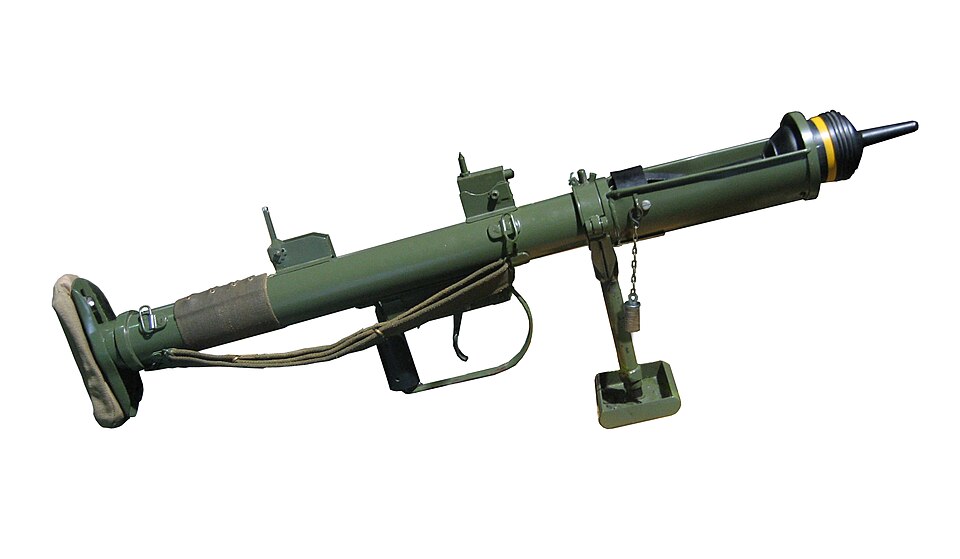
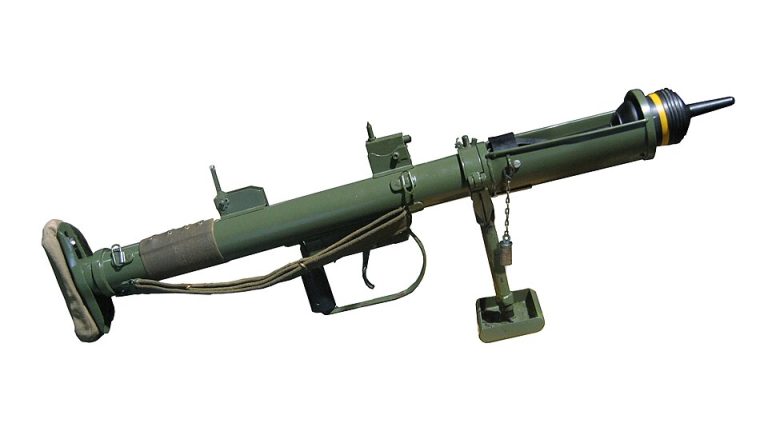
On the night of 21 October 1944, Private Ernest “Smokey” Smith of the Seaforth Highlanders of Canada crouched in a ditch on the bank of the Savio River in northern Italy, nine metres from a German Panther tank. He raised a PIAT — a weapon that weighed 32 pounds, fired a shaped charge bomb using an enormous internal spring, and had no propellant backblast to betray his position — and destroyed the tank with a single shot. When a second tank arrived to eliminate him, he damaged it with another round. Smith survived. He received the Victoria Cross. The PIAT, which entered service in 1943 and was replaced by the bazooka family of rocket launchers by the early 1950s, earned six Victoria Crosses in total during the Second World War — more than any other individual infantry weapon of the conflict. It was, by any reasonable measure, a successful weapon. It was also a very unusual one, built on a mechanical principle that conventional firearms engineers find counter-intuitive, and whose core advantages were never fully exploited before the weapon was retired. Those advantages are worth a second look.
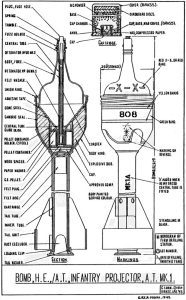
Diagram showing the projectile for the British PIAT (Projector Infantry Anti-Tank). April, 1945. UK War Office. Public Domain.
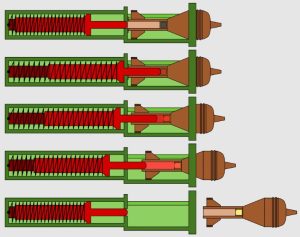
The PIAT was not a rocket launcher, and not a conventional gun. It was a spigot mortar — a weapon in which the effective “barrel” is formed by the hollow tail of the projectile itself rather than a fixed tube. When the soldier pulled the trigger, a heavy spring drove a metal rod — the spigot — into the bomb’s hollow tail resting in the weapon’s cradle. The spigot’s firing pin struck a propellant cartridge in the bomb’s tail, which launched the bomb forward while simultaneously driving the spigot rearward, compressing the spring and recocking the weapon for the next shot. The spring’s primary job was not to launch the bomb but to absorb and manage the recoil of the propellant firing — a distinction that matters for understanding both the weapon’s advantages and its limitations.
As produced, the PIAT weighed 32 pounds, was 39 inches long, and fired a 2.5-pound shaped charge bomb capable of penetrating armor up to 100mm thick — enough to defeat any German tank of the mid-war period from the sides or rear. Its effective anti-tank range was approximately 100 yards in direct fire. It could also be used as an indirect mortar, with a range out to approximately 350 yards, by bracing the stock against the ground — a secondary application that Commonwealth troops in Italy employed regularly, though never as an officially sanctioned role.
What It Did
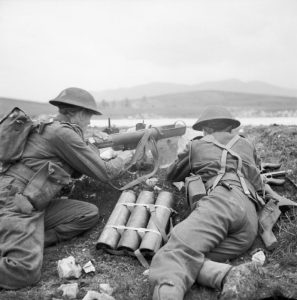
The PIAT’s combat debut came with Canadian troops during the Allied invasion of Sicily in July 1943, and it subsequently appeared in every theater where Commonwealth forces fought — North Africa, Italy, northwest Europe, and the Far East. In Normandy in 1944, a British study found that PIAT launchers accounted for seven percent of German tanks destroyed by British forces during the campaign — one percent more than rocket-firing aircraft. Company Sergeant-Major Stanley Hollis used a PIAT on D-Day itself to destroy German pillboxes and a field gun, earning the only Victoria Cross awarded for actions on June 6, 1944. At Arnhem, Major Robert Henry Cain — also awarded the Victoria Cross — used a PIAT to drive off German armor on multiple occasions over six days, at one point turning back three tanks on consecutive days when ammunition was nearly exhausted.
A PIAT in action in Tunisia, 19 February 1943. Imperial War Museums. Public Domain.
The weapon’s key tactical advantage across all of these actions was the same characteristic that made it unusual as a design: it produced no backblast and no muzzle flash. A bazooka or a Panzerfaust vents propellant gases rearward at firing, generating a visible flash and a pressure wave that prevents use from enclosed spaces and announces the firer’s position as clearly as a signal flare. The PIAT, firing by spring-driven spigot with the propellant charge contained entirely within the bomb’s tail, produced neither. It could be fired from inside a building, from a foxhole, or from against a wall without the backblast signature that made rocket launchers a liability in close terrain. The PIAT remained in service through the Korean War before being supplanted by the recoilless rifle and rocket launcher families that dominated postwar infantry anti-armor thinking.
The Operating Principle Revisited
The PIAT was retired mainly because its range was inadequate for evolving postwar armor, its cocking mechanism was notoriously difficult to use under combat stress, and its bomb was too small for the frontal armor of tank generations that followed World War 2. These are real limitations…but none of them are inherent to the spigot mortar principle itself — they are limitations of the 1942 engineering that created it, with the minimum-quality materials and manufacturing tolerances available to wartime Britain. The question worth asking in 2026 is what the same operating principle looks like when rebuilt with eight decades of advances in materials science, propellant chemistry, and projectile design.
The core advantages of the spigot system remain exactly what they were in 1944: no backblast, no muzzle flash, and dramatically reduced recoil compared to a conventional propellant-fired weapon of equivalent caliber. A conventional 60mm mortar — the lightest standard indirect fire weapon in most infantry inventories — weighs between 6.8 and 15.8 kilograms depending on configuration and requires a base plate to absorb the firing impulse ramming the bottom of the tube into the ground. An 81mm mortar system runs to approximately 35-40 kilograms including tube, bipod, and base plate — equipment that requires multiple soldiers to carry, a prepared firing position to set up before firing, and generates a firing signature audible and visible at significant distances. The PIAT’s spring-managed recoil system, if scaled and modernized, sidesteps the base plate requirement entirely: the spring absorbs the impulse within the weapon itself, transmitting minimal force to the mounting — whether that mounting is a soldier’s shoulder, a vehicle bed, or a simple tripod.
The Range Problem And Its Solution
The PIAT’s 100-yard direct-fire ceiling was what really ended its service life. Modern engineering offers a clear path past it: rocket-assisted projectiles, in which the round ignites a sustainer motor after leaving the weapon, extending range by maintaining velocity through a ballistic arc that gravity would otherwise cut short. The principle is already proven in conventional artillery — the U.S. Army’s XM1113 rocket-assisted 155mm projectile extends engagement range from roughly 24 kilometers to beyond 40 kilometers in a standard weapon system, and rocket-assisted rounds are a standard ammunition category for 120mm mortar systems. Applying the same principle to a modernized spigot-launched projectile is not a speculative leap. It is an established technology applied to an unusual, but proven, launch platform.
The combined effect of the spigot launch system and a rocket-assisted projectile addresses every tactical limitation the original PIAT carried into service. Range extends from the original 100-yard ceiling to potentially several kilometers depending on the sustainer motor specification and projectile weight. Patent-documented lightweight rocket-boosted launcher concepts have demonstrated that a 25-pound, man-portable system can achieve the same range effectiveness as a 115-pound 81mm mortar system, with round weights approximately half those of equivalent mortar ammunition. The firing signature advantages — no muzzle flash, no backblast, and a substantially reduced sound report compared to a conventional propellant charge venting to atmosphere — are preserved throughout, because the launch impulse is managed by the spring mechanism rather than an open propellant charge.
Why This Matters Now
The tactical environment that makes these characteristics valuable is not hypothetical. Ukraine’s war has demonstrated repeatedly that mortar crews operating conventional 60mm and 82mm systems are located and targeted within minutes of their first firing — the muzzle blast and sound signature are sufficient for drone-assisted counter-battery to fix the position and respond. The same dynamic applies to vehicle-mounted weapons in the irregular warfare contexts that have defined conflict from Mali to Myanmar: a firing signature that announces its position is a liability that light vehicles cannot survive long enough to overcome.
A modernized spigot mortar — far lighter than a conventional mortar of equivalent caliber, mountable without a base plate, firing rocket-assisted rounds to ranges that make it relevant at company and platoon level, and doing all of it without the backblast or muzzle flash that locate conventional weapons — addresses a genuine gap in the current indirect fire menu. The PIAT’s designers in 1942 were solving a specific problem: getting a shaped charge close enough to a Panther to defeat it, without the backblast signature that would have killed the soldier using it. The tactical problems of 2026 are different in their details. The operating principle that solved the 1942 version has not changed.
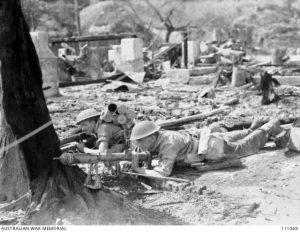
Private Aubrey Carl Kotz (left) and Pte W Spence (right), members of 7 Platoon, A Company, 2/10 Battalion take cover behind a tree with their PIAT gun during Operation Oboe 2, part of the Battle of Balikpapan, 3 July, 1945. Australian War Memorial photo. Public Domain.
Whether any current defense manufacturer is pursuing development along these lines is not a matter of public record. What the PIAT’s combat record demonstrates is that the spigot principle is not an experimental curiosity — it is a proven approach to delivering explosive projectiles without conventional firing signatures, validated in six Victoria Cross actions across three years of the most demanding infantry combat in history. The engineering to update it exists. The tactical requirement for it is present and growing. The gap between those two facts is the only thing standing between a forgotten 1943 weapon and a relevant 2026 one.
The Freedomist — Keeping Watch, So You Don’t Have To
In the summer of 1907, four armored warships slid into the Danube at Galați, Romania, attended by the royal family, government ministers, and a crowd that understood they were witnessing something significant. The ships were monitors — low-hulled, heavily armored river warships carrying naval guns in purpose-built turrets — and their appearance on the lower Danube completed a quiet arms race that had been running for nearly four decades along one of Europe’s most contested river frontiers. Austria-Hungary had been building Danube monitors since 1871. Romania had watched, waited, and was now answering in kind. The weapons they were building were not improvised solutions. They were purpose engineered warships, designed from the keel up by naval architects with established shipbuilding industries behind them. Understanding what they were, and what distinguished them
from the tank boats that would appear on the same river thirty years later, begins with understanding why the Danube needed warships in the first place.
The River As A Frontier
The Danube in the late nineteenth century was not merely a river. It was a political boundary, a commercial artery, and a military problem of the first order simultaneously. For Austria-Hungary, the Danube connected Vienna to the empire’s Balkan frontier, running through Hungarian territory and then tracing the border with Serbia and Romania before it reached the Black Sea. A river that wide and that long required armed patrols — not to fight fleet actions, really, but to enforce sovereignty, project firepower along banks where roads were absent or unreliable, and deny the river to an enemy seeking to use it for their own movement.
The Habsburgs had recognized the military requirement for river warships long before the monitor era. What the wars of the mid-nineteenth century demonstrated, however, was that the kind of vessel the Danube demanded was specific: shallow enough in draft to operate in channels that would strand a seagoing warship, armored well enough to absorb shore fire, and armed well enough to answer it. The American Civil War’s river monitor campaigns on the Mississippi and its tributaries had provided a template that European naval architects were paying close attention to. What the Austro-Hungarian Navy took from that experience was the principle of the purpose built river fighting ship — not a gunboat improvised from a commercial hull, but a warship designed for riverine conditions from the outset.
The Austrian Solution: Leitha And Her Descendants
The SMS Leitha and SMS Maros, completed in 1872 and built at the Pest Flumaner Schiffbau yard in Budapest], were the first river monitors in Europe — a distinction that sometimes surprises readers who assume the type was purely an American invention. Naval architectJosef von Romako oriented his design along the American monitor principle but adapted it specifically for Danube conditions: twin screws driven by high-pressure steam engines, a draft of just 1.3 meters, and an armament of two 150mm guns behind an armored casemate, later refitted with a 120mm gun in a rotating mount. At 50.5 meters in length and 310 tons, the Leitha class was small enough to navigate the middle Danube’s shallower reaches while carrying firepower that no riverbank fortification could ignore. SMS Leitha fired the first shot of the class in anger against Ottoman forces in Bosnia in 1878, during the occupation that followed the Congress of Berlin — the same campaign that gave Austria-Hungary control of territories that would be burning with nationalist conflict by 1914.
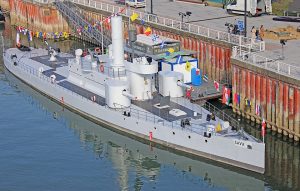
The restored river monitor Sava on display at the Belgrade waterfront on the Sava River, 2021. Photo by Srđan Popović. CCA/4.0 International.
The Austro-Hungarian monitor program continued in measured pairs across the following decades, as was the parliamentary custom — one hull for each legislature to fund. The Körös class of 1892 represented a significant upgrade: 448 tons displacement, a twin 120mm gun turret forward, belt armor running to 50mm, and a complement of 77 men. Then came the Temes class, the most capable of the pre-war generation, carrying 120mm Škoda naval guns and 70mm belt armor on a hull long enough to project genuine firepower across any reach of the river. By 1914 the Austro-Hungarian Danube Flotilla deployed six monitors in various states of modernity, the oldest — Leitha and Maros, both over forty years in service at that time — still capable enough that they were kept in commission rather than scrapped. On the morning of July 29, 1914, the flotilla fired the first artillery shots of the First World War, bombarding Belgrade from the Sava River — the Temes and Bodrog opening up against Serbian positions while the diplomats in Vienna were still drafting their final messages.
Romania’s Answer
Romania’s relationship with the Danube was as foundational as Austria-Hungary’s, but its strategic geometry was different. Romania lay along the river’s lower reach, where the Danube defined the border with Bulgaria and provided the only practical avenue for projecting military force toward Ottoman and later Bulgarian territory — or, critically, for defending Romanian soil against forces crossing from the south. Romanian independence, formalized in 1878 after the Russo-Turkish War, brought with it Black Sea access through the Dobruja coast, but it also brought the long-term challenge of maintaining a credible military presence on a river that Austria-Hungary was actively arming.
The Romanian Danube Flotilla had existed in some form since 1860, accumulating gunboats through the 1880s and 1890s — small, lightly armed craft adequate for patrol but not for battle against armored opponents. The monitor program of the early twentieth century was Romania’s answer to the regional arms environment, and it was ambitious. The four ships of the Bratianu class were built in sections by the Stabilimento Tecnico Triestino in Austria-Hungary, transported to Romania by rail, then assembled and launched at the Galați naval yard between 1907 and 1908 — an arrangement that reflected both Romania’s limited industrial capacity for major warship construction and the paradox of a state purchasing military hardware from the power it was quietly arming against.
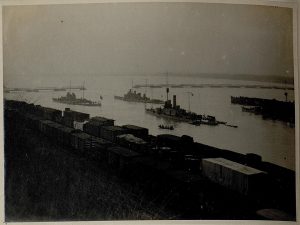
Monitors of Austria-Hungary on the Russe in 1916: SMS Bodrog (forward), SMS Temes (left), SMS Enns (middle, 2nd row). Original photo from the Imperial and Royal War Press Headquarters, Photographic Section – Vienna, 1916. Public Domain.
The result was formidable by river standards. At 680 tons displacement and 63.5 meters in length, the Bratianu-class monitors were larger than their Austro-Hungarian counterparts. They carried three 120mm Škoda naval guns in individual turrets arranged in a triangular pattern, along with 120mm howitzers for plunging fire against troops on the riverbanks — a weapons fit designed not just for ship-to-ship action but for the direct fire support of ground operations across the river. Belt armor ran to 70mm. At 13 knots they were faster than the older Austrian monitors they might one day face. When all four were commissioned in September 1907, Romania named them after the 19th-century statesmen who had shaped the nation’s independence: Ion C. Bratianu, Lascar Catargiu, Mihail Kogalniceanu, and Alexandru Lahovari — a deliberate statement that these were instruments of national sovereignty, not just naval hardware.
A Notable Footnote: Rozhestvensky On The Danube
Before the monitor era fully matured, the Danube theater attracted at least one figure whose later career would define the limits of nineteenth-century naval thinking. Admiral Zinovy Rozhestvensky, best known to history as the commander who led the Russian Baltic Fleet to catastrophic defeat at the Battle of Tsushima in 1905, spent the years 1883 to 1885 seconded to the newly formed Bulgarian Navy, organizing its nascent naval forces and designing a coastal defense scheme along the Black Sea — operating, that is, at the far end of the same river system where the monitor arms race was taking shape. The connection is oblique, but worth noting: the same geopolitical reorganization that followed the 1877–1878 Russo-Turkish War that created Romanian independence and redrew the Balkan map also created Bulgaria’s autonomy and the need for a Bulgarian naval force. Rozhestvensky, wiedly regarded as a fine naval officer, was one of Russia’s answers to that need — a gunnery specialist sent to instill European naval practice in a new state. That his career ended in the worst naval disaster since Trafalgar is, in this context, a footnote rather than the story. The story is the environment he moved through: a region of new states, contested rivers, and the urgent question of who controlled them.
What The Monitor Represented — And What It Didn’t
The pre-WWI Danube monitors were, in the fullest sense, genuine warships. They required established naval architecture, purpose-built shipyards, specialized gun mounts, trained crews, and supply chains for naval-grade ammunition that did not overlap with anything an army used. The Bratianu class’s Škoda naval guns were not the same weapons in any logistical sense as the Škoda field artillery serving Romanian or Austro-Hungarian ground forces — different mounts, different ammunition, different maintenance regimes, different institutional homes. This is precisely the distinction that the tank boat concept would later dissolve: the idea that a riverine fire support vessel had to be a warship in this full sense, drawing on naval industry and naval logistics, rather than a hybrid that reached sideways into the army’s supply chain.
Romania’s monitors demonstrated the strengths of the purpose-built approach during the First World War. During the Battle of Turtucaia in 1916, the monitors supported Romanian ground forces and evacuated the besieged Romanian 9th Infantry Division under fire — exactly the kind of combined-arms riverine operation that justified the investment in armored hulls and heavy guns. The Austrian monitors did the same on their side of the line, shelling Romanian positions and supporting river crossings. Both fleets performed as designed.
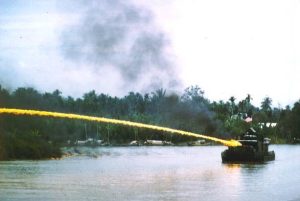
A U.S. riverboat monitor deploying napalm during the Vietnam War. US Navy photo c.1968. Public Domain.
What neither fleet could do was be improvised quickly, or cheaply, or by a state without a shipbuilding tradition. The Soviet engineers who developed the bronekater in the early 1930s were not building monitors because they didn’t know what monitors were. They were building tank boats because they understood the monitor’s industrial prerequisites — and because post-civil-war Soviet Russia did not reliably possess any. The Danube monitors represent the high road of riverine warfare, the answer available to states with the industrial depth to build genuine warships. The tank boat represents the other road — the answer available to everyone else. The same river eventually saw both solutions at work, often within artillery range of each other, which is perhaps the most concise possible illustration of why the distinction matters.
The Freedomist — Keeping Watch, So You Don’t Have To
In April 2026, a controlled explosion at the Guiana Space Center in French Guiana brought down a 52-meter service tower that had once guided Russian Soyuz rockets to the launch rail. The demolition was orderly and practical — the European startup MaiaSpace needed the pad cleared for its own rocket — but the symbolism was hard to miss. Russia had walked away from Kourou in February 2022, the day after its tanks crossed the Ukrainian border, abandoning one of the most advantageous launch sites on Earth: 5.2 degrees north latitude, open Atlantic to the east, a velocity boost from equatorial rotation that no high-latitude cosmodrome can replicate. Four years later, the infrastructure was physically erased. The question that follows from that erasure is not sentimental. It is strategic: where does Russia go next for low-latitude launch access — and whether the answer is already taking shape, quietly, in the landlocked heart of the African Sahel.
The Geography Problem Moscow Cannot Solve At Home
The physics of orbital mechanics are indifferent to politics. Rockets launched from near the equator receive a free velocity boost from Earth’s rotation — roughly 465 meters per second at the equator, declining to zero at the poles. For missions to geostationary orbit — the high-altitude band where communications satellites park — this advantage translates directly into payload capacity. A rocket that can lift five tons from an equatorial site might lift four from Baikonur and three from somewhere north of Moscow. The difference is not academic. It is commercial revenue, satellite mass margins, and competitive position in a launch market that Russia has spent decades trying to lead.
A Delta II rocket launches from Cape Canaveral Air Force Station Space Launch Complex 17B, Florida, carrying NASA’s Dawn probe into space. Photo by NASA/KSC, 27 September 2007. Public Domain.
Russia’s domestic cosmodromes offer no equatorial solution. Vostochny, Moscow’s expensive sovereign alternative to Baikonur, sits at 51 degrees north latitude — actually further from the equator than Baikonur itself, and its location in the Far East compounds the problem with transcontinental logistics for heavy hardware. Baikonur, leased from Kazakhstan through 2050, sits at 45.96 degrees north — better, but still far enough from the equator that the payload penalty for GEO missions is significant. Plesetsk, Russia’s northern military launch complex, exists for polar and reconnaissance orbits, not commercial GEO ones. Kourou, at 5.2 degrees north latitude, had been the answer — and between 2011 and 2022, Russia conducted 26 successful launches from the site before the Russian invasion of Ukraine ended the arrangement permanently.
The gap that Kourou’s loss created has not been filled. Moscow knows it. The question is what, if anything, it intends to do about it.
The Existing Footprint
The relationship between Russia and the Alliance of Sahel States — Mali, Burkina Faso, and Niger; the three military juntas that formalized their confederation in 2023 — has moved well beyond the informal patron-client arrangement it resembled two years ago. Africa Corps, the reconstituted successor to Wagner Group, provides security and counterterrorism support across all three countries. Russian weapons, advisors, and political backing have given the juntas a patron willing to ask fewer questions than Paris ever did. What has changed is the institutional architecture around that relationship. A formal “Russia-Sahel Alliance” consultations format now exists, with two completed rounds of foreign-minister level talks — Moscow in April 2025 and Niamey in July 2026, where Russian Foreign Minister Lavrov personally attended and both sides issued a joint statement committing to deepen “military and military-technical cooperation“. A third Russia-Africa summit, expected to include significant AES-specific agreements, is planned for October 2026 in Sochi. This is no longer an emerging relationship. It is an institutionalized one.
The space dimension has kept pace. In September 2024, officials from Burkina Faso, Mali, and Niger signed an agreement with Roscosmos’s commercial subsidiary Glavkosmos to jointly develop telecommunications and remote sensing satellites, with the Glavkosmos director describing the partnership as “crucially important” for regional security. Niger subsequently went further, signing a specific deal with Glavkosmos for three satellites — a communications satellite, a remote sensing satellite, and a radar satellite — to be manufactured in Russia over four years, with loaner equipment provided in the interim. By January 2026, Russia and Burkina Faso had moved to discussions about launching a dedicated Russian telecommunications satellite configured for the entire AES bloc, with a Russian cosmonaut in attendance at the Ouagadougou meeting — a detail that reads less as ceremonial flourish than as deliberate signaling about who Moscow sends when it wants to communicate seriousness.
What this progression establishes, cumulatively, is a formal Roscosmos presence in AES institutional life: working relationships, shared projects, procurement contracts, and a reason for Russian space engineers and officials to be on the ground in Bamako, Ouagadougou, and Niamey on a recurring basis.
The Speculative Geometry For Building
None of the above constitutes evidence that Russia is planning to build a spaceport in the Sahel. What it constitutes is the scaffolding from which such a project could plausibly grow — and an analytical framework for what the proposition would need to survive contact with reality.
The launch geometry is genuinely favorable. The Sahel sits between roughly 12 and 20 degrees north latitude — not equatorial in the Kourou sense, but substantially better than anything Russia currently operates, and comparable to China’s Wenchang facility at 19 degrees north, which Beijing selected specifically for GEO launch advantage. A launch site in northern Mali or Niger would represent a meaningful improvement over Baikonur for commercial GEO missions, particularly if the broader Ukraine situation eventually settles and Russia seeks to rebuild commercial launch revenues.
The security architecture for such a project already exists in embryonic form. Africa Corps provides the perimeter force. The satellite cooperation agreements provide the institutional cover and the precedent for Roscosmos personnel on the ground. The AES juntas have both the political will to host a Russian strategic infrastructure project — sovereignty signaling against Western criticism is central to their domestic legitimacy — and the demonstrated pattern of trading resource access for Russian security guarantees.
The obstacles are real and should not be minimized. The Sahel’s insurgency threat is not a peripheral complication; the JNIM attack on Bamako’s airport in September 2024 demonstrated that no fixed installation in Mali is beyond the reach of jihadist groups willing to strike at symbols of state authority. A spaceport is a very large, very fixed, very expensive target. The logistics chain for delivering heavy rocket components to a landlocked Sahelian location — across infrastructure that barely supports current military supply requirements — would challenge even a program not already strained by sanctions and wartime diversion of industrial capacity. Russia’s space program, operating under the same economic pressures that have degraded its military production, is not flush with capital for speculative equatorial ventures.
Malian troops stand guard outside Kati Barracks in Bamako, Mali, 31 October 2012. Photo by Magharebia. CCA/2.0 Generic.
What Russia has demonstrated historically, however, is patience with infrastructure projects that serve long-term strategic purposes even when the near-term economics are unfavorable. Baikonur was built at enormous cost in a remote Kazakh steppe because Moscow needed sovereign launch capability regardless of what that capability cost. The calculation for a Sahel site is different in the details — a partner state rather than an ex-Soviet territory, an insurgency rather than a Cold War logistics challenge — but the underlying logic is recognizable.
The Precedent No One Wants To Mention
A useful historical reference point is OTRAG, the German private rocket company that attempted to establish a commercial launch facility in Zaire in the late 1970s and briefly in Libya thereafter, operating precisely because equatorial African launch sites offered physics that European territory could not. The project collapsed under political pressure and host-country instability before a single orbital launch was achieved. Russia’s position in the AES is structurally stronger than OTRAG’s was in Mobutu‘s Zaire — the security relationship is deeper, the host governments are more ideologically aligned with Moscow, and the patron’s interest in the project’s survival is direct rather than commercial. But the OTRAG precedent is a useful reminder that the gap between “plausible geometry” and “operational spaceport” is wide, and that African political environments have a long history of consuming infrastructure projects before they reach completion.
The International Space Station is featured in this image photographed by an crew member on the Space Shuttle Endeavour/STS-134, after their un-docking from the station. NASA photo, 30 May, 2011. Public Domain.
What exists today in the AES is less a spaceport than a hypothesis — the convergence of Russian launch access needs, an established Roscosmos footprint, a sympathetic host, and a geography that solves a problem Moscow cannot solve at home. Whether the hypothesis becomes an actual construction project depends on decisions in Moscow that have not been made, funding that has not been committed, and a security environment that remains actively hostile to fixed installations. The Sahel has a way of defeating ambitious foreign projects on the ground even when they make perfect sense on a map. Russia knows this.
Whether that matters in a strategic calculus built on patience and tolerance against long odds remains, for now, an open question.
The Freedomist — Keeping Watch, So You Don’t Have To
The global arms market has long sorted itself into a predictable hierarchy: the United States and its European partners at the top, Russia and the People’s Republic of China in the middle, and everyone else buying what they can afford from whoever will sell to them. That hierarchy is not collapsing — but it is developing significant cracks. Three Muslim-majority states have built defense industrial bases capable, at varying levels of ambition and success, of competing in that market on something other than price alone: Turkey, Pakistan, and Iran. The three cases share little except religion and the broad definitions of geography. What they share analytically is the common experience of being told, at one point or another, that they couldn’t have what they needed — and deciding to build it themselves.
Turkey Makes The First Leap
The Turkish case is the most dramatic, because the numbers are now difficult to dispute. Turkish defense and aviation exports reached $10.05 billion in 2025, up 48 percent year-on-year — a figure that would have been unimaginable in 2002, when the country’s defense exports stood at $248 million. The growth reflects a deliberate, decades-long state project to reduce dependence on foreign suppliers. The share of domestically produced systems in Turkish defense procurement has now exceeded 80 percent, and Turkey now manufactures two out of every three military unmanned aerial vehicles sold worldwide.
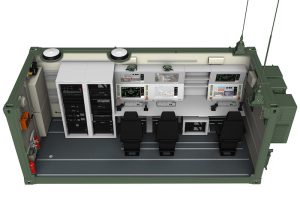
Bayraktar Ground Control Station truck-mounted module cutaway. Image by Bayhaluk. CCA/4.0 Int’l.
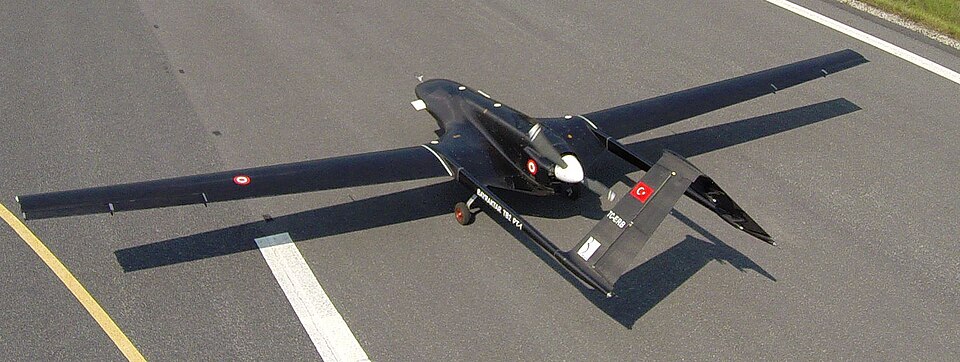
The platform that made Turkey’s name globally is the Bayraktar TB2 drone, which has proved itself in Libya, Azerbaijan, and Ukraine — but Ankara has not been content to remain a drone exporter. Indonesia has signed a contract for 48 KAAN fifth-generation fighters from Turkey in an agreement valued at around $10 billion, and Indonesia also became the first export customer for the Bayraktar Kizilelma unmanned combat aircraft, with deliveries set to begin in 2028. The pivot from tactical drones to stealth combat aircraft represents a qualitative shift — Turkey is no longer competing in the cheap-and-cheerful tier of the arms market. A €2.6 billion contract was signed for the export of 30 HÜRJET aircraft to Spain — which is a notable data point: NATO’s founding members are now buying Turkish military aircraft.
What distinguishes Turkey from the other two cases is the depth of its industrial base. ASELSAN, TUSAS, ROKETSAN, ASFAT, and MKE all appeared in the Defense News Global Top 100 list in 2025 — not one flagship company but five, spanning electronics, airframes, missiles, shipbuilding, and ammunition. Turkey is not exporting a product. It is exporting an ecosystem.
Pakistan’s Combat-Tested Moment
Pakistan’s story is different in character, though the trajectory is similar. For years, Pakistan occupied an awkward middle tier: a nuclear-armed state with modest ambitions in the conventional arms market, but was completely dependent on American F-16’s and whatever China was willing to co-develop. The JF-17 Thunder, a joint venture with the PRC’s Chengdu Aircraft Corporation assembled at the Pakistan Aeronautical Complex in Kamra, was widely categorized as a budget fighter for buyers who couldn’t afford better. That categorization survived until May 2025.
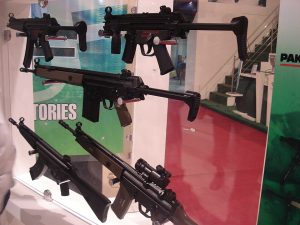
Infantry weapons systems displayed in the exhibition booth of Pakistan Ordnance Factories, 2008. Image by SyedNaqvi90. CCA/3.0 Unported.
The honest caveat is industrial capacity. Pakistan’s ability to produce the JF-17 is limited to roughly 25 units per year, shared between domestic requirements and exports. The pipeline of announced deals — potentially reaching $13 billion — is more ambitious than current production lines can realistically service in the near term. But Pakistan has something it did not have before May 2025: a combat record that export marketing teams can use, in conditions that the buyers who matter most were watching closely.
Iran: The Degraded Pole
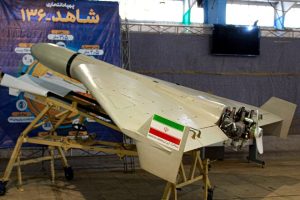
Iran’s case requires the most careful handling. Before February 2026, Iran had assembled one of the more impressive indigenously developed defense industrial bases outside the major powers — remarkable precisely because it was built entirely under sanctions. Despite those restrictions, Iran acquired dual-use technologies through a global network of intermediaries and front companies, with drone components traced to over 70 manufacturers across 13 countries. The Shahed-series loitering munition had become a genuine export product, proliferated to Russia for use in Ukraine and to proxies across the Middle East.
Iranian Shahed-136 combat drone on display, 2023. Image by Behrouz Ahmadi. CCA/4.0 Int’l.
What is not in dispute is the structural damage. Iran’s military industrial base depends on foreign dual-use and commercial items that historically arrived through UAE intermediaries — a route now unlikely to function as before. Iran retains institutional knowledge and engineering personnel. Its own Defense Ministry has stated its intention to restructure and modernize based on lessons from recent conflicts. But reconstitution of physical production infrastructure under expanded sanctions, without access to previous supply chains, is a project measured in years, not months.
As a pole of Muslim defense industrial capability capable in open-market competition, Iran is, for the foreseeable future, off the board.
What The Three Poles Mean
The portrait that emerges is not a single phenomenon but three distinct paths to the same destination: the determination to produce, not merely purchase, military capability. Turkey arrived there through sustained political will and a modernizing industrial policy. Pakistan arrived through a combination of Chinese partnership and an unexpected combat demonstration. Iran arrived through four decades of enforced self-reliance — and has now had much of what it built taken away.
The significance for the global arms market is less about whether any of these three will displace Lockheed Martin or Rheinmetall in the near term than about what they represent for the buyers at the lower end of the defense procurement food chain. Countries that cannot afford Western prices, cannot accept Western conditions, or cannot obtain Western approval now have more options than they did ten years ago.
That menu is expanding — even with one of its major entries temporarily removed from it.
The Freedomist — Keeping Watch, So You Don’t Have To
Sometime in the autumn of 1915, an Austro-Hungarian infantry officer on the Isonzo front watched a conventional mortar crew fire their weapon and die for it. The muzzle flash and smoke column were visible for miles along the bare limestone ridgelines of the Carso plateau. The Italian counter-battery response came within seconds. The problem was not tactical incompetence — it was physics. The twelve Battles of the Isonzo were fought at elevations reaching 3,600 meters, on terrain where concealment was measured in meters and exposure meant death, where the standard tools of industrial warfare performed exactly as designed and killed the men using them, in numbers. The solution that emerged from Austrian workshops in 1915 was one that would have been immediately recognizable to the designers of the Girandoni air rifle a century and a quarter earlier, and to the naval engineers who built the USS Vesuvius in 1888: compressed air, applied to the problem of throwing a projectile without announcing yourself to the enemy.
The Problem Of The Mountain Front
The Italian Front presented tactical challenges that the Western Front did not. On the Somme, a mortar crew could find dead ground, a ruined building, a treeline — some feature that would absorb their signature before it reached the enemy. On the Isonzo, Austrian defenders occupied the high ground and Italian attackers climbed into their fire, while both sides operated on exposed karst rock where concealment was structural rather than vegetative, meaning it had to be blasted or built rather than found. A conventional mortar firing from a prepared position in such terrain announced not just its existence but its precise location to any observer with eyes and a map. Muzzle flash, smoke, and the sharp crack of propellant discharge combined into a signature that no amount of tactical positioning could fully suppress on bare alpine limestone.
Austrian mountain infantry on the Isonzo Front, 1914. Public Domain.
There was a secondary problem peculiar to high altitude. Conventional propellants behave differently in thin air and extreme cold — burning rates shift, pressures become less predictable, and the mechanical tolerances that weapons are proof-tested at sea level do not always hold at 3,000 meters. Mules, the primary means of moving heavy equipment in mountain terrain, had practical load limits that imposed severe constraints on the weight of any weapon system and its associated ammunition. Everything about the mountain environment pushed toward lighter, simpler, quieter solutions.
Maschinenfabrik Esslingen’s Answer
The 15 cm Luftminenwerfer M 15 M.E. — the designation standing for Maschinenfabrik Esslingen, the German firm that designed it — was evaluated by Austro-Hungarian representatives on 21 September 1915 and produced, in the dry language of the official assessment, “the right impression.” Four weapons were sent for combat trials at the end of October 1915. The results were favorable enough that a production order followed.
Austrian 12cm pneumatic mortar and its crew. Date is c.1915. Photo author unknown. Public Domain.
The operating principle was the same one that had propelled Girandoni’s infantry air rifle and Vesuvius’s pneumatic torpedo tubes: compressed air stored in a cylinder, released through a valve, driving a projectile down a smoothbore barrel with no chemical combustion involved. The 15 cm Luftminenwerfer mounted its barrel on a central pivot attached to a base plate, with what the specifications describe as apparently 360 degrees of traverse — a significant tactical advantage over many contemporary mortars that required the entire weapon to be repositioned for new targets. The weapon weighed 207 kilograms (456 lbs) in action, manageable for a mountain environment where alternatives weighed considerably more for equivalent caliber. A single cylinder of compressed air was sufficient for twelve shots before the cylinder required replacement or recharging.
The tactical signature was, by the standards of the Isonzo front, essentially nothing. No muzzle flash. No propellant smoke. The mechanical thump of compressed air releasing was audible at close range but carried nothing like the sharp report of a conventional charge. An observer on a distant ridgeline watching the Austrian lines would see nothing. The mortar could fire, be repositioned on its pivot, and fire again without ever generating the visual signal that made conventional indirect fire weapons so lethal to their own crews on exposed terrain.
The broader Luftminenwerfer weapons family reflected the urgency of the requirement. The 8 cm Luftminenwerfer M 15 was actually developed in unit workshops by the 58th Infantry Division — frontline soldiers engineering their own solution before the manufacturers caught up — with the entire assembly weighing 30 kilograms (66 lbs), portable enough to be carried in a sack. It could fire approximately 16 rounds per compressed air tank. The slightly larger 10.5 cm Luftminenwerfer M 15, developed by Ehrhardt & Sehmer, used a rigid-recoil fixed base design and achieved fifteen shots per cylinder. The 12 cm Luftminenwerfer M 16, which eventually superseded the Esslingen design due to superior range and accuracy, reached 800 meters — double the M 15’s effective range — and became the most-produced of the family, with over 930 delivered by the end of 1917.
12 cm Luftminenwerfer, with mortar bombs laying in front. Austria, 1917. Public Domain.
Why It Didn’t Last
The Luftminenwerfer family’s operational life exposed the same fundamental constraint that had eventually limited the Girandoni rifle and the Vesuvius: the logistics of compressed air. Filling and transporting compressed air cylinders, particularly for the larger caliber weapons, imposed a burden on mountain logistics that grew heavier the more the weapons were used at scale. The rubber seals that maintained cylinder integrity became a supply problem as wartime rubber shortages bit into Austro-Hungarian manufacturing — leather was tested as an alternative but proved unreliable at the pressures required for useful range. The 500-meter maximum range of the M 15 was adequate for its specific mountain niche but inadequate for the broader tactical requirements of the war as it evolved.
Conventional mortars improved in parallel, and by 1916 the balance had shifted. The pneumatic weapons were shelved before their production runs were complete, made obsolete by conventional designs that had closed the performance gap while retaining logistical simplicity. The M 15 family remained a curiosity of the alpine war — a genuine tactical solution to a genuine tactical problem that the conditions of its own environment ultimately could not sustain at scale.
The Recoil Question, And What Comes After
The characteristic the historical record under-emphasizes is recoil— or rather, the near-total absence of it. A compressed-air propulsion system imparts virtually no recoil force to the mounting, because there is no rapid combustion event generating the rearward impulse that propellant-based weapons produce. The Luftminenwerfer’s 207 kilograms sat on a base plate on the ground, and the air release that sent a 150mm projectile downrange generated forces that a ground mount could absorb without difficulty. This is not a peripheral detail. It is the characteristic that makes the concept potentially interesting to a contemporary military designer looking at a specific and increasingly common tactical platform.
The technical — the civilian pickup truck armed with a crew-served weapon — has become the defining light fire support vehicle of irregular warfare, from Libya to the Sahel to Ukraine’s rear areas. Its limitation is the same one that constrains all vehicle-mounted indirect fire: recoil. A conventional mortar or light howitzer of meaningful caliber generates impulse forces that a light truck’s frame, suspension, and tires were not designed to absorb repeatedly. The solutions — outriggers, reinforced beds, dedicated mounting systems — add weight and complexity and slow the deployment that makes the technical tactically useful in the first place.
Somali fighters from the Islamic Courts Union ride a captured technical in Mogadishu, armed with a 106mm M40 recoilless rifle, 2006. Public Domain.
A modern compressed-air mortar of 150mm caliber would impose none of those forces on its mounting. The cylinder discharge that launches the round produces no rearward impulse worth engineering around. The technical drives up, the weapon fires its twelve-round cylinder, and the truck drives away — without the chassis stress, without the stabilization requirement, and without the muzzle signature that tells the opposition exactly where to look. The 500-meter range ceiling that made the original Luftminenwerfer tactically marginal by 1916 is not fixed by the physics of compressed air. It is fixed by the energy stored in a cylinder at the pressures then achievable and the projectile weight being moved. Rocket-assisted projectiles — rounds that ignite a sustainer motor after leaving the barrel — are an established solution for range extension in conventional artillery, adding kilometers to the flight of a shell that the gun itself could not otherwise achieve. Applied to a compressed-air launch system, rocket assistance could, in principle, extend a pneumatic mortar’s range from hundreds of meters to several kilometers, while preserving the zero-recoil launch signature that makes the platform vehicle-mountable in the first place.
The engineering challenges are real. Compressed air storage at militarily useful pressures requires robust cylinders that add weight and handling complexity. Seal reliability in dust, cold, and humidity remains the same problem Austrian quartermasters faced in 1916, addressed now with modern materials rather than wartime rubber. The twelve-shot cylinder that made the M 15 tactically self-contained is not a hard limit — it is a function of cylinder volume and pressure — but scaling up requires carrying more air, and air is heavy when compressed enough to be useful.
Whether any current defense manufacturer is actively developing along these lines is not a matter of public record. What the Luftminenwerfer demonstrates is that the concept was not only sound but combat-proven in conditions severe enough to validate its core advantages: silence, no muzzle flash, near-zero recoil, and mechanical simplicity that requires no propellant chemistry. The Isonzo front generated it because the Isonzo front demanded it. The contemporary technical-centric battlefield may be generating the same requirement from a different direction — not the bare ridgeline that cannot hide a muzzle flash, but the light vehicle platform that cannot absorb a recoil impulse.
But, Then…Once More, With Effort
A modern Luftminenwerfer built to the M-15’s basic architecture, but with carbon-fiber-wound pressure vessels, polymer seals rated for temperature extremes, and a rocket-assisted projectile extending range to three or four kilometers, would weigh a fraction of its ancestor and suffer none of its ancestor’s material failures. The physics that defeated the original — rubber seals, heavy steel cylinders, limited range — are 1915 problems with 2026 solutions. The physics that made it valuable — zero recoil, no muzzle signature, mechanical simplicity — are permanent. Whether any procurement office has done that calculation is not a matter of public record.
That none apparently has, may say more about institutional imagination than engineering feasibility.
The Freedomist — Keeping Watch, So You Don’t Have To
Chad is not a country most people associate with bold diplomatic gestures. Landlocked in north-central Africa, bordered by Libya to the north, Sudan to the east, the Central African Republic to the south, and Cameroon, Nigeria, and Niger to the west and southwest, it sits at the geographic crossroads of West, Central, North, and East Africa — a position that sounds advantageous until you add the context: GDP per capita runs around $1300. The poverty rate stands at approximately 42.3%. Oil dominates the economy, accounting for roughly 40% of government revenue and 70% of exports. Active security threats press in from multiple directions: Boko Haram operates in the Lake Chad basin. The Sudan conflict has pushed hundreds of thousands of refugees across the eastern border. The CAR remains deeply unstable to the south. Chad is not, by any conventional measure, a country with a lot of margin for bold bets.
Which makes the visa announcement all the more analytically interesting.
The Eighth Country, and What That Means
When the policy takes effect on January 1, 2027, Chad will join a growing cohort of African nations extending visa-free entry to all African passport holders — Rwanda, Benin, The Gambia, Seychelles, Ghana, Kenya, and Togo, which quietly implemented its own continent-wide visa-free policy on May 18, 2026, permitting stays of up to 30 days for passport holders who submit a travel declaration through the Togolese government’s online platform at least 24 hours before arrival. The Republic of the Congo (Congo-Brazzaville)announced an identical program scheduled for a January 1, 2027 implementation date, on May 25, 2026 — meaning Chad arrives not as a lone gesture but as part of a coordinated continental wave. The move aligns with the African Union’sAgenda 2063 vision of continental free movement, and it follows the broader momentum of a continent that has been, haltingly and unevenly, dismantling the visa architecture inherited from the colonial period. Togo’s framework — online pre-declaration, 30-day limit, passport plus yellow fever certificate — is currently the only published implementation model available, and it is the closest thing Chad has to a template.
What distinguishes Chad’s announcement from the others is the combination of geography and circumstance. Rwanda’s visa-free push in the 2000’s was backed by a functioning tourist infrastructure, a stable security environment, and a government with a coherent economic diversification strategy. Ghana and Kenya made similar moves from positions of relative institutional strength. Chad has none of those cushions. What it has instead is position — the literal crossroads of the continent — and a president who has decided that position is an asset worth monetizing before anyone else figures out how.
Déby’s framing of Chad as a “gateway connecting West, Central, East, and North Africa” is not hyperbole. It is geography. No other single country touches all four of those regions simultaneously. The Chad-Cameroon pipeline already exports oil to the Atlantic. A landmark MoU signed with the UAE in May 2025 for the long-planned Chad-Cameroon railway aims to give landlocked Chad a multimodal corridor to global markets. The “Chad Connection 2030” development plan, launched in Abu Dhabi, targets $30 billion in investment across oil, mining, and construction. The visa-free policy is not a standalone gesture — it is the people-movement component of a broader infrastructure and investment play that has been quietly assembling for two years.
Orthographic map of Chad. 2011 map by Everest700. Public Domain.
The Security Question Nobody Is Answering
Here is where the analysis has to be honest, because the cheerful continental-integration framing obscures something that security professionals will notice immediately.
Chad is currently on the United States’ restricted travel list, placed there in early 2025 alongside Afghanistan, Myanmar, and several other countries on grounds of deficient screening, vetting, and historically poor cooperation on deportation of overstaying nationals. Chad responded by suspending visa issuance to American citizens — a reciprocal measure that underlines how strained that particular relationship currently is. In that context, opening to all 54 African passports simultaneously is not merely a regional integration gesture. It is a pointed signal about whose framework for movement and security Chad intends to operate within going forward — and it is not Washington’s.
The more practical security question is what happens at Chad’s actual border crossings on January 2, 2027. The Chadian government announced the policy on July 15, 2026. As of September 2026 — four months later, with four months remaining before implementation — it has published zero operational guidance: no confirmed permitted stay duration, no documentation requirements beyond passport and yellow fever certificate, no processing procedures for land border crossings in a country where many entry points are remote, understaffed, and operating in active security environments. Togo managed its May 2026 implementation with a pre-arrival online declaration requirement and a 30-day stay cap. Chad has announced nothing comparable. The Lake Chad basin is a known operational corridor for Boko Haram and the Islamic State West Africa Province groups. The northern border with Libya is a documented transit route for weapons, fighters, and migrants moving across the Sahara. Opening that border architecture to 54 nations’ passport holders without a published implementation framework is not a trivial administrative challenge — it is an open invitation to anyone who understands that ungoverned entry points are operational assets.
None of this means the policy is necessarily reckless. It means the gap between the announcement and the operational reality needs to close before January 1, 2027, and the clock is running. Every visa-free regime that has worked — Rwanda’s, Kenya’s, Ghana’s, Togo’s — was backed by border infrastructure and published procedures capable of handling the additional movement. Chad’s published framework, as of this writing, consists of a presidential speech. That is not a security architecture. It is a deadline.
Tourism, Trade, and the Long Game
Set the security concerns alongside the economic logic, and Déby’s bet starts to look less impulsive. Chad has genuine natural assets that are almost entirely unknown outside specialist circles: the Ennedi Plateau, a UNESCO World Heritage Site of dramatic sandstone formations and ancient rock art, comparable in visual impact to anything in the American Southwest; Zakouma National Park, one of Central Africa’s most significant wildlife reserves, which has made a documented recovery from poaching devastation to become a functioning safari destination; and Lake Chad itself, a freshwater body whose dramatic shrinkage — from 25,000 square kilometers in the 1960s to under 2,000 today — is one of the most visible climate change stories on the continent, drawing researchers and journalists who currently have to navigate a cumbersome visa process to get there.
A steep-walled canyon on the Ennedi Plateau in Chad, with A large group of camels approach a waterhole. 2000 photo by “Desertman”. CCA/3.0 Unported.
None of those assets are currently monetized at anything approaching their potential. The visa barrier is a genuine friction point for all of them — not primarily for Western tourists, who represent a small fraction of African travel markets, but for the intra-African travelers, traders, researchers, and diaspora capital flows that are the real engine of the continent’s internal economic growth. The IMF reported that Nigeria alone moved approximately $59 billion in stablecoin transactions in a single year — money moving informally precisely because formal channels are too costly and too restricted. Visa-free movement is the physical-world equivalent of that same financial logic: reduce friction and watch what moves.
Déby is making a play that is simultaneously about tourism, trade, investment, and geopolitical positioning — a signal to the Gulf partners funding Chad Connection 2030 that he is serious about turning Chad into a hub rather than a corridor. Whether the infrastructure catches up to the ambition in time is the question. Whether the security framework keeps pace with the open border is the more urgent one.
What is not in question is the direction of travel. Chad is not the last landlocked Sahelian country that will make this kind of move. It is, characteristically, the one that did it first and loudest, from the least obvious position. When the word gets out — and it will — the empty parking lot is going to get very interesting very fast.
The Freedomist — Keeping Watch, So You Don’t Have To
Way back in 2022, we published an article on a seemingly-odd contraption out of Indonesia, namely, the “X-18 ATC Tank Boat“. This week, we will dig deeper into that story, because it is a historical window into riverine and littoral warfare that doesn’t get mentioned nearly as much as it should.
In the summer of 1944, Soviet armored gunboats flying the Red naval ensign were pushing up the Pripyat River toward Pinsk, their T-34 tank turrets swiveling to engage German positions on the riverbanks. They looked, from any distance, like tanks — because, in the most functionally important sense, they were tanks. The hulls beneath those turrets were nautical craft, drawing less than a meter of water, capable of beaching on a muddy bank to disembark infantry and then backing off to resume fire support. The guns, the optics, the ammunition — all of it drawn from the same production lines that were supplying the Red Army’s armored columns rolling west across the steppe. The result was a category of weapon that has never quite fit the standard taxonomies of naval warfare, and that militaries have kept reinventing for nearly a century: the “tank boat“.
Soviet ‘Bronekater’ BK-1125 river gunboat at the Ukrainian State Museum of the Great Patriotic War. 2007 photo by Avaness. CCA/3.0 Unported.
The concept requires a precise definition, because it is easily confused with something it is not. An amphibious tank — the Soviet PT-76, the American LVT series, the Japanese Ka-Chi — is a land vehicle adapted to cross water. It ‘swims’ as a means of getting from one bank to the other, then continues its primary existence as a ground combat platform. A tank boat inverts that relationship entirely. It is a nautical vessel — designed for sustained waterborne operations, crewed by sailors, navigated as a ship — that has been armed with turrets, guns, and fire control systems lifted directly from land combat tanks. The water is its element. The tank hardware is its weapon.
It is equally distinct from the river monitor — the purpose-built warship that represents the other solution to the same problem. The Austro-Hungarian Danube Flotilla, which fired the first shots of the First World War against Belgrade in 1914, operated monitors carrying Škoda naval guns in purpose-engineered turrets, with belt armor running to 40mm and displacements measured in hundreds of tons. Romania and Yugoslavia inherited and operated the same tradition. These were genuine small warships, designed from the keel up by navies with established shipbuilding industries. The tank boat exists precisely where that industrial capacity does not.
The logic behind the combination is straightforward enough that it has been discovered independently by several navies across a century of warfare. A nation that operates a river network requiring armed patrol faces an immediate practical problem: purpose-built naval gun mounts require dedicated design, specialized manufacturing, and production lines that many states simply do not possess. Tank turrets, by contrast, are produced in volume, supported by existing supply chains for ammunition and spare parts, and arrive pre-engineered with their own armor protection for the crew inside. Pulling a turret off the production line and bolting it to a river craft cuts months from the design cycle and keeps the logistics tail short — the same 76mm round that feeds a T-34 on the steppe feeds the boat patrolling the river behind it.
Industrial Origins
The Russian riverine tradition runs deeper than the Soviet period. The Amur Military Flotilla was formally established in July 1906 to defend the Far Eastern border along the Amur River against potential Chinese or Japanese encroachment, and by 1910 it comprised 28 vessels including eight turret gunboats — purpose-built craft with enclosed gun positions, though not yet drawing their hardware from a tank program that did not yet exist. The same operational imperative that drove that flotilla — the need to project armed force along river corridors that were, in many areas of the empire, the only routes of communication and control — carried forward into the Soviet period.
The decisive step came in the early 1930s, driven by a combination of operational lessons from the 1929 Sino-Soviet conflict on the Chinese border and the practical constraints of Soviet industrial capacity following the devastation of the civil war. Shipbuilding facilities had been lost or degraded; purpose-built naval gun mounts were expensive and slow to produce. The solution was the Project 1124, an armored river gunboat that would take its main armament directly from the tank production line. The first hulls were armed with turrets from the T-28 medium tank; by 1939, the program had upgraded to the T-34 turret, with its 76mm F-34 gun, as the standard fit. The smaller Project 1125followed the same logic on a reduced scale, carrying a single turret forward with a Katyusha rocket launcher option aft.
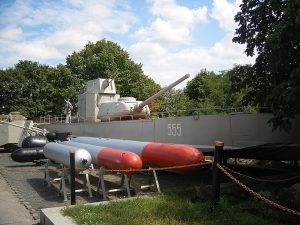
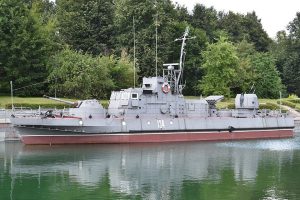
Project 1204 Shmel-class armored patrol boat on display in ‘Victory Park’, Museum of the Great Patriotic War, Poklonnaya Hill, Moscow, Russia. 2017 photo by Alan Wilson. CCA/2.0 Generic.
The specifications of these craft illustrate how completely the design was optimized for riverine work. The 1124 ran to 25.3 meters in length with a beam of roughly four meters and a draft of under one meter — shallow enough to operate in channels that would strand a conventional warship. Aircraft engines driving twin screws pushed it to speeds approaching 20 knots. The armor was light by land standards, running to 7mm on the belt and 20mm on the turret faces, but adequate against the small arms and light weapons fire that a river patrol was most likely to encounter. Over 310 units of both classes were completed between 1934 and 1945; approximately 90 were lost in combat.
The War On The Rivers
The ‘bronekater‘ — the Russian word translates roughly as “armored cutter,” a designation that captures neither the firepower nor the tactical versatility of the type — proved itself in the most demanding possible conditions during the Great Patriotic War. At Stalingrad, the gunboats worked the Volga under air attack and artillery fire, supplying the city’s defenders and providing fire support against German positions on the western bank. On the Dnieper, the Pripyat, the Danube, and eventually the rivers of Austria and Germany, they pushed forward with the advancing Soviet armies, beaching to land infantry, suppressing enemy strongpoints, and taking punishing losses from anti-tank guns that could penetrate their light hulls without difficulty.
The wartime production strain produced one of the more improvised chapters of the type’s history: when tank turret supply fell short of hull production, boats went to the front fitted with open-mount guns rather than tank turrets, an acknowledgment that the hull itself and the ability to beach and fire from a river were valuable enough to deploy even without the preferred armament. The successful combat testing of Katyusha rocket launchers on modified bronekater’s during the Stalingrad campaign — 82mm and 132mm variants replacing the aft turret — added a saturation fire capability to the type that no previous river craft had carried.
The Cold War successor to these wartime designs, the Project 1204 ‘Shmel’ (NATO designation “Bumblebee“), adapted the concept for border patrol duties along the Amur, Ussuri, and Danube river frontiers, substituting the PT-76 amphibious tank’s 76mm gun in a bow turret and adding a 140mm rocket launcher amidships. Between 1967 and 1972, 118 of these boats were completed, split between the Soviet Navy and KGB Border Troops. A number of them eventually saw combat in Afghanistan, where they patrolled the Amu Darya river border — a return to the original Amur flotilla mission, this time on the southern frontier.
The Concept Travels
The tank boat concept was not exclusively Soviet. France experimented with Sherman tank turrets mounted on riverine craft, and North Korea fitted modified T-34-85 turrets to patrol boats and at least one former Soviet minesweeper pressed into service as a corvette — a configuration that extended the concept from the brown-water environment for which it had been developed into genuine coastal waters. The underlying calculation remained consistent across all of these variations: a tank turret offered a level of protected firepower that no comparable naval mount could deliver at equivalent cost or on equivalent timelines.
The Indonesian Reinvention
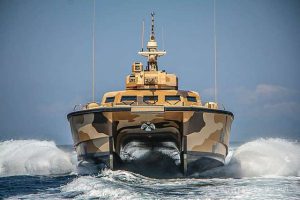
The most contemporary iteration of the tank boat concept arrived in the 2020’s from an unlikely direction. Indonesia’s PT Pindad, working with North Sea Boats and the Belgian arms manufacturer John Cockerill Defense, developed the X18 — formally designated the ‘Antasena’-class — an 18-meter composite catamaran hull carrying Cockerill turret systems originally designed for light armored vehicles. The initial operational configuration mounts the Cockerill 3030 unmanned turret with a 30mm autocannon and twin 12.7mm machine guns; a heavier variant carrying the Cockerill CT-CV 105HP rifled gun — capable of firing the Falarick 105 gun-launched anti-tank guided missile to ranges beyond five kilometers — has been demonstrated in concept and remains available as a turret-swap option.
The X18’s operational context explains the reinvention clearly. Indonesia’s archipelago geography — over 17,000 islands, thousands of kilometers of coastline, and extensive river networks in Borneo, Sumatra, and Papua — creates exactly the operational environment for which the ‘bronekater’ was first designed: vast areas of littoral and riverine water requiring armed patrol, where the shallow draft and beaching capability of a specialized craft is more operationally relevant than the deep-water endurance of a conventional warship. A range of approximately 600 nautical miles and the ability to operate from beaches without port infrastructure gives the X18 a reach across that archipelago that larger patrol vessels cannot match.
X18 Antasena-class combat boat prototype. Photo from PT Pindad, 2021. Public Domain.
The logic that drove Soviet engineers in the 1930’s — reach for the turret already in production rather than design a new naval mount from scratch — runs unbroken through to the X18’s Cockerill system, which is drawn from the same family of turrets fitted to the Indonesian Army’s ‘Harimau’ light tank and the Pindad Badak wheeled fire support vehicle. The ammunition is interchangeable. The training base overlaps. The supply chain is shared. The bronekater’s foundational insight — that the logistics advantages of a common land and naval armament outweigh the engineering compromises required to make a tank turret work on a boat — has proven durable enough to survive from the T-28 turrets of 1935 to the unmanned Cockerill systems of 2025. What changes is the technology inside the turret. What does not change is the underlying calculation that put it on a boat in the first place.
The Freedomist — Keeping Watch, So You Don’t Have To
Supply and commodity trading is boring stuff…Right?
The “Law of Unintended Consequences” is a very real thing. Many people, however, refuse to see them when they appear…and sometimes, they refuse to acknowledge it amid the wreckage of their error. To his credit, John F. Kennedy did acknowledge this – albeit parsed for public consumption – when he said, in the aftermath of the disaster that was the Bay of Pigs, “Victory has a thousand fathers, but defeat is an orphan.”
When we covered the opening weeks of Operation Epic Fury in March, in our monthly subscription edition, we flagged a supply chain casualty that most of the financial press was too focused on crude oil to notice: sulphur.
We noted that a Hormuz closure extending beyond 30 days would begin to bite into agricultural input supply chains, drive spot sulphur prices sharply upward, and extend inflationary effects well beyond the energy sector into global food commodity markets. We were right – and the situation has since become considerably more complicated than even that analysis anticipated.
And this is, in fact, what actually happened.
Commercial vessels in the Persian Gulf near Hormuz Island, Iran. 2011 photo by ninara. CCA/2.0 Generic.
The Invisible Commodity
Sulphur is not a commodity that generates headlines under normal circumstances. It does not trade on the nightly news. Most people could not tell you what it is used for, beyond a vague association with volcanoes and the smell of struck matches. That invisibility is precisely what makes it dangerous as a supply chain vulnerability.
Sulphuric acid – the primary derivative of elemental sulphur – is the most widely produced industrial chemical in the world. It is not an exaggeration to call it the nervous system of industrial civilization. It is the essential reagent for processing phosphate rock into the fertilizers – MAP, DAP, SSP and TSP – that sustain the yield levels modern agriculture depends on. It is a critical processing agent for copper, nickel, and the battery metals that underpin the energy transition. It is used in steel production, petroleum refining, pharmaceutical manufacturing, and water treatment. When sulphur supply tightens, the consequences do not stay in one sector.
They cascade.
The Strait of Hormuz carries approximately 45-50% of global seaborne sulphur trade. Saudi Arabia and the UAE are the dominant exporters, with Qatar contributing significantly as a byproduct of its LNG operations. When the strait effectively closed in late February 2026, that flow stopped – approximately 4 million metric tons of sulphur per year, originating from Iranian, Qatari, and UAE export terminals, were cut off from world markets.
But How Bad Is The Disruption, Really?
Before going any further, it is worth establishing what “closed” actually means in practice – because the picture is more nuanced than the headlines suggest, and the nuance matters for understanding how long the sulphur crisis persists.
Maritime shipping analysts tracking tanker movements through Kpler data estimates that actual Hormuz transits peaked recently at roughly 7.5 million barrels of oil per day equivalent on a seven-day rolling basis – against a pre-war flow of approximately 20 million barrels per day. Rerouting through Saudi pipelines to Yanbu and UAE facilities at Fujairah adds perhaps 4 million barrels per day of incremental bypass capacity. The net picture, properly benchmarked against total pre-war Middle Eastern outflow of approximately 23 million barrels per day, puts the region running at just over 50% of pre-war export levels.
Complicating the picture further: tanker AIS tracking data is being actively gamed. Ships are running dark – disabling their automatic identification systems – making real-time flow estimates inherently uncertain. What satellite imagery of loading docks can confirm is that the disruption is real and sustained, regardless of what official statements claim. CENTCOM reported on August 14th that U.S. forces had redirected 62 commercial vessels and boarded two to ensure compliance with the blockade. The UAE’s ADNOC shipping line reported two vessels attacked within a single week.
The Houthi dimension adds a further layer. Saudi oil rerouted through Yanbu and heading toward Asia must transit the Bab el-Mandeb – where Houthi forces, operating in conjunction with Iranian interests, are now targeting Saudi-linked vessels specifically. Tanker transits through Bab el-Mandeb have fallen approximately 40%, with more vessels running dark. The bypass route that was supposed to partially compensate for Hormuz is itself under attack.
What began as a Hormuz disruption rapidly evolved into something considerably more severe, because two major sulphur exporters seized the moment to protect their own domestic supply chains.
On April 10, China announced a full export ban on sulphuric acid through August 2026 – replacing a 700,000-ton annual quota with a complete cessation. China is the world’s largest sulphuric acid exporter, with Chile, Indonesia, and Saudi Arabia as its primary markets. Chile uses it for copper solvent extraction. Indonesia uses it for high-pressure acid leach nickel processing. Saudi Arabia and India use it for fertilizer production and industrial applications. The Chinese ban effectively removed a critical secondary supply option precisely when buyers most needed it.
The price response was swift and severe. Spot prices for granular sulphur FOB Arabian Gulf jumped from $80-90 per ton to $160 per ton in the first week of April alone, according to Argus Media data. Fertilizer costs overall are projected to rise more than 30% in 2026, according to the World Bank’s April Commodity Markets Outlook.
The Fertilizer Cascade
The downstream consequences for agriculture are where the sulphur story intersects with food security in ways that deserve serious attention.
Urea prices – the bellwether of nitrogen fertilizers – roughly doubled in a matter of weeks following the strait closure, jumping from $400-490 per metric ton to over $850 per metric ton in April 2026, before softening somewhat as China lifted its separate urea export ban and northern hemisphere spring application demand eased]. Diammonium phosphate prices climbed from approximately $580 to around $770 per metric ton. Indian and Brazilian phosphate fertilizer producers, facing shortages of sulphuric acid, reduced operating rates by 15-20%.
Brazil’s exposure deserves particular attention. The country imports more than 80% of its fertilizers and relies heavily on Gulf sources now blocked by the strait closure. Brazil is the world’s third-largest agricultural exporter – its soy, corn, and sugar output affects food prices globally. A sustained reduction in Brazilian fertilizer access does not stay in Brazil.
The aircraft carrier USS Ronald Reagan (CVN 76) leads a formation of Carrier Strike Group (CSG) 5 ships as U.S. Air Force B-52 Stratofortress aircraft and U.S. Navy F/A-18 Hornets pass overhead; 2018 U.S. NAVY photo. Public Domain.
Morocco’s OCP Group – the world’s largest phosphate producer and exporter, a company that underpins fertilizer supply for much of Africa and Asia – was already operating under sulphur supply constraints before February 28, following production outages at a major Qatar LNG facility in H2 2025. The Hormuz closure found OCP with sub-optimal sulphur inventory and no easy alternative supply source. The knock-on effects for African agricultural input availability are not yet fully visible in the data, but they are coming.
The domestic picture for U.S. readers is more reassuring than the global picture, but the country is not entirely insulated. Approximately 54% of U.S. sulphur output is recovered at Gulf Coast refineries in Louisiana and Texas – a domestic supply source entirely independent of Hormuz transit. That physical insulation is real and significant.
However, approximately 17% of U.S. urea consumption and roughly 20% of U.S. phosphate consumption originate from Gulf exporters whose shipments must transit the strait. Trade policy decisions in recent years – countervailing duties on Moroccan fertilizers, export restrictions from China – had already concentrated U.S. phosphate sourcing toward Saudi suppliers now blocked by the Hormuz closure. American farmers planting spring crops faced higher input costs at precisely the moment the strait closed. The global market sets prices regardless of where the physical supply originates, and international tightness exerts upward pressure on domestic prices even for buyers who can source locally.
The Structural Gap Nobody Wants To Talk About
The 2026 disruption has confirmed something that commodity analysts have warned about for years and policymakers have consistently declined to address: sulphur has no internationally coordinated strategic reserve. No emergency release mechanism exists. When the International Energy Agency (IEA) convenes member states to coordinate a strategic petroleum release, there is an institutional architecture to do that. When the sulphur supply collapses, there is no equivalent.
Oil has the IEA. Natural gas has emergency sharing agreements within the EU. Sulphur – the feedstock for the fertilizer that feeds the world – has nothing.
The East Asia Forum‘s July 2026 analysis identified the compounding factors with precision: geographic bottlenecks, by-product dependence – most sulphur is a byproduct of oil and gas processing, not a primary product – and policy control combine to amplify disruption across global production networks in ways that are structurally difficult to hedge against. When the by-product source is disrupted at the same time the major exporting nations choose to restrict trade, there is no lever to pull.
Now add a U.S. president posting maps of the strait labeled “New US Territory” while ceasefire negotiations flounder, a June memorandum of understanding between Washington and Tehran expiring with no final deal in place, and Houthi forces actively interdicting the primary bypass route. The resolution timeline that commodity markets were pricing in three months ago is no longer visible.
And, hysterical cheerleading to the contrary, maneuvers around the strait have not “reopened” it.
So – How Did We Get Here?
Military service, generally speaking, tends to impart a healthy skepticism in veterans, especially those who have been in combat, because those veterans get to see the immediate impact of poor decision-making ability among politicians. This tends, by extention, to make veterans with those experiences who become politicians wary of both jumping into warfare, but equally wary of allowing problems to masticate, because that tends to evolve into a kind of “cultural gangrene“.
It is important to remember that this is not an absolute – both John F. Kennedy’s and Jimmy Carter’s military experience failed them, rather spectacularly, especially in Carter’s case.
With that in mind, it is equally important to understand that from 1945 to 2026, only four US Presidents have not had some form of military service in their resumes: Bill Clinton (1993-2001), Barack Obama (2009-2017), Joe Biden (2021-2025)…and Donald Trump (2017-2021, and 2025-Present). Studying these Presidents’ various administrations from a military standpoint reveal very uneven decision-making capacities.
The reasons for these situations are many, and we could spend the next few months arguing specifics but that fact is that, strategically speaking, the performance of the United States over the past c.35 years has been…”underwhelming” is a fair term.
In regards to the Strait of Hormuz – the center of the current sulphur crisis – the problem can be laid squarely at the feet of Jimmy Carter, who preferred that the then-Shah of Iran, Muhammad Reza, be deposed and replaced by – of all people – the Ayatollah Khomeini. As a result, for nearly five decades, a cancer of a terrorist state being funded by stupendous oil profits to fester and metastasize into a cancer that endangers human civilization across the board.
For Donald Trump, the problem is different. Trump inherited the disasters left him by over forty years of objectively terrible leadership, and the allowance of the rise of an increasingly open corporate oligachy that runs the country, an oligarchy that is perfectly fine with the nationa’s foundations being destroyed entirely, if it makes their quarterly numbers look good.
Militarily, however, this translates into a particularly virulent form of brain cancer: the Toffler Effect.
Donald Trump, despite the breathless and hysterical screeds of abysmally educated and/or self-deluded “NPC’s“, is not a stupid person. Quite the opposite. However, with no grounding in actual military thinking, it appears that Trump has been misadvised on how to handle the Iran situation, in a way that is very attractive on its surface.
First, it appears that there was little, if any, pre-planning about how to actually deal with removing the openly psychotic and bloodthirsty terrorist regime ruling from Tehran. This means that when the Iranian Rial collapsed in December of 2025, Trump and his advisers jumped at the chance to undermine the regime, even if they had to “wing it”, and come up with a plan on the fly.
Fine – that’s not an optimal way of doing things, but it can be made to work…Except that this is where Toffler meets Billy Mitchell.
Brigadier General William “Billy” Mitchell was one of the early cheerleaders for what is now termed “strategic bombing”, the notion that air power alone can win wars. This frankly bizarre view has persisted since the 1930’s, despite repeated examples of its complete and utter failure…But for Trump, the airpower solution – aided by naval missile fires – is highly seductive.
If the regime in Tehran could be toppled solely through the United States and Israel using only airpower, that was an ideal solution: there would be no videos of US ground troops storming mud-walled compounds in the Iranian interior, with goats running for their lives, and the bodies of children caught in the crossfire – the sorts of images that the mainstream media froths at the mouth over, trying to skew the context to match their internal political narrative. Likewise, although air crews – both pilots, ground crew and missile defense troops – might be killed and wounded in action, the numbers would be comparatively tiny, compared to infantry companies having to fight house-to-house, potentially taking World War 2-scale casualties in the process.
Low-brow/low-information types (which really is a fair characterization) occasionally pontificate that the Iranian people need to “rise up and overthrow” the IRGC and the mullahs on their own…completely ignoring the fact that they tried that – and on January 8th and 9th, the IRGC promptly massacred over 36,000 of them in 48 hours. Passion and harsh language are a poor match for a DShK.
The problem with this, as has been shown clearly, is that airpower alone has not, can not, and will never win wars on their own. Without “boots on the ground” – be those boots American, non-terrorist Iranian, or otherwise – victory is impossible. Bombs can be dropped and missiles can be fired, but victoryis impossible.
Another aspect of this is the utterly rampant Dunning-Kruger Effect that is rotting (primarily) Western minds. Dunning-Kruger, simply put, is the effect of people with little to no experience or knowledge of a subject being convinced that they are, in fact, very competent in that sphere.
While it may seem like a cliche, in the case of Trump’s war on the terror regime in Tehran, this translates into Dunning-Kruger being formulated by video games, and breathless war documentaries: Call of Duty, World of Tanks/Warships, and more. While the effects produced by these games are certainly not uniform, they do impact public discourse…which, in turn, impacts politicians who are equally susceptible to Dunning-Kruger, and the public fawning when said politician agrees with the “TikTok PhD’s“.
As just one example, many people are convinced that the first Gulf War/Desert Storm “was won in 100 hours“. Nothing could be further from the truth. Desert Shield/Desert Storm took 7 months, from August 7, 1990, to February 28, 1991. “Combat operations” actually began on January 19, 1991…And yet, “keyboard commandos” almost literally froth at the mouth if anyone dares to disagree with the “100 Hour” gospel.
We don’t even need to discuss the Dunning-Kruger disconnect between the US march on Baghdad in 2003 and Russia’s march on Kiev in 2022.
And worse – the enemies of the United States are all watching US combat operations in the Persian Gulf/Arabian Sea verycarefully, measuring what we are actually capable of doing in a short-term, short-planning window environment…and the look on our side is not good.
As a result, the Strait of Hormuz has been functionally closed since early-March of 2026. This does not overly impact the United States directly, but it is about to. It is already impacting the wider world…
…And there is no clear exit, for any side.
The Strait of Hormuz is not just an oil issue. It is not just a gas issue. It is, as the fertilizer industry has now learned at considerable cost, a food issue – and the mechanisms to manage that risk, at every level from strategic reserves to diplomatic architecture, do not yet exist.
The Freedomist — Keeping Watch, So You Don’t Have To
Armored combat vehicles are relatively new things. Like most complicated technology, they had rough starts. Few people, be they the engineers who designed and built them, or the soldiers using them, had any real idea of how they should be used, nor what requirements were necessary to make them function.
There is a particular irony embedded in the early history of Soviet mechanized infantry that most Cold War histories skip past without pausing on it. When the Soviet military’s engineers sat down in November 1946 to design the Red Army’s first purpose-built armored personnel carrier, the vehicles they studied most carefully were American. Thousands of M3 half-tracks had arrived in the Soviet Union under the Lend-Lease program during the Second World War, alongside captured German Sd.Kfz. 251 half-tracks that Soviet troops had taken off the battlefield. Soviet infantrymen had ridden both into combat. Soviet engineers had pulled both apart to understand how they worked. When designer B.M. Fitterman’s team at the ZiS plant began drawing the vehicle that would become the BTR-152, they were not starting from scratch. They were starting from an M3.
That lineage makes the M3/BTR-152 comparison something more interesting than a simple East-West parallel. It is a study in what happens when one nation takes another’s design concept, rebuilds it from different industrial and doctrinal assumptions, and produces a vehicle that resembles its ancestor in outline while differing from it in almost every meaningful detail. The differences tell you more about the two armies’ understanding of mechanized warfare than the similarities do.
The M3: A Commercial Vehicle Goes to War
The M3 half-track emerged from a straightforward American procurement logic: build a vehicle that can carry a rifle squad across broken terrain, protect it from shell splinters and small arms fire over the front arc, and do so using as many commercially available components as possible to speed production and simplify maintenance. The White Motor Company produced the first prototype using the body of the existing M3 Scout Car mated to a half-track running gear derived from French Citroën-Kégresse designs the US Army had evaluated in the 1930s. Accepted for service in May 1941, it could carry thirteen men — three in the cab, ten in the rear — at up to 45 miles per hour on road, with cross-country performance the wheeled vehicles of the era could not match.
M3 Halftrack armored cars Fort Knox, June 1942. US Office of War Information photo by Alfred T. Palmer. Public Domain.
Its armor ran to 12mm at the front and 6mm on the sides — enough to stop rifle-caliber fire and most shell fragments, not enough to stop a machine gun at close range. The open top, which saved weight and allowed the crew to fire their weapons in any direction, was also the M3’s most consistent complaint: American troops, who nicknamed it the “Purple Heart Box” in grimly humorous reference to the decoration for combat wounds, objected that artillery airbursts and grenades dropped from above found the interior entirely unprotected. In the close terrain of the Italian campaign and the Hürtgen Forest, that limitation was lethal.
The M3 was produced in numbers that reflected American industrial capacity at full war mobilization: approximately 41,000 vehicles of all variants across the production run from 1941 to 1945, built by White, Diamond T, and Autocar and delivered to American, British Commonwealth, Soviet, and Free French forces across every major theater. Its variants numbered in the dozens — self-propelled artillery mounts, anti-aircraft platforms, mortar carriers, ambulances, command vehicles — which testified both to the design’s adaptability and to the American tendency to derive entire vehicle families from a proven platform rather than develop specialized vehicles from scratch.
Partly finished halftrack scout cars travel along a moving assembly line in a plant converted from the manufacture of safes and locks. Diebold Safe and Lock Company, Canton, OH. December, 1914. US Office of War Information photo by Alfred T. Palmer. Public Domain.
The M16 Multiple Gun Motor Carriage variant, mounting four .50 caliber M2 Browning machine guns in a powered turret, became the standard American light anti-aircraft vehicle of the war and one of the most effective ground support weapons of the Italian campaign. The M3 Gun Motor Carriage mounted a 75mm gun and served as a tank destroyer in North Africa before being replaced by purpose-built vehicles. The platform proved more versatile than its designers had intended, in the way that genuinely sound engineering often does.
The BTR-152: The Same Idea, Built Differently
The specification that produced the BTR-152 was issued in 1946, and work began at ZiS — the Zavod imeni Stalina, later renamed ZiL [https://en.wikipedia.org/wiki/ZIL] — under Fitterman that November. The design brief called for an all-terrain armored personnel carrier capable of operating with tank formations across the terrain of a future European war. The Soviet engineers’ answer was conceptually similar to the M3 but mechanically quite different: rather than a dedicated half-track running gear, Fitterman’s team took the chassis and drivetrain of the ZIS-151 [https://en.wikipedia.org/wiki/ZIS-151] six-by-six military truck — a vehicle already in Soviet service — and wrapped it in sloped armor. The result was a fully wheeled vehicle, not a half-track at all, carrying up to eighteen passengers at a maximum road speed of 75 kilometers per hour.
BTR-152 APC in Yad la-Shiryon Museum, Israel. 2005. Photo by Bukvoed. CCA/3.0.
The BTR-152 entered Red Army service on March 24, 1950, was first shown publicly in a Moscow parade in 1951, and was produced in approximately 8,600 units through 1959 — a much smaller run than the M3, reflecting both the Soviet Union’s more constrained postwar industrial capacity and the shorter window before the BTR-60 rendered it obsolete. It carried a 7.62mm SGMB machine gun on a pintle mount, with provision for a 12.7mm DShK heavy machine gun on some variants. Its armor ran to 15mm at the front and 9mm on the sides — marginally thicker than the M3, though the same fundamental vulnerability to heavy machine gun fire and direct anti-tank weapons applied.
The BTR-152’s combat debut came not in a major war but in a city. In November 1956, Soviet forces used BTR-152s in Budapest during the suppression of the Hungarian Uprising. The results were instructive and unflattering. Hungarian insurgents threw Molotov cocktails and grenades into the open-topped troop compartments. Bullets and improvised weapons punctured the tires, immobilizing vehicles that could not move on rims as a tracked vehicle might. The armor that had seemed adequate on a proving ground was penetrated by heavy machine gun fire at close range in the narrow streets. The BTR-152 V1 and V2 variants that followed added a central tire pressure regulation system allowing the crew to adjust tire pressure while moving — a direct response to the Budapest lesson — but the open top remained until the BTR-152K, which added an armored roof at the cost of the firing ports’ usefulness.
BTR-152 armored personnel carrier. Poland, 1957. Photo by Zbyszko Siemaszko. Public Domain.
The pattern was identical to the M3’s experience in the Hürtgen and Italy: a vehicle designed for open mechanized warfare proving costly when urban terrain inverted its advantages. The open top that allowed observation and flexible fire in the open became a liability the moment walls and rooftops provided the enemy with elevation.
Two Vehicles, One Lesson
The M3 and the BTR-152 belong to the same moment in military history — the point at which armies that had learned the hard way that infantry could not keep pace with tanks on foot began building the infrastructure to change that, without yet having developed a coherent theory of what a truly integrated mechanized infantry vehicle should look like. Both vehicles were, in the vocabulary of their era, “battlefield taxis”: their job was to deliver infantry to the edge of the fight in something better than a truck, with enough protection to survive the journey under fire and enough firepower to suppress opposition during the dismount. Neither was expected to fight through the objective with the infantry aboard. Neither had the armor or the weapons to do so.
It took the 1967 appearance of the BMP-1 — which we examined in an earlier piece in this series — to demonstrate what a vehicle built on a genuinely different concept could accomplish: infantry that fought from the vehicle rather than dismounting before the fight, organic anti-tank capability, protection against the NBC environment of a nuclear battlefield. The BMP made both the M3 and the BTR-152 look like what they were: first attempts at solving a problem that would take another generation of engineering to solve properly.
The M3 was declared obsolete by the US military around 1955, though it continued in Israeli service through the 1973 Yom Kippur War and with various other operators well into the 1980s. The BTR-152 was similarly retained by export customers long after Soviet motor rifle units had moved on to the BTR-60 and eventually the BMP. Both vehicles appeared in the Lebanese Civil War. The M3 appeared in the hands of the IDF as recently as the 1982 Lebanon War.
The deeper irony is that the vehicle the Soviet engineers built by studying their American ally’s design ended up serving as long, in the same breadth of conflicts, in as many hands as the original — not because it was worse, but because it was cheaper, simpler, and distributed to clients who could not afford to upgrade when something genuinely better arrived. Which is, when you examine it carefully, a reasonable description of the M3’s own staying power. The Lend-Lease intellectual debt ran in one direction. The lesson about simplicity and durability ran in both.
The Freedomist — Keeping Watch, So You Don’t Have To
Back FREEDOM for only $4.95/month and help the Freedomist to fight the ongoing war on liberty and defeat the establishment's SHILL press!!
Are you enjoying our content? Help support our mission to reach every American with a message of freedom through virtue, liberty, and independence! Support our team of dedicated freedom builders for as little as $4.95/month! Back the Freedomist now! Click here