On July 15, 2026, Chadian President Mahamat Idriss Déby Itno stood at the podium of the African Water Forum in N’Djamena and dropped a line that had nothing to do with water. “…Chad, the land of Toumaï, cradle of humanity, opens its borders and abolishes entry visas for all Africans from January 1, 2027…” The audience greeted it with an ovation. The announcement took roughly thirty seconds. Its implications will take considerably longer to work through.
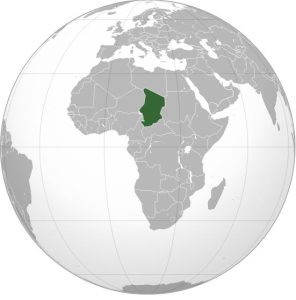
Chad is not a country most people associate with bold diplomatic gestures. Landlocked in north-central Africa, bordered by Libya to the north, Sudan to the east, the Central African Republic to the south, and Cameroon, Nigeria, and Niger to the west and southwest, it sits at the geographic crossroads of West, Central, North, and East Africa — a position that sounds advantageous until you add the context: GDP per capita runs around $1300. The poverty rate stands at approximately 42.3%. Oil dominates the economy, accounting for roughly 40% of government revenue and 70% of exports. Active security threats press in from multiple directions: Boko Haram operates in the Lake Chad basin. The Sudan conflict has pushed hundreds of thousands of refugees across the eastern border. The CAR remains deeply unstable to the south. Chad is not, by any conventional measure, a country with a lot of margin for bold bets.
Which makes the visa announcement all the more analytically interesting.
The Eighth Country, and What That Means
When the policy takes effect on January 1, 2027, Chad will join a growing cohort of African nations extending visa-free entry to all African passport holders — Rwanda, Benin, The Gambia, Seychelles, Ghana, Kenya, and Togo, which quietly implemented its own continent-wide visa-free policy on May 18, 2026, permitting stays of up to 30 days for passport holders who submit a travel declaration through the Togolese government’s online platform at least 24 hours before arrival. The Republic of the Congo (Congo-Brazzaville) announced an identical program scheduled for a January 1, 2027 implementation date, on May 25, 2026 — meaning Chad arrives not as a lone gesture but as part of a coordinated continental wave. The move aligns with the African Union’s Agenda 2063 vision of continental free movement, and it follows the broader momentum of a continent that has been, haltingly and unevenly, dismantling the visa architecture inherited from the colonial period. Togo’s framework — online pre-declaration, 30-day limit, passport plus yellow fever certificate — is currently the only published implementation model available, and it is the closest thing Chad has to a template.
What distinguishes Chad’s announcement from the others is the combination of geography and circumstance. Rwanda’s visa-free push in the 2000’s was backed by a functioning tourist infrastructure, a stable security environment, and a government with a coherent economic diversification strategy. Ghana and Kenya made similar moves from positions of relative institutional strength. Chad has none of those cushions. What it has instead is position — the literal crossroads of the continent — and a president who has decided that position is an asset worth monetizing before anyone else figures out how.
Déby’s framing of Chad as a “gateway connecting West, Central, East, and North Africa” is not hyperbole. It is geography. No other single country touches all four of those regions simultaneously. The Chad-Cameroon pipeline already exports oil to the Atlantic. A landmark MoU signed with the UAE in May 2025 for the long-planned Chad-Cameroon railway aims to give landlocked Chad a multimodal corridor to global markets. The “Chad Connection 2030” development plan, launched in Abu Dhabi, targets $30 billion in investment across oil, mining, and construction. The visa-free policy is not a standalone gesture — it is the people-movement component of a broader infrastructure and investment play that has been quietly assembling for two years.
The Security Question Nobody Is Answering
Here is where the analysis has to be honest, because the cheerful continental-integration framing obscures something that security professionals will notice immediately.
Chad is currently on the United States’ restricted travel list, placed there in early 2025 alongside Afghanistan, Myanmar, and several other countries on grounds of deficient screening, vetting, and historically poor cooperation on deportation of overstaying nationals. Chad responded by suspending visa issuance to American citizens — a reciprocal measure that underlines how strained that particular relationship currently is. In that context, opening to all 54 African passports simultaneously is not merely a regional integration gesture. It is a pointed signal about whose framework for movement and security Chad intends to operate within going forward — and it is not Washington’s.
The more practical security question is what happens at Chad’s actual border crossings on January 2, 2027. The Chadian government announced the policy on July 15, 2026. As of September 2026 — four months later, with four months remaining before implementation — it has published zero operational guidance: no confirmed permitted stay duration, no documentation requirements beyond passport and yellow fever certificate, no processing procedures for land border crossings in a country where many entry points are remote, understaffed, and operating in active security environments. Togo managed its May 2026 implementation with a pre-arrival online declaration requirement and a 30-day stay cap. Chad has announced nothing comparable. The Lake Chad basin is a known operational corridor for Boko Haram and the Islamic State West Africa Province groups. The northern border with Libya is a documented transit route for weapons, fighters, and migrants moving across the Sahara. Opening that border architecture to 54 nations’ passport holders without a published implementation framework is not a trivial administrative challenge — it is an open invitation to anyone who understands that ungoverned entry points are operational assets.
None of this means the policy is necessarily reckless. It means the gap between the announcement and the operational reality needs to close before January 1, 2027, and the clock is running. Every visa-free regime that has worked — Rwanda’s, Kenya’s, Ghana’s, Togo’s — was backed by border infrastructure and published procedures capable of handling the additional movement. Chad’s published framework, as of this writing, consists of a presidential speech. That is not a security architecture. It is a deadline.

Tourism, Trade, and the Long Game
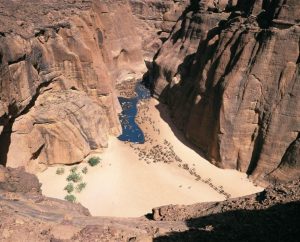
Set the security concerns alongside the economic logic, and Déby’s bet starts to look less impulsive. Chad has genuine natural assets that are almost entirely unknown outside specialist circles: the Ennedi Plateau, a UNESCO World Heritage Site of dramatic sandstone formations and ancient rock art, comparable in visual impact to anything in the American Southwest; Zakouma National Park, one of Central Africa’s most significant wildlife reserves, which has made a documented recovery from poaching devastation to become a functioning safari destination; and Lake Chad itself, a freshwater body whose dramatic shrinkage — from 25,000 square kilometers in the 1960s to under 2,000 today — is one of the most visible climate change stories on the continent, drawing researchers and journalists who currently have to navigate a cumbersome visa process to get there.
None of those assets are currently monetized at anything approaching their potential. The visa barrier is a genuine friction point for all of them — not primarily for Western tourists, who represent a small fraction of African travel markets, but for the intra-African travelers, traders, researchers, and diaspora capital flows that are the real engine of the continent’s internal economic growth. The IMF reported that Nigeria alone moved approximately $59 billion in stablecoin transactions in a single year — money moving informally precisely because formal channels are too costly and too restricted. Visa-free movement is the physical-world equivalent of that same financial logic: reduce friction and watch what moves.
Déby is making a play that is simultaneously about tourism, trade, investment, and geopolitical positioning — a signal to the Gulf partners funding Chad Connection 2030 that he is serious about turning Chad into a hub rather than a corridor. Whether the infrastructure catches up to the ambition in time is the question. Whether the security framework keeps pace with the open border is the more urgent one.
What is not in question is the direction of travel. Chad is not the last landlocked Sahelian country that will make this kind of move. It is, characteristically, the one that did it first and loudest, from the least obvious position. When the word gets out — and it will — the empty parking lot is going to get very interesting very fast.