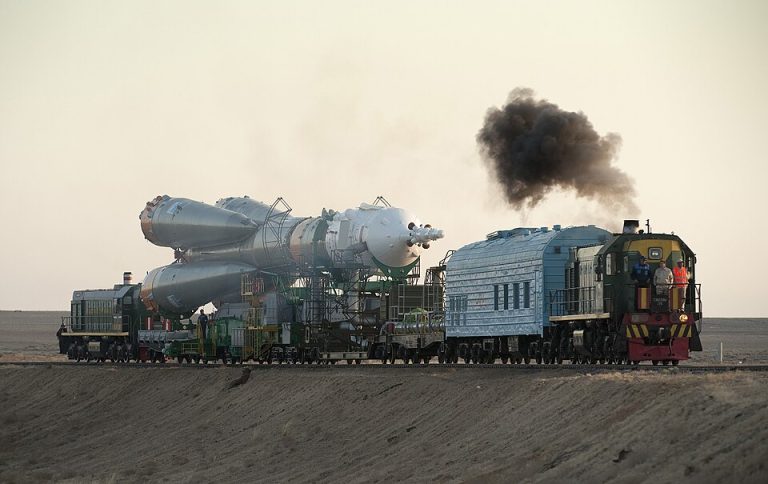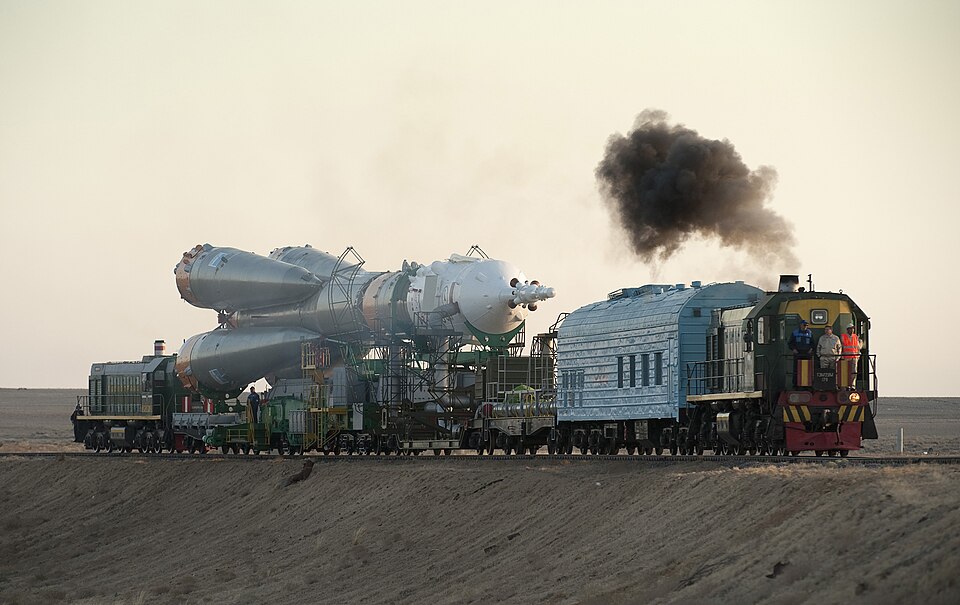

In April 2026, a controlled explosion at the Guiana Space Center in French Guiana brought down a 52-meter service tower that had once guided Russian Soyuz rockets to the launch rail. The demolition was orderly and practical — the European startup MaiaSpace needed the pad cleared for its own rocket — but the symbolism was hard to miss. Russia had walked away from Kourou in February 2022, the day after its tanks crossed the Ukrainian border, abandoning one of the most advantageous launch sites on Earth: 5.2 degrees north latitude, open Atlantic to the east, a velocity boost from equatorial rotation that no high-latitude cosmodrome can replicate. Four years later, the infrastructure was physically erased. The question that follows from that erasure is not sentimental. It is strategic: where does Russia go next for low-latitude launch access — and whether the answer is already taking shape, quietly, in the landlocked heart of the African Sahel.
The Geography Problem Moscow Cannot Solve At Home
The physics of orbital mechanics are indifferent to politics. Rockets launched from near the equator receive a free velocity boost from Earth’s rotation — roughly 465 meters per second at the equator, declining to zero at the poles. For missions to geostationary orbit — the high-altitude band where communications satellites park — this advantage translates directly into payload capacity. A rocket that can lift five tons from an equatorial site might lift four from Baikonur and three from somewhere north of Moscow. The difference is not academic. It is commercial revenue, satellite mass margins, and competitive position in a launch market that Russia has spent decades trying to lead.
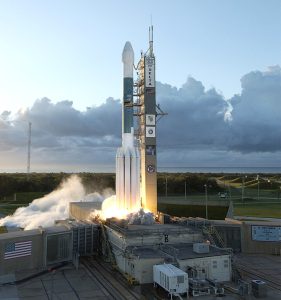
Russia’s domestic cosmodromes offer no equatorial solution. Vostochny, Moscow’s expensive sovereign alternative to Baikonur, sits at 51 degrees north latitude — actually further from the equator than Baikonur itself, and its location in the Far East compounds the problem with transcontinental logistics for heavy hardware. Baikonur, leased from Kazakhstan through 2050, sits at 45.96 degrees north — better, but still far enough from the equator that the payload penalty for GEO missions is significant. Plesetsk, Russia’s northern military launch complex, exists for polar and reconnaissance orbits, not commercial GEO ones. Kourou, at 5.2 degrees north latitude, had been the answer — and between 2011 and 2022, Russia conducted 26 successful launches from the site before the Russian invasion of Ukraine ended the arrangement permanently.
The gap that Kourou’s loss created has not been filled. Moscow knows it. The question is what, if anything, it intends to do about it.
The Existing Footprint
The relationship between Russia and the Alliance of Sahel States — Mali, Burkina Faso, and Niger; the three military juntas that formalized their confederation in 2023 — has moved well beyond the informal patron-client arrangement it resembled two years ago. Africa Corps, the reconstituted successor to Wagner Group, provides security and counterterrorism support across all three countries. Russian weapons, advisors, and political backing have given the juntas a patron willing to ask fewer questions than Paris ever did. What has changed is the institutional architecture around that relationship. A formal “Russia-Sahel Alliance” consultations format now exists, with two completed rounds of foreign-minister level talks — Moscow in April 2025 and Niamey in July 2026, where Russian Foreign Minister Lavrov personally attended and both sides issued a joint statement committing to deepen “military and military-technical cooperation“. A third Russia-Africa summit, expected to include significant AES-specific agreements, is planned for October 2026 in Sochi. This is no longer an emerging relationship. It is an institutionalized one.
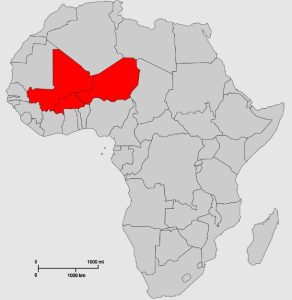
The space dimension has kept pace. In September 2024, officials from Burkina Faso, Mali, and Niger signed an agreement with Roscosmos’s commercial subsidiary Glavkosmos to jointly develop telecommunications and remote sensing satellites, with the Glavkosmos director describing the partnership as “crucially important” for regional security. Niger subsequently went further, signing a specific deal with Glavkosmos for three satellites — a communications satellite, a remote sensing satellite, and a radar satellite — to be manufactured in Russia over four years, with loaner equipment provided in the interim. By January 2026, Russia and Burkina Faso had moved to discussions about launching a dedicated Russian telecommunications satellite configured for the entire AES bloc, with a Russian cosmonaut in attendance at the Ouagadougou meeting — a detail that reads less as ceremonial flourish than as deliberate signaling about who Moscow sends when it wants to communicate seriousness.
What this progression establishes, cumulatively, is a formal Roscosmos presence in AES institutional life: working relationships, shared projects, procurement contracts, and a reason for Russian space engineers and officials to be on the ground in Bamako, Ouagadougou, and Niamey on a recurring basis.
The Speculative Geometry For Building
None of the above constitutes evidence that Russia is planning to build a spaceport in the Sahel. What it constitutes is the scaffolding from which such a project could plausibly grow — and an analytical framework for what the proposition would need to survive contact with reality.
The launch geometry is genuinely favorable. The Sahel sits between roughly 12 and 20 degrees north latitude — not equatorial in the Kourou sense, but substantially better than anything Russia currently operates, and comparable to China’s Wenchang facility at 19 degrees north, which Beijing selected specifically for GEO launch advantage. A launch site in northern Mali or Niger would represent a meaningful improvement over Baikonur for commercial GEO missions, particularly if the broader Ukraine situation eventually settles and Russia seeks to rebuild commercial launch revenues.

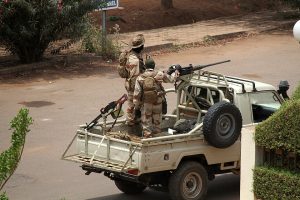
The security architecture for such a project already exists in embryonic form. Africa Corps provides the perimeter force. The satellite cooperation agreements provide the institutional cover and the precedent for Roscosmos personnel on the ground. The AES juntas have both the political will to host a Russian strategic infrastructure project — sovereignty signaling against Western criticism is central to their domestic legitimacy — and the demonstrated pattern of trading resource access for Russian security guarantees.
The obstacles are real and should not be minimized. The Sahel’s insurgency threat is not a peripheral complication; the JNIM attack on Bamako’s airport in September 2024 demonstrated that no fixed installation in Mali is beyond the reach of jihadist groups willing to strike at symbols of state authority. A spaceport is a very large, very fixed, very expensive target. The logistics chain for delivering heavy rocket components to a landlocked Sahelian location — across infrastructure that barely supports current military supply requirements — would challenge even a program not already strained by sanctions and wartime diversion of industrial capacity. Russia’s space program, operating under the same economic pressures that have degraded its military production, is not flush with capital for speculative equatorial ventures.
What Russia has demonstrated historically, however, is patience with infrastructure projects that serve long-term strategic purposes even when the near-term economics are unfavorable. Baikonur was built at enormous cost in a remote Kazakh steppe because Moscow needed sovereign launch capability regardless of what that capability cost. The calculation for a Sahel site is different in the details — a partner state rather than an ex-Soviet territory, an insurgency rather than a Cold War logistics challenge — but the underlying logic is recognizable.
The Precedent No One Wants To Mention
A useful historical reference point is OTRAG, the German private rocket company that attempted to establish a commercial launch facility in Zaire in the late 1970s and briefly in Libya thereafter, operating precisely because equatorial African launch sites offered physics that European territory could not. The project collapsed under political pressure and host-country instability before a single orbital launch was achieved. Russia’s position in the AES is structurally stronger than OTRAG’s was in Mobutu‘s Zaire — the security relationship is deeper, the host governments are more ideologically aligned with Moscow, and the patron’s interest in the project’s survival is direct rather than commercial. But the OTRAG precedent is a useful reminder that the gap between “plausible geometry” and “operational spaceport” is wide, and that African political environments have a long history of consuming infrastructure projects before they reach completion.
What exists today in the AES is less a spaceport than a hypothesis — the convergence of Russian launch access needs, an established Roscosmos footprint, a sympathetic host, and a geography that solves a problem Moscow cannot solve at home. Whether the hypothesis becomes an actual construction project depends on decisions in Moscow that have not been made, funding that has not been committed, and a security environment that remains actively hostile to fixed installations. The Sahel has a way of defeating ambitious foreign projects on the ground even when they make perfect sense on a map. Russia knows this.
Whether that matters in a strategic calculus built on patience and tolerance against long odds remains, for now, an open question.