In August 2026, shortly before the devastating floods on the Tibet-Nepal border, the Chinese Communist Party’s principal theoretical journal — Qiushi, the name translates as “Seeking Truth” — led its latest issue with a speech by Xi Jinping on disaster prevention, paired with five supporting articles on disaster governance. It was, by the journal’s own standards, an unusually heavy thematic commitment. Qiushi is not a policy gazette; it is the organ through which the Party announces its ideological priorities. When disaster management becomes the lead doctrinal story, something more than administrative concern is being communicated. For a Chinese readership steeped in four thousand years of political culture, the signal would have been legible without explanation: the Son of Heaven is worried about the storms.
The Concept The CCP Cannot Name
The “Tianming” — the “Mandate of Heaven” — is the oldest continuous political doctrine in Chinese civilization, and one of the most elegant: Heaven bestows upon a ruler the right to govern, but that right is conditional: A just ruler who governs well, controls floods, ensures harvests, and maintains order retains the mandate. In contrast, a ruler who fails at these tasks loses that mandate — and the evidence of that loss is written not in court intrigues or electoral returns, but in the natural world itself. Floods, droughts, earthquakes, famines, and plagues are not merely disasters in the classical Chinese reading: they are communications. They are Heaven’s commentary on the quality of governance.
The doctrine is explicit about the mechanism. When disasters multiply and compound, when no single calamity but an accumulating cascade of them strikes across a reign, the traditional interpretation is not ambiguous. The Ming Dynasty fell in the seventeenth century against a backdrop of the Little Ice Age, devastating famines, the catastrophic Shaanxi earthquake of 1556 that killed an estimated 830,000 people, and a fiscal system that could no longer respond to any of it. Chinese who lived through that collapse did not need historians to explain what was happening. The natural record was its own indictment.
The Chinese Communist Party is a Marxist–materialist organization that officially repudiates superstition, traditional cosmology, and any framework that locates political authority outside the Party itself. It cannot acknowledge the Tianming. What it cannot escape is the political psychology the doctrine describes — the deep cultural reflex, present in China’s population regardless of official ideology, that connects the quality of governance to the behavior of the natural world. Xi Jinping has, since 2012, encouraged a selective revival of traditional Chinese cultural forms as instruments of national cohesion. He has not revived this one.
He cannot afford to.
The Catalogue
The disaster record of the past eighteen months is not easily dismissed. In the first nine months of 2025 alone, natural disasters claimed 742 lives across China, and caused 217.7 billion yuan — approximately $29.9 billion — in direct economic losses, affecting 55.1 million people. In 2025, a 6.8-magnitude earthquake struck Dingri county in Tibet in January 2025. The July-August period alone accounted for 41 percent of annual fatalities and 48 percent of economic losses, driven by floods and geological disasters concentrated in the north and southwest. The first half of 2025 brought $7.55 billion in direct losses and affected more than 23 million people, with floods accounting for over 90 percent of the damage.
The summer of 2026 did not relent. In July, Typhoon Maysak triggered flooding across Guangxi that killed multiple people, burst a reservoir dam, and caused 40 rivers and waterways to overflow, forcing the evacuation of more than 130,000 residents. Simultaneously, a landslide in Gansu province’s Longnan city killed 21 after burying a hamlet of a mere 33 people. Tornadoes and severe thunderstorms in Hubei killed 11 more. Xi Jinping publicly called for “all-out efforts” to rescue flood victims — a notable departure, observers pointed out, from his predecessors’ more distant disaster posture. Super Typhoon Bavi was tracking toward the eastern coast before the month was out. The cascade was not a single event. It was a season.
The Party’s Next Move
The Qiushi response is the analytically significant element, here. Xi’s April 28 Politburo study session on disaster prevention — an unusual commitment of the Party’s senior collective study mechanism to an emergency management topic — produced a speech that acknowledged China faces a long-term, complex, and severe nature of natural disaster risks and warned that disaster risks must not be allowed to spill into economic, energy, food, and social security. The August publication of that speech as Qiushi’s lead, surrounded by a five-article disaster governance cluster, elevated the subject from administrative priority to ideological doctrine.
Publishing through Qiushi rather than a standard government announcement is a qualitatively different signal. Standard announcements direct ministries. Qiushi addresses the Party as a political organism — it shapes how cadres at every level understand their ideological obligations. Placing disaster resilience in Qiushi tells every Party member in every province that their political standing is now connected to how well they manage floods and landslides. That is not administrative guidance. That is a legitimacy framework being reconstructed in real time.
The reconstruction is necessary precisely because the original one is under pressure. The CCP’s implicit social contract with the Chinese people since 1978 has rested on a materialist bargain: deliver prosperity, and the question of political legitimacy does not arise. That bargain is fraying under the combined pressure of economic slowdown, a real estate sector that has not recovered since the 2021 collapse of the Evergrande Group, youth unemployment that remains structurally elevated, and now a natural disaster catalogue that the state’s own emergency management apparatus is struggling to address at scale.
The Mandate The Party Doesn’t Believe In
The irony that the Tianming framework would identify — and that Xi’s advisors are certainly aware of, whether or not they would use the language, even in private — is structural. The CCP governs a civilization whose political culture was shaped for millennia by the proposition that Heaven communicates through natural events. The Party has spent seven decades telling its population that this is superstition. It has simultaneously spent those same seven decades investing enormous political capital in flood control, drought management, and disaster response — because it understands, at an operational level, exactly what the Tianming doctrine says: that a government’s legitimacy is tested by how it handles the natural world.
Dynasties have risen and fallen on their handling of irrigation and flood control, and natural disasters have been frequently interpreted as nature’s commentary on the quality of governance. Xi Jinping has revived Confucian terminology, traditional ceremony, and historical dynastic imagery as instruments of national cohesion. He has positioned himself as the inheritor of China’s civilizational continuity. In doing so, he has, perhaps unavoidably, also activated the framework that comes with that positioning — including the part that reads compounding natural disaster as political verdict.
Whether the Chinese public reads current events through a Tianming lens in any conscious sense is a question that cannot be answered from outside China’s information environment. What is not in question is that the Party is responding to the disaster catalogue with the urgency of a government that understands the political stakes. The Qiushi issue is the tell. When a materialist party reaches for its ideological journal to address floods, it is not doing emergency management. It is doing legitimacy repair — under a framework it officially disavows, in language it cannot quite bring itself to use.
The Freedomist — Keeping Watch, So You Don’t Have To
In April 2026, a controlled explosion at the Guiana Space Center in French Guiana brought down a 52-meter service tower that had once guided Russian Soyuz rockets to the launch rail. The demolition was orderly and practical — the European startup MaiaSpace needed the pad cleared for its own rocket — but the symbolism was hard to miss. Russia had walked away from Kourou in February 2022, the day after its tanks crossed the Ukrainian border, abandoning one of the most advantageous launch sites on Earth: 5.2 degrees north latitude, open Atlantic to the east, a velocity boost from equatorial rotation that no high-latitude cosmodrome can replicate. Four years later, the infrastructure was physically erased. The question that follows from that erasure is not sentimental. It is strategic: where does Russia go next for low-latitude launch access — and whether the answer is already taking shape, quietly, in the landlocked heart of the African Sahel.
The Geography Problem Moscow Cannot Solve At Home
The physics of orbital mechanics are indifferent to politics. Rockets launched from near the equator receive a free velocity boost from Earth’s rotation — roughly 465 meters per second at the equator, declining to zero at the poles. For missions to geostationary orbit — the high-altitude band where communications satellites park — this advantage translates directly into payload capacity. A rocket that can lift five tons from an equatorial site might lift four from Baikonur and three from somewhere north of Moscow. The difference is not academic. It is commercial revenue, satellite mass margins, and competitive position in a launch market that Russia has spent decades trying to lead.
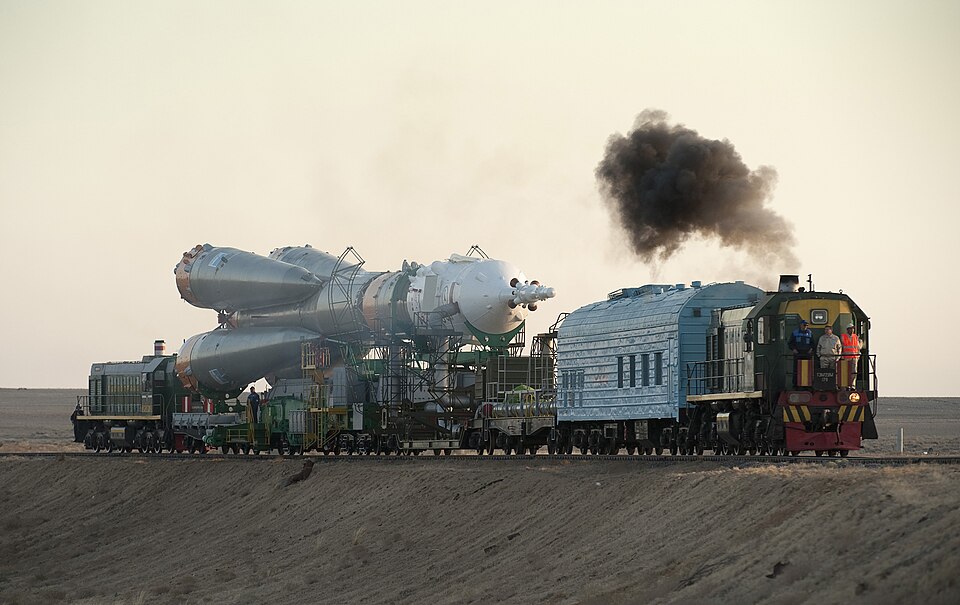
A Delta II rocket launches from Cape Canaveral Air Force Station Space Launch Complex 17B, Florida, carrying NASA’s Dawn probe into space. Photo by NASA/KSC, 27 September 2007. Public Domain.
Russia’s domestic cosmodromes offer no equatorial solution. Vostochny, Moscow’s expensive sovereign alternative to Baikonur, sits at 51 degrees north latitude — actually further from the equator than Baikonur itself, and its location in the Far East compounds the problem with transcontinental logistics for heavy hardware. Baikonur, leased from Kazakhstan through 2050, sits at 45.96 degrees north — better, but still far enough from the equator that the payload penalty for GEO missions is significant. Plesetsk, Russia’s northern military launch complex, exists for polar and reconnaissance orbits, not commercial GEO ones. Kourou, at 5.2 degrees north latitude, had been the answer — and between 2011 and 2022, Russia conducted 26 successful launches from the site before the Russian invasion of Ukraine ended the arrangement permanently.
The gap that Kourou’s loss created has not been filled. Moscow knows it. The question is what, if anything, it intends to do about it.
The Existing Footprint
The relationship between Russia and the Alliance of Sahel States — Mali, Burkina Faso, and Niger; the three military juntas that formalized their confederation in 2023 — has moved well beyond the informal patron-client arrangement it resembled two years ago. Africa Corps, the reconstituted successor to Wagner Group, provides security and counterterrorism support across all three countries. Russian weapons, advisors, and political backing have given the juntas a patron willing to ask fewer questions than Paris ever did. What has changed is the institutional architecture around that relationship. A formal “Russia-Sahel Alliance” consultations format now exists, with two completed rounds of foreign-minister level talks — Moscow in April 2025 and Niamey in July 2026, where Russian Foreign Minister Lavrov personally attended and both sides issued a joint statement committing to deepen “military and military-technical cooperation“. A third Russia-Africa summit, expected to include significant AES-specific agreements, is planned for October 2026 in Sochi. This is no longer an emerging relationship. It is an institutionalized one.
The space dimension has kept pace. In September 2024, officials from Burkina Faso, Mali, and Niger signed an agreement with Roscosmos’s commercial subsidiary Glavkosmos to jointly develop telecommunications and remote sensing satellites, with the Glavkosmos director describing the partnership as “crucially important” for regional security. Niger subsequently went further, signing a specific deal with Glavkosmos for three satellites — a communications satellite, a remote sensing satellite, and a radar satellite — to be manufactured in Russia over four years, with loaner equipment provided in the interim. By January 2026, Russia and Burkina Faso had moved to discussions about launching a dedicated Russian telecommunications satellite configured for the entire AES bloc, with a Russian cosmonaut in attendance at the Ouagadougou meeting — a detail that reads less as ceremonial flourish than as deliberate signaling about who Moscow sends when it wants to communicate seriousness.
What this progression establishes, cumulatively, is a formal Roscosmos presence in AES institutional life: working relationships, shared projects, procurement contracts, and a reason for Russian space engineers and officials to be on the ground in Bamako, Ouagadougou, and Niamey on a recurring basis.
The Speculative Geometry For Building
None of the above constitutes evidence that Russia is planning to build a spaceport in the Sahel. What it constitutes is the scaffolding from which such a project could plausibly grow — and an analytical framework for what the proposition would need to survive contact with reality.
The launch geometry is genuinely favorable. The Sahel sits between roughly 12 and 20 degrees north latitude — not equatorial in the Kourou sense, but substantially better than anything Russia currently operates, and comparable to China’s Wenchang facility at 19 degrees north, which Beijing selected specifically for GEO launch advantage. A launch site in northern Mali or Niger would represent a meaningful improvement over Baikonur for commercial GEO missions, particularly if the broader Ukraine situation eventually settles and Russia seeks to rebuild commercial launch revenues.
The security architecture for such a project already exists in embryonic form. Africa Corps provides the perimeter force. The satellite cooperation agreements provide the institutional cover and the precedent for Roscosmos personnel on the ground. The AES juntas have both the political will to host a Russian strategic infrastructure project — sovereignty signaling against Western criticism is central to their domestic legitimacy — and the demonstrated pattern of trading resource access for Russian security guarantees.
The obstacles are real and should not be minimized. The Sahel’s insurgency threat is not a peripheral complication; the JNIM attack on Bamako’s airport in September 2024 demonstrated that no fixed installation in Mali is beyond the reach of jihadist groups willing to strike at symbols of state authority. A spaceport is a very large, very fixed, very expensive target. The logistics chain for delivering heavy rocket components to a landlocked Sahelian location — across infrastructure that barely supports current military supply requirements — would challenge even a program not already strained by sanctions and wartime diversion of industrial capacity. Russia’s space program, operating under the same economic pressures that have degraded its military production, is not flush with capital for speculative equatorial ventures.
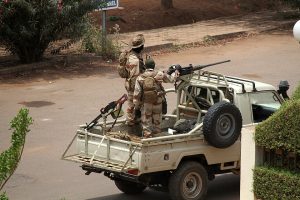
Malian troops stand guard outside Kati Barracks in Bamako, Mali, 31 October 2012. Photo by Magharebia. CCA/2.0 Generic.
What Russia has demonstrated historically, however, is patience with infrastructure projects that serve long-term strategic purposes even when the near-term economics are unfavorable. Baikonur was built at enormous cost in a remote Kazakh steppe because Moscow needed sovereign launch capability regardless of what that capability cost. The calculation for a Sahel site is different in the details — a partner state rather than an ex-Soviet territory, an insurgency rather than a Cold War logistics challenge — but the underlying logic is recognizable.
The Precedent No One Wants To Mention
A useful historical reference point is OTRAG, the German private rocket company that attempted to establish a commercial launch facility in Zaire in the late 1970s and briefly in Libya thereafter, operating precisely because equatorial African launch sites offered physics that European territory could not. The project collapsed under political pressure and host-country instability before a single orbital launch was achieved. Russia’s position in the AES is structurally stronger than OTRAG’s was in Mobutu‘s Zaire — the security relationship is deeper, the host governments are more ideologically aligned with Moscow, and the patron’s interest in the project’s survival is direct rather than commercial. But the OTRAG precedent is a useful reminder that the gap between “plausible geometry” and “operational spaceport” is wide, and that African political environments have a long history of consuming infrastructure projects before they reach completion.
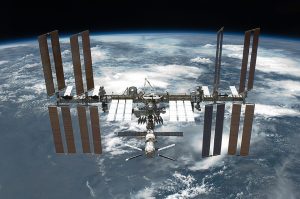
The International Space Station is featured in this image photographed by an crew member on the Space Shuttle Endeavour/STS-134, after their un-docking from the station. NASA photo, 30 May, 2011. Public Domain.
What exists today in the AES is less a spaceport than a hypothesis — the convergence of Russian launch access needs, an established Roscosmos footprint, a sympathetic host, and a geography that solves a problem Moscow cannot solve at home. Whether the hypothesis becomes an actual construction project depends on decisions in Moscow that have not been made, funding that has not been committed, and a security environment that remains actively hostile to fixed installations. The Sahel has a way of defeating ambitious foreign projects on the ground even when they make perfect sense on a map. Russia knows this.
Whether that matters in a strategic calculus built on patience and tolerance against long odds remains, for now, an open question.
The Freedomist — Keeping Watch, So You Don’t Have To
The global arms market has long sorted itself into a predictable hierarchy: the United States and its European partners at the top, Russia and the People’s Republic of China in the middle, and everyone else buying what they can afford from whoever will sell to them. That hierarchy is not collapsing — but it is developing significant cracks. Three Muslim-majority states have built defense industrial bases capable, at varying levels of ambition and success, of competing in that market on something other than price alone: Turkey, Pakistan, and Iran. The three cases share little except religion and the broad definitions of geography. What they share analytically is the common experience of being told, at one point or another, that they couldn’t have what they needed — and deciding to build it themselves.
Turkey Makes The First Leap
The Turkish case is the most dramatic, because the numbers are now difficult to dispute. Turkish defense and aviation exports reached $10.05 billion in 2025, up 48 percent year-on-year — a figure that would have been unimaginable in 2002, when the country’s defense exports stood at $248 million. The growth reflects a deliberate, decades-long state project to reduce dependence on foreign suppliers. The share of domestically produced systems in Turkish defense procurement has now exceeded 80 percent, and Turkey now manufactures two out of every three military unmanned aerial vehicles sold worldwide.
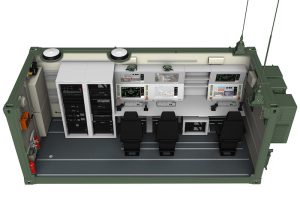
Bayraktar Ground Control Station truck-mounted module cutaway. Image by Bayhaluk. CCA/4.0 Int’l.
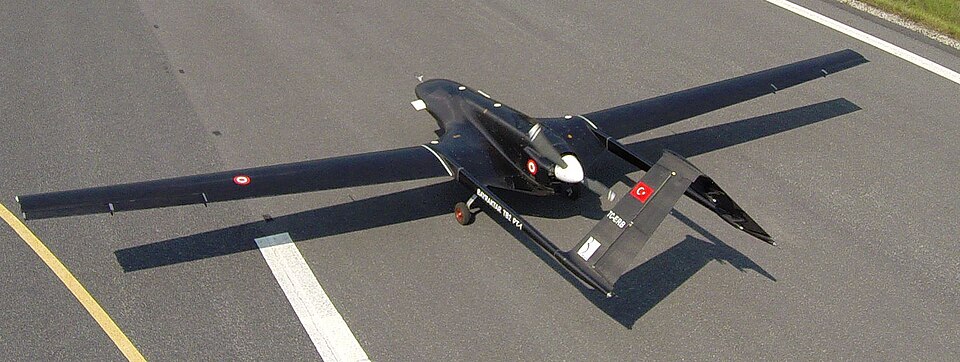
The platform that made Turkey’s name globally is the Bayraktar TB2 drone, which has proved itself in Libya, Azerbaijan, and Ukraine — but Ankara has not been content to remain a drone exporter. Indonesia has signed a contract for 48 KAAN fifth-generation fighters from Turkey in an agreement valued at around $10 billion, and Indonesia also became the first export customer for the Bayraktar Kizilelma unmanned combat aircraft, with deliveries set to begin in 2028. The pivot from tactical drones to stealth combat aircraft represents a qualitative shift — Turkey is no longer competing in the cheap-and-cheerful tier of the arms market. A €2.6 billion contract was signed for the export of 30 HÜRJET aircraft to Spain — which is a notable data point: NATO’s founding members are now buying Turkish military aircraft.
What distinguishes Turkey from the other two cases is the depth of its industrial base. ASELSAN, TUSAS, ROKETSAN, ASFAT, and MKE all appeared in the Defense News Global Top 100 list in 2025 — not one flagship company but five, spanning electronics, airframes, missiles, shipbuilding, and ammunition. Turkey is not exporting a product. It is exporting an ecosystem.
Pakistan’s Combat-Tested Moment
Pakistan’s story is different in character, though the trajectory is similar. For years, Pakistan occupied an awkward middle tier: a nuclear-armed state with modest ambitions in the conventional arms market, but was completely dependent on American F-16’s and whatever China was willing to co-develop. The JF-17 Thunder, a joint venture with the PRC’s Chengdu Aircraft Corporation assembled at the Pakistan Aeronautical Complex in Kamra, was widely categorized as a budget fighter for buyers who couldn’t afford better. That categorization survived until May 2025.
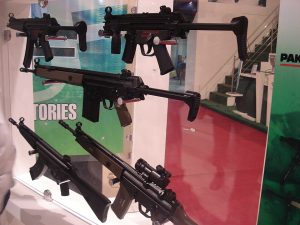
Infantry weapons systems displayed in the exhibition booth of Pakistan Ordnance Factories, 2008. Image by SyedNaqvi90. CCA/3.0 Unported.
The honest caveat is industrial capacity. Pakistan’s ability to produce the JF-17 is limited to roughly 25 units per year, shared between domestic requirements and exports. The pipeline of announced deals — potentially reaching $13 billion — is more ambitious than current production lines can realistically service in the near term. But Pakistan has something it did not have before May 2025: a combat record that export marketing teams can use, in conditions that the buyers who matter most were watching closely.
Iran: The Degraded Pole
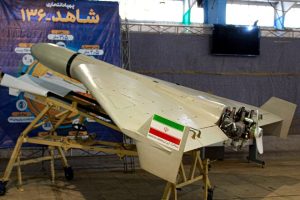
Iran’s case requires the most careful handling. Before February 2026, Iran had assembled one of the more impressive indigenously developed defense industrial bases outside the major powers — remarkable precisely because it was built entirely under sanctions. Despite those restrictions, Iran acquired dual-use technologies through a global network of intermediaries and front companies, with drone components traced to over 70 manufacturers across 13 countries. The Shahed-series loitering munition had become a genuine export product, proliferated to Russia for use in Ukraine and to proxies across the Middle East.
Iranian Shahed-136 combat drone on display, 2023. Image by Behrouz Ahmadi. CCA/4.0 Int’l.
What is not in dispute is the structural damage. Iran’s military industrial base depends on foreign dual-use and commercial items that historically arrived through UAE intermediaries — a route now unlikely to function as before. Iran retains institutional knowledge and engineering personnel. Its own Defense Ministry has stated its intention to restructure and modernize based on lessons from recent conflicts. But reconstitution of physical production infrastructure under expanded sanctions, without access to previous supply chains, is a project measured in years, not months.
As a pole of Muslim defense industrial capability capable in open-market competition, Iran is, for the foreseeable future, off the board.
What The Three Poles Mean
The portrait that emerges is not a single phenomenon but three distinct paths to the same destination: the determination to produce, not merely purchase, military capability. Turkey arrived there through sustained political will and a modernizing industrial policy. Pakistan arrived through a combination of Chinese partnership and an unexpected combat demonstration. Iran arrived through four decades of enforced self-reliance — and has now had much of what it built taken away.
The significance for the global arms market is less about whether any of these three will displace Lockheed Martin or Rheinmetall in the near term than about what they represent for the buyers at the lower end of the defense procurement food chain. Countries that cannot afford Western prices, cannot accept Western conditions, or cannot obtain Western approval now have more options than they did ten years ago.
That menu is expanding — even with one of its major entries temporarily removed from it.
The Freedomist — Keeping Watch, So You Don’t Have To
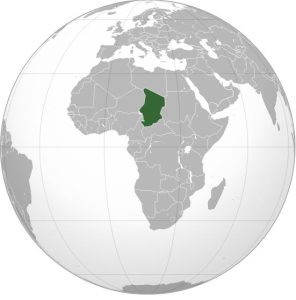
Chad is not a country most people associate with bold diplomatic gestures. Landlocked in north-central Africa, bordered by Libya to the north, Sudan to the east, the Central African Republic to the south, and Cameroon, Nigeria, and Niger to the west and southwest, it sits at the geographic crossroads of West, Central, North, and East Africa — a position that sounds advantageous until you add the context: GDP per capita runs around $1300. The poverty rate stands at approximately 42.3%. Oil dominates the economy, accounting for roughly 40% of government revenue and 70% of exports. Active security threats press in from multiple directions: Boko Haram operates in the Lake Chad basin. The Sudan conflict has pushed hundreds of thousands of refugees across the eastern border. The CAR remains deeply unstable to the south. Chad is not, by any conventional measure, a country with a lot of margin for bold bets.
Which makes the visa announcement all the more analytically interesting.
The Eighth Country, and What That Means
When the policy takes effect on January 1, 2027, Chad will join a growing cohort of African nations extending visa-free entry to all African passport holders — Rwanda, Benin, The Gambia, Seychelles, Ghana, Kenya, and Togo, which quietly implemented its own continent-wide visa-free policy on May 18, 2026, permitting stays of up to 30 days for passport holders who submit a travel declaration through the Togolese government’s online platform at least 24 hours before arrival. The Republic of the Congo (Congo-Brazzaville)announced an identical program scheduled for a January 1, 2027 implementation date, on May 25, 2026 — meaning Chad arrives not as a lone gesture but as part of a coordinated continental wave. The move aligns with the African Union’sAgenda 2063 vision of continental free movement, and it follows the broader momentum of a continent that has been, haltingly and unevenly, dismantling the visa architecture inherited from the colonial period. Togo’s framework — online pre-declaration, 30-day limit, passport plus yellow fever certificate — is currently the only published implementation model available, and it is the closest thing Chad has to a template.
What distinguishes Chad’s announcement from the others is the combination of geography and circumstance. Rwanda’s visa-free push in the 2000’s was backed by a functioning tourist infrastructure, a stable security environment, and a government with a coherent economic diversification strategy. Ghana and Kenya made similar moves from positions of relative institutional strength. Chad has none of those cushions. What it has instead is position — the literal crossroads of the continent — and a president who has decided that position is an asset worth monetizing before anyone else figures out how.
Déby’s framing of Chad as a “gateway connecting West, Central, East, and North Africa” is not hyperbole. It is geography. No other single country touches all four of those regions simultaneously. The Chad-Cameroon pipeline already exports oil to the Atlantic. A landmark MoU signed with the UAE in May 2025 for the long-planned Chad-Cameroon railway aims to give landlocked Chad a multimodal corridor to global markets. The “Chad Connection 2030” development plan, launched in Abu Dhabi, targets $30 billion in investment across oil, mining, and construction. The visa-free policy is not a standalone gesture — it is the people-movement component of a broader infrastructure and investment play that has been quietly assembling for two years.
Orthographic map of Chad. 2011 map by Everest700. Public Domain.
The Security Question Nobody Is Answering
Here is where the analysis has to be honest, because the cheerful continental-integration framing obscures something that security professionals will notice immediately.
Chad is currently on the United States’ restricted travel list, placed there in early 2025 alongside Afghanistan, Myanmar, and several other countries on grounds of deficient screening, vetting, and historically poor cooperation on deportation of overstaying nationals. Chad responded by suspending visa issuance to American citizens — a reciprocal measure that underlines how strained that particular relationship currently is. In that context, opening to all 54 African passports simultaneously is not merely a regional integration gesture. It is a pointed signal about whose framework for movement and security Chad intends to operate within going forward — and it is not Washington’s.
The more practical security question is what happens at Chad’s actual border crossings on January 2, 2027. The Chadian government announced the policy on July 15, 2026. As of September 2026 — four months later, with four months remaining before implementation — it has published zero operational guidance: no confirmed permitted stay duration, no documentation requirements beyond passport and yellow fever certificate, no processing procedures for land border crossings in a country where many entry points are remote, understaffed, and operating in active security environments. Togo managed its May 2026 implementation with a pre-arrival online declaration requirement and a 30-day stay cap. Chad has announced nothing comparable. The Lake Chad basin is a known operational corridor for Boko Haram and the Islamic State West Africa Province groups. The northern border with Libya is a documented transit route for weapons, fighters, and migrants moving across the Sahara. Opening that border architecture to 54 nations’ passport holders without a published implementation framework is not a trivial administrative challenge — it is an open invitation to anyone who understands that ungoverned entry points are operational assets.
None of this means the policy is necessarily reckless. It means the gap between the announcement and the operational reality needs to close before January 1, 2027, and the clock is running. Every visa-free regime that has worked — Rwanda’s, Kenya’s, Ghana’s, Togo’s — was backed by border infrastructure and published procedures capable of handling the additional movement. Chad’s published framework, as of this writing, consists of a presidential speech. That is not a security architecture. It is a deadline.
Tourism, Trade, and the Long Game
Set the security concerns alongside the economic logic, and Déby’s bet starts to look less impulsive. Chad has genuine natural assets that are almost entirely unknown outside specialist circles: the Ennedi Plateau, a UNESCO World Heritage Site of dramatic sandstone formations and ancient rock art, comparable in visual impact to anything in the American Southwest; Zakouma National Park, one of Central Africa’s most significant wildlife reserves, which has made a documented recovery from poaching devastation to become a functioning safari destination; and Lake Chad itself, a freshwater body whose dramatic shrinkage — from 25,000 square kilometers in the 1960s to under 2,000 today — is one of the most visible climate change stories on the continent, drawing researchers and journalists who currently have to navigate a cumbersome visa process to get there.
A steep-walled canyon on the Ennedi Plateau in Chad, with A large group of camels approach a waterhole. 2000 photo by “Desertman”. CCA/3.0 Unported.
None of those assets are currently monetized at anything approaching their potential. The visa barrier is a genuine friction point for all of them — not primarily for Western tourists, who represent a small fraction of African travel markets, but for the intra-African travelers, traders, researchers, and diaspora capital flows that are the real engine of the continent’s internal economic growth. The IMF reported that Nigeria alone moved approximately $59 billion in stablecoin transactions in a single year — money moving informally precisely because formal channels are too costly and too restricted. Visa-free movement is the physical-world equivalent of that same financial logic: reduce friction and watch what moves.
Déby is making a play that is simultaneously about tourism, trade, investment, and geopolitical positioning — a signal to the Gulf partners funding Chad Connection 2030 that he is serious about turning Chad into a hub rather than a corridor. Whether the infrastructure catches up to the ambition in time is the question. Whether the security framework keeps pace with the open border is the more urgent one.
What is not in question is the direction of travel. Chad is not the last landlocked Sahelian country that will make this kind of move. It is, characteristically, the one that did it first and loudest, from the least obvious position. When the word gets out — and it will — the empty parking lot is going to get very interesting very fast.
The Freedomist — Keeping Watch, So You Don’t Have To
Supply and commodity trading is boring stuff…Right?
The “Law of Unintended Consequences” is a very real thing. Many people, however, refuse to see them when they appear…and sometimes, they refuse to acknowledge it amid the wreckage of their error. To his credit, John F. Kennedy did acknowledge this – albeit parsed for public consumption – when he said, in the aftermath of the disaster that was the Bay of Pigs, “Victory has a thousand fathers, but defeat is an orphan.”
When we covered the opening weeks of Operation Epic Fury in March, in our monthly subscription edition, we flagged a supply chain casualty that most of the financial press was too focused on crude oil to notice: sulphur.
We noted that a Hormuz closure extending beyond 30 days would begin to bite into agricultural input supply chains, drive spot sulphur prices sharply upward, and extend inflationary effects well beyond the energy sector into global food commodity markets. We were right – and the situation has since become considerably more complicated than even that analysis anticipated.
And this is, in fact, what actually happened.
Commercial vessels in the Persian Gulf near Hormuz Island, Iran. 2011 photo by ninara. CCA/2.0 Generic.
The Invisible Commodity
Sulphur is not a commodity that generates headlines under normal circumstances. It does not trade on the nightly news. Most people could not tell you what it is used for, beyond a vague association with volcanoes and the smell of struck matches. That invisibility is precisely what makes it dangerous as a supply chain vulnerability.
Sulphuric acid – the primary derivative of elemental sulphur – is the most widely produced industrial chemical in the world. It is not an exaggeration to call it the nervous system of industrial civilization. It is the essential reagent for processing phosphate rock into the fertilizers – MAP, DAP, SSP and TSP – that sustain the yield levels modern agriculture depends on. It is a critical processing agent for copper, nickel, and the battery metals that underpin the energy transition. It is used in steel production, petroleum refining, pharmaceutical manufacturing, and water treatment. When sulphur supply tightens, the consequences do not stay in one sector.
They cascade.
The Strait of Hormuz carries approximately 45-50% of global seaborne sulphur trade. Saudi Arabia and the UAE are the dominant exporters, with Qatar contributing significantly as a byproduct of its LNG operations. When the strait effectively closed in late February 2026, that flow stopped – approximately 4 million metric tons of sulphur per year, originating from Iranian, Qatari, and UAE export terminals, were cut off from world markets.
But How Bad Is The Disruption, Really?
Before going any further, it is worth establishing what “closed” actually means in practice – because the picture is more nuanced than the headlines suggest, and the nuance matters for understanding how long the sulphur crisis persists.
Maritime shipping analysts tracking tanker movements through Kpler data estimates that actual Hormuz transits peaked recently at roughly 7.5 million barrels of oil per day equivalent on a seven-day rolling basis – against a pre-war flow of approximately 20 million barrels per day. Rerouting through Saudi pipelines to Yanbu and UAE facilities at Fujairah adds perhaps 4 million barrels per day of incremental bypass capacity. The net picture, properly benchmarked against total pre-war Middle Eastern outflow of approximately 23 million barrels per day, puts the region running at just over 50% of pre-war export levels.
Complicating the picture further: tanker AIS tracking data is being actively gamed. Ships are running dark – disabling their automatic identification systems – making real-time flow estimates inherently uncertain. What satellite imagery of loading docks can confirm is that the disruption is real and sustained, regardless of what official statements claim. CENTCOM reported on August 14th that U.S. forces had redirected 62 commercial vessels and boarded two to ensure compliance with the blockade. The UAE’s ADNOC shipping line reported two vessels attacked within a single week.
The Houthi dimension adds a further layer. Saudi oil rerouted through Yanbu and heading toward Asia must transit the Bab el-Mandeb – where Houthi forces, operating in conjunction with Iranian interests, are now targeting Saudi-linked vessels specifically. Tanker transits through Bab el-Mandeb have fallen approximately 40%, with more vessels running dark. The bypass route that was supposed to partially compensate for Hormuz is itself under attack.
What began as a Hormuz disruption rapidly evolved into something considerably more severe, because two major sulphur exporters seized the moment to protect their own domestic supply chains.
On April 10, China announced a full export ban on sulphuric acid through August 2026 – replacing a 700,000-ton annual quota with a complete cessation. China is the world’s largest sulphuric acid exporter, with Chile, Indonesia, and Saudi Arabia as its primary markets. Chile uses it for copper solvent extraction. Indonesia uses it for high-pressure acid leach nickel processing. Saudi Arabia and India use it for fertilizer production and industrial applications. The Chinese ban effectively removed a critical secondary supply option precisely when buyers most needed it.
The price response was swift and severe. Spot prices for granular sulphur FOB Arabian Gulf jumped from $80-90 per ton to $160 per ton in the first week of April alone, according to Argus Media data. Fertilizer costs overall are projected to rise more than 30% in 2026, according to the World Bank’s April Commodity Markets Outlook.
The Fertilizer Cascade
The downstream consequences for agriculture are where the sulphur story intersects with food security in ways that deserve serious attention.
Urea prices – the bellwether of nitrogen fertilizers – roughly doubled in a matter of weeks following the strait closure, jumping from $400-490 per metric ton to over $850 per metric ton in April 2026, before softening somewhat as China lifted its separate urea export ban and northern hemisphere spring application demand eased]. Diammonium phosphate prices climbed from approximately $580 to around $770 per metric ton. Indian and Brazilian phosphate fertilizer producers, facing shortages of sulphuric acid, reduced operating rates by 15-20%.
Brazil’s exposure deserves particular attention. The country imports more than 80% of its fertilizers and relies heavily on Gulf sources now blocked by the strait closure. Brazil is the world’s third-largest agricultural exporter – its soy, corn, and sugar output affects food prices globally. A sustained reduction in Brazilian fertilizer access does not stay in Brazil.
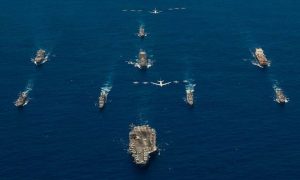
The aircraft carrier USS Ronald Reagan (CVN 76) leads a formation of Carrier Strike Group (CSG) 5 ships as U.S. Air Force B-52 Stratofortress aircraft and U.S. Navy F/A-18 Hornets pass overhead; 2018 U.S. NAVY photo. Public Domain.
Morocco’s OCP Group – the world’s largest phosphate producer and exporter, a company that underpins fertilizer supply for much of Africa and Asia – was already operating under sulphur supply constraints before February 28, following production outages at a major Qatar LNG facility in H2 2025. The Hormuz closure found OCP with sub-optimal sulphur inventory and no easy alternative supply source. The knock-on effects for African agricultural input availability are not yet fully visible in the data, but they are coming.
The domestic picture for U.S. readers is more reassuring than the global picture, but the country is not entirely insulated. Approximately 54% of U.S. sulphur output is recovered at Gulf Coast refineries in Louisiana and Texas – a domestic supply source entirely independent of Hormuz transit. That physical insulation is real and significant.
However, approximately 17% of U.S. urea consumption and roughly 20% of U.S. phosphate consumption originate from Gulf exporters whose shipments must transit the strait. Trade policy decisions in recent years – countervailing duties on Moroccan fertilizers, export restrictions from China – had already concentrated U.S. phosphate sourcing toward Saudi suppliers now blocked by the Hormuz closure. American farmers planting spring crops faced higher input costs at precisely the moment the strait closed. The global market sets prices regardless of where the physical supply originates, and international tightness exerts upward pressure on domestic prices even for buyers who can source locally.
The Structural Gap Nobody Wants To Talk About
The 2026 disruption has confirmed something that commodity analysts have warned about for years and policymakers have consistently declined to address: sulphur has no internationally coordinated strategic reserve. No emergency release mechanism exists. When the International Energy Agency (IEA) convenes member states to coordinate a strategic petroleum release, there is an institutional architecture to do that. When the sulphur supply collapses, there is no equivalent.
Oil has the IEA. Natural gas has emergency sharing agreements within the EU. Sulphur – the feedstock for the fertilizer that feeds the world – has nothing.
The East Asia Forum‘s July 2026 analysis identified the compounding factors with precision: geographic bottlenecks, by-product dependence – most sulphur is a byproduct of oil and gas processing, not a primary product – and policy control combine to amplify disruption across global production networks in ways that are structurally difficult to hedge against. When the by-product source is disrupted at the same time the major exporting nations choose to restrict trade, there is no lever to pull.
Now add a U.S. president posting maps of the strait labeled “New US Territory” while ceasefire negotiations flounder, a June memorandum of understanding between Washington and Tehran expiring with no final deal in place, and Houthi forces actively interdicting the primary bypass route. The resolution timeline that commodity markets were pricing in three months ago is no longer visible.
And, hysterical cheerleading to the contrary, maneuvers around the strait have not “reopened” it.
So – How Did We Get Here?
Military service, generally speaking, tends to impart a healthy skepticism in veterans, especially those who have been in combat, because those veterans get to see the immediate impact of poor decision-making ability among politicians. This tends, by extention, to make veterans with those experiences who become politicians wary of both jumping into warfare, but equally wary of allowing problems to masticate, because that tends to evolve into a kind of “cultural gangrene“.
It is important to remember that this is not an absolute – both John F. Kennedy’s and Jimmy Carter’s military experience failed them, rather spectacularly, especially in Carter’s case.
With that in mind, it is equally important to understand that from 1945 to 2026, only four US Presidents have not had some form of military service in their resumes: Bill Clinton (1993-2001), Barack Obama (2009-2017), Joe Biden (2021-2025)…and Donald Trump (2017-2021, and 2025-Present). Studying these Presidents’ various administrations from a military standpoint reveal very uneven decision-making capacities.
The reasons for these situations are many, and we could spend the next few months arguing specifics but that fact is that, strategically speaking, the performance of the United States over the past c.35 years has been…”underwhelming” is a fair term.
In regards to the Strait of Hormuz – the center of the current sulphur crisis – the problem can be laid squarely at the feet of Jimmy Carter, who preferred that the then-Shah of Iran, Muhammad Reza, be deposed and replaced by – of all people – the Ayatollah Khomeini. As a result, for nearly five decades, a cancer of a terrorist state being funded by stupendous oil profits to fester and metastasize into a cancer that endangers human civilization across the board.
For Donald Trump, the problem is different. Trump inherited the disasters left him by over forty years of objectively terrible leadership, and the allowance of the rise of an increasingly open corporate oligachy that runs the country, an oligarchy that is perfectly fine with the nationa’s foundations being destroyed entirely, if it makes their quarterly numbers look good.
Militarily, however, this translates into a particularly virulent form of brain cancer: the Toffler Effect.
Donald Trump, despite the breathless and hysterical screeds of abysmally educated and/or self-deluded “NPC’s“, is not a stupid person. Quite the opposite. However, with no grounding in actual military thinking, it appears that Trump has been misadvised on how to handle the Iran situation, in a way that is very attractive on its surface.
First, it appears that there was little, if any, pre-planning about how to actually deal with removing the openly psychotic and bloodthirsty terrorist regime ruling from Tehran. This means that when the Iranian Rial collapsed in December of 2025, Trump and his advisers jumped at the chance to undermine the regime, even if they had to “wing it”, and come up with a plan on the fly.
Fine – that’s not an optimal way of doing things, but it can be made to work…Except that this is where Toffler meets Billy Mitchell.
Brigadier General William “Billy” Mitchell was one of the early cheerleaders for what is now termed “strategic bombing”, the notion that air power alone can win wars. This frankly bizarre view has persisted since the 1930’s, despite repeated examples of its complete and utter failure…But for Trump, the airpower solution – aided by naval missile fires – is highly seductive.
If the regime in Tehran could be toppled solely through the United States and Israel using only airpower, that was an ideal solution: there would be no videos of US ground troops storming mud-walled compounds in the Iranian interior, with goats running for their lives, and the bodies of children caught in the crossfire – the sorts of images that the mainstream media froths at the mouth over, trying to skew the context to match their internal political narrative. Likewise, although air crews – both pilots, ground crew and missile defense troops – might be killed and wounded in action, the numbers would be comparatively tiny, compared to infantry companies having to fight house-to-house, potentially taking World War 2-scale casualties in the process.
Low-brow/low-information types (which really is a fair characterization) occasionally pontificate that the Iranian people need to “rise up and overthrow” the IRGC and the mullahs on their own…completely ignoring the fact that they tried that – and on January 8th and 9th, the IRGC promptly massacred over 36,000 of them in 48 hours. Passion and harsh language are a poor match for a DShK.
The problem with this, as has been shown clearly, is that airpower alone has not, can not, and will never win wars on their own. Without “boots on the ground” – be those boots American, non-terrorist Iranian, or otherwise – victory is impossible. Bombs can be dropped and missiles can be fired, but victoryis impossible.
Another aspect of this is the utterly rampant Dunning-Kruger Effect that is rotting (primarily) Western minds. Dunning-Kruger, simply put, is the effect of people with little to no experience or knowledge of a subject being convinced that they are, in fact, very competent in that sphere.
While it may seem like a cliche, in the case of Trump’s war on the terror regime in Tehran, this translates into Dunning-Kruger being formulated by video games, and breathless war documentaries: Call of Duty, World of Tanks/Warships, and more. While the effects produced by these games are certainly not uniform, they do impact public discourse…which, in turn, impacts politicians who are equally susceptible to Dunning-Kruger, and the public fawning when said politician agrees with the “TikTok PhD’s“.
As just one example, many people are convinced that the first Gulf War/Desert Storm “was won in 100 hours“. Nothing could be further from the truth. Desert Shield/Desert Storm took 7 months, from August 7, 1990, to February 28, 1991. “Combat operations” actually began on January 19, 1991…And yet, “keyboard commandos” almost literally froth at the mouth if anyone dares to disagree with the “100 Hour” gospel.
We don’t even need to discuss the Dunning-Kruger disconnect between the US march on Baghdad in 2003 and Russia’s march on Kiev in 2022.
And worse – the enemies of the United States are all watching US combat operations in the Persian Gulf/Arabian Sea verycarefully, measuring what we are actually capable of doing in a short-term, short-planning window environment…and the look on our side is not good.
As a result, the Strait of Hormuz has been functionally closed since early-March of 2026. This does not overly impact the United States directly, but it is about to. It is already impacting the wider world…
…And there is no clear exit, for any side.
The Strait of Hormuz is not just an oil issue. It is not just a gas issue. It is, as the fertilizer industry has now learned at considerable cost, a food issue – and the mechanisms to manage that risk, at every level from strategic reserves to diplomatic architecture, do not yet exist.
The Freedomist — Keeping Watch, So You Don’t Have To
The headline writes itself and is almost entirely misleading: three countries in West Africa’s Sahel have been seized by military coups, expelled French and American forces, turned to Russia for security partnerships, and formed a new political confederation outside the framework of the region’s established institutions. Read that sentence in isolation and the conclusion seems obvious — failed states, Russian proxies, chaos compounding chaos.
France staged a masterful rapid intervention to rescue the nation of Mali in 2013…but seven years later, the honeymoon ended in a very nasty – and very public – divorce.
The analytical picture on the ground is considerably more complicated, and understanding it matters, because the Alliance of Sahel States — the AES, comprising Mali, Burkina Faso, and Niger — is not what most Western coverage has made it out to be.
The wave of military takeovers that produced the AES did not emerge from a vacuum. Mali experienced coups in August 2020 and again in May 2021. Burkina Faso experienced two in 2022 alone, with Army Captain Ibrahim Traoré consolidating power in September of that year. Niger’s military removed President Mohamed Bazoum in July 2023. In each case, the military’s public justification was the same: the civilian government had failed to contain the jihadist insurgencies consuming the country’s territory, and French forces — present under Operation Barkhane and its predecessor missions since 2013 — had failed alongside them.
Burkina Faso President Captain Ibrahim Traoré, 2025. Image from RIA Novosti archive, image # / CC-BY-SA 3.0
That justification deserves scrutiny rather than dismissal. Despite the success of Operation Serval, French counterinsurgency strategy in the Sahel had produced a decade of inconclusive results despite significant resources, considerable French casualties, and the deployment of sophisticated ISR and strike assets that no Sahelian government could replicate independently. Operation Barkhane at its peak deployed approximately 5,100 French troops across five countries; JNIM and the Islamic State Sahel Province continued to expand their territorial control, increase their attack tempo, and grow their recruitment base throughout the same period. The populations of Mali, Burkina Faso, and Niger drew conclusions from that evidence. The coup leaders articulated those conclusions in the language of sovereignty rather than counterinsurgency doctrine, but the underlying assessment was not irrational.
What the departing French and American presence also represented, in a less discussed dimension, was a set of political constraints on how the AES governments could fight. Western counterinsurgency doctrine emphasizes civilian protection, human rights compliance, and governance reform alongside kinetic operations. Those emphases were not merely theoretical for the civilian governments that preceded the juntas — they were tied to aid flows, political recognition, and the terms on which French forces operated. The juntas removed those constraints. Whether what replaced them is better or worse for the populations of the Sahel is a genuinely open question; that the constraints existed and shaped operations is not.
The Economic Factor
The AES governments’ accusations that France colluded with or tacitly enabled jihadist groups in the Sahel have been widely dismissed in Western media as Russian-amplified disinformation. A French court ruling handed down on April 13, 2026 however, makes that dismissal considerably harder to sustain.
On that date, the Paris Criminal Court found Lafarge — the French cement giant now part of Swiss conglomerate Holcim — and four former executives guilty of financing terrorism. The conviction rested on documented payments totaling approximately €5.5 million made between 2013 and 2014 through Lafarge’s Syrian subsidiary to armed groups including the Islamic State and the al-Nusra Front, in order to keep the company’s Syrian cement plant operational during the civil war. Lafarge had already pleaded guilty in the United States in 2022, paying $778 million in fines and forfeitures to the US Justice Department for conspiring to provide material support to designated terrorist organizations. The Paris court imposed the maximum available corporate fine and sentenced the former executives to prison terms ranging from three to six years. A separate charge of complicity in crimes against humanity remains under investigation.
The Lafarge case does not prove that the French government directed or approved payments to jihadist groups. What it establishes is that a major French corporate entity — operating in a conflict zone where French military and intelligence assets were also present — paid jihadist organizations to protect its commercial operations, and that French institutional and legal processes took the better part of a decade to bring the company to account. The AES governments have not made the careful distinction between corporate and state culpability. Neither, in many cases, have their populations.
The economic dimension of France’s Sahelian presence is not peripheral to this story — it is, by any honest accounting, central to it. France generates approximately 70% of its electricity from nuclear power, and Niger was, until recently, its second-largest supplier of uranium, providing roughly 20% of French uranium imports over the past decade. That uranium came primarily from the Somair mine operated by Orano — a company majority-owned by the French state. Following Niger’s 2023 coup and the expulsion of French forces, the junta in Niamey revoked Orano’s license for the Imouraren deposit — estimated to hold 200,000 tons of uranium reserves — and by December 2024 had taken operational control of Somair itself, effectively nationalizing France’s primary nuclear fuel source in West Africa.
Mali has been equally direct about the economic reordering. The Malian government placed Barrick Gold‘s Loulo-Gounkoto gold complex under state administration in a tax dispute and detained the CEO of Australia’s Resolute Mining until the company agreed to a $160 million settlement. Mali’s military government states that its renegotiated mining contracts and royalty enforcement have generated over 700 billion CFA francs — approximately $1.2 billion — in additional state revenue. Gold mining accounts for roughly a quarter of Mali’s budget; the previous arrangements, negotiated under civilian governments with French backing, returned a substantially smaller share to the Malian state.
Essakane Mine in Burkina Faso. From iamgold.com. CCA/3.0 Unported.
The picture that emerges from these facts, taken together, is not one of ideologically pure anti-jihadist governance. It is one of sovereign governments — however imperfect their democratic credentials — reasserting control over natural resources that had been structured, over decades of post-independence arrangements, to benefit external corporate and state interests more than the populations sitting on top of them. Whether the AES juntas will deploy that recovered revenue effectively against the jihadist threat is a separate and still-open question. That the revenue was being extracted at terms unfavorable to the host nations, and that French military presence served as a guarantor of those terms regardless of its stated counterinsurgency mission, is now a matter of documented record rather than junta propaganda.
The AES – An Emerging Security Architecture
The Alliance of Sahel States was formally constituted through the Liptako-Gourma Charter in September 2023, initially as a mutual defense pact — an explicit response to ECOWASthreats of military intervention to restore civilian governance in Niger. The three states withdrew from ECOWAS formally in January 2025, and signed a Confederation Treaty in July 2024 that deepened the alliance’s institutional structure. On December 20, 2025, at a ceremony at an air base in Bamako, the AES inaugurated its Unified Force — the FU-AES — an initial force of approximately 5,000 troops drawn from all three armies, placed under the command of Burkinabe General Daouda Traoré and headquartered in Niamey. The April 2026 summit expanded the planned force to 15,000.
This is the third attempt to build a joint security mechanism for the central Sahel. The Multinational Joint Task Force announced in January 2017 never effectively materialized. The G5 Sahel Joint Force, established in July 2017 with French support and including Mauritania and Chad alongside the three AES states, collapsed when Mali withdrew in 2022 and the others followed. The AES Unified Force differs from both predecessors in one critical respect: it is explicitly designed to operate without Western donor funding, without French logistical support, and without the political conditionalities that accompanied both. Whether it can be sustained at scale on that basis is the central unresolved question.
Russian engagement has partly filled the gap. Africa Corps — the restructured successor to Wagner Group following Yevgeny Prigozhin’s death in August 2023 — has deployed personnel to Mali, Burkina Faso, and Niger, providing presidential guard services, counterinsurgency support, training, and hardware including helicopters, drones, and armored vehicles. Mali and Niger have also signed agreements with Roscosmos for telecommunications and surveillance satellites. The AES-Russia relationship is not an alliance of equals — Russia brings assets the AES cannot generate domestically, and the AES provides basing, political cover, and African legitimacy for Russian influence projection — but it is a functioning working arrangement, a meaningful difference from France’s openly neo-colonialist operations.
The Honest Accounting
Western analytical assessments of the AES have tended toward pessimism, and not without foundation. The ISS Africa analysis published in March 2026 noted plainly that by mid-2026, the core justification for the coups — that the juntas could succeed where civilian governments had failed — has not been settled. Jihadist territorial control in Burkina Faso is estimated at approximately 60% of the country’s land area; this should not, however, be assumed to equal the country’s population under jihadist control, given the nation’s population density of 90 per square kilometer (233 per square mile). JNIM’s attack lethality has increased year-on-year throughout the junta period. The April 25, 2026 assault on Kidal and the simultaneous car bombing at Kati that killed Mali’s Defense Minister represented a significant jihadist operational success against the AES and its Russian partners, occurring after the FU-AES had been formally activated.
Malian soldiers conduct close quarter battle drills in Ouagadougou, Burkina Faso on Feb. 26, 2019, as part of Flintlock 2019 exercise scenarios. U.S Army photo by Spc. Peter Seidler. Public Domain.
The counterargument — and it is a real one — is that the comparison baseline matters enormously. The AES governments inherited security situations that French-backed civilian governments had failed to stabilize over a decade, with deteriorating trajectories already established before the coups occurred. The relevant question is not whether the AES is winning, but whether it is performing better or worse than its predecessors given the same underlying conditions. That counterfactual is difficult to construct cleanly, and Western analysis has been slow to attempt it seriously, in part because the political incentives run toward emphasizing junta failure.
What is observable rather than inferential is this: the AES has demonstrated genuine political cohesion that neither the G5 Sahel nor any previous regional framework managed. When JNIM and the FLA struck on April 25, all three AES governments responded within hours with joint airstrikes in Malian territory — the Niger government explicitly welcoming “the prompt and vigorous response of the units of the unified force.” The FU-AES commander is Burkinabe, the headquarters is in Niger, and the force draws from all three armies. The institutional solidarity, at least, is functioning. The April summit expansion of the planned force from 5,000 to 15,000 signals that the member governments regard the Unified Force as viable enough to scale.
The AES is not winning its war, at least not quickly, and certainly not “cleanly”. But it is also not the simple story of junta incompetence and Russian exploitation implied by much of Western media coverage. It is three countries with legitimate sovereignty, genuine security problems that preceded their current governments, and a functional if fragile regional architecture, all trying to develop indigenous solutions to a problem that externally-backed approaches failed to solve. The complexity of that situation is not a reason to withhold analytical judgment. It is a reason to ground that judgment in the actual record rather than the preferred narrative.
The Freedomist — Keeping Watch, So You Don’t Have To
There is no published curriculum. No training manual has been captured and released. No defector has provided a detailed account of what happens inside a JNIM formation camp in the Sahel’s interior. What exists instead is a body of observable output — attacks of increasing precision, lethality, and tactical sophistication — from which the training architecture can be inferred with reasonable confidence. Military forensics works this way: you read the wound to understand the weapon. You read the tactics to understand the school that produced them. In the case of JNIM, what that school is producing in 2026 is considerably more dangerous than what it was producing five years ago, and the rate of improvement is itself analytically significant.
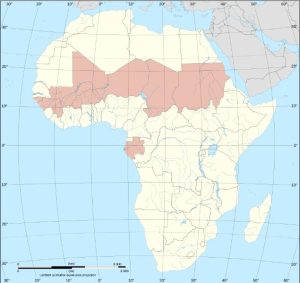
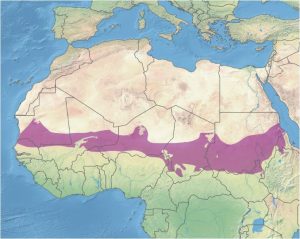
Sahel region of Africa. 2012 image by Tom Patterson, US National Park Service. Public Domain.
JNIM was formally constituted in March 2017 as a coalition of four Mali-based extremist groups — Ansar al-Din, al-Murabitoun, the Macina Liberation Front, and the “Sahara Emirate” subgroup of al-Qaeda in the Islamic Maghreb (AQIM). Its leader, Iyad ag Ghali, pledged allegiance to al-Qaeda’s leadership and to the Taliban, establishing the ideological lineage and the external mentorship relationships that have shaped the group’s development. The Institute for Economics and Peace’s 2025 Global Terrorism Index identified JNIM as the world’s second deadliest terrorist organization, responsible for more than 1,200 deaths across four countries in 2025 alone, following its 1,454 deaths and 46% year-on-year lethality increase in 2024. An average of ten deaths per attack is not the product of enthusiasm. It is the product of training.
The Recruitment Pipeline as a Training System
Before asking how JNIM trains its fighters, it is worth asking how it selects them — because the selection process is itself a form of pre-training that shapes what formal instruction needs to accomplish. The June 2026 Strategic Threat Outlook on JNIM, one of the most current analytical assessments available, is direct on this point: recruitment is less a function of large-scale ideological adherence than of the ability to convert local grievance systems into mechanisms of compliance, protection, and mobilization. Where the state is absent, predatory, or inconsistent, JNIM offers order, dispute resolution, and livelihood — and the fighters it recruits from that population arrive already embedded in the group’s social logic, already owing it something, already understanding what it is protecting them from.
This matters for training because it means JNIM is not starting from zero with its recruits in the way a conventional military does. A Fulani community member who joins JNIM after his village was burned by a government-backed militia arrives with motivation, local knowledge, and an understanding of the terrain that no classroom can replicate. The formal training layer is built on top of a foundation of grievance, familiarity, and social obligation that state armies spend years trying to manufacture through basic training and unit cohesion exercises. JNIM gets it for free from the conditions its adversaries have created.
The US State Department’s National Counterterrorism Center notes that JNIM explicitly trains militants to fight against the group’s enemies while simultaneously appeasing local communities through material resources — a dual-track approach that mirrors the classic Maoist model of winning the population while fighting the state. The fighting and the governance are not separate activities. They are taught together, because the group understands that a fighter who cannot govern cannot hold ground, and ground is what JNIM is increasingly interested in holding.
What the Attack Record Reveals
The tactical sophistication visible in JNIM’s recent operations implies a training system with several distinct components, none of which require a fixed training establishment to deliver.
The first is small-unit fire and movement. JNIM’s standard assault package — documented across multiple engagements — involves rapid concentration of motorbike-mounted fighters, multi-directional assault in early morning hours, and equally rapid dispersal before air assets can respond. That is not improvised. The dispersal discipline in particular — fifty motorbikes scattering in fifty directions on a pre-planned schedule — requires rehearsal, communications discipline, and an understanding of the enemy’s response timeline that comes from deliberate instruction and repeated practice. The JNIM fighters who executed the April 2026 assault on Kidal had practiced what they did.
Chadian technical combat truck during EUFOR operations in Chad. 2008 photo courtesy of the Ministry of Defence and Armed Forces of the Czech Republic.
The second is HUMINT collection and target development. The April 25 car bomb at Kati that killed Mali’s Defense Minister required precise knowledge of checkpoint locations, shift patterns, internal base layout, and the physical location of a senior government figure within a secured compound. That intelligence was not collected remotely. Someone with access collected it, which means JNIM trains — or at minimum briefs — its operatives on the systematic collection of human intelligence from inside adversary institutions. The tradecraft is real, if informal by Western standards.
Probably.
The third and most analytically significant component is drone integration. JNIM’s first documented drone activity occurred in September 2023. By mid-2025, the Policy Center for the New South documented over two dozen confirmed drone incidents, with 82% occurring since March 2025. By 2026, the group’s drone operations had expanded across three countries — Mali, Burkina Faso, and Togo — and the Policy Center’s analysis describes the shift explicitly: JNIM has moved from experimentation to operational doctrine. That transition happened in under thirty months.
Sit with that for a minute.
The speed of that transition implies a train-the-trainer structure. When Colonel Hussein Ghulam, previously with the Tuareg-Azawad FLA rebel alliance, joined JNIM in mid-2024, his name subsequently appeared in connection with drone operations including the Dioura strike of May 2025. The pattern — an expert joins, capability accelerates, geographic scope expands — suggests that JNIM absorbs technical expertise through personnel transfers and then systematically replicates it through internal instruction. The group is not re-inventing the wheel with each new drone operator. It is teaching the wheel.
The Technology Floor Has Collapsed
The practical significance of JNIM’s drone training pipeline extends well beyond the Sahel, because the technology it is training on is available to anyone with a retail account and a few hundred dollars. Commercial drones paired with offline artificial intelligence tools — used to bypass geofencing, optimize payload delivery, and plan flight paths without emitting trackable signals — represent a technical capability that requires weeks of instruction to master, not years. The March 2025 CTC Sentinel documented the expanding transmission ranges and payload capacities of commercially available platforms; the 2026 Eurasian Review analysis described the resulting economic inversion in stark terms: a $500 drone can destroy a vehicle worth hundreds of thousands of dollars and force a state military to respond with multimillion-dollar intercept systems.
Ukrainian loitering munitions made from FPV drones. 2023 image courtesy of the Ministry of Defense of Ukraine, armyinform.com.ua, per CCA/4.0 International.
What this means in training terms is that the barrier to producing a competent drone operator has collapsed to the point where a motivated group with basic organizational discipline can build that capability in a matter of months. JNIM demonstrated this. The implication for other non-state actors — in the Sahel, in coastal West Africa where JNIM’s operational reach is visibly expanding, and beyond — is that the playbook is now open-source. The tactics, the technology, and the organizational logic are all observable from public reporting. The only remaining variable is the will and the organizational coherence to implement them.
The foregoing is fairly straightforward, but – as the example of Ghulam shows – the door is wide open to major-state interference being a factor. Russia, Communist China, and even France (still smarting from its ejection from most of the Sahel region), are all possible sources for supplying training officers to JNIM. To be clear, there is no hard evidence of this as of writing, although the French cement company LaFarge is facing financing allegations. But – more direct foreign support to JNIM remains a potential factor.
JNIM currently controls or contests territory across Mali and Burkina Faso, with early indicators of an operational presence extending toward coastal West Africa — Ghana, Togo, Benin, Côte d’Ivoire. In each new operational area, the pattern repeats: grievance exploitation, governance provision, recruitment, instruction, attack. The school follows the army, because the school is the army. Understanding what it teaches is not an academic exercise. It is the precondition for countering it.
World War 3 isn’t being fought with nuclear weapons. It is being fought with simple tools, in regions of the world few people actually care about…unless they live there.
The Freedomist — Keeping Watch, So You Don’t Have To
Beware the old man, in a profession where men die young.
On January 2, 2025, India’s Ministry of Defense quietly issued a Request for Information to domestic defense companies, asking for proposals on a very specific problem: 23mm proximity-fused ammunition capable of detonating near an enemy drone rather than requiring a direct hit. The weapon they wanted to upgrade was the ZU-23-2 — a Soviet twin-barreled anti-aircraft cannon that entered service in 1960, the same year John F. Kennedy was elected president. That a weapon designed to engage Korean War-era low-flying aircraft is now being fitted with twenty-first-century smart fuzes to hunt quadcopters over the India-Pakistan border is, depending on your perspective, either a testament to the original design’s enduring utility or a commentary on how thoroughly the drone threat has outrun the world’s ability to respond to it.
The reality is likely somewhere in between.
From Vietnam to the Technical
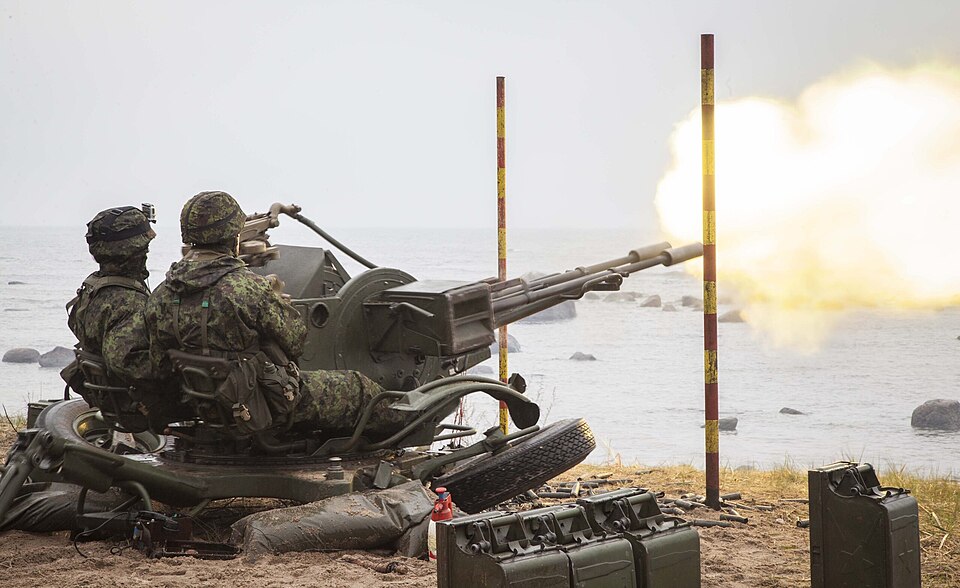
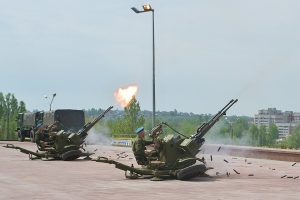
The ZU-23-2’s formal designation decodes itself: ZU for Zenitnaya Ustanovka — “anti-aircraft mount” — “23” for its caliber in millimeters, and “2” for the number of barrels. The KBP design bureau presented the prototype in 1955, refined it through the late 1950s, and the Soviet Army adopted it in 1960 as the standard towed light anti-aircraft weapon for Warsaw Pact forces. Its immediate predecessor in that role was the ZPU-2, which mounted twin 14.5mm KPV heavy machine guns — effective against very low and slow targets but outpaced by the jets that were becoming the dominant low-altitude threat by the late 1950s. The ZU-23-2’s twin 2A14 autocannons firing 23x152mm ammunition at a combined cyclic rate of up to 2,000 rounds per minute gave Soviet air defense batteries something capable of reaching targets at ranges out to 2,500 meters and altitudes up to 1,500 meters, with enough hitting power to be lethal rather than merely disruptive.
The Vietnam War gave the weapon its first major combat trial. From 1965 onward, the Soviet Union shipped ZU-23-2s to North Vietnam in quantity, and the gun became, alongside the 37mm M1939, the most commonly encountered anti-aircraft weapon in the theater. Given that approximately 83% of US Air Force losses over Vietnam came from ground fire rather than surface-to-air missiles or MiGs, the ZU-23-2 is conservatively credited with shooting down hundreds of aircraft — a combat record that no other weapon in this series can claim against modern fast jets in their first decade of service.
What the Vietnam experience also revealed was a capability the Soviet designers had built in but perhaps underemphasized: the gun’s effectiveness against ground targets. At 2,000 meters, its armor-piercing incendiary rounds could defeat light armored vehicles. Against infantry and unprotected positions, it was devastating. Soviet forces in Afghanistan confirmed and extended this lesson, mounting ZU-23-2s in the beds of ZIL-135 trucks to provide convoy protection against ambushes in mountain terrain — using the gun’s high elevation arc to engage Mujahideen fighters on ridgelines that tank guns and BMP autocannons could not reach. After the Soviet withdrawal, both the Taliban and the Northern Alliance operated the weapons left behind. The pattern was establishing itself: wherever the ZU-23-2 went, it tended to stay, and whoever inherited it found new uses for it.
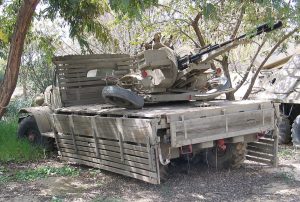
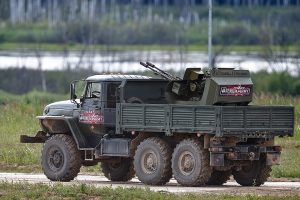
The technical — the improvised fighting vehicle built by mounting a weapon on a civilian truck — became the ZU-23-2’s most consequential platform adaptation. Lebanese militias in the civil war, Iraqi forces in 1991, Libyan factions in both of their civil wars, Sahelian insurgent groups including JNIM and its affiliates: all have mounted the gun on whatever truck was available and achieved a mobile fire support capability that costs a fraction of any purpose-built system. The weapon’s light weight — just over a ton in firing configuration — makes this straightforward. It can be set up for firing from the travel position in 30 seconds. It does not require specialized maintenance infrastructure. It fires ammunition that exists in virtually every post-Soviet conflict zone in quantities that border on inexhaustible. These are not small advantages.
ZU-23-2 mounted on ZIL-157 truck at Muzeyon Heyl ha-Avir, Hatzerim airbase, Israel, 2006. Photo by Bukvoed. CCA/3.0 Unported.
The Drone Problem and the Proximity Fuse Answer
For all of that, the ZU-23-2 spent the better part of its service life being quietly written off as obsolete for its nominal primary role. By the 1980s, jet aircraft were flying faster, higher, and with better electronic countermeasures than any optically-aimed 23mm gun could reliably engage. The ZSU-23-4 Shilka — the self-propelled, radar-guided development of the same 23mm caliber — had partially supplanted it in that role for Soviet forces, though even the Shilka was acknowledged as limited against fast-moving aircraft. The ZU-23-2 survived primarily because it was cheap, reliable, and effective against helicopters and slow aircraft — and because some 140,000 of them had been produced and distributed to something over fifty countries, which gives any weapons system remarkable institutional staying power regardless of its theoretical limitations.
The drone revolution has inverted that obsolescence logic almost completely. The primary aerial threat facing armies, militias, and non-state actors across Ukraine, the Sahel, Yemen, and the India-Pakistan border is no longer a fast jet flying at 600 knots. It is a commercial quadcopter or a fixed-wing FPV drone flying at 60 to 100 knots at low altitude, often in swarms, and costing between a few hundred and a few thousand dollars. Against that target class, the ZU-23-2’s engagement envelope — 2,500 meter range, 1,500 meter altitude ceiling, 2,000 rounds per minute combined — is not obsolete. It is, if anything, oversized for the job.
ZU-23 mounted on a Ural-4320 cargo truck. 2019 photo by the Ministry of Defence of the Russian Federation, via Mil.ru. CCA/4.0 International.
The remaining problem is probability of hit. A 23mm round fired at an FPV drone requires a near-direct hit to kill it. The drone is small, fast for its size, and maneuverable. Tracer-based manual aiming against such targets is demanding even for a well-trained crew. This is precisely the gap India’s January 2025 RFI was designed to close: proximity-fused 23mm ammunition that detonates within lethal radius of the target rather than requiring physical contact. The same concept drove the development of the original anti-aircraft proximity fuse in World War II — the VT fuze that transformed naval anti-aircraft gunnery against kamikazes — and its application to 23mm autocannon ammunition is technically straightforward given modern microelectronics. The payload is small; the fuze logic is well understood; the manufacturing challenge is miniaturization and cost, not physics.
India is not alone in recognizing this. Russia has deployed truck-mounted ZU-23-2 batteries in dedicated anti-drone mobile units in Ukraine since early 2024, pairing the guns with electronic warfare systems and smoke generators in combined teams designed to defeat FPV drone attacks. Russia has also developed and demonstrated a remotely operated variant, the ZU-23/30M1-3, with integrated electro-optical sighting — a concept first shown in 2013 that finally reached serious development attention under the pressure of the Ukraine war. Poland’s WB Group presented its ARM-28 electromechanical upgrade kit at the DEFEA 2025 defense exhibition in Athens, converting the ZU-23-2 into a semi-automated or remotely operated platform with digital drive motors, joystick control, and compatibility with external fire control systems. In May 2025, India’s own army air defense reported that ZU-23-2s alongside Bofors L/70 guns had been effective in shooting down multiple Pakistani drones during the India-Pakistan conflict — a real-world validation that arrived barely four months after the proximity fuse RFI was issued.
A Platform That Keeps Earning Its Place
The ZU-23-2’s spread across more than fifty national inventories and a substantial number of non-state arsenals means it occupies a peculiar position in the current global defense environment: it is simultaneously a museum piece and a front-line system, often in the same conflict zone. In Ukraine, Russian forces operate it as an improvised anti-drone gun. Ukrainian border guards have received new ZU-23-2 deliveries as recently as 2025. In the Sahel, JNIM-affiliated groups have truck-mounted examples that serve as the air defense component of a force that otherwise operates on motorbikes. In Yemen, Houthi forces have used them against Saudi coalition aircraft and, more recently, against drone threats.
What the proximity fuse development — in India, and likely elsewhere — signals is that the global community of ZU-23-2 operators has collectively decided the platform has a generation of useful life remaining, provided the ammunition catches up with the threat. The gun itself does not need to change. The carriage is sound, the barrels are replaceable, and the rate of fire is already more than adequate. What changes is the fuze in the nose of the round, and with it the probability that any given burst finds its target. A sixty-five-year-old Soviet anti-aircraft gun, fitted with a smart fuse developed for a threat that didn’t exist when the gun was designed, hunting Chinese-manufactured quadcopters over an Indian border post. The ZU-23-2’s designers at KBP in 1955 could not have anticipated any of that. The gun they built was flexible enough not to care.
The Freedomist — Keeping Watch, So You Don’t Have To
In August 2023, this column examined a question that most analysts had not thought to ask: what would it mean, in practical terms, if the Holy See decided to field an operational military force? The piece was speculative — a thought exercise grounded in the Vatican’s sovereign status under the Lateran Pacts of 1929, its financial depth, its 1.3 billion strong population of potential sympathizers, and its diplomatic relations with some 180 nations. The conclusion was cautious: the pieces existed, but there was no indication anyone was moving to assemble them.
On July 1, 2026, something happened that makes that question considerably less theoretical.
On that date, the Society of St. Pius X consecrated four new bishops at its seminary in Écône, Switzerland, in direct defiance of an explicit personal appeal from Pope Leo XIV not to proceed. The ceremony was attended by an estimated 15,000 to 16,500 faithful. Within twenty-four hours, the Vatican’s doctrinal office issued a decree declaring automatic excommunication — latae sententiae — for the six bishops involved, extending the penalty to all SSPX priests, and warning that lay faithful who formally adhere to the schism face the same consequence. Cardinal Víctor Manuel Fernández, head of the Vatican’s doctrine office, stated plainly: the SSPX is in schism, and its sacraments are now illicit. Confessions invalid. Marriages invalid.
The Church has not moved this hard against a traditionalist body since 1988.
The 1988 Echo and What Is Different Now
The parallel to 1988 is real and the SSPX knows it — Bishop Alfonso de Galarreta, who presided over the July 1 consecrations, was himself one of the four bishops excommunicated by John Paul II thirty-eight years ago to the day. The symmetry was deliberate. The SSPX issued a statement at the outset of the ceremony declaring that any Vatican sanctions against them “will have no validity.” That is not the language of an organization expecting reconciliation. That is the language of a body that has decided the break is permanent and is acting accordingly.
What is different from 1988 is the Vatican’s response. When Archbishop Marcel Lefebvre consecrated bishops without papal mandate that year, the excommunications fell on the bishops and Lefebvre himself, only — not on priests and laity. Pope Benedict XVI lifted those excommunications in 2009 as a gesture of reconciliation, and Pope Francis extended further concessions, allowing SSPX priests to hear valid confessions in 2015 and to officiate recognized marriages in 2017. The pattern across four pontificates was consistent: Rome extended olive branches, and the SSPX accepted the practical benefits while refusing to sign any doctrinal preamble acknowledging Vatican II as legitimate.
Leo XIV has ended that pattern. The July 2 decree explicitly rolled back the sacramental privileges granted under Francis and extended the excommunication beyond the episcopal level for the first time. America Magazine’s Vatican correspondent noted that this goes further than any previous Vatican action against the SSPX — and Leo XIV is the first pope to have undergone all of his seminary formation in the post-Vatican II era, which makes his position on the Council’s legitimacy non-negotiable in a way it perhaps was not for his predecessors. The olive branch strategy has been formally retired.
Coat of arms of the Holy See. From Donald Lindsay Galbreath’s, “A Treatise on Ecclesiastical Heraldry” (W. Heffer and Sons, 1930). Credit: WikimediaCommons User: F l a n k e r,. 2007. Public Domain.
What the SSPX Actually Represents
Before assessing what comes next, it is worth being precise about what the SSPX is, because popular coverage tends to flatten the reality. With an estimated 600,000 adherents across 77 countries, 751 priests, 1,500 total members including seminarians and religious, and a network of seminaries, schools, and chapels operating across Europe, the Americas, Africa, and Asia, the SSPX is not a fringe sect. It is a functioning parallel ecclesiastical structure with its own episcopal succession — now reinforced by four new bishops — its own formation pipeline, its own institutional infrastructure, and a lay following that skews educated, committed, and transgenerationally stable. The new Bishop Michael Goldade, one of the four consecrated, is American, from St. Marys, Kansas, where the SSPX maintains one of its most established North American communities.
The SSPX’s theological objection is not primarily over the Latin Mass, though that is the most visible symbol. It is to the ecclesiology and anthropology of Vatican II itself — specifically, the Council’s teachings on religious liberty, interdenominational relations, and the collegial authority of bishops. These are not peripheral disputes. They go to the fundamental question of what the Catholic Church understands itself to be, and what authority it claims over the temporal order. That is the ground the SSPX has refused to concede across six decades, and the grounds Leo XIV has now formally declared them expelled for refusing to concede.
The Wildcard — The Church Militant Variable
It is here that our previous 2023 analysis becomes relevant in a new way — and where precision matters more than ever.
The 2023 piece asked what a Vatican military capability would look like if the institutional will existed to build one. The answer then, as now, is that the raw material is available: financial depth, diplomatic reach, a global population of potential volunteers including many with military experience, and sovereign status under international law. What was missing was a driver — a circumstance acute enough to generate the institutional will.
The SSPX schism does not provide that driver for the Holy See itself. Leo XIV’s papacy is built around unity, not militancy, and the excommunication of the SSPX is a disciplinary action, not a mobilization signal. Rome is not arming up.
Yet.
But the schism does something analytically significant on the other side of the equation. It creates, for the first time in the modern era, a fully excommunicated traditionalist Catholic body with its own episcopal succession, its own institutional infrastructure, its own global network, and a leadership that has explicitly declared Vatican authority over them to be null. The SSPX has, in the vocabulary of canon law, stepped entirely outside the visible Church. It has done so with its bishops intact, its seminaries operational, its schools and chapels functioning, and its lay faithful — at least some of them — prepared to follow.
What makes this analytically significant beyond the canonical mechanics is something visible to anyone with an internet connection and five minutes on a mainstream retail platform. A substantial cultural ecosystem has grown up around the phrase Deus Vult — “God wills it,” the battle cry of the First Crusade.
Expressed in tactical morale patches, embroidered caps, hoodies, and apparel available on Amazon and Etsy and more carrying imagery of Crusader crosses, numerous military religious orders, and what the listings describe without irony as “biblical knight” and “Catholic warrior” iconography, is ready and in place for any group with even minimal funds to activate and leverage, much like the “Kek/Pepe the Frog” symbology of c.2015. This is not a fringe underground. It is mainstream commercial/retail, accessible to and purchased by a broad population of traditionally-minded Christians well beyond the SSPX faithful — Protestant as well as Catholic, American as much as European. The cultural identity infrastructure is already in place, already widely distributed, and currently unaffiliated with any institutional structure. The SSPX schism is the first event in the modern era capable of providing that infrastructure with a canonical anchor. More to the point, coherent and uniform iconography, taken seriously by those using it, is a core identity formation tool for military and military-adjacent units.
Sit with that for a moment.
An excommunicated body with episcopal succession, an existing organizational structure spanning 77 countries, a committed and relatively affluent lay base, and a theology that frames the current Roman hierarchy as having abandoned authentic Catholicism is not the same thing as a “splinter group“. It is, in structural terms, a parallel institution. Whether that parallel institution remains purely ecclesiastical, or whether it develops harder edges under the pressure of persecution and the psychology of a movement that now has nothing left to lose from Rome’s perspective, is the question analysts should be asking.
The historical record of excommunicated movements developing temporal as well as spiritual ambitions is long and instructive. The SSPX leadership has given no indication of moving in that direction. But the SSPX leadership also gave no indication, as recently as six months ago, that it would consecrate bishops in open defiance of a sitting pope’s personal written appeal. The July 1 ceremony at Écône was not an act of an organization that expects to be welcomed back. It was an act of an organization that has decided it is the Church, and that Rome is the schismatic party.
Possibilities, as was observed here in 2023, offer options. The landscape has changed, and dramatically so. Whether anyone, whether SSPX or the Vatican itself, moves to act on activating that landscape is a different question — and not one this column can answer at the moment.
But…the military potential is very real.
The Freedomist — Keeping Watch, So You Don’t Have To
The turret flies off cleanly — a forty-ton steel cap launched ten or fifteen feet into the air by the pressure wave of its own ammunition cooking off inside. It became the signature image of Russia’s war in Ukraine: T-72’s reduced to a burning hull and a displaced turret, the phenomenon so predictable it acquired a name. NATO analysts called it the “jack-in-the-box.” The Ukrainians called it a gift. That a tank designed in the late 1960s as an affordable alternative to a more advanced Soviet design is still absorbing those lessons in 2025 says something unflattering about Russian procurement — and something complicated about the T-72 itself.
Welcome to the wonderful world of Soviet tank development.
Origins Of The Economy Tank
The T-72 began not as a primary Soviet tank project, but as a parallel design for rapid mobilization, developed at the Uralvagonzavod factory in Nizhny Tagil, while the more sophisticated T-64 remained the prestige program. Designer Leonid Kartsev, joined by Valeri Venediktov, drew on the best features of the T-64 and the older, simpler T-62 to produce in the T-72 what was essentially a throwback to 1960s design logic, fitted with an improved autoloader and a two-component main armament stored in a less cumbersome configuration than the original T-64’s. The result was intentionally unglamorous: cheaper and faster to build, easier to maintain, and suitable for export to Warsaw Pact allies and client states who would never receive the classified T-64. Field trials ran from 1971 to 1973, and upon acceptance the Chelyabinsk Tank Factory immediately ceased T-55 and T-62 production to retool for the new design.
T-72B’s at the Chebarkul training ground, 2017. Ministry of Defence of the Russian Federation. CCA/4.0 Int’l.
Approximately 25,000 T-72s of all variants were produced throughout the Soviet era and beyond, making it one of the most numerous main battle tanks in history. The autoloader — the feature that most defined it — reduced the crew from four to three by eliminating the human loader, allowing a lower, more compact hull profile. The carousel mechanism fires at a quoted average rate of eight rounds per minute, cranking the gun up three degrees above horizontal to align the breech with each shell. It was an elegant solution to the problem of crew size and vehicle volume. It was also the design decision that would eventually turn T-72s into the most photogenic casualties in modern warfare.
The Carousel Problem
The autoloader stores its propellant charges and projectiles in a ring around the base of the turret — a “carousel” sitting at precisely the point where incoming fire is most likely to penetrate. Unlike modern, post-1970 Western tanks, which stow ammunition behind blow-out panels designed to vent explosive forces upward in the event of a catastrophic penetration, the T-72’s carousel offers no such protection. A penetration of that zone triggers rapid cook-off, blowing the turret clear of the hull and eliminating the crew. The effect is spectacular and lethal in equal measure.
Russian T-72B3 “cooking off”, after being struck by Ukraininan forces, 2022. Uknrainian Ministry of Defense. Public Domain.
The T-72’s ammo-in-turret design magnified kills throughout the Ukraine war, though artillery accounted for much of the actual stopping power. What Ukraine demonstrated — and what analysts had long suspected — was that the vulnerability becomes catastrophic when combined with the proliferation of top-attack weapons. Javelins, NLAWs, and FPV drones all strike from above or at steep angles, hitting precisely the turret ring and upper hull where the carousel sits. The tank was not designed against this threat class. Nothing in its upgrade lineage fully addresses it.
Positions of crewmembers in a Soviet T-72 tank. The driver (1) is seated in the vehicles front, commander (2) and gunner (3) are positioned in the turret, directly above the carousel (4), which contains the ammunition for the autoloading mechanism. 2010 image by Alexpl. CCA/3.0 Unported.
Fifty Years Of Variants – All With One Fundamental Flaw
The T-72 has proven remarkably adaptable within the constraints of its basic architecture. As of 2025, operators range from Algeria and Armenia to India, Belarus, and Azerbaijan, with around 40 nations fielding some variant of the platform. India operates over a thousand under the designation Ajeya. The Czech Republic developed the T-72M4CZ with a Western Perkins engine and composite armor reaching 570mm equivalent at the turret face. Poland, Yugoslavia, and Romania all produced licensed or derivative variants. Russia’s own T-72B3M, the current frontline upgrade, added Relikt explosive reactive armor, the Sosna-U thermal sight, and more recently hard-kill active protection systems — the first of which began appearing on frontline units in late 2024.
None of it solved the autoloader problem. In early 2024, a T-72B3 became the first tank in the world to frontally penetrate a US-supplied M1 Abrams in a tank-on-tank engagement in Ukraine — a data point Russia promoted heavily. The Abrams loss was real. So were the roughly 1,700 T-72s Russia has lost in the same theater. At the outset of the invasion in February 2022, Russia deployed approximately 2,100 late-model T-72s; estimated losses across the war now stand at around 1,700 vehicles, according to various sources.
The Lessons Ukraine Teaches
Ukraine became a real-time laboratory for what happens when a 1970s tank design meets cheap, proliferating drone technology. FPV drones carrying small explosive payloads proved capable of defeating T-72s consistently, detonating ammunition in the carousel even through improvised cage armor welded on to deflect the strikes. Russian crews responded with the so-called “turtle tank” configuration — welding metal roofing over the hull and turret — which reduced the drone threat while simultaneously eliminating visibility, ventilation, and the tank’s already marginal speed advantage. As Russia’s modern armor was depleted or withdrawn, Moscow fell back on T-62s from the 1960s and eventually T-55s, pulling vehicles from storage bases in the Russian Far East to back-fill frontline losses.
T-72 at the Drawsko Pomorskie training ground, 2008. Polish Ministry of National Defense. Public Domain.
The question every other T-72 operator is now asking is how much of this transfers to their own strategic situation. The answer depends on adversary, terrain, and the quality of combined-arms integration the tank operates within. Ukraine showed that the T-72 fails catastrophically when used without adequate additions of mass, infantry, air cover, or electronic countermeasures against drone threats. It showed rather less about what a competently integrated T-72 force might accomplish — because Russia rarely provided one. For the forty-odd nations still fielding the platform, that distinction matters decisively. The tank’s flaws are structural and unresolvable without a fundamental redesign. Whether those flaws are decisive depends on what they are being asked to do, and against whom.
The Freedomist — Keeping Watch, So You Don’t Have To
Back FREEDOM for only $4.95/month and help the Freedomist to fight the ongoing war on liberty and defeat the establishment's SHILL press!!
Are you enjoying our content? Help support our mission to reach every American with a message of freedom through virtue, liberty, and independence! Support our team of dedicated freedom builders for as little as $4.95/month! Back the Freedomist now! Click here