
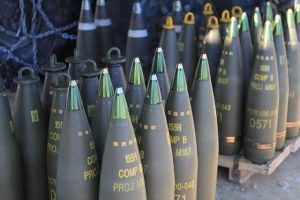
There is a number that should be haunting every defense ministry in the Western world right now, and it belongs to Britain. Tom Tugendhat, MP for Tonbridge and a man with actual military service to his name, stated it plainly in late April 2026: the United Kingdom can sustain major combat operations for approximately eight days. Not eight months. Not eight weeks. Eight days. In the same breath, he confirmed what open-source analysts have been documenting from the Ukraine front: Russian artillery is burning through upwards of twenty thousand rounds per day.

Those two numbers, placed side by side, tell you everything you need to know about where thirty years of post-Cold War optimism have left one of history’s great military powers.
The Arithmetic Of Hollowness
Eight days is not a figure Tugendhat invented for shock value. He is a former chairman of the Foreign Affairs Select Committee who served as a British intelligence officer in Iraq and Afghanistan. When he says it, he is drawing on briefings and wargames the public does not see. And the institutional analysis supports him.
The Royal United Services Institute – Britain’s premier defense think tank – has assessed that deploying a single armored brigade would consume somewhere between seventy and eighty percent of the British Army’s total combat engineering capability. A full division – the kind of force Britain would be expected to field in a serious NATO commitment – is, in RUSI’s measured language, “fanciful.” The regular Army currently stands at around 140,000 personnel, a number that sounds substantial until you compare it to France’s 250,000 or consider that a meaningful portion of that figure exists on paper rather than in uniform and ready to deploy.
The naval picture is no better. A Royal Navy carrier strike group is an impressive thing on paper – and it represents, on most operational days, nearly the totality of what the fleet can put to sea simultaneously. Two Type 45 destroyers, two Type 23 frigates, one fleet ready escort for home waters, and perhaps one attack submarine if the scheduling works out. That is not a global power’s navy. That is a capable but brittle force that cannot absorb losses or sustain extended high-intensity operations.
The Money Problem – And The Accounting Problem
Britain has technically met the NATO two-percent GDP spending guideline every year since its introduction in 2006, and officials in London have been quick to point that out. What they are slower to mention is that up to a quarter of that headline figure is absorbed by the nuclear deterrent – Trident and its associated infrastructure – leaving the conventional forces funded at something closer to 1.5 percent in practical terms. Germany, which spent barely over one percent of GDP on defense a decade ago, has now surpassed Britain in absolute defense expenditure and overtook the UK as NATO’s second-largest spender in 2024.
The Starmer government has committed to raising defense spending to 2.6 percent of GDP by 2027 and, following the June 2025 NATO summit, to 3.5 percent by 2035. The Ministry of Defense has warned of a £28 billion funding shortfall over the next four years even at current commitment levels [https://www.cityam.com/charts-uk-defence-reeves-nato-starmer-trump/]. The Treasury, managing a government that is simultaneously trying to fund the NHS, fix crumbling infrastructure, and service a substantial national debt, has responded to these warnings with the fiscal equivalent of a shrug. The ambition to reach three percent, officials have noted, will be achieved “when economic and fiscal conditions allow.” [https://www.trade.gov/country-commercial-guides/defense-equipment-united-kingdom] In a period of low growth and geopolitical turbulence, that is a phrase that can mean almost anything.

Meanwhile, NATO itself has moved the goalposts. At The Hague in June 2025, the alliance committed members to five percent of GDP – 3.5 percent on core defense, 1.5 percent on resilience and infrastructure – by 2035. Britain currently sits below the NATO alliance average as a share of GDP, lagging behind thirteen member states including Estonia, Latvia, and Poland – countries that, unlike Britain, share a border with the threat and have drawn the appropriate conclusions.
The Political Dimension
Tugendhat’s speech at the Policy Exchange think tank did not confine itself to hardware and stockpiles. He identified something harder to fix than an ammunition shortage: a political culture that has systematically avoided hard choices about defense for a generation.

“For three decades, we have been projecting an image of a Britain that no longer exists,” he said in 2026. The gap between Britain’s self-image – permanent Security Council seat, nuclear power, special relationship with Washington, the shadow of Churchill – and its actual military capacity has become wide enough to drive a naval convoy through. British generals, Tugendhat noted, have told him that the entire firepower of today’s British Army is less than what a single brigade commander could call on in the 1990s.
There is also a legal dimension that Tugendhat raised and that deserves more attention than it typically receives. He argued that British forces have been progressively fettered by legal constraints – human rights legislation improperly applied to battlefield conduct – that have had a measurable chilling effect on operational decision-making, as well, as on recruitment and retention. Whether or not one agrees with that argument, the perception within the force that prosecution rather than a medal awaits those who act decisively is a real factor in institutional confidence.
The Starmer government’s commitment to defense is “genuine,” in the sense that the numbers are moving in the right direction. But political commitment to a 2035 target does not fill an ammunition bunker today. It does not add a frigate to the fleet this year. It does not give the Army the engineering and logistics depth RUSI says it is missing. The eight-day window is not a projection of where Britain will be in a decade. It is where Britain is right now.
The Wider Lesson
Britain is not uniquely culpable here – the peace dividend was a collective European indulgence, and most NATO members spent the post-Cold War decades making the same assumptions about permanent stability and American underwriting. What makes the British case worth examining closely is the distance between the country’s continued great-power rhetoric and the material reality of its defense posture. France, for all its problems, has maintained a more coherent expeditionary force and a defense industrial base that can actually produce things under pressure. Poland is spending nearly four percent of GDP and building an army that is beginning to look like one of NATO’s more serious land forces. Germany has belatedly recognized the emergency and is spending accordingly.
Britain, by contrast, is in the uncomfortable position of being a country whose defense vocabulary still runs on Cold War confidence while its actual capabilities have been quietly liquidated to help balance budgets that were never quite balanced anyway.
Eight days. Russia burns around twenty thousand artillery rounds a day. The math is not complicated. The question is whether the political system can close the gap between the image and the reality before that arithmetic becomes relevant in the worst possible way.