August 26, 2026

Global Outlook

The King Of Chemicals And The Danger No One Is Watching


Supply and commodity trading is boring stuff…Right?

The “Law of Unintended Consequences” is a very real thing. Many people, however, refuse to see them when they appear…and sometimes, they refuse to acknowledge it amid the wreckage of their error. To his credit, John F. Kennedy did acknowledge this – albeit parsed for public consumption – when he said, in the aftermath of the disaster that was the Bay of Pigs, “Victory has a thousand fathers, but defeat is an orphan.

When we covered the opening weeks of Operation Epic Fury in March, in our monthly subscription edition, we flagged a supply chain casualty that most of the financial press was too focused on crude oil to notice: sulphur.

We noted that a Hormuz closure extending beyond 30 days would begin to bite into agricultural input supply chains, drive spot sulphur prices sharply upward, and extend inflationary effects well beyond the energy sector into global food commodity markets. We were right – and the situation has since become considerably more complicated than even that analysis anticipated.

And this is, in fact, what actually happened.


Commercial vessels in the Persian Gulf near Hormuz Island, Iran. 2011 photo by ninara. CCA/2.0 Generic.


The Invisible Commodity

Sulphur is not a commodity that generates headlines under normal circumstances. It does not trade on the nightly news. Most people could not tell you what it is used for, beyond a vague association with volcanoes and the smell of struck matches. That invisibility is precisely what makes it dangerous as a supply chain vulnerability.

Sulphuric acid – the primary derivative of elemental sulphur – is the most widely produced industrial chemical in the world. It is not an exaggeration to call it the nervous system of industrial civilization. It is the essential reagent for processing phosphate rock into the fertilizers – MAP, DAP, SSP and TSP – that sustain the yield levels modern agriculture depends on. It is a critical processing agent for copper, nickel, and the battery metals that underpin the energy transition. It is used in steel production, petroleum refining, pharmaceutical manufacturing, and water treatment. When sulphur supply tightens, the consequences do not stay in one sector.

They cascade.

The Strait of Hormuz carries approximately 45-50% of global seaborne sulphur trade. Saudi Arabia and the UAE are the dominant exporters, with Qatar contributing significantly as a byproduct of its LNG operations. When the strait effectively closed in late February 2026, that flow stopped – approximately 4 million metric tons of sulphur per year, originating from Iranian, Qatari, and UAE export terminals, were cut off from world markets.


But How Bad Is The Disruption, Really?

Before going any further, it is worth establishing what “closed” actually means in practice – because the picture is more nuanced than the headlines suggest, and the nuance matters for understanding how long the sulphur crisis persists.

Maritime shipping analysts tracking tanker movements through Kpler data estimates that actual Hormuz transits peaked recently at roughly 7.5 million barrels of oil per day equivalent on a seven-day rolling basis – against a pre-war flow of approximately 20 million barrels per day. Rerouting through Saudi pipelines to Yanbu and UAE facilities at Fujairah adds perhaps 4 million barrels per day of incremental bypass capacity. The net picture, properly benchmarked against total pre-war Middle Eastern outflow of approximately 23 million barrels per day, puts the region running at just over 50% of pre-war export levels.

Complicating the picture further: tanker AIS tracking data is being actively gamed. Ships are running dark – disabling their automatic identification systems – making real-time flow estimates inherently uncertain. What satellite imagery of loading docks can confirm is that the disruption is real and sustained, regardless of what official statements claim. CENTCOM reported on August 14th that U.S. forces had redirected 62 commercial vessels and boarded two to ensure compliance with the blockade. The UAE’s ADNOC shipping line reported two vessels attacked within a single week.

The Houthi dimension adds a further layer. Saudi oil rerouted through Yanbu and heading toward Asia must transit the Bab el-Mandeb – where Houthi forces, operating in conjunction with Iranian interests, are now targeting Saudi-linked vessels specifically. Tanker transits through Bab el-Mandeb have fallen approximately 40%, with more vessels running dark. The bypass route that was supposed to partially compensate for Hormuz is itself under attack.

And on August 14th, President Trump told a crowd of law enforcement officers in New York: “After we finish defeating Iran, which is being very badly defeated – pretty soon I’ll be declaring the Hormuz Strait a territory of the United States“. He followed that on August 18th by posting a map on Truth Social labeling the strait “New US Territory”. Iran responded that the strait “will remain Iranian.” Whatever the legal merits – and they are essentially nonexistent under international maritime law – the political signal is clear: the disruption is not resolving quickly, and the diplomatic pathway to normalization just became considerably more complicated, assuming that Trump’s statements are not simply another example of his grandstanding, as he did in referring to making Gaza into a resort town.


The Triple Shock

What began as a Hormuz disruption rapidly evolved into something considerably more severe, because two major sulphur exporters seized the moment to protect their own domestic supply chains.

On April 10, China announced a full export ban on sulphuric acid through August 2026 – replacing a 700,000-ton annual quota with a complete cessation. China is the world’s largest sulphuric acid exporter, with Chile, Indonesia, and Saudi Arabia as its primary markets. Chile uses it for copper solvent extraction. Indonesia uses it for high-pressure acid leach nickel processing. Saudi Arabia and India use it for fertilizer production and industrial applications. The Chinese ban effectively removed a critical secondary supply option precisely when buyers most needed it.

Russia extended its own sulphur export ban through the end of 2026. Turkey imposed export restrictions for Q2 and Q3. The result was a triple supply shock – Hormuz, China, and Russia/Turkey simultaneously – that no single alternative supply source could absorb. China’s sulphuric acid exports are projected to fall from 4.6 million tons in 2025 to approximately 1.2 million tons in 2026 – a reduction of nearly 75%.

The price response was swift and severe. Spot prices for granular sulphur FOB Arabian Gulf jumped from $80-90 per ton to $160 per ton in the first week of April alone, according to Argus Media data. Fertilizer costs overall are projected to rise more than 30% in 2026, according to the World Bank’s April Commodity Markets Outlook.


The Fertilizer Cascade

The downstream consequences for agriculture are where the sulphur story intersects with food security in ways that deserve serious attention.

Urea prices – the bellwether of nitrogen fertilizers – roughly doubled in a matter of weeks following the strait closure, jumping from $400-490 per metric ton to over $850 per metric ton in April 2026, before softening somewhat as China lifted its separate urea export ban and northern hemisphere spring application demand eased]. Diammonium phosphate prices climbed from approximately $580 to around $770 per metric ton. Indian and Brazilian phosphate fertilizer producers, facing shortages of sulphuric acid, reduced operating rates by 15-20%.

Brazil’s exposure deserves particular attention. The country imports more than 80% of its fertilizers and relies heavily on Gulf sources now blocked by the strait closure. Brazil is the world’s third-largest agricultural exporter – its soy, corn, and sugar output affects food prices globally. A sustained reduction in Brazilian fertilizer access does not stay in Brazil.

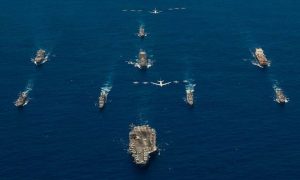
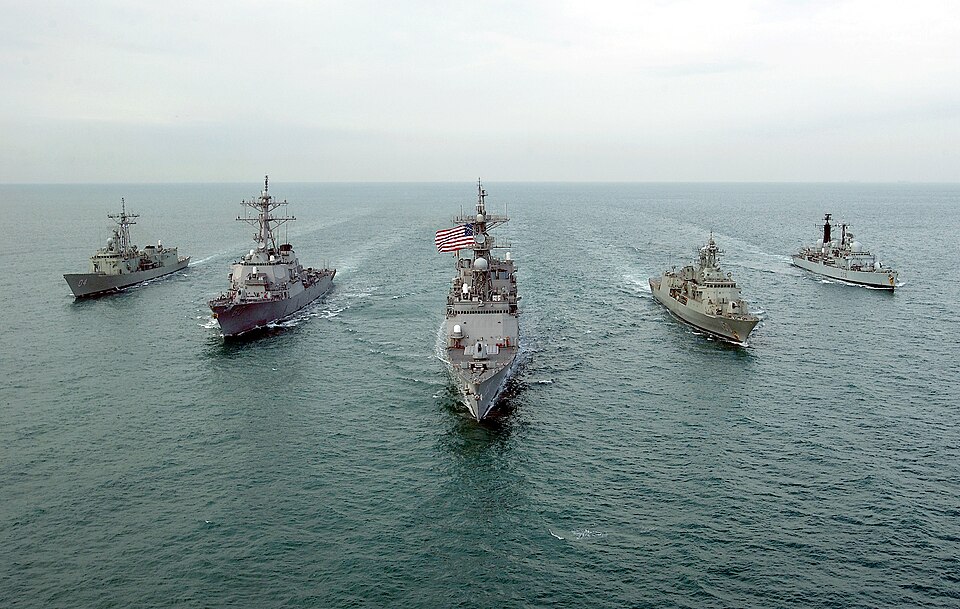
The aircraft carrier USS Ronald Reagan (CVN 76) leads a formation of Carrier Strike Group (CSG) 5 ships as U.S. Air Force B-52 Stratofortress aircraft and U.S. Navy F/A-18 Hornets pass overhead; 2018 U.S. NAVY photo. Public Domain.


Morocco’s OCP Group – the world’s largest phosphate producer and exporter, a company that underpins fertilizer supply for much of Africa and Asia – was already operating under sulphur supply constraints before February 28, following production outages at a major Qatar LNG facility in H2 2025. The Hormuz closure found OCP with sub-optimal sulphur inventory and no easy alternative supply source. The knock-on effects for African agricultural input availability are not yet fully visible in the data, but they are coming.

The United Nation’s Food and Agriculture Organization’s (FAO) chief economist was direct in his June 2026 assessment: the strait’s closure has reduced tanker traffic by more than 95%, disrupting millions of tons of fertilizer shipments monthly and creating an unprecedented shock to agricultural inputs. FAO estimates suggest cereal producers could face income losses of up to 5% in 2026, with lasting impacts through 2030. As one Ninety One analyst told CNBC: “Unfortunately, the poorer countries in the world are quite often more exposed to these crises“.


The American Position

The domestic picture for U.S. readers is more reassuring than the global picture, but the country is not entirely insulated. Approximately 54% of U.S. sulphur output is recovered at Gulf Coast refineries in Louisiana and Texas – a domestic supply source entirely independent of Hormuz transit. That physical insulation is real and significant.

However, approximately 17% of U.S. urea consumption and roughly 20% of U.S. phosphate consumption originate from Gulf exporters whose shipments must transit the strait. Trade policy decisions in recent years – countervailing duties on Moroccan fertilizers, export restrictions from China – had already concentrated U.S. phosphate sourcing toward Saudi suppliers now blocked by the Hormuz closure. American farmers planting spring crops faced higher input costs at precisely the moment the strait closed. The global market sets prices regardless of where the physical supply originates, and international tightness exerts upward pressure on domestic prices even for buyers who can source locally.


The Structural Gap Nobody Wants To Talk About

The 2026 disruption has confirmed something that commodity analysts have warned about for years and policymakers have consistently declined to address: sulphur has no internationally coordinated strategic reserve. No emergency release mechanism exists. When the International Energy Agency (IEA) convenes member states to coordinate a strategic petroleum release, there is an institutional architecture to do that. When the sulphur supply collapses, there is no equivalent.

Oil has the IEA. Natural gas has emergency sharing agreements within the EU. Sulphur – the feedstock for the fertilizer that feeds the world – has nothing.

The East Asia Forum‘s July 2026 analysis identified the compounding factors with precision: geographic bottlenecks, by-product dependence – most sulphur is a byproduct of oil and gas processing, not a primary product – and policy control combine to amplify disruption across global production networks in ways that are structurally difficult to hedge against. When the by-product source is disrupted at the same time the major exporting nations choose to restrict trade, there is no lever to pull.

Now add a U.S. president posting maps of the strait labeled “New US Territory” while ceasefire negotiations flounder, a June memorandum of understanding between Washington and Tehran expiring with no final deal in place, and Houthi forces actively interdicting the primary bypass route. The resolution timeline that commodity markets were pricing in three months ago is no longer visible.

And, hysterical cheerleading to the contrary, maneuvers around the strait have not “reopened” it.


So – How Did We Get Here?

Military service, generally speaking, tends to impart a healthy skepticism in veterans, especially those who have been in combat, because those veterans get to see the immediate impact of poor decision-making ability among politicians. This tends, by extention, to make veterans with those experiences who become politicians wary of both jumping into warfare, but equally wary of allowing problems to masticate, because that tends to evolve into a kind of “cultural gangrene“.

It is important to remember that this is not an absolute – both John F. Kennedy’s and Jimmy Carter’s military experience failed them, rather spectacularly, especially in Carter’s case.

With that in mind, it is equally important to understand that from 1945 to 2026, only four US Presidents have not had some form of military service in their resumes: Bill Clinton (1993-2001), Barack Obama (2009-2017), Joe Biden (2021-2025)…and Donald Trump (2017-2021, and 2025-Present). Studying these Presidents’ various administrations from a military standpoint reveal very uneven decision-making capacities.

The reasons for these situations are many, and we could spend the next few months arguing specifics but that fact is that, strategically speaking, the performance of the United States over the past c.35 years has been…”underwhelming” is a fair term.

In regards to the Strait of Hormuz – the center of the current sulphur crisis – the problem can be laid squarely at the feet of Jimmy Carter, who preferred that the then-Shah of Iran, Muhammad Reza, be deposed and replaced by – of all people – the Ayatollah Khomeini. As a result, for nearly five decades, a cancer of a terrorist state being funded by stupendous oil profits to fester and metastasize into a cancer that endangers human civilization across the board.

For Donald Trump, the problem is different. Trump inherited the disasters left him by over forty years of objectively terrible leadership, and the allowance of the rise of an increasingly open corporate oligachy that runs the country, an oligarchy that is perfectly fine with the nationa’s foundations being destroyed entirely, if it makes their quarterly numbers look good.

Militarily, however, this translates into a particularly virulent form of brain cancer: the Toffler Effect.

Donald Trump, despite the breathless and hysterical screeds of abysmally educated and/or self-deluded “NPC’s“, is not a stupid person. Quite the opposite. However, with no grounding in actual military thinking, it appears that Trump has been misadvised on how to handle the Iran situation, in a way that is very attractive on its surface.

First, it appears that there was little, if any, pre-planning about how to actually deal with removing the openly psychotic and bloodthirsty terrorist regime ruling from Tehran. This means that when the Iranian Rial collapsed in December of 2025, Trump and his advisers jumped at the chance to undermine the regime, even if they had to “wing it”, and come up with a plan on the fly.

Fine – that’s not an optimal way of doing things, but it can be made to work…Except that this is where Toffler meets Billy Mitchell.

Brigadier General William “Billy” Mitchell was one of the early cheerleaders for what is now termed “strategic bombing”, the notion that air power alone can win wars. This frankly bizarre view has persisted since the 1930’s, despite repeated examples of its complete and utter failure…But for Trump, the airpower solution – aided by naval missile fires – is highly seductive.

If the regime in Tehran could be toppled solely through the United States and Israel using only airpower, that was an ideal solution: there would be no videos of US ground troops storming mud-walled compounds in the Iranian interior, with goats running for their lives, and the bodies of children caught in the crossfire – the sorts of images that the mainstream media froths at the mouth over, trying to skew the context to match their internal political narrative. Likewise, although air crews – both pilots, ground crew and missile defense troops – might be killed and wounded in action, the numbers would be comparatively tiny, compared to infantry companies having to fight house-to-house, potentially taking World War 2-scale casualties in the process.

Low-brow/low-information types (which really is a fair characterization) occasionally pontificate that the Iranian people need to “rise up and overthrow” the IRGC and the mullahs on their own…completely ignoring the fact that they tried that – and on January 8th and 9th, the IRGC promptly massacred over 36,000 of them in 48 hours. Passion and harsh language are a poor match for a DShK.

The problem with this, as has been shown clearly, is that airpower alone has not, can not, and will never win wars on their own. Without “boots on the ground” – be those boots American, non-terrorist Iranian, or otherwise – victory is impossible. Bombs can be dropped and missiles can be fired, but victory is impossible.

Another aspect of this is the utterly rampant Dunning-Kruger Effect that is rotting (primarily) Western minds. Dunning-Kruger, simply put, is the effect of people with little to no experience or knowledge of a subject being convinced that they are, in fact, very competent in that sphere.

While it may seem like a cliche, in the case of Trump’s war on the terror regime in Tehran, this translates into Dunning-Kruger being formulated by video games, and breathless war documentaries: Call of Duty, World of Tanks/Warships, and more. While the effects produced by these games are certainly not uniform, they do impact public discourse…which, in turn, impacts politicians who are equally susceptible to Dunning-Kruger, and the public fawning when said politician agrees with the “TikTok PhD’s“.

As just one example, many people are convinced that the first Gulf War/Desert Storm “was won in 100 hours“. Nothing could be further from the truth. Desert Shield/Desert Storm took 7 months, from August 7, 1990, to February 28, 1991. “Combat operations” actually began on January 19, 1991…And yet, “keyboard commandos” almost literally froth at the mouth if anyone dares to disagree with the “100 Hour” gospel.

We don’t even need to discuss the Dunning-Kruger disconnect between the US march on Baghdad in 2003 and Russia’s march on Kiev in 2022.

And worse – the enemies of the United States are all watching US combat operations in the Persian Gulf/Arabian Sea very carefully, measuring what we are actually capable of doing in a short-term, short-planning window environment…and the look on our side is not good.

As a result, the Strait of Hormuz has been functionally closed since early-March of 2026. This does not overly impact the United States directly, but it is about to. It is already impacting the wider world…

…And there is no clear exit, for any side.

The Strait of Hormuz is not just an oil issue. It is not just a gas issue. It is, as the fertilizer industry has now learned at considerable cost, a food issue – and the mechanisms to manage that risk, at every level from strategic reserves to diplomatic architecture, do not yet exist.


The Freedomist — Keeping Watch, So You Don’t Have To


freedomist banner


The AES: Three Coups, One Alliance, And A War That Defies Simplicity


The headline writes itself and is almost entirely misleading: three countries in West Africa’s Sahel have been seized by military coups, expelled French and American forces, turned to Russia for security partnerships, and formed a new political confederation outside the framework of the region’s established institutions. Read that sentence in isolation and the conclusion seems obvious — failed states, Russian proxies, chaos compounding chaos.

France staged a masterful rapid intervention to rescue the nation of Mali in 2013…but seven years later, the honeymoon ended in a very nasty – and very public – divorce.

The analytical picture on the ground is considerably more complicated, and understanding it matters, because the Alliance of Sahel States — the AES, comprising Mali, Burkina Faso, and Niger — is not what most Western coverage has made it out to be.

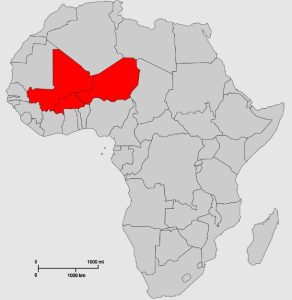
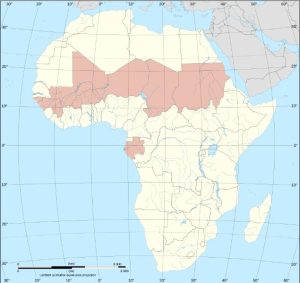
African countries in the Coup Belt. 2023 image by “Discombobulates“. CCA/4.0 International.


The Coups in Context

The wave of military takeovers that produced the AES did not emerge from a vacuum. Mali experienced coups in August 2020 and again in May 2021. Burkina Faso experienced two in 2022 alone, with Army Captain Ibrahim Traoré consolidating power in September of that year. Niger’s military removed President Mohamed Bazoum in July 2023. In each case, the military’s public justification was the same: the civilian government had failed to contain the jihadist insurgencies consuming the country’s territory, and French forces — present under Operation Barkhane and its predecessor missions since 2013 — had failed alongside them.

Burkina Faso President Captain Ibrahim Traoré, 2025. Image from RIA Novosti archive, image # / CC-BY-SA 3.0

That justification deserves scrutiny rather than dismissal. Despite the success of Operation Serval, French counterinsurgency strategy in the Sahel had produced a decade of inconclusive results despite significant resources, considerable French casualties, and the deployment of sophisticated ISR and strike assets that no Sahelian government could replicate independently. Operation Barkhane at its peak deployed approximately 5,100 French troops across five countries; JNIM and the Islamic State Sahel Province continued to expand their territorial control, increase their attack tempo, and grow their recruitment base throughout the same period. The populations of Mali, Burkina Faso, and Niger drew conclusions from that evidence. The coup leaders articulated those conclusions in the language of sovereignty rather than counterinsurgency doctrine, but the underlying assessment was not irrational.

What the departing French and American presence also represented, in a less discussed dimension, was a set of political constraints on how the AES governments could fight. Western counterinsurgency doctrine emphasizes civilian protection, human rights compliance, and governance reform alongside kinetic operations. Those emphases were not merely theoretical for the civilian governments that preceded the juntas — they were tied to aid flows, political recognition, and the terms on which French forces operated. The juntas removed those constraints. Whether what replaced them is better or worse for the populations of the Sahel is a genuinely open question; that the constraints existed and shaped operations is not.


The Economic Factor

The AES governments’ accusations that France colluded with or tacitly enabled jihadist groups in the Sahel have been widely dismissed in Western media as Russian-amplified disinformation. A French court ruling handed down on April 13, 2026 however, makes that dismissal considerably harder to sustain.

On that date, the Paris Criminal Court found Lafarge — the French cement giant now part of Swiss conglomerate Holcim — and four former executives guilty of financing terrorism. The conviction rested on documented payments totaling approximately €5.5 million made between 2013 and 2014 through Lafarge’s Syrian subsidiary to armed groups including the Islamic State and the al-Nusra Front, in order to keep the company’s Syrian cement plant operational during the civil war. Lafarge had already pleaded guilty in the United States in 2022, paying $778 million in fines and forfeitures to the US Justice Department for conspiring to provide material support to designated terrorist organizations. The Paris court imposed the maximum available corporate fine and sentenced the former executives to prison terms ranging from three to six years. A separate charge of complicity in crimes against humanity remains under investigation.

The Lafarge case does not prove that the French government directed or approved payments to jihadist groups. What it establishes is that a major French corporate entity — operating in a conflict zone where French military and intelligence assets were also present — paid jihadist organizations to protect its commercial operations, and that French institutional and legal processes took the better part of a decade to bring the company to account. The AES governments have not made the careful distinction between corporate and state culpability. Neither, in many cases, have their populations.

The economic dimension of France’s Sahelian presence is not peripheral to this story — it is, by any honest accounting, central to it. France generates approximately 70% of its electricity from nuclear power, and Niger was, until recently, its second-largest supplier of uranium, providing roughly 20% of French uranium imports over the past decade. That uranium came primarily from the Somair mine operated by Orano — a company majority-owned by the French state. Following Niger’s 2023 coup and the expulsion of French forces, the junta in Niamey revoked Orano’s license for the Imouraren deposit — estimated to hold 200,000 tons of uranium reserves — and by December 2024 had taken operational control of Somair itself, effectively nationalizing France’s primary nuclear fuel source in West Africa.

Mali has been equally direct about the economic reordering. The Malian government placed Barrick Gold‘s Loulo-Gounkoto gold complex under state administration in a tax dispute and detained the CEO of Australia’s Resolute Mining until the company agreed to a $160 million settlement. Mali’s military government states that its renegotiated mining contracts and royalty enforcement have generated over 700 billion CFA francs — approximately $1.2 billion — in additional state revenue. Gold mining accounts for roughly a quarter of Mali’s budget; the previous arrangements, negotiated under civilian governments with French backing, returned a substantially smaller share to the Malian state.

Essakane Mine in Burkina Faso. From iamgold.com. CCA/3.0 Unported.

The picture that emerges from these facts, taken together, is not one of ideologically pure anti-jihadist governance. It is one of sovereign governments — however imperfect their democratic credentials — reasserting control over natural resources that had been structured, over decades of post-independence arrangements, to benefit external corporate and state interests more than the populations sitting on top of them. Whether the AES juntas will deploy that recovered revenue effectively against the jihadist threat is a separate and still-open question. That the revenue was being extracted at terms unfavorable to the host nations, and that French military presence served as a guarantor of those terms regardless of its stated counterinsurgency mission, is now a matter of documented record rather than junta propaganda.


The AES – An Emerging Security Architecture

The Alliance of Sahel States was formally constituted through the Liptako-Gourma Charter in September 2023, initially as a mutual defense pact — an explicit response to ECOWAS threats of military intervention to restore civilian governance in Niger. The three states withdrew from ECOWAS formally in January 2025, and signed a Confederation Treaty in July 2024 that deepened the alliance’s institutional structure. On December 20, 2025, at a ceremony at an air base in Bamako, the AES inaugurated its Unified Force — the FU-AES — an initial force of approximately 5,000 troops drawn from all three armies, placed under the command of Burkinabe General Daouda Traoré and headquartered in Niamey. The April 2026 summit expanded the planned force to 15,000.

This is the third attempt to build a joint security mechanism for the central Sahel. The Multinational Joint Task Force announced in January 2017 never effectively materialized. The G5 Sahel Joint Force, established in July 2017 with French support and including Mauritania and Chad alongside the three AES states, collapsed when Mali withdrew in 2022 and the others followed. The AES Unified Force differs from both predecessors in one critical respect: it is explicitly designed to operate without Western donor funding, without French logistical support, and without the political conditionalities that accompanied both. Whether it can be sustained at scale on that basis is the central unresolved question.
Russian engagement has partly filled the gap. Africa Corps — the restructured successor to Wagner Group following Yevgeny Prigozhin’s death in August 2023 — has deployed personnel to Mali, Burkina Faso, and Niger, providing presidential guard services, counterinsurgency support, training, and hardware including helicopters, drones, and armored vehicles. Mali and Niger have also signed agreements with Roscosmos for telecommunications and surveillance satellites. The AES-Russia relationship is not an alliance of equals — Russia brings assets the AES cannot generate domestically, and the AES provides basing, political cover, and African legitimacy for Russian influence projection — but it is a functioning working arrangement, a meaningful difference from France’s openly neo-colonialist operations.


The Honest Accounting

Western analytical assessments of the AES have tended toward pessimism, and not without foundation. The ISS Africa analysis published in March 2026 noted plainly that by mid-2026, the core justification for the coups — that the juntas could succeed where civilian governments had failed — has not been settled. Jihadist territorial control in Burkina Faso is estimated at approximately 60% of the country’s land area; this should not, however, be assumed to equal the country’s population under jihadist control, given the nation’s population density of 90 per square kilometer (233 per square mile). JNIM’s attack lethality has increased year-on-year throughout the junta period. The April 25, 2026 assault on Kidal and the simultaneous car bombing at Kati that killed Mali’s Defense Minister represented a significant jihadist operational success against the AES and its Russian partners, occurring after the FU-AES had been formally activated.
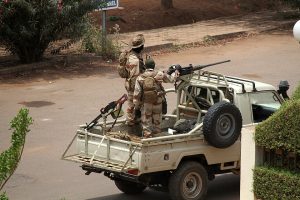
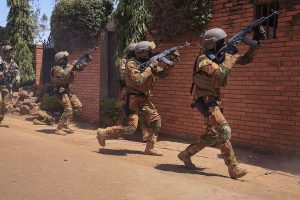
Malian soldiers conduct close quarter battle drills in Ouagadougou, Burkina Faso on Feb. 26, 2019, as part of Flintlock 2019 exercise scenarios. U.S Army photo by Spc. Peter Seidler. Public Domain.

The counterargument — and it is a real one — is that the comparison baseline matters enormously. The AES governments inherited security situations that French-backed civilian governments had failed to stabilize over a decade, with deteriorating trajectories already established before the coups occurred. The relevant question is not whether the AES is winning, but whether it is performing better or worse than its predecessors given the same underlying conditions. That counterfactual is difficult to construct cleanly, and Western analysis has been slow to attempt it seriously, in part because the political incentives run toward emphasizing junta failure.

What is observable rather than inferential is this: the AES has demonstrated genuine political cohesion that neither the G5 Sahel nor any previous regional framework managed. When JNIM and the FLA struck on April 25, all three AES governments responded within hours with joint airstrikes in Malian territory — the Niger government explicitly welcoming “the prompt and vigorous response of the units of the unified force.” The FU-AES commander is Burkinabe, the headquarters is in Niger, and the force draws from all three armies. The institutional solidarity, at least, is functioning. The April summit expansion of the planned force from 5,000 to 15,000 signals that the member governments regard the Unified Force as viable enough to scale.

The AES is not winning its war, at least not quickly, and certainly not “cleanly”. But it is also not the simple story of junta incompetence and Russian exploitation implied by much of Western media coverage. It is three countries with legitimate sovereignty, genuine security problems that preceded their current governments, and a functional if fragile regional architecture, all trying to develop indigenous solutions to a problem that externally-backed approaches failed to solve. The complexity of that situation is not a reason to withhold analytical judgment. It is a reason to ground that judgment in the actual record rather than the preferred narrative.


The Freedomist — Keeping Watch, So You Don’t Have To


freedomist banner


Eight Days


There is a number that should be haunting every defense ministry in the Western world right now, and it belongs to Britain. Tom Tugendhat, MP for Tonbridge and a man with actual military service to his name, stated it plainly in late April 2026: the United Kingdom can sustain major combat operations for approximately eight days. Not eight months. Not eight weeks. Eight days. In the same breath, he confirmed what open-source analysts have been documenting from the Ukraine front: Russian artillery is burning through upwards of twenty thousand rounds per day.

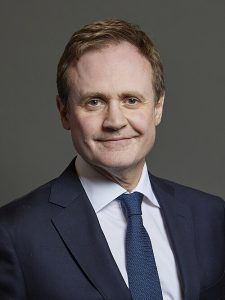
Official portrait of Tom Tugendhat MP. House of Commons / Laurie Noble, 2024. CCA/3.0 Unported

Those two numbers, placed side by side, tell you everything you need to know about where thirty years of post-Cold War optimism have left one of history’s great military powers.


The Arithmetic Of Hollowness

Eight days is not a figure Tugendhat invented for shock value. He is a former chairman of the Foreign Affairs Select Committee who served as a British intelligence officer in Iraq and Afghanistan. When he says it, he is drawing on briefings and wargames the public does not see. And the institutional analysis supports him.

The Royal United Services Institute – Britain’s premier defense think tank – has assessed that deploying a single armored brigade would consume somewhere between seventy and eighty percent of the British Army’s total combat engineering capability. A full division – the kind of force Britain would be expected to field in a serious NATO commitment – is, in RUSI’s measured language, “fanciful.” The regular Army currently stands at around 140,000 personnel, a number that sounds substantial until you compare it to France’s 250,000 or consider that a meaningful portion of that figure exists on paper rather than in uniform and ready to deploy.

The naval picture is no better. A Royal Navy carrier strike group is an impressive thing on paper – and it represents, on most operational days, nearly the totality of what the fleet can put to sea simultaneously. Two Type 45 destroyers, two Type 23 frigates, one fleet ready escort for home waters, and perhaps one attack submarine if the scheduling works out. That is not a global power’s navy. That is a capable but brittle force that cannot absorb losses or sustain extended high-intensity operations.


The Money Problem – And The Accounting Problem

Britain has technically met the NATO two-percent GDP spending guideline every year since its introduction in 2006, and officials in London have been quick to point that out. What they are slower to mention is that up to a quarter of that headline figure is absorbed by the nuclear deterrent – Trident and its associated infrastructure – leaving the conventional forces funded at something closer to 1.5 percent in practical terms. Germany, which spent barely over one percent of GDP on defense a decade ago, has now surpassed Britain in absolute defense expenditure and overtook the UK as NATO’s second-largest spender in 2024.

The Starmer government has committed to raising defense spending to 2.6 percent of GDP by 2027 and, following the June 2025 NATO summit, to 3.5 percent by 2035. The Ministry of Defense has warned of a £28 billion funding shortfall over the next four years even at current commitment levels [https://www.cityam.com/charts-uk-defence-reeves-nato-starmer-trump/]. The Treasury, managing a government that is simultaneously trying to fund the NHS, fix crumbling infrastructure, and service a substantial national debt, has responded to these warnings with the fiscal equivalent of a shrug. The ambition to reach three percent, officials have noted, will be achieved “when economic and fiscal conditions allow.” [https://www.trade.gov/country-commercial-guides/defense-equipment-united-kingdom] In a period of low growth and geopolitical turbulence, that is a phrase that can mean almost anything.

Meanwhile, NATO itself has moved the goalposts. At The Hague in June 2025, the alliance committed members to five percent of GDP – 3.5 percent on core defense, 1.5 percent on resilience and infrastructure – by 2035. Britain currently sits below the NATO alliance average as a share of GDP, lagging behind thirteen member states including Estonia, Latvia, and Poland – countries that, unlike Britain, share a border with the threat and have drawn the appropriate conclusions.


The Political Dimension

Tugendhat’s speech at the Policy Exchange think tank did not confine itself to hardware and stockpiles. He identified something harder to fix than an ammunition shortage: a political culture that has systematically avoided hard choices about defense for a generation.

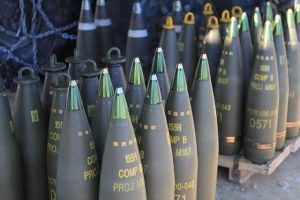
155 mm artillery rounds for the M777 howitzers. Yukon Training Area, near Eielson Air Force Base. 2012 photo by US Army. Public Domain.

“For three decades, we have been projecting an image of a Britain that no longer exists,” he said in 2026. The gap between Britain’s self-image – permanent Security Council seat, nuclear power, special relationship with Washington, the shadow of Churchill – and its actual military capacity has become wide enough to drive a naval convoy through. British generals, Tugendhat noted, have told him that the entire firepower of today’s British Army is less than what a single brigade commander could call on in the 1990s.

There is also a legal dimension that Tugendhat raised and that deserves more attention than it typically receives. He argued that British forces have been progressively fettered by legal constraints – human rights legislation improperly applied to battlefield conduct – that have had a measurable chilling effect on operational decision-making, as well, as on recruitment and retention. Whether or not one agrees with that argument, the perception within the force that prosecution rather than a medal awaits those who act decisively is a real factor in institutional confidence.
The Starmer government’s commitment to defense is “genuine,” in the sense that the numbers are moving in the right direction. But political commitment to a 2035 target does not fill an ammunition bunker today. It does not add a frigate to the fleet this year. It does not give the Army the engineering and logistics depth RUSI says it is missing. The eight-day window is not a projection of where Britain will be in a decade. It is where Britain is right now.
 

The Wider Lesson

Britain is not uniquely culpable here – the peace dividend was a collective European indulgence, and most NATO members spent the post-Cold War decades making the same assumptions about permanent stability and American underwriting. What makes the British case worth examining closely is the distance between the country’s continued great-power rhetoric and the material reality of its defense posture. France, for all its problems, has maintained a more coherent expeditionary force and a defense industrial base that can actually produce things under pressure. Poland is spending nearly four percent of GDP and building an army that is beginning to look like one of NATO’s more serious land forces. Germany has belatedly recognized the emergency and is spending accordingly.

Britain, by contrast, is in the uncomfortable position of being a country whose defense vocabulary still runs on Cold War confidence while its actual capabilities have been quietly liquidated to help balance budgets that were never quite balanced anyway.

Eight days. Russia burns around twenty thousand artillery rounds a day. The math is not complicated. The question is whether the political system can close the gap between the image and the reality before that arithmetic becomes relevant in the worst possible way.


The Freedomist — Keeping Watch, So You Don’t Have To


freedomist banner


Israel’s Recognition of Somaliland May Have Just Killed the Post-War World Order…


Nation-states are odd things. They are not really “tribes”, and are “more” than cities. But, perhaps insensibly, the mass of people today self-identify with one nation or another. Things have been this way since long before the Egyptians duked it out with the Hittites at Kadesh.

But sometimes…things go sideways. Really sideways.

On December 26th, while most of the world was still digesting Christmas leftovers, Israeli Prime Minister Benjamin Netanyahu did something that might prove to be the most consequential geopolitical act since 1945: Israel became the first nation to formally recognize the Republic of Somaliland as an independent state.

Somaliland has been seeking international recognition since 1991 – and recently tried to entice the United States with a similar offer of basing rights as they offered to Israel – but has been rebuffed by the “international community” at every turn…until now.

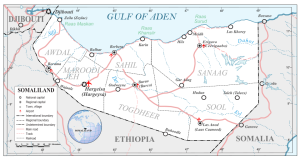
Somaliland map. 2022 image by WikiUser Siirski. CCA/4.0 Int’l

This act by Israel immediately set off hysterical outcries throughout the United Nations (but not from Israel’s closest regional allies, Ethiopia and the United Arab Emirates (UAE), note), with the Security Council calling an emergency session on the matter. However, complaints were short-circuited by Tammy Bruce, the United States’ Ambassador to the UN, who pointed out that Israel’s action in recognizing Somaliland was in no way different than the UN’s own actions in recognizing a state – Palestine, in 2012 – that has a far better claim to “legitimacy” than either Palestine or Somalia itself.

If your reaction is “So what? Some breakaway African territory got recognized by Israel — big deal,” then you’re missing what just happened. This isn’t about Somaliland. This is about the deliberate destruction of the international order that’s governed the planet since World War II ended…and may be the death-knell for the 400-year old Treaty of Westphalia – which matters a very great deal.


What Westphalia Is, and Why It Matters

The Peace of Westphalia (1648) established the principle that sovereign states have exclusive authority over their territory and that external powers shouldn’t interfere in their internal affairs. After 1945, this was modified: the United Nations system added the idea that existing borders are sacrosanct and territorial integrity must be preserved. In practice, this meant that no matter how artificial, dysfunctional, or oppressive a state might be, its borders were frozen in place by “international consensus.”

This system has a name in international law — the “constitutive theory” of statehood — which holds that you’re only a legitimate state when other states recognize you. It supposedly replaced the older Montevideo Convention standard (but see below…), which holds that you’re a state if you have: a permanent population, a defined territory, a functioning government, and the capacity to conduct foreign relations. “Recognition” just acknowledged an existing fact; it didn’t create statehood.

The problem with constitutive theory that should be obvious after about sixty seconds of thought is: who recognized the first state? The whole concept is circular logic masquerading as international law.


The Hidden Crowbar

One of the leading opponents of Israel’s move – Slovenia – complained that it was a violation of a member-state’s sovereign territorial integrity…which is a very rich and ironic take on the subject, given that the former Yugoslavian state’s existence as a sovereign nation was confirmed by the 1991 Badinter Arbitration Commission, which – by the UN’s own rules – openly and nakedly violated Yugoslavia’s sovereign territorial claims.

Why is this important? Because of the Montevideo Convention on the Rights and Duties of States.

Signed in 1933, and ratified into law in the United States in 1934, this international legal agreement defines precisely what is required for a state to be a state, namely: a) a permanent population; b) a defined territory; c) government; and d) capacity to enter into relations with the other states.

But the Convention goes on to use significant specific language. It is worth quoting Article 3 in full:

“The political existence of the state is independent of recognition by the other states. Even before recognition the state has the right to defend its integrity and independence, to provide for its conservation and prosperity, and consequently to organize itself as it sees fit, to legislate upon its interests, administer its services, and to define the jurisdiction and competence of its courts. The exercise of these rights has no other limitation than the exercise of the rights of other states according to international law.”

This is seriously explosive stuff. Re-read that as many times as it takes, if there is an issue with understanding it.

Now, this might be seen as a simple artifact of political maneuvering, except that when Yugoslavia disintegrated in 1991 – which created Slovenia from that state’s remains, among others – the United Nations formed the Badinter Arbitration Commission to determine the future of the region. And, in deciding that the components of the former Yugoslavia were in fact independent nations, the Commission – while not directly citing the Montevideo Convention, even though no state involved had attended or signed it, cited all of its core principles – thus confirmed the Convention as a valid component of international law.

This is the actual basis for the UN recognizing Palestine, because Palestine is as much a “breakaway” part of Israel as Somaliland is of Somalia.

Why Somalia Matters (And Doesn’t)

Somalia has been a failed state since 1991. Somaliland — the former British protectorate portion of the region — declared independence that same year and has maintained effective self-governance, relative stability, and functional institutions for the last 34 years. By any objective measure, including using Montevideo criteria, Somaliland is more of a “real state” than Somalia, itself, which can barely control its own capital.

But under the post-1945 system, Somalia’s non-existent territorial integrity trumps Somaliland’s actual effective and long-standing peaceful and successful governance. Why? Because the “international community” decided so, and because African nations fear that allowing ethnic self-determination will open a Pandora’s box. Nigeria’s strident condemnation of Israel’s move isn’t about solidarity with Somalia — it’s about Biafra and the nightmare that their own artificial borders might be questioned.


The Real Game: Netanyahu vs. The World

Benjamin Netanyahu isn’t stupid, and he’s not doing this for humanitarian reasons. Israel has spent decades being targeted by the UN system, the International Criminal Court, and the entire apparatus of “international law” being wielded as a weapon by nations that want to delegitimize the Jewish state’s existence. In a very real way, the only component missing is red white and black swastika armbands.

By recognizing Somaliland, Netanyahu is making a declarative statement, in effect:

Effective control and governance create legitimacy, not UN votes or ‘international consensus.’ We’re reverting to the Montevideo protocol, exclusively. Israel exists because we hold a defined territory and govern it effectively — in the same way as Somaliland. You don’t get to vote us out of existence.


This isn’t about Somaliland. It’s about destroying the gatekeeping power of international institutions that have become weapons against Israeli sovereignty. And Netanyahu is using the Trump administration’s transactional indifference to global norms as cover to reshape the fundamental rules.


Qaddafi Called It (And Paid For It)

In 2009, Libyan leader Muammar Qaddafi gave a rambling speech at the UN where he called the Security Council the “Terror Council,” tore up a page of the UN Charter, and accused the entire system of being neo-colonial power dressed up as international law. He was dismissed as a ranting dictator.

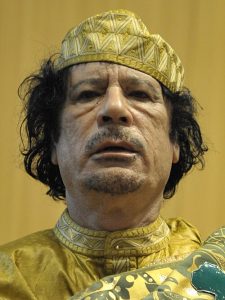
Muammar Qaddafi, 2009. US Navy photo. Public Domain.

Two years later, NATO — operating under a UN resolution — regime-changed him, turning Libya from Africa’s highest HDI state into a failed state with open-air slave markets. Qaddafi had correctly identified that the post-1945 system was “political feudalism” where five permanent Security Council members could do whatever they wanted while smaller nations faced “consequences” for trying the same actions.

Muammar Qaddafi was a vile individual…but he was not wrong. And they killed him for saying it out loud.


The Cascade Effect

If this precedent holds, the implications are explosive:

  • Catalonia’s independence movement gains legal ammunition against Spain and the EU
  • Taiwan’s status becomes purely about effective governance, not Beijing’s claims
  • Kurdistan becomes viable if they can maintain control and get recognition
  • Every artificial post-colonial border in Africa and the Middle East becomes reviseable
  • Texas…well, the Republic of Texas has serious historical precedent

The African Union, Egypt, Turkey, and Nigeria aren’t panicking because they care about Somalia’s feelings. They’re panicking because most of their borders are artificial lines drawn by European colonial powers that trapped rival ethnic groups together and split coherent peoples apart. Sykes-Picot and the 1884-1885 Berlin Conference created states, not nations. The post-1945 order then froze these arrangements and declared them permanent.

Netanyahu just said: No, they’re not.


Does This Actually Make Things Worse?

Ten years ago, I’d have predicted this would cause a global bloodbath. But would it really? Pre-1945 wars were generally frequent but bounded: limited objectives, clear territorial stakes. Post-1945, we’ve had continuous conflict: Korea, Vietnam, endless Middle East wars, proxy conflicts across Africa and Latin America, Afghanistan, Iraq, Syria, Yemen, Libya. The UN system didn’t prevent wars; it just made them illegitimate, forcing them to become covert, proxy-based, or justified through elaborate legal fictions.

We traded occasional large wars for permanent medium-intensity conflict. That might actually be the worse deal.

If destroying the constitutive theory allows organic nations to form based on actual cultural and historical coherence rather than colonial mapmaking, the initial instability might be worth it for long-term viability.


The Bottom Line

Israel’s recognition of Somaliland isn’t about Red Sea access or Ethiopian port deals, although those certainly matter. It’s about one simple proposition: The post-World War II international order, as currently administered, is illegitimate and they’re not playing by those rules anymore.

And it’s the sole fault of the United Nations itself, as their 2012 recognition of the wholly non-existent and non-governed “state of Palestine” handed the United States and Israel all the excuse they needed to unilaterally recognize Somaliland.

Whether you think that’s catastrophic or overdue depends entirely on whether you believe the current system has been preventing conflict or perpetuating it (hint: it’s the latter). But either way, what happened on December 26th of 2025 in Jerusalem is going to reshape the world map in ways we’re only beginning to understand.

The post-1945 era might have just ended. Most people haven’t noticed yet.

But they will.


The Freedomist — Keeping Watch, So You Don’t Have To


freedomist banner


Yemen’s Inevitable Divorce


Nations are odd things. They are difficult to found and internally fractious, but resist splitting up again when irreconcilable differences happen. Moreover, international “clubs” – like the United Nations – are loathe to accept new nations, unless those nations navigate the wholly articial, Twister-like rules which those clubs set. Conversely, said clubs steadfastly refuse to accept any new nation declaring its existance, whether they have effective control and administration over their territory or not.

And, this is especially true when the state in question has absolutely no collective identity, but was artificially constructed by former European colonial masters who drew lines on a map in a smoking room in some European capital, ignoring what people lived where, caring solely for natural terrain features like rivers, lakes and mountains that required little effort to delineate, because those doing the drawing had a croquet match to attend at the lawn party outside.

The question isn’t whether Yemen will split into two countries again — it’s whether the international community will finally acknowledge what’s already happened on the ground. The entity we call “Yemen” exists primarily on maps and in UN resolutions, while the actual territory operates as separate political systems with different governments, currencies, and security forces. The reunification experiment that began in 1990 is effectively over. What remains for the “international community” is deciding how to make it official without looking like complete morons.

And it isn’t as though precedents do not exist for this sort of thing: The most successful modern national partition remains Czechoslovakia’s “Velvet Divorce” in 1993. Unlike Yugoslavia’s violent disintegration, Czech and Slovak leaders negotiated a peaceful split despite polls showing most citizens preferred staying united. The separation was orderly: assets divided, treaties apportioned, borders established without dispute. Both successor states joined NATO and the EU, maintaining close economic ties and visa-free travel. The key difference? Political leaders committed to negotiated settlement rather than violence, no external powers had strong interests in preventing partition, and both populations were relatively homogeneous within their territories. It remains the gold standard for how national separations should work — and how rarely they actually do.

Understanding why requires looking back at how these “two Yemens” came to exist in the first place, and why their marriage was probably doomed from the start.


The Original Split

Modern North Yemen emerged from the collapse of the Ottoman Empire, becoming an independent kingdom in 1918 under Imam Yahya. It remained a conservative, tribally-organized monarchy until a 1962 military coup sparked an eight-year civil war that eventually established the Yemen Arab Republic — backed by Egypt and the Soviet Union against Saudi-supported royalists. The north was predominantly Zaydi Shia in religious orientation, though more moderate than Iranian Twelver Shiism, with a strong tribal structure and conservative social organization.

Ahmad bin Yahya Hamidaddin (1891 – 18 September 1962) was the penultimate king of the Mutawakkilite Kingdom of Yemen from 1948 to 1962. Public Domain.

South Yemen followed a completely different trajectory. After the British withdrawal from Aden in 1967, Marxist revolutionaries established the People’s Democratic Republic of Yemen — the only officially Marxist state in the Arab world. It was militantly secular, Soviet-aligned, and attempted rapid socialist transformation. The South’s population was more Sunni, more urbanized – centered around the port city of Aden – and ideologically committed to state-directed modernization. The two countries even fought a brief war in 1979.

These weren’t minor cultural differences. They represented fundamentally incompatible visions of governance, society, and Yemen’s place in the world.


The Unlikely Marriage

Reunification in 1990 was driven more by desperation than genuine reconciliation. The Soviet Union was collapsing, cutting off South Yemen’s economic lifeline. North Yemen’s economy was struggling. Both governments faced internal dissent and saw unification as a solution to their separate crises. President Ali Abdullah Saleh from the north and Ali Salim al-Beidh from the south negotiated a merger that papered over fundamental incompatibilities with promises of power-sharing and federal governance.

It lasted exactly four years before armed conflict erupted. The 1994 civil war saw northern forces, backed by Saudi Arabia and conservative tribal militias, defeat southern separatists decisively. What followed wasn’t genuine reunification but northern domination. Saleh’s government systematically marginalized southern politicians, appropriated southern oil revenues, and installed northern military commanders in southern territories. Resentment festered for two decades.

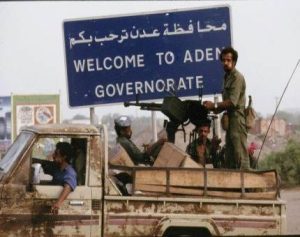
Yemen’s government army entering Aden Goveronate during the civil war, July 1994. Public Domain.


The Breaking Point

The “Arab Springreached Yemen in 2011, forcing Saleh from power but leaving underlying tensions unresolved. The Houthi movement — a Zaydi revivalist group from northern Yemen with Iranian backing — capitalized on the chaos. By 2014, they had seized the capital of Sanaa. When they pushed south toward Aden in 2015, Saudi Arabia launched a military intervention that continues today.

The conflict crystallized existing divisions. The Houthis control most of the north, operating what is effectively a separate state with its own governance, military, and foreign policy — as demonstrated by their attacks on Red Sea shipping in solidarity with Hamas. The Southern Transitional Council (STC), formed in 2017, controls much of the south including Aden, with UAE backing. They issue their own currency, operate separate security forces, and openly advocate for southern independence.

The internationally recognized government, meanwhile, barely controls anything and operates primarily from Saudi Arabia. This is a government in name only.

The October 2000 bombing of the destroyer USS Cole in Aden harbor — killing 17 American sailors — illustrated Yemen’s role as a base for transnational extremism long before the current crisis. Al-Qaeda in the Arabian Peninsula (AQAP) thrived in the ungoverned spaces created by weak central authority and competing factions. The current fragmentation has only worsened this problem, with AQAP and ISIS affiliates operating in territories neither Houthis nor STC fully control.


Why This Matters Beyond Yemen

The Houthi campaign against Red Sea shipping has demonstrated that a Yemeni faction can significantly disrupt global commerce even without international recognition. Their anti-ship and ballistic missiles, as well as “kamaikaze” drones, supplied by the Islamic of Iran, have forced naval deployments by the United States and European powers. A formally partitioned Yemen wouldn’t change these capabilities — it would simply acknowledge political reality.

A map of the Houthi engagements with commercial ships from various countries during the Gaza War. 2023 Map by WikiUser Ecrusized. CC0/1.0

More intriguingly, international recognition of a southern Yemeni state could establish precedent for other de facto separations. Somaliland, which declared independence from Somalia in 1991 and has maintained stable governance for over three decades, has long sought international recognition. If the international community accepts Yemeni partition based on historical precedent (the pre-1990 states) and effective governance, Somaliland’s case becomes significantly stronger, creating a range of possible fallout scenarios. Both represent functional states with historical legitimacy denied recognition due to international community inertia and fear of encouraging separatism.


The Path Forward

The question facing policymakers isn’t whether Yemen should split — it already has. The question is whether maintaining the fiction of Yemeni “national unity” serves any useful purpose, or whether acknowledging reality might actually enable better governance, clearer accountability, and more effective international engagement with whoever actually controls Yemeni territory.

Saudi Arabia and the UAE already deal with separate Yemeni entities. The Houthis negotiate independently with international actors. The Southern Transitional Council administers its territory with minimal reference to the “official” government. At what point does pretending these are temporary arrangements become more destabilizing than simply accepting the divorce?

Yemen’s reunification was an experiment that failed. Acknowledging that failure might be the first step toward actually addressing Yemen’s crises rather than pretending a unified government will somehow reassert control over territories it never effectively governed.


The Freedomist — Keeping Watch, So You Don’t Have To


freedomist banner


The South China Sea Gambit


What’s old is new, apparently. Everyone wants more land…even if the have to build it themselves.

While American attention remains fixated on Chinese aggression in the South China Sea, as well as on Venezuela, a different story is unfolding beneath the surface in the Far East. Vietnam has been building artificial islands at a pace that should make Beijing envious, and the most remarkable aspect isn’t the construction — it’s China’s silence.

Since October of 2021, Vietnamese dredgers have created over 930 hectares of new land across the Spratly Islands, transforming 21 previously marginal outposts into fortified positions complete with ports, helipads, munitions depots, and the infrastructure for military runways. That’s roughly 70 percent of what Communist China built during its infamous “Great Wall of Sand” island-building campaign from 2013 to 2017. At the current pace, Vietnam will match China’s total reclaimed area within two years.

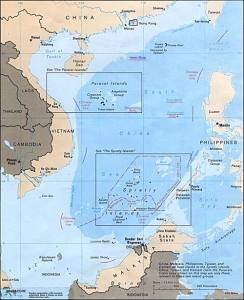
Map of the South China Sea, 1988. CIA image. Public Domain.

The scale is impressive, but the strategic implications are much more so. Take Bark Canada Reef — once barely above water, it now hosts 2.8 kilometers of reclaimed land with foundations laid for a 2,400-meter runway capable of handling military transport aircraft and bombers. Pearson Reef has expanded to nearly 1.3 square kilometers. Tennent Reef, Ladd Reef, South Reef — the pattern repeats across the archipelago: dredge through lagoons, pile sediment into sandbars, build infrastructure.

The construction follows a clear, “cookie-cutter” military logic: Each reef features identical clusters of buildings arranged around central courtyards, munitions depots surrounded by blast walls, and ports capable of servicing Vietnam’s Gepard-class frigates. These aren’t research stations or fishing outposts. They are naval forward operating bases, designed to extend Hanoi’s ability to sustain naval deployments far from the mainland. Ships can now resupply, refuel, and rotate crews without returning to the coast, dramatically extending patrol durations in contested waters.

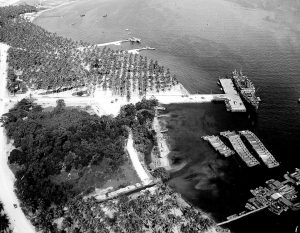
Espiritu Santo base boat repair dock in World War 2, 1943. US Navy photo. Public Domain.

What makes this particularly interesting is China’s muted response. Beijing, which has spent years aggressively confronting the Philippines over far smaller provocations, has issued only perfunctory diplomatic statements about Vietnam’s construction. No coast guard harassment. No water cannon attacks. No military posturing. The contrast is stark: the Philippines controls just nine land formations in the Spratlys and faces constant Chinese pressure, while Vietnam fortifies 29 positions and Beijing mostly looks the other way.

Three factors explain this disparity. First: bandwidth — China is fixated on the Philippines, which has strengthened its defense ties with the United States, opened additional bases to American forces, and conducted recent joint exercises with Washington’s Pacific allies. Beijing opening a second front against Vietnam risks unifying ASEAN against Beijing, something Chinese strategists would rather avoid.

Second: historical precedent — Vietnam has been expanding in the Spratlys since the 1970s, even seizing a few formations from China itself during a bloody 1988 skirmish that killed 64 Vietnamese sailors. From Beijing’s perspective, Vietnam’s current expansion, while larger in scale, isn’t fundamentally new behavior. The Philippines’ recent pushback, by contrast, represents a more pressing challenge to Chinese dominance.

Third: strategic ambiguity — Vietnam maintains partner status in BRICS, attended Beijing’s Victory Day ceremony, and recently finalized an $8 billion arms deal with Russia. When the Trump administration imposed reciprocal tariffs on Vietnam, President Xi visited Hanoi and signed dozens of economic agreements. China remains Vietnam’s largest trading partner with $25 billion in bilateral trade and over $31 billion in cumulative foreign direct investment. Beijing calculates that Hanoi can be managed through economic incentives rather than confrontation.

But, there is obviously a lot of recent history behind this.

The 1988 incident was hardly the first time Vietnam and China had come to blows, however. In February 1979, China launched a punitive invasion of northern Vietnam with 200,000 troops, ostensibly to “teach Vietnam a lesson” for its invasion of Cambodia and alignment with the Soviet Union. The month-long war proved costly for both sides — China claimed 6,900 killed while Vietnam reported 10,000 casualties, though actual figures were likely higher on both sides. Chinese forces captured several provincial capitals before withdrawing, but the operation exposed serious deficiencies in the People’s Liberation Army, which hadn’t fought a major conflict since the Korean War. Importantly, it is vital to remember that in the 1979 conflict, Vietnam fought on two fronts, with c.150,000 troops in Cambodia, while holding off a c.200,000 man Comminust Chinese army — no mean feat, on its own.

More importantly, it established a pattern: Vietnam demonstrated it wouldn’t be intimidated by Chinese military pressure, while Beijing learned that forcibly changing Vietnamese behavior carried steep costs. This historical context helps explain today’s dynamic — China remembers that Vietnam, unlike the Philippines, has proven willing and able to inflict significant casualties in defense of what it considers its territory.

The difference in Beijing’s reaction is telling. While the Philippines has proven that it can certainly fight invaders defensively, it has never actually fought a large-scale war on its own. The largest battle Filipino forces have fought on their own was the five month long siege of Marawi in 2017 – an urban warfare, COIN operation against Islamic State-affiliated guerillas.

Vietnam’s island-building is only part of a broader military transformation. In April 2025, Hanoi finalized a $700 million deal with India to acquire BrahMos supersonic cruise missiles — both ground-based launchers and air-launched versions for its Su-30 fighter jets. The BrahMos represents a significant capability upgrade: it flies at Mach 2.8, carries a 300-kilogram warhead, and can strike targets up to 290 kilometers away, with precision guidance that makes it extremely difficult to intercept. The missile’s sea-skimming trajectory — flying just 3-4 meters above the water’s surface—and terminal maneuvering make it particularly lethal against naval targets. Former BrahMos Aerospace CEO A. Sivathanu Pillai noted that the missile’s high speed combined with its heavy weight makes it about 15 times more lethal than conventional anti-ship missiles: “Any other anti-ship missile will only leave a hole in the hull of the attacked ship, but the Brahmos missile will completely obliterate the target.” Combined with Vietnam’s reported acquisition of 40 Su-35 fighter jets from Russia, including advanced electronic warfare systems, these weapons transform Vietnam’s fortified islands into what military planners call “unsinkable aircraft carriers.”

Extended Range Version of BrahMos missile successfully launched from a Su-30 MKI. 2022 photo from the Government of India. GODL.

The strategy is clear: create facts on the water faster than China can react, hoping to shape a reality too costly for Beijing to reverse. Whether Beijing’s restraint holds, or whether Vietnam’s bet on “hard power” over diplomacy eventually triggers the confrontation both sides claim to want to avoid, remains to be seen.

So — Why should you care? You should care, because approximately $5.3 Trillion dollars worth of global trade — about 24% — flows through this area. If you are one of the few people who can legitimately say that you have nothing in your home that cam from overseas…this still impacts you, because the systems you rely on come off of trans-ocianic ships. And, a major disruption of trade in this area will up-end the carefully curated global system of trade that all nations — including the United States — now depend on. And if you don’t believe that, just refresh yourself about the global impact of the grounding of the container ship EVER GIVEN in 2021…and that was one ship.

For now, the South China Sea is being remade one dredger-load at a time…and not by the country everyone’s watching.


The Freedomist — Keeping Watch, So You Don’t Have To


freedomist banner


Dead in the Water


The United States relies on overseas trade. That is a fundamental underpinning of the national economy, because as wide an array of resources that North America possesses, there is not enough to satisfy our needs here. In order to ensure that type of trade, the United States has relied on a strong military naval establishment for nearly 150 years.

Navies, however, are expensive. Eye-wateringly expensive. But, spending money is better than spending lives…at least, that is the calculus of rational people, and the elected public servants in Washington, DC are rarely categorized as “rational”.

President Trump recently made headlines discussing a return to building battleships, sparking debate about naval strategy and ship types. But that conversation missed a more fundamental problem: it doesn’t matter what kinds of ships we want to build if we’ve lost the ability to build them at all. And the cold and brutal truth is that America’s shipbuilding industry — once the “arsenal of democracy“, that launched thousands of ships in World War II — has collapsed to the point where China’s shipbuilding capacity is 232 times greater than ours.

Let that sink in. Not twice as large. Not ten times. Two hundred and thirty-two times. According to leaked Office of Naval Intelligence briefing slides, Chinese shipyards have a manufacturing capacity of roughly 23.25 million tons, while U.S. shipyards manage less than 100,000 tons. One Chinese state-owned company — China State Shipbuilding Corporation — built more commercial vessels by tonnage in 2024 than the entire U.S. shipbuilding industry has produced since the end of World War II.

Josef Stalin’s supposed quip about “quantity has a quality all its own”, whether he actually said that or not, does in fact apply here.


The Numbers Don’t Lie

The Navy’s FY2025 budget tells a grim story. The fleet will shrink from 296 ships to 287 ships during the fiscal year — a net loss of nine vessels. Only six new ships will be procured while nineteen are to be retired. The fleet is projected to hit its smallest size since 1917 in 2027 at just 283 ships before beginning to grow again, and won’t exceed 300 ships until 2032 – a far cry from Ronald Reagan’s desire for a 600-ship Navy. If there is any “bright light” in this, it is that the US Army is in the same boat, figuratively speaking.

Meanwhile, Communist China’s People’s Liberation Army Navy currently operates approximately 370 warships — the largest navy in the world. The Pentagon projects China’s fleet will grow to 395 ships by 2025 and 435 ships by 2030. That’s an increase of 65 ships in just five years, while America’s fleet shrinks. (How good those Chinese ships really are, of course, is still a matter of debate.)

The Navy has a goal of reaching 381 manned ships plus 134 unmanned vessels by the early 2040s. But the Congressional Budget Office estimates achieving this will cost roughly $40 billion per year — about 46% more than historical averages, and double what Congress has actually appropriated over the past five years. The total price tag: $1 trillion. At least.


Why We Can’t Build Ships

The problem isn’t just money. America’s shipbuilding industrial base has been gutted. We currently have only four active public shipyards compared to China’s 35 major sites. The United States accounts for just 0.11% of global commercial shipbuilding. In terms of gross tonnage, China, South Korea, and Japan build over 90% of the world’s ships. America builds 0.2%.

It really does seem that there is a quiet war going on against US shipbuilding.

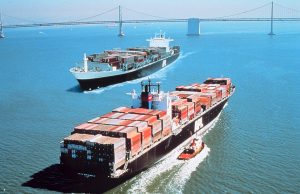
APL Post-Panamax container ships PRESIDENT TRUMAN and PRESIDENT KENNEDY near San Francisco, CA. NOAA Image ID: line0534. Public Domain.

The Government Accountability Office recently testified that despite nearly doubling the shipbuilding budget over the past two decades, the Navy has failed to increase its fleet size as planned. Ships are consistently delivered late, over budget, and with reduced capabilities. The Navy’s new Constellation-class frigates, for example, started construction before completing ship design — violating basic shipbuilding practices — and are now expected to be at least three years late.

The Government Accountability Office (GAO) has made 90 recommendations since 2015 to improve Navy shipbuilding. The Navy has fully or partially addressed only 30. Sixty recommendations remain unaddressed.

The workforce crisis compounds the problem. Shipyards rely on decades-old physical infrastructure. Skilled workers are retiring faster than they can be replaced. Finding enough qualified workers remains the biggest barrier to expanding production, even if Congress appropriated more money tomorrow.


What This Means for War at Sea

Communist China’s shipbuilding advantage isn’t just about peacetime fleet size. In a sustained conflict—the kind of war we’d face in defending Taiwan — China could repair damaged vessels and construct replacements far faster than the United States, at least in theory. The Navy faces a significant maintenance backlog and would struggle to quickly repair battle-damaged ships, let alone build new ones.

Former Navy Secretary Carlos Del Toro told Congress in 2023 that a single Mainland Chinese shipyard had more construction capacity than the entire U.S. industry. This isn’t a matter of China having marginally better capabilities — they’ve achieved total dominance in an industry that’s fundamental to naval power.


No Quick Fixes

Trump’s “Make Shipbuilding Great Again” initiative proposes tax incentives, a Maritime Security Trust Fund, and new maritime opportunity zones. But as Senator Roger Wicker noted in a February 2025 hearing, simply pouring money into shipbuilding won’t work because the U.S. doesn’t have the industrial base to support a surge. You can’t conjure skilled welders, modern shipyards, and supply chains out of thin air.

The Navy is exploring alternatives: unmanned vessels, utilizing allied shipyards in Japan and South Korea, and smaller surface combatants. These might help, as a band-aide. But they are merely workarounds for a fundamental problem — America destroyed its shipbuilding industry through decades of deindustrialization and offshoring, and China methodically built theirs up.

So much for “guns into butter” and “plowshares into swords“.

The hard reality is that naval supremacy requires industrial capacity, and we’ve ceded that capacity to our primary strategic competitor. All the strategy papers and fleet architecture studies in the world don’t matter if we can’t actually build the ships those plans require. China understands this. We’re still figuring it out…And by the time we do, China’s 435-ship navy may already control the Western Pacific.

The one bright spot, is that Chinese ships might be the “TEMU” version of fighting ships…Hopefully.


The Freedomist — Keeping Watch, So You Don’t Have To


freedomist banner


The Mozambique Insurgency – Unpacking the Terror Network Behind “Al-Shabaab”


Since 2017, a war has been raging. Chances are, you have never heard of it. This war, in a remote part of the world, is poorly reported because the goverment is humiliated by its failures, and refuses to allow too much access to report on the fighting.

This matters to you, and to your wealth – because if the Islamic State wins, you will know it…and then some. But in the proximate, there is a serious blind spot that hampers even professionals from understanding the situation fully.

When journalists and analysts discuss the insurgency devastating Mozambique’s Cabo Delgado province, they often go out of their way to clarify that the group locally called “al-Shabaab” has no connection to Somalia’s better-known terror organization of the same name. But this insistence on separation obscures a more complex — and much more alarming and troubling — reality about modern jihadist networks in Africa.

The truth is that while Mozambique’s Islamic State affiliate didn’t emerge from Somalia’s al-Shabaab, specifically, it operates within a sophisticated transnational network coordinated from an unlikely headquarters: the mountains of Puntland in northeastern Somalia.

Map of the Cabo Delgado insurgency; situation as of in March of 2024. Map by WikiUser BlookyNapsta. CCA/4.0 Int’l.

The Name Game

Understanding the confusion requires backing up to 2017, when armed militants first attacked the small ocean port town of Mocímboa da Praia. Locals and journalists needed something to call this nameless group, and many settled on “al-Shabaab” — Arabic for “the youth.” It was a descriptive term reflecting the insurgents’ demographics, not a claim of organizational affiliation. Some called them “Ahlu Sunnah Wa-Jama” after their ideological roots, but “al-Shabaab” stuck, creating endless confusion with Somalia’s al-Qaeda-affiliated terror group.

Here’s where analysts are technically correct: Somalia’s al-Shabaab pledges allegiance to al-Qaeda. Mozambique’s group — now formally called Islamic State Mozambique (ISM) — pledges allegiance to ISIS. These are rival international terror networks that actively fight each other. So no, ISM is not an offshoot or extension of Somali al-Shabaab. They’re on opposite sides of the jihadist world.

But that’s not the end of the story.


The Puntland Connection

What many casual observers miss is that ISIS restructured its African operations in early 2020, creating a coordination hub called the “Al-Karrar office” based in Puntland, Somalia. This office, embedded within ISIS-Somalia, was tasked with coordinating support across eastern and central Africa — including Mozambique.

According to the United Nations, ISIS-Somalia in Puntland began coordinating support to Mozambique as early as late 2019. That support included tactical training (documented by 2020), financial transfers routed through agents in Kenya, Tanzania, and Uganda, and strategic guidance that transformed ISM from a ragtag local insurgency into a formidable military force capable of capturing towns and threatening major infrastructure.

The impact became clear in 2020 and 2021 when ISM’s operational capabilities dramatically increased. The group launched increasingly sophisticated attacks, culminating in the March 2021 assault on Palma that killed dozens and forced French energy giant Total Energy to suspend its $60 billion natural gas project. The coordinated three-pronged attack, use of combined arms tactics, and disciplined withdrawal all bore the hallmarks of external training and coordination.

Buildings destroyed during the battle of Palma. April, 2021 image from Voice of America (VOA). Public Domain.


Foreign Fighters and Transnational Networks

The transcript of recent analysis on Mozambique mentions captured fighters with “foreign accents” and non-local origins — and this tracks with what researchers have documented. While ISM is predominantly staffed by recruits from northern Mozambique and Tanzania, it also draws fighters from the Democratic Republic of Congo (reflecting connections with ISIS’s Central Africa Province) and other parts of the Great Lakes region.

ISIS-Somalia itself has become remarkably international, with fighters from Ethiopia, Sudan, Tanzania, and even Arab Gulf states joining the Puntland-based operation. Some of these fighters have reportedly moved between ISIS’s various African franchises, bringing experience and expertise with them.

This is highlighted by ISM’s amphibious operations in the Quirimbas archipelago, beginning in 2020.

Quirimbas Islands. November, 2021 image from Earth Observatory/NASA. Public Domain.

The financial dimension is equally important. ISIS-Somalia has become one of ISIS’s most profitable branches, generating millions annually through extortion, smuggling networks, and taxation. Some of this money flows through the Al-Karrar office to support operations in Mozambique and elsewhere, creating a self-sustaining transnational terror economy.


Why the Distinction Matters (and Doesn’t)

Analysts aren’t wrong to insist that ISM and Somali al-Shabaab are distinct organizations. The distinction matters for understanding motivations, tactics, and potential diplomatic or military responses. ISM emerged from genuinely local grievances — poverty, government corruption, marginalization of Muslim minorities, and broken promises about natural gas wealth. Addressing those root causes requires different approaches than combating an externally imposed insurgency.

But the insistence on organizational separation can obscure the functional reality: ISM operates within a transnational ISIS network that provides coordination, training, funding, and ideological guidance from Puntland. The “local insurgency” framing risks underestimating the sophistication and resilience of this network.

What this insistence on pedantic nitpicking masks, is a terrifying reality: the remnants of the Islamic State — largely smashed in 2017-2019 — have reorganized themselves into distinctly Western-style “Combatant Commands“, semi-autonomous, regional commands that are all solidly aligned to the IS leadership, but plan and execute operations in their zones as they see fit.

This reorganization has made the organization far more resilient, more flexible, and far harder to attrit by direct military action.


The Bigger Picture

The Mozambique case illustrates how modern jihadist organizations operate in Africa. Rather than monolithic groups expanding from single headquarters, we see franchises that maintain local character while plugging into transnational support networks. ISIS’s pivot to Africa has created a web of affiliated groups that share resources, expertise, and ideological inspiration while adapting to local conditions.

For Mozambique’s suffering population — more than 700,000 displaced and 6,100 killed since 2017 — the organizational charts matter less than the ongoing violence. But for policymakers and analysts trying to disrupt these networks, understanding the Puntland-Mozambique connection is crucial. Cutting the financial and logistical links between ISIS’s regional hubs and its various franchises may prove more effective than treating each insurgency as an isolated local problem.

The insurgents in Cabo Delgado may not be the same “al-Shabaab” that terrorizes southern Somalia, but they’re very much part of the same global jihadist ecosystem—one that has successfully established deep roots in Africa’s most vulnerable regions.


Why This Matters

Mozambique, despite its remote location on the world map, sits on very important real estate…not because of the natural gas finds of Total Energies, but because of its physical location.

As we touched on briefly in 2022, the grounding of the container ship Ever Given in 2021 severely up-ended world shipping, with effects that extended far beyond the six days it took to clear the Suez Canal. Likewise, the explosion in the port of Beirut, Lebanon in 2020. As our 2022 article alluded to, while those incidents were accidents, should a group coordinate similar incidents, such an offensive would devastate world commerce.

More to the point, a deliberate closure of the Suez Canal — unlike the missile and piracy operations of the Houthis in Yemen — would force a rerouting of all ocean-going merchant traffic around South Africa’s Cape of Good Hope…which has to travel right past the war zone in Cabo Delgado.

Indian Ocean area. Historic map (1993), Library of Congress, via the Central Intelligence Agency. Public Domain.

And, again as we theorized about in 2022, multiple deliberate strikes like this present a clear threat to the economic vitality of the world, and directly to you.

The question is, are the real professionals paying attention to the nuance?


The Freedomist — Keeping Watch, So You Don’t Have To


freedomist banner


Continuing Disintegration – No Honor Among Thieves


The more things change, the more they stay the same. As we wrote back in January of 2025, the various terror, drug and insurgent groups in Afghanistan – not content with fighting each other- are poking what they see as a weakened tiger, in the form of a highly dysfunctional Pakistan.

With Pakistan clearly on the losing end of it brief – and terrifying – war with India in May, the various jihadist groups north of the Hindu Kush smelled weakness, and a steady intensification of attacks have been quietly growing, an intensification largely ignored in the wider world press, in favor of Israel v. Hamas, Ukraine v. Russia, and the “Gen-Z – Discord” revolts erupting in states from Morocco to Nepal.


Landscape of Afghanistan, with the Hindu Kush range in the background, and a T-62 MBT in the foreground. 2007 Public Domain photo by WikimediaUser davric.


The 2025 Afghanistan-Pakistan conflict that erupted in earnest in mid-October represents more than routine border skirmishes—it signals a fundamental breakdown in one of the region’s most consequential relationships. After decades of Pakistan supporting the Taliban as a strategic asset, Islamabad now finds itself conducting airstrikes on Kabul and trading artillery fire with forces it helped bring to power. The bitter irony is impossible to miss: Pakistan’s former proxy has become its primary security threat.


October Escalation

The immediate catalyst arrived on October 8, when militants killed 11 Pakistani military personnel, including a lieutenant colonel and a major, in Khyber Pakhtunkhwa’s Orakzai district. Pakistan’s response crossed a critical threshold — airstrikes not merely in border regions but directly on Kabul, Afghanistan’s capital, targeting Tehreek-e-Taliban Pakistan (TTP) leadership allegedly sheltering under Afghan Taliban protection.

The fighting that followed was the deadliest since the Taliban returned to power in August 2021. Pakistan claims it killed over 200 Afghan Taliban and allied fighters while losing 23 soldiers. Afghanistan counters that it killed 58 Pakistani soldiers while suffering only nine deaths. Both sides claim to have captured or destroyed dozens of enemy border posts. Independent verification remains impossible, but satellite imagery and verified drone footage confirm significant damage to Afghan military compounds.

The violence forced a 48-hour ceasefire brokered by Saudi Arabia and Qatar, but border crossings remain closed and tensions simmer. More ominously, Pakistan has adopted what analysts call a “new normal” doctrine: any attack originating from Afghan territory will trigger immediate cross-border retaliation, regardless of diplomatic cost.


The TTP: Pakistan’s Self-Inflicted Wound

At the conflict’s core lies the Tehreek-e-Taliban Pakistan, formed in 2007 during America’s “War on Terror.” The TTP seeks to overthrow Pakistan’s government and impose strict Islamic law, demanding the release of imprisoned members and reversal of tribal area integration into Khyber Pakhtunkhwa province. What makes the TTP particularly dangerous is its ideological alignment with and sanctuary provided by the Afghan Taliban.

The numbers tell a grim story. The TTP conducted at least 600 attacks against Pakistani security forces in the past year alone, with 2025 activity already exceeding all of 2024. August 2025 marked the deadliest month of militant violence in over a decade, with 194 people killed and more than 200 injured in 143 attacks across Pakistan. Pakistani security force casualties in 2025 are on track to be the highest ever recorded.

The TTP has evolved beyond “simple insurgency“, threatening to expand attacks against Pakistan’s military-run commercial enterprises — fertilizer companies, construction firms, housing authorities, and banks. This represents a significant escalation, potentially bringing urban areas into a conflict previously concentrated in remote borderlands.

Briefly, a “simple insurgency”, as defined by Google’s AI search tool can be described as:


A simple insurgency is an armed rebellion by a small, lightly armed group against a more powerful, established government. Because they lack the strength for a conventional military conflict, insurgents use guerrilla tactics and rely heavily on the support of the local population to challenge the ruling authority. [1, 2, 3, 4]
Key characteristics of a simple insurgency • Asymmetric warfare: A simple insurgency is defined by the severe mismatch in power between the rebels and the government they oppose. Insurgents, often called guerrillas, compensate by using hit-and-run attacks and avoiding direct, pitched battles.
• Irregular tactics: Instead of traditional army maneuvers, insurgents employ a variety of tactics to weaken the government and increase their own control and legitimacy. These can include:

• Guerrilla warfare
• Terrorism
• Sabotage
• Propaganda and recruitment

• Protracted struggle: Insurgencies are not short, decisive conflicts. They are typically protracted political-military campaigns designed to outlast and exhaust the government through persistent, focused violence.
• Focus on the population: The ultimate target of an insurgency is not just the government’s military forces, but the loyalty and support of the civilian population. Gaining popular support is the key to success. Insurgents accomplish this by:

• Providing services
• Discrediting the government
• Gaining the trust of people in rural or remote areas

• Driven by ideology: While some rebellions are a temporary revolt, insurgencies are often fueled by a powerful ideology that explains people’s grievances and provides a vision for a new political order. This can include motivations based on religion, ethnicity, or politics.
• Control over territory: Unlike purely terrorist organizations, a central objective of an insurgency is to control resources and eventually establish an alternative government in a particular area. [1, 4, 5, 6, 7, 8]

Simple insurgency vs. other conflicts • Revolution: A simple insurgency lacks the widespread, organized structure of a full-scale revolution, even though it may share the same goal of overthrowing the government.
• Coup d’état: This is different from a coup, which involves a swift, elite-driven seizure of government power. An insurgency, by contrast, relies on a protracted struggle for popular support and does not have the resources for a quick power grab.
• Terrorist organization: While insurgents may use terrorism as a tactic, their ultimate goal is different from purely terrorist groups. Insurgents aim to build an alternative government and control territory, while terrorist groups typically do not. [6, 7, 9, 10, 11]

Notes:

[1] https://en.wikipedia.org/wiki/Insurgency
[2] https://www.vocabulary.com/dictionary/insurgency
[3] https://www.vocabulary.com/dictionary/insurgence
[4] https://www.armyupress.army.mil/Journals/Military-Review/English-Edition-Archives/mr-history-page/MR-Categories-Guerrilla-Warfare/Daskal-1986/
[5] https://www.trngcmd.marines.mil/Portals/207/Docs/TBS/B4S5499XQ%20CounterInsurgency%20Measures.pdf?ver=2016-02-10-114636-310
[6] https://www.cia.gov/readingroom/docs/CIA-RDP87T01127R000300220005-6.pdf
[7] https://www.merriam-webster.com/dictionary/insurgency
[8] https://publications.armywarcollege.edu/News/Display/Article/3890242/the-challenges-of-next-gen-insurgency/
[9] https://2009-2017.state.gov/documents/organization/119629.pdf
[10] https://www.ebsco.com/research-starters/military-history-and-science/revolt-rebellion-and-insurgency
[11] https://www.britannica.com/topic/insurgency


Pakistan’s Strategic Blunder

The current crisis exposes Pakistan’s catastrophic series of miscalculations of the past. For decades, Islamabad’s military establishment pursued “strategic depth” in Afghanistan as a hedge against India, covertly supporting the Taliban even while publicly backing America’s War on Terror. The assumption was straightforward: a friendly Taliban government in Kabul would provide strategic advantage while ending Pakistan’s internal insurgency problems once American forces departed, by exerting control over the “Pakistani Taliban”.

Of course, the opposite promptly occurred. Since the Taliban’s 2021 return to power after the Biden Administration’s disastrous withdrawal from the country, the TTP has grown dramatically more capable and aggressive. Pakistan now faces an irreconcilable contradiction: the same Afghan Taliban it supported for decades now provides sanctuary to Pakistan’s primary internal security threat. Having invested enormous political and military capital ensuring Taliban victory, Pakistan cannot effectively pressure Kabul to eliminate TTP sanctuaries without undermining its broader regional objectives.

When Pakistan demands the Taliban eliminate TTP safe havens, Kabul either urges negotiations with the militants or claims inability to control them—sometimes both simultaneously. Pakistan’s leadership increasingly believes the Taliban deliberately weaponizes the TTP, either to expand Taliban-style governance into Pakistan or enable an allied Pashtun entity to control northwestern Pakistan.


The India Factor

Complicating matters further, India has pursued normalization with the Taliban precisely as Pakistan-Taliban relations deteriorate, almost certainly for that very reason – the brutal calculus of ‘realpolitik‘ usually wins, afterall. Afghanistan’s Foreign Minister Amir Khan Muttaqi visited New Delhi in October, with India announcing plans to reopen its Kabul embassy and calling the meeting “an important step in advancing our ties.” For Pakistan, which fought its brief war with India in May, this Taliban-India rapprochement represents strategic encirclement…which India well-understands.

Pakistan’s military noted the “serious provocation” of the fighting’s timing during Muttaqi’s India visit. The rhetorical shift is stark: Pakistan no longer refers to the Taliban as an “interim government” but as a “regime,” questioning their legitimacy to govern and calling for a more inclusive Afghan government. This represents a near-suspension of diplomatic ties between former allies.


Strategic Dead Ends

Pakistan’s options appear uniformly unattractive. Military operations against the TTP face fundamental constraints: the militants operate from Afghan territory beyond Pakistani reach, enjoy Afghan Taliban protection, and can simply retreat across the disputed Durand Line border when pressured. Localized clearing operations may temporarily displace militants but cannot hold territory without massive troop deployments that remain deeply unpopular among border populations.

Durand Line Border Between Afghanistan and Pakistan. CIA Image, 2007. Public Domain.

Negotiations offer no better prospects. Previous ceasefires collapsed when the TTP refused to compromise on core demands fundamentally incompatible with Pakistan’s constitutional order. The TTP’s demand for sharia law implementation and tribal area autonomy restoration cannot be reconciled with Pakistan’s governance structure. Moreover, the TTP’s track record of breaking agreements makes any deal inherently unstable.

Cross-border airstrikes — Pakistan’s current approach — risk escalating into broader conflict while failing to address root causes. The strikes humiliate the Afghan Taliban publicly, potentially driving them closer to the TTP and other anti-Pakistan groups. Pakistan is adopting tactics it vehemently criticized when India employed them against Pakistan itself earlier this year—a dangerous precedent that normalizes cross-border military action in a nuclear-armed region.


Regional Implications

The conflict’s reverberations extend beyond bilateral relations. China, with massive “Belt and Road” investments in Pakistan, watches nervously as infrastructure becomes militant targets. Regional powers including Russia, Iran, and Saudi Arabia have urged restraint, recognizing that instability along the Afghanistan-Pakistan border threatens broader security. The Kremlin’s Moscow Format Consultations specifically pressed the Taliban to eliminate the TTP threat – pressures Kabul shows no inclination to heed.

Perhaps most troubling, the conflict validates Pakistan’s historical paranoia about strategic encirclement while simultaneously demonstrating how that paranoia drove the very policies that created current threats. By backing the Taliban as a hedge against India, Pakistan helped create a government that now shelters Pakistan’s most dangerous internal enemy while courting Pakistan’s primary external rival.

And this, in a nuclear-armed nation with a very shaky government.


No Good Options

As the temporary ceasefire holds precariously, at least for the moment – the fundamental problem remains unresolved: Pakistan faces an emboldened insurgency operating from sanctuary areas it cannot easily eliminate without destroying relationships it spent decades building. The Afghan Taliban, meanwhile, must balance protecting ideological allies against managing fallout from Pakistani military actions — a calculation complicated by its own limited control over remote regions and internal pressure from hardline factions…in public, at least.

History suggests leaders within the Taliban understand that Afghan governments ending up on Pakistan’s wrong side rarely survive. Yet the Taliban’s public posture suggests they believe they can continue supporting the TTP without triggering Pakistani countermeasures sufficiently severe to destabilize their regime. Whether this calculation proves correct may determine the region’s stability for years to come.

What seems certain is that Pakistan’s investment in the Taliban as a strategic asset has become a strategic liability of the first order — a cautionary tale about the dangers of relying on militant proxies as instruments of state policy. The militants Pakistan once cultivated have become the militants Pakistan can no longer control, operating from territory Pakistan helped them secure. The tragic irony would be complete if it weren’t so dangerous.

But.

The most important thing to remember in this swirling morass of barely concealed knives, is that the two main players – India and Pakistan – are both nuclear-armed powers…and no one, including them, is quite sure how steady are the hands on those launch keys.

Prepare yourself accordingly.


The Freedomist — Keeping Watch, So You Don’t Have To


War Economics in the Shadows


Wars require money, in some form. Combatants have to buy weapons, ammunition, food, vehicles, fuel, spare parts, lay down bribes for intelligence and suborning various people, and medical supplies, along with just simple tools…and that’s before we talk about whether they actually pay their fightersd.

In the shadowy realm of contemporary warfare, the most destructive conflicts are increasingly those where the combatants get their war chests filled by distant, foreign capitals. From Ukraine’s defense against Russian aggression to Yemen’s devastating civil war, proxy conflicts have become the preferred method of great power competition — offering what military strategists euphemistically callquick, relatively cheap and low-risk options for the continuation of policy aims“.

Proxy warfare has evolved from Cold War-era confrontations into a sophisticated financial enterprise that operates through complex networks of state sponsors, shell companies, and illicit economic activities. As Foreign Policy columnist Emma Ashford observed, proxy wars have become a preferred method of great power competition, allowing major powers to exert influence while maintaining plausible deniability. Understanding the financial mechanisms that sustain these conflicts is crucial for comprehending modern geopolitical dynamics and developing effective countermeasures.

Yet behind every proxy war lies a complex economic ecosystem that determines not just who fights, but how long they can sustain the violence. Understanding these financial networks reveals uncomfortable truths about modern warfare: conflicts are increasingly about economic endurance rather than battlefield tactics, and the nations writing the checks often have more control over outcomes than the soldiers pulling triggers.


The State Funding Model: Direct Government Support

The most straightforward financing mechanism involves direct state funding of proxy forces. President Vladimir Putin’s extraordinary admission in June 2023 revealed that “the financing of the entire Wagner group was fully ensured by the State,” with the Russian Defense Ministry pouring nearly $1 billion into Wagner operations from May 2022 to May 2023. This disclosure shattered decades of Kremlin denials and provided unprecedented insight into how major powers fund their proxy operations.

No nation has perfected the economics of proxy warfare quite like Iran. Tehran’s “Axis of Resistance” represents perhaps history’s most sophisticated proxy financing operation, with the Islamic Revolutionary Guard Corps-Quds Force managing an estimated budget exceeding $1 billion annually for terrorist financing. This staggering sum supports between 140,000 and 185,000 proxy fighters across Afghanistan, Gaza, Lebanon, Pakistan, Syria, and Yemen.

Groups that are part of the “Axis of Resistance”. 2024 image via Kaliper1. CCA/2.5

Iran represents perhaps the most systematic state-sponsored proxy financing network. The U.S. State Department estimated that Iran spent more than $16 billion supporting the Assad regime and its proxies between 2012 and 2020. In 2020 alone, Iran funneled more than $700 million to Hezbollah, while providing more than $100 million annually to Hamas and Palestinian Islamic Jihad. These massive transfers occur through Iran’s Islamic Revolutionary Guard Corps-Quds Force (IRGC-QF), which serves as Tehran’s primary mechanism for financing proxy operations across the Middle East.

The scale of Iran’s investment becomes clear when examining individual recipients. Hezbollah alone receives more than $700 million annually from Tehran, a sum that dwarfs the entire defense budgets of many small nations. As Hezbollah Secretary General Hassan Nasrallah candidly admitted in 2016: “Hezbollah’s budget, everything it eats and drinks, its weapons and rockets, comes from the Islamic Republic of Iran.

Iran’s proxy economics operate on multiple levels simultaneously. Beyond direct cash transfers, Tehran provides weapons manufacturing capabilities, enabling proxies to achieve self-sufficiency while maintaining plausible deniability. In Syria, Iran helped organize, train, and fund over 100,000 Shia fighters, demonstrating how proxy economics can scale to conventional warfare levels when strategic interests demand it.

The sophistication of Iran’s financial network became apparent in 2016 when Hezbollah leader Hassan Nasrallah publicly announced that “all of his organization’s funding comes directly from Iran,” emphasizing that “the budget of Hizbullah, its salaries, its expenses, its food, its drink, its weapons, and its missiles come from the Islamic Republic of Iran“. This funding bypasses traditional banking systems, with Nasrallah confirming that transfers occur directly, “not through banks and other financial institutions”.

The Iranian model reveals a crucial economic principle: proxy wars succeed when sponsors can provide “stable and ample funding” while maintaining political control over their assets. Tehran achieves this through what former CIA analyst Norman Roule describes as controlling “their weaponry, their funding and significant political relationships with their key leaders”.


Economic Integration and Development Funding

China has pioneered a more sophisticated approach through its Belt and Road Initiative (BRI), which launched in 2013 with the Silk Road Fund’s $40 billion initial capital. While ostensibly focused on infrastructure development, analysts worry that the BRI could be a Trojan horse for China-led regional development and military expansion. The program’s dual-use potential becomes apparent through [debt-trap diplomacy, where China allegedly uses unsustainable loans to gain leverage over debtor governments.

A 2021 study analyzed over one hundred debt financing contracts China signed with foreign governments and found that the contracts often contain clauses that restrict restructuring with the Paris Club, providing Beijing with significant leverage over partner nations. This economic influence can be converted into military access, as demonstrated by China’s naval base in Djibouti, which many observers see as the first of many potential military expansions.


The Technology Transfer Economy

Modern proxy warfare increasingly revolves around technology transfer rather than simple arms sales. The Iran-North Korea weapons pipeline exemplifies this evolution, with both nations sharing ballistic missile technology, submarine designs, and nuclear expertise. Iran’s Shahab-3 missile closely resembles North Korea’s Hawasong-14, while satellite imagery suggests Iranian technical expertise contributed to North Korean missile silo construction.

This technological cooperation creates self-sustaining proxy economies. Rather than remaining dependent on foreign suppliers, proxies gradually develop indigenous capabilities. Iran has mastered this approach, transferring not just weapons but “the means of production and modification to enable independent manufacturing” to its proxy network.

The economic advantages are compelling. Technology transfer builds redundancy of supply, reduces shipping risks, enhances deniability, and creates local employment that strengthens proxy loyalty. For sponsors, it represents a long-term investment strategy that pays dividends far beyond any single conflict.


The Ukrainian Counter-Model: Coalition Economics

Ukraine’s defense against Russian invasion illustrates a different proxy economic model—multilateral coalition funding. Rather than relying on a single sponsor, Ukraine has assembled a diverse funding coalition including the United States, European Union, individual NATO members, and unexpected participants like Japan and South Korea.

This approach offers both advantages and vulnerabilities. Coalition funding can provide massive resource flows — U.S. assistance alone has exceeded $350 billion according to various estimates. However, it also creates dependency on multiple political systems with different priorities and election cycles. As U.S. support becomes uncertain under changing administrations, the sustainability of coalition-funded proxy warfare faces its ultimate test.

Japan and South Korea’s involvement demonstrates how proxy economics extend beyond traditional security partnerships. Both nations provide substantial non-lethal aid while “replenishing U.S. weapons stocks, supplying the United States with artillery shells and thereby freeing up Washington’s ability to send shells to Ukraine.” This creates layered economic relationships where allies subsidize great power proxy warfare indirectly.


The Russian Adaptation: Sanctions and Substitution

Russia’s proxy economic strategy has evolved dramatically under international sanctions pressure. Traditional funding mechanisms disrupted, Moscow has increasingly relied on partnerships with China, Iran, and North Korea to sustain both its direct war effort and proxy relationships. China provides crucial economic support that enables Russia to withstand Western sanctions, while Iran supplies drones and North Korea provides ammunition and even troops.

This adaptation reveals how proxy economics adjust to pressure. When conventional funding channels close, sponsors develop alternative networks. Russia’s use of Wagner Group mercenaries represented an attempt to privatize proxy relationships, creating plausible deniability while maintaining operational control. The Wagner model failed primarily due to political rather than economic factors, but its brief success demonstrated the potential for corporate proxy structures.


Escalation Economics

Perhaps most concerning is how proxy war economics influence conflict escalation. Traditional deterrence theory assumes rational actors will avoid escalation due to increasing costs. However, proxy warfare inverts this logic. As former CIA analyst Norman Roule observes, Iran operates as “an arsonist that then subcontracts out to other arsonists”, empowering proxies with resources while maintaining strategic distance.

This creates moral hazard problems where proxies may escalate beyond their sponsor’s intentions, confident that economic support will continue. The October 7, 2023 Hamas attack on Israel exemplifies this dynamic—Iran provided the economic foundation enabling Hamas capability, but the timing and scale caught Tehran off-guard, demonstrating how proxy economics can enable conflicts that spiral beyond original parameters.


Resource Extraction and Illicit Trade

Proxy groups increasingly finance their operations through control of natural resources and illicit trade networks. The U.S. Treasury Department revealed in 2023 that Wagner Group entities in the Central African Republic, United Arab Emirates, and Russia engaged in illicit gold dealings to fund Wagner operations. These operations involve sophisticated shell company networks, with Wagner using companies like Midas and Diamville to convert CAR-origin gold into U.S. dollars.

The U.S. Treasury Department exposed a convoluted Iranian illicit financing scheme in 2018 where Hezbollah officials, working with Iranian operatives and Russian companies, facilitated shipment of millions of barrels of Iranian oil to the Assad regime. The Assad regime would then transfer hundreds of millions of U.S. dollars to the IRGC-QF, which distributed funds to Hamas and Hezbollah. In one documented transaction, a Hezbollah official confirmed receipt of $63 million as part of this oil-for-terror scheme.


The Sustainability Question

Ultimately, proxy war economics succeed or fail based on sustainability. Iran’s model works because oil revenues provide consistent funding streams relatively insulated from international pressure. Coalition models like Ukraine’s support depend on sustained political will across multiple democracies—a more fragile foundation.

The economic lessons are clear: modern conflicts are won by whichever side can maintain funding longest, not necessarily whichever side fights best. This reality transforms strategy from tactical to economic, making treasury departments as important as defense ministries in determining conflict outcomes. As proxy wars become the dominant form of great power competition, understanding their economic foundations becomes essential for anticipating tomorrow’s conflicts—and their likely victors.


Private Sector and Diaspora Financing

Proxy organizations also tap into private funding sources and diaspora communities. Hezbollah has relied on funding from the Shi’ite Lebanese Diaspora in West Africa, the United States, and the Triple Frontier region along the junction of Paraguay, Argentina, and Brazil. These networks often operate through legitimate businesses and charities that serve as fronts for money laundering operations.

The United States has sanctioned numerous charities and front companies for providing financial support to proxy groups, including the Holy Land Foundation, which was designated in 2001 for providing millions of dollars annually to Hamas. These sanctions have had limited effectiveness, as current U.S. sanctions have not significantly impacted Iran’s relationships with its proxies.


Banking and Financial System Exploitation

Modern proxy financing relies heavily on exploiting legitimate financial institutions. A C4ADS report on leaked Wagner documents showed that without legitimate financial institutions such as JP Morgan Chase and HSBC as intermediaries, the Wagner Group would not have been able to establish a foothold in Africa. In 2017, the Sudanese Mining company Meroe Gold, acting as a shell company for Wagner, used JP Morgan Chase to process payments to sellers in China.

Iran has developed sophisticated methods to circumvent banking sanctions. The U.S. designated Bank Saderat in 2006 for facilitating transfers of hundreds of millions of dollars annually to Hezbollah, Hamas, and Palestinian Islamic Jihad. However, new financial networks continuously emerge to replace sanctioned institutions.


Government-to-Government Contracts

Some proxy financing occurs through legitimate government contracts that provide plausible cover for military support. Putin revealed that Wagner received contracts worth billions of rubles, including payments from governments who hired Wagner services, such as the Malian government, which reportedly paid Wagner more than $10 million each month. These arrangements allow both parties to maintain the fiction that the services being provided are purely commercial rather than military.


A Brave, New World

The financing of proxy warfare presents significant challenges for international security and governance. As noted by RAND Corporation analysts, geopolitical drivers of proxy warfare can often be self-reinforcing, with states able to develop proxy warfare capabilities very quickly, within a couple of years. The financial networks supporting these capabilities are equally adaptable, evolving new methods to circumvent sanctions and detection.

Recent developments suggest that proxy warfare financing will continue to evolve with the global financial system. Cryptocurrency, digital payment systems, and new forms of economic integration provide both opportunities and challenges for states seeking to fund proxy operations while maintaining deniability.

The complexity of modern proxy war financing reflects the broader evolution of international conflict, where economic warfare, information operations, and traditional military action converge in ways that challenge conventional approaches to conflict resolution and accountability. Understanding these financial mechanisms is essential for policymakers seeking to address the root causes of contemporary global instability.

…Money makes the world go ’round – it also helps to burn it.


The Freedomist — Keeping Watch, So You Don’t Have To


Main

Back FREEDOM for only $4.95/month and help the Freedomist to fight the ongoing war on liberty and defeat the establishment's SHILL press!!

Are you enjoying our content? Help support our mission to reach every American with a message of freedom through virtue, liberty, and independence! Support our team of dedicated freedom builders for as little as $4.95/month! Back the Freedomist now! Click here