
The global arms market has long sorted itself into a predictable hierarchy: the United States and its European partners at the top, Russia and the People’s Republic of China in the middle, and everyone else buying what they can afford from whoever will sell to them. That hierarchy is not collapsing — but it is developing significant cracks. Three Muslim-majority states have built defense industrial bases capable, at varying levels of ambition and success, of competing in that market on something other than price alone: Turkey, Pakistan, and Iran. The three cases share little except religion and the broad definitions of geography. What they share analytically is the common experience of being told, at one point or another, that they couldn’t have what they needed — and deciding to build it themselves.
Turkey Makes The First Leap
The Turkish case is the most dramatic, because the numbers are now difficult to dispute. Turkish defense and aviation exports reached $10.05 billion in 2025, up 48 percent year-on-year — a figure that would have been unimaginable in 2002, when the country’s defense exports stood at $248 million. The growth reflects a deliberate, decades-long state project to reduce dependence on foreign suppliers. The share of domestically produced systems in Turkish defense procurement has now exceeded 80 percent, and Turkey now manufactures two out of every three military unmanned aerial vehicles sold worldwide.
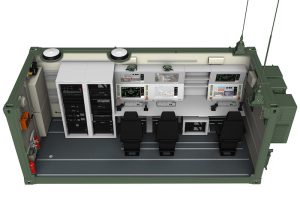
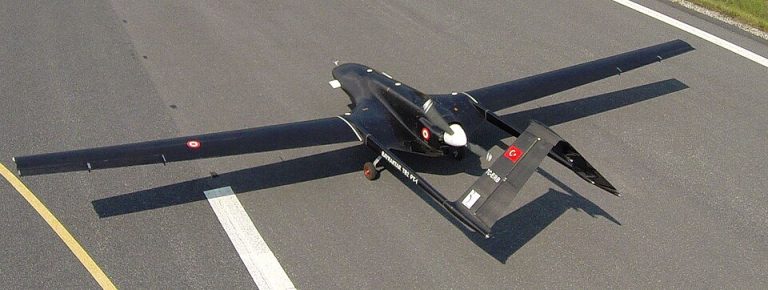
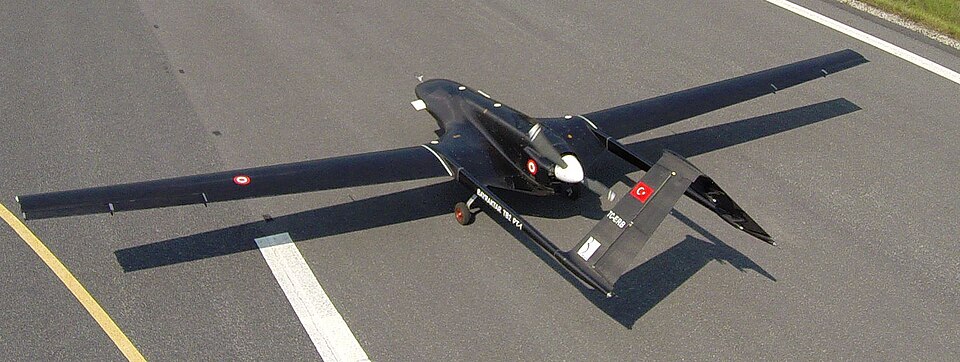
The platform that made Turkey’s name globally is the Bayraktar TB2 drone, which has proved itself in Libya, Azerbaijan, and Ukraine — but Ankara has not been content to remain a drone exporter. Indonesia has signed a contract for 48 KAAN fifth-generation fighters from Turkey in an agreement valued at around $10 billion, and Indonesia also became the first export customer for the Bayraktar Kizilelma unmanned combat aircraft, with deliveries set to begin in 2028. The pivot from tactical drones to stealth combat aircraft represents a qualitative shift — Turkey is no longer competing in the cheap-and-cheerful tier of the arms market. A €2.6 billion contract was signed for the export of 30 HÜRJET aircraft to Spain — which is a notable data point: NATO’s founding members are now buying Turkish military aircraft.
What distinguishes Turkey from the other two cases is the depth of its industrial base. ASELSAN, TUSAS, ROKETSAN, ASFAT, and MKE all appeared in the Defense News Global Top 100 list in 2025 — not one flagship company but five, spanning electronics, airframes, missiles, shipbuilding, and ammunition. Turkey is not exporting a product. It is exporting an ecosystem.
Pakistan’s Combat-Tested Moment
Pakistan’s story is different in character, though the trajectory is similar. For years, Pakistan occupied an awkward middle tier: a nuclear-armed state with modest ambitions in the conventional arms market, but was completely dependent on American F-16’s and whatever China was willing to co-develop. The JF-17 Thunder, a joint venture with the PRC’s Chengdu Aircraft Corporation assembled at the Pakistan Aeronautical Complex in Kamra, was widely categorized as a budget fighter for buyers who couldn’t afford better. That categorization survived until May 2025.
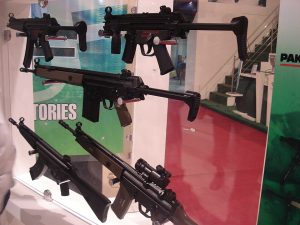
When India’s Air Force launched Operation Sindoor against targets in Pakistan following a terrorist attack in Kashmir, the Pakistan Air Force responded with JF-17’s armed with Chinese PL-15 air-to-air missiles. The military balance sheet of the clash remains contested between the two governments, but the international perception of the outcome was clear: the JF-17 had performed acceptably in high-intensity combat against Western platforms, and the global arms market noticed. Pakistan’s defense exports hit an all-time high in 2025, with approximately $10 billion in contracts, particularly for JF-17 fighter jets and the Mushshak trainer aircraft. In December alone, Libya entered into a $4.6 billion deal to procure 16 JF-17s and 12 Super Mushshak aircraft.
The JF-17’s appeal to the global south is structural, not just financial. Unlike Western systems, the JF-17 is exempt from the political vetoes and usage restrictions typically attached to American or European exports — a selling point that has become more resonant as Washington’s reliability as a security partner has grown more conditional. Pakistan is marketing its platforms as cost-effective alternatives to Western and Russian equipment, offering middle-power countries affordable solutions amid rising global defense spending.
The honest caveat is industrial capacity. Pakistan’s ability to produce the JF-17 is limited to roughly 25 units per year, shared between domestic requirements and exports. The pipeline of announced deals — potentially reaching $13 billion — is more ambitious than current production lines can realistically service in the near term. But Pakistan has something it did not have before May 2025: a combat record that export marketing teams can use, in conditions that the buyers who matter most were watching closely.
Iran: The Degraded Pole
Iran’s case requires the most careful handling. Before February 2026, Iran had assembled one of the more impressive indigenously developed defense industrial bases outside the major powers — remarkable precisely because it was built entirely under sanctions. Despite those restrictions, Iran acquired dual-use technologies through a global network of intermediaries and front companies, with drone components traced to over 70 manufacturers across 13 countries. The Shahed-series loitering munition had become a genuine export product, proliferated to Russia for use in Ukraine and to proxies across the Middle East.

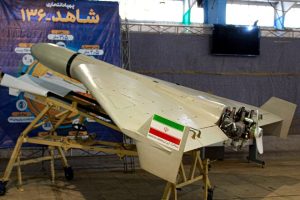
Operation Epic Fury, the 38-day U.S.-Israeli campaign launched on February 28, 2026, changed the equation. U.S. Chairman of the Joint Chiefs of Staff, General Dan Caine stated that approximately 90 percent of Iran’s weapons factories had been attacked, and that Iran’s missile industry was shattered, with solid rocket motor production capability effectively eliminated. These figures come from governments with obvious interest in maximizing their claimed success, and should be treated with some analytical caution — Reuters reported that U.S. intelligence could confirm with certainty that only about one-third of Iran’s missile arsenal had been destroyed as the campaign progressed. The picture is severe regardless of where the precise numbers fall.
What is not in dispute is the structural damage. Iran’s military industrial base depends on foreign dual-use and commercial items that historically arrived through UAE intermediaries — a route now unlikely to function as before. Iran retains institutional knowledge and engineering personnel. Its own Defense Ministry has stated its intention to restructure and modernize based on lessons from recent conflicts. But reconstitution of physical production infrastructure under expanded sanctions, without access to previous supply chains, is a project measured in years, not months.
As a pole of Muslim defense industrial capability capable in open-market competition, Iran is, for the foreseeable future, off the board.
What The Three Poles Mean
The portrait that emerges is not a single phenomenon but three distinct paths to the same destination: the determination to produce, not merely purchase, military capability. Turkey arrived there through sustained political will and a modernizing industrial policy. Pakistan arrived through a combination of Chinese partnership and an unexpected combat demonstration. Iran arrived through four decades of enforced self-reliance — and has now had much of what it built taken away.
The significance for the global arms market is less about whether any of these three will displace Lockheed Martin or Rheinmetall in the near term than about what they represent for the buyers at the lower end of the defense procurement food chain. Countries that cannot afford Western prices, cannot accept Western conditions, or cannot obtain Western approval now have more options than they did ten years ago.
That menu is expanding — even with one of its major entries temporarily removed from it.