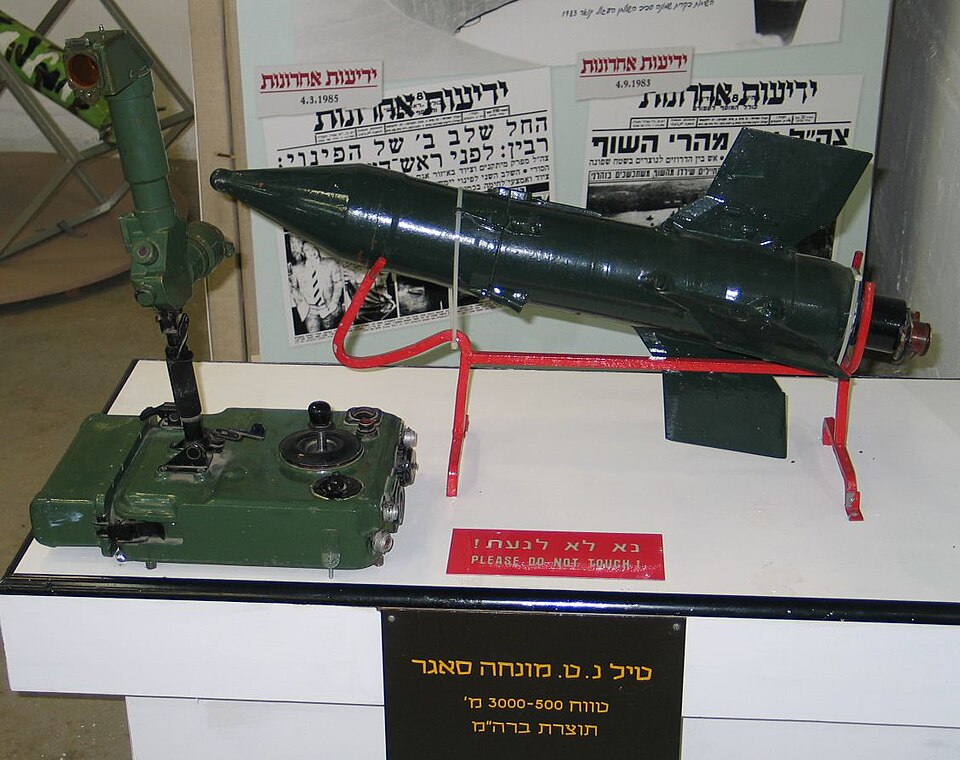

In this series, we have looked at many weapons that refused to die, weapons that conquered the world through simplicity, and weapons that failed their operators despite genuine technological ambition. This week, we look at something rarer: a weapon whose single most important moment in combat history changed the entire Western understanding of armored warfare overnight – and whose descendants are still being sold on the world market today. The Soviet 9M14 Malyutka – “Little One” in Russian, designated “AT-3 Sagger” by NATO – is not a weapon many casual readers will recognize by name. But its fingerprints are on nearly every anti-armor doctrine written since 1973, every advanced armor development, and every ATGM guidance improvement that followed its debut on the banks of the Suez Canal in October 1973.
The Weapon
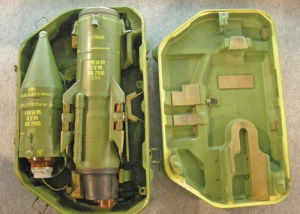
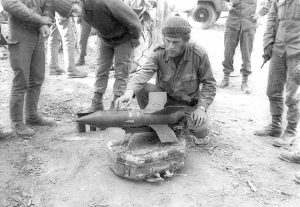
Development of the Malyutka began in July 1961, when the Soviet government assigned competing design teams at the Tula and Kolomna arsenals to produce the USSR’s first man-portable anti-tank guided missile. The design brief drew on Western systems of the 1950s – the French Entac and Swiss/West German Cobra – but the Soviets pushed for a smaller, more portable package optimized for infantry carry. The result entered service in 1963: an eleven kilogram missile that fits into a fiberglass suitcase that functions as a base for the missile’s launch rail, guided by a joystick an wire control system, using Manual Command to Line of Sight (MCLOS) guidance.
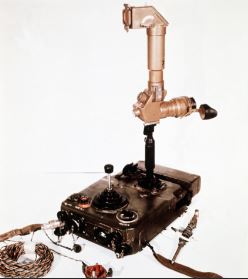
MCLOS guidance is exactly what it sounds like. The operator acquires the target, launches the missile, and then manually steers it to impact by watching a flare on the missile’s tail and manipulating a joystick that sends correction signals down a wire unspooling behind the missile in flight. It demands genuine skill, steady nerves, and an operator who can remain stationary and focused while a tank crew actively attempts to kill him. Soviet production peaked at 25,000 missiles per year during the 1960s and 1970s, making it almost certainly the most widely produced anti-tank guided missile in history. Exports went to over 45 nations, from Afghanistan and Algeria to Vietnam and Zimbabwe.
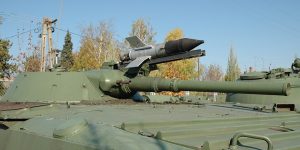
The weapon could be carried by a single infantryman, fired from the ground using a simple suitcase-style launcher, or mounted on vehicles including the BRDM reconnaissance vehicle and the BMP infantry fighting vehicle. Maximum effective range was 3,000 meters – considerably beyond the effective range of any unguided rocket reviewed so far in this series. The basic warhead penetrated more than 400mm of rolled homogeneous armor. On paper, for its time, it was a genuine tank killer.
October 1973: The Sagger Panic
On October 6, 1973 – Yom Kippur, the holiest day of the Jewish calendar – Egyptian forces crossed the Suez Canal in a coordinated assault that caught the Israeli Defense Forces badly off-balance. What followed in the first 48 to 72 hours was one of the most shocking reverses in Israeli military history, and the Malyutka was at the center of it.
Egyptian infantry crossed with Malyutka teams carrying three times the normal missile load. They deployed in static firing positions along the eastern bank and waited for Israeli armor – specifically the tank-heavy Israeli counterattack doctrine that had worked so devastatingly in the Six Day War of 1967. The Israeli tank crews – victims of “Victory Disease” – helpfully obliged, charging forward without infantry support in the manner that had defeated Arab armies six years earlier.
The Malyutka teams were ready.
The results were catastrophic. In the first days of the war, Egyptian Sagger teams knocked out Israeli armor at a rate that generated genuine panic in Israeli command structures. In total, Sagger’s knocked out more than 800 Israeli tanks and other combat vehicles during the war. A period known simply as the “Sagger Panic” set in, during which the future of the main battle tank as a concept was openly questioned – by NATO planners as much as by the Israelis themselves. If Egyptian infantry with Soviet missiles could kill Israeli Centurions and M60 Patton tanks at will, what would Soviet infantry equipped with the same missiles do to NATO armor in Central Europe?
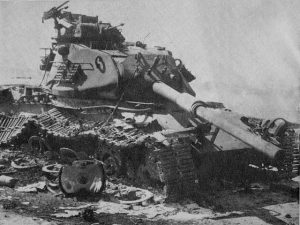
The answer the Israelis eventually developed was both tactical and improvised. Artillery concentration on suspected Sagger operator positions – suppressing the men rather than intercepting the missiles – proved effective. Tank crews learned to advance aggressively toward launch signatures rather than halt and present stationary targets. Firing rounds in front of the tank to generate dust clouds disrupted operator visibility. Moving laterally while the missile was in flight, exploiting the MCLOS system’s requirement for continuous operator correction, helped to cause misses. These Israeli adaptations were subsequently adopted wholesale by NATO as standard ATGM countermeasure doctrine. The “Little One” had, in six days of combat, restructured how the Western alliance thought about tanks, infantry, and the relationship between them.

The Weapon’s Limitations – And Its Evolution
The same combat record that demonstrated the Malyutka’s shock effect also revealed its constraints. MCLOS guidance demanded a level of operator training and composure that mass-fielded infantry forces could not reliably produce. Combat hit probabilities for MCLOS variants have been documented at approximately 25% under real conditions – effective enough in the hands of well-trained Egyptian teams in prepared positions, but far less reliable in dynamic, fast-moving and violent combat. The minimum engagement range of 500-800 meters forced operators into exposed forward positions. And the slow missile speed – averaging a mere 120 meters per second – gave alert tank crews meaningful reaction time if they spotted the launch.
Soviet designers addressed these limitations progressively. The 9M14M Malyutka-M, entering service in 1973, improved the motor to reduce flight time. The 9M14-2 Malyutka-2, entering service in 1992, replaced MCLOS with SACLOS – Semi-Automatic Command to Line of Sight – guidance, the same improvement that distinguished the Dragon II from its predecessor, dramatically reducing operator skill and workload management requirements. The 9M14-2M added a tandem HEAT warhead for use against reactive armor. Serbian engineers at VTI developed the Malyutka-2T with a 1,000mm penetration tandem warhead and a radio-guided variant with a range of 5 kilometers and a speed of 200 meters per second – a very different weapon from the 1963 original in almost every parameter except the basic airframe.
China produced its own unlicensed derivative, the HJ-73 Red Arrow, in multiple improved variants. Iran produces the RAAD-T – itself a reverse-engineered copy, supplied to Hezbollah and various militia forces and documented in conflicts across the Middle East and Yemen.
Still In The Field
The Malyutka family has appeared in virtually every significant ground conflict since 1973: the Iran-Iraq War, Grenada, the Gulf War, both Chechen Wars, Libya, Syria, Iraq, and Ukraine, on both sides. Free Libyan Army rebels were filmed using Saggers in 2011. Syrian opposition forces uploaded Sagger firing videos from 2012 onward. Current confirmed operators include Morocco, Saudi Arabia, Thailand, Syria, Iran, and a range of non-state actors who have acquired the weapon through the vast quantities exported during the Cold War.
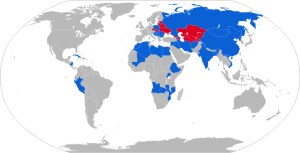
The weapon that crossed the Suez Canal in a suitcase in 1973 is still on the world’s battlefields in 2025 – modernized, copied, improved, and proliferated to an extent that makes any meaningful accounting of current stocks essentially impossible. That is the definition of a weapon that solved a real problem, in a way that the world found impossible to stop buying.
The Dragon was America’s answer to the same requirement at roughly the same time. The Malyutka was the Soviet answer. One of them changed the world. The other is remembered primarily for its 20% hit rate and the relief that the Javelin finally arrived.