
In the first ninety days after the D-Day landings in June 1944, a peculiar vehicle — part truck, part boat, ugly as a barge and about as graceful — moved eighteen million tons of supplies across the Normandy beaches and inland to the Allied armies pushing east. It crossed the English Channel under its own power to prove its seaworthiness before anyone would take it seriously. It hauled ammunition across the Rhine in March 1945 while engineers were still building the bridges. It was called the DUKW — the letters drawn from the General Motors model nomenclature that designated its year, purpose, drive configuration, and axle layout — and soldiers, of course, called it the “Duck“. The United States Army, having used it to win a war, retired it in the 1960’s and replaced it with vehicles that could not do what it did.
The Soviets, who received 586 of them under Lend-Lease and saw what they could do, and took a different approach. They built their own version, fixed its one genuine deficiency, and kept it in service into the 1980’s.
The comparison is instructive.
Not All Ducks Go Quack
The DUKW was a six-wheel-drive amphibious modification of the standard GMC 2.5-ton CCKW cargo truck, developed in 1942 through a partnership between GMC and the yacht design firm Sparkman & Stephens — whose principal, Roderick Stephens, brought the naval architecture that made it genuinely seaworthy rather than merely amphibious. The hull was added to the standard truck chassis along with a propeller driven from the main engine and a rudder for water steering; on land, the six driving wheels took over. The central tire inflation system allowed the driver to adjust tire pressure from the cab — dropping pressure for soft sand or muddy river banks without dismounting — a feature that sounds minor until you are on a beach under fire and cannot stop to operate a valve. It weighed 13,600 pounds, carried 2.5 tons of cargo, made 50 miles per hour on road and 6.4 miles per hour in water, and had a road range of 400 miles.
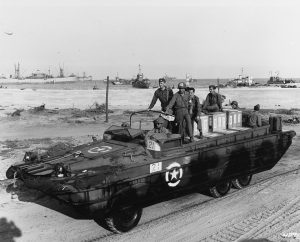
The military initially rejected it. A Coast Guard vessel going aground in rough weather off Cape Cod in late 1942, with a DUKW prototype the only available means of reaching the crew, ended that resistance. The Secretary of War told Roosevelt the next day that “an army truck rescued the men from a stranded naval vessel.” Production began immediately. At least 21,147 DUKWs were built before production ended in 1945. Britain received 2,000 under Lend-Lease; Australia received 535; the Soviet Union received 586.
What The Duck Did Differently
The DUKW’s combat debut came during the Allied invasion of Sicily in July 1943, and it subsequently appeared in every major amphibious and river-crossing operation of the war. At Normandy, DUKWs ferried troops and supplies from ship to shore and then inland without waiting for port facilities or permanent crossings to be established. At the Rhine crossing in March 1945, they carried supplies across the river while the first emergency bridges were still being assembled, maintaining the flow of ammunition and materiel that a conventional supply chain would have interrupted entirely while it waited for the engineers. In the flooded Netherlands during Operation Veritable and Operation Plunder, they operated in terrain that had defeated wheeled and tracked vehicles alike, moving through inundated farmland where no road existed and no bridge could be built.
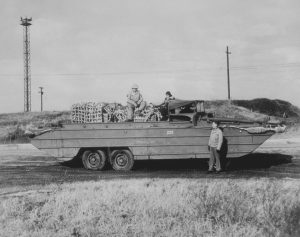
The Duck’s tactical value was not primarily speed or payload — it was continuity. A conventional supply convoy halts at a river and waits for a bridge or a ferry. A DUKW column does not halt. It crosses under its own power, anywhere along the waterway where the banks are manageable, and continues on the far side as a truck. The difference between reduced flow and no flow in a logistics chain is operationally enormous, and the DUKW provided reduced flow when no alternative was available. In Korea, DUKWs continued in the same role, and the vehicle remained in U.S. service until it was finally retired in the 1960s.
What Moscow Saw
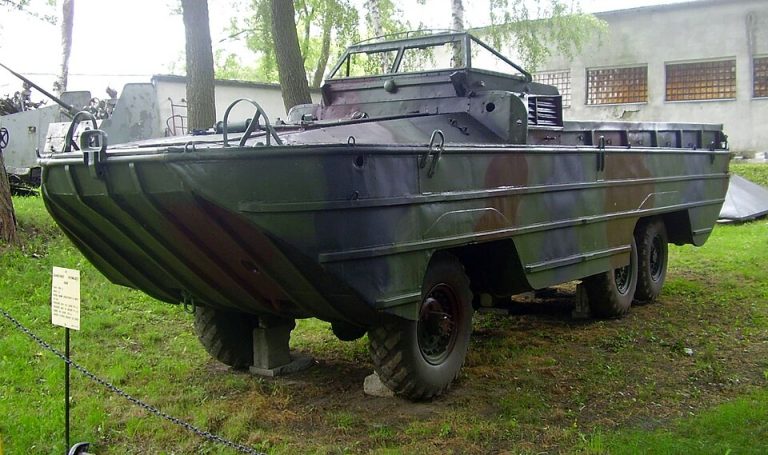
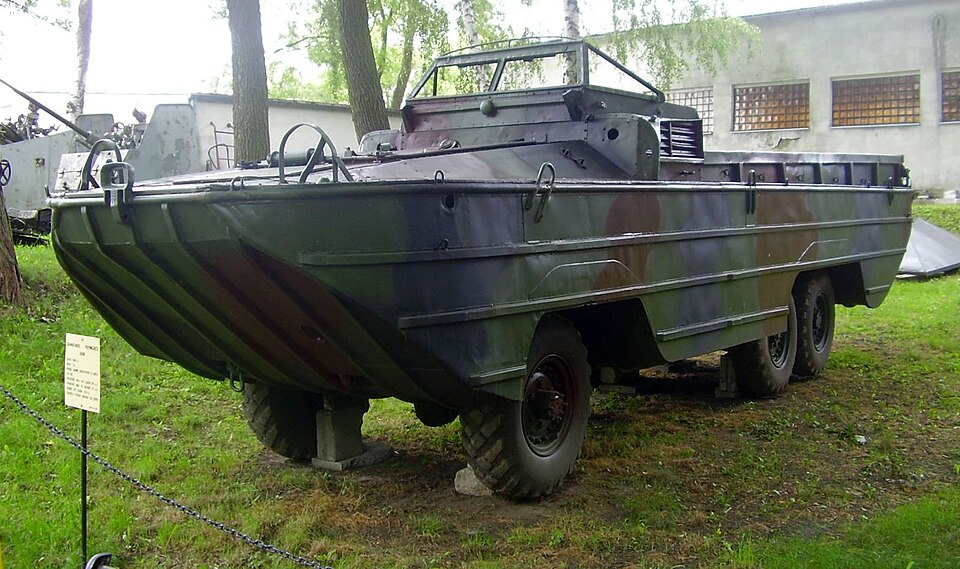
The Soviets studied their 586 Lend-Lease DUKWs very carefully. Their assessment was that the vehicle was operationally sound and its concept correct — a wheeled amphibian on a standard truck chassis, capable of sustaining river crossings along a wide front without fixed bridging infrastructure, was exactly what Warsaw Pact planners needed for an expected westward advance across a European continent cut by rivers every few dozen kilometers. What the DUKW lacked, in Soviet operational terms, was easy loading and unloading. The vehicle’s high sides meant cargo had to be lifted in by crane or manhandled over the gunwale — workable for boxes and bags, slow and difficult for light vehicles, mortars, and artillery pieces.
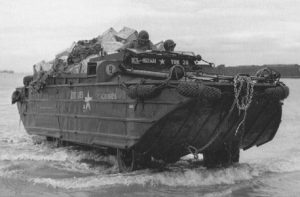
The BAV 485 was introduced in 1952 and produced until 1962, was the Soviet answer: a copy of the DUKW’s hull and operating principle, built on the ZIL-151 six-wheel-drive truck chassis, but with one significant addition: a drop-down tailgate in the rear that allowed light vehicles and weapons to be driven or rolled directly into the cargo bed. The BAV’s full Soviet designation — Bolshoi Avtomobil Vodoplavayushchiy, or “big floating vehicle” — reflected its institutional seriousness, despite the somewhat humorous tone.
This was not an experiment. Czechoslovak Army BAV 485’s were documented carrying 122mm howitzers loaded directly through the tailgate — the improvement that the U.S. Army had cited as a deficiency of the original DUKW became a solved problem through a modest change to a proven design.

The contrast in approach is the point. The U.S. Army’s “answer” to the DUKW’s loading limitations was to procure the LARC-V — a purpose-built lighter, an amphibious resupply cargo vehicle that prioritized beach operations alone, and carried 5 tons, but whose boat-first hull geometry made it too wide for road convoys and effectively confined it to the shoreline it was designed to be limited to. The Soviets fixed one deficiency in a vehicle they had and kept it in service. The Americans bought a new class of vehicle that addressed one complaint and created several others, all of them worse than the original problem.
The Ukrainian Argument
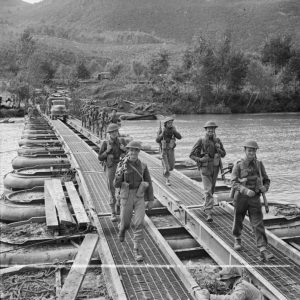
On 8 May 2022, Russian engineers constructed a pontoon bridge across the Siverskyi Donets River near the town of Bilohorivka in eastern Ukraine. Ukrainian drone operators spotted the construction and reported it immediately. By 10 May, Ukrainian artillery had destroyed the bridge, and with it the Russian force in the midst of crossing — approximately 480 casualties and more than 80 vehicles destroyed, the annihilation of at least one battalion tactical group concentrated at a single fixed crossing point. The British Defence Ministry observed that “conducting river crossings in a contested environment is a highly risky manoeuvre“, which is one way to describe what drone surveillance and precision artillery did to a force that had compressed itself into a single predictable location in order to cross a river.
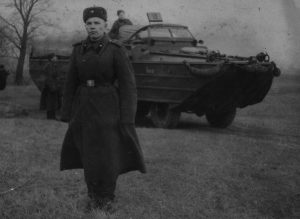
The Bilohorivka disaster is the contemporary proof of the DUKW’s original tactical logic. A pontoon bridge is a fixed, hard to move, high-value, easily identified target that concentrates crossing forces into a predictable location at a predictable time. A fleet of amphibious trucks is none of those things. DUKWs — or their modern equivalent — cross a river along a wide front, at multiple points simultaneously, using no fixed infrastructure that can be targeted and destroyed before the crossing is complete. Each vehicle carries a fraction of the total load, so the loss of any single vehicle is a fraction of the problem that the loss of a bridge represents. The drone and precision-fire environment that defined the Bilohorivka disaster is precisely the environment where the DUKW’s dispersal advantage is most valuable.
A modernized DUKW — a 2.5-to-5-ton amphibious truck on a current-generation six-wheel-drive chassis, with a rear loading ramp borrowing directly from the BAV 485’s solved problem, updated with modern materials, engine, and tire pressure management — is not a technically demanding proposition. The engineering has been proven twice: once by GMC in 1942, and once by ZIL in 1952. What it requires is an institution willing to ask what the vehicle needs to do in the war it expects to fight, rather than what a replacement program can justify in a cost-effectiveness analysis.
The Soviet answer to that question produced the BAV 485. The American answer produced the LARC-V, retired alongside the Duck it was meant to replace, leaving nothing behind that could swim a river and then drive to the front.
The DUKW and the BAV-485 did nothing wrong. Their leaders did.