
Artillery is the King of the battlefield, and has been for nearly three hundred years.
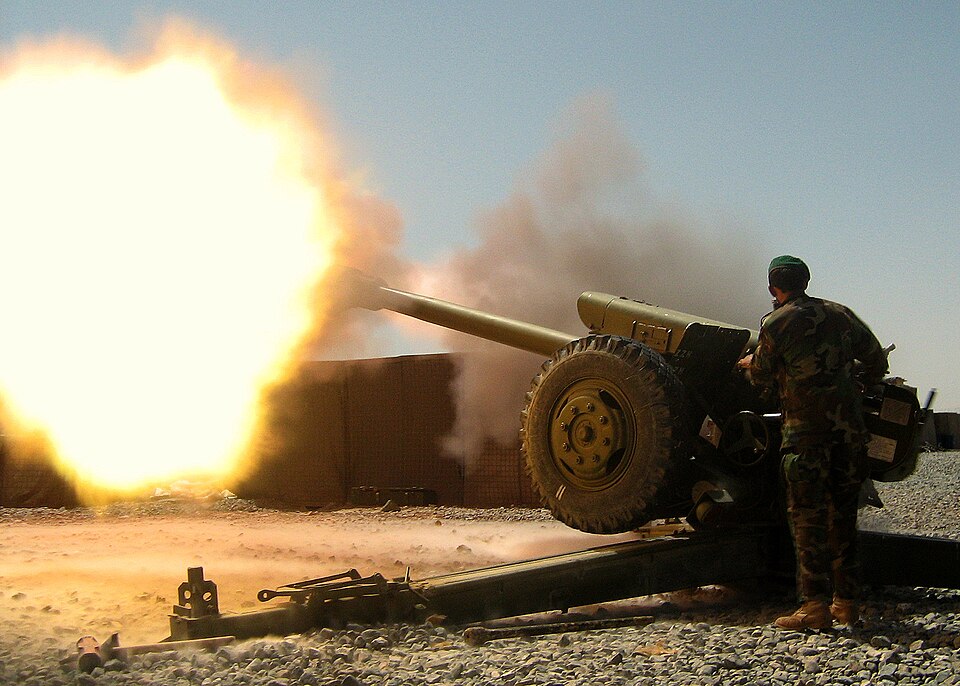
Set up a D-30 howitzer and watch the crew work. The gun arrives towed muzzle-first behind a truck, trails folded flat. The crew unhitches it, lowers the central hydraulic jack — lifting the wheels clear of the ground — and swings the two outer trail legs outward, each through 120 degrees, until all three rest on the earth and are staked in place. The whole evolution takes under two minutes. The gun can now traverse through a full 360 degrees and engage a target in any direction without being repositioned. That is not a feature common to artillery; it is a feature specifically engineered into the D-30 by its designer, F.F. Petrov working at Plant No. 9 in Sverdlovsk, in the 1950s, and it remains one of the most practical innovations in postwar artillery design. Sixty-five years after the D-30 entered Soviet service, its three-legged silhouette is still appearing in drone footage from Ukraine, on both sides of the front line.
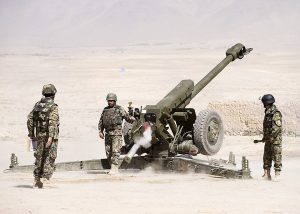
A Caliber With a Long History
If nothing else, Russians love stability. They adopted the 7.62x54R rifle cartridge in the 1890’s…and still use it today. The D-30’s 122mm calibre did not arrive with the Cold War. Russia adopted that bore in the early twentieth century, and it became central to Soviet artillery doctrine through the Second World War, when the M-30 howitzer — also a Petrov design, also from Plant No. 9 in Sverdlovsk — served as the backbone of divisional artillery across every front from Barbarossa to Berlin. By the mid-1950’s the M-30 was aging and its limitations were apparent: a split-trail carriage that restricted traverse to just 49 degrees, a barrel too short for the ranges modern warfare demanded, and a weight that strained the logistics of rapid mechanized advance. Petrov’s bureau was tasked with replacing it, and the design that emerged kept the calibre and the ammunition commonality while discarding everything else about the M-30’s architecture.
The result was the 2A18, designated the D-30 in service. Where the M-30 had a conventional split-trail carriage limiting it to a narrow arc, the D-30 used a three-legged tripod arrangement that permitted the full-circle traverse. Where the M-30’s barrel was a stubby 22.7 calibres long, the D-30’s ran to 38 calibres, driving muzzle velocity and range substantially higher. The effective range with standard HE ammunition reached 15.4 kilometers; with modern rocket-assisted projectiles, 21.9 kilometers. Rate of fire peaked at ten to twelve rounds per minute, sustained at five to six. The crew required — commander plus seven, or in some configurations six — was manageable for a divisional artillery unit. The Soviet Army adopted it in 1960 and began exporting it to Warsaw Pact allies and client states shortly afterward.
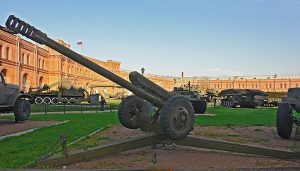
The Three-Leg Trick and What it Means
The 360-degree traverse deserves more analytical attention than it usually receives, because it was not simply a convenience feature. Soviet doctrine for motorized rifle divisions expected artillery to operate in fast-moving, fluid engagements where the threat direction could change rapidly — including from armored vehicles breaking through to artillery positions. A conventional split-trail howitzer caught by an unexpected flanking attack has no practical recourse; the crew cannot swing it to bear in time. The D-30’s crew can. With its HEAT round, the D-30 can penetrate over 450mm of rolled homogeneous armor — sufficient to defeat any IFV and most tank side armor — and the all-round traverse means the gun is in effect a self-defending anti-tank weapon of last resort, capable of engaging targets in any direction without emplacement changes. The US Army’s own assessment noted that the D-30 was “fully suitable for antitank defense” and could be equipped with infrared or passive night sights for direct-fire engagements after dark.
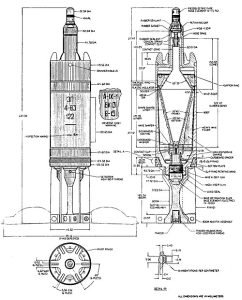
This dual-role capability — indirect fire howitzer and emergency anti-tank gun — was a deliberate Soviet design choice rooted in the expectation that artillery positions in a fast-moving European war might need to defend themselves. It added no meaningful weight or complexity. It cost nothing beyond the carriage design itself. It is, in retrospect, one of the more elegant solutions in Cold War artillery engineering.
The same barrel assembly went into the 2S1 Gvozdika self-propelled howitzer, which entered service in 1972 and gave motorized rifle regiments equipped with BMP infantry fighting vehicles a tracked, armored platform using the same ammunition as the towed D-30 batteries in the division behind them. The logistical coherence was intentional. Over 12,000 D-30s were produced across the Soviet period, with licensed or derivative manufacture in China, Egypt, Yugoslavia, Iran, and Iraq. It remains in production internationally and in service with more than 60 nations.
A Combat Record Spanning Decades
The D-30’s operational history reads like an atlas of post-1960 conflict. It fired in the Yom Kippur War of 1973, the Lebanese Civil War, the Soviet-Afghan War, the Iran-Iraq War — where both sides used it in the kind of grinding, WWI-adjacent attrition that consumed ammunition by the trainload — the Gulf War, the Yugoslav Wars, the Syrian Civil War, the recent Tigray War, and the ongoing conflict in Myanmar. No other postwar artillery piece has fired in as many distinct conflicts across as many continents. Its appearance in a conflict zone is almost a predictor of that zone’s geopolitical history: wherever the Soviet Union sold weapons and influence, the D-30 eventually followed.
Afghanistan was a particular proving ground. Soviet D-30 batteries engaged Mujahideen positions across mountain terrain that challenged every other piece in the divisional inventory. After the Soviet withdrawal, the gun remained with Afghan forces — and then with both the Afghan National Army and Taliban-adjacent formations — requiring US Army trainers to become proficient on it themselves in order to build Afghan artillery capacity. The JPEO Ammunition command was still procuring spare cannons, breeches, and fire control conversion kits for Afghan D-30s as recently as 2016.

Ukraine and the Drone Problem
The D-30’s presence in Ukraine is as a weapon on both sides of the line, which is itself a commentary on how thoroughly Soviet materiel saturated the world across the Cold War decades. Ukrainian forces inherited substantial D-30 stocks from the former Soviet military, and have supplemented them with captured Russian pieces. Russian forces continue to field them in motorized rifle formations alongside more modern systems, pulling them from storage reserves as attrition has consumed more capable equipment.
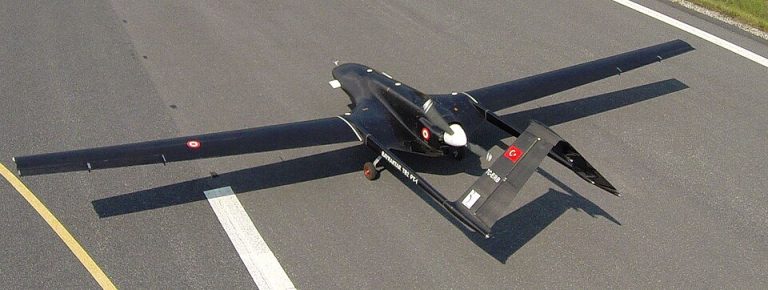
The drone age has been unkind to the D-30 in ways that go beyond mere vulnerability. A towed howitzer is by definition a slow-moving, visually distinctive platform that requires time to emplace and displace. On a battlefield where reconnaissance UAVs can locate a firing position within minutes of the first shot and direct a Lancet loitering munition or FPV drone onto it before the crew can limber up and move, the D-30’s greatest operational asset — its two-minute setup time — becomes a liability rather than an advantage. Ukrainian drone operators have documented and filmed the destruction of Russian D-30s throughout 2024 and into 2025, with Defense Express reporting confirmed drone strikes against the type in the Northern Slobozhanske direction as recently as late 2025.
The artillery doctrine Ukraine has developed in response to this environment emphasizes what analysts have called “shoot and scoot” discipline: fire a short mission, displace immediately, move before the counter-battery or drone response arrives. That discipline demands mobility. A D-30 towed by a Ural-4320 truck can reach 60 kilometers per hour on road and reposition within a few minutes of unlimbering — fast enough, if the crew is well-trained and the intelligence picture is managed carefully. Not fast enough, if it isn’t.
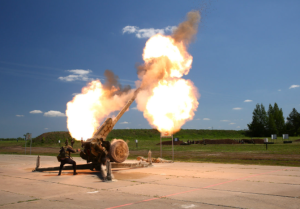
The D-30’s longevity is ultimately a product of the same qualities that have sustained every other piece of Soviet-era equipment in this series: rugged simplicity, ammunition commonality with a vast global stockpile, and a design architecture that asked nothing exotic of the armies operating it. The gun that Petrov’s bureau produced in Sverdlovsk in the 1950’s did not promise sophistication. It promised reliability, range, and the ability to swing in any direction and kill whatever came at it. In sixty-five years of continuous combat across six continents, it has largely delivered on that promise — and it is still being asked to do so.