
There is an old saying in the military sphere:
Beware the old man, in a profession where men die young.
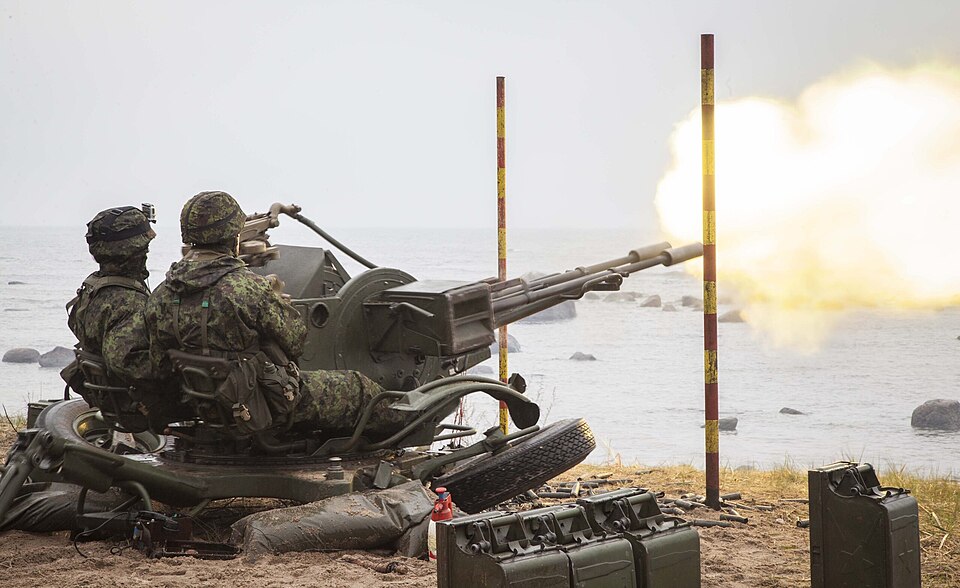
On January 2, 2025, India’s Ministry of Defense quietly issued a Request for Information to domestic defense companies, asking for proposals on a very specific problem: 23mm proximity-fused ammunition capable of detonating near an enemy drone rather than requiring a direct hit. The weapon they wanted to upgrade was the ZU-23-2 — a Soviet twin-barreled anti-aircraft cannon that entered service in 1960, the same year John F. Kennedy was elected president. That a weapon designed to engage Korean War-era low-flying aircraft is now being fitted with twenty-first-century smart fuzes to hunt quadcopters over the India-Pakistan border is, depending on your perspective, either a testament to the original design’s enduring utility or a commentary on how thoroughly the drone threat has outrun the world’s ability to respond to it.
The reality is likely somewhere in between.
From Vietnam to the Technical
The ZU-23-2’s formal designation decodes itself: ZU for Zenitnaya Ustanovka — “anti-aircraft mount” — “23” for its caliber in millimeters, and “2” for the number of barrels. The KBP design bureau presented the prototype in 1955, refined it through the late 1950s, and the Soviet Army adopted it in 1960 as the standard towed light anti-aircraft weapon for Warsaw Pact forces. Its immediate predecessor in that role was the ZPU-2, which mounted twin 14.5mm KPV heavy machine guns — effective against very low and slow targets but outpaced by the jets that were becoming the dominant low-altitude threat by the late 1950s. The ZU-23-2’s twin 2A14 autocannons firing 23x152mm ammunition at a combined cyclic rate of up to 2,000 rounds per minute gave Soviet air defense batteries something capable of reaching targets at ranges out to 2,500 meters and altitudes up to 1,500 meters, with enough hitting power to be lethal rather than merely disruptive.
The Vietnam War gave the weapon its first major combat trial. From 1965 onward, the Soviet Union shipped ZU-23-2s to North Vietnam in quantity, and the gun became, alongside the 37mm M1939, the most commonly encountered anti-aircraft weapon in the theater. Given that approximately 83% of US Air Force losses over Vietnam came from ground fire rather than surface-to-air missiles or MiGs, the ZU-23-2 is conservatively credited with shooting down hundreds of aircraft — a combat record that no other weapon in this series can claim against modern fast jets in their first decade of service.
What the Vietnam experience also revealed was a capability the Soviet designers had built in but perhaps underemphasized: the gun’s effectiveness against ground targets. At 2,000 meters, its armor-piercing incendiary rounds could defeat light armored vehicles. Against infantry and unprotected positions, it was devastating. Soviet forces in Afghanistan confirmed and extended this lesson, mounting ZU-23-2s in the beds of ZIL-135 trucks to provide convoy protection against ambushes in mountain terrain — using the gun’s high elevation arc to engage Mujahideen fighters on ridgelines that tank guns and BMP autocannons could not reach. After the Soviet withdrawal, both the Taliban and the Northern Alliance operated the weapons left behind. The pattern was establishing itself: wherever the ZU-23-2 went, it tended to stay, and whoever inherited it found new uses for it.
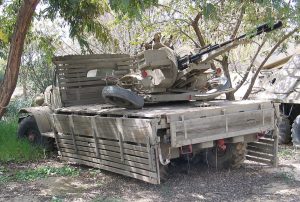
The technical — the improvised fighting vehicle built by mounting a weapon on a civilian truck — became the ZU-23-2’s most consequential platform adaptation. Lebanese militias in the civil war, Iraqi forces in 1991, Libyan factions in both of their civil wars, Sahelian insurgent groups including JNIM and its affiliates: all have mounted the gun on whatever truck was available and achieved a mobile fire support capability that costs a fraction of any purpose-built system. The weapon’s light weight — just over a ton in firing configuration — makes this straightforward. It can be set up for firing from the travel position in 30 seconds. It does not require specialized maintenance infrastructure. It fires ammunition that exists in virtually every post-Soviet conflict zone in quantities that border on inexhaustible. These are not small advantages.
The Drone Problem and the Proximity Fuse Answer
For all of that, the ZU-23-2 spent the better part of its service life being quietly written off as obsolete for its nominal primary role. By the 1980s, jet aircraft were flying faster, higher, and with better electronic countermeasures than any optically-aimed 23mm gun could reliably engage. The ZSU-23-4 Shilka — the self-propelled, radar-guided development of the same 23mm caliber — had partially supplanted it in that role for Soviet forces, though even the Shilka was acknowledged as limited against fast-moving aircraft. The ZU-23-2 survived primarily because it was cheap, reliable, and effective against helicopters and slow aircraft — and because some 140,000 of them had been produced and distributed to something over fifty countries, which gives any weapons system remarkable institutional staying power regardless of its theoretical limitations.
The drone revolution has inverted that obsolescence logic almost completely. The primary aerial threat facing armies, militias, and non-state actors across Ukraine, the Sahel, Yemen, and the India-Pakistan border is no longer a fast jet flying at 600 knots. It is a commercial quadcopter or a fixed-wing FPV drone flying at 60 to 100 knots at low altitude, often in swarms, and costing between a few hundred and a few thousand dollars. Against that target class, the ZU-23-2’s engagement envelope — 2,500 meter range, 1,500 meter altitude ceiling, 2,000 rounds per minute combined — is not obsolete. It is, if anything, oversized for the job.

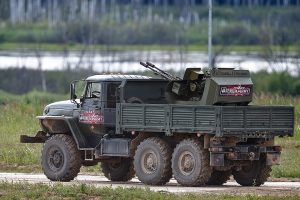
The remaining problem is probability of hit. A 23mm round fired at an FPV drone requires a near-direct hit to kill it. The drone is small, fast for its size, and maneuverable. Tracer-based manual aiming against such targets is demanding even for a well-trained crew. This is precisely the gap India’s January 2025 RFI was designed to close: proximity-fused 23mm ammunition that detonates within lethal radius of the target rather than requiring physical contact. The same concept drove the development of the original anti-aircraft proximity fuse in World War II — the VT fuze that transformed naval anti-aircraft gunnery against kamikazes — and its application to 23mm autocannon ammunition is technically straightforward given modern microelectronics. The payload is small; the fuze logic is well understood; the manufacturing challenge is miniaturization and cost, not physics.
India is not alone in recognizing this. Russia has deployed truck-mounted ZU-23-2 batteries in dedicated anti-drone mobile units in Ukraine since early 2024, pairing the guns with electronic warfare systems and smoke generators in combined teams designed to defeat FPV drone attacks. Russia has also developed and demonstrated a remotely operated variant, the ZU-23/30M1-3, with integrated electro-optical sighting — a concept first shown in 2013 that finally reached serious development attention under the pressure of the Ukraine war. Poland’s WB Group presented its ARM-28 electromechanical upgrade kit at the DEFEA 2025 defense exhibition in Athens, converting the ZU-23-2 into a semi-automated or remotely operated platform with digital drive motors, joystick control, and compatibility with external fire control systems. In May 2025, India’s own army air defense reported that ZU-23-2s alongside Bofors L/70 guns had been effective in shooting down multiple Pakistani drones during the India-Pakistan conflict — a real-world validation that arrived barely four months after the proximity fuse RFI was issued.
A Platform That Keeps Earning Its Place
The ZU-23-2’s spread across more than fifty national inventories and a substantial number of non-state arsenals means it occupies a peculiar position in the current global defense environment: it is simultaneously a museum piece and a front-line system, often in the same conflict zone. In Ukraine, Russian forces operate it as an improvised anti-drone gun. Ukrainian border guards have received new ZU-23-2 deliveries as recently as 2025. In the Sahel, JNIM-affiliated groups have truck-mounted examples that serve as the air defense component of a force that otherwise operates on motorbikes. In Yemen, Houthi forces have used them against Saudi coalition aircraft and, more recently, against drone threats.
What the proximity fuse development — in India, and likely elsewhere — signals is that the global community of ZU-23-2 operators has collectively decided the platform has a generation of useful life remaining, provided the ammunition catches up with the threat. The gun itself does not need to change. The carriage is sound, the barrels are replaceable, and the rate of fire is already more than adequate. What changes is the fuze in the nose of the round, and with it the probability that any given burst finds its target. A sixty-five-year-old Soviet anti-aircraft gun, fitted with a smart fuse developed for a threat that didn’t exist when the gun was designed, hunting Chinese-manufactured quadcopters over an Indian border post. The ZU-23-2’s designers at KBP in 1955 could not have anticipated any of that. The gun they built was flexible enough not to care.