August 24, 2026

World News

The King Of Chemicals And The Danger No One Is Watching


Supply and commodity trading is boring stuff…Right?

The “Law of Unintended Consequences” is a very real thing. Many people, however, refuse to see them when they appear…and sometimes, they refuse to acknowledge it amid the wreckage of their error. To his credit, John F. Kennedy did acknowledge this – albeit parsed for public consumption – when he said, in the aftermath of the disaster that was the Bay of Pigs, “Victory has a thousand fathers, but defeat is an orphan.

When we covered the opening weeks of Operation Epic Fury in March, in our monthly subscription edition, we flagged a supply chain casualty that most of the financial press was too focused on crude oil to notice: sulphur.

We noted that a Hormuz closure extending beyond 30 days would begin to bite into agricultural input supply chains, drive spot sulphur prices sharply upward, and extend inflationary effects well beyond the energy sector into global food commodity markets. We were right – and the situation has since become considerably more complicated than even that analysis anticipated.

And this is, in fact, what actually happened.


Commercial vessels in the Persian Gulf near Hormuz Island, Iran. 2011 photo by ninara. CCA/2.0 Generic.


The Invisible Commodity

Sulphur is not a commodity that generates headlines under normal circumstances. It does not trade on the nightly news. Most people could not tell you what it is used for, beyond a vague association with volcanoes and the smell of struck matches. That invisibility is precisely what makes it dangerous as a supply chain vulnerability.

Sulphuric acid – the primary derivative of elemental sulphur – is the most widely produced industrial chemical in the world. It is not an exaggeration to call it the nervous system of industrial civilization. It is the essential reagent for processing phosphate rock into the fertilizers – MAP, DAP, SSP and TSP – that sustain the yield levels modern agriculture depends on. It is a critical processing agent for copper, nickel, and the battery metals that underpin the energy transition. It is used in steel production, petroleum refining, pharmaceutical manufacturing, and water treatment. When sulphur supply tightens, the consequences do not stay in one sector.

They cascade.

The Strait of Hormuz carries approximately 45-50% of global seaborne sulphur trade. Saudi Arabia and the UAE are the dominant exporters, with Qatar contributing significantly as a byproduct of its LNG operations. When the strait effectively closed in late February 2026, that flow stopped – approximately 4 million metric tons of sulphur per year, originating from Iranian, Qatari, and UAE export terminals, were cut off from world markets.


But How Bad Is The Disruption, Really?

Before going any further, it is worth establishing what “closed” actually means in practice – because the picture is more nuanced than the headlines suggest, and the nuance matters for understanding how long the sulphur crisis persists.

Maritime shipping analysts tracking tanker movements through Kpler data estimates that actual Hormuz transits peaked recently at roughly 7.5 million barrels of oil per day equivalent on a seven-day rolling basis – against a pre-war flow of approximately 20 million barrels per day. Rerouting through Saudi pipelines to Yanbu and UAE facilities at Fujairah adds perhaps 4 million barrels per day of incremental bypass capacity. The net picture, properly benchmarked against total pre-war Middle Eastern outflow of approximately 23 million barrels per day, puts the region running at just over 50% of pre-war export levels.

Complicating the picture further: tanker AIS tracking data is being actively gamed. Ships are running dark – disabling their automatic identification systems – making real-time flow estimates inherently uncertain. What satellite imagery of loading docks can confirm is that the disruption is real and sustained, regardless of what official statements claim. CENTCOM reported on August 14th that U.S. forces had redirected 62 commercial vessels and boarded two to ensure compliance with the blockade. The UAE’s ADNOC shipping line reported two vessels attacked within a single week.

The Houthi dimension adds a further layer. Saudi oil rerouted through Yanbu and heading toward Asia must transit the Bab el-Mandeb – where Houthi forces, operating in conjunction with Iranian interests, are now targeting Saudi-linked vessels specifically. Tanker transits through Bab el-Mandeb have fallen approximately 40%, with more vessels running dark. The bypass route that was supposed to partially compensate for Hormuz is itself under attack.

And on August 14th, President Trump told a crowd of law enforcement officers in New York: “After we finish defeating Iran, which is being very badly defeated – pretty soon I’ll be declaring the Hormuz Strait a territory of the United States“. He followed that on August 18th by posting a map on Truth Social labeling the strait “New US Territory”. Iran responded that the strait “will remain Iranian.” Whatever the legal merits – and they are essentially nonexistent under international maritime law – the political signal is clear: the disruption is not resolving quickly, and the diplomatic pathway to normalization just became considerably more complicated, assuming that Trump’s statements are not simply another example of his grandstanding, as he did in referring to making Gaza into a resort town.


The Triple Shock

What began as a Hormuz disruption rapidly evolved into something considerably more severe, because two major sulphur exporters seized the moment to protect their own domestic supply chains.

On April 10, China announced a full export ban on sulphuric acid through August 2026 – replacing a 700,000-ton annual quota with a complete cessation. China is the world’s largest sulphuric acid exporter, with Chile, Indonesia, and Saudi Arabia as its primary markets. Chile uses it for copper solvent extraction. Indonesia uses it for high-pressure acid leach nickel processing. Saudi Arabia and India use it for fertilizer production and industrial applications. The Chinese ban effectively removed a critical secondary supply option precisely when buyers most needed it.

Russia extended its own sulphur export ban through the end of 2026. Turkey imposed export restrictions for Q2 and Q3. The result was a triple supply shock – Hormuz, China, and Russia/Turkey simultaneously – that no single alternative supply source could absorb. China’s sulphuric acid exports are projected to fall from 4.6 million tons in 2025 to approximately 1.2 million tons in 2026 – a reduction of nearly 75%.

The price response was swift and severe. Spot prices for granular sulphur FOB Arabian Gulf jumped from $80-90 per ton to $160 per ton in the first week of April alone, according to Argus Media data. Fertilizer costs overall are projected to rise more than 30% in 2026, according to the World Bank’s April Commodity Markets Outlook.


The Fertilizer Cascade

The downstream consequences for agriculture are where the sulphur story intersects with food security in ways that deserve serious attention.

Urea prices – the bellwether of nitrogen fertilizers – roughly doubled in a matter of weeks following the strait closure, jumping from $400-490 per metric ton to over $850 per metric ton in April 2026, before softening somewhat as China lifted its separate urea export ban and northern hemisphere spring application demand eased]. Diammonium phosphate prices climbed from approximately $580 to around $770 per metric ton. Indian and Brazilian phosphate fertilizer producers, facing shortages of sulphuric acid, reduced operating rates by 15-20%.

Brazil’s exposure deserves particular attention. The country imports more than 80% of its fertilizers and relies heavily on Gulf sources now blocked by the strait closure. Brazil is the world’s third-largest agricultural exporter – its soy, corn, and sugar output affects food prices globally. A sustained reduction in Brazilian fertilizer access does not stay in Brazil.

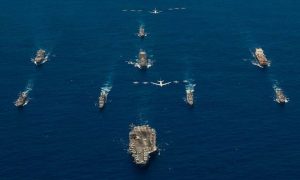
The aircraft carrier USS Ronald Reagan (CVN 76) leads a formation of Carrier Strike Group (CSG) 5 ships as U.S. Air Force B-52 Stratofortress aircraft and U.S. Navy F/A-18 Hornets pass overhead; 2018 U.S. NAVY photo. Public Domain.


Morocco’s OCP Group – the world’s largest phosphate producer and exporter, a company that underpins fertilizer supply for much of Africa and Asia – was already operating under sulphur supply constraints before February 28, following production outages at a major Qatar LNG facility in H2 2025. The Hormuz closure found OCP with sub-optimal sulphur inventory and no easy alternative supply source. The knock-on effects for African agricultural input availability are not yet fully visible in the data, but they are coming.

The United Nation’s Food and Agriculture Organization’s (FAO) chief economist was direct in his June 2026 assessment: the strait’s closure has reduced tanker traffic by more than 95%, disrupting millions of tons of fertilizer shipments monthly and creating an unprecedented shock to agricultural inputs. FAO estimates suggest cereal producers could face income losses of up to 5% in 2026, with lasting impacts through 2030. As one Ninety One analyst told CNBC: “Unfortunately, the poorer countries in the world are quite often more exposed to these crises“.


The American Position

The domestic picture for U.S. readers is more reassuring than the global picture, but the country is not entirely insulated. Approximately 54% of U.S. sulphur output is recovered at Gulf Coast refineries in Louisiana and Texas – a domestic supply source entirely independent of Hormuz transit. That physical insulation is real and significant.

However, approximately 17% of U.S. urea consumption and roughly 20% of U.S. phosphate consumption originate from Gulf exporters whose shipments must transit the strait. Trade policy decisions in recent years – countervailing duties on Moroccan fertilizers, export restrictions from China – had already concentrated U.S. phosphate sourcing toward Saudi suppliers now blocked by the Hormuz closure. American farmers planting spring crops faced higher input costs at precisely the moment the strait closed. The global market sets prices regardless of where the physical supply originates, and international tightness exerts upward pressure on domestic prices even for buyers who can source locally.


The Structural Gap Nobody Wants To Talk About

The 2026 disruption has confirmed something that commodity analysts have warned about for years and policymakers have consistently declined to address: sulphur has no internationally coordinated strategic reserve. No emergency release mechanism exists. When the International Energy Agency (IEA) convenes member states to coordinate a strategic petroleum release, there is an institutional architecture to do that. When the sulphur supply collapses, there is no equivalent.

Oil has the IEA. Natural gas has emergency sharing agreements within the EU. Sulphur – the feedstock for the fertilizer that feeds the world – has nothing.

The East Asia Forum‘s July 2026 analysis identified the compounding factors with precision: geographic bottlenecks, by-product dependence – most sulphur is a byproduct of oil and gas processing, not a primary product – and policy control combine to amplify disruption across global production networks in ways that are structurally difficult to hedge against. When the by-product source is disrupted at the same time the major exporting nations choose to restrict trade, there is no lever to pull.

Now add a U.S. president posting maps of the strait labeled “New US Territory” while ceasefire negotiations flounder, a June memorandum of understanding between Washington and Tehran expiring with no final deal in place, and Houthi forces actively interdicting the primary bypass route. The resolution timeline that commodity markets were pricing in three months ago is no longer visible.

And, hysterical cheerleading to the contrary, maneuvers around the strait have not “reopened” it.


So – How Did We Get Here?

Military service, generally speaking, tends to impart a healthy skepticism in veterans, especially those who have been in combat, because those veterans get to see the immediate impact of poor decision-making ability among politicians. This tends, by extention, to make veterans with those experiences who become politicians wary of both jumping into warfare, but equally wary of allowing problems to masticate, because that tends to evolve into a kind of “cultural gangrene“.

It is important to remember that this is not an absolute – both John F. Kennedy’s and Jimmy Carter’s military experience failed them, rather spectacularly, especially in Carter’s case.

With that in mind, it is equally important to understand that from 1945 to 2026, only four US Presidents have not had some form of military service in their resumes: Bill Clinton (1993-2001), Barack Obama (2009-2017), Joe Biden (2021-2025)…and Donald Trump (2017-2021, and 2025-Present). Studying these Presidents’ various administrations from a military standpoint reveal very uneven decision-making capacities.

The reasons for these situations are many, and we could spend the next few months arguing specifics but that fact is that, strategically speaking, the performance of the United States over the past c.35 years has been…”underwhelming” is a fair term.

In regards to the Strait of Hormuz – the center of the current sulphur crisis – the problem can be laid squarely at the feet of Jimmy Carter, who preferred that the then-Shah of Iran, Muhammad Reza, be deposed and replaced by – of all people – the Ayatollah Khomeini. As a result, for nearly five decades, a cancer of a terrorist state being funded by stupendous oil profits to fester and metastasize into a cancer that endangers human civilization across the board.

For Donald Trump, the problem is different. Trump inherited the disasters left him by over forty years of objectively terrible leadership, and the allowance of the rise of an increasingly open corporate oligachy that runs the country, an oligarchy that is perfectly fine with the nationa’s foundations being destroyed entirely, if it makes their quarterly numbers look good.

Militarily, however, this translates into a particularly virulent form of brain cancer: the Toffler Effect.

Donald Trump, despite the breathless and hysterical screeds of abysmally educated and/or self-deluded “NPC’s“, is not a stupid person. Quite the opposite. However, with no grounding in actual military thinking, it appears that Trump has been misadvised on how to handle the Iran situation, in a way that is very attractive on its surface.

First, it appears that there was little, if any, pre-planning about how to actually deal with removing the openly psychotic and bloodthirsty terrorist regime ruling from Tehran. This means that when the Iranian Rial collapsed in December of 2025, Trump and his advisers jumped at the chance to undermine the regime, even if they had to “wing it”, and come up with a plan on the fly.

Fine – that’s not an optimal way of doing things, but it can be made to work…Except that this is where Toffler meets Billy Mitchell.

Brigadier General William “Billy” Mitchell was one of the early cheerleaders for what is now termed “strategic bombing”, the notion that air power alone can win wars. This frankly bizarre view has persisted since the 1930’s, despite repeated examples of its complete and utter failure…But for Trump, the airpower solution – aided by naval missile fires – is highly seductive.

If the regime in Tehran could be toppled solely through the United States and Israel using only airpower, that was an ideal solution: there would be no videos of US ground troops storming mud-walled compounds in the Iranian interior, with goats running for their lives, and the bodies of children caught in the crossfire – the sorts of images that the mainstream media froths at the mouth over, trying to skew the context to match their internal political narrative. Likewise, although air crews – both pilots, ground crew and missile defense troops – might be killed and wounded in action, the numbers would be comparatively tiny, compared to infantry companies having to fight house-to-house, potentially taking World War 2-scale casualties in the process.

Low-brow/low-information types (which really is a fair characterization) occasionally pontificate that the Iranian people need to “rise up and overthrow” the IRGC and the mullahs on their own…completely ignoring the fact that they tried that – and on January 8th and 9th, the IRGC promptly massacred over 36,000 of them in 48 hours. Passion and harsh language are a poor match for a DShK.

The problem with this, as has been shown clearly, is that airpower alone has not, can not, and will never win wars on their own. Without “boots on the ground” – be those boots American, non-terrorist Iranian, or otherwise – victory is impossible. Bombs can be dropped and missiles can be fired, but victory is impossible.

Another aspect of this is the utterly rampant Dunning-Kruger Effect that is rotting (primarily) Western minds. Dunning-Kruger, simply put, is the effect of people with little to no experience or knowledge of a subject being convinced that they are, in fact, very competent in that sphere.

While it may seem like a cliche, in the case of Trump’s war on the terror regime in Tehran, this translates into Dunning-Kruger being formulated by video games, and breathless war documentaries: Call of Duty, World of Tanks/Warships, and more. While the effects produced by these games are certainly not uniform, they do impact public discourse…which, in turn, impacts politicians who are equally susceptible to Dunning-Kruger, and the public fawning when said politician agrees with the “TikTok PhD’s“.

As just one example, many people are convinced that the first Gulf War/Desert Storm “was won in 100 hours“. Nothing could be further from the truth. Desert Shield/Desert Storm took 7 months, from August 7, 1990, to February 28, 1991. “Combat operations” actually began on January 19, 1991…And yet, “keyboard commandos” almost literally froth at the mouth if anyone dares to disagree with the “100 Hour” gospel.

We don’t even need to discuss the Dunning-Kruger disconnect between the US march on Baghdad in 2003 and Russia’s march on Kiev in 2022.

And worse – the enemies of the United States are all watching US combat operations in the Persian Gulf/Arabian Sea very carefully, measuring what we are actually capable of doing in a short-term, short-planning window environment…and the look on our side is not good.

As a result, the Strait of Hormuz has been functionally closed since early-March of 2026. This does not overly impact the United States directly, but it is about to. It is already impacting the wider world…

…And there is no clear exit, for any side.

The Strait of Hormuz is not just an oil issue. It is not just a gas issue. It is, as the fertilizer industry has now learned at considerable cost, a food issue – and the mechanisms to manage that risk, at every level from strategic reserves to diplomatic architecture, do not yet exist.


The Freedomist — Keeping Watch, So You Don’t Have To


freedomist banner


Bear Trap: Russia’s African Disaster


There is a photograph – actually a drone image, captured by Azawadi rebel forces – of a Malian Army forward operating base somewhere in the Sahel. It is a large square of compacted dirt berm, perhaps 300 meters on a side, with a scattering of structures inside and no meaningful standoff from the surrounding terrain. It looks, as one analyst put it, like something a child might construct with Lincoln Logs. No overlapping fields of fire. No depth. No overhead cover. Wide open to drone observation from any direction. It is, in the bluntest possible assessment, not a fortification. It is a target with a flag on it.

Aerial view of a Malian Army forward operating base in the Sahel region, as photographed by an Azawadi Liberation Front drone during the 2026 offensive. Precise date and location undisclosed. Image released via open-source social media channels. Public Domain.

That image tells you most of what you need to know about why Russia’s African adventure is failing – and why it was always going to fail.


How It Started

When Mali’s military junta expelled French forces in 2022 and invited Wagner Group mercenaries to fill the security vacuum, Moscow portrayed the arrangement as a sovereign, non-colonial alternative to Western intervention. The narrative was carefully constructed: France had failed after nearly a decade of Operation Barkhane. The United Nations mission MINUSMA had failed. Russia, unburdened by colonial guilt and uninterested in human rights lecturing, would succeed where the West had not.

The opening force package was approximately 1,000 Wagner mercenaries. Mali is a country of 1.24 million square kilometers – roughly the size of Western Europe. The math was not encouraging from the start.

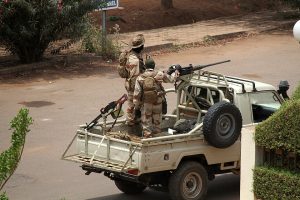
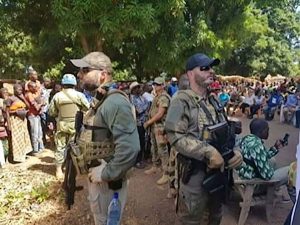
Russian mercenaries in Africa, 2019. Photo by Florence Maïguélé, CorbeauNews. CCA/4.0 International.


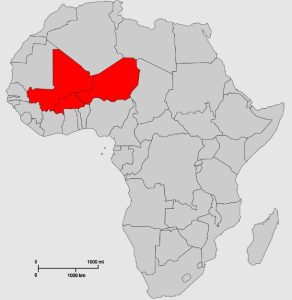
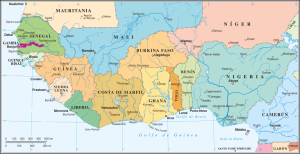
Map of West Africa, 2024. Map author WikiUser Rowanwindwhistler. CCA/4.0 International.

Wagner’s initial operational focus was not counterinsurgency in any meaningful sense. It was regime protection and resource extraction – concentrating in Bamako to shield the junta, while securing gold mining operations in the north. This is the model Russia has used across Africa: armed presence as a business arrangement, with strategic minerals as partial payment. The security of the population was, at best, a secondary consideration. At worst, it was actively counterproductive. Between January 2024 and Wagner’s exit in June 2025, Wagner and Malian soldiers caused more than 1,440 civilian casualties – four times the number of deaths and injuries attributed to JNIM jihadist forces during the same period.

In counterinsurgency operations, killing the population you are supposed to be protecting is not a viable long-term strategy.

The July 2024 ambush at Tinzaouatène was the first major indicator that the arrangement was structurally unsound. A Wagner convoy moving to secure a gold mining site was ambushed in the desert by Tuareg rebels of what would become the Azawad Liberation Front (FLA). Local sources claimed 84 Wagner fighters and 47 Malian soldiers killed, in effect, the complete destruction of Wagner’s 13th detachment. Wagner survivors later accused Malian intelligence of deliberately underestimating rebel numbers. Malian officers accused the Russians of ignoring chains of command and treating them with open contempt. As one senior Malian officer told The Sentry research organization: “We have gone from the frying pan to the fire.” The ambush reverberated far beyond the Sahel: for years, Wagner’s brand across Africa had rested on a carefully cultivated reputation for ruthless effectiveness – the force that succeeded where Western armies hesitated. Tinzaouatène punctured that reputation in a single afternoon, and the puncture was public: drone footage of the aftermath circulated across social media within hours, reaching every junta government on the continent that had been weighing a Russian security arrangement.

Touareg tribesman in Algiers (Algeria). 2015 photo by WikiUser Amine loua. CCA/4.0 International.


How It’s Going 

After Yevgeny Prigozhin’s death in 2023, the Russian Ministry of Defense absorbed Wagner’s African operations into a new entity called the Africa Corps – named, with what can only be described as either spectacular historical tone-deafness, or a badly mismanaged sense of humor – after the Wehrmacht’s North African expeditionary force of WW2. Roughly 70-80% of the Africa Corps was composed of former Wagner fighters. The same men, the same doctrine, the same fundamental mismatch between the mission and the force available – now with a Ministry of Defense letterhead.

The total Russian force in Mali reached approximately 2,000 personnel by late 2024. Two thousand troops, in a country the size of Western Europe, facing two converging insurgencies – JNIM’s Fulani-recruited jihadist network operating across the center and south, and the Tuareg-led FLA pressing from the north – that had demonstrated the ability to coordinate operations despite having no particular affection for each other.

The structural intelligence failure compounded everything else. The Small Wars Journal published a detailed analysis in March 2026 noting that Africa Corps operated as a TECHINT-rich, HUMINT-poor force – capable of drone strikes and signals intelligence, but systematically unable to cultivate the human networks necessary to understand insurgent intent before it materialized as an attack. The coercion-based approach to information gathering – intimidation and violence rather than community trust – actively destroyed the conditions necessary for effective intelligence collection…something all the more remarkable, given the widespread availability of afteraction reports from the mid-1990’s to today. JNIM’s ongoing fuel blockade of Bamako, which required sustained preparation, coordinated logistics, and expansion into southern Mali where the group had previously had minimal presence, was not detected until it was already operational.


The Fall Of Kidal

On April 25, 2026, JNIM launched a coordinated assault on Kati – the largest military base in the Bamako region, home to senior government figures including Mali’s Defense Minister. A car bomb driven through multiple checkpoints into the residential sector killed Defense Minister Sadio Camara and mortally wounded the chief of intelligence. The operation required insider knowledge that the junta has not publicly explained.

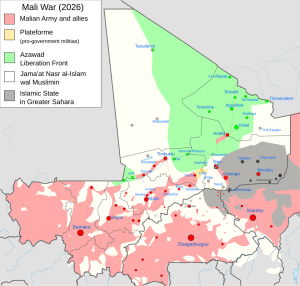
Simultaneously, the FLA launched its main offensive against Kidal — the strategic northern city that Wagner had captured in November 2023 in what was supposed to be the high-water mark of the Russian intervention. Within hours, FLA forces had overrun the city’s checkpoints, the police station, and the governor’s palace. The Russian Africa Corps garrison, unable to expect reinforcements with every available aircraft pinned down responding to the Bamako diversionary attacks, negotiated an exit — paying their way out of encirclement and withdrawing north in a convoy of trucks that included Tornado-G multiple rocket launchers and a D-30 howitzer.

Map of the Mali War, to early 2026. Map author WikiUser Borysk5. CCA/4.0 International.

They left behind a fully operational drone control substation, relay equipment, and a command post. The symbolism was not lost on anyone.

“It is the most consequential battlefield setback Russia’s African project has suffered,” said Justyna Gudzowska of The Sentry. “It is a major reputational and political blow,” inverting the idea that the Russian model was working.


The Structural Problem Russia Cannot Solve

The Carnegie Endowment’s analysis of the situation, published in March 2026, identified the core issue with precision: Russia is repeating France’s mistakes, favoring a heavy military hand without a political strategy to address the root causes of violence, all while simultaneously being less competent than France in the military dimension…an “achievement”, all by itself.

The Tuareg question has generated five rebellions since Malian independence in 1960. Every external power that has intervened in Mali – France included – has addressed the symptom without touching the cause. The Malian junta’s refusal to consider meaningful autonomy arrangements for the north, combined with its expulsion of the regional security architecture that might have provided some coordinating function, has left the country with fewer tools to address the insurgency than it had in 2021.

Russia has not brought a political strategy. It has brought mercenaries, helicopter gunships, and a mining concession model that has consistently generated civilian casualties faster than it generates security. The instability it was hired to contain is now pushing southward toward the West African coast – toward Benin, Côte d’Ivoire, and Togo, countries with the region’s largest populations and most developed economies.

That dirt berm in the drone photograph is not just a poorly built fortification. It is a precise architectural expression of the entire Russian strategic approach in the Sahel: a perimeter with no depth, no overlapping fields of fire, wide open to observation, and apparently designed by people who have never seriously considered what happens when the enemy actually arrives.

They arrived on April 25th.


The Freedomist — Keeping Watch, So You Don’t Have To


freedomist banner


2025 – A Year In Review


So. We have come to the end of 2025. To say the least, it’s been a wild ride.


In the United States

The year started off with a bang, with a pair of terror attacks: a truck-ramming assault in New Orleans, Louisiana, and the still-mysterious explosion of a Tesla Cyber Truck in the parking foyer of the Trump International Hotel in Las Vegas, NV, both on January 1st.

Then, beginning on January 7, a series of massive fires began in the Los Angeles Basin, that would eventually destroy the town of Pacific Palisades. In this case, while the main fires began on January 7, an initial fire was intentionally started on January 1; the perpetrator was swiftly arrested, and his fire was thought to have been contained, before it reignited. The scale of the destruction – around 58,000 acres in total – and controversies about poor fire fighting infrastructure continue to simmer as the year closes.

Then, on the heels of the Tutsi M23 rebel group seizing the city of Goma, in the Democratic Republic of the Congo on January 27, the aircraft world saw four major crashes in as many days (January 28 – 31), making for a total of twenty-six fatal accidents, as of December 18th, including a still bizarre collision of a US Army UH-60 Blackhawk helicopter with a Bombadier CRJ700 (operating as American Airlines Flight 5342, under the American Eagle brand) over the Potomac River, near the Kennedy Center. Questions remain, circling the exact chain of events.

Then – to cap off January – Asteroid 2024 YR4 became the first object to trigger planetary defense procedures on January 30, when it was initially determined to have a 1.3% chance of hitting the Earth in 2032. While it was later determined that the asteroid will not, in fact, hit the Earth, there remains a greater than zero percent chance (about 4%) of hittig the Moon in 2032. If this happens on the face of the Moon facing Earth, the debris blown towards us would very likely cause severe damage to the constellations of satellites in Low-Earth Orbit, that our communications and payment processing systems depend on. Any large-scale disruption to this network would effectively shut down commerce for months, at least.

Meanwhile, Trump’s tariff war, and his relentless drive to secure ceasefire or outright peace agreements in several conflicts seem to be working, although with the caution that the agreements seem focused on securing the flow of rare-earth materials, more than securing actual “peace”.

And – an end to the war in Ukraine still eludes Trump’s continued efforts to get the two countries to at least start talking.


External events

Internationally, wars continue to simmer. While the Assad Family’s near-50 year reign over Syria ended at the end of 2024, fighting has continued, with Israeli intervention in southern Syria, and one of the largest bombing campaigns in recent memory; eventually, three US personnel were killed in December at a meeting in the Syrian city of Palmyra.

The collapse of the Assad regime triggered a sudden and startling collapse of Iranian influence in the region, as Iranian proxy forces like Hezbollah saw their support infrastructure critically damaged as a part of the phase of their war against Israel in support of Hamas, that began on October of 2023.

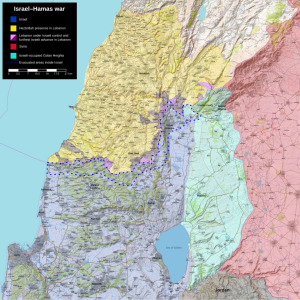
That particularly brutal conflict – beginning with the Hamas raids of October 7, 2023 – also sparked the Red Sea Crisis with the Houthi religious faction in Yemen launching relentless attacks on any commercial vessel with even the faintest connection to Israel – effectively, all commercial shipping in the world. In addition, the Houthis began firing Iranian-supplied ballistic missiles at anyone and anything within range.

Map of the of the 2023 Israel-Hamas War, 2023-present. 2023 image by Wikipedia Users Veggies and Ecrusized. CC0/4.0 International


These attacks resulted in a somewhat lackluster allied naval campaign to try and escort commercial vessels through the Red Sea, and ultimately to the Trump Administration launching a series of massive airstrikes throughout the region – sometimes support by, or in support of, Israeli strikes against the radical Islamic regime in Iran.

As the year closes, the region seems to be taking a breather. That won’t last.

Elsewhere, the civil war in Sudan continues to rage, with continued massacres conducted by both sides. And in Nigeria, religious massacres by Muslims against Christians suddenly elevated to the point where the Trump Administration openly called for a designation of “genocide”, and even hinted at possible military intervention.

In southern Africa, the persistent Islamic State-aligned insurgency in Mozambique continues on, threatening to turn the country into another Somalia.

In Asia, the civil war in Burma/Myanmar grinds on, with the ruling junta banking on continued massive support from Communist China…which may be a bad bet, as the Chinese economy continues to falter.

And finally, the Trump Administration continues with its”saber-rattling” at Venezuela, in an effort to force long-time dictator Nicolas Maduro from power. Whether this turns into an actual shooting war or a stunt, remains to be seen.


The Wrap

Overall, 2025 has seen some remarkable swings in the world situation…but there remains little indication of a true end to many of the persistent conflicts that remain ongoing. Economies are still adjusting to the reality of heavy US tariffs being imposed for the first time in decades, and wars continue apace.

Here’s to hoping things improve in 2026.


The Freedomist — Keeping Watch, So You Don’t Have To


freedomist banner


The Arsenal of Democracy’s Empty Shelves


By and large, your humble author has largely avoided talking about the war between Russia and Ukraine that entered its “hot” phase in late-February of 2022, even though it actually began in 2014 – but don’t expect the mainstream media to talk about that too much.

Breaking the “Fourth Wall” a bit, I hate politics, in general. I have strong and rigid opinions, and I am not going to beat dead horses here. So, don’t expect political moralizing. I write about the technical aspects of defense and security – which are completely agnostic, until some idiot decides that their juice is better than that of the other guy across the river.

Moving on.

There has been a toxic fantasy in the West – especially in the United States – that has arisen in the aftermath of the collapse of the Soviet Union. Caused by a putrid mix of slavish devotion among politicians desperately wanting to look good to voters, greedy and craven defense contractors, and military officers looking to pad their retirement portfolios, all of whom adopted the idiotic ideas of Alvin Toffler – a subject we recently touched on – have combined to weaken the military capacity of the West to levels of incapacity not seen in nearly a century.

After the Cold War ended, there was a frenetic rush to make the “butter not guns” dream a reality. The problem? Like all utopian concepts – especially when backed up with “sciency”-looking graphs and densely written tomes filled chock-full of techy-sounding wording – that paradigm drove Western defense infrastructure over a cliff.

What all of those lofty hopes-n-dreams deliberately ignored, was that with the demise of the Soviet Union, the only enemies left – so it seemed – were minor states, like Serbia and Iraq, and later, against various terrorist groups like al-Qaeda as part of the grandiosely-named “Global War On Terror” (GWOT).

The idea of a massive conventional war in Europe was completely dismissed as a thing of the past. In this, to be both as blunt and honest as possible, was a level of “genteel racism” that has run as an undercurrent (and occasionally not so “under”) through the psyches of the Western establishment, as massive conventional wars happened throughout those parts of the world the mainstream media chooses to ignore since the Cold War’s end.

As a result, modern (i.e., 21st Century) Western militaries are barely-hollow shadows of their former selves.

This particular Emperor’s lack of clothing became starkly apparently in 2022, as the war goaded into being by the “globalists”, led by Joe Biden’s autopen, revealed that there were no functional reserves of war material in the West, including within the United States…while Russia – with only minimal support from its allies – was able to easily maintain operations throughout the war, hysterical screaming from the Western/globalists.

Destroyed military vehicles on a street in Bucha, Ukraine, near Kiev, during Russia’s invasion of Ukraine, March 1, 2022. Picture by REUTERS/Serhii Nuzhnenko. CCA/2.0 Generic.

In a word – the “Arsenal of Democracy” is empty. And deliberately so, in the interests of greed.


Coming Clean

NATO Secretary General Mark Rutte delivered a sobering assessment to London audiences in the summer of 2025: “Russia produces in three months what the whole of NATO produces in a year” when it comes to ammunition. The statistic encapsulates one of the most profound strategic failures of the post-Cold War era – the systematic dismantling of the Western defense industrial base just as the world was returning to the high-intensity conflicts it was designed to support.

Three years after Russia’s invasion, Ukraine remains critically short of the basic ammunition needed to defend itself, despite receiving unprecedented Western military aid. The shortage isn’t due to lack of political will or financial resources, but something far more fundamental: the West simply cannot produce enough ammunition to meet the demands of modern warfare. What was once called the “Arsenal of Democracy” now struggles to keep a single medium-sized conflict adequately supplied.


The Arithmetic of Industrial Failure

The numbers tell a stark story. Before the war, [the United States produced approximately 14,400 artillery shells per month – roughly 180,000 annually. Europe’s combined capacity for 155mm shells ranged between 240,000 and 300,000 pieces per year. Meanwhile, Ukrainian forces were using 2,000 to 9,000 shells daily in active combat – potentially consuming the entire annual Western production in a few weeks.

Russia, by contrast, ramped up to producing an estimated 4.5 million shells annually by 2024, supplemented by millions more from North Korean stockpiles. This allowed Russian forces to fire 10,000 to 80,000 shells daily at their peak – a volume that Western production couldn’t match even if every shell manufactured went directly to Ukraine.

The disparity became operationally decisive. The fall of Avdiivka in early 2024 occurred not because Ukrainian defenders lacked courage or competence, but because they lacked ammunition. Soldiers withdrew from a town successfully defended since 2014 simply because they couldn’t shoot back.


How We Got Here

The post-Cold War “peace dividend” seemed reasonable at the time. With the Soviet threat vanished and conflicts shifting to counterinsurgency operations requiring precision strikes rather than mass artillery barrages, Western militaries optimized for quality over quantity. Production lines closed, skilled workers retired, and long-standing supply chains atrophied. The assumption was simple: modern warfare would be short, decisive, and technology-intensive. Artillery-intensive wars of attrition belonged to history.

A recent academic analysis suggests deeper psychological factors at work. Western militaries over-invested in visible weapon systems – aircraft carriers, stealth fighters, advanced tanks – that could be showcased to signal military strength while neglecting unglamorous stockpiles of shells and propellant. Like luxury goods in consumer markets, these prestige platforms satisfied political and institutional desires for status while the mundane logistics of sustained warfare received inadequate investment.

The result: warehouses that looked full but weren’t. NATO’s own ammunition stockpile targets, set in 2014 to sustain a 30-day high-intensity conflict, were never met. When Ukraine needed support, European nations were drawing from “half full or lower warehouses,” as Admiral Rob Bauer, chair of NATO’s Military Committee, acknowledged in 2023.


The Response: Too Little, Too Slow

Western nations recognized the crisis early but struggled to respond effectively. The U.S. has invested billions to increase 155mm production from 14,400 monthly shells to 40,000, with targets of 100,000 by late 2025. Europe set goals of 2 million rounds annually by 2025. These are impressive percentage increases but remain inadequate to both supply Ukraine and replenish depleted Western stocks.

The problem isn’t just production capacity – it’s the entire industrial ecosystem. Explosive production, particularly TNT, relies on a single Polish factory. Specialized steel alloys, propellants, and precision components all face similar bottlenecks. It takes two to four years to establish new production lines for high-intensity military equipment, meaning decisions made today affect battlefield realities years hence.

European efforts face additional complications. The EU produces around 170 different weapon systems, with 16 different types of 155mm shells alone. Ukrainian soldiers call this diversity a “zoo,” forced to constantly recalibrate equipment as they receive incompatible ammunition batches. National defense industries resist standardization to protect domestic jobs and capabilities, creating inefficiency precisely when efficiency matters most.

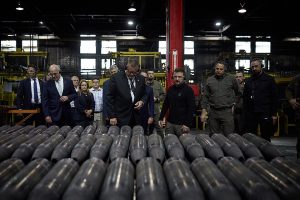
President of Ukraine Volodymyr Zelenskyy visiting the Scranton Army Ammunition Plant in Pennsylvania, where components for artillery and mortar shells are produced. Public Domain.


Strategic Implications

The ammunition shortage reveals uncomfortable truths about Western military power. The United States and its allies possess overwhelming technological superiority in sensors, precision weapons, and command systems. They can see the battlefield better, strike more accurately, and coordinate more effectively than any adversary. But modern wars – particularly wars of territorial conquest – still require mass. You cannot hold ground with satellites nor break fortified lines with precision alone, when the enemy can absorb losses and continue fighting.

Russia’s production advantage doesn’t reflect superior technology or efficiency – Russian shells are cruder and less accurate than Western equivalents. It reflects strategic focus and industrial mobilization. Russia maintained cold-war-era production capacity, kept supply chains intact, and prioritized ammunition stockpiling even when it seemed unnecessary. When war came, this unglamorous preparation proved decisive.

The West now races to rebuild what it spent thirty years dismantling. New contracts are signed, facilities are being constructed, and production targets are set. But wars don’t wait for industrial mobilization. Ukraine needs ammunition today, not in 2026 or 2027. Every month of shortfall translates to lost territory, casualties that might have been prevented, and strategic opportunities foreclosed.

The hollowed-out “Arsenal of Democracy” stands as testament to what happens when military planning assumes future wars will resemble preferred scenarios rather than probable realities. Preparing for the wars we want to fight while ignoring the wars we might have to fight is a luxury no serious power can afford – a lesson being relearned at terrible cost on Ukrainian soil.

Russia bet long, and is succeeding. The West bet short, and is failing….It’s as simple as that. The only good thing is that we are not in direct combat with Russia.

Yet.

I can’t tell you how we’re going to fix this, because there are entrenched actors in the West – in government, industry and military departments – absolutely unwilling to bend the knee to take the actions needed to fix the problems outlined above.

Not least, when the United States Army can only seem to feed its troops lima beans and toast on Thanksgiving.

Take note.


The Freedomist — Keeping Watch, So You Don’t Have To


freedomist banner


Continuing Disintegration – No Honor Among Thieves


The more things change, the more they stay the same. As we wrote back in January of 2025, the various terror, drug and insurgent groups in Afghanistan – not content with fighting each other- are poking what they see as a weakened tiger, in the form of a highly dysfunctional Pakistan.

With Pakistan clearly on the losing end of it brief – and terrifying – war with India in May, the various jihadist groups north of the Hindu Kush smelled weakness, and a steady intensification of attacks have been quietly growing, an intensification largely ignored in the wider world press, in favor of Israel v. Hamas, Ukraine v. Russia, and the “Gen-Z – Discord” revolts erupting in states from Morocco to Nepal.


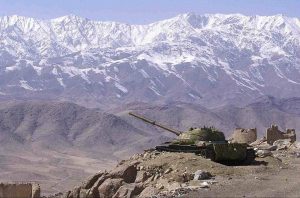
Landscape of Afghanistan, with the Hindu Kush range in the background, and a T-62 MBT in the foreground. 2007 Public Domain photo by WikimediaUser davric.


The 2025 Afghanistan-Pakistan conflict that erupted in earnest in mid-October represents more than routine border skirmishes—it signals a fundamental breakdown in one of the region’s most consequential relationships. After decades of Pakistan supporting the Taliban as a strategic asset, Islamabad now finds itself conducting airstrikes on Kabul and trading artillery fire with forces it helped bring to power. The bitter irony is impossible to miss: Pakistan’s former proxy has become its primary security threat.


October Escalation

The immediate catalyst arrived on October 8, when militants killed 11 Pakistani military personnel, including a lieutenant colonel and a major, in Khyber Pakhtunkhwa’s Orakzai district. Pakistan’s response crossed a critical threshold — airstrikes not merely in border regions but directly on Kabul, Afghanistan’s capital, targeting Tehreek-e-Taliban Pakistan (TTP) leadership allegedly sheltering under Afghan Taliban protection.

The fighting that followed was the deadliest since the Taliban returned to power in August 2021. Pakistan claims it killed over 200 Afghan Taliban and allied fighters while losing 23 soldiers. Afghanistan counters that it killed 58 Pakistani soldiers while suffering only nine deaths. Both sides claim to have captured or destroyed dozens of enemy border posts. Independent verification remains impossible, but satellite imagery and verified drone footage confirm significant damage to Afghan military compounds.

The violence forced a 48-hour ceasefire brokered by Saudi Arabia and Qatar, but border crossings remain closed and tensions simmer. More ominously, Pakistan has adopted what analysts call a “new normal” doctrine: any attack originating from Afghan territory will trigger immediate cross-border retaliation, regardless of diplomatic cost.


The TTP: Pakistan’s Self-Inflicted Wound

At the conflict’s core lies the Tehreek-e-Taliban Pakistan, formed in 2007 during America’s “War on Terror.” The TTP seeks to overthrow Pakistan’s government and impose strict Islamic law, demanding the release of imprisoned members and reversal of tribal area integration into Khyber Pakhtunkhwa province. What makes the TTP particularly dangerous is its ideological alignment with and sanctuary provided by the Afghan Taliban.

The numbers tell a grim story. The TTP conducted at least 600 attacks against Pakistani security forces in the past year alone, with 2025 activity already exceeding all of 2024. August 2025 marked the deadliest month of militant violence in over a decade, with 194 people killed and more than 200 injured in 143 attacks across Pakistan. Pakistani security force casualties in 2025 are on track to be the highest ever recorded.

The TTP has evolved beyond “simple insurgency“, threatening to expand attacks against Pakistan’s military-run commercial enterprises — fertilizer companies, construction firms, housing authorities, and banks. This represents a significant escalation, potentially bringing urban areas into a conflict previously concentrated in remote borderlands.

Briefly, a “simple insurgency”, as defined by Google’s AI search tool can be described as:


A simple insurgency is an armed rebellion by a small, lightly armed group against a more powerful, established government. Because they lack the strength for a conventional military conflict, insurgents use guerrilla tactics and rely heavily on the support of the local population to challenge the ruling authority. [1, 2, 3, 4]
Key characteristics of a simple insurgency • Asymmetric warfare: A simple insurgency is defined by the severe mismatch in power between the rebels and the government they oppose. Insurgents, often called guerrillas, compensate by using hit-and-run attacks and avoiding direct, pitched battles.
• Irregular tactics: Instead of traditional army maneuvers, insurgents employ a variety of tactics to weaken the government and increase their own control and legitimacy. These can include:

• Guerrilla warfare
• Terrorism
• Sabotage
• Propaganda and recruitment

• Protracted struggle: Insurgencies are not short, decisive conflicts. They are typically protracted political-military campaigns designed to outlast and exhaust the government through persistent, focused violence.
• Focus on the population: The ultimate target of an insurgency is not just the government’s military forces, but the loyalty and support of the civilian population. Gaining popular support is the key to success. Insurgents accomplish this by:

• Providing services
• Discrediting the government
• Gaining the trust of people in rural or remote areas

• Driven by ideology: While some rebellions are a temporary revolt, insurgencies are often fueled by a powerful ideology that explains people’s grievances and provides a vision for a new political order. This can include motivations based on religion, ethnicity, or politics.
• Control over territory: Unlike purely terrorist organizations, a central objective of an insurgency is to control resources and eventually establish an alternative government in a particular area. [1, 4, 5, 6, 7, 8]

Simple insurgency vs. other conflicts • Revolution: A simple insurgency lacks the widespread, organized structure of a full-scale revolution, even though it may share the same goal of overthrowing the government.
• Coup d’état: This is different from a coup, which involves a swift, elite-driven seizure of government power. An insurgency, by contrast, relies on a protracted struggle for popular support and does not have the resources for a quick power grab.
• Terrorist organization: While insurgents may use terrorism as a tactic, their ultimate goal is different from purely terrorist groups. Insurgents aim to build an alternative government and control territory, while terrorist groups typically do not. [6, 7, 9, 10, 11]

Notes:

[1] https://en.wikipedia.org/wiki/Insurgency
[2] https://www.vocabulary.com/dictionary/insurgency
[3] https://www.vocabulary.com/dictionary/insurgence
[4] https://www.armyupress.army.mil/Journals/Military-Review/English-Edition-Archives/mr-history-page/MR-Categories-Guerrilla-Warfare/Daskal-1986/
[5] https://www.trngcmd.marines.mil/Portals/207/Docs/TBS/B4S5499XQ%20CounterInsurgency%20Measures.pdf?ver=2016-02-10-114636-310
[6] https://www.cia.gov/readingroom/docs/CIA-RDP87T01127R000300220005-6.pdf
[7] https://www.merriam-webster.com/dictionary/insurgency
[8] https://publications.armywarcollege.edu/News/Display/Article/3890242/the-challenges-of-next-gen-insurgency/
[9] https://2009-2017.state.gov/documents/organization/119629.pdf
[10] https://www.ebsco.com/research-starters/military-history-and-science/revolt-rebellion-and-insurgency
[11] https://www.britannica.com/topic/insurgency


Pakistan’s Strategic Blunder

The current crisis exposes Pakistan’s catastrophic series of miscalculations of the past. For decades, Islamabad’s military establishment pursued “strategic depth” in Afghanistan as a hedge against India, covertly supporting the Taliban even while publicly backing America’s War on Terror. The assumption was straightforward: a friendly Taliban government in Kabul would provide strategic advantage while ending Pakistan’s internal insurgency problems once American forces departed, by exerting control over the “Pakistani Taliban”.

Of course, the opposite promptly occurred. Since the Taliban’s 2021 return to power after the Biden Administration’s disastrous withdrawal from the country, the TTP has grown dramatically more capable and aggressive. Pakistan now faces an irreconcilable contradiction: the same Afghan Taliban it supported for decades now provides sanctuary to Pakistan’s primary internal security threat. Having invested enormous political and military capital ensuring Taliban victory, Pakistan cannot effectively pressure Kabul to eliminate TTP sanctuaries without undermining its broader regional objectives.

When Pakistan demands the Taliban eliminate TTP safe havens, Kabul either urges negotiations with the militants or claims inability to control them—sometimes both simultaneously. Pakistan’s leadership increasingly believes the Taliban deliberately weaponizes the TTP, either to expand Taliban-style governance into Pakistan or enable an allied Pashtun entity to control northwestern Pakistan.


The India Factor

Complicating matters further, India has pursued normalization with the Taliban precisely as Pakistan-Taliban relations deteriorate, almost certainly for that very reason – the brutal calculus of ‘realpolitik‘ usually wins, afterall. Afghanistan’s Foreign Minister Amir Khan Muttaqi visited New Delhi in October, with India announcing plans to reopen its Kabul embassy and calling the meeting “an important step in advancing our ties.” For Pakistan, which fought its brief war with India in May, this Taliban-India rapprochement represents strategic encirclement…which India well-understands.

Pakistan’s military noted the “serious provocation” of the fighting’s timing during Muttaqi’s India visit. The rhetorical shift is stark: Pakistan no longer refers to the Taliban as an “interim government” but as a “regime,” questioning their legitimacy to govern and calling for a more inclusive Afghan government. This represents a near-suspension of diplomatic ties between former allies.


Strategic Dead Ends

Pakistan’s options appear uniformly unattractive. Military operations against the TTP face fundamental constraints: the militants operate from Afghan territory beyond Pakistani reach, enjoy Afghan Taliban protection, and can simply retreat across the disputed Durand Line border when pressured. Localized clearing operations may temporarily displace militants but cannot hold territory without massive troop deployments that remain deeply unpopular among border populations.

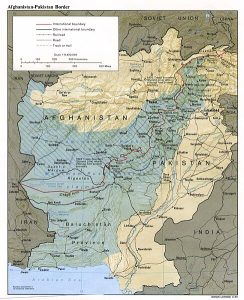
Durand Line Border Between Afghanistan and Pakistan. CIA Image, 2007. Public Domain.

Negotiations offer no better prospects. Previous ceasefires collapsed when the TTP refused to compromise on core demands fundamentally incompatible with Pakistan’s constitutional order. The TTP’s demand for sharia law implementation and tribal area autonomy restoration cannot be reconciled with Pakistan’s governance structure. Moreover, the TTP’s track record of breaking agreements makes any deal inherently unstable.

Cross-border airstrikes — Pakistan’s current approach — risk escalating into broader conflict while failing to address root causes. The strikes humiliate the Afghan Taliban publicly, potentially driving them closer to the TTP and other anti-Pakistan groups. Pakistan is adopting tactics it vehemently criticized when India employed them against Pakistan itself earlier this year—a dangerous precedent that normalizes cross-border military action in a nuclear-armed region.


Regional Implications

The conflict’s reverberations extend beyond bilateral relations. China, with massive “Belt and Road” investments in Pakistan, watches nervously as infrastructure becomes militant targets. Regional powers including Russia, Iran, and Saudi Arabia have urged restraint, recognizing that instability along the Afghanistan-Pakistan border threatens broader security. The Kremlin’s Moscow Format Consultations specifically pressed the Taliban to eliminate the TTP threat – pressures Kabul shows no inclination to heed.

Perhaps most troubling, the conflict validates Pakistan’s historical paranoia about strategic encirclement while simultaneously demonstrating how that paranoia drove the very policies that created current threats. By backing the Taliban as a hedge against India, Pakistan helped create a government that now shelters Pakistan’s most dangerous internal enemy while courting Pakistan’s primary external rival.

And this, in a nuclear-armed nation with a very shaky government.


No Good Options

As the temporary ceasefire holds precariously, at least for the moment – the fundamental problem remains unresolved: Pakistan faces an emboldened insurgency operating from sanctuary areas it cannot easily eliminate without destroying relationships it spent decades building. The Afghan Taliban, meanwhile, must balance protecting ideological allies against managing fallout from Pakistani military actions — a calculation complicated by its own limited control over remote regions and internal pressure from hardline factions…in public, at least.

History suggests leaders within the Taliban understand that Afghan governments ending up on Pakistan’s wrong side rarely survive. Yet the Taliban’s public posture suggests they believe they can continue supporting the TTP without triggering Pakistani countermeasures sufficiently severe to destabilize their regime. Whether this calculation proves correct may determine the region’s stability for years to come.

What seems certain is that Pakistan’s investment in the Taliban as a strategic asset has become a strategic liability of the first order — a cautionary tale about the dangers of relying on militant proxies as instruments of state policy. The militants Pakistan once cultivated have become the militants Pakistan can no longer control, operating from territory Pakistan helped them secure. The tragic irony would be complete if it weren’t so dangerous.

But.

The most important thing to remember in this swirling morass of barely concealed knives, is that the two main players – India and Pakistan – are both nuclear-armed powers…and no one, including them, is quite sure how steady are the hands on those launch keys.

Prepare yourself accordingly.


The Freedomist — Keeping Watch, So You Don’t Have To


UK Synagogue Terror Attack Leaves Two Dead, One Killed by Police

Syrian-born British citizen Jihad al Shamie attacked a synagogue in Manchester, UK by ramming his truck into a crowd outside the synagogue on October 2, 2025. He killed one person and injured three. The police shot the terrorist dead, but also killed one innocent bystander as well. So far, Islamists and leftists in the UK have been celebrating the attacks and rioting in support of Hamas in response.

Chief Constable of Greater Manchester Police Stephen Watson said in a statement “The only shots fired were from GMP’s Authorized Firearms Officers as they worked to prevent the offender from entering the synagogue and causing further harm to our Jewish community. It follows, therefore, that subject to further forensic examination, this injury may sadly have been sustained as a tragic and unforeseen consequence of the urgently required action taken by my officers to bring this vicious attack to an end.”

Madagascar Government Dissolved After Gen Z Riots

After Nepal’s government was felled by a Gen Z protest, the countries in the region have grown nervous, especially China. Now, the Gen Z revolution has spread, but not in the same region. This revolution happened in Madagascar. Madagascar youth began protests that have only been building, holding signs that say “We want to live, not survive.”

In response to the protests, Madagascar’s President, Andy Rajoelina, has dissolved the government, saying in his dissolution announcement, “We acknowledge and apologise if members of the government have not carried out the tasks assigned to them.”

Europe Rewards Terrorists with Palestinian State, who then IMMEDIATELY demand Trillions in “Reparations”

Mahmoud Abbas is now demanding $2 Trillion in reparations from Britain. This comes after most of Western Europe, including the UK, suddenly declared a recognition of the “Palestinian State” while under siege by Islamist revolutionaries their own governments paid to import.

Former top-ranking members of the UK’s military signed a letter denouncing the recognition of a Palestinian state by the UK. They called the decision “reckless in the extreme” and accused PM Kier Starmer’s action as being a danger to Britain’s own security.

Palestinian Authority Demands 2 TRILLION in Reparations After Starmer Recognizes “Palestine” State– gellerreport.com
Source Link
Excerpt:

After recognition of Palestinian statehood, Mahmoud Abbas is demanding £2 TRILLION in reparations from the UK.

He claims Britain owes compensation “in accordance with international law” for the land it controlled from 1917–1948.

Estimates go as high as £2 trillion.

REWARDING SAVAGES: Canada, Australia, Britain Recognize Islamic Terrorist “Palestinian” state

Now “Palestine” has officially been recognised as a state, Palestinian Authority President Mahmoud Abbas has demanded ‘reparations in accordance with international law’ based on the value of the land which was under British rule between 1917 and 1948.

This whole thing has been such a disaster

Taliban Tell Trump to Pound Sand in Demand they return air base to the U.S.

President Donald Trump publicly challenged Afghanistan’s ruling elite, the Taliban, DEMANDING they return Bagram Air base to the U.S. He told reporters that “we’re talking now to Afghanistan,” to which a reporter asked if he would use U.S. troops to take back the base.

Trump told the reporter, “We won’t talk about that. We want it back. And we want it back right away. If they don’t do it, you going to find out what I’m going to do.”  The Taliban responded through a spokesperson, who posted on X, “It should be recalled that, under the Doha Agreement, the United States pledged that ‘it will not use or threaten force against the territorial integrity or political independence of Afghanistan, nor interfere in its internal affairs.’”

Taliban rejects Trump’s bid to take over Afghan air base that U.S. controlled for almost 20 years– www.cbsnews.com
Source Link
Excerpt:

The Taliban government on Sunday rejected U.S. President Trump’s bid to retake Bagram Air Base, four years after America’s chaotic withdrawal from Afghanistan left the sprawling military facility in the Taliban’s hands.

… Earlier Sunday, the chief of staff at the Defense Ministry, Fasihuddin Fitrat, addressed Mr. Trump’s comments. “Ceding even an inch of our soil to anyone is out of the question and impossible,” he said during a speech broadcast by Afghan media.

France’s “Let’s Block Everything” Movement Shuts down country, greets new PM

As French Protests against Macron’s rollback of socialist handouts continue, their new Prime Minister, Sébastien Lecornu, seemingly has little hope of lasting much longer than his predecessor did. The “Let’s Block Everything” movement is already causing economic stress for the nation, as well as triggering increasing acts of civil disobedience.

No honeymoon period for France’s new PM as protests erupt – CNBC

Source Link
Excerpt:

There’ll be no honeymoon period for France’s newly named Prime Minister Sébastien Lecornu, with financial markets and the public showing increasing restlessness over France’s political and fiscal impasse.

Lecornu, who was only appointed as France’s new prime minister on Tuesday after the unceremonious ousting of PM Francois Bayrou at the start of the week, faces an immediate challenge as a mass public protest is unfolding Wednesday.

The grassroots “Let’s Block Everything” movement has called on disgruntled voters to show their dissatisfaction over the messy state of French affairs with acts of civil disobedience, urging protestors to blockade transport networks, public buildings and other services.

Paris police said Wednesday morning that 75 people have already been arrested, according to a France 24 report. Images have emerged of disorder erupting in the capital.

Main

Back FREEDOM for only $4.95/month and help the Freedomist to fight the ongoing war on liberty and defeat the establishment's SHILL press!!

Are you enjoying our content? Help support our mission to reach every American with a message of freedom through virtue, liberty, and independence! Support our team of dedicated freedom builders for as little as $4.95/month! Back the Freedomist now! Click here