
Armored combat vehicles are relatively new things. Like most complicated technology, they had rough starts. Few people, be they the engineers who designed and built them, or the soldiers using them, had any real idea of how they should be used, nor what requirements were necessary to make them function.
There is a particular irony embedded in the early history of Soviet mechanized infantry that most Cold War histories skip past without pausing on it. When the Soviet military’s engineers sat down in November 1946 to design the Red Army’s first purpose-built armored personnel carrier, the vehicles they studied most carefully were American. Thousands of M3 half-tracks had arrived in the Soviet Union under the Lend-Lease program during the Second World War, alongside captured German Sd.Kfz. 251 half-tracks that Soviet troops had taken off the battlefield. Soviet infantrymen had ridden both into combat. Soviet engineers had pulled both apart to understand how they worked. When designer B.M. Fitterman’s team at the ZiS plant began drawing the vehicle that would become the BTR-152, they were not starting from scratch. They were starting from an M3.
That lineage makes the M3/BTR-152 comparison something more interesting than a simple East-West parallel. It is a study in what happens when one nation takes another’s design concept, rebuilds it from different industrial and doctrinal assumptions, and produces a vehicle that resembles its ancestor in outline while differing from it in almost every meaningful detail. The differences tell you more about the two armies’ understanding of mechanized warfare than the similarities do.
The M3: A Commercial Vehicle Goes to War
The M3 half-track emerged from a straightforward American procurement logic: build a vehicle that can carry a rifle squad across broken terrain, protect it from shell splinters and small arms fire over the front arc, and do so using as many commercially available components as possible to speed production and simplify maintenance. The White Motor Company produced the first prototype using the body of the existing M3 Scout Car mated to a half-track running gear derived from French Citroën-Kégresse designs the US Army had evaluated in the 1930s. Accepted for service in May 1941, it could carry thirteen men — three in the cab, ten in the rear — at up to 45 miles per hour on road, with cross-country performance the wheeled vehicles of the era could not match.
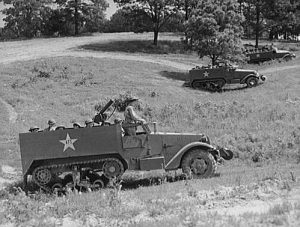
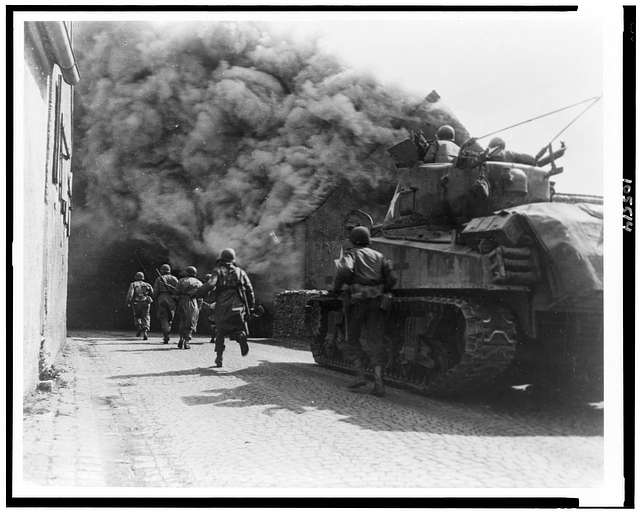
Its armor ran to 12mm at the front and 6mm on the sides — enough to stop rifle-caliber fire and most shell fragments, not enough to stop a machine gun at close range. The open top, which saved weight and allowed the crew to fire their weapons in any direction, was also the M3’s most consistent complaint: American troops, who nicknamed it the “Purple Heart Box” in grimly humorous reference to the decoration for combat wounds, objected that artillery airbursts and grenades dropped from above found the interior entirely unprotected. In the close terrain of the Italian campaign and the Hürtgen Forest, that limitation was lethal.
The M3 was produced in numbers that reflected American industrial capacity at full war mobilization: approximately 41,000 vehicles of all variants across the production run from 1941 to 1945, built by White, Diamond T, and Autocar and delivered to American, British Commonwealth, Soviet, and Free French forces across every major theater. Its variants numbered in the dozens — self-propelled artillery mounts, anti-aircraft platforms, mortar carriers, ambulances, command vehicles — which testified both to the design’s adaptability and to the American tendency to derive entire vehicle families from a proven platform rather than develop specialized vehicles from scratch.
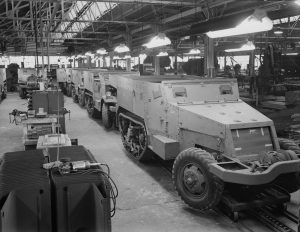
The M16 Multiple Gun Motor Carriage variant, mounting four .50 caliber M2 Browning machine guns in a powered turret, became the standard American light anti-aircraft vehicle of the war and one of the most effective ground support weapons of the Italian campaign. The M3 Gun Motor Carriage mounted a 75mm gun and served as a tank destroyer in North Africa before being replaced by purpose-built vehicles. The platform proved more versatile than its designers had intended, in the way that genuinely sound engineering often does.
The BTR-152: The Same Idea, Built Differently
The specification that produced the BTR-152 was issued in 1946, and work began at ZiS — the Zavod imeni Stalina, later renamed ZiL [https://en.wikipedia.org/wiki/ZIL] — under Fitterman that November. The design brief called for an all-terrain armored personnel carrier capable of operating with tank formations across the terrain of a future European war. The Soviet engineers’ answer was conceptually similar to the M3 but mechanically quite different: rather than a dedicated half-track running gear, Fitterman’s team took the chassis and drivetrain of the ZIS-151 [https://en.wikipedia.org/wiki/ZIS-151] six-by-six military truck — a vehicle already in Soviet service — and wrapped it in sloped armor. The result was a fully wheeled vehicle, not a half-track at all, carrying up to eighteen passengers at a maximum road speed of 75 kilometers per hour.
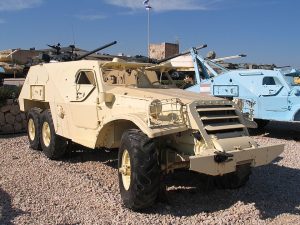
The BTR-152 entered Red Army service on March 24, 1950, was first shown publicly in a Moscow parade in 1951, and was produced in approximately 8,600 units through 1959 — a much smaller run than the M3, reflecting both the Soviet Union’s more constrained postwar industrial capacity and the shorter window before the BTR-60 rendered it obsolete. It carried a 7.62mm SGMB machine gun on a pintle mount, with provision for a 12.7mm DShK heavy machine gun on some variants. Its armor ran to 15mm at the front and 9mm on the sides — marginally thicker than the M3, though the same fundamental vulnerability to heavy machine gun fire and direct anti-tank weapons applied.
The BTR-152’s combat debut came not in a major war but in a city. In November 1956, Soviet forces used BTR-152s in Budapest during the suppression of the Hungarian Uprising. The results were instructive and unflattering. Hungarian insurgents threw Molotov cocktails and grenades into the open-topped troop compartments. Bullets and improvised weapons punctured the tires, immobilizing vehicles that could not move on rims as a tracked vehicle might. The armor that had seemed adequate on a proving ground was penetrated by heavy machine gun fire at close range in the narrow streets. The BTR-152 V1 and V2 variants that followed added a central tire pressure regulation system allowing the crew to adjust tire pressure while moving — a direct response to the Budapest lesson — but the open top remained until the BTR-152K, which added an armored roof at the cost of the firing ports’ usefulness.

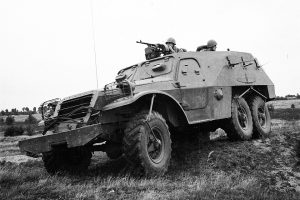
The pattern was identical to the M3’s experience in the Hürtgen and Italy: a vehicle designed for open mechanized warfare proving costly when urban terrain inverted its advantages. The open top that allowed observation and flexible fire in the open became a liability the moment walls and rooftops provided the enemy with elevation.
Two Vehicles, One Lesson
The M3 and the BTR-152 belong to the same moment in military history — the point at which armies that had learned the hard way that infantry could not keep pace with tanks on foot began building the infrastructure to change that, without yet having developed a coherent theory of what a truly integrated mechanized infantry vehicle should look like. Both vehicles were, in the vocabulary of their era, “battlefield taxis”: their job was to deliver infantry to the edge of the fight in something better than a truck, with enough protection to survive the journey under fire and enough firepower to suppress opposition during the dismount. Neither was expected to fight through the objective with the infantry aboard. Neither had the armor or the weapons to do so.
It took the 1967 appearance of the BMP-1 — which we examined in an earlier piece in this series — to demonstrate what a vehicle built on a genuinely different concept could accomplish: infantry that fought from the vehicle rather than dismounting before the fight, organic anti-tank capability, protection against the NBC environment of a nuclear battlefield. The BMP made both the M3 and the BTR-152 look like what they were: first attempts at solving a problem that would take another generation of engineering to solve properly.
The M3 was declared obsolete by the US military around 1955, though it continued in Israeli service through the 1973 Yom Kippur War and with various other operators well into the 1980s. The BTR-152 was similarly retained by export customers long after Soviet motor rifle units had moved on to the BTR-60 and eventually the BMP. Both vehicles appeared in the Lebanese Civil War. The M3 appeared in the hands of the IDF as recently as the 1982 Lebanon War.
The deeper irony is that the vehicle the Soviet engineers built by studying their American ally’s design ended up serving as long, in the same breadth of conflicts, in as many hands as the original — not because it was worse, but because it was cheaper, simpler, and distributed to clients who could not afford to upgrade when something genuinely better arrived. Which is, when you examine it carefully, a reasonable description of the M3’s own staying power. The Lend-Lease intellectual debt ran in one direction. The lesson about simplicity and durability ran in both.