Originally, this article was going to be considerably different, until research suddenly swerved in a different direction. That direction is to reinforce a fundamental military truth:
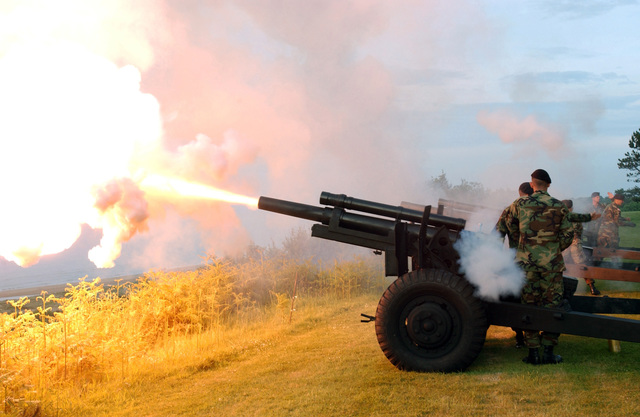
Artillery was, is, remains and will remain, the “King of Battle.”
While retaining the “Dragon Fire II” vehicle-mounted 120mm mortar, the reading on the rationale behind these decisions stands testament to an unacceptable failure by the military establishment in the United States to focus on reality.
Since combat operations commenced in Afghanistan in 2001, the US military in general has drilled down to a focus almost exclusively on “counterinsurgency operations” (COIN). Although pointedly left unsaid in public, this is a reaction to the fact that the US military establishment essentially abandoned COIN operations in the aftermath of the Vietnam War, to focus exclusively on the perceived threat of a Soviet invasion to Western Europe, and the assumed nuclear exchanges that would follow. In the aftermath of the 9/11 Attacks and the wars in Iraq and Afghanistan deteriorating into guerilla conflicts, the US military swung the pendulum 180° in the opposite direction from the 1980’s.
After the collapse of the Soviet Union, and Francis Fukuyama foolishly proclaiming the “End of History”, although rarely spoken out loud, military forces were seen as almost redundant anachronisms in many quarters, and should be reduced both in scale and capabilities, rendering them as something like heavily-armed police forces, with the occasional, movie-ready SWAT teams for hostage rescue. Combat operations like the first Persian Gulf War and Operation Iraqi Freedom were seen as aberrations, large operations against technologically inferior despot forces with lots of heavy (if antiquated) weapons and gear, and lots of troops, who – if not very well-trained or motivated – at least had plenty of simple weapons, and who would require somewhat more force than the international equivalent of a beat cop holding up their hand and saying “HALT!” in a loud voice.
Enter Russia.
While we are not going to delve too deeply, here, into the politics of this year’s Russian invasion of Ukraine, Russia is currently – by their own counts (which should, of course, always be taken with a large grain of salt) – running an average of c.580 fire missions per day. Assuming that these missions are run according to Russian military doctrine, each of these missions are a “battery shoot” involving a battery of four to six weapons. Roughly 30% of these would be rocket artillery, mostly from BM-21 ‘Grad’ type rocket systems, with the remainder fired by conventional “tube” artillery [https://en.wikipedia.org/wiki/Artillery]. Using the most conservatively realistic figures, this equals approximately 7,000 conventional artillery rounds being fired.
Per day.
This come out to over 200,000 rounds in a 30-day period.
In contrast, the Western democracies have “bet the farm” on weapon accuracy, developing “precision everything” in mortar, rocket and conventional artillery rounds. They chose this route, because the conventional news media is ecstatic over images of dead civilians, which is much more likely when using “dumb” weapons. Needless to say, such casualty-limiting precision comes at a price: the M982 “Excalibur” 155mm precision-guided artillery round costs anywhere from US$68,000 to $175,000 per round (depending on who is counting).
In the West, conventional “dumb” artillery rounds cost between US$300 and $1,000 each. This, of course, begs the question: is “smart” better than “dumb“?
Certainly – if you can afford it. Can the West?
Currently, following the defense budget cuts in FY2022 by the Biden administration, artillery ammunition procurement is being cutby some 36%. In the very best case scenario, this means that the United States currently produces enough ammunition in a calendar year for anywhere between ten days and three weeks of combat firing, based – again – on the mostconservative take on Russian claims of artillery fire missions and estimated rates of ammunition expenditure in Ukraine. And the United States is sending ammunition to Ukraine to go along with the 155mm howitzers and other weapons we are already supplying.
And the US is not alone. In 2021, the British Army conducted a large-scale, “main force” wargame where they completely exhausted national stocks of critical ammunition – at the national level – in eight days. Similarly, only about 2,100 units of the vaunted Javelin missile are produced each year – and the Ukrainians are claiming to fire “hundreds” of Javelins daily, leaving the US defense industry scrambling to bring new production streams online. The FIM-92 Stinger anti-aircraft missile is in a similar situation.
Worse still, Russia is known to have fired over 1,000 “cruise missiles” since invading the Ukraine proper in February of 2022. Even given the highly questionable reports of those firings’ performance, it is clear that the Russian industrial base is still more than capable of supplying the weapons and ammunition to the firing lines (the logistical aspects of this are an entirely different subjects).
It is vital to keep in mind, again, that the technical accuracy and reliability of the Russian arsenal is not the question, here. The fact is that they are able to maintain production and consumption rates of comparatively “dumb” systems – and firing something at the enemy is better than firing nothing, because you’re waiting on resupply.
The conclusion here is clear: the West is functionally trying to counter Russian aggression from a hospital bed, while ignorant children are playing with its life support equipment.
This is not 1939, and the West is no longer the “Arsenal of Democracy.” Ukraine is paying, and will continue to pay, a heavy price for trusting the modern-day Western states…and unless something is done quickly, the people of the West may well pay that price, as well – assuming that we do not pay an even heavier price.
The Freedomist — Keeping Watch, So You Don’t Have To
Shortly prior to the 95th founding anniversary of the Chinese People’s Liberation Army (PLA) on Monday, China for the first time revealed a video featuring the launch of what resembles a DF-17 missile, in a move experts said on Sunday displayed the flexibility of the “aircraft carrier killer” hypersonic weapon that is almost impossible to intercept, at a time when tension is rising in the Taiwan Straits amid US House Speaker Nancy Pelosi’s possible visit to the island of Taiwan.
State broadcaster China Central Television on Saturday released a video titled “The capabilities of the Chinese troops shown in 81 seconds”, celebrating the upcoming China’s Army Day, which falls on August 1.
A scene in the video, showing live-fire launch of a missile from a transporter erector launcher on a highway in a desert, attracted particular attention by military enthusiasts, who said the missile resembles the DF-17 hypersonic missile, which has been publicly displayed at the National Day military parade on October 1, 2019 in Beijing.
If the missile shown in the video is indeed a DF-17, this would be the first time China has publicly revealed a footage on the DF-17’s live-fire launch, observers said.
Being able to launch on a highway in a desert demonstrated that the new-type missile does not require a preset launch position to launch, Song Zhongping, a Chinese…
As First-World States Amp Up Their High Tech, The Opposition Sticks To Basics
An F-35 Lightning II prepares to take off, Luke Air Force Base, AZ – USAF photo by Sr Airman Devante Williams; Public Domain
Over the last hundred years or so, uncountable amounts of money have been spent by various countries, to develop ever more sophisticated weapons and vehicles, many times, almost literally reinventing the wheel. The latest gargantuan expenditures that come to mind are the M1 Abrams tank, the Zumwalt destroyer and the F-35b airplane.
Iranian soldiers with a BGM-71 TOW missile during the Iran-Iraq War, 1980-1988
Why this should be so, is of great discomfort to both defense companies and armies, around the world. The reason defense companies are worried is that the civilian Toyota vehicles are “good enough” for most combat vehicle applications. They are simple, rugged, durable, easy to understand and operate, and – most importantly – cheap.
Roll-on/roll-off ferry terminal at Queenscliff, Victoria, 1993.
On the military side, these are also concerns, but the military – by necessity – goes deeper: the very ubiquitous nature of the vehicles (driven by market, not military forces), in addition to their built-in ruggedness, makes it supremely difficult to both identify and attrit an asymmetric enemy’s mobile infrastructure without attacking civilian targets at the same time.
Mongol horseman, 14th Century
It has long been known that light vehicles equate to light cavalry. Unfortunately, historically, conventional militaries have always had a distinctly difficult time dealing with forces that can master the techniques of light cavalry campaigns.
U.S. Marines and guide in search of bandits. Haiti, circa 1919.
Similarly, it has long been recognized that simple, robust weapons systems give unconventional forces near-parity of effectiveness at the “boots on the ground” level of combat. As long ago as 1940, in the US Marine Corps – in its “Small Wars Manual” – recognized that as technology developed, and lightweight, fully automatic weapons spread, the tactics the manual outlined would be rendered obsolete.
AK-74 assault rifle
Modern small arms development has essentially hit a plateau in the years since 1946. Once the move to self-loading rifles was complete, what remained were alterations to ergonomics and attachments. The weapons could be massed produced with a very high degree of mechanical simplicity built in…This, of course, resulted in the development of the near-universal AK-series of assault rifles in the hands of both urban and rural guerrilla forces, as well as the later tribal militias, to say nothing of its continued use by regular armed forces throughout the world.
Adding to the difficulty for conventional armies is the widespread deployment of highly effective, yet almost laughable uncomplicated, heavy support weapons at the squad level, primarily the RPG-7 and the General Purpose Machine Gun (GPMG).
An Afghan National Army (ANA) soldier fires an RPG-7 rocket-propelled grenade launcher, Helmand province, Afghanistan, May 20, 2013. USMC photo.
The RPG-7 rocket-propelled grenade launcher, while becoming less capable against frontline combat vehicle armor, is still more than capable against light vehicles, light or hasty fortifications, and even some aircraft. A robust and simple design, the RPG-7 is a valuable weapon in any force’s arsenal, and is widely available.
PKM Machine Gun
Likewise, the Soviet-designed PKM GPMG is another simple, robust and highly capable weapon system, easily a match for anything produced by the West.
Of course, except for the Toyota pickup trucks, the two things that the above weapons all have in common is that they are both products of Cold War-era Soviet Army design bureaus, and were handed out in vast numbers to many armies and guerrilla groups as the Cold War ground on.
And yet, their effects remain.
Adding to the problem is the impact of remotely piloted drone technology, especially drones modified to drop small munitions on target. Coupled to cheap and reliable internet access and radio technology, as well as the wide dissemination of both automated and manual secure encryption methods, armies trying to chase down irregular, terrorist and/or guerrilla forces today have issues far outside the scope of previous generations.
The challenge for both conventional forces, defense companies, and perhaps especially the political leadership of First World powers, frankly, is to find a way to equip the large security forces necessary to ensure a counterbalance to terrorist groups that operate like multinational corporations, while not cutting off their noses to spite their faces, by bankrupting the countries they are trying to sell their products to.
In general, people tend like good things. This should be self-evident: good food, good sex, good booze (in no particular order), so…anything ‘good’ should be, well, “good” – right? Like – peace, for instance.
Right?
I mean, war is all about violence, blood, horror, terror, crippling and debilitating injuries and very tragic and untimely death, all of which are really bad things…So…Less war must be good.
Right?
Today, we will examine a tiny sliver of that question.
Paris Street in Rainy Weather, 1877, Gustave Caillebotte.
In 1856, in an attempt to “limit the scourge of war”, a collection of European nations’ representatives gathered in Paris, France and signed a convention, the “Paris Declaration“, that eliminated the practice of “privateering“, or “legalized piracy in time of war.”
Letter of marque given to Robert Sutton de Clonard for the privateer Comte d’Artois, 1780.
The mechanism of this decision was simple: the Admiralty court system that adjudicated the “condemnation” and auctioning of “prizes of war” were disestablished, more or less overnight, removing the purpose of issuing “Letters of Marque and Reprisal“…and freeing – it was hoped – merchant shipping from the scourge of “legalized plunder“…
…But what was the real effect of this declaration?
Prior to 1856 – for roughly 400 years, in a formal sense – Western nations had deliberately evolved the system of prize-capture to avoid the cost of keeping excessively large (and very expensive) fleets manned when there was no war going on. Since merchant ships were generally alone in dangerous waters anyway, it only made sense to build cargo ships that carried weapons comparable to warships, and by extension, to utilize those same ships in time of war.
Thus, as an adjunct to the very common practice on land of hiring part-time professional soldiers – i.e., mercenaries – to flesh out an army, armed merchantmen were offered commissions to supplement regular navies, until those navies could get their actual warships fully crewed. After ferrying troops and supplies, many of these armed merchantmen struck out at the merchant ships of the enemy, striking targets of opportunity, capturing enemy vessels, hauling them to friendly (or even neutral), to sell off the cargoes and the ships themselves (sometimes at a staggering profit), as well as ransoming the prisoners.
The Ranger, Private Ship of War, with her Prizes. By Nicholas Pocock, 1780
After 1856, this all changed.
As the United States (which did not sign the Paris Declaration) was to discover to its horror, the dismantling of the prize system removed any incentive to capturing ships intact — where shipping companies (previously, at least) had the chance of buying their captured vessels back, once there was no possibility of easily selling off a captured prize, there was no reason to not strip the surrendered ships of useful supplies and destroy them after capture. The crews were either abandoned on remote islands to uncertain (and very unpleasant) fates, or tossed ashore in the first non-hostile port the ship came to, with nothing but the clothes on their backs…if they were that lucky.
Four years after the Declaration, the various States that formed the Confederacy attempted to leave the Federal Union, sparking the four-year long American Civil War. Among its many disadvantages, the Southern Confederacy did not really have a maritime tradition, as their northern opponents did. As a result, lacking hard currency or deep economic capital internally, their few attempts at issuing Letters of Marque were dismal failures, as limited cash in a bottled market could not chase what should have been lucrative captures.
“The Alabama destroying the Texan Star, or Martaban, in the Malacca Straits – The Kwan-Tung, Chinese War-Steamer, in the distance. From a sketch by Commander Allen Young, Royal Navy.” London Illustrated News, April 2, 1864, p. 320. Public Domain
In a series of brutal cruises, Confederate Navy corsairs slashed and burned their way through the United States’ merchant fleets; the US Pacific whaling fleet (supplying vital supplies of whale oil in a pre-petroleum society) was almost completely destroyed. Indeed, by 1864 most US-flagged merchant ships were laid up in US ports, as crews flatly refused to leave port under US colors, because of the danger of prowling rebel raiders; not even ruinous insurance rates could entice crews to sea. To remain solvent, many American merchant investors had to sell their vessels to foreign companies in a buyers market, just to maintain some form of capitol flow. The US merchant fleet would not fully recover its position in the world’s shipping arena until after World War 2.
Other countries – and their navies – noticed.
A battleship squadron of the German High Seas Fleet; the far right vessel is the battlecruiser SMS Von der Tann, 1917.
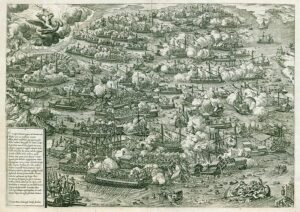
The basic requirements of naval warfare had not changed, the future writings of US Navy Admiral Alfred Thayer Mahan notwithstanding: an enemy nation’s merchant marine still had to be neutralized. This meant larger navies, with many more fighting ships in commission, at all times, since merchant ships could no longer, by about 1890, be easily converted into viable warships (since they could no longer be used as warships, there was no reason to design them with warship guns and armor). But, because technology was also expanding — both the fight between the USS Monitor and the CSS Virginia (the former USS Merrimack) in 1862, as well as the Austro-Italian Battle of Lissa in 1866 marking the first engagements between “armored” (or, “ironclad”) naval warships and fleets — this began a race to develop ever-bigger guns, better armor, faster and more fuel-efficient engines…and the armies, jealous of the navies’ lavish funding, also took note. But, with few major wars (only one, really) between industrial states taking place between 1875 and 1914, no one really paid attention…except, of course, the builders of naval artillery and warships.
Photograph of U-111, a German Submarine.
Come the end 1914, with the land war in Western Europe lurching into a blood-soaked, trench-bound stalemate, enforced by machine guns and more field artillery than anyone had ever seen before, Imperial Germany turned to widely deploying previously experimental or unseen weapons – specifically, the submarine and poison gas.
While there had been a slow and steady development of submarines in the previous decades, few officers of the day took them seriously as anything but scouts for battle fleets. But, once the German High Seas Fleet’s inability to blockade Britain became clear, the Kaiser unleashed his U-Boat fleet.
British 55th (West Lancashire) Division troops blinded by gas, 10 April 1918.
The slaughter was tremendous, as merchant ship crews began dying in huge numbers, and mind-boggling amounts of ship tonnage was sent to the bottom. Britain was almost starved of war-making material, and actually began to experience food shortages. In the next round, in 1940, Britain very nearly did lose its war — and American and British merchant seamen died by the thousands…On land, the role of the machine gun and poison gas is better known. The never-ending quest to one-up to other guy was in full force.
“The battle between the Aisne and Marne: German ammunition column, teams and horses with gas masks when passing a gasified forest.”
On land, with the stalemate and slaughter of trench warfare enforced by machine guns, the German High Command was induced to take what for them was a radical (and, by their own admission, distasteful) action: allowing scientists, led by Fritz Haber, the chemist who perfected the extraction of ammonia from atmospheric nitrogen, to develop what had been annoyingly dangerous byproducts of industrial chemical processes into deadly weapons that killed indiscriminately…and ultimately, led directly to the Zyklon-B of Hitler’s gas chambers.
Ultimately, the quest for “more is not only better, it is vital” led directly to the atomic bomb. Although its destructive force was not truly understood at first, even after its effects were understood in their full horror, their development continued apace, leading to the culmination of destruction: the “Tsar Bomba” of the Soviet Union.
However, nothing happens in a vacuum — while states, and the armies and navies that served them, raced frantically to find faster, broader and more efficient ways to kill each other, those nations’ populations paid attention…and learned the unintended lesson:
Life is cheap, fragile, and easily thrown away — and if governments don’t care about the lives of their individual citizens, why should the citizens care about the lives of an “enemy” people?
Kill ’em all – let God sort ’em out.
Right?
Right?
Terrorists, 2020
…..Welcome to the so-called Islamic Caliphate of the 21st Century – and why not? They are merely responding to the stimuli they have been presented and raised with. They don’t have naval fleets, or fleets of airplanes — but they do have knives and cameras, and fear and horror are ancient and basic weapons. Doubly so, when they pay their troops in loot and slaves…just like the “good ol’ days.” And, in an era where humans can be easily enticed to volunteer to function as “squishy cruise missiles“, the addition of real horror to simple terrorism follows a direct course from that origin point.
So…the next time someone cries “Peace! PEACE!“, it may be instructive to wonder whythere was no peace in the first place.
It is also instructive to remember that sometimes, “peace” is another word for “surrender“.
NOTE TO THE READER: The following is a necessarily brief overview of a top-tier national military force. The opinions expressed are those of the author, and are based solely on “open-source” research. This is the first of a series on national military forces that may not be well-known to the general reader.
Additionally, a version of this article was previously published online, on May 29, 2017, by this author, at the former “Military Gazette” web page (now defunct). This version has been edited and updated, and is published here with the agreement and consent of the editorial staff, as well as this author.
Introduction
The modern Indian armed forces date from 1947, but trying to write even a general overview of the military history of India is far beyond the scope of an article such as this. Indeed, this article can give only the barest overview; thus, any holes that appear are unintentional, and were left out for the sake of brevity.
Postcard captioned “Gentlemen of India marching to chasten German Hooligans” in English and French, 1914
India did not lack for professionalism in armed forces when it gained its independence from Great Britain in 1947. Indeed, Indian forces had been fighting under British direction for well over 200 years, since at least 1774AD. Interestingly, this makes the modern Indian Army slightly older than its United States counterpart. Indian troops from across the subcontinent have repeatedly proven themselves the equal – if not the superior – to both British and European armed forces. India’s success as an independent state is directly attributable to the professionalism of both its Civil Service, and its Armed Forces, part of the latter being the subject of this article.
At the time of the Partition of India, the various British Imperial Indian forces were divided between between India and Pakistan; other than the inevitable disruption caused to organizational structures, both new countries inherited highly professional forces, as well as school structures and defense industries. As a result, Indian forces performed very well in their firsttests, and ensured India’s continued existence as a nation.
Indian soldiers of the 9th Battalion, Sikh Infantry test-firing a handgun aboard the amphibious assault ship USS Boxer (LHD 4) – US Navy photo
Although there would be missteps later on, India’s national integrity has never been seriously threatened over the course of the last seventy years, in stark contrast to many other former European colonies, who seem continually on the brink of complete and utter collapse.
With a total of over 5.137million troops – counting Active, Reserve and Paramilitary – India possesses the fourth-largest armed force in the world, ahead of even the People’s Republic of China, and the second-largest Active Duty force, overall, ahead of the United States. Below, we will briefly glance at India’s army, and will then assess its strategic capabilities.
Comprising some eighty percent of India’s national forces, the Army is a modern force, striving to upgrade its capabilities to keep pace with the more “public” militaries, such as those of the United States, Britain, France and Germany. However, those states are not India’s adversaries – those slots are taken up primarily by Pakistan and the PRC.
India, by and large, neither starts wars – directly or indirectly – nor seeks conflicts. In the past, however, India has faced attacks from both Pakistan and the PRC; in the former case, several times.
Indian army infantry vehicles move onto the firing range at Camp Bundela, India Oct. 26, 2009 – US Army photo
Like most states, the core of India’s armed forces is its infantry. Indian infantry have long been regarded as among the toughest and most capable in the world. India, like the United States, uses a modified “regimental system” within its army, with regiments such as the Madras, the Gurkha’s, and the Sikh Light Infantry (among many, many more) having long and distinguished histories, but those regiments primarily provide well-trained battalions to the Army’s divisional structures (some forty divisions, in fourteen corps), as part of the seven major commands that the Army is structured into, rather than deploy as complete units on the battlefield. These divisions, except for certain specialized units – such as mountain, parachute and several special forces units – are mingled with tanks and artillery to form cohesive battlefield units.
The Army’s F-INSAS program is a development project aimed at reequipping the individual soldier with an advanced suite of combat systems. This program, modeled on the US Army’s zombie-like “Future Force Warrior” program (that has been killed and resurrected so many times, it is now hard to keep track of the various iterations), is perhaps over-ambitious.
Lance Naik (Lance Cpl.) Fateh Singh, of the 4th Rajput Battalion of the Indian Army confirms the zero of his INSAS assault rifle, Donnelly Training Area, Fort Greely, Alaska, 2007 — US Army photo
However, the Indian Army demonstrated in 2016 that it has the intestinal and institutional fortitude to make choices that would embarrass other forces, in its acknowledgement that its 5.56x45mmINSAS rifle (no relation to the aforementioned program) simply wasn’t working. The Indian Army’s 2016 requirement is one of the clearest signs, yet, that the end of the “intermediate cartridge” ballistic dead-end is near, as the Army requirement acknowledged the need for a “full-power” (in this case, the venerable 7.62x51mm) cartridge for frontline service.
As a result, the Indian Army inked deals to both purchase and manufacture the AK-203 rifle in 7.62x39mm (a total of 670,000 – 70,000 directly from Russia, with the remainder to be manufactured under license) in Uttar Pradesh, while also purchasing slightly modified SIG Sauer 716 G2 Patrol rifles in 7.62mmNATO for more specialized units. Simultaneously, a deal for over 16,000 Israeli-madeNG-7 ‘Negev’ Light Machine Guns – also in 7.62x51mm NATO – was let in 2019, with the first batch of 6,000 arriving in India in early 2021.
While arguments can certainly be made over some of the choices made in the Army’s reequipping strategy, real armies always strive to stay out on the edge of technological development, while also keeping hold of tools and doctrines that have been proven to work, before adopting newer – but untested – concepts. Truly professional forces are able to acknowledge when they have taken a wrong turn, and move forward to fix the issue…That’s a lesson the US military would benefit from remembering.
Army Air
One of the challenges for the Army is its somewhat limited organic aircraft and helicopter assets. As it took the common page from other modern forces, India from the beginning separated its air forces from its ground forces. And, also like many modern armies, the result has been very spotty application of close air support (CAS) to the ground forces. Like all air forces, the Indian Air Force tries, but it is hampered in its efforts by both budgetary constraints and the associated need to focus on that service’s core missions. India is not alone in this issue; the US military discovered the problems inherent in this type of division with its own “Key West Agreement” in 1948, a confused decision that would cause delays and confusions that would impact combat operations well into the 1970’s.
Mi-35 Hind helicopter, Kandahar, Afghanistan, 2009 – US Air Force photo
Arjun Mk II MBT, live demonstration, 2016 – photo by Indian Navy
On the brighter side, the Arjun Mk IIMBT has finally matured. After a rough start to its development cycle, and serious problems in its earlier version, as well as major cost overruns and an epically long (37 years, to be exact) development cycle, the Arjun has matured into a frontline weapon that is in the top tier of combat vehicles. The only real hurdle to its full-scale deployment, as with virtually every army, is money. On the other hand, its deployment, while slow, has finally allowed India to retire its 1940’s-era T-55’s. At the same time, the Defense Ministry settled on a modernizaton and upgrade program for its Soviet-era T-72’s and T-90’s, the better to avoid too unevenly improving systems.
Pinaka MBRL’s on parade, 2011
India’s burgeoning economy, however, has allowed plans to significantly modernize its artillery park to move forward with speed. Systems like the Dhanush howitzer, developed to replace the Haubits FH77/B units acquired from Sweden in the 1980’s; the excellent M1954 (M-46) 155mm model, as upgraded by Soltam, of one of the best artillery pieces ever built, with a maximum unassisted range of 27km/16.77mi, and an assisted range of 38km/23.61mi; rounding off the new purchases is the indiginously developed, truck-mounted Pinaka multiple rocket launcher (similar to the US ‘HIMARS‘), designed to replace the BM-21’s and ‘Smerch’ 9K58’s acquired from the Soviet Union. Something DRDO may want to look at is the EVO-105, which the Freedomist recently reviewed.
A serious problem, however, is in India’s IFV park. The ‘Abhay’ (Sanskrit: अभय, “Fearless”) IFV is still in “development hell” (although the incorporation of the 40mm Bofors L/70 gun is an inspired choice for a main weapon of this type). While DRDO has informed Russia that they intend to pursue an Indian IFV, rather than purchase the BMP-3, the Indian Army is stuck, in the meanwhile, with the abysmal BMP-2. The BMP series, generally speaking, has a well-deserved reputation as the worst of the IFV field: its limited range, cramped compartments, horrible ride and poor armor are legendary…well, perhaps “notorious” is a better term. Armor – as has been decisively proven – cannot operate without infantry support, and infantry need something more than a “battle taxi”, as good as the M113 might be. The original models of the US Marine Corps’LAV-series is another off-the shelf option that would be far superior to the BMP-series.
Combat Support
Ashok Leyland Stallion 4×4’s of the Indian Army, Himalaya region, 2010
India’s motorized military support is firmly anchored on three vehicles: the Ashok Leyland Stallion Mk III & IV, the Maruti Gypsy, and the Tatra 815, although the Tatra 815 is slowly being replaced by newer vehicles. These are all solid, highly capable vehicles, supplemented by smaller numbers of more specialized frames, easily the equal of other nation’s vehicle parks in capacity and reliablity.
As well, mine protected vehicles such as the venerable and battle-tested South AfricanCasspir and the domestically-produced Aditya are entering the vehicle pools in increasing numbers, in ackowledgement of the growing threat of IEDs.
Strategic Forces
India, as is well-known, maintains a nuclear arsenal and an ongoing development plan. This arsenal is currently estimated at between 150 and 300 devices. Currently, the known weapons available to be deployed are the short-range Prithvi-I and the intermediate-range Agni-III, with longer-range land-based weapons and MIRVs under development. The K-15 SagarikaSLBM, now operational, is now deployed aboard the INS Arihant…and awaiting sister ships.
Country’s first under-water- launched Missile B05 (Sagarika) was successfully flight tested from Bay of Bengal off the coast of Visakhapatnam.
This developmental pace is surprising only to people who lack a grounding on India’s regional security situation. A nuclear deterrent is definitely something taken seriously by the People’s Republic of China. But the main focus is India’s long-time enemy, Pakistan. While the nuclear program was originally more of a prestige program than an operational imperative, increasing instability in the Muslim world, coupled to both Pakistan and Iran’snuclear programs, as well as both 9/11 and the 2008 Mumbai attack have transformed the nuclear program into a real and pressing project: India has serious reasons to maintain a nuclear arsenal…which is a very serious range issues that need to be solved, lest they get out of hand.
Tactically, however, the main question is the true state of the Indian military’s nuclear, biological and chemical (NBC) program for allowing individual troops to operate in such environments.
Conclusion
The Indian Army is a highly capable, well-disciplined and professional force, with a very long, and honored history. It has repeatedly demonstrated that it is capable of both making hard decisions, as well as admitting its errors, at least to a greater extent than many other top-tier forces. If the Indian Army has any weaknesses, they lay in procurement, which is something the force does not have full control over, although a critical need for a real airmobile component is its worst issue; there are very cogent reasons why virtually all modern militaries have abandoned parachute infantry as primary “first in” forces, in favor of heliborne formations.
The Army well understands that it needs to modernize its forces – too long tied into less-than-capable (to be polite), Soviet-era systems – a task made significantly easier by the increasingly close relationship to Western militaries, militaries that recognize the danger of an unstable, nuclear-armed Pakistan, as well as an increasingly bellicose China.
Armies exist to buy time through intimidation, for political leaders to avoid conflict. But those forces, for their intimidation strategies to work, must be capable of actually following through on their promise of ability.
Ultimately, the Indian Army succeeds in this quite admirably.
The goal of this column is to present news from around the world that is not often – if ever – covered by more mainstream entities, using local sources wherever possible, but occasionally using news aggregators not used, again, by the mainstream media. Also, please note that we do use links to Wikipedia; while Wikipedia is well-known as a largely-useless site for any kind of serious research, it does serve as a launch-pad for further inquiry, in addition to being generally free of malicious ads. As with anything from Wikipedia, always verify their sources before making any conclusions based on their pages.
This column will cover the preceding week of news.
To make it easier for readers to follow story source links: anytime you see a bracketed number marked in green – [1] – those are the source links relating to that story.
North America
The ongoing “Strategy of Tension” continued across the United States this week, with a continuing wave of hoax bomb threats being called in to various locations, primarily colleges and technical schools; curiously, several nursing schools were also on the call roster. As noted previously, many of the source links below refer to multiple calls and threats being made to schools in a given area. [1]-[13] In a few cases, actual devices were discovered, and in two cases, arrests were made. [14]-[16]
One interesting aspect of the devices being recovered, is that few, if any of them, were actually triggered. It remains to be seen, if this is a deliberate tactic, or if it is simply poor assembly.
In Nigeria, terrorist and bandit violence continues, as the wave of ambushes, kidnappings, targeted murders, skirmishing and violence continue, seemingly without respite.
In Somalia, heavy fighting was reported in a the villages of Yeed, Aato and Washaaqo along the country’s ill-defined border with Ethiopia. Reports – as usual in the area – remain sketchy, but it appears that Al-Shabaab fighters attacked detachments of Ethiopian regional police operating in that area of Somalia by agreement with Somali authorities, striking directly at the towns of Yeed and Aato, while also launching what appears to be “spoiling attack” on Washaaqo, to pin possible reinforcements.
As in Nigeria, scattered fighting continued apace throughout the Middle East, this week. Turkish forces inside Syriaand Iraq continued to launch drone and artillery strikes on essentially any armed force that is not Turkish. [1]-[3] Further south, in Iraq, several Iraqi troops have been killed in skirmishes with remnant Islamic State terrorists. [4]
In Afghanistan, a local-area Taliban commander was reportedly killed near the city of Kunduz, by unknown gunmen. This comes as a recent UN report concluded that IS-Khorasan and other groups are gaining ground in securing footholds in Afghanistan, as the Taliban’s hold on the country is increasingly shaky. This has the potential to return the world to the situation as it stood in 2001, with Afghanistan becoming a base-area, yet again, for terrorists from around the world.
In Pakistan, scattered attacks were reported, including a bombing of a girls’ school in the port of Gwadar, and a grenade attack on Frontier Corps (FC) police, that wounded a total of four people, including an FC officer.
In India, aside from the long-running violence in Jammu & Kashmir [1]-[6], the only issues of note were a hoax bomb threat against a private school and a bomb attack that injured one woman, being blamed on Naxalite activity. [7][8]
Finally, reports from Myanmar are emerging that the ethnic Arakan Army group has claimed to have killed several government soldiers and captured as many as thirteen more, including at least one officer. Myanmar, ruled by a military juntasince 2021, has seen an increasing number of rebels actively attacking its forces since it’s seizure of power.
Since the Russian invasion of Ukraine on February 24th of 2022, the Ukrainian military has struggled to hold on against enormous pressure. While there have been successes against the surprisingly anemic Russian juggernaut, the fact is that the conflict has seen the return of massed artillery fires, at a scale and intensity not seen since at least the 1990-1991 Gulf War.
Derelict Tank in badly shelled mud area, Europe, 1917.
Artillery, in its many forms, has been a major component of armies since at least the 15th Century. Artillery can cause heavy damage to both attacking forces in an open field, but can also hammer fortifications into a moonscape, if allowed to.
French Caesar self-propelled howitzer fires into the Middle Euphrates River Valley.
Like many armies, Ukraine had allowed its artillery establishment to atrophy – despite armies depending on massed artillery for centuries – and it now finds itself desperately scrambling to replace damaged and lost artillery pieces, and scrape together more ammunition. This has seen the first mass deployments for systems such as the French ‘CAESAR‘ 155mm self-propelled howitzer, the M777155mm towed howitzer and the M142 HIMARS Multiple-Launch Rocket System, among others, all supplied by NATO states trying to shore up Ukraine’s defenses.
But none of these weapons – nor their ammunition – are arriving in the quantities Ukraine needs. There may be at least a partial solution to Ukraine’s problem, however:
The EVO-105, now designated the K105HT.
Improved K105HT during firing drill. Undated photo.
The EVO-105/K105HT uses an assembly of long-proven systems to make a lightweight, self-propelled artillery piece. While originally produced as a cost-saving idea to get the maximum utilization out of old artillery, the basic design could easily be adapted to artillery similar to the M101-series, such as the L118, or the M119. Although having a significantly shorter range than larger-caliber weapons (a maximum of 17.5km (10.9 mi), or 19.5km (12.1 mi) with RAP (Rocket-Assisted Projectiles)), the K105HT is much faster to “shoot-n-scoot“, firing one or two rounds, then rapidly moving to a new firing location, and can do this faster than most other similar systems.
Hindsight is always 20/20, but other states and other forces can take the artillery issue as a lesson from Ukraine’s failure to maintain a well-rounded defense establishment.
Artillery matters. Victory also matters – and artillery wins more wars than gory pictures do.
The goal of this column is to present news from around the world that is not often – if ever – covered by more mainstream entities, using local sources wherever possible, but occasionally using news aggregators not used, again, by the mainstream media. Also, please note that we do use links to Wikipedia; while Wikipedia is well-known as a largely-useless site for any kind of serious research, it does serve as a launch-pad for further inquiry, in addition to being generally free of malicious ads. As with anything from Wikipedia, always verify their sources before making any conclusions based on their pages.
This column will cover the preceding week of news.
To make it easier for readers to follow story source links: anytime you see a bracketed number marked in green – [1] – those are the source links relating to that story.
North America, Central America & the Caribbean
United States
The “Strategy of Tension” continued in the United States this week, with what can only be described as a “swarm attack“, hoax bomb threats were called in to dozens of locations around the country, again primarily to college campuses (including as far out as Hawaii, and another in Canada), but also to businesses and public buildings, repeatedly overloading emergency services in the impacted areas. The focus of the ‘swarming’ this week was the State of Florida – although smaller swarms occurred in Ohio, New Jersey and Virginia – as opposed to the states of Texas and Louisiana, last week. And, also as with last week’s reporting, although there are 21 news links, these represent as many as a dozen additional hoax threats, as some stories report on multiple threats. [1]-[21]
Additionally, an increasing number of actual explosive devices are being disarmed and recovered by police and military bomb-disposal teams, throughout the nation, including three actual explosive devices found in Calaveras County, CA this week, alone. [1]-[3]
In Haiti, reports from the global medical charity Médecins Sans Frontières (MSF) (“Doctor’s Without Borders”) are coming out that thousands of residents in the capital of Port-au-Prince’s notorious Cité Soleil slum have been cut off from food, water and medical aid, as rival gangs – some reportedly allied to various factions within the police and military – battle each other in what is rapidly spiraling into a war-zone/collapse scenario. The protests had begun in May of 2022, over a lack of fuel for generators, as Haiti’s electrical grid has never recovered, following a series of massive earthquakes over the last twelve years, due to endemic instability and corruption in the tropical nation, that included the assassination of the country’s President, Jovenel Moïse in July of 2021.
In Mexico, the long-running drug war continues, as police recovered remains – many beheaded – of drug cartel victims across the country. [1][2] This, as police in Mexico City rescued two kidnap victims being held for ransom, in a furious shootout with cartel members armed with automatic weapons, including a belt-fed machine gun, that freed the victims and resulted 14 arrests, although four officers were wounded in the shootout. [3]
Meanwhile, in the state of Sinaloa, on the country’s Pacific coast, police and military forces conducted a joint operation that resulted in the arrest of Rafael Caro Quintero, co-founder the Guadalajara cartel. Although the 69-year old was found hiding in the bushes by a tracker dog named “Max“, tragically, a Blackhawk helicopter of the Mexican Navy crashed during the operations, killing 14 of the 15 occupants, leaving the survivor in serious condition. Quintero remains on the FBI’s Most Wanted List for the 1985 kidnapping, torture and killing of US Drug Enforcement Administration (DEA) agent Enrique “Kiki” Camarena, after he escaped custody following a botched court hearing in 2013 that attempted to free him after 28 years in prison on a technicality, but which was dismissed by Mexico’s high court…but not before Quintero was spirited away. [4][5]
In Brazil, authorities responded to a suspicious package discovered following a threatening call to the Russian Embassy in the capitol of Brasilia on the 14th. Authorities isolated the package, then removed it to a secure location and detonated it safely. Examinations of contents and the investigation into the incident continue at press time.
In England, the passport office in Newport, Wales was evacuated after a suspicious package was received that contained a white powder. The building was sealed off, and staff were medically examined. The powder was determined to be non-toxic, and the facility reopened later in the day. [1]
In Leeuwarden, in the Netherlands, several town council members and administrative staff were evacuated following what police termed a “credible bomb threat“. A police investigation discovered no devices, nor suspicious persons, despite an earlier report of a man with a bomb. Investigations continue. [2]
Finally, in Moldavia, the Chisinau International Airport – Moldova’s main international air transit facility – was temporarily closed following an emailed bomb threat against the airport. operations resumed after some three hours, while security checked the airport buildings, but no devices were found. Chisinau International has been the target of several hoax bomb attacks in the previous weeks.[3]
Once more, fighting in Nigeria dominates the African news scene, as repeated violence continues around the country. Gunmen, variously reported as either “bandits” or as “terrorists“, have continued a vicious campaign of bombings, kidnappings, assassinations of state-level politicians and random murders, design to incite fear among the population, even as police try to increase security for targets deemed most at risk, specifically schools and churches. [1]-[12]
In somewhat better news, relatively speaking, Nigerian troops in the northern state of Borno, reacted swiftly to reports of Boko Haram terrorists blocking roads in the state, and kidnapping people. The troops reacted, and drove the terrorists off, reportedly killing at least ten. [13]
Across the border, in Cameroon, Boko Haram reportedly killed two civilians in an attack on a village in the country’s far north, as the government sought to tighten internal security after a bomb blast rocked a crowded market in the nation’s capital. Although no injuries were reported, this is the second such attack in as many weeks.
In Benoni, South Africa, police arrested a “Mozambican man” on charges of possessing explosives on the 13th, as attacks by Islamist insurgents continue to increase in number and violence, even as the Mozambican government insists that it is winning its war with Muslim insurgents that has been raging since 2017. [1]-[4] This is in stark contrast to the assessment of veteran defense journalist John Stupart, Director, African Defense Review, who points out that the current situation is, if anything, worse than it was a year ago. [5]
The ever-shaky ceasefire in Yemen may be about to collapse completely, as a sudden burst of attacks this week threaten to renew fighting on a large scale. Yemen has been trapped in the throes of a civil war since 2014, part of the wider Iran-Saudi Arabia Proxy War.
In Syria and Iraq, scattered skirmishing and assassinations continued this week, as the US State Department warned that the situation in the region would worsen, even including a possible Islamic State “resurgence”, if non-Syrian/non-Iraqi foreign fighters for IS were not returned to their home nations. [1]-[6]
In Afghanistan, Taliban forces clashed with Iranian border guards, as scattered fighting destroyed infrastructure and killed dozens, including religious scholar Sheikh Sardar Wali Saqib. Elsewhere, the increasingly unstable Taliban are beginning to fight amongst themselves, as internal skirmishing killed several, and the Taliban began arresting their own officers because of “internal disputes”. [1]-[6]
In Pakistan, Balochi militants of the Balochistan Liberation Army (BLA) murdered kidnapped Army officerLieutenant-ColonelLaeeq Baig Mirza, as a rescue team closed on the insurgent’s position. The team managed to kill two of the terrorists, but the remainder escaped. LtCol Mirza was kidnapped on the 12th by the militant group. Balochis have been fighting for their independence from Pakistan and Iran off and on since 1948. [1][2]
Elsewhere, Pakistani forces killed a reported dozen terrorists in various operations, with one soldier being killed. [3][4]
Wall relief at Medinet Habu depicting Ramses III defeating the Sea Peoples in the Battle of the (Nile) Delta, c.1200-1150BC
Warfare at sea has been recorded for at least three thousand years, but fighting on the ocean almost certainly occurred long before Ramses fought his desperate battle. As on land, there are a dizzying array of reasons why a nation may fight on the water. However, the challenges of fighting at sea are vastly more complex and expensive than fighting on land, or even in the air. Only the concept of space-based warfare is more expensive.
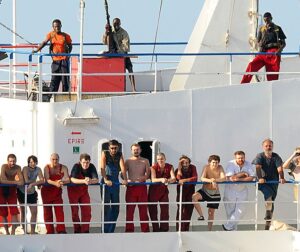
The crew of the merchant vessel MV Faina stand on the deck after a U.S. Navy request to check on their health and welfare, 9 November 2008. Some of their Somali pirate captors stand above them. US Navy photo.
Like land warfare, naval warfare has tenets and goals. Those are, however, vastly different from those of land warfare. Central to that concept, is the definition of a “warship“. While people usually have some idea of what a “warship” is, that definition is usually shaped by modern entertainment media. A warship, at its core, has two defining characteristics: it is simultaneously, any water vessel that is armed – whether that ship is a bass boat or a nuclear-powered aircraft carrier – and conveys the perception of being under the control of a crew that adheres to both military discipline and a “legal” higher authority. This last, is what separates “pirate ships” from “naval vessels”.
Broadly speaking, there are three basic kinds of naval forces. Sometimes, there may be aircraft of various type associated to each force; there may be marines/’naval infantry’ (ground troops attached to the naval force) and there may be some form of “special operations forces” as well. The three basic types of forces we will briefly examine here are categorized as “blue water“, “green water“, and “brown water“.
First, however, we need to address the two basic schools of thought, regarding naval warfare.
Mahan’s central theory argued that control of the sea was vital to a nation’s greatness, and that a navy’s main focus should be on controlling the seas by destroying an enemy nation’s main fleet at the earliest stage of war possible, instead of worrying about a more nuanced approach.
German Imperial High Seas Fleet at sea as at the Battle of Jutland on 31st May 1916.
The naval aspect of World War 1 was inconclusive as to whether Mahan’s theory was correct or not, as there were few fleet actions, and those few were inconclusive draws. However, Mahan formed the basis of both Imperial Japan’s, and the United States’ naval doctrine in World War 2. For the Japanese, Mahan formed the core of their doctrine against Imperial Russia in the Russo-Japanese War, resulting in the decisive fleet action at the Battle of Tsushima in 1905.
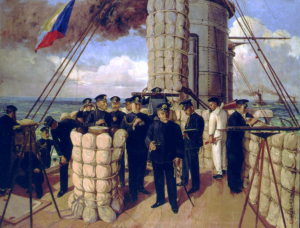
Admiral Tōgō Heihachirō on the bridge of the Battleship Mikasa during the Battle of Tsushima, 27–28 May 1905.
Murderer’s Row: U.S. Third Fleet aircraft carriers at anchor in Ulithi Atoll, 8 December 1944. US Navy photo.
However, Mahan’s theories were not foolproof. In fact, they masked serious problems.
Sir Julian Corbett came to naval strategy as a civilian, in mid-life. Already a well-regarded historian, Corbett made friends in the Royal Navy with his more limited and nuanced approach to naval strategy, which offered a more realistic application of naval power projection that suited Britain’s needs as an Imperial power, even in its waning days. While agreeing with Mahan about the importance of sea power to a nation, Corbett took a completely opposite view of how to maintain this, arguing that control of the sea did not necessarily have to depend on smashing the main enemy fleet. He went further, arguing that “control of the seas” could be maintained if the fleet could ensure the security of the nation’s maritime commerce while inhibiting, if not outright halting, that of the enemy. German Grand Admiral and Secretary of State of the German Imperial Naval OfficeAlfred von Tirpitz, dismissed any sort of “commerce raiding” naval strategy (Corbett’s main view, in its most basic form) during World War 1, opting to do his best to use Mahan’s theories against Britain.
By 1945, it was clear that Corbett was the more correct of the two theorists.
Very briefly, a nation’s “fleet” is the total number of warships it has in current service, along with such vessels it might have “in reserve“, which can be quickly brought into service. For some time, during the late-19th Century, there was an idea that a nation’s “fleet” consisted of all of its major ships, operating en masse, in accordance with Mahanian principles.
The United Kingdom largely attempted to adopt this strategy, keeping the bulk of its main battle fleet massed in British home waters, while dispersing a mush smaller portion of its fleet to stations around the world. The United States, however, faced the harsh reality that due to its geography, it would be forced to split its fleet in any major conflict involving a war in both the Atlantic and Pacific oceans. This was proven true in 1941, as the USN was forced to fight in both oceans, simultaneously.
Physical map of the World, from CIA The World Factbook in 2021.
What everyone generally thinks of when hearing the word “navy”, blue water forces focus on three basic missions: projecting national power well beyond the shores of the home nation, defeating enemy fleets, and “maintaining the SLOC.”
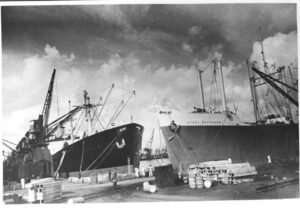
Two US cargo ships docked at Bombay Harbor, 1948
The ‘SLOC‘, or ‘Sea Lines Of Communication‘, are the maritime conduits through which food,
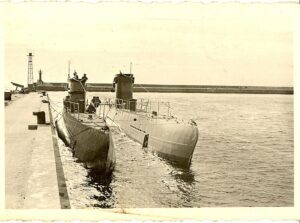
World War II U-boats of Nazi Germany’s Kriegsmarine following their surrender at Lisahally, near Londonderry, Northern Ireland, UK in May 1945. Public Domain
fuel, raw materials and finished goods flow. Very few countries are truly self-sufficient, and a nation under attack has a desperate and immediate need to keep the sea open to merchant vessels funneling supplies to them. It was for this reason that winning the Battle of the Atlantic was so vital to the Allied war effort, because losing it would have forced Britain to surrender; world history would have been fundamentally different had that occurred.
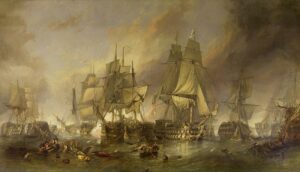
The Battle of Trafalgar (21 October 1805), by Clarkson Frederick Stanfield, 1936
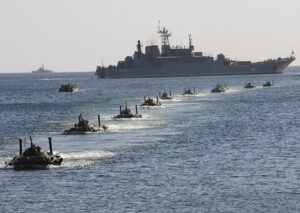
Russian Black sea Fleet conducting an amphibious landing exercise, near Crimea, Ukraine, 2012
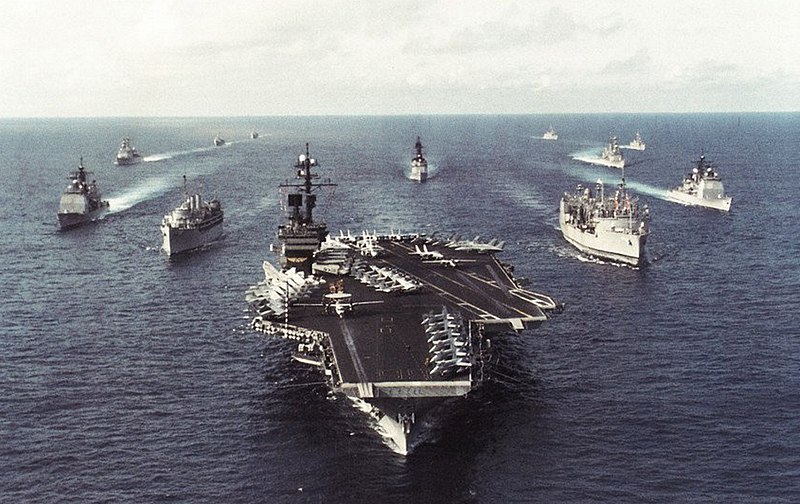
While there have been very few naval battles, as such, in the modern era (and haven’t been since the end of the Napoleonic Period), projecting power is still necessary, as was recently demonstrated by the international anti-piracy patrol off the Horn of Africa, and most famously, by the frequent deployments of the US Navy throughout the world — parking a carrier battle group – containing more fighting power on its own, than the total combat power of most national armed forces…before adding the potential of several thousand US Marines to the mix – off the coast of a restive country is a serious statement, sufficient to give all but the most delusional leader and their supporters serious pause.
While the USN is the only navy currently capable of doing this on any large scale, other countries such as Britain, France and India can deploy smaller but still very powerful forces to trouble spots, actual and potential. The Chinese “People’s Liberation Army Navy“, while large, is not well-practiced in “expeditionary operations“, as yet, and – despite certain breathless reporting – has yet to demonstrate more than a rudimentary capability.
Amphibious assault vehicles from the forward-deployed amphibious dock landing ship USS Tortuga (LSD 46) land on the beach during Exercise Cobra Gold 2012.
However, while some seventy percent of the Earth’s surface is covered by water, the remaining thirty percent is land. This may seem like a throwaway statement, but according to the United Nations, an estimated 60% of the Earth’s population live within 100km (62 miles) of an ocean coastline…it is for this very reason, that the United States maintains the largest “naval infantry” force in the world. While marine units are certainly capable (or should be) of seizing a section of hostile shore or a port area, their primary function is to hold that space just long enough for reinforcments to be landed, or some other limited mission completed. This is because – in a similar manner to airborne forces – most naval landing forces (short of a massive assault landing, such as D-Day or Okinawa) are very light in combat power, relying far more on confusion, fear and intimidation…which only works for a short time.
Green Water operations – taking their name from the shift in color from the deep blue of the open ocean to the “sea green” of coastal regions – primarily involve either getting troops ashore (“over the beach“), or finding and suppressing coastal anti-ship defenses, whether troops are going to be landed or not. It is here, that most naval mines are laid, to restrict access to vital coastal regions. This is also where most “coast guards” operate, whether under wartime missions, or during peacetime, conducting customs and safety inspections, police functions, and the occasional search and rescue operation.
In general, green water fleets are small in total hull numbers, as well as overall tonnage, but their functions are, comparatively, much more complex than those of blue water fleets. However, because the ships are orders of magnitude less expensive – at least, for the strictly defensive functions – this is what most navies in the world are composed of.
Humankind’s first water forces were riverine – they operated on those rivers deep enough to take hulls carrying significant numbers of occupants. In a word, those ships were able to carry enough people to both operate the boat, and fight from it.
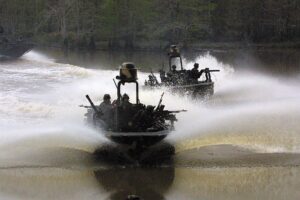
Special Warfare Combatant Crewmen (SWCC) demonstrate the new Special Operations Craft-Riverine (SOC-R) while training at the Stennis Space Center. U.S. Navy photo
Riverine warfare involves the control of waterways away from the ocean shore. Any waterway – natural or man-made – that can be used as a highway to transport people and goods, is a vital conduit for a nation. Good examples are major rivers, such as the Mississippi, the Rhine, the Amazon, the Nile and the Mekong; the list can continue, running into several pages.
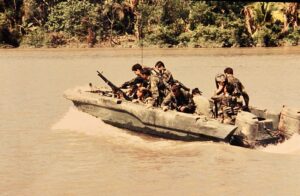
Members of U.S. Navy Seal Team One move down the Bassac River in a Seal Team Assault Boat (STAB) during operations along the river south of Saigon, November 1967.
Ships operating in rivers and delta’s are almost always significantly different in design from their sea-going cousins, but are no less deadly. It is here, where many countries first “dip their toes“, so to speak, in nautical operations. Speeds in rivers and estuaries are generally slower, as is the draft the ships must deal with.
A U.S. riverboat (Zippo monitor) deploying napalm during the Vietnam War
The vessels used in riverine operations can range from shallow-draft, high-speed boats – including small high-speed craft, with a machine gun mount bolted on – to large-scale, heavily-armed, river monitors. These ships are capable of both direct fire as well as indirect fire support missions, forcing enemies ashore to consider their distance to waterways, as well as roads.
Naval Special Forces
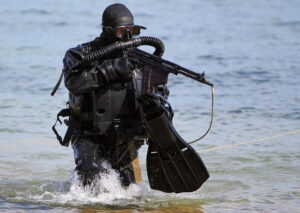
Russian commando frogman of the Caspian Flotilla during exercises
Above, we briefly touched on marines/naval infantry. Here, even more briefly, we will touch on naval special operations forces.
The idea of non-marine special operations forces, while not new, has never before reached a level comparable to that of today. This is largely driven by technology, but parochialism also plays a role.
US Navy Seals securing the beach. (Promotional image)
SEAL team member moves through deep mud in South Vietnam, May 1970. US Navy photo.
Like all special operations forces, however, these forces are difficult to employ to their full potential. Their training – of necessity, long and arduous…and expensive – means that they are extremely susceptible to poorly-thought out missions. The numbers of politicians capable of understanding how and when special forces in generally – and naval special forces in particular – should be deployed, is thin indeed.
Conclusion
Naval forces are generally the most expensive sector of a nation’s armed forces. Purpose-built warships represent a very significant investment for any nation, even (perhaps especially) the United States. It is also easy to forget, amid a slew of video games where real people do not die, that even the smallest modern destroyer carries a crew of well over one hundred people…and potentially a crew of thousands.
Anyone talking about naval policy needs to keep that foremost in their minds.
The goal of this column is to present news from around the world that is not often – if ever – covered by more mainstream entities, using local sources wherever possible, but occasionally using news aggregators not used, again, by the mainstream media. Also, please note that we do use links to Wikipedia; while Wikipedia is well-known as a largely-useless site for any kind of serious research, it does serve as a launch-pad for further inquiry, in addition to being generally free of malicious ads. As with anything from Wikipedia, always verify their sources before making any conclusions based on their pages.
This column will cover the preceding week of news.
To make it easier for readers to follow story source links: anytime you see a bracketed number marked in green – [1] – those are the source links relating to that story.
This assassination, however, overshadowed by a staggering wave of hoax bomb threats made to college campuses around the nation, in what The Freedomist is now terming a “Strategy of Tension,” given it’s stark resemblance to similar events in the past. The only question, at this juncture, is who, exactly is behind this strategy, which began at least as far back as early 2016. In one instance, however,, one person was located and arrested after calling in a hoax threat. [1]-[25]
In a possibly related incident, police in Altus, OK recovered an IED that was discovered by a citizen taking trash to a dumpster. [26] In New York state, meanwhile, two persons were observed setting a live incendiary device against the crescent monument outside a mosque in Ronkonkoma, which caused minor damage to the monument. [27]
In war-torn Burkina Faso, suspected Islamist militants have killed at least 22 civilians and wounded numerous others in an attack on a farming commune in Kossi province on the night of July 3-4, according to the provincial governor. [1][2]
In neighboring Niger, a group of Boko Haram terrorists launched the second attack in three days on a Niger Army outpost near the country’s border with Chad. Niger Army forces beat back the attack, killing at least 17 terrorists, while suffering a reported 14 dead and 6 more wounded. [3]
Turning to Nigeria, the nation’s President – Muhammadu Buhari – survived an attack on his motorcade while en route to his home region of Katsina due to the swift reactions of his bodyguards. Officials are describing the attackers as “bandits“, rather than one of the various Islamist terror groups plaguing the country. Banditry in Nigeria has taken a dramatic upswing in recent years, as the nation’s security forces focus on combating the Islamic terror groups striking throughout the country. [1]
Elsewhere in the country, attacks on police and civilians continue, including the kidnapping of another Chinese ex-patriot worker and an officer of the Nigerian Navy visiting his home, as well as arson attacks around the country. Additionally, sometime-allies Boko Haram and ISWAP stormed a prison on the outskirts of the nation’s capital, Abuja, freeing over 400 hardened prisoners, along with many Islamist terrorists captured by the military and security forces. After some 27 were re-arrested, Boko Haram and ISWAP issued death threats against the families of the officers who had led the operations to capture the terrorists, as well as the officers responsible for recapturing the escapees. [2]-[10]
On the other hand, in a curious turn, the Somali terror group Al-Shabaab has reportedly denied that it funds Islamist terror groups in Mozambique and Nigeria. The Freedomist is investigating these claims at press time. [2][3]
Scattered violence in Afghanistan continues, with Taliban forces clashing internally, while also launching a campaign to forcibly displace families in the Panjshir Valley, the center of NRF resistance to their control of the country. [1]-[7]
Finally, turning to Myanmar, guerrilla’s resisting the nation’s military junta staged three simultaneous attacks in Mandalay City, the country’s second-largest urban center. The attacks may mark a dangerous shift in the philosophy of the resistance groups towards a more terror-focused approach, risking their credibility and legitimacy if the descend to the junta’s level, by attacking civilian targets.
Back FREEDOM for only $4.95/month and help the Freedomist to fight the ongoing war on liberty and defeat the establishment's SHILL press!!
Are you enjoying our content? Help support our mission to reach every American with a message of freedom through virtue, liberty, and independence! Support our team of dedicated freedom builders for as little as $4.95/month! Back the Freedomist now! Click here