April 18, 2026

Military

MILTECH: Rethinking The Fortress


We’ve all seen them — whether picturesque castles, grim fortresses, chaotic and open firebases, or grimy underground tunnel warrens — most people know a “fort” when they see it. Most people, however, also assume that such things are passe, obsolete ideas long overcome by technology.

But – are fortresses obsolete?

From mankind’s earliest days of social interaction, we have been building defensive structures. At first, defense against the weather – mainly, the rain and the cold – was the major concern, mostly because caves could be hard to come by. Over time, however, it became readily apparent that sturdier defenses were needed, to protect us from large predators. Eventually, though, someone realized that improving those structures made it difficult for the raiding party from the next valley to steal all the women and goats. Thus, the first real walls were built…causing, consequently, the first arms race.

As time went on, attackers began figuring out how to get over, under, around or through walls. In response, walls got taller and thicker, and foundations sank deeper into the ground. Covered parapets began to appear. Then, someone built a tower, and someone else extended walls away from it…


This spiral continued for unknown millennia, until – in Western Europe, at least – the early 14th Century. Then, black powder appeared in concert with cannon, and with increasing speed, castles that had withstood multiple sieges began falling, as their inflexible stone battlements were blown apart by stone – followed by iron – shot.


Martello Tower, Shenick Island, County Dublin, Ireland (Source: Pixabay)


It took until the middle of the 17th Century before one man brought fortifications back from obscurity: Vauban.

Sebastien le Prestre de Vauban (1633-1707), Maréchal de France; Artist: Charles-Philippe Larivière (1798–1876)


Starting with the basis of the “trace italienne” designs, Vauban revolutionized the entire science of military engineering, developing a system of both attack and defense from modern fortifications – now, fortresses became more or less impervious to all but the most massive bombardment, and became offensive weapons in their own right. Vauban’s designs were applied around the world for the next two hundred and fifty years. And then, of course, technology caught up.

The advent of high explosive artillery in the late 19th Century spelled the end – for a time – of Vauban-style fortresses, as the high explosives could obliterate the intricately laid out constructions at will.

But then, an odd thing happened.

Following World War 1, France was left with the stark reality that nearly an entire generation of its young men had been wiped out in the trenches. Needing what we would now call a “force multiplier“, France turned to its military engineers, and built the “Maginot Line“, named for the war veteran and War minister of the time, Andre Maginot.


Ligne Maginot – Schoenenbourg. CCA/2.0


This enormous complex was a series of self-contained concrete fortresses, all of which were built around multiple pieces of heavy artillery. For most of its length. the forts in the defensive belt that ran from the Swiss border to Luxembourg could cover their neighbors with overlapping artillery fires, making any attempt at assault costly to even contemplate. Only the sections beginning at the Ardennes Forest – rough, heavily-forested terrain – were more thinly spread out.

French leaders were convinced that the Maginot Line would force Germany into a repeat of their World War 1 strategy of striking though Belgium, while slowing the attack further south, but that this time France would be ready, and could slow the German war machine down long enough to give France time to assemble allies to once again batter Germany into defeat.

But, when war finally came, French and British troops sat and stared at Germany, until the Nazis smashed through the Low Countries, and forced France to surrender in six weeks.

The hideously expensive Maginot Line, it seemed, had failed completely. Coupled with the other spectacular surrenders of heavily and expensively fortified places in World War 2, it seemed that fortresses were finally dead.


Lieutenant-General Percival and his party carry the Union flag on their way to surrender Singapore to the Japanese, February, 1942. Public Domain.


But…were they? Did the Maginot Line fail?

In a word – no.

In fact, the Maginot Line worked flawlessly: it forced the Germans to essentially repeat their much maligned Schlieffen Plan of World War 1, with the crucial additions of at least partially armored and motorized formations supported by dedicated ground attack aircraft. These additions, coupled to a hopelessly inadequate and lackluster command structure among the Allies, are what led to France’s collapse.

In fact, only one of the fortresses of the actual Maginot Line ever fell to the Nazis. The most famous fortress built on the Maginot model to fall – that of Eben-Emael, in Belgium – was neither part of a cohesive defensive network, nor was fully manned or supplied, and was not designed to defend against a glider assault, something built into the layout of the Maginot network.

However, the public – and unfortunately, most of the military – perceptions were that the concept of a fortress, as such, was dead, especially with the advent of atomic and nuclear weapons.


A B-61 thermonuclear weapon, showing its major components; Source: US government DOD and/or DOE. Public Domain.


And yet…countries still built versions of fortresses, a practice which continues into the present day.

From the underground command bunkers and ballistic missile silo’s of the militaries of the United States and the USSR in the Cold War, to the firebases and underground guerilla bases of Vietnam, to today’s “forward operating bases“, fortresses still quietly soldier on.


C-RAM 3 air defense system; Source: US government; Public Domain


One of the chief arguments against a modern fortress is its supposed vulnerability to “smart munitions“, primarily bombs and missiles. However, this dangerous assumption presumes two things to exist: complete command of the air, and a lack of effective anti-missile systems on the part of the defenders in the fortress. The North Vietnamese Armed Forces, like the modern Islamic State, would have happily bombed and shelled US and South Vietnamese fire bases and FOB’s out of existence from afar; however, lacking any effective way to contest the airspace over those bases, those forces were forced to rely on infiltration, suicide bomber tactics and human wave assaults. Similarly, although Saddam Hussein’s Iraq was capable of buying effective anti-missile systems, he declined to do so, because that would have required a level of technical ability and professional competence to operate that he was loathe to allow in his fragmented military forces.

Another argument against a modern fortress is its susceptibility to attack by conventional ground forces, such as artillery and tanks, as well as infiltration attacks by various types of special forces. This argument ignores the fact that while a modern fortress can indeed be severely damaged by modern high explosives, the amounts of artillery ammunition needed are staggering; in fact, it is questionable if modern armies possess the firepower necessary to reduce a position like Verdun – even with no modern updates – and the fact that infiltration has been tried against fortresses throughout history.

As a result of these factors, no one has attempted to design an actual “fighting fortress“, as such, for almost a century. This begs the question: What would such a fortress look like?

In order to be functional, the fortress would have to be sited to guard a specific location, like its predecessors. It would need an array of offensive weapons, of both tactical- and theater-level, and both active and passive defensive systems, as well as a mobile garrison which could launch conventional attacks against enemies attempting to lay siege to it.

In the offense, the fortress would need batteries of tactical- and theater-level conventional missiles, likely stored ready-to-fire in vertical-launch units; these types of missiles have been in use for decades. Our hypothetical modern fortress would also have an array of emplaced conventional artillery. These weapons, most with ranges in excess of 15km or more, have been in common use worldwide for over a century. The modern fortress could also have some form of armored cavalry unit secured in underground revetments, ready to launch rapid counterattacks if necessary.


A Tomahawk Cruise Missile launch form the USS Farragut (DDG-99), August, 2009. U.S. Navy photo by Mass Communication Specialist 1st Class Leah Stiles. Public Domain.


Defensively, our modern fortress would have passive defenses in the form of Vauban-style approaches, as well as barbed wire and defensive landmine barriers, designed to channel and slow conventional infantry attackers, and making armored attacks on the fortress problematic. Active defenses would include various radars, as well as defensive missiles like the Rolling Airframe Missile and rotary cannon anti-missile turrets, but could also employ more advanced systems, such as “Iron Dome” or a THEL-type system.


Tactical High Energy Laser/Advanced Concept Technology Demonstrator, 2005. US Army Photo. Public Domain.


The penultimate argument actual fighting fortresses in the modern age, at the end of the day, is one of expense: in an era where countries are paying well in excess of US$100million for a single fighter plane, constructing a fighting fortress could be staggeringly expensive.

But not completely out of reach.

Time – and finances – will tell, if the fighting fortress will make a return to the front of the stage.


An aerial photograph of the town of Neuf-Brisach, 2018. CCA/4.0


The Freedomist — Keeping Watch, So You Don’t Have To
How The Sultan Got His Groove Back

In 2016, among many other incidents, there was an “attempted coup d’état” in Turkey, in an attempt to unseat Recep Tayiip Erdogan. The quotation marks are there for the simple reason that the Turkish coup was a scam, played for a Turkish audience, only.


Why would a leader – popular or otherwise – take such a dangerous course, as to stage a fake coup d’état against themselves? It doesn’t seem to make sense, even in spite of prepared arrest lists.


In the bizarre world of ‘realpolitik’, however, it makes perfect sense.


Erdogan has survived conspiracy plots before, but he and his nation’s military had come to some level of truce. However, as has become increasingly clear, Erdogan has big dreams, and is willing to take big risks to do it, including actively aiding one of the most savage and brutal terrorist groups seen in the last century.

Recep Tayyip Erdogan, President of Turkey, 2018. Photo Credit: Mikhail Palinchak. CCA/4.0


But, why? What prize could be so valuable, as to risk wars on multiple fronts, with some of the largest, most powerful nations in the world? In simple terms, Recep Tayyip Erdogan is trying to become the first Sultan of a restored Ottoman Empire.


The case for this is fairly straightforward.


Erdogan began injecting Turkey into Levantine politics as far back as 2010, with Turkey’s tacit support of the Palestinian relief flotillas. No one with any experience in the region expected those flotillas to accomplish much, but its tacit support reintroduced the world to Turkey as a significant political player.


This was followed by the appearance of the so-called ‘caliphate’, also known as the ‘Islamic State’. Although ISIL had its genesis from many authors, as the video above clearly demonstrates, its major bases and overland supply corridors originated in southern Turkey.


But again, why? How does active support for ISIL lead to Turkey reforming the Ottoman Empire? The secret is revealed in an ISIL video, since removed by YouTube. The video’s emphasis in its monologue is almost exclusively about destroying the Sykes-Picot Agreement. The Sykes-Picot Agreement, drawn up during World War 1, created the modern map of the Middle East as we know it today. The modern nations of Turkey, Lebanon, Syria, Iraq, Kuwait, Jordan, IsraelPalestine, and Saudi Arabia were all the children of that agreement.

 

“Destroying” Sykes-Picot would result in absolute anarchy — an anarchy into which a “strong leader on a horse” could step, bringing unity, stability and ultimately, peace. Abu Bakr al-Baghdadi, no matter how legitimate a candidate for Caliph he may have been, would never have been able to bring that peace and stability; the idea that he could bring any kind of unity to the region was simply laughable on its face.


However, a restored Ottoman state, headed by a Turkey with a comparatively untainted reputation, would fit the bill, as it could make the claim that Sykes-Picot was imposed on the region illegally.


But, as possession is always 9/10th of the law, how was this supposed to play out in the military arena? Refer to the map video above, one more time: the main targets of this Turkish ‘grand plan’ were Syria and Iraq. None of the nations in the region would be willing to jump into Turkey’s bed ‘just because’, so some ‘motivation’ needed to be applied to those countries’ peoples.


The so-called ‘Arab Spring‘ provided the opening. Bashar al Assad’s regime was considered to be very stable before the unrest began — but there were still too many US troops in Iraq for the push to start there.


As Syria collapsed into civil war, Iraq consequently fell into even more instability. Two years later, as ISIL exploded out of obscurity, both nations were so badly weakened, they could do little against the terrorist tsunami.


As the IS gained ground, rolling over all the opposition before them, they began to edge southeastward, as if attempting to surround Baghdad, but they never seemed able to close the pincers. Doing so was the logical military move, as it would have cut Baghdad’s only route of ground supply, and would have forced a major battle with Iraq’s Shiite-dominated government — a battle the weak Iraqi government was in no way guaranteed of winning, given the state of its military forces at that time.


ISIS (Grey) Territory Change 2014-2016 Legend: grey: ISIS light/dark yellow: Syrian/ Iraqi Kurdish forces dark red: Iraqi government forces light red: Syrian government forces. Green: Syrian rebel forces. 2016. CCA/4.0


The impending collapse of Shiite-dominated Iraq would, so the thinking went, have drawn in Shiite Iran, which should have sent the main-force heavy units of the Artesh (the Iranian Army) in a US Army-style assault all the way to Baghdad, riding like the cavalry to the rescue in a John Wayne movie, with Arabic subtitles…which would, naturally, have allowed IS to scream for help to rest of the Sunni world against the heretic Shiite aggressor…


That is, of course, not what happened.


Iran Army in 2018; Date: 28 May 2019. Photo Credit: Amir Hossein Nazari. CCA/4.0


The Iranians – the Persians of Biblical and Greek history – have been in the war business for several millennia, and saw that trap for what it was. Their response was — to do nothing. When things got very tight for Shiite Baghdad, the Iranians sent in their “Quds Force” (the Iranian version of special forces), because the Quds Force is seen as an advisory group, not a garrison force.


This left ISIL withering on the vine, as no one could openly support such a savage and bestial regime as al Baghdadi’s. Worse, for ISIL, at least, was first Iran’s and then Russia’s not-very-covert aid to the Assad government. Hardening resistance by Kurdish groups like the Peshmerga and the YPG began to slice away ISIL gains, resulting in increasing repression by Erdogan’s regime. Then, everything almost came completely off the rails when the Russians intervened, an event that nearly caused NATO to choose between Turkey – an event that could have caused World War 3 – and dissolution, if it failed to back a member nation under attack.


This failure of ISIL to fulfill its role as sacrificial lamb to the Iranian lion also exposed the dark underbelly of the world of realpolitik, revealing Turkey’s clear role of support, and implying support (tacit or direct) from other countries. In this atmosphere, it would appear that at least some of Erdogan’s military commanders began to whisper about the possibility of a coup. From the stunted development of the coup, it is clear that the coup plotters in the field had little to no direction. In the end, the instant Erdogan put in an appearance, the foot soldiers began giving up.


As a result, Erdogan has now cemented his position within Turkey, as the “hero” who stood up to the military, and prevented the return of military rule…and, of course, disrupted the desultory Allied air campaign against ISIL.


But what about the possible “other” actors? Those foreign powers that may have been – or may be – supporting ISIL directly? Why would they back something like this? Simply: the myriad of Middle Eastern nations are too fractious and chaotic. Replacing them with one state is easier to manage…and take advantage of.


It really is that simple.

Welcome to the World Situation Report For April 10, 2022

The goal of this column is to present news from around the world that is not often – if ever – covered by more mainstream entities, using local sources wherever possible, but occasionally using news aggregators not used, again, by the mainstream media. Also, please note that we do use links to Wikipedia; while Wikipedia is well-known as a largely-useless site for any kind of serious research, it does serve as a launch-pad for further inquiry, in addition to being generally free of malicious ads. As with anything from Wikipedia, always verify their sources before making any conclusions based on their pages.

This column will cover the preceding week of news.


North America

This week, the wave of bomb threats against schools continues, with schools across the country alternatively being evacuated or ordered to ‘shelter in place‘ across the country. Most of the bomb threats against schools this week were delivered by phone, but only one was definitively an automated voice call threat. Interestingly, the targets included a school in the city of Grande Prairie, Alberta in Canada, and a Muslim private school in Worcester, Massachusetts. In the Canadian case, school officials specified to the Royal Canadian Mounted Police (RCMP) that the caller was from the United States.

In Texas, meanwhile, a suspected pipe bomb was disabled at the Ector County courthouse in the county seat of Odessa. As this involved an actual device at a government facility, it falls under the purview of the FBI and the BATFE.

In Mexico, gang violence related to the country’s ongoing drug war continues to erupt in popular tourist destinations, with a beach-side assassination in the west coast city of Acapulco that resulted in a police chase and shootout among sunbathers, and an abrupt uptick of killings in the Yucatan Peninsular state of Quintana Roo.


[Source 1] – [Source 2] – [Source 3] – [Source 4] – [Source 5] – [Source 6]

[Source 7] – [Source 8] – [Source 9] – [Source 10] – [Source 11] – [Source 12]


South America

Three soldiers of the Colombian Army were killed by a roadside IED on the 8th, in the rugged and mountainous Antioquia Department, according to the Army’s 7th Division. Army officials believe the IED was planted by members of the so-called “Structure 18” group, yet another of the kaleidoscope of dissident and breakaway factions that splintered away from the disbandment of the FARC, which had disbanded in 2016 following peace talks with the Colombian government.

In neighboring Venezuela, army troops in rural Apure State reportedly disarmed an IED reportedly laid by the mysterious (and possibly fake)  TANCOL group. The Venezuelan government claims that the mystery group was created by the Colombian government to undermine Venezuela and facilitate drug trafficking, while Colombian sources counter that the group is yet another FARC offshoot. Whichever the case, Venezuelan farmers in Apure and next door in Colombia’s Arauca Department are caught in the middle…as usual.

In the Peruvian capital of Lima, protests against the curfew ordered by left-wing President Pedro Castillo turned violent on the 4th. Castillo had ordered the curfew in an attempt to break a strike and demonstrations by Peruvian truck drivers against skyrocketing fuel costs. The strike, which began on March 28th, has begun to seriously impact the Peruvian economy. Various factions within the Peruvian government – including some of Castillo’s allies, slammed the curfew as unconstitutional and “unenforceable.” Protesters reportedly stormed the Supreme Court building, even attempting to set it ablaze, but instead satisfied themselves by looting computers and furniture and burning records. The Freedomist will keep an eye on this situation.


[Source 1] – [Source 2] – [Source 3] – [Source 4]


Africa

The Polisario Front has suspended contacts with the government of Spain, after Spanish Prime Minister Pedro Sanchez recognized Moroccan control over the former Spanish colony of Western Sahara. This move marks a sharp reversal of long-standing Spanish policy towards the region, which backed a United Nations call for the self-determination of the Sahrawi people, which Morocco has ignored in its efforts to exploit the mineral-rich region. This move comes after Morocco loosened its border controls on Spain’s only remaining African continental possessions of Ceuta, opening the way for the unauthorized crossing of thousands of young Moroccans and migrants from other African countries into Spanish territory, after Spain allowed a Sahrawi leader into the country for treatment for Covid-19. This is a matter of serious concern, as it could breathe new life into the Polisario Front, which could lead to a further destabilization of the region, and a possible expansion of operations by groups such as Al Qaeda in the Maghreb and potentially even the Islamic State in Libya, or their associates, the Islamic State in the Greater Sahara.

To the south, the Malian Army went on the offensive in the central part of the country, reportedly killing some 22 suspected terrorists. However, the United Nations and some human rights organizations have claimed that the offensive may have seen excessive uses of force, and that civilians may have been killed instead.

In neighboring Burkina Faso, an army outpost in Namissiguima was overrun in a “complex attack“, which left twelve troops dead and another 21 wounded. Although the group conducting the attack was not specifically identified, it was likely the Islamic State in the Greater Sahara, who remain the greatest threat in the region.

In a potentially-related event, unidentified gunmen abducted an 83-year old American nun, Sister Suellen Tennyson of the Catholic congregation Marianites of Holy Cross, from the congregation’s house in the parish of Yalgo, part of the diocese of Kaya.

In Nigeria, some 17 troops were reported dead, and another 40 were wounded, after “gunmen” believed to be part of the Ansaru group (a splinter faction of Boko Haram) overran an outpost in the state of Kaduna in a swift and violent attack, mounted on motorcycles, came in armed with AK-47s and RPGs. The attack reportedly destroyed as many as three armored personnel carriers (APC), although precise details remain sketchy.


[Source 1] – [Source 2] – [Source 3] – [Source 4] – [Source 5]


Middle East


Violence continues in Israel, as Palestinian protests and terror attacks by various groups continue throughout the region. Two of the attacks were claimed by the Islamic State. The recent wave of violence has killed and injured dozens, in the ongoing, and seemingly never-ending violence.


[Source 1] – [Source 2] – [Source 3] – [Source 4]


Scattered, low-level fighting continued throughout eastern Syria this week, with Syrian government soldiers being killed in the southern Daraa  region, as Israel reportedly targeted several Assad government military sites in the central part of the country with missile strikes. Elsewhere, Turkish units launched drone and artillery strikes against suspected targets across the northern part of the country. This, as several US troops were injured in an “indirect fire” attack on their base in the oil-rich Deir al-Zor region, reportedly by Iranian-backed militias.


[Source 1] – [Source 2] – [Source 3] – [Source 4] – [Source 5] – [Source 6] – [Source 7] – [Source 8] – [Source 9]


More US forces came under attack in Iraq’s Al-Diwaniyah, capital of Iraq’s Al-Qādisiyyah Governorate, and in Dhi Qar, when their logistics convoys were attacked by roadside bombs. These attacks have been happening frequently, often several times a week, as local groups demand that the Iraqi government enforce a resolution it passed in January of 2020, to expel all foreign forces from the country. Given Iraq’s track record on the subject of expelling foreign forces like the Islamic State in the last eight years, the question of “how” is begged.

Elsewhere in Iraq, scattered military and police actions resulted in arrests of suspects, and several Iraqi security forces killed and wounded.


[Source 1] – [Source 2] – [Source 3] – [Source 4] – [Source 5]


In Pakistan, the US State Department issued a travel advisory on April 4th, urging US citizens to reconsider travel to the country, due to rising levels of terrorism and sectarian violence. This comes after the March 4th attack on a Peshawar mosque that killed 62 and wounded 196.

Elsewhere in the country, two soldiers and two terrorists were killed in the Sinji area of southwest Balochistan’s Awaran District. This is almost certainly an outgrowth of the long-simmering insurgency in the region.

Meanwhile, a total of five more terror suspects were killed in northwest Khyber Pakhtunkhwa province, reportedly from the Tehrik-e-Taliban Pakistan group.


[Source 1] – [Source 2] – [Source 3]


South Asia


India was surprisingly – and thankfully – quiet in general, this week. The only items of real interest were a series of bomb threats against several schools in Bengaluru/Bangalore, made via email, on the 8th. Interestingly, police officials stated that they believed that the emails came from the United States. As we noted above, in our North American section, a school in Canada also received a bomb threat believed to have originated in the US.

Also, two Indian Army soldiers were reported wounded by a bomb blast in the Khunti District, in central Jharkhand State, on the 6th. The device was reportedly of “low power”, and only caused light injuries.

Finally, the US State Department issued another travel advisory, this time for the nation of Sri Lanka, citing elevated COVID-19 risks, fuel and medicine shortages and terrorism.

To quote the advisory in part:

“…There have recently been protests over the economic situation and queues at gas stations, grocery stores and some pharmacies. Protests have occurred throughout the country and have mostly been peaceful. In some instances, police have used water cannons and tear gas to disperse protesters.

“There have also been daily planned power outages across the island, as well as some unplanned power outages, as fuel for backup generators is increasingly scarce. Public transportation in some instances has been limited or curtailed. Travellers should monitor local media for updates on the ongoing situation…”

Forewarned is forearmed.


[Source 1] – [Source 2] – [Source 3]

TECHNICAL DESTRUCTION


If I were to ask the average reader, “What is the most popular combat vehicle of the last c.100years?”, most people would say something like the World War 2 US M4 Sherman tank…or, perhaps, the Soviet T-34 series, from the same conflict (both of which remain in limited service). Some might even say the Cold War-era Soviet T-55 – which also still soldiers on, around the world — but, like virtually everyone else, they would be wrong.

In fact, the most prolific and widely-deployed combat vehicle in modern history is — the humble “Technical.”


An improvised fighting vehicle armed with a ZU-23 autocannon.


The Technical – a term whose etymology is generally believed to have originated in the nation of Somalia during that country’s civil war, which began in 1991 (and which included the disaster that is now known as “Blackhawk Down“), when various NGO’s – unable to legally hire armed private security (i.e., “mercenaries“), instead used “discretionary funds for ‘technical services’” to hire “local security” who were, in fact tribal militiamen, who formed the core of the warring tribal/clan armies of the various warlords vying for control of the failed state.


A “technical” in Mogadishu at the time of the UNOSOM mission (1992 or 1993)


There is no single model of Technical. In general, a ‘Technical’, as such, is a civilian vehicle – usually a light pickup truck or some sort of 4-wheel drive vehicle, repurposed as an armed combat vehicle, although such vehicles used solely for troop and logistics transport are still considered Technicals. There are a special class of technicals, the “Gun Truck“, that are actual military vehicles, such as WW2 ‘Willys’ Jeeps or M35-series, M939, M809 and later 2.5ton trucks that have been used since WW2, but especially during the Vietnam War. Until very recently, the closest the US military came to deploying a Technical, was the occasional arming of various CUCV-type vehicles, beginning in the 1970’s (but read on to the end). While certainly improvised for combat, such vehicles were not – at those times – generally available to the public; debate on the term continues.

This was not, however, the first use of vehicles that could be classified as “Technicals.” Initially, almost military vehicles were “technically” (no pun intended) ‘Technicals’, simply because there were few “military vehicles”, as such, anywhere in the world. The first truly extensive use of such vehicles came during World War 2, with the British Army’sLong Range Desert Group (LRDG)“, one of the predecessors of the famed “Special Air Service (SAS)“. Using whatever light civilian trucks they could scrounge up in Egypt at the time, the LRDG conducted deep raids and reconnaissance against Axis forces and installations during the Desert Campaign of 1940-1943. While this model was copied by a few other units during the war, most armies quickly scrapped the idea after the war was over. The reasons are many, but the primary one is that armies are conservative – even reactionary – by nature, and dislike “ad hoc” solutions to problems, unless there is an emergency situation.


“T10” a T Patrol Long Range Desert Group 30 cwt Chevrolet, during WW2. Public Domain.


The public’s first real exposure to Technical-type vehicles, however, was the Great Toyota War of 1986-1987, part of the Chadian–Libyan conflict. The nation of Chad – perpetually poor and fractious – needed a way to counter the heavy, Soviet-supplied combat vehicles of the Libyan army of dictator Muammar Gaddafi. Using the only vehicles readily available (mostly Toyota Hilux’s and Land Cruisers) in a manner similar to light cavalry, as well as the WW2 LRDG, the Chadians almost literally “ran rings” around the Libyans, inflicting an estimated 8,500 casualties (dead, wounded and missing), and capturing or destroying an estimated 800 tanks, APCs and other vehicles, as well as around 30 aircraft, wildly out of all proportion to their perceived abilities as an army, French intervention notwithstanding.

(Of note, the Libyan general who lost the Chadian War, Khalifa Haftar), now leads the Libyan National Army (LNA), one of the primary factions in the country’s intermittent civil war.)


General Khalefa Haftar, 2011. CCA/2.0


While the scale of this defeat brought on pithy jokes and comments about the Libyan Army’s prowess, more sober-minded observers started paying attention to the concept, although little actual work was done during this period.

As the Somali Civil War increased in intensity, the widespread use of technicals was increasingly studied. As the 1990’s evolved into the early-2000’s, and with wars erupting around the world in the wake of the 9-11 attacks in the United States, regular militaries increasingly found themselves facing – and occasionally using – such vehicles, a few salient point became apparent.


Chadian soldiers on a Toyota Land Cruiser pickup truck in 2008. Photo credit: Czech Ministry of Defense. Public Domain.


Technicals, by their very nature as lightweight civilian vehicles, are simultaneously cheap,

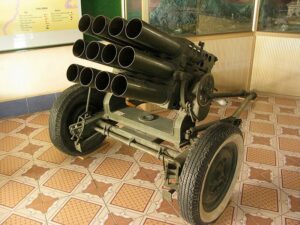
commonly available, easy to work on, have a ready supply of spare parts, and generally get far better gas mileage than comparable military vehicles. They can also mount a variety of very powerful weapons, from the BGM-71 TOW Missile and other types of ATGMs, to heavy-caliber recoilless rifles, multiple-launch rocket systems such as the seemingly-immortal Type 63, as well as heavier and longer-ranged rockets, and a variety of other improvised rocket launchers and anti-aircraft cannons. (For a much more in-depth study, please see the excellent Tank Encyclopedia article on Techincals, YouTube video linked below.)


IRGC Ground Force loading a Type 63 MRL, 2017. Photo credit, Tasnim News, CCA/4.0


For many national armies faced with tight military budgets – and guerrilla and terror groups – around the world, Technicals are increasingly the first choice when swift formations are needed for attack and/or defense. However, the above comes with a very significant caveat: Technicals, as a class of combat vehicle, typically have little or no armor — which is why casualties among Technical crews meeting determined opposition tend to be very high, compared to more heavily-protected units…a consideration that seems to be an acceptable option for the US Army, given its recent adoption of the Infantry Squad Vehicle (ISV) — all at a staggering cost of nearly $330,000 — per vehicle.


Infantry Squad Vehicle; 24 January 2020. Public Domain.


Maybe the Army should call Toyota — their Special Forces did.


Technicals Part 1 (Tank Encyclopedia)

DIY Tanks of Iraq (Source: Vocativ)


The Freedomist — Keeping Watch, So You Don’t Have To
The Democratization of Military Training…


Or, Once More With Effort, “Professionals Are Predictable, But The World Is Full Of Amateurs”


It seems that “everyone” has an ax to grind, these days. After over 4000 years of recorded history, it seems that we humans just keep getting more adept at this whole “war thing“.

And – just to be clear – no, this article is not a “how to” do anything. You’re on your own, there.

There are as many reasons to “go to war“, as there are human groups in existence; anytime two or more people decide that they agree on an issue enough that they are willing to do violence – if not agree to lay down their very lives – in that goal’s furtherance, “war” at some level becomes a distinct possibility. And by this, we’re talking about “war” in the sense most people are thinking – replete with dead people, lots of violence, destroyed cities, etc., as opposed to a more figurative example…like, say, “the war on poverty“.

However, most people simply don’t “get” war. From an external view, they do not grasp the intricate web of minutiae that goes into “war”; it’s not simply swinging a sword, or pulling the trigger of a firearm, or pushing a button to launch a missile. It is not only knowing when to do so, but also is knowing how and when to do these things, as well as understanding the systems that enable these actions.

While the individual “spear carrier” does not need to understand the intricacies of the industrial base that created his sword or rifle, his leaders most definitely do. The real challenge for any prospective leader or groups of leaders, though, has always been how to teach some kid – who may even agree with their goals, as far as they can understand them – how to swing that sword, or shoot that rifle.

Military training and military science have evolved over time. Even in the days when muscle power was the definitive factor in combat – swinging a sword is a very physically demanding job, when done for any length of time – it was an understood fact that the person who worked from a regularized system of actions (“drills“, or even “kata’s“, in modern parlance) in combat had a much better chance of winning the fight than someone who simply ran up and tried to smash their opponent in the face with a bat.

However, that kind of training has always been hard to come by – either there simply were not enough people with the knowledge to teach it, or the teaching took too long — it was said of the dreaded English and Welsh Longbowmen, that “if you wanted to train the archer, start by training the archer’s grandfather.” This is why projectile weapons were continuously evolving, much faster than swords and polearms.

The reason for this, militarily speaking, is quite simple: maneuver is a very powerful tool, and if you can hurt your opponent at long range and still stay on the move, that is definitely what you want to do…However, this brought on other problems: horses are faster than humans, but they require a large and intricate infrastructure to obtain and support, complete with specialized fields of labor, such as the farrier; specialized saddle-makers; special armor and weapons to maximize fighting from horseback, and on and on…

This translates across virtually every conceivable field – the never ending quest to “tweak” the equipment you have, and to find The Next Big Thing.

These all contribute to the training problem – “training, techniques (or ‘tactics’) and practices (or, ‘procedures’)” (TTP) – since the TTP’s for any given concept or field are in a constant state of flux.

What this translated to, as recently as the 1980’s, was getting some people together, teaching them how to march, then handing them each a rifle and a few rounds of ammunition to practice, then sending them out to do battle for the “glory” of whatever…with usually predictable results. And make no mistake – this phenomenon was in no way limited to guerrilla bands of former farmers and shopkeepers who had never held a weapon in their hands with lethal intent. There were plenty of armies around the world who did exactly this — and in some places, still do, as of this writing.


But today, things have largely changed. With the advent of the internet, the World Wide Web and digital file sharing, it is now possible to create the core of a training program – at almost every level – simply by searching out the appropriate files and videos. Nothing, obviously, can replace actually running around an assault course with a real weapon, but it is entirely possible to locate acceptable-quality videos and training manuals online to show a person exactly how to run the course – it is up to the searcher to then put into practice what the videos and manuals teach them (see the second video, below).

People love to share; that’s a feature of human interaction. Whether it’s cooking recipes, flower arrangements, tips on fixing your car or what have you, chances are, someone out there has not only written something about it, but may have a video to teach you how to do it for yourself. What’s more, their advice is likely free…whether they intended it that way, or not.

Military training is no different. Finding information in the form of .PDF manuals – everything from the basics of plumbing, to field food service, to how to build a fortified bunker, to just exactly how to go about “taking that hill” – whether created in a government printing office, or written by a private person (whether they are a professional soldier or a gifted amateur), is ridiculously easy, in most parts of the world.

Military training video courses – some of them quite extensive, as in the first video, below – are equally accessible for most people with the acumen to navigate LiveLeak, YouTube or Vimeo. For the raw, untrained amateur, the sheer wealth, depth and breadth of information available is staggering, so much so, that it can overwhelm them. For the experienced trainer, however, there is a vast Archive of tools to study, that anyone who knows what they’re looking for can access for their training program, for free, between their morning Lifer Juice and lunch.

For the aspiring totalitarian, this is a terrible, terrible thing, because it undermines the State’s monopoly on the application of force as a tool of control — if every Tom, Dick and Harriet in your country knows how a military force operates (even if only in the crudest, most basic manner), your loyalist military will be facing a staggering number of enemies, far more than they have ammunition to deal with, and possibly so many that they will begin to desert, rather than try to plant your boot for you…Much more so, when the enemy is literally at the gates, and you find yourself begging and press-ganging your citizens into your army, handing them weapons for free that you previously prevented them from owning — that’s the real takeaway from Ukraine, but I digress…..

Of course, if you are a Libertarian with the proper outlook on the world in general – and human civilization in particular – this is probably the closest to heaven that you are going to get to, since The People now have the means to stand up to those professional armies that you are so worried about. (We’ll leave talk about casualties another time…)

So — the next time a politician starts talking about limiting the availability of, or the access to, information – of whatever stripe – remember that information is the real root of all power, and if a politician doesn’t want you to have it, you should probably be seriously worried about why they don’t want you to have it.


How Can We Think About This 21st Century War?

by Betsy Dorminey

Mature Language Warning

Faced with the horror of the unfolding war in Ukraine a young linguist of my acquaintance decided to conduct a bit of “man in the street” polling, 21st-century style.  The original post featured a screen shot of a Russian language post: her notes and translation appear below.

I speak a little Russian, so I’ve been reading the Russian-language side of Reddit.  Selection bias since it’s Russians posting on Western media, but since it’s *in* Russian it should be mostly free of trolls.  Most of them are really not happy with Putin.  Again, my language skills are rough but my translation:

Title:  Jesus Christ, where we’re headed is completely insane

Text:  Fucking hell, it’s already been six days of this shit.  Six days of following this clusterfuck and I can’t believe this isn’t a simulation, that it’s not some experiment on hamsters.  I’ve already gone stark raving mad, I can’t sleep from the panic.  What’s next?  How can we live like this? Why are the war hawks yelling “this is what Ukrainians deserve, our fight is righteous!”  Why the fuck does anyone support this goddamn regime?  God fucking fuck dammit HELP

Translator’s note:  hard for me to translate the vast arsenal of curse words in the Russian language, the post was peppered with them.

The official line, of course, is different.  State-controlled media portrays it as a “special military operation,” “de-nazification,” or “protection of Russian-speaking peoples.  But as Sean Illing reports in Vox dissenting journalists have fled and we know Russians are protesting the Ukraine invasion.  The state has imposed draconian penalties on dissent.  (Fifteen years in the slammer for using the “w” word!)  This expletive-laden cri de coeur really brings it home.

Good news is hard to find.  As Kyle Smith observes in The New York Post, journalism suffers when “what neutral principles do we stand for?” is replaced by “which side are we on?” Either you live in an authoritarian country like Russia where government controls the media, or you live in an authoritarian country like the U.S. where the media controls the government.  Ironic, isn’t it, since technology empowers anyone with internet access and a keyboard to reach the world.  You have to hunt, and peck. Fortunately there are clever youngsters out there who know how to bypass parental/governmental controls through social media.

Forget war crimes, treaties, the UN, and international tribunals.  War is a crime against humanity.  Killing people and destroying their homes is bad, and wrong.  Pious accords and laws on the conduct of warfare don’t make it right, or better.  An exceptional article by Dexter Filkins in the September 8, 2021  New Yorker asks, “Did Making the Rules of War Better Make the World Worse?”  Our obsession with rules has attempted to persuade us that wars can be legally waged in accordance with them.  No fair targeting civilians, okay?

Filkiins focuses on Humane: How the United States Abandoned Peace and Reinvented War,  by Samuel Moyn, a professor of history and of jurisprudence at Yale.  Moyn evokes Clausewitz and Tolstoy, Sherman, Afghanistan, and the My Lai massacre, and identifies a turning point in 1977 when the Geneva Convention was updated to impose rules on combatants where hitherto only destructive force had prevailed.  Moyn bemoans such legal niceties for damping the public outcry that should induce politicians to end such conflicts:  “”Humane” war [i]s a consolation prize for the failure to constrain the resort to force in the first place.”  (extra quotation marks mine.)  Protest is how a population responds to war and strives to end it.  See above.

It’s far from clear that having military lawyers second-guess generals has produced less war, or a safer world.  In the end, force will out.  As Joseph Stalin reportedly asked, how many divisions has the Pope?  I’ve got to believe Putin is familiar with that line.

Filkins takes issue with some of Moyn’s conclusions, but agrees in the end that “efforts to curb the cruelty of military force may have backfired.”  Fleets of drones and “smart bombs” and oceans of intel haven’t kept us out of armed conflicts.  For all its military might the United States hasn’t really “won” a war since 1945.  And, having just concluded two “forever wars” – Iraq and Afghanistan – Filkins cautions that the U.S. may be on the brink of a new cold war.  Or a hot one.

Conventions about how to wage war within limits have reduced the incentives to stop fighting. I can only hope that the players moving these lethal chess pieces around the Kievan Rus will stop and think a minute.  Assuming, of course, that they can gain access to reliable news about it.

Because, to echo the Russian post, what the fuck? We can’t live like this.

# # #

Betsy Dorminey is an attorney in Georgia and an entrepreneur in Vermont. Her columns have appeared in the American SpectatorWestern JournalTownhall, Vermont Digger, and The Hill.


Serbs Declare for Russia

Serbia urges EU state not to block Russian gas transit — RT World News

From www.rt.com
2022-03-21 13:45:00
RT
Excerpt:


President Aleksandar Vucic said Belgrade is continuing to pay for the transit of gas to his country

Serbian President Aleksandar Vucic has urged neighboring Bulgaria not to stop the flow of Russian gas through the TurkStream pipeline. Sofia said it will not renew the contract with Moscow in light of its military campaign against Ukraine.

“It’s important to us that Bulgaria doesn’t interrupt the operation of the pipeline,” Vucic said on Sunday, adding that his country is paying for transit.

“We’re saying that we want the Russian gas from the TurkStream pipeline, so let us take it, we’re paying for it. And what you do is your business, and what you want is your business, we have no issue with it.”

Read Full Article

Ukraine Hopes Home Drone Defense Can Defeat Russia

Ukrainian drone owners are using their drones in a range of ways to resist the Russian army. There is a great risk involved if your drone is from China, as it has a special feature that allows the operator of the drone to be easily located. However, there are workarounds that all but eliminate the problem. The drones have been used for a variety of missions, including being used as drone suicide bombers.
The pattern is emerging for how retail drones come into play in any conflict, starting with earnestness in Syria and reaching new strategic expressions over the skies of Livya, where Turkey emerged as a drone superpower, along with China. Today, Turkey is arming the Ukrainian military with the now legendary Bayraktar,
The future of war is drones. The future of self-defense is drones. The future of associative defense is drones. The Ukraine War is becoming an inexact proving ground for the ability of drones to either defend or propel offenses in a modern conventional war. My supposition is that drones are leveling the playing field for the smaller, defensive, or insurgent powers, which could be a great opportunity for liberty to emerge, or great risk for any short-term return to stability.

Ukraine Drone Enthusiasts Form Flying Fury Force To Thwart Russian Forces

From amp.hothardware.com
2022-03-07 20:34:59

Excerpt:


Drone enthusiasts in Ukraine have volunteered to use their flying skills in an attempt to combat Russians forces. This is a major shift from flying their drones as a hobby, to flying them to save potentially save lives. One retail store in the capital city of Kyiv has emptied its stock, as it has given out some 300 DJI drones for the purpose of war related missions. Others throughout Ukraine are attempting to get their hands on more drones from friends and colleagues in Poland and other places throughout Europe.

“Why are we doing this? We have no other choice. This is our land, our home,” stated Denys Sushko, head of operations at Kyiv-based industrial drone technology company DroneUA. Before the war, the company sold mainly to farmers and energy companies.


Read Full Article

Navy Looks to Go Unmanned in a Big Way

The United States Navy is well in the process of developing new platforms that are unmanned, autonomous.  Now, the Navy has announced plans to develop an autonomous code standard that will enable more rapid development of autonomous platforms, but also help retrofit legacy platforms with autonomous features.

The code is to be called Unmanned Maritime Autonomous Architecture, UMAA.  It is being developed by the Navy’s Rapid Autonomy Integration Lab.

Navy Setting Stage for Influx Of Autonomous Systems

From www.nationaldefensemagazine.org
2022-03-02 00:53:35

Excerpt:

The Navy — which is pursuing an ambitious unmanned systems plan through a mixture of air, surface and underwater platforms — is working to test and mature those autonomy systems through multiple programs.

These include efforts such as new autonomy standards as well as the standing up of its Rapid Autonomy Integration Lab, said Capt. Pete Small, program manager for unmanned maritime systems at Naval Sea Systems Command.

Updating legacy platforms with new autonomy software codes can be an arduous process, he said during a briefing at the Surface Navy Association’s annual conference. To combat that, the Navy is developing an autonomy standard for code development called the unmanned maritime autonomy architecture, or UMAA.


Read Full Article

Main

Back FREEDOM for only $4.95/month and help the Freedomist to fight the ongoing war on liberty and defeat the establishment's SHILL press!!

Are you enjoying our content? Help support our mission to reach every American with a message of freedom through virtue, liberty, and independence! Support our team of dedicated freedom builders for as little as $4.95/month! Back the Freedomist now! Click here