Depiction of sixteenth century cannon placements, with gabion baskets in front of them, from “Le diverse et artificiose machine del capitano Agostino Ramelli”
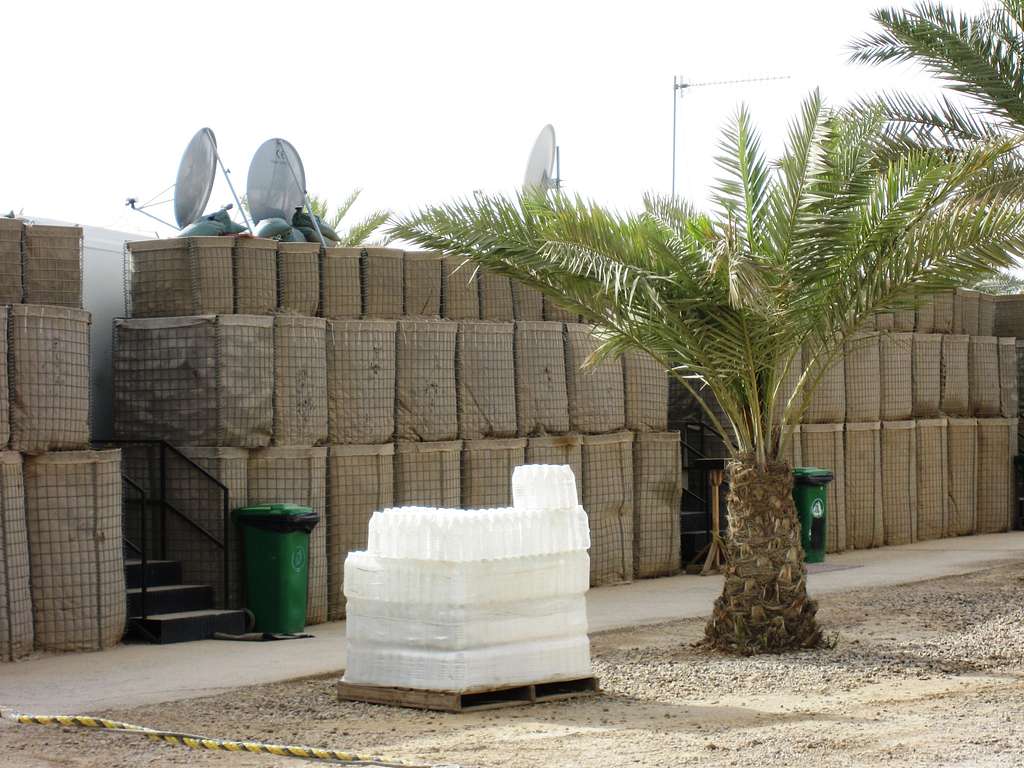
First deployed in 1991 by the British firm HESCO Bastion, Ltd, the HESCO Barrier is a modern-day gabion originally developed for flood and coastal erosion control in the late 1980’s. However, as soon as the British military’s Royal Engineers saw it, they instantly recognized its military potential.
In the hoary old days of “pre-Gulf War 1“, the fastest way to create a fortified camp in the wilderness was sandbags. These are extremely labor-intensive, and not terribly efficient (although they certainly do* offer real protection* at a cheap price). It was also a waste of manpower, as troops who should have been briefing, resting or patrolling were out shovel-filling sandbags by hand, instead. There is really very little that can be done to automate the process of filling sandbags, given their size and flimsiness. But, in the absence of a better alternative, sandbags were the only alternative.
HESCO barriers changed that landscape overnight.
The prefabricated gabion system is easily deployable either by hand, or by being laid from a truck-dragged container. The company’s containerized “RAID” system can deploy a gabion wall, approximately 1,000 feet long, in under one minute. At that point, front-end loaders begin dumping bucket-loads of dirt into the gabions, and a barrier wall that would have taken days, if not weeks, to build with sandbags and shovels, is built in a few hours, using fill scooped out from what become perimeter trenches.
A crew of workers using skid loaders to fill Hesco bastions around the University of Iowa’s Advanced Technology Laboratories, in preparation for flood defense along the Iowa River
The company’s product line has expanded, based on their products wide-ranging success in war and natural disaster zones around the world. The company is now expanding rapidly into the oil and gas market, with the deployable gabions acting as blast containment walls to limit blast damage from accidents, as well as spills.
In response to the rising trend of corporate financial institutions to utilize their platforms to target political opponents for market assassination, a new company, Coign, has come forward.
Coign is offering the political opposition to these corporations (anyone not openly, enthusiastically embracing their new woketarianism) a financial safe space where they can expect their credit card company not to cancel their account because they refused to not define what a woman is.
“Too many corporations are investing their customers’ money in political and social priorities that align with their executives, the media, and the left’s agenda,” said Coign founder Rob Collins.
A credit card company launching Tuesday will allow cardholders to funnel cash to conservative causes in an attempt to push back on a woke corporate culture that has seen banks funnel billions to causes like Black Lives Matter and the Clinton Foundation.
Coign, whose advisory team includes former Republican senator Cory Gardner (Colo.), is eschewing those politics, instead allowing cardholders to cast votes on which charities receive their merchant fees.
“Too many corporations are investing their customers’ money in political and social priorities that align with their executives, the media, and the left’s agenda,” Coign founder Rob Collins, a former GOP political operative, told the Washington Free Beacon. “Coign will let conservatives voice their priorities through charitable…
A team of researchers affiliated with multiple institutions in China has successfully managed to increase the speed of charging a lithium-ion battery to a rate of 5.6 minutes for a 60% charge, according to a report by TechXplore published on Thursday. They achieved this impressive feat by adding a copper coating and nanowires to the battery’s anode in order to effectively improve ordering……
One of the major bottlenecks in speeding up charging is the battery’s anode. Most are made of graphite and are constructed in a non-ordered slurry, which the researchers note, is not an efficient means of passing along current.
To overcome this problem, the researchers first ran particle-level theoretical models to optimize the spatial distributions of different sized particles and electrode porosity. They then took what they learned from the models to make changes to a standard graphite anode. They coated it with copper and then added copper nanowires to the slurry and then heated and then cooled the anode, which compressed the slurry into a more ordered material.
They affixed the anode to a standard lithium-ion battery and then measured the amount of time it took to charge. They found they were able to charge the battery to 60% in just 5.6 minutes (as opposed to 40% for a control battery with no alterations) and to 80% in just 11.4 minutes.
…..This week saw a somewhat different take on constructing these minuscule devices: chemistry. A research team linked up the two materials used in the earlier study, graphene and molybdenum disulfide, using a single bridging molecule that could react with each of them. The chemistry of the bridging molecule also influenced the behavior of a device made using this approach…..
…..The new work aims to create a single molecule that acts as a bridge between graphene and molybdenum disulfide. At one end of the bridge, there’s a chemical group that reacts with molybdenum disulfide. On the other, there’s a chemical group that interacts with graphene. In between is just a short, unreactive benzene ring.
Starting with some molybdenum disulfide flakes, the researchers ran a reaction that linked the bridge to the flake. Afterward, the flakes were placed in with graphene sheets, where the other end of the bridge molecule reacted with the graphene. The result was a graphene sheet decorated with molybdenum disulfide flakes, with the two connected via the bridge molecule…..
“Military Stuff” is a wide, deep, and vast canyon of a subject. Most people – even within established militaries – try to impart as deep a knowledge of military items and terms to their troops – not only about their own items but also about as many foreign weapons as they can realistically report on – as quickly as possible. This is, however, frequently a spotty and haphazard process, and seldom takes a firm hold in memory for any but the most commonly-used items and terms.
This is a much greater problem when civilians, or even military veterans, try to catch up on short notice because of “Situation X” has happened “suddenly”, and people watching the TV or news websites have no idea of the terminology being casually thrown around by professional presenters — who are also largely clueless about the terms they just dropped…
The results are misleading and frustrating, to say nothing of alarming and potentially very damaging, as people who may not trust their government or news agencies very much, don’t know how to make sound judgements based upon what they are seeing.
As a result, we need to correct some mistakes of terminology. This should not be understood as pointless doting, as confused terminology results in all of the evils above. This will almost certainly not be a complete list, and we will likely make this into a multi-part series.
With that out of the way — let’s get started.
RPG, LAWS or AT-4?
RPG-7 ammunitionAn Afghan National Army (ANA) soldier fires a RPG-7 rocket-propelled grenade launcher
“RPG” is a generic term for a man-portable, rocket-propelled grenade launcher.
This can cover a wide variety of weapons, but it is also the specific designation of a Soviet-designed weapon of extraordinary utility and longevity: the legendary RPG-7 series. To avoid confusion, the term “RPG-7” should be used only when referring to that specific weapon.
U.S. Marine training with AT-4 anti-tank weaponU.S. Marines train with M-72 LAWS
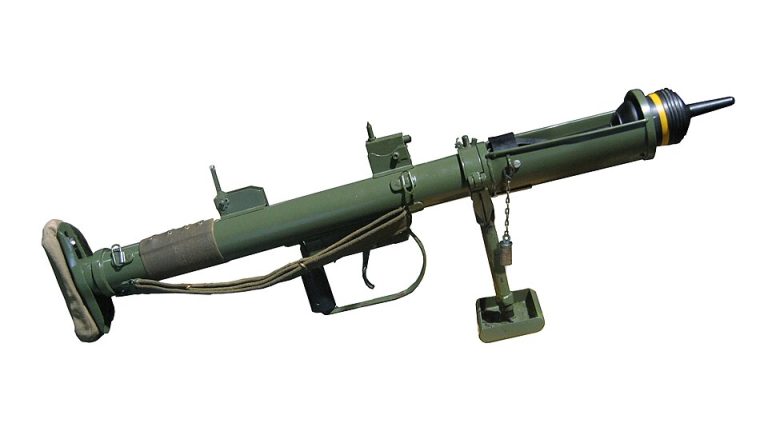
In contrast, the US-designed M72 “LAWS” and the Swedish-designed “AT-4” weapons,
and their many foreign copies or equivalents, are also RPG-like devices, and perform similar functions.
“Rifle” vs. “Gun”
A rifle is not a gun, and a gun is not a rifle.
Piles of Japanese weapons and equipment surrendered to the 25th Indian Division at Kuala Lumpur, Malaysia
A ‘rifle’ is a small arm designed to be carried and fired by one
View looking down the barrel of a Type 99 Arisaka rifle with the bolt removed
person.
“Rifling” is a descriptive term denoting the spiral grooves cut into a barrel to impart centrifugal spin to a projectile, increasing accuracy.
A ‘gun’ is a very large, “crew-served” weapon, sometimes also called a ‘cannon’, which fires a very large (1 inch+ diameter) projectile, usually explosive-filled. Guns are either towed like a trailer behind a vehicle, or are mounted on vehicles in their own right.
Soldiers of the Royal Artillery are pictured firing 105mm Light Guns during an exercise
Magazine, Clip and Charger
These are NOT the same things!
In infantry parlance, a “magazine” is a detachable box containing a number of cartridges [q.v.] under spring tension, used as a component to the rifle’s feed system. Outside of the infantry spectrum, it can refer to both a storage facility for land and naval artillery ammunition, and as an archaic term for a general supply depot.
A “clip” is a small piece of sheet metal that holds a fixed number of cartridges in the fixed, internal magazine of a weapon.
A “charger” is a small piece of sheet metal holding a fixed number of cartridges for loading into an internal magazine by being manually pushed off of the charger.
EXAMPLES:
US Marine, reloading an M16 rifle (with attached M203 grenade launcher), Djibouti, AfricaA man aiming a Romanian built AK type rifle at an outdoor shooting range in NevadaEn Bloc Clip for M1 Garand (8 rounds) and Strip Clip for SKS Rifle (10 rounds)A U.S. soldier holding a captured M1 Garand rifle in Western Muqdadiyah, Iraq
Modern Rifles for military use. From top Snider-Enfield, SKS, M16A2, Type 56, Steyr AUG
Bullet vs. Cartridge vs. Round
Cartridge cross section
A “round” is a complete projectile/propellant/case combination containing both projectile and propellant in a metal case.
A “bullet” (or “shell” if filled with explosives) is the projectile fired by any weapon that leaves the barrel at the muzzle.
A “cartridge” is a container used to hold bullets and propellants firmly in a more or less watertight environment.
Tank vs. APC vs. “Armored Car”
This is one of the single most misunderstood terminology conflicts out there, and is one of the most important conflicts to resolve.
Leopard 2 Main Battle Tank
A “tank” is a large, heavily armored combat vehicle, capable of carrying and firing an artillery-grade weapon, usually from a rotating turret. Although there are several classes of tank (light, medium, heavy and assault), and some tanks are designed without turrets, the cue is the massive cannon they carry.
M113 Armored Personnel Carrier of the Argentine Army
In contrast, while an APC (Armored Personnel Carrier) may resemble a tank in many respects, it is most certainly not a tank. One of the earliest APC’s, the M113, have been made in such numbers (well in excess of 80,000, and remained in production from 1960 to 2014, although parts are still made in many countries), it is the “gold standard” for the class.
APC’s, or “Armored Personnel Carriers,” are used to transport infantry troops to support and protect tanks. APC’s are usually very lightly armored, compared to tanks, and usually do not possess weapons that can engage tanks successfully, although some do carry one or two anti-tank guided missile launchers. Note that APC’s and armored cars do sometimes have turrets, and relatively heavy guns; this does not make them tanks, due to their extremely thin armor (compared to that of tanks).
BMP Infantry Fighting Vehicle, Iraq
Closely related to the APC (and developed from it), is the “Infantry Fighting Vehicle”, or IFV. This vehicle class is largely responsible for all the confusion regarding the differences between tanks and everything else. IFV’s tend to carry small infantry units, but are also armed with significantly heavier weaponry than APC’s. The Soviet-designed BMP-1 was the first IFV ever designed, and still soldiers on, all over the world.
Armored SUV used by the French GIGN counter-terrorist unit
Cadillac Gage Commando, Osan Air Base (1980)
An “armored car” is just that: essentially a large truck or “Sport Utility Vehicle” (SUV)
that has been plated in armor of some kind to make it proof (more or less) against rifle/machine-gun fire and artillery shrapnel. These vehicles are correctly employed only for security and convoy escorts, where their opponents will mainly be light infantry, who are very susceptible to the armored cars’ onboard machineguns.
“Rifle” vs. “Machinegun”
There is great confusion engendered by a heavily-politicized media establishment, either by incompetence or design, over small arms types. As described above, a ‘rifle’ is a small arm, intended to be carried and fired by one person.
Jordan Border Guard Force Soldiers manning an M2HB machine gun
In contrast, a machine-gun is a sustained-fire (meaning that it is intended to fire in automatic mode [q.v.] for extended periods), crew-served (meaning that it requires more than one person to operate) weapon intended to support infantry units.
Although some rifles may fire like machine guns, they are simply rifles with an automatic-fire function.
“Automatic” vs. “Semi-automatic” vs. “Selective Fire” vs. “Runaway Fire”
“Automatic” means that once the trigger is pulled, a weapon will continue to fire until either the trigger is released, or the weapon runs out of ammunition.
“Semi-automatic” means that when the trigger is pulled and the weapon fires, the weapon cycles the next round into the chamber with no input from the shooter, who must pull the trigger again to fire.
“Selective fire” means that a rifle can be easily transitioned back and forth between Automatic and Semi-Automatic by the operator.
A “runaway” is what happens when something goes wrong inside a semi-automatic firearm, and it begins firing in a fully-automatic state until it runs out of ammunition. This is the result of either operator error (for example, if the weapon is reassembled improperly), or parts breakage. All shooters dread a runaway condition, because it is unexpected, and very hard to control.
Cover vs. Concealment
“Cover” (as in “taking cover“) refers to any material or structure that can act as a shield or stop against direct small arms fires and light, hand grenade-sized fragments. Some structures, commonly called “bunkers“, are built to withstand fire from artillery shells and missiles.
“Concealment” refers to any material or structure that will conceal, or hide, the unit from observation by the enemy. Concealment typically offers little to no cover or protection.
Finally, there are a truly vast number of free resources online for anyone wanting to learn about the “nuts and bolts” of military systems. While a site like Wikipedia is fine – as long as one knows how to use it – it has a significant number of errors; the Freedomist doesn’t use Wikipedia because it is necessarily accurate, but because it is a fast and clean interface. Nothing at Wikipedia should be taken wholly at face value – it is a starting point, nothing more.
Other “clearing house” sites – such as MilitaryFactory, or Gary’s Olive Drab Page – are also fine, more or less, but in addition to having some accuracy issues, a user has to have a rather specific idea of what they are looking for. Below, are some free resource sites with good generalized pages…
Federation of American Scientists (FAS): The FAS does have a currently functioning and updated website, but they no longer update the pages listed below. These older pages are deliberately kept online – albeit with no further updating – because they do provide solid information to the general public about military affairs. The following links are specifically for “Land Systems” (military equipment used on land), and is very comprehensive. These links cover all sorts of vehicles and weapons, and is one of the best sites to scroll through if you are looking for something you don’t recognize; once you find it, you can use the FAS data to search Google for more information…
A “clearing house” site, Olive Drab has one of the most extensive libraries of entries on military equipment, albeit primarily US equipment. It is listed here, because it is so in-depth of a resource, its entries are frequently used by Wikipedia…
Finally, we come to the ODIN “World Equipment Guide”. This is the official – and unclassified – site that the US Army uses as a training resource. In addition to multiple wargaming environments, ODIN maintains a series of databases that cover non-US military equipment, including data on improvised combat vehicles, such as Technicals…
To paraphrase Christopher Hitchens, You may not be interested in war – but War is definitely interested in YOU.
To quote someone far more educated and experienced than Hitchens: “Sun Tzu said: War is a matter of vital importance to the State; the province of life or death; the road to survival or ruin. It is mandatory that it be thoroughly studied.” (The first line in Sun Tzu’s ‘Art of War’, c.500BC)
These things are paid for – both in cash, as well as in blood – by you, the Reader. You need to learn this stuff, whether or not you are carrying a rifle or making decisions about sending someone else’s children out to go and do these things.
We’ve all seen them — whether picturesque castles, grim fortresses, chaotic and open firebases, or grimy underground tunnel warrens — most people know a “fort” when they see it. Most people, however, also assume that such things are passe, obsolete ideas long overcome by technology.
But – are fortresses obsolete?
From mankind’s earliest days of social interaction, we have been building defensive structures. At first, defense against the weather – mainly, the rain and the cold – was the major concern, mostly because caves could be hard to come by. Over time, however, it became readily apparent that sturdier defenses were needed, to protect us from large predators. Eventually, though, someone realized that improving those structures made it difficult for the raiding party from the next valley to steal all the women and goats. Thus, the first real walls were built…causing, consequently, the first arms race.
As time went on, attackers began figuring out how to get over, under, around or through walls. In response, walls got taller and thicker, and foundations sank deeper into the ground. Covered parapets began to appear. Then, someone built a tower, and someone else extended walls away from it…
This spiral continued for unknown millennia, until – in Western Europe, at least – the early 14th Century. Then, black powder appeared in concert with cannon, and with increasing speed, castles that had withstood multiple sieges began falling, as their inflexible stone battlements were blown apart by stone – followed by iron – shot.
Martello Tower, Shenick Island, County Dublin, Ireland (Source: Pixabay)
It took until the middle of the 17th Century before one man brought fortifications back from obscurity: Vauban.
Sebastien le Prestre de Vauban (1633-1707), Maréchal de France; Artist: Charles-Philippe Larivière (1798–1876)
Starting with the basis of the “trace italienne” designs, Vauban revolutionized the entire science of military engineering, developing a system of both attack and defense from modern fortifications – now, fortresses became more or less impervious to all but the most massive bombardment, and became offensive weapons in their own right. Vauban’s designs were applied around the world for the next two hundred and fifty years. And then, of course, technology caught up.
The advent of high explosiveartillery in the late 19th Century spelled the end – for a time – of Vauban-style fortresses, as the high explosives could obliterate the intricately laid out constructions at will.
But then, an odd thing happened.
Following World War 1, France was left with the stark reality that nearly an entire generation of its young men had been wiped out in the trenches. Needing what we would now call a “force multiplier“, France turned to its military engineers, and built the “Maginot Line“, named for the war veteran and War minister of the time, Andre Maginot.
Ligne Maginot – Schoenenbourg. CCA/2.0
This enormous complex was a series of self-contained concrete fortresses, all of which were built around multiple pieces of heavy artillery. For most of its length. the forts in the defensive belt that ran from the Swiss border to Luxembourg could cover their neighbors with overlapping artillery fires, making any attempt at assault costly to even contemplate. Only the sections beginning at the Ardennes Forest – rough, heavily-forested terrain – were more thinly spread out.
French leaders were convinced that the Maginot Line would force Germany into a repeat of their World War 1 strategy of striking though Belgium, while slowing the attack further south, but that this time France would be ready, and could slow the German war machine down long enough to give France time to assemble allies to once again batter Germany into defeat.
But, when war finally came, French and British troops sat and stared at Germany, until the Nazis smashed through the Low Countries, and forced France to surrender in six weeks.
The hideously expensive Maginot Line, it seemed, had failed completely. Coupled with the other spectacular surrenders of heavily and expensively fortified places in World War 2, it seemed that fortresses were finally dead.
Lieutenant-General Percival and his party carry the Union flag on their way to surrender Singapore to the Japanese, February, 1942. Public Domain.
In fact, only one of the fortresses of the actual Maginot Line ever fell to the Nazis. The most famous fortress built on the Maginot model to fall – that of Eben-Emael, in Belgium – was neither part of a cohesive defensive network, nor was fully manned or supplied, and was not designed to defend against a glider assault, something built into the layout of the Maginot network.
However, the public – and unfortunately, most of the military – perceptions were that the concept of a fortress, as such, was dead, especially with the advent of atomic and nuclear weapons.
A B-61 thermonuclear weapon, showing its major components; Source: US government DOD and/or DOE. Public Domain.
And yet…countries still built versions of fortresses, a practice which continues into the present day.
C-RAM 3 air defense system; Source: US government; Public Domain
One of the chief arguments against a modern fortress is its supposed vulnerability to “smart munitions“, primarily bombs and missiles. However, this dangerous assumption presumes two things to exist: complete command of the air, and a lack of effective anti-missile systems on the part of the defenders in the fortress. The North Vietnamese Armed Forces, like the modern Islamic State, would have happily bombed and shelled US and South Vietnamese fire bases and FOB’s out of existence from afar; however, lacking any effective way to contest the airspace over those bases, those forces were forced to rely on infiltration, suicide bombertactics and human wave assaults. Similarly, although Saddam Hussein’sIraq was capable of buying effective anti-missile systems, he declined to do so, because that would have required a level of technical ability and professional competence to operate that he was loathe to allow in his fragmented military forces.
Another argument against a modern fortress is its susceptibility to attack by conventional ground forces, such as artillery and tanks, as well as infiltration attacks by various types of special forces. This argument ignores the fact that while a modern fortress can indeed be severely damaged by modern high explosives, the amounts of artillery ammunition needed are staggering; in fact, it is questionable if modern armies possess the firepower necessary to reduce a position like Verdun – even with no modern updates – and the fact that infiltration has been tried against fortresses throughout history.
As a result of these factors, no one has attempted to design an actual “fighting fortress“, as such, for almost a century. This begs the question: What would such a fortress look like?
In order to be functional, the fortress would have to be sited to guard a specific location, like its predecessors. It would need an array of offensive weapons, of both tactical- and theater-level, and both active and passive defensive systems, as well as a mobile garrison which could launch conventional attacks against enemies attempting to lay siege to it.
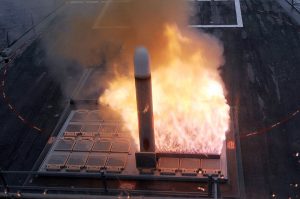
In the offense, the fortress would need batteries of tactical- and theater-level conventional missiles, likely stored ready-to-fire in vertical-launch units; these types of missiles have been in use for decades. Our hypothetical modern fortress would also have an array of emplaced conventional artillery. These weapons, most with ranges in excess of 15km or more, have been in common use worldwide for over a century. The modern fortress could also have some form of armored cavalry unit secured in underground revetments, ready to launch rapid counterattacks if necessary.
A Tomahawk Cruise Missile launch form the USS Farragut (DDG-99), August, 2009. U.S. Navy photo by Mass Communication Specialist 1st Class Leah Stiles. Public Domain.
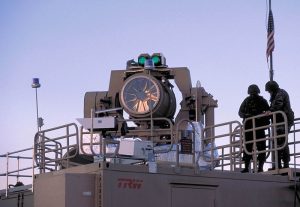
Defensively, our modern fortress would have passive defenses in the form of Vauban-style approaches, as well as barbed wire and defensive landmine barriers, designed to channel and slow conventional infantry attackers, and making armored attacks on the fortress problematic. Active defenses would include various radars, as well as defensive missiles like the Rolling Airframe Missile and rotary cannon anti-missile turrets, but could also employ more advanced systems, such as “Iron Dome” or a THEL-type system.
Tactical High Energy Laser/Advanced Concept Technology Demonstrator, 2005. US Army Photo. Public Domain.
The penultimate argument actual fighting fortresses in the modern age, at the end of the day, is one of expense: in an era where countries are paying well in excess of US$100million for a single fighter plane, constructing a fighting fortress could be staggeringly expensive.
The work that I do leads me to survey roughly 1k-2k headlines a day, looking for useful content seeds, as I think of them.
I also have on my Facebook page more than 100 local news facebook pages running through my feed. I highly recommennd all of you do this.
You will see narratives spit out with sameness and with near-same timing. It’s fascinating to behold.
I have been surveying western philosophical thought pretty intensely the last 4 years, and eastern philosophical/religious thought the last 2 years (still far behind here than my western thought understanding).
I have a fair sense of world and prehistory up to current year.
I have a LOT of 10,000 mile high survey views of the current news of the world, history, and major philosophical thought, east and west (still have yet to learn African and Pre-Columbian American mythology, thought to gain a truly ecumenical survey view).
I believe this gives me a unique perspective on what’s going on the world right now.
I say all this to build some standing in the words I speak (though not disinviting critique) with you, whoever might be reading this.
The key fight behind all the other false dramas these engineers at the top keep spinning through their tight control of the means of social and cultural production is over Intellectual Property versus Individual Sustainable Flourishing.
We have the technology to build defendable citadels that can provide for most of the essential needs and, in network with other like-designed citadels, could quickly, with minimal population sizes (perhaps as low as 5K), provide a fully sustainbly flourishing community where each individual, by nature of the citadels themselves, are incentivized to want one another to win when value is exchanged between them.
We have the technology to incentivize consensual exchange.
What will stop this is only this- if technology is protected by Intellectual Property Rights. The Citadelians (mostly, but not exclusively, billionaires, and not all billionaires are Citadelians) understand that technology is not on their side. It favors small-scale sovereignty. It favors defense, overwhelmingly. The cost of coercion to hold an unwilling land has gotten to prohibitively high numbers.
They know this. So they need to scare us, divide us, shock and awe us, traumatize us to keep us from talking too much among ourselves, to figure out that we already have the power here and now to neutralize tyranny by building our own citdals, so that the poorest of the poor in our community is yet a citadelian when facing the threat of tyranny.
The woketarian shrillitarian meltdown addicts are nothing more than mouthpieces of mostly white citadelians, delighted in the trauma these concern trolls are inflicting on everyone around them, in the name of helping the poor creatures that can’t do it themselves….wannabe Christs sacrificing their former family and friends so that they can keep on sinning, but still feel righteous about it.
The MAGA Tards and their Trump Trump Trump are mouthpieces of the former citadelians who didn’t go so deep, so fast, so hard into entangling themselves in China (not that they didn’t entangle, everyone entangled with China).
What you are seeing right now, the alleged Freedom and Bill of Rights champions and the alleged End Hate and End Racism Cultists, are two satellite countries, one representing the ascendant Citadelian Empire and the other representing the former Citadelian Empire (with both sides including some nouveau riche wannabe generational citdaleians still auditioning for the part).
You Leftists and you conservatives are but pawns in a war between billionaires in which both sides agree on one thing, we want, in the end, to be the exclusive holders of the ‘right’ to manufacture technology to assure that the version the poors gets (we are all poors to Citadelians if we are not Citadelians) is limited in function and tied to a subscription plan.
The poor rank and files of both these shrill sides are mostly the product of being made by the faction they chose than being stewards of their own beliefs, stewards of their own preferences.
In truth, if you strip away the morality claims of both sides, we poors have far more in common with one another than not, and there is an ineffable gulf between us and the Citadelian class.
We have the technology, we have even ancient customs, that can enable leftists to live next to magas with no fear of threat from the other, for both understand that the other is a citadel in and of themselves. The cost of coercion is too high. People who don’t like each other can yet share value with one another with no fear to hinder consensual exchange, even if the communities might not exchange as much value with one another as they do with more like-minded communities.
We can create resources where we live at scales never even dreamed of before. We have opportunities in 3D printing, new developments in vertical farming, the development of power foods like microgreens, we have ever-more-difficult-to-crack encryption technologies, plant engineering that can enable us to grow more and more raw materials by creating plants that can produce them (like certain chemicals, etc).
We have the ability to augment our expertise with AI services that can provide quick, naturally expressed and understandable expert advice in multiple disciplines, including medicine and technology development itself.
Microdrones 3D printed and armed with munitions of various kinds able to be cranked out in defense of a community.
The ability to create local digital, secured currency, and labor exchanges, and more ways to exchange value with like-minded, and geographically-proximal individuals and communities.
The future is either subscription services that artificially maintain the gap between the Citdaelians and the poors or hundreds of thousands of citdaels scattered throughout these lands, and most in places where currently no one is living (or very few).
The old cities will be demolished and redesigned to be honeycombs of citdaels that can create sustainably flourishing communities.
The choice is ours, here and now, and I am doing what I can to make my family sustainably flourishing, and hoping to find people in my city willing to do the same. I am working with other people on other projects as well, like-minded people.
The movement to become sustainbly flourishing is growing, but we still need way more people, of course.
Walk away from the fake drama and the dependence on the systems that keep terrorizing their own customers, employees, and citizens. Let them have their world. We have the technology to not need it.
Those who choose to stay, let them suffer what comes from such authoritarian systems. Those who wish to leave but cannot, as we sustainbly flourish ourselves we seek to rescue as many who are willing, but not able, as we can.
If you’ve read this far, comment down below if you are ready to sustainably flourish, or if you already are and how you are doing that.
NASA astronauts on board the International Space Station (ISS) are testing new spacesuits with built-in water cooling systems to withstand the heat of space.
In a new video, NASA has shown how its personnel are conducting spacewalks just outside of the ISS while receiving cooled water from an on-board device.
Astronauts are wearing special garments under their spacesuits that feature tubes filled with a constant stream of this circulating water.
The concept of using water as a coolant goes back to Apollo era in the 1970s, but NASA’s new system is equipped with pressure sensors, a thermal control loop to maintain a set temperature, and the ability to release warm water vapour into space.
NASA astronauts on board the International Space Station are testing futuristic spacesuits with built-in cooling systems
Cooling technologies are being tested for the upcoming Artemis missions to the Moon, set to take place in 2025, according to NASA.
Lexalytics®, an InMoment® Company and pioneer in AI-based NLP technology, announced today that Pulsar has chosen Lexalytics’ on-premise, AI-driven Salience™ NLP engine to power its audience intelligence platform. The original equipment manufacturer (OEM) agreement brings best-in-class text analytics and sentiment analysis, along with natively processed, multilingual content across channels to Pulsar’s global customer base in the areas of social listening, reputation intelligence, and…
Rolling robots used at hospitals for a variety of tasks — including transporting medication — have been patched for five vulnerabilities that could have allowed attackers to potentially disrupt patient care or capture sensitive information, researchers said Tuesday.Health care cybersecurity company Cynerio said it found the bugs in Aethon’s TUG robots in December, and then “worked closely” from January onward with the manufacturer through the federal Cybersecurity and Infrastructure Security Agency’s process for disclosing critical vulnerabilities. Aethon said it took “immediate action” after receiving the information from CISA.
“We are pleased that the notification process worked as intended and helped to discover, report, and rectify system vulnerabilities in a collaborative effort so that we can continue to stay a step ahead of bad actors and provide the efficiency systems like ours are made to deliver,” Aethon said.
The most serious of the bugs, which scored 9.8 out of 10 on the open source Common Vulnerability Scoring System, could have allowed an unauthenticated user to connect to the TUG Home Base Server that controls the robots, Cynerio said. Attackers could potentially cancel existing tasks, use a TUG to meddle with elevators and even open and close its drawers.
Back FREEDOM for only $4.95/month and help the Freedomist to fight the ongoing war on liberty and defeat the establishment's SHILL press!!
Are you enjoying our content? Help support our mission to reach every American with a message of freedom through virtue, liberty, and independence! Support our team of dedicated freedom builders for as little as $4.95/month! Back the Freedomist now! Click here