Tesla Lets Three Quarters of its Bitcoin Go – Elon Musk has moved 75 percent of Tesla’s Bitcoin assets over to cash, amounting to nearly $1 billion dollars. The move could be telegraphing Tesla’s faithlessness in Bitcoin’s future or its need for cash-flow due to rising costs in production and other cash-demand issues the company has recently experienced.
Elon Musk’s Tesla Motors has sold 75% of its bitcoin (BTC) holdings in recent weeks, converting the cryptocurrency into around £782 million-worth of US Dollars ($936).
In its second quarterly report for 2022, out this week, the automaker said its bitcoin holdings were impairing the company’s profitability.
NOTE TO THE READER: The following is a necessarily brief overview of a top-tier national military force. The opinions expressed are those of the author, and are based solely on “open-source” research. This is the first of a series on national military forces that may not be well-known to the general reader.
Additionally, a version of this article was previously published online, on May 29, 2017, by this author, at the former “Military Gazette” web page (now defunct). This version has been edited and updated, and is published here with the agreement and consent of the editorial staff, as well as this author.
Introduction
The modern Indian armed forces date from 1947, but trying to write even a general overview of the military history of India is far beyond the scope of an article such as this. Indeed, this article can give only the barest overview; thus, any holes that appear are unintentional, and were left out for the sake of brevity.
Postcard captioned “Gentlemen of India marching to chasten German Hooligans” in English and French, 1914
India did not lack for professionalism in armed forces when it gained its independence from Great Britain in 1947. Indeed, Indian forces had been fighting under British direction for well over 200 years, since at least 1774AD. Interestingly, this makes the modern Indian Army slightly older than its United States counterpart. Indian troops from across the subcontinent have repeatedly proven themselves the equal – if not the superior – to both British and European armed forces. India’s success as an independent state is directly attributable to the professionalism of both its Civil Service, and its Armed Forces, part of the latter being the subject of this article.
At the time of the Partition of India, the various British Imperial Indian forces were divided between between India and Pakistan; other than the inevitable disruption caused to organizational structures, both new countries inherited highly professional forces, as well as school structures and defense industries. As a result, Indian forces performed very well in their firsttests, and ensured India’s continued existence as a nation.
Indian soldiers of the 9th Battalion, Sikh Infantry test-firing a handgun aboard the amphibious assault ship USS Boxer (LHD 4) – US Navy photo
Although there would be missteps later on, India’s national integrity has never been seriously threatened over the course of the last seventy years, in stark contrast to many other former European colonies, who seem continually on the brink of complete and utter collapse.
With a total of over 5.137million troops – counting Active, Reserve and Paramilitary – India possesses the fourth-largest armed force in the world, ahead of even the People’s Republic of China, and the second-largest Active Duty force, overall, ahead of the United States. Below, we will briefly glance at India’s army, and will then assess its strategic capabilities.
Comprising some eighty percent of India’s national forces, the Army is a modern force, striving to upgrade its capabilities to keep pace with the more “public” militaries, such as those of the United States, Britain, France and Germany. However, those states are not India’s adversaries – those slots are taken up primarily by Pakistan and the PRC.
India, by and large, neither starts wars – directly or indirectly – nor seeks conflicts. In the past, however, India has faced attacks from both Pakistan and the PRC; in the former case, several times.
Indian army infantry vehicles move onto the firing range at Camp Bundela, India Oct. 26, 2009 – US Army photo
Like most states, the core of India’s armed forces is its infantry. Indian infantry have long been regarded as among the toughest and most capable in the world. India, like the United States, uses a modified “regimental system” within its army, with regiments such as the Madras, the Gurkha’s, and the Sikh Light Infantry (among many, many more) having long and distinguished histories, but those regiments primarily provide well-trained battalions to the Army’s divisional structures (some forty divisions, in fourteen corps), as part of the seven major commands that the Army is structured into, rather than deploy as complete units on the battlefield. These divisions, except for certain specialized units – such as mountain, parachute and several special forces units – are mingled with tanks and artillery to form cohesive battlefield units.
The Army’s F-INSAS program is a development project aimed at reequipping the individual soldier with an advanced suite of combat systems. This program, modeled on the US Army’s zombie-like “Future Force Warrior” program (that has been killed and resurrected so many times, it is now hard to keep track of the various iterations), is perhaps over-ambitious.
Lance Naik (Lance Cpl.) Fateh Singh, of the 4th Rajput Battalion of the Indian Army confirms the zero of his INSAS assault rifle, Donnelly Training Area, Fort Greely, Alaska, 2007 — US Army photo
However, the Indian Army demonstrated in 2016 that it has the intestinal and institutional fortitude to make choices that would embarrass other forces, in its acknowledgement that its 5.56x45mmINSAS rifle (no relation to the aforementioned program) simply wasn’t working. The Indian Army’s 2016 requirement is one of the clearest signs, yet, that the end of the “intermediate cartridge” ballistic dead-end is near, as the Army requirement acknowledged the need for a “full-power” (in this case, the venerable 7.62x51mm) cartridge for frontline service.
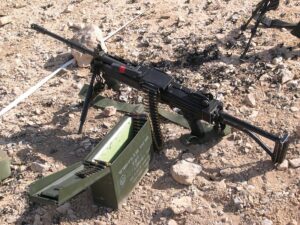
As a result, the Indian Army inked deals to both purchase and manufacture the AK-203 rifle in 7.62x39mm (a total of 670,000 – 70,000 directly from Russia, with the remainder to be manufactured under license) in Uttar Pradesh, while also purchasing slightly modified SIG Sauer 716 G2 Patrol rifles in 7.62mmNATO for more specialized units. Simultaneously, a deal for over 16,000 Israeli-madeNG-7 ‘Negev’ Light Machine Guns – also in 7.62x51mm NATO – was let in 2019, with the first batch of 6,000 arriving in India in early 2021.
While arguments can certainly be made over some of the choices made in the Army’s reequipping strategy, real armies always strive to stay out on the edge of technological development, while also keeping hold of tools and doctrines that have been proven to work, before adopting newer – but untested – concepts. Truly professional forces are able to acknowledge when they have taken a wrong turn, and move forward to fix the issue…That’s a lesson the US military would benefit from remembering.
Army Air
One of the challenges for the Army is its somewhat limited organic aircraft and helicopter assets. As it took the common page from other modern forces, India from the beginning separated its air forces from its ground forces. And, also like many modern armies, the result has been very spotty application of close air support (CAS) to the ground forces. Like all air forces, the Indian Air Force tries, but it is hampered in its efforts by both budgetary constraints and the associated need to focus on that service’s core missions. India is not alone in this issue; the US military discovered the problems inherent in this type of division with its own “Key West Agreement” in 1948, a confused decision that would cause delays and confusions that would impact combat operations well into the 1970’s.
Mi-35 Hind helicopter, Kandahar, Afghanistan, 2009 – US Air Force photo
Arjun Mk II MBT, live demonstration, 2016 – photo by Indian Navy
On the brighter side, the Arjun Mk IIMBT has finally matured. After a rough start to its development cycle, and serious problems in its earlier version, as well as major cost overruns and an epically long (37 years, to be exact) development cycle, the Arjun has matured into a frontline weapon that is in the top tier of combat vehicles. The only real hurdle to its full-scale deployment, as with virtually every army, is money. On the other hand, its deployment, while slow, has finally allowed India to retire its 1940’s-era T-55’s. At the same time, the Defense Ministry settled on a modernizaton and upgrade program for its Soviet-era T-72’s and T-90’s, the better to avoid too unevenly improving systems.
Pinaka MBRL’s on parade, 2011
India’s burgeoning economy, however, has allowed plans to significantly modernize its artillery park to move forward with speed. Systems like the Dhanush howitzer, developed to replace the Haubits FH77/B units acquired from Sweden in the 1980’s; the excellent M1954 (M-46) 155mm model, as upgraded by Soltam, of one of the best artillery pieces ever built, with a maximum unassisted range of 27km/16.77mi, and an assisted range of 38km/23.61mi; rounding off the new purchases is the indiginously developed, truck-mounted Pinaka multiple rocket launcher (similar to the US ‘HIMARS‘), designed to replace the BM-21’s and ‘Smerch’ 9K58’s acquired from the Soviet Union. Something DRDO may want to look at is the EVO-105, which the Freedomist recently reviewed.
A serious problem, however, is in India’s IFV park. The ‘Abhay’ (Sanskrit: अभय, “Fearless”) IFV is still in “development hell” (although the incorporation of the 40mm Bofors L/70 gun is an inspired choice for a main weapon of this type). While DRDO has informed Russia that they intend to pursue an Indian IFV, rather than purchase the BMP-3, the Indian Army is stuck, in the meanwhile, with the abysmal BMP-2. The BMP series, generally speaking, has a well-deserved reputation as the worst of the IFV field: its limited range, cramped compartments, horrible ride and poor armor are legendary…well, perhaps “notorious” is a better term. Armor – as has been decisively proven – cannot operate without infantry support, and infantry need something more than a “battle taxi”, as good as the M113 might be. The original models of the US Marine Corps’LAV-series is another off-the shelf option that would be far superior to the BMP-series.
Combat Support
Ashok Leyland Stallion 4×4’s of the Indian Army, Himalaya region, 2010
India’s motorized military support is firmly anchored on three vehicles: the Ashok Leyland Stallion Mk III & IV, the Maruti Gypsy, and the Tatra 815, although the Tatra 815 is slowly being replaced by newer vehicles. These are all solid, highly capable vehicles, supplemented by smaller numbers of more specialized frames, easily the equal of other nation’s vehicle parks in capacity and reliablity.
As well, mine protected vehicles such as the venerable and battle-tested South AfricanCasspir and the domestically-produced Aditya are entering the vehicle pools in increasing numbers, in ackowledgement of the growing threat of IEDs.
Strategic Forces
India, as is well-known, maintains a nuclear arsenal and an ongoing development plan. This arsenal is currently estimated at between 150 and 300 devices. Currently, the known weapons available to be deployed are the short-range Prithvi-I and the intermediate-range Agni-III, with longer-range land-based weapons and MIRVs under development. The K-15 SagarikaSLBM, now operational, is now deployed aboard the INS Arihant…and awaiting sister ships.
Country’s first under-water- launched Missile B05 (Sagarika) was successfully flight tested from Bay of Bengal off the coast of Visakhapatnam.
This developmental pace is surprising only to people who lack a grounding on India’s regional security situation. A nuclear deterrent is definitely something taken seriously by the People’s Republic of China. But the main focus is India’s long-time enemy, Pakistan. While the nuclear program was originally more of a prestige program than an operational imperative, increasing instability in the Muslim world, coupled to both Pakistan and Iran’snuclear programs, as well as both 9/11 and the 2008 Mumbai attack have transformed the nuclear program into a real and pressing project: India has serious reasons to maintain a nuclear arsenal…which is a very serious range issues that need to be solved, lest they get out of hand.
Tactically, however, the main question is the true state of the Indian military’s nuclear, biological and chemical (NBC) program for allowing individual troops to operate in such environments.
Conclusion
The Indian Army is a highly capable, well-disciplined and professional force, with a very long, and honored history. It has repeatedly demonstrated that it is capable of both making hard decisions, as well as admitting its errors, at least to a greater extent than many other top-tier forces. If the Indian Army has any weaknesses, they lay in procurement, which is something the force does not have full control over, although a critical need for a real airmobile component is its worst issue; there are very cogent reasons why virtually all modern militaries have abandoned parachute infantry as primary “first in” forces, in favor of heliborne formations.
The Army well understands that it needs to modernize its forces – too long tied into less-than-capable (to be polite), Soviet-era systems – a task made significantly easier by the increasingly close relationship to Western militaries, militaries that recognize the danger of an unstable, nuclear-armed Pakistan, as well as an increasingly bellicose China.
Armies exist to buy time through intimidation, for political leaders to avoid conflict. But those forces, for their intimidation strategies to work, must be capable of actually following through on their promise of ability.
Ultimately, the Indian Army succeeds in this quite admirably.
Since the Russian invasion of Ukraine on February 24th of 2022, the Ukrainian military has struggled to hold on against enormous pressure. While there have been successes against the surprisingly anemic Russian juggernaut, the fact is that the conflict has seen the return of massed artillery fires, at a scale and intensity not seen since at least the 1990-1991 Gulf War.
Derelict Tank in badly shelled mud area, Europe, 1917.
Artillery, in its many forms, has been a major component of armies since at least the 15th Century. Artillery can cause heavy damage to both attacking forces in an open field, but can also hammer fortifications into a moonscape, if allowed to.
French Caesar self-propelled howitzer fires into the Middle Euphrates River Valley.
Like many armies, Ukraine had allowed its artillery establishment to atrophy – despite armies depending on massed artillery for centuries – and it now finds itself desperately scrambling to replace damaged and lost artillery pieces, and scrape together more ammunition. This has seen the first mass deployments for systems such as the French ‘CAESAR‘ 155mm self-propelled howitzer, the M777155mm towed howitzer and the M142 HIMARS Multiple-Launch Rocket System, among others, all supplied by NATO states trying to shore up Ukraine’s defenses.
But none of these weapons – nor their ammunition – are arriving in the quantities Ukraine needs. There may be at least a partial solution to Ukraine’s problem, however:
The EVO-105, now designated the K105HT.
Improved K105HT during firing drill. Undated photo.
The EVO-105/K105HT uses an assembly of long-proven systems to make a lightweight, self-propelled artillery piece. While originally produced as a cost-saving idea to get the maximum utilization out of old artillery, the basic design could easily be adapted to artillery similar to the M101-series, such as the L118, or the M119. Although having a significantly shorter range than larger-caliber weapons (a maximum of 17.5km (10.9 mi), or 19.5km (12.1 mi) with RAP (Rocket-Assisted Projectiles)), the K105HT is much faster to “shoot-n-scoot“, firing one or two rounds, then rapidly moving to a new firing location, and can do this faster than most other similar systems.
Hindsight is always 20/20, but other states and other forces can take the artillery issue as a lesson from Ukraine’s failure to maintain a well-rounded defense establishment.
Artillery matters. Victory also matters – and artillery wins more wars than gory pictures do.
Wall relief at Medinet Habu depicting Ramses III defeating the Sea Peoples in the Battle of the (Nile) Delta, c.1200-1150BC
Warfare at sea has been recorded for at least three thousand years, but fighting on the ocean almost certainly occurred long before Ramses fought his desperate battle. As on land, there are a dizzying array of reasons why a nation may fight on the water. However, the challenges of fighting at sea are vastly more complex and expensive than fighting on land, or even in the air. Only the concept of space-based warfare is more expensive.
The crew of the merchant vessel MV Faina stand on the deck after a U.S. Navy request to check on their health and welfare, 9 November 2008. Some of their Somali pirate captors stand above them. US Navy photo.
Like land warfare, naval warfare has tenets and goals. Those are, however, vastly different from those of land warfare. Central to that concept, is the definition of a “warship“. While people usually have some idea of what a “warship” is, that definition is usually shaped by modern entertainment media. A warship, at its core, has two defining characteristics: it is simultaneously, any water vessel that is armed – whether that ship is a bass boat or a nuclear-powered aircraft carrier – and conveys the perception of being under the control of a crew that adheres to both military discipline and a “legal” higher authority. This last, is what separates “pirate ships” from “naval vessels”.
Broadly speaking, there are three basic kinds of naval forces. Sometimes, there may be aircraft of various type associated to each force; there may be marines/’naval infantry’ (ground troops attached to the naval force) and there may be some form of “special operations forces” as well. The three basic types of forces we will briefly examine here are categorized as “blue water“, “green water“, and “brown water“.
First, however, we need to address the two basic schools of thought, regarding naval warfare.
Mahan’s central theory argued that control of the sea was vital to a nation’s greatness, and that a navy’s main focus should be on controlling the seas by destroying an enemy nation’s main fleet at the earliest stage of war possible, instead of worrying about a more nuanced approach.
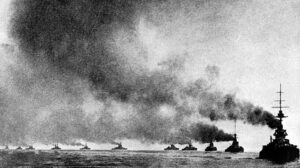
German Imperial High Seas Fleet at sea as at the Battle of Jutland on 31st May 1916.
The naval aspect of World War 1 was inconclusive as to whether Mahan’s theory was correct or not, as there were few fleet actions, and those few were inconclusive draws. However, Mahan formed the basis of both Imperial Japan’s, and the United States’ naval doctrine in World War 2. For the Japanese, Mahan formed the core of their doctrine against Imperial Russia in the Russo-Japanese War, resulting in the decisive fleet action at the Battle of Tsushima in 1905.
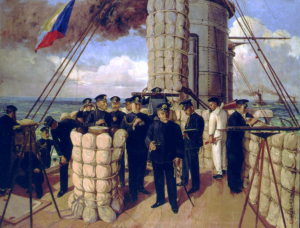
Admiral Tōgō Heihachirō on the bridge of the Battleship Mikasa during the Battle of Tsushima, 27–28 May 1905.
Murderer’s Row: U.S. Third Fleet aircraft carriers at anchor in Ulithi Atoll, 8 December 1944. US Navy photo.
However, Mahan’s theories were not foolproof. In fact, they masked serious problems.
Sir Julian Corbett came to naval strategy as a civilian, in mid-life. Already a well-regarded historian, Corbett made friends in the Royal Navy with his more limited and nuanced approach to naval strategy, which offered a more realistic application of naval power projection that suited Britain’s needs as an Imperial power, even in its waning days. While agreeing with Mahan about the importance of sea power to a nation, Corbett took a completely opposite view of how to maintain this, arguing that control of the sea did not necessarily have to depend on smashing the main enemy fleet. He went further, arguing that “control of the seas” could be maintained if the fleet could ensure the security of the nation’s maritime commerce while inhibiting, if not outright halting, that of the enemy. German Grand Admiral and Secretary of State of the German Imperial Naval OfficeAlfred von Tirpitz, dismissed any sort of “commerce raiding” naval strategy (Corbett’s main view, in its most basic form) during World War 1, opting to do his best to use Mahan’s theories against Britain.
By 1945, it was clear that Corbett was the more correct of the two theorists.
Very briefly, a nation’s “fleet” is the total number of warships it has in current service, along with such vessels it might have “in reserve“, which can be quickly brought into service. For some time, during the late-19th Century, there was an idea that a nation’s “fleet” consisted of all of its major ships, operating en masse, in accordance with Mahanian principles.
The United Kingdom largely attempted to adopt this strategy, keeping the bulk of its main battle fleet massed in British home waters, while dispersing a mush smaller portion of its fleet to stations around the world. The United States, however, faced the harsh reality that due to its geography, it would be forced to split its fleet in any major conflict involving a war in both the Atlantic and Pacific oceans. This was proven true in 1941, as the USN was forced to fight in both oceans, simultaneously.
Physical map of the World, from CIA The World Factbook in 2021.
What everyone generally thinks of when hearing the word “navy”, blue water forces focus on three basic missions: projecting national power well beyond the shores of the home nation, defeating enemy fleets, and “maintaining the SLOC.”
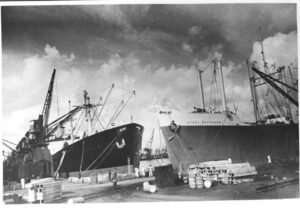
Two US cargo ships docked at Bombay Harbor, 1948
The ‘SLOC‘, or ‘Sea Lines Of Communication‘, are the maritime conduits through which food,
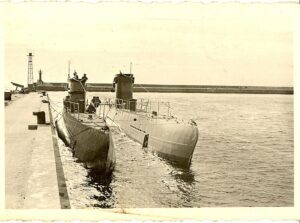
World War II U-boats of Nazi Germany’s Kriegsmarine following their surrender at Lisahally, near Londonderry, Northern Ireland, UK in May 1945. Public Domain
fuel, raw materials and finished goods flow. Very few countries are truly self-sufficient, and a nation under attack has a desperate and immediate need to keep the sea open to merchant vessels funneling supplies to them. It was for this reason that winning the Battle of the Atlantic was so vital to the Allied war effort, because losing it would have forced Britain to surrender; world history would have been fundamentally different had that occurred.
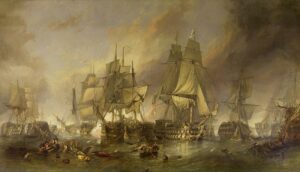
The Battle of Trafalgar (21 October 1805), by Clarkson Frederick Stanfield, 1936
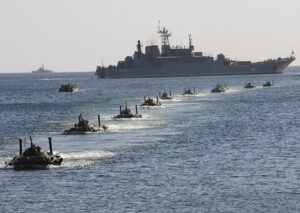
Russian Black sea Fleet conducting an amphibious landing exercise, near Crimea, Ukraine, 2012
While there have been very few naval battles, as such, in the modern era (and haven’t been since the end of the Napoleonic Period), projecting power is still necessary, as was recently demonstrated by the international anti-piracy patrol off the Horn of Africa, and most famously, by the frequent deployments of the US Navy throughout the world — parking a carrier battle group – containing more fighting power on its own, than the total combat power of most national armed forces…before adding the potential of several thousand US Marines to the mix – off the coast of a restive country is a serious statement, sufficient to give all but the most delusional leader and their supporters serious pause.
While the USN is the only navy currently capable of doing this on any large scale, other countries such as Britain, France and India can deploy smaller but still very powerful forces to trouble spots, actual and potential. The Chinese “People’s Liberation Army Navy“, while large, is not well-practiced in “expeditionary operations“, as yet, and – despite certain breathless reporting – has yet to demonstrate more than a rudimentary capability.
Amphibious assault vehicles from the forward-deployed amphibious dock landing ship USS Tortuga (LSD 46) land on the beach during Exercise Cobra Gold 2012.
However, while some seventy percent of the Earth’s surface is covered by water, the remaining thirty percent is land. This may seem like a throwaway statement, but according to the United Nations, an estimated 60% of the Earth’s population live within 100km (62 miles) of an ocean coastline…it is for this very reason, that the United States maintains the largest “naval infantry” force in the world. While marine units are certainly capable (or should be) of seizing a section of hostile shore or a port area, their primary function is to hold that space just long enough for reinforcments to be landed, or some other limited mission completed. This is because – in a similar manner to airborne forces – most naval landing forces (short of a massive assault landing, such as D-Day or Okinawa) are very light in combat power, relying far more on confusion, fear and intimidation…which only works for a short time.
Green Water operations – taking their name from the shift in color from the deep blue of the open ocean to the “sea green” of coastal regions – primarily involve either getting troops ashore (“over the beach“), or finding and suppressing coastal anti-ship defenses, whether troops are going to be landed or not. It is here, that most naval mines are laid, to restrict access to vital coastal regions. This is also where most “coast guards” operate, whether under wartime missions, or during peacetime, conducting customs and safety inspections, police functions, and the occasional search and rescue operation.
In general, green water fleets are small in total hull numbers, as well as overall tonnage, but their functions are, comparatively, much more complex than those of blue water fleets. However, because the ships are orders of magnitude less expensive – at least, for the strictly defensive functions – this is what most navies in the world are composed of.
Humankind’s first water forces were riverine – they operated on those rivers deep enough to take hulls carrying significant numbers of occupants. In a word, those ships were able to carry enough people to both operate the boat, and fight from it.
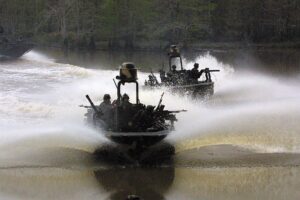
Special Warfare Combatant Crewmen (SWCC) demonstrate the new Special Operations Craft-Riverine (SOC-R) while training at the Stennis Space Center. U.S. Navy photo
Riverine warfare involves the control of waterways away from the ocean shore. Any waterway – natural or man-made – that can be used as a highway to transport people and goods, is a vital conduit for a nation. Good examples are major rivers, such as the Mississippi, the Rhine, the Amazon, the Nile and the Mekong; the list can continue, running into several pages.
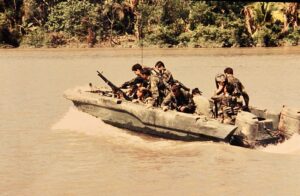
Members of U.S. Navy Seal Team One move down the Bassac River in a Seal Team Assault Boat (STAB) during operations along the river south of Saigon, November 1967.
Ships operating in rivers and delta’s are almost always significantly different in design from their sea-going cousins, but are no less deadly. It is here, where many countries first “dip their toes“, so to speak, in nautical operations. Speeds in rivers and estuaries are generally slower, as is the draft the ships must deal with.
A U.S. riverboat (Zippo monitor) deploying napalm during the Vietnam War
The vessels used in riverine operations can range from shallow-draft, high-speed boats – including small high-speed craft, with a machine gun mount bolted on – to large-scale, heavily-armed, river monitors. These ships are capable of both direct fire as well as indirect fire support missions, forcing enemies ashore to consider their distance to waterways, as well as roads.
Naval Special Forces
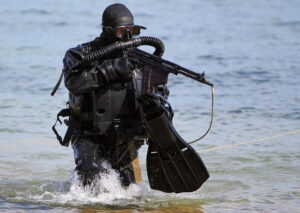
Russian commando frogman of the Caspian Flotilla during exercises
Above, we briefly touched on marines/naval infantry. Here, even more briefly, we will touch on naval special operations forces.
The idea of non-marine special operations forces, while not new, has never before reached a level comparable to that of today. This is largely driven by technology, but parochialism also plays a role.
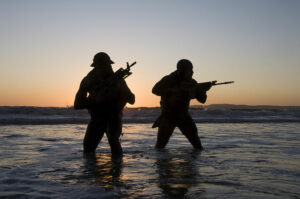
US Navy Seals securing the beach. (Promotional image)
SEAL team member moves through deep mud in South Vietnam, May 1970. US Navy photo.
Like all special operations forces, however, these forces are difficult to employ to their full potential. Their training – of necessity, long and arduous…and expensive – means that they are extremely susceptible to poorly-thought out missions. The numbers of politicians capable of understanding how and when special forces in generally – and naval special forces in particular – should be deployed, is thin indeed.
Conclusion
Naval forces are generally the most expensive sector of a nation’s armed forces. Purpose-built warships represent a very significant investment for any nation, even (perhaps especially) the United States. It is also easy to forget, amid a slew of video games where real people do not die, that even the smallest modern destroyer carries a crew of well over one hundred people…and potentially a crew of thousands.
Anyone talking about naval policy needs to keep that foremost in their minds.
Begun in July of 2005, the program that produced the IAR (Infantry Automatic Rifle) met or exceeded all of the United States Marine Corps’ design requirements for a “lightweight automatic rifle“, with a Heckler & Koch variant of the HK416 being selected as the winner in 2009, receiving the type classification of “M27“, underlining a desired return to a magazine-fed automatic rifle.
The only problem is that the concept was badly flawed from the beginning.
An American soldier displaying a M1918 Browning automatic rifle at the Ordnance Department at Chaumont, 9 November 1918.
The IAR attempts to hearken back to the heady, halcyon days of the Browning Automatic Rifle (BAR). Weighing in at 19lbs/8.61kg, the .30-06 BAR – fielded in 1918 – earned a reputation for reliability on the battlefields of World War 2 and Korea, lasting in combat around the world well into the 1960’s. But, with its heavy weight and small ammunition capacity (feeding only from a 20-round magazine), it was recognized that something else was needed.
M14E2 Rifle, US Government photo
In 1963, the M14E2/A1 was selected to replace the BAR, in complement to the newly-adopted (in 1957) M14 rifle. However, serious problems still existed, as the new weapon still relied on a twenty-round magazine, and was much harder to control in fully automatic fire, due to its lighter weight.
A camouflaged infantryman armed with an M60 machine gun. US Dept. of Defense
As a stopgap, the M60 machine gun was introduced to progressively lower unit levels, both during and after the Vietnam War. A belt-fed weapon firing from an open bolt, the M60 was a dedicated machine gun, rather than a simple automatic rifle. In addition, while it weighed more than twice what an M14 weighed, it still weighed a bit less than the BAR; at the same time, it could be very temperamental in the field, but was capable of delivering a large volume of accurate automatic fire, assisted by a quick-change barrel, both being crucial features which the BAR and the M14 lacked.
A US Marine fires his M-249 Squad Automatic Weapon during Exercise Forest Light 2007. USMC photo.
This “stopgap” solution persisted into the early 1980’s, when first the US Army, shortly followed by the US Marine Corps, adopted the ‘Minimi‘ light machine gun, designed by the Belgian firm Fabrique Nationale (which had built legendary weapon designer John Browning’s last handgun design, the HP-35 ‘Hi Power’) as the “M249 SAW” (Squad Automatic Weapon).
Firing the same 5.56x45mm cartridge as the M16-series rifles, the belt-fed, quick-change barrel, open-bolt SAW was not the lightest of ‘light’ machine guns, weighing in at 22lbs/10.5kg when loaded with a 200-round assault pack, and it had its share of teething troubles in its early days, but the worst of these issues were solved fairly quickly. A notable feature of the SAW was its ability to use 30-round M16 magazines (loaded from the lower-left side of the receiver) in the event of the gunner firing all of his belted ammunition in combat (although this was a problematic feature).
Ultimately, the troops accepted the weight as a necessary trade-off for the ability to sustain an effective rate of fire of 100 rounds per minute (rpm) for extended periods, or 200 rpm for short periods. Still, the desire was for the lightest weight possible. While a laudable goal, all weapons involve trade-offs in design; no weapon can be “all things to all men”. In 1999, with an aging population of M249’s, the Marine Corps began to develop the requirements and criteria for the SAW’s replacement.
It is at this point, that something went drastically wrong.
American Hotchkiss Gun in action. Western Front, World War 1. US War Dept.
In effect, the HK416/M27 IAR is an attempt to deploy a “5.56mm BAR” at the fire team level. Where the M249 gunner would carry three 200-round assault packs into combat, the IAR gunner has to carry at least twenty-two 30-round M16 magazines to provide the same the same level of fire onto a target — however, this obscures the facts that a) only 30 rounds at a time can be fired; b) that the effective sustained rate of fire is 30-06 rpm, vs. 100-200 for the SAW; and, c) that the barrel of the M27 is fixed to the weapon and is impossible to change outside of an armorer’s shop. Even using H&K’s proprietary gas piston system instead of the direct gas impingement operating system of the conventional M16-series, the heat of extended firing will quickly be a critical issue in use, directly impacting squad fire and maneuver.
The IAR’s one saving grace – after its lighter weight of eight pounds – is its supposed accuracy. This concept completely misses the point of a fully automatic squad weapon: “accuracy” in automatic weapons is measured by how tight the cone-of-fire and the beaten-zone areas are. Automatic weapons are inherently inaccurate; they are “area of effect” weapons, intended to fire large amounts of ammunition into relatively small areas much faster than conventional rifles. Even the Marine Corps’ own Combat Developments and Integration office understood the loss of suppression fire that this represents.
An M16A1, belonging to Indonesia’s Brigade Mobil.
More prosaically, the IAR is essentially a “product-improved” M16A1 rifle, shoehorned into a role it cannot perform.
Although reports from Afghanistan indicate positive reception from Marines in the field, the reports of its positive reception read like forced advertising brochures. As well, despite the Marine Corps announcing in December of 2017 that it planned to equip all infantry Marines at the squad level with the M27, by as early as 2018, the Marine Corps had already tacitly recognized the deficiencies of a 30-round magazine weapon in the suppression role. On top of this, lays the problem of the M27’s inability to use the widely-sold “PMAG 30 GEN M2“, made by Magpul. This is a serious concern, given the need to reduce the overall logistical footprint (especially in high-intensity operations), not being able to use a widely distributed and low-cost magazine is a real handicap.
IMI Negev machinegun, in use by the Israel Defense Forces
If the M27 IAR is as accurate and as much of a quantum shift as it is portrayed to be, then the real question is begged: ‘Why is the US Army not making any attempt, whatsoever, to adopt this weapon?’ This is not an idle question. The US Army has always received the lion’s share of the military budget for land warfare systems, going back to the founding of the United States. While there are certainly valid complaints to be leveled at the M249 (and this author is right there with the criticisms, having carried and used one frequently), the argument was never to ditch the belt-fed weapon, to field a better belt-fed weapon.
While observations have been made that accuracy must be the paramount concern in a counter-insurgency environment, the fact is that the world is changing rapidly, and the possibility of full-on, “main-force” combat with a major power – such as the People’s Republic of China and especially given the results of the ongoing Russian invasion of the Ukraine – is becoming much more likely than it was even ten years ago. One of the foundational precepts of the post-Vietnam era was that the United States could not afford to be caught at the outset of a war with a military geared to fight the wrong war.
Unfortunately, this is a very expensive proposition in dollars, it is far more expensive in dead troops, lost battles, and wounded and/or disabled veterans. The problems with the M27 IAR, however, go much deeper, as it is not a question of cost: the replacement cost to the US Army of a single M249 is currently (FY2011) $4,512, while the cost of a single M27 is (FY2012) $2,896 — the savings simply are simply not significant enough to warrant the loss of mass-target suppression fire at the squad level.
The real problem is a perfect storm of a flawed design concept, and a civilian leadership bereft of functional knowledge of warfare at the ‘muddy boot’ level.
Heckler & Koch cannot be blamed for this – they produced precisely the design that was requested, and did it well. There is no doubt that the M27 IAR, like the HK416 that it derives from, is a fine weapon.
But it is not a a replacement for a belt-fed machine gun.
A complex task that would take conventional computers over 9,000 years to process was completed in 36 microseconds by a photonic quantum device, a computer chip called Borealis. A Toronto-based company called Xanadu accomplished the task and published their study in Nature. The team used the gold standard of Quantum tests, the Gaussian Bosom Sampling.
An OpenAI text-to-image system called DALL-E2 has created its own language. At least that’s what computer science PHD student Giannis Daras is claiming.
“DALLE-2 has a secret language. The discovery of the DALLE-2 language creates many interesting security and interpretability challenges,” Daras tweeted.
A new type of 3D printing is being developed at Switzerland’s École polytechnique fédérale de Lausanne (EPFL) that can use light and volumes of resin to instantly print objects, as opposed to having to add layer upon layer in the much more-time consuming method of most 3D-printers, additive printing.
The method works similarly to existing resin printers by shining a specific light pattern on the resin in order to harden it. The main difference is that the resin is initially placed in a cylinder and spun at a high speed, and the light is shined on the resin at different angles with very precise intensities and timings in order to harden the resin in specific areas. This high-speed method allows the printer to produce prints in record-breaking time. The only current downside, besides the high price for the prototype printer, is that it’s currently limited to small prints.
With the ability to scale in the future and the trend of most new technologies to come down in price after they have been on the market for some amount of time, it would be groundbreaking to be able to produce prints with this type of speed if printers like these can be scalable. Especially if they end up matching the size and scale of homemade printers like this resin printer.
In our first installment of this series, we talked about the FN FAL, as one of the “other” assault rifles of the world, post-World War 2. Today, we will talk about the next one in line. (Also, there will be a Part 3 to this story, coming later.)
In the aftermath of World War 2, Germany was a shambles: it had been heavily bombed, many millions of its civilians, as well as the bulk of its professional armed forces, had been killed or displaced, and the country itself had been occupied and partitioned off between the victorious Allied powers, and its industry was severely restricted in what it was allowed to manufacture. (We are not here to discuss the morality of those actions; that is another conversation, entirely.) For Germany’s many weaponsmiths, they had to either find something else to make, or they had to leave the country for other nations, nations in need of innovative weapons designers.
German soldiers armed with HK G3 rifles exiting a Marder IFV
The world of 1946 was not “standardized“, as we would think of the term, now. There were few industries that even attempted to design to internationally accepted standards. As of 1946, a quick (and thoroughly unscientific) glance shows that there were some ten or eleven different rifle calibers in “widespread” use in the world, minimum, depending upon how one describes “widespread” and “rifle caliber“.
Spain – still recovering from a brutal civil war in the mid-1930’s, as well as a grain blight and a recovering agriculture industry that caused severe food shortages during WW2 – had largelysat out the war, but had had paid careful attention to its course and the technological developments emerging from it. After the war was over, Spain decided that it needed to catch up to the other major powers, beginning by revamping its pre-war small arms inventory.
The design is rugged, robust, reliable and adaptable. As well, it is a relatively simple system to manufacture, making great use of stamped-steel construction, rivaling (almost) even the AK-47 in its simplicity. It is also highly modular, able to swap major components between various models, in a manner only approached (but not equaled) by the AR-15/M-16/M4 series.
MP5 A3. This is the retractable buttstock version of the MP5
The G3 rifle and its many legendary derivatives – the H&K MP-5, HK21, HK33, SG-1, and PSG-1 – would go on to be adopted by over 40 nations and anyone else who could lay hands on them, and with manufacturing licenses being sold to some 18 countries, there were – and are – plenty to go around.
HK21 Light Machine Gun
The G3 and it’s descendants have fought – and continue to fight – in virtually every theater of conflict in the world, today. Whatever conflict zone you might find yourself in, you will likely find G3’s in abundance; knowing how they – and other major small arms – operate is in your own best interest.
Back FREEDOM for only $4.95/month and help the Freedomist to fight the ongoing war on liberty and defeat the establishment's SHILL press!!
Are you enjoying our content? Help support our mission to reach every American with a message of freedom through virtue, liberty, and independence! Support our team of dedicated freedom builders for as little as $4.95/month! Back the Freedomist now! Click here














 Unfortunately, this is a very expensive proposition in dollars, it is far more expensive in dead troops, lost battles, and wounded and/or disabled veterans. The problems with the M27 IAR, however, go much deeper, as it is not a question of cost: the replacement cost to the US Army of a single M249 is currently