A new breakthrough could lead to a new way to create transistors using crystals that would lower the power demand of processors, while at the same time making them more efficient. The crystal could lower the amount of required voltage to run a processor by 30 percent. The crystal is constructed from one layer of hafnium oxide and one layer of zirconium oxide stacked on top of it.
The find could lower the overall power requirements of processors by nearly 1/3, a leap in efficiency that would certainly make cryptocurrency mining more efficient, less resource-demanding as well.
When we use our computers and phones, we usually aren’t thinking about the amount of energy they’re using. But as computers continue to grow smaller and more powerful, they require more and more energy to operate.
Now, a major breakthrough in the design of a transistor component – the tiny electrical switches that form the building blocks of computer chips – could significantly reduce their energy consumption without sacrificing speed, size, or performance.
A new study has shown that an engineered crystal – composed of a layered stack of hafnium oxide and zirconium oxide – can lower by approximately 30% the amount of voltage required to control transistors, and as a result the amount of energy a computer consumes.
The engineered crystal is used in a component of transistors known as a gate oxide – a thin layer of material that converts the applied voltage into an electric charge, which then switches the transistor on…
French President Macron managed to beat all comers in the recent Presidential election, but failed to win more than 50 percent of the vote, hitting just 28 percent in voter support, with his next-closest rival, Marine Le Pen finishing at 23 percent.
The two will now face off in a winner-take-all runoff election. It seems the Mumbai police are joining a growing list of police departments worldwide willing to become de facto guinea pigs for how to successfully utilize face recognition software to assure that dissenters don’t achieve too much success inspiring more dissent by tracking them in videos of protests and using the software to identify who the protestors are in the hope of arresting them.
The Gamdevi police are lauding the success of their Cyber Cell program to find the dissenters and gather them up. Protesters have been gathering outside a party chief’s residence, They have been filmed, identified, and had their digital lives scrubbed to determine who their affiliates are. Nation-states like China, Russia, and, to a lesser extent, India, have much less Rule of Law standards impeding the state from aggressively targeting non-direct offenders of laws for levels of surveillance and control far beyond (theoretically) the power states such as the United States of America possess.
Mumbai: Gamdevi police, which has been probing the rioting incident outside Nationalist Congress Party (NCP) chief Sharad Pawar’s residence Silver Oak, is now taking the help of cyber police to scrutinise call data records and social media chats of protesters to find out whether they were instigated by any political party or an organisation.
Police have also scanned the footage of CCTVs close to Silver Oak to find out if a recce has been conducted of Pawar’s residence before the protest. Advocate Gunaratan Sadavarte, who has been remanded in two days’ police custody, is being interrogated by police, said a senior IPS officer.
Meanwhile, senior police inspector RJ Rajbhar was suspended on Sunday following the MSRTC workers’ protest at Silver Oak. Rajbhar was the senior inspector of Gamdevi police station — which has the jurisdiction of the place where this incident took place on Friday. Soon after the protest, he was transferred to Local Arms unit.
If I were to ask the average reader, “What is the most popular combat vehicle of the last c.100years?”, most people would say something like the World War 2 US M4 Sherman tank…or, perhaps, the SovietT-34 series, from the same conflict (both of which remain in limited service). Some might even say the Cold War-era Soviet T-55 – which also still soldiers on, around the world — but, like virtually everyone else, they would be wrong.
In fact, the most prolific and widely-deployed combat vehicle in modern history is — the humble “Technical.”
An improvised fighting vehicle armed with a ZU-23 autocannon.
The Technical – a term whose etymology is generally believed to have originated in the nation of Somalia during that country’s civil war, which began in 1991 (and which included the disaster that is now known as “Blackhawk Down“), when various NGO’s – unable to legally hire armed private security (i.e., “mercenaries“), instead used “discretionary funds for ‘technical services’” to hire “local security” who were, in fact tribal militiamen, who formed the core of the warring tribal/clan armies of the various warlords vying for control of the failed state.
A “technical” in Mogadishu at the time of the UNOSOM mission (1992 or 1993)
There is no single model of Technical. In general, a ‘Technical’, as such, is a civilian vehicle – usually a light pickup truck or some sort of 4-wheel drive vehicle, repurposed as an armed combat vehicle, although such vehicles used solely for troop and logistics transport are still considered Technicals. There are a special class of technicals, the “Gun Truck“, that are actual military vehicles, such as WW2 ‘Willys’ Jeeps or M35-series, M939, M809 and later 2.5ton trucks that have been used since WW2, but especially during the Vietnam War. Until very recently, the closest the US military came to deploying a Technical, was the occasional arming of various CUCV-type vehicles, beginning in the 1970’s (but read on to the end). While certainly improvised for combat, such vehicles were not – at those times – generally available to the public; debate on the term continues.
This was not, however, the first use of vehicles that could be classified as “Technicals.” Initially, almost military vehicles were “technically” (no pun intended) ‘Technicals’, simply because there were few “military vehicles”, as such, anywhere in the world. The first truly extensive use of such vehicles came during World War 2, with the British Army’s “Long Range Desert Group (LRDG)“, one of the predecessors of the famed “Special Air Service (SAS)“. Using whatever light civilian trucks they could scrounge up in Egypt at the time, the LRDG conducted deep raids and reconnaissance against Axis forces and installations during the Desert Campaign of 1940-1943. While this model was copied by a few other units during the war, most armies quickly scrapped the idea after the war was over. The reasons are many, but the primary one is that armies are conservative – even reactionary – by nature, and dislike “ad hoc” solutions to problems, unless there is an emergency situation.
“T10” a T Patrol Long Range Desert Group 30 cwt Chevrolet, during WW2. Public Domain.
The public’s first real exposure to Technical-type vehicles, however, was the Great Toyota War of 1986-1987, part of the Chadian–Libyan conflict. The nation of Chad – perpetually poor and fractious – needed a way to counter the heavy, Soviet-supplied combat vehicles of the Libyan army of dictator Muammar Gaddafi. Using the only vehicles readily available (mostly Toyota Hilux’s and Land Cruisers) in a manner similar to light cavalry, as well as the WW2 LRDG, the Chadians almost literally “ran rings” around the Libyans, inflicting an estimated 8,500 casualties (dead, wounded and missing), and capturing or destroying an estimated 800 tanks, APCs and other vehicles, as well as around 30 aircraft, wildly out of all proportion to their perceived abilities as an army, French intervention notwithstanding.
While the scale of this defeat brought on pithy jokes and comments about the Libyan Army’s prowess, more sober-minded observers started paying attention to the concept, although little actual work was done during this period.
As the Somali Civil War increased in intensity, the widespread use of technicals was increasingly studied. As the 1990’s evolved into the early-2000’s, and with wars erupting around the world in the wake of the 9-11 attacks in the United States, regular militaries increasingly found themselves facing – and occasionallyusing – such vehicles, a few salient point became apparent.
Chadian soldiers on a Toyota Land Cruiser pickup truck in 2008. Photo credit: Czech Ministry of Defense. Public Domain.
Technicals, by their very nature as lightweight civilian vehicles, are simultaneously cheap,
commonly available, easy to work on, have a ready supply of spare parts, and generally get far better gas mileage than comparable military vehicles. They can also mount a variety of very powerful weapons, from the BGM-71 TOW Missile and other types of ATGMs, to heavy-caliber recoilless rifles, multiple-launch rocket systems such as the seemingly-immortalType 63, as well as heavier and longer-ranged rockets, and a variety of other improvised rocket launchers and anti-aircraft cannons. (For a much more in-depth study, please see the excellent Tank Encyclopedia article on Techincals, YouTube video linked below.)
IRGC Ground Force loading a Type 63 MRL, 2017. Photo credit, Tasnim News, CCA/4.0
For many national armies faced with tight military budgets – and guerrilla and terror groups – around the world, Technicals are increasingly the first choice when swift formations are needed for attack and/or defense. However, the above comes with a very significant caveat: Technicals, as a class of combat vehicle, typically have little or no armor — which is why casualties among Technical crews meeting determined opposition tend to be very high, compared to more heavily-protected units…a consideration that seems to be an acceptable option for the US Army, given its recent adoption of the Infantry Squad Vehicle (ISV) — all at a staggering cost of nearly $330,000 — per vehicle.
Infantry Squad Vehicle; 24 January 2020. Public Domain.
A phone charger company named Anker is going into the 3D printing business and, apparently, they have created a 3D printer that can print 5 times faster than other consumer 3D printers. The company is offering advanced orders on the new printer through kickstarter at $500. the retail price for the printer will be $750.
If this pans out to be true (and so far, the ‘experts’ in the field seem ready to believe it might be) this could dramatically accelerate the use of portable 3D printers at home. The opportunities for home 3D printing are many, including offering home business opportunities for people, and printing parts rather than having to order them (if they are available in the first place).
3D printing can be a time-consuming and expensive hobby — even if you try to do it on the cheap. It feels like I’ve adjusted, replaced, or upgraded half the parts on my Ender 3 Pro. It’s been fun, but never easy.
But what if a truly consumer-ready 3D printer changed that? We may be about to find out. Trusted phone charger company Anker is officially expanding beyond its Eufy smart home devices, Soundcore audio, Nebula projectors and Roav car accessories into 3D printing this year — and not in a small way. The just-revealed AnkerMake M5 looks like it could give leading brands a serious run for their money.
A fascinating proposal from physicist Melvin Vopson suggests that information itself might be the actual 5th state of matter. The idea itself is intriguing in that it makes the information we hold a physical property. Perhaps this is the synthesis between material and idea that Berkely severed, triggering centuries of debate between materialists and idealists and all sorts of hybrids in between.
Vopson hopes to measure the physical properties of information using a matter-antimatter annihilation process that he hopes will produce “an extra dash of energy: two infrared, low-energy photons of a specific wavelength.” The studies are being conducted at the University of Portsmouth in the UK, where Vopson is studying information theory.
Trying to make sense of information is a universal daily experience. For physicist Melvin Vopson, this pursuit goes well beyond the mundane—he’s trying to prove that information has a physical presence. It’s a weighty task that could lead to new insights about how we can manage the future of information storage. It could also lead to a fundamental shift in how we think about the universe.
Vopson, who studies information theory at University of Portsmouth in the United Kingdom, wants to use an experiment to confirm that elementary particles have measurable mass. It would involve a matter-antimatter annihilation process that would shoot a beam of positrons at electrons in a piece of metal. Positrons and electrons are both subatomic particles, with the same mass and magnitude of charge. However, positrons are positively charged, and electrons are negatively charged. A sheet of metal has many free electrons, increasing the probability of collision with the incoming positrons.
Vopson proposes that a positron-electron annihilation should produce energy equivalent to the masses of the two particles. It should also produce an extra dash of energy: two infrared, low-energy photons of a specific wavelength (predicted to be about 50 microns), as a direct result of erasing the information content of the particles. Photons are particles of electromagnetic radiation.
3D Printing your home might not be the most cost-efficient way to build your home today. As a matter of fact, it might be difficult to completely 3D print your home. Still, the potential future for 3D printing in home construction could lead to radically new ways of living as 3D printing of the future will theoretically allow greater design opportunities than current conventional methods do. In addition to that, future homes might one day be highly customizable, as well as recyclable.
As your needs change, your home might need to be changed. It can get bigger or smaller. It can be changed as tastes change. Every 10 years or so you might one day go on a vacation and come back to your new home printed for you, mostly printed using the material from your old home.
It’s no secret America is in the midst of a housing shortage, with home prices ballooning, supply remaining stagnant, and would-be homebuyers frantic to secure an affordable place to live. Supply chain backups due to the pandemic made building materials more expensive and caused long delays, and there’s a labor shortage too. Worryingly, the situation doesn’t show signs of getting better anytime soon.
In an inspiring presentation at South By Southwest last month titled “It’s Time to Build” (perhaps in reference to Marc Andreesen’s compelling, widely-circulated 2020 blog post of the same title), ICON co-founder and CEO Jason Ballard shared his vision of a new paradigm in homebuilding, and the power of 3D printed houses to change the construction industry.
“I think the homes and buildings of our future are going to have to be profoundly different than they are today,” he said. “Not a little bit different—profoundly different.”
If offered a 100-year-old home versus a home built a year ago, he said he’d take the 100-year-old home. It’s a sad state of affairs; in what other industry would you choose something very old over something brand-new? But construction quality and materials have devolved to a point that this is the reality we find ourselves in.
To address this problem, scientists looked for answers in the mysterious field of quantum physics. Their search has led to the discovery that quantum technologies may promise new mechanisms to charge batteries at a faster rate. Such concept of “quantum battery” has been first proposed in a seminal paper published by Alicki and Fannes in 2012. It was theorized that quantum resources, such as entanglement, can be used to vastly speed up the battery charging process by charging all cells within the battery simultaneously in a collective manner.
….Recently, scientists from the Center for Theoretical Physics of Complex Systems within the Institute for Basic Science (IBS) further explored these questions. The paper, which was chosen as an “Editor’s Suggestion” in the journal Physical Review Letters, showed that all-to-all coupling is irrelevant in quantum batteries and that the presence of global operations is the only ingredient in the quantum advantage. The group went further to pinpoint the exact source of this advantage while ruling out any other possibilities and even provided an explicit way of designing such batteries.
In a world first, a quantum gravity sensor has been used to detect a buried structure outside of laboratory conditions, offering “a new lens into the underground”.
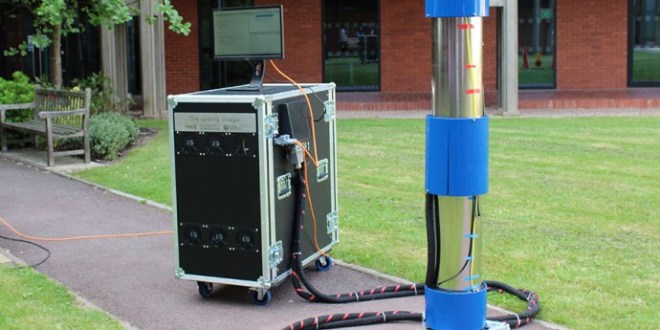
The quantum gravity gradiometer was used to find a tunnel buried outdoors in real-world conditions one metre below the ground surface at the Birmingham University campus.
The sensor was developed by University of Birmingham researchers from the UK National Quantum Technology Hub in Sensors and Timing as part of the Gravity Pioneer project. The research results were recently published in the journal Nature.
The sensor works by detecting variations in microgravity using the principles of quantum physics, which is based on manipulating nature at the submolecular level.
The Gravity Pioneer project is a collaboration between the University of Birmingham, environmental, engineering and sustainability solutions provider RSK, the…
The Israeli company named GenCell recently released findings that show the company was able to produce green ammonia from water using a process that requires significantly lower temperatures and pressures than current methods. This method also produces no carbon emissions, making it a zero emission process.
Green Ammonia is used primarily for agriculture, but is also being developed a viable option to fossil fuel. It is also storable, and could then be converted as needed for fertilizer or power. The breakthrough is not ready for commercial production. If the methodology proves to be cost efficient, as early results suggest it would be, then green ammonia could become far more than fertilizer in the years to come.
Israeli company GenCell Energy has announced they’ve achieved a major scientific breakthrough that enables the production of green ammonia directly from water at a very low temperature and pressure in comparison to the traditional ammonia production processes typically carried out around the world today.
Following their evaluation of GenCell’s scientific breakthrough, Japanese technology provider TDK Corporation announced they plan to continue investing in and developing GenCell’s innovative zero-emission green ammonia synthesis project towards its next milestone.
GenCell, based in Petah Tikva, is the leading provider of hydrogen and ammonia to power solutions.
Back FREEDOM for only $4.95/month and help the Freedomist to fight the ongoing war on liberty and defeat the establishment's SHILL press!!
Are you enjoying our content? Help support our mission to reach every American with a message of freedom through virtue, liberty, and independence! Support our team of dedicated freedom builders for as little as $4.95/month! Back the Freedomist now! Click here