BIDEN EDICT CREATES DNC FIEFDOMS IN FEDERAL GOVERNMENT – Attorney Cleta Mitchell exposes Biden plot to politicize government. She stated, “Politico got a tape from our Arizona Summit in which I was presenting to the group there about how the Biden administration is using our tax dollars to turn every federal agency into a Democratic political operation.”
Cleta Mitchell explains why the mainstream media is out to get her — Because she is exposing the Biden/Democrat plan to use the federal government to get out the vote by enlisting new voters who will support the Democrat cause, all on the taxpayer dime.
“Politico got a tape from our Arizona Summit in which I was presenting to the group there about how the Biden administration is using our tax dollars to turn every federal agency into a Democratic political operation. I used the langue that they used, which is their new Democratic majority… Biden issued an executive order based on a plan that was put to him by a left-wing organization, Demos… and it orders every federal agency to develop a voter registration and turnout program, and they are going to give grants to approved groups… Guess who’s going to approve those groups? Susan Rice.”
NOOSE TIGHTENS AROUND HUNTER, DRAWING JOE IN – Hunter Biden probably violated a 1938 law requiring Americans acting in the interest of a “foreign principle” register with the US government, something Hunter failed to do. As this emerges, more evidence connects Joe Biden to “The Big Guy” referred to emails that connect Joe directly with Hunter’s “foreign principles.”
Hunter Biden failed to register as a foreign agent during years of overseas business dealings — a possible crime that could finally land him in prison, experts say.
While Biden registered as a lobbyist for domestic interests (a gig which so annoyed President Obama that Biden was forced to drop it in 2008), he never registered under the federal Foreign Agents Registration Act (FARA).
The 1938 law has in recent years been employed to shine a light on foreign advocacy and lobbying in the US. It mandates individuals acting as “an agent, representative, employee, or servant … at the order, request, or under the direction or control of a ‘foreign principal,’” must register with the US government. Failing to do so is a crime punishable by up to five years in federal prison and a $250,000 fine.
“Foreign principal” is broadly defined, and can include government officials, foreign corporations, political organizations, influential private…
A text exchange from 2020 involving one of Hunter Biden’s former business partners, James Gilliar, confirms years of speculation about the identity of “the Big Guy,” the New York Post reports.
In an earlier email from 2017, Gilliar outlined the breakdown of profits from a Chinese deal involving Hunter, the president’s brother Jim and a 10% cut for “the Big Guy.”
We’re talking about politically charged deals involving people who want something from a vice president Joe Biden and certainly want something now from a President Biden,” said Peter Schweizer, president of the Government Accountability Institute.
The president has repeatedly denied any knowledge or involvement in Hunter’s overseas deals. Mounting evidence from Hunter’s laptop and phones suggest otherwise.
DNC TERRIFIED OF TRUMP’S POST-2024 2ND TERM PLAN – If Donald Trump gets re-elected, he intends on reinstating his Schedule F Executive Order, an order that would essentially enable him, with ease, as President, to purge his cabinet of DNC operatives. Using this order, he allegedly intends on purging the State Department, the CIA, and the FBI.
President Trump’s administration represents an object lesson in lost opportunities. The ability of the administration to cut the Gordian Knot of the Middle East “peace process” and turn the United States into an energy exporting nation was little short of amazing. That said, the horrible personnel choices made by President Trump and his personal indiscipline combined to create a constant sh**storm that prevented President Trump from ever developing the broad national support he deserved. While the choice of people and intemperate comments would have been background noise, his administration was the subject of a concerted campaign of sabotage and obstruction never before witnessed in our history. The campaign, centered in our “nonpartisan” civil service, robbed President Trump of his first term included a soft coup attempt based on the Russia Hoax and calculated leaks of national security information.
THE GREAT WALL OF TRUMP TO BE BUILT BY BIDEN – Embattled Arizona Democrat Senator Mark Kelly announced the intention of DHS to build the gaps in Trump’s Wall. From his website, “Kelly has urged the Biden administration to close this gap and find solutions that include…upgrading ports of entry, and fencing and barriers where they make sense and are effective.”
… Vulnerable Arizona Democratic Sen. Mark Kelly wants to win in November. Illegal immigration is drowning the state. Gov. Ducey has been sending people on buses to Washington, D.C. But that’s another story.
I guess his susceptibility got to the point he couldn’t ignore it because Kelly pushed President Joe Biden to build a portion of President Donald Trump’s border wall in Arizona.
After many months of pushing the Biden administration to close border barrier gaps near the Morelos Dam, today, Arizona Senator Mark Kelly announced that the Department of Homeland Security (DHS) has authorized Customs and Border Protection (CBP) to move forward with closing the gaps located near the Morelos Dam in the Yuma Sector. Listening to city leaders, local law enforcement, and Border Patrol, Kelly worked to ensure DHS closed the gaps posing security challenges in Yuma.
GALLUP REGISTERS NEW APPROVAL LOW FOR BIDEN – A July Survey from Gallup shows that President Biden has reached a new low in their tracking, registering 38 percent approval versus 59 percent disapproval. Strongly approve stood at 13 percent while strongly disapprove is 45 percent. Only 31 percent of independents approve of Biden’s job performance.
“… Democrats were already facing a tough environment in this fall’s midterms as they seek to retain their narrow majorities in the U.S. House of Representatives and Senate. Biden’s now weaker approval makes their odds of doing so even steeper,” Gallup noted.
2021 VA HOUSE ELECTION UPHELD AGAIN BY FEDERAL JUDGE – US District Judge David J Novak issued a 49-page ruling declaring the results of the 2021 Virginia House Election will not be re-run, despite efforts by the DNC to seek to overturn an election that saw them lose control of the Virginia Legislature, as well as the governorship.
…In a 49-page opinion, U.S. District Judge David. J. Novak ruled the plaintiffs in the case don’t have standing to sue the state and the federal courts lack the authority to order a new election. With early voting for the 2022 elections set to begin next month, Monday’s ruling appears to be the end of the line for efforts to hold new House elections this year.
The case centered on the constitutionality of Virginia’s 2021 elections and the state’s seeming inability to redraw its political maps on schedule due to the late arrival of 2020 U.S. Census data.
The legal challengers argued the state violated Virginians’ voting rights by failing to conduct redistricting on time…
Wall relief at Medinet Habu depicting Ramses III defeating the Sea Peoples in the Battle of the (Nile) Delta, c.1200-1150BC
Warfare at sea has been recorded for at least three thousand years, but fighting on the ocean almost certainly occurred long before Ramses fought his desperate battle. As on land, there are a dizzying array of reasons why a nation may fight on the water. However, the challenges of fighting at sea are vastly more complex and expensive than fighting on land, or even in the air. Only the concept of space-based warfare is more expensive.
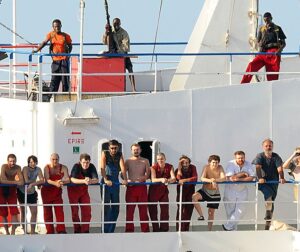
The crew of the merchant vessel MV Faina stand on the deck after a U.S. Navy request to check on their health and welfare, 9 November 2008. Some of their Somali pirate captors stand above them. US Navy photo.
Like land warfare, naval warfare has tenets and goals. Those are, however, vastly different from those of land warfare. Central to that concept, is the definition of a “warship“. While people usually have some idea of what a “warship” is, that definition is usually shaped by modern entertainment media. A warship, at its core, has two defining characteristics: it is simultaneously, any water vessel that is armed – whether that ship is a bass boat or a nuclear-powered aircraft carrier – and conveys the perception of being under the control of a crew that adheres to both military discipline and a “legal” higher authority. This last, is what separates “pirate ships” from “naval vessels”.
Broadly speaking, there are three basic kinds of naval forces. Sometimes, there may be aircraft of various type associated to each force; there may be marines/’naval infantry’ (ground troops attached to the naval force) and there may be some form of “special operations forces” as well. The three basic types of forces we will briefly examine here are categorized as “blue water“, “green water“, and “brown water“.
First, however, we need to address the two basic schools of thought, regarding naval warfare.
Mahan’s central theory argued that control of the sea was vital to a nation’s greatness, and that a navy’s main focus should be on controlling the seas by destroying an enemy nation’s main fleet at the earliest stage of war possible, instead of worrying about a more nuanced approach.
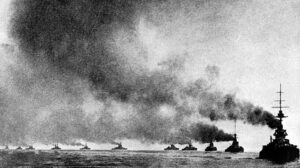
German Imperial High Seas Fleet at sea as at the Battle of Jutland on 31st May 1916.
The naval aspect of World War 1 was inconclusive as to whether Mahan’s theory was correct or not, as there were few fleet actions, and those few were inconclusive draws. However, Mahan formed the basis of both Imperial Japan’s, and the United States’ naval doctrine in World War 2. For the Japanese, Mahan formed the core of their doctrine against Imperial Russia in the Russo-Japanese War, resulting in the decisive fleet action at the Battle of Tsushima in 1905.
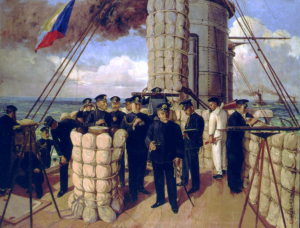
Admiral Tōgō Heihachirō on the bridge of the Battleship Mikasa during the Battle of Tsushima, 27–28 May 1905.Murderer’s Row: U.S. Third Fleet aircraft carriers at anchor in Ulithi Atoll, 8 December 1944. US Navy photo.
However, Mahan’s theories were not foolproof. In fact, they masked serious problems.
Sir Julian Corbett came to naval strategy as a civilian, in mid-life. Already a well-regarded historian, Corbett made friends in the Royal Navy with his more limited and nuanced approach to naval strategy, which offered a more realistic application of naval power projection that suited Britain’s needs as an Imperial power, even in its waning days. While agreeing with Mahan about the importance of sea power to a nation, Corbett took a completely opposite view of how to maintain this, arguing that control of the sea did not necessarily have to depend on smashing the main enemy fleet. He went further, arguing that “control of the seas” could be maintained if the fleet could ensure the security of the nation’s maritime commerce while inhibiting, if not outright halting, that of the enemy. German Grand Admiral and Secretary of State of the German Imperial Naval OfficeAlfred von Tirpitz, dismissed any sort of “commerce raiding” naval strategy (Corbett’s main view, in its most basic form) during World War 1, opting to do his best to use Mahan’s theories against Britain.
By 1945, it was clear that Corbett was the more correct of the two theorists.
Very briefly, a nation’s “fleet” is the total number of warships it has in current service, along with such vessels it might have “in reserve“, which can be quickly brought into service. For some time, during the late-19th Century, there was an idea that a nation’s “fleet” consisted of all of its major ships, operating en masse, in accordance with Mahanian principles.
The United Kingdom largely attempted to adopt this strategy, keeping the bulk of its main battle fleet massed in British home waters, while dispersing a mush smaller portion of its fleet to stations around the world. The United States, however, faced the harsh reality that due to its geography, it would be forced to split its fleet in any major conflict involving a war in both the Atlantic and Pacific oceans. This was proven true in 1941, as the USN was forced to fight in both oceans, simultaneously.
Physical map of the World, from CIA The World Factbook in 2021.
What everyone generally thinks of when hearing the word “navy”, blue water forces focus on three basic missions: projecting national power well beyond the shores of the home nation, defeating enemy fleets, and “maintaining the SLOC.”
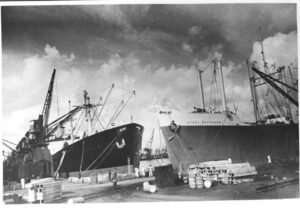
Two US cargo ships docked at Bombay Harbor, 1948
The ‘SLOC‘, or ‘Sea Lines Of Communication‘, are the maritime conduits through which food,
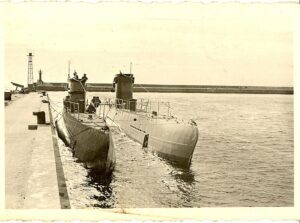
World War II U-boats of Nazi Germany’s Kriegsmarine following their surrender at Lisahally, near Londonderry, Northern Ireland, UK in May 1945. Public Domain
fuel, raw materials and finished goods flow. Very few countries are truly self-sufficient, and a nation under attack has a desperate and immediate need to keep the sea open to merchant vessels funneling supplies to them. It was for this reason that winning the Battle of the Atlantic was so vital to the Allied war effort, because losing it would have forced Britain to surrender; world history would have been fundamentally different had that occurred.
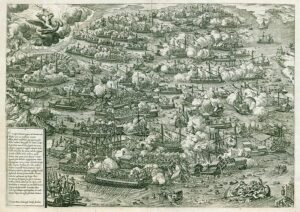
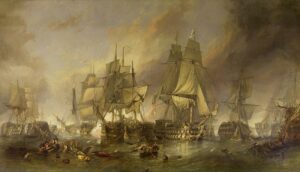
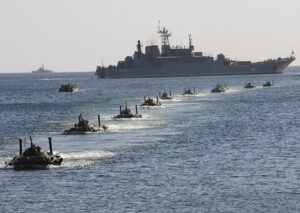
The Battle of Trafalgar (21 October 1805), by Clarkson Frederick Stanfield, 1936Russian Black sea Fleet conducting an amphibious landing exercise, near Crimea, Ukraine, 2012
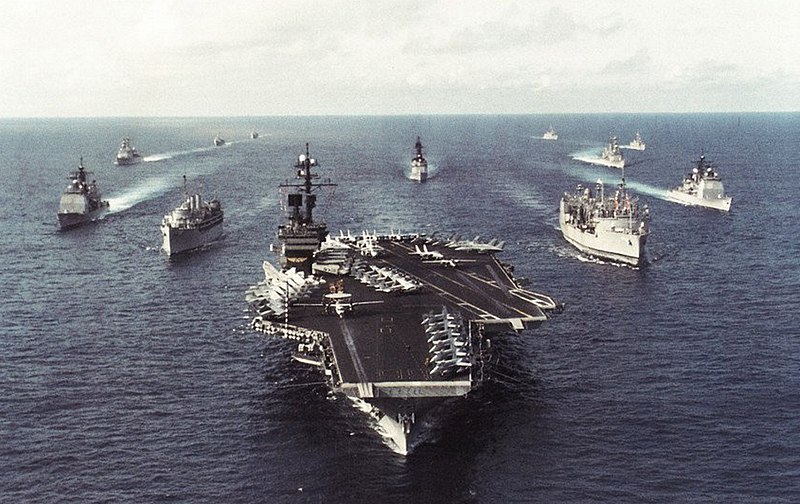
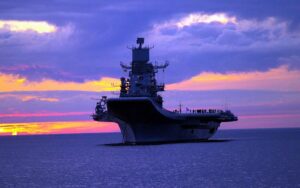
While there have been very few naval battles, as such, in the modern era (and haven’t been since the end of the Napoleonic Period), projecting power is still necessary, as was recently demonstrated by the international anti-piracy patrol off the Horn of Africa, and most famously, by the frequent deployments of the US Navy throughout the world — parking a carrier battle group – containing more fighting power on its own, than the total combat power of most national armed forces…before adding the potential of several thousand US Marines to the mix – off the coast of a restive country is a serious statement, sufficient to give all but the most delusional leader and their supporters serious pause.
While the USN is the only navy currently capable of doing this on any large scale, other countries such as Britain, France and India can deploy smaller but still very powerful forces to trouble spots, actual and potential. The Chinese “People’s Liberation Army Navy“, while large, is not well-practiced in “expeditionary operations“, as yet, and – despite certain breathless reporting – has yet to demonstrate more than a rudimentary capability.
Amphibious assault vehicles from the forward-deployed amphibious dock landing ship USS Tortuga (LSD 46) land on the beach during Exercise Cobra Gold 2012.
However, while some seventy percent of the Earth’s surface is covered by water, the remaining thirty percent is land. This may seem like a throwaway statement, but according to the United Nations, an estimated 60% of the Earth’s population live within 100km (62 miles) of an ocean coastline…it is for this very reason, that the United States maintains the largest “naval infantry” force in the world. While marine units are certainly capable (or should be) of seizing a section of hostile shore or a port area, their primary function is to hold that space just long enough for reinforcments to be landed, or some other limited mission completed. This is because – in a similar manner to airborne forces – most naval landing forces (short of a massive assault landing, such as D-Day or Okinawa) are very light in combat power, relying far more on confusion, fear and intimidation…which only works for a short time.
Green Water operations – taking their name from the shift in color from the deep blue of the open ocean to the “sea green” of coastal regions – primarily involve either getting troops ashore (“over the beach“), or finding and suppressing coastal anti-ship defenses, whether troops are going to be landed or not. It is here, that most naval mines are laid, to restrict access to vital coastal regions. This is also where most “coast guards” operate, whether under wartime missions, or during peacetime, conducting customs and safety inspections, police functions, and the occasional search and rescue operation.
In general, green water fleets are small in total hull numbers, as well as overall tonnage, but their functions are, comparatively, much more complex than those of blue water fleets. However, because the ships are orders of magnitude less expensive – at least, for the strictly defensive functions – this is what most navies in the world are composed of.
Humankind’s first water forces were riverine – they operated on those rivers deep enough to take hulls carrying significant numbers of occupants. In a word, those ships were able to carry enough people to both operate the boat, and fight from it.
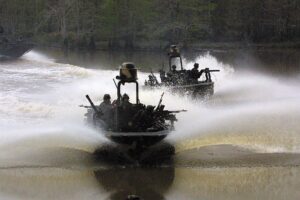
Special Warfare Combatant Crewmen (SWCC) demonstrate the new Special Operations Craft-Riverine (SOC-R) while training at the Stennis Space Center. U.S. Navy photo
Riverine warfare involves the control of waterways away from the ocean shore. Any waterway – natural or man-made – that can be used as a highway to transport people and goods, is a vital conduit for a nation. Good examples are major rivers, such as the Mississippi, the Rhine, the Amazon, the Nile and the Mekong; the list can continue, running into several pages.
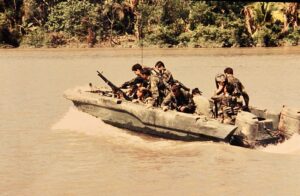
Members of U.S. Navy Seal Team One move down the Bassac River in a Seal Team Assault Boat (STAB) during operations along the river south of Saigon, November 1967.
Ships operating in rivers and delta’s are almost always significantly different in design from their sea-going cousins, but are no less deadly. It is here, where many countries first “dip their toes“, so to speak, in nautical operations. Speeds in rivers and estuaries are generally slower, as is the draft the ships must deal with.
A U.S. riverboat (Zippo monitor) deploying napalm during the Vietnam War
The vessels used in riverine operations can range from shallow-draft, high-speed boats – including small high-speed craft, with a machine gun mount bolted on – to large-scale, heavily-armed, river monitors. These ships are capable of both direct fire as well as indirect fire support missions, forcing enemies ashore to consider their distance to waterways, as well as roads.
Naval Special Forces
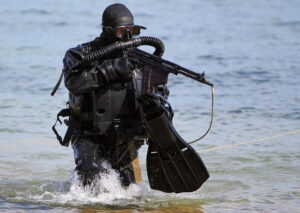
Russian commando frogman of the Caspian Flotilla during exercises
Above, we briefly touched on marines/naval infantry. Here, even more briefly, we will touch on naval special operations forces.
The idea of non-marine special operations forces, while not new, has never before reached a level comparable to that of today. This is largely driven by technology, but parochialism also plays a role.
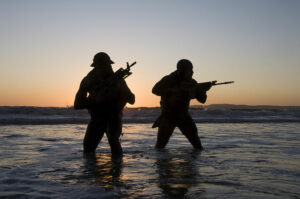
US Navy Seals securing the beach. (Promotional image)
SEAL team member moves through deep mud in South Vietnam, May 1970. US Navy photo.
Like all special operations forces, however, these forces are difficult to employ to their full potential. Their training – of necessity, long and arduous…and expensive – means that they are extremely susceptible to poorly-thought out missions. The numbers of politicians capable of understanding how and when special forces in generally – and naval special forces in particular – should be deployed, is thin indeed.
Conclusion
Naval forces are generally the most expensive sector of a nation’s armed forces. Purpose-built warships represent a very significant investment for any nation, even (perhaps especially) the United States. It is also easy to forget, amid a slew of video games where real people do not die, that even the smallest modern destroyer carries a crew of well over one hundred people…and potentially a crew of thousands.
Anyone talking about naval policy needs to keep that foremost in their minds.
Planning to fight a war is universally seen as aggressive. After all, “planning” to fight a war means that the planner intends to do serious violence to the people their war plan defines as “the enemy”, right? And violence is bad — therefore, war planning must be a bad thing…right?
Well – no.
Countries fight wars. If the reader learns nothing else from History class, it should be that. Now, wars are fought for many reasons; sometimes, those wars are fought for all the wrong reasons, for mistakes and errors of judgement, sometimes for loot or religion, and sometimes, just for the “doing” of conquest.
German troops crossing the Soviet border during Operation Barbarossa, 1941
But, what about “just” wars? Suppose that Country X has “stuff”. Country X is willing to share…but their neighbor, Country Y, doesn’t want to simply share – they want all the stuff. Country X has two options: they can blare a prerecorded message saying “We Surrender!” over loudspeakers scattered throughout the country, as Country Y’s forces march in (this was actually proposed by Leftist politicians in the Scandinavian country of Denmark in the 1980’s; the Danes – being Danes – declined), or Country X can resist.
Insert four and a half thousand years of recorded battle, army creation, training and support history here.
Ramses II at the Battle of Kadesh (relief at Abu Simbel)
Over the millennia, those who study war have been able to agree that certain aspects of warfare are universal. While this is not the venue to discuss all of those common aspects, one of the central tenets is that having a plan – almost any plan – when sharp, pointy objects start flying, is infinitely better than having no plan at all…as the US Army has rediscovered, as it frantically tried to reorient from twenty years of counterinsurgency operations back towards a more “traditional” scope of warfare, especially as the Russo-Ukrainian War grinds onward.
Now, it’s important to define what we’re talking about, here: we are talking about national-level plans. We are nottalking about what the British Army calls “Small Tactics“, the methods of maneuvering small groups of troops in direct combat with an enemy. Neither is it the maneuvering of larger units, such as regiments and brigades, or even divisions and corps‘.
What we are talking about here, is the planning at the national level. Let’s look at the best-documented modern example: the development of the so-called “Rainbow Plans” of the United States of America, in the first half of the 20th Century.
For countless generations after the collapse of the Roman Empire in Western Europe, common thinking on the mechanisms of warfare was usually limited to a very narrow spectrum of people, in any given place and time. It was only improvements in communications and the wider movements of people between states and cultures that opened the door to that interchange, beginning in earnest in the 15th Century: the walls of Constantinople – capital of the Eastern Roman Empire (often called the ‘Byzantine Empire‘) – had stood, impregnable, for over a thousand years before falling to Ottoman cannon fire…and those cannons were largely designed by a Christian Hungarian military engineer.
Foreign Officers and Correspondents after the Battle of Shaho, Manchuria, 1904.
By the 19th Century, it was entirely possible to find many foreign officers serving their respective states as observers in wars their state was not involved in: Prussian officers observed Federal forces during the American Civil War, while their counterparts from England observed the Confederate forces. These officers neither advised, nor took part in the fighting; they merely observed operations. The information and experiences they brought home, frequently helped shape their own armies’ future policies.
Still, however, war planning was generally a very nebulous exercise; it was usually done “on the fly“. Information was usually scarce, and commanders in the field largely had to guess at the situation they were walking into…And, if this sounds like a disaster waiting to happen, it frequently was. This was taken as a “cost of doing business” by commanders, because no one saw an alternative.
Detail from Charge of the 24th and 25th Colored Infantry, July 2nd 1898.
Then-US Secretary of State John Hay might have called it a “splendid little war“, but in point of fact, the performance of the forces of the United States was abysmally bad. It is in no way a stretch to say that the United States won the war more because Spanish forces were even more incompetent than those of the USA were. Once the stirring sounds of marching bands and the cheers of the crowds faded in the war’s aftermath, the US Army and Navy faced the cold, hard fact that their respective on-scene commanders both pursued separate and uncoordinated theater strategies, and neither had either the information or support – intelligence or logistical – to properly execute the separate and mutually exclusive campaigns they had been assigned to pursue. Where the United States had been able to project military power beyond its shores fifty years before, and to effectively coordinate continent-spanning joint operations forty years prior, something had gone badly wrong.
The result, in 1903, was the formation of a Joint Army and Navy Board.
HMS Argus, 1918. US Navy photo
The Board’s mission was to plan for potential wars that the United States may need to wage. Since the 1870’s, the United States – like many European powers before it – had become increasingly tied to foreign trade; instability in a foreign land had the potential to cause significant damage to the US economy, if not start an actual shooting war. US military power at that time was nowhere near what it is today – the prospect of a hostile navy conducting a devastating shelling of US coastal cities was a very real concern.
Red guard unit of the Vulkan factory in Petrograd, October 1917
Much has been made, over time, about the Joint Board and its supposedly isolated and insular nature, operating outside the reality of geopolitics. In fact, the Joint Board began by only acting on information fed to it from the civilian State Department. In the aftermath of the Russian Revolution of 1917, pre-planning major-war operations assumed new urgency. Like Iran some sixty years later, an ally quite literally changed from a friend to a potential enemy overnight.
As well, the context of the times must be understood. The United States had treated the Atlantic and Pacific Oceans as very large “moats” for most of the preceding 125 years…Yet, in the space of barely 17 years – from 1891 to 1904 – the United States has seen not only technological advances that saw massive vessels crossing the Atlantic in barely a week, but had also seen a near-war with Chile that would have required sending naval reinforcements all the way around South America with no guarantee of bases and possible hostile state’s navies in the way, as the strategic shortcut of the Panama Canal had not yet been built; the aforementioned Spanish-American War; the Second Boer War, where great Britain had deployed nearly half a million troops from around its world-spanning empire to a theater that defined the term “remote”, and introduced the term “concentration camp” to the modern English language lexicon; the Boxer Rebellion and the joint-international Peking Relief Expedition; the Philippine Insurrection; and the Russo-Japanese War, best thought of as the beta-test for World War 1, as it was only missing the poison gas and airplanes. The United States was now facing a serious threat of possible invasion from non-Western Hemisphere industrial powers, who were capable of matching US military power.
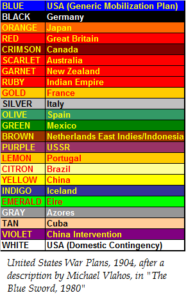
The Joint Board thus began examining as many potential conflicts as it could realistically foresee, as evidenced by the list of plans they produced at some level, between 1904 and 1945:
Some of these plans are well known, such as ORANGE (the war plan to defeat the Empire of Japan), and RED (the war plan to fight Great Britain, the subject of a somewhat breathless documentary by Britain’s Channel 5, in 2011). But the rest of the plans reflected the reality of the United States’ strategic situation in the first four decades of the 20th Century.
One aspect of these plans were the so-called “Rainbow Plans“, begun in the 1930’s, that postulated potential wars against alliances of multiple states on the list.
So — what goes into a war plan at this level?
The primary purpose of a nation’s strategic war plan against a potential enemy, is to present a realistic assessment of that potential opponent’s capabilities. Assessing the strategic intent of an enemy is not usually a concern for the war planner, because – as in the case of both Russia and Iran – those intentions can change with surprising speed. A war plan focuses on the actions of the “friendly country” once war has been declared, or (as was the case after the Japanese attack on the US naval base at Pearl Harbor, Hawaii) once combat operations have commenced.
A war plan is a theoretical blueprint. It seeks to present “best options”, based on the best available assessments of the potential enemy in question:
What resources does the enemy possess? What are the points of entry into their country?
What targets and systems need to be attacked, in what order?
What forces and facilities of the enemy need to be attacked immediately, and which can be bypassed, and dealt with later?
What are the enemy’s capabilities to strike your country and its forces?
These are not questions that can be addressed on the fly. The information takes time to assemble, and planners are only human – the cycle of information intake, assessment and employment cannot be accelerated at short notice. A war plan, then, uses the most accurate information available to make general plans. Those general plans are far easier to alter based on current information flowing in, than starting from scratch. Broad operational orders can be disseminated to commands beforehand, to get the right forces moving, in the right order, in the shortest possible time.
But…Why is this important?
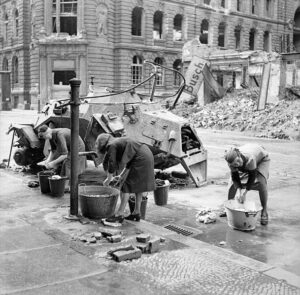
German women doing their washing at a water hydrant in a Berlin street.
No one profits from long wars. The faster the decision cycle, the faster that decisive, war-winning dominance can be gained by one side or the other, the faster the war ends, and the fewer people die…And therein lays the secret that anti-military people hate to acknowledge: the best militaries always seek to win as quickly as possible, with the fewest number of deaths to the “friendly” side — and, more likely than not, fewer deaths on the “enemy” side. That requires states to quite literally spend money on guns, instead of butter: to plan, prepare, stockpile equipment, train troops, maintain ready forces and update all of those things as necessary, against the day when they may be needed.
The core of the war plan, then, is a clear understanding of what the planning force is to accomplish, in the shortest possible time, with the most effective expenditure of people and resources.
Failure to plan effectively, inevitably leads to complete failures of strategy, and long, bloody wars, that can last interminably, wrecking the economy of the country and killing entire generations of youth.
Would, that leaders of the first part of the 21st Century had listened to the leaders of the first part of the 20th.
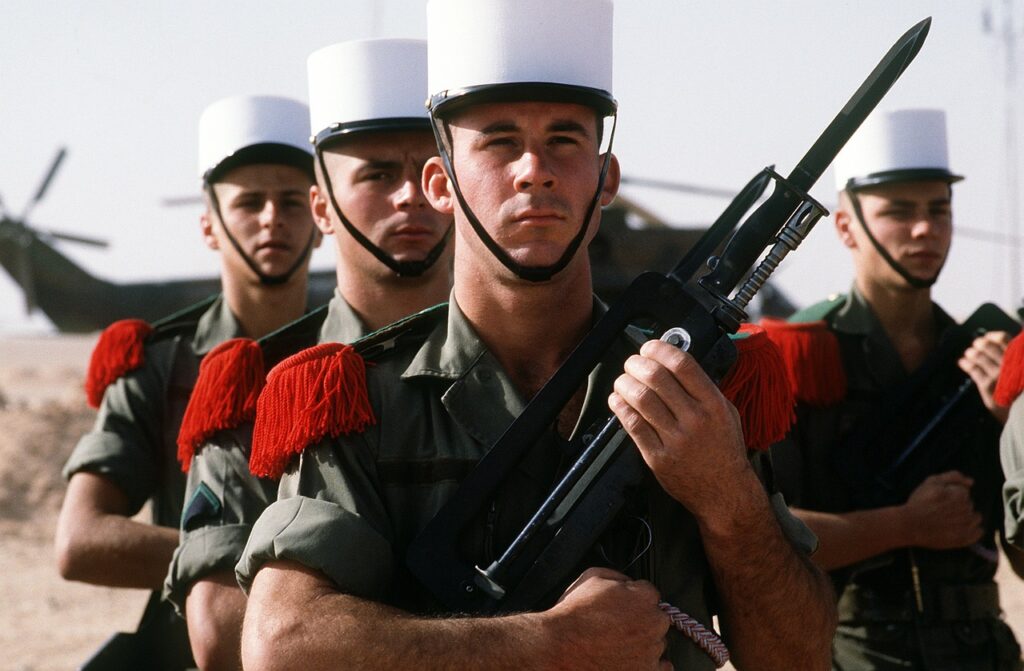
Foreign legions have existed for centuries, but in their generally-accepted form, have only really existed since roughly the end of the 1700’s. Unlike condottieri of RenaissanceItaly, “foreign legions” are not, strictly speaking, “mercenaries“, in that they are not usually specialists hired for one-time contract work, who remain separate from a nation’s actual armed fores, but are organized, uniformed and disciplined units of non-citizen foreigners, organized into separate units by the recruiting nation.
French Foreign Legionnaire firing machine gun
Most famously used by France, one of the harsh truths of foreign legions is that a nation usually finds them necessary only when their own populations are unwilling or unable to serve their nation effectively in the military. There is growing evidence that the United States of America may have reached a point where a foreign legion is a necessity.
Baron Steuben drilling American troops at Valley Forge in 1778.
The United States has always had foreign volunteers in the ranks of its military forces: whether as mercenaries or starry-eyed volunteers in the American War of Independence, through the German immigrants who fought for the Union in the American Civil War, to individuals from nations suffering under the rule of hostile foreign powers (this author served with several such volunteers in the 1980’s), non-citizen foreigners are no oddity in US military service. However, times are changing, and it may become necessary to rethink how the US military operates.
Draft-age Americans being counseled by Mark Satin (far left) at the Anti-Draft Programme office on Spadina Avenue in Toronto, August 1967.
Since the end of the Draft in 1973, the United States has had an “all-volunteer force” (or, “AVF”). Better-educated, on average, than the mass of draftees that it replaced, the AVF is also smaller in total numbers, even as the relative budget for the military in general has grown exponentially. The reasons for this are many, but boil down primarily to a desire for more remotely-operated weapons to keep US troops out of harms way as far as possible — as the military learned the hard way in Vietnam, dead American troops coming back in flag-draped coffins tend to cause a media frenzy, that paints even successful military actions in a poor light. One result of this, has been an increasingly smaller number of American citizens willing to volunteer to serve, because competition from the private sector is intense.
Quietly, in the background, a slowly worsening situation is developing, a situation that severely threatens US national security.
As recent articles have pointed out, American youth – now, as many as 70% – are unfit for military service. The situation is bad enough, that the military is seriously considering bringing in civilian specialists for direct commissioning (now termed “lateral entry”), because they cannot find enough suitable recruits. The reasons are many, but boil down to five core problems, either singly or in combination.
US Army Sgt. Ryan Moldovan throws a practice hand grenade at Fort Jackson, S.C., Sept. 7, 2016.
First, there is a noticeable epidemic of obesity in the United States. The US is not alone in this, as the problem does exist is several other developed countries, but the cold facts are that too many young people who would otherwise be excellent prospects for recruiters are simply too physically unfit to pass even the most basic physical fitness course. Recruiters try very hard to get these prospects into shape, but the results often end in failure. This situation has grown to the point where the US Army has actually dropped its requirement to – of all things – demonstrate proficiency in throwing hand grenades to 25 meters, one of the most basic duties of the infantry.
USMC Sgt. Jennifer Wilbur, Sgt. Jennifer Wilbur, poses for a photo at Camp Lejeune, North Carolina, May 1, 2020.
Second, reductions in military budgets, mated to extreme costs for high-dollar, high-tech weapons programs have forced reductions in overall troops numbers, to a point not seen since the early 1940’s. This has led to arbitrary, petty, toxic and damaging practices that directly impact both troop morale and reenlistment figures; critically, this is also hemorrhaging combat-seasoned talent from the various services.
Third, is the widening percentage of US youths who cannot pass even highly “flexible” criminal background checks. Debates about various civil/criminal policies aside, a critical factor in not finding suitable recruits is the fact that many youths get into real trouble before they can be enlisted.
Fourth, is a problem that has existed since the end of the Draft: civilian sector competition. Bluntly, without a Draft providing a steady stream of troops, the various armed services have to compete with civilian companies for talent…and with the aforementioned budget reductions, the military services find it extremely difficult to compete with civilian companies, given the requirements of military service: most introductory-level civilian jobs do not involve you getting shot at. Additionally, since 2002, the military has had to compete in earnest with the rise of “private military contractor” (PMC) companies — where this was rarely a factor affecting both enlistment and reenlistment in previous decades, the surge in use of PMC’s – including in high-threat combat areas – has sparked investment in those companies that aggressively recruit talent from the military, talent (usually either special operations troops, or aircraft technicians) that has been expensively trained, and that the military desperately wants to keep, but cannot, for parsimony.
Last, is a crushing sense of ennui – bordering on existential nihilism – in a disturbingly high percentage of US youth. This serious emotional crisis breeds a distrust, if not outright disgust, with anything concerning governments, militaries and higher ideals in general. And again, there are numerous reasons for this, none of which can be resolved by military establishments.
You can only work with what you are given.
Yet, “spear carrying” troops are still needed. As military professionals are all too painfully aware, no matter how high-tech your military machine, you still need some kid with a rifle and a bayonet to stand on a patch of dirt, and dare anyone to come and kick them off. The recent casualty rates, coupled to the abject failure of Russia’s “BTG” (Battalion Tactical Group) in the Russo-Ukrainian War have highlighted the fact that mass mobilization and mass armies are definitely not relics of a bygone era – when you need them, and do not possess the structure to generate the numbers, you are in serious trouble.
Despite all its political, societal and economic woes, the United States still has immigrants flocking to its colors every year, so many, that artificial limits to legal immigration remain in force. These immigrants leave their homes, precisely because they still believe in what used to be called the “American Dream“…and many are more than willing to fight for that dream. Those artificial limits, however, only encourage emigres with “desirable” skills, and a desire to “fix bayonets and charge” is not usually on that list.
So — shouldthe United States begin an active program to recruit a “Foreign Legion”? Not as individual recruits, as is done today, but as separately organized units, officered by Americans, but whose ‘other ranks’ are universally non-citizen, in the same manner as the French Foreign Legion?
On the plus side, such units are not staffed with too many “American Boys and Girls“, and consequently will not produce as visceral a negative reaction in either the press or the electorate when they soak casualties on the battlefield.
On the down side, forming a Foreign Legion is essentially an admission of defeat. To paraphrase the words of author Robert A. Heinlein, if a citizenry will not volunteer to fight for its country, does that country deserve to continue to exist?
More darkly, on the third hand, if the country does deserve to continue, is it time to rethink exactly what “citizenship” means for the United States in the 21st Century?
The United States of America is an ongoing “noble experiment“, an experiment that many still believe in, that many believe is still worth fighting and dying for. There is a decisive break-point in this argument, however, and that break-point of decision is rapidly approaching.
“Who is this pinnacle of trust-busting that has earned the ire of evil? Gigi Sohn….capable of breaking up Sinclair’s right-wing propaganda machine.” – Movement Labs
—
The nominee appears to be on the ropes, but no vote has been called for so far, though time is running out on the nominee’s consideration.
Back FREEDOM for only $4.95/month and help the Freedomist to fight the ongoing war on liberty and defeat the establishment's SHILL press!!
Are you enjoying our content? Help support our mission to reach every American with a message of freedom through virtue, liberty, and independence! Support our team of dedicated freedom builders for as little as $4.95/month! Back the Freedomist now! Click here















 remotely-operated weapons to keep US troops out of harms way as far as possible — as the military learned the

 Third, is the widening percentage of US youths who cannot pass even
  Fourth, is a problem that has existed since the end of the Draft: civilian sector competition. Bluntly, without a Draft providing a steady stream of troops, the various armed services have to compete with civilian companies for talent…and with the aforementioned budget reductions, the military services find it extremely difficult to
  Last, is a
  Yet, “spear carrying” troops are still needed. As military professionals are all too painfully aware, no matter how high-tech your military machine,
  So — should the United States begin an active program to recruit a “Foreign Legion”? Not as individual recruits, as is done today, but as separately organized units, officered by Americans, but whose ‘other ranks’ are universally non-citizen, in the same manner as the