To give our non-military readers a very basic overview, the better to understand the problem, let’s take a brief look at the framework of supply in the military sphere.
Warfare destroys and wastes whatever it touches – both people and equipment. People can be recovered (where that can be possible) through medical treatment and counseling.
But what about equipment?
Kansas Army National Guard Soldiers work to package and stage personal protective equipment. (U.S. Army Photo by Sgt. Ian Safford, 105th Mobile Public Affairs Detachment)
Everything a military force needs – the “beans, bullets and band-aides,” if you like – can be categorized, ordered, received, inventoried, issued and turned back in at will. The trouble is getting all of those actions to work in sync, on time, and (hopefully) in something close to the right amounts. For the most part, your humble author is happy to stick with the US Armed Forces system, not simply because it is what I am used to, but because it is more precise than comparable systems, while also not being overly cluttered.
Oshkosh M-978 fuel servicing trucks line a holding area during Joint Logistics Over the Shore (JLOTS) training, part of exercise Ocean Venture ’92. An M-901 TOW vehicle is parked to the left. US Navy photo.
Class I– Rations – Subsistence (food and drinking water), gratuitous (free) health and comfort items
Class II– Clothing And Equipment – individual equipment, tentage, some aerial delivery equipment, organizational tool sets and kits, hand tools, unclassified maps, administrative and housekeeping supplies and equipment
Class III – POL – Petroleum, Oil and Lubricants (POL) (package and bulk): Petroleum, fuels, lubricants, hydraulic and insulating oils, preservatives, liquids and gases, bulk chemical products, coolants, deicer and antifreeze compounds, components, and additives of petroleum and chemical products, and coal
Class IV – Construction materials, including installed equipment and all fortification and barrier materials
Class V – Ammunition of all types, bombs, explosives, mines, fuses, detonators, pyrotechnics, missiles, rockets, propellants, and associated items
Class VI – Personal demand items (such as health and hygiene products, soaps and toothpaste, writing material, snack food, beverages, cigarettes, batteries, alcohol, and cameras—nonmilitary sales items)
Class VII – Major end items such as missile and rocket launchers, tanks, mobile machine shops, some parachute systems and vehicles
Class VIII – Medical material (equipment and consumables) including repair parts particular to medical equipment
**Class VIIIa – Medical consumable supplies not including blood & blood products
**Class VIIIb – Blood & blood components (whole blood, platelets, plasma, packed red cells, etc.
Class IX – Repair parts and components to include kits, assemblies, and sub-assemblies (repairable or non-repairable) required for maintenance support of all equipment
Class X – Material to support nonmilitary programs such as agriculture and economic development (not included in Classes I through IX)
Miscellaneous – Water, salvage, and captured material
Saraktash scrap-heap. By “Imankulov”, under CCA/3.0 Unported.
My only real complaint about this list is the last item, because the only true “miscellaneous” items are truly ‘scrap‘ materials. Thus, I use the following, in addition:
Class XI – Non-potable Water
Class XII – Captured/Recovered Material
Of these, “Class XI” (Non-potable water), is the simplest: Non-potable (i.e., non-drinkable) water is fine for washing equipment, fire-fighting and for flushing out waste.
An Iraqi AML-90 light armored car captured during Operation Desert Storm. A captured ZPU-23-4 anti-aircraft machine gun is at right. USMC photo.
Class XII(Captured/Recovered Material) are the various detritus that can be scraped up from a battlefield, including enemy material. The process for handling this class of gear (whether from a friendly, liberated, requisitioned or enemy source) is as follows:
a. The materiel is brought into a receiving yard, where it is identified, categorized and assessed for serviceability. Anything of direct and immediate interest to Intelligence goes straight to them. For everything else, we move on to…
b. Type Classification and Field Stock Number Registry: Materiel recovered and brought in should have a tag applied to them, then be classified with a temporary Stock Number, first, using the Supply Classifications as listed above to categorize the item. Then, after applying a two-digit number for the supply class, add one of the following qualifiers after the class to the item tag:
(x) – Material recovered from allied/friendly military sources
(y) – Captured/Liberated enemy material
(z) – “DIY”, improvised, ad hoc or requisitioned from civilian sources
Then, add the appropriate qualifier from the following list:
(A) – Ready To Issue; the item can be issued immediately, with minimal servicing and/or repainting. It should be tagged, and placed into an appropriate storage slot
(B) – PM Required; minor maintenance/clean-up required prior to reissue. This should be forwarded to the appropriate maintenance queue
(C) – Major Repairs Required; the item is repairable, but is dead-lined until it can be repaired. This should also be forwarded to the appropriate maintenance queue
(D) – Sub-Assembly Salvageable; the complete item is too damaged to reissue as a complete unit, but can be broken down into its constituent sub-assemblies (i.e., brake drums, alternators, engines, various major components, etc.) to issue in order to repair other items. This process should be commenced immediately, using either unit specialists, or civilians hired on contract.
(E) – Scrap; the item is damaged to the point where it can no longer be used. This material should be towed or set out of the way, and should either be returned to a manufacturing area for re-smelting/recovery, or sold off. Depending on the material, it may be able to be repurposed into engineering barrier or shelter material.
This is more an essay than a quick article. The views hear-in are those of the author, alone.
As a certain writer once said, there is nothing wrong with fearing pain, deprivation and hardship…and I agree. Hence, I am a “survivalist” (rr, “prepper“, if you prefer). No — I don’t have the elaborate underground bunker (I wish!), and no, I do not sit on a mountain of supplies (again, I wish!), but the attitude is there.
I think about it. I plan for it. I continually assess and reassess my options.
So I wondered: where does this come from? Why have I always been concerned about massive damage, and massive dislocations of society? Am I weird? Disturbed?
Well – I grew up in California, so…Yeah — pretty much…And for all the Californio’s reading this: How many of you remember the “earthquake exercises” we used to do? You know the ones: Do you know where the key is, to turn off the gas in case of an earthquake? So the house doesn’t explode? Did you make up earthquake kits in school? Bottles of water, before it was fashionable, and cans of Chef-Boy-Ar-Dee and Campbell’s Pork-n-Beans, squirreled away in corners of the house, so that at least one or two would be sure to survive a big shaker?
…Then, of course, it was the early 80’s. And yes — I’ve been at this since the early 80’s. I’ve already made all the mistakes you need to avoid.
So, what is the point of all this?
Recently, in the last few years, there has been a rise in “reality” programming of so-called “prepper” shows, chief among them, National Geographic Channel’s “Doomsday Preppers“, where the show visits various “survivalists” – or “preppers” – and documents their ideas and strategies. Other shows work on a similar format.
The only problem is, the entire thrust of most of these programs is to demonize anyone involved in “prepping” as a paranoid freak, resulting in many people shaking their heads, and turning away from the very idea of carrying more than a tire iron and a set of jumper cables in their car.
This is a disastrous situation, one that magnifies the already terrible effects of a disaster – be it natural or man-made – by planting the seed in people’s minds that it is “crazy” to prepare for a disaster.
How do these shows do this? By highlighting one of two conditions, and magnifying them far out of proportion, for the “Wow!” effect: the shows seek the most extreme survivalists, and seek to show either their “vast” resources or their “extreme” views, or both. Normal, rational people see these views as either unattainable or dangerous and frightening, and stay away from the entire idea…
…Which is usually about the time a major disaster befalls them.
In fact, disaster preparation is much like insurance — a person does not get home insurance because they intend to destroy their home, they get it, in case some disaster (earthquake, fire, flood, hurricane, a car driving through the front wall, etc.) might happen at some point.
Preparing to mitigate the effects of an extreme disaster is no different.
US Navy Lifeboat Survival Kit, c.1943. US Navy photo.
For all that, there are a lot of well-meaning people out there trying to prepare for “Disaster ‘X'”, who are wasting precious resources, money, brain sweat, real sweat and time operating along a very poor planning cycle.
First, there has to be a clear understanding of what I call the “Survival Breadbox” — an interactive rectangle of arrays of items that define capabilities. Most people approach the Box neither knowing what it is, nor really understanding it, and only perceive it in a disjointed fashion; in fact, failure to understand the Box is why many preppers give up, as it looks far too complicated and frustrating. However, once you understand the Box, you can start planning effectively, and – most importantly – successfully implementing those plans.
The reason I describe the Box as an “interactive rectangle” is because there are four points to it…
The “EEK”
The Week-Long 72-Hour Window
The Cantonment
The Panoply
The reason these are in a rectangle, rather than a hierarchy, is that they feed off of each other, and operate together to form a cohesive whole — you can function without one of the corners for a while, but you had better address it, and FAST, before you run into a situation where you.
One of the most common mistakes preppers make is to plan for “Disaster ‘X’“…only to have “Disaster ‘L’” show up. I tend to take this from the point of view that anything that significantly disrupts the nation’s logistical infrastructure for more than a week is the “worst case”.
Roadway damage, Oslo, MN, May, 2009. FEMA photo.
Why? Because the country functions on its logistical infrastructure — you might garden, but how many reading this grow their own cotton, harvest it, process it, and make clothing out of it? How many people reading this can go out to a local store, and buy a metal object that was made locally, that went straight from raw ore to a finished product, “locally” being defined as “within 100 miles from where you live”?
Based on that, chances are good that the person reading this got every single thing in their house from off of a truck, something that was made somewhere else, and rather far away…including the food in your fridge. And if the system that makes all that flow smoothly is disrupted, everything will quickly get seriously out of whack, as every business requires a steady flow of widgets to function — and even if the place that makes Widget A still functions, and can get its product to its customer, that Widget is useless without the other 30 or 30,000 widgets that make the final product work.
Most preppers recognize this at some level, and don’t know what to do about it…so they try hard to ignore it…
Let’s look at each point in the Box.
First, is the “EEK” — the “Escape and Evasion Kit“. This is almost always currently referred to as a “bug-out bag“, or a “Get Out Of Dodge” (GOOD) kit. I casually detest both terms. Why? Because they put people in the wrong mindset.
If you are “bugging out” or “getting out of Dodge“, this implies that you will have some warning, so it might be appropriate to take “whatever you can carry“…
…Folks – you’re not packing to go hiking at Aspen. So why, oh, WHY do you carry five ways to start a fire? This isn’t the Scouts.
If you actually needto use a kit like this, things have gone ‘BLOOEY‘ in a major and surprising way, and you suddenly need to get from Point A to Point B — on foot. Now, if the ‘BLOOEY‘ has happened, just how many otherpeople do you think are going to be trying to get to an area somewhere near Point B?
Then WHY ARE YOU DRAWING ATTENTION TO YOURSELF WITH A FIRE? Worse – COOKING?! People who are scared and hungry will come after you like a moth to a flame. Why? Because sound, light, and smell all carry a LONG way, and while someone alone might not want to risk a confrontation on Day 1, what about Day 2? Or Day 4? What happens when their children are hungry, and you don’t have enough food to share?
Now, the truly selfless will try to help as many as they can, as quickly as they can – and that’s a good thing…under normal circumstances. What happens when things are no longer ‘normal‘? What happens when you have to decide between the children of a person you’ve never met, and your ownchildren? Not as easy a question, now, is it?
Ain’t moral dilemma’s great?
First rule of the EEK: Do NOT draw attention to yourself.
Second rule of the EEK: Travel light!
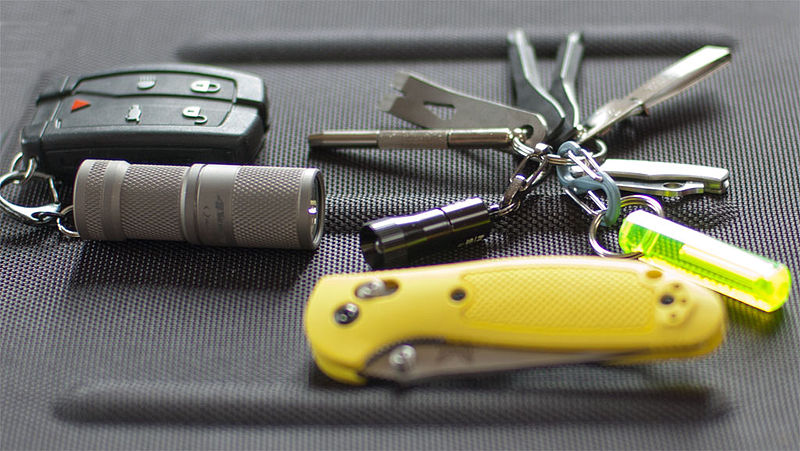
What should be in an EEK? Everyone will customize it, but try this yardstick: if your EEK won’t fit into a common student backack, you have too much stuff in it…
A military-spec rain poncho
A first aid kit
A multitool and/or a Swiss Army Knife
A 4″ lock blade Knife
Two methods of purifying water that do NOT involve fire
At least one quart-sized water bottle (like a Gatorade bottle or a military-style canteen)
Now, most preppers have seen this before, and are thinking that is waaaay too light for three days. Yet, you can in fact carry a three days of food in a small day pack, if you are using USCG Ration packs…you don’t even need to carry too many extra condiments.
As well, let us not discuss the person with the fifteen knives (seriously — the video will leave you slack-jawed) in their kit.
Remember: The EEK is supposed to get you from Point A to Point B, on foot, in 3 – 5 day’s time. Planning on anything else means that you need to use the next tier…
Next, we’ll look at the “Week-Long 72-Hour Kit“.
Preppers frequently talk about the “3 day’s worth of supplies“. I’m not entirely sure why. In fact, the only reference I know of about this time-frame comes from a now-outdated FEMA flyer…Refer to Hurricane Sandy.
This is your “standard” disaster kit. It is intended to help you survive-in-place until help arrives. FEMA says “a few days”; 5 is realistic; 14-90 days is not a bad idea.
Note that this is not intended for you to carry — the amount of supplies and equipment is too great to carry on your back, and if you plan on being on the road for longer than three days to reach your cantonment (q.v.)…you need a better plan.
The only “prepper”-type features you will likely see in this kit are 55-gallon water barrels (based on 5 gallons of water, per person, per day; yes, you can get by with one gallon per person/day, but you won’t like it) and various types of stoves, grills or Dutch Ovens for cooking without electricity or gas.
And speaking of water, make sure to not simply store a few bottles of it – you need ways to purify it, preferably ways that do not involve fire. These methods involve bleach (16 drops to the gallon, per FEMA), or some sort of filtration system…As an aside, you should really look into your local laws concerning the capture and retention of rainwater — you may be both alarmed, amazed, horrified and outraged at just what some of these laws actually say. Forewarned, etc.
One of the advantages in this, similar to the Cantonment, is that you can eat what you are accustomed to eating normally, albeit with different cooking methods. If you’ve never tried to make rice on a Weber Grill — you need to get on that.
Since you’re not planning on moving, you also do not need to worry overmuch about things like cold storage, unless you take medications that require refrigeration. For that, you may want to look into either a solar PV power station, or a small gasoline-powered generator, to run a portable fridge.
Since you’re already at home, you don’t really need to acquire too much in the way of “special” foods, although you do want to make sure that you maintain a 5 – 14 day stockpile of food, minimum, of the kind of foods that will keep for a long time. (Hint: The expiration dates on canned goods are there for two reasons: to get you to rotate stock, and to absolve the manufacturer of legal responsibility if you are stupid enough to eat from a bulging or stinky can.)
Properly sealed canned goods, in cans that are not badly dented, will keep and be both edible and nutritious (I did NOT say “Will remain tasty”!) for up to 10 years; however, this DOES NOT apply to high-acidity foods like tomatoes.
Another important aspect of this kit that is shared by the Cantonment is the easy access to distraction materials — i.e., books and games.
What?
Role-playing dice set.
Hey, if a disaster has happened, and things are in the process of going back to normal, you are going to have a lot of downtime; it’s not like you’re going to be at work. Without power, your laptop/device batteries will die out fast, and roll-up PV panels only go so far. So…Have “distraction tools” ready to hand: boardgames, cards, RPG’s (the paper and pencil kind), and most importantly, BOOKS.
Third, we’ll look at the “Cantonment“.
This is a word derived from military use to describe a permanent or semi-permanent installation. In the early 80’s, when big-S ‘Survivalism’ was in the public consciousness, this was called the “Survival Retreat”.
The main idea goes like this: You have a workaday life and home in The Big City…but you have a “cabin in the woods”, or a patch of undeveloped land that you pull an RV onto to “camp” every now and then. However, you realize that if anything truly terrible happens, and things go south with a quickness, staying in the Big City is a B-A-D idea. The Retreat, or Cantonment, is the place you are going to “take a sudden vacation” to as things go ‘BLOOEY!’ In the event of a sudden-onset disaster, you may find yourself using the EEK, above – or even the Panoply, below – to ‘exfiltrate’ (i.e., “Get the F— OUT, NOW!“) out of the City.
Does that sound paranoid to you? You certainly don’t seem to think that it is, if you’re still reading this, this far in…That’s because you are likely old enough – or at least Net-savvy enough – to re-watch the aftermath of Hurricane Katrina and/or the Rodney King Riots in Los Angeles to realize that, if things go south badly, even if order gets restored eventually, what condition are you going to be in, if you try to “stick it out” at home?
Now – just imagine what will happen when “…order will not be restored for ‘some time’…maybe as long as three to six months“. (That, incidentally, is a verbatim quote that I got once, I kid you not, not from any wild-eyed, ‘tin-foil-hat’ person, but from an executive of a major international corporation, in a public meeting…)
The Cantonment is a piece of property set out “in the sticks” (which is different, depending on who you talk to). It could be a bare spot of land, an empty-appearing field with a bunker buried underneath, or it could be an actual “Summer/Winter Home“…But one well-stocked, with a good deal of supplies socked away.
Whatever Cantonment model you choose, its location should not be more than one half-tank plus 10 gallons of gas in your primary vehicle in distance from your home; for most people, this equals about 400 miles, at the low end. Really, you shouldn’t be driving more than 200 miles if things are breaking down, unless you are making the Cantonment your full-time residence.
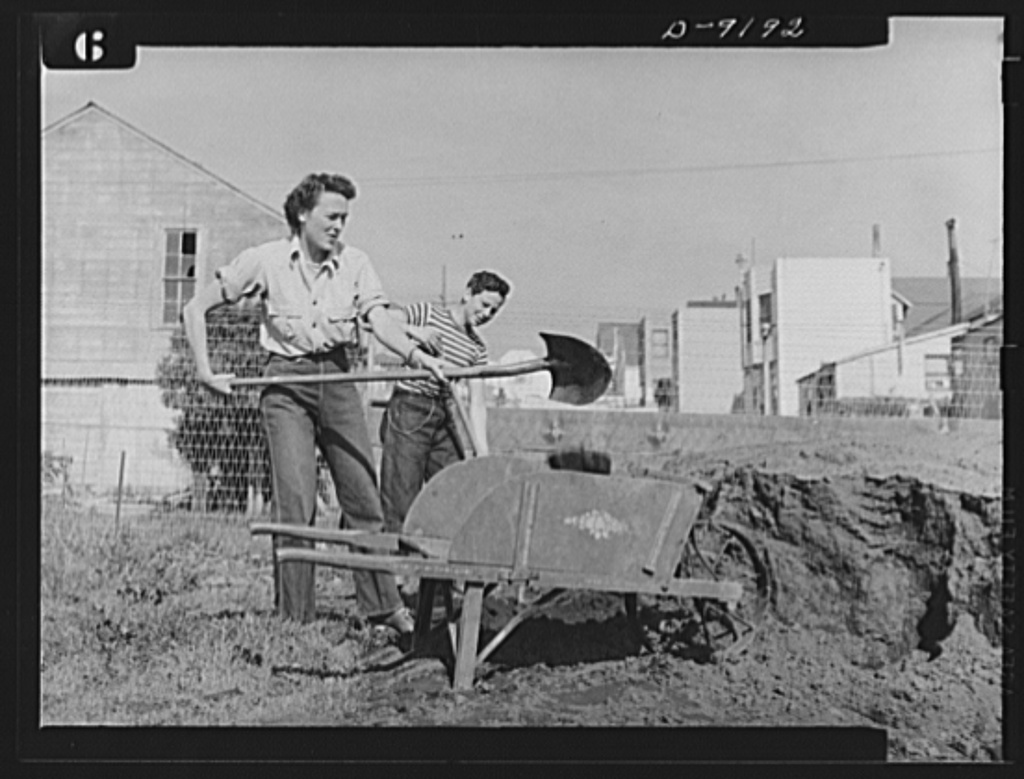
Whatever the case, the Cantonment needs to have some kind of land on it, even a measly quarter-acre. This is because, when things go ‘BLOOEY!’, you will need to get a ‘Victory Garden‘ going, and fast…
Victory Garden, 1943. Library of Congress.
Note that I said ‘Victory GARDEN‘. Singular. You might be able to plant two or three plots, maximum, but unless you already know what it’s like…don’t plan on being a “farmer”. If you haven’t worked the job, you have absolutely NO idea how back-breaking of a job it truly is. You need to get on the gardening bandwagon now, if you haven’t, already.
One thing most people thinking about a Cantonment do not think of is ‘community’. Believe me – ‘No Man Is An Island’ is the name of the game, here. You, the ‘significant other’, two kids and the dog do not an effective defense force make. Get to know your neighbors – NOW – and try to get a good idea of where they stand and what they plan to do. If they plan on sticking around, bring them in gently, and ply them with their favorite “tasty beverage”. If things are going to hell, friendly neighbors with a joint plan beat the heck out of the alternative.
This brings us, at long last, to the fourth point: the Panoply.
The US Army Soldier Protection System, 2019. US Army photo.
The word ‘panoply’ comes from the Greek word ‘panopilia‘ (πανοπλία), meaning literally, “all arms“. The Panoply was the complete ‘fighting kit’ of the ancient Greek fighting man, the Hoplite. It included his weapons (spear, sword and dagger), his armor (shield, cuirass, and greaves), his sandals if he wore any, and all the rest of the gear he wore on the march.
…”Oh, no! Here we go, with the “militia” rant! I KNEW it was coming!”
Yes. And?
Look — I appreciate the idea that people generally do not wish to do violence to their fellow human beings. I get that. Really. However, I hate to be the bearer of bad tidings, but a whole lot of your fellow humans to not feel the same way — make them hungry, tired and scared, and it will be infinitely worse.
We haven’t even started discussing already-organized gangs.
One of the basic principle of Western culture is the concept that a free person should “armed, and trained to arms“. That idea has been much-criticized recently, mostly by a certain sector that enjoys the freedom to criticize such “outmoded notions” while hiding behind the guns of those who do not subscribe to the idea of “situational ethics“.
Okay so, politics aside, what is in the modern Panoply? Well, at first glance, it will look a lot like the EEK, but there are important differences, differences that are based on psychology.
The panoply is about one thing, and one thing, only: fighting. While the EEK is designed to help you flee, the panoply is intended to make you orders of magnitude more effective at defense than simply standing in your doorway with a double-barreled 12gauge.
I’m not overly worried about the anti-gunners who read this, who are already frothing at the mouth — one of two things applies to these folks: a) you’re kidding yourselves, and you are just going to learn the hard way, or b) if the ‘BLOOEY!’ happens, you won’t last long enough to have to worry about it.
There’s no point in couching that with an apologia, either — it is what it is. You will either make the (very minimal) effort to save your own life, or you won’t. I have no input on that, whatsoever. That’s all on you.
I sincerely hope that no one else’s life is dependent upon your choice.
If you’re reading this, and you live in the US or Canada, you have a very limited time (especially if you live in Canada) to get the ‘big-ticket’ items that you require, because there are a LOT of people out there in positions of authority who want to remove your ability to obtain these things. That’s not politics — that’s on the news, if you care to watch it at all.
So, let’s get the ‘big tickets’ out of the way, first. What do you need: a rifle, a pistol, or a shotgun?
I’m going to take this from the premise that the reader has little-to-no experience with firearms as they read this — so all of the “gun guru’s” out there, yes, I appreciate that you have an opinion, but this is MY article…write your own.
If you have only limited experience with firearms, stay away from handguns of any type, at least at first — pistols take a great deal of training and practice to use effectively, and even after shooting from the age of 5, I do not consider myself to be any kind of expert.
“Long guns” – rifles and shotguns – are MUCH easier to learn, and arguably more effective at what you are trying to use them for: pistols are ultra-short range weapons, and are suitable only for last-ditch self defense. Yes, I know a lot of people carry concealed handguns legally — I don’t carry at all, as a matter of personal choice — and that police and some Special Forces units carry them as a primary “offensive” armament…But take a good, long look at where those folk’s targets are: within 50 feet, and usually a LOT closer.
This is something you REALLY want to avoid. Trust me, here.
Small Arms, Panama, 1989. USMC photo.
A shotgun would be a good place to start, but there are some disadvantages: while it does use a variety of ammunition types, its range is usually limited to about 100 yards, maximum (and usually under 40 yards with any accuracy, for most people), and shooting accurately requires a lot of practice to master.
Rifles, on the other hand, require comparatively less time to become proficient with. Also, they are accurate all the way out to 300-1,000 or more yards, depending on exactly what you are carrying…And no, you’re probably not going to need anything that shoots more than 300-500 yards — unless you get good enough to make the long ranges work.
The answer is — something simple. Something that is fun to shoot, is reliable, reasonably accurate ‘as is’, with no mechanical modifications, that uses a commonly available caliber.
The later-production AR-15’s (the ones with the 20-inch barrels…just trust me, here – copious amounts of “adult beverages” are needed for that technical of a discussion) are perfectly fine — as are the AK-47’s…but don’t limit your options. There are plenty of fine weapons out there that are not AR’s or AK’s, that will more than fill your needs. Don’t turn your nose up at a bolt-action rifle, or an SKS carbine because some pundit called them “outdated antiques”.
Once you have a firearm, you need to practicewith it. That may seem obvious, but people raised on a steady diet of “first-person” shooting games seem to think that firearms are like USB connections – pick it up, and just “become accurate”. No…Just…No — Remember: The “…train to arms” part means that you need to TRAINwith whatever weapon you obtain.
After you decide on a rifle, you need ammunition, and not just ammunition to train with.
Ammunition comes in boxes or cases — rifle ammo comes in 20-round boxes, pistol ammo in 50-round boxes; cases generally run from 500 rounds (for shotguns) to one or two thousand rounds for rifles, depending on caliber and manufacturer.
I won’t get into reloading, here, although the economics of reloading your own ammunition will quickly become apparent to the new shooter, especially if your weapons are in heavy or odd calibers.
Loaded M-16 magazines, 2017. US Army photo.
In general, for a rifle, you’re going to need about 600 rounds “ready” — about 200 rounds to carry with the rifle, plus two more reloads; this also includes magazines sufficient to carry those 600 rounds…Think about that, the next time someone wants to restrict magazine sizes, Stephen King notwithstanding [https://www.youtube.com/watch?v=MCSySuemiHU]. This is the bare minimum, but if you started off by buying a 1000-round case, that leaves you c.400 rounds to start practicing with.
After that? It depends on your wallet, how much you intend to practice, and exactly what you’re preparing for.
After that comes “gear”. A lot of this looks remarkably like the EEK, and there is, in fact, a great deal of overlap between the two.
The BASIC kit for the Panoply looks something like this…
A rifle
200 ‘ready’ rounds for the above rifle, with another 400 as a ‘ready reserve’
Some type of “load bearing equipment” to distribute the ammunition and magazines (if your rifles uses magazines – see “bolt action rifles“, the “SKS” or the “M1 Garand“) more evenly across your body.
Should you buy camouflage uniforms? If you intend to operate with a unit of some type, it’s a good idea, because it makes it that much easier to identify your friends. Uniforms are not about some arcane, male power fantasy — like a shovel, they are a practical tool, nothing more.
What camo is ‘best’? Whatever works for your environment — ex-US “Woodland BDU” is excellent, if a little on the common side, although Vietnam-era Tigerstripe is usually better. The current rage is for digital pattern camo or the newer Multicam pattern. Really, it depends on your environment, and common sense: don’t wear a desert pattern in the Tennessee forest, and don’t wear Woodland BDU in the desert.
Do you need a gas mask? If you live within 5 miles of an operating railroad line, you do — those tanker cars aren’t carrying milk, and when a train derails and they start evacuating, they’re doing it for a reason.
If you can afford body armor — BUY some. If not — you’re going to have to take your chances without it. Practical, affordable body armor in the firearm era didn’t exist before the early 70’s, so you’ll be in good company.
And BOOTS — Ye GAWDS, but don’t forget GOOD boots! If you have to spend $200 on a pair of boots, but they are the best thing out there…DO IT! You feet will thank you later.
…Despite what some people will try to tell you, there is no hard and fast rule about gear and equipment — the regular military makes it easy: you wear/carry what you are issued. When you’re not in the regular military, you have to customize as a matter of course — find what works for you, by going to an Army-Navy surplus store (or even the local ‘Chinese Consulate‘…a.k.a., “Walmart“) and trying things on before you plonk down the hard cash for this stuff.
One of the oft overlooked aspects of the military in general are the small items that form part of a soldier’s kit. While the vast majority of these items are very mundane, indeed, occasionally an item appears which offers a sea-change in its sphere.
While mass produced, purpose-designed combat first aid dressings date back to the early 1920’s with the advent of the “Carlisle Dressing“, developed at the US Army’s Carlisle Barracks, in the aftermath of World War One, surprisingly little further development occurred until PerSys Medical’s design came along. The Carlisle Bandage was a simple affair, simply a sterile dressing on one side, backed by a gauze, later cotton, cloth backing used to secure it in place. (Indeed, Bar-Natan attributes his drive to invent the bandage with being issued Carlisle bandages manufactured in 1938, during his time as an IDF medic.)
While the Carlisle and its successors were useful, and certainly saved lives on the battlefield, they were far from perfect solutions. The dressings frequently came loose, and the design allowed for a great deal of contamination to enter the wound area, even if tightly secured in place. The only way to effectively protect the wound from post-trauma infection was to apply an ace-type elastic wrap after applying the battle wound dressing. Obviously, this was rarely done, as medics tended to use the space and weight of the ace wrap to carry extra bandages, instead.
Variants of the Carlisle were used all the way into the 1990’s, two being included in the first-aid kit of the day, until the deployment of the modern IFAK, which includes the “Emergency Dressing”, as it is termed by the US Military.
Bar-Natan’s design abandoned the simplicity of the Carlisle, in favor of a significantly improved version which, although somewhat more complex to use, provides far better care for an injury victim. The Emergency Bandage comes already attached to an ace-type wrap, which is integral to the dressing’s function. After removal, the sterile side of the dressing is applied as direct pressure to the wound area, and the elastic wrap is wound one turn around the extremity (or the torso or head), until it meets the second essential part of the design.
U.S. Military First Aid Kit. US Department of Defense photo.
The Emergency Bandage’s patented “pressure bar” is a stirrup-shaped device mounted directly with the elastic wrap. Slipping the wrap through the stirrup of the pressure bar, then reversing the direction of the wrap, causes the pressure bar to exert a mild tourniquet-type force against the wound. This results in the creation of an additional barrier to external media contaminating the injury. The wrap is then secured in place by the bandage’s closure bar, which hooks into the bandage in much the same way as a ballpoint pen clipping to a shirt pocket.
US Military-issue IFAK, 2012. US Army photo.
Additionally, the Emergency Bandage can in many instances be self-applied one-handed, something extremely difficult, if not impossible, with the Carlisle-model dressing family.
Mated to QuikClot-impregnated gauze, this provides a very powerful field dressing that is practical, easy to use and easy to train on. Indeed, the Emergency Bandage has been credited with saving many of the victims of the notorious 2011 shooting in Tucson, AZ, in which Congresswoman Gabrielle Giffords was critically wounded.
The Emergency Bandage – the “Israeli Bandage” to many US troops – has saved, and continues to save, lives in combat theaters and disaster emergencies, around the world.
The Freedomist — Keeping Watch, So You Don’t Have To
This is a bizarre tale. It is the story of two men, four events, and how the world – after three-quarters of a century – has come to the brink of total war, again…a war that threatens the fabric of civilization, itself.
Qutb was born in rural Egypt, in 1906. By any rational measure, Qutb should have been an inspiring and moving success story. Deeply religious, Qutb held a burning passion for education, yet throughout his life, firmly held that religious studies should be taught only in conjunction with modern, secular studies. In a time where few of his neighbors could afford to send their children to school, Qutb slowly and painfully built up a large – for his village – library of twenty-five books, and forced his way through his own shyness to try and teach other village children (boys and girls, alike) what he had learned.
Egyptian village of Keneh, c.1918. CCA/2.5
This passionate thirst for knowledge and education eventually bore fruit, and Qutb became a teacher, working for the Ministry of Public Instruction, in 1933. Six years later, he took a minor post with the Ministry of Education, itself. Qutb soon became an author in his own right, publishing several novels, and helped several other authors launch their own careers, including that of noted novelist Naguib Mahfouz. Qutb’s first major theoretical work of religious social criticism, Al-‘adala al-Ijtima’iyya fi-l-Islam (“Social Justice in Islam”), was published in 1949.
In 1948, the Ministry of Education sent Qutb to the United States, to study the American educational system. The event changed Qutb’s life.
“Culture shock” is not a good description of Qutb’s reaction to the late-1940’s United States — “horror” would probably be more accurate.
Sodom and Gomorrah afire by Jacob de Wet II, 1680. Public Domain.
While Egypt was Westernizing slowly, Qutb was – to use the Americanism – “a real square”: women had their place (well-treated, but very much under the care of their husbands and fathers) but he also found Americans unhealthily devoted to the most inane things: devotion to materialism paled in Qutb’s mind, to the American obsessions with lawn maintenance and jazz music; the open racism prevalent at the time likely didn’t help. It would not be a stretch to say that Qutb viewed the United States as something in the same category as the Biblical Sodom and Gomorrah, or Babylon. The experience bred in him a horror and hatred of Western culture, and began his slide towards what became Radical Islam.
Upon his return from the United States, Qutb would publish his experiences in “The America That I Have Seen.” He resigned his post at the Education Ministry, and joined the Muslim Brotherhood, swiftly rising through its ranks, and quickly became one of its leading intellectual lights.
Qutb and the Muslim Brotherhood initially welcomed Gamal Abdel Nasser‘s coup d’état against the Egyptian monarchy in 1952, but quickly broke with him when it became obvious that Nasser had no intention of establishing an Islamic state in Egypt. There followed a predictable pattern of plots, prison, torture and radicalization, followed by execution by hanging, in 1966, that made Qutb into a martyr.
However, Qutb’s later, apocalyptic writings – from a brief period of freedom before his final arrest – have lived on, and have come to form the coals of the fire of modern radical Islamic thought.
Anatoly Golitsyn was an officer, specifically a Major, in the KGB, the Soviet Union’s dreaded intelligence service of the Soviet Union. In 1961, Golitsyn defected with his wife and daughter from Helsinki, Finland, and was spirited to the United States, where he was interviewed at length by the CIA. His defection caused an immediate shock wave within the KGB, generating a series of cables to Soviet embassies around the world, with instructions on how to mitigate the possible damage from his defection.
Golitsyn has always had a controversial reputation in the intelligence community. On the one hand, the Britishgeneral, SirJohn Hackett, at one time the commander of the British Army of the Rhine, described Golitsyn as the most valuable defector to have ever reached the West; on the other hand, the official historian of Britain’s MI5 intelligence service described his assessments as questionable, even while acknowledging that his raw intelligence was solid.
The primary reason for this dichotomy was a remarkable claim that Golitsyn made during his debriefings, where he claimed the existence of a long range plan, begun by “elements” within the KGB, to undermine the Western states, specifically the United States, a a plan which would result in an ultimate victory for worldwide Soviet Communism. This plan would revolve around a “seeming” Soviet and Communist collapse on a worldwide scale, that would lull the West into apathy, while allowing the Communist leading states of Russia and the People’s Republic of China to rebuild themselves, bringing about a Communist victory when the West collapsed under the strain. Golitsyn revealed this idea publicly in his 1984 book, New Lies For Old, and later, in 1995’s The Perestroika Deception.
Vladimir Putin (President of Russia), 2018. Public Domain, CCA/4.0
As remarkable as this story was, sounding as it does like the plot of a Robert Ludlum novel, historian Mark Riebling claimed in his book Wedge – The Secret War between the FBI and CIA (Knopf, 1994) that of 194 predictions in New Lies For Old, some 139 had been proven true by 1993, nine were clearly wrong, and the remaining 46 were ‘not soon falsifiable’.
One part of this complicated plot was the infiltration and undermining of Western institutions, such as the Catholic Church, and centers of higher learning. As was proven repeatedly throughout the Soviet Era, idealistic – but impressionable – young people could be turned into rabid Communists by having “agents of influence” prey on their inherent good natures, by convincing them that Marxist-Leninist thinking was the best – and only – way to improve the lives of the downtrodden. This process was outlined in 1954, in the exposé “School of Darkness: The Record of a Life and of a Conflict Between Two Faiths“, by Dr. Bella V. Dodd, at one time a leader of the Communist Party of America (CPUSA). The specific mechanism used in this undermining process is a concept called “strategical diversion“, as outlined to the public by another KGB defector, Yuri Bezmenov, a process which seeks to alter the perception of reality through what we would now term “information overload“.
KGB defector Yuri Bezmenov’s warning to America (1984) (Full interview HERE)
One clear result of this infiltration is the marked reluctance of Western academia to discuss the murderous nature of the Soviet state, not simply under the reign of Josef Stalin, but continuing all the way through the supposed collapse of the Soviet state itself, even while highlighting foibles of western countries that pale in comparison to the wholesale slaughter inflicted by the Communist world.
Another obvious aspect of this plan was the undermining of US influence and image within the Third World. This brings us to the four events of this analysis.
The “Baker” explosion, part of Operation Crossroads, a nuclear weapon test by the United States military at Bikini Atoll, Micronesia, 1946. DoD Photo. Public Domain.
Unlike what many people may be thinking at this point, the list of events does not begin with Vietnam. In the 1950’s and 60’s, the United States as seen as near-invincible. Although the Korean War had ended in a stalemate, and the US and USSR were engaged in tit-for-tat one-upsmanship around the world, no one – least of all the Soviet Union – seriously considered that war at any realistic level with the USA was even remotely winnable. That said, as the 1960’s wore on, it became apparent to anyone paying attention that the United States was stumbling. This was to be expected: no country is ever going to have it all go their way, all the time, and the United States was not immune, despite a c.150-year track record of winning, both internally and externally. No, the triggers in this story begin in a very different place:
From this start, there would be a swift series of seemingly unconnected blows over the following twenty-four months, that would combine to thoroughly undermine the West, and raise the specter of world war, once again, albeit of a very different type…before the old ways appeared to have returned.
Iran – ancient Persia – had spent the 20th Century unevenly trying to Westernize itself. But, the road was rocky. The ruling Qajar Dynasty was overthrown in 1925 by army office Reza Pahlavi, who soon made himself Shah at bayonet-point, and founded the House of Pahlavi. However, endemic corruption, increasing paranoia and very poor choices in foreign policy in the run-up to World War 2 led to the invasion of Iran by British and Soviet forces in 1941. Reza I was deposed, and his young son, Reza II, was installed as a puppet. As the United States’ “Lend-Lease” policy began to shift into high gear, Iran became a vital avenue of supply to a beleaguered Soviet Union.
Official portrait of Mohammad Reza Pahlavi, 1973. Public Domain.
Following World War 2, Reza II worked to repair his house’s reputation, and began a program of modernization. However, the Soviet penetration of Iran had immeasurably strengthened the Tudeh Party, the Iranian Communist Party. This group helped to foment the unrest of 1952-53, which ultimately resulted in the United States overthrowing a democratically-elected government, in favor of an autocratic monarchy.
In the aftermath of Operation Ajax, Reza II worked hard to modernize and and Westernize Iran. Ultimately, the Shah turned into Iran into a bastion of Western military power directly abutting the Soviet Union’s border.
In doing so, he came into conflict with hardline Shi’ite clerics, ultimately led by the Ayatollah Ruhollah Khomeini. However, it is increasingly apparent that the Tudeh Party began infiltrating the Shi’ite religious establishment in Iran, in a manner similar to that used in the United States.
Ayatollah Khomeini returns to Iran after 14 years exile on February 1, 1979. Photo by Sajed.ir
Exiled to Turkey in 1965 (where he stayed in the home of a Colonel in Turkish military intelligence), Khomeini moved to the Shia holy city of Najaf, Iraq, where he would remain until October of 1978, when he was expelled on the direct orders of Iraqi dictator Saddam Hussein. Khomeini had by then assumed the leadership of anti-Shah sentiment in Iran, following the death “under mysterious circumstances” of the previous acknowledged leader, the revolutionary sociologist and historian Dr. Ali Shariati in a Southampton hospital in 1977.
Iran had become increasingly unstable in the preceding five years, so much so that the Shah – ill with terminal cancer – was completely unable to deal with the unrest. As well, the United States appeared utterly incapable of aiding one of its most important allies in the Middle East. With Khomeini’s expulsion from Iraq, the situation escalated, until the Shah and his family “went on vacation” at the end of January, 1979. Khomeini returned in triumph on the first of February, and officially declared the end of the monarchy and the creation of an “Islamic republic” on the eleventh. The increasingly downward spiral within Iran led directly to an open break with the United States, with the seizure of the US embassy on November 4th.
The appearance of helplessness in its inability to save what appeared to be one of its strongest allies severely – possibly irreparably – damaged the image of the United States as a strong bulwark of democracy in the world. Abandoning South Vietnam to its fate after a bruising, 15-year long war could be written off as a stumble. Likewise, the fall of the Somoza regime in Nicaragua could be viewed as inevitable. But, like the shattering of the public perception of the character of the Vietnam War following the release of the so-called “Pentagon Papers“, the fall of the Shah and the radicalization of Iran came as a brutal shock to many in the West, but especially to many in America. Indeed, the fall of the Shah was the prime reason behind the complete defeat of of President Jimmy Carter’sreelection bid.
But then, a curious thing happened.
Nearly forgotten by the Western public, some two weeks after the seizure of the US embassy in Tehran, a group of men stormed the Grand Mosque in Mecca, Saudi Arabia, on November 20, 1979.
Saudi soldiers wearing gas masks, and armed with G3 battle rifles, fight their way into the Qaboo Underground beneath the Grand Mosque of Mecca, 1979. Public Domain, per “Saudi Arabian Law Royal Decree No: M/41”
The bloody, two-week long siege of the Grand Mosque – Islam’s holiest shrine – seriously undermined the ruling House of Saud, in ways not fully understood at the time. However, within the Islamic world, the stamping out of a “false Mahdi“, and the frantic attempts to blame the Khomeini regime for the attack backfired, as Khomeini (and the KGB) swiftly capitalized on the attack by blaming it on the United States. The resulting uproar caused demonstrations and riots throughout the Muslim world, and led to the destruction by mobs of the US embassies in Libya and Pakistan.
Although the militants were rooted out, and the leader and 67 of his surviving men were beheaded for the seizure, the real aftermath was that the Saudi monarchy was forced to yield more and more authority to the country’s conservative Ulama.
But, there is one final act to this blood-soaked play: The Iran-Iraq War.
An aerial view of the Iranian frigate IS Sahand (74) burning on 18 April 1988, after being attacked by aircraft of U.S. Navy Aircraft Carrier USS Enterprise (CVN-65), during Operation Praying Mantis. Photo by US Navy. Public Domain.
…To review, we have a sequence of four events, spanning some twenty-four months – three of the events happening in the space of a mere eight weeks – that are clearly related to, and feed off of each other, yet which have no real reason to exist separately:
The implosion of the Pahlavi regime, while perhaps inevitable, was noticeably accelerated by the expulsion of Khomeini from Iraq by Saddam Hussein, a known and acknowledged ally of the Soviet state. That implosion and collapse led, swiftly and directly, to the imposition of a brutal regime almost irretrievably hostile to the United States, a regime certainly heavily infiltrated by the Iranian Communist Party.
While no hard evidence exists pointing to Soviet or Iranian Revolutionary involvement with the seizure of the Grand Mosque, both Iranian and KGB sources were surprisingly swift to put out believable stories blaming the United States for a very unique and specific event…which, in the KGB’s case, is even stranger, given what would happen eight weeks after the Grand Mosque was retaken by Saudi forces.
The Soviet invasion of Afghanistan was an act of blinding insanity: it critically damaged the Soviet Union’s image throughout the Muslim world, and virtually guaranteed a steady stream of volunteers to battle “godless Communist dogs” — America might be the “Great Satan“, as Khomeini continually railed, but they were at least nominally Christian, and thus, “People of the Book“. Likewise, there could be no rational view of the invasion by the Western powers as anything but a direct threat to Pakistan, another US ally in upheaval, already facing the regional titan of India – then, a some-time ally of the Soviets – and now facing the might of the Soviet Union hard against their northern border. There was no scenario in which the US could not respond as they ultimately did, arming and training the Afghan Mujaheddin…and waiting in the wings, were the students of Sayyid Qutb. Qutb’s final, apocalyptic tracts, written after the duress of imprisonment and torture, had nowhere to go, and were withering on their poisoned vine…until saved by the revolutionary fervor of an “honest holy war,” against an avowed enemy of all religion.
Some nine months later, Saddam Hussein invaded Iran. While much has been made of Soviet attempts at courting both sides, in reality the long, bloody war worked doubly in the Soviets’ favor: Revolutionary Iran was bled white, losing nearly an entire generation of its young men in the fighting, while its attempts to spread its revolution were severely curtailed with the wrecking of its economy and the utter destruction of its navy. Meanwhile, Saddam’s Iraq was badly weakened, and in his weakened state, he could be counted on to act foolishly, out of desperation, when his neighbors refused to give him leeway with Iraq’s debts incurred fighting revolutionary Iran.
USAF aircraft of the 4th Fighter Wing (F-16, F-15C and F-15E) fly over Kuwaiti oil fires, set by the retreating Iraqi army during Operation Desert Storm in 1991. USAF Photo. Public Domain.
And all the while, the serpent birthed by the United States’ undermining of the Soviets in Afghanistan – Al Qaeda – grew and developed like the cancer that it is, ultimately rising on September 11th, 2001, to strike directly at the heart of the United States, sparking what has become a multi-decade war, rooted in the extremist ideals of “offensive jihad” of Sayyid Qutb…
…Now, there is no reason to connect any of these disparate events – in the absence of Golitsyn’s conspiracy plan. If Golitsyn was wrong, then the events of the twenty-four month period of October 1978 to September 1980 are simply happenstance, nothing more than the Fickle Finger of Fate at work.
But — if Golitsyn is correct, the implications are dire.
This is not simply a matter of ironmongery; buying more “stuff” is not the problem. The United States military lacks the manpower – and has lacked it for almost two decades – and the training to face either former KGB officer Vladimir Putin’s Russia or Xi Jinping’sChina. This is because of a conscious decision to not fully mobilize the nation to fight in the War on Terror. As well, the nature of the conflict in the Middle East that the US fought for nearly twenty years has led to an atrophying of capability to fight “main force” opponents, which Russia – and increasingly China – most certainly are…and, given fundamental – and objectively disastrous – policy changes just before 9/11, that is unlikely to change in the near-term.
The outlook for political leadership within the United States is bleak. With a bitterly divided electorate, trust in government leadership is at an all-time low. The political structure of the United States seems pathologically devoted to attacking everyone and everything at home, instead of watching the borders, and what lays beyond.
While that was a strategy that may have worked twenty-five years ago, it will not work now.
President Donald J. Trump was clearly a lightning rod of controversy for the course of his Presidency. It is clear that open mainstream media bias contributed to a negative public perception of him. In the aftermath of a questionable election, it is unclear whether the majority of the American people can be motivated to care enough to recall that national unity sometimes requires disciplined collective action, much less that disagreements do not need to be fundamental.
What is abundantly clear, however, is that the current incarnation of the Democrat Party is fundamentally incapable of dealing with the kaleidoscope of problems the nation faces, because their entire political existence is predicated on wooing an increasingly shrinking minority, while desperately trying to maintain control of the narrative via mediums that are rapidly becoming irrelevant.
While it may sound alarmist, there is no fallback position, now – if the United States is unable to “get its act together”, there is nowhere to fall back to. If there is no effective response to the rise of Russian and Chinese aggression, the world will go to a very dark place — and will stay there for a very, very long time.
The Freedomist — Keeping Watch, So You Don’t Have To
In the wake of more violence by perpetrators who happen to use firearms this week, we are once again witness to strident calls to restrict the access to firearms by certain segments of the population, despite there being ever-less appetite for such actions, because most Americans now realize the fallacies and dangers of such calls for restrictions – because they worked so well before – not least, because we witnessed the spectacle, not two months ago, of the Ukrainian government frantically offering to almost literally throw military weapons of all types to a civilian population – few if any, of whom had any prior military experience or training – in preparation to receive a military invasion by a neighboring power that was literally “at the gates”, as it were…no word on how that is working out.
Battles are fought all the time, on every continent, between all kinds of opponents. While it is true that the victors write the history, sometimes, the victors shoot themselves in the foot.
Today is no different.
The Minute Man, a statue by Daniel Chester French erected in 1875 in Concord, Massachusetts; Source: US National Parks Service; Public Domain
On April 19, 1775, a battle was fought outside the city of Boston, Massachusetts. In the aftermath of that battle, a heroic – even Homeric – myth was created, a kind of ‘American Iliad‘, which sought to define a nation and how it fought its wars.
The effects of this myth have killed innumerable American soldiers since it took hold, and has caused a potentially fatal misunderstanding of military force within the United States, a misunderstanding that drives everything from firearms design to national military fiscal policy, to casualty rates and has called into question not only the very idea of taxation itself, but of military training, as a concept. It is a myth that needs to be staked to the ground, and its head struck off.
The myth goes something like this:
“The arrogant, degenerate, and authoritarian British foolishly tried to clamp a tax on their American Colonies without giving them a say in the matter. When the Americans protested, the British tried to throw their weight around — at which point, the rugged, sturdy American farmers “grabbed thar shootin’ ayhrons”, and rose in righteous fury to destroy the vaunted professional army of the British Empire in detail…”
…Which would make for a really great story.
The only problem is that it is almost entirely bogus.
The taxation issue aside – and the British, to be honest, weren’t being unreasonable in any way, about it – here is what actually happened:
On the British side, as tensions rose in Boston, the Crown began to send in more troops. These troops had the cache of “the Regulars” behind their name…the problem being, the vast majority of them were raw, in the extreme. Most had never heard a shot fired in anger, and most of the units involved had been on quiet garrison duty for decades.
In contrast, as much as 40% of the Colonial militia in the region around Boston were not simply veterans, but combat veterans, of the French and Indian War (part of the Seven Years War, for our European readers). As well, most of the senior American militia officers, while not having served as long as their British counterparts, had served all of their time during “active combat operations“, as we would say now.
When it became clear, in 1774, that military action was likely, the Patriot hard-core staged a political takeover of the Massachusetts Militia structure – largely a joke at that point – and began training in earnest and assembling supplies — while lots of historians like to discuss the activities of the Committees of Correspondence, or the Committees of Safety, not many tend to delve too deeply into the actions of the ad hoc Committees of Supply…’logistics‘ are boring drudgery after all.
Right?
General Thomas Gage; oil on canvas; Author:John Singleton Copley (1738-1815), 1788; Source: Yale Center for British Art, Paul Mellon Collection; CC0/1.0
General Thomas Gage – a very sharp (by the standards of the time) and well respected leader by all sides – tried to carry out his government’s orders, and 1774 became a kind of ‘spy war’, as British and Colonial intelligence teams sparred. (The Founding Father’s were hell on wheels when it came to intelligence operations, but that’s another article, entirely.) There were several small armed confrontations prior to the battle, and every one of them revolved around weapons and/or ammunition stockpiled by the Committees of Supply.
These raids, in fact, convinced the Massachusetts Patriot leadership to concentrate a large portion of their supplies at Concord – over 20 miles from Boston – to (hopefully) place them beyond the easy reach of the British garrison. Very quickly, however, Gage’s intelligence teams located the cache. Gage – who, knowing America and Americans very well, having both an American wife and nearly 20 years of service in America – had tried to take a diplomatic track to defuse the crisis. For his efforts trying to play peacemaker, he learned that he was about to be replaced (“aided and advised” was the term used) by three senior generals, so he fatefully decided to launch a swift raid to try and polish up his image, before he had to testify before Parliament.
Gage selected for the raid the British Army of the time’s equivalent to “special operations forces” – his garrison’s grenadier and light infantry companies; as an afterthought, he detailed his Third Brigade of ‘regular’ troops to act as a reserve force.
By the standards of the time, Gage’s plan was difficult, but it should have worked with little trouble. As it happened, however, Colonial intelligence was on the ball, found out about the details of the raid, and got the alarm out when the raid force began moving to their boats.
By the time the raid force marched into Lexington, the town militia company had assembled, then partially dispersed, to wait for events to develop. The details of Lexington are very well known: a tired, wet, jumpy British force; a confused command structure; and a random shot at the wrong moment, all combined into “the Shot Heard Round the World”…
Cropped version of “The battle of Lexington, April 19th. 1775. Plate I.” In: “The Doolittle engravings of the battles of Lexington and Concord in 1775.”; Date: 1775 Source: New York Public Library Collection Guide: Picturing America, 1497-1899; Author: Amos Doolittle (engraver), Ralph Earl; Public Domain
…Meanwhile, the Colonials had not been idle.
After their political coup to gain control over the militia, the Colonials – in addition to assembling a large amount of supplies – had been training relentlessly, while their senior leadership sorted themselves into a command structure with a speed only seen with veteran officers who have no time for posturing.
The numbers (Galvin) are staggering — nearly twenty-two thousand militiamen were available for combat on April 18th. Perhaps 40% of these troops could be termed “Minutemen“, available to respond to an alarm “at a minute’s notice“, at least in theory. In practice, the Minutemen were usually in the forefront of Colonial action.
LtCol Francis Smith, leader of the British forces at the Battles of Lexington and Concord; 1764; Artist: Francis Cotes (1726–1770); oil on canvas; Collection: National Army Museum (national-army-museum.ac.uk); Public Domain
Portrait of Paul Revere, 1768; Artist: John Singleton Copley (1738-1815); oil on canvas; Public Domain
As the well-behaved British troops’ destruction of what supplies they could find spurred the militia units assembled on Punkatasset Hill to march into history at the North Bridge, thinking that the British were burning Concord town, other regiments – summoned by the alarm riders Dawes, Prescott and Revere – were marching down the twisting road network towards the Boston Road. Because of the poor nature of the roads, the Militia units to the northeast of the fighting actually had further to travel than other units to the west, near Worchester.
Fighting began in earnest as the seven hundred or so British troops were swiftly outnumbered by the continually-massing militia forces, as they tried to make an orderly retreat from Concord down the tiny, twisting, sunken road between the two villages. By the time the task force reached Lexington, they were effectively finished as a fighting force; had Hugh, Lord Percy’s 3rd Brigade (summoned by LtCol Smith, the raid force commander, earlier in the morning) not been anchored on Lexington Green, awaiting the raid force, they would have been destroyed in detail.
As a result, after the British column rested and reorganized momentarily in Lexington under the artillery of the 3rd Brigade, they set out for Boston. Along the way, the leading elements of multiple Militia regiments struck the British column with as much force as they could; Brigadier General Hugh, 5th Earl Percy, wisely kept his column moving as quickly as he was able. As the Militia companies fired on the British, and the column continued its retreat, the remainder of the arriving regiments piled into the pursuing Militia column that snaked back along what is now called “Battle Road”.
In the end, of course, the battered, exhausted British column successfully retreated into Boston, while the pursuing Militia regiments fed in around the city to establish siege lines, beginning the American War of Independence…
…Which brings us to — “What’s the point of this article?”
The foregoing should demonstrate the obvious: that the Colonial Militia could never have fought the battle it did on the 19th of April without spending significant time training relentlessly and assembling a real supply base well beforehand — a supply base, incidentally, that shaped the entire course of the battle.
This leads us to several lessons about the “spontaneous uprising of disgruntled farmers”:
Training works. Disorganized rabble goes to war in droves – and dies in droves. Although they might win – will they have a viable population afterwards?
Supplies are vital. Without them, the enemy likely won’t go after you immediately…of course, you can’t go after them, either. For the modern “Patriot” militia in the US, this means that you need to stop being selfish and greedy, and start buying supplies for a unit, with the full knowledge that you are going to give all of that stuff away early, on.
Have a plan. Even if it’s a bad plan, that’s better than no plan at all.
Learn about “things military”. The myth of the “Armed, Righteous Farmer” (or “Worker”, take note) translates both to people feeling that they do not need to know much about “military stuff”, but also – dangerously – that it can’t be overly complicated. This, in turn, usually prevents people from asking things like, “Why are we spending US$148million for an airplane that doesn’t have an engine?” See: A, B & C
“Professionals’ are predictable, but the world is full of amateurs.”
Truer words have never been spoken.
There is a dangerous – and frankly, bizarre – notion that has been creeping into the Western psyche for the last twenty or so years. This particular pearl of twisted, acrobatic logic goes something like this:
Standing armies are dangerous to Liberty, are ridiculously expensive, encourage “foreign adventures”, and really aren’t all that capable, when it comes to winning wars. After all, that was the view of America’s Founding Fathers, and they were generally right, more than they were wrong, so this must be the case. Therefore, we just need to forget about standing forces, and rely on Citizen militias, like in the early days of the American and French republics – after all, the Swiss and the Israeli armies are all or mostly militias, and they do just fine…
…Now, this argument is rightly laughed at openly by anyone with anything more than the most cursory knowledge of military history or science — but the problem in both the United States, and increasingly in the other Western powers, is that few people study either subject. Indeed, it can be argued that the study of these subjects by anyone outside the professional military establishment is actively discouraged, with many institutions of higher learning being openly hostile to the very idea of devoting resources to such classes.
As a result, what had been the occasional comedic relief and internet meme fodder provided by certain political figures breathlessly ranting about the evils of bayonet lugs, “magazine bullet clips“, and “shoulder things that go up” has now taken on a far more serious dimension, as people who should know better are increasingly making dangerous attempts to use badly flawed historical references or simple dismissals and assumptions to prove their case.
While it is clear that armies can be dangerous liabilities to their home countries, as of the earlyearly-2000’s, few states in the world can be accurately described as being “military dictatorships”. Nor has this been the case for many years. However, given the history of the past hundred years, a tyranny enforced at bayonet-point is a valid fear.
The willful disregard of history, technology, economics, logic and psychology in certain quarters, especially in hyper-unstable times such as these is a direct result, in most Western countries, of two or more decades of confused missions, “mission creep“, and shocking levels of mismanagement in defense expenditures and policies; the United States is unique only in the scale of its own issues.
This attitude is typified – to cite just one example – among adherents of former US Congressman Ron Paul (R-TX), who infamously suggested (supposedly as a joke) pursuing every enemy from Osama bin Laden to Somali pirates using mercenaries operating under Congressionally-issued “Letters of Marque” — in apparent ignorance of how such documents worked in the past, what the ramifications (legally, as well as internationally) could be, nor even the simple fact that there is painfully little incentive for anyone to pursue or attack such targets.
But that sidesteps the real issue, that being where these prospective privateers got their training and equipment in the first place…but that is a digression from the point.
To grasp this problem in full bloom, this author had it explained to him by a person, via Facebook (with, apparently, a completely straight face) that standing armies – and presumably, their training – were pointless, because all that training and equipment failed to prevent the slaughter at Omaha Beach, on D-Day, and that likewise, all the training and equipment in the world failed the US Army Rangers in Mogadishu, as well as the lack of victory in both Afghanistan and Iraq, and now in Syria, to say nothing of Vietnam…
…It is truly difficult to attempt to argue at such a level of “un-knowledge” (hooray for adding to the English language?).
To demonstrate this problem, let us engage in a thought experiment.
I propose a situation where two thousand people are assembled in a parking lot. We will divide them into two equal groups. These two thousand people are uniformly aged 18 – 25; are 90% male/10% female; are all in what could be generally regarded as “good physical condition“; and finally, all of whom are capable of reading to at least the eighth grade level.
These two units together, equal the manpower of two slightly large light infantry battalions. We will train each battalion for one year, at the end of which, they will fight. Battalion A will be trained the way citizen militia aficionados think they should be trained. Battalion B will receive a more conventional training regimen. Both battalions will have access to the exact same weapons and equipment.
Both battalions will be provided with teams of experienced instructors; but here is the first difference: Battalion A’s instructors will be a grab bag of prior service veterans from various armed forces, while Battalion B’s instructors will be a dedicated and experienced team of professional soldiers, working from a minutely planned schedule. (We’ll leave aside how Battalion A’s instructors actually got their training, for the moment.)
Neither group of instructors will accompany their battalions into the coming fight in a year’s time.
How will this play out? We’ll begin with Battalion A.
Firstly, Battalion A’s troops will have to purchase their equipment from their own pockets. This will significantly degrade their individual supply situation, because they are from a cross-section of the economic spectrum. Modern military equipment is expensive — it takes roughly US$3,000, as of 2016, to equip one person as a light infantry soldier with the most basic level of gear.
This also impacts their weapons: modern crew-served weapons (machine guns and mortars) are significantly expensive; the US military currently pays c.$25,000 for every 81mm mortar it buys – and there are anywhere from four to eight in an infantry battalion. Machine guns – from M249 SAWs to M2HB .50’s – are no cheaper. And those prices are only for the weapons themselves – ammunition not included. Battalion A might be able to pass a collection hat, but they won’t get more than a few military-grade automatic weapons. On top of this, Battalion A must purchase their own ammunition, for both training and combat.
Then, we get to training.
Battalion A’s recruits are completely untrained. Their instructors all have experience, but both they and their recruits — being unpaid — all have day jobs. This means that they will train when they can, usually between two and four days each month. That applies to both instructors and students. As a result, only fifty to sixty percent of the unit will be training at any given time, because that is all that will likely be able to show up.
As well, Battalion A will need to rely on charity to find places to train, where they can actually learn how to maneuver around in the field. Also, Battalion A must rely on their private vehicles for both training and combat – $25,000 for a mortar is a lot of money, but that’s only half of what a decent pickup truck capable of functioning as a “technical” costs, new.
Actual, “military-grade” vehicles are almost certainly out of Battalion A’s reach.
Because of the loose structure of the unit, the troops will choose their own officers and NCOs – sometimes, they will pick competent people, most times…not.
Meanwhile…..
Soldiers in a Niger army unit stand in formation while a dignitary visits their outpost during Operation Desert Shield. The men are armed with M-14 rifles; Date: 14 May 1992; Author: TECH. SGT. H. H. DEFFNER; Public Domain
Over at Battalion B, things are radically different.
Battalion B’s instructors started by herding them all aboard buses. They then trucked them to a large, remote base in the countryside. There, they began a punishing, 12-week long training cycle, learning as much of the basics of soldiering – which is far more than simply pulling a trigger – as they can. Battalion B will probably wash out 10-15% of their recruits during this period, mainly because a certain percentage of the population simply doesn’t mesh well with that kind of environment.
At the end of this 12 week cycle, the instructors give the troops a week off, to blow off steam. When they return, they begin a three week long advanced infantry course, where they fine tune the very basic infantry training they were given earlier.
This is also where the instructors begin identifying those with real leadership potential — with only a year to get ready, there is no time for a service academy, nor even full-length officer or NCO training schools. The leaders the instructors choose will be cracking eighteen hour days, while their troops will be running sixteen.
British Army Lt. Col. Alistair Aitken, commanding officer, Combined Forces Lashkar Gah; Date: 16 July 2011; Source: http://www.defenseimagery.mil/imageRetrieve.action?guid=d27d4312dd0f5f1534d9ac33ad07a4b5ff92c737&t=2; Author: Cpl. Adam Leyendecker; Public domain photograph from defenseimagery.mil.
After this, the recruits will enter a grueling, four month long training cycle, to learn the ins and outs of specific job fields. Finally, there will be four months of field maneuvers, trying lock down the specifics of complex operations, before going up against Battalion A…
So — how will our hypothetical battle play out?
A lot, obviously, depends on the mission of each unit: realistic orders and goals from the unit’s respective higher authorities will have an enormous impact on their actions.
But in most plausible scenarios, even if Battalion B performs badly, Battalion A is going to get used like a floor mop: if they’re lucky, perhaps sixty percent of their force will even show up. Those troops will have little coordination, as not everyone will have radios. Night fighting will be problematic, at best, since few of Battalion A’s people could afford night vision equipment. Battalion A’s casualty recovery and evacuation processes will haphazard to non-existent, exacerbated by many of its people not being able to afford even minimal body armor or basic medical gear.
In contrast, Battalion B – showing up with everyone who had not washed out of training – will likely be advancing rapidly, coordinating the movements of its subordinate units via radio. While many of its troops will be hit, their injuries will be greatly ameliorated by having everyone in body armor, and prompt medical processes. Some of Battalion A’s squad elements might have some level of success (and, being fair, possibly spectacular success), but nowhere near enough to affect the outcome: Battalion A gets creamed, ninety-nine times out of a hundred…
Battalion B was equipped, trained, housed and paid by a government that took in enough money to make this happen. Just how much money are we talking about?
Conservatively speaking, somewhere in the neighborhood of $50-100 million dollars for the battalion…and that’s running on an extremely tight budget.
As of 2007, it cost the United States Marine Corps approximately $52,000 to “basically train” a single recruit over an eighty-six day training cycle. Add in an additional nine months of training, plus meals and graduated pay for troops and instructors, as well as replacing expended training materials, and you can easily multiply that by six — in excess of $300,000, per person…
…On top of the $50-100 million for the minimal amounts of arms, vehicles, equipment and expendable items a battalion would need to enter combat with.
Troops buying their own gear, and providing their own training, simply doesn’t work for any but the most basic of military functions, and hasn’t, since at least the year 1900.
Now, a charge of bias could be leveled, here, in that the author – a product of, and firm believer in, standing professional forces, supplemented by properly trained and equipped citizen militias – deliberately weighted the results of this hypothetical battle in favor of the big-government supported force. That is a valid concern, which I will now address.
When the “small government/citizen militia” advocates seriously suggest measures like what produced Battalion A, they invariably cherry-pick data, and cite examples well out of context to prove their points. Favorite examples include the US Army Rangers’ disaster in Mogadishu, and the examples of the Swiss and Israeli use of largely Citizen militia forces.
What they avoid mentioning are things like the lopsided numbers (90-odd Rangers vs c.3,000 Somali militia, with the Rangers inflicting at least 500 casualties, or more), as well as the fact that the Swiss and Israeli economies both stop dead if any large-scale call-up occurs. As well, the fact that both nations employ compulsory service for most of their citizens, in addition to maintaining comparatively large standing bodies of troops, is rarely mentioned.
Even in the United States, the various State National Guards do not operate this way: their recruits attend Regular Army basic training and schools, just like Regular Army recruits — although there may be long delays between schools.
In point of fact, no one outside of Third or Fourth World tribal militias even attempt to train forces using the weekend method…
…Because, again, it just doesn’t work against any serious opponent.
The point must be driven home, that this dangerous set of beliefs is not merely a beer and pretzel thought experiment, nor a set of hypotheticals discussed over gallons of coffee in a cafe.
Gary Hart was wrong to promote it in 1998, Ron Paul was wrong to imply it, and their adherents are wrong to promote it, today.
The Universe is not static; things change. You adapt the the changes or you get run over.
If you recognize that Western Civilization has become morally and spiritually deranged and you don’t recognize how your lifestyle might be thereby influenced then you are probably in your own delusional bubble. If you think you can be a solo actor, a lone wolf, and maintain your own cultural convictions in a society that is hostile to your faith, then you are deceived.
If you want to be free and to prosper, you must consider your own lifestyle choices first. If you want to change your lifestyle to fit real needs and truth, you must build a strong support system of mutual care and even accountability that is never forced and that always promotes YOUR happiness. If you don’t radically change your way of life, all your efforts to fight back against the growing storm of authoritarianism will fail!
Your atomized life with a small circle of support and care, confined mostly to your own house, without a strong and connected community of other people who share your values is a severe limitation on your potential.
On one hand, you recognize that the prevailing culture has become sordid and practically barbaric, without a moral compass or real respect for moral and ethical standards that might affirm life and promote human dignity. This culture is confused, childish, savage, and corrupt to its core and you know it is.
But you haven’t thought through WHY it is so. You can point to religious and philosophical norms and ideas that have been tossed aside in favor of utopian, outlandish, and fantastical alternative theories. But these outlandish and nonsensical experimental ideas spawned from structural realities, namely the atomization of nuclear families into islands as small as each individual house. Now we see the redefining and impermanence of even nuclear families and of marriage itself as a transactional relationship for self-satisfaction, mostly revolving around what pleasures you sexually and then emotionally at a shallow level.
The atomization of nuclear families and then of individuals who are all disconnected islands has allowed the void of sociocultural self-government at the local level to be filled by larger-scale top-down hierarchical systems, like monopolistic crony corporations and the overreaching state until what has emerged to control culture, and your life, is a crony corpostate system.
We submit that the large familial community of around 120 adults who enjoy a high degree of organic cohesiveness and who revolve around the basic idea that children ought to be raised by their own biological parents within the maternal enclosure of a close-knit village-like community of related people is the ideal fractal of human civilization itself. Indeed, true advanced culture is based only on such arrangements but our culture has created legal and financial impediments and mental roadblocks to developing and maintaining such familial fractals.
Your lifestyle is an atomized lifestyle without connections or accountability to others who both share your values and genuinely root for your happiness, well-being, prosperity, and success. You have likely not experienced this kind of warm and loving embrace and absolute acceptance for long periods of time by more than a few people.
The outlandish and foolhardy notions of this present culture and its utter spiritual backwardness didn’t CAUSE this atomization. This atomization, which really begins in the 1950s lifestyle where nuclear families in suburbia became disconnected from larger familial communities, is where the outlandish experimental notions came from.
When people cluster together using this basic assumption that children ought to be raised by their own biological parents, or adopted parents as the case may be, they don’t wander off the cliff of rationality to explore these fringe lunatic notions. It is the loss of familial community at scale, again around 120 adults in some form of relational connection of shared beliefs and values, that has generated destructive negative ideas.
Atomization has decimated our capacity to reason and think rationally and morally. We have abandoned our historic heritage, all the hard-won lessons of our ancestors, and forfeited our future and that of our progeny, condemning them to a life of servility where their only “freedom” is the ability to itch their more base and shallow animal lusts.
We thought, collectively, that disconnecting from larger familial communities made us less mutually accountable and therefore more free. But we see, the way the largest-scale structures of a power mad corpostate dictate to us far exceeds any “control” we image a extended family within a close-knit community might “control” you through mutual accountability to common standards and norms.
To rebel against a culture in moral and spiritual decline is not so much about arguing against its outlandish level of confusion or the corporate and political regimen of control. No, to rebel against this culture one must make a conscious choice to CHANGE YOUR LIFESTYLE.
Herein lies the problem: the people we are related to by blood are not necessarily willing to join you in this lifestyle change and are also not necessarily likely to have your shared values and beliefs. Basically, trying to reconstitute the social fabric of family as we understand it (the nuclear family in one house or apartment), the extended family, and the familial village isn’t possible for most people if you are limited to people you are related to by blood.
The phrase we use for the quality that defines and connects these village-like familial communities is “organic cohesiveness.” Organic cohesiveness is a quality of interdependence and connectedness that comes from the heart, it isn’t dictated or imposed, it is something you desire and want because it embraces you and affirms you without controlling you. Seeking affirmation with people whose core beliefs and identity do not reflect your own faith and convictions is generally a fool’s errand, they may generally accept you and affirm you at some level but it won’t ever be as deep and warm as that which people of a shared identity based on deeply shared beliefs, values, and convictions can enjoy together.
This doesn’t mean we should stop being connected to others and let them challenge our beliefs or navigate a pluralistic society and revel in its diversity. Outside of this need for a true maternal enclosure one must realize that uniformity and an aversion to opposing ideas or challenging ideas is death to any culture. Pluralism is essential to inventiveness and competitive advancement.
The pluralism we speak of isn’t just how each individual may be different. No, the pluralism we speak of is the diversity of familial communities of around 120 or so adults who can cohabitate a city or area within many different such communities, cheek by jowl, and engage in mutual exchanges that respect and uplift human dignity. Competition and freedom will sort out the familial and community notions that bring the most happiness to human beings, as opposed to top-down sociocultural diktat from corrupt corpostate systems.
The larger scale connection of similar communities distributed throughout a land, not as the sole sociocultural body of people but as a distinct body of people, is what we call spiritual nationhood. This is a meta identity that connects vast numbers of people with the same organic cohesiveness spoken of for these familial villages. It isn’t necessarily, or usually, necessary, for this nationality of people to be the sole nationality within a given land. In a free and pluralistic society there are diverse communities of people and many are part of diverse meta identities or nationalities. It is diversity layered within diversity but all within plurality.
We cannot in any way compel anyone to adopt this concept, which we call nationhood at the meta scale and kinship community at the local scale. Likewise, even if they agree in principle with this concept, we cannot compel them to adopt our particular form of nationhood, which we call “Upadaria.”
Upadaria is a nationality whose ideals, principles, and practices will tend to make you more free, happy, prosperous, and successful in your own life. This nationality can be adopted by any human being who loves God and who has a heart to reach the nations for Yeshua. If you adopt this nationality and use its ideas you will begin to transcend the surrounding culture and escape its artificial constraints on your own fulfillment.
You NEED a strong support structure of people who share your beliefs and values if you are going to be able to be free and prosper AND maintain your values! That is, in a nutshell, what “nationhood” does for you, it provides the spiritual and intellectual ideas/norms that make the creation of such supportive communities readily possible and scalable.
Our approach is not to try and reform or control society through corporate or political power that forces people. Our approach is to unilaterally build what we envision, namely a shared form of nationhood as the basis of re-creating the lost maternal enclosure of these kinship communities.
We desire a lifestyle change that builds a lost life in modern form because this life of individual sovereignty balancing interdependence for mutual profit is advanced culture while the present culture is barbaric, savage, primitive, and archaically backwards.
What the Upadaria Platform will do for its subscribers, in part, is enable them to find local people who deeply share their values and who desire to form community on the basis of those values and in defense of a Christian way of life, even in an authoritarian cultural setting that opposed this way of life.
People say it’s HARD to find people they can trust, who share their values and beliefs, AND who are willing to actually make the kind of mutual commitment needed to build a solid support system that helps you in times of trouble, defends your way of life, and protects your rights, person, and property from harm. Through both the Upadaria Platform and the adoption of this shared identity/nationality, it will be much easier to find such people who have been vetted and proven to be reliable trustworthy, and compatible with your own Christian worldview and way of life.
Totalitarianism, upheaval, and even the collapse of a whole civilization are the fruits of the lack of a strong social fabric that connects people on a purely freewill participatory basis. This social fabric connects people from the individual to a very large scale and provides a sanctuary against the centralized and top-down hierarchies of control, which always devolve to serfdom for the many for the benefit of the ruling class.
The social fabric of human civilization exists within such known structures as marriage and the family, but also within more ancient and weakened or even forgotten structures like the extended family, kinship groups of around 15 or so adults, and kinship communities of around 120 adults, all with some form of shared faith and ethnic/national identity. Rebuilding such social fabric is not about reform or using politics and laws, it is about both using our own models and blueprints and it is about imparting these ideas to others but mostly through a living witness and example they can see and interact with.
Eventually, networks of such kinship communities form the basis of larger distributed communities (we call them “Shires”) like unto free cities, cities of refuge, or spiritual city-states all based on spiritual as opposed to political sovereignty. In this manner we build the genesis structures both for a new qnd globally-distributed nation and a new civilization of many such nations even in the midst of the decline of old civilizations whose cultural and spiritual life has been politicized and corrupted.
We both propose our own model, the Upadarian Model based on our spiritual nation as a vanguard people of a new civilization, and the broader adaption of its more universal principles to other peoples and nations around the world, all based on Kingdom essentials, like the core of historic Christian doctrinal and ethical orthodoxy.
We begin with a Upadarian Kinship Group which you and others can unilaterally and autonomously build together using our blueprint qnd framework. Aside from the need to secure a very low cost “license” to use our brand and nomenclature, the development and management of your kinship group is controlled by you and can connect to the larger global Upadarian community through our website and eventually our platform.
A Upadarian kinship group is a more formal extended, but intentional, familial group of around 10-20 adults who treat one another like an extended family in terms of mutual support, mutual self-reliance, and a shared purpose. Imagine 20 other adults who live near you and who care for your well-being, success, and happiness as much as they care for their own and where you feel the same way.
A Kingship Group is like unto a small extended family, but it does not replace your own blood kin. In fact, many such groups may form mostly among people already related by blood, though blood relations are not the sole basis of a Kinship Group and every adult member is both a Christian and a peer of our spiritual nation. But, that being said, Kinship Groups do not replace your own blood relations to whom you have mutual obligations.
In an ideal world, using historical examples as our inspiration, kinship groups generally occupied the same property. But in the real world where people have leases and mortgages and cannot just up and relocate, or may not wish to, such groups may be “distributed”, as in people who live near each other connect and gather at some sort of common space or in each other’s houses. Either way, it is possible to reconstitute a modern version of the ancient kinship group whenever a group of people meet the criterion for such a group and choose to practice mutual self-reliance and support in pursuit of shared goals.
We propose that nationhood, as in a form of shared identity that can be shared with two people or more and that can scale upward to include millions without a neee for some centralized hierarchy of top-down control, or something like it, is an essential criteria. A kinship group requires a deep degree of shared beliefs, values, and convictions about daily life and practices, otherwise the only form of cohesiveness that is possible would be through some form of charismatic and/or authoritarian leader, which is most certainly not what anyone needs.
When the connections and bonds of unity are organic, that is, from the heart and strictly voluntary and open-ended (free to enter, free to leave), then the need or tolerance for top-down control is almost zero. It should be zero. The difference between a healthy kinship group where people’s individual destiny and happiness are served and a cultish environment where people’s individuality itself is subsumed may in fact be this organic cohesiveness.
Cultish behavior is considered by Upadarians to be one of the greatest threats to human dignity, happiness, and autonomy as God intends it. People lording it over others and forcing or manipulating them to conform for the good and benefit of the few is a gross sin against God and your fellow human beings.
Where something like nationhood as we define it, on strictly voluntary and spiritual grounds and through freewill participation and adoption of shared ideals and the such, is applied, we have organic cohesiveness that is open-ended and that enhances the individual’s quality of life. In theory other forms of organic cohesiveness may be created, but unless they embody shared social, cultural, economic, and even civic virtues and standards that guide the whole and reflect the actual beliefs, values, and convictions of the participants on a freewill participatory basis, then the opportunity for some form of top-down control to emerge is there.
Through our 17 Protocols, for instance, we can spell out what those things are on a very transparent manner and people can then decide, on a voluntary basis, whether or not these things reflect their own beliefs, values, and convictions. It’s not a matter of us saying “you need to change to relfect these Protocols”, it’s us saying “we are being totally transparent about the things that guide us and IF AND ONLY IF this REFLECTS your own beliefs, values, and convictions and FITS AND SERVES your own destiny and happiness, then perhaps these 17 Protocols are yours as well, perhaps you already are a peer of our spiritual nation.”
It is not unusual for one of us to tell people that their choice to affiliate with our spiritual nation, by making a pledge between themselves and God alone to be guided and inspired by these 17 Protocols, is entirely their own and should only be made if they are ceertain this fits and serves God’s best for their lives. If we maintain this stance and Upadarian kinship groups and communities emerge around bodies of people autonomously pursuing the use of these Protocols to have and experience mutual self-reliance and support, then every Upadarian kinship group will be a launching pad for the dreams and visions of each individual participant.
As we must often say, Upadaria isn’t a church or denomination. As a spiritual nation, any person, anywhere in the world, can adopt this form of nationhood, call it an intentional spiritual nationality, without formally joining any organization or buying anything. There is no hierarchy of control deeming who can become a Upadarian nor how using the 17 Protocols best fits your life, your needs, your dreams, and your circumstances.
Likewise, while every Upadarian kinship group will use these 17 Protocols as a guide, just how they do this, in what order or priority, and in all the details and specifics, is up to that autonomous and self-governing body of people. While Upadarian structures, organizations, enterprises, and institutions can and must exist, no Upadarian, by virtue of having taken the Pledge, is obliged to subscribe to our join or otherwise be governed by any of them. If you choose to adopt this spiritual nationality in addition to your political citizenship or ancestral ethnicity/nationality, and layered within and subordinated to your identity as a follower of Yeshua and citizen of the Kingdom of God, that is totally and solely, to be abundantly and painfully clear, between you and God!
Upadarians are first and foremost Christians, followers of Yeshua and citizens of the Kingdom. That, and not Upadaria, is our core identity. Being a Upadarian is a diversity expression of nationhood as prescribed by God who ordained a multiplicity of diverse nations of people whose God is the Lord. Not all Believers are called to our diversity expression of nationhood in Christ.
So even as we propose and lay out frameworks specifically for Upadarian kinship groups, the broader principles apply to all, and at the heart of this must be some form of organic cohesiveness like unto those who, through adopting the 17 Protocols, have become peers of our spiritual nation on a strictly voluntary basis.
This is the most difficult concept for people in the West especially because they live such atomized, as in separated to the smallest scale, lives. They are individuals and at most nuclear families that are easily and lightly separated by a form of divorce that has no deeper mutual commitment than what satisfies each individual person’s lower order needs. Such an atomized life is easy prey to any cohesive group with more wealth and power in society, for which reason slaves were never allowed to develop their own nuclear families on a long-term basis (mates would be separated and sold out, for instance, and children were taken from parents). They certainly weren’t allowed to create extended family groups or cohabitations with them.
The idea of a grand scale form of voluntary kinship which includes both people related by blood who maintain the same connections and others who aren’t blood related but who you have a spiritual connection to is difficult to envision. We cannot say “here is a modern example that is exactly what we are talking about.”
Historic examples existed and students of history know that from hunter-gatherer bands to the first village-size settlements, for most of human history, most human beings were connected to, but did not lose their personal identity within, bands and villages of around 15-20 adults which were usually connected to larger community groups pf around 80-150 adults. What has been lost and is being suppressed is that we “modern” humans have not by any means lost our needs for these kinds of social, cultural, economic, and civic connections based on a shared form of identity, like nationhood. The number one reason why we are seeing corporations and governments run amuck and violate basic human rights with impunity is their deliberate suppression of the social fabric.
Hedonism and the destruction of the family and extended family through atomized libertinism are the hallmarks of a society headed toward some form of tyranny or collapse, or both. While we would not mandate who you loved or lived with or how you define marriage or family, it is our conviction and belief that a man and woman raising their own biological and/or adopted children in connection with a larger extended multi-family community of like-minded souls is the ideal and perfect fractal of human civilization.
It is not for you to agree or not. Our holding to the dream of creating our own scalable social fabric on this basis alone, to the exclusion of all other arrangements, is not a threat to your holding to other opinions and ideas in your own connections and relationships. We believe that in a sick society, politics and the corporate world tend to create, or impose is a better word, a top-down culture that atomizes individuals and that thwarts efforts to create a more positive and voluntary social fabric. In a healthy society politics and corporate policy serves culture, it doesn’t impose sociocultural norms throughout coercive or manipulative means from above.
The idea in Western Civilization that one can change culture to change politics is idealism. One must so change politics that it retreats from culture and thereby also prevents the emergence of monopoly corporations that also use their influence and economic power to punish those who don’t adhere to the corporate ideology. But it is also possible to find and create carve-outs from even this political-corporate regimentation of atomization of individuals into an amorphous blob. While one ought to engage whatever powers are engaging them, by all reasonable means at hand, the deliberate creation of these kinship groups and the restoration of the social fabric of human civilization on a unilateral and freewill basis could eventually become pervasive enough that politics and corporate policy will change.
To create a kinship group with people who have adopted the 17 Protocols of Upadaria as a guide for their shared identity, conduct and behavior toward each other, and goals and purpose, is to walk away from the atomized life of top-down control and opt for more individual liberty and self-sufficiency using this most successful model for human flourishing. It is a change on lifestyle, particularly who you spend time with, where you spend that time, and how you spend that time, and even how you use your wealth, property, talents, and resources.
Changing from the atomized collectivism of a centralized command culture that serves the ruling class to an organic cohesiveness in connection to a kinship group based on a shared spiritual nationality is a major shift for most people akin to moving to an entirely new and alien land with a different sociocultural framework than you have ever known. It is an ancient way of life that is readily adapted to modern needs and possibilities, but for most people it is as novel as an imagined culture on an alien planet.
Part of why we have “Experiences” that start on the basis of you being a “refugee” is that the understanding of this form of social fabric is outside most people’s previous experiences within Western Civilization. Reconstituting these ancient norms and connections in modern form will take some effort and it requires a careful balance to prevent abuse: forming a strong social fabric should in no way subordinate or bury your individuality or allow anyone to control your life. The opposite should be the case.
A Upadarian kinship group just using the 17 Protocols has the basic foundation upon which to build organic cohesiveness that is positive, beneficial, and empowering to each individual. Participants in such efforts will find that more and more of their lives are liberated from the top-down control of a corrupt political and corporate ruling class who lord it over an amorphous mass of atomized individuals.
Defining and building freedom in our lives, relationships, associations, and communities is a vital necessity in this unforgiving time of troubles. Freedom is being hunted by a complex junta of corporate and political rulers and America is devolving into a land of serfs where everyone who isn’t a ruler is a slave.
We must not allow the controversies and blaring breaking news headlines distract us from the fundamentals or keep our eyes off our true course, we must resort, again and again, to the sacred and just standards of freedom as intended by our Creator. If you do not have this focus and intentionality you will become too easily distracted by the bogeyman fears and utopian promises and by your own partisan identity to notice yet another war crime against the cause of freedom.
Leaving behind the sophistry and nuance of wordsmiths who may debate the meaning of freedom in some sort of bloodless, academic, and detached tone, we should define freedom in a more practical, everyday manner.
For Freedomists, freedom is the domain of the free, people created in the image of God and who own an inherent spiritual sovereignty from which all other individual and shared forms of sovereignty are derived. In practical terms, freedom is a condition in which most all decisions and common norms or standards that govern your life emanate mostly from you, then those you freely associate with, then your very local community of all your fellow citizens, and, finally, and in a minor capacity, the states, the corporate world, and the federal government.
From the perspective of how one obtains and maintains freedom, and all these things must be voluntary, not imposed, it is necessary to exercise and achieve civic and moral virtue, liberty as defined by the original spirit and intent of the US Bill of Rights, and independence through material autonomy and self-reliance at the individual to local scale. In short, one needs virtue, liberty, and independence to obtain and maintain freedom, but the pursuit of these things must be strictly voluntary.
Whatever bogeyman you fear or whatever utopian promises you crave, if the policies and actions devised materially hinder one’s ability as an individual in free association with others to obtain the conditions of and exercise the practices of virtue, liberty, and independence, then one is committing a crime against humanity. Everything must be judged through this litmus test: does it IMPEDE any individual in free association with others from exercising or obtaining virtue, liberty, or independence?
The condition of freedom, obtained and maintained through virtue, liberty, and independence, is a condition every person and every community of people own all sovereign authority as unto God to seek and obtain and then maintain without hindrance. Every hindrance thereto is in fact a crime against God Himself, whose own sovereignty is conveyed to and through each individual human being.
We define freedom in these terms. We understand the world of sophists and philosophers, the world of pundits and politicians, will continue to debate freedom, often in stark partisan rhetorical terms with all participants missing the point and only using freedom as a cover for their hidden agenda.
One might argue, and many do, that the left wants “freedoms” that obliterate independence, the right want freedoms that obliterate virtue. Whether or not you see it this way, neither the left nor the right in American politics has advanced the cause of freedom or consistently lived up to the freedom standard as defined by virtue, liberty, and independence. For example, the right gave us “the Patriot Act”, the left gave us the IRS!
Building freedom is not easy or simple. To build freedom one must also engage in civic and political activism, at least to try and mitigate the overstep of corporations and the state, both of which wield an unhealthy amount of power and tend to make the three standards of freedom difficult to obtain.
The above being said, it is urgent that you understand that the foundation of freedom building is that which you do as an individual and in free association with others. If your civic and moral virtue is lacking, why do you think a more civically and morally virtuous person will rise to power in the corporate and political worlds which essentially run your life? Without your own respect for the liberty of all, sans favoritism or prejudice, how then can you expect such respect for yourself from more power corporate and governmental authorities? Without the intentional and deliberate pursuit of your own material independency how can you expect independence from the influence and control of the corporations and government?
If we want to build freedom we cannot eschew civic or political activism, but neither must we allow ourselves to be or feel limited to these venues of action. Understanding and using virtue, liberty, and independence first as an individual and then in freewill participation with others is the foundation of building freedom in your own life, relationships, and associations.
Perhaps you should more diligently study what freedom is in its standards and what practices one must engage in to actualize those standards in a meaningful way in your own life. Building freedom is a deliberate act that will be an inconvenience and sacrifice, especially because this present sociocultural and socioeconomic structures, governed by corporate and political rulers from the top down, is designed to keep people down as serfs. For those who refuse to be serfs, just using what is convenient and handy and trying to fit in isn’t a viable option: only rulers are served and serfs are managed by these structures and arrangements. If you neither seek to be ruler nor accept your role as a serf, then everything from how you spend your time and money to who you do this with just radically change.
Everyone who doesn’t have a way of defining freedom that is similar to this way we are defining it and who doesn’t actively seek to build it, even when it is not convenient, is a serf or a ruler, and is most likely a serf. Don’t be a serf. Define your freedom and build your freedom in your own life and relationships, be deliberate and intentional, and make respect for freedom the litmus test for who your inner circle are.
Bill Collier- Without support from other people who share the same culture and who are materially self-sustaining, a culture will die. This requires the development of new communities that have norms and standards of conduct, as well as decision-making structures, that strongly reflect their own cultural convictions and way of life.
You must realize that the top-down political culture that permeates your society and imposes barbaric norms that previous generations rightly saw as moral depravity. The formation of new communities, which can be in one contiguous space or distributed, is essential to preserving our Judeo-Christian worldview and way of life. The ability to form such clusters of people who have their own material independency and their own sociocultural and socioeconomic norms and standards is an inherent right that no person or government has any morally justifiable jurisdiction over.
The ability to form such community with others who are of the same mind is being hounded and limited by authoritarianism, but, regardless of the law, our rights to self-determination are inviolate and come from God. Our tendency to work within the law inasmuch as we are able doesn’t mean we morally concur with any notion that the state has legitimate power over our freewill participatory communities.
The barbaric savages and their alt-gendered atomization not only desire this hedonistic and perverted way of life, based on animalistic self-gratification, but they most definitely want to destroy any mechanisms by which a culture founded upon millenia of historic Christian moral and doctrinal orthodoxy can preserve itself. But to God we must be true.
Our goal must be to create sociocultural and socioeconomic structures in the form of local intentional communities, even if they are distributed, that nurture this Judeo-Christian worldview and way of life. The legal structures and means may require quite a creative and multi-faceted approach with multiple different types of legal entities with different functions all coordinating to essentially, de facto, creat a materially and economically autononous community where the social, cultural, and economic standards and norms are still strongly guided by a Judeo-Christian worldview.
Again, the barbarian savages don’t want Judeo-Christian communities to emerge because they know these communities will thrive and will provide a strong freedom option to their alt-gendered authoritarianism. We don’t have to fear them because the God of Creation is not their God, they are not on His side, we are on His side, and we are doing his work. Therefore God will guide and protect us but we MUST take the first bold steps.
The call to form communities based on some form of Christian nationhood defined by Kingdom essentials and His standards of righteousness and justice with freedom and prosperity is the radical imperative of our time.
The new totalitarianism is a weird combination of hedonistic alt-gendered self-indulgence, cancel culture bigotry, corporate monopolies, and neocommunist politicos all working together using bogeyman fears and utopian promises to alternatively bully and con the population into submission. The lust for power and control is matched by an opposite desire to be dominated and have all worries removed by some power that takes care of everything for you. This lust for power is also fueled by ego on one hand and desire to avoid personal responsibility on the other hand. It is all the worse vices working as one to advance the power of the few at the expense of the many.
Most of the fights to push back against this totalitarianism within our midst are focused on political outcomes and events, all still aimed at hoping to control who is in the highest offices. These fights are not as essential to the battle as many believe and in some ways are a distraction from the real needs and better tactics.
Totalitarianism thrives in crisis, material dependency, a concentration of wealth and power, and the loss of support for the individual through the institutions of faith, family, and community. When individuals regain material independency and restore their support through a revitalization of faith, family, and community, they destroy the reach and power of totalitarianism in their own lives and relationships. When this happens many hundreds of thousands of times, a core of liberated people emerges who have the means and resources to effect local then state and eventually national election outcomes and they hold enough economic weight that corporations who try to cancel them get canceled themselves.
Building freedom is primarily a local effort that begins with you as an individual with your own immediate family and friends connecting in order to become as self-reliant and prosperous as possible!
Do you want to be controlled by power-mad politicians and corporations whose values you find reprehensible? Or would you prefer to be governed by your own values and to enjoy the mutual support of others who deeply share your values and beliefs?
We basically believe that close-knit collaborative relationships seeking absolute mutual self-reliance and material independency require a high degree of organic cohesiveness that shallow, braod-based coalitions of people whose core values are not deeply aligned cannot obtain. The larger coalitions needed to win an election cannot be translated to the kind of close-knit collaborative relationships needed to obtain material independency within the framework of your essential spiritual and moral convictions.
One breakthrough idea we have is the concept of intentional spiritual nationhood, which is meant to enable people to create a shared identity that reflects their beliefs and allows anyone who uses that identity to easily connect with anyone else who does. When people have such a voluntary shared identity, when it reflects their own beliefs, values, and convictions, they can connect and collaborate naturally, organically, without a top-down controlling hierarchy dictating things to them.
To build such an identity we both offer principles and an example. The “Upadarian” national identity is a form of spiritual nationhood with a Christian core identity and a set of specific ideals, principles, and practices which we might say are based on convictions that aren’t essential Christian dogma but that define that national people group.
Anyone who is a Christian and who embraces the shared convictions of this “national people”, which are spelled out in “The 17 Protocols of Upadaria”, can be a Upadarian. They have nothing to join and no human hierarchy to answer to in this decision or how they will pursue it in their life. The presence of organizations and structures that are based in whole or in part on this identity should never be conflated with the identity itself.
This is the kind of organic cohesiveness needed for small and strictly voluntary groups of people to function together in order to both acheive material independency and nurture their shared beliefs, values, and convictions. It is possible for broader coalitions of people to acheive some degree of mutual self-reliance, but if your own beliefs, values, and convictions are not nurtured, the benefit of such a group is limited.
Material independency is essential to defeating totalitarianism in our lives, relationships, and neighborhoods but spiritual and sociocultural as well as socioeconomic autonomy within a nurturing and totally free-will participatory community of fellow travelers is essential to a material independency that nurtures your own beliefs, values, and convictions.
To simply be materially independent without having your own beliefs supported and valued is of little use to your own long-term spiritual and mental well-being. One needs both spiritual and cultural independency and material independency, but spiritual and cultural independency is a necessary prerequisite to the kind of material independency that makes you truly free!
Our focus is threefold in this arena of local liberation: we promote a specific form of spiritual nationhood, we nurture compatible forms of nationhood consistent with our freedom vision, and we promote broader coalitions of people for mutual support on a group-to-group, multilateral, basis.
Holding local seminars or gatherings to find the right people may be essential to our efforts to build local self-reliance.
Building a local self-reliance and mutual support community should begin with identifying and gathering people who might wish to adopt your shared form of spiritual nationhood. Once they realize that through adopting this intentional form of spiritual nationhood they can collaborate more freely and without any hierarchical control, they will be able to quickly devise ways to be more socioculturally and then materially independent.
We do explore ways people can become more independent, but the focus of this article is on the necessity of forming local ad hoc groups that have a high degree of organic cohesiveness, such as a shared form of nationhood. When you know 20 people who live near you and who share your beliefs, values, and convictions who also have your back, as you do theirs, you will see many new opportunities to become more materially independent together, through mutual efforts.
Let’s focus here on this: creating a group of 20 or more local people who are each all connected to each other for mutual benefit and support and whose beliefs, values, and convictions are in total harmony. Forget everything else for a minute; if you achieve this your options and opportunities to be more free will grow exponentially.
All these efforts to build freedom without building these close-knit local mutual-benefit and mutual self-reliance groups based on strong organic cohesiveness are like going to war without an army. Sure, large groups can be quickly drawn together if the initial cost of engagement is really low, but such groups are undisciplined mobs easily defeated by much smaller and more cohesive groups!
If you want to be free, you need a local group of people with amazing organic cohesiveness who can work together informally or formally to deliberately create material independency while nurturing their shared beliefs, values, and convictions. While we suggest the breakthrough concept of intentional spiritual nationhood as a means to obtain this end, your particular approach simply needs to ensure that the common thread for all members is a deeply held set of beliefs, values, and convictions all within some for of shared ideals, principles, and practices which become the acceptable norms and standards of the group.
If, for instance, you read and pray over and feel drawn to the 17 Protocols of Upadaria as representing your own innermost beliefs, values, and convictions then you could find people who might agree, introduce them to these things, and, for those who feel the same way, begin to build your own local group who agree to work toward mutual self-reliance and mutual support until everyone is material independent.
Through “The Blue Book of Upadaria”, we will provide some ideas and blueprints you can use, but any group who simply use the 17 Protocols can begin building mutual self-reliance and mutual support in their own way. This is entirely autonomous.
This does not mean YOU have to use our 17 Protocols. You can build your own form of intentional spiritual nationhood use some other form of organic cohesiveness. The point is that groups of 20 people or more who strive together to build mutual self-reliance are essential to building freedom and defeating totalitarianism one neighborhood at a time!
If you desire freedom and independence, you MUST decide to work toward finding those 20 or more local people with whom mutual benefit and mutual self-reliance are possible through organic cohesiveness. If you say you cannot do this because “nobody here will do that”, first, we caution that this may not be so, but, second, and if it is true, then maybe you need to move.
Through platforms like the Freedomist and other means, you can connect to other people virtually and gain some degree of support. They may also be a handy way to gather or meet local people who are outside of your present circle but who share your beliefs. What is essential in all this is to know that the closer your group of 20 or more fellow travelers are on beliefs and physical proximity the easier it will be to obtain material independency.
Back FREEDOM for only $4.95/month and help the Freedomist to fight the ongoing war on liberty and defeat the establishment's SHILL press!!
Are you enjoying our content? Help support our mission to reach every American with a message of freedom through virtue, liberty, and independence! Support our team of dedicated freedom builders for as little as $4.95/month! Back the Freedomist now! Click here