President Trump’s recent comments about potential military action against Venezuela have sent ripples through diplomatic channels and defense planning offices alike, including Congress hysterically trying to invoke the “War Powers Act“. The question isn’t whether the United States could conduct military operations against the Maduro regime — the answer to that is obviously yes. The real questions are whether we should, what it would actually cost, and whether anyone in Washington has seriously thought through what happens on Day Two.
Venezuela presents a deceptively complex military problem wrapped in what looks like a simple regime-change operation. On paper, the Venezuelan military is a sad joke. The Bolivarian National Armed Force fields Soviet-era equipment in various states of disrepair, struggles with spare parts due to sanctions, and has been hollowed out by corruption and political purges. Their Russian Su-30 fighters are mostly grounded. Their navy is a coastal defense force at best. The country’s air defense systems are…”dated”…is a charitable term. In a conventional fight, U.S. forces would achieve air superiority within hours and could strike any target in the country with impunity.
But that’s where the easy part ends.
Venezuela isn’t Iraq in 2003. It’s a country of 28 million people with a long history of guerrilla warfare, sitting on top of the world’s largest proven oil reserves — an estimated 303 billion barrels, more than Saudi Arabia. The terrain ranges from Caribbean coastline to Amazonian jungle to urban sprawl. Caracas alone has a metropolitan population of 5 million packed into a valley surrounded by mountains and barrios — sprawling hillside slums that would make Sadr City look manageable especially compared to the favelas of Rio de Janeiro.
The military operation itself would be straightforward enough: establish air superiority, conduct precision strikes on regime leadership and military infrastructure, land forces to secure key facilities. The U.S. Southern Command has surely war-gamed this scenario dozens of times. We could decapitate the Maduro regime in a matter of days, possibly hours if we caught them by surprise.
But then what?
Venezuela’s economy has been in free-fall for a decade. Hyperinflation reached 130,000 percent in 2018. Basic services are collapsing. Over 7 million Venezuelans have already fled the country — the largest refugee crisis in Latin American history. The infrastructure is crumbling, the healthcare system barely functions, and the electrical grid fails regularly. This isn’t a country where you can remove the dictator, install a friendly government, and expect things to stabilize.
More problematically, Maduro isn’t universally despised. He’s incompetent and brutal, but he’s also built a patronage network through Colombian guerrilla groups, narco-trafficking operations, and the military officer corps. The colectivos — pro-government paramilitary groups — number in the tens of thousands and are heavily armed. Unlike Iraq’s Republican Guard, which evaporated when confronted with U.S. armor, these groups would likely melt into the population and wage an extended insurgency. They know the terrain, they have local support in certain areas, and they’ve got nothing to lose.
The logistics alone should give Pentagon planners nightmares. Venezuela shares borders with Colombia, Brazil, and Guyana. Securing those borders to prevent weapons flow and insurgent safe havens would require tens of thousands of troops and cooperation from neighbors who have no interest in hosting a U.S. occupation next door. Brazil, in particular, would likely oppose military intervention strongly — they’ve got their own political complexities and don’t want American forces operating on their northern border.
Then there’s the oil question. Venezuela’s petroleum infrastructure is a disaster after years of mismanagement and underinvestment. The heavy crude requires specialized refining. Simply occupying the oil fields doesn’t mean production magically resumes. You’d need to secure the various facilities, bring in real expertise, negotiate contracts, establish security for workers — all while dealing with potential sabotage and insurgent attacks. Iraq’s oil infrastructure, which was in far better shape, took years to fully restore after 2003.
The regional implications are equally messy. Every Latin American country remembers the history of U.S. military interventions — Guatemala (1954), Dominican Republic (1965), Grenada (1983), and Panama (1989). Even governments that despise Maduro would face domestic political pressure to condemn American military action. The Organization of American States would fracture. China and Russia, both of which have significant investments in Venezuela, would use the intervention as proof of American imperialism and work to undermine any post-conflict stabilization.
And here’s the fundamental question nobody seems to want to answer: what’s the actual U.S. national security interest that justifies the cost? Yes, Maduro is a thug. Yes, Venezuelan refugees are destabilizing neighboring countries. Yes, the humanitarian crisis is real. But none of that constitutes a direct threat to American security that requires military intervention. The oil? We don’t need it — the U.S. is now a net energy exporter.
Trump’s “Crazy Gaijin” act on the world stage has genuine strategic value—keeping adversaries uncertain about American responses can deter aggression. But there’s a difference between strategic unpredictability and backing yourself into a corner where you either have to act or lose credibility. If the rhetoric about Venezuela escalates much further, Trump may find himself facing exactly that choice.
And if Trump is anything, “unpredictable” fits the descriptive bill.
The question then becomes: is this administration prepared for what an actual shooting war with Venezuela would require? Not the easy part — the invasion. The hard part — the occupation, stabilization, and reconstruction that would consume American resources and attention for a decade or more.
Based on our track record in Iraq and Afghanistan, foolish optimism about anyone’s ability to honestly answer that question before the first shots are fired is not something that we should trust in.
The Freedomist — Keeping Watch, So You Don’t Have To
The United States relies on overseas trade. That is a fundamental underpinning of the national economy, because as wide an array of resources that North America possesses, there is not enough to satisfy our needs here. In order to ensure that type of trade, the United States has relied on a strong military naval establishment for nearly 150 years.
Navies, however, are expensive. Eye-wateringly expensive. But, spending money is better than spending lives…at least, that is the calculus of rational people, and the elected public servants in Washington, DC are rarely categorized as “rational”.
President Trump recently made headlines discussing a return to building battleships, sparking debate about naval strategy and ship types. But that conversation missed a more fundamental problem: it doesn’t matter what kinds of ships we want to build if we’ve lost the ability to build them at all. And the cold and brutal truth is that America’s shipbuilding industry — once the “arsenal of democracy“, that launched thousands of ships in World War II — has collapsed to the point where China’s shipbuilding capacity is 232 times greater than ours.
Let that sink in. Not twice as large. Not ten times. Two hundred and thirty-two times. According to leaked Office of Naval Intelligence briefing slides, Chinese shipyards have a manufacturing capacity of roughly 23.25 million tons, while U.S. shipyards manage less than 100,000 tons. One Chinese state-owned company — China State Shipbuilding Corporation — built more commercial vessels by tonnage in 2024 than the entire U.S. shipbuilding industry has produced since the end of World War II.
Josef Stalin’s supposed quip about “quantity has a quality all its own”, whether he actually said that or not, does in fact apply here.
Meanwhile, Communist China’s People’s Liberation Army Navy currently operates approximately 370 warships — the largest navy in the world. The Pentagon projects China’s fleet will grow to 395 ships by 2025 and 435 ships by 2030. That’s an increase of 65 ships in just five years, while America’s fleet shrinks. (How good those Chinese ships really are, of course, is still a matter of debate.)
The Navy has a goal of reaching 381 manned ships plus 134 unmanned vessels by the early 2040s. But the Congressional Budget Office estimates achieving this will cost roughly $40 billion per year — about 46% more than historical averages, and double what Congress has actually appropriated over the past five years. The total price tag: $1 trillion. At least.
Why We Can’t Build Ships
The problem isn’t just money. America’s shipbuilding industrial base has been gutted. We currently have only four active public shipyards compared to China’s 35 major sites. The United States accounts for just 0.11% of global commercial shipbuilding. In terms of gross tonnage, China, South Korea, and Japan build over 90% of the world’s ships. America builds 0.2%.
It really does seem that there is a quiet war going on against US shipbuilding.
APL Post-Panamax container ships PRESIDENT TRUMAN and PRESIDENT KENNEDY near San Francisco, CA. NOAA Image ID: line0534. Public Domain.
The Government Accountability Office recently testified that despite nearly doubling the shipbuilding budget over the past two decades, the Navy has failed to increase its fleet size as planned. Ships are consistently delivered late, over budget, and with reduced capabilities. The Navy’s new Constellation-class frigates, for example, started construction before completing ship design — violating basic shipbuilding practices — and are now expected to be at least three years late.
The Government Accountability Office (GAO) has made 90 recommendations since 2015 to improve Navy shipbuilding. The Navy has fully or partially addressed only 30. Sixty recommendations remain unaddressed.
The workforce crisis compounds the problem. Shipyards rely on decades-old physical infrastructure. Skilled workers are retiring faster than they can be replaced. Finding enough qualified workers remains the biggest barrier to expanding production, even if Congress appropriated more money tomorrow.
What This Means for War at Sea
Communist China’s shipbuilding advantage isn’t just about peacetime fleet size. In a sustained conflict—the kind of war we’d face in defending Taiwan — China could repair damaged vessels and construct replacements far faster than the United States, at least in theory. The Navy faces a significant maintenance backlog and would struggle to quickly repair battle-damaged ships, let alone build new ones.
Former Navy Secretary Carlos Del Toro told Congress in 2023 that a single Mainland Chinese shipyard had more construction capacity than the entire U.S. industry. This isn’t a matter of China having marginally better capabilities — they’ve achieved total dominance in an industry that’s fundamental to naval power.
The Navy is exploring alternatives: unmanned vessels, utilizing allied shipyards in Japan and South Korea, and smaller surface combatants. These might help, as a band-aide. But they are merely workarounds for a fundamental problem — America destroyed its shipbuilding industry through decades of deindustrialization and offshoring, and China methodically built theirs up.
So much for “guns into butter” and “plowshares into swords“.
The hard reality is that naval supremacy requires industrial capacity, and we’ve ceded that capacity to our primary strategic competitor. All the strategy papers and fleet architecture studies in the world don’t matter if we can’t actually build the ships those plans require. China understands this. We’re still figuring it out…And by the time we do, China’s 435-ship navy may already control the Western Pacific.
Everyone thinks battleships are cool, right? Certain movies not withstanding…
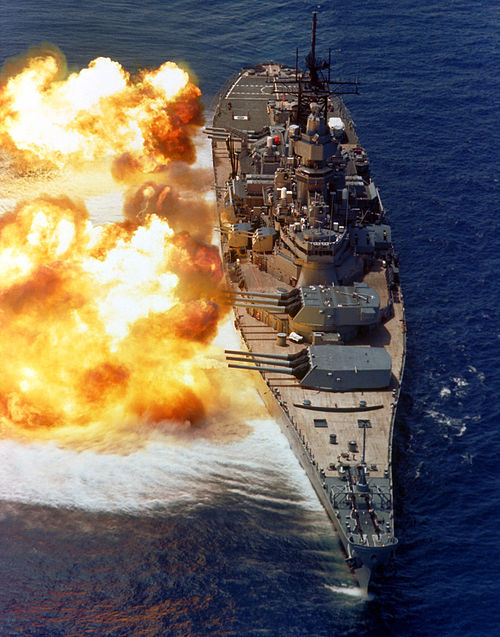
When President Trump floated the idea of bringing battleships back into service, the response from the defense establishment was immediate and predictable: eye-rolling dismissal, lectures about “modern warfare,” and knowing smirks about nostalgia trumping strategy. The think tanks and defense journals lined up to explain why this was obviously impossible, impractical, and frankly embarrassing.
There’s just one problem: The more you examine the actual arguments, the less absurd it looks.
Starting with what Trump actually said, stripped of the mockery:
Modern aluminum-hulled ships are vulnerable
Guns deliver cost-effective firepower compared to missiles
Battleships demonstrated effectiveness in the Gulf War
China’s naval expansion requires a response that doesn’t bankrupt us
The “experts” immediately attacked the metallurgy comment. Aluminum doesn’t just “melt,” they said. Trump doesn’t understand materials science. Except…the U.S. Navy already agrees with him. That’s why the Arleigh Burke-class destroyers went back to steel construction in the 1980’s. The Falklands War demonstrated aluminum’s vulnerability to fire and battle damage. The 1975 USS Belknap fire drove the lesson home. The Navy’s own design decisions validate exactly what Trump said—they just said it in engineering reports instead of campaign speeches.
USS Belknap (CG 26) after her collision with USS John F. Kennedy on 22 November 1975. US Navy photo. Public Domain.
Now consider the actual strategic problem Western – and American – navies face: magazine depth. The Red Sea operations against Houthi drones and missiles – consuming an estimated 30 years of firing in 15 months – exposed a critical vulnerability. Modern warships carry perhaps 90-100 missiles in their Vertical Launch Systems. Once those are expended, you’re done. You’ve got a $2 billion ship that has to withdraw from the fight and spend weeks getting rearmed for anything beyond self-defense. Each Standard missile costs between $2 and 4 million. Each Tomahawk missile runs $1 and 2 million. Between October 2023 and January 2025, Navy ships fired more defensive missiles than they used in the three decades following Desert Storm. You can burn through a quarter-billion dollars in magazine capacity in a single extended engagement.
A Tactical Tomahawk Cruise Missile launches from the forward missile deck aboard the guided-missile destroyer USS Farragut (DDG 99) during a 2009 training exercise. US Navy photo by Mass Communication Specialist 1st Class L. Stiles. Public Domain.
Compare that to a 16-inch gun. Modern rocket-assisted projectiles could reach 100+ miles. Each round costs perhaps $25,000-50,000 in current dollars — less if produced at scale. An Iowa-class battleship could fire continuously for days, delivering devastating effects on shore targets, surface vessels, and even providing anti-air support with proximity-fused rounds. The math isn’t even close: sustained and accurate fires at a fraction of the cost.
But what about vulnerability to modern anti-ship missiles? This is where the analysis gets interesting. An Iowa’s belt armor is 12 inches of hardened steel, backed by layers of structural protection. Modern anti-ship missiles — whether subsonic Harpoons or supersonic weapons — typically carry 500-1,000 pound warheads designed to penetrate thin aluminum hulls and detonate inside the ship. Against 12 inches of armor backed by compartmentalized protection? The penetration physics are completely different. Modern warheads might crater the armor, but achieving a “mission kill” (rendering a vehicle or craft unable to continue fighting, without destroying it) becomes vastly more difficult.
Survivability
Three cases are instructive in the vulnerability argument:
When HMS Sheffieldwas sunk during the Falklands War in 1982, the warhead of the French EXOCET missile that struck it failed to detonate, or at least did not detonate properly. Instead, the Sheffield was irreparably damaged by fires started by the missile’s still-running engine
In 1987, the USS Stark was attacked and struck by a pair of Iraqi-fired EXOCET missles. Prompt damage control prevented the ship sinking. After extensive repairs, the Stark returned to service, before being decommissioned in 1999, and scrapped in 2006.
Later, in early 1988, the USS Samuel B. Roberts struck an Iranian naval mine while escorting a civilian oil tanker. The severely damaged ship required around a full year off repairs, before being returned to service.
In 2000, the USS Cole was mined in the harbor of Aden, Yemen (although framed as a “bombing”, the actual attack counts as a ‘mining’ in naval terminology) by Al Qaeda terrorists using a massive IED. Following extensive repairs, the Cole remains in naval service.
In contrast, there is the USS Nevada (BB-36), the only battleship on the list. Severely damaged by relentless air attack at Pearl Harbor, the Nevada was repaired and returned to service, serving throughout World War 2. At that war’s end, however, the ship was worn out, and thoroughly outdated, as it had originally been laid down in 1914…So, it was decided to use the old battleship as a nuclear target during Operation Crossroads, the first atomic tests at Bikini Atoll. The Nevada survived not one, but two, close range detonations, to such an extent that she had to be scuttled in 1948 by naval gunfire from the USS Iowa. That, however, was still insufficient to sink her, so she was finished off by an aerial torpedo.
Battleships, it would seem, are remarkably resilient.
Battleship USS Nevada (BB-36) painted in orange as target ship for the Operation Crossroads Able Nuclear weapons test. 1946 photo by US Navy. Public Domain.
Drones
The drone threat is real, but consider the defensive advantage: modern close-in weapon systems, electronic warfare, and updated radar married to a platform that can absorb damage and keep fighting. A kamikaze drone that could cripple an aluminum-hulled destroyer might barely scratch an Iowa’s main deck.
And, as operations in the Red Sea have shown, against actual warships – properly manned with trained crews – drones simply don’t present the threat that many believe to be real.
Manning – The Real Problem
The manning argument deserves serious consideration. Yes, the original crew was 1,500-1,800 sailors. But that was 1940’s technology with manual systems throughout. Selective modernization — updated damage control, automated fire control, modern propulsion plant controls — could potentially reduce crew requirements by 30-40 percent while maintaining the core advantages of proven mechanical systems over fragile digital networks.
Currently, while all services saw an increase in recruiting in the aftermath of Trump’s 2024 election victory, it remains to be seen if this increase will continue. The fact that the only real restriction on a “big-gun” battleship revival is whether the Navy can recruit enough personnel, is telling.
Conclusion
The real question isn’t whether battleships make technical sense. The real question is why the defense establishment is so hostile to the idea. And here’s where it gets interesting: battleships represent everything the current procurement system hates. Simple, proven technology. Conventional construction. Multiple potential suppliers. Long service life. Low-margin, high-volume ammunition. No proprietary software requiring endless updates. No justification for $100 million unit costs or trillion-dollar development programs.
Trump’s idea threatens a very lucrative business model. That’s why it sounds “crazy” to people with consulting contracts and board positions. To people actually concerned with sustainable naval power?
It starts looking remarkably sane.
The Freedomist — Keeping Watch, So You Don’t Have To
The late actor Andreas Katsulas, in his role on the TV show “Babylon5” as Ambassador G’Kar, delivered the line:
“…something is moving, gathering its forces, quietly, quietly, hoping to go unnoticed…” (Babylon 5, S2E2, “Revelations”)
In 2025, something out there, for real, is “…gathering its forces, quietly…hoping to go unnoticed…” This “something” has been doing so for at least two decades, as of this reporting, that is preparing for some event or possibly multiple events, beginning in 2030, something that may represent an existential threat to human civilization, as we know it. The Department of Defense (DoD) and the Department of Homeland Security (DHS) both know this, and have been quietly moving on a plan of mitigation, a plan that transcends petty political party squabblings.
A plan that definitely involves you.
The first glimmer of this appeared in 2012, when people began asking why the DHS and DOJ were buying so much ammunition, enough – so those agencies and their cheerleaders claimed – for every armed DHS agent to fire over 100 rounds per month, according to the Government Accounting Office (GAO). To put a fine point on it DHS, alone, let two identical contracts on the same day, totaling over 46 million rounds of – per the report – “.223, 30-06, .308, 12 gauge, .357, .38, .40, .45, 7.62, and 9mm”…The shooters reading this already see two oddities: both .308 and 7.62 ammunition, rifle rounds that are dimensionally identical, differing only in specific technical details.
A portion of GAO-14-119 (2014). Government Accounting Office. Public Domain.
Interesting, but not necessarily alarming…if you don’t know what you’re looking at.
That’s a LOT of ammunition.
How much is “a lot“? The Department of Defense was burning through c.1.8 billion rounds of small arms ammunition, per year, at the height of the fighting in Iraq, and was buying ammunition from Israel in an attempt to address the shortfall…and not even the GAO could hide the scale of the purchases, no matter how hard they tried.
…but hey, that’s just some weirdo, “Alex Jones” ravings, right?
Right?
Well…the US Army, out of nowhere, released a massively redacted procurement order on September 23, 2024, to purchase M60E4/E6 General Purpose Machine Guns (GPMG’s), with conversion/upgrade and training kits, for a total amount of $14,960,324.75. Some of the un-redacted portions of the purchase order are extremely interesting:
1. Technical Specifications:
M60E4/M60E6 variants with conversion kits
“Conversion kit upgrades any serviceable M60 receiver to M60E6/E4 configuration”
“Can convert and upgrade a serviceable M60 machine gun in fewer than 30 minutes”
2. Operational Requirements:
“Only One Responsible Source” – they specifically =need= M60s, nothing else will work
“No prior contract for this requirement was accomplished using Full and Open Competition”
“US Ordnance is the only known source that possesses the capability”
3. Customer Base Curiosities:
“M60E4 and M60E6 MGs are already currently in use by the [REDACTED] customers”
“Through its utilization for over two decades, [REDACTED] customers’ armed forces personnel have become very familiar with the M60 MG series”
4. Timeline Curiosity:
Five-year contract delivering through 2029
Company C, 1st Battalion 5th Marines machine gunner fires his M60 machine gun at an enemy position. February 1968, Hue City, Republic of South Vietnam. USMC photo. Public Domain.
Most curious. The culture of pedantic security tends to undo the intent of those most desperate to maintain it, because the extensive redactions, themselves, speak volumes…
The United States military – except for some very specialized units like the US Navy SEALS – hasn’t used the M60 in any numbers since about 2005. We supposedly “gifted” the African nation of Senegal some 2,500 M60’s (XLSX download) in 2002…Or – did we?
Certainly, Senegal got some older model M60’s from us, but in 2025 their total armed forces (army, navy and air force) currently stand at c.17,000 personnel – 2,500 GPMG’s would be one M60 for every 6.8 troops; in 2002, when this transfer supposedly happened, Senegal had all of 9,400 personnel, all-in…which would have been one M60 for every 3.76 troops. That is completely ludicrous – no one buys support weapons at that kind of loony ratio.
A portion of the 2014 spreadsheet on the Defense Security Cooperation Agency’s report on “Excess Defense Articles” (EDA’s) – Warning: Direct .xlsx download. Public Domain.
Very curious – what happened?
According to theDefense Security Cooperation Agency (DSCA): “…When items in the Department of Defense (DoD) inventory are no longer needed by any military service…they can be declared as excess equipment or Excess Defense Articles (EDA)”, but, “…Not all EDA are overseas; the majority will be in depots located in the continental United States, along with a few in Europe and one in Asia. EDA would only be overseas when in consolidated depot repair yards or where items are taken in-country as U.S. forces are leaving. In such cases, the host nation gets no preferential treatment with respect to EDA – unless Congress passes special legislation authorizing direct transfers in-country…”
So – where did those 2,500 M60’s actually go, in 2002? Are they still in US Government warehouses? The procurement model makes no logical sense, otherwise.
Most “land-force” infantry-type battalions have anywhere between twelve and twenty-25 GPMG’s, depending on their exact Table of Organization & Equipment (or, “TO&E”); this would include both the M60 and its replacement, the M240. The Pentagon’s near-$15 million order would field anywhere between 2,100 and 2,500 weapons, likely at the lower end. Assuming a median figure of 20 GPMGs to a battalion (600 – 1,000 people), c.2,100 GPMG’s are enough to outfit about 100battalions.
That is roughly 60,000 – 100,000 troops…Or is it?
You see, that number is based on only the “new-build” weapons in at US Army contract…What about the “conversion kits”? As specified, these kits can upgrade “older” M60 weapons to the E6/E4 standard “in less than 30 minutes“. There is no mission profile that requires that kind of conversion speed…no conventional (or even special operations) mission profile, that is.
As the purchase order specifically blanked out the numbers of both new weapons and conversion kits being ordered, the only reasonable conclusion is to assume a 1:1 ratio, of “new weapon:conversion kit”. Another reasonable assumption, based on the most commonly-quoted price for a new and complete M60E6, of some $6,000, is that a conversion kit likely runs around $1,000, each. Thus, using a figure of $7,000 for the combination of one new weapon and one conversion kit, that equates to 4,200 total weapons (4,274.3785 weapons, to be pedantic) for the near-$15 million purchase order.
In other words, they are reactivating old weapons, to be placed alongside the new ones.
At the above median of 20 weapons to a battalion-equivalent unit, that comes to 213.71 battalions…or – about the current size of the United States Marine Corps, when counting the low end of what constitutes a “battalion” (c.600 troops).
That’s a lot of battalions…Expressed differently, this would allow for some 20 or so battalion-equivalents of “security units” (essentially, Military Police) to be mobilized in all ten FEMA administrative regions.
FEMA Region Map, 2024. FEMA. Public Domain.
And, let’s not forget the fact that this order is for…M60 machine guns.
As noted above, except for a very few in use by highly specialized units like the US Navy SEALs, very few armed organizations use the M60 in any configuration or numbers, and the few who do, are mostly looking to replace their GPMG’s with something like a MAG-58/M240 or a Russian PK-series…So – who, exactly, are going to be getting up to 4,200 M60E6’s, enough to outfit a multi-division corps?
Given the level of redactions in the purchase order, we are forced into speculative territory, here, over who the likely recipients of this massive number of support weapons might be.
The only group that makes sense, in this context – as bizarre and extreme as it might sound – is the population of the United States, in the form of the Militia of the United States, as described in 10 USC 246of the US Code…
…I can already hear the howls of laughter – when you’re done, answer this question: Who else would be familiar with the M60 platform in such large numbers?
What most people do not realize about 10 USC 246, is that there is an exception to the 17 to 45 year old age limit: per 32 USC 313, referenced in 10 USC 246 above, all former active-duty Federal military personnel are subject to recall for Militia service – at any time, for any reason – until their 64th birthday.
So…why recall the gray-hairs, and what does this have to do with M60 machine guns?
Simply put: Any veteran of the United States Army or Marine Corps, who served between 1980 and 2000, will be highly familiar with the M60 – and even 25 to 30 years later, will remember how to operate and care for these weapons, with minimal “refresher” time…if given a weapon and a manual. In contrast, someone learning the M240, new, would take a week or so, at least, to learn to operate it safely.
While many people – even self-identifying “Patriots” – pay homage to the concept of “The Militia“, very few have any real idea of what would happen in an actual Militia call-up in 2025: Essentially, a gaggle of well-meaning people – some veterans, most not – would show up to a designated assembly point, most armed with rifles…and, giving credit where it is due, most of those individuals’ rifles will be both in better condition, and frankly just “better” overall, than anything in the hands of the regular military.
But…that’s all they will be: individuals – unorganized, largely untrained, with little in the way of supplies or support weapons…like the M60. That’s a no-win situation, one that has prevented actual militia call-outs for over a century. But it does bring up some interesting questions, chief among them:
If the government anticipates scenarios requiring militia activation, why isn’t there a systematic program already in place to ensure those militia units would be at least somewhat effective?
The M60 procurement suggests they expect to need these capabilities, but there’s no evidence of corresponding human resource development.
Back in 2023, we wrote about some potential scenarios requiring domestic militia activation. The recent procurement patterns, specifically concerning the M60, suggest the government may be preparing for exactly these contingencies, and more, but as of this writing there is no corresponding investment in the human side – while 10 USC 246 can certainly call up the “Militia of the United States“, it specifies no current mechanism for “musters”, unit establishment, or training for those it is designed to call forth…That is a fatal flaw which has existed for over a century, one which needs addressing, because armed people with no organization or command structure are a significant liability, not an asset. That’s something you, the Reader, might want to address by contacting your Representatives and Senators about modernizing 10 USC 246 implementation.
But we’re getting ahead of ourselves here.
Clearly, someone in Washington thinks that something is on the horizon. Between the massive ammunition purchases hand-waved off as “bulk buying of training ammunition“, and now a bizarre contract for a machine gun design some 20 years out of general issue, to meet completion in five years time, it is clear that something is afoot.
But, what, exactly? None of the logical and/or viable options are good.
While a certain sector of the “political fringe” is still on about an invasion of the United State by everyone from North Korea to Iran – which, given the failures of the Biden administration in 2021-2025 – is now a valid concern, not least because at least someone in the US Government has known about the threat for over 50 years, the reality is that “social” or “economic” collapse is not really a very realistic model requiring actual militia call-ups and martial law…but there are a few possibilities of concern, beginning in, or just prior to, 2030:
Beginning in 2029-2030, we will enter Solar Cycle 26, which is predicted to be a “Grand Solar Minimum“, leading to a major drop-off in global temperatures, potentially up-ending agricultural cycles around the world. It shouldn’t take a degree in Sociology or Psychology to see the levels of potential unrest that would result.
Then, at the end of 2032, there is the possibility of Asteroid 2024 YR4 impacting the Moon. While this probability is low – currently (mid-2025) standing at 4.3% – it is not zero. This matters, because such a Lunar impact would spew out a debris cloud that would pulverize most of the satellites in Low Earth Orbit, zeroing out payment processing, along with internet and cell service, for months at least…and virtually no store north of the Rio Grande is capable of ringing customers out using cash only…But don’t trust me – ask your local grocery store manager.
Then, there is the possibility of the Campi Flegrei supervolcano in Italy ‘waking up’. In addition to vaporizing the major world city of Naples, this could easily generate conditions similar to those that followed the eruption of Tambora, in 1815, which caused the “Year Without A Summer” in 1816, leading to the last great food subsistence crisis in North America.
And finally, there are the much-ballyhooed Iranian “sleeper cells” that Washington media Chicken-Littles are so terrified of, in the aftermath of President Donald Trump’s recent attacks on Iran’s nuclear program sites…However, refer to that “known threat” from above: the potential is certainly there, although the lack of action as of this writing tends to indicate that this threat is likely much overblown.
On balance, though, it is clear that right after the scheduled completion of the M60 contract, there are some potentially highly serious problems that could well actually require a “martial law” declaration, which, in turn would require the rapid mobilization of a Citizen militia force.
The signs are that the United States Government – or at least, entities =within= the government – have either known or strongly suspected that “something” was coming for at least two decades, and are worried enough about it, that they have now made an unprecedented public move to pre-position at least some of the tools necessary to make possible mitigation strategies work, tools that the people-at-large cannot realistically obtain on their own.
Whatever is going on, you – the Reader – need to stay ahead of the curve. If you are not sure what kind of preparations you need to take, you need to take action now to find out, and assess your situation…because, Militia or not, when everything goes sideways…
You are on your own.
The Freedomist — Keeping Watch, So You Don’t Have To
As we close out the year of 2024, it has certainly been a monumental year. Movements have waxed and waned, politicians have been both humiliated and nearly assassinated, business leaders have actually been removed from the field, nations have fallen, wars continue, and security flaws have been exposed. This article will close out the year; the next article will be in the first week of January.
Pretty standard stuff, really…except that many of these events this year have been truly significant.
The United States
Starting with the proverbial elephant in the room, Donald J. Trump – the 45th President of the United States – was reelected to the Presidency by a very comfortable margin over his primary challenger, the thoroughly un-electable Vice President Kamala Harris. Trump’s re-election was secured following his survival of an assassination attempt on July 13th, in Butler, Pennsylvania, where the former President missed death on live television by literally millimeters; innocent bystanders were not so lucky. The image of a blood-spattered Trump being hustled away from the target zone by Secret Service agents while shouting “Fight, fight, fight!” has joined the Zapruder film in the minds of a new generation of Americans of what political violence actually looks like.
But it was not the attempt itself that secured Trump’s victory: it was the response from the Biden White House to the assassination attempt – especially in its agencies frankly unbelievable responses to the events, including washing down the crime scene within hours of the attempt, and cremating the shooters remains before any proper autopsy or toxicology screen could be done on the remains. The other issue was the gleeful responses from a wide swath of the political Left in the United States, alternately cheering the attempt and whining over the assassin missing his mark (although he didn’t).
A wounded President Trump at the Republican National Convention’s final night. Photo credit by Tim Kennedy. CCA/2.0
Reasonable and rational Americans were shocked and disgusted by the extreme Left’s responses, and began moving away from the Biden camp in earnest…which quickly led to shocking replacement of Biden on the Democrat Party ticket by Kamala Harris within days of the failed attempt. Harris was confirmed as the Democrat candidate without a voting process allowing other candidates to present themselves to party members as options…the end result was an election that flipped the leadership of the US again, by a comfortable margin.
The reason for concentrating on the US election so much, is that it represents a sea-change in US politics, not simply concerning domestic policies, but in international policies. This is both a blessing and a curse for the incoming administration, as the world is tired of the United State’s 50% chance of a 180° swing in its policies every four years.
On top of all of this, is the widespread outpouring of frankly disgusting sexual angst from the Left over the alleged assassin of United Healthcare CEO Brian Thompson. Once again, we were “treated” to deranged lunatics fawning over a potential killer, and the mainstream media promotes this view, in a desperate attempt to ignore the real reasons why sympathy for a murdered healthcare CEO is nearly impossible to find.
And finally, no end-of-2024 recap for the United States would be complete without talking about the waves of drones that have been plaguing the East Coast since November, which we covered last week. Short answers:
Aliens don’t use FAA-approved navigation light patterns, and
If a nuclear weapon, nuclear waste, or chemical anything had been lost in New Jersey, drones would be in the sky 24/7, and every flavor of law enforcement and the military would be out in the streets, armed to the teeth, and being highly hostile to anyone who looked at them sideways, until they found the missing cargo. Instead, we have seen the US Government, Inc. display a level of incompetence at such a staggering level, it boggles the imagination, as – 23 years after 9/11 – “mystery drones” are operating with impunity inside US airspace, at low altitude, and no one in the government has any idea who is responsible for making a decision on what to do about it, and no one is willing to take responsibility for acting in good faith.
Gnaw on that, for a while.
Europe
Europe continues to descend into failed-state status, as continual squabbling and inefficiencies in the structure of the European Union are crushing the economy of Europe as a whole, while “Great” Britain is desperately trying to outdo its continental neighbors in becoming a drug-addled, comic-opera version of Charlie Chaplains “The Great Dictator“, and France’s Emmanuel Macron is desperate to prove that he is not a literal “Momma’s Boy” by alternately trying to either start World War 3 by sending French and NATO forces into direct combat against Russia, while trying to revive its flagging influence on a continent that is past-done with France trying to be the colonial overlord with a nice face.
Of course, this includes the war in Ukraine, where Russia’s Vladimir Putin is hanging on long enough for Trump to step in and kill support to the absolute donkeys leading the lions of the Ukrainian forces. The Ukraine has only held as long as it has, because the general character of the “spear-carriers” in the literal trenches is as good as it is – it all fails, though, when you get above the level of the battlefield that is in range of Russian artillery.
The Middle East
The big news in the Middle East as the year closes is obviously the collapse of the Assad regime in Syria. After ruling the country since 1971, Bashar Assad was forced to flee into exile in Russia after “Hay’at Tahrir al-Sham” (HTS) a revived Al Nusra Front/Al Qaeda/Islamc State zombie rolled out of its Turkish bases and overran the country in under two weeks.
The reasons for the swift collapse are not hard to understand, if you understand the region. Assad’s remaining forces were exhausted draftees no longer interested in dying for his regime; his Iranian allies – including their Hezbollah proxies – were causing him more trouble than they were worth; Putin is too wrapped up in Ukraine to offer more than token support; and his country has been effectively partitioned since 2011.
Assad saw what was coming in November, and sent his family to Russia “on a vacation”. He, himself, stayed behind long enough to try and fight is out – you never know, in warfare – but when it was obvious that it was over, he escaped, demonstrating that he was at least smarter than Muammar Gaddafi.
As a result, the region is now in chaos, and is on the verge of becoming a “Libya, 2.0” on the borders of Turkey, Lebanon, Israel, Jordan and Iraq. Effectively, this has guaranteed at least another decade – or more – of warfare in the region. Turkey Recep Tayyip Erdogan may have though this was a good idea, but he is about to discover the truth of opening Pandora’s Box.
Africa
Africa remains a basket case, with wars, rumors of wars, and coups d’état all over the continent; there is another major war brewing, but that article is coming in January 2025. Although Russian influence was clearly on the rise in 2023 and 2024, the war in Ukraine has severely curtailed Russian operations on the continent, at least for the moment.
Yemen – which should technically be a part of the Middle East section, but is included here, because of its impacts on eastern Africa, saw the Houthis dealt a heavy blow to their confidence when neither Russia nor Iran were able to prevent Assad’s Syrian collapse, causing their co-religionist Hezbollah allies to atomize, in order to get out of the vice of Israel and a revived Islamic State…Whether or not this will cause them to back off their war against the world’s commercial shipping in the Red Sea remains to be seen.
Asia
Asia remains relatively quiet, compared to the rest of the world, with the only current major conflict of note being the “Tatmadaw” of Burma continuing to hang on by their fingernails, as the union of rebel movements sputters without effective outside support, while the military junta keeps trying to break bread with Communist China.
Of note, however, is that North Korea began trading human troops to Russia for ballistic missile technology, which is threatens a direct impact on the balance of power on the Korean Peninsula.
Meanwhile, VISA – the credit card giant – has decided to embrace DEI fully, by violating the Logan Act in trying to force Japan to conform to the company’s morals. While the Japanese government has not yet reacted, the utterly tone-deaf head of VISA is very likely about to find out why that is a terrible idea.
Conclusion
The only relatively quiet spot in the world remains South America, where – despite a host of issues – large-scale violence remains almost unknown, compared to the rest of the planet.
It has been a tiring year, but – cautiously – things might be looking up.
Let’s hope no wingnut screws it up.
The Freedomist — Keeping Watch, So You Don’t Have To
The United States Army Special Forces faces a growing crisis that threatens the effectiveness of America’s elite military units. The drive to maintain special operations forces (SOF) numbers through direct recruitment programs has led to concerning patterns of casualties and reduced operational effectiveness, highlighting the dangers of shortcuts in developing elite warriors. Unfortunately, there is a great deal of generalization in the numbers that follow, because of the classified nature of Special Operations in general, but the trend is there.
The Traditional Path
Historically, becoming a Special Forces operator involved a carefully structured progression. Candidates typically served 3-5 years in conventional military units before applying to Special Forces training. This traditional pathway provided several crucial elements.
Older candidates tended to have developed their own knowledge of what physical training and development strategies worked best for them, more formulaic Army methods aside. This enabled them to understand how their bodies reacted to physical stress, which usually lowered the possibility of physical injuries. It also allowed a “leveling-off” in a soldier’s physical maturation, which also helped reduce injuries.
Group of Soldiers from ARVN with SFC Norman A. Doney, 5th S.F. Group, Vietnam, September 1968. United States Army Heritage and Education Center. Public Domain.
This also allowed the SF candidate to gain valuable experience in stress management, leadership, and technical skills. Likewise, the experience gained as a “regular” soldier provided a deeper understanding of military psychology and culture, providing valuable experience in how operations are typically run, with a “bottom-up” view that would offer the candidate vital experience in understanding the challenges they would face when isolated on operations.
The resulting teams of “Operators” were very well situated to a wide array of “unconventional” tasks, ranging from “deep” reconnaissance, to what is now termed “direct action missions”, to embedding as liaison teams with Coalition units during Operation Desert Storm, to acting in their original mission, by training “partner nation” forces, either from scratch or by refining their existing training.
In this older model, the candidate with three to five years of experience before entering Special Forces also allowed the members of the “Operational Detachment Alpha” (ODA) teams (the famous “A-Teams”) to have both a primary Military Occupational Specialty coming in through the door, but would also allow for them having acquired “side” experience, through which they could obtain secondary or “alternate” specialty training in diverse and unrelated field, meaning that a 12-man ODA actually had up to twenty-four (or more) technical specialties at hand, including backups, within their team.
The Rush to Fill Ranks
Following the 9/11 attacks, the demands on special operations units throughout the United States military structure led to a serious manpower shortage, as – despite (if not “because of”) battlefield successes – the existing special forces units quickly began to experience manning shortages, as casualties mounted and operational teams were exhausted by the rapid pace of operations. This would lead to the creation of programs to rapidly bring in fresh recruits to fill the gaps.
In the US Army’s case, this became the “18X (Special Forces Candidate)” program, allowing civilians to directly enlist into Special Forces training. The idea was that a candidate who met all the basic educational and fitness requirements for Army Special Forces could be enlisted and “fast-tracked” to SF training, running through Army Basic Training, A.I.T., then on to parachute training, before being sent to the actual Special Forces training. The result was physcally fit, highly motivated operators, who had “checked off” all the requisite boxes, but who lacked the depth of experience of those who had come before them. The result was something more akin to “elite assault infantry”, something more akin to the US Army Rangers, rather than “Special Forces”.
There is nothing wrong with the concept of the Rangers – but that concept is not the same thing as Army Special Forces…What follows is by no means an indictment of the candidates themselves, but of the wider Army command structure, who should have known better.
While the 18X program helped meet the immediate personnel needs for Army Special Forces, they have revealed some serious problems:
Physical Casualties
– Higher rates of training injuries
– Increased long-term physical damage
– More frequent stress fractures
– Earlier career-ending injuries
Psychological Impact
– Elevated PTSD rates
– Higher frequency of “burnout”
– Reduced stress tolerance
– Shorter operational careers
As noted above, veterans of conventional units brought crucial life experiences into their Special Forces careers that direct-enlistment recruits simply lack, because they have not had the time to learn and experience those life lessons that their predecessors had.
Going straight from training to high-intensity “operational” status is functionally sending out people who know how to pull a trigger, not someone who understands the nuances of how to react to their surroundings, nor how to deal with the stresses of everything going completely wrong at the first shots. Special Forces have to be able to switch instantly from shooting people, to working with survivors in the immediate area, as well as how to calmly and rationally coordinate with foreign military and police units in the aftermath, whether those are from the country the SF team is operating in, or from allied nations. These functions require both maturity and humility, which can only be developed over time – time that the 18X program cannot impart.
The Historical Record
The 77th Infantry Division’s World War 2 experience provides a damning historical precedent that the Army seemingly ignored when creating the 18X program. The 77th’s success – with its higher average age of 35 and consequently more mature decision-making abilities – demonstrated clear advantages in the complex, high-intensity combat of the Pacific theater. Despite facing some of the war’s most challenging battlefield conditions, the division’s older, more experienced from civilian life soldiers generally suffered lower casualty rates than younger-aged units in the same actions.
77th Infantry division troops during the Battle of Okinawa, May, 1945. US Army Archives. Public Domain.
This historical data – especially in light of the history of Special Forces operations from the 1950’s to the 1990’s – should have served as a clear warning against the 18X program’s entire premise. If older, more experienced soldiers performed better in conventional warfare, it follows that rushing young, inexperienced recruits directly into the even more complex and demanding world of special operations would be problematic, at the very least. The Army had empirical evidence from the 77th, reinforced from Vietnam to Desert Storm, that maturity and life experience were crucial force multipliers in challenging combat environments, especially for Special Forces, yet chose to disregard these lessons when designing the 18X program. The resulting higher casualty rates among direct-entry special operations personnel represent a preventable tragedy.
Statistical Reality
Recent studies indicate troubling trends among direct-entry special operators. Over 75% of musculoskeletal injuries among Special Forces are preventable. Unfortunately, the reality is that data collection for these kinds of statistical studies is extremely hazy in quality.
The real story lies in the fact that the 18X program is still in force as an active recruitment tool, indicating that either the US Army is having serious problems attracting applicants to one of its premier “Tier 1” formations (which would not be surprising, given the Army’s well known recruiting woes), or that the 18X program still needs to run, in order to keep the numbers flowing in.
Neither offers a comforting picture.
The Cost of Shortcuts
The financial and operational costs of these programs are significant: Higher washout rates – whether from medical, emotional or psychological reasons – waste contentious budget monies, and make teams harder to form, train and deploy.
This also makes operational deployments much more expensive, overall, while limiting the capabilities of the units deployed, due a general lack of experience, and an increase in the requirements for already heavily strained support operations.
The whole combines into a toxic soup that lowers morale, degrades mission capabilities, and results in frantic attempts by inexperienced political leadership to find workaround solutions that, frankly, aren’t.
U.S. soldiers load a simulated casualty on a UH-60 Black Hawk during a medical evacuation at Fort Hunter Liggett, Calif., May 17, 2011. Photo credit: Technical Sgt Chris Hibben, US Army. Public Domain.
Conclusion
The United States desperately needs an effective special operations establishment. While highly capable at their missions, the Rangers are not suited to replace Army Special Forces. But Army SF is locked into a vicious cycle, where they need to maintain numbers for operations, but have serious problems (not all of their own making) with bringing in fresh candidates. That may change in the next few years, but there is little light in this tunnel.
The effectiveness of America’s special operations forces depends on finding the right balance between meeting personnel needs and maintaining the high standards that make these units elite…but, much more telling, is the need for coherent leadership at the top of both the military and civilian establishments.
The reality of history is that the regular military services have long detested the very idea of “elite” formations, despite their demonstrated capabilities. In the civilian quarter, the highly toxic nature of civilian politics in the United States means that few serious veterans want anything to do with the civilian leadership establishment in any way, leading to an increasingly wide divergence in understanding of what military forces require to operate, nor of their true capabilities.
There are no easy answers to this last problem, but something needs to be done to fix it, because there is an ogre lurking in the background, that no one wants to see come back into reality.
The Freedomist — Keeping Watch, So You Don’t Have To
Wars cannot end, until the enemy is defeated, and there is no stomach in the West for the necessary operations…
With the reelection of Donald J. Trump to the Presidency of the United States, even as Progressive, Left-wing pundits around the world launched into publicly televised hysterical meltdowns (that were subdued, compared to those of the many programmed victims of their psychological manipulations of the last few decades), heads of state around the world – the sane ones, at least – broadcast their congratulations to Trump.
In the Middle East, this was also true, for the most part. However, in both Iran and Yemen, reactions were mixed. Neither state is particularly happy about Trump’s victory, as both know that Trump is a diehard supporter of Israel, far more so than the ineffectual and vacillating Democrat administration of Joe Biden has been. This bodes ill for Trump’s immediate foreign policy options.
Since October 19, 2023, the Shi’a Muslim Houthi faction in Yemen has “done a yeoman’s work” in supporting the Hamas terrorist group that attacked and slaughtered defenseless civilians – including pregnant women – in their October 7th invasion of southern Israel that year.
While Yemen is physically separated from Israel and Gaza by a very considerable distance, one could be forgiven for assuming that the Houthis would only be able to offer kind words to Hamas. However, this is the 21st Century, and the Houthis are being supported by the Shi’a Muslim mullahs ruling Iran, to the north…and who have supplied the Houthis with not only Iran-designed derivatives of the ancient Soviet SCUD missiles, but with anti-ship missiles as well.
And it is that last group of weapons that is going to present Donald Trump with his most serious challenge, the first of a series of messes left for him to clean up, much as he found in 2017, when he had to pick up the pieces of Barack Obama’s eight-year long “bombing-fest”.
This time, though, Trump will have a far harder time. Trump’s first administration, as hard as Liberal news organs try to deny it, was marked as being the first Presidency in living memory to have not resulted in the United States becoming embroiled in any new military conflicts – every military action during the “Trump Years” of 2017-2021 were part of conflicts he inherited from Barack Obama.
The US and Western militaries in general, have been critically weakened as a result of the staggering incompetence of the last four years of mismanagement from Washington and NATO capitals. The aloof and disconnected-from-reality “ivory tower” political elites in the West have floundered as their intricate “house of cards” strategies for global dominance have collapsed, as those people they discounted as backwards, uneducated “camel jockeys”, simply declined to play by the script those elites had written for them.
Their first stumble was pushing Vladimir Putin’s Russia into invading Ukraine – the Western elites never imagined that Putin would actually invade – they assumed that he would either meekly acquiesce, or that he would launch a new Cold War, one that would boost the elites’ defense industry stock portfolios into orbit (literally)…The notion that Putin would actually commit to massive, “main force” combat on a scale not seen since 1990-1991 was never on their “bingo cards”.
Next came Africa, as local state armies – usually led by Western-trained officers (sparking delightfully daft conspiracy ravings from Left-wing talking heads) – in the “Coup Belt” of the Sahel Region decided that tossing out Western – primarily French – influence for good, via military action, was worth the risk. The elites were left slack-jawed to discover that what they had considered their racial and cultural inferiors had had enough of their paternalistic ravings, and told them to get out. So “uppity” has Africa gotten, that the Ugandan government publicly and messily refused to bend the knee to the United States over imposing visa restrictions on its officials over the country’s anti-LGBTQ policies – and had to watch as most African countries lined up behind the Central African state. Then, the Sahel nation of Niger – one of the most recent “Coup Belt” states – non-too politely told the US State and Defense departments to ‘pound sand’ over what they described as threats to the country if they did not immediately restore the corrupt government installed by French corporations – then told them that the DoD to remove the $100 million drone operations base at Agadez…To paraphrase a certain comic book-cum-movie character: “…Not a good plan, America…”
And then, there is Ukraine. It does not matter in the slightest, whether you support Ukraine, or Russia, or neither. That is literally irrelevant. All that matters, are three things:
Despite obscene amounts of Western monetary and material support, Ukraine is losing the war. Deal with it.
The nuclear saber rattling from both sides has brought the world closer to and intentional nuclear exchange than at any time in history.
The United States and NATO defense establishments have demonstrated their categorical inability to supply even basic war materials – this is not Star Trek, and there are no replicators here
To this context, we must add the fact that North Korea – which was at least willing to listen to Trump, at some level – smelled weakness in Washington, and moved swiftly to capitalize on that weakness. (NB: The Freedomist covered this on itsmonthly subscription side, as well.)
Yemen is a truly ancient nation, with its recorded history stretching back at least 7,000 years, with much of that history revolving around the sea. Like most of the states and people’s in the region, Yemenis of all tribes and religious sects understand one of the core truisms of warfare: “A ship’s a fool to fight a fort.” (Attributed to Admiral Horatio Nelson.)
While some modern naval pundits have tried to dismiss this wisdom in the modern day – much as their recent ancestors though that “capabilities based planning” was a better idea than traditional strategic thinking – the current effort by Yemen’s Houthis has proven how true it really is, if one has the ability to think about warfare on multiple levels.
The Houthis have no defined “fort” to fight – the operate their missiles as a kind of “shell game”, shuttling them around the countryside, much as the original US strategy for the Minuteman Missile system of the 1980’s. That idea works, as sea-launched land-attack missiles have trouble finding those targets.
Added to this, has been the recent escalation in the Israel-Hamas war, first with the Iran-backed terror group Hezbollah launching multiple attacks into northern Israel, with the Israeli’s hitting back just as hard, if not harder.
In fact, very little, at least at first glance. The problem is that Yemen is a fantastic foil for Iran against the United States and its allies: it forces Israel and those Western powers hostile to Iran to split their forces between theaters, while limiting their ability to shift naval forces. At the same time, the Houthis – and thus, Iran – have been able to critically damage the commercial system that the West depends on, and all without Iran becoming directly involved.
This situation has no solution, other than a very messy, and very bloody “boots on the ground” invasion of the Houthi-controlled areas of Yemen…by Trump…With all that implies, given the last twenty-five years of war.
This is because neither the Houthis, nor the Iranians, are willing to actually negotiate any sort of peace agreement, unless Israel agrees to undue everything it has done in reply to Hamas and Hezbollah…Which is simply not going to happen.
Because of the failures of the Biden administration, small but hostile powers states have launched wars because they saw the weaknesses of the United States and the West, and sought to capitalize on that weakness…and they know that Trump will not be able to fix those problems before the 2026 mid-term elections in the US.
If one were a conspiracy theorist, one could almost think that this was a deliberate ploy to undermine a Trump victory.
But that’s just crazy-talk.
Right?
The Freedomist — Keeping Watch, So You Don’t Have To
This article is going to press on November 8th of 2024. Donald J. Trump as been confirmed to have won the US Presidential election be a decisive margin. While much is being made in some quarters about how “Daddy Trump” is going to fix everything overnight, the reality is that Trump will face a myriad of major diplomatic challenges on Day One of his new administration. While we could write multiple articles on every one of the many wars Trump will have to deal with – and we will discuss one of them next week – this week, we will talk about the most important issue.
The ongoing conflict in Ukraine has exposed critical weaknesses in Western defense industrial capacity, while recent infrastructure incidents highlight the fragility of military logistics chains. These vulnerabilities raise serious questions about NATO’s ability to sustain high-intensity conflicts and maintain global military readiness, because they are not being addressed.
“Peace Through Strength” is a resounding cry, but it requires “strength” to make it work.
The Artillery Crisis
NATO’s inability to meet Ukraine’s artillery shell requirements has revealed a stark reality: Western defense industries are no longer configured for industrial-scale warfare. The conflict has consumed ammunition at rates not seen since World War II, with Ukraine firing approximately 6,000-8,000 artillery rounds per day, while Russia expends an estimated 15,000-20,000 rounds daily.
European and American ammunition plants, optimized for peacetime efficiency rather than wartime surge capacity, have struggled to increase production. Most Western facilities operate on a single-shift basis with aging equipment, lacking the workforce and infrastructure for rapid expansion. The situation is exacerbated by shortages of raw materials and specialized components, many of which come from a limited number of suppliers.
In contrast, Russia – which had correctly forecasted the coming decade’s events – quietly began classifying increasing amounts of its economic (and possibly population) data, beginning in 2014. Further, while the Western powers had deliriously wrapped up and eventually converted or bulldozed much of its war production capacity, the newly non-Soviet Russia did not: they mothballed their facilities. And, as tensions with the West began rising after the Donbas War began, they began to quietly bring those mothballed plants back online.
The reason for focusing so much on artillery production is that, far more than the production of drones, tanks or airplanes, artillery is the most important determiner of modern warfare capabilities, after Logistics infrastructure and the combat abilities of one’s infantry forces.
Infrastructure Vulnerabilities
The recent collapse of the Francis Scott Key Bridge in Baltimore, Maryland after being struck by the container ship MV Dali highlights another critical vulnerability in military logistics. Major ports and waterways are essential for moving military equipment and supplies, yet many rely on aging infrastructure. The Baltimore incident demonstrates how a single point of failure can disrupt both civilian and military shipping patterns across an entire region.
The Military Sealift Command (MSC) fast combat support ship USNS Supply (T-AOE 6) sails through the Atlantic Ocean, 2006. U.S. Navy photo by Photographer’s Mate 3rd Class Joshua Kinter. Public Domain.
Similar vulnerabilities exist across NATO’s logistics infrastructure:
Aging rail networks crucial for moving heavy military equipment
Limited redundancy in key shipping channels and ports
Concentrated dependence on specific facilities for military operations
Vulnerability of critical bridges and tunnels to both accidents and potential sabotage
Limited upgrades to handle increased loads
Supply Chain Complexity
Modern defense systems rely on intricate supply chains involving thousands of contractors and subcontractors. This complexity creates multiple potential points of failure:
Raw Materials
Critical mineral dependencies
Limited processing facilities
Potential supply disruptions from geopolitical tensions
Component Manufacturing
Specialized electronics producers
Precision machining capabilities
Quality control requirements
Assembly and Integration
Skilled workforce shortages
Facility capacity constraints
Security clearance requirements
The China Factor
Many of these vulnerabilities trace back to China’s quiet dominance in global supply chains. Critical raw materials, electronic components, and industrial chemicals often originate from Chinese sources. This dependency creates strategic risks, particularly in scenarios where China might decide to restrict exports or support adversaries.
While this has yet to significantly impact the war in Ukraine, it remains a distinct possibility…especially should a Trump diplomatic effort fail or stall – or expand.
Impact on Military Readiness
These supply chain vulnerabilities affect military readiness in several ways:
Reduced Training
Limited ammunition for training exercises
Delayed maintenance due to parts shortages
Restricted live-fire drills
Strategic Reserve Depletion
Ammunition stocks below minimum requirements
Extended replacement timelines
Reduced crisis response capability
Force Projection
Logistics bottlenecks limiting deployment options
Increased vulnerability to interdiction
Reduced sustained operation capability
Misplaced Priorities
Another serious consideration is the toxic culture of the long-ballyhooed “military-industrial complex“. That term is a tired trope that has been overused to the point of reducing it to a joke…However, it is very real, and is one of the major axes that is causing the downstream bottleneck that is choking the combat power of Western forces.
For generations, defense contractors have made squeezing as much taxpayer money as possible in technical “peacetime” as high a priority as possible, whether their products worked or not – the Sgt York and Dragon ATGM come immediately to mind. Making products like “dumb” (i.e., “unguided”) artillery ammunition and aircraft bombs is not considered as cost-effective, from a business perspective, as more technically complex – and thus, highly expensive – weapons systems.
The fact that these weapons cannot be produced anywhere near as quickly as modern combat demands – as demonstrated in Ukraine – is not part of the cost-benefit calculations of the commercial military-industrial complex.
Addressing the Challenges
Military planners are attempting to address these vulnerabilities through several initiatives:
Industrial Base
Investing in modernized production facilities
Developing workforce training programs
Creating redundant supply sources
Infrastructure
Identifying critical chokepoints
Developing alternative routing options
Improving facility protection
Stockpile Management
Reassessing minimum stock levels
Implementing more robust tracking systems
Developing new storage facilities
At the same time, those same military planners face the harsh reality that too many civilian leaders in Congress – both outgoing and incoming – received a large amount of cash that put them into a very cushy position, and that getting those same politicians to act against what defense contractors see as their own best interests is going to be an uphill battle, all the way. This will be even harder for Donald Trump, who has dared to speak the unspeakable, that peace needs to break out again.
The Near Term Outlook
The combination of industrial capacity limitations and infrastructure vulnerabilities presents a serious challenge to Western military capabilities, and especially to the incoming 47th President. Addressing these issues requires sustained investment and policy attention, potentially including:
Defense Industrial Base revitalization
Infrastructure hardening and redundancy
Supply chain diversification
Stockpile expansion
International cooperation on critical materials
And finally, reining in the military-industrial complex, whether they like it or not
The lessons from Ukraine and incidents like the Baltimore bridge collapse underscore the urgent need for comprehensive supply chain resilience in defense planning…They also show the dangers of thinking that business and war are analogous – misapplying the principle of Sun Tzu is actually far more dangerous than dismissing them.
ICYMI — On May 22, Representative Chrissy Houlahan (D-PA), sponsored a bill to automate the registration of all males within the United States aged 18 to 26 into the Selective Service System, also known as the Draft. This comes amid the ongoing disaster of military recruiting numbers.
Now, the House has passed this measure as part of the latest National Defense Authorization Act (NDAA). Once again, Democrats all about putting your children “behind the trigger”…not theirs. Democrats love war – they just suck at waging it.
The only glimmer of brightness in this morass, is the inclusion of measures curbing various “woke” ideologies, including pro-choice, pro-LGBTQ+, and various lunatic psuedo-environmental “Sciencisms”, guaranteeing some level of delay to the process.
The Freedomist — Keeping Watch, So You Don’t Have To
This morning, June 14th, the Supreme Court of the United States overturned the Trump-era ban on “bump stocks” for semi-automatic rifles.
Justifiably, the “Pro-2A Sphere” is rejoicing; predictably, their “anti” opponents are screaming hysterically, crying that there will be “blood in the streets” over letting what amounts to a toy that has never been used in a crime (that’s for an entirely different article). But the real question is: Is this really a victory?
Trump’s decision to push the bump-stock ban was an abject failure of leadership. It was also treasonous, as are every single blanket gun control law, proposed law or regulation, at every level of government and law enforcement in the United States.
Let me explain.
Gun control in the United States has a comparatively short history. Prior to 1934, there were no specific restrictions on firearms at the Federal level. At all. That included owning cannons and other types of artillery, as well as arming private warships, which someone should remind the current occupant of 1600 Pennsylvania Ave about. The few mentions of firearms ownership at the Federal level of law enforcement either specified what weapons every citizen was required to maintain, but also specified – twice – that restrictions on civilian firearms ownership were not simply specifically forbidden, but that firearms ownership in the United States has a specifically military character. Naturally, anti-gun sentiment wants desperately to dismiss or ignore this sentiment. Increasingly – thankfully – these childish views are being dismissed, not only by the Supreme Court, but by lower courts as well, albeit in uneven language.
One recent tack anti-gun promoters have tried to employ is the “well regulated” clause in the 2nd Amendment, weaving the tortuous logic that “well regulated” somehow equates to the Federal Government having the ability to remove firearms from private hands at will. Clearly, these are silly arguments. A far better argument is to point out that “the Militia”, as such, has no ability to either muster or train…and that is absolutely correct. The Presser v. Illinois case cited above specified that the “several states” held the sole authority of managing military affairs within their state boundaries, except when it came to Federal military forces. The caveat to that was that states quickly took that as an excuse to functionally eliminate any requirement within their borders for militia to muster or train. And, at the Federal level, Congress also failed in its enumerated duties, because the 2nd Amendment is not the only place in the Constitution where the word “militia” appears.
In the aftermath of the Spanish-American War of 1898, the United States quickly found itself at war with its erstwhile guerrilla allies in the formerly Spanish-held Philippine Islands. That conflict lasted over three years, and presented a huge issue for the United States in terms of manpower – many of the soldiers enlisted for the war with Spain had enlisted for just that: the duration of war with Spain…no one had said anything about fighting Filipino locals, who had already been fighting the Spanish. Most of those volunteers came close to mutiny if they were not returned to the United States, or enlisted – at exorbitant cash bounties – directly into the Army.
To get around this problem, Congress created the Militia Act of 1903, popularly known as the “Dick Act”. This act created the modern National Guard, as we understand the term. The National Guard is described as forming the “Organized Militia”; in effect, it forms a reserve force for the US Army, which body regulates, arms and trains it, but which the states pay for during peacetime, and which they can use at the discretion of the state government unless the Federal government requires those troops for Federal use.
But back when the Dick Act was passed, there was a provision for “everybody else”: since the “Militia of the United States” defines the “Militia” as all ‘able-bodied males’ between 17 and 45 (unless you’re a veteran of Federal military service – see the link above), the Congress in 1903 lumped “everyone else” into the “Reserve Militia”, which was given a detailed organizational framework. In 1956, however, the “Reserve Militia” disappeared, replaced in the United States Code with the term “Unorganized Militia”…and, by definition, an “unorganized” group can neither muster nor train as a unit – something certain members of Congress are now attempting to formalize in law.
Don’t worry – we’re getting to the treason part, I promise.
The first specific example of Federal-level restrictions on firearms ownership came in 1934, with the “National Firearms Act”, known as NFA’34. This act is why you have to pay an additional $200 tax to buy any kind of automatic weapon (the real ones, not what the mainstream media thinks are ‘machine guns’), explosive device or noise suppressor for a firearm…assuming, of course, that one is willing to go through the byzantine paperwork to become one of a privileged class, who can be arrested at any time, for the slightest infraction.
But, I digress.
The 1934 NFA was, publicly, instituted to make it harder for criminals to obtain automatic weapons – despite those criminals usually stealing them from National Guard armories. In reality, the restrictions were aimed at organized labor, which had been growing increasingly restive during the 1920’s and 30’s, leading inevitably to the 1934 General Strike. The government was desperate to limit the access of unionists to military-grade weapons, and used the phantom of organized crime as an excuse. The National Firearms Act was so incoherent, the Supreme Court of the day actually used language that found against the NFA, while incoherently ruling that the act was, in fact, legal.
Aside from the scare to the federal government caused by the 1946 “Battle of Athens”, there were no real Federal attacks on private firearms ownership until the “Gun Control Act of 1968” (GCA’68) was passed. Prior to GCA’68, a person could order many types of firearms out of most gun and sporting magazines of the time, especially surplus weapons. Any person – including African Americans…more or less anonymously.
While certain parties had been pushing the core of GCA’68 since the assassination of President John F. Kennedy, those parties managed to push it through following the twin assassinations of Martin Luther King and Senator Robert F. Kennedy, D-NY (JFK’s brother), in April and June of 1968, respectively. What GCA’68 did was eliminate the ability of citizens to purchase any weapon directly through the mail, from any source. This is why you, the Reader, have to fill out a government form to legally buy a firearm from a store or a licensed dealer. And – in contravention of the anti-gunners hysterical screams about the supposed ‘power’ of the National Rifle Association (NRA) – that organization, to its eternal shame, happily backed GCA’68 to the hilt.
The excuse given for GCA’68 was, aside from restricting mail order the access to firearms like those used in those assassinations, was to keep weapons out of the hands of dangerous criminals and drug addicts (including modern users of “medical marijuana”)…which is rather odd, considering that without any kind of “instant check system”, no one with a valid identification could be refused a sale, a system which has demonstrated that any database is only as good as its inputs.
Again, this major bill failed to stop any crime – so, why was it passed? Easy: the Black Panthers.
The Black Panther Party (BPP) was formed in 1966, in response to increasing violence by police against black communities around the country…and, despite the pleas of leaders like Dr. King and Malcolm X, the BPP was determined to take a more confrontational approach, with its armed members “monitoring” police stops in black neighborhoods. In response to this, in California, the Mulford Act was proposed, criminalizing the open carry of firearms without a permit. In response to the proposed act, the BPP staged an armed protest on the step of the California State House in Sacramento. Whether this was simply a “publicity stunt” or not, the measure passed decisively, backed by both Republicans and Democrats, again with the full support of the NRA, and was signed into law by then-governor Ronald Reagan (who was no friend of gun owners, despite the misguided beliefs of many).
So. Given the history lesson above, where do I come off, claiming that restrictive gun control is “treasonous”?
The important part, here, is the “adheres to their enemies, giving them aid and comfort within the United States or elsewhere” part. “Giving aid and comfort” can take many forms, but, in light of the fact that blanket restrictions on firearms ownership pointedly weaken, if not eliminate, the ability of the average citizen to not simply protect themselves, but to defend the nation in times of distress. And, given the increasing number of unidentified and unregistered “military-age males” flooding into the United States currently, there is a decidedly high chance that the United States may soon face a wave of Mumbai-scale terrorist attacks, in many cities around the nation.
Should such a wave of attacks ensue, it will be completely and totally the fault of the Democrat Part in general, and the Biden regime, in particular.
The scale of the actions against citizen firearms ownership across the nation, coupled to the flood of illegal aliens, is too extensive to be a simple series of accidents – it is pointedly intentional in nature. It is a direct and immediate threat to the People of the United States, and it needs to be dealt with.
Donald Trump may not be the best candidate for President, and he clearly made serious errors in judgment while in office…but the alternative is a nest of active traitors to the nation.
Back FREEDOM for only $4.95/month and help the Freedomist to fight the ongoing war on liberty and defeat the establishment's SHILL press!!
Are you enjoying our content? Help support our mission to reach every American with a message of freedom through virtue, liberty, and independence! Support our team of dedicated freedom builders for as little as $4.95/month! Back the Freedomist now! Click here