Under oath before the House Judiciary Committee hearing, Special Council Robert Hur testified President Joe Biden took classified documents for the purpose of cash profit.
He told the committee, “Mr. Biden had strong motivations to ignore the proper procedures for safeguarding the classified information in his notebooks… During hours of recorded interviews in which he read aloud from his notebooks in his private home, Mr. Biden provided raw material to his ghostwriter detailing meetings and events that would be of interest to prospective readers and buyers of his book.”
… Next, Jordan asked Hur about the advance Biden received for that book, “Promise Me, Dad.” According to Hur’s report, Biden received $8 million — a highly lucrative deal.
“Joe Biden had 8 million reasons to break the rules. He took classified information and shared it with the guy who was writing the book,” Jordan said. “He knew the rules, but he broke them for $8 million in a book advance.”.
.. Hur told Rep. Pramila Jayapal (D-Wash.) that his investigation did not exonerate Biden.
On the contrary, Hur explained in his opening statement that his investigation “identified evidence that the president willfully retained classified materials after the end of his vice presidency, when he was a private citizen.”
Donald J Trump and Joe Biden are set to repeat the battle of 2020 as both men have now unofficially won enough delegates to clinch their respective parties.
Trump added three more primary wins in Washington, Mississippi, and Georgia, winning each election by more than 80 percent of the primary vote. The news comes on the heels of a recent purge of the RNC by Trump’s daughter-in-law, Laura Trump, the new co-chair of the RNC.
With no real concessions won, House Speaker Mike Johnson (R-AR) oversaw the passage of a partial budget in the House that was signed by President Joe Biden. The total amount of the spending bill comes to $460 billion and will keep “essential” agencies funded through fiscal year 2024.
… The measure contains six annual spending bills and had already passed the House. In signing it into law, Biden thanked leaders and negotiators from both parties in both chambers for their work, which the White House said will mean that agencies “may continue their normal operations.”
Meanwhile, lawmakers are negotiating a second package of six bills, including defense, in an effort to have all federal agencies fully funded by a March 22 deadline.
“To folks who worry that divided government means nothing ever gets done, this bipartisan package says otherwise,” Senate Majority Leader Chuck Schumer, D-NY, said after lawmakers passed the measure Friday night just hours before a deadline.
We’ve previously discussed the “democratization of military training”, way back in 2022, looking at the idea of individuals, with no previous military training or experience, teaching at least one of those skills to themselves. Since that article, the ability to acquire those skills – what Great Britain used to call “small tactics” – has only expanded throughout the internet; indeed, all that is necessary is knowing what information to ask for.
Of course, certain things are required to teach oneself these kinds of skills, primarily access to at least basic small arms, such as rifles, handguns and/or shotguns. Of course, for the longest time, access to such weapons could be problematic; in many places in the world – and increasingly, within the United States, itself – that requirement can still present issues. Recently, however, that impediment has been reduced through the use of highly realistic “toys”, primarily “Airsoft” weapons, which mimic actual military-type weapons in current use. While Airsoft toys have significant issues in trying to impart realistic levels of firearms training, they can be effectively utilized to cover many of the basics, drastically reducing the need for “live fire” training and experience. Likewise, while keeping in mind that using Airsoft for military-like training has serious handicaps, it can help teach the basics of small-unit maneuver, at least up to the squad to platoon levels.
This ability to train realistically – even if not precisely up to the level of “actual” military levels – is already making its impacts felt in places such as Burma, where insurgents fighting a brutal military junta’s forces have been able to couple effective training with 3-D printed firearms to “bootstrap” themselves into effective guerilla infantry formations.
So terrified has the “power elite” within the United States Government become, they are resorting to desperate actions to ban even a hint of such training options for civilians – in effect, creating an underclass dividing civilians from prior-service military personnel…The fact that such actions are specifically counter to Congress’ own foundational requirements does not seem to even be a consideration to a group desperate to retain their own power and authority.
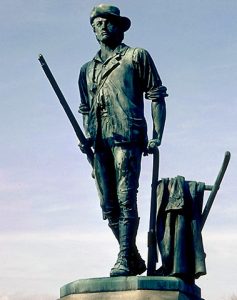
The Minute Man, sculpture by Artist Daniel Chester French (1850–1931), 1875, Concord, Massachusetts. National Park Service. Public Domain.
That said, there is another aspect to the training issue: that of “leadership”.
Military leadership – contrary to the views of many in the military, political and corporate sectors – is very different from “leadership” in either the corporate or political sectors. Leadership in a law enforcement agency does bear some resemblance to military leadership, but there are fundamental differences even there.
At its core, military leadership is much more difficult to define, let alone execute in the field. While there is a legal expectation of obedience inherent in military leadership, as there is in the political and law enforcement spheres, this almost never true in the corporate sector. Likewise, while law enforcement officers are expected to voluntarily face danger, there is seldom – if ever – a legal requirement to risk their own lives, as the verdict in the trial of the armed officer in the Parkland high school mass shooting demonstrated…This is very much not a verdict that would be laid in a military court martial for a similar offence.
In a very real sense, military leadership is centered on the fundamental principal that the commissioned or non-commissioned officer holds both the legal responsibility and moral authority to order their subordinates into situations that have a high chance – and potentially a guarantee – of resulting in said subordinates death or severe wounding. Such a responsibility is something that few politicians will ever face, in the course of their political careers; in the United States, the only political leaders who hold such authority are the President of the United States (in relation to the Federal Armed Forces), and the various governors of the Several States (in relation to their State National Guard commands).
The prescient question for this article, however, does not necessarily revolve around “legitimate authority”; in fact, the nature of his article more or less assumes that the notion of “legitimacy” does not come from a “vertical hierarchy”, but from a “lateral agreement”.
In the real “old days”, military leadership came from the strongest, meanest and most capable warrior, who used their fighting prowess to gain a band of followers who followed them because of their demonstrated skill and wisdom. In time, this evolved into various forms of social hierarchy, primarily in the form of “kingship” and an associated aristocracy, based on military ability and personal loyalty. Aside from the occasional aberration, such as the Roman Centurion system, this remained the case in Western Europe until the 17th Century.
The First Muster, 1637. Artist: Don Troiani. Public Domain.
Beginning around that time, the idea of the old “feudal levy” began to evolve into that of citizen militias. These types of formations were frequently self-organizing, in the literal sense of the term, where a group of local people – usually at the village or town level – would assemble on their own, pronounce the formation of some level of militia unit, the members of which would then volunteer to “place themselves under military discipline” (a very ‘loaded’ term, and one which the modern military struggles with to this day). And then, they would frequently do something so unheard of today, it is nearly impossible to find references to it: the self-mustered militia soldiers would elect officers from among their ranks as leaders.
In the British colonies of North America, the various colonial governors preferred to appoint officers to military ranks, such as George Washington’s direct appointment to the rank of Major by the Lieutenant Governor of Virginia, but the reality was that colonial governors could not afford to be too picky with a group of militia self-organized in time of need.
While the election of officers from within the ranks could certainly be problematic and prone to corruption, incompetence, and discipline problems, it actually tended to work out more often than not. George Washington’s frequent criticism of the various Colonial militias was aimed primarily at their officers being more concerned about keeping their positions by not enforcing too strict a regimen of discipline on their men, and likewise not training their men too strenuously, since those men could easily vote them out of their positions at any time. This was not true, however, in all of the hodge-podge of militia units Washington had to work with, but it did have a negative impact. While this negative impact led to the creation of a “regular” army, that army remained tiny for the entirety of the War of Independence, relying on local militias to fill its gaps for the entire course of the war.
As time went on, of course, the idea of local militias began to fade out of the public mind, especially as states struggled to retain sole control over their state military forces. Now, the same parties within the US government trying to outlaw military training for civilians outside of the armed forces, with the aid of their allies in the “popular press” have demonized the term “militia” to the point where most American equate the word to “terrorist”…
…But that is a whole other discussion.
To return to the point: Can a civilian – with no formal training or military experience – “self-teach” themselves to become an effective military leader? A leader capable of not simply leading a military formation, but of creating a basic training regimen for whatever troops they can “attract to their banner” (to borrow a phrase)?
The answer, as can be surmised, is…it’s complicated.
Reading various works on military leadership, both from the “old days” and newer works, is always a good start; a basic reading list will be presented at the end of this article. However, there is always a break point, where theory and reading must be put into practice.
And that’s the difficult part: a military officer – whether appointed from a higher authority or self-taught – is very much a chief in need of ‘spear carriers’: without troops to lead and teach, the self-taught “officer” will never know whether they have effectively learned the lessons their readings have taught them.
The majority of readers of this article will almost certainly never have to actually face this issue in “real life”…and you shouldn’t want to, by any means. But – the situations and threats of the world of the early-21st Century may require those skills.
It’s your decision whether or not to pursue the idea of teaching yourself how to lead troops. While I certainly cannot make that decision for you, you should be very concerned about government flunkies who don’t want you to do so.
The U.S. House voted 339 to 85 to pass 6 spending bills that will keep the government open until the end of Fiscal Year 2024. 207 Democrats voted for the bill, with 132 Republicans joining them. The package contained 1,050 pages and includes $450 billion of funding for the government.
The legislation is expected to pass the Senate before the Friday government shutdown deadline. U.S. House Speaker Mike Johnson (R-AR) claimed the move nudges congress in the right direction towards passing full omnibus deals, saying “In a way we’re sort of victimized by the tradition that’s been developed in Congress and we’re working really hard to bend that backwards, right. And so you can’t turn an aircraft carrier overnight. So what we did was we broke the omnibus fever, we put it into the laddered CR approach.”
The House on Wednesday approved a package of six spending bills, sending the legislation to the Senate days ahead of Friday’s partial government shutdown deadline.
The “minibus” — which funds a slew of programs and agencies through the end of fiscal 2024 — cleared the House in an 339-85 vote, with 207 Democrats and 132 Republicans throwing their support behind the measure.
The 1,050-page package calls for more than $450 billion in funding for the departments of Veterans Affairs, Agriculture, Interior, Transportation, Housing and Urban Development, Justice, Commerce and Energy.
The legislation now heads to the Senate, where Majority Leader Chuck Schumer (D-N.Y.) said the chamber will hold a vote this week so Congress can fund the relevant departments “with time to spare before Friday’s deadline.” That timeline, however, is up in the air.
The successful vote means the House is halfway done with the appropriations process for fiscal 2024, an undertaking that has fractured the GOP conference, thrown Speaker Mike Johnson (R-La.) into hot water with his right flank, and required four short-term extensions to arrive at the current juncture.
California has introduced legislation called the “California Dream for All Shared Appreciation Loans” that seems to give illegal aliens home loans they don’t actually have to pay back. The loans require no down payment and can be repaid if the “homeowner” resells to home. It is only open to “first-generation” homebuyers and is open to non-citizens, including illegal aliens.
State Senator Briah Dahle (R-Bieber) stated, “Assembly Bill 1840 is an insult to California citizens who are being left behind and priced out of homeownership. I’m all for helping first-time homebuyers, but give priority to those who are here in our state legally.”
… Democrats in the left-wing state are mulling a plan to give illegals a no money down mortgage “loan” that they also, coincidentally, don’t even have to make payments on…
The U.S. Supreme Court delivered another win to former President Donald Trump by considering a Presidential immunity case which triggered an automatic pause of the criminal trials targeting Trump’s activities while acting in an official capacity as President of the United States.
The court has scheduled hearings to begin on the consideration starting April 25, 2024. The move means even if Trump is not found to be protected from immunity, the cases will not likely be resolved before the November 2024 election. The ruling comes shortly after SCOTUS ruled 9-0 to keep Trump on the Presidential ballot.
The U.S. Supreme Court has scheduled arguments for former President Donald Trump’s presidential immunity claims, and will review the decision of the U.S. Court of Appeals for the District of Columbia, which upheld U.S. District Judge Tanya Chutkan’s ruling that Trump is not immune from prosecution.
On Tuesday, March 5, 2024, voters in 16 states participated in the GOP Presidential Primary, delivering 15 wins to Trump and one to Haley, who won Vermont. This followed wins by Trump in the previous week in Michigan, Iowa, and Missouri, leaving him with a delegate total of 1,059 to Haley’s 93. 1,215 delegates are needed to secure the nomination.
Following the loss, Haley, who relied heavily on Democrat donors and voters to get as far as she did, suspended her campaign, but refused to endorse Trump for President, claiming he would have to earn her vote and the votes of her supporters.
After Trump won more than 50% of the vote in Iowa, where Haley placed a distant third, members of the Republican Party quickly consolidated around the former president and endorsed him. Former 2024 candidates, including biotech entrepreneur Vivek Ramaswamy, South Carolina Sen. Tim Scott and North Dakota Gov. Doug Burgum, campaigned with Trump on the eve of the New Hampshire primary. Florida Gov. Ron DeSantis also took a parting shot at Haley as he exited the field, calling her platform “a repackaged form of warmed-over corporatism.”
Former U.N. Ambassador Nikki Haley has scored a surprise victory on Super Tuesday, upsetting Donald Trump to win Vermont.
That victory will do little to dent Trump’s primary dominance, however. The former president won 11 other states on Super Tuesday.
Haley is the last major rival to Trump standing in a once-crowded primary field. She has increasingly stepped up her attacks on the former president, arguing that he will lose in November to President Joe Biden if he clinches the party’s nomination.
On the Democratic side, Biden also ran up the score with wins all around the country against only token primary opposition — all but cementing the long-expected November rematch between him and Trump.
Former U.S. president Donald Trump continued his march toward the GOP nomination on Saturday, winning the Missouri caucuses and sweeping the delegate haul at a party convention in Michigan. Idaho Republicans planned to caucus later.
Trump earned every delegate at stake on Saturday, bringing his count to 244 compared to 24 for former UN Ambassador Nikki Haley. A candidate needs to secure 1,215 delegates to clinch the Republican nomination.
Donald Trump got a major victory from SCOTUS ahead of Super Tuesday when the Supreme Court voted 9-0 to strike down rulings by Democrat Attorneys General, State Secretary and Colorado Supreme Court who had all moved to remove Trump from the Presidential ballot for allegedly being an insurrectionist, even if he hasn’t been convicted of such charge.
Democrats and their supporters decried the ruling, with some calling for SCOTUS to be dismantled and others claiming the ruling is a threat to Democracy. The 9-0 ruling is a major rebuke of the legal bona fides of many Democrat legal experts who claimed the removal of Trump from the ballot should be a legal no-brainer.
The trial to determine the qualification of Lawfare Assassin, DNC-CCP anti-American activist and Fulton County DA Fani Willis continues, with Terrence Bradley being called to the witness stand after texts emerged that shows he told a Trump Co-Defendant’s attorney Willis was having relations with an ill-qualified lawyer she hired to prosecute Trump.
In addition to that, it is now coming out that the Biden administration allegedly has a plant in the Willis office, a campaign finance legal expert named Jeff DeSantis, who appears to have been installed by the Biden administration to help the ill-educated lawfare assassin, Fani Willis, come up with a “plausible” reason to do what they always wanted to do, use lawfare to eliminate the DNC-CCP’s main rival, Donald J. Trump.
Terrence Bradley, Nathan Wade’s former law partner and divorce lawyer, allegedly told Trump co-defendant Michael Roman’s attorney outside of court that Fani Willis and Nathan Wade had sex at the law office she was renting before she was Fulton County District Attorney.
Bradley was back on the stand on Tuesday after previously refusing to answer questions and hiding behind attorney-client privilege. However, Judge Scott McAfee ruled he was not protected by attorney-client privilege and ordered him to testify Tuesday morning.
Attorney Ashleigh Merchant made this bombshell revelation during her examination of Bradley in the third hearing on a Motion to Disqualify Fani Willis from the RICO case against Trump and 18 co-defendants. Merchant asked Bradley if it’s true that Fani Willis had sex with Nathan Wade at her private law office before she was District Attorney and before Wade was hired to lead the prosecution.
Watch a replay of Bradley’s full testimony earlier here.
… “one significant figure is overlooked in the Fulton County scandal”: one Jeff DiSantis, Breitbart reported, “the county’s Deputy District Attorney with professional experience far greater than the average county employee.”
A 2020 Willis campaign operative, he was also executive director of the state Democratic Party. And he has “extensive knowledge of campaign finance law.” He was a top hand as director of compliance at the Democratic National Committee.
DiSantis’ biography:
Jeff has also worked for candidates in 30 states running for a variety of offices, including President of the United States, United States Senator, Governor, United States Representative, Attorney General, District Attorney, and Mayor, as well as for a national political party committee. He has served as a campaign manager, media consultant, pollster, press spokesman, research director, and policy advisor.
That seems innocent enough. Lawyers in major-league politics are a dime a dozen. But the sources told Breitbart that DiSantis is no ordinary big-league designated hitter.
“Sources credit DiSantis with colluding with the White House to target Trump,” Breitbart continued:
“DiSantis did this,” one source told Breitbart News about the Trump case. “He’s the one. He is the one pulling all the strings. He was the one that walled her [Willis] off. He was in every important meeting. He is the brainchild behind this. That is the connection to the White House.”
Back FREEDOM for only $4.95/month and help the Freedomist to fight the ongoing war on liberty and defeat the establishment's SHILL press!!
Are you enjoying our content? Help support our mission to reach every American with a message of freedom through virtue, liberty, and independence! Support our team of dedicated freedom builders for as little as $4.95/month! Back the Freedomist now! Click here


.jpg%2F440px-Joe_Biden_(49385177488).jpg&f=1&nofb=1&ipt=8de1d34e8e3a558d11578aebb358a63c6a6b90887de510583be217d3d152517e&ipo=images "Biden Signs Partial Budget Bill")