April 1, 2026

Global Outlook

Coughing Tiger, Drunken Dragon – The Danger Of Globalization


Amid all the shrill backbiting over continuing to flagellate the dying Ukrainian efforts against Russia, as well as the capering of France trying to stave off the disintegration of its African satrapies, as those states internally realign themselves with Russia and China – by force, when necessary – a specter lurks in the background, the proverbial “elephant in the room”: Communist Chinese insecurity over Taiwan.

In this insecurity, lay the seeds of global economic collapse.

At the end of World War Two, Communist leader Mao Zedong led his “People’s Liberation Army” out of their mountain hideouts, and slid in behind Soviet forces occupying Manchuria, swiftly arming themselves with ex-Japanese military equipment captured from the defeated Imperial Japanese Army. Thus armed, the Communists went on the offensive against the exhausted Nationalist Kuomintang (KMT) forces, which had born the brunt of fighting against the Japanese for the preceding eight years (1937-1945).

Despite several billion dollars in US aid, and the poorly though-out deployment of the III Amphibious Corps and elements of the 7th Fleet, the sheer exhaustion and demoralization of the KMT resulted in a series of worsening defeats on the battlefield, until, in 1949, the surviving KMT military and government units retreated (for the most part) to the island of Formosa (now, Taiwan), and established a government in exile.

That is the situation as it remains, today.

Communist China, throughout its bloody and draconian history from 1950 until today, cannot abide that a recognized province of the country is not under its thumb. This manifests itself in the news of today, as near-continual violations of Taiwan’s declared air and sea boundaries by Communist military forces. The normal response of the United States has been to occasionally deploy aircraft carrier battle groups into the disputed waters as a dare to the Communists to fire on them.

The question for many, however, is – why? After all, the United States famously showed Taiwan the door in 1972, which made the country a diplomatic pariah state…so, why does the United States constantly go “eyeball-to-eyeball” with Communist Beijing over the island? For that matter, why can’t Beijing just let it go?

Two answers: For Beijing – and particularly for Premier Xi Jinping – Taiwan is a gaping sore for the Communists, as the island rapidly prospered under the KMT’s governance, while Communist China wallowed in poverty, famine and induced technological stagnation under the increasingly mentally unstable Mao…and that, in spite of the extreme brutality of the KMT’s actions in securing the island, beginning in the late 1940’s. As prosperous as Communist China has become in the aftermath of the reforms of Deng Xiaoping, the Communist state still lags behind Taiwan by a long distance.

Second, the United States knows a fundamental truth that many around the world (and particularly within the United States), a truth that is the basis of this article:


Any Communist attempt to invade and conquer Taiwan – even if it failed – would collapse the global economy overnight.


The reason for this is brutally simple: microchips.


Circuit board. Public Domain.


Silicon chips, semiconductors, or integrated circuits as the Reader prefers, are what drive modern technology, from the device you are reading this article on, to the CPU in your car, computer chips drive every object of any consequence in your everyday life.

And Taiwan produces at least fifty percent (50%) of the world’s supply.

Most of Taiwan’s chips are produced by one company, Taiwan Semiconductor Manufacturing Co. (TSMC). Unlike other manufacturers like Samsung and Intel (who manufacture chips for internal products), however, TSMC chips are not proprietary to them. Instead, their chips supply manufacturers of computer-driven hardware around the world, companies like Apple, Nvidia and Qualcomm, to name just three. Other nations around the world currently hover at less than half of TSMC’s production capacity; the United States currently holds about 12% of the global manufacturing capacity.

Invasions, as proven by the Russia’s invasion of the Ukraine, are bloody, messy and highly destructive affairs. Any actual Communist Chinese attempt to seize Taiwan would be no different, the severe problems of a combined arms assault on the island equating to a probable Communist failure aside. To say that such an invasion would “disrupt” TSMC’s operations is a laughable understatement, not least because standard military doctrine virtually guarantees direct attacks on the company’s production facilities, to say nothing of worker attrition from “collateral damage”.


Devastation in Bucha, Ukraine. CC0/1.0, Public Domain.


What would such a circumstance mean for the global economy? Simply, virtually all generalized computer and electronic device production and repair or upgrades utilizing semiconductors would grind to a halt, as stocks of chips dried up virtually overnight. This is due to the phenomenon of “just-in-time delivery”, an outgrowth of the wave of globalization that has been the norm since the 1990’s.

The Reader may recall the term “supply chain disruption” that became popular during the recent pandemic. Workers at both manufacturing plants, but also – critically – stevedores and loading crane operators stayed home, either terrified of catching the disease, by legal order, or both. This ricocheted throughout the global supply and transport system, and was greatly aggravated by what many considered to be a minor event, namely the grounding of the container ship Ever Given in March of 2021. The effects of these body blows to the global economy continue as of this writing.


Container Ship ‘Ever Given’ stuck in the Suez Canal, Egypt, March 24th, 2021. Copernicus Sential photo. CCA/2.0 Generic


In regards to a hypothetical – but very possible – Communist invasion of Taiwan, the disruption would be vastly worse, as there is no way for global manufacturers to quickly retool to make up for the loss, even if a ceasefire were quickly closed…And note that this does not address the general disruption of commercial cargo traffic in and out of the Communist nation, in the event of such a war.

But, there is an even greater danger lurking in this very possible scenario: the facts that not only will Taiwan not go quietly, but that they have a plan to take Communist China with them.

Without resorting to nuclear weapons.

The non-Communist Chinese in Taiwan all know full well what a Communist takeover of their country would entail. Given the Communist state’s recent history, to say nothing of its habit of “disappearing” political dissidents and anyone who disagrees with their regime too loudly. Because of this, there lurks a plan that Taipei lets slip every once in a while, to remind Beijing of what the consequences of invasion would be.


The Three Gorges Dam on the Yangtze River, China, 2009. CCA/2.0 Generic


Taiwan’s “doomsday” plan (YouTube link) would be a series of strikes against the Three Gorges Dam. If concentrated, such a strike package would collapse at least a section of the dam, releasing the force of 39.3 km3 to pour downstream in a massive deluge.

Provisionally, this action could kill up to 400 million people…And this is not an idle threat, as the KMT has done it before. To say that this could result in a nuclear response is a given…with everything else that derives from that.

Right now, Communist China is desperate to appear tough and capable. The chances of bluster turning into an actual invasion are very real, however.

This fact is something that should be taken seriously by anyone reading this.


The Freedomist — Keeping Watch, So You Don’t Have To
African Chess: Russo-Chinese Rise on the Corpse of Neo-Colonialism

By Michael A. Cessna, Military Affairs Correspondent

INTRODUCTION

On July 26th, the Presidential Guard of Niger arrested and detained the country’s President, Mohamed Bazoum, in a palace coup. The Presidential Guard’s move was quickly approved of by the Nigerian military, with General Abdourahmane “Omar” Tchiani being named to head the military junta now ruling the country.

The international response was as swift as it was predictable, with stentorian platitudes about immediately restoring democratic rule.” However, events swiftly took an equally unexpected turn, which has brought Western Africa to the point of all-out war, not just internally, but with France, and potentially NATO itself.

In brief: Africa is sick of France’s runaway neo-colonialism and is starting to find its legs with a nascent unified front…and Russia is waiting to pick up the pieces.

THE CURRENT SITUATION

As news of the coup spread, Nigerien civilians swept into the streets, in apparent support of the coup. While not unusual in coups, especially in Africa, what made this particular coup immediately different was the number of civilian coup supporters openly waving Russian flags and signs saying “Thank You, Russia!” in French (the country’s official language), accompanied by similar chants, shouts, and “man in the street” interviews.

The response by the wider “world community” was also predictable, with strident calls to release President Bazoum immediately and restore him to power. In doing so, this knee-jerk cheerleading figuratively shot itself in the foot, as it openly demanded restoration of “democratic rule via status quo ante” at all costs, even if the “democratic leadership” in question was openly corrupt.

Whether that is true of Bazoum’s administration is open to question, but there were certainly complaints within the military that Bazoum had a lackadaisical – at best – https://my.bible.com/users/paulcollier/reading-plans/13630-bibleproject-old-testament-in-a-year/subscription/940218825/day/58approach to the ongoing threat of Al Qaeda- and Islamic State-aligned jihadist insurgents threatening the nation.

1. ECOWAS – Again, none of this type of rhetoric – on both sides – is overly unusual, being the common refrain in virtually every coup since World War II. However, the rhetoric quickly took on a completely different tone, as France (the former colonial master of Niger) immediately began threatening the use of direct military force against the junta. The regional ECOWAS coalition (led by neighboring Nigeria) also quickly threatened military intervention to restore Bazoum, something to be taken seriously, as the regional body has done exactly this in the past.

The junta’s response, daring both France and ECOWAS (the regional economic, and now military, interstate body, that has intervened militarily in several West African states in the last twenty-odd years) to attempt to use force against the coup, was almost immediately backed up by the nations of Burkina Faso and Mali, who have declared that any attempted military intervention in Niger will be regarded as a “declaration of war” on them, presumably requiring an equal response.

These acts, by two countries that have both undergone coups in recent years, have effectively broken ECOWAS as a body, as several member states – critically, including the nation of Chad – have expressed their unwillingness to participate in either military action or sanctions. In fact, the Senate of neighboring Nigeria, to the south, is dragging its feet (as of this writing) on authorizing military action, despite the resolute calls of that country’s President for military intervention.

2. FRENCH DEPENDENCE ON NIGER – This seemingly extreme response is easy to understand when viewed in light of uranium extraction: Niger supplies 10-13% of the raw uranium that powers French civil nuclear power. While the loss of Niger’s uranium would be annoying for France, it would not be devastating…unless Niger’s neighbor, Chad, follows suit with the other landlocked uranium suppliers.

But for France and the wider Western “First World,” this is about much more than uranium – it is about both the rapidly collapsing structure of French neo-colonialism (using local proxy governments, propped up by bribery and occasionally French military muscle, to maintain highly unbalanced trade and mining concessions with the former colony), and the loss of strategic partnerships and military basing to the nascent Russia-China alliance that has quietly spread across the African Sahel in the last five years.

WHAT HAVE YOU DONE FOR ME LATELY?

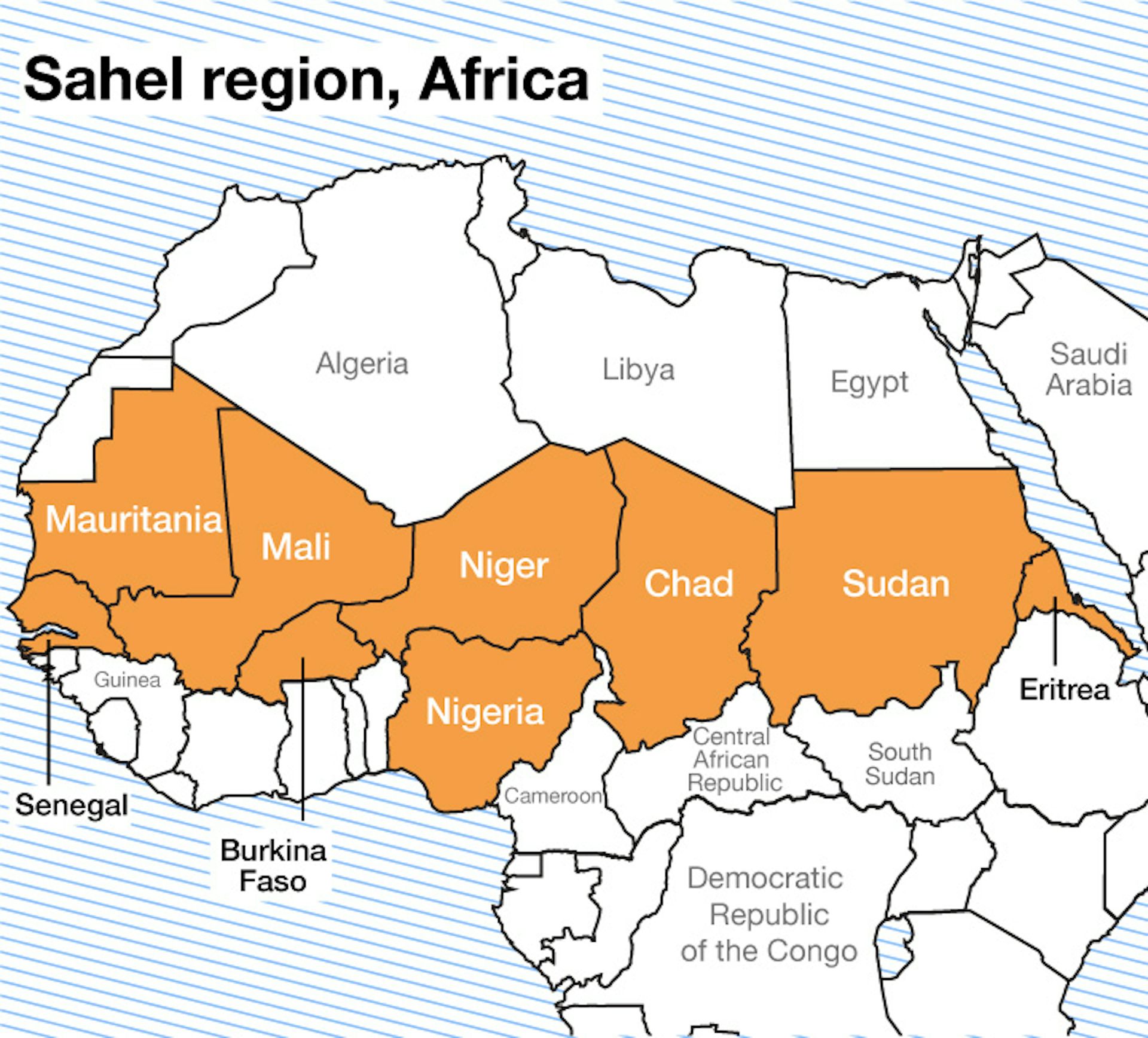
The African Sahel – that band of land separating the Sahara-Mediterranean coast from the tropical-temperate southern portion of the continent – has been locked in a desperate battle with a brutal Islamist insurgency for over twenty years. The fighting has been fierce and bloody, especially when viewed in light of the comparatively small populations involved (relative to the physical size of the nations involved.

For example, Niger is approximately twice the size of the US state of Texas, but has a smaller population. While France certainly stepped up a decade ago, and the United States saw a Special Forces team overrun and nearly annihilated in October of 2017, very little has happened since to improve the military situation, despite nearly 3,000 French and American troops being deployed in the country for nearly a decade.

1. THE SAHEL – Adding to this toxic state of affairs is the continued imbalance of remits for mineral extraction rights, not just within Niger, but within the wider arc of former French colonies in the Sahel. In true neo-colonialist fashion (not to be confused with “neo-cons,” although the two are related), the imbalance of remits is theoretically balanced by French and international aid packages to these economically disadvantaged nations; these are, however, demeaning to peoples who want to stand on their own, but are prevented from doing so by “leaders” who are kept in power by “foreign state backing” (read: “bribery”).

Eventually, this led to coups…but the recent spate of coups has taken on a new dimension, in that those executing the military removal of their corrupt and ineffectual, but “duly elected,” governments have seen the local putschists reach out to a new set of foreign backers: Russia and China, forming a kind of “Trans-Asian Pact” (TPA).

2. WAGNER FACTOR – Where China offers the possibility of access to cheap consumer goods provided by its Belt & Road Initiative.” Russia offers military muscle, not only in the form of weapons, but also in the form of combat support, training, and “direct action” combat missions by its “deniable” mercenary army, the Wagner PMC.

Militarily, despite the abysmal performance of Russia’s main military actor on the continent – the Wagner PMC, formerly headed by Yevgeny Prigozhin – the current policy has worked because the vast majority of the internal conflicts that have been hammering Africa in the last two decades are primarily tribal and/or ethnic in nature, rather than sectarian; for example, Niger’s Bazoum comes from the country’s Arab minority, comprising barely 0.4% of the population. In fact, Wagner troops’ performance in the field has fallen off considerably in the past when opposing the forces of the Islamic State, who – despite their much-reduced size – are far more motivated to stand and fight, like conventional infantry, rather than hit-and-fade, like strictly tribal forces.

One factor about Wagner needs to be kept in the forefront: Wagner is an extension of the Russian government. While it is technically a private corporation and does take contracts not directly associated with Russian foreign policy, it is entirely at the beck and call of Moscow, despite the recent putsch and its reorganization to stage in Belarus.

As well, the source of the corporation’s frequently poor troop performance in the past was tied to the fact that, at present, an estimated 80% of the corporation’s forces were recruited directly from Russian prisons.

While that might have worked 150 years ago, that is no longer a viable or effective recruiting ground for a modern military force.

However, the above facts should not be taken as bookends to define current Wagner troop capabilities. While much is being made of Wagner troops’ poor performance in Mozambique in 2019-2020 and against US Army Special Forces in Syria, as well as its equally poor performance against IS and Al Qaeda forces elsewhere in Africa, the local view among the people of the Sahel region is that Wagner troops are willing to get their hands dirty fighting terrorists, but without the presumption that they are colonizing troops.

Similarly, the Russo-Ukrainian War directly impacts this situation, as veteran Wagner forces realigned to Belarus are being filtered into Africa.

This is not something to be discounted – these troops have recent experience in a type of all-out combat not often seen in Africa, and the extensive combined arms operational doctrines associated with that type of warfare. While many, if not most, of the armies in Africa pay lip service at best to this type of warfare, they are mainly focused on operations more tied to counterinsurgency.

In this environment, it is entirely likely that Wagner’s poor performances of past years are no longer, and counting on the PMC to deploy poorly motivated and inept forces is likely a very bad idea.

THE BATTLESPACE

The fighting area is the African “Sahel” region, the “ecological/environmental buffer zone” dividing the Mediterranean-Saharan Desert region of northern Africa from the temperate-tropical “Sub-Saharan” regions to the south.

Broadly speaking, this region extends in an unbroken line from the Red Sea to the Atlantic Ocean.

The resource base of the countries in this region is vast and commercially exploitable, security concerns aside.

Given the regional political situation, France would have to enter several states to get at Niger, states that will either engage them directly and immediately, or whose populations will not exactly receive them with open arms.

Next, even a cursory examination of events in the preceding decade shows the clear nature of the Russo-Chinese Trans-Asia Pacts soft penetration: there have been a steady string of invitational interventions by Wagner forces across the Sahel, as well as a steady string of coups (many successful) in the same nations.

On the larger map, this shows the clear scope of the Trans-Asian Pact’s operations, as local power elites across the entire Sahel region have either staged – or at least attempted – coups with support (either direct or implied) from Wagner…and thus, from Russia.

The sole exception, as of early August 2023, is the nation of Chad – which announced on August 3rd that it would not participate in any military intervention against the Niger junta.

1. WHEELS WITHIN WHEELS

The Trans-Asia Pacts goals are clear and easily understandable: Supporting the coup groups in the African Sahel” region weakens the Wests control over those African states and impedes the strategic capability reach of Western powers.

In a minor sense, while this appears to imply a type of mercantilist plan – i.e., extracting local mineral resources in trade for pittance-level remunerations in cash and cheap goods – the trade balance is far more equal (at present) than those Sahel states’ situations with the West in general, and France in particular.

2. COUP WAVE – The wave of coups against openly corrupt governments, which are then replaced by Trans-Asia Pact-friendly juntas, makes possible a continent-spanning trade corridor.

3. TRADE, NOT SOCIAL ENGINEERING – Russia and China have quietly developed a mirror image of the Western colonial/mercantilist model of transactional relationships, but one with a fundamental difference: Neither Russia nor China make any pretensions to a civilizing mission in Africa – they are open about seeking strictly transactional relationships with local power elites; there is no presumption that either state cares about helping to raise up the populations of their local partners…and neither is there a presumption of imposing democracy on states that are ill-suited to the concept.

The current situation is most emphatically not the same as the proxy wars of the 1960s, ’70s, and ’80s: There is no pretension of fighting the capitalist-imperialist-colonialist diktat for the greater liberation of the Proletarian Workers according to the principles of Marx, Lenin, and Mao. This is strictly about economics and tangentially about military basing.

4. MILITARY REALITY – Militarily speaking, the West is confronted by two potentially insurmountable issues in Africa: First, aside from Wagner PMC forces, there are no apparent plans to attempt to deploy Russian or Chinese national forces to the Sahel, aside from Chinese warships already deployed to Djibouti as part of the international anti-piracy naval task force, and a pre-existing Russian basing agreement with Sudan.

This is extremely important, as it eliminates claims of colonial garrisonsin the partner nations.

The other problem is the growing military professionalism among African militaries. Western nations have gone to great lengths to bring officers from Third World national militaries to Western military academies and professional staff schools, in addition to the training teams of special forces deployed to their countries.

This has been coupled with the easy availability of weapons and support equipment at parity with Western nations…and, significantly, the ability and willingness to use that equipment.  While the military forces of a Niger or a Burkina Faso are certainly no match for French or American forces in an antiseptic, “one-on-one” contest, the reality is that France cannot invade the region like it was the 19th Century…and for completely different reasons; no US administration is willing to endure the firestorm of masses of mostly-Caucasian infantry doing more in Africa than training local forces or defending themselves.

It is a situation predicted over eighty years ago in The Small Wars Manual (1940), a semi-official “war-fighting” manual written by the United States Marine Corps at the dawn of World War II. The manual points out that its recommended tactics did work at that time, but that the more developed insurgent forces became, and the more they were able to source modern weapons and equipment, the less effective the book’s tactics would become.

Two much more worrying factors for the West are Algeria and the Great Rift Valley.  Algeria, also a former French colony, has angrily denounced French threats of military intervention in Niger. Having watched the 2011 NATO destruction of its eastern neighbor, Libya – by NATO forces led by France and Italy, and the earthshaking instability that resulted – it is not about to stand to see it happen on its already-threatened southern frontier. And Algeria has both the economic and military muscle to back that up, as it controls many of the oil pipeline heads supplying Europe with African crude.

5. GREAT RIFT INSTABILITY – The other issue is the continual instability in the Great Rift Valley, in Eastern Africa. This mineral-rich region has been kept as undeveloped and disorganized as possible, as it produces sky-high profit margins for the vital minerals that keep the West’s high-tech industries running…at the cost of what amounts to slave labor, strip mines, and continual banditry and insurgencies.

6. CULTURE WARS – In light of ongoing events, including the recent move of insanity by the World Bank to shut out the nation of Uganda from any further loans because of their passage of openly anti-LGBTQ laws, it is no feat of clairvoyance to see that many states in the region may reach out to the Russia-China TPA, and its associated partners in BRICS, to obtain cash loans against their mineralogical outputs. While still disadvantageous to the African countries, such deals would still likely be better deals than what they currently get from the West.

PREDICTIVE ANALYSIS

Over a period of thirty-odd years, the West figuratively built a massive stone wall – then promptly ran into it, face-first, and at full speed. This construct was built from a combination of Victory Diseaseinspired arrogance after the end of the Cold War, abject greed, and a not-small amount of paternalistic plantationracism.

The result has been the West resting on its laurels, assuming that the Third World peasants it has deliberately kept in an undeveloped state to maximize corporate profits were too stupid and brutalized to take any meaningful action against them and their money-generating interests.

In fact, the near-constant state of war in Africa has created the ultimate Darwinian laboratory, where only the most cunning and ruthless leaders and forces survive…with leaders who are far more intelligent and crafty than anyone in the leadership echelons in Western Europe or the US.

Africa is now at the point where, while perhaps unable to fully operate on their own, they are more than capable of ditching their neo-colonial masters for others who, while also not caring about them in any functional way, are at least open and honest with them about what their intentions are.

And, unlike during the proxy warperiod of the 1960s–1980s, the grotesque incompetence of the Western Powers – especially the United States – has resulted in a state where the West is unable to take meaningful action against a Third World regional bloc. Western militaries and defense industries are incapable, as of 2023-2024, of doing more than chasing the occasional goat herder – the Western powers who goaded Ukraine into a no-win war with Russia did so without the ability to back up their saber-rattling…And now, not only are they unable to back their Ukrainian gambit, they cannot intimidate a Third World bloc unwilling to bend the knee, if that bloc keeps its spine straight.

Military action by France against the Niger junta is impossible, even with US support. As stated above, this will never happen, as no administration inside the DC Beltway will risk the image of masses of white American troops doing more in Africa than defending themselves, if that.

Added to the possible north-south advance of Wagner into the Great Rift Valley (where Western tech firms get the critical materials for their technologies), a possible axis of advance helped in no small part by the deranged response of the United States to Uganda’s recent anti-LGBT legislation, this means that the long-dreaded, fundamental shift in economic balance is now visible on the horizon:

Africa is on the verge of entering the world commodities market as a single negotiating bloc, capable of executing most-favored-nation statustrade agreements as a continent, with any and all other countries.

This will fundamentally undo the current economic paradigm of globalism that has clamped onto the jugular and carotid arteries of the world for thirty odd years.

The end results will not be pretty.

FURTHR RESEARCH

Al Qaeda in the Islamic Maghreb: Shadow of Terror over The Sahel, from 2007 – Al Venter

Small Wars Manual – Department of Defense

Fiasco – Thomas Ricks

How To Make War, 4th Edition – James F. Dunnigan


You Never Go Full ‘Don Quixote’ – Or, When ‘Crazy Eddie’ Throws Pasta


In 1974, authors Larry Niven and Jerry Pournelle, writing in their seminal science fiction novel “The Mote In God’s Eye”, coined a character concept called “Crazy Eddie”, a concept-figure who would appear in a society’s mindset at time of extreme social stress, and take the most insane and contradictory actions possible, which usually resulted in accelerating the collapse of a society or civilization.

The world is in a remarkable state of tumult as of September 1 of 2023. The war in Ukraine is well into its second year. In Africa, a wave of military coups is obliterating France’s sixty-plus year old “totally-not-an-empire”, sending the region and the wider world into a frenzy of impotent rage, as no one wants to wade into a quagmire against black nations standing up to imperialist and corporate interests. Russia and China, aside from rattling military sabers to whet the appetite of the ravenous bloodlust of the Western media and entertainment spheres, are quietly marching towards an economic checkmate against the West, in a move that will not simply destroy the Western business models, but will smash Western economies flat, potentially reducing many Western European economies to a state no scene since the post-World War 2 recovery, and the Marshall Plan…only there won’t be a Marshall Plan this time. Maybe a Putin-Xi Plan, but not a Marshall Plan.

Pretty heavy for an opening bit, eh?

Amid all of the current tumult in the United States – the possible return of Covid lockdown restrictions not least among those – there is a quietly increasing crescendo calling for actual military intervention – meaning, “invasion” – of Mexico, in order to “deal” with the flow of illegal drugs.

I wish I were joking.

The current power bloc in Washington, DC – supported by their cohorts in The City of London, Paris, and Brussels – had goaded Russia into what they thought would be a “warm-n-fuzzy” kind of “Cold War, 2.0”; what they got was a full-on invasion. Although there initial, hysterical screams to “go to war” with Russia, both from within the power blocs and from those in the general public who should probably be on emotional-management medications, it soon dawned on most people that “going to war” with Russia would almost certainly mean a “nuclear” war, that no one would “win”.

Then came Africa: Beginning in 2017 (YouTube link), people seemed to suddenly remember that there were still islamist jihadi’s out in the world, burning, looting, raping and killing people in order to serve the warped vision of religion espoused by a tortured political prisoner. However, murderous religious maniacs were “so three years ago”, and virtually no one on the “Western Street” considered barely-literate bandits hiding under the cloak of religious fervor to be an existential threat to Western civilization. Likewise, the recent wave of coups – not coming at the behest of Western governments and corporations – aren’t exactly revving the martial engines of Western populations being crushed under rancid economies and continual political scandals.

Something else was needed…And in the United States that answer is, increasingly, the illicit drug problem.

And it is a problem: tens of thousands of Americans die every year from drug overdoses, a large percentage involving the drug fentanyl. Unlike the normal cries for “Bayonets UP!”, however, this group of calls comes from the opposite side of the aisle: instead of Democrats leading the charge for military intervention, this time, the main thrust is coming from the Republican side of the fence.

This should not be a surprise, given the GOP’s continuous cries against illicit drugs. After all, it was no less a figure than Richard Nixon, who authorized the placing of cannabis (aka, “marijuana”) on the list of drugs as a Schedule 1 compound, right next to heroin – a position it retains to this writing – in 1970. And, like the vigorously enforced alcohol raids of the Prohibition Era – also enforced by successive Republican administrations – the GOP’s “war on drugs” has directly sparked the explosive growth of massive, high-revenue and well-armed and frighteningly well-equipped drug cartels, who have an international reach, and who have now diversified into human trafficking.

Given the abject inability of the US military to deal with the opium trade in Afghanistan during its twenty-year long occupation of the country – which saw opium poppy fields expand five-fold – the idea that a smaller military, struggling with recruiting efforts, and quietly speaking the dreaded “D-Word” out loud, can deal with the various drug cartels is not a matter for political or military debate, but a matter to be dealt with by mental health counselors.

The US military is having trouble recruiting people with bonuses exceeding $50,000 to sign up. As Mexico itself has discovered, military recruiters have a hard time competing with their counterparts in the Cartels, especially if the Cartel recruiters can use Mafia-like threats against potential recruits’ families. Likewise, the Cartels not only pay what regular forces term “combat pay”, but offer bounties against specific targets.

As well, with revenues between US$20 billion and US$60 billion per year (minimum), and far less overhead than conventional corporations and nation states, the Cartels have plenty of cash left over for high-intensity R&D: the wave of combat footage coming out of Ukraine, showing drones – from both sides – dropping small bomblets into trenches and bunkers are merely the current state of a technology pioneered by the Cartels, and refined in Syria in the aftermath of the rise of ISIL.

Much worse, from both a tactical and an operational standpoint, is the ability of Cartel members to blend into the general population. While islamist jihadis are comparatively easy to target, as they belong to a very narrow slice of the US population, Cartel members are a subset of the largest minority group in the United States. Where – to get rather “ugly” about it – potential jihadists tend to limit themselves to Muslim mosques, Cartel soldiers are largely Catholic, and are thus able to circulate freely among the Catholic population, the fastest-growing Christian denomination in the world.

The Cartel’s leadership echelons are not idiots. In fact, a distressing number began as military professionals, as is clear from their ability to organize a military-style logistics system. They are watching the rhetoric coming from within Washington, DC and various other organs, both from within the government, and from government-adjacent groups – nothing presented here is new to the Cartels.
Decades of neglect of border security, up to and including the recent encouragement of millions of desperate economic refugees to cross the southern border of the United States illegally – an action which helps to fuel the cartels’ diversified revenue structure, to say nothing of the very real physical dangers of the northern Mexican deserts and the human trafficking predations of the “coyotes” – has fueled an massive surge in drug-related deaths across the United States. Communist China is certainly complicit in this, as they are the Cartels’ prime suppliers of fentanyl precursor drugs…something they have no issue supplying, as Beijing sees this as “payback” for the Opium Wars…but that is a whole other story.
With the hyperventilating actions of people who should know better, calling for a Presidential authorization to use military force against the Cartels, alongside equally breathless and stentorian calls to designate the Cartels as “Foreign Terrorist Organizations” (FTO’s), and coupled to a military establishment that has seemingly lost its way, to the point where it is quietly considering a return to a military Draft, the notion of an all-out “hot” war on the southern border of the United States is the height of lunacy, a lunacy driven by both sides of increasingly incompetent power blocs.

We, the People” have allowed our “elected” leaders to paint us into a corner, a corner from which there is no real way out, except through the use of extreme levels of violence.

Kind of like Africa in the last few months.


The Freedomist — Keeping Watch, So You Don’t Have To
When ‘Forever Wars’ Fail – Delusions vs Realities


On July 26 of 2023, a military coup unseated the president of the West African nation of Niger; details of this situation and its wider implications are the subject of a Freedomist monthly, subscription-only article, set to go to press as this article is being written. While coups d’état are not unusual in post-1960 Africa, what made this one unusual was that it was the sixth since 2020, and was only the latest in a string of some twelve coups in the region, beginning in 2008. Another unique feature in Niger is the open public praise of Russia, complete with homemade Russian flags.

And this is aside from the absolutely remarkable statements from both the US State Department and the Pentagon’s AFRICOM command that they have no idea and no way to track what happens to the Third World military officers (some of whom earn Master’s degrees in US and British military universities) that they train.

These coups are not complex events to understand – not that the various “think tanks” advising policy makers around the world seem to understand them. At all. In fact, the tone-deaf mewlings of people overly impressed by the letters after their own names begs inquiry as to whether or not they are using word-salad AI Chatbots to write their papers.

Additionally, the non-military sphere is heating up as well, as the BRICS Group has just extended invitations for membership to six states: Argentina, Egypt, Ethiopia, Iran, Saudi Arabia, and the UAE. This is no small thing…again, however, not that the US, British of Western European foreign policy, military and financial power structures seem to care.

And this is also separate from the catastrophically embarrassing failures of the same nation’s attempts at training Second- and Third World military forces to something approaching a Western military standard. From the nation of Georgia in 2008, to the collapse of the Iraqi Army in 2014, that of the Afghan National Army in 2021 and the abysmal performance of the “retrained” Ukrainian Army in 2022-23, Western – meaning, United States and NATO countries – military training programs have consistently failed (and failed miserably) to train up effective forces. Given that the current US Secretary of Defense, retired General Lloyd Austin, testified before Congress (YouTube link) on the spectacular $500 million failure to train more than a handful of “friendly” anti-regime forces in Syria, it would seem obvious that rather penetrating questions should have been asked, on numerous occasions.

But, I digress…Back to the original question: Why is it so hard to understand what is happening in world affairs?

There are only three realistic possibilities: incompetence, delusion and/or corruption.

Incompetence at this level, while alarming to the uninitiated, is depressingly common in areas of higher education. Classroom theories about lofty and obtuse notions of “democracy”, finance, resource management and social equity fail instantly and completely when confronted with the stark realities of the real world – as education widens in the population base, the “common folk” begin to learn just how badly they are being screwed…and eventually, they will stop taking it, rise up, and either stand on their own, or at least look for a new partner that isn’t insultingly paternalistic and slimy.

That, in a nutshell, is what just happened in Niger, as the population is fed up with France acting as the glowering, judgmental schoolmaster, desperately trying to hold on to a zombified economic dominion over its former “colonies.” Russia – while certainly no saint – has no real colonial history in Africa, and is remembered by many as a reasonably friendly power from the Cold War era.

Turning to the possibility of delusion, that is also an easy, if depressing, possibility to grasp. The sad fact is that Western institutions of education have spent at least forty-odd years hammering at the nail of “democracy”, as if it were a panacea to all of the world’s ills. This is done despite the bald facts that “democracy” is extremely fickle, and fails abjectly when forcibly introduced into a populace who has little, if any, history or inclination to properly use what is a notoriously clunky system, a system that encourages discrimination at virtually every level if not carefully carried out. Countries and peoples that have political systems imposed on them with little education or even training quickly spiral into internal unrest, if not civil war. This is the historical record, from Sri Lanka to Iraq, to Niger; where exceptions appear, those simply ‘prove the rule.’

Corruption, too, is a distinct possibility. The Western “establishment” deeply fears an Africa whose national peoples – even though their “nations” are, for the most part, wholly artificial constructs with boarders drawn by distant colonial powers with delusions of adequacy – might someday agree to set aside their differences, overthrow their corrupt “leaders”, and tell the West that their free lunch is over…and lest you, the Reader, dismiss this as an empty threat, you would be wise to remember that cheap African minerals are why you were able to afford the computer, tablet and/or smartphone you are reading this article on.

In contrast to the incoherent bleatings of people with more letters after their names than actual experience, critical thinking and/or “plain common sense,” the issue at hand is not that the United States, France and other Western powers are somehow deliberately scheming to topple governments with whom they are already friendly (because they stage-managed the elections that put those governments in power), using officers trained in their own advanced schools of military education, in order to install governments antithetical to those Western states’ views and desires while aligning themselves with said Western states’ semi- (if not full-on) hostile opponents (read that again, if you need to; I did)…it is far more a matter of “keeping the pot simmering,” to keep the local “partner nations” off-balanced, and in dire need of “friendly support”…the notion that local military officers, professionally trained by Western militaries, might go home, look at the rank corruption and incompetence of their “democratically elected” governments, and decide that “drastic measures” are required to save the country, is apparently unfathomable inside the air conditioned think tanks of Washington, DC, London, Paris and Brussels.

No word on how the Western troops at the sharp end feel about this. (YouTube link)

There is, however, another dimension to this situation: Grand Strategy.


African countries that have had coups between 2020 and 2023 (July 2023). Credit: Discombobulates. CCA/4.0


The BRICS Group, led by Communist China and Vladimir Putin’s Russia, has used the wave of coups across the African Sahel region – the so-called “Coup Belt” – to their distinct advantage. When zooming out to a wider Africa map, it is clear that the pattern of coups in the African Sahel region stretch in a near-unbroken line from the Red Sea to the Atlantic Ocean…and every coup in those states in the last fifteen odd years has been done with at least tacit Russian or Chinese support. With the BRICS Group inviting in new members, this opens the possibility of a revival of a British idea from their imperial days in Africa: instead of a “Cairo to Cape Town Railway”, the wave of Russia-friendly governments produced by the wave of recent coups opens the possibility of a “Port Sudan to Dakar Railway”, cutting across the breadth of the continent, causing a vast and violent shift in global commerce, as it would allow a transshipment route for cargoes that would bypass the Suez Canal…All that is needed for such a project is money (see: Saudi Arabia joining BRICS, above), and a much-improved security situation, neutralizing both “islamist insurgents” and general banditry. This would also open the possibility of reviving the “Cairo to Cape Town” route, as well as additional north-south spur lines. Russia is well-versed in the impacts of a continent-spanning rail line, as their more-than-a-century-old Trans-Siberian Railway remains a vital economic artery for the Russian state.

Another dimension, is the neutralizing of ECOWAS, the “Economic Community of West African States”, an economic cooperation sphere which has been increasingly flexing its military muscles, intervening in several member states over the years, for a variety of reasons. In Niger, however ECOWAS’s immediate order to the coup’s ruling junta to immediately return the deposed Nigerien president to power, was met with a blunt refusal – a refusal that has now been formally backed up by the nations of Burkina Faso and Mali, both of whom are currently led by military junta’s who also succeeded in their own recent coups. And in the broader ECOWAS nations, there is very little support for the idea of a military intervention, especially in light of increasing attacks by AQIM and Boko Haram in recent months.

On top of this, the Organization of African Unity (the “OAU”) has also taken action that is not being well received on the “African Street”. These unpopular actions in recent weeks hold the possibility of seriously fragmenting both organizations.

Which, to return to the corruption angle, also brings up an ugly possibility, one verging into full-on “Conspiracy-Theory Land” (a place that is increasingly “Conspiracy-Fact Land”): that Western militaries are being deliberately hamstrung in fighting islamist insurgencies – not simply in Africa, but around the world.

This is in no way the fault of the Western troops at the “pointy end of the spear” – major policy theories and decisions are presented to troops detailed to execute them far less often than they are presented to the general public, regardless of country. But there is a clear pattern in the preceding thirty or so years: Western forces are sent into a state which – although theoretically rich in natural resources – is almost hopelessly backward, and kept that way by Western interests who want both cheap resources, no matter the cost, and “strategic positioning,” also no matter the cost.

Military force has its limits. The problem with Georges Clemenceau’s tired saw, that “war is too important to be left to the generals”, is that politicians – and the “political” generals advising them – are almost always in a far worse position to be making military decisions than their generals.

This is as true in Africa as it is in Ukraine. In the latter case, the hysterical incompetence and base greed of “corporate donation”-driven politicians has brought the world closer to open nuclear conflict than at any time since at least 1983. (YouTube link)

But in Africa, this hysterical incompetence actually presents a far greater danger to the West: African states with enough military competence to make it difficult to invade them all, who can form a solid negotiating bloc – especially one with support from Russia and Communist China – can up-end Western technology and transport infrastructures to the point of collapse, without firing a shot. Those directing affairs in Washington, London, Paris and Brussels believe that they can “manage” these coming “adjustments”; they cannot, but that is not stopping them from proceeding with their plans, plans driven by arrogance, hubris, and not a little racism.

The people running things in the West are playing a game by rules that they think that wrote, and which they assume cannot be changed unless they want to.

The Universe will only tolerate a certain amount of stupidity. When that limit is passed, the Universe has a habit of collapsing things, in any of a number of way – none of them good.

To quote the Athenian scholar and general, Thucydides, “The society that separates its scholars from its warriors will have its thinking done by cowards and its fighting by fools.

Prepare accordingly.


The Freedomist — Keeping Watch, So You Don’t Have To
House of Cards – Victory Disease, Unhinged Greed and the Pentagon’s Darkest Fear


‘MERICA


There is a perception in the world, a perception with solid reasoning behind it, that the United States of America is the most powerful nation in the recorded history of the world. In fact, the world system of the early 21st Century is hinged on that very concept.

But – is it true?

Economically, the United States is certainly a powerhouse. As measured by Gross Domestic Product (GDP) the US economy is almost larger than the next three economies in the world. However, in GDP per Capita the US is seventh, and in Purchasing Power Parity (PPP) (a measure of the ratio of the price of a “basket of goods” in different countries, that is used to compare the absolute purchasing power of national currencies), the US is in 10th place. In exports, the US is in second place to China, and even then, the vast bulk of US exports are limited to petroleum, aircraft, pharmaceuticals and medical instruments, due primarily to the high costs of US labor. Dangerously, the imbalance of imports shows that the US is reliant on the willingness of the rest of the world for a vast amount of its real goods, like industrial machinery.

We could talk about how reporting on the quality of education in the US is “cooked”, but we’ll let the World Population Review discuss that.

But really – that’s not why you’re reading this, right? After all, if the Reader has been reading the Freedomist for any length of time, you are fully aware what my focus is. So, let’s go there.

Militarily, the United States Armed Forces possess a set of demonstrated structures that maximize its global reach and power projection…in theory. The state of the US military – and, critically, its supporting industrial base and capacity – is abysmal. This is not a question solely of culture or corruption, although those things are certainly major factors. The issue to keep in mind, here, is that the United States military is an apolitical and a-cultural bellwether for the nation – if the military works, the nation’s political and cultural problems are not insurmountable; conversely, if the military isn’t working, metaphorically speaking, the nation is in danger…How much danger, we will look into below.

Why is the military in the poor state that it is? On the surface, the issues started to became public, albeit in a very quiet way, in 2001…not with the 9/11 attacks, but with the release of the 2001 Quadrennial Defense Review. The 2001 QDR – one of a series of documents issued every 4 years from 1997 to 2017 by and for the Washington, DC bureaucratic swamp that describes a “4-year plan” (…) – was the first to explicitly state the plan to replace the notion of “strategy” (in the historical sense) with “capabilities-based planning”.

Basically, “strategy” was too hard to do effectively in an “asymmetric environment”, where hostile actors could erupt anywhere, at any time, and act in unpredictable ways. So…it followed that traditional strategic planning model no longer functioned. The solution – “capabilities-based planning” – posited the notion that if an issue arose, a “basket” of units with various capabilities appropriate to the nation, region and operational environment could be quickly assembled, and thrown into action, until the problem went away.

Given what should have been the obvious disaster in the making with such a childish idea, it should be no surprise that it failed, miserably, utterly and completely, almost from its first use.

But the problem is much deep than this.


JUNGLE GHOSTS


The United State Armed Forces were badly scarred, in a psychological and cultural sense, by the collapse of the Western effort in the Vietnam War. This is well known. What is not so well known, at least among the general public, is the US military’s responses to the defeat.


South Vietnamese refugees aboard a U.S. Navy vessel during Operation Frequent Wind, the final evacuation of Saigon, Republic of Vietnam. April 29, 1975. US Department of Defense. Public Domain.


The US military, as a group, essentially abandoned “counterinsurgency” in the aftermath of the Vietnam defeat. It had deployed massive forces, conventional and special, which had uniformly fought hard, in a confusing and frustrating environment. And it had failed. In the bizarre world of guerrilla warfare, while US and Allied units won every engagement above the level of the infantry company, they had still lost the war, because South Vietnam had ultimately fallen, seemingly rendering the efforts moot.

The reasons for South Vietnam’s collapse are many, and not the subject for this article. But, the reaction by the US military was to refocus all of its efforts towards very likely fights with the Soviet Union and the People’s Republic of China, in effect, “World War 3”, ala, “World War 2, but with lots more nukes.”

To do this, the US military – primarily the Army – had to rethink its concept of strategy, following the failure of its “Pentomic Army” experiment. The answer seemed to arrive in 1976, when John Boyd, Colonel, USAF (ret.) first presented his “Patterns of Conflict” work, that outlined what is now known as the “OODA Loop”. The OODA concept took the US military establishment by storm in the mid-1970’s, and resulted in two things: the revitalization of the Opposition Force (OPFOR) concept, and in a new battle strategy for winning the conventional side of World War 3 – “AirLand Battle”.

The US military had maintained the idea of an “opposing force” as a training model since 1946; in fact, the Freedomist covered this unique and seminal organization in May of this year. In the late 1970’s, the program was completely overhauled, and centered on a then state of the art training facility at Ft. Irwin, CA, and later at Ft Polk, LA (now renamed as Ft. Johnson), which focused on counterinsurgency as operations in Iraq and Afghanistan shifted in focus, in concert with the US Marine Corps’ facility at 29 Palms, CA. The concept has been maintained and updated over the years. The concept created the most realistic combat training facility ever established, that trained a generation of primarily US Army armor officers and troops in how to fight and win on an armored battlefield. The armored warfare training program fell out of extensive use during the Global War on Terror, as there was little need for massed armored formations after the successful invasion and conquest of Iraq in 2003.

Coupled to the success of the AirLand Battle concept in 1991, it seemed that the US military had recovered from Vietnam, and was back in the dominant position it had seemingly enjoyed since the end of World War 2.


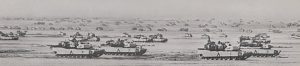
A Brigade of the U.S. 3rd Armored Division masses in northern Saudi Arabia in preparation for the invasion of Iraq during the Gulf War, February 1991. US Army photo. Public Domain.


COLLAPSE?


But, lurking beneath the surface, there was a palpable, unsettled feeling – something just didn’t…“feel right”. There was suspicion, whispered in private, that we were actually training potential combat leaders how to “win the battle, but not the war”. Those concerns, however, were mostly forgotten as “bumps in the road” and “just bad luck”, as Iraq and Afghanistan metastasized into the quagmires they became.

But, hey – counterinsurgency is hard and messy, right? It’s comparatively a lot harder than the good, old-fashioned smash of the armored fist into the bad guy’s face.

Right?

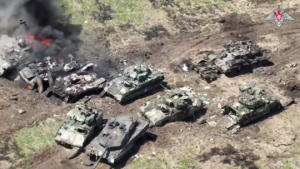
But then – Russia formally invaded Ukraine. (The war had actually been going on for some eight years by 2022, but no one wants to talk about that.) And, after a year of intense combat – the very type of “main-force” combat Western combat leaders thought AirLand Battle was designed to fight – the Ukrainians launched a counter-offensive in the summer of 2023, using troops given a “quickie” training course in US/NATO AirLand Battle concepts, and fortified with deliveries of US M2 Bradley Infantry Fighting Vehicles and German Leopard 2 main battle tanks…..the results were as dismal as they were alarming.


A Ukrainian Leopard 2 tank and several Bradley fighting vehicles destroyed by the Russian forces in Russia’s Zaporozhye Region, June 2023. Photo: Mil.ru. CCA/4.0


The US military, as well as the armed forces of the wider NATO Alliance, is getting a ringside to the live practice of the war they planned to fight…and it doesn’t look good.

The reality is that the AirLand Battle concept was never designed as an “attack” strategy, like its predecessor, the misnamed “Blitzkrieg” – it was always implicitly a defensive strategy. While people in the higher levels of the Army and the wider Pentagon establish speak confidently and relentlessly about “combined arms” and “maneuver warfare”, the cold fact is that their operational plans remain rooted in Airland Battle doctrine, a doctrine that does not play well on the offense…unless, of course, your opponent is a badly-trained, badly-equipped and demoralized rabble, who hate their leaders so much, they are willing to allow a foreign invader to enter and conquer their nation, wholesale.

The situation with Ukraine and Russia is spiraling out of control. What began as a craven attempt to restart the Cold War for “fun and profit” has now grown, until it is beginning to run off of the rails. This naked corruption, coupled to unsustainable recruiting numbers in the armies facing Russia – and soon, perhaps, those of Belarus and the People’s Republic of China – and an exhausted and flagging industrial base that cannot keep up with the vast needs for munitions and weapons – and not simply advanced weapons, but even basic arms – has led the White House to the highly unusual (and frankly rather alarming) decision to activate individuals within the “Inactive Ready Reserve” for immediate deployment to the European Combatant Command.

In 1941, as the Japanese launched their attack on Pearl Harbor, the United States had spent well over a year building up its military forces in the first peacetime military draft call-up in the nation’s history. As well, war industry production had been steadily increasing since 1939; Lend-Lease would be formalized in early 1941, vastly increasing the production of war materials.

That is most emphatically not the case, as of July of 2023.

Neither the United States nor its allies have been able to increase production of basic military supplies like artillery ammunition. No one willing to support Ukraine seems to be able increase its production rates to serious war levels, even after some eighteen months of fighting. Western defense firms do, indeed, produce very high quality weapons…but that quality comes at an equally high price, in that those weapons frequently require special materials and/or complex components, all of which cost a lot of money.

And, just as there is no desire in the West to “gear down” to use simpler weapons and equipment, there is no desire to implement a peacetime draft to flesh out military numbers; in fact, a peacetime draft may be impossible, not only in the US, but in most of Western Europe…

And meanwhile – Russian industry is working multiple shifts, not simply producing war material for Ukraine, but fulfilling foreign orders as well. China is expanding its influence in resource-rich Africa, while securing “back door” supply chains to support Russia through its “Belt & Road” corridors in Asia.

The outlook is grim. For far too long irrational, incompetent and openly corrupt corporations and politicians have been inventing ways to sustain the “Great Green Machine”. For twenty-odd years, “Achmed the Goat-Herder” was touted as an existential threat to Western Civilization. When that failed – not simply because the general public realized that presentation for the lie that it is, but because using a $100million+ fighter plane to bomb Achmed is stupid and wasteful in the extreme – it was decided to push Russia into a “cold” conflict, to boost sales numbers.

And now…the incompetents in charge have no way out. They think that they do – but they do not. They are playing at a craps table, where failure will lead to a nuclear exchange.

And that exchange is aimed at you and me.


The Freedomist — Keeping Watch, So You Don’t Have To


Team Biden Wants Foreigners to Control U.S. Military Contracts

In the name of saving the planet from the number one enemy of the Democratic Party, the human race, the mass mailer President committee of Joe Biden is “proposing” allowing a foreign environmental group called Science Based Targets Initiatives (SBTI) out of the UK to veto military contracts with companies that fail to meet international carbon emission reduction targets.

Senior fellow for the Heritage Foundation Travis Fisher warned, “I think Americans will be upset when they realize the Biden administration is trying to put a bunch of unelected bureaucrats and a climate activist group—headquartered in London—in charge of long-term planning for our national defense contractors.”

The “proposal” would target 671 contractors for foreign agent adjudication to determine if they are towing the climate ideology party line, never mind if they can provide the best services and equipment our military needs to be an effective fighting force, something that has always been of little importance to the Democratic Party for as long as this writer (now in his 50s) remembers.

SBTI came from a far-left association of dark money organizations called “We Mean Business Coalition” in 2015. The groups are closely aligned with the global fascist organization World Economic Forum. The connections to Marxist ideologues and organizations is thick and heavy and further serves to give the American people evidence of the truly seditious nature of the DNC-CCP, which has values that are aligned with Chairman Xi, not Thomas Jefferson.

Mercenaries, Spies & Private Eyes, Part 2 – Is the PMC Era Coming To An End?


Mercenaries have been around for a very long time; so long, in fact, that working as a “sell sword” is regarded as a prime candidate for the title, “The Second Oldest Profession”; the Freedomist even covered this previously. During the Italian Renaissance, the sometimes substantial forces of various condottieri mercenary captains had a noted and significant impart on Western History. In the modern day, from 2003 onwards, this has been exemplified by the rise of the “Private Military Company” (PMC).

While some people may think that mercenaries are a relatively recent phenomena, having been largely eliminated after the Napoleonic Wars, the truth is that the profession has continued on up to the present day, albeit on a more individual level, more than massed units like the hired Hessian troops of the American War of Independence.

(An important note is that those to whom the 19th Century term “filibusters”, as related to military activity, applied were not ‘mercenaries’ in the traditional sense, as military filibustering was rarely done at the behest of any internal faction in a country. Military filibusters were essentially well-armed bandits with political aspirations.)

Many military figures of world history were mercenaries at one time or another, figures like the Athenian general and historian Xenophon, author of The Anabasis, which chronicles the withdrawal of some ten thousand mostly-Greek mercenaries from the Achemenid Empire, to Baron Friedrich Wilhelm von Steuben, the Prussian professional soldier who joined George Washington’s army, and had such an impact on it, that he is regarded as one of the ‘founding fathers’ of the United States Army.


Baron Frederick William von Steuben, c.1780. Painted by artist Charles Willson Peale (1741–1827). Public Domain.


In the aftermath of the overthrow and ultimate execution of French king Louis XVI, France instituted what we would now refer to as “national mobilization”, the vast size of the armies the revolutionary government was able to field proved so attractive to nations everywhere, notions of unique national character were deliberately reinforced. As a result, it came to be considered odd – if not more than a little dirty – to serve in the armed forces of another state.

And yet such service, primarily for money, continued. The French Foreign Legion, established in 1831, was created to place foreigners who had previously served as mercenaries in French royal service, into the French Army for service outside of France. Smaller such units appeared from time to time, but after about 1820 or so, the “Soldier of Fortune” phase began in earnest, first with the Filibusters, but soon incorporating many individuals, mostly former soldiers but also a few pure amateurs, who were what we would now call “adrenaline junkies”, following reports of wars breaking out in various places around the world, where formal military education and technical abilities were scarce. The advanced education and experience of many of these individuals often proved invaluable to their employers. As just one example, British Royal Navy Captain (later Rear-Admiral) Thomas Cochrane, 10th Earl of Dundonald, was instrumental in creating the revolutionary navies of Brazil, Chile and Peru, in the 1820’s and 30’s.


Admiral Lord Cochrane, portrait of James Ramsay, c.1830. Public Domain


By the 1890’s, “freebooters” and soldiers of fortune were seemingly everywhere, fighting for almost all sides in world conflict zones. With the advent of weapons such as practical machine guns and quick-firing artillery, coupled to a highly permissive “cash-n-carry” environment for buying weapons, meant that those individual’s technical skills were often absolutely decisive in conflicts in remote areas.

Following World War’s 1 & 2, however, the world saw the return of mass national mobilization, and a reinforcement of the perceived uniqueness of national character. As a result, aside from long-established units like the French Foreign Legion, “mercenary work” mostly vanished completely, for about fifteen years. As the tensions of the Cold War increased, however, the decolonization of Africa initiated a series of “proxy wars”, which would define much of the following thirty years. In 1961, mercenaries returned to the world’s consciousness in force – both literally and figuratively.

In 1961, Thomas Michael Hoare (who would come to be known as “Mad Mike”), a former officer in the British Army and veteran of the Burma Campaign in the Second World War, was hired by Moïse Tshombe, the leader of the nascent breakaway province of Katanga, to form the core of an army to secure the state’s independence.

Although that effort was ultimately unsuccessful, Tshombe – in the absolutely wild world of Congolese politics (YouTube link; language warning) – was recalled to become the country’s fifth Prime Minister in mid-1964, to deal with the so-called “Simba Uprising”, a massive and extremely bloody rebellion in the vast state’s northeastern regions. Tshombe, in turn, recalled Hoare to recruit a force of mercenaries to act as a spearhead to the wavering Congolese Army. Hoare promptly recruited mercenaries through newspaper advertisements in South Africa and Rhodesia (now Zimbabwe), and formed his unit as “5 Commando, ANC”.


Troops of the mercenary-led 5 Commando, ANC, during Operation ‘Dragon Rouge’, 1964. US Army Photo. Public Domain.


Although the force got off to a rocky start, it was quickly whipped into shape (mostly by enforcing a regimen of discipline that western armies had long ago abandoned.) Hoare quickly began rolling up the Simba’s, in a series of operations that resulted in the liberation of Stanleyville (now Kisangani). In traditional mercenary fashion, Hoare’s c.300 mercenary troops and their Congolese allies happily sacked the city in the aftermath, blasting open bank vaults and looting anything not nailed down. Atrocities – although nowhere near the levels committed by the Simba’s – were rampant. Hoare’s unit would ultimately be disbanded in 1967, after some six years of mostly-successful operations. A few other pseudo-units of (mostly White) mercenaries came and went in the Congo during the 1960’s, contributing to actions that would leave the Congo devastated into the modern day.

Mercenary activity simmered for another twenty years, with Western mercenaries – usually, but not always, former soldiers – taking part in many, possibly a majority, of the conflicts of the 1970’s and 80’s. In the aftermath of the rise and fall of “Executive Outcomes” (defunct in 1998, but recently reestablished), the prototype for the modern PMC, the United Nations passed a frankly idiotic and laughably unenforceable prohibition against mercenaries, “formally” outlawing the practice and denying them status as prisoners of war under the increasingly irrelevant Geneva Conventions…which were rarely, if ever, extended to captured mercenaries, in any case.

The September 11th, 2001 attacks are what ultimately rode to the rescue of the mercenary profession. The reason was painfully simple: With the end of the Cold War in 1991, most of the nations of the world severely trimmed their massive military establishments, leaving their capability to deploy military force critically short. As there were no national mobilizations after the attacks, and the dawning of the “Global War on Terror” mostly took the form of actions by small units of superbly (and expensively) trained special forces units, backed up by comparatively small numbers of conventional troops, the military landscape seemed to have changed.


A Special Forces company commander meets with village elders and members of the 1st Kandak, 209th Afghan National Army Corps April 10, 2007. Photo Credit: Specialist Daniel Love, U.S. Army. Public Domain.


However, this change was actually a mirage, an image warped by a declining lack of military knowledge among the general population. In fact, the cuts in manpower during the 1990’s had been so deep, across the globe, that military forces – including those of the United States – were left completely incapable of operating for any length of time in a war zone. With the various wars and military actions abroad becoming increasingly unpopular “back home”, there was no interest in trying to expand the manpower numbers of western military forces (which is an entirely different story on its own), a solution had to be found, and quickly.

This is what led to the rise of the 21st Century PMC.

Private Military Companies are a polite legal fiction, designed to hide their status as mercenaries (thus avoiding legalistic maneuvers by nations of the UN) by usually referring to them as “security contractors”, who insist that they take no active role in military actions, merely defending themselves. It’s a paper-thin dodge, and one no one with any concept of self-decency ever really believed.

As of the beginning of 2022, however, the world’s military calculus has begun to shift once again. With military actions such as the Tigray War and the Russian invasion of Ukraine in early 2022, the return of mass warfare (long thought vanished as a realistic possibility) has returned, with a vengeance.

Massed wars – “main force conflicts”, if one prefers – like these in the modern era are inimical to most flavors of PMCs. Fighting insurgents armed with individual small arms and a few light weapons is one thing – contesting a battlefield against a first-tier military state is another matter, entirely. To borrow the words of author Thomas Ricks, few “contractors” within any PMC has a dog in any fight like that.

While PMC’s will continue to be employed in the short term, it is a virtual certainty that the non-state supported, independent PMC will vanish within ten years.

…Assuming, of course, that Western States can fix their broken military forces.

Let that sink in.


The Freedomist — Keeping Watch, So You Don’t Have To
The Next Carrier War…The Ghost of the Atlantic Conveyor


We would like to express our thanks to naval OSINT analyst H I Sutton, of Covert Shores, for his kind assistance with this article.


Illness is an odd thing. One rarely pays close attention to outside events unless those events have a direct and immediate impact on the ill person. In the case of your humble author, 2022 was a rough year. As a result, I completely missed this article when it came out, and didn’t think clearly about the implications of using larger vessels in a DIY Navy when that article was written.

Mea culpa, mea culpa, mea maxima culpa…Consider this to be Part 2.

For small national navies, as well as “guerrilla” navies, Part 1 is still absolutely true: limited funds and resources limit options when building a naval force of any kind. However, for the nation-state that is in the “middle sea” [sic], so to speak, those have more options.

As described in a previous article, a nation desiring to construct a navy needs to first decide on exactly what kind of navy they need – not want, but need. To briefly recap, there are three basic choices: Blue, Green & Brown:


  • A “blue” navy is basically the kind of navy used by the United States, Great Britain, and France, the kind of navy that Communist China aspires to: a naval force to maintain the “Sea Lanes of Communications” (the SLOC). This is the hardest kind of fleet to build, and far and away the most expensive.
  • A “green” navy is mostly a coastal force, whose main job is to facilitate amphibious operations, i.e., landing troops ashore. Still expensive, but the better choice for nations like the Republic of the Philippines.
  • A “brown” navy operates almost solely along rivers and close in to coastlines. These naval forces are comparatively cheap, but are very limited in range and capabilities, compared to the other two types of fleet.


Obviously, there is a good deal of overlap between the various types: brown and green navies complement each other well, where their environments meet. Likewise, green and blue navies can have a very great deal of overlap when projecting state power at a long distance. While there is little overlap between blue and brown fleets, blue water units can benefit from the lightweight/high-speed boats of the brown squadrons.

Iran, however, has taken the path of outside-the-box thinking to a different level.

Beginning in 2021, the Iranian Revolutionary Guard Corps commissioned the building of at least two “drone carriers,” former “Panamax” [https://en.wikipedia.org/wiki/Panamax] box-carriers [https://en.wikipedia.org/wiki/Container_ship] refitted to operate combat and surveillance drone aircraft, “Shahid Mahdavi” and “Shahid Bagheri”. In form, the two ships initially looked like their recent sister ship, the “forward base ship” “Makran”.


IRGC ship ‘Madahvi’ at dockside. Photo credit: H. I. Sutton, Covert Shores


IRGC ship “Bagheri” in shipyard near Bandar Abbas, 2022. Photo credit: H. I. Sutton, Covert Shores


Unlike Makran, however, Mahdavi and Bagheri are apparently focused solely on drone craft operations. The Bagheri is being fitted with an overhanging deck extension on their port (left) side. While visually similar to US Navy carriers of the last c.65 years, this seems to have been designed in order to launch and recover heavier drone craft on an angle, from port to starboard, due to the container ships’ superstructure at the aft (rear) end, which cannot be easily modified. This seems to be confirmed, as Iranian state news is showing pictures of a “ski jump” being installed on the Bagheri. The “ski jump” flight deck has been used to aid in flight operations since at least the 1970’s, when the UK’s Royal Navy used them for their “Harrier carriers”, HMS Hermes and HMS Invincible, during the Falkland Islands War of 1982.


IRGC ship “Bagheri” under construction in shipyard near Bandar Abbas, 2022, showing angled flight deck. Diagonal arrows show the non-standard flight deck. Photo credit: H. I. Sutton, Covert Shores


IRGC ship “Bagheri” under construction in shipyard near Bandar Abbas, c.early-2023, showing the ‘ski jump’ nearing completion on the flight deck. Photo credit: H. I. Sutton, Covert Shores


Harrier Jump Jet, Farnborough Air Show 2014 by Christine Matthews. CCA/2.0


This modification opens the possibility of launching much heavier drone craft, capable of carrying much heavier ordnance than other drones. While certainly incapable of handling heavier, manned craft, this bodes ill for anyone Iran chooses to focus on.


Bayraktar TB2 on the runway. Credit: Bayhaluk, 2014. CCA/4.0/Int’l.


There has not been a direct, “force on force”, aircraft carrier battle since WW2; the aforementioned Falklands campaign nearly resulted in one, but that turned out to be a false start. While there have been thousands – if not tens of thousands – of carrier-launched fighters and bombers attacking land targets and land-based aircraft, these were not “carrier” battles, in the naval sense. The concern, here, the nightmare of rational naval planners since the 1970’s, has been the “improvised aircraft carrier.” The naval dimension of the Falklands War, once again, informs on the problem.

When Argentina invaded the Falklands, Great Britain immediately assembled an amphibious task force for “Operation Corporate”. Like most post-WW2 navies, Great Britain had comparatively few naval supply and support ships in its fleet, and had to resort to “STUFT” (Ships Taken Up From Trade), civilian vessels requisitioned into military service as auxiliary vessels to carry supplies, and occasionally troops.

One of these vessels was the SS Atlantic Conveyor.


SS Atlantic Conveyor, approaching the Falklands. About 19 May 1982. Photo: DM Gerard. CCA/2.5


A combination roll-on/roll-off container ship, Atlantic Conveyor was used primarily to ferry aircraft for the British invasion force. When the vessel arrived in the combat area, the Harrier ‘jump jets’ she carried were launched from her, and flown off to the aircraft carries. On May 25th 1983, during the ferocious air attacks by Argentine air forces during the Battle of San Carlos, Atlantic Conveyor was struck by two Exocet anti-ship missiles, killing twelve of her crew, including her captain; gutted by fires, the ship sank three days later, while under tow, joining several other vessels in becoming the first Royal Navy vessels lost in action since World War 2. The loss of all of the remaining aircraft aboard (all of them helicopters) would severely hamper British operations ashore for the remainder of the campaign.

But note the first part of that story: Atlantic Conveyor was able to at least launch manned fighter jets while underway. What the Royal Navy – long starved for funding for ships and manpower (HMS Hermes was scheduled for decommissioning – without a replacement – when the invasion happened) had built a “jack carrier”, effectively equivalent to a WW2 “escort carrier”, at very short notice, with the potential – had she not been destroyed – of being able to conduct combat operations at some level.

This capability had been recognized with helicopters for many years, but this was the first time it had been proven valid for manned combat jet aircraft. Although conjectural, this is likely the real reason why the US and UK defense establishments buried the Harrier’s proposed follow-on aircraft, the supersonic version of the Hawker Siddeley P.1154, cancelled in 1965. No serious attempt was made to perfect a supersonic-capable VTOL until the introduction of the F-35B by the United States in 2015. As there are few carriers in the world capable of operating conventional jet aircraft, this ensured the naval dominance of those states that possessed these massive and expensive weapons.


F-35B Lightning taking off from a ski-jump, from HMS Queen Elizabeth, 2020. Photo: LPhot Luke/MOD. UK/OGL v1.0


Now, however, we find ourselves in the 21st Century, and technology has significantly progressed, across the board. Long-range drone craft, capable of carrying heavy ordnance, and armed – presumably – with anti-ship missiles and capable air- and anti-ship missile defenses, have now changed the structure of naval “battle calculus.” This is because the world’s second- and third-line military forces have relearned the fundamental truth of national military strength: it doesn’t matter how strong a nation’s military is overall, but how much of that force can be brought to bear against a particular target.

Iran’s naval deployment of ersatz carriers may seem laughable to many in first-line forces, but no one in second- or third-line navies are laughing. Iran has demonstrated that they are perfectly capable of worldwide naval cruises and deployments, and while their carriers and other vessels almost certainly stand no chance against a US or UK task force, they are more than a match for most of the other navies in the world. This is especially true for their “forward base ship” concepts, which are capable of deploying commando units via helicopter and speedboat, in a manner similar to first-line navies.

The deployment of these three vessels, the Makrun, Mahdavi and Bagheri, marks the first time since 1976 (in the days of the Imperial Navy of Iran) that Iran has had a truly capable naval arm for its military forces. Given the country’s friendly relations with Russia and Communist China, the possibility of joint fleet operations with at least China, if not Russia, along with their recent truce – brokered by the PRC – with Saudi Arabia, means than Iran can easily conduct far more complicated and wide-ranging power projection operations than they were able to in the past.

Much more worryingly, these ship commissioning’s are being done in public, and there are plenty of nations in the world at Iran’s tier who can take inspiration to boost their own naval capabilities.

The foundations of the world economy are set on the concept of the “freedom of the seas”, a concept enforced since World War 2 by the United States, Great Britain and France…but all three states are in financial trouble, and their navies are down to razor-thin numbers, in both ships and sailors. It will take careful, resolute and competent leadership to navigate through this.

The question is: is that leadership in place? Or even on the horizon?


Rumors of…Something


On May 21 of 2023, CBS news released a story concerning the Senate Sergeant at Arms, retired US Army LtGen Karen Gibson, offering satellite telephones (pdf link) to the 100 members of the United States Senate, as an “enhanced security measure.” The wording in the wider reporting on this occurrence is odd, with at least one outlet opining that the ‘offer’ of the devices “…has been extended to all 100 senators…”.

Karen Gibson, Sergeant At Arms of the United States Senate. Official photograph. Source: US Senate. Public Domain.

Odd…So – Not all Senators were offered the phones initially? Why? It’s not like the Houses of Congress have ever been shy with budgetary items for themselves.

Moving on.

While the public reason for issuing Senators with these devices is to “enhance security” in the wake of threats to members of Congress – citing the January 6, 2021 protests and the recent attack on the husband of former house Speaker Nancy Pelosi – the deeper picture is not so straightforward.

“Continuity of Government Operations” (or “COGOPS”) are operations, protective measures and security procedures designed to maintain government functions in the face of some catastrophic event. An artifact of the Cold War, the idea behind ‘continuity of government’ came from the very real threat that a Soviet surprise nuclear strike could destroy the entirety of the United States’ elected leadership in a single, Pearl Harbor-like strike. Numerous measures and programs were instituted (the Congressional bunker at the Greenbrier resort in West Virginia among them), and one of the many was a monitoring system that can and does track the locations of all members of Congress.

The problem with a cell phone-based tracking system is that, in the event of major damage being done to the cell tower network in a region (by whatever mechanism), your personal cell phone will not be able to connect to the network. While the cell phone identification numbers of the members of the “National Command Authority” (the President, Vice President and the President’s Cabinet), the Supreme Court and both Houses of Congress all have priority access to the nation’s cellular telephone network in case of a “disruptive event,” that priority access is worthless if there is no network to connect to.

In contrast, a satellite phone network works by connecting a phone directly to the satellite communications network. This network is largely immune – at least in theory – from being significantly damaged by most conceivable “disruptive events.” It also allows a much cleaner and clearer signal when trying to locate a particular person.

The notion that members of Congress require satellite phones for their personal and family security is, to be blunt, laughable to the point of being offensive.

There are very few things could potentially impact the cell grid to the point of requiring satellite phones as a substitute emergency communications device. We’ll briefly look at a few of those possibilities below.

The preeminent threat of this type, as of mid-2023, is a large scale nuclear attack on the United States, an idea that would have been unheard of barely ten years ago. This would obviously have a vast and destructive impact on the nation as a whole, but would particularly impact the telephone system. The primary vectors of a nuclear-induced incident would include electromagnetic pulses (EMP) critically damaging unprotected and unhardened points within the network across a wide area.


But there are other possibilities, many of which may seem to approach a level of hysterical hyperbole.

The notion of a “supervolcano” such as Yellowstone, erupting is a certainly extremely remote as a possibility…but not an impossible one. Similarly, a smaller volcanic eruption at – for example – the Cumbre Vieja volcano on the island of La Palma in the Canary Islands, has the potential (YouTube link) to generate a tsunami that would make the tsunamis in the Indian Ocean in 2004 (YouTube link) or the 2011 event at Fukushima, Japan (YouTube link) look tiny in comparison.

An even more remote – but still very real – potential avenue of disruption would be a cometary or meteoric impact. The Earth is being continually bombarded by meteors; they can be seen as “shooting stars” in the night sky. The vast majority of these objects never actually reach the Earth’s surface, burning away to vapor long before coming close to the surface…some, like the 1908 Tunguska Event, are another matter entirely.

However, an event such as the Burckle Impact Event – which occurred, in geological and astronomical terms, only yesterday – or a smaller-scale version of the 1994 impact of Comet Shoemaker–Levy 9 into Jupiter (just on a smaller, Earth-sized scale) would obviously damage the systems of the world to the extent that the survivors may well be reduced to barbarism…but that is not an option that any government – and especially that of the United States – is willing to entertain. And mitigating that fall – no matter how remote a possibility the causative event may be – requires some level of a functioning government, which as always, is rooted in those placed in authority.

Meteor impact; artist concept. Credit: Don Davis, 1991, NASA.

It is perfectly acceptable to detest those in government – especially when they deserve it – but it also must be acknowledged that any civilization above the most basic level requires some form of leadership in order to function. What you, the Reader, should be doing, is figuring out your own strategy to get through what may well be coming.

…Because governments rarely update their COGOPS in public.


The Freedomist — Keeping Watch, So You Don’t Have To
As The Wheel Turns – Modern Ersatz Armies


Previously here, we have reported on various aspects of warfare, both ancient and modern. The tools change all the time. Sometimes, the specific techniques to employ that technology changes, the better to employ the new sets of hardware that come out of inventor’s workshops and laboratories. But the basic rules, as the saying goes, do not change over time.

The proverbial “rag-tag band of rebels” – or revolutionaries, or guerrillas, as the reader prefers – have been a feature of warfare from the very beginning. In fact, a strong argument could be made that such groups were the very first “fighting forces” to appear on the battlefield; “organization” is the basic requirement for “organized warfare,” and that organization had to start somewhere.

But that is lost in the mists of eons.

Organized warfare, as such, waxes and wanes. The Mediterranean Basin and the European continent – south of the Danube, west of the Rhine, and north of Africa’s Mediterranean coast, and even extending into the Black Sea – was dominated by Rome and its army. This was, for the time, the best organized, regularly supplied and funded army in recorded history; the only real comparisons known are the armies of Sargon the Great and Alexander of Macedon…and yet, Rome “collapsed” (at least in Western Europe) in the 5th Century; the final destruction of Rome in the east – what is now better known as “Byzantium” – would take another thousand years.

That Rome collapsed (both times) was not the fault of either form of its armies (that’s a long discussion). There were numerous factors involved in both series’ of collapses; in both cases, the ultimate failures of the Roman armies were merely the final acts. Indeed, it is no stretch of the imagination to say that the highly professional, disciplined and minutely organized Roman and Byzantine armies are what kept their respective states alive as long as they did.

Infantry wins wars, and the more professional your infantry, the faster and more decisively you win, all other things being equal. But, continuing with this historical digression, the battle of Adrianople in 378AD ushered in a perception of the superiority of mounted horse cavalry over professional infantry; whatever the actual historical truth of the battle (the arguments of Oman and Burns aside), the perception held true, and those ideas would lead directly to the rise of the mounted knight as the main military component of the medieval period. Horse-using elites were certainly not new, but they were never truly decisive, no matter how diverse the mercantile and military (YouTube link) trade networks were.


Full-size replica of the Uluburun shipwreck, St. Peter’s castle, Bodrum, Turkey, 2004. Photo credit: Georges Jansoone. CCA/3.0


In the aftermath of those Roman collapses, warfare reverted to a more localized and tribal form of organization. Even in the Levant, where the First Caliphate and the later Ottoman Sultanate largely ruled from the 7th Century onwards, government regulation and control were not what they had been under either Roman or Persian rule. Warfare was largely thrown back at least a thousand years, each time.

Technology played a large part in this seesaw. Spears, swords, bows and arrows, and metal armor are all relatively easy for a blacksmith to turn out. As long as armies were small, and some form of “hard tack” (to use the modern term) was set back in a castle of some sort, small armies could maneuver cross-country without too much trouble. Bands of what we would now call “guerrillas” could also maneuver easily, as they generally operated in their native areas, and knew where watering holes and useful resources were located.

The advent of gunpowder changed all of this, however. While developed in Song Dynasty China in the 9th Century AD (on the European calendar), the first use of the formula as a weapon dates to the early 10th Century, in use against Mongol tribes. Once gunpowder became dominant as an infantry weapon in Europe, in the late 15th to the early 16th centuries, the scales that had been tipping slowly back towards infantry dominance slammed down decisively on the infantry’s side: now, as gunpowder weaponry rapidly progressed from the matchlock through to the flintlock, it became comparatively cheap and easy to recruit and train infantry en masse to a level sufficient to return cavalry to their nominal roles of scouting and decisive shock action.


Vive l’Empereur!, 1891. Édouard Detaille (1848–1912). Charge of the 4th Hussars at the battle of Friedland, 14 June 1807. Public Domain


But, that tipping of the scales had consequences, as gunmaking was a very specialized skill, as its requirements were very different from making simple metal objects like blades or horseshoes.

Likewise, the advent of motor vehicles changed the factors of “battle calculus” yet again, by replacing the horse with the motor engine. While the automobile has a host of limitations, those drawbacks are minimal in comparison to those of horse cavalry…

Which brings us, at last, to our core topic: “Ersatz Armies.”

As noted above, “irregular” forces – rebels, guerrillas, etc – have frequently struggled to compete with better-organized and supported “regular” armies. Such groups have to improvise methods of supplying not simply weapons, but food, medicines and other basic needs of a military force. In the past, these services and products were generally stolen from an enemy government, or were supplied directly by a foreign government, supporting the guerrillas. More infrequently than is generally assumed, a guerrilla force might purchase arms from “black market” arms dealers; in those cases, the guerrilla forces were teetering dangerously on the edge of being a criminal gang, more than a “heroic band of fighters for the people.”

But, with the sudden and rapid anarchy taking place in Sudan, another factor has once again reared its head: a deliberately created ersatz army.

In 2003, the Sudanese government in Khartoum recruited a group of tribal militias that coalesced into what is now known as the “Janjaweed”. This grouping of tribal militias went on to commit a host of terrible crimes, encompassing all the worst categories of criminal activities. So bad were these events, both the Sudanese dictator of the time, as well as one identifiable leader of the group, have been formally indicted for war crimes.

In the aftermath of the worst parts of the Darfur Conflict, the Janjaweed was not paid off and stood down by the government of Omar al Bashir – instead, it was expanded, given better training and weapons, had its name changed to the “Rapid Support Force” (RSF) (YouTube link) and was then used a force of “shock troops” to fight in regional wars, such as Libya and Yemen, where they proved willing to do the dirty jobs no self-respecting and –disciplined military would touch.

In effect, al Bashir created his own version of Adolf Hitler’s SA or SS – a powerful armed force, separate from the regular military, willing to do whatever was asked of them. Unlike Hitler, however, al Bashir lost control of his non-Army force; this resulted in the RSF collaborating with the regular Sudanese military to remove him from power. And, as these things almost always do, this resulted in a falling out among thieves, leading to the current disaster in the country.

What makes the RSF different from similar groups in the past, however, is its size and equipment. The RSF is estimated to number around 100,000 men (YouTube link), and have been equipped comparatively cheaply, with the most basic of infantry weapons and gear, as well as the ubiquitous “technical” vehicles. A hundred thousand troops, even if poorly trained, is nothing to scoff at, even if you intend to engage them directly.

Sudan is not unique: while other states may not have armed groups to the extent of the RSF, it is a far cheaper thing to do, than most people think…But these types of forces – with little or no control, nor moral training, but with effective weapons and training – are growing in number.

Ponder that, the next time you hear about drug cartel armies on the south side of the Rio Grande (YouTube link).


The Freedomist — Keeping Watch, So You Don’t Have To
Main

Back FREEDOM for only $4.95/month and help the Freedomist to fight the ongoing war on liberty and defeat the establishment's SHILL press!!

Are you enjoying our content? Help support our mission to reach every American with a message of freedom through virtue, liberty, and independence! Support our team of dedicated freedom builders for as little as $4.95/month! Back the Freedomist now! Click here