In human cultures, worlds and eras have a habit of disappearing. Sometimes, they disappear in a gentle fade-out; sometimes, they evolve, and sometimes, they die in fire. As one example, in mid-1914, Western society had reached a peak of culture, in literature, thought and technology that is hard to understand, some one hundred years later.
Of course, this culture was certainly not all roses: aside from “wealth disparity” and “social inequality,” both recent, and artificially moral, phrases of questionable utility, did have significant impacts on class relations, in the form of simmering anger among the urban poor and lower middle class, that frequently led to riots. Likewise, racism was rampant, despite some surprisingly modern views in many quarters; indeed, no sane person in the early 21st Century would attempt to defend the actions of Imperial Germany in Southwest Africa, of those of the Belgians in the Congo…or of the United States in its own West, against its Native American population.
A Rake’s Progress, Plate 4. William Hogarth, 1735. Public Domain.
But for all that, early 1914 in Europe was still the world of Renoir…And six years later, it was gone, never to return. The places still existed – mostly – and most of the people were still alive, but six years of all-out industrial warfare, revolutions, and a crushing pandemic had left the survivors numbed. The result was a long period of despair, economic depression, social and political strife, that resulted in a tawdry cynicism.
Of course, this was certainly not the first time: Two hundred and thirty-four years ago – and some 131 years before 1920 – a similar event happened, an event that would destroy the Europe of the day, leaving it a pale shadow of its former self.
While the “gory details” (and they were gory) of the French Revolution are not really the point of this article, the earth-shaking similarities between that event and the aftermath of World War 1 are important to understand, because they help inform our modern reality.
Nine émigrés are executed by guillotine, 1793. Unknown author. Public Domain.
Taking inspiration from the recent end of the American Colonies’ successful rebellion against Great Britain, the French population rose up against King Louis XVI and the Ancien Régime in 1789, and hammered France into a Frankenstein version of a republic. Surrounding European monarchies, rightly fearing for their own existence, and attempting to return the Ancien Régime to power, wasted little time in launching invasions of France on multiple fronts. These wars would last for some twenty-three years, only ending in with Napoleon Bonaparte’s defeat in 1815 on the battlefield of Waterloo, in what is now Belgium.
But, even before Napoleon’s ultimate defeat, the ‘great powers’ of Europe had already gathered in Vienna, Austria, in what became the “Congress of Vienna”, to establish a new European system – the system, in fact, that would be destroyed less than a century later…But that is the “60,000 Foot View.”
More practically, the Congress of Vienna solidified the previous Treaty of Westphalia, which we touched on briefly last year. The impact of the Congress, however, failed to deal with the impact of one of the little understood results of Revolutionary France’s effort to deal with the invasions that began in 1792:
Before the French Revolution, military conscription in Europe was rather rare. Although used by some navies during this period, most nations found it highly distasteful, not to mention dangerous, as it greatly increased the chances of peasant uprisings, and in the middle of a war, that was last thing a nation needed (as the United States would discover in 1863).
While European states certainly preferred to recruit their regular soldiers from within their own nations after the Treaty of Westphalia, hiring professional officers that had been released by their native states (for any of a number of reasons) was considered perfectly normal and common. Although the word “mercenary” has developed a very negative connotation since the end of World War 2, in the 1790’s, it was considered a completely normal practice.
And the United States was certainly not immune – the Marquis de Lafayette(George Washington’s long-time aide), Baron von Steuben (who rebuilt the Continental Army at Valley Forge), the engineer Tadeusz Kościuszko and friends Casimir Pulaski (who would die at the Battle of Savannah) and Michael Kovats de Fabriczy (who would die defending Charleston, South Carolina) (together, known as the “Fathers of American Cavalry”), were quite common in the Continental Army. While many, like Lafayette and Fabriczy were certainly volunteers motivated by the American cause, most of the foreign officers certainly were not, following centuries-old common practice.
Kazimierz Pulaski. Jan Styka, c.1920-1925. Public Domain.
But, after the French Revolution, Nationalism began to take hold. Nationalism is the idea that the characteristics of “nation” and “state” are intertwined and inseparable. For example, in the United States, there are various “tribal nations” (such as the Navajo or Cherokee), or any of a number of ethnic “national people” groups from outside of North America, but those ethnic and cultural “nations” are a part of the “state”, in the form of the United States government.
This is not an insignificant point: After Revolutionary France instituted the levée en masse, serving in the military of a foreign state was often seen as something approaching treason. This view would eventually evolve into equating “foreignness” to “evil,” frequently resulting in little or no quarter being offered or given. Aside from some notable exceptions, it has only been in the first quarter of the 21st Century, in which “mercenaries” (now euphemistically termed “security contractors” or “private military contractors) are seen as an acceptable alternative to “regular” military forces, despite their unreliability.
Employees of PMC “FDG” in Al-Faluja, Anbar province (Iraq), 2007. CCA/3.0
Over time, nationalism began to take on its own negative connotations – for obvious reasons – and was replaced, very briefly, with “globalism,” and its associate term, “globalization”, doctrines that are now beginning to collapse after a bare thirty years of experimentation, despite attempts to couch the terminology.
This brings us to 2023.
With technological acceleration and the rise of the online job market, skilled workers can frequently work from home, managing offices and even factories on the other side of the planet via online conferencing. Meanwhile, industrial production has evolved to the point where only moderate levels of skill are required to perform maintenance and repair on plant equipment.
These points, along with other factors deriving from the acceleration of technological development, are causing people to increasingly question the utility of “nationalism,” as well their own, personal, “national identity.”
The issue? “Evil,” despite attempts to dismiss or consign the term to the passé in recent years, still exists. And “Evil” does not negotiate. The response to this is, and always has been, direct military confrontation; while myriad examples of individual failures – and successes – in “anti-Evil” warfare can be cited, those are not the point.
Massed military force is needed to fight Evil when it stops being metaphorical, and enters the physical realm, lest it get out of hand.
Bombed out streets of Mosul. Northern Iraq, Western Asia. 18 November, 2016. Photo: Mstyslav Chernov. CCA/4.0
But, militaries around the world (and especially in the West) are finding it increasingly difficult to fill their ranks without resorting to conscription, and in many countries – including the United States – even instituting conscription, while certainly legal, is politically impossible, and could easily lead to widespread revolts, possibly rising to the level of revolution.
U.S. Air Force Col. Becky Beers, administers the Oath of Enlistment to U.S. Air and Space Force recruits, Nov. 17, 2020. U.S. Space Force photo by Van Ha. Public Domain.
But – Evil is still out there, waiting, training and planning. And it still needs to be dealt with.
The reasons for this situation are not well understood: Is it a failure of nationalism? A failure of globalization? “Wokeness”? No studies seem to be taking a look at this phenomenon…But it is something that needs to be addressed urgently, because – as Thomas Sowell, PhD (Economics, U. of Chicago, 1968) says in his 1980 book “Knowledge and Decisions”
Near the end of World War 2, the Soviet Union was searching for a new rifle. While the country was very happy with the venerable 7.62x54mmR (Rimmed)cartridge (dating from the 1880’s), its primary service rifle – the Mosin-Nagant – was long past its due date. The Mosin was, and is, a terrible rifle. Its one major positive, was that the Soviet state arms factories had been producing it for so long, they could (figuratively) make the rifles in their sleep. The 7.62x54R was, and remains, a fantastic cartridge for machineguns, as well as for sniper weapons, but as a general-issue cartridge for infantry weapons, there are serious issues that run against the cartridge, as the Soviets discovered to their regret.
SVT-40 Russian semi-automatic rifle (1940), without magazine. Caliber 7.62x54mmR. From the collections of Armémuseum (Swedish Army Museum), Stockholm, Sweden. CCA/4.0
The solution presented itself in the form of the M43 cartridge. The M43 – developed in 1943 – was formally adopted in 1945, for use in the SKS rifle. But the SKS, although a perfectly fine weapon, was on the tail end of technical developments, much like the Western FN-49 rifle. The Soviets had found that as war had changed, so too did tactics need to evolve as well. We touched on these tactical concerns recently, but a short review is warranted.
In their fight-back against Nazi Germany, the Soviets had learned that massed, fully automatic firepower from the infantry, assaulting alongside tanks, was one of the main keys to victory. This was especially true in assaulting into urban areas, where suppressive fire, delivered in close concert with the infantry, was vital to success. In these tight, fast-moving combat environments, long, cumbersome and slow-firing weapons like the Mosin (even in its shorter cavalry carbine version) were simply incapable of getting the tasks done.
The Soviet solution was deploying massive numbers (YouTube link) of submachine guns. This, however, was only a stopgap solution, as almost all SMG’s fire pistol caliber only. Even when using a longer barrel than a handgun, this significantly restricted the range of the weapons, forcing Soviet infantry to not fire until almost at point-blank range. And after that, if ranges suddenly opened back up, SMG-armed troops were immediately thrust back into a severe range disadvantage.
The solution to this problem was not a smaller weapon, but a carbine-class cartridge – and hence, the M43 was born. Fired from a 14- to 16-inch barrel, the M43 is accurate to 300-400 meters.
Home studio shot of the most common pistol and rifle cartridges. From left to right: 5.45×39mm, 5.56×45mm NATO, 7.62×39mm (the M43 cartridge), 7.62×51mm NATO and 7.62×54mmR. CC0/1.0
As noted above, although the SKS was – and is – an excellent carbine, it is severely limited by its fixed, 10-round magazine. A different weapon was required, a weapon that could feed its ammunition through a detachable magazine, similarly to an SMG, and with a similar ammunition capacity, of preferably in the range of thirty rounds. It needed to be selective-fire (capable of firing either single shots, for accurate fire, or emptying its contents in bursts, in the assault), and it needed to be compact, to fit in tight confines in vehicles, and when maneuvering through trenches and urban areas.
SKS Carabine, with charger strip of M43 ammunition inserted. CCA/4.0
The Soviets had faced the German StG-44 – the first true “assault rifle” – on the Eastern Front, and it fit the requirements for their new weapon. Although certain quarters still try to insist that what became the AK47 is a copy of the StG-44, nothing could be further from the truth. Aside from a superficial resemblance on the outside, the AK47 and the StG-44 are completely different weapons under the skin.
Although the story has almost certainly been embellished over the decades, Mikhail Timofeyevich Kalashnikov (1919-2013) had grown up tinkering, as so many inventors do, with anything mechanical. But his “grease monkey” side was balanced with his love of poetry; he would go on to publish six books of poems over the years. In 1938, Kalashnikov was conscripted into the Red Army, where his engineering skills had him first assigned as a tank mechanic, and then a tank commander. When Nazi Germany turned on Stalinist Russia, Kalashnikov commanded his T-34 tank in several battles, before being seriously wounded at the Battle of Bryansk in October of 1941.
While recuperating in the hospital, Kalashnikov began designing small arms in earnest. His design for a submachine gun was rejected in 1942, but was seen as good enough to warrant assigning him to the Central Scientific-developmental Firing Range for Rifle Firearms of the Chief Artillery Directorate of the Red Army.
The original prototype of the Kalashnikov rifle. CCA/2.0
Over time, his design would evolve, eventually being adopted as the AK-47 (Avtomat Kalashnikova, model 1947).
English: AK-47 copies confiscated from Somali pirates by Finnish minelayer Pohjanmaa, during Operation Atalanta, c.2012. Public Domain.
Comparatively light in weight and relatively cheap (especially after a stamping process was developed for the receivers), the AK47 was also more reliable than most of its Western competitors, and was a very easy weapon to learn. If the stock version of the AK47 has a major fault, it is the rifle’s “iron” (or, “manual”) sights, which – while usable – need real improvement. In this regard, however, it is no worse than most of the rifles and carbines that preceded it.
Once the design was perfected, the Soviet Union began producing them on a gargantuan scale. Factoring in licensing to non-Soviet manufacturers, a 2007 study (pdf link) estimated that, of the c.500million firearms in circulation in the world, approximately 100million are AK-variant weapons, with some ~75million being AK47’s.
AK47s are, quite literally, everywhere: in every conflict zone in the world – actual or potential – a person is guaranteed to run across an AK-variant rifle. The weapon is so ubiquitous, it is a central feature on national flags and emblems from Mozambique and Zimbabwe, to East Timor, in the Pacific Ocean.
The only significant version to see widespread service to date is the AK74. Entering service in 1974, the AK74 is chambered for the 5.45x39mm cartridge. This caliber was chosen as a result of studies of infantry combat during the Vietnam War (1946-1975), where the North Vietnamese Army and Viet Cong guerillas battled with French and US forces, the latter of whom deployed the M-16, in 5.56x54mm. While sharing the simplicity and reliability of its older sibling, the –74 is merely different – “good different,” to be sure, but only that. The later Kalashnikov variants have never surpassed the older rifle in popularity, reinforcing the rubric, “If it ain’t broke, don’t fix it!”
For good or for ill, Kalashnikov rifles have battled across the globe for over 75 years, and are not likely to disappear within the lifetimes of the readers of this article. Anyone who thinks that they may encounter a Kalashnikov model at some point, would do well to find a manual – if not an actual weapon – and learn how to employ it.
One never knows when that kind of information might come in handy.
AK47 Manual, 2009. USMC. Public Domain.
The Freedomist — Keeping Watch, So You Don’t Have To
In the intelligence world, one of the key disciplines is communicating information securely. If this sounds familiar, that’s because it is, albeit for different reasons. Since the invention of radio communication – or “wireless telegraphy,” if you prefer – has been the Numbers Station.
To understand what a numbers station (One-Way Voice Link, or OWVL), is the technical term) is, we briefly have to discuss cryptography.
In its simplest form, cryptography is the art of making and breaking codes. Over the course of human history, many states and leaders have come up with various, often ingenious, codes and ciphers, as well as the means to both break them and manipulate them. Sir Francis Walsingham, official spymaster for the first Queen Elizabeth, was responsible (among many other things) for the interception and breaking of the ciphers used by Mary, Queen of Scots – an intelligence operation that resulted in that monarch’s execution. Likewise, the “polyalphabetic substitution cipher”, invented by an Italian cryptographer named Giovan Battista Bellaso in 1553 (better known as the Vigenère cipher), was so strong, it remained unbroken until 1863. There are many other systems – ancient, new and unique – but all share the same fundamental flaw: Key Distribution.
Front matter of Cifra (1553), Bellaso. Public Domain.
In cryptography, encipherment and decipherment are relatively easy, but only if both sender and receiver share the code – and written codes, as proved by Walsingham – can be intercepted, opening messages’ secrets that could and did lead to war, death and betrayal.
Heavy stuff.
The goal of key distribution was only solved – for a time, at least – by the invention of PGP (Pretty Good Privacy) in the 1990’s…but that’s for another time.
But the problem, ‘back in the day’, seemed insurmountable: in order to decipher a message, the receiver required a copy of the code, a serious problem if a considerable distance separated sender and receiver. The Vigenère cipher, however, significantly reduced that problem through what we would now call “keywords”. Still, as was proven in 1854 by English mathematician and scientist Charles Babbage, Prussian army Major Friedrich Wilhelm Kasiski in 1863, and by American engineer William F. Friedman in the 1920’s, the Vigenère cipher model could, and was, breakable, via frequency analysis.
As early as World War 1, strange radio transmissions in the short-wave band began to be heard over the public airwaves. These stations transmitted signals in Morse Code, but the transmissions were not encoded. Instead, they were just strings of letters, numbers, and occasionally both. It quickly became apparent that these signals were almost certainly in a code of some kind, but no one – in public, at least – was able to decode the signals. They were resistant to frequency attacks, and seemed to be immune to proven forms of cryptanalytic attack.
An example of a one-time pad. Mysid, 2007. Public Domain.
First outlined in 1882 by the American banker Frank Miller, the OTP was reinvented in 1917, patented in the United States by Gilbert Vernam and Joseph Mauborgne (pdf link). In this coding system, random strings of letters or numbers (and sometimes both) were added or subtracted against a list of random numbers, to produce an enciphered message. The receiver – who would have a copy of the list of numbers – would, using their copy of the list – work in reverse, to reveal the message. Once received and decrypted, both sender and receiver would cross out the section of the numbers list they had used…and never use those exact sequences again.
And, up to this day, as long as the strict requirements of the system are followed, the messages are indecipherable, unless a decrypter has access to the key. (For a full discussion of the practical use of OTP’s, visit this PDF file).
What someone had realized was that an encoded signal did not have to go via telephone, telegraph or mail, all of which were open to interception. Instead, all a secret agent in the field needed, was a radio capable of picking up the Morse signals on the proper frequency, to receive a message. And, with the OTP, the agent’s “codebook” was shrunken to the size of a roll of postage stamps.
As time went on, wireless radio moved from Morse to verbal speech, helping to eliminate errors in transmission. National intelligence services constructed powerful shortwave transmission towers in areas they controlled around the world, and – in addition to the normal propaganda broadcasts and music they would play – would periodically pause, and transmit strings of letters and/or numbers at specific times of the day.
Three portable shortwave receivers. CCA/3.0
Counterintelligence officers found this highly frustrating, because there was no way to monitor who had a simple radio receiver. Capturing agents was usually through those agent’s mistakes, not through any kind of cunning technology.
And that is where things stand, to this day. Numbers stations transmit messages “in the clear,” and unless someone makes a mistake, there is no way to decipher the messages. No nation, incidentally, will openly admit to operating a numbers station, and will only rarely acknowledge their existence, as happened in the “Atención spy case”, where the bumbling of a group of agents from Fidel Castro’s Cuba rolled up a network of some twenty-seven agents, among many other operations.
…Just…please don’t get caught doing dumb things. If certain parties in government think you are up to no good, you won’t be able to catch our articles on time.
Priorities, you know.
The Freedomist — Keeping Watch, So You Don’t Have To
As the Cold War wound down in the early 1990’s, militaries around the world were being forced to prematurely “beat plowshares into swords.” Part of the so-called “peace dividend” was interpreted to mean that military forces had to take on more “civic” missions, in order to remain relevant. As a part of that shift in focus, certain quarters thought that “reinventing the wheel” was a good idea. In that regard, one of their less-than-bright ideas was to reinvent the concept of the submachine gun (SMG)…and, since reactionary-anything is regarded negatively, they had to slap a new logo onto the idea.
The idea was for something better than a handgun, but something not as powerful as an “assault rifle”. Readers may recall a recent article wherein we discussed this very concept. Without going into exhaustive detail, the results were less than spectacular…not least, since the PDW – then known as the “machine pistol” – had already been done some ninety-five years before, and had been done much better than the modern PDW.
Heavy and somewhat ungainly, the C-96 was a semiautomatic, that fed its ammunition from a ten round strip-clip; later models would use 20- and 40-round detachable box magazines. In a time long before neurotic and incoherent restrictions on firearms, the pistol’s grip was cut to accept a shoulder stock, allowing the shooter much more control over the weapon and increasing its accuracy considerably. Due to its compact size, even with a stock affixed, the weapon was easily wielded in very tight confines, making it one of the main choices for trench warfare when World War 1 settled into its slugfest phase, a role it would later play in China’s war against Japan.
Chinese soldier aiming Shansi Type 17 while wearing a gas mask, c.1937-1945. Public Domain.
As well, the pistol’s original cartridge, the 7.63x25mm Mauser cartridge, was no slouch: when the Royal Italian Navy tested what would become their 1899 Contract model, it was reliably punching 25mm-deep holes into 60mm-thick fir boards at a range of 1,000 meters (YouTube link).
C-96 with ammunition. 2010. CCA/2.0
The pistol was reliable enough, if having a problematic concept of a “safety” mechanism. Despite its clumsiness, however, Mauser quickly found itself with a hit to compliment its Gewehr 98 rifle, albeit not enjoying nearly as wide an acceptance. However, the steady stream of international orders for militaries quickly made the pistol a solid win for Mauser.
As World War 1 grew, the nations led by Germany needed more and more handguns, and Mauser greatly increased its production of the C-96, even changing its caliber to the more common 9x19mm; those pistols had a large, red-painted, numeral “9” engraved into their hand grips, to differentiate them from the originals.
Mauser C96 M1916 “Red 9” with holster-stock fixed. CCA/4.0
Post-WW1, Mauser continued the development of the C-96 for its foreign markets, eventually producing the Schnellfeuer (rapid fire) selective-fire pistol with detachable magazines in 1932, after the Spanish gun-makers Beistegui Hermanos and Astra had started making variants in the late 1920’s.
Mauser C-96 machine pistol, model 712, with detachable magazine. Public Domain.
Over the decades, attempts were made to put machine pistols into service, but weapons like the Vz-61 Škorpion and the VP-70 never really caught on like the C-96 had.
While the C-96 is long gone, its legacy has never really been equaled. The SMG came and went, displaced by the assault rifle for most functions, and after the painful silliness of the various PDW projects, militaries settled on just using a simple handgun for their ‘back-up’ weapon to a long arm…which is unfortunate, since there was once a complete package of weapon that fit the needs of the PDW precisely.
Unless a person has paid essentially no attention to any news for the last twenty years, strident complaints and warnings about the abysmal state of basic infrastructure in the United States is nearly impossible to avoid.
Highways, local roads, bridges, railroads – the arteries that carry both commerce and the work force, both inter- and intrastate – are in terrible condition. The situation has become critical enough, that it has noticeably slowed the velocity of the supply chain, compounding the impacts of both the COVID-19 pandemic, as well as the grounding of the MV Ever Given container ship in 2021.
Critically, failures in the railroad network caused by favoring profiteering over operational efficiency – one of the few examples of actual failure in deregulation policies – are leading to staff cuts of up to twenty-nine percent, while the mileage of operating rail track has steadily decreased, even though per-mile profits rise.
An eastbound freight train at West Drive overpass in Brampton, Ontario. CCA/4.0
This is a toxic situation, as the imbalance between railroads and over-the-road (OTR) trucking continues to grow. Even given the inefficiencies inherent in OTR vs Rail (as freight trains commonly haul between 200 and 300 intermodal containers, or dedicated freight cars, allowing a crew of three or four to do the work of 200 or more people), slowdowns caused by poor infrastructure increasingly impact the economy…
All of this has been known for decades, although it is little remarked about in the mainstream press, unless there is some major newsworthy nugget to titillate the audience…That said – what does this have to do with a critical strategic threat to the United States? What does this have to do with security and defense, aside from the obvious logistics advantages?
A recent YouTube video by the channel “Real Life Lore” (YouTube link) pointed out that the Continental United States, i.e., the “Lower 48”, is uniquely blessed with a unique terrain that practically guarantees global economic dominance to anyone who can control this territory. This has, in fact, been the reason for the meteoric rise of the United States over the course of the last one hundred and thirty-odd years.
A map of the Mississippi River Basin, made using USGS data. CCA/4.0
The driving engine behind this geological and geographical system lays in the facts that, first, no major agricultural or manufacturing center in the Lower 48 is further than 150 miles (240km) from a navigable waterway. East of the Rocky Mountains, the majority of navigable waterways feed into the Mississippi River system (which is itself navigable all the way to Minneapolis-St. Paul, Minnesota), which then flows south, to the port of New Orleans.
From there, the Intracoastal Waterway chain of barrier islands provides a near contiguous navigable seaway, for almost the entire length of the US coast, from Brownsville, Texas, to Virginia, and from there, to the Hudson River, which connects to the Great Lakes, all with little exposure to open sea conditions. No other continent has this precise mix of features. And, as water transport is anywhere from ten to thirty times more efficient than any other type of transport, the titanic economic advantages are obvious.
However – there is a catch: Vidalia, Louisiana.
Most readers will have never heard of Vidalia. This is not surprising, as it is a tiny town of barely 4,300 people, even though it is the seat of Concordia Parish. Vidalia, however, is home to perhaps the single-most critical point of physical security in the world:
Completed by the US Army Corps of Engineers in 1963, the Old River Control Structure was built to prevent the Mississippi River from diverting its course into the Atchafalaya River. The Mississippi River’s tends to wander over time. For the entire existence of the United States as a nation, the Mississippi followed (more or less) its current course. As a result, the city of New Orleans – and its seaport – was built and expanded into the critical complex that it is today. Indeed, it was a pivotal point in the War of 1812, in a battle that launched the career of a future President, and later formed a cornerstone of Federal strategy in the Civil War.
The delta of the Atchafalaya River on the Gulf of Mexico. View is upriver to the northwest. 1999. U.S. Army Corps of Engineers.
In 1953, however, the Corps of Engineers concluded that the Mississippi was beginning to shift its course again, and that if left unchecked, it would divert into the Atchafalaya Basin by 1990. Thus, they launched the Old River Control Structure project at their predicted point of divergence at Vidalia, as the result of such a diversion would be catastrophic, as the Mississippi river would quickly and violently carve a new channel and river delta complex, emptying into the Gulf of Mexico some sixty miles to the west of New Orleans, an even that would leave both New Orleans and the Louisiana state capital of Baton Rouge not simply ‘high and dry’, but would leave both major cities without a source of fresh water.
Aside from the catastrophic environmental impact on the United States and major cities along the river’s route –as well as the significant impact on the strategic military system of the US in the Lower 48 – the impact on the economy of the United States would almost certainly lead to another “Great Depression”, virtually overnight, an economic contagion that would almost certainly crash the world’s economy, as the United States’ economic system is not designed to flow “upriver”.
The Corps of Engineers did a fantastic job on the control project; the only significant natural threat to the structure was the Mississippi flood of 1973, with damaged the structure to a degree.
Mississippi River inundating Morgan City, Louisiana, May, 1973. Environmental Protection Agency. Public Domain.
But now, we live in the world of the early 21st Century, and “lateral thinking” about security has to be taken into account…Specifically, the “Poor Man’s Nuclear Weapon”.
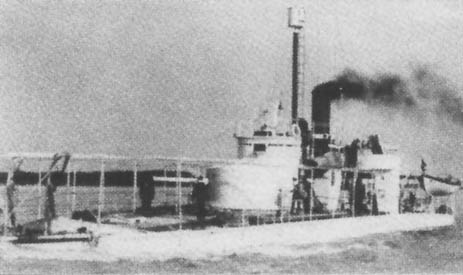
On April 16, 1947, an explosion in the port of Texas City, Texas mostly vaporized the SS Grandcamp, formerly, the SS Benjamin R. Curtis, a Liberty Ship built during World War 2 and later gifted to France to help rebuild that country’s merchant marine. The ship had been loaded with approximately 2,300 tons of ammonium nitrate – used in fertilizer or explosives – as well as small mounts of other cargo. The explosion leveled nearly 1,000 buildings within 2,000 feet of the explosion, killing at least 560 people (including all but one of the town’s 28-man volunteer fire department) and injuring more than 5,000 people, almost 1,800 of whom were admitted to area hospitals. Some 63 people were unidentifiable, and were buried in a memorial cemetery; an additional 113 people were declared “missing”, because no identifiable parts could be found. The Grandcamp’s 2-ton anchor was hurled over 1.5 miles, digging itself into a 10-ft deep crater, while one of her propellers was thrown 2 miles inland. More than 1,100 vehicles, 360 rail freight cars and 500 homes were damaged; 10 miles away, in the city of Galveston, half the windows in town were shattered. All told, damages totaled between $1,000,000,000 and $4,500,000,000, in 2019 dollars.
Texas City disaster. Parking lot 1/4 of a mile away from the explosion, 1947. University of Houston Digital Library.
Then, on August 4, 2020, an estimated 2,750 tons of ammonium nitrate fertilizer – confiscated from an impounded ship nearly a decade before – detonated in a gargantuan explosion. The blast – estimated as equal to 1.1 kilotons of TNT – killed at least 218 people, injured over 7,000, and left nearly 300,000 people homeless.
Port of Beirut, Lebanon. Before (Left, 7/30/2020) and after (R) comparison showing blast damage from the August 4,2020 explosion (circled area). Google Earth Pro and Maxar Technologies.
Such a blast would critically damage the Old River Control Structure; two or three, should they happen simultaneously, would certainly destroy it outright. Neither ships, nor ammonium nitrate, are hard to come by. And they are not, comparatively, all that expensive. Both are within easy reach of many “extra-national hostile groups”. And the MV Rhosus, the ship at the center of the Beirut blast story, would have been capable of transiting for most of the Mississippi’s length…
…And yet, there are no real security measures in Vidalia that would prevent an American version of the St. Nazaire Raid.
Someone should really look into this.
Really.
The Freedomist — Keeping Watch, So You Don’t Have To
As strange as it may seem, the “Vietnam Generation” – meaning, those of age to have fought in that conflict – are in their very late 60’s, at best, and more likely in their early- to mid-70’s. In addition to the more “televisable” repositories of collective memory that have been lost, there are nuances within those repositories that fade into the background.
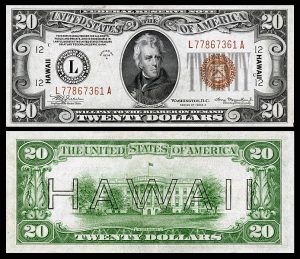
The MPC (pdf link) was a form of “occupation currency”, used by the Armed Forces of the United States from 1946 to 1973. The idea was to try and control inflation in occupied zones, as well as attempting to limit black market activity in the various occupied nations as close to the minimum as possible. The very first iteration of this practice, however, was the “HAWAII Overprint” note, issued from 1942 to 1944.
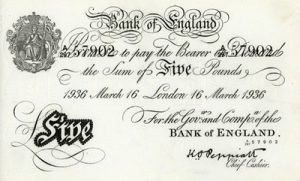
The Hawaii Overprint was an otherwise-valid US note that was printed by the US Mint in San Francisco, but that was stamped “H A W A I I” on the reverse. The rationale was that, in the event of the island chain’s invasion and capture by the Japanese Empire, all existing “HAWAII” stamped notes could be declared invalid, preventing Japan from trying to inflate the United States’ currency reserves by mass-dumping captured cash back into the US economy via Mexico. In fact, a version of this strategy was employed by the Nazi SS in their “Operation Bernhard”, which resulted in £15-20 million worth of nearly undetectable counterfeit notes being in circulation by the end of World War 2; adjusted for inflation, this amounted to approximately £493,146,000 – 657,528,000 (c.$611,052,280 – $814,736,370) in 2022 figures.
Hawaii overprint note issued by the Federal Reserve Bank of San Francisco during World War II. National Numismatic Collection, National Museum of American History. Public Domain.
The United States’ MPC, along with various similar types of scrip from other occupying powers, accomplished this by paying Allied troops stationed “in country” in specifically made military scrip, instead of the normal national currency. In this way, the troops could spend their pay within the local economies, without injecting inflationary levels of hard currency – such as US dollars or British pound-sterling notes – that would trade at far higher levels of exchange on the local black markets, thus forcing the occupation governments, in turn, to print vast quantities of paper currency to compensate, devaluing the local currencies even further. In fact, such a resultant death spiral of currency hyperinflation in post-World War One Germany (albeit for different reasons) was one of the root causes that allowed the rise of Adolf Hitler’s Nazi Party.
An Operation Bernhard forgery of the Bank of England five pound note. UK-Public Domain.
The United States continued its use of the MPC throughout its occupation period in both Europe and various parts of the Pacific, into the 1960’s, when the war in Vietnam began to accelerate. In the same way as in the post-World War Two era, the South Vietnamese đồng (which had replaced the French colonial piastre in 1953, at their independence) was simply too weak to survive against the US dollar. MPCs were issued as pay for US troops posted in the country, to limit the arbitrage impact. The method the United States used to effect this was to arbitrarily convert to a new issue of MPC to US troops; US troops were never told when a “Conversion Day” (or, “C Day”) would happen, but would find themselves suddenly restricted to base, where they were informed that they had to exchange their old MPC issue for the new version, as the previous MPC issue would not be valid for exchange after that C Day. This, in turn, prevented the MPC from acting as a wholesale stand-in for the US dollar.
The MPC program was retired after the United States’ involvement in Vietnam ended. The MPC system was deemed unnecessary by then, as by the 1970’s, the nations occupied at the end of World War Two had been long ago released from their occupied status, and their economies were, in general, strong and flourishing. As a result, the circulation of US dollars paid out to US troops stationed there was not deemed to be destabilizing, and the United States went back to simply ferrying US dollars in cash to various bases for direct disbursements to troops stationed there.
In 1997, following the dissolution of the Soviet Union at the end of 1991, the United States found itself deploying forces to semi-permanent stations for “peacekeeping” duties – occupation duties, in all but name – in portions of the former Yugoslavia, as the region exploded in a series of ethnic and sectarian wars.
The costs of transporting cash to troops stationed in the hostile areas quickly became very expensive. Given that the United States’ Department of Defense (DoD) had established a vast, world-girdling logistical network by then, and given that there was very little available for purchase in the war zones, the DoD expanded what had been a pilot program used in various military basic training facilities within the US, into the “EagleCash” system.
EagleCash functions in a manner similar to a gift card, in that it allows deployed troops to use an ATM-like kiosk to transfer money from their bank accounts in the US to the EagleCash card, then use that card to purchase various goods and services from on-post stores and exchanges.
There is, however, a catch: The EagleCash system, like so many other things in the 21st Century, is a great, streamlined system of finance that functions reliably to pay troops forward-deployed in hostile areas…as long as the backbone infrastructure the system relies upon works.
With the rise of cyber warfare, as well as the potential for a disruption of the satellite communications network – to say nothing of actual nuclear warfare – there is a very good chance that the United States and its allies may well need to return to an MPC-type system of finance for deployed troops. While there is a specific entry in the Code of Federal Regulations (pdf link) regarding MPC’s, it remains unclear if the US government is prepared to reissue paper MPC’s in the event of some major network disruption…
…And unpaid troops can become very unhappy and disgruntled troops, very, very quickly.
Food for thought.
The Freedomist — Keeping Watch, So You Don’t Have To
When people think of military actions, those thoughts are usually centered on frenetic Hollywood action sequences. There are the occasional meetings/briefings where the stock, lantern-jawed heroes get their orders from a grizzled, crusty-looking officer, who occasionally pushes their “knife hand” across what is probably a real enough map of…somewhere, but probably not the “somewhere” of the show.
The effect is even more divorced from reality when watching the average news broadcast: the tall, swarthy, lantern-jawed heroes are almost always either completely hidden by helmets and body armor, or are somewhat short, usually bald, and squinting through their sunburns and badly wind-dried skin. The vehicles and surrounding terrain are anonymous and dusty (or heavy with tropical foliage, or a blasted city-scape) – things are certainly happening, but the viewer has little context. The reporter delivering the story probably has even less.
The grizzled and lantern-jawed stock characters from Central Casting do occasionally appear – and are even frequently as heroic as Hollywood portrays them to be – but the above images (real and fictional) obscure the reality: the Grunts who have to carry out the mission have their tasks explained to them by sleep-deprived, over-caffeinated, and hyper-stressed troops suffering from ulcers, who have likely been awake for over 24 hours, straight, and have been monitoring units in combat with the enemy, while coordinating artillery fires, air support, medical evacuations, resupply, reinforcement and probably armored support, as well…and have to get creative on short notice when one, some or most of those things are not available, because of shipping delays, bad weather, enemy attacks on the supply lines and just plain bad-to-non-existent maintenance means that something else needs to be found to help the Grunts get the job done.
Those officers and troops, punchy from lack of sleep, are the Staff.
In the “old days”, military staff work was not overly taxing, by today’s standard. Literate officers and troops (read the letters of some officers on campaign in the old days – yikes) made the decisions and wrote the orders, trying to be as clear – yet couched and polite – as the writing conventions of the time allowed. Unit sizes were rarely above the Brigade level (c.3-5,000 troops), and the “optempo” (“operations tempo”, or, the pace of operations) was measured by how far a unit could march in a day. By modern standards, it was quite sedate. The only real “specialization” in the military staff were the Surgeon(for obvious reasons) and the Quartermaster, who handled the acquisition of supplies; this last position, while recognized as highly important, was not much sought after, as it was viewed as a rather menial task.
The railroad revolutionized warfare in a way not seen before in land warfare. In the past, like cargo, the fastest and most efficient way to move troops more than 100 miles was by water. By 1863, the United States Military Railroad (USMRR) was able to transfer some 25,000 troops a distance of 1,200 miles in just 12 days. The USMRR did this by creating a dispersed staff of railroad schedule planners who communicated via telegraph to coordinate their movement plans. In 1866, the Prussian Army – having sent observers to both sides of the American Civil War – calculated that they could concentrate 285,000 troops in twenty-five days, and used this ability to overwhelm Austrian forces. Four years later, Prussia would demonstrate the defensive advantage of the railroad, by using their internal rail system to rapidly shift their outnumbered troops around the country to first blunt, and then counterattack the French invasion, resulting in not simply the defeat of France, but the capture of an Emperor and the annexation of Alsace-Lorraine, specifically because they had established a “railway section” as a part of their ‘general staff’ system after the return of their observers from the American Civil War.
This is not, however, an article on the military use of railroads. Instead, it shows the first real expansion of the military staff system since the days of Napoleon, and going well beyond his reforms.
Napoleon Bonaparte created what we now refer to as the “Continental Staff System”, minutely categorizing and specializing roles that had previously been handled somewhat haphazardly. As armies began to grow in size and complexity after Napoleon, the old staff methods simply could not keep up. Even in the case of Napoleon’s own staff reforms, they could barely keep up with the demands of La Grande Armée. The US Army, first, then quickly followed by Germany, began to make significant reforms and expansions.
However, this was not a streamlined or consistent process. In fact, in Germany’s case, it became a decided negative, as the German General Staff took the statistical process too far, imparting a rigidity that more or less completely ignored the Clausewitzian warnings about “friction” and the “fog of war”. This rigidity contributed to the failure of the Schlieffen Plan and led directly to the hell of trench warfare on the Western Front of World War 1.
In the modern day, the staff system has evolved to the point where it can swiftly alter itself to account for new technologies. As radio replaced visual-sight signaling, dispatch riders, carrier pigeons and the telegraph, staffs were increasingly able to effectively control and support their subordinated commands in real-time. Today, that progression includes satellite communications and (theoretically) secure internet connections, as well as incorporating intelligence from ground- and air-based drones.
In order to better streamline the core functions of a staff, tasks and responsibilities are divided between departments led by specialized officers. Even in the last 30-odd years, there has been expansion and readjustment, as some of the current offices either did not exist in the 1980’s, or were considered to be part of a “Special Staff” section, created on an ‘as needed’ basis.
Currently, there are a total of nine departments recognized as part of the Continental Staff System. These nine offices scale upwards, as designated by a prefix letter code (see below), and generally only begin to appear as part of a battalion-level staff. The nine offices in general use are:
Manpower or Personnel. This office manages the more mundane, non-combat personnel-management tasks of a unit, such as record-keeping and handling pay for the troops.
Intelligence and Security. This is the office with the unenviable task of trying to predict what the enemy in a local area are planning. However, their ‘side functions’ are much more extensive, and include everything from weather monitoring and map making, to cultural and demographic surveys to refine information that was likely glossed over by their national-level counterparts.
Operations. This is the office that actually controls the troops in the field. The unit commander, their executive officer (i.e., the “second in command”) and the “-3” officer (who is effectively 3rd in command) direct operations, through the mechanism of the “command post” system.
Logistics. Logistics – what used to be called the “Quartermaster” office – is one of those dreary, ho-hum functions that people only get annoyed over when they either fail, or when someone points out that the military unit in question is incapable of functioning if they ignore the “4-Shop”. If your logistical plan is deficient in the civilian world, that is annoying and inconvenient. In the military world, bad logistics lose battles, campaigns and wars.
Plans. This is where you will find those grizzled old officers making knife-hands over a map. The Plans office has to take the commander’s ideas and vision, lay them out coherently on a map, then write the orders to the various sub-units to carry out those plans.
Signals (i.e., communications or IT). “Signals” are the people who run the radios, and make sure the computers are working right. They will also occasionally restore telephone service to a town or city…usually inside of 36 hours.
Military education and training. Exactly what it says – there are always new things coming out, that troops need to be trained on, which can also include seemingly non-military course like the dreaded “Personal Finance” course. In case anyone is wondering why distance-learning courses like that are offered, troops who badly manage their pay are frequently preoccupied, hyper-tense and distracted in the field; this leads to very unpleasant results for them, and likely everyone in their general vicinity.
Finance and Contracts. Also known as resource management. This is the department that handles buying tools, materials and food from the local area. In the “home country”, these kinds of contracts are normally handled at higher levels; when operating in a foreign country, however, the situation frequently dictates that a units needs to let contracts with the locals…which not only gets the unit supplies locally, easing the logistics burden of the higher commands, but also helps a local economy that may have been destroyed and needs more than simple hand-outs of cash.
As noted above, there are a variety of letter designators for these staff functions, depending on the size and/or function of the unit in question. The most commonly used designators are:
A, for air force headquarters.
C, for combined headquarters (multiple nations) headquarters.
F, for certain forward or deployable headquarters.
G, for army or marine general staff sections within headquarters of organizations commanded by a general officer and having a chief of staff to coordinate the actions of the general staff, such as divisions or equivalent organizations (e.g., USMC Marine Aircraft Wing and Marine Logistics Group) and separate (i.e., non-divisional) brigade level (USMC MEB) and above.
J, for joint (multiple services) headquarters, including the Joint Chiefs of Staff).
N, for navy headquarters.
S, for army or marines executive staff sections within headquarters of organizations commanded by a field grade officer (i.e., major through colonel) and having an executive officer to coordinate the actions of the executive staff (e.g., divisional brigades, regiments, groups, battalions, and squadrons; not used by all countries); S is also used in the Naval Mobile Construction Battalions (SeaBees) and in the Air Force Security Forces Squadron.
U, is used for United Nations military operations mission headquarters.
While there is certainly much more to military staff functions than this brief outline, the goal was to introduce the Reader to the idea behind the Military Staff, in a general way. If you would like more information on the subject from the source, check out the US military’s field manual on the subject, FM 6-0 – Commander and Staff Organization and Operations, in print here, or as a pdf download directly from the US Army, here. (Note that most military manuals in the United States are unclassified and publicly available for anyone to own – if it’s classified, you will definitely know, and you are definitely on your own, in that regard.)
The Freedomist — Keeping Watch, So You Don’t Have To
Many times, taking the status quo for granted is the normal mode we all operate in. In this context, when growing up in the 1980’s, if one aspired to study “things military”, you would simply accept the organizational structures of various militaries without question. Studying old – even ancient – military organizations was seen as a good thing for historical research, but really didn’t have much utility in the modern day…
…Or did it?
On New Year’s Day 2023, I had one of those head-slap moments, when I realized something profound: In some four thousand years of recorded military history, only nine organizational units have made it down through history, some of which still exist to this day. Nine. There have been other unit organizations, certainly, but none of them have ever taken hold for any length of time, and none of them are ever seriously considered for resurrection. This is not a merely academic idea, either – trillion-dollar military budgets are largely based on supporting these unit formations (in theory, at least).
Today, we’re going to explore a basic outline of those nine unit types.
The Tribal War Band
The Tribal War Band is the oldest continuously used formation in recorded history. It is an amorphous collection of extended family and clan warriors, hastily assembled to either make a raid, or defend against one, after which it would disperse until needed again. The War Band grew out of familial hunting parties that took advantage of human numbers, communications and cooperative effort to hunt down either game animals, or predators encroaching on the family/tribe’s hunting/foraging grounds. In many parts of the world today, the tribal war band continues, as underdeveloped areas and peoples see no reason for a more formalized organization.
Combat for the old war band was similar to the kind of melee combat popular in modern television shows and movies, being essentially a street or bar brawl, albeit with swords and spears, instead of sharpened bicycle chains and switchblade knives.
“Three Young Ngoni Warriors, Livingstonia Malawi”, ca.1895. Public Domain
The tribal war band, in the modern day, remains dangerous primarily because it is almost impossible to gather meaningful intelligence on them, and thus it is nearly impossible to create plans to counter them by remote study and planning techniques. The only solutions in the “military tool box” are to use massive, overwhelming force and numbers to occupy and saturate an area, or to send in tiny parties on the ground, to locate the tribe[s] in question, and find out more information about them…which is usually vastly more effective – and practical – than simply running the proverbial steamroller over the area.
The Phalanx
The Phalanx was the first regularized tactical unit on record. While we know of armies before the time of Classical Greece – those of Sumer, or Egypt and the Hittites, specifically, as well as armies in China and India – those armies did not leave a record of their formal organizations.
In contrast, the ancient Greeks, as first described by the poet Homer, deployed their armies of citizen-spearmen – the Hoplites – in a rigid, square or rectangular formation, of anywhere from 100 to 500 men, and occasionally more, in files of 16 to 32 troops. These troops were armed with a sword and shield, but their main weapon was the “sarissa”, a type of spear or pike that could be up to twenty feet in length. In combat, the phalanx would try to use its weight and mass to basically “shove” the opposing phalanx off the battlefield. In a contest where the sides were more or less evenly matched, this came down to individual physical strength and stamina, and a willingness to hold out until the enemy got tired, and decided to try and run for it…and, as in most battles before about 1900AD, that would be where the real casualties would happen.
A phalanx fighting the Persians. 19th Century. Public Domain.
The phalanx has disappeared, only being resurrected by pre-gunpowder forces that were unable to organize or train for anything more complex, because the formation had severe and fundamental flaws: it was hard to keep it in formation; it was slow and clumsy to move in anything but a straight line; and it was helpless against lightly armed forces, such as archers, slingers or peltasts (a type of skirmisher that threw javelins).
Agrianian Peltast by Johnny Shumate, [email protected]. Public Domain.
As soon as the phalanx met an infantry formation that was more flexible, it was completely torn apart.
The Contubernium/Section
The next unit is the second-oldest unit overall, and the first of four units still in use to this day, well over two thousand years after its inception: the Contubernium.
Roman Reenactment legionaries about to attack. CCA/3.0
The Contubernium (derived from a Latin term meaning, “tenting together”) was the basic eight-man unit of the Roman Army. It consisted of eight legionaries who lived, trained and fought – and occasionally died – together. Unlike their modern equivalent, the Section, there was little volatility in the Contubernium, as the legionaries within would frequently remain together for up to a decade or more, barring deaths or promotions. The contubernium was the basic building block for the next level up, that being the Century.
Today, the contubernium still exists as the “Section”. The modern Section of eight troops is used in many armies for the same purpose as its ancestor, as the infantry’s basic fighting unit in combat.
A Wehrmacht infantry Gruppe (Section) armed with the MG 34 light machine gun. Poland, 1941. German Federal Archives.
The Century/Company
The Century was a unit of 80-100 troops (the number varied over time). Their leaders, the Centurions were long-serving, professional officers, and had to be literate, have prior military experience in the ranks (at least in theory, although this was mostly true for most of the era), had to have “connections” (expressed in ‘letters of recommendation’) and had to be able to demonstrate proficiency with all the common weapons of the soldier. The centurions were simultaneously soldiers, officers, disciplinarians, combat commanders, administrators, and occasionally, even jurists or spies.
Roman Centurion (reenactment). Hans Splinter, 2010. CCA/2.0
The modern Company, in contrast, is about one-half to twice the size of the Roman Century. However, that was an evolution, over about three hundred years, because the infantry Company, from before the American War of Independence, was roughly 50-80 men at full strength, until about the time of World War 1, with the advent of more complex weapons and the organizations to support them. However, the organization of the “fighting company” has remained stable at 100-200 troops. There have been attempts at explaining this, but the one theory that has taken hold is that 150 troops is the rough “sweet spot”, where one person can directly lead about 150 people in combat with only a minimal staff.
Soldiers assigned of Alpha Company, 3rd Battalion, 187th Infantry Regiment, 101st Airborne Division, pause near Narizah, Afghanistan, 2002. US Army Photo.
In the Mess, we call that “learning through trial & error”.
The Cohort/Battalion
The next level up from the Century/Company is the Cohort/Battalion. The Cohort was a subset of a Legion (q.v.), which had a total of ten Cohorts. The Cohort, like its descendant, was a collection of centuries. Unlike its descendant, however, the Cohort was generally fixed in size, at about 600 legionaries. The modern battalion, in contrast, can be anything from 300 to 1,200 troops in size, depending on its specific job and organization. (As an aside, some translations of John 18:3 note that it was a “Roman cohort” that arrived to arrest Jesus at Gethsemane.)
“A Roman Legion”, by Marco Dente, c. 1515-1527. Public Domain.
This level of command is typically regarded as both the first “operationally capable” unit that can operate on its own, as it includes its own internal (or, “organic”) support elements, such as a medical staff that offers more than First Aid +, communications, supply, maintenance and a number of other dedicated support elements, is considered to be the basic tactical unit in combat. In Roman times, specialist officers within the Cohort and Legion were assigned drafts of troops for non-fighting tasks such as building roads and entrenchments, or manning artillery pieces.
Group portrait of the Australian 11th (Western Australia) Battalion, 3rd Infantry Brigade, Australian Imperial Force, posing on the Great Pyramid of Giza on 10 January 1915. Public Domain.
The Battalion, like its ancestor, forms the bedrock for larger units.
The Legion/Brigade
Rounding out the “units of history” is the legendary Roman Legion. Composed of ten Cohorts, plus additional troops (mostly cavalry and scouts) and support staff, a Roman Legion at full strength numbered anywhere from five thousand to seven thousand troops in size. The twenty-eight Legions of Octavian Augustus – a force estimated at c.300,000 troops overall – formed the core of a Roman military machine that would maintain the security of the Empire for nearly five centuries.
In the modern day, the basic structure of the Legion continues as the “Brigade”, which is at the core of most modern armies. While the modern-day brigade is a miniature army – effectively mirroring the Battalion albeit much larger in size – this was not always the case, as it evolved from an ad hoc grouping of Regiments (q.v.). With the end of the Cold War, however, most nations ‘downsized’ their militaries, leaving Divisions (q.v.) as mostly administrative commands for their component “maneuver brigades”. With the return of large-scale (if rather desultory) mechanized warfare with the 2022 Russian invasion of Ukraine, many nations are reevaluating their policies of leaving brigades to operate independently, outside the “support umbrella” provided by the Division.
Lightning strikes as Bradley Fighting Vehicles from the 30th Armored Brigade Combat Team prepare to fire TOW missiles during an exercise at Fort Bliss, Texas, in August 2018. (Staff Sgt. Brendan Stephens/Army). Public Domain.
In one of those quirks of history, the modern Brigade has approximately the same “bayonet strength” of troops as a Roman Legion, although it maintains larger support units.
De Re Militari
How is it that the preceding four organizations carried over to the modern day, over a span of some two thousand years? The answer lies in a book, De Re Militari (English translation), written sometime in the early 5th Century AD by a late-Roman author, Publius Flavius Vegetius Renatus. In it, Vegetius reviewed the organization, training and discipline of the old legionary system, attempting to convince the Emperor of the time to return to those methods. While those exhortations apparently had little effect on the Western Empire, copies of the work circulated throughout the misnamed “Dark Ages”, until it received its first printed edition in 1473AD.
A morocco bound copy of the 1494 edition of “De Re Militari”. Public Domain.
Kings and commanders throughout Western Europe tried to emulate various aspects of Vegetius’ work, but social, political and technological limitations hampered anything more than the most basic of his ideas. With the rise of larger, better-organized states in the 15th Century, however, Vegetius’ ideas became viable, and many states – especially after the near-total adoption of firearms as the main personal combat weapon in the various armies – latched onto the book as a template for their new, much larger forces.
The Tercio
The Tercio (from the Spanish term for “a third”) is somewhat unique in this list, as it only really lasted for about one hundred and fifty years, at most, but had an impact out of all proportion to its size and organization. This was because it was the first unit in modern times to show the potential of what infantry was actually capable of, in an arena where the mounted knight had been viewed as the dominant power.
As originally organized, the tercio deployed was split into three more or less equal types of infantry: pikemen, swordsmen and crossbowmen. Rapidly, however, the arquebus replaced the crossbow, and the swordsmen began to dwindle in number, replaced by troops carrying halberds. Eventually, as the arquebus first became cheaper, then evolved into the musket, the swordsmen disappeared entirely. The result was the first real “combined arms” formation since the Roman Legions, a unit of 400-3,000 troops what could operate independently of outside support.
Rocroi, el último tercio. 2011. Augusto Ferrer-Dalmau. CCA/3.0
The tercio revolutionized warfare, and lead directly to the next ‘unit of history’, the Regiment.
The Regiment…and the Bayonet
The Regiment evolved out of the Tercio, as the technology of military firearms advanced. As the arquebus evolved into the musket, it was realized that coordinated firepower was the infantry’s final, real answer to cavalry dominance. However, while the Tercio did have advantages, the use of pikes was increasingly seen as a waste of troops: while the pikes did well in protecting the infantry from cavalry attacks, commanders wanted to somehow combine the pike and the musket into a single weapon.
British infantryman in 1941 with a long WWI sword-type bayonet affixed to his rifle. 1941. Imperial War Museum. Public Domain.
In the late 17th Century, around 1671AD or so, French General Jean Martinet standardized the first practical bayonet (so named for its purported place of invention, the French city of Bayonne), the so-called “plug bayonet”. The plug bayonet was exactly that: it was essentially a type of dagger, fitted with a small, round hilt made of wood, that could be quickly inserted into the muzzle of a musket, turning it into a type of spear, which could be used to fend off cavalry that got too close, a common occurrence, given the limitations of the muskets of the time.
Obviously, though, this type of weapon was not ideal, as it could only be used while the musket was empty. The plug bayonet quickly evolved into the “socket bayonet”, which was fitted over the outside of the muzzle and was offset to one side, allowing the soldier to load and fire his musket while the bayonet was fixed.
It was at this point – in c.1700 – where the Tercio, as such, finally disappeared and was replaced by the Regiment.
The Sikh Regiment marching contingent passes through the Raj path during the 61st Republic Day Parade-2010, in New Delhi on January 26, 2010. GODL-India
This is not a useless digression – by eliminating the pike, military units (at least in Europe) became all-firearm formations, capable of both maximizing firepower, while simultaneously being able to counter direct cavalry shock attack.
The bayoneted musket directly allowed the creation of the Regiment. Nominally a unit of 500-1,000 troops, the regiment was usually organized into ten equal companies, ideally of 50-100 troops each, with a regimental command staff to handle administration, medicine and logistics. The troops could – as their Roman predecessors had been – be assigned to various specialist tasks under the supervision of officers skilled in fortification and road building, although gunpowder artillery was left to specially trained soldiers, given the dangers involved.
The Regiment, in this format, remained the dominant maneuver unit until after World War 1. Although the term was occasionally used interchangeably with the Battalion – even today – the Regiment remains the bridge between the Battalion and the Brigade. In its most basic form, the modern regiment is composed of two to three battalions, with perhaps a battalion’s worth of support units. This organization is the source of some confusion, as it appear to resemble a brigade…however, the main difference between the two units is in the number of support personnel.
Three hundred years on, the Regiment – while evolved in size and organization – is still going strong, and shows no sign of disappearing anytime soon.
The Division
While there has always been a delineation of larger military units into “divisions”, the modern Division (capitalized intentionally) originated during the Napoleonic Wars, as Napoleon reorganized the French Army into Divisions and Corps’.
In the modern day, a division typically consists of three brigades, of three “fighting” regiments/battalions each, with their associated support elements, and a collection of other support units under the direct control of the division headquarters. Numbers-wise, the division can range anywhere from 6,000-25,000 troops, depending on its composition, mission and national military doctrines.
M1-A1 Abrams main battle tanks of the U.S. Army 1st Armored Division, along with two AH-64A Apache helicopters coordinate their fire as they practice at a range in Glamoc, Bosnia and Herzegovina, on April 2, 1998. U.S. Army Photo.
As referenced above, while the Division faded into an administrative grouping in most nations following the end of the Cold War, the current (as of January of 2023AD) war between Russia and Ukraine is causing a serious reconsideration of reviving the Division as an operational combat command among nations fearful of being drawn, once again, into an all-out, conventional (hopefully) slugging match.
Soviet troops of the Voronezh Front counterattacking behind T-34 tanks, 1943. Mil.ru
Conclusion
Why is it important to know these things? Well…that really depends on one’s view of their place in the world: How much do you trust your government to properly inform you of what is happening with your nation’s military? When you see or hear a news story about “military unit X”, what does that mean? Is it a minor issue, or a major one? The popular media rarely, if ever, bother to try and explain it to you, and when they do, they usually get it wrong.
To paraphrase historian Niall Ferguson, in his 2008 series “The Ascent of Money”, not knowing this stuff can seriously affect your life.
For nearly seventy-five years, the military forces of the world have been saddled with “assault rifles”, weapons that use an “intermediate cartridge” – smaller than a “full-power” rifle cartridge, but considerably more powerful than a handgun cartridge.
There is a never-ending controversy in the “gun vs. anti-gun” debate over the term “assault rifle”. While the “pro” side is technically precise in its language, the “anti” side verges on the neurotic in insisting on ignoring anything but the screaming propaganda fed to them.
The “assault rifle”, as such, comes from three distinct and separate strains of “institutional DNA”. The impact of the fusion of those strains on military affairs is our subject, here.
The German Strain
Prior to World War 2, a “rifle” was, well…a rifle. After the introduction of smokeless powder by France in 1884, the world’s militaries settled on rifles with calibers between 6- and 8mm, with bullet weights in the vicinity of 140 to 160 grains. This seemed to be the proverbial “sweet spot”, giving long ranges (as far as c.2200 yards/2000 meters), with acceptable terminal performance at the limit that troops could shoot.
An Indian rifleman with a SMLE (Short Magazine Lee-Enfield) No. 1 Mk III, Egypt, 1940. Public Domain.
And then – 1914 happened.
The First World War brought on (as could be expected) more military innovation in four years than in the previous four decades, radically altering the perception of warfare in all the participating states (whether those states could act to maximize those perceptions is another matter, entirely).
April, 1918 During the German Spring Offensive in Artois two German A7V tanks (Hagen 528) and (Schnuck 504/544) roll towards the Western Front. Public Domain.
The victors of WW1 were content to make a few improvements to their military structures here and there, but the collective sigh of relief at the war’s “conclusion” (because fighting continued for nearly five full years, at least, past 1918) imparted a dangerous wave of “Victory Disease” in those states, whose armed forces, while doing research and making a few alterations to their doctrines, either largely failed to learn the right lessons from the war, or failed to convince their political leadership to fund improvements promptly. This would come back to haunt them twenty years later. What most nations could agree upon, though, was the need for a semi-automatic rifle to replace the universally deployed bolt-action rifles, in models unique to every major nation.
Two of the major combatants in WW1, however, took the exact opposite approach.
While “Imperial Russia” was destroyed and replaced by the Soviet Union, “Russia”, as such, had suffered such a crushing defeat in the war, that the new Communist government immediately launched a long-range plan to create the most advanced armed forces in the world…and largely succeeded, at least on paper. This impressive force would be gutted by Stalin’s Great Purge, and would thus nearly collapse in the early days of its new war with Germany, in 1941…but that is another story.
Soviet tanks on Khalkhyn Gol, 1939. Public Domain.
In contrast, Germany – the leader of the losing faction of World War 1, the “Central Powers” – had the Treaty of Versailles inflicted on it, losing large swathes of territory, being forced into paying crushing war reparations (including the physical seizure of actual industrial plant equipment and machinery) to the victors, and being forced to officially reduce its military forces to a pale shadow of their former size.
While the minutiae of the Treaty are not the subject of this article, it did conclusively show that Germany had been defeated. This caused the remnant of the German military to immediately begin a careful assessment of what it had gotten right – and more importantly, wrong – during the war. This actually began before the war ended, in early 1918, when a certain Hauptmann (Captain) Piderit, part of the Gewehrprüfungskommission (“Small Arms Examination Committee”) of the German General Staff pointed out that infantry rarely fired at enemies further than 870y/800m distant, and that a physically smaller, intermediate cartridge would save on materials and allow for a smaller and lighter Maschinenpistole (submachine gun), while allowing the troops to carry more ammunition (the contradictory irony of his conclusions apparently escaped Hauptmann Piderit).
While these points did have some validity, specifically in regards to the American M1895 Lee-Navy rifle (YouTube link), it contained two fundamental flaws: first, that the General Staff was perfectly satisfied with its MP18 SMG, and second, that Hauptmann Piderit apparently concentrated his study on actions on the Western Front, which is the stereotypical vision of WW1, where most of the war was fought in the hell of the trenches, and largely ignored the much more mobile warfare of the Eastern Front, as well as the mountain warfare on the Italian front. Hauptmann Piderit’s assessment stands as a sterling example of the dangers of relying strictly on sterilized statistics.
A Maschinenpistole 18 (MP 18) in service in Berlin, Germany, 1919. Public Domain.
In any case, Germany – like most nations in the postwar period – recognized the need to adopt a semi-automatic rifle. Unfortunately – or fortunately, depending on one’s view – the Reichswehr (the post-Versailles German army) seemed to have taken Piderit’s study to heart, laying out requirements for a new rifle for the military that would ultimately lead to the StG 44 rifle, developed, manufactured and deployed during 1944, at the height of World War 2. This weapon, formally termed the “Sturmgewehr 44” – or, literally, “Assault Rifle 44” – is the origin of the term “assault rifle” itself.
The German Sturmgewehr 44, found in Iraq by US troops, c.2004. DoD Photo.
Using a cartridge very similar to the later Soviet M43 cartridge, the StG 44 proved a nasty surprise to Allied troops…when it worked. Postwar assessments were not kind to the design, which was made as the German economy and resource base were collapsing under Allied assaults, and which assessments thus overcompensated in dismissing the German “wunderwaffe”.
This flawed development process would continue to lie quietly, fascinating and exciting the minds of leaders and middle managers more enticed with monetary and resource savings than tactical utility.
The Soviet Strain
The Soviet Union’s Red Army, in contrast, was very practical in its approach to the problem of updating its infantry weapons.
Beginning World War Two with the perfectly awful Mosin-Nagant rifle, the Soviets quickly discovered that high-firepower weapons (mainly submachine guns) were the decisive winners in close assaults and urban warfare. Independently (probably), they hit on the idea of an intermediate cartridge for general issue. The first weapon to use this new M43 cartridge was adopted as the SKS (Samozaryadny Karabin sistemy Simonova) rifle, designed by Sergei Simonov. However, the Soviets freely acknowledged that the SKS was a carbine-class weapon…and, shortly after the SKS’s adoption, former tank commander and budding weapons designer Mikhail Kalashnikov perfected the first model of the AK-47, which would go on to become one of, if not the, premier, infantry weapon of the last seventy-five years.
Comparison of AKM and SKS 45. Swedish Army Museum. CCA/4.0
The AK-47 was adopted en masse as soon as it was made easier to manufacture. It seemed to be the very best “middle ground”: the M43 cartridge was suitably powerful; the rifle was accurate to 300-400m; it was lightweight and handy; it could fire in either semi– or full-automatic; it used a detachable 30-round magazine versus the SKS’s fixed, 10-round magazine; and was comparatively compact, even without a folding stock. Additionally, it was both rugged and easy to learn, making it the weapon of choice throughout a “developing world” with terrible levels of education, almost from the time of its creation.
The American Strain
In complete contrast, the United States of America backed into the assault rifle more or less by accident, aided by incompetence, parochialism, destructive pettiness that bordered on the criminal and a failed war.
The United States entered World War Two with what was arguably the best rifle of the conflict, the famed M1 Garand. Although an Army board had recommended the adoption of a lighter cartridge in 1928, the realities of shrunken postwar budgets precluded any real attempt at a fundamental change in caliber. However, development continued, as the Army searched for a combat-capable semi-automatic rifle. Adopted in 1936, the semi-automatic M1 was big and beefy, weighing 9.5lbs/4.31kg, and being almost 44in/1100mm in length. It fired the full-power .30-06 Springfield cartridge, fully capable of shooting out past 2,000 yards with ease.
M1 Garand rifle and M1 carbine. Public Domain.
As good as the M1 was, however, the US military realized that it needed to stay ahead of the development curve, and began experimenting with a detachable-magazine variant of the rifle as early as 1944, to counter the limitations of the M1’s 8-round “en bloc” clip…
…But we’re getting ahead of ourselves.
The US Army saw the need, as early as 1938, for a ‘light rifle’ to issue to its support troops (clerks, drivers, radio operators, etc), who needed something more powerful than a handgun, but lighter than an M1 Rifle or a Thompson SMG. The result was the somewhat confusingly named M1 .30 Carbine.
The M1 Carbine was about 40% lighter than the rifle (a little over 5lbs/2kg), and its “.30 Carbine” round, although significantly lighter in projectile weight and range, was much easier to handle for its light recoil. The much shorter range of the Carbine (300y/270m) was not seen as a problem, as it was seen as what we would now refer to as a “personal defense weapon”. The M1 Carbine would go on to evolve through several variants, including fully automatic versions, and would continue to serve around the world well into the 1980’s.
None of the Carbine’s development, however, would really have a meaningful impact on postwar rifle development.
After the creation of NATO, and that body’s adoption of the 7.62x51mm cartridge, the US Army would hold a competition in the mid-1950’s that would result in the adoption of the M14 rifle.
U.S. Army Sgt. 1st Class Richard Wiley demonstrates shooting an M-14 rifle in Iraq, 2006. US Army Photo.
While the long list of shenanigans – rising, bluntly, to the levels of criminal incompetence, corruption or both – surrounding that trial series are better left to another discussion, the end result was the adoption of a weapon that was intended to do “everything”: the M14 was supposed to replace the M1 Rifle, the M1918A2 B.A.R., the M3A1 ‘Grease Gun’ SMG and the M1 Carbine…In the end, the M14 only replaced the M1 Rifle, and then for a paltry five years, from 1959 to 1964, although it continued to serve in Vietnam until 1967, and in other limited roles until 1970.
Although the M14 would mature over time, and eventually become an exceptionally good firearm (and was used as a sniper rifle, the M21), the program was initially so plagued with severe development, production and cost-overrun issues that it finally drew the official attention of then-Secretary of Defense Robert McNamara, who overrode the protests of the parochial Army officers who had backed it, and ordered the program to be canceled in 1968…
…To be replaced with the M16…Back to the Fifties…
The original trials, which resulted in the M14, had three participants: the prototype M14, designated the “T44”; a version of the Belgian-designed FN FAL, designated as the “T48”; and the AR-10, from the ArmaLite division of the Fairchild aircraft company, which was a late addition to the trials, and did not receive a “T” designator.
AR10 rifle, with bayonet attached, 2017. CCA/4.0
The AR10 was an incredibly light and compact design for the powerful 7.62x51mm cartridge (which was essentially a scaled-down .30-06), weighing just 6.85lbs/3.11kg empty. Designed by the legendary Eugene Stoner, the AR10 was a huge leap forward in rifle design. Although the disappointingly gory details of the trials are best explained in “The Black Rifle”, by Edward C. Ezell, in the end, the trials guaranteed that the M14 prototype would be the winner.
Disappointed by the trial results, Stoner tried to shop the AR10 to foreign markets, and managed to get a few sales, with the rifles built by the Dutch company “Artillerie Inrichtingen”. Although the rifles received glowing reports from users fielding the rifles in combat, the AR10 never saw the kind of sales that it should have gotten.
Fairchild then decided to try and rework the rifle for the American market, and L. James Sullivan – working with Stoner’s notes, as Stoner had left Fairchild by that time – reduced the AR10 in size and caliber, resulting in the AR15.
From top to bottom: M16A1, M16A2, M4, M16A4. CCA/3.0
After the end of US involvement in Vietnam, in what President Jimmy Carter would call “a national malaise”, there was little incentive in Congress to fund yet another round of service rifle trials, despite there being a completely different,battle-proven weapon system designed by Eugene Stoner, that both the US Army and Marine Corps were seriously interested in. Instead, both services decided that the M16-series was good enough, and focused on acquiring the new “Big Ticket” vehicles and aircraft it wanted for its burgeoning “Active Defense Doctrine” (which would later be replaced by the “AirLand Battle Doctrine” that was the basis of US and Coalition strategy and operation in the 1990-1991 Gulf War) in the desperate attempt to erase the memory of the loss in Vietnam.
Now, some 60-odd years after it was first presented to the US military, the AR15/M16 series of rifles are still the primary infantry rifles for all of the country’s armed services, only now being replaced…
So…what are we to make of all of this wandering down three different avenues, to get to the intersection of today?
As pointed out in Increasing Small Arms Lethality in Afghanistan: Taking Back the Infantry Half-Kilometer, by then-Major Thomas P. Ehrhart, US Army (pdf link), around 50% of infantry engagements in Afghanistan occurred at ranges beyond 500 meters…and the 5.56x45mm ammunition of the M16 and M4 rifles of the US infantry were completely inadequate to meet those challenges. Major Ehrhart’s data, stating the obvious, is one of the drivers that resulted in the Army’s adoption of the XM5 in 6.8x51mm caliber – a caliber of usable size and power, comparable to the 7.62x51mm, but looking “shiny, new and improved”, because they can’t be see to be reverting to “old stuff” by a civilian leadership wholly unqualified to assess the military’s needs.
As the world is moving into more urban-focused combat (YouTube link), rifles firing lightweight projectiles are at an increasing disadvantage. India recognized this, when they opted for a stopgap purchase of almost 140,000 SIG Sauer 716 rifles in 7.62x51mm for its army, when they finally accepted that their native-designed INSAS rifle program had failed.
Indian army soldier armed with a Sig 716i, 2021. GODL-India
Modern infantry combat happens at a variety of ranges, and always has. Whether it is point-blank, on the other side of a door, or takes place at distances where telescopic sights are necessary for accuracy, the infantry battle area is wide – and the infantry needs a weapon that can reach all of those points within a rational distance.
The assault rifle concept was based on a flawed statistical study, a bloodthirsty and unimaginative style of combat operations, and sheer, petty – and possibly criminal – incompetence…and troops of many nations have been paying the price of those flawed policies for nearly eight decades.
It is no admission of incompetence to recognize that an idea has failed, and needs to be corrected.
If India can do it, the rest of the world can, as well.
The Freedomist — Keeping Watch, So You Don’t Have To
In the firearms world, there is a wide array of classifications for various types of weapons. These varying classes and “families” of weapons change over time, as buzzwords come and go; one of the current buzz terms, and one that generates a great deal of controversy, is the “PCC”, or the “Pistol-Caliber Carbine”.
A PCC is best defined as a firearm intended to be used like a rifle, but which fires a projectile and cartridge caliber commonly associated with a handgun. This is not really a “new thing” – the majority of the 19th Century Winchester family (YouTube) of level-action rifles all came in pistol cartridges, at first.
The first true “PCC’s” of the modern era, though, were the German submachine guns of the First World War, closely followed by the Thompson SMG, the famous “Tommy Gun” (a term that comes from WW2). These weapons – while not exactly “carbines”, as they were not “shortened rifles”, as such – showed armies that there was room in their doctrines for a lightweight and compact (comparatively speaking) type of “long-ish” weapon, that was cheaper and easier to produce than more conventional rifles and carbines.
In the United States this would eventually result, in 1942, with the introduction of the M1 Carbine. While using a cartridge considerably more powerful than most handgun cartridges, the .30 Carbine cartridge was far less powerful than a “full-power” cartridge, like the .30-06 used by the M1 Garand Rifle. The M1 Carbine was significantly lighter and handier than the larger and heavier M1 Rifle, and was only really usable out to about 150 yards/138 meters, but that was deemed to be perfectly sufficient for its intended use: giving troops who did not really need a “full-power” M1 Rifle something to defend themselves with that was more accurate and longer-ranged than a handgun.
M1 Garand rifle and M1 carbine. Public Domain.
The “carbine” field became somewhat muddied with the widespread adoption of the “intermediate” cartridge class after World War 2, but eventually settled back to the original idea of a “carbine”, that being a shortened version of a service rifle. One of the side effects of this adoption trend, meanwhile, led to fewer and fewer true “pistol-caliber” SMG’s being developed, as post-war battlefield developments made SMG’s largely redundant. Submachine guns were slowly pushed to the fringes, eventually used only by police or elite and highly specialized military units, primarily for hostage rescue and use in very crowded areas like airport concourses and large entertainment venues, where rifle cartridges – even coming from a shortened barrel – were not satisfactory, due to over-penetration at close-quarters’ range.
However, in areas that were friendly to private firearms ownership, the first PCC’s began to appear in the 1970’s. At first, these were weapons that mimicked the “look and feel” of SMG’s, but that fired only on semi-automatic. Soon, however, companies began to move away from the “military look”, as hysteria in certain quarters arose, and took on a more “civilian-friendly” look.
M105 Calico .22 carbine (Photo by Oleg Volk)
As the 21st Century dawned, companies in the United States began – after the 2004 sunset of the 1994 “Assault Weapons Ban” – to release PCC’s onto the civilian market. While little regard was given to these weapons at first, closer looks ensued as more an more people bought various types of PCC’s, for everything from recreational shooting to home defense. Inevitably, perhaps, highly raucous debate began as some quarters began to discuss the “tactical” uses of PCC’s…
…And, as in most debates about modern firearms, much hysterical screeching ensued.
The essential point of contention are that PCC’s are more or less useless against modern body armor – which is true…although the numbers of criminals staging “home invasions” at 2AM, while wearing high-grade body armor, is very low. As a result, the PCC is a good choice for home defense instead of a “full power” rifle or carbine, as its projectiles are less likely to leave your home and land a block or two away, in someone else’s home. As well, although there is a net savings on ammunition for practice, “training” (two different things) and recreational shooting, the savings are not that large, overall. One thing PCC’s are demonstrably good at, is acting as introductory weapon to ease new shooters into long-arm use.
Just Right Carbines (JC Carbine) 9mm. CCA/4.0
Do PCC’s have a “military” use? For an established national armies or police forces, the answer is “not really”. Although some arguments could be made that police forces would do better with a PCC than an actual “patrol rifle” (usually a military carbine), any real need for a pistol-caliber long-arm is usually better filled by a submachine gun.
Unlike more high-powered firearms, PCC’s are well suited to “guerrilla factories”, especially using “additive manufacturing” infrastructures, as the tolerances required are considerably less than those required for fully-automatic weapons. Likewise, additive manufacture requires few, if any, of the tools, equipment and supplies needed – and thus more-easily tracked – for more conventional weapons.
Anti-junta rebels in Myanmar, armed with FCG-9 carbines. 2021-2022. Author unknown.
In sum, then, if you are living in a “gun-friendly” location, a PCC is a good tool for both recreation and home defense, while also being a good choice for introducing new shooters to long-arms…and, if things really go sideways, they are a good choice for arming an insurgency or resistance movement, with the intention – as in Myanmar – of using them to capture more powerful enemy weapons.
The only “obsolete” weapon is the weapon that can no longer harm you. You have to work with what you have at hand. Thinking in advance is one of the keys to personal safety and survival.
The Freedomist — Keeping Watch, So You Don’t Have To
Back FREEDOM for only $4.95/month and help the Freedomist to fight the ongoing war on liberty and defeat the establishment's SHILL press!!
Are you enjoying our content? Help support our mission to reach every American with a message of freedom through virtue, liberty, and independence! Support our team of dedicated freedom builders for as little as $4.95/month! Back the Freedomist now! Click here