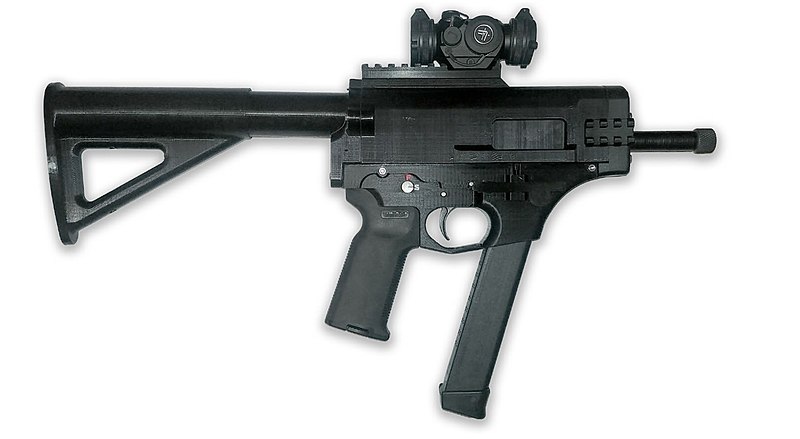
Additive Manufacturing – better known as “3D Printing” – has been increasing in popularity and capability, while decreasing in price, for the last thirty years. Today, many very capable printers can be had for well under US$500. The products produced range from simple objects to complex and detailed models, both of mechanical parts, as well as people. As well, 3D printing has begun to expand into using metals, which can be heated after printing to make the printed items strong enough for working applications.
Naturally, as soon as the technology’s capabilities reached a certain, ill-defined threshold, minds in many quarters began studying the possibility of military applications. While many do see “potential”, is that potential actually useful “downrange”?
Military forces have – obviously – changed significantly over the millennia. A soldier of Sargon the Great didn’t really require a great deal in the way of supplies, weapons or equipment. Indeed, in many cases, a soldier of Sargon may likely have been able to make much of their needed weapons and equipment on the spot, if they had the time and resources. All that really needed to be supplied to the soldier was food and water (for both troops and animals), and perhaps some large parts for siege engines.
As time and technology progressed, of course, weapons and equipment became increasingly specialized and difficult to manufacture. But, while troops could still forage for food and water, once the weapons were delivered, they were comparatively uncomplicated to both use and work on, should repairs be required in the field.
By the end of the 20th Century, of course, weapons, ammunition and much of the soldier’s equipment had advanced to the point where the vast majority of troops in all armies had only a nominal idea of how their weapons worked, let alone how to make or repair them.
These were all factors taken into account by those studying additive manufacturing for military purposes.
As is it possible, and relatively easy, to pack a “job shop” or three into shipping containers, along with some raw material stock and possibly parts blanks (although 2- and 3-D pictures, animations and mechanical drawings are far easier with digital reference libraries that can “live” on computers, or even on microfilm archives), making repair parts for many weapons and vehicles are not overly taxing for most units in the field. Plus, there are no questions concerning how strong or durable the field-manufactured parts are…after all, armies are some of the most conservative organizations in history. As a result, there are few specifically military applications, at present, where additive manufacturing can excel over conventional methods…
Mobile Machine Shop truck of the 741st Ord. Co., 41st Inf. Div., at Horanda, New Guinea, 1943. US Army Signal Corps Photo. Public Domain.
Inevitably, someone was going to make a firearm using additive manufacture. While the saga of Defense Distributed is too complicated to wade through here, the point is that – like Britain’s P.A. Luty before them – Defense Distributed proved that making firearms at home was not that complicated a process, if a person could obtain some very basic materials and tools.
Side-view of Defense Distributed ‘Liberator’ 3D-Printed hand-gun.
Now, both the “3-D Printed Gun” from Defense Distributed, as well as Luty’s 9mm submachine gun, were – being charitable – both crude, barely-usable weapons. While Luty’s design is occasionally manufactured by criminal gangs in parts of the world with very strict firearms laws, the fact of these weapons’ existence simply proves the points made by both Defense Distributed and P.A. Luty, that no matter how strictly a state tries to enforce restrictive gun control, people who want firearms will get them somehow, even if they have to make them. But, in the law enforcement and military spheres, 3-D firearms remained crude and barely usable, even if they were dangerous.
This all began to change in 2019, when the FCG-9 appeared, designed by a shadowy German-Kurdish anti-gun control activist known as “JStark1809” (who, incidentally, was tracked down in 2021, using financial transaction records; two days after a raid that found no weapons in his residence, the 28-year-old JStark1809 was found dead in his car of, according to the coroner, a “heart attack”).
Prototype of FGC-9 made by its designer, JStark1809. CCA/4.0
A photo of FGC-9 firearm unassembled components, included in original FGC-9 release files.
The FCG-9 is an altogether different 3-D animal, as it appeared in the hands of a dissident IRA splinter group in a parade during Easter of 2022 and – much more significantly – it is reportedly in use by anti-junta rebel groups in Myanmar, beginning in 2021. Being made of 3-D printed media, with a few steel parts for strength, the 9mm weapon is easy to mass-produce in guerrilla workshops, and is apparently far more reliable and useable than either Defense Distributed’s or Luty’s deisgns, further reinforcing the ridiculous nature of restrictive firearms laws.
Anti-junta rebels in Myanmar, armed with FCG-9 carbines. 2021-2022. Author unknown.
But…How useful is this technology to an army? Well, beyond the obvious utility for guerrilla forces, as mentioned above, the answer is ‘not much’. As also pointed out above, there are far cheaper and more conventional ways to manufacture spare parts for military-grade vehicles and weapons
The Freedomist — Keeping Watch, So You Don’t Have To
Inside the United States, people frequently talk about “exercising their rights”. Most often, this refers the freedom of speech, or the freedom of religion. The most vitriolic discussion of “rights”, however, is that of the right to own and possess “arms”, i.e., the rights of the Second Amendment to the Constitution:
While this is a pretty straightforward statement – for reasonable, rational and at least decently educated people – certain parties insist on hammering this sentence all out of proportion, to make it seem to mean the diametric opposite. In fact, the wholly unconstitutional (see Clauses 15 & 16) creation of the National Guard in 1903 allowed the “several States” to completely and deliberately ignore the maintenance, organization and training of “The Militia of the United States”, to the point of silently accepting the oxymoron of the concept of an “Unorganized Militia” (pages 230 & 231) – a ‘militia’, by definition, is a ‘military force’…which cannot be “unorganized”. This was coupled to a Supreme Court case, Illinois v. Presser (1886), which prevents citizens from forming militia units without the explicit approval of their state governors…and which, ironically, bans virtually all forms of restrictive “gun control” – but a lot of people aren’t ready for that discussion.
As a result, a “military class” has developed in US society, where a tiny percentage of the population volunteers for military service on a generational basis (this author being part of that class), while the vast majority of Americans have little to no contact with “things military,” beyond possibly knowing someone who enlisted or became a commissioned officer; video games don’t count. Coupled to the fact that a decreasing percentage of the US population neither hunts, target shoots nor sport shoots, most American firearms owners have little concept of guns in general, nor of what goes into “military training”.
While this is not the place to present a ‘full-court press’ for a plan of military training, this is certainly a venue for a brief explanation of what firearms Americans should own, in order to start exercising their Second Amendment rights properly.
The following are the views of the author, and not necessarily those of the Freedomist.
First, the Reader will need to carefully consider the laws of their state and locality of residence. While there are some websites that can help, the reader is strongly advised to check their state and local laws directly, to avoid confusion.
So – now that you’ve checked the state/local laws, what firearms should the you, the Reader, buy?
The next thing to understand is that firearms are expensive – there are plenty of firearms for sale as this article goes to press, which cost more than several cars this author has owned over the years. Just like buying a car, research the specific model of firearms you are thinking about purchasing, before you invest that kind of money in them.
And speaking of money, don’t spend more than about $1,200 on ANY firearm, unless you intend to become a professional sport shooter. Very few people in the world need a $2,000 firearm – what they need, is an $800 firearm, and $1,200 worth of training.
With those concerns addressed, let’s turn to ironmongery.
Every adult in the US who is not a professional shooter should own a number of firearms sufficient to cover the following five areas:
First, buy a handgun. There are plenty of cases where carrying a “long gun”, like a shotgun or a rifle, is simply too inconvenient. Handguns fill that gap. However, unlike movies and video games, handguns take comparatively more practice to master, and are nothing more than a “backup” weapon – in the words of a friend of this author, a handgun is what you use to shoot your way to something better. Handguns are also highly personalized: if you are not in the military, you currently have a wide variety of choices of frame. Visit a shooting range near you that will rent firearms for their in-house range, fire a magazine or two from multiple pistols, and see what you like – don’t let “experts” restrict your choice. Buy what works for you, and train with it.
Buy a firearm in “.22LR”. This can be either a handgun or a rifle. The .22LR is an old design of cartridge (see the image below), that remains in use because of its utility – it is almost the perfect cartridge for practice, small game hunting (like rabbits and squirrels), and just general “plinking”, because it is so lightweight and cheap.
Buy a shotgun, in either 12- or 20-gauge (shotgun gauges increase in size as the gauge number decreases, so a “12-gauge” is larger than a “20-gauge). Shotguns will handle somewhere around 75-80% of what you need a firearm for. While rather short ranged, it is great for home defense and hunting, when loaded with the appropriate ammunition. Shotguns are also some of the cheapest firearms you can legally buy, usually starting somewhere around $250 in most cases.
Buy a hunting riflesuitable for 4-legged varmints. Even if hunting is not your normal gig, the time may come where you need to hunt for food. That’s not being paranoid – that’s being prudent.
Buy a rifle sufficient for two-legged varmints. Yes – that means what you think it does. See #4, above, and consider the events of 2017-2021. You may think you are safe, now, but what happens if things really go sideways? If the statement, “That will never happen here” is rummaging around in your mind right now, why are you still thinking about this subject? Think about the safety of you and your loved ones, and act accordingly.
Now that we have addressed the five areas of firearms, the important takeaway is not necessarily that you need five separate weapons. That may be out of your price range. But, the thing about firearms is that, unless the firearm in question is highly specialized, you can get away with making one weapon cover multiple jobs. For example, a 12- or 20-gauge shotgun is fully capable of taking most game in North America up to the size of a deer, if you can get within 100 yards, and have the right ammunition. Because of the variety of shotgun ammunition (#4 Birdshot, “Double-Aught” [a.k.a., “00 Buckshot”], and Slug are the basic loads) out there, it will also work for hunting birds, as well as defending your home from an attacker. As well, any hunting rifle that can take a deer or a hog (Hogzilla is real…look it up) can also deal with a two-legged varmint – see #5, above.
How much ammunition should you have on hand? In general, 100 rounds per handgun, 100-200 rounds per shotgun, and 100-300 rounds for rifles should be more than sufficient. Note that there is nothing wrong with keeping more on hand, if you can afford it.
Cartridge comparison. CCA/4.0
But remember: You still need to trainwith your firearms. The absolute minimum should be putting at least 100 rounds ‘downrange’ per firearm, per year. If you can afford a professional training course, get that done. Working with a firearm is just like driving a car: it’s easy to learn, but you need to practice, as far as you are able.
It’s your life we’re talking about, after all…as well as those of your loved ones.
It has long been said that, “…the Pen is mightier than the Sword…” While that may be true, having that sword is far more profound and effective of a statement – words on a paper are only that: words on paper. Those words are much more effective, when backed up with a sword.
The Freedomist — Keeping Watch, So You Don’t Have To
There are very few machines in the world, today, that can claim to have been designed over a hundred years ago. There are some railroad engines, for example, that are still run as “living museums”, ferrying the curious around closed rail circuits, allowing modern riders to experience some of the feels and smells of bygone eras. In other places, there are hydroelectric dams that have changed little in the near-century since they were built; Hoover Dam comes to mind, as it nears its own century mark, with only minimal updates to its internal design.
Series of massive electrical generators beneath the Hoover Dam. CCA/4.0
This is equally true of firearms. The Browning Machine Gun, in both .30 and .50 calibers, and the Colt 1911 (also designed by John Moses Browning) all date from over a century ago, yet remain in both first- or second-line service around the world. The Mosin-Nagant rifle, and its 7.62x54mmR cartridge, in contrast, date all the way back to 1891, and while the Mosin rifle may no longer be in common service (aside from a few WW2-era examples turning up in Ukraine), the 7.62x54mmR remains the cartridge of choice for the PKMGPMG, one of the most widely deployed machine guns of the early 21st Century.
7.62 mm PKM machine gun used by Finnish military. 2012. Public Domain.
But one weapon stands apart from all of these: the Maxim Machine Gun.
Swiss Maxim Machine gun Model 1911, cal 7.5 mm. CCA/3.0
First invented in 1884 by an American inventory, Hiram Stevens Maxim, and first offered for sale in 1886, the Maxim Gun has been used in every part of the world, in virtually every conflict of note since that time. The Maxim was the first true “machine gun”, in the mechanical sense that we understand the term today. Unlike most machine guns of today, the Maxim is recoil-operated, meaning that it only uses the recoil impulse of the cartridge firing, to retract, extract, and eject spent cartridges, then chamber and fire a new cartridge. In contrast, most modern automatic weapons use some form of gas-operated piston – very similar to the piston in a car engine – to operate their cycle.
An Australian soldier manning a Vickers machine gun during the Korean War. Date Unknown. Public Domain.
Similarly, the Maxim typically use a large, cylindrical water jacket to cool and protect the barrel from the heat of firing, unlike modern weapons which rely on the flow of air and “quick-change” barrels to accomplish the same task. While very good at cooling barrels, the water jackets were very cumbersome, and prone to damage, both in and out of combat, which could cause catastrophic damage to the weapon if no immediately repaired.
With a cyclic rate of about 600 rounds per minute, the Maxim is – by modern standards – heavy, clunky, and awkward. As well, it is certainly nowhere near to modern standards of reliability in the field…and yet, the gun refuses to quietly disappear into a museum, because it continues to soldier on in the 21st Century.
Twin-mounted Maxim Guns with a modern optical sight. Ukraine. Author Unknown.
The Maxim was tweaked and fiddled with by every state operator who bought copies. But Maxim wasn’t done with his design: in the early 1890’s, he released a much larger version of his machine gun (YouTube link) that fired 37mm explosive shells, at a rate of c.300 rounds per minute, to about 4,500 yards. Versions of this “pom-pom gun” (so-called, because the sound it made while firing) would be used as secondary and tertiary armament on ships, as well as early anti-aircraft weapons, until the end of WW1.
U.S.S. Vixen, Maxim machine gun and gunner Smith. The gun appears to be a Maxim-Nordenfelt 37-mm 1-pounder autocannon, known to the British as a “pom-pom”. Public Domain.
British QF 1 pounder Mk II 37 mm “pom-pom” gun, World War I era, on display at the Imperial War Museum, London. CCA/2.0
The Maxim would be used as a frontline weapon through the war in Korea. By then, though, it was showing its age, as better materials and designs produced lighter, more reliable and more portable weapons. The surviving weapons, around the world, were mostly placed in storage…but the Maxim’s legacy continued: the PKM and its successor, the Pecheneg GPMG, both use ammunition belts that are backwards-compatible with the PM1910, the Imperial Russian version of Maxim’s design, dating from before WW1.
Photo of a 1910 Maxim Machine gun. CCA/4.0
But again – Maxim’s design refuses to gently go into that good night.
As the world exploded in the aftermath of the so-called “Arab Spring”, many citizen rebels and resistance fighters overran government armories, and found Maxim’s old guns in storage crates. Those guns were broken out and cleaned, training and maintenance manuals were sourced from online repositories, and the century-old weapons went back into action. They may no longer be the best guns available, but old and creaky guns are better that harsh words and rocks.
Captured German Maxim machine gun. Malard Wood, 9 August 1918. Imperial War Museums. Public Domain
Firearms – of all categories – are very recent additions to Mankind’s arsenal, as they have been effective combat tools for considerably less than 1,000 years. They are one of the most – if not themost – decisive “force multiplers” in human history. Learning about firearms makes no one “evil”, nor is it “glorifying” weapons – it makes them well informed and productive members of the societies…who should REALLY be wondering just whose side they are really on.
Don’t go gently into the night – because it may not be as gentle of a night as you think it to be.
Disclaimer: The following are the personal views of the author, alone, and do not necessarily represent the views of FreedomistMIA.
In the closing weeks of 2022, it is painfully evident to even the most disinterested observer that the United States is in the throes of the worst political turmoil in generations. Significant blocs have formed within the voting-age population with diametrically opposing political views, views that are for the most part completely disconnected from their perceived opponents. Meanwhile, the majority sits quietly in the middle, struggling with skyrocketing costs of living, while wishing the rest would just be quiet for a little while.
But the populace of the United States is not alone in these views. Around the world, citizens of many nations protest regularly – and sometimes violently – over the same, or much worse, problems as the American electorate: whether those be skyrocketing inflation caused by the staggering incompetence of a disconnect globalist elite, the very real fact of a lack of fuel as winter closes in on Europe, fears of a widening of the Russo-Ukrainian War, the never-ending war on terrorism, and many more.
In short – people around the developed world are frustrated, disappointed, alarmed and very angry at governments in general, and usually their own governments in particular. These facts are enhanced by clear perceptions of corruption and wrongdoing, whether warranted or not. Indeed, “government contract” is virtually a dog-whistle signaling likely corruption being in play.
While your humble author makes no pretension of formal political science education, I have been studying this problem for over almost two decades. The following are my own conclusions, based on my own experience and research.
The fundamental problems are two: Firstly, most people simply lack an understanding of political tidal forces because, secondly, they have never been taught how to think about them.
This is a deliberate policy, because doctrinal public education models and doctrines have for over a century focused not on training students to think critically, but to learn just enough to be useful in the workplace. Thus, when situations accrete together, as they have at the end of 2022, the population cannot understand what is happening, which increases discord exponentially.
In the current realm, the point of the following discussion is to clarify the role of “government” as a generic entity, without delving into political mud slinging.
At the heart of this discussion is a fundamental question: Which is superior – ‘the government’ or ‘the people’?
The idea that the Government is inherently superior to the People is a childish and ridiculous notion, unsupportable in either logic or reason, for the simple fact that governments cannot create themselves – they cannot self-organize. “The People”, however that entity can be described, must decide to institute a governing body to oversee those things that individuals cannot carry out on their own, and retain the right to remove it at will.
And yet, there is a pervasive and festering notion that “government” somehow trumps the body that created it.
This idea comes from a sense of overwhelming intimidation, which has been drummed into the population at large by a scientific community that focuses on the mere mechanical reality of the vastness of Nature and the Universe, while ignoring the far more stunning fact that Humankind is able to consider and act to enhance its knowledge of what it can observe around it.
To attempt a start at a remedy for this condition of “directed circumstance”, I will present the following as an aide to those trying to understand the functions of government. We will focus on “functions” of government, to avoid getting lost in measly and petty political minutiae.
In short, “Governments” have a few critical functions that cannot be easily accomplished by the individual citizen. These were the real reasons why the collectivist rubric of a ruling structure that existed separately from the populace that created it was formed, back to at least the Sumerians, and likely much farther back than that (YouTube link).
Governments, in fact, have precisely eight jobs, and ONLY eight – anything else is automatically suspect, because of the propensity for corruption – and even in these eight functions, below, corruption and mismanagement happen frequently:
Government deals with the barbarians across the river, so that the average Citizen doesn’t have to…Whether this means talking to them or killing them, is immaterial.
There is a pervasive attitude that the individual citizen is perfectly capable of defending themselves without a government to tax them in order to go fight eponymous ‘bad guys’. Since this has been dealt with previously, what I will say is, good luck with that artillery battery that’s in range of your house.
Government establishes uniform weights and measures, to attempt to cut down on graft, theft and corruption by their Citizens, and their friends and neighbors…However, “Caveat Emptor” still applies.
Pretty simple. The legal term “fungible” was coined to describe the nature of an undifferentiated mass of product.
Government establishes a common and uniform medium of exchange, for the same reasons as #2.
See #2. Governments work very hard to keep their currencies from being counterfeited, for reasons that should be obvious.
Government sees to the maintenance of certain lines of communication, so that no area becomes too isolated.
Look around your house – if you didn’t grow it or dig it, every single thing in your house came from somewhere else, and it came over a line of communication (a road, an airport, a railroad or a seaport) that is almost certainly not maintained by you…your tax dollars, however, pay the people who do maintain those lines.
Government enforces only those “mala prohibita” laws sufficient to maintain #’s 1 – 4, and ensures that “mala in se” crimes are adjudicated fairly.
You and a couple of buddies are not “law enforcement officers” – you’re a lynch mob. Careful legal processes exist to adjudicate cases fairly, both for the safety of the community as a whole, as well as for your safety…if that’s a difficult concept, look up “Robespierre”.
Government collects reasonable taxes to make 1 – 5 function properly.
People really get hung up over this. Everyone hates taxes; it’s a thing. But the secret, dirty little truth is, people are happy paying what they see as “reasonable” taxes, if they think that the Government is spending those taxes wisely…As pointed out above, however, many people around the world most definitely do not think that they taxes are being spent wisely.
Government ensures, as far as possible, equality of opportunity…never – ever – equality of outcome.
This is another sticking point that many are encouraged to ignore. Governments can only provide “equality of opportunity”. It cannot give things away “for free”, simply because Government is a net consumer, not a net producer, and never has been. If a government “gives” you something, the government took it from someone else, likely under threat of violence. Even in the days when troops were paid with loot from conquered enemies, the expenditures the Government incurs are never recouped for at least a century…and it is the Citizenry that bears the costs.
Government ensures that monopolies are limited and strictly controlled.
This is Government’s primary failure, especially in the modern day, simply because there is far too much temptation in the amounts of money and potential pot-government sinecures that large businesses can dangle at Government officials…which is a fancy way of saying that “money corrupts”.
Reread the above, as many times as you need to…Then, sit down and read or listen to Sun Tzu – he did the work for you, c.2,500 years ago. The least you could do, is read him for free.
The Freedomist — Keeping Watch, So You Don’t Have To
Central Europe lies in ruins, smoldering. Cities have been reduced to rubble. Entire urban populations have been massacred, displaced and raped; many survivors cower in hiding in forests, to avoid roving gangs of bandits. Famine and epidemics kill more of the survivors on a daily basis. Armed bands – the “armies” evaporated long ago – meander, too tired to loot and pillage, seeking to provide security in trade for food and shelter.
Thirty percent of the German population is dead. No one is sure how many others have met an untimely demise…
The preceding is not a work of post-apocalyptic fiction. And while it is history, it is neither the aftermath of either “world war”. This was the year 1645 A.D., the end of the Thirty Years War – a war that killed more people, both directly from physical attacks and from the side effects of war, than any event in Europe since the Black Death of the 14th Century. So ruinous and destructive was this war that the surviving rulers of Europe realized that something had to change.
The war had begun as just another petty squabble between even pettier aristocrats, claiming the sanctity of religion as their excuse. But those petty aristocrats had feudal overlords, and when they found themselves in far over their heads, they screamed to their somewhat exasperated overlords for help. And those overlords – who had to keep up appearances – moved to support their minions, the better to display their loyalty to their followers, and maybe grab some advantage over their churlish neighbors.
The reason they were in over their heads, was largely due to a democratization of technology: the first wisps of the Industrial Revolution had begun to waft through Europe, and allowed a resurgence of industrial-scale production of weapons and their accouterments, as well as systematized regimens of food production and storage, allowing a freedom of military action that had been rarely seen in Europe during the preceding five hundred years. This allowed small feudal aristocrats, and even many towns and cities, to equip small “pocket armies” with the latest military hardware.
All of that fed into an ever-increasing spiral of war, where most armies were more or less evenly matched, and the result of battles depended more on the character and skill of the commanders than anything else. Troops largely fought for whatever side paid them on time…and when promised cash was not forthcoming, looting, pillage, torture and murder were the order of the day.
The result was slaughter on a scale not seen again for nearly two hundred years, with the rise of the “popular army” of Revolutionary France, brought to its ultimate expression by Napoleon Bonaparte.
The Thirty Years War was ended by a treaty, signed at Westphalia, in modern-day Osnabrück and Münster, in 1648. One of the key aspects of the Treaty of Westphalia, was to establish what has come to be known as the concept of “Westphalian sovereignty”, or “state sovereignty”, the principle in international law that each state has exclusive sovereignty over its declared territories, and the understanding that other states will not interfere in the internal affairs of other sovereign nations, as outlined by the SwissjuristEmer de Vattel. It also formed the concept of ‘nation-state sovereignty‘ as being based on a defined physical territory.
While it is certainly true that nation-states since the Treaty have committed terrible crimes, it can be argued that Westphalia has tempered more war than it has encouraged.
However, as they say, “The times, they are a-changin’“…
Contingent Sovereignty rationalizes (the idea is not codified in international law) the idea that a duty exists for other states to intervene in the internal/domestic affairs of an otherwise-sovereign state, if that state is “failing”, cannot protect its citizens, and/or is actively making war on its own citizens, thus invoking the principle of a responsibility to protect that nation’s citizens by external states.
While a seemingly noble idea on its surface, the opening for abuse should be plainly apparent: Contingent Sovereignty is a concept aimed at legitimizing neo-colonialism and neo-imperialism, imposed at bayonet-point by wealthy nations on countries too weak to resist, despite the widespread availability of affordable and equalizing armaments.
What the states of the Developed World have failed to realize, is that this sword cuts both ways: as many First World countries seem to be descending into political, economic and social chaos – at least, according to the popular press – as their internal blocs seem to be deliberately devouring their own economies and societies, less economically developed countries – but, countries with a surplus of manpower and cheap weapons – stare at them, remembering that their own states were created by colonial fiat, Contingent Sovereignty gives those “lesser” states all the authority they need to move en masse against the Developed World, making invasions “all nice and legal,” as the saying goes.
And, lest anyone think that this is not a possible fate for many “First World” nations, it must be pointed out that sufficient training and equipment has been provided to many Third World nations to allow them to at least ponder the idea.
All those states need, is a unifying figurehead, in effect, a 21st Century Napoleon Bonaparte.
And, as Napoleon himself is reported to have said, “A revolution is an idea which has found its bayonets.”
The Freedomist — Keeping Watch, So You Don’t Have To
In previous articles, we have touched on the ideas for building “DIY” ground- and air-combat forces. Today, we will take a look at the naval aspect of this idea.
Water-based travel is not new. In fact, for the majority of human history, travel further than 100 miles in any direction was usually faster, cheaper and safer than overland travel, even if wide detours were necessary. Without getting into the physics of fluid dynamics, movement is a lot easier when nature is helping you along, especially when friction resistance is determined more by shape than by weight. It was not until the advent of railroads in the early 19th Century that land travel became faster and comparatively safer than travel by water.
River Landscape with Man in Rowing Boat and Tree-Lined Shore. Johannes Hermanus Koekkoek (1778–1851). 1800-1850. Public Domain.
However, when looking at the military dimensions of water travel, while there were early examples of purpose-built warships, such as the Greek and Roman “triremes”, the vast majority of ships were perfectly suitable for both military and commercial use. Mostly, this consisted for transporting troops, animals, equipment and other supplies. Because of the ships’ designs of these eras, most vessels were also capable of going fairly far upriver; this was the main tactic of Viking raiders, from the 8th-11th Centuries, whose “Karvis”, “Snekkjas” and “Drakkars” drew as little as 30in/762mm in draft.
Gokstad Ship, late 9th Century, Viking Ship Museum, Oslo. CCA/2.0 Generic.
As previously noted, however, after about 1860, a dramatic divergence began to open between purely military and purely civilian merchant vessels. Without restating those points here, by the end of World War 2, it seemed that the divide was complete and unbridgeable: “Warships” fought in wars, and civilian vessels supported the warships, while remaining mostly unarmed.
But, there lurked an exception: the PT Boat.
Patrol Torpedo Boat (PT) 658 transits past U.S. Navy ships at the Portland Rose Festival. US Navy photo. Public Domain.
Developed just as WW2 was starting, the “Patrol Torpedo Boat” quickly became famous as the heavily armed war vessel of WW2, on a weapon-to-tonnage basis. Not much larger than most commercial yachts, the PT’s were fully capable of sinking full-size warships – as long as their torpedoes worked. If there weren’t enough enemy warships around to sink, the PT’s could easily remove their torpedoes, and bolt on heavier cannons to destroy lightly armored barges and lighters, as well as extra machine guns, turning them into floating anti-aircraft batteries.
While the US Navy seemed to have forgotten the lessons of PT Boat warfare after the end of the war, that turned out to not be the case. While light-armed craft more or less vanished from the Navy’s inventory after WW2, that was due to the savage budget cuts and vicious organizational fights of the post-war years, more than because the Navy didn’t want the boats. Indeed, the Navy had to burn significant political clout just to help prevent the Marine Corps from being disbanded by an Army and Air Force that were battling for scarce funding.
As soon as the Vietnam War began to heat up, it was discovered that North Vietnam was supplying the Viet Cong and its own troops in the South by smuggling arms and supplies down the coast in civilian sampans. The solution to this were the “Swift Boats” – small, high-speed, aluminum-hulled boats, heavily armed with machine guns. With very shallow drafts, these fast craft were able to chase down almost any watercraft, and usually outgunned whatever they could catch. As well, they could land small parties of US and Vietnamese Marines or SEALs deep in enemy territory, doing great damage to areas the enemy had thought to be relatively safe.
Fast Patrol Craft (PCF, Swift boat) during riverine operation in Vietnam. US Navy photo. Public Domian.
After the war in Vietnam ended, the US Navy once again had to struggle for funding, and small combat craft went onto the back burner. But not completely. As funding improved in the 1980’s small combat craft came back to prominence, leading to the expansion of the Special Warfare Combatant-craft Crewmen (SWCC) career field in the Navy, and the development of the SOC-R. NATO partners took note, at least to some extent.
Like naval warfare and transport in general, small craft-based warfare is not new. In the modern era, say from 1800 to today, military raids against pirates operating from swampland bases with open canoes and boats was far more common than fighting large ships, à la Hollywood pirate films. Indeed, in World War 1, the “Battle for Lake Tanganyika” was fought and decided by a handful of small boats that barely qualified as life rafts; the largest vessel, the SMS Graf von Goetzen, was barely 235ft long; that’s short for a warship.
German steamship Goetzen before its warship conversion in 1915. Public Domain.
Likewise, Filipino guerrillas fighting the Japanese in their archipelago after Japan’s conquest of the island group in early-1942 made good use of small-boat smuggling tactics to make amphibious raids throughout the islands for three years, until the war ended. The Philippine government continued this successful strategy in the Huk Rebellion that followed the war, and both government and anti-government forces continue to use boats for the same purposes to this day.
Starting from essentially scratch in 1976, the LTTE quickly showed – much as the Islamic State would do, decades later – that all that was required for an insurgency to grow exponentially, was intelligent, cunning and quick-witted leadership…Even if they end up using straight-out terror tactics.
In its 25-year history, the LTTE’s “Sea Tigers”, with no more than 3,000 personnel at any given time, not only fought the Sri Lankan Navy to a standstill, sinking nearly 30 vessels, while also conducting amphibious raids, it conducted widespread “strategic support operations”, until the Sri Lankan military got serious, got its collective act together, and ground the LTTE down by mid-2009.
Slovenian fast patrol boat HPL-21 Ankaran (Super Dvora MK II class), 2009, of a type used by the Sri Lankan Navy. CCA-3.0
But – what about other groups?
While the LTTE managed to create a ferociously effective “commando navy,” the “Navy of the Islamic Revolutionary Guard Corps”, has taken the direction of using masses of small “Boghammer”-type speedboats. Based on a design from the Swedish company Boghammar Marin AB developed in the 1980’s, the modern “Boghammer” has taken on the moniker to describe any improvised naval fighting vessel.
A speed boat (used in a terror attack attempt on 5 May 1990) in the Clandestine Immigration and Naval Museum, Haifa, Israel. CCA/3.0
As used by the IRGC-N, the Boghammer is armed with a variety of weapons, including RPG-7 type rocket launchers, as many as three 12.7mm heavy machine guns, recoilless rifles and 107mm multiple rocket launchers based on the Type 63 MRL. And these craft do pose a threat to major-nation warships, when used in swarms. After nearly ten years of study, it remains a problem that major-state navies – including those of the United States and Great Britain – don’t talk about in public.
That’s all well and good…but, what about “modern guerrillas”? The above examples, including the LTTE, were all either formally organized navies, or were at least funded on a regular basis. What about a small guerrilla force? What can they do on the water?
Quite a bit, actually.
While large, ocean going vessels are going to be mostly out of a small group’s reach, at least initially, acquiring civilian pleasure craft (through theft or “under the table” deals) that can be modified to carry weapons is not at all difficult. While craft as large as Boghammers are uncommon, they are not so unusual that they would be noticed.
There is, however, another class of vessel normally associated with major states that most people would not associated with guerrilla warfare: long-range submersibles – i.e., submarines…Specifically, drug-running “narco-subs”.
Narco-submarine captured by the Peruvian Navy in December 2019. Ministerio de Defensa del Perú. CCA/2.0.
While “combat submersibles” in the modern era begin with David Bushnell’s Turtle in 1775-1776, submarines have only played a pivotal role in naval warfare since WW1, and the first “Battle of the Atlantic”. Submarines have always been complicated and dangerous craft – there is always a solid chance that something will go catastrophically wrong while submerged. Survival rates when things like that happen at sea are never good.
Submarines are also expensive, in the extreme. As a result, few people imagine a threadbare guerrilla army being able to operate something as technically complex and ridiculously expensive as a submarine. Sure, there are “vanity” submarines out there, used to excursions by cash-rich vacationers, but surely no one is actually building submarines intended for combat.
Established navies, however, beg to differ – which is why they are spending significant amounts of money designing advanced harbor-protection systems…specifically to counter small combat submarines.
But, for our purposes, narco-subs are not that. Narco-subs are generally thought of as “semi-submersible”, in that they cannot “deep dive,” like a conventional submarine. Instead, they are designed to run at or just below the surface. And these craft are not small – narco-subs with cargo capacities of up to 17,000lbs have been captured. That’s a significant capacity for a “guerrilla shipyard”.
And, as hard as the militaries of North and South America try, they cannot catch them all; at best, one in ten are estimated to be intercepted. Worse, the drug subs are being much more sophisticated, diving deeper, becoming less detectable, carrying more, and extending their range, with some now being able to cross the Atlantic, to bring drugs into the waters of Spain and Portugal.
This is a serious concern, and not from the narcotics angle. While infiltrating “operators” into a nation (even the United States) is relatively easy, importing weapons and explosives is not. And 10-17,000lbs of weapons, ammunition and explosives at a time provides significant capacity for an attacker.
Indeed, since 2000, abandoned narco-subs – true deep-diving models – have been discovered in South America that have cargo capacities in the range of 20,000lbs or more, and with ranges of c.3,700km, more than enough to reach New Orleans from most of the South American Caribbean coast.
A fully-operational submarine built for the primary purpose of transporting multi-ton quantities of cocaine located near a tributary close to the Ecuador/Colombia border that was seized by the Ecuador Anti-Narcotics Police Forces and Ecuador Military authorities with the assistance of the DEA in 2010. Public Domain.
Making matters much worse, these craft are very difficult to detect at sea, because their hulls are made mostly of fiberglass and Kevlar; are painted sea-blue; and vent their engine exhaust along the bottom of their hulls before releasing it to the atmosphere, cooling it to the point of being indistinguishable from the surrounding water. Coupled to them running just below – or well under – the surface, this makes them virtually invisible to radar and sonar. In fact, the vast majority of the narco-subs captured were spotted by aircraft, running on the surface.
So – why is this important? It’s “just” drugs, right?
Well, “cargo” covers a very broad scope. Narco-subs don’t have to carry drugs, after all. Coupled to this, is the fact the fact that the South American and Mexican cartels operate these subs in alliance with guerrilla groups such as the FARC, among others. It requires no great leap of imagination to picture a scenario of a group like Revolutionary Iran or the I.S. infiltrating two- to four-hundred trigger-pullers into the US, hidden among the masses of illegal immigrants being allowed into the country by a criminally – if not deliberately – incompetent political establishment so arrogant, that they believe that the Rules of War do not apply to them.
Why is the author so vehement about this?
In 1974, R&D Associates – a think tank in Santa Monica, California – working under contract for the Department of Defense, produced a document titled A Soviet Paramilitary Attack on U.S. Nuclear Forces – A Concept (PDF link). The paper sketched out a threat concept to US strategic nuclear forces, wherein Soviet Spetznatz special forces could potentially infiltrate sabotage teams into the US to attack ICBM, bomber and nuclear submarine bases, simply by walking in over the borders from Mexico and/or Canada. It goes into detail of then-current estimated numbers of illegal aliens crossing the US border, who were not intercepted by the Border Patrol, and pointed out that enough four- to six-man teams could be infiltrated and housed by ‘illegal’ KGB agents just long enough to sabotage US nuclear forces in preparation for a Soviet first strike.
Very James Bond, yes?
This paper remained classified until 1995.
ISIS fighters execute Taliban fighter In the city of Jalalabad, December 2021. CCA/4.0
A threat – a clear and present one – exists against the United States, and its citizens. While some would argue that this author is “letting the cat out of the bag” by speculating on this in public, none of the information in this article is classified; there is no “whistle-blower” information here. If this author can find it, anyone can. You, the Reader, simply aren’t being told any of this. I will let you speculate as to why that is the case. The author, here alone, is unable to take corrective measures against this threat – it is the job of the Reader to do so.
All I can do, is warn you.
The Freedomist — Keeping Watch, So You Don’t Have To
With all the recent talk of nuclear war, catastrophic shortages of vital fuels, Europe in complete economic meltdown and Communist China’s stock markets tanking as a dictator is “reelected“, a person could be forgiven for thinking that “The End” really might be nigh. However, there is one thing that most people have forgotten about in all the tumult…and Joe Biden’s Democrat Party is directly responsible for it:
Terrorism inside the United States.
Now, again, the Reader could be forgiven for thinking that this is hyperbole, or some desperate attempt at cashing in on some “counter terrorism” degree, but no – this is quite serious. There is a clear and present terrorist threat to the home territories of the United States, one that was set up (whether by intent or incompetence is irrelevant, now) by the Democrat Party, and that has been exacerbated and accelerated by the Biden Administration since January of 2021. What is the source of this, you might ask?
Illegal immigration.
I can hear the groans in the back rows, already…You would do well to keep reading.
Back in the “good old days,” illegal immigration was tolerated by both parties, because it scored points for the Democrats with the Hispanic Community, and it provided a source of cheap labor for agribusiness and later, for construction, making certain GOP interests happy. While there were occasional scandals, followed by roundups by “La Migra”, it was still tolerated, even though it was beginning to erode the viability of “entry-level” work in the United States.
Over time, however, the Democrats began to change the game: it was no longer about simply scoring fractional points with minority communities, but about actually using illegal aliens as “straw voters”, who could be shuttled to polling stations, posing as dead people to vote…for a certain party, of course. Like most things, it didn’t start out big, but it began to grow unchecked, in the late-1990’s. After 9/11 there was some concern about terrorists infiltrating over the border, but since nothing happened, the Democrats quickly spun the notion as unhinged paranoia, that verged on racism. Meanwhile, the economy – for many reasons – continued to sag.
In the chaos of 2016-2022, however, illegal immigration began to skyrocket out of control, as the US descended into a low-key civil war. Inside the US Government, loyalists of President Donald J. Trump and bureaucrats trying to simply do their jobs, attempted to carry out the directives of the President, as they are legally obligated to do, while others actively worked to undermine the President, sometimes verging close to sedition, if not treason. While the Trump Administration accomplished many things, those within the government structure who decided that their personal political beliefs were more important than their oaths deliberately hindered many more. Dangerously, this rose to the point of Democrat loyalists declining to comment on open support for waves of illegal immigration openly being supported by the United Nations, even given the extreme dangers faced by migrants, themselves, on the journey north
Once President Trump’s reelection bid failed – again, whether legitimately or by malfeasance no longer matters – and Joe Biden entered office, the proverbial floodgates were opened: the numbers of illegal aliens being detained by the Border Patrol are the highest ever recorded in the 97 year history of the agency, with nearly 2 million being reported by the agency in the first nine months of the Biden presidency. As of the end of October 2022, the cross-border flood continues.
While this is clearly a massive problem on many levels, for security professionals, this is particularly worrying, because a very large percentage of the border-crossers fall into the dangerous category of “military-age males”, or, those males between the late-teens and mid-30’s, who are suitable for military service. Further, increasing numbers of border crossers are from African countries.
Why is this important?
Simply put, while the mainstream media decided that terrorism was passé, the actual terror groups out there have very much ignored that pronouncement. As well, while many people, and especially many in the under-30 year old demographic within the United States, have been fed a steady media diet of the concept that “terrorist” equates only to “Middle Easterners” and “straight, white males,” the truth is that many of the radical Islamist groups since 2000 have recruited far and wide, and are just as diverse as either the US military – or the Leftist protestors of North America and Europe who lack the education or worldly experience to understand what is happening.
So – is this just hysterical paranoia? After all, there have been no major terror attacks inside the United States since 9/11, right? (We’re not going to talk about Las Vegas today, because you’re not ready for that conversation.) So why marginalize ‘migrants’?
Because, as the second President Bush said: They hate us. And they will not stop.
Assuming – for the sake of argument, to placate the naysayers – that the last sentence is true, how does that relate to immigration/migration?
In 1974, R&D Associates – a think tank in Santa Monica, California – working under contract for the Department of Defense, produced a document titled A Soviet Paramilitary Attack on U.S. Nuclear Forces – A Concept (PDF link). The paper sketched out a threat concept to US strategic nuclear forces, wherein Soviet Spetznatz special forces could potentially infiltrate sabotage teams into the US to attack ICBM, bomber and nuclear submarine bases, simply by walking in over the borders from Mexico and/or Canada. It goes into detail of then-current estimated numbers of illegal aliens crossing the US border, who were not intercepted by the Border Patrol, and pointed out that enough four- to six-man teams could be infiltrated and housed by ‘illegal’ KGB agents just long enough to sabotage US nuclear forces in preparation for a Soviet first strike.
A group of about ten terrorists (it may have been a smaller team) slipped into the seaside megacity, and launched a brutal assault on the city’s tourist district, killing at least 166, and wounding over 300 over the course of a 3-day battle, doggedly holding out against elite Indian Army commandoforces and troops from the crack Jat Regiment to the bitter end.
Those are the facts that most people who know anything at all about this incident know.
Much less well known, is how the terrorists got to Mumbai.
The terrorists were given advanced military training by elements of the Pakistani army and intelligence services, including boat training. The terrorist team headed out into the Indian Ocean on November 21, 2008, and motored along for two days, until they hijacked the Indian fishing trawler Kuber, killed four of the crew, and forced the captain to sail for Mumbai. Arriving off Mumbai at dusk on November 26, the terrorists dropped anchor, killed the captain, and headed into Mumbai Harbor in three inflatable boats. Shortly after, the terrorists begin attacking civilians, and took up positions in various locations.
And, to top it all off, the terrorists were in constant communication – via cell phone – with an internet-capable “tactical operations center” (TOC) that had been set up on the fly in an apartment in Pakistan.
Very James Bond, yes?
So, how do illegal immigration, a moldy study from the 1970’s, and a terrorist attack in 2008 track with each other?
Mumbai was not a “hardened” target; quite the opposite – it was a treasure trove of “soft” targets: train stations, hotels, nightclubs, hospitals and a religious school.
Just like American cities.
For a well-financed terror group, slipping 200 to 300 ‘actors’ into the United States by simply hiking over the border is not a difficult challenge. Potentially, they could slip in as a single group. It’s not as if anyone would notice, amid the throngs moving over the border. Arming them? Also not hard – they don’t need to actually try and purchase weapons legally; AKM’s and M16 and M4 carbines abandoned in Afghanistan are light enough to fit into a backpack, and making homemade hand grenades can be done by a simple shopping trip to a hardware store (no, we will not discuss “how to”).
And all of this, if before we start talking about attacks on the power grid, as winter arrives.
Now, am I implying that the Democrat Party set this up deliberately? Certainly not – I don’t think they are smart enough, to be perfectly frank. I am, however, absolutely certain that there are plenty of terror groups out there who are smart enough to figure this out. Nothing talked about above is “classified”, and really doesn’t take much to figure out.
Security professionals – the real ones – rarely sleep well, knowing that these threats are out there…much less, when they know that significant elements in Washington, DC are actively creating the permissive environment necessary for all of this to happen.
Stock up now. Arm up now. Talk to your neighbors now. If you don’t – you will be very much on your own.
Good luck.
The Freedomist — Keeping Watch, So You Don’t Have To
No matter how you consume your news, whether from the “mainstream” or from more “alternative” sources, recent months have been all abuzz about the “mighty HIMARS“; and the HIMARS is, indeed, a very capable system…for those who either have friends, or who can afford it. But — what about us? What about the “poor’s“? Every weapon has a development cycle, and HIMARS is no exception. In this article, we will take a (very) brief look at the history of rocket artillery, and a singular weapon that is everything the HIMARS is not: cheap, simple, flexible, and readily available for anyone or any group with even a modest mount of cash.
Rocket artillery is far from ‘new.’ In fact, rockets were arguably the first practical use for gunpowder when it was invented in China, in the 9th Century AD. As gunpowder migrated westward, however, the idea of rocketry largely disappeared, until the late 18th-early 19th century, when rocketry began to reappear, most famously in the form of the Congreve Rocket. These early attempts were wildly unreliable, including having a nasty habit of exploding on their own, or returning to their owners in the most unpleasant of manners. Thus, it should not be surprising that rockets mostly disappeared from European-style warfare after about 1850 or so.
Fireships firing rockets and details of storage and launch. Colonel Congreve, 1814. Public Domain.
As a result, it would take until World War 2 to resurrect rocket artillery in a meaningful way, with the German introduction of the “Nebelwerfer” (or, ‘smoke mortar’) multiple rocket launcher (MRL) system. The system fired a variety of rockets, normally 5 – 7 at a time, depending on their exact size and weight. While initially intended to deliver chemical weapons, the distaste – and fear – from all sides outside of Asia about using such weapons caused the Germans to quickly develop high-explosive rounds for the various calibers. These were used to devastating effect by the Germans, initially…not so much for their raw destructive power, but for their terrifying psychological effects on troops who had never imagined the sound the rockets produced.
Nebelwerfer crew in action, Soviet Union, 1944. German Federal Archives.
All of the major Allies quickly copied the concept, and by the end of the war, were deploying far larger and more capable designs. However, the love affair with short-range multiple rocket systems wouldn’t last. By the mid-1950’s, most “First World” nations had largely begun to abandon the battlefield MRL; the notable exception was the Soviet Army and it’s subject armies, who maintained the devastating BM-21 ‘Grad’ into the present day. The reason for this abandonment of MRL’s was that, despite the MRL’s decided advantages (they were cheap and lightweight, compared conventional artillery, and were capable of firing truly impressive amounts of rounds in a time far shorter than regular artillery when grouped into batteries), they had significant disadvantages: their range tended to be shorter; they took far longer to reload; they were nearly impossible to use in “direct fire”, a feature of conventional artillery; and their rockets’ velocity was far too low to actually penetrate dug-in shelters or tank armor.
Nebelwerfer crew moving into action, France, 1944. German Federal Archives.
The reason the Soviet Bloc hung on the BM-21, was that while it had all of the disadvantages cited above, it had a very powerful warhead, a long range, was simple and easy to maintain, and was far cheaper and easier to build than conventional artillery. The Soviets accepted the downsides of the MRL idea, and found a way to incorporate it into their artillery fighting doctrine.
BM-21 Grad on display at the Karen Demirchyan Complex, Armenia. CCA/4.0
The Chinese Communists, following their disastrous – if effective – intervention in the Korean War (1950-1953), had a terribly disorganized arsenal. As China had spent the previous fifty years alternating between civil wars and hellish foreign invasions (WW2 actually begins in 1937, in China, instead of Poland in 1939), the PLA was stuck with a hodge-podge of weapons from at least six or more sources, they were badly in need of a complete rearmament strategy, literally from the top, down.
The immediate problems for the CCP was that their manufacturing base had to be completely rebuilt – which, being fair, was a problem for most of the active participants of the war, although Mao Tse Tung’s “Great Leap Forward” almost destroyed the country wholesale – but, more cripplingly, they had very little money to buy foreign equipment. Unable to pay even the Soviet Union for enough field artillery, the PLA went looking for an alternative.
And, in 1963, they created one of the most important, but least-known, pieces of artillery in modern history: the 107mm Type-63 MRL.
Type-63 107mm MRL. 2016. CCA/4.0
A 12-shot launcher mounted on a 2-wheeled trailer, the system weighed in at about 1,300lbs/602kg, and only needed a crew of five. It was capable of firing a wide variety of ammunition (albeit limited to HE-types, as well as incendiary and smoke rounds) to (initially) c.5mi/8km; ranges were quickly improved. Some models could be broken into 2-tube loads for transport through rough terrain, by either people or mules. Eventually, a variety of single-tube launchers were developed for the rocket ammunition. The PLA realized that they had a good thing, and eventually equipped each infantry division with 18 units.
It was also quickly realized that the unit’s light weight made it easy to mount on small vehicles, giving the launcher the ability to quickly fire its rockets, and quickly relocate to avoid counter-battery fires.
IRGC Ground Force Commandos loading a Type-63 type MRL. 2017. CCA/4.0
As word got around, and the units began to be used by Communist guerrillas and regular armies, the system became a source of hard currency through exports and licensing; at least seven countries would eventually obtain legal production licenses for both the launchers and their ammunition.
Naturally, the advantages of the Type-63 became apparent to every rebel, guerrilla and terrorist group in the world, and those entities quickly began competing with small armies to buy, steal or beg units on both the legal and black markets.
The Type-63 has proved itself to be a significant game-changer in “low intensity conflicts” because it allows small forces operating on a shoe-string budget to seriously threaten adversaries who cannot afford the advanced systems, like battlefield radars or C-RAM (which are fantastic to have, if you can afford or get them, somehow), to counter the fast-moving artillery. As a result, lightweight, highly mobile “technical” units can add a significant punch to their operations.
While susceptible to well (and expensively) equipped Western armies, the Type-63 remains a significant threat to anyone without powerful “friends” willing to commit to their aid.
The Type-63 has been reshaping battles for nearly 65 years, at this writing. There seems to be no end in sight for this venerable weapon…not least, because it is now being deployed on high-speed inshore craft…Newer may often be better, but old weapons will still harm you.
As any sane person in the world nervously watches the continuous back-and-forth between Russia and the West over Ukraine, wondering if they are going to see mushroom clouds start sprouting over their cities, Emperor Joe and his deranged courtiers are doing their absolute best attempt at impersonating Emperor Nero (or, perhaps, Elagabalus). With the potential of World War 3 looming (not that the dissolute Imperial Swamp Court believes that it could really happen, so why not play with nuclear toys?), the Imperial Court (I could call them the “Legion of Doom,” but they’re not cool enough) have decided that they need to continue the geopolitical game – the one they should have been paying more attention to, that is – by plotting to be invited to invade, of ALL places…Haiti.
…What?
Oh, yes. Haiti.
Haiti has long been ranked as one of the poorest nations in the world. With a low-end economy based on minuscule agricultural and mining sectors, the country’s only real manufacturing sector involves pennies-on-the dollar clothing manufacture; in fact, the country’s only real claim to economic fame, is that it supplies around half of the world’s supply of “vetier oil” (an essential oil used in high-end perfumes). Otherwise, the country is, almost literally, a “banana republic.” As a result, Haiti can’t even capitalize on a tourism industry, although it is well-suited to one, since most vacationers dislike chilling on the beach while the country literally disintegrates around them.
Royal Decameron Indigo Beach Resort & Spa, Cote des Arcadins, Haiti, 2015.
The main reason for this disintegration, is the political instability that followed the demise of the Duvalier dynasty in 1986. After “Baby Doc” was forced to flee the country, Haiti tried to recover from the depredations of that regime, but it suffered from continual economic decline, political instability, repeated coups d’état, and a wave of major earthquakes.
Haitian President Jovenel Moïse, 2019. US Dept. of State photo.
Elected to the Presidency of Haiti in early 2017, Moïse had started out as a local businessman. His ideas earned him the attention of a center-right political policy, that would catapult him into the Presidency of the island nation. Despite accusations of a corrupted election, Moïse did make notable progress in developing both infrastructure projects, as well as launching new initiatives to expand Haiti’s agricultural sector, by improving rice production.
However, continued controversy over when Moïse’s actual term of office was supposed to end continued to simmer. Then, seemingly out of nowhere, a group of what can only be described as “hitmen” stormed Moïse’s residence in the early morning hours of 7 July 2021. Like many rulers in the world, Moïse’s residence had little real security; in fact, only six police officers were present that night – two were active informants to the attackers and the other four did their best to do nothing at all.
What followed could be favorably described as a “Keystone Kops” caper, had no one actually died. The survivors of the 26 actual attackers would later claim that they had been hired – via WhatsApp, of all things – to be security for Moïse…who were then informed that the mission was actually to kidnap the president, although several of them apparently knew well in advance that the real plan was to assassinate him. Video and audio evidence showed the attackers shouting via a bullhorn that the operation was a US Drug Enforcement Administration (DEA) operation, which at least help to momentarily confuse Haitian authorities.
Port Au Prince, Haiti, 2012
There followed a wild chase through the capital of Port-au-Prince, as police and civilians tried to hunt down the suspects who were now fleeing in panic, as it seems that no one had thought through what might happen afterwards. Eleven of the suspects broke into the Embassy of Taiwan, apparently seeking sanctuary, but were promptly arrested after Taiwan waived the embassy’s extraterritoriality status to allow the attacker’s arrest.
Bookmark that last – we’ll come back to it.
The subsequent investigation revealed a tangled web of conspirators, spanning Haitians, Americans, Colombians, among others, who seemingly accreted out of thin air, on a jumble of ideas about what kind of operation they were running: Were they seizing power in a coup? Were they launching a revolution? Were they arresting the president? Were they simply hitmen? The answer to all of these questions, at one point or another, was “Yes”. In this regard, the planning and execution of this operation make 2020’s “Operation Gideon” look like D-Day.
Venezuelan authorities detaining Operación Gedeón militants, 2020. Venezuelan Government photo.
As a result, Haiti began to spiral out of control. That descent continues a year later, as certain parties are now calling for international – and specifically American – intervention…Which is odd, given Haiti’s history of intervention with the United States…Doubly so, when the United States is currently “eyeball to eyeball” with Russia, in an international confrontation that is more serious than anything since the early 1980’s.
So — why Haiti? Why the push for intervention? Haiti’s politics aside, who would be behind such an attack? There are only three real possibilities:
Christian Emmanuel Sanon, an over-60 year old Haitian-American doctor from South Florida, who was identified as a possible front-man for the operation.
The US government of Joe Biden.
The government of Communist China.
The first case, of the 60-something doctor, is more than a little bizarre. An operation like this requires a lotof money, and the rewards need to balance out the risks. While it has never been illegal (mostly) for Americans to travel to a foreign country to fight in a war, it has always been illegal to plan and conduct such operations from within US borders. As in, serious and very real jail time to those involved. In this regard, it is not really credible to assume that this came solely out of a Florida office complex.
The second case is more interesting, but verges into “4-D Chess“. It is barely – just barely – possible that Joe Biden’s administration may have set up a deliberately bungled operation to send Haiti over the edge. Why? Because that would please the Communist Party of China, who were very upset about the strengthening ties between its claimed ‘province’ of Taiwan and Haiti, while giving the US an excuse to play the White Knight, riding to Haiti’s rescue, yet again.
On Communist China’s part, they could have easily concocted the same plot, for mostly the same reasons, and ran such an operation with the help of Venezuelan dictator Nicolás Maduro’s intelligence services, who were actually embedded into the aforementioned “Operation Gideon” from basically the start. For Communist China, implying tacit Taiwanese support to the operation (recall some of the plotters fleeing to the Taiwan embassy compound) could give Taiwan a black eye, locally inside Haiti. On Maduro’s part, getting the United States to launch another intervention into a Caribbean nation would be a spectacular win, that he can make hay from for the next decade or so, while burnishing his image with Russia’s Vladimir Putin, of general purposes.
My own assessment? The sordid affair is most likely a combination of #2 and #3, because of the confused nature of planning, and the byzantine levels of actors involved. The US has to maintain the image of being in control of its own back yard, and with fires burning all around it, Imperial Joe’s Court of Jesters needs to distract its populace from evermore ridiculous gaffe’s and disasters…
…Until, of course, scary noises and bright lights commence.
Which, naturally, does nothing for the long-suffering people of Haiti.
Despite the title, this article is not about politics, per se. Nor is it any kind of product endorsement. This is an advisory, drawn on current events. As well, these are strictly my own opinions, based on my own training and experience, and are not necessarily the position of FreedomistMIA.
I have frequently stated that fifteen or twenty years ago, I would never have imagined that this aspect of CBRN(Chemical/Biological/Radiological/Nuclear) would be what I would find myself advising people about. The first three, certainly: chemical spills happen all the time, as do pandemics (COVID is only the latest, and the one that hit me, personally), and as someone who both watched the real Chernobyl on the news when it happened, and received briefings on it later, accidents at nuclear power plants and storage areas are nothing to sneeze at.
But full-scale nuclear war, between Russia and the United States? In the early 21st Century? I’d have told you that Hollywood was no longer accepting derivative scripts like that.
Now, however, that very term is being tossed around blithely by many “leaders” in the world, and very seriously by one in particular. This has generated the usual, shockingly uninformed response from the shrill and the trolls, to scare people for the “lulz.”
So — I am going to talk to you about nuclear war, in order to inform you, rather than scare you.
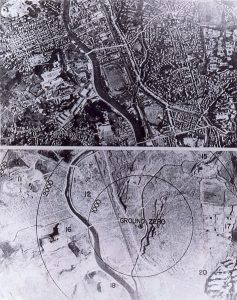
The picture below is a “before and after” image of the city of Nagasaki, Japan, following it’s destruction by an atomic bomb on August 9, 1945. This was the “other” atomic bomb that week. I have been to the memorial site in Hiroshima (familial connection…on the Japanese side); should you, the Reader, ever get to Japan, you need to put it on your must-see list.
Just try to avoid going in the first week of August.
Nagasaki, Japan, before and after the atomic bombing of August 9, 1945.
This is the image most people have about nuclear war. That it is mostly wrong, is not something the wider news media is going to waste time talking to you about. The general consensus about nuclear war, as presented in such movies as The Day After, On The Beach, and Threads and reinforced by scientists of a certain political persuasion, is that after the bombs drop, those who live through that, will soon join the rest.
The reality is going to be closer to a downmarket, Road Warrior rip-off. No zombies; sorry.
While the notion of being turned into a shadow on a street by a nuclear blast is very real, the simple truth is that you have to be almost directly underneath the blast. For most Americans, that is simply not going to happen. To find out why, take a stroll through the Nuke Map website, and find the closest major city to you. This is one of the most educational sites of its kind on the internet, and a great companion to Alternate Wars’ World War 3 section.
Most people who live near a major urban area don’t actually live “in” said city, but in the surrounding suburbs. For example, I tell people that I live in “Dallas, Texas” – the reality is that I live well outside the city, itself; in fact, I don’t even live in the same county. That is a conscious choice on my part, because – in my heart of hearts – I never trusted the political leadership of the USA to not do something monumentally stupid, so I try to live outside target zones.
Nuclear weapons are expensive and complicated, so anyone deciding to fire one at an enemy long ago realized that they needed to think very carefully about targeting. Targeting enemy commands and military facilities are almost always not the first option, because – under the doctrine of Mutual Assured Destruction (MAD) – it was assumed that as soon as you launched your missiles, the other side would launch theirs. As a result, there was no point in targeting empty air bases and missile silo’s. Likewise, targeting command elements (i.e., the President, et al) was not a good idea, because if you succeeded, there was no one left to negotiate with. So, the target planners settled on “economic and communications nodes.”
In short – cities.
If you look at a map of almost any major city, there are almost always a confluence of major highways in or near the city centers, conveniently close to major office towers housing the headquarters of companies that control “war production industries“…meaning, essentially anything that can be useful in warfare…which is virtually everything.
But, what if you don’t live in one of these “target-rich environments“? If you live “out in the ‘burbs,” like me, at most, you will get a certain amount of damage to your home (unless you are staring directly at the blast when it goes off; that will make your life…problematic). If you live in an actual rural area, you might not notice that a nuclear event has happened, until your local emergency services suddenly turn out in force.
For those thinking that the recent “advisory” posters and videos from various governments around the country, warning you to head indoors and wait for instructions in the event of a nuclear attack, means that the government will actually tell you how they are going to save you in the aftermath…they won’t. Those poster’s job is to keep you off the roads, to lessen traffic jams caused by fleeing people.
In short, the government wants you done. Well done, that is.
So…The foregoing naturally begs the question: If you’re outside a target area, a nuclear exchange does happen, and you’re alive afterwards — what do you do?
First, you need to plan ahead. If you think that I mean that you should become a “prepper” – you would be correct. But – should you stay in place, or go somewhere else? You know your area and your neighbors better than I do. If you live in an apartment complex, I strongly recommend that you have a plan to go somewhere else.
I am in a position where I have options in several directions. Again, I did this deliberately. That said, if you think that you are in a good position to stay where you are, that’s what you need to do. Hitting the road after a nuclear attack is, obviously, a pretty dangerous undertaking, no matter how well-prepared you think you are.
In addition to the requisite stocks of food – which is cheap to start, if you start now, by simply buying a few extra cans of beans and vegetables, and bags of beans and rice with every grocery run – you need to think seriously about water. Getting a couple of 55-ish gallon drums, along with several hand-pumped water purifiers for hiking, is a good step.
Next, I have to insert a disclaimer: the following is NOT medical advice. Do NOT “experiment” with the following. Short of a nuclear attack, do NOT take these products without consulting your doctor. Neither myself, nor FreedomistMIA are responsible if you violate this warning.
You have been warned.
The only specifically anti-radiation drug available to the general public in a pre-attack environment is Potassium Iodide. This is used as a protective for the thyroid glads from certain forms of radiation. The link above is to the Mayo Clinic’s advisory page on the drug – read that THOROUGHLY before taking. Potassium Iodide can be bought either as a product called “IOSAT“, which is sold in packets of fourteen 130mg pills. These are perfectly fine to use, but I do not recommend them, because in my opinion they are too expensive, and not as useful as the alternative. The better option are sold as tablets, by the bottle, usually coming as c.140 tablets of 130mg each (the standard dosage for an adult) to each bottle. The reason for this is simple: the IOSAT box is only good for protection after a single detonation — what do you do on Day 12, post-Attack, when their is another explosion? It’s a distinct possibility. Buy the bottle.
As well – calcium supplements. These are the only reasonable measure to counter the effects of Strontium-90 exposure. While there is no cure for Strontium exposure, calcium supplements can help you maintain bone health, since Strontium competes with calcium in the body. Again, talk to your doctor.
Last – multivitamins. Should an attack happen, your stress levels and changes in diet will throw your body out of whack for some time, until you can settle into a new normal. Multivitamins can help regulate the nutrients your body needs in the short term. Again, talk to your doctor.
Next, you need to consider, right now, what your gardening potential is. Start looking up your gardening zone, to see what kinds of food crops you can put in. As well, learn sprouting, because it really will keep you alive. Likewise, check out THIS video, as well.
That last thing we’ll talk about here, is personal defense and protection.
While I am fairly certain that many of those reading this article probably possess firearms of some sort, you need to think carefully about how to organize you personal and family protection strategies. Even if you live in a hyper gun-controlled state, you still have viable firearms options, such as pump shotguns, lever- and bolt-action rifles, and revolvers. Don’t do anything to run afoul of your local governments, but arm yourself, if you haven’t already.
Lastly, don’t neglect first aid. There are several products readily available, at very low cost that will significantly increase your chances of survival. Your options in this regard are vastly better than what was available 20-odd years ago. Also, there are plenty of training videos out there, on YouTube; “Dr. Bones & Nurse Amy” is one of the best.
Finally — I am not writing this to scare you. Even though I do not know you, I want you to live, should a nuclear attack happen…because the chances are very good that you willsurvive the attack, itself, and likely in relatively good physical condition. I find the idea of a person who survives a nearby nuclear explosion dying because they were not prepared beforehand, out of depression and ennui induced by sources that they should be able to trust, to be offensive in the extreme. You don’t have to know every single thing that I know, but what you need to know is that, if the worst comes, you and your family can survive, if you just exert the effort now.
I hope this helps. Good luck, check your six and keep your powder dry.
Back FREEDOM for only $4.95/month and help the Freedomist to fight the ongoing war on liberty and defeat the establishment's SHILL press!!
Are you enjoying our content? Help support our mission to reach every American with a message of freedom through virtue, liberty, and independence! Support our team of dedicated freedom builders for as little as $4.95/month! Back the Freedomist now! Click here