In light of current events in Russia, we’re going to take a look at something long forgotten in the United States: Civil Defense, and how the US government has been failing it’s citizenry since 1979.
Prior to World War 2, there wasn’t really a notion, nor a need, for a “civil defense” structure within the United States as we understand the term. While there had been efforts to mobilize the nation’s non-military workforce, including women, during World War 1, there simply wasn’t that great of a threat of external attack, and the false start was quickly dismantled after that war ended.
Photograph taken from a Japanese plane during the torpedo attack on ships moored on both sides of Ford Island shortly after the beginning of the Pearl Harbor attack. View looks about east, with the supply depot, submarine base and fuel tank farm in the right center distance.
Once large-scale war returned to Europe in 1939, however, it became clear that the United States would be facing severe challenges. As a result, the Office of Emergency Management (OEM) was established on May 25, 1940, to coordinate a national strategy for mobilizing the population to defend the country in the event of a direct attack. These preparations, as tentative as they were, came into sharp focus following the attack on Pearl Harbor, and the staggering Japanese offensive throughout the Western Pacific Ocean. Very shortly, German U-Boats swarmed towards American waters, and promptly sank over 100 merchant vessels along the US Atlantic and – some in sight of land – in the first three months on 1942, alone. Pearl Harbor-style raids by Japanese aircraft carriers along the Pacific Coast were seen as a real possibility. As well, there was a real fear of Japanese and German commandos sending landing parties ashore from submarines to sabotage everything from industrial plants to railroads and bridges; machine gun-equipped security posts were set up to guard Hoover Dam.
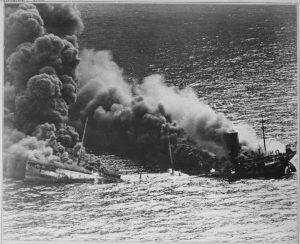
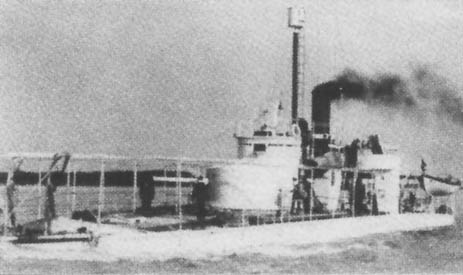
Allied tanker torpedoed in Atlantic Ocean by German submarine. US Navy photo.
Even though the feared attacks never went further than U-Boat raids on shipping and one of the strangest series of raids ever seen (aside from the actual invasion of Alaska), an extensive network of air raid shelters and local security was established, and remained functional until the end of the war, when it was disbanded.
That document led to the establishment of a huge network of programs, studies, shelters and supplies, that placed some level of planning for the civilian population of the United States to survive a projected nuclear attack. The resulting Civil Defense program continued it’s attempt to prepare American civilians for surviving a nuclear attack until the early 1970’s, when it’s oversight began to be dismantled, and its functions dispersed out to other agencies. Everything from food, water storage, tools and medications (even a 200-bed emergency hospital) were available from the Civil Defense system, direct to homeowners and small communities, at either no or little cost…But that wouldn’t last. There were, of course, problems and failures, but at least the government was trying.
Survival Supplies for the Well-Stocked Fallout Shelter, c.1964. US Gov’t photo.
FEMA is a “reactive” agency – aside from providing some free information on their website, there is no longer any systematized response to any sort of disaster, be that a hurricane, earthquake or nuclear war. “Proactive measures” are not in the wheelhouse of any US government agency, when it comes to protecting the civilian population. While there are certainly “survivalists” and “preppers” out there, those people are frequently ridiculed and shoved into the category of “kooks” and “weirdos” for trying to coherently prepare for any sort of catastrophe – after all, if something should ever happen, the government will help you far better than you can on your own, right?
Hurricane Katrina survivors at the Houston Astrodome Red Cross Shelter. US Gov’t photo.
Today, with the proverbial “wars and rumors of wars,” as well as economic and energy chaos around the world, civilians (and even some military’s troops) are increasingly worried, because the governments of the world offer little in the way of assurance, let alone practical solutions, and quite literally seem to be attempting to make things worse. There have been too many years between serious, practical planning, done by actual specialists, to prepare people for “Disaster X”.
The bottom line is this: You are on your own. The government is not going to be there to help you..in fact, the government may very well decide that whatever you have, what you have spent your own money to stockpile for your family, is not actually yours, and that they will take it from you, by force, if they deem it necessary. If you doubt this, read it in their own words, HERE – the language is intentionally broad, and it can be changed on a whim.
Again: You are on your own. If you don’t have a plan, you’d better get started. Rice and beans are cheap…for the moment.
For more information, visit the website of the Civil Defense Museum HERE
We all like nice things. Especially new, nice things. New things tend to have that “new” smell and/or touch. They “feel” better, and give us all a certain sense of accomplishment – after all, “new” tends to be expensive, in comparison to older things, and “buying new” gives us a feeling of accomplishment, because the new thing is a physical representation of our hard work paying off.
But – is “new” actually “better“?
In the realm of consumer products, the reality of new items hitting the shelves (literally or figuratively) is very much hit or miss. Many times – perhaps even most times – the new stuff offers new features, or is lighter, or does things more efficiently than what it is replacing. Conversely, many times, the new product – while looking very snazzy or streamlined on the outside – is actually flimsy, cheaply made and has a very good chance of failing if you look at it sideways, usually the day after its warranty expires (if it even came with a warranty). This can lead the frustrated consumer to try and return the product for a replacement or a refund (which sometimes, they are actually able to receive), and often going out and buying a similar product from a more reliable and trusted brand.
But in reality, buying a “new and improved” coffee maker on sale and having it fail on you after three months, while frustrating, really isn’t a monumental problem; annoying, certainly, but no one is dying over it…In the military realm, however, the consequences of untested tools – and worse, untested structural models – can be catastrophically disastrous.
Let’s look at two examples, one a matter of hardware, the other, a matter of organization.
Boom Sticks
First, with the rise of the AK-47, militaries around the world began to clamor for a rifle chambered in an “intermediate cartridge“, in short, something more powerful than a pistol-calibersubmachine gun, but not as massive as a full-power cartridge. The path to the intermediate cartridge idea is one of those dark secrets of firearms history, that will make for a good, more in depth article down the line, but here, it will be sufficient to outline a brief overview.
Intermediate rounds are, on average, smaller and lighter than their larger cousins, which equals less use of materials (i.e., gunpowder and various metals); while the savings are tiny, per cartridge, when you are producing billions of rounds at a time, those tiny figures become very significant, very quickly. On the side that really matters to a land army – infantry combat – the “field experiment” of the last sixty or so years, initially seemed to validate the idea of the intermediate cartridge: the intermediate class of round seemed to be perfectly effective at its intended role. But looks, as usual, can be deceiving.
Comparison of Pistol, Rifle and Intermediate cartridge. From left: 9 × 19 mm Parabellum (Pistol cartridge) 7.92 × 33 mm Kurz (Intermediate cartridge) 7.92 × 57 mm Mauser (Rifle cartridge)
While fine at ranges out to 300 meters or so (the intermediate’s intended range), when ranges moved out past that, the rifles rapidly became very ineffective, more so because – since the “maximum effective range” was accepted worldwide as 300 meters – the militaries of the world saw little reason to train the average recruit to shoot any further than that…and besides, the few times where the ranges opened up, military forces had General Purpose Machine Guns (GPMG’s), Heavy Machine Guns (HMG’s), mortars, artillery, sniper rifles and even air support to deal with anything “out there.”
The resulting twenty-plus year long series of wars and interventions around the world began to show cracks in the armor of the intermediate cartridge idea. As infantry combat moved out of jungles and cities, and into vast deserts and mountain ranges, combat ranges opened up considerably, well outside the range (pdf link) of intermediate cartridge weapons. And this is where the US military hit a wall.
After going “all in” on the intermediate cartridge during the Vietnam War, the US military was stuck with an entire ensemble of weapons, equipment, training foundations and doctrines that revolved around the intermediate M-16. But now, they were finding themselves being engaged by guerrilla’s firing near century-old rifles, shooting at ranges well beyond 1200 (YouTube link) meters (pdf link). In those instances, US troops generally only had a few GPMG’s and HMG’s to respond. The US military’s response was to develop a completely new (and, inevitably, veryexpensive) rifle and light machine guncombination, along with a completely new type of cartridge that is best described as “intermediate plus“, that had longer range and better “hitting power” than the 60+ year old 5.56x45mm rounds.
U.S. Soldiers with the firing party with the 69th Infantry Regiment, New York Army National Guard prepare to fire a rifle salute during the Pearl Harbor Day ceremony in New York Dec. 7, 2012. US Army photo.
For those who might be scratching their heads and wondering why the US military went this route, congratulations – many other people have been doing the same thing: Why not simply adopt an older cartridge, specifically the 7.62x51mm M80, that was already in the system (such as the M240-series), and any of a number of older-pattern rifles of proven design…after all, new manufacturing techniques and materials would surely make those older designs very competitive, weight-wise, right?
The answer for the US military was, simply put, politics: with a Congress facing a public tired after twenty years of inconclusive war, and massive budgetary issues, there was no way that the military could go to Congress and ask them to fund a step “backwards”. On the other hand, they couldask Congress to fund something “new and improved” – they just had to put the right “bells and whistles” on it…or, to be peckish, a nicer ribbon.
In contrast, stands India: Faced with a rifle that just wasn’t working, no matter what they did, India bit the bullet, admitted defeat, and inked deals to both purchase and manufacture the AK-203 rifle in 7.62x39mm (a total of 670,000 – 70,000 directly from Russia, with the remainder to be manufactured under license) in Uttar Pradesh, while also purchasing slightly modified SIG 716 G2 Patrol rifles in 7.62x51mm.
Indian Army soldier armed with a modified AK-type rifle. Indian Ministry of Defence photo.
The bog-standard 7.62x51mm M80 cartridge has been standard for most western GPMG’s since at least 1983 – it just works.
Whether switching to a “new and improved” weapons suite is a good idea for the US military or not, remains to be seen. Hopefully, it will work.
Hopefully. Troops’ lives depend on it.
Misusing An Organizational Idea
The current war between Russia and Ukraine brought into focus the Russian idea of the “Battalion Tactical Group” (Russian: Батальонная тактическая группа, batal’onnaya takticheskaya gruppa). The BTG is one of those oddities that is rather hard to define, primarily because it only works in a very narrow area of military operations, that being as a “cadre force.”
On paper, a BTG is a combined arms formation that is technically a “battalion” of mechanized infantry, with a number of smaller specialist units (i.e., engineers, medical, air defense, etc.) being assigned as needed, and kept in a high state of readiness. Conceptually, a BTG is similar to the Western “task force” at various levels…except in artillery, where the BTG – with fewer than 1,000 troops assigned – has more long-range firepower than a US Brigade Combat Team (BCT).
There are, however, problems.
The first, is a lack of infantry support. One of the mistakes many civilians make in studying modern warfare, is the idea that tanks can do everything on their own. They cannot. A tank crew is seriously restricted in seeing what is happening around them, specifically in that they cannot see enemy infantry armed with lightweight anti-tank missiles that are more than capable to turning a tank into burning scrap metal. This is not a feature unique to Russian tanks – it is a feature of all main battle tanks in the world, in general. The only viable solution to this problem, was training specialist infantry to escort and guard the tanks against enemy infantry.
Obviously, this requires a lot of infantry…Yet Russian BTG’s, on average, have about 250 infantry escorting them, somewhere between 1/3 and 1/4 of what they actually need. Why?
The BTG dates from the end of the Soviet era, when the Soviet Army was refining its plans for invading Western Europe, and were carefully studying how to deal with Western company, battalion and brigade task forces. BTGs were deployed as an experiment in Afghanistan, before the final collapse of the Soviet efforts in that country in 1989, and worked well enough in that level of fighting that they were kept on, until the Soviet Union dissolved. At that point, the rancid Soviet economy that Russia inherited simply could not support the expense of permanently established combat units that required careful tactical training to work effectively. Worse, the necessary reforms to make all of this happen required a long-serving, professional corps of non-commissioned officers (NCO’s, i.e., Corporals and Sergeants), which was something the Soviets had never really tried to build. This, coupled to the political upheavals of the day, and the general Russian attitude towards their military as a barely-necessary evil (unless the enemy is literally inside the gates…and sometimes, not even then) which made an “all-volunteer” force of the likes of the United States or Great Britain an impossibility, made mass formations and a rigid conscription system moot points. While the Russian army retained the idea of brigades and divisions, at their hearts, they were really just a collection of sketchily-trained, down-market BTG’s.
A farewell ceremony for the 331st Airborne Regiment of the 98th Airborne Division withdrawn from Chechnya. www.kremlin.ru
As a result, while the concept of the BTG was retained after the Soviet Union became Russia again, the training of the troops in those formations was very haphazard. As the Russian economy began to rebound in the late-1990’s, training and readiness began to improve, and combat experience in forming ad hoc BTG’s during the wars in Chechnya showed that the concept was a viable way of fighting minor forces and guerrillas. This culminated in the 2008 Russo-Georgian War, where the BTG idea seemed to work very well against the Western-trained Georgian Army (yet another article for the future). All of this led to the 2008 Russian military reform, an all-out attempt to revamp the Russian military establishment into something like a 21st Century force.
When Russia began its “intervention” in Ukraine in 2014, the BTG finally seemed to find its niche. While it had glaring weaknesses against comparable Western formations, Russian BTG’s being sent into eastern Ukraine were able to augment themselves with swarms of thousands of local anti-Kiev insurgents who, while poorly armed and scarcely trained, were able to advise and guide Russian units through local terrain, and were also able to help screen the BTG’s against Ukrainian anti-tank teams, backed up by the more professional Russian infantry and artillery. And, when Russia intervened in Syria in 2015, the Russian commanders on the scene quickly duplicated this model with local Syrian auxiliaries. The concept worked there, as well.
It seemed that Russia had found the perfect balance: BTG’s were simultaneously long-service soldiers, not conscripts, and – not being manpower-intensive – thus would not unduly upset the Russian population when they were sent out. At the same time, they seemed to be able to get the job done, and were very cost-effective in comparison to the older-model, mass formations of past wars.
“Scene of Gen. Custer’s last stand, looking in the direction of the ford and the Indian village.” Unknown author, ca. 1877. From the US National Archives.
Unless carefully controlled, Victory Disease can rapidly infect a population with the idea that their forces are nigh-invincible. If left alone to fester, this breeds an arrogance that the nation can take on any opponent, anywhere, anytime, without too much effort or thought.
Which brings us back to Ukraine, 2022.
Whatever the causes of the current war may be, this is not the article to discuss them. The Russian leadership clearly assumed that their forces would overrun Ukraine with relative ease, and would allow them to accomplish limited objectives that would not be too onerous on the Russian population. While this was mostly true in the southern sectors, it only appeared to be so, initially, in the northern theater. There, the BTG’s showed all of their glaring faults, as stalled convoys strung out along roads (an inevitable consequence in armored warfare – just ask the US Army and Marines about the advance on Baghdad in 2003) were suddenly cut to pieces by Ukrainian infantry and partisans operating behind the Russian advance. Without the mass of infantry that a more conventional organization would have had, the Russians were unable to defend those convoys as US forces had in 2003, as there was no way that the razor-thin film of infantry the Russians had access to could adequately protect the long columns of vehicles packed tightly into ready-made kill-zones. It was never that the Russians were “running out of infantry” – they simply never had the necessary numbers plugged into their organizational combat unit structures. The disastrous results of this oversight have now greatly lengthened the war, and have led – as of late-September, 2022 – to the Russian leadership calling for a “partial” national mobilization.
What impact this may have on the war, remains to be seen.
For the purposes of this article, Russia took a low-impact approach to military organization out of harsh necessity, and allowed it to become a dominant aspect of its military and – dangerously – its political psychology. When it then applied that approach to smaller wars, and saw that it worked, they made the assumption that it would work against larger opponents. With the inevitable failure of the model when it stepped outside its boundaries, Russia is now in the position of being forced to escalate the conflict to avoid defeat.
Chieftain. M1 Abrams. Leopard 2. Leclerc. Challenger. To anyone with a passing familiarity in the world of modern armored warfare, these names are well known, and rightly feared, should one come up in opposition to them. These vehicles all occupy the top tier of main battle tanks in the world of 2022.
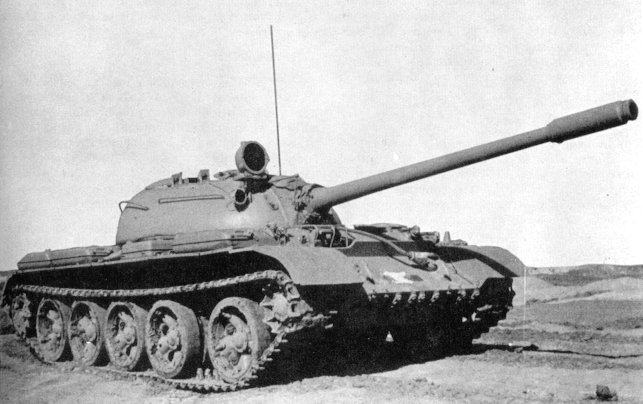
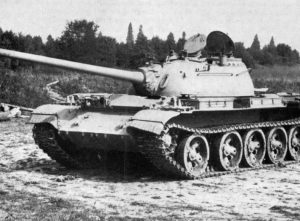
However, even given the impressive combat record of all the vehicles listed above, none of them – combined – match the battle history, breadth of deployment nor numbers produced of the most numerous battle tank in history: the near-immortal T54/55.
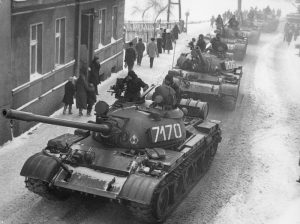
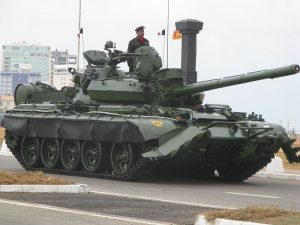
Polish T-55A’s on the streets during Martial law in Poland, December, 1981. Public Domain.
As of this writing (September, 2022), an estimated 100,000 units – or more – are in current service, around the world, counting variants made in China.
The first prototype rolled out of the assembly bays at Nizhny Tagil, in the Sverdlovsk Oblast, near the end of 1945. Design work had begun in 1943, at the Morozov Design Bureau, in the desperate days of the Soviet Union’s battle against the juggernaut of Nazi Germany. With the end of the war, immediate pressure to crank out a new tank lessened, and the Soviets took their time to get the vehicle right.
The result was a vehicle that rivaled the legendary T-34 tank, as it had almost the same cross country performance as its predecessor, but had far better armor, running gear and much more powerful D10-T 100mm main gun. Going into production in 1948, a small initial batch of just under 1,500 vehicles were built, and – as usual with new designs – issues began to show up. Over time, enough of these corrections and redirections (including a focus on surviving nearby nuclear detonations) accumulated to give birth to the T55.
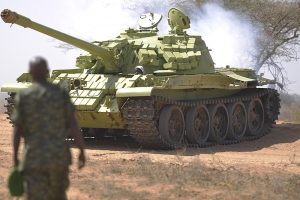
A T-55, one of several Somali National Army tanks (ca. 1981). US Army photo.
By then, the T54 had seen some of its first real combat actions, in both the Soviet Union’s invasion of Hungary in 1956, and in some of the very early stages of the Second Indochina War. But that was only the beginning.
As the production lines ramped up, and more units rolled off the lines, users around the world suddenly discovered that they had a relatively cheap, yet very effective, battle tank. While the T54/55 was quickly surpassed by newer and more advanced designs, in both its home country and in the West, it continued in production. The reason was simple: while the T54/55’s replacements (such as the T-62 and T-72, among others) might have been technically more capable and effective, the T54/55 was more effective than all of them, when it was the only tank on the field, and its enemies had either inferior tanks (or no tanks at all) to face it.
As it was simple to service in the field, and comparatively cheap (at c.US$200,000 in 1972), it became a favorite of Third World armies, in many cases, being the first battle tank of any sort that those countries had ever deployed. The D10-T main gun turned the tank – with certain limitations – into an effective mobile artillery piece. The platform also quickly proved highly adaptable, with multiple variants quickly appearing on the horizon, variants that further expanded the tank parks of many small countries. For many nations, the T54/55 became a pillar of their armed forces. Many firms around the world offer various types of upgrade packages for the design, as of this writing.
T-55AM2 Main Battle Tank of the Sri Lankan Army, 2012
Of course, as with all poorly handled equipment, if an operator just bought tanks for show, and then tried to use them for real, the results were…less than spectacular. Although suffering repeated drubbings at the hands of top-tier armies like the IsraeliIDF and the US military (and, embarrassingly, the Chadians), many other armies – like India, Vietnam, Tanzania and Sri Lanka – showed that when properly handled, the tank designed at the end of World War 2, was a highly dangerous combatant on the battlefield.
This remains the case. Around the world of 2022, this guttural steel monster continues to fight. There are better tanks, now, but that doesn’t matter, unless those tanks show up to oppose the ancient beast…and even then, it might surprise its younger cousin’s, depending on who is crewing it.
Tank driver, Lance Corporal Mudondo Zabina of the Uganda Peoples Defence Forces, manoeuvres her tank under the watch of her commanding tank officer, Lieutenant colonel Fred Kakaire. Zabina was a tank driver in Gulu befoe she was deployed to Somalia. AU/UN IST PHOTO / David Mutua
It has long been acknowledged that John Browning is one of – if not the – greatest American firearms designer of all time. Indeed, his Winchester 1894 – the venerable “.30-30” – with over six million units produced, is the most numerous sporting rifle ever made. Browning’s designs have lasted well over one hundred years; in fact, variations of his M1911A1 pistol and M2HB heavy machine gun are still in service in the United States Armed Forces, at least in some capacity, despite both being over a century old.
John M. Browning, c.1920.
At the end of World War One, however, Browning did not rest on his laurels after a sixty-year career of designing weapons for both civilians and military forces. As he was no longer offering his designs exclusively to Winchester, after the war was over, Browning began working with the Belgian firm Fabrique Nationale (FN). One of the final designs Browning was working on, a French military requirement for a new service pistol, the “Grand Rendement” (French for “high efficiency“), would never be completed, as Browning would die suddenly of heart failure, on the floor of his son and co-designer’s shop November 26, 1926, at the age of 71.
The service pistol design, while not complete, had advanced far enough that it could be completed by Browning’s assistant, designer Dieudonné Saive, a tremendously talented designer in his own right, who would go on to design many legendary firearms, including the FAL (Fusil Automatique Leger or Light Automatic Rifle), which would become known as the “Right Arm of the Free World.”
The pistol for the French contract was a “game-changer” design. Browning had been one of the first designers of practical and reliable semi-automatic pistols, as far back as 1899, and the French pistol built on from everything he had learned to that point. The task, however, was not simple, as Browning had to compete with himself — he had previously sold his patent on the M1911 to Colt Manufacturing; as a result, Browning was unable to directly copy that design. The new pistol used a 13-round, detachable box magazine (designed by Saive), the first true ‘staggered-stack’ design that allowed a near-doubling of ammunition capacity, without overly-enlarging the grip.
Due to the French commission’s wandering requirements (something all to common in the weapons design world, being one of the chief reasons for mindless cost overruns in defense products), the design was unable to mature until 1931, when the Belgian Army ordered 1,000 units of the early design, and was finally completed in 1934…Which was, of course, when the French chose another pistol, that went on to become barely a footnote in history.
Weapons used by Swedish Volunteer Corps. Inglis of Canada HP-35 in upper-right corner (#4).
The Belgian Army, however, had been following the pistol’s development, and were highly impressed with the small sample that they had purchased three years earlier. The French competition was barely over, when the Belgians formally adopted the pistol, as the “HP-35“, as their national sidearm, which would become known as the “High Power“.
World War 2 saw Nazi Germany swallow Belgium whole, and with it, the FN factories. When it became clear that Belgium would fall, Saive and other FN engineers fled to England, and carried the designs of many weapons, including the High Power, with them. The High Power’s plans were handed over to John Inglis and Company, of Toronto, Canada, who rapidly tooled up lines to produce two versions of the design: the standard model with fixed sights, and a version with an adjustable rear sight and a detachable shoulder stock (primarily for a Nationalist Chinese contract). From there, the High Power took off to became the primary sidearm of the armies of 93 nations, as well as many special operations forces, most famously, Great Britain’s SAS, and remains in service with many of those militaries to this day.
Canadian soldiers inspect their weapons, Camp Blanding, Fla., April 18, 2009, in support of Partnership of the Americas 2009. USMC photo.
Unfortunately, all good things come to an end – or seem to. After 82 years of continuous production, FN Herstal announced that the production of the Hi-Power would end, and it was discontinued in early 2018 by Browning Arms. From 2019 to 2022, with no new Belgian Hi-Powers being built, clones were designed by various firearm companies around the world, including Springfield Armory, as the “SA-35.” These new Hi-Power clones began competing with each other by offering new finishes, enhanced sights, redesigned hammers, beveled magazine wells, improved trigger, and increased magazine capacity.
However, in 2022, presumably to compete with the sudden surge in Hi-Power popularity, FN announced they would resume production of the Browning Hi-Power. The 2022 “FN High Power” incorporated a number of entirely new features such as a fully ambidextrous slide lock, simplified takedown method, enlarged ejection port, reversible magazine release, wider slide serrations, different colored finish offerings, and 17-round magazines.
As of the end of 2022, the eighty-seven year old design has suddenly found new life, and will likely continue in service well past its 100-year design mark…
Since the earliest days of people hanging armor plates and machine guns onto motor vehicles, “armored cars” have formed an essential component of military’s around the world. The better versions are small(-ish), cheap, fast, reasonably dependable and armed enough to defend themselves, as their crews sent recon reports via their radios.
But sometimes, something special appears.
Introduced in 1959, the AML- series (Auto Mitrailleuse Légère, or “Light Machine Gun Car”), manufactured until 1987 by the French company Panhard (who have been making automobiles since 1890), is small, even by armored car standards, at 16’9″x12’5″x6’6″, and weights in right at six tons.
AML-60, armed with the 60mm Brandt gun-mortar.
Initially, it was armed as a light, fast, highly-mobile mortar carrier, carrying a 60mm Brandt gun-mortar and a pair of the uniquely French MAS AA-52 NF-1 machine guns. However, although the little armored car was an immediate hit with French troops in Algeria, as that conflict wound down, there was less of a need for a mobile mortar carrier. As foreign buyers began looking at the design, it was the Apartheid-eraSouth African Army who asked if Panhard could give the little truck a heavier punch.
And thus, the AML-90 was born.
Mounting a DEFA D921 90mm/3.54in rifled cannon, this new vehicle was fully capable of engaging and destroying the main battle tanks of the 1960’s. As the years wore on, even though its 90mm cannon could not keep pace with developments in tank armor, its high-explosive (HE) projectiles remain fully capable to destroying most vehicles smaller than a tank or modern IFV. Even the US Army’s the United States Army Research Laboratoryacknowledged in 1979 (PDF link) that the AML “operated effectively in Beirut” and noted that “the ease with which the Panhard is driven and repaired, and the absence of tracks, provide the mobility desirable in an urban environment.”
An AML-90 (R) of the Lebanese Army, Beirut, Lebanon, 1982
And it was simple, in the extreme – AML hulls were assembled from only 13 welded pieces. Thirteen. In the early 1980’s, an upgrade to the AML-90 Lynx became available, offering a new turret loaded with a modified D921 main gun and up-rated range-finding equipment and night-vision gear.
Bottom: Original H-90 turret. Top: Lynx 90 turret incorporating a new commander’s cupola, sights, searchlight, and a laser rangefinder.
The AML-90 and its somewhat lesser known variants were sold all over the world, albeit mostly in Africa, where they proved very effective when used for their intended roles. As just one example, when France conducted a series of operations during the Chadian-Libyan Conflict, only three vehicles were reportedly lost in action, apparently to RPG fire, despite several engagements versus Libyan tanks. While not completely immune to land mines, the AML’s were not known to fall prey to them very often.
Although withdrawn from French service in 1991 (replaced by the Panhard ERC and AMX-10RC vehicles), the AML – in most of its forms – continues to soldier on, around the world, with the last foreign sales being completed in 1999.
An Iraqi AML-90 light armored car, captured during Operation Desert Storm. USMC photo.
Are there better vehicles, today? Absolutely. The AML, by modern standards, is cramped, has neither NBC protection, nor any real “comfort” items modern forces take for granted, and has poor armor. But still…until it comes against those better vehicles, the AML remains cheap and effective — even sixty-odd years later.
“Old” does not necessarily mean “useless”…A thing that more military’s in the world would do well to learn.
If your political foe calls you a great Satan, understand that unless you match or exceed their rhetoric, the public will tend to think the more sensationalist claims are true. Moreover, if your foe calls you a great Satan and this is patently false, then take this both as projection and equate this to murderous intent.
(Note: some measure of this is always evident at almost all times, but what is at issue here is the pervasiveness, loudness, and sensationalism of such claims and rheorical assaults aimed at delegitimization and even criminalization of any substantial part of your movement.)
The public gravitate toward epic batttles between implacable foes, not tame debates in response to vicious attacks by the other side.
Lopsided battles in which one side tries to be polite to one who is being violent and beyond the pale hold little interest. The assumption is that the louder and more violent must necessarily be right because average people would never make such outlandish claims and act so reprehensible without cause.
Hence to perhaps over-quoted bit about “the big lie”, telling it loudly and repeatedly until it is believed.
If the Ukes had not been so vicious and violent in their response to the Orc invasion out of Russia and Byelorus, for instance, the general public would have lost interest. Nobody adores a weakling. But notice, the Ukes have only done limited attacks on the Russian homeland itself for fears of escalating this into a nuclear war.
In politics, of course, the term “violent” is not literal. It is a spirit and energy. Like where it says it the Sacred text: the Kingdom of God suffers violence and the violent take it by force. When one side demonizes over the top, the only response is to return the favor in spades, assuming all their demonizations are projection and represent intent.
To drive this point home: it is ALWAYS reasonable to assume that whatever lies are used to defame your side are a projection of the true character and intent of the other side. When the other party openly deems any part of your movement traitors or something like that, then dialog must end and peaceful street actions must begin in a visible way that forces the public to choose a side.
Abandon any notion that any attack on perhaps a less seemly element of your movement is not actually a precursor to a general attack on the totality of your movement.
Once matters go to a stage where “legal” devices, abuses of power, are targeting individuals and using sensationalist claims and hyperbolic exaggeration to actually raid homes and arrest people, the response must be to assume all of your side are in the crosshairs. This is the kind of dangerous measures that actually lead to real violence when the organs of power come with guns to harrass or even imprison their opponents.
The political party or movement that cannot mass people for protests and civil disobedience to protect its own members, even those it may not heartily embrace, will soon face extinction. Illegal abuses of power targeting a few people who may be skirting the edge of propriety but who have not substantively broken the law, must be deemed an illegal persecution of the whole movement.
The only response would include protests, mass demonstrations, and even crippling work stoppages aimed at causing as much of a OR nightmare and and as much economic pain as possible on the oppressive party. But a peaceful albeit overwhelming response is needed with the aim of deescalation: using violence can tip things over the edge and lead to a lose-lose scenario for your entire country.
Essentially, match and exceed their rhetoric, or accusations, understanding that it is reasonable to assume the worst lying smears are actual projection and represent serious mal intent. But do not escalate with physical violence when peaceful demonstrations and/or work stoppages can be availed.
To give our non-military readers a very basic overview, the better to understand the problem, let’s take a brief look at the framework of supply in the military sphere.
Warfare destroys and wastes whatever it touches – both people and equipment. People can be recovered (where that can be possible) through medical treatment and counseling.
But what about equipment?
Kansas Army National Guard Soldiers work to package and stage personal protective equipment. (U.S. Army Photo by Sgt. Ian Safford, 105th Mobile Public Affairs Detachment)
Everything a military force needs – the “beans, bullets and band-aides,” if you like – can be categorized, ordered, received, inventoried, issued and turned back in at will. The trouble is getting all of those actions to work in sync, on time, and (hopefully) in something close to the right amounts. For the most part, your humble author is happy to stick with the US Armed Forces system, not simply because it is what I am used to, but because it is more precise than comparable systems, while also not being overly cluttered.
Oshkosh M-978 fuel servicing trucks line a holding area during Joint Logistics Over the Shore (JLOTS) training, part of exercise Ocean Venture ’92. An M-901 TOW vehicle is parked to the left. US Navy photo.
Class I– Rations – Subsistence (food and drinking water), gratuitous (free) health and comfort items
Class II– Clothing And Equipment – individual equipment, tentage, some aerial delivery equipment, organizational tool sets and kits, hand tools, unclassified maps, administrative and housekeeping supplies and equipment
Class III – POL – Petroleum, Oil and Lubricants (POL) (package and bulk): Petroleum, fuels, lubricants, hydraulic and insulating oils, preservatives, liquids and gases, bulk chemical products, coolants, deicer and antifreeze compounds, components, and additives of petroleum and chemical products, and coal
Class IV – Construction materials, including installed equipment and all fortification and barrier materials
Class V – Ammunition of all types, bombs, explosives, mines, fuses, detonators, pyrotechnics, missiles, rockets, propellants, and associated items
Class VI – Personal demand items (such as health and hygiene products, soaps and toothpaste, writing material, snack food, beverages, cigarettes, batteries, alcohol, and cameras—nonmilitary sales items)
Class VII – Major end items such as missile and rocket launchers, tanks, mobile machine shops, some parachute systems and vehicles
Class VIII – Medical material (equipment and consumables) including repair parts particular to medical equipment
**Class VIIIa – Medical consumable supplies not including blood & blood products
**Class VIIIb – Blood & blood components (whole blood, platelets, plasma, packed red cells, etc.
Class IX – Repair parts and components to include kits, assemblies, and sub-assemblies (repairable or non-repairable) required for maintenance support of all equipment
Class X – Material to support nonmilitary programs such as agriculture and economic development (not included in Classes I through IX)
Miscellaneous – Water, salvage, and captured material
Saraktash scrap-heap. By “Imankulov”, under CCA/3.0 Unported.
My only real complaint about this list is the last item, because the only true “miscellaneous” items are truly ‘scrap‘ materials. Thus, I use the following, in addition:
Class XI – Non-potable Water
Class XII – Captured/Recovered Material
Of these, “Class XI” (Non-potable water), is the simplest: Non-potable (i.e., non-drinkable) water is fine for washing equipment, fire-fighting and for flushing out waste.
An Iraqi AML-90 light armored car captured during Operation Desert Storm. A captured ZPU-23-4 anti-aircraft machine gun is at right. USMC photo.
Class XII(Captured/Recovered Material) are the various detritus that can be scraped up from a battlefield, including enemy material. The process for handling this class of gear (whether from a friendly, liberated, requisitioned or enemy source) is as follows:
a. The materiel is brought into a receiving yard, where it is identified, categorized and assessed for serviceability. Anything of direct and immediate interest to Intelligence goes straight to them. For everything else, we move on to…
b. Type Classification and Field Stock Number Registry: Materiel recovered and brought in should have a tag applied to them, then be classified with a temporary Stock Number, first, using the Supply Classifications as listed above to categorize the item. Then, after applying a two-digit number for the supply class, add one of the following qualifiers after the class to the item tag:
(x) – Material recovered from allied/friendly military sources
(y) – Captured/Liberated enemy material
(z) – “DIY”, improvised, ad hoc or requisitioned from civilian sources
Then, add the appropriate qualifier from the following list:
(A) – Ready To Issue; the item can be issued immediately, with minimal servicing and/or repainting. It should be tagged, and placed into an appropriate storage slot
(B) – PM Required; minor maintenance/clean-up required prior to reissue. This should be forwarded to the appropriate maintenance queue
(C) – Major Repairs Required; the item is repairable, but is dead-lined until it can be repaired. This should also be forwarded to the appropriate maintenance queue
(D) – Sub-Assembly Salvageable; the complete item is too damaged to reissue as a complete unit, but can be broken down into its constituent sub-assemblies (i.e., brake drums, alternators, engines, various major components, etc.) to issue in order to repair other items. This process should be commenced immediately, using either unit specialists, or civilians hired on contract.
(E) – Scrap; the item is damaged to the point where it can no longer be used. This material should be towed or set out of the way, and should either be returned to a manufacturing area for re-smelting/recovery, or sold off. Depending on the material, it may be able to be repurposed into engineering barrier or shelter material.
This is more an essay than a quick article. The views hear-in are those of the author, alone.
As a certain writer once said, there is nothing wrong with fearing pain, deprivation and hardship…and I agree. Hence, I am a “survivalist” (rr, “prepper“, if you prefer). No — I don’t have the elaborate underground bunker (I wish!), and no, I do not sit on a mountain of supplies (again, I wish!), but the attitude is there.
I think about it. I plan for it. I continually assess and reassess my options.
So I wondered: where does this come from? Why have I always been concerned about massive damage, and massive dislocations of society? Am I weird? Disturbed?
Well – I grew up in California, so…Yeah — pretty much…And for all the Californio’s reading this: How many of you remember the “earthquake exercises” we used to do? You know the ones: Do you know where the key is, to turn off the gas in case of an earthquake? So the house doesn’t explode? Did you make up earthquake kits in school? Bottles of water, before it was fashionable, and cans of Chef-Boy-Ar-Dee and Campbell’s Pork-n-Beans, squirreled away in corners of the house, so that at least one or two would be sure to survive a big shaker?
…Then, of course, it was the early 80’s. And yes — I’ve been at this since the early 80’s. I’ve already made all the mistakes you need to avoid.
So, what is the point of all this?
Recently, in the last few years, there has been a rise in “reality” programming of so-called “prepper” shows, chief among them, National Geographic Channel’s “Doomsday Preppers“, where the show visits various “survivalists” – or “preppers” – and documents their ideas and strategies. Other shows work on a similar format.
The only problem is, the entire thrust of most of these programs is to demonize anyone involved in “prepping” as a paranoid freak, resulting in many people shaking their heads, and turning away from the very idea of carrying more than a tire iron and a set of jumper cables in their car.
This is a disastrous situation, one that magnifies the already terrible effects of a disaster – be it natural or man-made – by planting the seed in people’s minds that it is “crazy” to prepare for a disaster.
How do these shows do this? By highlighting one of two conditions, and magnifying them far out of proportion, for the “Wow!” effect: the shows seek the most extreme survivalists, and seek to show either their “vast” resources or their “extreme” views, or both. Normal, rational people see these views as either unattainable or dangerous and frightening, and stay away from the entire idea…
…Which is usually about the time a major disaster befalls them.
In fact, disaster preparation is much like insurance — a person does not get home insurance because they intend to destroy their home, they get it, in case some disaster (earthquake, fire, flood, hurricane, a car driving through the front wall, etc.) might happen at some point.
Preparing to mitigate the effects of an extreme disaster is no different.
US Navy Lifeboat Survival Kit, c.1943. US Navy photo.
For all that, there are a lot of well-meaning people out there trying to prepare for “Disaster ‘X'”, who are wasting precious resources, money, brain sweat, real sweat and time operating along a very poor planning cycle.
First, there has to be a clear understanding of what I call the “Survival Breadbox” — an interactive rectangle of arrays of items that define capabilities. Most people approach the Box neither knowing what it is, nor really understanding it, and only perceive it in a disjointed fashion; in fact, failure to understand the Box is why many preppers give up, as it looks far too complicated and frustrating. However, once you understand the Box, you can start planning effectively, and – most importantly – successfully implementing those plans.
The reason I describe the Box as an “interactive rectangle” is because there are four points to it…
The “EEK”
The Week-Long 72-Hour Window
The Cantonment
The Panoply
The reason these are in a rectangle, rather than a hierarchy, is that they feed off of each other, and operate together to form a cohesive whole — you can function without one of the corners for a while, but you had better address it, and FAST, before you run into a situation where you.
One of the most common mistakes preppers make is to plan for “Disaster ‘X’“…only to have “Disaster ‘L’” show up. I tend to take this from the point of view that anything that significantly disrupts the nation’s logistical infrastructure for more than a week is the “worst case”.
Roadway damage, Oslo, MN, May, 2009. FEMA photo.
Why? Because the country functions on its logistical infrastructure — you might garden, but how many reading this grow their own cotton, harvest it, process it, and make clothing out of it? How many people reading this can go out to a local store, and buy a metal object that was made locally, that went straight from raw ore to a finished product, “locally” being defined as “within 100 miles from where you live”?
Based on that, chances are good that the person reading this got every single thing in their house from off of a truck, something that was made somewhere else, and rather far away…including the food in your fridge. And if the system that makes all that flow smoothly is disrupted, everything will quickly get seriously out of whack, as every business requires a steady flow of widgets to function — and even if the place that makes Widget A still functions, and can get its product to its customer, that Widget is useless without the other 30 or 30,000 widgets that make the final product work.
Most preppers recognize this at some level, and don’t know what to do about it…so they try hard to ignore it…
Let’s look at each point in the Box.
First, is the “EEK” — the “Escape and Evasion Kit“. This is almost always currently referred to as a “bug-out bag“, or a “Get Out Of Dodge” (GOOD) kit. I casually detest both terms. Why? Because they put people in the wrong mindset.
If you are “bugging out” or “getting out of Dodge“, this implies that you will have some warning, so it might be appropriate to take “whatever you can carry“…
…Folks – you’re not packing to go hiking at Aspen. So why, oh, WHY do you carry five ways to start a fire? This isn’t the Scouts.
If you actually needto use a kit like this, things have gone ‘BLOOEY‘ in a major and surprising way, and you suddenly need to get from Point A to Point B — on foot. Now, if the ‘BLOOEY‘ has happened, just how many otherpeople do you think are going to be trying to get to an area somewhere near Point B?
Then WHY ARE YOU DRAWING ATTENTION TO YOURSELF WITH A FIRE? Worse – COOKING?! People who are scared and hungry will come after you like a moth to a flame. Why? Because sound, light, and smell all carry a LONG way, and while someone alone might not want to risk a confrontation on Day 1, what about Day 2? Or Day 4? What happens when their children are hungry, and you don’t have enough food to share?
Now, the truly selfless will try to help as many as they can, as quickly as they can – and that’s a good thing…under normal circumstances. What happens when things are no longer ‘normal‘? What happens when you have to decide between the children of a person you’ve never met, and your ownchildren? Not as easy a question, now, is it?
Ain’t moral dilemma’s great?
First rule of the EEK: Do NOT draw attention to yourself.
Second rule of the EEK: Travel light!
What should be in an EEK? Everyone will customize it, but try this yardstick: if your EEK won’t fit into a common student backack, you have too much stuff in it…
A military-spec rain poncho
A first aid kit
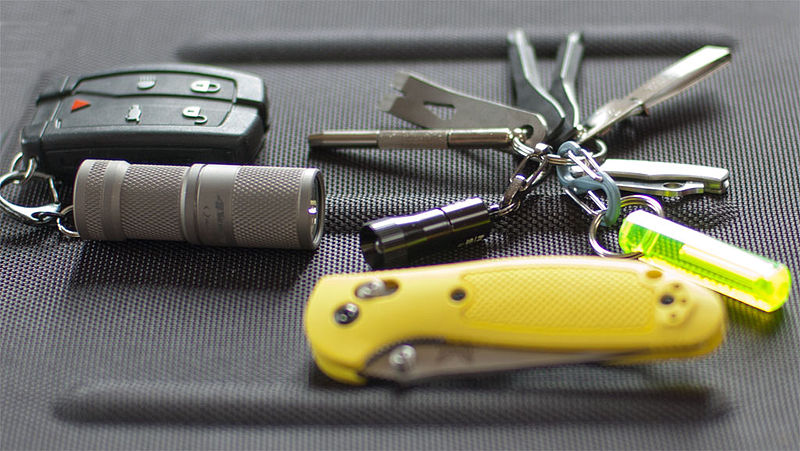
A multitool and/or a Swiss Army Knife
A 4″ lock blade Knife
Two methods of purifying water that do NOT involve fire
At least one quart-sized water bottle (like a Gatorade bottle or a military-style canteen)
Now, most preppers have seen this before, and are thinking that is waaaay too light for three days. Yet, you can in fact carry a three days of food in a small day pack, if you are using USCG Ration packs…you don’t even need to carry too many extra condiments.
As well, let us not discuss the person with the fifteen knives (seriously — the video will leave you slack-jawed) in their kit.
Remember: The EEK is supposed to get you from Point A to Point B, on foot, in 3 – 5 day’s time. Planning on anything else means that you need to use the next tier…
Next, we’ll look at the “Week-Long 72-Hour Kit“.
Preppers frequently talk about the “3 day’s worth of supplies“. I’m not entirely sure why. In fact, the only reference I know of about this time-frame comes from a now-outdated FEMA flyer…Refer to Hurricane Sandy.
This is your “standard” disaster kit. It is intended to help you survive-in-place until help arrives. FEMA says “a few days”; 5 is realistic; 14-90 days is not a bad idea.
Note that this is not intended for you to carry — the amount of supplies and equipment is too great to carry on your back, and if you plan on being on the road for longer than three days to reach your cantonment (q.v.)…you need a better plan.
The only “prepper”-type features you will likely see in this kit are 55-gallon water barrels (based on 5 gallons of water, per person, per day; yes, you can get by with one gallon per person/day, but you won’t like it) and various types of stoves, grills or Dutch Ovens for cooking without electricity or gas.
And speaking of water, make sure to not simply store a few bottles of it – you need ways to purify it, preferably ways that do not involve fire. These methods involve bleach (16 drops to the gallon, per FEMA), or some sort of filtration system…As an aside, you should really look into your local laws concerning the capture and retention of rainwater — you may be both alarmed, amazed, horrified and outraged at just what some of these laws actually say. Forewarned, etc.
One of the advantages in this, similar to the Cantonment, is that you can eat what you are accustomed to eating normally, albeit with different cooking methods. If you’ve never tried to make rice on a Weber Grill — you need to get on that.
Since you’re not planning on moving, you also do not need to worry overmuch about things like cold storage, unless you take medications that require refrigeration. For that, you may want to look into either a solar PV power station, or a small gasoline-powered generator, to run a portable fridge.
Since you’re already at home, you don’t really need to acquire too much in the way of “special” foods, although you do want to make sure that you maintain a 5 – 14 day stockpile of food, minimum, of the kind of foods that will keep for a long time. (Hint: The expiration dates on canned goods are there for two reasons: to get you to rotate stock, and to absolve the manufacturer of legal responsibility if you are stupid enough to eat from a bulging or stinky can.)
Properly sealed canned goods, in cans that are not badly dented, will keep and be both edible and nutritious (I did NOT say “Will remain tasty”!) for up to 10 years; however, this DOES NOT apply to high-acidity foods like tomatoes.
Another important aspect of this kit that is shared by the Cantonment is the easy access to distraction materials — i.e., books and games.
What?
Role-playing dice set.
Hey, if a disaster has happened, and things are in the process of going back to normal, you are going to have a lot of downtime; it’s not like you’re going to be at work. Without power, your laptop/device batteries will die out fast, and roll-up PV panels only go so far. So…Have “distraction tools” ready to hand: boardgames, cards, RPG’s (the paper and pencil kind), and most importantly, BOOKS.
Third, we’ll look at the “Cantonment“.
This is a word derived from military use to describe a permanent or semi-permanent installation. In the early 80’s, when big-S ‘Survivalism’ was in the public consciousness, this was called the “Survival Retreat”.
The main idea goes like this: You have a workaday life and home in The Big City…but you have a “cabin in the woods”, or a patch of undeveloped land that you pull an RV onto to “camp” every now and then. However, you realize that if anything truly terrible happens, and things go south with a quickness, staying in the Big City is a B-A-D idea. The Retreat, or Cantonment, is the place you are going to “take a sudden vacation” to as things go ‘BLOOEY!’ In the event of a sudden-onset disaster, you may find yourself using the EEK, above – or even the Panoply, below – to ‘exfiltrate’ (i.e., “Get the F— OUT, NOW!“) out of the City.
Does that sound paranoid to you? You certainly don’t seem to think that it is, if you’re still reading this, this far in…That’s because you are likely old enough – or at least Net-savvy enough – to re-watch the aftermath of Hurricane Katrina and/or the Rodney King Riots in Los Angeles to realize that, if things go south badly, even if order gets restored eventually, what condition are you going to be in, if you try to “stick it out” at home?
Now – just imagine what will happen when “…order will not be restored for ‘some time’…maybe as long as three to six months“. (That, incidentally, is a verbatim quote that I got once, I kid you not, not from any wild-eyed, ‘tin-foil-hat’ person, but from an executive of a major international corporation, in a public meeting…)
The Cantonment is a piece of property set out “in the sticks” (which is different, depending on who you talk to). It could be a bare spot of land, an empty-appearing field with a bunker buried underneath, or it could be an actual “Summer/Winter Home“…But one well-stocked, with a good deal of supplies socked away.
Whatever Cantonment model you choose, its location should not be more than one half-tank plus 10 gallons of gas in your primary vehicle in distance from your home; for most people, this equals about 400 miles, at the low end. Really, you shouldn’t be driving more than 200 miles if things are breaking down, unless you are making the Cantonment your full-time residence.
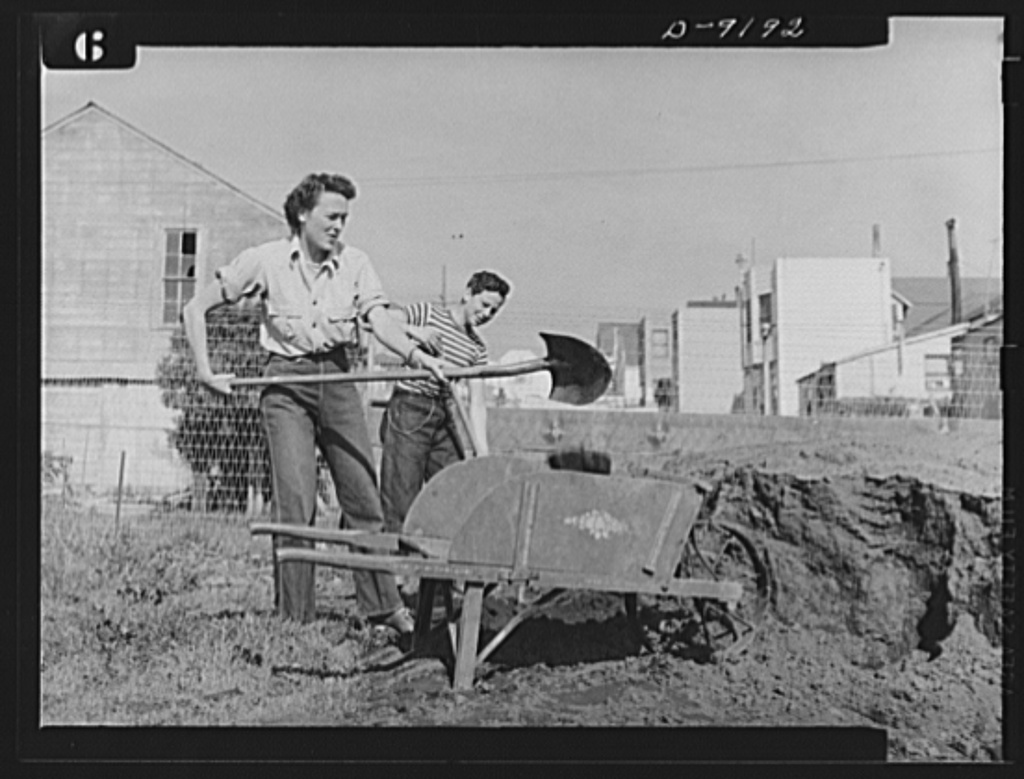
Whatever the case, the Cantonment needs to have some kind of land on it, even a measly quarter-acre. This is because, when things go ‘BLOOEY!’, you will need to get a ‘Victory Garden‘ going, and fast…
Victory Garden, 1943. Library of Congress.
Note that I said ‘Victory GARDEN‘. Singular. You might be able to plant two or three plots, maximum, but unless you already know what it’s like…don’t plan on being a “farmer”. If you haven’t worked the job, you have absolutely NO idea how back-breaking of a job it truly is. You need to get on the gardening bandwagon now, if you haven’t, already.
One thing most people thinking about a Cantonment do not think of is ‘community’. Believe me – ‘No Man Is An Island’ is the name of the game, here. You, the ‘significant other’, two kids and the dog do not an effective defense force make. Get to know your neighbors – NOW – and try to get a good idea of where they stand and what they plan to do. If they plan on sticking around, bring them in gently, and ply them with their favorite “tasty beverage”. If things are going to hell, friendly neighbors with a joint plan beat the heck out of the alternative.
This brings us, at long last, to the fourth point: the Panoply.
The US Army Soldier Protection System, 2019. US Army photo.
The word ‘panoply’ comes from the Greek word ‘panopilia‘ (πανοπλία), meaning literally, “all arms“. The Panoply was the complete ‘fighting kit’ of the ancient Greek fighting man, the Hoplite. It included his weapons (spear, sword and dagger), his armor (shield, cuirass, and greaves), his sandals if he wore any, and all the rest of the gear he wore on the march.
…”Oh, no! Here we go, with the “militia” rant! I KNEW it was coming!”
Yes. And?
Look — I appreciate the idea that people generally do not wish to do violence to their fellow human beings. I get that. Really. However, I hate to be the bearer of bad tidings, but a whole lot of your fellow humans to not feel the same way — make them hungry, tired and scared, and it will be infinitely worse.
We haven’t even started discussing already-organized gangs.
One of the basic principle of Western culture is the concept that a free person should “armed, and trained to arms“. That idea has been much-criticized recently, mostly by a certain sector that enjoys the freedom to criticize such “outmoded notions” while hiding behind the guns of those who do not subscribe to the idea of “situational ethics“.
Okay so, politics aside, what is in the modern Panoply? Well, at first glance, it will look a lot like the EEK, but there are important differences, differences that are based on psychology.
The panoply is about one thing, and one thing, only: fighting. While the EEK is designed to help you flee, the panoply is intended to make you orders of magnitude more effective at defense than simply standing in your doorway with a double-barreled 12gauge.
I’m not overly worried about the anti-gunners who read this, who are already frothing at the mouth — one of two things applies to these folks: a) you’re kidding yourselves, and you are just going to learn the hard way, or b) if the ‘BLOOEY!’ happens, you won’t last long enough to have to worry about it.
There’s no point in couching that with an apologia, either — it is what it is. You will either make the (very minimal) effort to save your own life, or you won’t. I have no input on that, whatsoever. That’s all on you.
I sincerely hope that no one else’s life is dependent upon your choice.
If you’re reading this, and you live in the US or Canada, you have a very limited time (especially if you live in Canada) to get the ‘big-ticket’ items that you require, because there are a LOT of people out there in positions of authority who want to remove your ability to obtain these things. That’s not politics — that’s on the news, if you care to watch it at all.
So, let’s get the ‘big tickets’ out of the way, first. What do you need: a rifle, a pistol, or a shotgun?
I’m going to take this from the premise that the reader has little-to-no experience with firearms as they read this — so all of the “gun guru’s” out there, yes, I appreciate that you have an opinion, but this is MY article…write your own.
If you have only limited experience with firearms, stay away from handguns of any type, at least at first — pistols take a great deal of training and practice to use effectively, and even after shooting from the age of 5, I do not consider myself to be any kind of expert.
“Long guns” – rifles and shotguns – are MUCH easier to learn, and arguably more effective at what you are trying to use them for: pistols are ultra-short range weapons, and are suitable only for last-ditch self defense. Yes, I know a lot of people carry concealed handguns legally — I don’t carry at all, as a matter of personal choice — and that police and some Special Forces units carry them as a primary “offensive” armament…But take a good, long look at where those folk’s targets are: within 50 feet, and usually a LOT closer.
This is something you REALLY want to avoid. Trust me, here.
Small Arms, Panama, 1989. USMC photo.
A shotgun would be a good place to start, but there are some disadvantages: while it does use a variety of ammunition types, its range is usually limited to about 100 yards, maximum (and usually under 40 yards with any accuracy, for most people), and shooting accurately requires a lot of practice to master.
Rifles, on the other hand, require comparatively less time to become proficient with. Also, they are accurate all the way out to 300-1,000 or more yards, depending on exactly what you are carrying…And no, you’re probably not going to need anything that shoots more than 300-500 yards — unless you get good enough to make the long ranges work.
The answer is — something simple. Something that is fun to shoot, is reliable, reasonably accurate ‘as is’, with no mechanical modifications, that uses a commonly available caliber.
The later-production AR-15’s (the ones with the 20-inch barrels…just trust me, here – copious amounts of “adult beverages” are needed for that technical of a discussion) are perfectly fine — as are the AK-47’s…but don’t limit your options. There are plenty of fine weapons out there that are not AR’s or AK’s, that will more than fill your needs. Don’t turn your nose up at a bolt-action rifle, or an SKS carbine because some pundit called them “outdated antiques”.
Once you have a firearm, you need to practicewith it. That may seem obvious, but people raised on a steady diet of “first-person” shooting games seem to think that firearms are like USB connections – pick it up, and just “become accurate”. No…Just…No — Remember: The “…train to arms” part means that you need to TRAINwith whatever weapon you obtain.
After you decide on a rifle, you need ammunition, and not just ammunition to train with.
Ammunition comes in boxes or cases — rifle ammo comes in 20-round boxes, pistol ammo in 50-round boxes; cases generally run from 500 rounds (for shotguns) to one or two thousand rounds for rifles, depending on caliber and manufacturer.
I won’t get into reloading, here, although the economics of reloading your own ammunition will quickly become apparent to the new shooter, especially if your weapons are in heavy or odd calibers.
Loaded M-16 magazines, 2017. US Army photo.
In general, for a rifle, you’re going to need about 600 rounds “ready” — about 200 rounds to carry with the rifle, plus two more reloads; this also includes magazines sufficient to carry those 600 rounds…Think about that, the next time someone wants to restrict magazine sizes, Stephen King notwithstanding [https://www.youtube.com/watch?v=MCSySuemiHU]. This is the bare minimum, but if you started off by buying a 1000-round case, that leaves you c.400 rounds to start practicing with.
After that? It depends on your wallet, how much you intend to practice, and exactly what you’re preparing for.
After that comes “gear”. A lot of this looks remarkably like the EEK, and there is, in fact, a great deal of overlap between the two.
The BASIC kit for the Panoply looks something like this…
A rifle
200 ‘ready’ rounds for the above rifle, with another 400 as a ‘ready reserve’
Some type of “load bearing equipment” to distribute the ammunition and magazines (if your rifles uses magazines – see “bolt action rifles“, the “SKS” or the “M1 Garand“) more evenly across your body.
Should you buy camouflage uniforms? If you intend to operate with a unit of some type, it’s a good idea, because it makes it that much easier to identify your friends. Uniforms are not about some arcane, male power fantasy — like a shovel, they are a practical tool, nothing more.
What camo is ‘best’? Whatever works for your environment — ex-US “Woodland BDU” is excellent, if a little on the common side, although Vietnam-era Tigerstripe is usually better. The current rage is for digital pattern camo or the newer Multicam pattern. Really, it depends on your environment, and common sense: don’t wear a desert pattern in the Tennessee forest, and don’t wear Woodland BDU in the desert.
Do you need a gas mask? If you live within 5 miles of an operating railroad line, you do — those tanker cars aren’t carrying milk, and when a train derails and they start evacuating, they’re doing it for a reason.
If you can afford body armor — BUY some. If not — you’re going to have to take your chances without it. Practical, affordable body armor in the firearm era didn’t exist before the early 70’s, so you’ll be in good company.
And BOOTS — Ye GAWDS, but don’t forget GOOD boots! If you have to spend $200 on a pair of boots, but they are the best thing out there…DO IT! You feet will thank you later.
…Despite what some people will try to tell you, there is no hard and fast rule about gear and equipment — the regular military makes it easy: you wear/carry what you are issued. When you’re not in the regular military, you have to customize as a matter of course — find what works for you, by going to an Army-Navy surplus store (or even the local ‘Chinese Consulate‘…a.k.a., “Walmart“) and trying things on before you plonk down the hard cash for this stuff.
“Unconventional thinking” is one People are fond of creating pithy shortcuts and analogies. When it comes to “Things Military,” here is one of mine:
Military forces are like a conventional automobile – they need four tires, sitting on the ground in unison, or the car doesn’t go very far. Think of it as a Venn diagram, if the car analogy doesn’t work. Moving on…The four “tires” of the military are:
Catania, Sicily (Jan 15, 2003) – U.S. Marines stand prepare Meal’s Ready to Eat (MRE) for shipment. U.S. Navy photo.
1. Food– No matter how well-equipped or trained your troops may be, if they have no food, they will be unable to fight within seven days. Period. Troops need an absolute minimum of 2,800 calories (and preferably 3,500-3,600) – weighted towards carbohydrates – per day, in order to function effectively in combat. Without food, troops can function for three to five days, maximum. After that, their effectiveness rapidly falls off, until they will not be able to walk; that phase takes between eight and eleven days, and they will be dizzy and on the verge of incoherent after about six or seven days. There are examples of people “surviving” or “lasting” for two or more weeks without food — but those people were confined to bed, minimizing all physical exertion, and required constant care. In the case of hunger-strikers, after two weeks, they will be too weak to lift a glass of water to their lips. In situations where this has happened in the past, the medical remediation starts with small amounts of rice milk, with recovering taking weeks, at the very least.
Food. Because it is existential, few people give it any thought. You, on the other hand, can never let food drift too far from a military unit’s calculations.
Oil Field, Saratoga, Texas, 1908.
2. POL/Fodder (POL/F) – Modern armed forces, be they military, paramilitary or police, rely on powered systems at some level. Whether for vehicles, generators, stoves or fodder for animals (mules, yaks and camels are still used for military pack transport around the world), POL/F supplies are absolutely critical to operations. Neglect your POL/F, and your troops will be reduced to marching, carrying only what extra supplies they can carry on pack frames, or that they can drag behind them on hand carts…and then, their food requirements will skyrocket (see #1, above), requiring them to carry less operational weapons and supplies (i.e., mortars, mortar bombs, rockets and their launchers, artillery munitions, etc) in favor of the extra food needed – assuming, of course, that the operational weapons can even be carried or dragged by the troops.
Whether you intend – or are forced – to use bicycles, POL/F is a factor that you can never neglect, if you expect to function effectively in an operational environment.
Rows and rows of shells are stored upright in a New Zealand ammunition dump during World War I near Acheux, France.
3. Munitions– Another existential within the modern military sphere – and thus, frequently ignored – “munitions” are everything that physically strikes the enemy: ammunition of all kinds, knives, grenades, etc. If you are not careful in planning or accounting for the amount of ammunition you both have and need, your troops will very quickly burn through everything they have, leaving them – quite literally – with nothing but knives, sharp sticks, rocks and harsh language…that quip is only funny when no one is shooting at you.
Bridge radios of Irish offshore patrol ship LÉ Róisín (P51) photographed in Helsinki.
4. Communications– Without a radio communications system, you are limited to runners, bugles and whistles (all of which are still in use, in places) and the limit of the range of your voice. That is fine, at the lowest tactical levels, but those have long been rendered impractical for anything above platoon level, as the speed and scope of military operations has increased. There is also the issue of communications security, including codes and ciphers. It is an in-depth issue, far too complex to fully address here, but it is nonetheless something the prospective user needs to get a handle on early.
The Pennsylvania National Guard’s First Troop Philadelphia City Cavalry during a parade to mark the U.S. Army’s 237th anniversary in 2012. US Army photo.
5. Motivation– Finally, Motivation is the engine of the “military automobile.” Nothing outlined above, nothing in this document, and nothing in any conventional manual you will ever find, means anything if your troops are not motivated to strive, struggle and sacrifice for the Cause, whatever that cause might be. None of it matters, if your troops are not willing to use the tools at hand effectively, if at all. They will sit down when they think you can’t see them; they will desert if they think that they can get away with it; and they will run the first time someone shoots at them in earnest.
These are the five things you can never shortcut. The minute you think you can get away with short-sheeting these points, you’re losing.
We all hear about them on the news: Those places where Soldiers, Sailors, Airmen and Marines are housed and trained; where they form up to deploy to some remote space on a map that most of us had never heard of a week ago…
But — what is a ‘base’, exactly?
Here at The Freedomist, we covered one aspect of this question some time ago, but this article will take a broad overview of the question at large.
Aside from castles or fortresses, “bases” come in a vast array of forms. Certain histrionics aside, a “military base” can come in almost literally any form. There are massive bases, such as Fort Bliss, in Texas or the Naval Air Weapons Station, China Lake, which are larger than some states, but there are also tiny installations that are also bases, such as Marine Barracks, Washington D.C., which is a mere 6 acres (2.4 ha) in size, and has been in continuous use since 1801. As a result, a base can take almost any shape.
At the same time, size comparisons obscure the question. A different way to think about a “generic” base, however, would be to consider it as a collection of components. Generally speaking, a “base” – while it may have a specific purpose – is where troops can be housed and trained for combat; where they can do at least basic levels of maintenance on weapons and equipment; and where supplies sufficient for a unit to deploy (in theory) can be safely and securely stored.
The training component is the hard part here, because even with the many advances in “virtual” training that have taken place in the last thirty-odd years, troops still need to actually fire live ammunition thought their weapons; short of actual nuclear, biological and chemical weapons, nothing focuses training like the dangers of live-fire. When we are dealing with classes of personal weapons, firing ranges of fifty to five hundred yards or meters in length may well be sufficient. Once we move into longer-ranged weapons – heavy machine guns, mortars, rockets, tank cannons and actual artillery – the ranges quickly become very long range.
But…short of that? Let’s do a thought experiment.
We will start with a large open field. A road, perhaps a highway or freeway, runs along one side of the field. Imagine one to four multi-story motels, clustered together; nearby, is a small, two-story office building. To one side, there is a gas/convenience station, and a large chain-style restaurant. There are one or two warehouses, a full-service garage, a few large parking lots filled (hopefully) with large and heavy vehicles. There are a scattering of other buildings, including one that is very “blockish”-looking building surrounded with barbed wire; there might even be a fire station. There is likely a shooting range, one hundred to five hundred yards/meters in length. If the unit’s home nation is relatively wealthy – and wise – there may be a small housing development across the road from the actual base, with family homes for married troop’s whose families live with them. None of the buildings are very “upscale”; most would be described with uncharitable snobbery as “drab” or even “ramshackle” or “brutalist” if someone wanted to be nasty. That would be the effect of government contracting restrictions.
What was just described above are the very basic facilities for an infantry battalion of 700-1,000 troops. There would be a few more buildings if the unit is more specialized, but the above description represents a generic enough core. Drop, say, another dozen or so of these areas close together, add an actual hospital, a large supermarket nestled next to a department store (if they’re not combined), a branch bank, a few more gas stations and regional-scale airport that can handle C-130-type aircraft, a few very long-distance (say, two to five miles in range) and you have a base suitable for a brigade-to-division scale unit – anything from eight to sixteen thousand troops.
Reserve or militia units can get away with one or two buildings, with a large and fenced-off parking lot, as long as they keep personal weapons and a basic load or two of ammunition at home…However, these units are going to be extremely limited in what operations they can carry out.
In sum, most military bases are not too dissimilar from a small town – except, of course, for the weapons, uniforms and intent. Aside from the occasional museum, most military installations /are/ drab, dreary and uninviting, and not places most people would want to live in for very long. But that dividing line, that willingness to tolerate minimalist living environments because their belief in the greater good, is best described in a paraphrase of the words of neoconservative essayist and film critic Richard Grenier —
Back FREEDOM for only $4.95/month and help the Freedomist to fight the ongoing war on liberty and defeat the establishment's SHILL press!!
Are you enjoying our content? Help support our mission to reach every American with a message of freedom through virtue, liberty, and independence! Support our team of dedicated freedom builders for as little as $4.95/month! Back the Freedomist now! Click here