
In a previous piece in this series, we examined the D-30 — the Soviet 122mm howitzer that entered service in 1960, whose three-legged carriage gave it full 360-degree traverse and whose rugged simplicity has kept it relevant across six decades of continuous combat. The D-30 was designed to solve a specific problem: how do you give a divisional artillery piece the ability to defend itself against armor coming from any direction, while keeping it light enough to move with a mechanized force? The answer Petrov’s bureau reached in Sverdlovsk was the tripod carriage.
In the same years that Soviet engineers were developing that solution, American engineers at Rock Island Arsenal in Illinois were wrestling with a version of the same problem — and arriving at a remarkably similar answer, albeit by a different route. The result was the M102, a lightweight 105mm howitzer that also achieved full 360-degree traverse, also prioritized air mobility over raw firepower, and also remained in service decades beyond its expected replacement date. The parallel is instructive, and the differences are at least as revealing as the similarities.
The M101: The Gun That Wouldn’t Retire
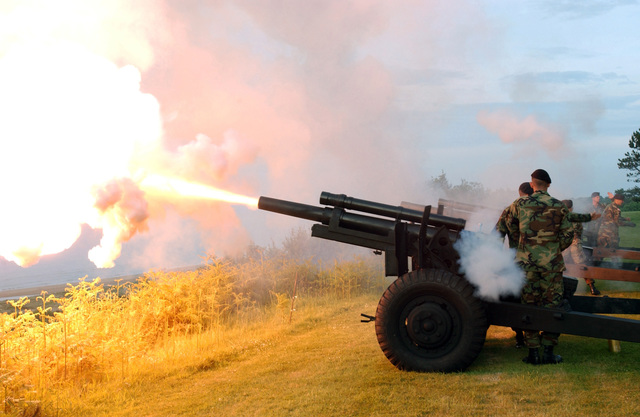
To understand the M102, you have to start with what it replaced. The M101 — originally designated the M2A1, redesignated in 1962 — was itself a development of a 1920s design, standardized as the M1 howitzer in December 1927 after the US Army Ordnance Department spent the immediate post-World War One years studying captured German 105mm artillery pieces. Entering full production in 1941, it became the standard American light field howitzer of the Second World War, serving in both the European and Pacific theaters in quantities that dwarfed any comparable weapon: a typical US infantry division’s artillery complement included three battalions of twelve M101s each, alongside a single 155mm battalion, giving each division thirty-six 105mm “tubes”. The gun fired its HE round to approximately 11,270 meters — about seven miles — with a probable range error of 41 meters at 9,000 meters, a figure that reflected genuine accuracy for a mass-produced field piece of that era.
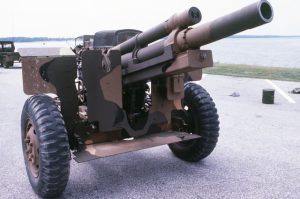
The M101 was accurate, reliable, and thoroughly understood by the armies that operated it. It was also, by the mid-1950s, showing its age. Its split-trail carriage limited traverse to 46 degrees — adequate for a fixed defensive position, problematic for a fast-moving mechanized advance where the threat direction could change without warning. At 2,260 kilograms (4,980 pounds), it was heavier than the Army wanted for the airmobile doctrine that was beginning to take shape around the capabilities of rotary-wing aircraft. And its 22 caliber barrel — stubby by contemporary standards — capped its range at figures the evolving battlefield was beginning to render inadequate. The US Army issued a requirement for a replacement in 1955. Work began in earnest in 1962.
The M101 nevertheless outlasted its intended replacement in front-line service, remaining alongside the M102 throughout Vietnam and retiring from US Army active use only when the M119 — a licensed American version of the British L118 Light Gun — entered service in 1989. By that point, the M101 had accumulated a combat record spanning World War Two, Korea, Vietnam, the Lebanese Civil War, the Iran-Iraq War, and multiple smaller conflicts across four continents.
Approximately 10,200 were built. They remain in service today with the Philippines, several Latin American armies, and various other operators — appearing as recently as the 2022-present Russo-Ukrainian War in Ukrainian hands…and the United State Marine Corps, which still operates over three hundren guns in 2026.
The M102: Lighter, Lower, and Capable of Looking in Any Direction
The prototype “XM102”, completed at Rock Island Arsenal in 1962 and type-classified as Standard A in December 1963, addressed the M101’s limitations through a fundamentally different carriage architecture. Where the M101 used a conventional split-trail design that anchored the gun to a fixed arc, the M102’s single-leg box trail ended in a roller assembly that allowed the entire weapon to pivot around a central firing platform — achieving the same 360-degree traverse the D-30’s tripod provided, by a different mechanical path. The parallel with the Soviet gun is not coincidental: both design teams were solving the same doctrinal problem in the same decade, and both reached the full-traverse solution as the correct answer.
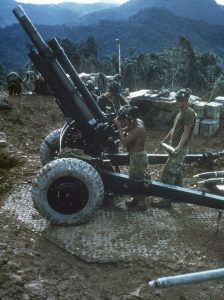
The M102’s aluminum alloy carriage reduced its weight to approximately 1,496 kilograms (3,298 pounds) — nearly 800 kilograms lighter than the M101 it replaced — making it slingable under the UH-1 Huey and later the CH-47 Chinook, and parachute-droppable with airborne units. Its barrel ran to 32 calibers in length, rather than the M101’s 22, extending effective range to 11.5 kilometers (7.1 miles) with standard ammunition and 15.1 kilometers (9.4 miles) with rocket-assisted projectiles — broadly comparable to the D-30’s figures. Maximum rate of fire reached ten rounds per minute for the first three minutes, sustained at three rounds per minute — again, a figure that tracks almost precisely against the Soviet gun’s quoted performance.
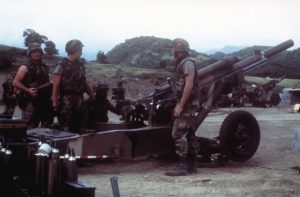
The M102 reached South Vietnam in June 1964, equipping the airmobile formations then being developed around the 1st Cavalry Division. Fire bases across the country were built around it, and its combination of light weight, high rate of fire, and full traverse made it the defining artillery piece of that war’s particular tactical geometry — a geometry built around helicopter mobility, rapidly shifting threat axes, and positions that needed to cover 360 degrees by necessity rather than by design choice. The gun’s low silhouette when firing — a deliberate design feature — reduced its vulnerability to counter-battery fire in a way that its taller predecessor could not match.
From Grenada to Iraq and the AC-130
After Vietnam, the M102 accompanied American forces through Operation Urgent Fury in Grenada in 1983, Operation Just Cause in Panama in 1989, and the Persian Gulf War in 1991, consistently in the hands of airborne and air assault units for whom its slingload capability remained the critical attribute. Its last confirmed combat deployment came in 2004 in Iraq, when the 1st Battalion, 206th Field Artillery of the Arkansas Army National Guard deployed seventeen M102s to Camp Taji — and, in a detail worth filing, scavenged spare parts from M102s in the Camp Taji boneyard that had been captured from Iran by the Iraqi Army during the Iran-Iraq War and left behind. The gun’s global proliferation had created its own improvised logistics chain.
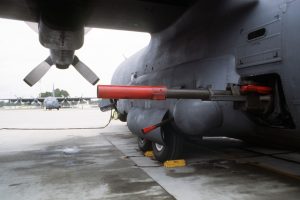
The M102 also found an afterlife that its designers could not have anticipated. The gun’s cannon assembly — the M137 barrel and M37 recoil mechanism — was adapted for use in the AC-130 [https://en.wikipedia.org/wiki/Lockheed_AC-130] gunship, firing from the aircraft’s left-rear side door in the ground attack [https://en.wikipedia.org/wiki/Close_air_support] role. That application remains in service today, making the M102’s mechanism one of the longest-lived in the American arsenal in any form.

The US Army began replacing the M102 with the M119 in Regular Army units from 1989 onward, while National Guard battalions retained their M102s through the 2004 Iraq deployment. The M119 itself is now being supplemented in some roles by the M777 155mm lightweight howitzer, which Ukraine has operated to good effect — and which has absorbed the same drone-vulnerability lessons that have reshaped every other artillery platform on that battlfield.
Two Guns, One Problem, Different Philosophies
Set the M102 against the D-30 and the comparison rewards attention. Both entered service in 1960-64. Both achieved 360-degree traverse as a deliberate design priority. Both weighed approximately 1,500 kilograms (3300 pounds) in firing configuration. Both fired to comparable ranges with comparable rates of fire. Both were designed for fast-moving combined-arms warfare in which the threat direction could not be guaranteed. Both outlasted their planned service lives by decades.
The differences are equally instructive. The D-30 was designed to be cheap, simple, and producible in the tens of thousands — a gun for a mass army expecting to absorb enormous losses and keep fighting. The M102 was designed to be light enough for helicopter sling loads, reflecting an American doctrine that substituted mobility and firepower concentration for mass. The D-30 used steel construction throughout; the M102’s aluminum carriage saved weight at the cost of field repairability in austere conditions. The D-30 has been exported to over sixty nations and manufactured on multiple continents; the M102 saw limited export, reflecting American caution about transferring military technology to all but close allies.
What both guns share, beyond their technical specifications, is the quality that defines every piece in this series: they outlasted the strategic assumptions that produced them, adapted to conflicts their designers never anticipated, and remained useful long after theoretically superior replacements had arrived. The M102’s cannon still fires from AC-130 gunships. The M101 still fires in Ukraine. Petrov’s three-legged gun still fires in more conflict zones than this column has space to cataloge.
There is a lesson in that persistence, and it is not primarily about the guns.