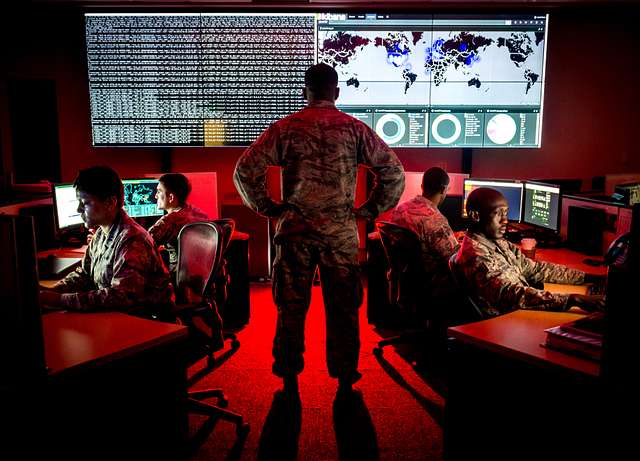
48 States led by both Democrat and Republican Governors have sent a warning flag to the Pentagon that its plans to empower the Secretary of the Air Force to override Governors’ determinations of the use of their own Air National Guards would destroy America’s National Guard altogether and make it a D.C.-controlled institution unable to flexibly meet the needs of the state they serve.
Ret. Maj. Gen. Francis M. McGinn, head of the U.S. National Guard Association said the new rule “This move represents a significant federal overreach that should concern governors and federal lawmakers alike. This is an attempt to bypass the longstanding authority Congress gave to governors requiring their consent before any National Guard units can be removed from their states.”
Republican Govs. Greg Abbott of Texas and Ron DeSantis of Florida penned letters Friday condemning a proposal that would effectively allow the Democratic administration to wrest control over National Guard units away from governors across the country.
The Republican duo was late to the party when signaling opposition to U.S. Air Force’s Legislative Proposal 480. The governors of 48 states and the leaders of five American territories voiced their opposition to LP480 last month in a letter to the Pentagon.
Air Force Secretary Frank Kendall approved the draft legislation on March 15. The Pentagon subsequently delivered LP480 to the Senate Armed Services Committee on March 29.
LP480 would enable the Secretary of the Air Force to transfer the covered space functions currently performed by the Air National Guard to the U.S. Space Force. The secretary would be enabled to change the status of an ANG unit to a unit of the USSF, to deactivate the unit, or to assign the unit to “a new Federal mission.”
To say that Douglas MacArthur was a controversial general officer would be making a massive understatement. While still lauded by many, and despite being awarded the United States Medal of Honor – the highest medal for valor in combat that can be awarded in the United States – there remains a large (and increasing) number of people who are not simply uncertain of MacArthur’s ultimate competence, but who actively reject it.
While this might appear to be a simple debate that is best restricted to staid academics in dusty rooms, it most certainly is not…because, like it or not, Douglas MacArthur is the prototype for the modern general officer. Let me explain.
Before MacArthur, there were basically four kinds of officers. According to German GeneralKurt von Hammerstein-Equord, the first type were the dashing, energetic and brilliant commander, the sort you could easily see leading a valiant charge across Pelennor Fields…or at least to relieve Vienna. The second type was the lazy, but brilliant officer, who could out-think and out-plan virtually anyone they were likely to face in battle. Then, there was the stupid and lazy officer; you couldn’t give them any job requiring dynamic and energetic thought, but they were useful in positions that weren’t critical, but that required an officer to be in command. But then…there was the fourth type: the officer who was stupid, but energetic.
That would be where Douglas MacArthur enters the picture.
An “Army Brat” (MacArthur’s father, Arthur MacArthur, Jr. had been a hero of the American Civil War, on the Union side, and had been the Military Governor of the Philippines from 1900-1901), had carefully stage-managed his career in the Army (stage managed by the ‘helicopter parenting’ of his mother). While performing decently as a battalion commander in the First World War, MacArthur spent the remainder of the “interwar period” alternating between acting as the Army’s spokesman, learning how the (comparatively) new technologies of radio and film could present the Army in a positive light (as well as burnishing his own personal image) to a public that had been exhausted by the “War To End All Wars”.
At the end of 1937, MacArthur “technically” retired from the United States Army, having already been named as Field Marshal of the Philippine Army. Although the Philippines was still technically a colonial territory of the United States, it had been decided to begin creating a Filipino armed forces establishment as a result of the 1934 Tydings-McDuffie Act, declaring that the Philippines would become fully independent on July 4, 1946. Also factoring into MacArthur’s appointment, were the rising tensions with Japan in the Pacific as the Interwar Period progressed.
MacArthur was recalled to active duty by the US Army on 26 July 1941, as a major general (and was promoted to lieutenant general the next day) and appointed as commanding general of United States Army Forces in the Far East (USAFFE). The results were…“not optimal” is probably the most polite term that can be used.
MacArthur was awarded the Medal of Honor in the aftermath of the disaster in the Philippines not because of his performance, but in spite of it: by early 1942, the United States was, to put it bluntly, getting its ass handed to it by a nation that US leaders and media organs frequently dismissed as “little yellow monkeys”. In that environment, the United States needed as many heroes as it could scrape together. Admiral Kimmel and General Short – the Navy and Army commanders, respectively during the Pearl Harbor attack – were already under investigation by their armed services, as well as by Congress, and the military did not need to disgrace someone who had been the face of the Army barely ten years before. Thus, MacArthur remained in charge.
Aided by the virtually bipolar staff he had assembled, one that vacillated between simpering toadying and rock-solid (if rather uninspired) brilliance, MacArthur was able to conduct a reasonably competent, if very uninspiring, campaign to march across the Pacific to liberate the Philippines from the stunning savagery of the Japanese occupation of the archipelago. Further feeding his narcissistic tendencies, after the surrender of Japan, MacArthur was appointed Supreme Commander for the Allied Powers (SCAP) and given command of all Allied Forces in Japan…In effect, he was made an Imperial Viceroy in all but name. More than that, Japan – previously a major world state – was essentially reduced to the status of being his personal plaything, to do with as he willed.
As part of his role as SCAP, one of MacArthur’s major functions was to be placed in charge of overseeing the defense of the newly liberated South Korean republic. Of course, the forces of Kim Il Sung’s North Korea – armed, equipped and trained by the Soviet Union – stormed across the border defined by the 38th Parallel on 25 June 1950. In a disturbingly similar repeat to what had happened in the Philippines some nine years before, South Korean forces – badly equipped and laughably under-trained – were swiftly overrun and destroyed, and the survivors – along with the equally poorly trained and equipped US advisors and troops sent to their immediate aid – rapidly pushed back into a tiny, Dunkirk-like perimeter centered on the port city of Pusan.
Then, with reinforcements beginning to arrive from the United States, as well as many member-states of the United Nations, MacArthur made the single gutsiest move of his entire career, by launching a breakout from the Pusan Perimeter, in direct concert with an amphibious assault at the port of Inchon, near the South Korean capital of Seoul well to the north, near the 38th Parallel. This caused the near-immediate collapse of the North Korean army, sending Kim’s forces into headlong retreat, all the way to the Yalu River.
Newly-Communist China (the Chinese Civil War had ended decisively in 1949) – not a combatant at this point – pointedly warned the US and UN leaders in early October of 1950 not to advance to the Yalu, as it would not tolerate such a massive armed force on its border. Advised (incompetently) by MacArthur, President Harry S. Truman decided that the Chinese were bluffing, and ordered his general’s offensive to continue.
The US-led UN forces were shattered and driven back below the 38th Parallel line. Entire regiments, brigades and divisions were shattered, if not completely annihilated; the 1st Marine Division (USMC) was specifically targeted for destruction (a decision that went rather badly…for the Chinese), but was able to successfully escape by sea evacuation. United Nations – and United States – forces were so badly beaten in this offensive, no serious attempt was ever made to recross the 38th Parallel in strength for the remainder of the war’s active phase. In fact, the Korean War has never ended; a ceasefire agreement was reached in 1953, and the conflict has been frozen in place ever since.
MacArthur’s response to the Chinese counter-attack was, to be frank, psychotically hysterical: MacArthur demanded an immediate wave of attacks using atomic bombs against targets throughout China…At this point, Truman had had enough, and recalled MacArthur to the United States, and into forcible retirement.
So – What was the point of the foregoing narrative?
The attitudes both of MacArthur, but also of the establishment that allowed him nearly free rein for almost five decades, despite extremely, if not catastrophically, substandard performance are still alive and well within the United States Armed Forces. As pointed out by authors Thomas Ricks in his book “The Generals”, and James Dunnigan and Albert Nofi in their book “Shooting Blanks: War Making that Doesn’t Work”, military leaders – particularly in the United States – are no longer “leaders”, as such, but more “managers”.
While this is certainly not a criticism in the world of civilian business, it is catastrophic in the military world. MacArthur was a reasonably good manager; however, his deep-seated narcissism made him an absolute disaster as a military leader.
There are very few – if any – currently serving general (or, “flag”) officers in the United States Armed Forces who can be confidently identified as “leaders”, much less “combat leaders”. With the world in the state that it is in, and the threats the United States is facing – both internally and externally – the time for “military managers” is long past. But, there is essentially no way, short of some miracle, for this problem to be fixed, short of all-out war.
And we’ve been down the “sudden, all-out war” path before – one would think that we would have learned our lesson, after the last “on the job training” exercise that we call “World War 2”, a war that cost the United States over a million casualties.
But, apparently not.
“Thank You For Your Service” is a nice sentiment, but it is a poor substitute for endemically poor military leadership, in a country that supposedly prides itself in its civilian control over the military…especially when the children of the Reader are the first ones lined up to pay the price.
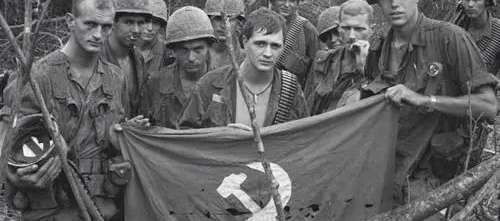
Since the dawn of warfare, the most prized battlefield trophy that soldiers present to their commander is the enemy’s battle flag.
In the early Sixties, the objective of the Vietnam conflict, as established by Eisenhower and Kennedy, was to contain China’s Communist expansion in South East Asia. At the outset, our American leaders assessed the campaign with auspicious optimism. The Americans had the North Vietnamese out-gunned, and we enjoyed unassailed air superiority. How could we lose?
Indeed, up until 1975, when the South Vietnamese government lost in the Fall of Saigon, the American forces had decisively won every major kinetic battle in the war. Those victories would eventually grow hollow. Ho Chi Minh plotted to drag the American Forces into an endless hornets nest of guerrilla warfare.
A journalist once asked General Vo Nguyen Giap, Commander of the North Vietnamese Army, how long he would have continued to fight against the American forces had they not withdrawn in 1975. “Twenty years,” he replied. “One hundred years. Even more, if necessary. We would have fought indefinitely until we prevailed.”
In the Spring of 1968 the North Vietnamese Army suffered a bitter loss in their attempt to seize the Marine airfield at Khe Sanh. With B-52 bombers and F-4 fighter-bombers, the Americans dropped more bombs on the North Vietnamese defending that siege than all the bombs the US forces dropped in World War II. American commanders estimated that the NVA suffered as many as 15,000 KIAs at Khe Sanh.
Despite the horrific losses heaped on Giap’s army, Khe Sanh became a turning in the Vietnam War. The nightly news bombarded the American people with horrific images of the Tet Offensive and the siege of Khe Sanh. After the siege, Walter Cronkite broke his career-long tradition never to divulge his personal viewpoints on a news story. Cronkite declared on his nightly broadcast that the Vietnam War was a lost cause. President Johnson’s favorability rating plummeted so low that he closed his reelection campaign. Fed up, the American people were ready to bring the troops home.
And from the ashes of Khe Sanh, the North Vietnamese had discovered a surprising windfall – a political victory won on the American home front.
Finally, on April 30, 1975, at the Fall of Saigon, the North Vietnamese handed the mighty United States a humiliating defeat on the world stage.
Today Vietnam enjoys a thriving economy and a growing middle class. They have western shopping malls that sell the bourgeois brand names of Gucci, Louis Vuitton, Lacoste, and Rolex. As of this writing, each year the country hosts 12 – 15 million tourists adding $27 billion to their annual GDP. Their thriving aviation industry has a superb safety record. Vietnam is on pace to be the world’s 10th largest economy by 2050.
Their economy can be labeled as anything but “Communist.” A more accurate description would be “Free Market Authoritarianism.” But wasn’t the defeat of Communism America’s prime war objective in 1965? Of course. And so in 1986, the Vietnamese politburo passed economic reforms that have led to the prosperity they enjoy today.
To this end, the United States actually won the Vietnam War against the Communists.
We should never have fired a single bullet. The 57,939 service members need not have given their lives. Nor did the countless service members need to have sacrificed the healthy bodies of their youth, nor the soundness of their souls. The cauldron of death we waged upon our own boys and against the Vietnamese people lay in abject waste.
Without firing a shot, we ultimately defeated the Vietnamese Communists. And we did so by General Giap’s own measure: not over a matter of years, but over the course of decades; over generations.
And who were the grand prizewinners of the war? The Vietnamese people. The war reunited the North and South Vietnamese people under a unified flag, and they now enjoy a cornucopia of wealth bestowed by the Free Market.
Today Vietnam is Communist in name only. The Vietnamese people offer the party only a grudging appearance of respect, hollow of any sense of personal loyalty or pride. They regarded me as a fool when I purchased these flags. “Party members are the only ones who buy those flags,” they snickered.
In the same way the North Vietnamese failed to recognize their political power on the American home front, so too did the American leaders, at the dawn of the Vietnam conflict, fail to recognize the might of the Free Market.
The last shot of the Vietnam War was fired on December 18, 1986, when the Vietnamese Communist Politburo surrendered to the Free Market.
This hammer and sickle flag is their tattered, defeated battle flag; our prized trophy of their surrender.
LET US NOT LEARN THE WAYS OF POLITICIANS BEING MOTIVATED BY GREED AND FEAR BUT RATHER LET US BE MOTIVATED BY LOVE
We can be motivated by love, truth, and a form of righteousness that isn’t all judgy and rude but humane and enlightened, warm and kind.
Some are motivated by greed, they want more than is their due and what they have earned, and they pay never a mind to who actually pays the bill. This can come both on the form of money as well as things like environmental impact and social impacts which won’t affect you but will affect others.
Some are driven along their decision-making path by hobgoblins and boogeyman, caricatures and stereotypes of anyone different from themselves, from whom they need protection, and which protection they are willing to pay for with the rights and wealth of others being laid upon the altar of their gods of fear and panic.
You can be sure that, regardless of their Party or staged ideology, almost every politician appeals to the latter two and almost none would appeal to the first group and their motivations. We can, however, have eyes wide open and just assume whatever any politician says comes from greed or fear, and if we scratch a little beneath the surface we’ll see the true color very easily. So scratch below the surface and ask yourself how much the first group is appealed to, then you will learn to view most every politician, even the one you support, with suspicion and contempt, because most are not to be trusted.
Politicians are too easy to pick apart, however. Most of them got there by being cagey, self-absorbed twits who fool most of the voters, or who manage to get the most votes counted in their name (you be the judge), by fooling enough people to pass the post.
What about me. What about you.
I have ascertained, sadly, that TOO MUCH of what I say is motivated too much by the latter thing, fear and the anger that comes with it. I’m not above being greedy, it’s just that I am far more conscious of it, so it’s not really a pet vice of mine. That doesn’t make me better than you as fear is also, in my estimation, a vice when it’s not rational or justified, and most of the time is isn’t.
I think both the greed and fear motivators are down to a heightened self-importance and conceit about what one deserves and is entitled to. As to fear, I’m no entitled to feeling safe from things and people I ought not fear, especially as a Christian who should rest in the Lord, come what may!
I am broken and I think maybe we all are. Ironically, I think, the more you engage in politics, and I literally make a living from politics (well, around 70% of what I do), the more you get the infection.
The thing about greed, and I remind you I’m specifically talking about wanting something you didn’t earn, aren’t owed, and should not expect at other people’s expense, is that those who promise to slake your thirst are always lying. No sane person believes that taking that which others are rightly due and giving it to others whose do not deserve it is sustainable. It doesn’t matter if it’s business owners being told they will get what their workers are due or non-working people will get it from business owners (and therefore also workers), it’s always a lie and never sustainable.
As for fear, it is so easy to become afraid of the other side, of people who are different, of things that you don’t like or that you think are wrong, go against being on the right side of history, or are a sin. When someone promises to cure the fear by clamping down on what you fear, they always demand you surrender all or part of your own agency so they can save you from the things they probably taught you to fear in the first place!
Greed and fear are terrible motivators but ask yourself if you’ve ever been motivated to vote based on love? Imagine a politician saying their agenda is to pave the way through good public policies that benefit all of society and not just a preferred demographic or other special interest so that people can feel and walk freely in love, to be loved and to love others, without greed or fear stalking their conscience and unsettling their heart. It’s not gonna happen.
In the US it’s Biden or Trump. Do they motivate people by love for their fellow man and by being loved and being free to love and pursue their life in peace, or do they use appeals to greed and fear mostly to exclusively? In my opinion, they both use greed and fear, in spades, in extremes that are not common even in US politics. Indeed, we have to go back to the 1850’s and right before the Civil War to match the tone we have seen set today.
I followed the Nigerian elections closely and the side I thought would be best for the country lost to a genius vote counter who plied the people with an appeal to greed and made promises the federal government could never keep without bankrupting the part of the constituency they do not cater to for votes, especially the Igbo and Christians! But what politician appealed to love for Nigeria, to each other, and for yourself to be able to experience love through a life of freedom and abundance? Not one, in my opinion!
In Germany not one Party appeals to love and as the AFD grows so grows the call to censure them and invalidate them through boogeyman fears about “Mustache Man 2.0”, because the lame establishment UNIPARTY of corpostate shills has only ever played the people based on different measures of greed and fear, depending on if it’s the SD or CD, Greens, of FDP. As an aside, the FDP is to me the most purposeless party in human history and is hardly anything to get rowdy about. The AFP is more about fear and their dalliance with Russia is alarming, albeit not because their alternative views on German foreign policy should be labeled treasonous as they have. None appeal to love.
Even India’s Mohdi, who maintains a solid lock on Indian politics, is most certainly not driven by love, despite his religious posturing as if he is himself a Hindu Monk (if their is such a thing)! His policies are greed and fear like all the rest and his opponents, who keep losing to him over and over again, offer nothing different in substance but only in form.
Wherever you are in this world the politicians are an extreme caricature themselves of the most negative currents in society and they become part of a self-feeding loop that perpetuates more and more extremes until finally it eats itself and society collapses. See Haiti of recent history and the French Third Republic of the 1930s which lost to the Germans despite having better and more of the right equipment to fight a war!
As I recall no examples of a political movement or leaders who appeal almost exclusively to love, slightly to legitimate fear, and not at all to greed, I am not certain politics will ever be more than slowing the speed of collapse so private people can prepare and get themselves hidden from the deluge to come. If anyone knows of an example where this isn’t true, enlighten me, but if you are an American and say Trump or Biden, let me stop you right now and just say, “no!”
Going back to where I speak of appealing slightly to legitimate fear, the Bible itself in Proverbs 22 explains how when the wise see danger coming they hide themselves and when the foolish see danger coming they keep on moving along until eventually they get wacked, or punished. Of course if China is building out a strong offensive military force we would be idiots to ignore that and let our own military decline to the point we can’t beat the CCP, as an example.
Neither fear nor greed, understanding that wanting what you deserve, are owed, and have earned and having your own self-interest are not greed but wanting what isn’t by right yours to demand IS greed, are terrible motivators for life. We should start to eschew the ways of our politicians and both become sensitive to their true nature and to our own propensity to be infected by their rhetoric to become like them.
Pictured here is my mom to the left and Dora to the right to illustrate love, they loved each other and had a blast, no greed or fear between them.
Obviously, anyone reading this is aware – or should be – that Israel and Iran are now trading missile volleys. This is a situation that rightfully scares anyone with the capacity to think, as it widens the scope of Israel’s response to the war that Hamas started with their massacre of October 7, 2023.
Beginning on April 1, 2024, Israel launched an airstrike on the Iranian embassy in Damascus, Syria. This attack demolished an annex (a stand-alone building within the embassy compound), wherein a major meeting was taking place. This meeting included at least eight high-rank officers of the Iranian Revolutionary Guard Corps (IRGC) (including two general officers), members of Lebanese Hezbollah, and the Front for the Liberation of the Golan (FLG) (a puppet force organized and trained by Hezbollah in 2017), although further casualties have not been identified as of April 19. While the “usual suspects” instantly made hysterical condemnations against Israel over this attack (as well as Iran’s repost on the 13th), it should be pointed out that officers of Hezbollah – a group openly acknowledged as being under the control of the Iranian state – was assembled inside the Iranian embassy, and were clearly a primary target of the Israeli raid.
Iranian missiles passing over w:Al-Aqsa after IRGC hit Israel with multiple airstrikes. Mehr News photo. CCA/4.0
The legal issue with this first exchange is a complete non-starter. While embassies are considered to be inviolate to military action, there is a significant caveat: when those embassies are used as military planning and coordinating locations, they are no longer “civilian structures” under the Laws of War, but become legitimate military targets, in exactly the same manner that religious churches and temples are considered inviolate – until they are deliberately used by one combatant for military purposes. The inviolability of an embassy remains intact, technically, if that nation’s intelligence agencies run spying operations out of it, but not if the embassy is aiding in the planning and conduct of military operations against another power.
Both Hezbollah and the FLG have been engaging in active terror attacks on Israeli citizens and in military strikes against Israeli troops for years. Their personnel and commanders meeting with Iranian military officers, on Iranian soil (all national embassies are considered to be the sovereign territory of the nation they represent), means that Iran has openly admitted that its military forces are coordinating with force actively engaging in combat against Israel. This made the Iranian embassy to Syria a legitimate military target, whether Israel chooses to explain its actions or not. The public record speaks for itself.
Following the Israeli raid, Iran vowed to retaliate. It did so some twelve days later, firing a hail of drones and ballistic missiles into Israeli airspace, in coordination with the Houthi terror group in Yemen, and an Iraqi state-sponsored group, the Popular Mobilization Forces – both groups being sponsored by Iran, as well as the Shiite government of Iraq.
Then, in the early morning hours of April 19 (local time), Israel responded, attacking targets near the Iranian cities of Isfahan and Natanz – both cities being noted for their association to Iran’s nuclear weapons program – as well as SEAD strikes against Syrian and reportedly Iraqi bases, to knock out early warning radar sites.
An F-4G Phantom II wild weasel 1991. These aicraft conducted SEAD missions during the conflict. USAF photo. Public Domain.
The Israeli attacks were very limited and restrictive in nature. The speculation, as of April 19, is that Israel was sending a clear message to Iran, that they (Israel) were clearly capable of striking targets deep inside Iran at will. Much more interesting, however, is the current Iranian response.
Despite the posturing of Hossein Amirabdollahian, the Iranian Foreign Minister, in vowing an “immediate and severe” response to any Israeli attack on Iran, Iran seems to be backing down. Unless Iran attempts to launch another raid in the near future, this may represent a de-escalation on their part.
If true, this raises a very disturbing question:
Is the Iranian government losing control of its IRGC “Praetorian Guard”?
At this stage, de-escalation by Iran is a tacit admission of defeat, as it demonstrates that the Iranian chest beating over their military prowess does not intimidate Israel. This is certainly not something the religious leadership of Iran can afford, as the appearance of weakness places their regime – highly unpopular at home – on even shakier ground than it already is.
Iranian military losses over the last decade have been limited to the IRGC. It was IRCG troops from the Quds Force who entered Iraq to shore up the beleaguered Iraqi government and military in the early days of the Sunni Islamic State forces’ drive on Baghdad in 2014. Its senior commander, Qasem Soleimani, was targeted by the United States government in a drone strike in 2020, while he was inside Iraq, coordinating the organization of Shiite militias. Additionally, the force has been described as “an industrial empire with political clout”, in addition to the command casualties it suffered in the Israeli attack on the Damascus embassy…In many ways, it very much resembles the Waffen SS of Nazi Germany.
In a very real way, a perceived defeat against Israel will seriously undermine the IRCG, far more than the Iranian government and its regular armed forces. The problem, here, is that dismantling a Praetorian Guard is never easy, and is always violent. If this stewing situation turns out to be real, versus speculation, there is a very serious chance that it could result in a catastrophic collapse within Iran, one mimicking the swift collapse of the Shah’s regime in 1978. If either side continues shooting at the other, the regional expansion of the conflict will be guaranteed.
And this is something to be feared.
The Freedomist — Keeping Watch, So You Don’t Have To
Spying is as old as human civilization. One of the foundational duties of any government, as we understand the term, is to obtain information on potential threats to the community…because there are always threats. That’s just the way of the Universe.
Over time, of course, simple scouting evolved into what we think of as “espionage”. People volunteer to be spies for many reasons. They may be passionate patriots to their nation; they may be base and mercenary in nature, selling information to the highest bidder. Conversely, they could be traitors, operating against their own nation on behalf of a foreign power, for any of a number of personal reasons. The saddest figures are those entrapped into spying on their homeland, and not having the moral strength to go to their own government, turning in the enemy spies, and taking their licks for getting themselves into trouble.
Dedicated and loyal intelligence operatives – such as the fiction James Bond – whatever the nation or era, are recruited at relatively young ages, usually in their early-to-mid 20’s; frequently, they are military officers bored with their lives in the military. These recruits are almost always enticed by the ideas of excitement and adventure, but certainly not money – government spies are always just ‘government civil servants’, and are paid accordingly.
The reality that these officers face is that actually going “into the field”, or worse, “undercover” is invariably not only extraordinarily dangerous, but frequently unrewarding, as the dangers they put themselves (and sometimes, their families) into often result in no results, or even highly negative results…And that is before they have to face betraying local contacts to their fate, as happened in locating Osama bin Laden.
Traitors who spy against their own nations of their own accord (as opposed to those entrapped into espionage against their will) do so for many reasons, as well.
Sometimes, the willing traitor is outraged by their government’s actions of varying kinds. This was the case of Christopher John Boyce, who was outraged to discover – as an accident of his Top Secret clearance working with spy satellites for TRW – that the CIA was directly involved in undermining an Australian government that they did not like.
Seal of the C.I.A. – Central Intelligence Agency of the United States Government. Public Domain.
Likewise, Polish intelligence officer Michael Goleniewski – who also spied for the Soviet KGB on Polish intelligence – began spying for the West in 1959 after having, as he put it, a “Damascus-like” conversion event, where he realized how fundamentally wrong and evil the Communist system. Goleniewski revealed copious amounts of intelligence to the West on spies within the United States and British intelligence agencies. He was one of the most valuable spies for the West during one of the tensest periods of the Cold War. Unfortunately, claims persist that the CIA – for its own reasons – played enough “mind games” with Goleniewski that it drove him into mental instability, to the point where he is now primarily known for claiming to be the deceased Tsarevich Alexei, resulting in him being relegated to history as a crank.
Emblem of the KGB. Image credit: jgaray. Public Domain.
However a spy is recruited, if that officer is not a “field agent”, they are usually relegated to the ranks of “analyst”, or a specialist researcher, focusing on a particular nation, region, group, or even a particular individual. Frequently, this involves using OSINT tools (some of which can be quite advanced) to glean information. The work is usually interesting for a certain type of personality, but is not what most people would regard as “spying”…even though it most certainly is espionage.
Those personality types who enjoy that kind of activity generally stay with an agency for decades. The levels of knowledge and information that they can accumulate during their years of service make them very “high value targets” (HVT) for hostile agencies to recruit. “Turning” a long-time analyst – whether for purely mercenary reasons, for political ideology, or just the raw excitement of stepping outside their boring “bullpen” world – is frequently the crowning achievement of a field agent’s career…If the traitor is eventually caught, that may be unfortunate for the traitor, but that will not usually weight too heavily on the conscious of the case officer.
The “case officer” is the closest thing in an intelligence agency to a movie spy. They are skilled at illegally entering a foreign country and conducting all manner of intelligence activities, including “running” a local asset who has volunteered to spy against their home nation. Sometimes, the will operate as “paramilitary officers”, conducting high-risk protection and/or extraction (such as evacuating an embassy when military special operations units are too far away to assist), training foreign armed groups (whether for a foreign government, or a group trying overthrow a foreign government), and possibly rescuing an HVT who has been captured.
An Operational Detachment Alpha being lifted off the ground by a CH-47 Chinook helicopter during a training event Eglin Base Air Force Base, Fl., Feb. 05, 2013. U.S. Army photo by Spc. Steven Young. Public Domain.
There are also “legal spies”, who are placed within their nation’s embassy in a foreign nation, usually with an innocuous-sounding title, such as the “Second Assistant for Agricultural Relations”, or some such. These officers are usually the ones to receive communications from “walk-ins”, or locals wanting to offer to spy against their governments. They rarely, if ever, actually try to “run” a walk-in as an “asset”, merely evaluating whether the walk-in is worth the risk of assigning them to a case officer.
And, although no one wants to talk about it openly, allies frequently spy on each other, as happened with Israeli intelligence “running” CIA and US Navy intelligence analyst Jonathan Pollard in 1984-1985. The revelation of the Israeli operation caused an immediate frost in relations between the US and Israel, something that happens frequently when intelligence operations are exposed, or “blown”.
Spying is far from a “glamorous” life. It is, unequivocally, a dirty, nasty proposition at any level outside that of the analyst’s cubbyhole in an office bullpen…and many times, even that it is not a “sterile environment”, because an analyst’s work can set in motion operations that are very “down and dirty”.
Watch the path in front of you carefully.
The Freedomist — Keeping Watch, So You Don’t Have To
The judgment against Donald Trump for the crime of allegedly overclaiming property value to secure loans might not be appealable because Donald Trump cannot afford to pay the required bond. The bond is to secure the $464 million judgment made against him by NY Judge Arthur Engoron.
Trump’s lawyers claimed in the filing, “Defendants’ ongoing diligent efforts have proven that a bond in the judgment’s full amount is ‘a practical impossibility. These diligent efforts have included approaching about 30 surety companies through 4 separate brokers.” They are appealing to the courts for relief.
After President Donald Trump commented at a rally that if he didn’t get elected there would be a “bloodbath,” the media shared a narrative that Trump was calling for violence if he didn’t get elected. Upon reviewing the clip, the listener can hear Trump is referring to the economic cost of another four years of Biden and not calling for violence should he not get elected.
The media stories have been community-noted on X, showing the context of the Trump quote and the long history of the media’s use of the term bloodbath in exactly the same way Trump used it. Among those who only filter their news through DNC-serving outlets, however, they will be led to believe that half the country wants a violent civil war if their side doesn’t win, which is sure to produce more left on right violence, an effect this writer theorizes is JUST what the media is hoping to create.
Sarah had the story today: the liberal media went apoplectic over Trump’s warning of a “bloodbath” this year. At a rally in Ohio over the weekend, the former president expounded on how China’s trade policy is primed to hurt American families. Here’s how the media framed these remarks juxtaposed with what was actually said:
We are witnessing the invention of the “bloodbath” hoax in real-time
The media is lying about Donald Trump with this narrative about a “bloodbath” if he loses the election. He was very clearly talking about the car manufacturing industry—before and after he used the word.
If you’re listening, President Xi — and you and I are friends — but he understands the way I deal. Those big monster car manufacturing plants that you’re building in Mexico right now … you’re going to not hire Americans and you’re going to sell the cars to us, no. We’re going to put a 100% tariff on every single car that comes across the line, and you’re not going to be able to sell those cars if I get elected.
Now if I don’t get elected, it’s going to be a bloodbath for the whole — that’s gonna be the least of it […] It’s going to be a bloodbath for the country. That will be the least of it. But they’re not going to sell those cars. They’re building massive factories.
Yes, this is one of the reasons why the media isn’t trusted. It’s also peculiar since five days ago, the same clowns used the word “bloodbath” to describe Trump’s indirect overhaul of the Republican National Committee.
The controversy over the militarization of law enforcement has been a continuing question in the United States since the inception of the SWAT (Special Weapons And Tactics) concept of the late-1960’s. While some parties cover their own political biases on the subject by ranting about the US Federal Government providing “military equipment” to local law enforcement departments, primarily through Washington’s “LESO” program, such pandering to “fear-porn” is simply the willful refusal to acknowledge the reality that any “militaristic” expression of law enforcement is precisely what those hysterical parties demanded for years…and then were faced with results that they refused to believe were possible.
While rather clichéd, the popular idea of the “good police” was formed in the 1950’s by television shows such as Dragnet and the later Adam-12. As the years rolled by, however, it became increasingly apparent that the “good cop” – even if a real thing – was not capable of dealing with the new realities of criminal violence at the end of the 1960’s.
Increasingly, local police and county-level sheriff’s departments were faced with criminal gangs operating drug labs in remote rural areas, that offered criminals the ability to utilize military-style tactics to defeat police efforts at arrest. Similarly, worsening political violence in urban areas displayed a significantly different character than the violence of previous decades. In this context, armed groups – primarily Communist groups inspired by the likes of Vladimir Lenin, Mao Tse Deng, and Ernesto “Che” Guevara – attempted to initiate urban revolutionary warfare against the United States establishment and its citizens.
The passage of time, as well as the shifting motivations of the popular media, has downplayed the levels violence involved, to the point where the resurfacing of old training videos sponsored by state-level police departments are seen as almost fiction, when in fact, the reality was that violent attacks and kidnappings were frequent occurrences. What would now be openly called organized terrorist campaigns were waged by groups as diverse as the Weathermen, the Black Liberation Army, the Ku Klux Klan (KKK), and the Symbionese Liberation Army.
For these reasons, long-time observers were in no way surprised at the recent uptick in “ambush attacks” against police officers around the nation; indeed, the wonder was that the surge in such attacks had not happened earlier.
In response to the increasingly complex violence of the 1960’s, first the Philadelphia Police Department – quickly followed by the Los Angeles Police Department (LAPD) – established large teams of officer designated and trained to respond to various situation that were outside the realm of normal police duties. To a great degree, the SWAT concept was limited to dealing with bank robberies and hostage situations. This situation changed decisively after LAPD SWAT fought its landmark gun battle with the Symbionese Liberation Army on May 17, 1974. Police departments around the nation took note of a law enforcement unit being suddenly thrust into an openly military type of operation, and began to act accordingly.
LAPD SWAT officers, 2015. Photo Credit: Marc Cooper. Public Domain.
Beginning with larger departments, SWAT-type units were formed within departments, and began training and equipping those teams accordingly, frequently seeking training advice from prior-military service veterans of the recently concluded Vietnam War, as those soldiers usually possessed skills not previously taught to police officers. The Federal Government took notice, with the FBI laying out the basis for its Hostage Rescue Team (HRT) in the late-1970’s, leading to its actual founding in 1983.
Civil police departments, however, quickly realized that they needed more extensive assistance to maximize a unit like a SWAT team. With the US military establishment being both legally restricted from directly aiding civilian law enforcement by the Posse Comitatus Act, and not wanting bad press in the aftermath of Vietnam, police departments struggled to properly equip their teams. However, as there was a concurrent decrease in strictly political violence as the 1970’s drew to a close, local departments used their SWAT units for both “high-risk warrant service” and hostage rescue situations. Both type of operations, of course, straddle the line between strictly police enforcement and military operations.
FBI HRT during the 2011 the Aztec Fury exercise. USMC Photo. Public Domain.
Beginning in 1990, with the National Defense Authorization Act for Fiscal Years 1990-1991, the Federal Government opened up the direct sale of military surplus equipment – including weapons and certain armored vehicles – to civilian law enforcement agencies, under what was then called the “1208 Program”, after where is appears in the enabling legislation. In 1996, various wording was changed and the law was expanded, going into effect in 1997, becoming the current “1033 Program”.
The vast bulk of the weapons and equipment available to civilian law enforcement agencies is gear that is either excess to the military’s needs, or is older equipment that the military has completely replaced in its Active, Reserve and National Guard units. Because of the heavily discounted amounts (down to “free for the taking”) offered to civilian law enforcement, this has been a great boon to expanding the capabilities of local police departments and their various special teams. Since 1997, though, while high-risk warrants and hostage rescues by police have certainly happened, but SWAT units in most departments are usually used to raid drug labs and dealers, which actions are specifically encouraged in the 1997 legislation.
Tactically speaking, these operations are far from military-level actions. The reasons are simple: such raids will have, at most, one to four hostiles that the police are planning on arresting, and even if the police teams meet resistance, it is certain to be short, disorganized and ineffectual. Most importantly, the criminals the SWAT teams are trying to arrest rarely have any desire to “fight it out to the bitter end”; actions like that certainly happen, but it is very rare. Criminals, by and large, are more likely to surrender than to fight to the death.
Two incidents, however, revealed the weakness of the widespread reliance on SWAT teams.
On February 28, 1997, serial bank robbers Larry Phillips Jr. and Emil Mătăsăreanu attempted to rob a Bank of America branch in the Los Angeles suburb of North Hollywood, sparking one of the largest gun battles in US police history. While the details – and video footage – of the shootout are widely available, the takeaway is that responding police officers were categorically incapable of dealing with a single pair of largely untrained criminals, operating under significant amounts of illegals drugs, who had no intention of surrendering. The pair of gunmen were finally taken down because their own incompetence, Phillips dying by his own hand, and an already-wounded Mătăsăreanu being mortally wounded by a hail of point-blank fire from three SWAT officers after a bungled attempt to flee.
Worse, however, were “after-action” interviews with the SWAT officers. While all of the responding police officers – and certainly the SWAT officers – displayed outstanding levels of bravery that should be justifiably recognized and hailed, their attempts at conveying accurate technical information was terrifyingly abysmal.
This is not a case of pedantic criticism. One of the chief tenants of military ability is being both “technically and tactically proficient”, in this case, being able to correctly identify both the types and capabilities of equipment, but also in making realistic assessments of hostile force’s capabilities. This was very definitely not in evidence in the aftermath of the shootout, even years later.
The other case was exposed serious issues in police response to determined, non-criminal violence was the 2008 terrorist attacks on the city of Mumbai, India. A 10-man team of terrorists from the Pakistan-based Lakshar-e-Taiba conducted a highly complex infiltration and attack operation against the city – a metropolis of over 12 million – lasting four days, with a frightening level of competence.
Local police were essentially helpless, as the attackers were not there to commit simple crimes like robbery or kidnapping. The terrorists were there to kill as many Indian civilians as they could; only one terrorist would ultimately survive to lay out the details of the operation for Indian police and military operators.
A 2013 Naval Postgraduate Study examined the question of potential United States civilian police response to a hypothetical Mumbai-style attack. The results are far from encouraging, especially given the events of the subsequent decade.
While very large police departments – such as the LAPD, among others – have written detailed plans for dealing with multiple “active shooter” incidents, and while acknowledging that improvised bombing attacks can generate larger number of casualties than infantry/commando style shooting attacks, both the study and those department’s own manuals also acknowledge that such dedicated types of attacks would generate widespread fear and terror (hence, the designation of “terrorist attack”) throughout not simply the urban area affected, but also throughout the wider region, as well as the nation as a whole.
Lurking under these stolid studies is a fundamental issue: Police officers – hysterical screaming to the contrary – are not mentally or psychologically prepared for a confrontation with a group such as Lakshar-e-Taiba. Taking down drug dealers, child traffickers and the occasional unstable individual are one thing; dueling with an organized, focused and dedicated team of shooters who are not operating for any of the conventional criminal reasons is an animal of an entirely different stripe.
As incidents from the North Hollywood shootout, to the Columbine and Uvalde school shootings demonstrate, many police departments around the country – regardless of the level of material support they may have received from the 1033 Program – are not psychologically prepared to deal with a single shooter who is willing to fight to the end, much less a pair of shooters, even when the shooters are completely untrained; the response of Nashville, Tennessee police officer to the recent school shooting there is the exception that demonstrates the rule.
In light of the foregoing, the continued hysterical demonization of American citizens to not simply defend themselves firearms in the absence of police, and equally strident calls to limit not only the ability of American citizens to own firearms, but to restrict their ability to obtain competent and useful training with weapons they already own, is highly worrying, given the demonstrated willingness of left-leaning city administrations to not only actively restrict their police departments from dealing with organized, large-scale violence, but also giving criminals literal “get out of jail free cards” for “petty crimes”.
This demonstrates, more than anything else, that the “average American citizen” is very much on their own when it comes to crime in their nearby areas.
If you are reading this inside the United States of 2024 – take note.
The Freedomist — Keeping Watch, So You Don’t Have To
We’ve previously discussed the “democratization of military training”, way back in 2022, looking at the idea of individuals, with no previous military training or experience, teaching at least one of those skills to themselves. Since that article, the ability to acquire those skills – what Great Britain used to call “small tactics” – has only expanded throughout the internet; indeed, all that is necessary is knowing what information to ask for.
Of course, certain things are required to teach oneself these kinds of skills, primarily access to at least basic small arms, such as rifles, handguns and/or shotguns. Of course, for the longest time, access to such weapons could be problematic; in many places in the world – and increasingly, within the United States, itself – that requirement can still present issues. Recently, however, that impediment has been reduced through the use of highly realistic “toys”, primarily “Airsoft” weapons, which mimic actual military-type weapons in current use. While Airsoft toys have significant issues in trying to impart realistic levels of firearms training, they can be effectively utilized to cover many of the basics, drastically reducing the need for “live fire” training and experience. Likewise, while keeping in mind that using Airsoft for military-like training has serious handicaps, it can help teach the basics of small-unit maneuver, at least up to the squad to platoon levels.
This ability to train realistically – even if not precisely up to the level of “actual” military levels – is already making its impacts felt in places such as Burma, where insurgents fighting a brutal military junta’s forces have been able to couple effective training with 3-D printed firearms to “bootstrap” themselves into effective guerilla infantry formations.
So terrified has the “power elite” within the United States Government become, they are resorting to desperate actions to ban even a hint of such training options for civilians – in effect, creating an underclass dividing civilians from prior-service military personnel…The fact that such actions are specifically counter to Congress’ own foundational requirements does not seem to even be a consideration to a group desperate to retain their own power and authority.
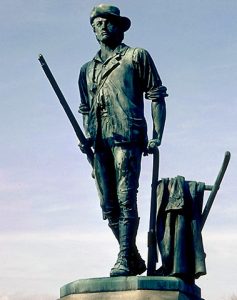
The Minute Man, sculpture by Artist Daniel Chester French (1850–1931), 1875, Concord, Massachusetts. National Park Service. Public Domain.
That said, there is another aspect to the training issue: that of “leadership”.
Military leadership – contrary to the views of many in the military, political and corporate sectors – is very different from “leadership” in either the corporate or political sectors. Leadership in a law enforcement agency does bear some resemblance to military leadership, but there are fundamental differences even there.
At its core, military leadership is much more difficult to define, let alone execute in the field. While there is a legal expectation of obedience inherent in military leadership, as there is in the political and law enforcement spheres, this almost never true in the corporate sector. Likewise, while law enforcement officers are expected to voluntarily face danger, there is seldom – if ever – a legal requirement to risk their own lives, as the verdict in the trial of the armed officer in the Parkland high school mass shooting demonstrated…This is very much not a verdict that would be laid in a military court martial for a similar offence.
In a very real sense, military leadership is centered on the fundamental principal that the commissioned or non-commissioned officer holds both the legal responsibility and moral authority to order their subordinates into situations that have a high chance – and potentially a guarantee – of resulting in said subordinates death or severe wounding. Such a responsibility is something that few politicians will ever face, in the course of their political careers; in the United States, the only political leaders who hold such authority are the President of the United States (in relation to the Federal Armed Forces), and the various governors of the Several States (in relation to their State National Guard commands).
The prescient question for this article, however, does not necessarily revolve around “legitimate authority”; in fact, the nature of his article more or less assumes that the notion of “legitimacy” does not come from a “vertical hierarchy”, but from a “lateral agreement”.
In the real “old days”, military leadership came from the strongest, meanest and most capable warrior, who used their fighting prowess to gain a band of followers who followed them because of their demonstrated skill and wisdom. In time, this evolved into various forms of social hierarchy, primarily in the form of “kingship” and an associated aristocracy, based on military ability and personal loyalty. Aside from the occasional aberration, such as the Roman Centurion system, this remained the case in Western Europe until the 17th Century.
The First Muster, 1637. Artist: Don Troiani. Public Domain.
Beginning around that time, the idea of the old “feudal levy” began to evolve into that of citizen militias. These types of formations were frequently self-organizing, in the literal sense of the term, where a group of local people – usually at the village or town level – would assemble on their own, pronounce the formation of some level of militia unit, the members of which would then volunteer to “place themselves under military discipline” (a very ‘loaded’ term, and one which the modern military struggles with to this day). And then, they would frequently do something so unheard of today, it is nearly impossible to find references to it: the self-mustered militia soldiers would elect officers from among their ranks as leaders.
In the British colonies of North America, the various colonial governors preferred to appoint officers to military ranks, such as George Washington’s direct appointment to the rank of Major by the Lieutenant Governor of Virginia, but the reality was that colonial governors could not afford to be too picky with a group of militia self-organized in time of need.
While the election of officers from within the ranks could certainly be problematic and prone to corruption, incompetence, and discipline problems, it actually tended to work out more often than not. George Washington’s frequent criticism of the various Colonial militias was aimed primarily at their officers being more concerned about keeping their positions by not enforcing too strict a regimen of discipline on their men, and likewise not training their men too strenuously, since those men could easily vote them out of their positions at any time. This was not true, however, in all of the hodge-podge of militia units Washington had to work with, but it did have a negative impact. While this negative impact led to the creation of a “regular” army, that army remained tiny for the entirety of the War of Independence, relying on local militias to fill its gaps for the entire course of the war.
As time went on, of course, the idea of local militias began to fade out of the public mind, especially as states struggled to retain sole control over their state military forces. Now, the same parties within the US government trying to outlaw military training for civilians outside of the armed forces, with the aid of their allies in the “popular press” have demonized the term “militia” to the point where most American equate the word to “terrorist”…
…But that is a whole other discussion.
To return to the point: Can a civilian – with no formal training or military experience – “self-teach” themselves to become an effective military leader? A leader capable of not simply leading a military formation, but of creating a basic training regimen for whatever troops they can “attract to their banner” (to borrow a phrase)?
The answer, as can be surmised, is…it’s complicated.
Reading various works on military leadership, both from the “old days” and newer works, is always a good start; a basic reading list will be presented at the end of this article. However, there is always a break point, where theory and reading must be put into practice.
And that’s the difficult part: a military officer – whether appointed from a higher authority or self-taught – is very much a chief in need of ‘spear carriers’: without troops to lead and teach, the self-taught “officer” will never know whether they have effectively learned the lessons their readings have taught them.
The majority of readers of this article will almost certainly never have to actually face this issue in “real life”…and you shouldn’t want to, by any means. But – the situations and threats of the world of the early-21st Century may require those skills.
It’s your decision whether or not to pursue the idea of teaching yourself how to lead troops. While I certainly cannot make that decision for you, you should be very concerned about government flunkies who don’t want you to do so.
Back FREEDOM for only $4.95/month and help the Freedomist to fight the ongoing war on liberty and defeat the establishment's SHILL press!!
Are you enjoying our content? Help support our mission to reach every American with a message of freedom through virtue, liberty, and independence! Support our team of dedicated freedom builders for as little as $4.95/month! Back the Freedomist now! Click here