The mass mailer President Joe Biden committee signed an order calling up 3,000 reserve troops to become part of an expanding “Operation Atlantic Resolve in Europe” mission. The mission began in 2014 after Russia annexed the Crimea from Ukraine. The move will be as an escalation of the Russians and critics say it risks further destabilizing the region rather than stabilizing it.
“The designation of OAR as a contingency operation is an important demonstration of the U.S. commitment to our NATO Allies and partners,” said U.S. European Command Spokesperson U.S. Navy Capt. Bill Speaks. “It further provides US EUCOM with greater flexibility to support continued U.S. and Allied commitments to the defense of the Euro-Atlantic and allows us to provide key entitlements to the forces who support those commitments.”
Senator Ted Cruz (R-TX) responded to the news in a tweet, “Biden’s weakness started this war, now he’s threatening to put our military in a shooting war with Russia.
Senator Mike Lee (R-UT) commented, “I’ve been trying to figure out what this means. Bottom line up front: President Biden is arguably walking the U.S. up to the line of war and daring Russia to shoot first.”
He also challenged the legality of this escalation, saying that he has no legal authority to increase the troops involved in Operation Atlantic Resolve as it was started in 2014 with the authority given for the President to increase troops up to one year after the mission began.
He also warned, “President Biden did the same thing at the beginning of the war in Ukraine in 2022, massively increasing our active-duty force presence when we knew hostilities were imminent. But now it’s even more risky because hostilities are active. Not only does this run the risk of further locking us into supporting Ukraine, now the military-industrial complex will say the US military presence is THE one thing preventing Russia from crossing NATO’s eastern border & that we have to maintain such presence indefinitely.”
CCP operatives have accessed sensitive U.S. email accounts, including U.S. State and Commerce Department emails linked to top officials, with the highest ranked official being Secretary of Commerce Gina Raimondo. Microsoft provided information on the hacking, claiming it came from a group called Storm-0058.
Apparently, the group forged digital authentication tokens which they used to enter the amil accounts. They said in their statement, “As with any observied nation-state actor activity, Microsoft has contacted all targeted or compromised organizations directly via their tenant admins and provided them with important information to help them investigate and respond.”
China, through its London embassy said the accusation was “disinformation.” They added this, the U.S. government is “the world’s biggest hacking empire and global cyber chief.”
It should be noted that American business lobbyists are currently pushing on the government to ease off its aggressive approach to the CCP, whom they seem to fear and value more than they do American citizens and true American interests.
An article in The Federalist asks the question, “Is America Losing the Battle for Naval Superiority to Red China?” The evidence that it shows is compelling. China’s Navy has only been expanding this past decade, now boasting over 340 ships compared to the U.S. at 300. While the U.S. faces more slowdowns at home, China is only surging forward in adding to the world’s largest Navy.
From The Federalist:
Among the more alarming trends in China’s military rise is the rapid pace at which it has expanded its maritime fleet. On Tuesday, The Warzone published data from the Office of U.S. Naval Intelligence documenting how the growing disparity between the U.S. and Chinese fleet sizes is “being helped by China’s shipbuilders being more than 200 times more capable of producing surface warships and submarines.”
According to a May Congressional Research Service (CRS) report, Chinese efforts to modernize its navy have been underway for the past 30 years. As a result of such investments, the PLAN has evolved into a “much more modern and capable force,” giving it the ability to regularly operate throughout regional waters and expand its operations in the “the Western Pacific, the Indian Ocean, and waters around Europe.”
To date, the PLAN is the largest navy in the world, boasting approximately 340 ships compared to the U.S.’ 300. This disparity is only expected to grow in the coming years.
Further on in The Federalist article is this most relevant finding:
A series of war games conducted by the Center for Strategic & International Studies earlier this year found in the event of a military engagement with China, the U.S. would “likely” run out of key weaponry such as “long-range, precision-guided munitions — in less than one week in a Taiwan Strait conflict.” The simulation further concluded the U.S. is “not adequately prepared” for the current, global “security environment.”
Under the current administration, efforts to demoralize American military personnel through the Woketiarain agenda that operates on the “theory” white people invented evil and heteronormativity and cis-genderism to oppress the better classes will mean that even the best technological advantage will fail when placed in the hands of emotionally damaged and immature adherents to the woketarian ideology.
Only if Americans can purge the Democratic Party from the public square can we hope to survive as a nation, a people. So long as Democrats control our institutions, we will continue to devolve towards third world status, leaving China to rise and become the new hegemon, one which will be far less benign than America ever was at the height of her power.
China has made a claim that it has build a signals intelligence facility at Bejucal, Cuba. The station, if it exists, is located only 90 miles from the U.S. At first, the U.S. denied the claim, with Pentagon spokesperson Brig. General Pat Ryder saying in May, “We are not aware of China and Cuba developing any type of station.” But now, NSA spokesperson John Kirby has tacitly admitted the base exists when he said in answer to a question on the station’s existence “We’re not going to be able to get into too much detail about own counterintelligence efforts.”
The spy base is rumored to be the beginnings of a full-scale military base just 90 miles from the coastland of Florida. A so-called expert at the U.S. Army War College Strategic Studies Institute said the base was so close to the U.S. it was not of great military value to the CCP. Dr. Evan Ellis, the expert cited, said “The closeness of Cuba to the United States means that its value for PLA navy forces is probably pretty low because, again, that would be very, very vulnerable being that close to the United States.”
This writer thinks that might be what the kids these days are calling a cope or an agit prop DNC-CCP party line aimed at assuaging our natural fears over such a possibility as well as our outrage that this administration allowed for this to occur.
Mercenaries have been around for a very long time; so long, in fact, that working as a “sell sword” is regarded as a prime candidate for the title, “The Second Oldest Profession”; the Freedomisteven covered this previously. During the Italian Renaissance, the sometimes substantial forces of various condottieri mercenary captains had a noted and significant impart on Western History. In the modern day, from 2003 onwards, this has been exemplified by the rise of the “Private Military Company” (PMC).
While some people may think that mercenaries are a relatively recent phenomena, having been largely eliminated after the Napoleonic Wars, the truth is that the profession has continued on up to the present day, albeit on a more individual level, more than massed units like the hired Hessian troops of the American War of Independence.
(An important note is that those to whom the 19th Century term “filibusters”, as related to military activity, applied were not ‘mercenaries’ in the traditional sense, as military filibustering was rarely done at the behest of any internal faction in a country. Military filibusters were essentially well-armed bandits with political aspirations.)
Many military figures of world history were mercenaries at one time or another, figures like the Athenian general and historian Xenophon, author of The Anabasis, which chronicles the withdrawal of some ten thousand mostly-Greek mercenaries from the Achemenid Empire, to Baron Friedrich Wilhelm von Steuben, the Prussian professional soldier who joined George Washington’s army, and had such an impact on it, that he is regarded as one of the ‘founding fathers’ of the United States Army.
Baron Frederick William von Steuben, c.1780. Painted by artist Charles Willson Peale (1741–1827). Public Domain.
In the aftermath of the overthrow and ultimate execution of French king Louis XVI, France instituted what we would now refer to as “national mobilization”, the vast size of the armies the revolutionary government was able to field proved so attractive to nations everywhere, notions of unique national character were deliberately reinforced. As a result, it came to be considered odd – if not more than a little dirty – to serve in the armed forces of another state.
And yet such service, primarily for money, continued. The French Foreign Legion, established in 1831, was created to place foreigners who had previously served as mercenaries in French royal service, into the French Army for service outside of France. Smaller such units appeared from time to time, but after about 1820 or so, the “Soldier of Fortune” phase began in earnest, first with the Filibusters, but soon incorporating many individuals, mostly former soldiers but also a few pure amateurs, who were what we would now call “adrenaline junkies”, following reports of wars breaking out in various places around the world, where formal military education and technical abilities were scarce. The advanced education and experience of many of these individuals often proved invaluable to their employers. As just one example, British Royal Navy Captain (later Rear-Admiral) Thomas Cochrane, 10th Earl of Dundonald, was instrumental in creating the revolutionary navies of Brazil, Chile and Peru, in the 1820’s and 30’s.
Admiral Lord Cochrane, portrait of James Ramsay, c.1830. Public Domain
By the 1890’s, “freebooters” and soldiers of fortune were seemingly everywhere, fighting for almost all sides in world conflict zones. With the advent of weapons such as practical machine guns and quick-firing artillery, coupled to a highly permissive “cash-n-carry” environment for buying weapons, meant that those individual’s technical skills were often absolutely decisive in conflicts in remote areas.
Following World War’s 1 & 2, however, the world saw the return of mass national mobilization, and a reinforcement of the perceived uniqueness of national character. As a result, aside from long-established units like the French Foreign Legion, “mercenary work” mostly vanished completely, for about fifteen years. As the tensions of the Cold War increased, however, the decolonization of Africa initiated a series of “proxy wars”, which would define much of the following thirty years. In 1961, mercenaries returned to the world’s consciousness in force – both literally and figuratively.
In 1961, Thomas Michael Hoare (who would come to be known as “Mad Mike”), a former officer in the British Army and veteran of the Burma Campaign in the Second World War, was hired by Moïse Tshombe, the leader of the nascent breakaway province of Katanga, to form the core of an army to secure the state’s independence.
Although that effort was ultimately unsuccessful, Tshombe – in the absolutely wild world of Congolese politics (YouTubelink; language warning) – was recalled to become the country’s fifth Prime Minister in mid-1964, to deal with the so-called “Simba Uprising”, a massive and extremely bloody rebellion in the vast state’s northeastern regions. Tshombe, in turn, recalled Hoare to recruit a force of mercenaries to act as a spearhead to the wavering Congolese Army. Hoare promptly recruited mercenaries through newspaper advertisements in South Africa and Rhodesia (now Zimbabwe), and formed his unit as “5 Commando, ANC”.
Troops of the mercenary-led 5 Commando, ANC, during Operation ‘Dragon Rouge’, 1964. US Army Photo. Public Domain.
Although the force got off to a rocky start, it was quickly whipped into shape (mostly by enforcing a regimen of discipline that western armies had long ago abandoned.) Hoare quickly began rolling up the Simba’s, in a series of operations that resulted in the liberation of Stanleyville (now Kisangani). In traditional mercenary fashion, Hoare’s c.300 mercenary troops and their Congolese allies happily sacked the city in the aftermath, blasting open bank vaults and looting anything not nailed down. Atrocities – although nowhere near the levels committed by the Simba’s – were rampant. Hoare’s unit would ultimately be disbanded in 1967, after some six years of mostly-successful operations. A few other pseudo-units of (mostly White) mercenaries came and went in the Congo during the 1960’s, contributing to actions that would leave the Congo devastated into the modern day.
Mercenary activity simmered for another twenty years, with Western mercenaries – usually, but not always, former soldiers – taking part in many, possibly a majority, of the conflicts of the 1970’s and 80’s. In the aftermath of the rise and fall of “Executive Outcomes” (defunct in 1998, but recently reestablished), the prototype for the modern PMC, the United Nations passed a frankly idiotic and laughably unenforceable prohibition against mercenaries, “formally” outlawing the practice and denying them status as prisoners of war under the increasingly irrelevant Geneva Conventions…which were rarely, if ever, extended to captured mercenaries, in any case.
The September 11th, 2001 attacks are what ultimately rode to the rescue of the mercenary profession. The reason was painfully simple: With the end of the Cold War in 1991, most of the nations of the world severely trimmed their massive military establishments, leaving their capability to deploy military force critically short. As there were no national mobilizations after the attacks, and the dawning of the “Global War on Terror” mostly took the form of actions by small units of superbly (and expensively) trained special forces units, backed up by comparatively small numbers of conventional troops, the military landscape seemed to have changed.
A Special Forces company commander meets with village elders and members of the 1st Kandak, 209th Afghan National Army Corps April 10, 2007. Photo Credit: Specialist Daniel Love, U.S. Army. Public Domain.
However, this change was actually a mirage, an image warped by a declining lack of military knowledge among the general population. In fact, the cuts in manpower during the 1990’s had been so deep, across the globe, that military forces – including those of the United States – were left completely incapable of operating for any length of time in a war zone. With the various wars and military actions abroad becoming increasingly unpopular “back home”, there was no interest in trying to expand the manpower numbers of western military forces (which is an entirely different story on its own), a solution had to be found, and quickly.
This is what led to the rise of the 21st Century PMC.
Private Military Companies are a polite legal fiction, designed to hide their status as mercenaries (thus avoiding legalistic maneuvers by nations of the UN) by usually referring to them as “security contractors”, who insist that they take no active role in military actions, merely defending themselves. It’s a paper-thin dodge, and one no one with any concept of self-decency ever really believed.
As of the beginning of 2022, however, the world’s military calculus has begun to shift once again. With military actions such as the Tigray War and the Russian invasion of Ukraine in early 2022, the return of mass warfare (long thought vanished as a realistic possibility) has returned, with a vengeance.
Massed wars – “main force conflicts”, if one prefers – like these in the modern era are inimical to most flavors of PMCs. Fighting insurgents armed with individual small arms and a few light weapons is one thing – contesting a battlefield against a first-tier military state is another matter, entirely. To borrow the words of author Thomas Ricks, few “contractors” within any PMC has a dog in any fight like that.
While PMC’s will continue to be employed in the short term, it is a virtual certainty that the non-state supported, independent PMC will vanish within ten years.
…Assuming, of course, that Western States can fix their broken military forces.
Let that sink in.
The Freedomist — Keeping Watch, So You Don’t Have To
A Highly Unofficial Military Assessment of the UAP Threat
We need to talk. It’s time for “that” discussion.
On April 27th of 2020, the Department of Defense officially released three videos of “anomalous objects” or “unidentified aerial phenomena” (along with some even more shocking revelations in 2022). These videos, recorded as “gun camera” footage by F/A-18 fighters of the US Navy in 2004 and 2015, were leaked in 2007 and 2017, respectively, sparking off furious speculation as to what the objects recorded actually were. For its part, the Navy and the DoD admitted publicly that they had no idea what the origin or nature of these objects actually were.
While that might true for the people issuing the public statements, it is yet another bald-faced lie by the government. If that sounds harsh, or even histrionic, it isn’t – it is an objective truth, as we will show below.
Let’s talk about the videos, first.
Exotic Craft
While the videos may seem pretty mundane at first glance, they are most certainly not…especially when one begins to read more deeply into the situations behind the videos in question. The short answer, based on the testimony of skilled, veteran pilots – people trained in air-to-air combat – is that these craft are performing maneuvers that are not possible within the currently accepted realm of physics.
For you, the Reader, your choice is simple: you can believe the testimony of professional officers and pilots, trained to engage with hostile aircraft, or you can believe the hysterical denials of wholly unqualified rando’s on the interwebz trying to sell you a website membership, a book or a magazine subscription.
Choose one.
The other issue at hand is the number of craft being sighted. In the now-famous “Tic-Tac” video, described in detail (Spotify link) by retired US Navy Commander David Fravor on the Joe Rogan Podcast in 2020, the additional details of the story – not discussed on Rogan’s show – were laid out (YouTube link) by whistleblower Luis Elizondo in 2019. In short, radar and air defense operators aboard the USS Princeton (CG-59) reported tracking up to one hundred objects at once, over the course of the week prior to the intercept by Commander Fravor. According to the operators from the Princeton, these craft dropped down from 80,000 feet, essentially out of nowhere.
Ok…So what?
Seeing a single object doing extraordinary things can be written off as either a mistake or a hoax. Seeing a hundred such objects is neither. The United States Navy – inter-service rivalry jabs aside – is not in the habit of re-tasking extremely-expensive-to-operate aircraft to investigate hoaxes and jokes. It is simply not done in the real world.
Given that reality, why is the number of targets spotted on radar important?
Right now, if the Reader has the money, you can order a “kit car” online. In a couple of weeks, a truck will arrive with several large boxes of components, and you can assemble a fully functional and road-legal automobile in your garage. Doing so, however, does not make one an “automobile manufacturer”. The same is true for aircraft.
According to Cmdr. Fravor’s description, the object he and his flight of F/A-18’s intercepted was about the size of his fighter. Presuming – a loaded term, to be sure – that the other radar tracks were similar in size to the intercepted unknown, a number of craft equivalent in number to the entire complement of a modern aircraft carrier, appeared to descend from orbit, within the engagement envelope of an aircraft carrier battle group, essentially with no warning.
F-18 Hornet of the US Marine Corps. Photo Credit: Pixabay.com Public Domain.
Clearly, if these claims are true – refer to the above comment – the US Navy (at the operational level, at least) has no idea what these craft are, nor who they belong to.
That’s a problem.
The other problem is: Like a kit car or plane, making a one-off craft with a breakthrough propulsion system in your barn is not “manufacturing” said craft. Making a hundred – is. In the “biz”, that is called “serial production”.
So…If the United States is not making these – as the government insists that they are not – then who is? It isn’t the Russians. Nor is it the Chinese. There is simply no nation or organization on Planet Earth that can do so, because (“conspiracy theorists” aside – who have had a pretty good track record over the last few years) no one has the technology displayed by the recorded craft.
The reason this can be stated so conclusively, is that any craft with this range of performance characteristics is a dominating advance – a leap in technology so decisive, any nation on Earth that can place such craft into serial production can and will dominate every other nation on Earth. Yet…no one has done so.
And recall: the first of these videos were recorded in 2004, some nineteen years ago, at this writing.
Prepping the Battlefield
So – if no one on Earth is producing these craft, who is? What are they doing here? Why aren’t they landing in Washington, New York, London, Moscow or Beijing, popping their hatches and say, “Take me to your leader”?
If these sightings are neither hoaxes, drug-addled ramblings, mistaken identities, “ball lightning”, “swamp gas”, “lenticular cloud formations”, “extremely slow-moving meteors that change direction” (my personal favorite) or craft from terrestrial nations…the only other alternative is that they are from “elsewhere”. That is the presumption we will work from in this article, going forward.
“Prepping the Battlefield” is military slang for a directed and wide-reaching survey of a potential battlefield. The purpose is to identify the terrain and nature of the potential opposition, in order to refine a potential battle plan.
US Marines on reconnaissance exercise, 2003. USMC Photo. Public Domain.
Now, there are a large number of people, with…unfortunate…critical thinking skills, who will insist that any species capable of crossing the vast gulfs of space at presumably faster-than-light speeds would have no trouble soundly defeating “puny humans” like us.
People with such tangled thought processes are why there are safety warnings on Pop-Tarts.
History is replete with examples of technologically advanced groups being soundly defeated by peoples well behind them in technology, but that is not the issue here. The issue is that technology is not linear in development. The ability to build a typewriter does not equate to the ability to build a computer. Industrial or mechanical abilities can only define possible technologies; they do not guarantee the existence of technologies.
So – presuming that “aliens” are coming here from outside the solar system, and are neither invading, nor formally contacting us as the “Galactic Brotherhood”…why are they here?
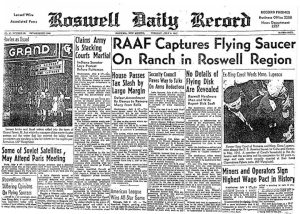
Aside from a few hazy reports from so long ago that most of the witnesses are now long dead, the modern “UFO” milieu began in 1947, with the Roswell Crash.
Roswell Daily Record from July 9, 1947 detailing the Roswell UFO incident. Public Domain.
What is not often discussed, however, is the fact that Roswell was not the only incident in 1947. In fact, there were multiple incidents that year, incidents that led to the United States Air Force to launch not one, but two formal investigations of what was going on in United States airspaces because, to paraphrase the words of former UK Ministry of Defense investigator Nick Pope, countries do not fail to pay attention to uncorrelated targets in their airspace.
Not surprisingly, this pair of investigations, spanning the period from 1948 to 1951, concluded that there was nothing to see, that virtually all of the reported sightings – including those from professional and military aviators – were uniformly either mistaken identity, outright hoaxes, or any number of unusual but natural phenomena, because clouds always look like aircraft, apparently.
So adamantly and rigidly did the US Air Force adhere to this stance that as late as the late-1990’s, that organization issued no less than two separate reports on the Roswell incident directly, both of which did not simply lie and demean the general public, as well as its own officers, but that openly claimed that its own records of major projects were completely mislabeled as happening at least a decade earlier than they did.
…But – why? Why all the secrecy and deception, especially after it became painfully clear to the public that the military and the government were proverbial lying through their teeth? There are two reasons. In reverse order: first, because once you defend a secret as vigorously and for as long as the government has regarding “UFO’s”, you are going to commit more than a few crimes along the way (YouTube link).
Second was the desperate attempt to avoid widespread public panic. One basic mistake made by most “UFOlogists” in the modern day is to equate the attitudes and perceptions of today, to the late-1940’s; this is comparing apples to hydraulic jacks.
In 1947, World War 2 had only been over, in an official sense, for barely a year. In many cases, the military and political leaders at the “sharp end” of this wave of sightings had seen friends, and sometimes family members, killed, seriously wounded or possibly even severely reprimanded and forcibly retired. Additionally, the panic caused by Orson Welles’ “War of the Worlds” broadcast was only nine years in the past. Going on-air, nationwide, and admitting that the government had no idea what or who were responsible for the extraordinary things in the sky would have caused an immediate, worldwide panic.
Given all of the above, we return to the core question: Assuming that these craft are a) real, b) are from and operated by entities that are not native to the Earth – What are “they” doing?
An Unofficial Military Assessment
UFO’s, UAP’s, “flying saucers”, etc., are here. They are not contacting us, at least publicly. Many people – in the tens of thousands – have reported seeing the craft. Some people have claimed various types of contact with the crews of the craft.
Beginning from at least 1947, there has been an intense series of what can only be described as “surveillance flights” began to be observed over the Earth, primarily in the United States, but quickly spreading outside the country. These flights were concentrated in regions near military bases, government centers, “high tech” laboratories, and production and refining facilities relating to the production of both missile systems and nuclear materials.
It is a fact that the first known atomic weapons were detonated in 1945, barely two years prior to the wave of sightings in 1947. (NB: There were scattered reports (YouTube link) of “Foo Fighters” among Allied pilots during World War 2, indicating a possible early phase of surveillance.)
With clear interest in terrestrial states’ development of atomic weaponry, it is equally clear from the pattern of observable surveillance that this was a major factor of interest. The implication is that these “visitors” view such systems as a threat.
If that is true, the lack of outright physical attack in the 1947-1950 period makes little sense, assuming that a) the “command authority” of the reconnaissance elements conducting the surveillance viewed such developments as a threat to themselves, and b) that this alien society was significantly advanced technologically over that of post-World War 2 Earth.
Functionally speaking, these points are contradictory, as logical threat response would dictate that some level of direct intervention – the proverbial “landing on the Capital Mall”, if not actual military invasion – would be necessary. Indeed, in 1947-1950, the nations of the Earth were in absolutely no position to effectively resist any such action.
Or…were we?
A Dangerous Place
Referring back to the technology discussion above and considering – with trepidation – the “Ancient Aliens Hypothesis” [sic] in concert with this, it is entirely possible that these alien visitors did not develop weapons technologies in sync with us…And specifically, as regarding firearms.
The “Ancient Aliens Hypothesis” presumes that non-human aliens have been “visiting” Earth – “interfering” is not too strong a term for that hypothesis’ view – for thousands of years. Yet, when one looks back through verifiably ancient works of art, there are no personal weapons identifiable other than swords, spears, slings, and bows and arrows. Certain implications contained in Indian Vedas do indicate the possibility of high-technology weapons – potentially atomic weapons – there is no representation of identifiable firearm-type weapons.
Mesopotamian god. Pixabay.com Public Domain.
Eschatologically and religiously, there are non-Abrahamic scriptural and textual descriptions implying “magical” instruments being wielded by “the gods” that could be taken as various types of directed-energy weapons. Presuming that aliens did visit Earth in the remote past, a non-human alien deploying a laser-type weapon – or even a taser-equivalent – could easily be seen as “godlike”, even leaving aside “miracles” like instant communication, advanced medicine and “talking boxes” (i.e., computers). This is even more true, when handheld weapons such as simple clubs and crude swords would appear helpless in the face of aliens.
This is important, because the vast majority of credible contactee reports indicate that the alien crews are physically far smaller and weaker than the average human. This syncs up with the timing of credible reported contacts, the vast majority of which occur at night. Humans are ‘diurnal’, in nature, meaning that humans operate best in daylight and typically sleep at night, as opposed to nocturnal creatures, which are active at night, and generally sleep during the day.
The implication is that, all other things being equal, the alien ship crews as physically described would likely faire poorly in hand-to-hand/unarmed combat against an aroused and angry human who is unimpressed or unaffected by their high-tech weapons.
However, consider individual firearms. The firearm, as such, is a comparatively ‘brand new’ development in human history, being barely nine hundred years old. And modern firearms – shooting high-velocity, aerodynamically stabilized projectiles – are another matter, entirely over the simple ‘black powder’ muskets of barely two hundred years ago.
While seemingly counter-intuitive, it is entirely possible that the alien race[s] behind the sudden “visitation” campaign that came to public prominence in 1947 never developed firearms, simply because firearms are a unique development in technology, having no relation to any other relational sphere.
There are, however, other possibilities for non-engagement:
One factor to consider is a demographic one – maybe the aliens from Zeta Reticuli have a comparatively low population, or are loathe to losing a good chunk of it in an all-out, D-Day style invasion of Earth.
There may also be logistical concerns: perhaps, while being able to travel interstellar distances, the technology to do so is complicated and expensive in some way, limiting the number, capacity and/or size of ships that can be sent.
Another potential factor could be a ‘near-peer’ threat closer to the alien’s home area, leaving them unable to divert sufficient forces for security reasons.
While there are numerous possible reasons for the non-engagement, at least publicly, there is another intriguing possibility: treaty violations.
Much has been made in the fringe areas of UFOlogy about the “Galactic Brotherhood” or the “Galactic Federation”, concepts dating at least to the 1950’s. More sober and mainstream UFO researchers have uniformly dismissed the very idea, but that may have been hasty.
In recent years, Dr. Joseph P. Farrell, PhD (Oxford) has presented a theory (YouTube link), based on translations (YouTube link) of the Assyrian “Epic of Ninurta”, postulating that a war was fought across the Solar System in the extremely distant past, and that the peace treaty that resulted from the end of that war is still in force at some level. If such a treaty does exist, that would almost certainly be a limiting factor, per Option #3, above.
In support of such an idea, research conducted (YouTube link) by Dr. John Brandenburg, PhD (UC Davis) indicates the distinct possibility that the planet Mars was once bombarded by nuclear weapons at a scale that make the current arsenals of Earth look like firecrackers in comparison.
“Disclosure”, at last…?
Assuming that the above points are even plausible – and especially if they are true – then, what actions would military and political leaders have taken in the period of 1947 and onward?
First, a dedicated study would need to be conducted, both of any recovered objects (biological, as well as technological) as well as a detailed look back through history (“classical education” used to involve far more than simply Greco-Roman writers). The behaviors of alien craft would need to studied, at far more depth than in this article, in order to try to guess at the focus of their reconnaissance, while a deception campaign would need to be deployed to try and confuse the aliens about what our level of knowledge actually was. All of this would have to be coordinated in such a manner, that the operation’s progress would be difficult to impossible to intercept.
In that last regard, the Earth establishments of 1947 had a distinct advantage over their descendants of today, since the use of human couriers carrying locked briefcases was far more common than it is, today. Such a communications method would force the aliens to physically intercept every single person with a briefcase, something they simply would not be able to do. In the modern day, virtually every communication passes through some form of digital interface – and as anyone who has had their computer hacked knows well, attacking a digital signal is almost comically easy. Hand-carried information? Vastly harder.
As the decades passed, information and technologies would be gleaned and exploited, albeit slowly. But, if the deception operations against the aliens were successful, the nations of Earth could eventually reach a level where it was not viable to actually invade or even attrit human capacity with a “main force” attack, by making direct military action too expensive to contemplate.
But.
In the world of terra firma, maintaining such a dire body of secrets means that governments and agencies are going to do a lot of highly illegal things (YouTube link) to wholly and completely innocent – even patriotic – people. The people who carry out these kinds of operations have a vested interest in keeping these secrets for as long as possible, because if the secrets are released without ironclad guarantees of legal immunity to those who willingly carried them out, those people will be lucky to spend the rest of their lives in prison, if they are not lynched, first.
Is the United States government finally admitting, “we are not alone”? Given both the official recognition of leaked gun-camera footage, and the recent “whistleblower” testimony of USAF intelligence officer David Grusch, it seems that an admission may – after over seventy years – be coming…
…Because at some point, the big secrets have to come out.
The Freedomist — Keeping Watch, So You Don’t Have To
As the hours wore on, more reports came in: Wagner troops captured the city of Rostov-On-Don, Russia’s primary regional headquarters tactically controlling the ongoing battles in the breakaway Ukrainian regions of Luhansk and Donbas; there were reports of army commanders “defecting” to Wagner; there were reports of scattered attacks by the Russian Air Force on columns of Wagner troops advancing north along the M4 highway, eventually reaching the critical junction of the city of Voronezh, in an apparent bid to storm the Russian capital city of Moscow, with attendant reports of loyalist forces frantically fortifying sections of the city, as well as mutinies at some military bases around the capital. Russian leader Vladimir Putin was reported to have fled the capital as did, apparently, many of the business “oligarchs” who control the Russian economy, leading to many Western governments and sophomoric, desperate-for-news pundits to chortle at Putin’s seeming demise…
…And then – it was over.
Late on June 24, the story suddenly flipped: Alexander Lukashenko, long-time dictator of the nation of Belarus and a staunch Putin ally, apparently negotiated an agreement between Putin and Prigozhin that saw the mercenary leader “exiled” to Belarus, in trade for ordering his prison-mercs to reverse course, and return to their original cantonments on the front lines of Southern Ukraine.
The world – and especially Western intelligence services – were dumbfounded…ourselves, included.
After careful analysis, the staff at FreedomistMIA has reached a general conclusion as to what we think has happened.
As we remarked in our article from June 23, our second point of analysis was the possibility that Prigozhin had actually launched his “putsch” at the direct order of Putin, in a bid to strengthen Putin’s position inside Russia. While we considered this to be unlikely at that time, that is what now seems to be the case.
At issue, firstly, was Prigozhin’s demonstrated fanatical loyalty to Putin (who had made Prigozhin his personal chef at one point, and then made him the head of the already-established Wagner PMC). Second, were Prigozhin’s, frankly bizarre and inconsistent (bordering on the incoherent) statements on various social media platforms, ranting (not too strong of a term) about the Russian Ministry of Defence not simply hamstringing his forces by deliberately denying them supplies and other critical combat support, but of actively bombarding them, in their forward bases, killing large numbers of the mercenaries…none of which made any sense, at all.
In response, Putin addressed the Russian nation and the world early on the 24th (US time), calling Prigozhin and any Wagner troops supporting him rebels and traitors, and calling on the Wagner mercenaries to detain Prigozhin and/or return to the Ukrainian front. Shortly after that address, Lukashenko “brokered” an end to the “fighting”.
So…where does this leave us, as of the afternoon (US time) on June 26?
The putsch is over. Wagner forces are returning to southern Ukraine. Prigozhin’s whereabouts are unclear. What has the result been, overall?
First, Putin’s hold on power – despite the desperate ravings of certain sections of the popular media – has been greatly strengthened: the abortive putsch saw many anti-Putin oligarchs and lower-level military commanders and officials either ‘sit pat’, or actively try to ingratiate themselves to Prigozhin. Where their loyalties to the Putin regime may have been questionable before the putsch, their stances are now out in the open, for all to see.
Second, there has apparently been no significant disruption in the logistical throughput passing through Rostov-On-Don, meaning that the Russian and mercenary forces on that front have suffered no real interruption to the flow of personnel, supplies, or equipment. Likewise, tactically speaking, there has been no opportunity for Ukraine to exploit “disruptions” in Russian ranks.
Third, is the interplay between Russia, Belarus and Wagner. With Prigozhin “exiled” to Belarus – to date, a ‘silent partner’ to Russia, allowing significant Russian forces to be based in their country – there is the significant possibility that Progozhin will take many of his Wagner troops with him (the idea of Russia allowing all Wagner troops to go to Belarus is a non-starter, as the mercenaries are too vital as shock troops). Those troops, likely under a different corporate name, would both strengthen the Russian units now in Belarus, while also providing vital training services for Belarusian forces, who have no combat experience to speak of. This could be enhanced, due to reports during the “not-a-putsch”, of Wagner units opening prisons, arming the freed inmates and adding them to their forces, something Wagner has done in the past, with official sanction. Where Wagner was suspected to have fielded approximately 50,000 troops worldwide, with some 25,000 fighting in Ukraine, that figure may have been significantly increased.
Overall, it would appear that Putin has staged a solid deception operation that has measurably strengthened his power base, added forces to his army prosecuting his war in Ukraine, and greatly shored up a close ally, an ally which may well need a “loyal” force of battle-hardened mercenaries to secure his regime, as Lukashenko is reportedly in ill health.
As a result, the world collectively has a lot of egg on its face, to Putin’s benefit.
And that, as it lowers the Western public’s opinions of their governments and news media in general, bodes ill.
The Freedomist — Keeping Watch, So You Don’t Have To
SUMMARY – On June 23, Yevgeny Prigozhin, a petty criminal-turned-hot dog vendor-turned-restaurateur-turned mercenary warlord led his mercenary army, the infamous “Wagner Group”, in what he describes as a “March of Justice” against the Russian Defense Ministry, accusing that governmental body of launching deliberate attacks on his troops in order to destroy his army. As of the dawn of June 24, Prigozhin’s forces have captured the major city and vital command and logistics hub of Rostov-On-Don, securing the city center, as well as the main regional military headquarters. Russian leader Vladimir Putin has vowed to crush the Wagner mutiny in a public address on the morning of June 24. These actions have dire implications for the world. This is a developing situation.
The Current Situation – The Wagner PMC has been the core of Russia’s recent battles in Ukraine, acting as elite shock troops in brutal battles throughout the region, particularly in Bakhmut, at the end of May. The mercenary army has been in action around the world, primarily in Africa (in Chad, Libya and Sudan) and the Middle East, earning a reputation for combat effectiveness, corruption and brutality.
Over the last few months, however, the 62-year old Prigozhin has been increasingly seen as unstable, making increasingly angry and bizarre claims that the Russian Ministry of Defence has been deliberately attacking his forces, claims that the Ministry has vehemently denied. It is these attacks that appear to be the linchpin behind the crisis.
The “Long March” Begins – On June 23rd, Wagner troops variously either left their positions to follow Prigozhin in his march to Rostov-On-Don, or turned and fired on regular Russian Army troops. This has completely disrupted Russian operations in Ukraine. Additionally, Western intelligence services have been caught flat-footed, not remotely suspecting Prigozhin’s actions, indicating that Prigozhin may not have been suborned.
As of the morning of June 24th, Wagner forces have been reported in the city of Voronezh, an approximate 6-hour drive from Moscow. In Moscow itself, loyalist troops and armored vehicles have been deployed into the city itself to protect the Kremlin and various areas where the oligarchs supporting the Putin regime live. There are also reports of scattered fighting and other potential mutinies at various bases around Moscow.
The danger, and the reason this action by Prigozhin is so dangerous, is that the vast bulk of Russia’s regular army is physically inside Ukraine at this time, meaning that there are very few forces between Prigozhin and Moscow who are either willing or capable of standing up to Wagner’s battle-hardened troops in any kind of fight.
Predictive Analysis
The Bad…Good and Ugly Being Irrelevant – Information on the situation remains highly fluid and uncertain, but some analysis is possible.
To begin, Prigozhin’s actions are frankly bizarre. “Friendly Fire” incidents happen in war, often frequently. Even in extreme cases, these kinds of incidents are no reason for a mutiny that can only be seen as not simply irrelevant, but highly damaging to an active war effort.
What is currently unknown – and is a decisive factor – is whether or not the flow of supplies through Rostov-On-Don has been disrupted or not.
This leads to three possibilities, none of them good:
Prigozhin may have been “turned”, or “suborned”, by a foreign intelligence agency to strike out against Putin’s government. It is hard to understand why Prigozhin would agree to do such a thing, as he owes everything good that has happened in his life in the last thirty-odd years to Vladimir Putin, personally. And, while not having any real, professional military training, Prigozhin must certainly understand the impact his actions will have on the Russian war effort against Ukraine. The fact that Ukraine itself does not seem to be taking advantage of this disruption immediately, would tend to indicate that they had no knowledge of Prigozhin’s actions beforehand. This is backed up by anonymous sources within the Western intelligence communities, who have confirmed that no one knew or suspected the mercenary chief’s actions until he struck out on his suicide charge.
Conversely, swinging into pure speculation-mode, Prigozhin may be tilting at this particular windmill at the direct order of Putin, himself, in an old-school-Hollywood bit of skullduggery, taking a radical action that would allow Putin to declare martial law, and make a clean sweep of the Russian oligarchs (most of whom, like Putin, are former KGB officers) standing in his way from a return to Stalinist-style policies of control, effectively creating a kind of “Soviet Union, 2.0”, with Putin as absolute and unchallenged ruler. In this scenario, Prigozhin could be “tried for treason” and “sentenced to prison”, and then retired to a nice country home in Siberia, far away from cameras and reporters. While certainly requiring some extensive mental gymnastics, this is not outside the realm of possibility.
Lastly, there is the most frightening possibility: That Prigozhin has actually become unhinged, and truly believes that his actions of the last forty-eight hours are perfectly justified. If this is the case, all bets are off, because Putin has been facing a quietly increasing rise of resistance from the oligarchs he relies on to retain power. This could lead to an all-out Civil War in Russia, a nuclear-armed superpower with a nuclear arsenal comparable to that of the United States, with the potential for unauthorized uses of nuclear weapons. Peripheral to this, is the possibility that, should Ukraine “steal a march” on Russia, and make a sudden spate of critical gains, the Russian military command could panic, and use tactical nuclear weapons to attack Ukraine’s Main Supply Routes (MSR’s) to hold their advance amid the confusion. Such an action would cause a panic in both the European Union and in NATO…and no one knows what will happen after that.
Conclusion – Yevgeny Prigozhin’s actions are unprecedented in the modern day. Nothing like this has been seen on so critical a geopolitical scale since the Russian Revolution of 1917. While pithy remarks about Machiavelli being right on mercenaries might be true, they are also largely irrelevant to the current situation.
By his actions, whatever their rationale might be, Yevgeny Prigozhin and his mercenary army have placed the world in significant danger of all-out war, on a scale never before seen.
The FreedomistMIA is keeping a close watch on this situation at press time, and will update this story for our readers as the situation develops.
The Freedomist — Keeping Watch, So You Don’t Have To
The hand grenade has been employed in warfare, in one form or another, for over 3,500 years. Very early on after gunpowder was perfected, well before the first real “firearms”, there were hand grenades. The first gunpowder grenades were small, fired-clay pots that were filled with gunpowder, small stones and scrap metal, had a simple fuse stuck into them and were hurled at an enemy. This was an easy development, because other such pots had been filled with thickened, flammable oil, and thrown at an enemy to cause burns, ignite flammable structures, and sow confusion and fear – essentially, what we would now call “Molotov Cocktails” – as well as various type of smoke making and stink bomb-type noxious mixtures.
The main problems with these early types of grenades were many. Their fuses were highly unreliable, for starters; this made them extremely dangerous to use, as they could easily explode early…assuming that the fuse didn’t sputter out, turning the grenade into a dud. Also, the early grenades suffered from the same issues of modern grenades, as there was a long development arc to learn how to balance the weight of the grenade canister, to the weight of the gunpowder charge, to the outer case’s design, to how to store and carry the devices. And, through trial and error, it was soon found that hand grenades are very non-discriminatory – if the thrower is too close when the grenade explodes, its fragments will hit the thrower as well.
An illustration of a fragmentation bomb from the 14th Century Ming Dynasty book “Huolongjing“. Public Domain.
It is that last part is what kept the grenade from truly widespread use: safety issues aside, the range of hand grenades is limited by the strength of the thrower. And, given the unreliability of fuses, getting close enough to physically hurl a grenade at an enemy was “problematic” at best; cannons were simply better. Although solutions were tested in the 17th and 18th Centuries, such as the creation of “grenadier” units – men chosen for their physical size and strength, seen as being better at throwing objects long distances – were tried, both the technology and the battle tactics of the era eventually made the throwing of hand grenades a largely pointless exercise; grenadiers eventually stopped carrying hand grenades entirely, instead refocusing their size and strength into acting as elite shock troops, used to storm enemy formations and entrenchments…most people tried to not think about the casualty rates.
By the end of the 19th Century, however, technology had advanced to the point where hand grenades could be equipped with reliable fuse mechanisms, while advances in metals and explosives could make hand grenades vastly more effective.
Hand grenades (as opposed to “rifle grenades”, which will be a subject for another article) are today one of the most widespread non-firearm “force multipliers” in use throughout the world. There are numerous misconceptions about hand grenades and their uses, largely engendered by Hollywood (the “pulling the pin with your teeth” being among the most egregious) that we will strive to correct here.
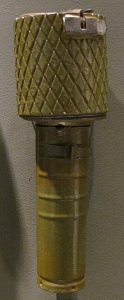
When World War 1 arrived, the war soon bogged down into the stalemate of trench warfare, it was soon realized that the infantry needed an edge when assaulting a trench. In both the Allied and Triple Alliance camps, some people remembered the grenade, and set to work. The results were very different – the German “Stielhandgranate” (known as the “potato masher,” from its distinctive shape) and the British “Mill’s Bomb” became the default standards.
Mills bombs. From left to right: N°5, N°23, N°36. Photo Credit: J-L Dubois, 2007. CCA/3.0
As the world passed through the inter-war years, then through WW2 and Korea, more types of grenades came into use, as the utility of the devices as married to advancing technology became evident. Today, grenades are everywhere, in a multiplicity of types.
Hand Grenade Types
There are several types of grenades in use, today. All of the types have very different characteristics, and thus should be used only in the right situation. Hand grenades can only be thrown about 30 meters/yards, and typically weigh between 0.75 and 1.25 lbs. Offensive and Pyrotechnic grenades are often rigged with tripwires as booby traps, although any type of hand grenade can be technically used as an IED.
There are five general types of hand grenades in current use:
Defensive
Offensive
Pyrotechnic
Gas
Special Purpose Munitions
Defensive Grenades
The Defensive Grenade (the “Mill’s Bomb”, referenced above) is what most people are probably thinking of when they hear the word “grenade”. This class of grenade is a high explosive, ‘fragmentation’ grenade, like a WW2 “Pineapple” grenade. These are termed “Defensive” because such grenades are designed to be used from behind “cover” (YouTube link).
A World War II re-enactor equipped with a replica Colt M1911 pistol, a pair of Mk 2 “pineapple” grenades (L) and a smoke grenade (R) on his uniform. U.S. Air Force photo by Staff Sgt. Nathanael Callon. Bastogne, Belgium, 2012. Public Domain.
These grenades explode violently, sending out a shower of fragments in all directions. In general, if you are within about 7 meters/yards of a Defensive grenade explosion, you have a better than 90% chance of becoming either a very serious casualty…or becoming very dead. If you are within 15 meters, chances are good that you will be wounded in some manner.
Russian combat F1 defensive fragmentation hand grenade. Photo Credit: Samo8383. CCA/4.0
In general, grenades technically have a 5 second fuse; one should expect a 3 second fuse, at best. Note, however, that when dealing with captured supplies, that anything recovered (or “dropped accidentally”) from a lone supply truck should be treated as suspect material.
Offensive Grenades
Offensive grenades – sometimes called “blast” or “concussion grenades” – are designed to kill/wound/stun through “blast effect” (the physical force of the blast) rather than through fragments. See the “Stielhandgranate” reference, above. The casings on these grenades are essentially vaporized by the blast (often, the casings are waterproof paper).
German soldier in Russia, about to throw a Stielhandgranate, c.1941. Author unknown. Public Domain.
For some reason, the Germans attached a handle to this grenade, which increased its throw-range (because the handle acts as a lever) by about 30% over the more “baseball”-like shapes, such as the Mill’s Bomb. It should be noted that WW2 Soviet RGD-33 stick grenade reversed this trend.
Soviet RGD-33 stick hand grenade. Photo Credit: MKFI, 2010. Public Domain.
The lethal radius of an Offensive grenade is about 3 – 4 meters, with a casualty radius of about 6 – 10 meters. Offensive and Defensive grenades are usually about the size and shape of a baseball.
Pyrotechnic Grenades
“Pyrotechnic” is a classification for grenades that do not cause casualties through their mechanism, but that do different things to support combat operations. In general, this means generating either smoke or illumination.
Smoke grenades produce smoke, usually in a variety of colors, the most popular being red, blue, green, yellow and white. These are useful for concealing movement, as well as signaling.
In contrast, illumination grenades use some kind of very bright-burning material, often magnesium, to light up dark places, usually well in excess of 200,000 candlepower.
Pyrotechnic grenades of all types are usually about the size and shape of a 12oz. soda can.
U.S. Air Force Tech. Sgt. Israel Garza explains tactical concealment using M18 smoke grenades to Forces Armèes Nigeriennes partners at Nigerien Air Base 201, Niger, Dec. 15, 2018. U.S. Air Force Photo by Staff Sgt. Daniel Asselta. Public Domain.
Gas Grenades
Almost universally, “gas grenades” employ CS gas (2-chlorobenzalmalononitrile) as their “tear gas” agent. For those reading this who may have previously served in the armed forces and have gone through the “gas chamber”, but have never had a full-strength riot grenade used on them, the real, “tactical”, grenade is far worse.
American-made tear gas grenade utilizing CS gas, used by Egyptian riot police. Photo Credit: Sherif9282, 2011. CCA/3.0
Tactically, CS grenades make fantastic contact-breakers for an outnumbered patrol that may be surprised, and has to withdraw quickly. This is because gas training is almost never taken seriously by most militaries…which is why it is vital for every unit to maintain gas masks, and train regularly to “don and clear” as rapidly as possible…However, it should be noted that gas grenades are technically classified as a “chemical weapon” in some quarters, which is why
Gas grenades are generally about the size and shape of a “regulation” softball. They do not generally break into more than 8 or 9 fragments, and have only a very tiny explosive charge in the fuse, just enough to break open the grenade body and disperse the agent within.
Special Purpose Munitions
“Special Purpose Munitions” is a catchall term for “everything else”. This includes both “stun (or ‘flash bang’) grenades” (lots of loud noise and bright flash, but no fragmentation and little real blast effect…unless you’re hold it when it goes off), low-powered “sting-ball” grenades (low explosive charge – or even compressed gas – and the “fragments” are low-velocity rubber balls), and “demolition charges” such as Thermite (which burns hot enough to melt through most types of steel) or White Phosphorous (“WP”, also known colloquially as “Willie Pete”), which disperses particles of phosphorus over a wide area.
A Flash-Bang Explodes In The Air. Photo Credit: Hongao Xu, 2020. CCA/2.0
The phosphorus tends to ignite flammable objects, and inflicts severe burns on human beings, and cannot be extinguished by water, because it carries its own oxidizing compound. The only thing that can be done to remove the WP matter is to submerge the patient in water, and remove the glowing “coals” from their body with forceps or tweezers.
Fortunately – or unfortunately, depending on your personal viewpoint – the hand grenade of today is the infantryman’s personal artillery: used intelligently, the hand grenade can get at enemies hiding around corners, hidden in rooms in a building, in folds in the terrain, or behind cover – all places rifles and pistols cannot reach.
While the technology behind the hand grenade is certainly lethal, and may be upsetting to contemplate for some, it will do to remember the words of the Chinese general Sun Tzu, writing c.500BC:
“There is no instance of a nation benefiting from prolonged warfare.”
The Freedomist — Keeping Watch, So You Don’t Have To
In the twenty-first century, few people in Western societies give much thought to bicycles. The machines are usually seen as something one gives to a child as a birthday present; or, something one buys to use for exercise in the sunshine. In some cities, and especially in Asia, bicycles are used as a primary mode of transportation, both in day to day living for activities like going to work and shopping, as well as in actual business, such as postal and product deliveries, but also as taxis for passengers, in those areas that still allow ‘rickshaw’ traffic.
Rickshaw in Japan, 1897. Credit: Rev. R. B. Peery, A.M., Ph.D. Public Domain
Very few people give any thought to the bicycle as a military tool, but it was – and remains – a vital component of many military operations.
The modern bicycle dates from a design created by the German Baron Karl von Drais, who invented his “Laufmaschine” (German for “running machine“) in 1817 (patented in 1818), that was called “Draisine” (English) or “draisienne” (French) by the press; this term would evolve over time into “velocipede”. Von Drais’ design was the first commercially successful two-wheeled, steerable, human-propelled machine on record.
It should be noted that it also quickly earned the nickname of “bone-shaker”, for obvious reasons.
An early ‘velocipede’. Photo of a Lithograph from 1819. Public Domain.
But, the design fascinated people, and progress was made in developing it. Many of these designs, such as the ‘penny-farthing’ of Englishman James Starley and Frenchman Eugène Meyer, are outright silly and fanciful, more suited to the pages of a Jules Verne novel than to any kind of useable machine. All that began to change in 1885, and first line militaries around the world began to take notice.
An example of a ‘penny-farthing’. Skoda Museum, Czech Republic 2003. CCA/3.0
In 1885, John Kemp Starley, James Starley’s nephew, invented what became known as the “safety bicycle”. Departing from past designs by making both wheels identical in size, employing a high-necked caster to better anchor the handlebars for steering, and incorporating the first rear-wheel chain drive on a bicycle, all combined to vastly improve the ride, handling and speed of the bicycle.
The younger Starley’s design – which was widely copied, as he had failed to patent the design – was swiftly followed by the last two major developments that would draw serious military attention to the bicycle for military use.
The first innovation was the reinvention of the pneumatic tire by John Dunlop in 1888, greatly smoothing out the ride and simplifying the design, and the patenting of the folding bicycle by African-American inventor Isaac R. Johnson, approved on October 10, 1889. Johnson’s design is also the first recognizable appearance of the “diamond frame” design that is still common over a century later.
Racing bike, showing the diamond frame. Photo Credit: Julius Kusuma. CCA/3.0
These two developments created an explosion of interest in cycling throughout the United States and Western Europe in the early 1890’s, actually causing an economic bubble near the turn of the century. It is at this point that the ‘Turmoil of the Century’s Turning’ happened.
The decade from 1895 to 1905 saw multiple – and massive – wars break out all over the world, from the First Sino-Japanese War of 1894-1895, to the Second Boer War (1899-1902) in southern Africa, which saw Great Britain deploy nearly 300,000 Imperial troops by steamship – to the Russo-Japanese War of 1904-1905. In the midst of these massive conflicts – a sort of “dress rehearsal” for World War 1 – there was the Spanish-American War of 1898, and the “China Relief Expedition” of 1900, with saw an allied force of British, French, Japanese, Russian, German, Austrian, Italian, and American troops marching from the Chinese city of Tientsin to rescue the diplomatic staffs in Peking (now Beijing) at the height of China’s “Boxer Rebellion” (1898-1901).
“I’ll Try, Sir!” – American troops in the relief of Peking in China on 14 August 1900 during the Boxer Rebellion. H. Charles McBarron, Jr., for the US Army. Public Domain.
All of these major conflicts – as large and expansive as most of the wars of the twentieth and twenty first centuries – made the various militaries realize that they needed to continue to innovate and upgrade their forces, a process that had already been happening in earnest for over thirty years.
Infantry – the core of all military forces – moves at the speed of a walking soldier, unless there are tools such as railroads, motorized vehicles or airplanes to carry them…and even then, they will still be walking. As well, the infantry have been carrying much of their own equipment for most of that time, to the tune of some 120lbs (c.54kg) on their backs. Something needed to be done to improve their mobility.
Typical US infantry load. USMC photo. Public Domain.
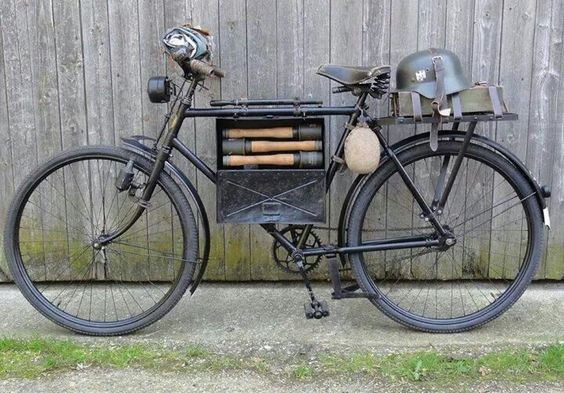
Bicycles were obviously useful to horse-drawn armed forces as messengers, as the cyclists did not need to worry about sick or lame animals; bicyclers were relatively easy to fix if something broke down. Other functions were tried out, including using bicycles to lay communication wire, create local maps by fixing clinometers to the frame, and patrol rail lines; there were even experiments to use them as ambulances and to haul machine guns around the battlefield. While not usable in the cavalry role – which should be apparent from the nature of the machine – could the infantry use it?
Italian Bersaglieri infantry with folding bicycles, c.1917. Public Domain.
This led to the creation of “bicycle infantry”: infantry units began to test out bicycles during long-distance rides, more or less to see what happened. This is where James Moss enters out story.
Then First Lieutenant James A. Moss, of the 25th United States Army Infantry Regiment (Colored), the storied “Buffalo Soldiers” (the United States military was still heavily segregated then) obtained permission in 1896 to take fifteen volunteers from the regiment on an experimental series of rides that culminated in a 1,900 mile ride from Missoula, Montana, to St. Louis, Missouri. Moss’ unit completed the trek – which avoided roads and paths where possible, sticking strictly to overland travel – made the trip in some 40 days, at an average of 6 miles per hour (pdf link). While the US Army was ultimately satisfied with conventional infantry units, armies outside the United States took notice of Moss’ experiments. (James Moss would go on to lead a bicycle-equipped unit in Cuba, and would later write a set of basic instruction manuals for troops and officer that form the basic framework of basic military instruction manuals today.)
25th US Infantry Bicycle Corps at Fort Missoula in 1897. Lt. James at right. Public Domain.
When World War One broke out, the bicycle served in all theaters. However, it was rarely deployed into direct combat, primarily due to the confines of trench warfare in Western Europe, and a simple lack of resources on the Eastern Front, in Russia. This unspectacular performance, overall, signaled the death knell of the military bicycle to the military pundits of the time.
However, other officers came out of World War One with a better understanding of bicycles and their military uses.
In the Second World War, bicycles were deployed extensively in Malaya, where Japanese intelligence officers, familiar with the Japanese Army’s use of c.50,000 bicycle infantry in the 1937 invasion of China, made sure in their pre-war scouting to note the presence of bicycle shops throughout the British-controlled colony. Likewise, Germany and Italy deployed units of bicycle infantry in rugged terrain, where horses would struggle. Many guerilla and partisan units – and the intelligence teams from the Allies who supported them – used bicycles for scouting, messages and to run electric generators to power radio systems that reported on Axis forces until the end of the war.
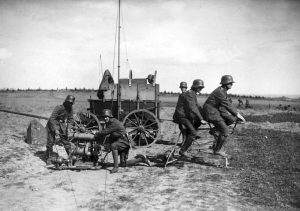
A German unit using a tandem bicycle power generator to power a radio station, September 1917. Public Domain.
Post-1946, the bicycle again faded into obscurity in most of the military world, although bicycle infantry units would continue to serve for decades in Swedish and Swiss military units. In one place, however, the military bicycle would reach its peak – in a place called Vietnam.
France, although it had been soundly beaten by Hitler’s Germany in 1940, was desperate to retain its colonial empire. When French forces returned to Indochina in September of 1945, the Vietnamese were less than impressed. Where French troops had capitulated to Japanese troops more or less without firing a shot, the resistance in Indochina had been led by native Vietnamese, and mostly by the Communist Party led by Ho Chi Minh and Vo Nguyen Giap (who were supported (pdf link) by the American Office of Strategic Services (OSS) during the war). After French forces seized control of Saigon (now Ho Chi Minh City) by force in September of 1945, the Communists retreated into the mountains and countryside, vowing to continue their war, now framed as a war of independence from France. This brought about the “cargo bike”.
The Communist forces, known as the ‘Viet Minh’, waged a brutal guerilla campaign in the rural areas of the country, causing steady and damaging casualties to French forces. However, the Viet Minh faced all the same challenges as a pre-WW2 non-motorized army, but with the added problem that suitable pack animals were few in number, and human porters could only carry a tiny amount of the supplies needed.
Viet Minh mechanics took the commonly-available bicycle, and began modifying it, resulting in a vehicle that could reliably carry up to 400lbs (c.181kg) at the pace of a walking adult human. While not the equal of a cargo truck or a boat, this was a far better solution. And it very shortly made its effects known.
Vietnamese army bike – Vietnam War Museum in Hanoi. Photo credit: Przemek P, 2010. CCA/3.0
In 1954, Viet Minh forces surrounded and destroyed the cream of the French Army in Indochina, at the Battle of Dien Bien Phu. France deployed its best units, numbering over 12,000 troops, in a badly thought out plan to bring the Viet Minh to battle in order to destroy them. At the extreme range of supply and support aircraft, the French troops found themselves over-extended and cut off, as French ground forces could not break through to reach them. The Viet Minh surrounded the town the French had fortified, and fought a nightmarish siege for nearly two months. Eventually, some 11,000 French troops would surrender; nearly 8,000 would die in a march to prison camps that rivaled the Bataan Death March in its brutality. The result was France agreeing to Vietnamese independence, surrendering their Indochina colonies in whole, which would lead to yet another war…but that is another story.
Viet Minh troops plant their flag over the captured French headquarters at Dien Bien Phu, May 7, 1954. Photo credit: Roman Karmen. Public Domain.
One of the primary reasons the Viet Minh were able to crush the French was their ability to move supplies, and the ‘cargo bicycle’ was at the heart of the Vietnamese logistical triumph. But again, the military use of the bicycle receded into seeming obscurity, despite its next successful showing against American forces in Vietnam…
…And yet – the bicycle remains in use as a military tool by guerilla and insurgent forces around the world. Why?
Within its obvious limits, the military facts of the bicycle of today remain unchanged from those same facts discovered by James Moss and his unit of Buffalo Soldiers in 1896: the bicycle requires no fuel, beyond the food required for its operator; it moves essentially silently, at a constant speed of up to twelve miles per hour; it raises no dust in its passing; it can operate in most weather and terrain conditions; and it can be used to power various systems, from air circulation fans to electric generators, and does so with no heat output, again, aside from the signature produced by the operator.
Three Swedish bicycle infanterists armed with m/45 SMGs and Bantam anti-tank missiles, Sweden, 1965. Public Domain
Given the ludicrous progress of the US Army’s new Infantry Squad Vehicle (ISV), it might be time for regular militaries to think about “going old school”.
The Freedomist — Keeping Watch, So You Don’t Have To
Back FREEDOM for only $4.95/month and help the Freedomist to fight the ongoing war on liberty and defeat the establishment's SHILL press!!
Are you enjoying our content? Help support our mission to reach every American with a message of freedom through virtue, liberty, and independence! Support our team of dedicated freedom builders for as little as $4.95/month! Back the Freedomist now! Click here


_while_mooring_at_the_pier_in_Pearl_Harbor.jpg&f=1&nofb=1&ipt=d527250d1015e9f1d804b6b4a2886c37a4ddc3df3f73a74c05c897d1ec511849&ipo=images "China’s Navy Rising as U.S. Navy Sinks")