Senator Tommy Tuberville (R-AL) has been holding up new appointments to high levels of military leadership over their decisions to go woke and become nothing more than the military branch of the Democratic Party, serving the party, not the republic.
At issue is the military’s commitment to validate the woke ideology that destroys the human reality of men being men and women being women and its commitment to support, endorse, fund murdering unborn children. Now, the military leaders are accusing Tuberville of aiding and abetting the enemy (projecting their own reality onto others).
Air Force Secretary Frank Kendell made himself eligible for impeachment and criminal prosecution should Americans regain the positions of authority in our own republic when he said to Jake Tapper on CNN, one of the military information departments of the DNC-CCP, “Our potential adversaries are paying attention. It is affecting how they view the United States and our military capabilities and support for the military. This needs to stop.”
This is the language of sedition. The military, and the party it serves over country, can fix this problem by removing the anti-Americanism they are intentionally coding into what is fast becoming an enemy force wearing American gear. End the woketarian indoctrinations of our troops. End the support for murdering unborn children and providing “trans” therapies to confused individuals that live to affirm the DNC-CCP lie, that men are not men and women are not women.
Navy Secretary Carlos Del Toro joined in the sedition, saying that as someone “born in a Communist country, I would have never imagined own senators would actually be aiding and abetting a communist and other autocratic regimes around the world.”
This type of language is a direct, lethal threat to a sitting Senator, who is not acting outside of his constitutional right, and is doing so to protect our military from the communist ideology this former and now self-outed current communist is implementing.
It is only a matter of time before Merrick Garland’s DOJ files charges against Tuberville for sedition, lest the GOP-controlled states no longer continue to idly sit by while the dark net of woketarian fascism closes in on them, led, this time, by our own generals.
These seditionists are right that Tuberville is aiding and abetting their enemies, which are the American people themselves that still commit themselves to live out the standards of our Declaration of Independence, our Constitution, and, more specifically, our Bill of Rights, documents that have little meaning to a cabal of anti-Americanists now willingly indoctrinating U.S. soldiers to believe America is just a white supremacist construct that needs to be ended if we are to save the LGBTQ+ community and the “people of color.”
It is time for the GOP-led states to act and declare the Democratic Party a terrorist organization in league with our true enemies, the corporatists of the world who view our republic as an impediment to their plans, not something to be honored and respected.
These “Generals” talked out of both sides of their mouths on CNN, working as agit propagandists seeking to establish the criminality of any opposition to their anti-American agenda. Tuberville is a traitor….to progmerica (which is no America at all), but a patriot to the republic. The Generals are patriots of a different nation, not America, whose flag should not be flown by the likes of these dark warlords.
In 1974, authors Larry Niven and Jerry Pournelle, writing in their seminal science fiction novel “The Mote In God’s Eye”, coined a character concept called “Crazy Eddie”, a concept-figure who would appear in a society’s mindset at time of extreme social stress, and take the most insane and contradictory actions possible, which usually resulted in accelerating the collapse of a society or civilization.
The world is in a remarkable state of tumult as of September 1 of 2023. The war in Ukraine is well into its second year. In Africa, a wave of military coups is obliterating France’s sixty-plus year old “totally-not-an-empire”, sending the region and the wider world into a frenzy of impotent rage, as no one wants to wade into a quagmire against black nations standing up to imperialist and corporate interests. Russia and China, aside from rattling military sabers to whet the appetite of the ravenous bloodlust of the Western media and entertainment spheres, are quietly marching towards an economic checkmate against the West, in a move that will not simply destroy the Western business models, but will smash Western economies flat, potentially reducing many Western European economies to a state no scene since the post-World War 2 recovery, and the Marshall Plan…only there won’t be a Marshall Plan this time. Maybe a Putin-Xi Plan, but not a Marshall Plan.
Pretty heavy for an opening bit, eh?
Amid all of the current tumult in the United States – the possible return of Covid lockdown restrictions not least among those – there is a quietly increasing crescendo calling for actual military intervention – meaning, “invasion” – of Mexico, in order to “deal” with the flow of illegal drugs.
I wish I were joking.
The current power bloc in Washington, DC – supported by their cohorts in The City of London, Paris, and Brussels – had goaded Russia into what they thought would be a “warm-n-fuzzy” kind of “Cold War, 2.0”; what they got was a full-on invasion. Although there initial, hysterical screams to “go to war” with Russia, both from within the power blocs and from those in the general public who should probably be on emotional-management medications, it soon dawned on most people that “going to war” with Russia would almost certainly mean a “nuclear” war, that no one would “win”.
Then came Africa: Beginning in 2017 (YouTube link), people seemed to suddenly remember that there were still islamist jihadi’s out in the world, burning, looting, raping and killing people in order to serve the warped vision of religion espoused by a tortured political prisoner. However, murderous religious maniacs were “so three years ago”, and virtually no one on the “Western Street” considered barely-literate bandits hiding under the cloak of religious fervor to be an existential threat to Western civilization. Likewise, the recent wave of coups – not coming at the behest of Western governments and corporations – aren’t exactly revving the martial engines of Western populations being crushed under rancid economies and continual political scandals.
Something else was needed…And in the United States that answer is, increasingly, the illicit drug problem.
And it is a problem: tens of thousands of Americans die every year from drug overdoses, a large percentage involving the drug fentanyl. Unlike the normal cries for “Bayonets UP!”, however, this group of calls comes from the opposite side of the aisle: instead of Democrats leading the charge for military intervention, this time, the main thrust is coming from the Republican side of the fence.
This should not be a surprise, given the GOP’s continuous cries against illicit drugs. After all, it was no less a figure than Richard Nixon, who authorized the placing of cannabis (aka, “marijuana”) on the list of drugs as a Schedule 1 compound, right next to heroin – a position it retains to this writing – in 1970. And, like the vigorously enforced alcohol raids of the Prohibition Era – also enforced by successive Republican administrations – the GOP’s “war on drugs” has directly sparked the explosive growth of massive, high-revenue and well-armed and frighteningly well-equipped drug cartels, who have an international reach, and who have now diversified into human trafficking.
Given the abject inability of the US military to deal with the opium trade in Afghanistan during its twenty-year long occupation of the country – which saw opium poppy fields expand five-fold – the idea that a smaller military, struggling with recruiting efforts, and quietly speaking the dreaded “D-Word” out loud, can deal with the various drug cartels is not a matter for political or military debate, but a matter to be dealt with by mental health counselors.
The US military is having trouble recruiting people with bonuses exceeding $50,000 to sign up. As Mexico itself has discovered, military recruiters have a hard time competing with their counterparts in the Cartels, especially if the Cartel recruiters can use Mafia-like threats against potential recruits’ families. Likewise, the Cartels not only pay what regular forces term “combat pay”, but offer bounties against specific targets.
As well, with revenues between US$20 billion and US$60 billion per year (minimum), and far less overhead than conventional corporations and nation states, the Cartels have plenty of cash left over for high-intensity R&D: the wave of combat footage coming out of Ukraine, showing drones – from both sides – dropping small bomblets into trenches and bunkers are merely the current state of a technology pioneered by the Cartels, and refined in Syria in the aftermath of the rise of ISIL.
Much worse, from both a tactical and an operational standpoint, is the ability of Cartel members to blend into the general population. While islamist jihadis are comparatively easy to target, as they belong to a very narrow slice of the US population, Cartel members are a subset of the largest minority group in the United States. Where – to get rather “ugly” about it – potential jihadists tend to limit themselves to Muslim mosques, Cartel soldiers are largely Catholic, and are thus able to circulate freely among the Catholic population, the fastest-growing Christian denomination in the world.
The Cartel’s leadership echelons are not idiots. In fact, a distressing number began as military professionals, as is clear from their ability to organize a military-style logistics system. They are watching the rhetoric coming from within Washington, DC and various other organs, both from within the government, and from government-adjacent groups – nothing presented here is new to the Cartels.
Decades of neglect of border security, up to and including the recent encouragement of millions of desperate economic refugees to cross the southern border of the United States illegally – an action which helps to fuel the cartels’ diversified revenue structure, to say nothing of the very real physical dangers of the northern Mexican deserts and the human trafficking predations of the “coyotes” – has fueled an massive surge in drug-related deaths across the United States. Communist China is certainly complicit in this, as they are the Cartels’ prime suppliers of fentanyl precursor drugs…something they have no issue supplying, as Beijing sees this as “payback” for the Opium Wars…but that is a whole other story.
With the hyperventilating actions of people who should know better, calling for a Presidential authorization to use military force against the Cartels, alongside equally breathless and stentorian calls to designate the Cartels as “Foreign Terrorist Organizations” (FTO’s), and coupled to a military establishment that has seemingly lost its way, to the point where it is quietly considering a return to a military Draft, the notion of an all-out “hot” war on the southern border of the United States is the height of lunacy, a lunacy driven by both sides of increasingly incompetent power blocs.
“We, the People” have allowed our “elected” leaders to paint us into a corner, a corner from which there is no real way out, except through the use of extreme levels of violence.
Kind of like Africa in the last few months.
The Freedomist — Keeping Watch, So You Don’t Have To
On July 26 of 2023, a military coup unseated the president of the West African nation of Niger; details of this situation and its wider implications are the subject of a Freedomist monthly, subscription-only article, set to go to press as this article is being written. While coups d’état are not unusual in post-1960 Africa, what made this one unusual was that it was the sixth since 2020, and was only the latest in a string of some twelve coups in the region, beginning in 2008. Another unique feature in Niger is the open public praise of Russia, complete with homemade Russian flags.
And this is aside from the absolutely remarkable statements from both the US State Department and the Pentagon’s AFRICOM command that they have no idea and no way to track what happens to the Third World military officers (some of whom earn Master’s degrees in US and British military universities) that they train.
These coups are not complex events to understand – not that the various “think tanks” advising policy makers around the world seem to understand them. At all. In fact, the tone-deaf mewlings of people overly impressed by the letters after their own names begs inquiry as to whether or not they are using word-salad AI Chatbots to write their papers.
Additionally, the non-military sphere is heating up as well, as the BRICS Group has just extended invitations for membership to six states: Argentina, Egypt, Ethiopia, Iran, Saudi Arabia, and the UAE. This is no small thing…again, however, not that the US, British of Western European foreign policy, military and financial power structures seem to care.
And this is also separate from the catastrophically embarrassing failures of the same nation’s attempts at training Second- and Third World military forces to something approaching a Western military standard. From the nation of Georgia in 2008, to the collapse of the Iraqi Army in 2014, that of the Afghan National Army in 2021 and the abysmal performance of the “retrained” Ukrainian Army in 2022-23, Western – meaning, United States and NATO countries – military training programs have consistently failed (and failed miserably) to train up effective forces. Given that the current US Secretary of Defense, retired General Lloyd Austin, testified before Congress (YouTube link) on the spectacular $500 million failure to train more than a handful of “friendly” anti-regime forces in Syria, it would seem obvious that rather penetrating questions should have been asked, on numerous occasions.
But, I digress…Back to the original question: Why is it so hard to understand what is happening in world affairs?
There are only three realistic possibilities: incompetence, delusion and/or corruption.
Incompetence at this level, while alarming to the uninitiated, is depressingly common in areas of higher education. Classroom theories about lofty and obtuse notions of “democracy”, finance, resource management and social equity fail instantly and completely when confronted with the stark realities of the real world – as education widens in the population base, the “common folk” begin to learn just how badly they are being screwed…and eventually, they will stop taking it, rise up, and either stand on their own, or at least look for a new partner that isn’t insultingly paternalistic and slimy.
That, in a nutshell, is what just happened in Niger, as the population is fed up with France acting as the glowering, judgmental schoolmaster, desperately trying to hold on to a zombified economic dominion over its former “colonies.” Russia – while certainly no saint – has no real colonial history in Africa, and is remembered by many as a reasonably friendly power from the Cold War era.
Turning to the possibility of delusion, that is also an easy, if depressing, possibility to grasp. The sad fact is that Western institutions of education have spent at least forty-odd years hammering at the nail of “democracy”, as if it were a panacea to all of the world’s ills. This is done despite the bald facts that “democracy” is extremely fickle, and fails abjectly when forcibly introduced into a populace who has little, if any, history or inclination to properly use what is a notoriously clunky system, a system that encourages discrimination at virtually every level if not carefully carried out. Countries and peoples that have political systems imposed on them with little education or even training quickly spiral into internal unrest, if not civil war. This is the historical record, from Sri Lanka to Iraq, to Niger; where exceptions appear, those simply ‘prove the rule.’
Corruption, too, is a distinct possibility. The Western “establishment” deeply fears an Africa whose national peoples – even though their “nations” are, for the most part, wholly artificial constructs with boarders drawn by distant colonial powers with delusions of adequacy – might someday agree to set aside their differences, overthrow their corrupt “leaders”, and tell the West that their free lunch is over…and lest you, the Reader, dismiss this as an empty threat, you would be wise to remember that cheap African minerals are why you were able to afford the computer, tablet and/or smartphone you are reading this article on.
In contrast to the incoherent bleatings of people with more letters after their names than actual experience, critical thinking and/or “plain common sense,” the issue at hand is not that the United States, France and other Western powers are somehow deliberately scheming to topple governments with whom they are already friendly (because they stage-managed the elections that put those governments in power), using officers trained in their own advanced schools of military education, in order to install governments antithetical to those Western states’ views and desires while aligning themselves with said Western states’ semi- (if not full-on) hostile opponents (read that again, if you need to; I did)…it is far more a matter of “keeping the pot simmering,” to keep the local “partner nations” off-balanced, and in dire need of “friendly support”…the notion that local military officers, professionally trained by Western militaries, might go home, look at the rank corruption and incompetence of their “democratically elected” governments, and decide that “drastic measures” are required to save the country, is apparently unfathomable inside the air conditioned think tanks of Washington, DC, London, Paris and Brussels.
There is, however, another dimension to this situation: Grand Strategy.
African countries that have had coups between 2020 and 2023 (July 2023). Credit: Discombobulates. CCA/4.0
The BRICS Group, led by Communist China and Vladimir Putin’s Russia, has used the wave of coups across the African Sahel region – the so-called “Coup Belt” – to their distinct advantage. When zooming out to a wider Africa map, it is clear that the pattern of coups in the African Sahel region stretch in a near-unbroken line from the Red Sea to the Atlantic Ocean…and every coup in those states in the last fifteen odd years has been done with at least tacit Russian or Chinese support. With the BRICS Group inviting in new members, this opens the possibility of a revival of a British idea from their imperial days in Africa: instead of a “Cairo to Cape Town Railway”, the wave of Russia-friendly governments produced by the wave of recent coups opens the possibility of a “Port Sudan to Dakar Railway”, cutting across the breadth of the continent, causing a vast and violent shift in global commerce, as it would allow a transshipment route for cargoes that would bypass the Suez Canal…All that is needed for such a project is money (see: Saudi Arabia joining BRICS, above), and a much-improved security situation, neutralizing both “islamistinsurgents” and general banditry. This would also open the possibility of reviving the “Cairo to Cape Town” route, as well as additional north-south spur lines. Russia is well-versed in the impacts of a continent-spanning rail line, as their more-than-a-century-old Trans-Siberian Railway remains a vital economic artery for the Russian state.
Another dimension, is the neutralizing of ECOWAS, the “Economic Community of West African States”, an economic cooperation sphere which has been increasingly flexing its military muscles, intervening in several member states over the years, for a variety of reasons. In Niger, however ECOWAS’s immediate order to the coup’s ruling junta to immediately return the deposed Nigerien president to power, was met with a blunt refusal – a refusal that has now been formally backed up by the nations of Burkina Faso and Mali, both of whom are currently led by military junta’s who also succeeded in their own recent coups. And in the broader ECOWAS nations, there is very little support for the idea of a military intervention, especially in light of increasing attacks by AQIM and Boko Haram in recent months.
On top of this, the Organization of African Unity (the “OAU”) has also taken action that is not being well received on the “African Street”. These unpopular actions in recent weeks hold the possibility of seriously fragmenting both organizations.
Which, to return to the corruption angle, also brings up an ugly possibility, one verging into full-on “Conspiracy-Theory Land” (a place that is increasingly “Conspiracy-Fact Land”): that Western militaries are being deliberately hamstrung in fighting islamist insurgencies – not simply in Africa, but around the world.
This is in no way the fault of the Western troops at the “pointy end of the spear” – major policy theories and decisions are presented to troops detailed to execute them far less often than they are presented to the general public, regardless of country. But there is a clear pattern in the preceding thirty or so years: Western forces are sent into a state which – although theoretically rich in natural resources – is almost hopelessly backward, and kept that way by Western interests who want both cheap resources, no matter the cost, and “strategic positioning,” also no matter the cost.
Military force has its limits. The problem with Georges Clemenceau’s tired saw, that “war is too important to be left to the generals”, is that politicians – and the “political” generals advising them – are almost always in a far worse position to be making military decisions than their generals.
This is as true in Africa as it is in Ukraine. In the latter case, the hysterical incompetence and base greed of “corporate donation”-driven politicians has brought the world closer to open nuclear conflict than at any time since at least 1983. (YouTube link)
But in Africa, this hysterical incompetence actually presents a far greater danger to the West: African states with enough military competence to make it difficult to invade them all, who can form a solid negotiating bloc – especially one with support from Russia and Communist China – can up-end Western technology and transport infrastructures to the point of collapse, without firing a shot. Those directing affairs in Washington, London, Paris and Brussels believe that they can “manage” these coming “adjustments”; they cannot, but that is not stopping them from proceeding with their plans, plans driven by arrogance, hubris, and not a little racism.
The people running things in the West are playing a game by rules that they think that wrote, and which they assume cannot be changed unless they want to.
The Universe will only tolerate a certain amount of stupidity. When that limit is passed, the Universe has a habit of collapsing things, in any of a number of way – none of them good.
To quote the Athenian scholar and general, Thucydides, “The society that separates its scholars from its warriors will have its thinking done by cowards and its fighting by fools.”
Prepare accordingly.
The Freedomist — Keeping Watch, So You Don’t Have To
Let’s face it – tanks are sexy. So are “combat vehicles.” We’ve all seen them on television for years: big, brutalist vehicles, racing around a course, firing monstrous cannons, or grinding their way across the desert. Massive engines of war, practically defining the idea of the “warrior ethos.”
A Brigade of the U.S. 3rd Armored Division masses for the invasion of Iraq during the Gulf War, February 1991. US Army photo. Public Domain.
Or, perhaps, they are carrying infantry, dramatically exiting their vehicle, perhaps under fire. These kinds of vehicles fulfill another part of the “warrior ethos” equation, with warriors heading into violent, close-range, face-to-face battle with a dogged opponent. Very Audie Murphy.
US Army soldiers from 3rd Battalion, 21st Infantry Regiment, dismount from a Stryker APC, Mosul, Iraq, 2005. US Army Photo. Credit: SPC Jory C. Randall, US Army.
The idea of “sex” selling military equipment is alive and well, as can be seen by the marketing at any international arms show.
But this, of course, begs the question: Is this all there is? Of course, there are other aspects of “militarydom” that news media outlets and “infotainment” channels talk about relentlessly, as long as the public expresses interest in “things war-like.” These include paratroops, Rangers, or commandos, or special forces either stealthily creeping through enemy territory, or storming a “bad guy” hideout to neutralize said bad guys, or to rescue the hostages in dramatic fashion, especially if news cameras are present. Again – we’ve all seen these images and videos repeatedly, either on the news or in popular entertainment…and, for the most part, these all definitely deliver and validate that sort of drama, courage and honor.
This, of course, brings us once again to the question: it that it? In a word – no. Not by a long shot.
Combat troops require support. While combat troops are certainly capable of improvising, they are far better at executing their combat missions when the “non-combat” troops are relentlessly driving food, fuel, ammunition and spare parts forward, and doing the jobs that the combat units do not need to expend time and energy to learn: maintenance, medicine above the 1st Aid level, building (or destroying) structures – occasionally under fire – all of which are things that the combat forces need, but are too busy to spend time doing.
In “the biz,” this is expressed as the “tooth-to-tail ratio”, or, the proportion of combat to support troops. This is a very dense subject to get into, and there are a wide array of opinions on the subject, most of which disagree at one level or another with all of the other opinions. The point, however, is that any group with pretensions to military force is going to have more support troops who are unlikely to see actual fighting, than combat forces intended for straight up combat.
And those support forces need equipment – a LOT of equipment – and the unique supplies and spare parts to keep those running. And a main component of that equipment is armored support vehicles.
Lurking in the background, seldom photographed, and even less talked about or reported on, are the “combat support vehicles.”
These vehicles are not cargo trucks, but the sort of vehicles you can see on your daily commute when passing a construction site – everything from road graders to backhoes, bulldozers. These vehicles frequently have a coat of “military green” paint slapped onto them; hopefully, they have slats of armor plate welded onto them to protect the operator. They are then sent out to build anything from roads, to towns and camps for refugees, to large airfields.
A United States Navy Seabee uses a grader to construct a parking lot during the combined US/Honduran training operation “AHUAS TAR” (BIG PINE), 1983. Photo Credit: TSGT Ken Hammond. US National Archives. Public Domain.
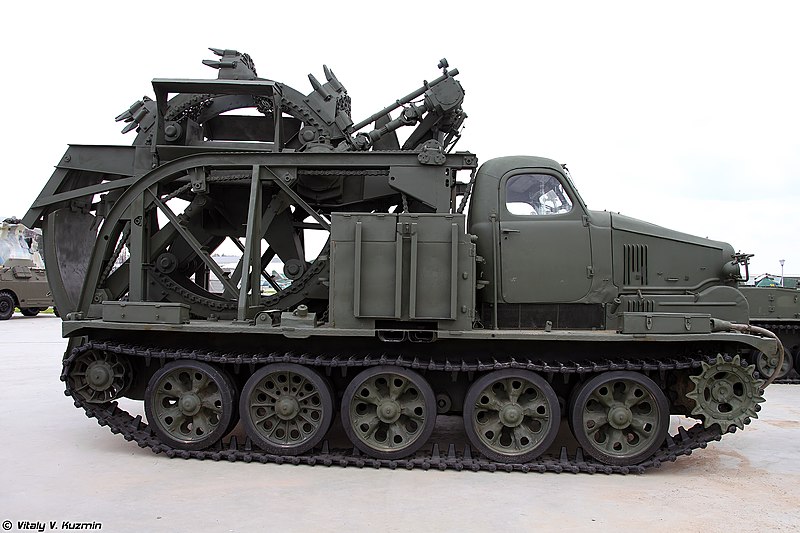
But these vehicles also include highly specialized vehicles, such as minefield breachers and high-speed trenching machines, like the Soviet BTM-3. The BTM, in particular, has made a resurgence in the Ukraine war (YouTube link), as both Russia and Ukraine quickly turned to trench warfare, as the war bogged down into a bloody stalemate. With trench systems resembling those of World War 1, the BTM and its later derivatives and cousins have worked frantically to construct vast trench systems far faster and more efficiently than individual soldiers can. After a trencher slices through the area, troops need to do no more than to expand the position, “filling in” the parts that the trencher vehicle cannot easily do.
Unfortunately, since these vehicles, as highly effective and vital as they are, are rarely given any kind of real consideration…because they are not “sexy.” And, disappointingly, the leaders of most countries have little interest in these vehicles (because they are not “sexy”), so the vehicles sit, rarely used or considered when discussions of “militarydom” occurs…until, of course, tensions suddenly escalate into actual war, and those vehicles – many times, barely running – become a decisive combat multiplier, usually outweighing actual “combat vehicles” in value.
And that’s before we talk about trucks.
If you’ve read this far, I will offer you the following advice: The next time your elected officials start talking about the “defense budget,” spend some time, and look into what they actually want to spend your money on. It’s your tax money, after all, that is spent to “defend” you.
You might want to look into how it is being spent.
Senator Tommy Tuberville (R-AL) continues to use what little power the Republican Party has to prevent further infestation of the military by woke leaders who are beholden to the Democratic Party and not the American Constitution. He has been holding all new considerations for military leadership confirmation required by the Senate, now numbering over 200, until they come clean on the military’s embracing of a partisan issue like abortion. The media, of course, is portraying this as irresponsibility, but this writer calls it courage, a courage rarely displayed by the GOP, which is why many top GOP leaders are loathe to openly support him, and some are inclined to seek to undermine his heroic efforts.
Note how the headline below subliminally characterizes this move as being irresponsible by whining about a woke military not having the “leaders” it needs to function. A military that is being transformed to become an enemy of the republic is one that does not leaders, it needs federal prosecution against the treasonous leaders currently in positions of leadership it has today.
Sen. Tommy Tuberville (R-Ala.) is holding up the nominations of more than 200 general and flag officers in protest against the Pentagon’s abortion policy, a move that has impacted top military roles.
Chief of Naval Operations Adm. Mike Gilday stepped down from his position on Monday, leaving the Navy— along with the Army and Marine Corps — without a Senate-confirmed leader.
Adm. Lisa Franchetti, the first woman slated to lead the Navy, is now an acting leader awaiting Senate confirmation.
The genesis of this article came from a completely different angle, namely, the deployment of laser weapons to the battlefield. However, as things frequently go, that initial idea led to something of much more immediate interest.
Previously, the Freedomist has covered some aspects of “improvised warfare” that some seem to take as James Bond-like fantasy. Yet, as we progress through the third decade of the 21st Century, remotely controlled drones – available in most countries through their local Amazon store – capable of both conducting tactical combat surveillance, as well as tactical air support by dropping small fragmentation grenades, are serious and maturing battlefield threats, threats that military and security forces are struggling to counter.
“Improvised warfare” has been around since the first caveman grabbed the jawbone of his last dinner to bash in the noggin of another caveman trying to muscle in on the first one’s turf. Throughout military history, outside of the heroically vast and sweeping battles of storied yore, there has always lurked the “PBI” – the “Poor, Bloody Infantry” – struggling to make do with usually-substandard weapons and equipment, improvising on the fly, on the idea that “if it looks stupid, but works – it isn’t stupid.”
This is also true in naval warfare. “Suicide boats,” in the form of “fire ships”, go back to at least the 3rd Century AD in China, and the 5th Century AD in the Mediterranean, and those dates are only the earliest we have on record. The use of fire ships in combat has always been problematic, as controlling the vessels after the skeleton crews abandoned them was impossible, and the abandoned vessels could easily come back on the attackers.
Chinese fire ships used by the navy as floating incendiaries, from the Wujing Zongyao military manuscript written in the year 1044 during the Song Dynasty. Public Domain.
As naval technology advanced however, fire ships, as such, disappeared, replaced by explosive-laden boats propelled by early steam engines. These boats had some advantages, not being as subject to winds as the old ships, and their explosive warheads were much more capable of inflicting serious, if not fatal, damage to large warships. Still, the inability to steer the boats remotely left their utility still strictly limited.
As with so many things in the military sphere, during World War 2, everything changed. The intersection of technologies with mass production and sincere desperation, allowed the first tactically useful guided weapons, not simply on land and in the air, but at sea, human control was still the primary aiming method until the last moment.
Post-WW2, the use of explosive motorboats continued, eventually evolving into actual “suicide boats”, where the crews rode the craft directly into their targets. While this was always a danger for the operators of these boats, very few navies outside of WW2 Japan set out with this as their operating profile. Beginning in the 1980’s, this began to change, first with the LTTE in Sri Lanka and with Iran in its “WW1, 2.0” war with Iraq. This is, in fact, what happened to the USS Cole (DDG 67) when it was attacked at anchor in October of 2000, as the suicide crew happily “saluted” the American crew before detonating their massive charge, nearly destroying the ship.
And then – another “sea change” (no pun intended) happened.
As the Soviet Union collapsed, and Communist China finally figured out how mix capitalism with a brutal, totalitarian governmental system, the West welcomed the Communist remnants into a burgeoning world trade system with open arms. As the global economy shifted and changed, the technology sector exploded in its own form of “business as war.” Technology once reserved only to the “Great Powers” became ‘democratized’, available at reasonable prices to the general public. While major nations certainly had far better and more capable – and much more expensive – systems, smaller states (and groups) suddenly had access to technology and manufacturing bases that significantly increased their capabilities versus local opponents (including their own citizens, but that’s another conversation, entirely).
Container port in operation. Credit: Piqsels.com. Public Domain.
All that was waiting was another spate of desperation to drive improvisation.
As the “Global War on Terror” (the “GWOT”) drove on in the aftermath of the 9/11 attacks, the many small, localized wars it spawned drove desperate innovation, once again. Various ethnic and religious factions around the world desperately sought some sort of advantage. This has led to everything from “homemade tanks”, to artillery, to ‘sci-fi’ weapons manufacture.
But now, desperation-induced technological innovation has caught up with the navies of the world.
On January 30, 2017, the Saudi Arabian frigate RSN Al Madinah (FG 702) was struck and seriously damaged by an explosive-laden speedboat. Initially, it was believed that the craft was a piloted suicide boat deployed by the Shi’a Islam Houthi rebels of Yemen, which country has been in its most recent civil war since 2014. Soon, though, it became apparent that the attack craft was actually a remotely- controlled craft.
Speculation immediately turned to Iran. Iran, in addition to being co-religionists to the Houthis, was already supplying the rebels with short-range ballistic missiles and combat drones. In this regard, Iran differs from Ukraine only in that they supply their craft externally.
Ukrainian naval drones, c.2022. Unknown author.
Given the rapid advances in remote-operations technology, it would be no great task to re-engineer common pleasure boats to function as drone attack craft; as well, the issue of a simplified, “standard issue” refit kit (similar in theory to an aircraft JDAM unit) is virtually guaranteed.
But ultimately – what does all this actually mean, in the grand scheme of things?
Simply, insurgents and guerrillas are now much more capable than they were in the past, as they are now capable to extend remote-controlled warfare into the nautical dimension. With the democratization of military training, this opens the ugly possibility of radical forces being capable of enforcing localized (if not regional) combined-arms dominance over all the most capable of national militaries.
The fact that this is an operational possibility worthy of consideration is not something that should alarm only strategic planners – it is something that average citizen needs to seriously consider.
Act accordingly.
The Freedomist — Keeping Watch, So You Don’t Have To
Unless a person is a member of the Catholic faith, most people don’t give a great deal of thought to what they think of as “the Vatican”, unless there is some noteworthy story concerning the Church. Most historians (both professionals and amateurs) are well versed, in varying degrees, about the Church’s history. Historians know that the Holy See – the actual leadership of the complex structure that is Catholicism – is an independent and sovereign nation, a condition settled by the Lateran Pacts of 1929, after seventy years of upheaval. But really – it’s not like the Catholic Church is actually a nation, right?
Right?
Well, no, actually. That is not the case, at all. And while it of course is a matter of immediate impact to the 1.3 billion-odd Catholics in the world, it is also a major concern – or should be – for non-Catholics, including non-Christians, throughout the world.
The Catholic Church – the strictly religious organization – has certainly existed in some form for over two thousand years; in fact, our formal dating system (i.e., “2023AD”, where ‘AD’ means “Anno Domini”, or, literally, “in the Year of our Lord”) is based on the Church’s established interpretation of the historical timeline.
During those twenty-odd centuries the temporal authority of the Holy See has waxed and waned. Where it once held immediate and direct sway over the secular affairs of much of the Christian world, in the minds of most people – even of most Catholics – the notion of the Pope as a secular leader is somewhat bizarre. In 1870, when Italy was finally united, the Holy See was stripped of its “Papal States”, although the Pope of the day, Pius IX, flatly refused to recognize the “Law of Guarantees” imposed on his rule, and referred to his rule, as well as that of his successors, as the “Prisoner in the Vatican” era.
This was the situation that remained in force until the signing of the aforementioned Lateran Pacts in 1929 by Pope Pius XI, which created the modern division between the Holy See, and the Vatican as a sovereign city-state, albeit a tiny one, only holding some 108 acres within the city of Rome. However, these remain technical differences. Among those differences is that Vatican City the City-State retains its own military forces…whose “commander in chief” (to use the modern term) is the Pope.
And it is here, that we reach the subject of this article.
Unlike most of the articles like this at the Freedomist, this is not a historical piece. Instead, we will consider the Vatican’s potential to impact current affairs through creating and applying military action.
While the Holy See is no stranger to maintaining military forces – some of which still exist – it has not had “operationally deployable forces” (again, to borrow the modern vernacular) since 1870. It does retain military and police forces, specifically the Pontifical Swiss Guard and the less-well known Gendarmerie Corps of Vatican City State.
While the Swiss Guard, famous for their Renaissance-period ceremonial armor and uniforms, directly protects the Pope (or the College of Cardinals, when they gather to elect a new Bishop of Rome), the Gendarmerie conducts more police-like duties within Vatican City, mostly managing tourist traffic. The Swiss Guard has significantly improved their protective training in the decades since the 1981 assassination attempt on Pope John Paul II. Still, these two forces comprise barely two hundred and fifty troops, and are only armed with the lightest of small arms.
Swiss guards after a celebration inside St. Peter Dome, 29 June 2006. Photo credit: Alberto Luccaroni. CCA/3.0
Additionally, of the Church’s remaining military orders, only the Sovereign Military Order of Malta (SMOM) is really “military” in any way: SMOM maintains a military medical detachment, providing medical support to the Italian Armed Forces.
Troops of the Sovereign Military Order of Malta, during an army parade in Italy, 2007. Photo Credit: Utente:Jollyroger. CCA/2.5
Should the Holy See decide to expand its secular military, finances are not an issue, should the Vatican decide to reform an operational military arm. Accusations of certain fiscal shenanigans aside, the Holy See is fully capable of mobilizing all of the vast capital (much of it not easily tracked down) that it controls. At the same time, a program soliciting remittance-like donations (even tithes) from Catholics would provide a significant boost to the Holy See’s income stream. Spent wisely, Vatican finances are more than sufficient to field a very large force, and very quickly, as the world is awash in arms and equipment.
But surely, this is all hypothetical. It’s not like the Vatican is going to suddenly militarize. Right?
States have a habit of changing their nature quickly, and sometimes functionally overnight; take modern Iran as one example. How would such a thing happen to the Holy See?
While the current leadership of the Holy See and Vatican City are well known for “liberal” policies that could easily change. Granted, it would have to be an extraordinary circumstance, but a change to a staunchly conservative, even reactionary, leadership within the Church is certainly not beyond the realm of possibility. In such a circumstance, assuming that a reactionary Pope ascended to the Throne of St. Peter, and decided to field a functional military, how would that take shape?
First, the reactionary Pope would need to define a mission for the expanding Papal forces. Given the nature of the modern era, this could easily begin with a revival of the Papacy’s long-disbanded Papal State forces, including its navy.
One of the curiosities of the Covid pandemic was that many cruise lines retired their older cruise ships, selling them off for scrap, using the suspension of cruise travel to purchase new ships. Many of the ships that were scrapped were still usable, and could have been converted into hospital ships, with a land component to handle the more delicate surgeries at dockside. This is completely in line with the current mission of SMOM, and could be presented as an expansion of the Order’s mission…Of course, the docked vessels would need armed guards.
A French Georges Leygues-class destroyer moored alongside a cruise ship and other military vessels at a pier in Bahrain, following Operation Desert Storm. TSGT Paul J. Page, USAF, March 19, 1991. USAF Photo. Public Domain
An expansion of this mission is where things start to get dicey. With the active persecution of Catholics and other Christians (to say nothing of other religious groups) by terror groups like ISIL, it would be entirely plausible to see Papal “peacekeeping forces” inserting into conflict zones to defend refugee camps from attack. As has been painfully learned in the last two decades, such defense measures require serious weapons and training. That requires an army, an army with equipment…and bases.
This is not an implausible thought exercise. The Holy See maintains diplomatic relations with some one hundred and eighty nations, giving it all the diplomatic ‘in’ it needs to open a dialogue with a potential host nation. Likewise, there are many Third World states that would welcome a Vatican military base inside their borders, even with limited extraterritoriality.
World map of the foreign relations of the Holy See; dark green: diplomatic relations, light green: other relations, gray: no official relations. Credit: Muso, 2011. CCA/3.0
But – where would all the necessary military talent come from? It’s not like this is the Renaissance, with large number of experienced troops and officers available for hire at short notice, even given the vast numbers of PMC’s available for hire. The answer is unsettlingly simple.
With an estimated worldwide population of 1.3 billion Catholics – many of them, from many countries, being former soldiers and officers, many with recent combat experience – the Holy See has no shortage of potential recruits to recruit from, including many officers and long-serving enlisted personnel with all the necessary skills to train a force that would resemble the French Foreign Legion in character, given the disparate origins of its recruits.
Numbers-wise, it should be remembered that India – with a population similar in size to the Catholic Church – currently fields a force of around 2.5 million troops, counting reverses. The Holy See would not need anything approaching that number…at least, not initially. However, given the money and space to house and train troops, it could easily assemble a comparable force.
…Now, all of the preceding is speculation. There is no sign that the Catholic Church is going to suddenly “arm up”, drawing in hundreds of thousands of Catholics from around the world to join a massive military force, and no indication that it is even thinking about it.
But it is possible…And possibilities offer options.
Deus Vult, indeed.
The Freedomist — Keeping Watch, So You Don’t Have To
When the tank appeared on the battlefields of World War One, it sparked terror among armies, who had no answer to it at first. The Germans attempted to counter it with new artillery tactics and later, new artillery weapons to destroy the armored beasts, followed by their first attempt to copy the British behemoths. After World War One ended, all of the militaries involved (the professional ones, at least) reviewed their activities during the war, trying to learn what had gone right, and – more importantly – what had gone wrong.
Regarding the tank, it was found to be useful, certainly, but it suffered from all the ills of any prototype concept, being ridiculously unreliable, too large, too slow, and poorly armored by the end of the war. The next two decades saw continual developments in all of the nations who felt that they might well be on the front line of the next war which – platitudes and wishful thinking about the “war to end all wars” aside – knew was coming.
World War two proved to be the watershed in tank design that most militaries expected. Designs were refined, weapons were improved, and tactics were evolved by force. In general, the things that didn’t work were ruthlessly cast aside, in favor of what worked. This cycle, of course, worked in both directions.
Tanks have severe weaknesses. For the crews, the most important weakness was a painfully limited view. Sticking one’s head outside a tank in the middle of a fight was not conducive to long life, and the visions blocks inside the tank had severely limited fields of view (and still do), limiting the crews’ ability to see anything outside of their steel box. For this reason, specially trained infantry had to escort the tanks across the battlefield to protect them long enough to make it into contact with the enemy…whose infantry could be expected to be armed with whatever anti-tank weapons they had access to, usually in large quantities.
The infantry forces of the world were not about to concede the battlefield to the metal beasts, however.
From the beginning, in WW1, non-armored forces struggled to find countermeasures against the tank. By 1946, dedicated anti-tank artillery had been joined (albeit briefly) by anti-tank rifles. During the “interwar period”, anti-tank hand grenades were developed; while effective, the grenades were really desperation weapons, given how they had to be used. Another weapon was the anti-tank landmine. A very effective class of weapon, they are strictly defensive in nature, and could be problematic in use, as the mines themselves could not be easily re-positioned at need.
A combination of simple rocket technology pushing a small warhead based on the “Monroe Effect”, the first crude “bazookas” deployed by the US Army proved to be highly effective tools for the infantry. Their only real downside was their very short range, compared to tank cannons. Still it was a major advance.
Soldier holding an M1 “Bazooka”, 1943. US Army photo. Public Domain.
The American bazooka was copied directly by the Germans, in their “Panzerschrek” (or, “tank’s bane”), who had jump-started their own research program early in 1943 with their “Panzerfaust” (or, “armor-fist”), a one-shot weapon much like a conventional hand grenade. Both weapon concepts continue today, in a variety of models.
But, it was quickly recognized early on that a ‘middle ground’ was needed. Where conventional – if specialized – artillery was effective, the materials involved in building the dedicated weapons took away from more conventional artillery fire missions. At the same time, hand-held weapons – while also effective – were quickly being countered with better tank armor, and better coordination between enemy tanks and infantry.
In the aftermath of World War 2, the victorious states quickly divided into two mutually hostile camps, initiating the “Cold War”. And, like their fathers in the interwar period, continued the search for the middle ground.
To a great extent, anti-tank artillery disappeared after WW2, in a concession to realism, because the class of weapons was simply not dynamic enough to keep pace with the speed demands of a modern battlefield. It was here, however, that the next development arrived.
Although very crude versions of the “recoilless rifle” were developed in World War 1, the Second World War would see their mechanical maturity, and the first deployments in combat, in the hands of German paratroopers.
A U.S. Special Forces soldier fires a Carl Gustav Recoilless Rifle during a training exercise conducted in Basrah, Iraq, May 2, 2009. US Army Photo. Public Domain.
Resembling a conventional artillery tube, the recoilless rifle barrel is much thinner, for its caliber. Recoilless rifles work, basically, by firing a shell from a specially designed shell casing. This casing is perforated to allow a portion of the ballistic gases to vent to the rear, through a hollow breach. While not completely “recoil-less”, these weapons were a serious threat to tanks, as their warheads were fully capable of destroying a “main battle tank” of the day in one shot. And, while too heavy to be carried by hand, they were still light enough to be mounted in the back of a Jeep or pickup truck.
The recoilless rifle, in its turn, was sidelined by improvements to tank armor. Replacing it, however, was the ATGM. The Anti-Tank Guided Missile dawned in the early 1950’s. They were crude by modern standards, were hard to control in flight, and had a limited range, but technology was advancing rapidly, and the weapons improved dramatically in the 1960’s, especially in warhead technology.
The 1970’s dawned, and with it, the ATGM. In 1972, the US Army deployed the TOW Missile System to Vietnam, where it quickly began destroying tanks, being fired from helicopters. But this was just the proverbial ‘opening round’.
On October 6, 1973, the armed forces of Egypt invaded the Israeli-occupied Sinai Peninsula. The furious, three-week long battle that resulted fundamentally changed the landscape of war for the first time since World War 1.
The Israelis had built up a well-deserved reputation for military prowess, one that would hold true in 1973…but not without taking a severe bruising in the process.
When Egyptian forces crossed the Suez Canal and overran the Israeli defensive line, they halted and set up their own line, waiting for the Israeli counterattack. That should have been the first sign of trouble. Israeli tank commanders, however elected to not wait for more infantry to come up to support them, and attacked directly into the Egyptian line. The result was a bloodbath: the Israelis lost more than sixty tanks in a matter of minutes, as Egyptian ATGM troops cut the unsupported tanks to shreds.
An Israeli M60 Patton destroyed in the Sinai. Photo credit: Sherif9282. Public Domain.
The 9M14 Malyutka (NATO Reporting Name : AT-3 ‘Sagger’), first produced by the Soviet Union in 1963, is probably the most-produced ATGM in history, a weapon still in both production and use as of this writing.
Serbian-made modified Malyutka wire-guided anti-tank missile on display at “Partner 2009” military fair. Photo credit: Kos93. CCA/4.0 Int’l.
A tiny weapon, the Malyutka/Sagger fits into a briefcase-sized carrier. Assembled at its launch sight, the missile has an effective range of 500-3,000 meters. Its warhead remains potent even today: although no longer effective against most tanks, it remains very effective against buildings and light vehicles. The weapon’s warhead is in the same general category as that of the RPG-7, but has a much longer range.
Armies – and other groups – took note.
Now, there are a wide array of ATGM’s prevalent throughout the world. From the European MILAN launchers mounted to Toyota Hilux pickup trucks in the Chadian desert, to American Javelin missiles destroying invading Russian tanks in Ukraine, lightweight military forces around the world have finally found the balance they need to meet heavier forces equally on the field.
U.S. Army paratrooper engages targets with Javelin shoulder fired anti tank missile during a live-fire exercise as part of Exercise Rock Sokol at Pocek Range in Postojna, Slovenia, March 9, 2016. U.S. Army photo by Paolo Bovo. Public Domain.
The dust these changes have stirred up have not fully settled as of 2023. Tanks remain dangerous actors on the battlefield, pundit declarations to the contrary aside. But, as we increasingly enter a period of “discount war”, high-powered weapons in the hands of light, fast-moving forces with tiny logistical footprints and easy-to-acquire and -operate combat vehicles is forcing a serious rethink of the scope of military action…
…At least, among those who pause long enough to reflect on the question.
The Freedomist — Keeping Watch, So You Don’t Have To
Since 2021, there has been a war simmering between the United States and Iran. The US began seizing – via court-based “arrest” orders – ships carrying cargo (mostly oil) –out of Iran, to various nations that the United States has under economic sanction. The nations under US sanctions, such as Venezuela, have no real method to respond to the United States.
Iran, however, is a different matter.
Iran has begun seizing ships in the Persian Gulf by force, and in earnest, in response to the actions by the United States; the number is now up to twenty vessels. Additionally, some firms in the United States have begun to refuse to unload ships seized with Iranian cargo, fearing Iran seizing their vessels in retaliation.
Because of the clear threat presented to the “freedom of the seas”, the United is now responding to Iran by reinforcing its forces in the Persian Gulf with additional destroyers…and a few thousand US Marines.
While the first inclination of many will be to recall that the United States severely damaged the Iranian Navy in 1988’s Operation Praying Mantis – launched in response to an Iranian naval mine severely damaging the USS Samuel B. Roberts (FFG-58) – that was some thirty-five years ago.
Iranian frigate IS Sahand (74) burning on 18 April 1988 after being attacked by aircraft of U.S. Navy Carrier Air Wing 11. US Navy photo. Public Domain.
Iran’s naval capability – while still no match for the US Navy in a direct fight – has significantly improved since their defeat, very likely enough to cause serious damage to United States forces in the process. Such a defeat, were it to happen, would almost certainly spark hysterical screams from within Washington, DC, demanding an all-out invasion.
LtGen Paul K. Van Riper, USMC (retired), c.1995. LtGen Van Riper led the “opposing force” in the “Millennium Challenge 2002” exercise. USMC official photo. Public Domain.
This is certainly not a whimsical or marginal threat. There has been a long-standing resistance within the Washington establishment to any rational negotiations with Iran; indeed, this escalated after then-President Donald Trump called off a disproportionate attack in response to Iran shooting down an unmanned US surveillance drone in 2019. In fact, hysterical calls for war with Iran have been a steady feature of US rhetoric for over a decade.
While the reasons for this hysterical behavior by long-serving chickenhawks in the Washington Swamp are unclear, they are nonetheless real. And with the weak, disconnected and floundering administration currently in place in the Swamp, wallowing in failures both domestic and foreign, highly irrational decisions are a serious possibility.
Iran is not Iraq. An irrational and ill-advised war against the current iteration of Ancient Persia – no matter how technically weak it may appear – would be an absolute disaster for the United States in the immediate sense, but also for the wider world, as the impact on the global trade system would not simply be catastrophic, but could swiftly escalate out of control.
For far too long, the people of the United States have bought into the mythology of “American Invincibility”. While this belief was justifiable until about 2010, it is no longer the case. The US Navy currently fields less than 300 vessels; all of the armed services except the Marine Corps have admitted that they expect to fall short of their recruitment targets by at least 20%, if not more. As the Biden administration openly admitted less than two weeks before this writing, US industry has not been able to step up the production of basic artillery ammunition to meet the needs of the administration’s support to Ukraine.
There is nothing left for the United States’ potential need for combat operations, should that happen.
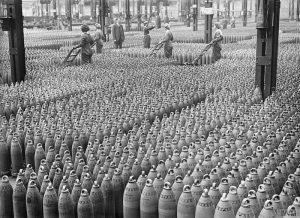
Munitions Production on the Home Front, 1914-1918. Imperial War Museums. Public Domain.
And there are painfully few options available, if any still exist at all. Despite some twenty-odd years of near-continuous combat, neither US industry nor the wider population have been mobilized for the possibility of a major war…or wars. In 1941, as the forces of Imperial Japan were attacking Pearl Harbor, the United States had been girding for war for nearly two full years, mobilizing a “command economy” to increase the production of war materiel to support Great Britain in its war against Hitler’s Germany, and instituting the first peacetime military draft in the country’s history, giving all of the armed services of the day time to bring in and train troops in readiness for war.
None of that has been happening in the last 20+ years. And the cold reality is that it is likely not possible, without twenty years, minimum, of corrective measures: Thirty years of globalism’s industrial and business realities have removed the bulk of heavy industrial manufacturing from within the borders of the United States. Likewise, there is virtually no chance of the Draft being reactivated; while it is certainly still on the books as a legal option, the social policies instituted, promoted and encouraged by the Democrat Party in the last fifteen years have poisoned the recruiting well for the military, encouraging the armed service’s core demographics to pointedly not step forward to enlist. Basic training has been eroded to the point where the vast majority of troops with under ten years service are not psychologically prepared for combat at any level.
And yet – the chickenhawks of the Swamp persist, thinking that their actions to please their vote base have had no impact on military readiness – despite facts to the contrary – because they are so disconnected from the real world…
…Now, if the issue were simply Iran and a shortfall for materiel’s shipments to Ukraine, this might not be that large of a problem. A problem, certainly, but not a critical one.
However, as many chickenhawk cheerleaders crow over the recent attack on the Kerch Bridge over the Sea of Azov, Russia’s response was swift and decisive: Russia has abandoned the deal it agreed to previously, which allows the export of Ukrainian grain crops to supply the world’s food needs.
Satellite picture of Crimea, 05-16-2015, with location of the Kerch Bridge in red. NASA. Public Domain.
Russia is now actively targeting the port city of Odessa with long-range missile strikes, and is laying naval mines to close off Ukraine’s remaining coastal regions. Moscow has also hinted at the possibility that it will attack commercial vessels attempting to reach Ukraine.
The real danger in this series of moves lies far to the south, where Egypt is critically dependent upon Ukrainian wheat to feed its population. In the face of this loss, Egypt – already struggling with massive unemployment and the irrational and childish dismissal of its concerns over the Grand Ethiopian Renaissance Dame (GERD) project by the government in Addis Ababa.
This is important, because if Egypt lashes out against Ethiopia in desperation – using an air force largely reequipped by the US – it could easily spark a much wider war, a war that could easily result in the closing of the Suez Canal…an act that, as was demonstrated by the grounding of a single container ship in 2021 for less than a week, would up-end the world trade system.
Which loops us back to Iran.
If the United States tilts that windmill, it will destroy the International North–South Transport Corridor, the decade-old project by Russia, China, Turkey, India and Iran to build a trade corridor designed to drastically shorten the transit of commercial cargo, bypassing the Suez Canal entirely.
This is a hair-trigger environment that is capable of sparking World War 3. This is not hyperbole, in any way.
It is solely the construct of the Swamp – a body that imagines itself as completely immune to anyone it deems “lesser”…which term includes you and I.
Let that sink in.
The Freedomist — Keeping Watch, So You Don’t Have To
There is a perception in the world, a perception with solid reasoning behind it, that the United States of America is the most powerful nation in the recorded history of the world. In fact, the world system of the early 21st Century is hinged on that very concept.
But – is it true?
Economically, the United States is certainly a powerhouse. As measured by Gross Domestic Product (GDP) the US economy is almost larger than the next three economies in the world. However, in GDP per Capita the US is seventh, and in Purchasing Power Parity (PPP) (a measure of the ratio of the price of a “basket of goods” in different countries, that is used to compare the absolute purchasing power of national currencies), the US is in 10th place. In exports, the US is in second place to China, and even then, the vast bulk of US exports are limited to petroleum, aircraft, pharmaceuticals and medical instruments, due primarily to the high costs of US labor. Dangerously, the imbalance of imports shows that the US is reliant on the willingness of the rest of the world for a vast amount of its real goods, like industrial machinery.
We could talk about how reporting on the quality of education in the US is “cooked”, but we’ll let the World Population Review discuss that.
But really – that’s not why you’re reading this, right? After all, if the Reader has been reading the Freedomist for any length of time, you are fully aware what my focus is. So, let’s go there.
Militarily, the United States Armed Forces possess a set of demonstrated structures that maximize its global reach and power projection…in theory. The state of the US military – and, critically, its supporting industrial base and capacity – is abysmal. This is not a question solely of culture or corruption, although those things are certainly major factors. The issue to keep in mind, here, is that the United States military is an apolitical and a-cultural bellwether for the nation – if the military works, the nation’s political and cultural problems are not insurmountable; conversely, if the military isn’t working, metaphorically speaking, the nation is in danger…How much danger, we will look into below.
Why is the military in the poor state that it is? On the surface, the issues started to became public, albeit in a very quiet way, in 2001…not with the 9/11 attacks, but with the release of the 2001 Quadrennial Defense Review. The 2001 QDR – one of a series of documents issued every 4 years from 1997 to 2017 by and for the Washington, DC bureaucratic swamp that describes a “4-year plan” (…) – was the first to explicitly state the plan to replace the notion of “strategy” (in the historical sense) with “capabilities-based planning”.
Basically, “strategy” was too hard to do effectively in an “asymmetric environment”, where hostile actors could erupt anywhere, at any time, and act in unpredictable ways. So…it followed that traditional strategic planning model no longer functioned. The solution – “capabilities-based planning” – posited the notion that if an issue arose, a “basket” of units with various capabilities appropriate to the nation, region and operational environment could be quickly assembled, and thrown into action, until the problem went away.
Given what should have been the obvious disaster in the making with such a childish idea, it should be no surprise that it failed, miserably, utterly and completely, almost from its first use.
But the problem is much deep than this.
JUNGLE GHOSTS
The United State Armed Forces were badly scarred, in a psychological and cultural sense, by the collapse of the Western effort in the Vietnam War. This is well known. What is not so well known, at least among the general public, is the US military’s responses to the defeat.
South Vietnamese refugees aboard a U.S. Navy vessel during Operation Frequent Wind, the final evacuation of Saigon, Republic of Vietnam. April 29, 1975. US Department of Defense. Public Domain.
The US military, as a group, essentially abandoned “counterinsurgency” in the aftermath of the Vietnam defeat. It had deployed massive forces, conventional and special, which had uniformly fought hard, in a confusing and frustrating environment. And it had failed. In the bizarre world of guerrilla warfare, while US and Allied units won every engagement above the level of the infantry company, they had still lost the war, because South Vietnam had ultimately fallen, seemingly rendering the efforts moot.
The reasons for South Vietnam’s collapse are many, and not the subject for this article. But, the reaction by the US military was to refocus all of its efforts towards very likely fights with the Soviet Union and the People’s Republic of China, in effect, “World War 3”, ala, “World War 2, but with lots more nukes.”
To do this, the US military – primarily the Army – had to rethink its concept of strategy, following the failure of its “Pentomic Army” experiment. The answer seemed to arrive in 1976, when John Boyd, Colonel, USAF (ret.) first presented his “Patterns of Conflict” work, that outlined what is now known as the “OODA Loop”. The OODA concept took the US military establishment by storm in the mid-1970’s, and resulted in two things: the revitalization of the Opposition Force (OPFOR) concept, and in a new battle strategy for winning the conventional side of World War 3 – “AirLand Battle”.
The US military had maintained the idea of an “opposing force” as a training model since 1946; in fact, the Freedomist covered this unique and seminal organization in May of this year. In the late 1970’s, the program was completely overhauled, and centered on a then state of the art training facility at Ft. Irwin, CA, and later at Ft Polk, LA (now renamed as Ft. Johnson), which focused on counterinsurgency as operations in Iraq and Afghanistan shifted in focus, in concert with the US Marine Corps’ facility at 29 Palms, CA. The concept has been maintained and updated over the years. The concept created the most realistic combat training facility ever established, that trained a generation of primarily US Army armor officers and troops in how to fight and win on an armored battlefield. The armored warfare training program fell out of extensive use during the Global War on Terror, as there was little need for massed armored formations after the successful invasion and conquest of Iraq in 2003.
Coupled to the success of the AirLand Battle concept in 1991, it seemed that the US military had recovered from Vietnam, and was back in the dominant position it had seemingly enjoyed since the end of World War 2.
A Brigade of the U.S. 3rd Armored Division masses in northern Saudi Arabia in preparation for the invasion of Iraq during the Gulf War, February 1991. US Army photo. Public Domain.
COLLAPSE?
But, lurking beneath the surface, there was a palpable, unsettled feeling – something just didn’t…“feel right”. There was suspicion, whispered in private, that we were actually training potential combat leaders how to “win the battle, but not the war”. Those concerns, however, were mostly forgotten as “bumps in the road” and “just bad luck”, as Iraq and Afghanistan metastasized into the quagmires they became.
But, hey – counterinsurgency is hard and messy, right? It’s comparatively a lot harder than the good, old-fashioned smash of the armored fist into the bad guy’s face.
Right?
But then – Russia formally invaded Ukraine. (The war had actually been going on for some eight years by 2022, but no one wants to talk about that.) And, after a year of intense combat – the very type of “main-force” combat Western combat leaders thought AirLand Battle was designed to fight – the Ukrainians launched a counter-offensive in the summer of 2023, using troops given a “quickie” training course in US/NATO AirLand Battle concepts, and fortified with deliveries of US M2 Bradley Infantry Fighting Vehicles and German Leopard 2 main battle tanks…..the results were as dismal as they were alarming.
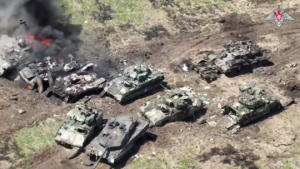
A Ukrainian Leopard 2 tank and several Bradley fighting vehicles destroyed by the Russian forces in Russia’s Zaporozhye Region, June 2023. Photo: Mil.ru. CCA/4.0
The US military, as well as the armed forces of the wider NATO Alliance, is getting a ringside to the live practice of the war they planned to fight…and it doesn’t look good.
The reality is that the AirLand Battle concept was never designed as an “attack” strategy, like its predecessor, the misnamed “Blitzkrieg” – it was always implicitly a defensive strategy. While people in the higher levels of the Army and the wider Pentagon establish speak confidently and relentlessly about “combined arms” and “maneuver warfare”, the cold fact is that their operational plans remain rooted in Airland Battle doctrine, a doctrine that does not play well on the offense…unless, of course, your opponent is a badly-trained, badly-equipped and demoralized rabble, who hate their leaders so much, they are willing to allow a foreign invader to enter and conquer their nation, wholesale.
The situation with Ukraine and Russia is spiraling out of control. What began as a craven attempt to restart the Cold War for “fun and profit” has now grown, until it is beginning to run off of the rails. This naked corruption, coupled to unsustainable recruiting numbers in the armies facing Russia – and soon, perhaps, those of Belarus and the People’s Republic of China – and an exhausted and flagging industrial base that cannot keep up with the vast needs for munitions and weapons – and not simply advanced weapons, but even basic arms – has led the White House to the highly unusual (and frankly rather alarming) decision to activate individuals within the “Inactive Ready Reserve” for immediate deployment to the European Combatant Command.
In 1941, as the Japanese launched their attack on Pearl Harbor, the United States had spent well over a year building up its military forces in the first peacetime military draft call-up in the nation’s history. As well, war industry production had been steadily increasing since 1939; Lend-Lease would be formalized in early 1941, vastly increasing the production of war materials.
Neither the United States nor its allies have been able to increase production of basic military supplies like artillery ammunition. No one willing to support Ukraine seems to be able increase its production rates to serious war levels, even after some eighteen months of fighting. Western defense firms do, indeed, produce very high quality weapons…but that quality comes at an equally high price, in that those weapons frequently require special materials and/or complex components, all of which cost a lotof money.
And, just as there is no desire in the West to “gear down” to use simpler weapons and equipment, there is no desire to implement a peacetime draft to flesh out military numbers; in fact, a peacetime draft may be impossible, not only in the US, but in most of Western Europe…
And meanwhile – Russian industry is working multiple shifts, not simply producing war material for Ukraine, but fulfilling foreign orders as well. China is expanding its influence in resource-rich Africa, while securing “back door” supply chains to support Russia through its “Belt & Road” corridors in Asia.
The outlook is grim. For far too long irrational, incompetent and openly corrupt corporations and politicians have been inventing ways to sustain the “Great Green Machine”. For twenty-odd years, “Achmed the Goat-Herder” was touted as an existential threat to Western Civilization. When that failed – not simply because the general public realized that presentation for the lie that it is, but because using a $100million+ fighter plane to bomb Achmed is stupid and wasteful in the extreme – it was decided to push Russia into a “cold” conflict, to boost sales numbers.
And now…the incompetents in charge have no way out. They think that they do – but they do not. They are playing at a craps table, where failure will lead to a nuclear exchange.
And that exchange is aimed at you and me.
The Freedomist — Keeping Watch, So You Don’t Have To
Back FREEDOM for only $4.95/month and help the Freedomist to fight the ongoing war on liberty and defeat the establishment's SHILL press!!
Are you enjoying our content? Help support our mission to reach every American with a message of freedom through virtue, liberty, and independence! Support our team of dedicated freedom builders for as little as $4.95/month! Back the Freedomist now! Click here