With all the recent talk of nuclear war, catastrophic shortages of vital fuels, Europe in complete economic meltdown and Communist China’s stock markets tanking as a dictator is “reelected“, a person could be forgiven for thinking that “The End” really might be nigh. However, there is one thing that most people have forgotten about in all the tumult…and Joe Biden’s Democrat Party is directly responsible for it:
Terrorism inside the United States.
Now, again, the Reader could be forgiven for thinking that this is hyperbole, or some desperate attempt at cashing in on some “counter terrorism” degree, but no – this is quite serious. There is a clear and present terrorist threat to the home territories of the United States, one that was set up (whether by intent or incompetence is irrelevant, now) by the Democrat Party, and that has been exacerbated and accelerated by the Biden Administration since January of 2021. What is the source of this, you might ask?
Illegal immigration.
I can hear the groans in the back rows, already…You would do well to keep reading.
Back in the “good old days,” illegal immigration was tolerated by both parties, because it scored points for the Democrats with the Hispanic Community, and it provided a source of cheap labor for agribusiness and later, for construction, making certain GOP interests happy. While there were occasional scandals, followed by roundups by “La Migra”, it was still tolerated, even though it was beginning to erode the viability of “entry-level” work in the United States.
Over time, however, the Democrats began to change the game: it was no longer about simply scoring fractional points with minority communities, but about actually using illegal aliens as “straw voters”, who could be shuttled to polling stations, posing as dead people to vote…for a certain party, of course. Like most things, it didn’t start out big, but it began to grow unchecked, in the late-1990’s. After 9/11 there was some concern about terrorists infiltrating over the border, but since nothing happened, the Democrats quickly spun the notion as unhinged paranoia, that verged on racism. Meanwhile, the economy – for many reasons – continued to sag.
In the chaos of 2016-2022, however, illegal immigration began to skyrocket out of control, as the US descended into a low-key civil war. Inside the US Government, loyalists of President Donald J. Trump and bureaucrats trying to simply do their jobs, attempted to carry out the directives of the President, as they are legally obligated to do, while others actively worked to undermine the President, sometimes verging close to sedition, if not treason. While the Trump Administration accomplished many things, those within the government structure who decided that their personal political beliefs were more important than their oaths deliberately hindered many more. Dangerously, this rose to the point of Democrat loyalists declining to comment on open support for waves of illegal immigration openly being supported by the United Nations, even given the extreme dangers faced by migrants, themselves, on the journey north
Once President Trump’s reelection bid failed – again, whether legitimately or by malfeasance no longer matters – and Joe Biden entered office, the proverbial floodgates were opened: the numbers of illegal aliens being detained by the Border Patrol are the highest ever recorded in the 97 year history of the agency, with nearly 2 million being reported by the agency in the first nine months of the Biden presidency. As of the end of October 2022, the cross-border flood continues.
While this is clearly a massive problem on many levels, for security professionals, this is particularly worrying, because a very large percentage of the border-crossers fall into the dangerous category of “military-age males”, or, those males between the late-teens and mid-30’s, who are suitable for military service. Further, increasing numbers of border crossers are from African countries.
Why is this important?
Simply put, while the mainstream media decided that terrorism was passé, the actual terror groups out there have very much ignored that pronouncement. As well, while many people, and especially many in the under-30 year old demographic within the United States, have been fed a steady media diet of the concept that “terrorist” equates only to “Middle Easterners” and “straight, white males,” the truth is that many of the radical Islamist groups since 2000 have recruited far and wide, and are just as diverse as either the US military – or the Leftist protestors of North America and Europe who lack the education or worldly experience to understand what is happening.
So – is this just hysterical paranoia? After all, there have been no major terror attacks inside the United States since 9/11, right? (We’re not going to talk about Las Vegas today, because you’re not ready for that conversation.) So why marginalize ‘migrants’?
Because, as the second President Bush said: They hate us. And they will not stop.
Assuming – for the sake of argument, to placate the naysayers – that the last sentence is true, how does that relate to immigration/migration?
In 1974, R&D Associates – a think tank in Santa Monica, California – working under contract for the Department of Defense, produced a document titled A Soviet Paramilitary Attack on U.S. Nuclear Forces – A Concept (PDF link). The paper sketched out a threat concept to US strategic nuclear forces, wherein Soviet Spetznatz special forces could potentially infiltrate sabotage teams into the US to attack ICBM, bomber and nuclear submarine bases, simply by walking in over the borders from Mexico and/or Canada. It goes into detail of then-current estimated numbers of illegal aliens crossing the US border, who were not intercepted by the Border Patrol, and pointed out that enough four- to six-man teams could be infiltrated and housed by ‘illegal’ KGB agents just long enough to sabotage US nuclear forces in preparation for a Soviet first strike.
A group of about ten terrorists (it may have been a smaller team) slipped into the seaside megacity, and launched a brutal assault on the city’s tourist district, killing at least 166, and wounding over 300 over the course of a 3-day battle, doggedly holding out against elite Indian Army commandoforces and troops from the crack Jat Regiment to the bitter end.
Those are the facts that most people who know anything at all about this incident know.
Much less well known, is how the terrorists got to Mumbai.
The terrorists were given advanced military training by elements of the Pakistani army and intelligence services, including boat training. The terrorist team headed out into the Indian Ocean on November 21, 2008, and motored along for two days, until they hijacked the Indian fishing trawler Kuber, killed four of the crew, and forced the captain to sail for Mumbai. Arriving off Mumbai at dusk on November 26, the terrorists dropped anchor, killed the captain, and headed into Mumbai Harbor in three inflatable boats. Shortly after, the terrorists begin attacking civilians, and took up positions in various locations.
And, to top it all off, the terrorists were in constant communication – via cell phone – with an internet-capable “tactical operations center” (TOC) that had been set up on the fly in an apartment in Pakistan.
Very James Bond, yes?
So, how do illegal immigration, a moldy study from the 1970’s, and a terrorist attack in 2008 track with each other?
Mumbai was not a “hardened” target; quite the opposite – it was a treasure trove of “soft” targets: train stations, hotels, nightclubs, hospitals and a religious school.
Just like American cities.
For a well-financed terror group, slipping 200 to 300 ‘actors’ into the United States by simply hiking over the border is not a difficult challenge. Potentially, they could slip in as a single group. It’s not as if anyone would notice, amid the throngs moving over the border. Arming them? Also not hard – they don’t need to actually try and purchase weapons legally; AKM’s and M16 and M4 carbines abandoned in Afghanistan are light enough to fit into a backpack, and making homemade hand grenades can be done by a simple shopping trip to a hardware store (no, we will not discuss “how to”).
And all of this, if before we start talking about attacks on the power grid, as winter arrives.
Now, am I implying that the Democrat Party set this up deliberately? Certainly not – I don’t think they are smart enough, to be perfectly frank. I am, however, absolutely certain that there are plenty of terror groups out there who are smart enough to figure this out. Nothing talked about above is “classified”, and really doesn’t take much to figure out.
Security professionals – the real ones – rarely sleep well, knowing that these threats are out there…much less, when they know that significant elements in Washington, DC are actively creating the permissive environment necessary for all of this to happen.
Stock up now. Arm up now. Talk to your neighbors now. If you don’t – you will be very much on your own.
Good luck.
The Freedomist — Keeping Watch, So You Don’t Have To
This is a bizarre tale. It is the story of two men, four events, and how the world – after three-quarters of a century – has come to the brink of total war, again…a war that threatens the fabric of civilization, itself.
Qutb was born in rural Egypt, in 1906. By any rational measure, Qutb should have been an inspiring and moving success story. Deeply religious, Qutb held a burning passion for education, yet throughout his life, firmly held that religious studies should be taught only in conjunction with modern, secular studies. In a time where few of his neighbors could afford to send their children to school, Qutb slowly and painfully built up a large – for his village – library of twenty-five books, and forced his way through his own shyness to try and teach other village children (boys and girls, alike) what he had learned.
Egyptian village of Keneh, c.1918. CCA/2.5
This passionate thirst for knowledge and education eventually bore fruit, and Qutb became a teacher, working for the Ministry of Public Instruction, in 1933. Six years later, he took a minor post with the Ministry of Education, itself. Qutb soon became an author in his own right, publishing several novels, and helped several other authors launch their own careers, including that of noted novelist Naguib Mahfouz. Qutb’s first major theoretical work of religious social criticism, Al-‘adala al-Ijtima’iyya fi-l-Islam (“Social Justice in Islam”), was published in 1949.
In 1948, the Ministry of Education sent Qutb to the United States, to study the American educational system. The event changed Qutb’s life.
“Culture shock” is not a good description of Qutb’s reaction to the late-1940’s United States — “horror” would probably be more accurate.
Sodom and Gomorrah afire by Jacob de Wet II, 1680. Public Domain.
While Egypt was Westernizing slowly, Qutb was – to use the Americanism – “a real square”: women had their place (well-treated, but very much under the care of their husbands and fathers) but he also found Americans unhealthily devoted to the most inane things: devotion to materialism paled in Qutb’s mind, to the American obsessions with lawn maintenance and jazz music; the open racism prevalent at the time likely didn’t help. It would not be a stretch to say that Qutb viewed the United States as something in the same category as the Biblical Sodom and Gomorrah, or Babylon. The experience bred in him a horror and hatred of Western culture, and began his slide towards what became Radical Islam.
Upon his return from the United States, Qutb would publish his experiences in “The America That I Have Seen.” He resigned his post at the Education Ministry, and joined the Muslim Brotherhood, swiftly rising through its ranks, and quickly became one of its leading intellectual lights.
Qutb and the Muslim Brotherhood initially welcomed Gamal Abdel Nasser‘s coup d’état against the Egyptian monarchy in 1952, but quickly broke with him when it became obvious that Nasser had no intention of establishing an Islamic state in Egypt. There followed a predictable pattern of plots, prison, torture and radicalization, followed by execution by hanging, in 1966, that made Qutb into a martyr.
However, Qutb’s later, apocalyptic writings – from a brief period of freedom before his final arrest – have lived on, and have come to form the coals of the fire of modern radical Islamic thought.
Anatoly Golitsyn was an officer, specifically a Major, in the KGB, the Soviet Union’s dreaded intelligence service of the Soviet Union. In 1961, Golitsyn defected with his wife and daughter from Helsinki, Finland, and was spirited to the United States, where he was interviewed at length by the CIA. His defection caused an immediate shock wave within the KGB, generating a series of cables to Soviet embassies around the world, with instructions on how to mitigate the possible damage from his defection.
Golitsyn has always had a controversial reputation in the intelligence community. On the one hand, the Britishgeneral, SirJohn Hackett, at one time the commander of the British Army of the Rhine, described Golitsyn as the most valuable defector to have ever reached the West; on the other hand, the official historian of Britain’s MI5 intelligence service described his assessments as questionable, even while acknowledging that his raw intelligence was solid.
The primary reason for this dichotomy was a remarkable claim that Golitsyn made during his debriefings, where he claimed the existence of a long range plan, begun by “elements” within the KGB, to undermine the Western states, specifically the United States, a a plan which would result in an ultimate victory for worldwide Soviet Communism. This plan would revolve around a “seeming” Soviet and Communist collapse on a worldwide scale, that would lull the West into apathy, while allowing the Communist leading states of Russia and the People’s Republic of China to rebuild themselves, bringing about a Communist victory when the West collapsed under the strain. Golitsyn revealed this idea publicly in his 1984 book, New Lies For Old, and later, in 1995’s The Perestroika Deception.
Vladimir Putin (President of Russia), 2018. Public Domain, CCA/4.0
As remarkable as this story was, sounding as it does like the plot of a Robert Ludlum novel, historian Mark Riebling claimed in his book Wedge – The Secret War between the FBI and CIA (Knopf, 1994) that of 194 predictions in New Lies For Old, some 139 had been proven true by 1993, nine were clearly wrong, and the remaining 46 were ‘not soon falsifiable’.
One part of this complicated plot was the infiltration and undermining of Western institutions, such as the Catholic Church, and centers of higher learning. As was proven repeatedly throughout the Soviet Era, idealistic – but impressionable – young people could be turned into rabid Communists by having “agents of influence” prey on their inherent good natures, by convincing them that Marxist-Leninist thinking was the best – and only – way to improve the lives of the downtrodden. This process was outlined in 1954, in the exposé “School of Darkness: The Record of a Life and of a Conflict Between Two Faiths“, by Dr. Bella V. Dodd, at one time a leader of the Communist Party of America (CPUSA). The specific mechanism used in this undermining process is a concept called “strategical diversion“, as outlined to the public by another KGB defector, Yuri Bezmenov, a process which seeks to alter the perception of reality through what we would now term “information overload“.
KGB defector Yuri Bezmenov’s warning to America (1984) (Full interview HERE)
One clear result of this infiltration is the marked reluctance of Western academia to discuss the murderous nature of the Soviet state, not simply under the reign of Josef Stalin, but continuing all the way through the supposed collapse of the Soviet state itself, even while highlighting foibles of western countries that pale in comparison to the wholesale slaughter inflicted by the Communist world.
Another obvious aspect of this plan was the undermining of US influence and image within the Third World. This brings us to the four events of this analysis.
The “Baker” explosion, part of Operation Crossroads, a nuclear weapon test by the United States military at Bikini Atoll, Micronesia, 1946. DoD Photo. Public Domain.
Unlike what many people may be thinking at this point, the list of events does not begin with Vietnam. In the 1950’s and 60’s, the United States as seen as near-invincible. Although the Korean War had ended in a stalemate, and the US and USSR were engaged in tit-for-tat one-upsmanship around the world, no one – least of all the Soviet Union – seriously considered that war at any realistic level with the USA was even remotely winnable. That said, as the 1960’s wore on, it became apparent to anyone paying attention that the United States was stumbling. This was to be expected: no country is ever going to have it all go their way, all the time, and the United States was not immune, despite a c.150-year track record of winning, both internally and externally. No, the triggers in this story begin in a very different place:
From this start, there would be a swift series of seemingly unconnected blows over the following twenty-four months, that would combine to thoroughly undermine the West, and raise the specter of world war, once again, albeit of a very different type…before the old ways appeared to have returned.
Iran – ancient Persia – had spent the 20th Century unevenly trying to Westernize itself. But, the road was rocky. The ruling Qajar Dynasty was overthrown in 1925 by army office Reza Pahlavi, who soon made himself Shah at bayonet-point, and founded the House of Pahlavi. However, endemic corruption, increasing paranoia and very poor choices in foreign policy in the run-up to World War 2 led to the invasion of Iran by British and Soviet forces in 1941. Reza I was deposed, and his young son, Reza II, was installed as a puppet. As the United States’ “Lend-Lease” policy began to shift into high gear, Iran became a vital avenue of supply to a beleaguered Soviet Union.
Official portrait of Mohammad Reza Pahlavi, 1973. Public Domain.
Following World War 2, Reza II worked to repair his house’s reputation, and began a program of modernization. However, the Soviet penetration of Iran had immeasurably strengthened the Tudeh Party, the Iranian Communist Party. This group helped to foment the unrest of 1952-53, which ultimately resulted in the United States overthrowing a democratically-elected government, in favor of an autocratic monarchy.
In the aftermath of Operation Ajax, Reza II worked hard to modernize and and Westernize Iran. Ultimately, the Shah turned into Iran into a bastion of Western military power directly abutting the Soviet Union’s border.
In doing so, he came into conflict with hardline Shi’ite clerics, ultimately led by the Ayatollah Ruhollah Khomeini. However, it is increasingly apparent that the Tudeh Party began infiltrating the Shi’ite religious establishment in Iran, in a manner similar to that used in the United States.
Ayatollah Khomeini returns to Iran after 14 years exile on February 1, 1979. Photo by Sajed.ir
Exiled to Turkey in 1965 (where he stayed in the home of a Colonel in Turkish military intelligence), Khomeini moved to the Shia holy city of Najaf, Iraq, where he would remain until October of 1978, when he was expelled on the direct orders of Iraqi dictator Saddam Hussein. Khomeini had by then assumed the leadership of anti-Shah sentiment in Iran, following the death “under mysterious circumstances” of the previous acknowledged leader, the revolutionary sociologist and historian Dr. Ali Shariati in a Southampton hospital in 1977.
Iran had become increasingly unstable in the preceding five years, so much so that the Shah – ill with terminal cancer – was completely unable to deal with the unrest. As well, the United States appeared utterly incapable of aiding one of its most important allies in the Middle East. With Khomeini’s expulsion from Iraq, the situation escalated, until the Shah and his family “went on vacation” at the end of January, 1979. Khomeini returned in triumph on the first of February, and officially declared the end of the monarchy and the creation of an “Islamic republic” on the eleventh. The increasingly downward spiral within Iran led directly to an open break with the United States, with the seizure of the US embassy on November 4th.
The appearance of helplessness in its inability to save what appeared to be one of its strongest allies severely – possibly irreparably – damaged the image of the United States as a strong bulwark of democracy in the world. Abandoning South Vietnam to its fate after a bruising, 15-year long war could be written off as a stumble. Likewise, the fall of the Somoza regime in Nicaragua could be viewed as inevitable. But, like the shattering of the public perception of the character of the Vietnam War following the release of the so-called “Pentagon Papers“, the fall of the Shah and the radicalization of Iran came as a brutal shock to many in the West, but especially to many in America. Indeed, the fall of the Shah was the prime reason behind the complete defeat of of President Jimmy Carter’sreelection bid.
But then, a curious thing happened.
Nearly forgotten by the Western public, some two weeks after the seizure of the US embassy in Tehran, a group of men stormed the Grand Mosque in Mecca, Saudi Arabia, on November 20, 1979.
Saudi soldiers wearing gas masks, and armed with G3 battle rifles, fight their way into the Qaboo Underground beneath the Grand Mosque of Mecca, 1979. Public Domain, per “Saudi Arabian Law Royal Decree No: M/41”
The bloody, two-week long siege of the Grand Mosque – Islam’s holiest shrine – seriously undermined the ruling House of Saud, in ways not fully understood at the time. However, within the Islamic world, the stamping out of a “false Mahdi“, and the frantic attempts to blame the Khomeini regime for the attack backfired, as Khomeini (and the KGB) swiftly capitalized on the attack by blaming it on the United States. The resulting uproar caused demonstrations and riots throughout the Muslim world, and led to the destruction by mobs of the US embassies in Libya and Pakistan.
Although the militants were rooted out, and the leader and 67 of his surviving men were beheaded for the seizure, the real aftermath was that the Saudi monarchy was forced to yield more and more authority to the country’s conservative Ulama.
But, there is one final act to this blood-soaked play: The Iran-Iraq War.
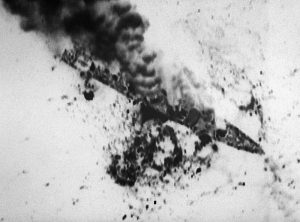
An aerial view of the Iranian frigate IS Sahand (74) burning on 18 April 1988, after being attacked by aircraft of U.S. Navy Aircraft Carrier USS Enterprise (CVN-65), during Operation Praying Mantis. Photo by US Navy. Public Domain.
…To review, we have a sequence of four events, spanning some twenty-four months – three of the events happening in the space of a mere eight weeks – that are clearly related to, and feed off of each other, yet which have no real reason to exist separately:
The implosion of the Pahlavi regime, while perhaps inevitable, was noticeably accelerated by the expulsion of Khomeini from Iraq by Saddam Hussein, a known and acknowledged ally of the Soviet state. That implosion and collapse led, swiftly and directly, to the imposition of a brutal regime almost irretrievably hostile to the United States, a regime certainly heavily infiltrated by the Iranian Communist Party.
While no hard evidence exists pointing to Soviet or Iranian Revolutionary involvement with the seizure of the Grand Mosque, both Iranian and KGB sources were surprisingly swift to put out believable stories blaming the United States for a very unique and specific event…which, in the KGB’s case, is even stranger, given what would happen eight weeks after the Grand Mosque was retaken by Saudi forces.
The Soviet invasion of Afghanistan was an act of blinding insanity: it critically damaged the Soviet Union’s image throughout the Muslim world, and virtually guaranteed a steady stream of volunteers to battle “godless Communist dogs” — America might be the “Great Satan“, as Khomeini continually railed, but they were at least nominally Christian, and thus, “People of the Book“. Likewise, there could be no rational view of the invasion by the Western powers as anything but a direct threat to Pakistan, another US ally in upheaval, already facing the regional titan of India – then, a some-time ally of the Soviets – and now facing the might of the Soviet Union hard against their northern border. There was no scenario in which the US could not respond as they ultimately did, arming and training the Afghan Mujaheddin…and waiting in the wings, were the students of Sayyid Qutb. Qutb’s final, apocalyptic tracts, written after the duress of imprisonment and torture, had nowhere to go, and were withering on their poisoned vine…until saved by the revolutionary fervor of an “honest holy war,” against an avowed enemy of all religion.
Some nine months later, Saddam Hussein invaded Iran. While much has been made of Soviet attempts at courting both sides, in reality the long, bloody war worked doubly in the Soviets’ favor: Revolutionary Iran was bled white, losing nearly an entire generation of its young men in the fighting, while its attempts to spread its revolution were severely curtailed with the wrecking of its economy and the utter destruction of its navy. Meanwhile, Saddam’s Iraq was badly weakened, and in his weakened state, he could be counted on to act foolishly, out of desperation, when his neighbors refused to give him leeway with Iraq’s debts incurred fighting revolutionary Iran.
USAF aircraft of the 4th Fighter Wing (F-16, F-15C and F-15E) fly over Kuwaiti oil fires, set by the retreating Iraqi army during Operation Desert Storm in 1991. USAF Photo. Public Domain.
And all the while, the serpent birthed by the United States’ undermining of the Soviets in Afghanistan – Al Qaeda – grew and developed like the cancer that it is, ultimately rising on September 11th, 2001, to strike directly at the heart of the United States, sparking what has become a multi-decade war, rooted in the extremist ideals of “offensive jihad” of Sayyid Qutb…
…Now, there is no reason to connect any of these disparate events – in the absence of Golitsyn’s conspiracy plan. If Golitsyn was wrong, then the events of the twenty-four month period of October 1978 to September 1980 are simply happenstance, nothing more than the Fickle Finger of Fate at work.
But — if Golitsyn is correct, the implications are dire.
This is not simply a matter of ironmongery; buying more “stuff” is not the problem. The United States military lacks the manpower – and has lacked it for almost two decades – and the training to face either former KGB officer Vladimir Putin’s Russia or Xi Jinping’sChina. This is because of a conscious decision to not fully mobilize the nation to fight in the War on Terror. As well, the nature of the conflict in the Middle East that the US fought for nearly twenty years has led to an atrophying of capability to fight “main force” opponents, which Russia – and increasingly China – most certainly are…and, given fundamental – and objectively disastrous – policy changes just before 9/11, that is unlikely to change in the near-term.
The outlook for political leadership within the United States is bleak. With a bitterly divided electorate, trust in government leadership is at an all-time low. The political structure of the United States seems pathologically devoted to attacking everyone and everything at home, instead of watching the borders, and what lays beyond.
While that was a strategy that may have worked twenty-five years ago, it will not work now.
President Donald J. Trump was clearly a lightning rod of controversy for the course of his Presidency. It is clear that open mainstream media bias contributed to a negative public perception of him. In the aftermath of a questionable election, it is unclear whether the majority of the American people can be motivated to care enough to recall that national unity sometimes requires disciplined collective action, much less that disagreements do not need to be fundamental.
What is abundantly clear, however, is that the current incarnation of the Democrat Party is fundamentally incapable of dealing with the kaleidoscope of problems the nation faces, because their entire political existence is predicated on wooing an increasingly shrinking minority, while desperately trying to maintain control of the narrative via mediums that are rapidly becoming irrelevant.
While it may sound alarmist, there is no fallback position, now – if the United States is unable to “get its act together”, there is nowhere to fall back to. If there is no effective response to the rise of Russian and Chinese aggression, the world will go to a very dark place — and will stay there for a very, very long time.
The Freedomist — Keeping Watch, So You Don’t Have To
We’ve all seen them — whether picturesque castles, grim fortresses, chaotic and open firebases, or grimy underground tunnel warrens — most people know a “fort” when they see it. Most people, however, also assume that such things are passe, obsolete ideas long overcome by technology.
But – are fortresses obsolete?
From mankind’s earliest days of social interaction, we have been building defensive structures. At first, defense against the weather – mainly, the rain and the cold – was the major concern, mostly because caves could be hard to come by. Over time, however, it became readily apparent that sturdier defenses were needed, to protect us from large predators. Eventually, though, someone realized that improving those structures made it difficult for the raiding party from the next valley to steal all the women and goats. Thus, the first real walls were built…causing, consequently, the first arms race.
As time went on, attackers began figuring out how to get over, under, around or through walls. In response, walls got taller and thicker, and foundations sank deeper into the ground. Covered parapets began to appear. Then, someone built a tower, and someone else extended walls away from it…
This spiral continued for unknown millennia, until – in Western Europe, at least – the early 14th Century. Then, black powder appeared in concert with cannon, and with increasing speed, castles that had withstood multiple sieges began falling, as their inflexible stone battlements were blown apart by stone – followed by iron – shot.
Martello Tower, Shenick Island, County Dublin, Ireland (Source: Pixabay)
It took until the middle of the 17th Century before one man brought fortifications back from obscurity: Vauban.
Sebastien le Prestre de Vauban (1633-1707), Maréchal de France; Artist: Charles-Philippe Larivière (1798–1876)
Starting with the basis of the “trace italienne” designs, Vauban revolutionized the entire science of military engineering, developing a system of both attack and defense from modern fortifications – now, fortresses became more or less impervious to all but the most massive bombardment, and became offensive weapons in their own right. Vauban’s designs were applied around the world for the next two hundred and fifty years. And then, of course, technology caught up.
The advent of high explosiveartillery in the late 19th Century spelled the end – for a time – of Vauban-style fortresses, as the high explosives could obliterate the intricately laid out constructions at will.
But then, an odd thing happened.
Following World War 1, France was left with the stark reality that nearly an entire generation of its young men had been wiped out in the trenches. Needing what we would now call a “force multiplier“, France turned to its military engineers, and built the “Maginot Line“, named for the war veteran and War minister of the time, Andre Maginot.
Ligne Maginot – Schoenenbourg. CCA/2.0
This enormous complex was a series of self-contained concrete fortresses, all of which were built around multiple pieces of heavy artillery. For most of its length. the forts in the defensive belt that ran from the Swiss border to Luxembourg could cover their neighbors with overlapping artillery fires, making any attempt at assault costly to even contemplate. Only the sections beginning at the Ardennes Forest – rough, heavily-forested terrain – were more thinly spread out.
French leaders were convinced that the Maginot Line would force Germany into a repeat of their World War 1 strategy of striking though Belgium, while slowing the attack further south, but that this time France would be ready, and could slow the German war machine down long enough to give France time to assemble allies to once again batter Germany into defeat.
But, when war finally came, French and British troops sat and stared at Germany, until the Nazis smashed through the Low Countries, and forced France to surrender in six weeks.
The hideously expensive Maginot Line, it seemed, had failed completely. Coupled with the other spectacular surrenders of heavily and expensively fortified places in World War 2, it seemed that fortresses were finally dead.
Lieutenant-General Percival and his party carry the Union flag on their way to surrender Singapore to the Japanese, February, 1942. Public Domain.
In fact, only one of the fortresses of the actual Maginot Line ever fell to the Nazis. The most famous fortress built on the Maginot model to fall – that of Eben-Emael, in Belgium – was neither part of a cohesive defensive network, nor was fully manned or supplied, and was not designed to defend against a glider assault, something built into the layout of the Maginot network.
However, the public – and unfortunately, most of the military – perceptions were that the concept of a fortress, as such, was dead, especially with the advent of atomic and nuclear weapons.
A B-61 thermonuclear weapon, showing its major components; Source: US government DOD and/or DOE. Public Domain.
And yet…countries still built versions of fortresses, a practice which continues into the present day.
C-RAM 3 air defense system; Source: US government; Public Domain
One of the chief arguments against a modern fortress is its supposed vulnerability to “smart munitions“, primarily bombs and missiles. However, this dangerous assumption presumes two things to exist: complete command of the air, and a lack of effective anti-missile systems on the part of the defenders in the fortress. The North Vietnamese Armed Forces, like the modern Islamic State, would have happily bombed and shelled US and South Vietnamese fire bases and FOB’s out of existence from afar; however, lacking any effective way to contest the airspace over those bases, those forces were forced to rely on infiltration, suicide bombertactics and human wave assaults. Similarly, although Saddam Hussein’sIraq was capable of buying effective anti-missile systems, he declined to do so, because that would have required a level of technical ability and professional competence to operate that he was loathe to allow in his fragmented military forces.
Another argument against a modern fortress is its susceptibility to attack by conventional ground forces, such as artillery and tanks, as well as infiltration attacks by various types of special forces. This argument ignores the fact that while a modern fortress can indeed be severely damaged by modern high explosives, the amounts of artillery ammunition needed are staggering; in fact, it is questionable if modern armies possess the firepower necessary to reduce a position like Verdun – even with no modern updates – and the fact that infiltration has been tried against fortresses throughout history.
As a result of these factors, no one has attempted to design an actual “fighting fortress“, as such, for almost a century. This begs the question: What would such a fortress look like?
In order to be functional, the fortress would have to be sited to guard a specific location, like its predecessors. It would need an array of offensive weapons, of both tactical- and theater-level, and both active and passive defensive systems, as well as a mobile garrison which could launch conventional attacks against enemies attempting to lay siege to it.
In the offense, the fortress would need batteries of tactical- and theater-level conventional missiles, likely stored ready-to-fire in vertical-launch units; these types of missiles have been in use for decades. Our hypothetical modern fortress would also have an array of emplaced conventional artillery. These weapons, most with ranges in excess of 15km or more, have been in common use worldwide for over a century. The modern fortress could also have some form of armored cavalry unit secured in underground revetments, ready to launch rapid counterattacks if necessary.
A Tomahawk Cruise Missile launch form the USS Farragut (DDG-99), August, 2009. U.S. Navy photo by Mass Communication Specialist 1st Class Leah Stiles. Public Domain.
Defensively, our modern fortress would have passive defenses in the form of Vauban-style approaches, as well as barbed wire and defensive landmine barriers, designed to channel and slow conventional infantry attackers, and making armored attacks on the fortress problematic. Active defenses would include various radars, as well as defensive missiles like the Rolling Airframe Missile and rotary cannon anti-missile turrets, but could also employ more advanced systems, such as “Iron Dome” or a THEL-type system.
Tactical High Energy Laser/Advanced Concept Technology Demonstrator, 2005. US Army Photo. Public Domain.
The penultimate argument actual fighting fortresses in the modern age, at the end of the day, is one of expense: in an era where countries are paying well in excess of US$100million for a single fighter plane, constructing a fighting fortress could be staggeringly expensive.
Back FREEDOM for only $4.95/month and help the Freedomist to fight the ongoing war on liberty and defeat the establishment's SHILL press!!
Are you enjoying our content? Help support our mission to reach every American with a message of freedom through virtue, liberty, and independence! Support our team of dedicated freedom builders for as little as $4.95/month! Back the Freedomist now! Click here