With both Mexico and the United States facing elections for the top offices in their land, the American left and the Mexican left have forged an agreement to assure illegal immigration into the U.S. is limited until their elections are over.
Mexico has an election for their top spot, President, in June while the Democrats in America face an election in November.
Mexico and the United States will hold presidential elections within the same calendar year for the first time in more than two decades. Mexican President Andres Manuel Lopez Obrador’s willingness to crack down on migrant crossings may have more to do with securing an election victory for U.S. President Joe Biden and his own ruling Morena political party than securing the border. A temporary pause in migration designed to ensure a November win for the Democrats in the United States and a June win for AMLO’s Morena party candidate, Claudia Sheinbaum, could keep the border wide open for years to come.
A 2024 win for both Sheinbaum and President Biden in the near-simultaneous elections would also benefit Mexico’s violent cartels, who profit from the lax national security posture present in both countries. A victory for Sheinbaum, who shares AMLO’s stance on dealing with Mexican cartels with “hugs, not bullets,” will likely spell a continuation of the cartel’s ability to continue flooding the United States with fentanyl and other narcotics if paired with a Biden victory…
The effects of the under-the-radar Biden/AMLO border plan have been visible in Texas border cities. According to a source within U.S. Customs and Border Protection, apprehensions along the Texas border have dropped by 60 percent between December and February. As reported by Breitbart Texas, the sudden reduction in migrant crossings along the Texas-Mexico border began shortly after a series of meetings between Biden and AMLO in late December, followed by a meeting between the Mexican President and Secretary of State Anthony Blinken and DHS Secretary Alejandro Mayorkas shortly afterward.
There are wars, and rumors of wars, all over the world as 2024 dawns. Russia and Ukraine continue to bludgeon each other relentlessly. Israel’s war against Hamas grinds on, threatening to expand into the southern territory of Lebanon under the control of the Iranian-backed Hezbollah terror group. To the south and east, the Houthis in Yemen are waging a “pin-prick war” that has diverted some 12% of the world’s commercial shipping, forcing extensive delays and threatening to log-jam global trade on a scale that rivals the dislocations of the COVID pandemic, as their backers in Iran rattle their own sabers and threaten the oil export structure of the Persian Gulf.
Across the Red Sea from Yemen, wars rage in Sudan and Ethiopia, while Ethiopia’s own actions threaten wars with Eritrea and Somalia. To the north, Egypt and Jordan – for different reasons – are on the verge of internal collapse. Throughout the rest of Africa, nations struggle with internal, interminable and seemingly unsolvable issues, with many states facing continued attacks from radical jihadist militias. In Myanmar, the military government is clinging to power by its proverbial fingernails. In South America, Venezuela continues to threaten the annexation of Guyana, while Bolivia and Ecuador are the new battlegrounds in the war of the drug cartels.
Naturally, with all of these long-running – or suddenly appearing – conflicts, most of them remote, obscure and obtuse to outsiders, there are other conflicts that get lost in the shuffle…but those conflicts are no less important; in fact, many of them are not petty in any way, with the victims not simply being on the short end of the stick, but who were actively abandoned to the whims of ‘realpolitik’.
The war in Kurdistan is just that kind of conflict.
The wars and depredations inflicted on the Kurdish people for over one hundred years have largely been caused by the West, primarily Britain and France…but the United States hasn’t helped. And that war continues, not only against Syria and Turkey, but against Iran.
While the Kurdish nation has been noted as a separate and distinct people since the 11th Century, when the term “Kurdistan” was noted by the Seljuk Empire, it was only after World War 1, and the last, vile gasp of debased European imperialism – the Sykes-Picot Agreement – that the real agony began.
Neither Kurdistan nor its people were given more than lip service by Britain and France. Bolshevik (Communist) Russia repudiated any Russian claims associated with the agreement after the revolution that unseated the Tsar, as they had far more pressing problems. The signatories, channeling previous agreements covering African and Asia, cavalierly split what they, themselves, knew to be ethnically Kurdish areas between themselves to rule. While subsequent, limp-wristed treaties “graciously” allowed for the possibility of a Kurdish state (despite several Kurdish states being organized from 1918 to 1930), the European powers threw up their hands in 1923, and washed their hands of the Kurdish areas, for the most part, with the Treaty of Lausanne, which made no mention of the region at all, condemning the Kurdish people to be split between what is now Turkey, Syria, Iraq and Iran. The Kurd’s only ally of significance was Winston Churchill, who argued for a separate Kurdish state, but his political influence in the 1920’s was very limited, compared to what it would become in later decades.
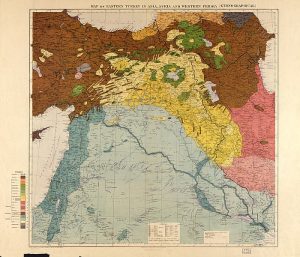
Lt Col Francis R. Maunsell’s map, Pre-World War I British Ethnographical Map of eastern Turkey in Asia, Syria and western Persia, 1910. Kurdish regions are in yellow. Library of Congress.
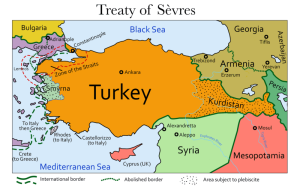
The 1920 Treaty of Sèvres was a draft treaty between the Ottoman Empire and the Principal Allied Powers. It was ultimately shelved because of Turkish non-ratification and was replaced by the Treaty of Lausanne. Map by User:Zero0000 CCA/4.0
But the Kurds wouldn’t give up.
The Kurds sent a delegation to the San Francisco Peace Conference of 1945, which would form the United Nations, to argue for an independent state; they were, of course, refused. But, armed Kurdish groups continually waged low-level guerrilla wars against the states they had been relegated to; the wars’ ferocity depended on how intense the ruling government’s programs to suppress Kurdish culture were at the time.
However, this would occasionally swing into full-on war crime territory, as happened in the Halabja Massacre of 1988, when the Kurdish village was attacked with lethal “war agent” chemicals weapons, primarily mustard gas, but also with a mix of nerve and blood agents. It is generally assumed that Saddam Hussein’s government was responsible for the attack, although allegations have long been made against Iran.
When the 1991 Persian Gulf War ended, US President George H. W. Bush made casual, off-hand remarks, that left many in Iraq – including the Kurds – believing that if they rose up to overthrow Saddam Hussein, they would get at least some help from the United States. Unfortunately for them, the Kurds in the north and Shi’a Iraqis in the south read far too much into the first Bush’s words, and were left stunned (assuming they lived) then they rose up…and the United States barely lifted a finger, seemingly completely surprised that the subject peoples of a brutal dictatorship might actually have the gall to rise up in armed revolt against said brutal government.
The absolute cheek of little people.
Shamed into doing something, though, the Bush administration launched “Operation Provide Comfort” to protect Kurdish refugees fleeing the Iraqi Army units not destroyed fighting the United States and its allies in Kuwait.
Quite unintentionally, this would be the first real break for Kurdish autonomy since 1918. The strict limiting of Iraqi military abilities against the Kurds left the northern people able to organize in safety, and begin building a formal military organization, the Peshmerga, from scattered guerrilla forces. While remaining in “recognition limbo” – without formal recognition as a sovereign state – the Kurdish authorities could not legally purchase military weapons on the open world market, forcing them to develop a “cottage industry” for making weapons, alongside reusing weapons captured from Iraqi forces when the government in Baghdad drags its feet on providing any, buying weapons on the black market and the occasional under-the-table crumbs offered by a scattering of Western states.
With the overthrow of Saddam in 2003, and the resulting upheaval in the aftermath, this organization became much more formalized and professional, at least compared to where it had been. It still has serious internal issues, a reflection of thirty-odd years of disordered and fragmented political organization, leading to a fragmented command and operational structure.
Kurdistan deserves better, not least because they have carried the United States water in the region with little return for their money. Kurdistan, from 2003 onwards, made themselves into a safe area for the US and its allies, doing what it could against Al Qaeda-aligned jihadist groups, for very little return.
Kurdistan remains split between four nations, with no prospect of real help from anyone else. Syria, still embroiled in its decade-and-a-half long civil war, has no intention of allowing its Kurdish regions to leave the country; the autonomous region known as “Rojava” formalized in 2018 is nothing more than a convenience for Bashar al-Assad’s government in Damascus.
The United States is unlikely to attempt to rein in the extreme excesses of Turkey’s operations in its own Kurdish areas, nor the northern parts of Syria and Iraq. This is because Turkey, as a member of NATO, is vital to European security…even as the Turkish state keeps expanding its influence throughout the world.
Likewise, Iraq is not about to allow its own Kurdish areas to actually leave, as that would remove a large oil-producing area from the country, fundamentally weakening the shaky government in Baghdad.
And then – there is Iran.
The mullahs in control of Iran view its Kurdish population as a useful foil that allows them to accuse any number of nations of trying to undermine them, while occasionally killing people wholesale to intimidate all of its ethnic minorities.
Now, however, with wider wars exploding throughout the region, as well as the rest of the world, the faint glimmer exists that the Kurds may soon have a chance to finally establish themselves as an organized state. The chances are remote, and it will be neither easy nor bloodless, but the chance is there.
The question is: Can the Kurd’s leadership come together to capitalize on the opportunity?
If they can, the United States should help make it happen – that’s not “imperialism”. That’s helping your actual friends, who have sacrificed to help you in the past, with no prompting.
The Freedomist — Keeping Watch, So You Don’t Have To
It would seem that 2024 is off with a bang, if the Reader will forgive the pun.
Beginning on October 7th of 2023, of course, Hamas launched its suicidal Don Quixote war with Israel, showing that the debased savagery of the Islamic State is alive and well. Shortly after, on October 13th, Ethiopian Prime Minister Abey Ahmed announced what can only be termed a policy of “lebensraum” for Ethiopia, demanding free access to the Red Sea. And, as if on cue, the Houthi rebels in Yemen began attacking any unarmed commercial vessels they could draw a bead on in the nautical chokepoint of the Bab-el-Mandeb Strait, controlling the southern access point to the Red Sea.
Now, as the second week of January 2024 closes, Iran has entered the fray, seizing the oil tanker St. Nikolas off the coast of Oman, in the Arabian Sea, significantly widening the security problem – and potential naval combat area. Iran’s explanation for the seizure is a flimsy claim to Iranian ownership, a claim even flimsier than the excuse of the Houthi’s for attacking ships in the Red Sea.
Obviously, as we reported last week, all of this military action has begun to significantly impact world commerce, as increasing numbers of shipping lines abandon the critical Red Sea route, opting for the much longer transit around the Cape of Good Hope.
The question for most Readers is, obviously, “Where is the US Navy in all of this?” Good question.
The United States Navy is, unquestionably, the most powerful navy the world has ever seen. Disputing that statement is, frankly, ludicrous. The United States currently operates more aircraft carriers for fixed-wing operations than the rest of the world, combined…and this is before the various US Marine Corps aviation squadrons are added to its figures. It operates some seventy-six Arleigh Burke-class destroyers, regarded as the most capable destroyer class ever designed. Likewise, the US Navy maintains amphibious and supply forces that no other nation can match, giving it a truly global reach. It is not an exaggeration to say that a US Navy carrier battle group can deploy more firepower to a region than can be mustered by most nations’ entire militaries.
So – handling the Houthi’s, or even Iran, should present no great trouble for the United States, right?
Well…it’s complicated.
While the United States does, indeed, have a vast and capable military, like the armed forces of Great Britain before it, it has a major problem. It is not really a question of how good your weapons are; the greatest warship ever designed is completely useless if it isn’t where you need it to be, when you need it to be there.
The US military, and specifically the US Navy, cannot be everywhere at once. Aside from the chronic, military-wide problems with both recruiting and retention of personnel, the political leadership of the United States has, for the preceding forty years or so, almost uniformly failed to make even reasonably good choices in economic, military, social and foreign policy decisions. These failed policies have led to critically short numbers of personnel in almost all of the armed services, which translates into too few forces being available to deal with multiple threats. Indeed, while the US Navy, as of 2019, had some four hundred and eighty ships in commission, it could only deploy about two hundred and ninety.
What does this mean in the modern day, of January 2024?
As US and Western industry still struggles to supply the war in Ukraine, that situation is now worse, as the limited supply of ammunition is further divided to support Israel in its war against Hamas. Added to this, is the double threat from Iran and it’s Houthi proxies, a threat that is already damaging world commerce.
And then – there is Communist China…more on that, later.
Many people fail to grasp the impact of world shipping. Like it or not, everything you rely on is tied into global commerce in some way. Even if nothing you directly interact with physically transits the Red Sea, the major delays created will affect the prices of the everyday item you pay for. Likewise, the rising interest and insurance rates caused by the fighting will impact the Reader in a very real way, as those industries have to spread out the damage.
The end result of actions like this, is universally bad for the capabilities of a nation’s military forces, overall, as it significantly hampers military initiative, in favor of rigid obedience to political dogma – translation: Scare your military enough, and they will be too busy avoiding being shot by your political officers to fight your actual enemies.
However, there are many forms of warfare, and Communist China has learned that throwing money at a problem can make that problem either go away, or at least not bother it…and undermining an enemy while doing so is icing on the cake.
The bottom line? The West is failing. It is failing partially from it’s own success, but mostly from too many decades of throwing pasta at walls to see what sticks. The desire for profit beyond the dreams of avarice has led to a simultaneous weakening of Western industry, and to “good enough” levels of technological and industrial capacity leaking out to nations and groups who hate the West.
In a word: they hate you. It’s not so much that they hate you, personally – but they hate the society you grew up in, and are more than happy – and capable – of burning the world to the ground to spite you.
As of this writing, there are two hundred and ninety-seven days to the 2024 election. One way or another, you need a plan for what happens when we get there.
Assuming, of course, that we get there.
The Freedomist — Keeping Watch, So You Don’t Have To
In the week before Christmas of 2023, there are several large-scale wars going on, with several more potential wars in the making: Russia-Ukraine; Israel-Hamas/Hezbollah; the ongoing offensive of pro-democracy rebels closing in on the fascist junta in Myanmar/Burma; the never-ending battles across the African Sahel region, and the potential Venezuelan invasion of Guyana.
But, lurking in the background is another potential conflict, one that may be impacting and aiding the neo-con agenda: Ethiopia vs. Eritrea.
Ethiopia is unique in history, as the only African state that was never colonized by any European power. Although conquered and occupied by Italy in the years immediately preceding World War 2, that occupation was short-lived, as the country was fully liberated from Italian rule by 1943.
A truly ancient state, Ethiopia maintained its status as an imperial monarchy until 1974, with the Communist revolution that placed a brutal Marxist-Leninist government in charge of the country. This government would, in turn, be deposed in another revolution in 1989, as part of the wave of Communist states around the world that collapsed as the Soviet Union and the Warsaw Pact imploded, leaving Communist “economies” to wither on the vine.
In the aftermath of the Derg’s collapse, Ethiopia was left unable to stop a popular referendum in one of its most critical provinces – Eritrea – that resulted in that state becoming independent in 1993. While this may seem like a random “factoid”, it is actually of enormous significance.
Eritrea – long part of Ethiopia – occupies the coast of the Red Sea, and as such, was Ethiopia’s only access to world commerce…and after a series of wars in the 1990’s and early-2000’s, Eritrea has effectively blocked Ethiopia from using its Red Sea ports. With a population of over one hundred and seven million, Ethiopia ranks 13th in the top fifteen nations in the world by population – and is the only one of those states that is completely landlocked.
This translates to Ethiopia being forced to pay exorbitant, even “extortionate”, fees to export its goods to market through its only access to the Red Sea, via the Port of Djibouti, which handles an estimated 95% of Ethiopia’s foreign commerce.
Ethiopia’s Prime Minister, Abiy Ahmed, takes this issue seriously…seriously enough, that he made statements on the 13th of October of 2023, that explicitly underlined Ethiopia’s ‘right to access’ to the Red Sea. Understandably, this rattled every other nation in the “Horn of Africa”, all of whom are vastly outnumbered in both population and military capacity by Ethiopia.
These remarks came less than two weeks after the Hamas terror attacks on Israel that commenced on October 7th. As a result, the wider world – obviously – paid little the comments little attention. But then, the Iran-backedHouthi rebels in Yemen chose to insert themselves into that conflict on the side of Hamas, on October 19th…clearly a coincidence, surely.
And then, on January 1st, Ahmed dropped another bombshell, announcing that Ethiopia had inked a deal with the breakaway Somali province of Somaliland to use their port of Berbera to access the Gulf of Aden – well outside the current shooting gallery – reputedly in exchange of recognition of the breakaway state. This has obviously infuriated Somalia, which has never relinquished its claim to the province, despite the region being de facto independent since 1991 and the region’s independence being ratified in a referendum in 2001.
Now, in the first week of 2024, the Houthi missile attacks and piracy have attracted the attention of major powers around the world, many of whom have joined “Operation Prosperity Guardian”, in an attempt to guarantee safe passage through the Bab-el-Mandeb Strait…albeit too late for world shipping giant Maersk, who announced on January 5th that they were ordering all of their vessels not already in the Red Sea to divert around southern Africa’s Cape of Good Hope, to avoid the fighting. While this, alone, will cause serious disruptions to global trade, many more cargo carrier lines are virtually certain to not take the risk and divert their vessels, for the same reason as Maersk. This could easily lead to a reprise of the shipping disruptions that happened at the height of the COVID pandemic.
As a result, there are increasingly serious calls within Washington circles to attack Iran directly, as they are the Houthi’s major source of money and weapons. This would be a Godsend to neo-con chickenhawks desperate to finally get the United States into their long-desired war with Iran…
…Which brings us back to Ethiopia’s moves on its future access to the Red Sea.
Ethiopia has three options: they can a) maintain the status quo, with limited access to world shipping solely through Djibouti’s port; b) conclude their deal to access breakaway Somaliland’s ports; or – c) invade at least part of Eritrea, to capture at least that nation’s port of Assab.
Obviously, the status quo is not working for Ethiopia; if it were, there would have been no need for the deal with Somaliland. Djibouti’s port is increasingly limited in capacity, and has little physical room to expand operations, which will soon severely stunt Ethiopia’s economic output…Conversely, the deal with Somaliland risks war with Somalia, as recognition of Somaliland’s independence would almost certainly gut Somalia’s hopes at stabilizing their nation, which was only reunified in 2012. Somalia would have to launch a military campaign to invade the territory to bring it to heel, presenting Ethiopia with the option of going to war with Somalia in support of a breakaway province, something Ethiopia would be loath to encourage, considering recent history.
As well, invading Eritrea to capture Assab carries significant risks on its own, because – all other things being equal in the absence of the current conflict in the Bab-el-Mandeb – Ethiopia could well face a UN-led coalition of military powers “riding to the rescue” of what has been described as the “North Korea of Africa”.
None of these seem like viable solutions, on their own…Unless the world is focused on a different series of conflicts that would combine to divert attention away from Ethiopia “readjusting” the local map, and allowing Addis Ababa to present the world with a fait accompli in the aftermath of the Houthi’s inevitable neutralization, as well as the likelihood of a massive US-Iran war…
…While the foregoing may sound like the implication of a dastardly plot on Ethiopia’s part, it is not…well, mostly “not.” But, the timeline of Ethiopia’s rhetoric regarding its right-to-access to the Red Sea is certainly suspicious, and indicates some level of foreknowledge of events beginning ion October of 2023, and having active plans and options ready to go.
There are plenty of players in this global chess tournament, and too many “leaders” in the West – and elsewhere – are arrogantly blind to the knives in the dark, thinking that “bit players” cannot harm them.
…Rather like Britain, France and the United States from the 1950’s to the 1980’s.
Word to the wise.
The Freedomist — Keeping Watch, So You Don’t Have To
The Islamic state of Iran has significantly escalated tensions in the Red Sea, by deployingthe warship Alborz to the crucial Bab el-Mandeb Strait a day after US Navy helicopters drove off Iranian-backed Houthi piratesof Yemen following their attempted seizure of the Singapore-registered container ship Maersk Hangzhou, sinking several Houthi boats and killing an estimated ten pirates, on December 30, according to CENTCOM.
The move by Iran raises the distinct possibility of hostile action between the Iranian vessel and the various, dozen-or-so warships of Operation Prosperity Guardian, assembled in late-December to counter repeated missile and boarding attacks on international shipping, claiming to be countering the Israeli response to the unprovoked attack on its civilians that began on October 7 by the Hamas terrorists operating in the Gaza Strip.
The Freedomist will continue to monitor the situation as it develops.
Updated at 5:50pm CST, with information and links to the attack on MV Chem Pluto.
The Freedomist — Keeping Watch, So You Don’t Have To
RED SEA, 12.12.2023, 1100hrs CST – The Japanese-owned, Norwegian-flagged general oil and chemical tanker MK STRINDA was struck by a missile fired by Houthi rebels in Yemen, while transiting the Bab el Mandeb strait, late on the 11th. the ship reported damage and a fire, but reported no casualties.
The Arleigh Burke-class destroyer USS Masonresponded to the tanker’s distress call, and is rendering assistance as of press time. The Mason, along with other US Navy warships, have engaged Houthi missiles and drones fire at Israel as part of the Houthi’s
The Houthi group is a religious sect that is the main party in a civil war that has raged since 2014. Although the hard-line Shi’a Muslim group is reported to be receiving assistance from many corners, no state has recognized them as a legitimate state. They were, and remain, a group of bandits, pirates and terrorists.
The Freedomist will continue to monitor the situation.
The Freedomist — Keeping Watch, So You Don’t Have To
YEMEN – In a press release dated December 9th, the rebel Houthi government of Yemen announced its intention to blockade the Bab el-Mandeb strait, at the southern entrance to the Red Sea, in order to halt all maritime commerce going to or from Israel, including – significantly – vessels of any nation, including any vessel owned by Israeli companies or individuals. This presents a direct and immediate threat to the Freedom of the Seas doctrine of international law, as there is no way to verify the details of vessels in the Red Sea without physically stopping them. This also places a considerable portion of world commerce in immediate jeopardy, as the Red Sea is one of the main conduits of global commercial traffic, not simply limited to the oil industry.
This comes after weeks of rising tensions, as the rebel Houthi regime has repeatedly attacked and captured commercial vessels in the Red Sea, while firing ballistic missiles supplied by Iran towards Israel. Both United States and French Navy warships have fired in defense of vessel attacked by Houthi forces. These rash actions could lead to an all-out naval war in the Red Sea.
Red Sea, 2005. Photo credit: NASA. Public Domain.
As of press time, the United States has not issued a statement on the situation, although rumors swirl about some form of joint, direct-action against the Houthis.
Keep watch here for further developments.
EDIT, 12.11.2023, 1700hrs CST
A link from the Telegraph shows an estimate of the world’s shipping container traffic – some 12% of the world’s shipping containers, roughly 15 million units – that could be impacted should fighting in the Bab el Mandeb escalate…..
The Freedomist — Keeping Watch, So You Don’t Have To
Part 1 – What Does That Smudge Actually Say, Again?
Maps are funny things. As an old saying goes,
“When in doubt, look at a map – it will always tell you something. It may not be anything you don’t already know, but it will tell you something…”
As with most old sayings, though, this particular one is very nuanced in its meaning.
Maps, in a military or geopolitical sense, are usually a two-dimensional representation of a three-dimensional sphere. Modern computer systems can approximate an accurate 3-D picture of terrain, but those developments are relatively new. For thousands of years, the few maps that existed were very crude, verging into the abstract. Beginning only in the late 18th Century, did maps begin to add more accurate details and consistent distance scales.
Maps, then – as we understand the term – are a surprisingly recent phenomenon. But OH! The power and magic they convey! Depending on your point of view – and your immediate needs – maps can become works of holy writ, exuding an illusion of absolute truth. This is especially important when talking about borders, and where you intend to defend them. And, if you can find an old map whose details you can…“selectively interpret”…those maps can feed visions of military glory…
…Or offer desperate and failing governments a lifeline to motivate (they hope) a depressed and reactionary population.
This was the story in 1982, when the military junta of Argentina, led by General Leopoldo Galtieri, realized that national economies cannot be managed like a military budget, especially when their “security policy” was like some weird nightmare, left over from World War 2. What to do? Galtieri & Co. thought they found an answer in old maps.
There had been an old dispute with the United Kingdom over a group of islands two hundred odd miles east of Argentina, well into the Atlantic Ocean: the Falkland Islands.
The uninhabited, barren and windswept islands had been sort-of settled first by Spain…then England…then Spain again…the Argentina again, until the English returned and made their claim permanent by deporting the few Argentinean colonists back to the mainland, and establishing a colony devoted to sheep herding, maintaining a station for whaling ships, and later, a coaling station for the Royal Navy.
For about one hundred and fifty years, Argentina repeatedly tried to get England into talks to return the islands to them; England was never really interested in talking about anything of the kind, but were too polite to simply tell Argentina to go pound sand – the islands were England’s; English people had settled on the islands and actually developed them; and they had formed a part of England’s military strategies for decades. It just wasn’t going to happen.
But then…Britain’s colonial empire eroded into nothingness, replaced by a loose economic sphere of former colonies, that England didn’t really bother trying to control too closely. Empires, you see, are extremely expensive to create and maintain, and after the hellscapes of World Wars 1 and 2, the people of England more or less lost all interest in spending literal blood and treasure to maintain decisive control over colonies with unhappy and unruly populations, which produced – overall – very little to justify their expense. On top of this, eliminating the ability of people to elevate themselves into higher positions on the social standing tree meant that conquest was just another job that was hard, dangerous, and offered little to show for the effort.
To Galtieri and his junta, this seemed like a great time to “revisit the ownership” of the Falklands – after all, England’s main military and economic focuses were on Europe and the Mediterranean. Surely, they wouldn’t mind be relieved of the burden of paying for less than settlers at the literal opposite end of the earth.
This is the sort of “logic” that desperately unpopular and extremely unworldly people engage in, using the post-operative mantra, “Well, it seemed like a good idea at the time!”
Britain, it turned out, was done with giving away things. And, with the after-image of the Iranian Hostage Crisis in the very recent past, it was not about to give ‘hostile actors’ around the world the notion that the few remaining British territories were up for grabs.
The result – the Falklands War – was a dramatic reminder that even the remnants of empires can be extraordinarily dangerous to provoke. Now, if the Reader thinks that the Falklands War served as a teaching tool to petty dictators to not trust old maps, you would be sadly mistaken.
Cut to the last weeks of 2023.
Part 2 – Other People’s Money
The Communist dictator of Venezuela, Nicolás Maduro, has finally recognized that the policies begun by his predecessor, Hugo Chavez – policies that Maduro enthusiastically expanded on – have resulted – to borrow the immortal words of Margaret Thatcher, the British Prime Minister who determined that Britain would, indeed, fight for the Falklands – in Maduro “running out of other people’s money.”
Venezuela, which should be a ridiculously wealthy nation due to its vast oil reserves, has had its economy and business sectors so badly managed by the Chavez-Maduro regime, that the country is now one of the poorest nations on the planet. And this comes far ahead of any sanctions placed on the country by the United States or anyone else.
Because of the failing economy he is actively trying to destroy, Maduro has decided to revive an old map dispute on his eastern border. You see, Venezuela’s eastern neighbor – Guyana – is a former colony of Britain, about the size of Idaho, but with only half the population. In 1966, just prior to granting Guyana independence, Britain (speaking for Guyana) and Venezuela both agreed to arbitrate the border dispute in the International Court of Justice (ICA). Neither country really pulled out the stops to press negotiations, however, because there was no real need; like many such disputes, this one just laid around, gathering dust.
But now, the winds are blowing in different directions.
Maduro – like most totalitarian dictators – relies on the illusion of “the democratic process” to stay in power. In this case, no election since the ascension of Chavez has been “legitimate” – it’s an open secret, but as long as Maduro stayed within his own borders, no one outside of Venezuela – including successive Presidential administrations in the United States – really cared.
In 2015, however, oil was discovered off the coast of Guyana – in the area off the shore of the disputed region. And, in September of 2023, Guyana issued drilling licenses to various oil companies, including ExxonMobil (which had several oil facilities in Venezuela nationalized many years ago).
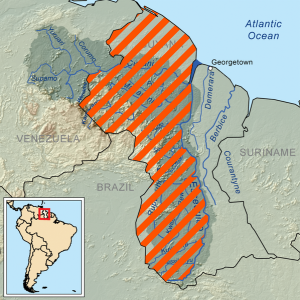
Map of Guyana Essequiba. The area lined in orange constitutes the area claimed by Venezuela. Credit: Karl Musser. CCA/3.0.
And in November of 2023, Maduro suddenly announced that his government would hold a referendum among the Venezuelan people, to see if they would mind their government annexing the disputed region, and telling the international courts to shove off. Surprising absolutely no one outside of the denizens of upscale café’s in Hollywood and New York – and, of course, Starbucks’ outlets – Venezuelans “voted overwhelmingly”, as in 95% of voters, that yes, their country should absolutely invade and dismember a neighbor that they have never fought a war with.
Now, it would wrong to assume that this situation is about oil, per se. Oil is a component in this situation, but it is actually not that far into Maduro’s wheelhouse. Maduro’s real problem is that he is up for reelection in 2024, and Venezuelans – like Argentineans before them – are getting fed up with the charade…and Maduro’s real fear is that Venezuelans may just “go all Romanian” on him.
That’s not a bingo card entry anyone wants.
Like Galtieri before him, Maduro is hoping that starting a war will make him popular enough at home to easily retain power – that’s known as “not changing horses in midstream.” The problem? Guyana, while it does not have a very large military, is not an island…Guyana and Venezuela share a border in the disputed region with a third nation: Brazil.
Brazil is a massive and powerful nation within the region. Even given the ludicrous and destructive policies of its current ruling party, the Brazilian economy is a powerhouse, regionally. As well, its armed forces are nothing to mess with; the Brazilian military – at all levels – seriously outclasses that of Venezuela. Maduro’s outlandishly comical “referendum” is so divorced from reality, not even a hardened Socialist leader like Lula da Silva can let such an idea go.
This is shaping into a potential three-way war, which could include a rarity, for the modern day: and actual naval battle. This is due to the geography of the region, with puts a large amount of the disputed region within range of naval forces’ fire support capabilities on the Caribbean coast, to say nothing of the extensive network of rivers that form the best highways in the interior.
In any shooting war, Venezuelan forces will be at a serious disadvantage if Brazil enters the fray.
This does, however, beg the question: What about the United States?
In the United States, the administration of Joe Biden is giving typically half-hearted and limp-wristed lip service to tell the kids in the south to calm down. The Swamp – or, if you prefer, “Sodom on the Potomac” – is far more concerned with events in Ukraine, Israel, and potentially in the Bab al-Mandeb, at the southern entrance to the Red Sea, to worry about a minor territorial squabble in South America. Functionally, refusing to take decisive action on its proverbial doorstep would be a foreign policy disaster on a scale with Jimmy Carter’s inability to deal with the Iranian hostage crisis.
…So – is there a “wild card” in this mess? Yes, there is: ExxonMobil.
Big Oil is not dead. Far from it. Venezuela long ago parted company with ExxonMobil and other foreign oil producers. And now, from ExxonMobil’s view, Maduro is trying to muscle in on their turf, yet again.
But ExxonMobil is “just a corporation,” right? What could they possibly do? Twenty years ago, that answer would have been simple: suck it up, count your losses, and find somewhere else…But that was twenty years ago, and a lot has happened since then.
There is absolutely nothing stopping ExxonMobil – especially in concert with other corporations – from fielding its own armed forces…including naval and air forces…to insert themselves into a potential Venezuela-Guyana war, if the potential returns are worth the risks. Guyana’s estimated 11 billion barrels (at the low end) is a pretty big incentive.
This last scenario would be no more than an interesting action-adventure story, if the players in Washington, DC, were not so incompetent and self-absorbed.
Happy voting.
The Freedomist — Keeping Watch, So You Don’t Have To
In mid-November, the South American nation of Guyana appealed for help to both the United Nations and the International Court of Justice, which just handed down a sternly worded finding on 12/1/2023 on the matter. Guyana, which shares its western border with Venezuela, became justifiably alarmed after Venezuelan dictator Nicolás Maduro’s government scheduled a public referendum for December 3, 2023, “asking” the Venezuelan people if they would be okay with annexing the Essequibo region from Guyana – which comprises some two-thirds of Guyana.
Map of Guyana Essequiba. The area lined in orange constitutes the area claimed by Venezuela. Credit: Karl Musser. CCA/3.0
So – what’s going on, and why should you care? In reverse order, the reasons you need to care about this are simple.
First, unlike the current wars in Ukraine and Israel, this is on the proverbial doorstep of the United States. Second, is that seemingly tired old problem: oil. Third, the very fact that this has even come up, is yet one more pointed demonstration of the abject and total failures of both the Biden administration, and the neo-con RINO’s desperately clinging to power inside the GOP, best described by GOP candidate Vivek Ramaswamy as “Dick Cheney in three inch heels”.
Venezuela and Guyana form part of the northern coast of South America. Any war in South America is of preeminent importance to the United States, because of the potential to spill onto the United States’ doorstep, in addition to all the other problems spilling over a border that the Biden administration apparently believes not to exist. A Venezuelan attempt to “flex” for imperialist territorial expansion would – and threatens to do so – lead to a much wider war, as Brazil’s territorial integrity is also threatened by Maduro’s actions.
The question is, why? The answer is simple: oil.
Venezuela has been tied into the global petroleum extraction network since the early 1900’s; indeed, the country was the world’s third largest producer of crude oil in 1940, and was the tenth largest producer in 2008. However, beginning in the mid-1970’s, a series of terrible decisions by successive governments nationalized the country’s oil industries. This resulted in the companies whose plants were confiscated politely refusing to continue to perform maintenance and upkeep on the systems…that should not have come as a surprise to anyone, but apparently did. And, as the oil infrastructure fell apart, Venezuela was unable to attract another other foreign companies to invest in their national oil fields, which – again – should have surprised no one.
As a result, the spiraling failures of Maduro’s increasingly socialism-driven economy and government has created a growing and increasingly desperate need to revive the country’s only remaining viable export industry, in his case, by bringing in Iranian technicians to try and get the nation’s oil industry back on its feet…If that sounds like a disturbing idea – Iranians flooding into a country within easy striking distance of the United States – that’s because it is.
So, how does this relate to Guyana?
In 2008, as Venezuela doubled down on excluding foreign companies from its oil industry, ExxonMobil (one of the companies forced out by Venezuela) began exploring the offshore region of Guyana, on the hunch that since the two countries were physical neighbors, there should have been a high likelihood that Guyana should possess exploitable reserves…and, in 2015, Esso (a subsidiary of ExxonMobil) hit paydirt, discovering the first of several rich offshore oil fields off Guyana’s Caribbean coastline. After a series of negotiations, on 19 September of 2023, Guyana authorized several oil companies – including ExxonMobil – to begin drilling in their offshore fields.
An increasingly desperate Maduro, seeing the continuing disaster of his party’s long-discredited Socialist policies, chose this moment to revive an old territorial dispute that Venezuela had chosen not to pursue, which laid a Venezuelan claim to some two-thirds of Guyanese territory…that part, or course, that contains most of the new oil fields.
For those readers of “a certain age”, if this sounds a little like 1981-1982 in the South Atlantic, you are not alone. Forty-odd years ago, another South American dictator sniffed rumors of oil in an area his country had long-claimed, and – with tensions mounting at home over disastrous economic policies and midnight death squads everywhere – Argentinean junta leader General Leopoldo Galtieri decided that the United Kingdom would not fight over the Falkland Islands, if not too much blood was spilled invading them. Turns out, he was very wrong.
Maduro’s “popular” referendum is a clear attempt to justify an invasion, one that is sickeningly lopsided, as the Guyanese military is barely 3% the size of Venezuela’s armed Forces…the ringer being, of course, being Brazil, whose armed forces outmatch Venezuela’s by at least double, if not triple…The possible consequences of a desperate Socialist country sparking a regional war that could disrupt not just oil production but commercial shipping in the Caribbean, in general, are something every American needs to be worried about.
But then, there is the last question: Why does Maduro think that he can get away with Saddam Hussein-levels of bad decisions? In a word – Joe Biden and the Democrat-Neo-Con alliance, which desires a weak United States, one that they think that they can rally to their side like FDR did in 1941.
That they cannot do so, because of the actions they have taken in public – not even bothering to hide it – have so soured their potential recruiting bases, that they cannot meet their manpower needs without reviving the Draft…which even their supporters in the deluded Left are stating a flat, hard-no to.
If this sounds pessimistic – it is. Expect shortages, if Maduro thinks his calculus is correct…which it might be, unlike Saddam’s.
Part 2 – Saying the Quiet Part Out Loud
But, on the other side of the world, another “Rumble in the Jungle” is brewing: Myanmar/Burma’s ruling military clique, the so-called “Tatmadaw”, is collapsing. In this, the only real question is if the radical Socialist junta will go down like the collapse of the Somoza regime of Nicaragua in 1979, and the following multi-sided civil war (encouraged, being fair to history, by the United States) or if it will go the way of Yugoslavia – violent and bloody, but mercifully short, in comparison.
Beginning in late October of 2023, a coalition of formerly rival ethnic/tribal groups in Myanmar united in a virtually unheard of alliance, to launch a massive, coordinated offensive across the country, swiftly overrunning several regime military bases along the Myanmar/Communist China border, and forcing the surrender of several military units in their entirety. This is causing a collapse in morale, both among troops and in their families, who are now being forced to pull security for their deployed husband’s military bases. In fact, the junta has begun mobilizing civil servants and local police as second-line military forces, to try and stem the tsunami of military defeat.
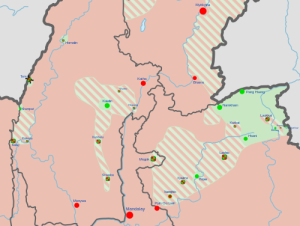
Map of Operation 1027, as of 7 November 2023. Credit: Clyde H. Mapping. CCA/4.0
Obviously, the Freedomist has been remarking on this situation for some time, mostly in the context of the 3-D printing revolution. The facts are that the world was content – again – to allow a brutal, dictatorial regime to make a mockery of civilized society, because the profit margin is so high.
For Communist China, however, Myanmar is far from a laughing matter. The ruling junta, the “Tatmadaw”, is a vital component in the CCP’s “Belt & Road Initiative”, and if their allies in the junta go the way of Somoza or Yugoslavia, their entire plan is in jeopardy. What Communist China chooses to do about this is anyone’s guess.
Part 3 – Where Do We Go From Here?
Functionally, the moves by Maduro’s Venezuela are far more important to the United States in the immediate short-term. The hopeful collapse of the Myanmar regime, while definitely of regional importance in the Indian Ocean region, is mostly of academic interest for the US. While that may sound harsh and uncaring, it is not. It is simply the recognition of global realities.
The United States – for good or ill – is committed to the support of both Israel and Ukraine. And, as it and its European allies have discovered, neo-con fever dreams mixed with deranged, far-Left utopian word-salad does not equate to valid battle calculus, even in the short term.
The world is racing towards a cliff, and the leaders of the nations most capable of preventing that from happening are too concerned with pet delusions to even start getting a handle on the problem.
2024 is looking pretty grim, at present.
You should take action to protect yourselves, and those you are responsible for, now.
Washington and London certainly aren’t.
The Freedomist — Keeping Watch, So You Don’t Have To
A potential regional war is brewing in South America as Brazil moves troops towards its border with Venezuela in response to the fascist left country’s alleged looming invasion of neighboring state Guyana. Venezuela appears prepared to invade Guyana with the hope of annexing the country into its own territory.
Venezuela is claiming ownership rights of a huge swathe of Guyana called the Essequibo region. The rubber-stamp parliament passed a resolution initiated by dictator Nicolas Maduro to “allow” the Venezuelan voters to decide if they want to annex Guyana to gain control of the disputed region. Guyana has petitioned an international court to rule on this de facto move for annexation but has not received word back from the court.
The referendum is to be held Sunday, December 2, but skirmishes between Venezuelan and Guyanan troops are already being reported. Brazil has committed itself to defend Guyana should Venezuela choose to invade, which could lead to a regional war in South America.
Back FREEDOM for only $4.95/month and help the Freedomist to fight the ongoing war on liberty and defeat the establishment's SHILL press!!
Are you enjoying our content? Help support our mission to reach every American with a message of freedom through virtue, liberty, and independence! Support our team of dedicated freedom builders for as little as $4.95/month! Back the Freedomist now! Click here