Chairman Xi was in a phone conversation with Zambian President Hakainde Hichilema in which he declared that the two countries are tied together forever, through good and bad weather, and each should serve the core interest of the other as outlined by the CCP.
China attaches great importance to its relations with Zambia, and is ready to work with Zambia to consolidate and deepen their friendship and push bilateral ties to higher levels and broader areas, Chinese President Xi Jinping said Tuesday afternoon.
He made the remarks in a phone conversation with Zambian President Hakainde Hichilema.
Noting that China and Zambia are “all-weather friends” with traditional friendship, Xi said the friendship between the two countries is unbreakable.
In the past year, China-Zambia relations have maintained positive momentum of development, with two-way trade hitting a record high and Zambia becoming the country enjoying the most Chinese direct investment in Africa, Xi said, adding that the cooperation between the two countries has huge potential and bright prospects.
Xi stressed that the two sides should view bilateral relations from a strategic height, support each other on issues concerning their respective core interests, strengthen inter-party exchanges, and share experience in governance.
He also called for strengthening strategic communication and policy synergy, fully implementing the nine programs announced by China at the 8th Ministerial Conference of the Forum on China-Africa Cooperation(FOCAC) in 2021, deepening mutually beneficial cooperation in various fields, pushing for more Zambian goods, especially quality agricultural products, to enter the Chinese market, and strengthening anti-epidemic cooperation.
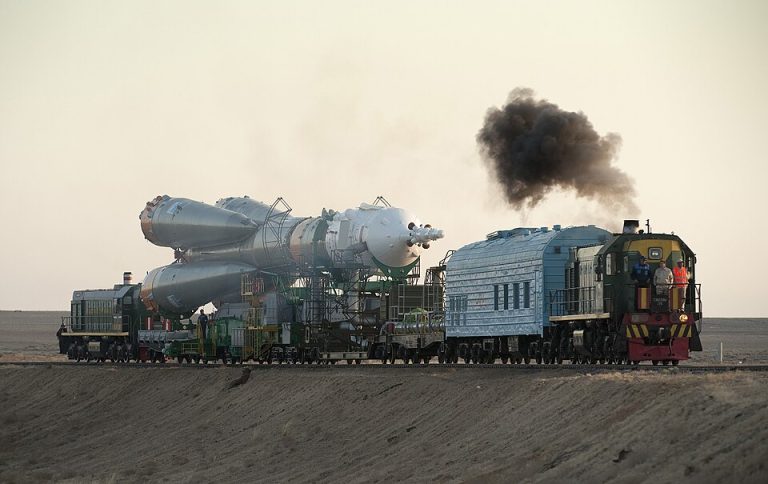
Xi called on both sides to carry forward the Tanzania-Zambia Railway spirit, keep it updated in accordance with the trend of the times, and make the railway an important transportation channel in the region, Xi noted.
THEWILL reports that the Muslim scholars in the South-West in its reaction to the emergence of Atiku as presidential candidate of the PDP, on Wednesday, insisted on a Muslim of Yoruba extraction as the next president or Vice-President of Nigeria in 2023.
Ibe, who faulted the position of the group, said, “This is unfortunate that a religious group will veer off tandem into the political arena. However, the future that His Excellency, Atiku Abubakar, envisages for Nigeria is one country of one people with one future in which every tribe, tongue and faith will stand united. Above all, it is incumbent on religious and community leaders to preach peace rather than division.
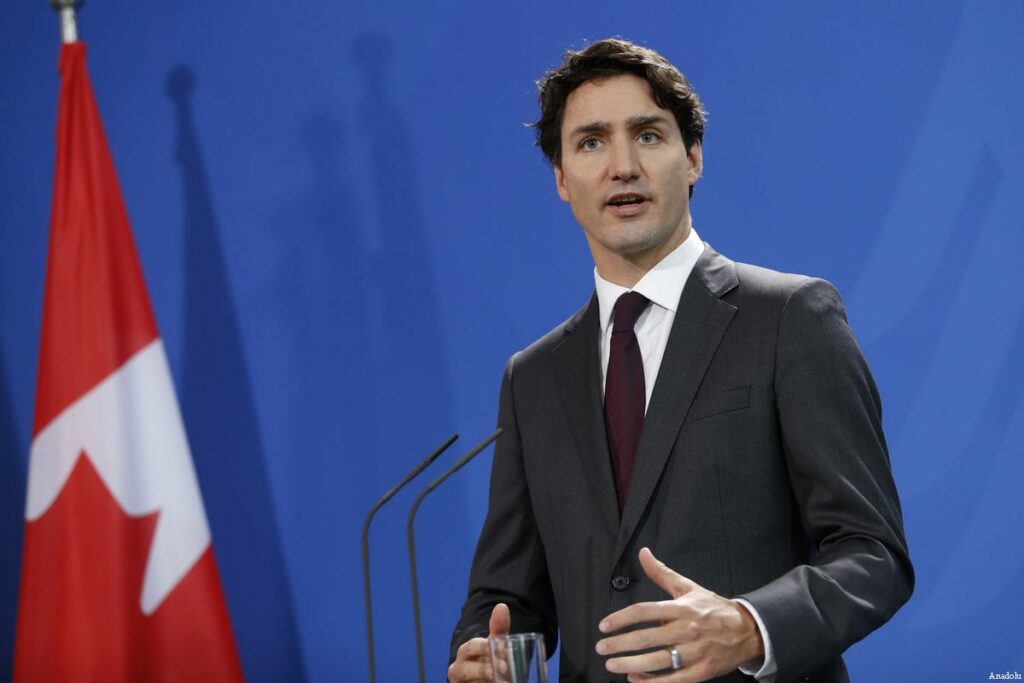
Canada’s Prime Minister Justin Trudeau has announced plans to pass draconian anti-gun legislation that would put a freeze on all handgun sales. In addition, it would limit magazine capacity to five rounds and create a buy-back program to confiscate already banned guns like the AR-15 peacefully.
The goal of this column is to present news from around the world that is not often – if ever – covered by more mainstream entities, using local sources wherever possible, but occasionally using news aggregators not used, again, by the mainstream media. Also, please note that we do use links to Wikipedia; while Wikipedia is well-known as a largely-useless site for any kind of serious research, it does serve as a launch-pad for further inquiry, in addition to being generally free of malicious ads. As with anything from Wikipedia, always verify their sources before making any conclusions based on their pages.
This column will cover the preceding week of news.
To make it easier for readers to follow story source links: anytime you see a bracketed number marked in green – [1] – those are the source links relating to that story.
North America
Following an unforeseen break last week, The Freedomist’sWorld Situation Report is back.
For obvious and unfortunate reasons, the first item is the school shooting in Uvalde, Texas, where a disturbed young man killed some 19 children and two school teachers, after mortally wounding his own grandmother. While the incident is certainly a tragedy of the first order, two even more disturbing events occurred in the aftermath. The first was the naked and seedy behavior of a major-party candidate to attempt to politicize the tragedy to try and boost his flailing campaign. [1] In the second, serious questions have been raised concerning the police response to the incident [2], where the shooter was allowed to continue his rampage for some ninety minutes, while police officials – whose leadership had undergone “active shooter” training as recently as December [3] – tried to decide what to do, even as the perpetrator continued to fire, raising serious question as to whether police are capable of acting at all to deal with these types of threats.
Turning to other news around the United States, the bomb threats against schools continue, as more schools received bomb threats via telephone and email, some – again – receiving multiple threats on a near-weekly basis. [4]-[8] Meanwhile, a West Virginia man, Joshua Aaron Edens, was arrested on charges of illegal possession of destructive devices, explosive materials, or incendiary devices (in this case, blasting caps), after police observed him acting suspiciously and discovered the explosive devices buried in a residential home’s backyard…Evens was already on police radar, after police officers executing a search warrant on April 12th discovered some 35“pipe bombs” in his living room. [9]
On the 23rd, in the town of Waukesha, Wisconsin, police responded to a local resident who stated that they had received a package via mail containing a “mysterious, white, powdery substance”. The resident had noted the strange package on heir doorstep, and was attempting to bring it to the police station, when they saw several Fire Department personnel in the parking lot in front of City Hall, and approached them with the package. As of press time, investigations continue as to the nature of the substance, and its origins. [10]
Finally, in two incidents that may be related, Federal officers arrested a 52-year old Shihab Ahmed Shihab Shihab, an Iraqi man who had filed a petition for asylum in the United States, on charges of aiding and abetting terrorists, as he was attempting to smuggle four other Iraqi men across the Mexican border, in an apparent plot to kill former President George W. Bush. The next day, Mirsad Kandic, 40, was found guilty of conspiracy and providing material support to the IS after a three-week trial in a Brooklynfederal court. According to authorities, Kandic was one of IS’s major recruiting officers, responsible for recruiting “thousands” of foreign volunteers for the terror group. He faces up to life in prison at his sentencing on November 9. [11][12]
In France, this week, police charged an unnamed 18-year old Muslim man with plotting a knife attack dedicated to the IS. Police said that the man was in possession of a video of himself swearing allegiance to the IS at the time of his arrest. [1]
In Sweden, meanwhile, sentenced to Swedish-born brothers to eight months in prison for attempting to join the IS as active fighters. The pair were arrested in February, because their “recruiting officer” turned out to be an undercover intelligence officer. [2]
In Burkina Faso, at least 50 civilians of Madjoari, in Kompienga Province, in eastern part of the country, were massacred by terrorists on the 25th, according to government officials. This follows two other attacks directed at civilians in the preceding week, which left some twenty-five dead or wounded. Burkina Faso’s war against Islamic terror groups has killed over 1,000 people and displaced over 1 million since 2015. [1]
In Nigeria, assassinations, bombings and kidnappings continued through the week, as terrorists kidnapped priests and congregants from their church, twelve farmers were massacred and a youth leader was assassinated elsewhere in the country. [2]-[5]
In a surprising twist to a story from March 28, the group who had killed eight and kidnapped an unknown number of people from a train, including a Pakistani national, in the central part of the country released videos of some of their captives as part of a public demand to release their children (aged 1 to 8), who they claim are being illegally held at an orphanage in Yola, the capital of Adamawa State. The kidnappers stated that they had been offered millions of naira (the Nigerian currency) to release the kidnapped victims, but that they had refused, saying expressly that money was not their motive. The group has stated (on May 24) that they would start killing hostages in seven days time if their demands are not met. [6][7]
The region was remarkably quiet this week, the only issues of note being an attack by IS terrorists on a wheat farm near the northern city of Kirkuk, in northern Iraq. The attack, in which the terrorists set fire to the farm, was used to lure security forces into an ambush. After killing three police officers and two civilians who had responded to try and put the fires out, the terrorists withdrew when reinforcements began to arrive. [1]
In Turkey, police in the southern part of the country killed a suicide bomber before he could detonate his vest. This comes two days after police in the country’s largest city, the world-famous Istanbul, arrested a man on suspicion of attempting to organize suicide attacks in the city for the Islamic State group. [2][3]
In the Afghan city of Mazar-i-Sharif, a series of bomb attacks on small mini-bus taxis killed nine, and wounded at least fifteen, on the 25th. The same day, a bomb attack on a mosque killed two and wounded ten others. [1] On the 23rd, unknown attackers blew up three power transmission towers in northern Samangan province, which run in from neighboring Uzbekistan, temporarily cutting power to several towns. These attacks have been occurring with greater frequency, as other attacks cut power to the capital city of Kabul two weeks ago. [2]
In Pakistan, two soldiers were killed when terrorists attacked their outpost in North Waziristan on the 24th. Elsewhere, police deployed tear gas and used riot batons to prevent supporters of ousted Prime Minister Imran Khan from reaching the capital Islamabad. Khan, who had been removed from power following a no-confidence vote on April 10th, has called on his supporters to march on the capital and occupy it until the new government is forced to step down, and new elections are held. [3][4]
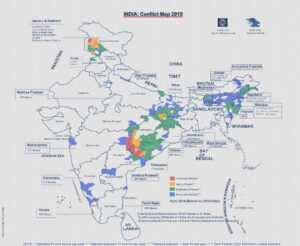
Finally, in India, the conflict in Jammu & Kashmir continues, with at least ten terrorist suspects being killed in a 3 day period, as a soldier was injured by a landmine, and a police officer and local TV were assassinated (and their children injured) in separate incidents. [1]-[7]
Thankfully, the remainder of the nation was mostly quiet during the week.
A common argument, one of the fundamental arguments at a certain low level within military – and “wannabe” circles – is, “What is the best rifle for the battlefield?” We have resolutely avoided this dreaded question until now, because of the most important truism at the heart of the argument: place ten military professionals in a room and ask them this question, and you are guaranteed to get fifteen answers, every one of them passionately and adroitly argued with verifiable facts, figures and real-life examples.
There are many factors that go into this argument, not least, that it is a vital question at a basic level, because not answering it hamstrings any military at its inception, because service rifle selection impacts training, tactics and logistics simultaneously.
M12 Small Arms Storage Rack, secures ten M16/M16A1 rifles.
What are the features that a “service rifle” must have? There are a lot of considerations that need to be balanced in answering that question.
First, the weapon must be reliable. An unreliable rifle, prone to malfunction, is not capable of performing any other mission, and is both a waste of money, a guarantee of mission failure and a killer of your own troops, whatever its other benefits might be.
Second, the rifle needs to be “ergonomically sound“. This is a modern term, that essentially means that the rifle “handles well”, and is logically designed so that troops can use it when they are tired, dirty, cold, wet and slathered in mud — which they are guaranteed to be, when it counts the most.
Third, a service rifle must fire a projectile that can actually harm an opponent, preferably with lethal effect. There has been a great deal of controversy in the last few decades over this requirement, as more brutally-minded pundits have argued in favor of a rifle that is more prone to wounding opponents than killing them, as a wounded soldier is a severe drain on resources, requiring extensive medical care and rehabilitation, and is also a continuing negative reinforcement to morale. conversely, meanwhile, the dead soldier is simply…dead – his comrades will mourn him, but will usually be able to quickly recoup, and continue their mission.
The notion that wounding a soldier on the battlefield, versus killing him, is – very real psychological degradation aside – a very dangerous strategy for any nation actively seeking to deploy such a rifle, for the very simple reason that history is replete with examples of wounded soldiers – and sometimes horrifically wounded ones(video link) – continuing to man positions and fight on, long after they should have been felled(video link). A wounded enemy is, if anything, frequently much more dangerous than even a live enemy, much less a dead one.
Fourth, the rifle should be semi-automatic. This might seem like a misnomer in the Twenty-First Century, but it is a basic fact that most troops with fully-automatic rifles, who have not been trained as actual machine gunners, tend to waste vast quantities of ammunition to little effect. Forces who spend time on training, as well as experienced fighters without formal training, quickly learn that they get far more effect out of steady, aimed semi-automatic fire. Firing a full magazine of rounds blindly from a rifle is not “suppressive fire“.
A ration party of the Royal Irish Rifles in a communication trench during the Battle of the Somme.
Fifth, the rifle should be as light in weight as possible. Combat troops have always carried far more weight than is advisable…unfortunately, this has usually been a necessity. However, while every ounce saved is appreciated by the infantry, shaving too much weight from the rifle makes it prone to malfunction, overheating and inaccurate in rapid fire, to say nothing of fully automatic fire.
Sixth, the service rifle should have at least a twenty round magazine. The current world standard is thirty, given the current military touchstone of the intermediate cartridge.
Seventh, the service rifle should be affordable for the nation’s military. This is another touchy subject, as the lives of a country’s troops is usually seen as a matter of vital importance. However, most countries simply do not have the money to equip all of their troops with the absolute best weapons available (Switzerland‘s reliable, but incredibly expensive Stgw 57 comes immediately to mind), and compromises must be made. Some nations do a better job than others at this.
US Marines practicing bayonet combat.
Eighth, and last, is the requirement for a functional bayonet. This is also a controversial view, as bayonets have historically inflicted few casualties in actual combat, and whose actual use in combat has steadily declined, despite the occasional instance of an actual bayonet charge in the last thirty-five or so years. However, the bayonet will never die as a military weapon, because it is as much a psychological weapon as a physical one; it is as much a statement of determinationas desperation, both to the enemy as well as your own troops.
So – how have these eight requirements been applied over the years?
Reviewing a simple list of service rifles reveals a dizzying array of weapons, so many that it is tempting to ignore the list entirely. But…look at that list a different way: you should note that virtually every service rifle adopted in the last sixty years has been in one of three calibers: 5.56x45mm, 7.62x39mm, 7.62x54mmR or 7.62x51mm.
What’s more, throughout conflict zones around the world, were you suddenly transported from reading this to one of those places, you have approximately a 95% chance of picking up one of four rifles: an AR-15/M-16/M4, an AK-typerifle, an FN FAL or a CETME/G3-type, as we have covered in previous installments of this series:
There are two basic reasons for this phenomenon.
First, are the brutal economics of the Cold War: as small, poor nations sided with one bloc or the other, the powerful nations at the core of those blocs were happy to provide their rifle of choice at little to no charge, in trade for influence and control. This encouraged small countries to only buy either that rifle, or a rifle that used that ammunition.
Inside the Ross Rifle Factory, Quebec City, ca. 1904-1905
Second, the laws of Supply and Demand and Mass Production meant that three or four basic ammunition types would standardize, eventually. Together with 9x19mm ‘Parabellum’ (in military handguns and most submachine guns) and ’12gauge’ (for shotguns), the standardization of weapons and ammunition around the world were virtually guaranteed. Additionally, there are enough of the above four rifles out there, that their respective characteristics are well known, including their strengths and flaws.
But — what does all this mean for the budding army builder? Knowing all these factors, what service rifle should you choose?
The answer is simply this:
The best service rifle is the one that you can lay hands on in the largest quantity, in the shortest amount of time, that you can train the largest number of people quickly to use, that is at least reasonably reliable…in that order.
That’s it. Really.
The “Big Four” rifles – the AR, the AK, the FALand the G3– are: universally cheap (for various reasons); are all battle-proven designs; have had all of their major faults identified and (mostly) fixed; and all have vastquantities of both weapons and accoutrements readily available, virtually everywhere in the world.
You can spend the money on a “shootout” between the various weapons, or read through the exhaustive literature on all of the weapons to decide…of course, there is always the chance that you may need to use whatever is at hand. In that case:
The best service rifle in the world, is the one that will fire when you expect it to.
The goal of this column is to present news from around the world that is not often – if ever – covered by more mainstream entities, using local sources wherever possible, but occasionally using news aggregators not used, again, by the mainstream media. Also, please note that we do use links to Wikipedia; while Wikipedia is well-known as a largely-useless site for any kind of serious research, it does serve as a launch-pad for further inquiry, in addition to being generally free of malicious ads. As with anything from Wikipedia, always verify their sources before making any conclusions based on their pages.
This column will cover the preceding week of news.
To make it easier for readers to follow story source links: anytime you see a bracketed number marked in green – [1] – those are the source links relating to that story.
South America
Leading off, this week, a “tear gas grenade” was thrown into a student body election meeting at the Tomas Frías Autonomous University in the city of Potosí, Bolivia on the 9th. In the resulting panic-induced stampede, four young women were killed, and over 80 students were injured. Bolivian police have arrested four suspects: Manfred Flores, 25, Mauricio Quintanilla, 25, Milton Fuentes, 35 and Ariel Quispe, 40, on suspicion (currently) of homicide and possession of a gas grenade.
Bolivian authorities have not speculated on the reason for the attack, and are attempting to discover how the men obtained the grenade, which is normally very difficult to obtain in Bolivia.
The odd nature of the on-going wave of bomb threats against schools continued to develop in the United States this week, with four incidents of note: two handwritten notes making threats were found, resulting in one arrest [1] and police seeking a “person of interest” [4]; another, in which an 8th Grader apparently called in a threat [2], and another threat made via Instagram [3]. As usual, there were many other similar incidents, but those stories had too little information to reference. While these threats are widely dispersed, they do cluster, and this new tack in the course of the wave remains an object of interest, deviating from the previously reported robocall format.
In Mali, four soldiers were killed and one was wounded, when their patrol vehicle struck an IED near Djenné in the central part of the country. Two children were killed and four other people were wounded in Diondiori, also in central Mali, by what officials describe as “shellfire” from “Armed Terrorist Groups“, as authorities frequently do not know which of the many groups that have been fighting inside the beleaguered nation since 2012 are responsible. [1]
In neighboring Burkina Faso, meanwhile, army units reported that they successfully ambushed a group of terrorists in Mouhoun Province, killing 40, and capturing a large amount of weapons and equipment. In another incident, however, other terrorists attacked a prison in the town of Nouna, on the border with neighboring Mali, freed and escaped with all 60 prisoners, leaving one person dead. [2]
Burkina Faso has battled their insurgency since 2015, when fighting in Mali spilled over the border.
In what may be a disturbing expansion of the ongoing war in the north, the nation of Togo saw an attack on an army outpost in the Kpendjal prefecture on its northern frontier border with Burkina Faso. Officials report that some eight troops were killed and 13 wounded. Togo has remained largely free of violence in the last ten years, but that could be changing, as violence continues moving south. [3][4]
In related news, the West Africa Centre for Counter-Extremism (WACCE) released a report warning that the nation of Ghana, which has also escaped the violence to its north so far, was increasingly exposed to danger, pointing out that some 53% of ECOWAS (the “Economic Community of West African States”) nations are currently in the midst of mostly Islamist terrorist insurgencies, and that the contagion is spreading.
In Nigeria, the last few weeks of relative calm were shattered this week, as a combination of terror groups and simple bandits emerged on the attack, killing dozens (including civilians, soldiers and police), hijacking buses – crucial to Nigeria’s infrastructure – and kidnapping victims that ranged from a pair of nursing mothers to traditional monarchs and tribal chiefs.
Elsewhere on the continent, 14 people were reported killed in an attack on a “displaced persons” camp outside the town of Fataki, near the city of Bunia in the Democratic Republic of the Congo, on the 10th. The CODECO terror group, accused of being loosely affiliated with IS-CAP, is believed to have been responsible, as they were responsible for an attack on a nearby mining camp on the 8th. The fighting is part of the Ituri Conflict, which has been continuing in fits and starts since 2003. [1][2]
In Afghanistan, the Taliban have reportedly begun to actively recruit child soldiers, although the Taliban leadership have said that they are forbidding the recruitment of “teenagers”…video footage under the link. [1]
In Pakistan, a spate of attacks this week killed at least eight people, including three children and three soldiers. This comes as the country’s government denied, yet again, that it was harboring terror groups that targeted its neighbors. [2]-[5]
In India, the long-running conflict in the northern Jammu & Kashmir region saw a burst of violence, as well, this week, with several operations – both jihadist and national – taking place during the week, leading to multiple arrests, but also to the death of a police officer by assassination. [1]-[7]
The week also saw the emergence of a little-known group, JKFF (‘Jammu Kashmir Freedom Fighters’), who hurled an explosive device at a bus loaded with Hindu religious pilgrims. Very little is known about the group, aside from them being ‘broadly‘ Muslim, and “jihadist” in nature. [8]
On Friday, at least 12 schools in the city of Bhopal received bomb threats via email, in a manner similar to a wave a month ago, that targeted schools in the southern city of Bangalore. In this case, some school received as many as 50 emails with bomb threats, coming from several email addresses. Police bomb squads cleared all of the targeted schools, and are continuing their investigation to attempt to trace the emails’ ISP addresses. [9]
India’s “Red Corridor” saw a sudden burst of activity this week, with multiple arrests and arson attacks throughout the troubled region. Small arms and explosives were recovered in several areas. As well, a Naxal couple surrendered to authorities in the Gadchiroli district, citing the constant threat from security forces and wild animals, forced sterilization and separation of couples and attractive surrender policy of the Maharashtra government. [10]-[15]
Finally, Sri Lanka‘s economic crisis – the worst since its independence in 1948 – came off the rails this week, as protests turned into riots, and violence has escalated to the point of the government in Colombo issuing orders to the armed forces to open fire on anyone vandalizing or looting public property. The violence has left over two hundred people injured and eight dead, including a member of Parliament and his bodyguard.
“Security forces have been ordered to shoot on sight anyone looting public property or causing harm to life,” the ministry said as reported by news agency AFP.
The protests that began on April 9th, are over the country’s downward economic spiral, brought on by a combination of the government’s response to the 2019 Easter Bombings, the effects of the COVID-19 pandemic, staggeringly bad economic and monetary policy decisions, and the continuing economic shock-waves of Russia’s invasion of Ukraine.
The Hidden Conflict With The Potential To Shatter Global Trade
Beginnings
Since 2017, a war has been raging. This war has remained largely ignored in the world media, because, as wars go, this war has been rather “low-level”. As well, this war is the living example of an uncomfortable truth – that the so-called “Islamic State” is not dead, despite losing its major base areas in Iraq and Syria.
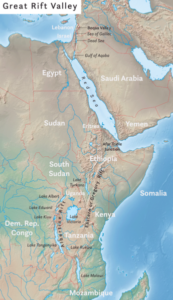
Following the same broad strategy as the rest of IS’s offshoots (extreme violence and torture, brutal oppression of women, use of child soldiers, etc.), ISCAP initially appeared to be focusing on destabilizing the Great Rift Valley region of Central Africa. Long unstable and prone to large-scale violence, ISCAP’s entry into this region of staggering mineral and agricultural wealth initially went rather unnoticed — Central Africa was not seen as having significant potential for the IS, and while of some concern, ISCAP was relegated to the figurative “back burner”, as there were much more immediate terrorism problems in Africa, like “Al Qaeda in the Islamic Maghreb (AQIM)” and Boko Haram.
But then…Mozambique exploded. Somewhat literally.
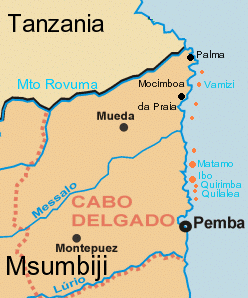
Map of the region of Cabo Delgado-Mozambique with Kirimba archipelago
Cabo Delgado Province is one of only two provinces in Mozambique with a majority-Muslim population (the other being neighboring Niassa Province). Both of these northern-most provinces are badly underdeveloped, economically speaking, and are grindingly poor as a result. Things seemed to be looking up, however, as the American energy company Anadarko Petroleum (now a subsidiary of Occidental Petroleum) decided to launch a major expansion onshore of its previously discovered offshore liquid natural gas (LNG) fields. This would create a large number of well-paying jobs, directly, and create “knock-on” industries to support development of the region.
The future looked bright.
But then, beginning on 5 October 2017, a predawn raid was staged on police stations in the seaside town of Mocímboa da Praia that killed some seventeen people, including two police officers and a community leader. The attack quickly fell apart, and nearly half the raid force was captured. Interrogations of the prisoners indicated that the Al Qaeda-affiliated Al Shabaab terror group from Somalia (also known as “Ansar al-Sunna”) had suborned some disgruntled ex-police officers to train local recruits.
Not being known for having a delicate touch, the Mozambican response was rather heavy-handed, with widespread arrests on questionable evidence, and the closing of several mosques in the provincial capitol of Pemba for “suspected connections” with “Islamic fundamentalism“. A subsequent attack on the village of Mitumbate reportedly killed some fifty people, including women and children, although it remains unclear as to what, if any, connection the casualties may have had to the insurgents.
Attacks continues apace through the remainder of 2017, and continued throughout 2018 and into 2019. Increasing numbers of people were kidnapped or murdered outright, houses, businesses and government buildings were burned, and civilians began fleeing the area, in numbers that would eventually displace an estimated 400,000 people by 2020, resulting in panicked calls to the international community for help by various national, international and non-governmental agencies.
ISCAP Arrives
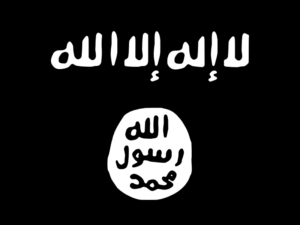
At some point, likely in late-2018 or early-2019, ISCAP seems to have arrived in Cabo Delgado, and either displaced or absorbed the Al Qaeda affiliate. It is important to understand the implications of this event. Where Al Qaeda-aligned groups at that time rarely left the terrorist model to engage in actual guerrilla warfare tactics, the Islamic State was almost the exact reverse – while certainly not shying away from terrorist attacks, the IS usually focuses on trying to act as an “actual” army.
This difference quickly became apparent.
On June 4, 2019, “Islamist” forces attacked a Mozambican Army outpost in the town of Mitopy, reportedly killing or wounding some 30 people, and capturing equipment. Attacks continued to escalate, as Russia began delivering military equipment to the Mozambique government (Russia, recall, had intevened in Syria in 2015 to shore up Bashar Al Assad’s government against relentless IS offensives), and the “Wagner Group“, the PMC aligned to the Russian government. This did not go well…for the Russian contractors. Despite some initial successes, the ISCAP forces repeatedly hit back at least as hard as they were being attacked.
(One of the ongoing frustrations in this conflict is the lack of press freedom, which dramatically limits the range of detail available.)
This activity continued through the end of 2019, when a break in ISCAP’s offensive seems to have occurred. The cautious optimism engendered by the break was shattered when ISCAP came roaring out of the forests, in a Syria-style offensive, on March 23, 2020. ISCAP forces stormed Mocímboa da Praia and captured the town, destroying government buildings, looting banks…and then distributing much of the loot to locals, in an apparent propaganda campaign. ISCAP withdrew from the town the next day, and launched a wide-ranging offensive across the province. Worryingly for military observers at the time, this particular attack was a coordinated land-sea assault. This period also saw South Africanspecial forces units deployed to the country.
The see-saw series of skirmishes continued for the next five months, with Mozambique government forces claiming to have killed hundreds of insurgents, even as attacks increased. ISCAP forces seem to have focused on Mocímboa da Praia in particular; the reason for this focus would not become apparent until August of 2020.
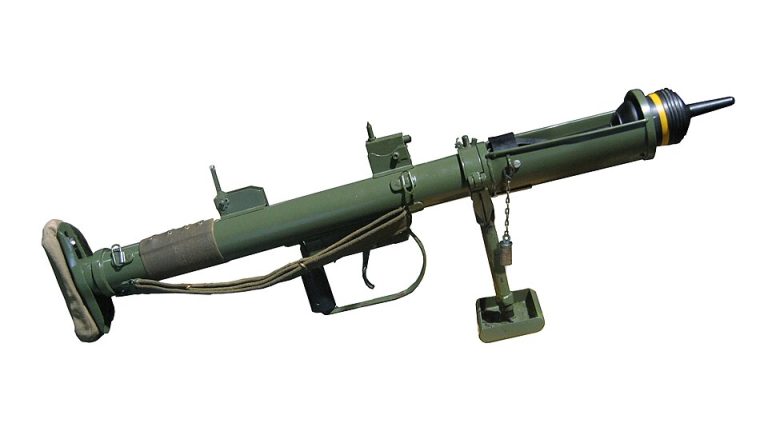
Beginning on August 5th, ISCAP launched a ferocious assault that focused on Mocímboa da Praia. after skillfully isolating the town, ISCAP forces hammered their way into the town. Mozambican forces, although supported by helicopters of the the South African PMC “Dyck Advisory Group (DAG)“, were either overrun and destroyed or captured, with the survivors fleeing the town by sea in commandeered boats. ISCAP forces engaged the retreating boats from the shore, sinking a French-built HSI-32 “interceptor” vessel with fire from RPG-7‘s. After the town’s capture, ISCAP declared it to be their “capitol”, and began a series of amphibious raids throughout the neighboring Quirimbas Islands, driving local island inhabitants ashore as refugees.
Even for regular, professional militaries, these were not “simple” operations.
ISCAP would hold Mocímboa da Praia for a full year, until August of 2021, following the intervention of Malawian and Rwandan army units deployed to the country to help stem the tide. However, before pushing ISCAP out of Mocímboa da Praia, ISCAP attempted to capture the border town and port of Palma in a 12-day long battle, a murderous fight that – while ultimately beaten back by Mozambian forces – left the city largely destroyed, suspending oil and gas company operations in the area, and killing numerous civlians, both Mozambicans and foreigners.
Although, as of February of 2022, ISCAP seems to have been battered back into the forests, there have been multi-month-long lulls in the fighting before. This fight is not over.
Meanwhile, though, as Mozambique burned, other things were happening…..
Two Unconnected Events & A Brutal Attack Make Three
While all the fighting was happening in Mozambique, the rest of the world lumbered onward, as it always does. Amid all of the other things going on in the military and security spheres of that time, there occurred yet another massive, bloody attack on civilians…
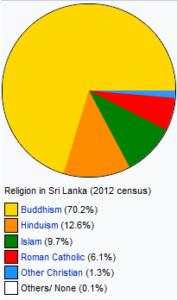
Religion in Sri Lanka, 2012; Source: Government of Sri LankaBloodstained statue of Risen Jesus after renovation of 2019 Sri Lanka Easter bombings at St. Sebastian’s Church, Katuwapitiya
On Easter Sunday, April 21, 2019, suicide bombers struck three Christian churches and three luxury hotels in the city of Coloumbo in coordinated attacks between 8:25am and 9:20am, local time; two smaller explosions occurred later in the day in other parts of the city. In total, 261 people were killed and over 500 were injured.
Sri Lanka’s population is less than 10% Muslim, inclusive of several different sects, which seriously calls into question how much support the NJT – a hyper-radical, Sunni-based sect – would have had. Another problem is that Sri Lanka is simply not on IS’s radar; it is well outside IS operational theaters, and committing more than “lip service” resources to an operational group there would be wasted effort, when the IS itself was under continuous attack elsewhere, and was hemorrhaging money, fighters, trainers and resources trying to defend its core territories.
While Sri Lanka is absolutely no stranger to suicide bombing attacks, having fought a blood-soaked 26-year war against the “Liberation Tigers of Tamil Eelam (LTTE)“; that group, though, was wiped out quite decisively in 2009. The LTTE, however, could in hindsight be viewed as “Islamic State, Beta“, in that it created a functional government from scratch, with very little external support, as well as a functional military establishment, including an air force and a navy.
As these kinds of things usually do, the Sri Lankan attacks quickly faded from the news, and the world shuffled onwards. Then, as ISCAP was preparing to launch its offensive against Mocímboa da Praia in August of 2020, a blunder of staggering incompetence happened.
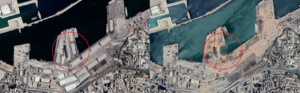
At roughly 5:45pm local time, fire crews were summoned to Warehouse 12 at the Port of Beirut, Lebanon, on a report of a warehouse fire. The first crew to arrive on-scene immediately called for backup — the blazing warehouse was massively engulfed, and completely out of control. Some twenty minutes later, at 6:07pm local time, the dockside warehouse exploded in a titanic blast, registering an estimated 3.3 on the Richter Scale. The blast was heard in Cyprus and Israel, some 150 miles/240km distant, and was felt as far away as parts of Europe. Estimates of the blast force ranged from 1.5 to 2.5 tons of TNT, equivalent to a small nuclear warhead.
Port of Beirut, Lebanon. Before (Left, 7/30/2020) and after (R) comparison showing blast damage from the August 4,2020 explosion (circled area)
Despite early attempts by various terrorist groups, both inside and outside of Lebanon, to claiming responsibility for the attack, it was quickly determined to have been the result of a level of bureaucratic lethargy and incompetence, coupled to irresponsible work practices on a scale that boggles the imagination.
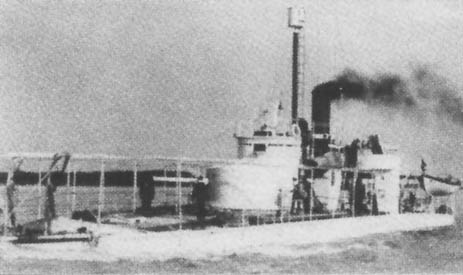
In November of 2013, the Moldovan-flagged cargo ship ‘MV Rhosus‘, carrying 2,750 tonnes (3,030 short tons) of ammonium nitrate bound for Mozambique (this was well before the current war there), was seized by the Port of Beirut’s Port state control officials for, according to Lloyd’s List, some US$100,000 in unpaid bills. Ammonium nitrate, while used primarily as and agricultural fertilizer, is also a significant component in explosives. As the ‘MV Rhosus‘ was deemed unseaworthy by Port state control, the ship was condemned and her cargo was unloaded in February of 2014 and stored in Warehouse 12. The crew, all either Ukrainian or Russian, were allowed to return home on compassionate grounds, as the ship owner had reportedly gone bankrupt, and was unable to either repair the ship or pay the fines it had accrued.
The ammonium nitrate cargo then sat in Warehouse 12 for the next six years, as Lebanese officialdom tepidly argued over what to do with it. During this time, in a staggering display of irresponsibility, a massive load of fireworks were stored in a section of the warehouse complex, right next to the bays holding the ammonium nitrate. Inevitably, a construction crew working on a loading door with a welding torch apparently set the fireworks alight, and as the blaze spread, the heat and pressure eventually touched off the ammonium nitrate…..
Over 200 people are known to have been killed in the blast of August 4th, and over 7,000 wounded, collapsing local medical capacity. Somewhere in the ballpark of 300,000 people were left homeless. Damages exceeded US$15 billion, a staggering sum for a small country with a wobbly economy. Numerous terro groups in the region tried to claim responsibility in the aftermath, in the end it was a disaster brought on simply by monumental levels of incompetence.
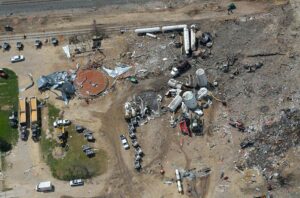
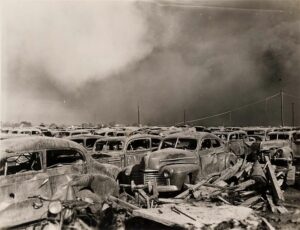
Aerial photo of the explosion in West, Texas, taken several days after blast (4/22/2013)Texas City disaster. Parking lot 1/4 of a mile away from the explosion
This wasn’t the first time something like this had happened…and it certainly wasn’t the last…
Contrary to popular belief, ocean-going vessels — even in the modern day — run aground all the time. No one is perfect. However, sometimes, all the stars will align in the worst possible way.
Today, contanerization is the primary mode of moving “non-bulk” freight loads via ship; somewhere near 90% of all non-bulk freight moving by ship moves in intermodal containers. The “Twenty-foot Equivalent Unit (TEU)” is the one of the standards for measuring the capacity of a container ship. The more than 9,000 vessels of this type (per UNCTAD, 2010) are typically massive vessels, with truly massive carrying capacities.
Container Ship ‘Ever Given’ stuck in the Suez Canal, Egypt, March 24th, 2021
The “Ever Given“, with a capacity of over 20,000 TEUs (if loaded onto trucks, those trucks (all 10,000 of them) – if lined up nose-to-tail, all at once – would stretch from Downtown Dallas, TX to north of Durant, OK, a distance of over 100mi/160km), was transiting the Suez Canal that March day, bound for the port of Rotterdam. Although the precise details of the incident remain a bone of contention, the “Ever Given” ended up jammed hard into the banks of the canal, in one of the worst possible stretches of the canal. As a result, at least 300 cargo vessels – including five other container ships of similar size, 41 bulk carriers and 24 crude oil tankers – were stuck waiting at either end of the canal for six days.
“Ita quomodo huc venisti?” (So, how did we get here?)
So — What point are we making, here? While the foregoing are certainly interesting points for study, they have little, if anything, to do with each other on the surface. However, there is a time-bomb lurking beneath the surface. The following is an example of “predictive analytics.” The key points are as follows:
It is a given, that the “Islamic State” (IS) sees itself as the enemy of the West. It is also a given that IS operatives around the world very much watch the news. They are fully aware, at the very least, of every event outlined above. Believing otherwise is simply not a valid world-view.
Given the IS’ proclivities for grandiose attacks, and given the fact that they have been heavily battered – being on their third leader in four years – IS is increasingly desperate to stage a major attack to regain its former prestige in the world.
Mozambique as a theater of operations for the IS – or Al Qaeda, for that matter – makes little sense at this point, if taken as a circumstance by itself. While only roughly three days via boat from Somalia at 10 knots (11.5mph/18.5kph), the rest of the factors are out of whack: the Muslim population in the country is tiny; the country as a whole is economically depressed; language is a serious issue; and the nation’s infrastucture is rudimentary, at best. These are all significant negatives to IS’ normal mode of operation…And yet — someone is expending a significant amount of resources and manpower to secure an Islamist foothold in the country.
Locally in Cabo Delgado, the Islamist insurgents are known as “Al Shabaab“…and, significantly, as “Somalis“. Despite insistance from certain quarters that there is no known connection between the “Ansar Al-Sunna/Al Shabaab” group in Mozambique and the similarly-named group in Somalia, the connection from the operational area in question is too significant to ignore.
If a connection does exist, that bodes ill all by itself, as it indicates a potential thaw in relations between Al Qaeda and the Islamic State, as the two have been, at the very least, “not friends” since the IS separated from the Al Qaeda orbit in 2014.
Then, there is the curious case of the Easter, 2019 bombings in Sri Lanka. For the reasons outlined above, there was little to be gained by these attacks. While they certainly demonstrated the potential reach and influence of the IS, it gained them very little, either tactically or strategically.
Finally, the seeming outlier points are the explosion in Beirut and the stranding of the “Ever Given”. Both were absolutely accidents, and not connected to any known terror group.
There are too many coincidences in the above points for the total picture to be some random splatter of a bizarre avant-garde art movement. Something is missing.
The Corporal and the Sea Pigeons
The problem in dealing with all “non-state actors” is that they are able to remain largely anonymous, until they surface publicly and act. There are so many possibilities, they get lost in the shuffle.
U.S. Marine artillerymen set up their 155 mm M198 howitzer…20 January 1991 during Operation Desert Storm
Hussein was activated with the rest of his unit, and served in Operation Desert Storm in 1990-1991. Later, as Operation Restore Hope got underway in his native country in late 1992, Hussein was activated again, being assigned to the 2nd Battalion, 9th Marines, as an interpreter, being the only person in the Marine Corps at that time who spoke any Somali dialect, and to provide a link to his father. He would serve in this capacity only briefly, being withdrawn after three weeks, once other Somali volunteers from the United States (mostly college students) volunteered to return. The Marine Corps was well aware of Hussein’s family background, and as his father was a prominent warlord in the country’s worsening civil war, following the ouster of dicator Siad Barre, they wanted no possibility of a conflict of interest arising for the young Marine. As a result, he was not present in Somalia when US forces launched Operation Gothic Serpent in an attempt to arrest some of his father’s lieutenants, in what became known as the “Battle of Mogadishu“.
At some point between 1993 and 1996, Hussein was named as his father’s ‘heir apparent’ to the leadership of Habir Gidir clan. When his father died during surgery after being shot during a battle with rival forces, Hussein Farrah Aidid advised his reserve unit that he would be traveling abroad for a number of months, and would miss his next several drills. Traveling to Somalia, he assumed the leadership of his clan, and initially continued his father’s policies of armed confrontation with opposition forces. However, this did not last — by 1997, Hussein turned to negotiation instead of armed conflict, and actively advocated working with not only the international community, but the United States directly.
Although he would later be named to several cabinet-level posts in Somalia’s shaky transitional government, Hussein would not simply be forced out of the Somali government structure, but out of the country itself — by 2007, Hussein Farrah Aidid had been forced into exile in Eritrea, making accusations that Ethiopia was guilty of “genocide” in its intervention into Somalia and calling for the withdrawal of its forces from the country. Ethiopia stated that it intervened “reluctantly”, but with the support of the United States and the African Union (AU), and it did withdraw its forces as soon as AU troops entered the country.
Although staying well under the radar in the years since his exile, confidential intelligence sources (speaking on condition of anonymity) reveal that a potential link to Hussein Farrah Aidid is being seriously investigated. The probability of his involvement in southern Africa is considered to be high, although absolute proof has not been uncovered.
The reasons for this are as simple as “the enemy of my enemy is my friend“. While seeming to be nominally friendly to the Ethiopian government by aiding it in its ongoing conflict with the Tigray people, Eritrea is out for revenge against the Tigray, with whom it fought a sharp war in 1998-2000. There are indications that militia’s loyal to the younger Aidid are taking part in Eritrean operations, at the very least in supporting capacities.
The thinking behind the notion of Hussien Farrah Aidid siding with Islamist groups lays in the fact that he appears to have valued his personal connections to both the United States and its Marine Corps highly, but those connections have done him little good over the years, as his attempts at diplomacy and conciliation have left him in exile. While many people would regard him as a “mere corporal” (and likely make allusions to a certain Austrian of similar rank), it is important to remember that one of the core principles of leadership is the willingness to delegate – the catch being, that a leader still needs to give guidance on what to look for, in order for the subordinate to get started.
Hussein Aidid possesses exactly those abilities. In a direct sense while he, himself, was almost certainly never involved in any form of higher-level strategic planning, he would know what to look for, if he wanted to set up a training program for his loyalists. As well, being exiled to Eritrea freed him, in a sense, from focusing on his father’s form of “desert power“, and shifting to the other major form of Somali warfare…
The ability to move troops, equipment and supplies by sea is a huge challenge over any significant distance…but, if a person – or a staff – were able to think in those terms, the oceans of the world provide a nearly-uncontested avenue for movement.
Which brings us to the next puzzle piece: the Sea Pigeons.
When Sri Lanka was deep in its war against the Tamil Tigers, the Tigers maintained a naval force that conducted suicide and interdiction attacks against Sri Lankan naval and merchant vessels throughout the long war. These “Sea Tigers“, however, had another asset.
The so-called “Sea Pigeons” were a kind of “ghost fleet” of ocean-going merchant vessels, usually operating with “flexible” papers. The ships of this merchant fleet carried arms and equipment to resupply the LTTE directly, but also operated around the world, carrying legitimate cargo’s for profits like any other shipping company, profits that were a major source of funding to the LTTE. While at least ten of these ships were destroyed by the Sri Lankan Navy by 2009, no one is entirely certain how many ocean-going vessels the LTTE operated…And, while the remnants of the LTTE have struggled to keep the glimmer of resistance alive since the destruction of the main movement in May of 2009, there has been little word of any remaining Sea Pigeons.
Which brings us back to the Easter Bombings of 2019, from above.
IF Hussein Farrah Aidid was looking for a way to strike a blow that could greatly elevate his status within both the radical Islamist and African spheres…and, IF he were in contact with surviving Sea Pigeons, HOW could he entice those former guerrillas – after surviving underground for a decade – to aid him?
Getting the Islamic State to stage a significant attack in Sri Lanka – as a “sign of good faith” – could be viewed as a “down payment” to gain access to the remaining Sea Pigeon fleet.
But to what end?
The Threat
The international shipping and trade network is the critical artery of the modern Western world. And it is anchored on two locations: The Suez Canal, and the Panama Canal.
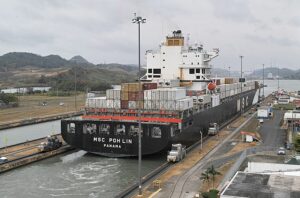
The panamax ship MSC Poh Lin exiting the Miraflores locks, March 2013
Along with the Suez Canal, discussed previously, the Panama Canal is the other major choke point of international shipping, as it removed the need to use the highly dangerous route around South America‘s Cape Horn. A relatively minor accident in the Suez Canal, solved in six days, nearly unhinged world trade.
What would a pair of attacks, against both canals simultaneously, do? Especially if those attacks did not simply close the routes for a few days, but for months, if not years? But – how would such attacks play out?
In the case of Suez, simply limpet mining or scuttling one or two very large vessels in the right place[s] would be sufficient, as the ships and their cargoes would have to be fully cleared before traffic could resume.
Panama, however, is more difficult. The lock system that makes up the canal is not really susceptible to scuttling, because of the canal’s layout. A ship scuttling inside a lock, while certainly a disaster, would be relatively easily to resolve.
But — what about a ship carrying three or four thousand tones of ammonium nitrate “suddenly” exploding in the Panama Canal?
The explosion of the ammonium nitrate cargo in the Port of Beirut left a blast crater over 400ft/124m in diameter, and some 140ft/43m deep. What effect would a larger explosion have, in the tight confines of a lock system like Panama’s? At the very least, the Panama Canal would cease operations for months, if not a full year…
…And, coupled to a similar closure of Suez, world trade would be forced to make long and dangerous detours…
So — Why would this benefit the Islamic State, encouraging it to expend significant resources in an attempt to establish a base in northern Mozambique, well outside their normal operational zones?
Because, if Suez were to be closed, the shipping detour around Africa’s Cape of Good Hope has to run right past Mozambique’s Cabo Delgado region.
Location of Mayotte and neighboring countries in the Mozambique Channel
But — If the above is true, what would the benefit be for the surviving Sea Pigeons to help Hussein Farrah Aidid and the Islamic State? Simply put: Revenge.
The United States – as well as India – aided the Sri Lankan Navy in attacking the Sea Tiger/Sea Pigeon layover areas with satellite imagery showing those assembly area’s locations and layouts. Both the People’s Republic of China (PRC) and Russia directly supplied the Sri Lankan government with military weapons, equipment, vehicles and aircraft for its final, apocalyptic campaigns against the LTTE. Great Britain was largely responsible for the confused and messy end of Colonialism in Sri Lanka, and was directly responsible for the ethinc divisions that ultimately led to the island’s civil war. France and the rest of the major nations of the world eagerly lined up to proscribe and hunt down the remainder of the LTTE outside of Sri Lanka, and actively worked to dismantle the group’s international financing network…And every one of these states would be critically damaged by an attack of this nature.
If any non-religious group has reason to want to destroy the West, it is the remnants of the LTTE.
Turkey, as we pointed out in April, was deeply involved in the creation and expansion of the Islamic State’s original form. However, once Erdogan’s plan to launch a religious war against Iran failed, he dropped the Islamic State like a hot potato, leaving it to die on the vine…except that, like troublesome weeds, it refused to die quietly.
It Islamic State learned from this. And the primary lesson it learned, was that it was just as much of a pawn in international “realpolitik” as any other group. And – like their institutional ancestors, Al Qaeda, in the aftermath of carrying the CIA’s water in expelling the Soviet’s from Afghanistan – they refused to simply go home.
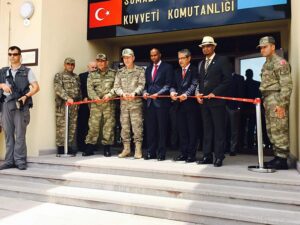
Turkey Opens Largest Foreign Military Base in Mogadishu, 2017
Money is money, after all — and everyone’s money is good, if it buys you ammunition.
But Turkey has gone a step further, expanding its reach into Africa, but especially into Somalia and Libya where it is actively working with other major powers against Islamist militant groups, even as it plays multiple sides in Ethiopia. An attack that closed the Suez Canal would do as much, if not more, damage to the Turkish economy as it would to the wider world.
Again — the Islamic State is capable of assembling all of the above points into a strategic picture; the Freedomistis not saying anything not publicly-available. Additionally, even if the educated guesses about Aidid and the Sea Pigeons are completely wrong, if we can work through this, so can the Islamic State. In fact, any competent intelligence analyst can see it, if they do the work…as many have.
The question is: Will those the analysts work for, listen to them?
In our first installment of this series, we talked about the FN FAL, as one of the “other” assault rifles of the world, post-World War 2. Today, we will talk about the next one in line. (Also, there will be a Part 3 to this story, coming later.)
In the aftermath of World War 2, Germany was a shambles: it had been heavily bombed, many millions of its civilians, as well as the bulk of its professional armed forces, had been killed or displaced, and the country itself had been occupied and partitioned off between the victorious Allied powers, and its industry was severely restricted in what it was allowed to manufacture. (We are not here to discuss the morality of those actions; that is another conversation, entirely.) For Germany’s many weaponsmiths, they had to either find something else to make, or they had to leave the country for other nations, nations in need of innovative weapons designers.
German soldiers armed with HK G3 rifles exiting a Marder IFV
The world of 1946 was not “standardized“, as we would think of the term, now. There were few industries that even attempted to design to internationally accepted standards. As of 1946, a quick (and thoroughly unscientific) glance shows that there were some ten or eleven different rifle calibers in “widespread” use in the world, minimum, depending upon how one describes “widespread” and “rifle caliber“.
Spain – still recovering from a brutal civil war in the mid-1930’s, as well as a grain blight and a recovering agriculture industry that caused severe food shortages during WW2 – had largelysat out the war, but had had paid careful attention to its course and the technological developments emerging from it. After the war was over, Spain decided that it needed to catch up to the other major powers, beginning by revamping its pre-war small arms inventory.
The design is rugged, robust, reliable and adaptable. As well, it is a relatively simple system to manufacture, making great use of stamped-steel construction, rivaling (almost) even the AK-47 in its simplicity. It is also highly modular, able to swap major components between various models, in a manner only approached (but not equaled) by the AR-15/M-16/M4 series.
MP5 A3. This is the retractable buttstock version of the MP5
The G3 rifle and its many legendary derivatives – the H&K MP-5, HK21, HK33, SG-1, and PSG-1 – would go on to be adopted by over 40 nations and anyone else who could lay hands on them, and with manufacturing licenses being sold to some 18 countries, there were – and are – plenty to go around.
HK21 Light Machine Gun
The G3 and it’s descendants have fought – and continue to fight – in virtually every theater of conflict in the world, today. Whatever conflict zone you might find yourself in, you will likely find G3’s in abundance; knowing how they – and other major small arms – operate is in your own best interest.
The goal of this column is to present news from around the world that is not often – if ever – covered by more mainstream entities, using local sources wherever possible, but occasionally using news aggregators not used, again, by the mainstream media. Also, please note that we do use links to Wikipedia; while Wikipedia is well-known as a largely-useless site for any kind of serious research, it does serve as a launch-pad for further inquiry, in addition to being generally free of malicious ads. As with anything from Wikipedia, always verify their sources before making any conclusions based on their pages.
This column will cover the preceding week of news.
To make it easier for readers to follow story source links: anytime you see a bracketed number marked in green – [1] – those are the source links relating to that story.
North America
Leading off in North America, a series of three “homemade bombs” were detonated along a two-mile long area of Vista, California over a 3-hour period on Thursday. The explosions occurred in open areas and parking lots. No injuries or property damage was reported, although two small fires were quickly extinguished. The San Diego County Sheriff’s Office said that there was no obvious target or motivation for the bombs, and that no threat had been received. However, it should be kept in mind that Vista is also a “bedroom community” for the nearby US Marine base at Camp Pendleton and the attached extension of the Seal Beach Naval Weapons Station in nearby Fallbrook, and is home to numerous married personnel and their families. [1]
Elsewhere in the nation, bomb threats targeting schools continued unabated this week, although – as we reported last week – there is a perceptible shift occurring, as more threats are coming in the form of physical notes and social media, the last being especially odd, given the ease of tracking posters. [2]-[8]
In Burkina Faso‘s northern region, a total of eleven soldiers were killed in two separate incidents on Thursday and Friday; nine people were reportedly wounded, while the military claims to have killed at least twenty suspected islamist jihadis in turn. Burkina Faso has been fighting various jihadist groups since 2015; operations continue to grind onwards. [1]
In Nigeria, fighting continued steadily across the nation, as military and police forces worked to counter the tide of attacks by groups such as Boko Haram and the “Islamic State – West Africa Province (ISWAP)” in their continuing offensives to collapse the government and create their varying versions of Islamist rule. [2]-[7]
Meanwhile, in neighboring Cameroon, separatists from the Ambazonia Defence Forces, an armed wing of the breakaway “Federal Republic of Ambazonia” kidnapped Regina Mundi, a Senator of the country’s ruling “Cameroon People’s Democratic Movement” and her driver on the 2nd. “Ambazonia“, also known as the “Southern Cameroons” are an English-speaking region in northwest Cameroon, bordering Nigeria. When Cameroon became independent in 1961, the English-speaking areas agreed via plebiscite to join the French-speaking side of the colony in a federal union. However, tensions over the years finally boiled over in 2016, resulting in what is now termed the “Anglophone Crisis”, or the “Ambazonia War”. The issue is messy and complicated – as most of the colonial independence breakups were – because the french-speaking side of Cameroon is supported by Nigeria, because factions of the Ambazonians and the Ibo people of Nigeria – still agitating for an independent Biafran state – actively support each other. [8]-[10]
The Middle East remained surprisingly (and refreshingly) quiet this week, with few incidents of note making their way onto the news wires. Chief among these, the ceasefire in Yemen continues to hold, albeit shakily, as the Houthi side of the conflict claimed to have launched a drone attack on a Saudi command center, and in turn, shot down a Saudi drone in a separate incident. [1][2]
In Israel, meanwhile, at least three people were killed and another nine were injured in a terrorist attack in the city of Elad, on Thursday. Police have arrested the attackers, 19-year-old As’sad al-Rafai and 20-year-old Emad Subhi Abu Shqeir, who carried out their attack with hand axes, according to witnesses. [3]-[5]
On Friday, CPRF and officers from other security agencies arrested two suspected members of the Lashkar-e-Taiba terror group, in Northern Kashmir’s Baramulla district, recovering some light arms. Also on Friday, security forces killed Hizbul Mujahideen terrorist “Commander” Ashraf Molvi along with two other terrorists in an encounter in Kashmir’s Anantnag district. Molvi was at the top of the MHA (Ministry of Home Affairs) “Most Wanted” list. [2][3]
Apparently taking a page from both North Korean and Mexican Drug Cartel operations, India’s “Border Security Force (BSF)” discovered a 150 meter-long tunnel, shored up with sandbags, in an area under the Chak Faquira outpost in Samba on Wednesday evening, according to BSF officials. The tunnel is still being cleared at press time. [4]
On the opposite side of the country, in the state of Mizoram, units of the Assam Rifles seized massive caches of explosives in two separate incidents. The finds are believed to be related to the ongoing violence in Myanmar, just over the border from Mizoram, following the 2021 military coup d’état in that country. [5][6] In neighboring Manipur, the state capitol of Imphal saw two IED attacks in a 24-hour period, on May 5th and 6th. [7] Meanwhile, troops of the 14th Battalion of the Rajput Regiment discovered a small cache of weapons in the Changlang area of the far-northeastern state of Arunachal Pradesh. [8]
Northeastern India has been plagued by low-level insurgency groups for decades.
These days, a (rational) person within the United States who hears the term “assault rifle” will likely think automatically of one of two weapons: the AR-15 or the AK-47 or one of those weapons derivatives. Both are, in fact, not “technically” assault rifles, as the models the vast majority of Americans can access are not capable of selective fire, but humans are visual creatures, so that’s an issue we can leave aside for the time being.
There are, obviously, a vast array of “other” assault rifles that have been made since World War 2, but the vast majority of those were either based in some fashion on the AR- or AK- platforms, or never really achieved widespread adoption. Today, we’ll look at one that did…and still does.
This article is the first of two parts.
British Army patrol crossing a stream during the Mau Mau rebellion, armed with Belgian-made 7.62mm FN FAL’s (1st and 2nd soldiers from right)
The first “assault rifle” (or “battle rifle”, if you prefer that term) to come along after World War 2 was the “FAL” (Fusil Automatique Léger), known simply as the “FAL“, made by Fabrique Nationale Herstal, Belgium, and was designed primarily by Dieudonné Saive, one-time assistant to legendary arms designer John Browning. Introduced in 1951 and completed in 1953, the FAL rapidly became one of the baseline standards of Western and Western-aligned military forces, so much so, that it became known as the “Right Hand of the Free World“, eventually being adopted at some level by some 90 nations (recall that the number of recognized nations as of press time is 216).
Members of the Eastern Caribbean Defense Force in Operation URGENT FURY, 1983, armed with Belgian-made 7.62mm FN FAL rifles
Using a short-stroke gas piston system, the FAL offered a soldier twenty rounds of “full power” 7.62x51mm ammunition in a reasonably lightweight (for the time) package. Despite some reliability issues in desert and arctic climates, the FAL was a serious contender against what became the M-14 rifle in the US military’s service rifle trials of the mid-1950’s; that rather shoddy affair is the subject for a later rant. (The other contender in that trial, the AR-10, was the father of the AR-15/M-16.)
Despite the United States not adopting it, the FAL went on to be adopted by so many countries, it ended up on both (or all) sides in conflicts all over the world, most notably in the Falklands War of 1982.
British troops armed with L1A1 (L), and piles of captured Argentine FALs (R), Falklands, 1982
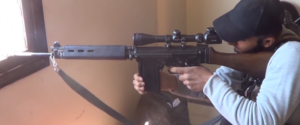
A fighter of the Siddiq Battalions fire a scoped FN FAL at Syrian government forces
Although now approaching its 70th year, the FAL remains in action around the world, fighting on
A Bolivian soldier armed with a Belgian-designed 7.62 FN FAL
battlefields as diverse as Syria and Bolivia. This is one of those tools that humanity has made that, for good or ill, will not go quietly into the night…nor should it.
Rifles are tools – nothing more. They are no different from hammers or saws…or computers and pencils. They are just tools. It is what is done with those tools that defines “good” or “evil”, “right” or “wrong”. Learn about these tools, even if you never have need or cause to use them. They are important. They matter.
Back FREEDOM for only $4.95/month and help the Freedomist to fight the ongoing war on liberty and defeat the establishment's SHILL press!!
Are you enjoying our content? Help support our mission to reach every American with a message of freedom through virtue, liberty, and independence! Support our team of dedicated freedom builders for as little as $4.95/month! Back the Freedomist now! Click here



 At some point, likely in late-2018 or early-2019, ISCAP seems to have arrived in Cabo Delgado, and either displaced or absorbed the Al Qaeda affiliate. It is important to understand the implications of this event. Where Al Qaeda-aligned groups at that time rarely left the terrorist model to engage in actual
  Although, as of February of 2022, ISCAP seems to have been battered back into the forests, there have been multi-month-long lulls in the fighting before. This fight is not over.