The goal of this column is to present news from around the world that is not often – if ever – covered by more mainstream entities, using local sources wherever possible, but occasionally using news aggregators not used, again, by the mainstream media. Also, please note that we do use links to Wikipedia; while Wikipedia is well-known as a largely-useless site for any kind of serious research, it does serve as a launch-pad for further inquiry, in addition to being generally free of malicious ads. As with anything from Wikipedia, always verify their sources before making any conclusions based on their pages.
This column will cover the preceding week of news.
To make it easier for readers to follow story source links: anytime you see a bracketed number marked in green – [1] – those are the source links relating to that story.
North America
The security news in North America was dominated this week by a huge wave of telephoned-in bomb threats, mostly against college campuses, being made across the nation [1]-[8], with a wave of threats across the breadth of North Carolina. [9]-[13] Elsewhere, similar threats were received by an abortion clinic in Victorville, CA [14], and by the Public Defender’s office in Miami-Dade County, FL. [15] In Rochester, MN, a woman picked up a device she believed to be an possible explosive device she had found in a park, and transported to the local police station, a highly dangerous and irresponsible action which we commented on in last week’s World Situation Report. [16] In Germantown, TN, meanwhile, police safely recovered the second of two IED’s, after responding to one of the devices detonating, although no damage was reported. [17]
By comparison to North America, Africa this week was comparatively quiet, given the pace of violent activities in recent weeks. Thankfully, the rest of the world – the Russo-Ukrainian War being the obvious exception – also remained largely quiet this week, to the point that we will be ending this Report on that continent.
Beginning in Burkina Faso, terror attacks killed a dozen people – all believed to be civilians – in two attacks in the central part of the country. [1][2] Meanwhile, Islamist insurgents severely damaged a critical bridge linking the towns of Kaya(just to the northwest of the nation’s capital of Ouagadougou) and Dori, approximately 120miles/193km to the northwest. [3][4] This appears to be a fresh offensive by jihadists to isolate the capital from the northern part of the country, as there are reports of jihadi’s effectively blockading towns along the contested roadway. The central government currently controls only an estimated 60 percent of the country. Burkina Faso, one of the poorest nations in the world, has been battling a festering Islamist insurgency since 2015, primarily against movements linked to the Al-Qaeda and the Islamic State groups. More than 2,000 people have been killed and 1.8 million displaced.
In Nigeria, Islamist jihadi’s reportedly kidnapped a number of medical personnel while murdering numerous civilians in the neighboring states of Kaduna (which also saw the reported kidnapping of a police officer) and Zamfara, in the country’s northwest, while some 13 people were reported killed by terrorists on a mining site in Niger State (not to be confused with the nation of the same name), and reportedly kidnapped two Chinese nationals working on the site. The kidnapping of medical personnel is significant, indicating that repeated operations by Nigerian police, military and civilian militia’s are exacting a heavy toll on the terrorist groups. [1]-[4]
In the southeast, attacks killed at least three people, and resulted in several homes being burned down. [5] In the country’s northwest, meanwhile, Islamic terror groups have begun attacking the national power distribution infrastructure, resulting in increasing strain on the country’s power grid. [6]
Across the continent, Ethiopian officials are blaming the deaths of some 338 people – mostly ethnic Amhara’s – in the Oromia Region on the Oromo Liberation Army (OLA) rebel group. The group has denied any involvement in the killings. The Oromo conflict has been waxing and waning in intensity since 1973, which has been aggravated by the ongoing Tigray War in the northern part of the country.
It seems more and more certain that another election is about to take place, with Benjamin Netanyahu, the leader of the past record-setting 12 years, possibly attempting to return once again even as he faces his own legal issues.
As the Chinese continue to extend themselves into foreign enclaves, from Latin America to Africa, from Eastern Europe to Pakistan, they will increasingly become the targets of various factional groups willing to kill them rather than negotiate with them or submit to them.
China has come along rather late in the colonial version of Empire, where the soft power of the market coupled with strategic brutal violence was enough to keep the natives at bay. These are different times, and many of the lands China hopes to now de facto possess are long in the tooth in the colonial game, and even more than before willing to commit themselves to life or death struggles to avoid seeing the pattern of colonialization again.
The goal of this column is to present news from around the world that is not often – if ever – covered by more mainstream entities, using local sources wherever possible, but occasionally using news aggregators not used, again, by the mainstream media. Also, please note that we do use links to Wikipedia; while Wikipedia is well-known as a largely-useless site for any kind of serious research, it does serve as a launch-pad for further inquiry, in addition to being generally free of malicious ads. As with anything from Wikipedia, always verify their sources before making any conclusions based on their pages.
This column will cover the preceding week of news.
To make it easier for readers to follow story source links: anytime you see a bracketed number marked in green – [1] – those are the source links relating to that story.
North America
Beginning in North America and the Caribbean, this week saw a return of bomb threats against schools and Jewish centers, after near-silence for two weeks. The anonymous threats were concentrated in California, and in the Northeast, in Upstate New York and neighboring Canada. [1]-[4]
In an incident somewhat similar to the recent series of threats made against the town of Kiel, Wisconsin, a series of bomb threats were made against a host of offices of the Alabama state Department of Transportation, as well as various officials of the agency. According to the threat letter received, the person making the threats was opposing the eminent domain case the Alabama DOT is pursuing against a local family, attempting to seize a portion of their property – including four homes – for a highway project. The family in question is reportedly “disturbed” by the threats made against the local government. [5]
Finally for the United States, 42-year old Allison Fluke-Ekren plead guilty in federal court on the 7th, on charges of conspiring to provide material support or resources to a foreign terrorist organization. Fluke-Ekren, a purported leader within the Islamic State terror group, was accused of leading the “Khatiba Nusaybah”, a reported all-female unit of IS fighters that planned terror attacks inside the United States. Fluke-Ekren faces up to 20 years in prison. [6][7]
Turning briefly to the Caribbean, unknown “gangs” reportedly kidnapped some 38 people riding in ‘mini-buses’, as they left Port-au-Prince, the capital of the impoverished nation of Haiti. No further details were available at press time. Haiti has been on an increasingly downward spiral, in the aftermath of devastating earthquakes in 2010 and 2021, the assassination of the nation’s President in 2021 and an array of problems associated with the Covid pandemic. [8]
Turning to Europe, officials reported that a number of Belgrade schools received another round of bomb threats this week, disrupting classes as police responded to investigate and clear the schools. Some analysts have begun trying to link the relentless waves of threats to Serbia‘s continued refusal to impose sanctions on Russia, over its ongoing invasion of Ukraine. [1]
In Germany, one person was killed and 30 more were injured when a man rammed his car into a crowd of shoppers in central Berlin, near the Breitscheidplatz, site of the 2016 Berlin truck attack, that killed 12 and wounded 56, an attack for which the Islamic State of the day took responsibility. There was no word at press time of the identity of the assailant, who was detained at the scene by shoppers until the police arrived, or his motivation. [2]
In Nigeria, while the pace of arson, assassination and kidnapping attacks continue throughout the nation, the number of attacks was noticeably lower this week, in comparison to previous weeks. The ongoing investigation into last week’s bloody massacre of Catholic worshipers in Ondo, saw police on the scene recover at least three IED‘s from the scene. [1]-[6]
The ISWAP terror group, reeling from last week’s losses to the Nigerian Army and civilian militias, staged an attack on the town of Lawan, near Maiduguri in the state of Borno, in the eastern part of the country, reportedly kidnapping a number of civilians. This shaped into a major fight, with the ISWAP fighters attempting to block the main road in the area, and having to be dislodged by army troops, with air strikes from the Nigerian Air Force. The terrorists were ultimately driven off, with three “technicals” captured and another destroyed. This is in the same area as last year’s deadly assault (which reportedly included a captured Scorpion Light Tank) on an army camp near the town of Mainok, which resulted in the death of some 33 soldiers, and the destruction of several heavy vehicles, including a T-55 tank, a BTRIFV‘s and several MRAP‘s. [7][8]
Desultory violence continued throughout the region, this week, as two Egyptian soldiers and three civilians were killed in the town of Rafah, in the Sinai Peninsula, by Islamic State militants. The Egyptian state and people have been battling IS since 2011, in a protracted war of terror against Egypt. [1]
Turning to Syria, Turkey’s intervention ground on through its eleventh year, with artillery and drone strikes in its occupation zone in Syria’s Kurdish-majority north, where Turkey is trying to destroy Kurdish infrastructure, in order to limit support from getting to its own restive Kurdish minority. [2]-[4]
This week saw a sudden uptick of violence across Afghanistan, where a wave of bombings has killed at least two dozen people, and wounded dozens more, as the Taliban struggle to maintain order in the wake of their seizure of the government and capital of Kabul in September of 2021. This is not simply a case of resistance by the Northern Alliance (which has been clinging to life in the Panjshir Valley) since the Taliban takeover, but the reality of Islamic terror: no one is ever “ideologically pure” enough…which is why most of the world’s victims of Islamist terror are Muslims.
In Pakistan, scattered terrorist incidents killed over a dozen in scattered shootings and bombings across the country, including four terrorists from various groups and one soldier.
Turning to India, finally, Indian police captured a drone delivering supplies to Islamic insurgents in Jammu & Kashmir, as continuous operations killed or captured a dozen terror suspects, and netted weapons and explosives. [1]-[7]
Elsewhere in the country, fallout continues over the comments made in May by two of India’s ruling BJP (“Bharatiya Janata Party”) party officials (who were dismissed over the religiously offensive comments), which many Muslims saw as profaning Muhammad, the Prophet of the Islamic faith. At least three protestor’s have been killed by police in riots in Ranchi, the capital of Jharkhand State, in protests demanding the arrest of Nupur Sharma, one of the female party members who made the offensive comments. In the northern state of Uttar Pradesh (site of the Taj Mahal), police have arrested over 300 people in in connection with the violent protests, and officials have begun a highly controversial policy of bulldozing the homes and businesses of some of the rioters. Additionally, the “Al-Qaeda in the Indian Subcontinent” terror group chimed in, vowing suicide attacks in retribution. [8]-[4]
Recently, the New York Times, working with Pulitzer Prize-nominated journalist Rukmini Callimachi, spent fifteen months unpacking a trove of over fifteen thousand internal documents of the so-called “Islamic State“, painstakingly assembled over the course of a five trips to Iraq over the span of a year.
Members of the 9th Iraqi Army Division fire a heavy machine gun at ISIS positions near Al Tarab, Iraq, March 17, 2017 (U.S. Army photo by Staff Sgt. Jason Hull)
The documents are fascinating, intriguing…and alarming…as they expose, in excruciating detail, the internal operations of a group of modern barbarians, along with the ‘why’ and the ‘how’ by which they were able sustain a functioning state, under continuous attack, largely cut off from external aid.
Some of the 12,000 Iraqi Yazidi refugees at Newroz camp in Al-Hassakah province, north eastern Syria after fleeing Islamic State militants, 13 August 2014.
Despite its barbaric nihilism – including public mass beheadings and a return to open-air (and openly televised) slave markets – the terrorist state at one point controlled a swath of territory the size of Great Britain, as well as a population estimated at nearly 12 million people, not to mention parts of Libya, Nigeria andthe Philippines coming under their nominal control, via various local groups swearing allegiance to the group. As fascinating as the article – as well as its attendant photo archive and supplementary articles – may be, it is even more fascinating for what it does not say, namely:
How did this happen?
One of the curious blind spots of the Times’ reporting, is that they already had the answer to this question. As early as August of 2014, the Times quite accurately reported that ISIL relied heavily on former officers – and civil officials – of deposed and executed Iraqi dictator Saddam Hussein’s forces and the Iraqi Ba’ath Party structure.
Many of these men – most of them dedicated career officers and officials – were summarily ejected from the Iraqi governmental and military structure through the staggering incompetence of the Coalition Provisioning Authority in the aftermath of the Coalition invasion of Iraq, which toppled the dictator from power. The Coalition’s ill-conceived Order Number 2 effectively destroyed the internal structure of Iraq at a stroke, leading to chaos within the country, and directly to the uprising of the Sunni demographic minority, who had formed the majority of the Iraqi state’s bureaucracy for its entire existence. Democratic structures are always messy to implement, and in a culture with little to no concept of the principles involved, the chances of abuse is heightened, especially when the demographic majority has been systematically abused by a controlling minority.
Abandoned Iraqi Army equipment, Mosul, 2014
Iraq was no different, and once George W. Bush, left office in early 2009, to be replaced by the ineffectual and diffident Barack Obama, who was eager to fulfill his campaign promise to get the United States out of Iraq, no matter what, as soon as possible, old hatreds that had been suppressed by the heavy presence of Coalition forces immediately began to regain ground.
ISIL forces were not terribly energetic in their capture of Mosul – Iraq’s “second city” – in 2014, and by all rights, outnumbered by as much as 15-to-1, should have been speedily annihilated by the Iraqi 2nd and 3rd Infantry divisions…which didn’t happen, due to the systematic reprisals by the Shia-dominated government of Nouri al-Maliki against the mostly-Sunni officer and NCO corps’ that had been carefully built by US and Coalition military advisor teams for almost ten years, all of which went largely unaddressed by President Obama until it was nearly too late. That Iraq remained intact at all, and that ISIL’s offensive first stalled, then fizzled, was due to the restraint showed by – of all entities – Iran.
Iranian soldiers help unload a U.S. Air Force C-130 on the airfield at Kerman, Iran, Dec. 28, 2003
Iran – ancient Persia – has been in the “war business” for a very long time, and saw the trap they were being enticed into from a mile away…and declined to bite. The Iranian mullahs (who learned their lesson after nearly being toppled during the Iran-Iraq War of 1980-1988) asked their professional soldiers – the Artesh – what to do. The Artesh, knowing their job very well, told the mullahs to avoid sending in the Artesh at all costs, and to send – at most – the Revolutionary Guard Corps’ “Quds Force” (their version of “special forces“). Their reasoning was as simple as it was true: Sending in the Artesh to try and copy the American- and British-led invasion of the country a decade before would be seen by the Sunni Muslim world as an invasion by infidels, and that is was better to let ISIL strangle itself. (The Freedomist has covered some of this elsewhere.)
However – a lack of Western grand strategies aside – with the conquest of Mosul, it suddenly became apparent that ISIL was not the typical terror group. While the vast bulk of their non-Iraqi or -Syrian recruits were in their mid-20’s and well-educated, but mostly work-inexperienced and largely ignorant of the Quran or the intricacies of Sharia law, and most of their in-country recruits tended to be indifferently educated and had little experience of the wider world, the group seemed able to “magically” set up and run a functioning state almost literally overnight.
How was such a thing possible? What happened, to cause this?
Iraqi Republican Guard after pushing Iranian forces from the Al-Faw peninsula in 1988
In the aftermath of the 2003 invasion, and the disenfranchisement of the bulk of the Iraqi government bureaucrats and military officers by Order Number 2, it is clear that a number of mid-level (captains and majors, primarily) military officers – and possibly some civil servants – fled into Syria. While Syria was not an active member of the so-called “Coalition of the Willing” then entrenched in neighboring Iraq, they largely kept their Ba’athist cousins in check. In such an environment, with nothing else to do, and with undoubted access to some of the many secret bank accounts squirreled away by Saddam and his henchmen, such men would have done what all of their professional training told them to do: assess what had happened to get them to that place, and plan for what to do to regain some semblance of their former power and self-respect.
Freed from the constraints of the ruthless, sadistic, paranoid and militarily-incompetent Saddam and his henchmen, these professionally trained officers would have conducted a multi-leveled interdisciplinary review, that examined and assessed Iraq’s defeats of the preceding twenty-odd years, the reasons for the United States’ and its allies repeated victories over them, the state of their finances, what immediately-available technology and supplies those funds could purchase, and how to more effectively employ those assets…there were just two problems these men could not overcome, given the regime philosophy they had served: a lack of privates, and the lack of a figurehead.
As mid-level officers, these men were largely faceless and unknown – the stereotypical “gray man“. But, they could not implement their plans without an army of “spear-carriers” and a leader…which is the point where fate, in the form of the “Arab Spring“, intervened.
Anti-riot police in central Damascus, Jan. 16, 2012
As the region’s more restrictive states began to explode with internal protests in December of 2010, it quickly became apparent that the United States was involved, at least at some level. As protests began to intensify in Syria in early 2011, the former Iraqi officers in Syria undoubtedly began to wonder if this was their moment. While certainly grateful for the sanctuary provided by Bashar al-Assad, they would also have chafed at the restrictions he kept them under.
Syrian rebels in combat against government forces in Qaboun, Damascus, 2017.
As early as August, 2011 what would become ISIL – after relentless pounding by US and Coalition forces, that also saw the death of its founder, Abu Musab al-Zarqawi and the rise of his successor, Abu Bakr al-Baghdadi – began withdrawing into western Iraq…and began filtering cadre into Syria to help form what would become the al-Nusra Front. This is likely the point, in 2013, where the two groups first mingled, given the al-Nusra/ISIL group’s rapid growth in effectiveness, its apparent professionalism and its reputed large numbers of “foreign” fighters.
By January of 2014, it was too late: a well-motivated and suddenly professional ISIL, reinforced by dissident al-Nusra troops and the bulk of the Russian-speaking Jaish al-Muhajireen wal-Ansar (JMA) group, roared out of Aleppo and Raqqa, and into history…
Syrian rebels of Jaych al-Nasr (ASL) in the Idleb region, January 23, 2018.
…But in their wake, came the “little grey men“: military bureaucrats and administrators – professional, worldly and well-educated – appeared hot on the heels of the assault units, rounding up the local populace, for either recruitment, co-opting or “ethnic cleansing“. They swiftly established licensing and tax collection regimens, “bootstrapped” an economy from scratch, and started to put services back into operation, i.e., literally “turning the lights back on” and repairing water supply and treatment systems…all while creating a receiving/inventory/reissue system for loot taken from the homes and businesses of non-Sunni’s (or those Sunni’s who opposed them) who had been massacred or driven out of their homes, to be reissued on a “ration book“-style system to fighters arriving in the new state, along with a property redistribution system for housing their new troops.
As Ms. Callimachi points out in her Times article, the administrative and logistical professionalism of these men was breathtaking in its effects: ISIL operations within its territory were almost entirely financed by its internal taxation policies. While there was clear assistance from outside, the lesson Ms. Callimachi presents is stark: a non-state group can, given enough forethought by its leadership – or its middle managers – as well as a lack of interference in day-to-day operations by inexperienced leaders, and effective military training at even a low level, can self-sustain itself in ways we have rarely seen, previously.
While none of this was ever exactly “secret” information, a mythology has grown up, which states that “military and governmental professionalism” implied the requirement for a vast, complex and expensive infrastructure to function. In fact, it is the systems and processes that make a professional infrastructure, long before money changes hands, “brick-and-mortar” facilities are built, and equipment is purchased. None of this is surprising, as most of the systems and processes are little different from Western Cold War-era nuclear attack recovery plans…The Islamic State simply started at that point, using frameworks of established systems and processes gleaned from publicly-available government websites on the internet, rather than developing a wholly-new process from scratch.
And if ISIL can do it, any group that operates to at least their level can do it, as well.
Someone has opened Pandora’s box, again…and the future bodes ill for it.
Xi has always viewed work concerning agriculture, rural areas and farmers from a broader historical perspective and made a series of important discourses on the topic. He has answered a series of major theoretical and practical questions, providing an action plan and fundamental guidance for work in the sector….
The EU has passed new “terrorist content” regulation that will require Social Media platforms to remove content deemed to be terroristic by any government within the EU. The law passed last year, but the regulations took effect Tuesday, June 7th. Content that incites violence is also included.
The Washington Free Beacon is reporting that USA Today has been taking money from the Chinese Communist Party. China Daily, a CCP-owned and operated agit prop publication, has bought over a quarter million dollars in advertising from USA Today, which lost 62 percent of its circulation in one year.
The goal of this column is to present news from around the world that is not often – if ever – covered by more mainstream entities, using local sources wherever possible, but occasionally using news aggregators not used, again, by the mainstream media. Also, please note that we do use links to Wikipedia; while Wikipedia is well-known as a largely-useless site for any kind of serious research, it does serve as a launch-pad for further inquiry, in addition to being generally free of malicious ads. As with anything from Wikipedia, always verify their sources before making any conclusions based on their pages.
This column will cover the preceding week of news.
To make it easier for readers to follow story source links: anytime you see a bracketed number marked in green – [1] – those are the source links relating to that story.
North America
The United States remained largely quiet during the week, despite a sudden spate of shootings that are possible “copy cat” crimes, seeking to emulate the school shooting in Uvalde, TX on May 24th, even as emerging details of the police response to that incident have left the governor of the state, Greg Abbott, “livid” at being given untrue information. [1]-[4]
Elsewhere, only two handwritten-note bomb threats were received at schools in the country this week, although several threats to both schools and businesses resulted in swift arrests. [5]-[9]
The last incident of note for North America this week comes from Kiel, Wisconsin. The city police received a threat from an as yet unnamed person or persons, threatening multiple targets in the city if a Title IX investigation by the school district against several students is not dropped “immediately.” Additional threats have been received, including one that came after the school district closed its investigation. The incident in question – as reported by the NYPost, on May 14 – involved three 8th grade students being investigated for sexual harassment on the grounds of refusing to refer to another student by their chosen pronouns. A “Title IX investigation” is a legal requirement for schools that requires school districts to immediately investigate any formal claim that sexual harassment of any kind has occurred. [10]-[12]
Turning to Europe, the email bomb threat wave struck again, with police and various other government agencies in the Bosnian cities of Banja Luka and Sarajevo received “hundreds” of emailed threats against targets ranging from police stations and hospitals to elementary schools. The emails targeted both Serb and non-Serb entities within the country. No “live” incidents were reported, and no arrests have been made.
In central Mali, two Egyptiansoldiers, part of the UN’s now 13,000 strong MINUSMA peacekeeping mission in the war-torn country, were killed by an IED that was detonated as their vehicle was near the town of Douentza, on the road to Timbuktu. This comes after an attack on a UN convoy on Wednesday, that resulted in the death of a Jordanianpeacekeeper, near the town of Kidal, in northern Mali, which wounded three other soldiers. This brings the number of UN peacekeepers killed in action since MINUSMA’s initial deployment in July of 2013, to 174. [1]
As we go to press, reports are coming in from southwestern Nigeria that as many as 50 worshipers have been killed in an attack on the St Francis Catholic Church in the town of Owo, in Onda State. No word on the number of wounded, but if the numbers of dead being reported are accurate, the number of wounded is likely very high. As information is still sketchy, the identity and motives of the attackers remain [2]-[4]
Elsewhere in the country, violence – some terror attacks, some simple banditry and kidnapping – continued through the week, with multiple kidnapping and arson attacks. [5]-[8]
In better news, the group responsible for the kidnapping of dozens of victims from a train in March, rescinded their threat to begin killing their hostages if the local government did not free their under-10 year old children, who they claim were being held illegally. State authorities stated that they had located the children, and that negotiations with the kidnappers were continuing. [9]
As well, civilian militias in the northern state of Borno, reportedly killed a Boko Haram local commander and his deputy in a running gun battle on May 31st. Three days later, on June 2nd, the Nigerian Army, working directly with local militias, launched a surprise raid on Boko Haram and ISWAP camps that killed at least 14 terrorists, resulted in the arrest of 15 more, and freed “scores” of prisoners. Additionally, a solid haul of weapons, vehicles and equipment were also recovered. [10][11]
In neighboring Cameroon, meanwhile, Boko Haram terrorists killed three soldiers and four civilians in an attack on the remote village of Hitaoua, in the far north of the country, on May 31st. [12]
Sporadic and desultory fighting continued this week throughout Syria and Iraq, as Turkey continues its interventions in both countries, as it continues its war against the Kurdish peoples of the region, in fighting that now threatens US positions in the area.
Out of Afghanistan, long-time Al Qaeda leader Ayman al-Zawahiri released a video of him swearing allegiance to Taliban leader Hebatullah Akhundzadah, in a renewal of the two groups’ long-standing alliance. Al Qaeda – then under it’s founder, Osama bin Laden – was given a safe haven in the ravaged country by the Taliban in the 1990’s, and became Al Qaeda’s main base of operations, until the US invasion of the country in 2001, after the September 11, 2001 Attacks in the United Sates. [1]
In Pakistan this week, scattered terror attacks continued, with roadside IEDs and hand grenade attacks killing or wounding approximately a dozen troops and civilians. Also this week, in an apparent case of “No kidding,” that the “Tehrik-e-Taliban Pakistan (TTP)” group, based in Afghanistan, poses a significant danger to Pakistan…which, considering the frequency of terror attacks by the group in the country, should surprise no one. [1]-[5]
Finally, turning to India, scattered violence continued in the northern Jammu & Kashmir region this week, that killed four (including two terrorists), as police issued an alert over terrorists using drones (reportedly supplied by North Korea) to drop explosives during attacks, something that has been happening with increasing frequency in the ongoing war between drug cartels. [6]-[11]
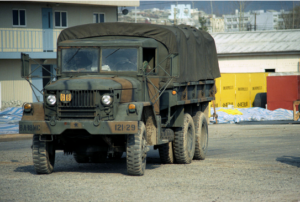
An M35 2 1/2-ton cargo truck arrives in the 146th Combat Support Hospital, Operation TEAM SPIRIT ’86
Military equipment, like all man-made products, breaks down
A B-52 Stratofortress, 307th Bomb Wing, Barksdale Air Force Base, La.
over time…and sometimes, very quickly. Worse,
items can be rendered obsolescent, if not outright obsolete, before they even reach the field. When things like this happen, it is of course the smart move to retire such gear to museums and movie studios…And yet, some equipment survives: the M35-series 2.5ton cargo truck was produced from 1950 to 1988; the M939-series 5ton cargo truck has been in continuous production since 1982. The B-52 strategic bomber – designed in the 1950’s – is expected to remain in service until the 2050’s. And the C-130 – also designed in the 1950’s – really hasn’t reached its “best by” date.
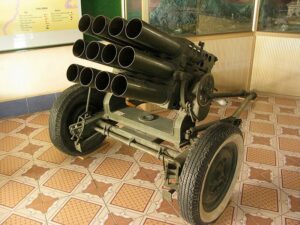
IRGC Ground Force Commandos load a Type 63 MRL mounted on a “technical”
first designed in 1961, and went into production some time around 1963…and remains in production to this day. Likewise, the Soviet-design T-54/55 series main battle tank was produced in massive numbers beginning in the early-1950’s, and remains in service in many countries.
But — why? Why do some weapons persist in use, and others barely make it to the battlefield?
While the Freedomist has touched on the subject of supply in the past, in this article, we will look into “procurement rationale”: why does a military adopt a system, and keep it in service, or retire it.
Fenced House, Tamaki Maori Village, Rotorua, New Zealand
Technology advances. This has always been the case. The times where technology seems to have retreated (and there are very few such examples to study) were brought on by catastrophic impacts on society at large. In general, however, there is a noticeable back-and-forth between offensive and defensive technologies: is it raining on you? Build a house to keep the weather out. Worried about predators dragging you off at night? Build a wall around your house. Are people able to get over your wall? Make it taller and thicker…You can apply this theme to pretty much every endeavor where people have to deal with something other people have invented.
Ellen Johnson-Sirleaf, president of Liberia, congratulates graduates of the Armed Forces of Liberia, 2008
For the budding military Procurement and/or Supply Officers out there, let’s start from zero — we will assume that you have a brand new country, with a brand new military; insert whatever history you find plausible to make this happen…What do you do?
First, you have to determine your country’s needs. This is in no way as easy as a lay person might think.
How large is your country in land area? How much is urban, vs rural? How much arable land is there? How extensive are your road and rail networks? How long is your coastline? What is your country’s population? How many of them are of military age (16 and up)? What is their education level? How extensive is your internal industrial and chemical base?…
We can literally go on all night. This is where all those seemingly pedantic entries in the CIA World Factbook start to look very, veryimportant. For example, most military field manuals (but nottechnical manuals!) around the world are written at the equivalent reading level of the 8th Grade in the United States (Year 8 or 9 elsewhere). This is because that is deemed the absolute minimum reading level necessary to properly utilize the information that has to be presented – are your military-age citizens capable of reading to that level? The terrain, road suitability, and farming/ranching details all directly impact a military’s ability to form itself, long before discussing what type of operations that force may need to execute. Of no small importance, is the nature of threat your country expects to face.
All of these factors are (or should be) considered when trying to understand why military forces buy the gear they do.
Clearly, a force will need a certain basic level of equipment; the frustrating and terrifying thing, is how frequently even long-established military forces simply ignore this basic notion. Clearly, the factors involved are extraordinarily complicated, and it is easy to take a wrong turn — and sometimes, those wrong turns can be lethal.
British Vickers machine gun crew wearing PH-type anti-gas helmets, during the Battle of the Somme, July 1916
The reason military forces are, by and large, conservative to the point of being “hidebound”, is that they know that older systems and techniques work. Old gear that worked in the last war…worked. As well, the limitations, problems and quirks of older systems are well-known, and are usually worked into the training of new recruits. Look back through the historical archives of any established military, and you will find volumes of correspondence deriding new technology as expensive, tactically-useless toys…and frequently, such correspondence is not wrong. Much has been made over the resistance of European militaries’ to deploying machine guns in continental wars, in the decades before World War 1. Part of that was “old Stick In The Mud” intransigence, but also from the very real fact that a Vickers water-cooled machine gun at the start of World War 1, when adjusted for inflation, cost the modern equivalent of just over US$418,000 in 2022 US$ (per George Coppard, “With A Machine Gun to Cambrai (1969)”; the 1914 cost was ₤175). Each. In a time where budgets were incrediblyrestricted, compared to the modern era, a Procurement Office needed to be absolutely certain that the item in question did everything it advertised.
United States Army soldier wearing basic ALICE equipment, c.1973
It is only around the 1980’s that this attitude began to change, with ever-increasing speed. Talk to many professional soldiers of the last forty years, and they will say that the speed of adopting new gear has been too fast.
What are the general considerations for adopting new gear?
First, there needs to be a real need for the item. Many things “look” good or useful, but they really aren’t — or, they may be useful, but only in a limited way, too limited to justify the expense of reequipping a force. Perhaps the classic example of the latter phenomenon is the US Army’s “SPIW” Program. Beginning in the 1950’s, the US Army began looking for a way to increase the lethality of the individual rifleman. While the data this entire project was based on may have been faulty, at best, after forty years of development, the US Army and various NATO Allies carefully watched the adoption of the the G-11, developed by Heckler & Koch of West Germany, by the latter’s army (the Bundeswehr). Although test data indicated that the G-11 was superior to conventional weapons, both ballistically as well as mechanically, it wasn’t superior enough to warrant immediate, widespread adoption; having West Germany adopting it as a “test bed” was deemed acceptable, as the necessary funding would only be for a comparatively small force.
As the G-11 was “good” – but not overly so – the idea of an “advanced combat rifle” (as the project had come to be called) was dropped, for many reasons. Logistically speaking, how long would the caseless ammunition remain good in storage, under various conditions? No data – there were estimates, nothing more. Water immersion? Again, no hard data, only estimates. The rifle was “better” than its conventional, established competitors, but not enough to justify retooling the entire military logistical system of dozens of first-line national militaries.
“Appreciate America Stop the Fifth Column”, US WW2 propaganda poster
Next, military gear needs to be both durable, and simple to operate. In military circles, this is the polite way of saying “Idiot-Proof“. The damnedest things happen to gear and weapons in the field, even when it is just an exercise, to say nothing of actual combat. It is a generally-held tenet that uniforms – especially boots – can be expected to last about 3 – 6 years in normal, peacetime use…and about 3 months, if that, in actual combat. War is highly wasteful, even when you are winning, and troops need a constant flow of resupply of weapons, ammunition and equipment once the fighting actually begins. This is in addition to losses in transit, be that from simple accidents, enemy air or sea raids on convoys, to enemy guerillas or special forces striking supply bases and convoys in the theoretical “rear areas”, as well as sabotage inside your own country, whether from enemy agents, or sympathizers.
Two other factors, ease of maintenance and reliability, enter the picture here. Military equipment, when needed, will see hard use. That equipment needs to remain in operation for as long as possible, before needing any but the most rudimentary maintenance. As well, when the time comes to perform serious maintenance on a piece of equipment – and it always does – it needs to be easy and fast to pull major components out, get them onto a bench to be worked on, then get them back into place; this was, in fact, one of the strong points of the T-55, mentioned above.
A South African soldier with the 9th South African Infantry Battalion, during Exercise “Shared Accord 13”
What all this translates to in terms of supply and procurement budgets, at its most basic level, is that you need a minimum of three separate sets of //everything//: if you have 10,000 troops, you need to maintain an additional 20,000 sets of gear for them, on hand, at all times, aside from the normal new-issue and replacement gear amounts…In the real world, supply officers are lucky if they can beg, borrow or steal enough equipment to maintain an extra 10% of everything for their units.
Thus, keeping old gear around, gear that may be dated, but that may still be “good enough”, is something real supply establishments try to hide from the people writing budgets, lest those people (the dreaded and hated “Bean Counters”) insist that one-generation old gear be transferred to client countries, or to the civilian “surplus or scrap” market.
There is, of course, another aspect to this, one that certain defense contractors – and even established militaries, who should know better – do not like to talk about: Amateur Hour.
A forward ammunition supply point at Pleiku, Republic of Vietnam, c.1968
There used to be a running joke in military circles, that three hundred angry farmers, armed with 100 rifles and 200 machetes, made a revolution. In the post-9/11 world, however, it is no longer a laughing matter. Starting in the early 1980’s small, poorly-funded, badly equipped, yet desperately embattled armies in the Third World began adapting in unexpectedly innovative ways. The clearest early example of this was the “Toyota War“, where the forces of Chad went up against the might of Muammar Gaddafi’sLibyan Army. On paper, it should have been a cake-walk for the Libyan forces: Chad had no ability to match the Libyans, who were well supplied by the Soviet Union. The Chadians, however, responded by militarizing commonly-available Toyota Hi-Lux and Land Cruisers 4×4 pickup trucks, mounting them with anti-tank guided missile launchers (ATGMs), eventually achieving more or less a standard with MILAN units, supplied by the country’s former colonial master, France. In the process, the Chadians developed what would later be called “technicals“.
Chadian soldiers on a Toyota Land Cruiser pickup truck in 2008; EUFOR operation in Chad
Potential rebel forces around the world took note. Eventually, another group would take note, as well — and burn its way into infamy.
In sum, military supply and procurement establishments need to keep up with modern developments in technology and systems, but also need to take care that they don’t bankrupt the nation in order to buy some kind of “New and Improved!” system — unless said system is truly revolutionary, and they can honestly justify the need for the expense.
Conversely, there are many people out there who understand very little of how actual military operations work. In most countries, there is a dedicated military force to handle those things. If a person with no military experience sees their national military forces holding on to what looks like hopelessly outdated gear, or sees them spending hard cash – that came from tax monies – to purchase what looks like pointless “new” gear, take it from a former Supply specialist: take them out to dinner, and politely ask them why. Don’t scream hysterically at them for waste. There is almost always a very good reason behind them doing these things, reasons the local media may have decided are too complex to try and explain…And yes, there is a certain level of sarcasm at that last.
Back FREEDOM for only $4.95/month and help the Freedomist to fight the ongoing war on liberty and defeat the establishment's SHILL press!!
Are you enjoying our content? Help support our mission to reach every American with a message of freedom through virtue, liberty, and independence! Support our team of dedicated freedom builders for as little as $4.95/month! Back the Freedomist now! Click here