April 1, 2026

Global Outlook

The Militarization of the Poles: Future Warfare On The Frozen Frontier


Amid the ongoing chaos of in the world of 2024, other areas of military research and development continue apace. Despite nearly thirty years of warfare in the arid climates of the Middle east, as climate change reshapes the Arctic and Antarctic landscapes, these once-forbidding regions are being strenuously studied as new arenas for potential conflict. Polar warfare, long considered a niche aspect of military strategy, is now gaining prominence as nations vie for resources and strategic advantages in these harsh environments.

Arctic region (orthographic projection) with national borders and land highlighted. 2023. Credit: Heraldry, Isochrone. CCA/3.0.

The Arctic, in particular, has become a focal point of international interest. With an estimated 13% of the world’s undiscovered oil reserves and 30% of its undiscovered natural gas, the region is attracting attention from both Arctic and non-Arctic nations. As ice coverage over the poles recedes, new shipping routes are opening up, promising shorter transit times between Europe and Asia. These developments have spurred a renewed focus on developing and improving military capabilities suited to polar conditions.

The Antarctic Continent, 1928 map. Credit: New York Times. Public Domain.

The challenges of warfare in polar regions are numerous and unique. Extreme cold, unpredictable weather, and long periods of darkness or constant daylight create a hostile environment for both personnel and equipment. Standard military gear often fails in these conditions, necessitating specialized cold-weather equipment and extensive training for troops.

One of the primary concerns in polar warfare is cold-weather logistics. The vast, often empty expanses of the Arctic and Antarctic make supply lines long and vulnerable. Fuel consumption increases dramatically in cold weather, and equipment requires constant maintenance to prevent freezing and malfunction. These factors make theater sustainment a critical aspect of polar military operations.

Naval operations in polar regions present their own set of challenges. Ice-covered waters require specially designed ships with reinforced hulls. Icebreaker ships become crucial assets, not just for clearing paths but also for projecting power and maintaining presence in these regions. Submarines, long seen as the ideal platform for under-ice operations, are gaining renewed importance in polar strategy.

The USCG Healy (WAGB-20) breaks ice around the Russian-flagged tanker Renda 250 miles south of Nome, Alaska, Jan. 6, 2012. DoD photo by Petty Officer 1st Class Sara Francis, U.S. Coast Guard. Public Domain.

Air power in polar regions is complicated by the lack of established airfields and the effects of cold on aircraft systems. However, long-range patrol aircraft and drones are becoming increasingly important for surveillance and maintaining situational awareness over vast Arctic expanses. While the US Navy has only recently resumed carrier operations north of the Actic Circle after a near-thirty year absence, there has a been a steady, if quiet, push to improve operational capabilities for ship-based aviation going on for the last decade or so.

Ground operations in polar environments also require specialized training and equipment. Troops require specialized – and thus, very expensive – training in cold-weather survival techniques and must be able to operate vehicles and weapons in the extreme environments they will encounter. White-out conditions, crevasses, and unstable ice make movement treacherous, requiring expert navigation skills and fast reactions. These aspects of arctic warfare were brought into sharp focus during the Falklands/Malvinas War of 1982, when an attempt to insert a Special Air Service (SAS) team onto Fortuna Glacier on the island of South Georgia, went disastrously wrong, although fortunately without fatalities.

The role of technology in polar warfare cannot be overstated. Satellite communications, crucial for modern military operations, can be unreliable at extreme latitudes. GPS systems also face challenges, necessitating the development of alternative navigation methods. Advanced sensors capable of operating in harsh conditions are becoming increasingly important for detection and targeting in the polar environment.

Several nations are actively developing their polar warfare capabilities. Russia, with the world’s longest Arctic coastline, has been particularly active in militarizing its northern regions. The country has reopened Soviet-era Arctic bases and is developing new icebreakers, including nuclear-powered vessels, as well as hypersonic missiles adapted to the Arctic environment. The United States, Canada, and Nordic countries are also enhancing their Arctic capabilities, conducting regular exercises in the region.

In the Antarctic, while the Antarctic Treaty System prohibits military activity, nations maintain a presence through scientific research stations. However, the potential for future conflict cannot be ignored, particularly as the treaty comes up for potential revision in 2048. The Islamic Republic of Iran, however, is attempting to establish its own presence on the continent, claiming both “property rights” on the continent, as well as stating that the terms of the 1959 treaty system do not apply to them, as they were never signatories to that treaty. It remains to be seen what, if anything, may come of this apparent (hopefully) chest-thumping.

Remaining in the forefront of the Treaty System’s signatories is “Operation Highjump“, now remembered in popular media mostly for various conspiracy theories. In fact, the United States sent a massive force, Task Force 68, totaling some seventy ships, including the aircraft carrier USS Philippine Sea (CV-47), acting as the flagship. Whatever the actual reasons for the expedition, the ability of the United States to operate in the extremes of the Antarctic was one of the factors that ultimately lead to the establishment of the Treaty System a decade later.

A U.S. Navy personnel use a bulldozer to clear a path to facilitate transport of supplies from ships during Operation Highjump in Antarctica. Note the supply ships USS Yancey (AKA-93), right, and USS Merrick (AKA-97) in the background. US Navy photo, c.1947. Public Domain.

The geopolitical implications of increased military activity in polar regions are significant. There are concerns that the Arctic could become a new theater of great power competition, potentially destabilizing the current international order. The Arctic Council, an intergovernmental forum for Arctic nations, has so far managed to maintain cooperation on issues like search and rescue and environmental protection. However, military matters are explicitly excluded from its mandate.

Environmental concerns add another layer of complexity to polar warfare. The fragile ecosystems of the Arctic and Antarctic are particularly vulnerable to pollution and disturbance. Military activities, from exercises to potential conflicts, could have severe and long-lasting impacts on these environments.

As nations develop their polar warfare capabilities, there is a growing need for international dialogue and agreements to prevent militarization from spiraling into conflict. Transparency in military activities, joint exercises focused on common challenges like search and rescue, and agreements on resource exploitation could help maintain stability in these regions. These needs for dialog and agreement, however, will only be effective if strengthened by realistic enforcement protocols, something that has been studiously avoided since 1959.

The future of polar warfare will certainly be shaped by technological advancements: autonomous systems capable of operating in extreme conditions to reduce the risks to human personnel; advanced materials science to provide better cold-weather gear and more resilient equipment; improved satellite and communication technologies could enhance command and control capabilities in these remote regions. These form only the tip of research that can be applied to the issue at hand.

Climate change – from whatever source – will continue to play a crucial role in shaping the polar battlespace. As ice coverage decreases, new areas will become accessible for military operations. However, this also means that the environment will be in constant flux, requiring adaptable strategies and equipment.

As the polar regions become more accessible and strategically important, military planners worldwide are grappling with the unique challenges of potential conflicts in these extreme environments. The combination of harsh conditions, valuable resources, and geopolitical tensions makes the Arctic and Antarctic potential flash-points for future conflicts. As technology advances and climate change reshapes these landscapes, the nature of polar warfare will continue to evolve, presenting both challenges and opportunities for nations with interests in these regions.

War happens everywhere. You either prepare for war in any environment, or you cede that environment to whoever gets there first.


ADDITIONAL RESOURCES

  1. Kathleen H. Hicks (2016), Undersea Warfare in Northern Europe
  2. Klaus Dodds and Mark Nuttall (2015), The Scramble for the Poles: The Geopolitics of the Arctic and Antarctic
  3. James Kraska, Editor (2013), Arctic Security in an Age of Climate Change
  4. Shelagh D. Grant (2010), Polar Imperative: A History of Arctic Sovereignty in North America
  5. Brian Garfield (1995), Thousand-Mile War: World War II in Alaska and the Aleutians


The Freedomist — Keeping Watch, So You Don’t Have To


The Quiet Revolution You Should Fear


In the shadows of Silicon Valley, artificial intelligence is quickly reshaping the battlefield, providing a glimpse of a future where wars may be won or lost in milliseconds by algorithms we can barely comprehend. As AI seeps into military strategy, we face the prospect of a new era in warfare — one where the line between human intuition and machine calculation blurs, and a single line of code could spark the next global conflict.

As we witness the disaster that is the is the “Gaza Pier“, driven by the ongoing “Corporate BS Bingothat replaced decades of actual training and planning, it’s easy to miss new developments, especially with contentious elections at hone, and ground-shaking political shifts overseas.

Artificial Intelligence” (AI) systems are revolutionizing the military decision-making processes through their ability to rapidly process, analyze, and collate vast amounts of data, far faster than even teams of trained and experienced humans can do. These developing capabilities have several key implications for military strategy, and thus, national security strategies.

The first factor is enhanced situational awareness: AI can integrate data from multiple sources (satellites, drones, ground sensors, etc.) in real-time, at speeds faster than conventional processes. It also provides commanders with a more comprehensive and up-to-date battlefield picture, helping to identify patterns and anomalies that human analysts might miss.

AI can cycle through predictive analysis at high speed, to better forecast enemy movements, and possible intentions, based on historical data and current intelligence information as it comes in. Clearly, this aids in proactive strategy development rather than reactive responses, helping to predict potential geopolitical events and conflicts before they escalate, at levels down to the division level of command, or even lower.

Artificial Intelligence is able to quickly analyze multiple scenarios to determine optimal resource allocation, improving resource optimization, aiding efficiency in troop deployment, equipment distribution, and supply chain management. These points are not insignificant, as they form the critical underpinnings of military operations.

In addition, faster decision cycles, despite the increased potential for errors, allow AI-assisted analysis to significantly reduce the time needed to make strategic decisions. This potential increase in accuracy and speed would prove crucial in fast moving, rapidly developing conflict situations.

These advantages are not without risks, however. The risk of over-reliance on AI recommendations, without human oversight, is a serious ethical issue. This is best demonstrated by the deployment of the STM Kargu, a completely autonomous drone that uses facial recognition technology to identify specific individuals for targeted assassination, without input from a human operator. These drones, according to the United Nations, Turkey executed exactly this type of attack in 2020.

There is a distinct need for some sort of protocol to explain to AI how to understand the reasoning behind strategic suggestions. As well, “friendly” AI needs to be trained to recognize deception tactics, especially those that may come from “adversarial AI”, attempting to manipulate a friendly AI’s decision-making systems and processes.

In that regard, the integration of AI in cyber security and information warfare is transforming both offensive and defensive capabilities, first through enhanced cyber defenses. As in the wider civilian sphere, AI systems can monitor networks in real-time, detecting and respond to threats faster than human operators. Machine learning algorithms can identify new types of cyber attacks by recognizing potential attack patterns. Automated, independent patch management and vulnerability assessment tools, also powered by AI, can enable these systems to aid in their own defense.

Also in that regard, AI-powered cyber attacks are another aspect of this developing realm. The development of more sophisticated and adaptive malware, intended for deployment by AI, can discover and exploit vulnerabilities in target networks more efficiently than manual searching. This holds the potential for AI to coordinate large-scale, multi-vector attacks on hostile cyber networks.

In the realm of information warfare and disinformation, AI has already developed tools for creating and disseminating very convincing fake news and propaganda. Such psychological operations formerly required a massive investment in conventional printing and radio technology, with results that were frequently uneven in performance. The use of natural language processing to analyze and target specific population demographics with tailored disinformation can reshape both civilian and troop viewpoints in near-real time.

AI-generated realistic video and audio, as a result, will soon prove crucial for military deception operations, through challenges in verifying the authenticity of intelligence gathered from open sources, as well as via recovered intelligence report. Development of AI tools to detect deepfakes and other manipulated media is a major aspect of ongoing AI combat developments.

The reason for this kind of focus, as indicated above, lies in the realm of social media manipulation. AI bots capable of influencing public opinion and sowing discord in target populations can potentially undermine a hostile nation’s national strategy – and potentially its active combat operations – by using AI to identify key social influencers and vulnerable groups for targeted messaging, deep fake video and audio, presenting a distorted perspective to a hostile nation or support group’s population.


But, AI systems can also be used to detect and counter enemy disinformation campaigns, including those conducted by hostile AI’s. The key feature in these types of operations lies in the speed of detection, and in effective countermeasures, as soon as those types of subtle attacks are detected.

In more conventional situations, quantum computing and cryptography hold the potential for quantum-capable AI systems to rapidly break current encryption methods. This is a serious problem, one of extreme concern, as AI holds the potential to crack the “holy grail” of cryptography, by possibly finding a shortcut to breaking the “one-time pad” (OTP) encryption protocol which, despite its faults, is still the most secure system for securing classified transmissions.


An example of a one-time pad. Image credit: Mysid, 2007. Public Domain.


Related to this, is the development of AI management for quantum-resistant cryptography, to protect sensitive military communications. In signals intelligence (SIGINT), advanced AI systems for intercepting and decrypting enemy communications can use natural language processing for real-time translation and analysis of intercepted messages.

This list, quite literally, can go on for miles.

The expansion of artificial intelligence into the military sphere is not something to be hand-waved off as a passing fad. Like all developments in military technology, there are both design and deployment cycles, but also countermeasures that can be discovered and implemented.

The Chinese have a saying: “May you live in interesting times.”

That is not a positive…not least, because we do, in fact, live in interesting times.

Act accordingly.


ADDITIONAL RESOURCES

  1. Paul Scharre (2023), Four Battlegrounds: Power in the Age of Artificial Intelligence
  2. Sam J Tangredi (USN, Ret.), George Galdorisi (2021), AI at War
  3. Denise Garcia (2024), The AI Military Race
  4. Thomas Ricks (2012), The Generals
  5. James F. Dunnigan (2003), How To Make War, 4th Edition
  6. James F. Dunnigan (1991), Shooting Blanks


The Freedomist — Keeping Watch, So You Don’t Have To


Global Shipping Container Rates Jump 29%


NewsBlurb

A new report shows that global container shipping rates have jumped some 29%, as of the end of April, 2024. While the Pentagon is confident that military actions against the Iran-back Houthi terrorists in Yemen are succeeding in tamping down attacks on shipping, the mess of port congestion around the world is also seriously impacting the shipping world, which will inevitably cause significant price increases on all imported goods.

Read more here, or watch here.


The Freedomist — Keeping Watch, So You Don’t Have To

World In Flames – The Guns of May Edition


It’s been a busy week. That is not a good thing.


Opening Round 1 – Iran


The President of Iran, Ebrahim Raisi, as well as Iran’s Foreign Minister, Hossein Amirabdollahian,  was killed in a very “sketchy” sounding helicopter crash in the far northwest of the country, in mountainous terrain near Iran’s border with Azerbaijan, in bad weather on May 19th.

The death of Raisi, a dedicated revolutionary hard-line cleric – responsible for the 1988 massacre of Iranian political prisoners, resulting in his nickname of “The Butcher of Tehran” – potentially opens the way for the Islamic Revolutionary Guard Corps (IRGC) to gain dominant power within the country, as they wield significant influence in choosing Raisi’s successor. The reason for this opening is that under the Iranian Constitution, a committee whose appointments are largely approved by the IRGC is responsible for confirming the eligibility of candidates for the Presidency, but is also responsible for selecting the country’s next “Supreme Leader” – the position originally taken by the Ayatollah Ruhollah Musavi Khomeini in the late 1970’s – which is now a critical juncture, as the current Supreme Leader, Seyyed Ali Hosseini Khamenei, is known to be in ill health, and could either die or retire at any time.

This is important, because the IRGC is now viewed as the main driver of the direct Iranian drone assault against Israel on April 13, in retaliation for Israel’s strike on the Iranian embassy in Damascus, Syria, on April 1st, which killed several senior IRGC officers.

Needless to say, the IRGC is also the driving force behind arming the Houthis in Yemen with advanced weapons, which that group has been using to both attack Israel, as well as sink, damage or pirate commercial shipping in the Red Sea, resulting in widespread disruption of the world’s vital shipping traffic, actions that directly impact you, the Reader.


Opening Round 2 – The DRC


Next up – Africa…but not the part of Africa you’re thinking.

Also on May 19th, there was an attempted coup d’état in the Democratic Republic of the Congo, which is neither “democratic” nor a “republic”. The coup was led by former DRC Army Captain Christian Malanga, who had been imprisoned for his opposition to the heavily disputed 2011 national elections; after his release, Malanga fled to the United States, and formed the “New Zaire Government in Exile” in 2017; it is unclear what course that movement will take, now that its leader is dead.

Also arrested in the coup’s aftermath were Malanga’s son, Marcel, and his friend, Benjamin Reuben Zalman-Polun, described as a “business associate”.

While this would-be comic opera revolution – which it would have been, had no one been killed or seriously injured – bears a striking resemblance to the attempted coup/kidnap “operation” Venezuela in 2020. More importantly, this marks an escalation in the ongoing instability in the DRC. The reason that this is important?

The computers and electronic devices you rely on in your daily life depend on a variety of “rare earth minerals”, many of which are only (barely) “commercially recoverable” in the DRC’s eastern regions. These metals, along with diamonds (both for industrial use, as well as in jewelry) are the source of both the continent’s wealth, but also one of the major drivers of war throughout Sub-Saharan Africa, which is also one of the driving factors of the region’s many recent coups d’état.

As a result, Western “developed” nations are as bound to the internal economics and politics of the region as the locals are, and neither has any reasonable option to counter the problems that have plagued Africa for over one hundred and fifty years.


Opening Round Three – West Taiwan Goes Full Patagonia


Rounding off the week – as of Friday the 24th – Communist China (a.k.a., “West Taiwan”) has upped its ante in saber rattling against the actual legitimate government of the ancient country, by staging a massive series of “punishment drills” around the island. In doing so, the Communist regime in Beijing has revealed both its “intentional arrogance” in dealing with the United States, but has also revealed its desperation.

Chinese Communist Party strongman Xi Jingpin – a person who makes Vladimir Putin look positively saintly in comparison – is increasingly becoming desperate. His regime is deeply unpopular in general, but especially because of the communists state’s flagging economy, seemingly unsolvable demographic crisis, and the fact that the world is quietly laughing at their comic-opera military. This is a dangerous combination.

In 1982, Leopoldo Galtieri, then the leader of the military junta ruling Argentina, was in a very similar position as Xi is now, and for many of the same reasons. With his nation’s economy falling apart – because military officers are not usually economic geniuses – Galtieri was desperate for an event that could distract his increasingly angry populace, and hopefully swing popular opinion in his junta’s favor…and what better way to do that, than to start a war that should be popular at home?

Right?

The result was the Falkland’s War, a war well worthy of study for every person reading this article, in which the armed forces of Great Britain showed that the British Lion still had some real fight left in it, smashed and humiliated the Argentinean military on a scale equivalent to what the US-led coalition would do to the Iraqi armed forces of Saddam Hussein some eight years later.

Now? It appears increasingly possible that Xi may be channeling Galtieri’s ghost, as the “battle calculus” in his head may be leading him to a decision that attacking – or at least trying to force a showdown with the “recalcitrant” province – Taiwan might be a good way to “kill multiple birds” with one stone.

As Freedomist/MIA has pointed out before, this would be tantamount to slaying the world’s economic goose, taking the Communist state with it.


What Is Happening?


There are many reasons behind why these scenarios are playing out the way they are at this moment in time, but the core reason is the same in all cases: the crippling weakness, on open display, of the United States under the regime around Joe Biden.

Now, I know that we tend to harp on this subject a lot, but it is absolutely true: nations and peoples around the world do not have to like us, but it is vital to the survival of the United States as a nation for those states to respect, if not fear us…and for more than thirty years, with the single four-year interregnum of Donald Trump’s administration, the world’s view of the United States as a powerful, even dominant, leading force in the world has steadily eroded. The reasons for this erosion are many, of course, but can be summed up as an increasingly incompetent and unreliable – if not incoherent – series of poor policy decisions has left the international reputation, image and impression of the United States in the gutter, far moreso than at any point between 1946 and 1990.

Xi feels free to threaten Taiwan at will, because of the induced weakness of the United States armed forces, who are so critically undermanned, it is becoming difficult to effectively crew sufficient warships (the ones that work, anyway), where the US Army had to admit defeat and reduce its official strength by some 24,000 troops, because it was consistently failing to meet its recruiting targets. Likewise, in both the Middle East and Africa, state actors increasingly recognize the United States as a non-consequential factor.

That is something you should very much be worried about, come November.


The Freedomist — Keeping Watch, So You Don’t Have To

Why Democrats Don’t Understand How To Do Colonialism


The rot inside Washington, D.C. has turned truly gangrenous.

Leaving aside the immediately abysmal series of disastrous decisions that have invalidated the Biden “administrations” actions that began with the June 2021 cancellation of the Keystone XL oil pipeline, costing the United States some 59,000 jobs and over $9 billion over a largely-finished system that would have sent an estimated 830,000 barrels of oil every day from the Canadian shale oil fields, to their handling of the COVID-19 crisis in releasing untested drugs on a desperate and unsuspecting public, to their limp-wristed “warnings” to Vladimir Putin’s Russia over invading Ukraine, displaying such a level of inability and incompetence, that not only has it confirmed the critical weaknesses in Western military structures that many suspected, it has also given Russia – and thus, Communist China – critical experience in learning how to deal with “cutting edge” western military technology, to the extent that Russia is now able to tweak the nose of the West, by staging a static display of captured western equipment in Moscow.

Now, as if to cap off what can only be described as a deliberate attempt to destroy the fundamental underpinnings of United States policy, worldwide, Biden’s “administration” continues to spew out pie-in-the-sky, “It’s Sunny In Philadelphia”© pronouncements about how fantastic it’s foreign policy initiatives are working, especially in Africa.

Really? Africa would disagree.

Doubling down on “Vice President” Kamala Harris’ “stunning and brave” – and utterly tone-deaf – finger wagging at as many African states as she could over a continent-wide rejection of pro-LGBTQ+ policies, the Biden “Teletubby” group in the District of Columbia struck Uganda from the African Growth and Opportunity Act (AGOA), which allows African countries to export selected products to the USA duty-free.

In doing so, the Biden group attempted to use open and naked “strong-arm” tactics to impose what amounts to colonial rule over African states that “behave all naughty-like”, believing that those states are too stupid, backward and crippled to do anything about it, and would thus be forced to “kowtow” to their demands.

Here’s the problem.


If you want to impose colonialist rule on a place, you have to be willing and able to impose it by military force. The reason for this simple dictum is that there are plenty of other countries in the world who have lots of money to invest in the countries you are trying to impose your will on…and the Biden group has failed so miserably at such a basic function of ‘realpolitik’, that even their nominal supporters are now referring to the elder abuse victim at 1600 Pennsylvania Ave. as “Genocide Joe”.

Case in point: Niger.

On July 26, 2023, Nigerien General of the Presidential Guard Abdourahamane Tchiani deposed the government of his chief executive, President Mohamed Bazoum, in a coup d’état. The reasons behind the coup are lost in the nitpicking common to most coups. The point here, however, is the foreign response.

France, the former colonial power that ruled what would become Niger from 1900 to 1958, was immediately humiliated, as it openly threatened a direct military invasion of the country – the junta installed by the coup’s response?

Go for it.

France was exposed as a paper tiger, because despite getting Niger’s neighbors to wage an economic war against civilians – a war crime, by definition – it could not muster any meaningful support for military action, even getting Algeria – which is critical of the coup in Niger – to ban French military flights over its territory, at least for a time.

As a result, French influence on the continent is in full retreat.

Apparently seeking to emulate the French, the United States also charged at the Nigerien junta like a blind picador on a three-legged horse with heart trouble. Sending in what apparently passes for their “best and brightest”, in the person of Molly Phee, the State Department’s top official for African affairs, Foggy Bottom’s Finest “laid down the law according to Biden”, managing to threaten and insult the junta’s appointed Prime Minister, Ali Mahaman Lamine Zeine, a formally-trained economist, by dictating from on high that Niger was to refrain from engaging with Iran and Russia in ways objectionable to Washington if Niger wanted to continue its security relationship with the United States. Zeine also said Phee had further threatened sanctions if Niger pursued a deal to sell uranium to Iran.

Niger’s response to the United States? Get out, and take your useless drone base with you.

And other states in Africa’s “Coup Belt” are watching closely.


African countries that have had coups between 2020 and 2023. By WikiMedia User Discombobulates. CCA/4.0


The few sane people left in “Sodom on the Potomac” are desperately trying to patch the holes in the sinking diplomatic boat that the Biden group keeps shooting holes in with Grandpa Joe’s double-barreled shotgun, but it is unclear if they can hold the line until the 2024 election, and much-hoped for return of Donald Trump to the White House.

Meanwhile, as should be expected, Russia is the proverbial “Johnny on the Spot”, moving in to replace the United States and France with its own “Africa Corps” (really, the jokes, while bitter, write themselves), to the extent of occupying parts of the drone base known as “Niger Air Base 201” near the Nigerien city of Agadez, a base which was first occupied by the US in 2016, and which began operating in 2019. Once US troops are fully out of the base, the Russians will have unfettered access to one of the most strategically vital military installations on the African continent…courtesy, of course, of a c.$100 million “investment” by US taxpayers (that would be you, the Reader)…

Ultimately, what does all this mean, in the “grand scheme of things”?

Essentially, the Democrat Party knows that it is about to go down in an epic, flaming defeat in November of 2024, a defeat that they cannot undo with any amount of “trumped up” (pun intended) court cases, nor ballot-stuffing.

The only logical conclusion to be reached in observing the insanity of the Biden group’s operations since 2021, is that they intend to burn down as many bridges as the possibly can before their defeat, which would force a second Trump Presidency to spend all of its time trying to get the country back to at least the same level it was at in 2017.

Think about that carefully in six months.


The Freedomist — Keeping Watch, So You Don’t Have To

The Lion Stirs – The Murky War Upsetting World Commerce


In the week before Christmas of 2023, there are several large-scale wars going on, with several more potential wars in the making: Russia-Ukraine; Israel-Hamas/Hezbollah; the ongoing offensive of pro-democracy rebels closing in on the fascist junta in Myanmar/Burma; the never-ending battles across the African Sahel region, and the potential Venezuelan invasion of Guyana.


But, lurking in the background is another potential conflict, one that may be impacting and aiding the neo-con agenda: Ethiopia vs. Eritrea.


Ethiopia is unique in history, as the only African state that was never colonized by any European power. Although conquered and occupied by Italy in the years immediately preceding World War 2, that occupation was short-lived, as the country was fully liberated from Italian rule by 1943.


A truly ancient state, Ethiopia maintained its status as an imperial monarchy until 1974, with the Communist revolution that placed a brutal Marxist-Leninist government in charge of the country. This government would, in turn, be deposed in another revolution in 1989, as part of the wave of Communist states around the world that collapsed as the Soviet Union and the Warsaw Pact imploded, leaving Communist “economies” to wither on the vine.


In the aftermath of the Derg’s collapse, Ethiopia was left unable to stop a popular referendum in one of its most critical provinces – Eritrea – that resulted in that state becoming independent in 1993. While this may seem like a random “factoid”, it is actually of enormous significance.


Eritrea – long part of Ethiopia – occupies the coast of the Red Sea, and as such, was Ethiopia’s only access to world commerce…and after a series of wars in the 1990’s and early-2000’s, Eritrea has effectively blocked Ethiopia from using its Red Sea ports. With a population of over one hundred and seven million, Ethiopia ranks 13th in the top fifteen nations in the world by population – and is the only one of those states that is completely landlocked.


This translates to Ethiopia being forced to pay exorbitant, even “extortionate”, fees to export its goods to market through its only access to the Red Sea, via the Port of Djibouti, which handles an estimated 95% of Ethiopia’s foreign commerce.


Ethiopia’s Prime Minister, Abiy Ahmed, takes this issue seriously…seriously enough, that he made statements on the 13th of October of 2023, that explicitly underlined Ethiopia’s ‘right to access’ to the Red Sea. Understandably, this rattled every other nation in the “Horn of Africa”, all of whom are vastly outnumbered in both population and military capacity by Ethiopia.


These remarks came less than two weeks after the Hamas terror attacks on Israel that commenced on October 7th. As a result, the wider world – obviously – paid little the comments little attention. But then, the Iran-backed Houthi rebels in Yemen chose to insert themselves into that conflict on the side of Hamas, on October 19th…clearly a coincidence, surely.


And then, on January 1st, Ahmed dropped another bombshell, announcing that Ethiopia had inked a deal with the breakaway Somali province of Somaliland to use their port of Berbera to access the Gulf of Aden – well outside the current shooting gallery – reputedly in exchange of recognition of the breakaway state. This has obviously infuriated Somalia, which has never relinquished its claim to the province, despite the region being de facto independent since 1991 and the region’s independence being ratified in a referendum in 2001.


Now, in the first week of 2024, the Houthi missile attacks and piracy have attracted the attention of major powers around the world, many of whom have joined “Operation Prosperity Guardian”, in an attempt to guarantee safe passage through the Bab-el-Mandeb Strait…albeit too late for world shipping giant Maersk, who announced on January 5th that they were ordering all of their vessels not already in the Red Sea to divert around southern Africa’s Cape of Good Hope, to avoid the fighting. While this, alone, will cause serious disruptions to global trade, many more cargo carrier lines are virtually certain to not take the risk and divert their vessels, for the same reason as Maersk. This could easily lead to a reprise of the shipping disruptions that happened at the height of the COVID pandemic.


As a result, there are increasingly serious calls within Washington circles to attack Iran directly, as they are the Houthi’s major source of money and weapons. This would be a Godsend to neo-con chickenhawks desperate to finally get the United States into their long-desired war with Iran…


…Which brings us back to Ethiopia’s moves on its future access to the Red Sea.


Ethiopia has three options: they can a) maintain the status quo, with limited access to world shipping solely through Djibouti’s port; b) conclude their deal to access breakaway Somaliland’s ports; or – c) invade at least part of Eritrea, to capture at least that nation’s port of Assab.


Obviously, the status quo is not working for Ethiopia; if it were, there would have been no need for the deal with Somaliland. Djibouti’s port is increasingly limited in capacity, and has little physical room to expand operations, which will soon severely stunt Ethiopia’s economic output…Conversely, the deal with Somaliland risks war with Somalia, as recognition of Somaliland’s independence would almost certainly gut Somalia’s hopes at stabilizing their nation, which was only reunified in 2012. Somalia would have to launch a military campaign to invade the territory to bring it to heel, presenting Ethiopia with the option of going to war with Somalia in support of a breakaway province, something Ethiopia would be loath to encourage, considering recent history.


As well, invading Eritrea to capture Assab carries significant risks on its own, because – all other things being equal in the absence of the current conflict in the Bab-el-Mandeb – Ethiopia could well face a UN-led coalition of military powers “riding to the rescue” of what has been described as the “North Korea of Africa”.


None of these seem like viable solutions, on their own…Unless the world is focused on a different series of conflicts that would combine to divert attention away from Ethiopia “readjusting” the local map, and allowing Addis Ababa to present the world with a fait accompli in the aftermath of the Houthi’s inevitable neutralization, as well as the likelihood of a massive US-Iran war…


…While the foregoing may sound like the implication of a dastardly plot on Ethiopia’s part, it is not…well, mostly “not.” But, the timeline of Ethiopia’s rhetoric regarding its right-to-access to the Red Sea is certainly suspicious, and indicates some level of foreknowledge of events beginning ion October of 2023, and having active plans and options ready to go.


There are plenty of players in this global chess tournament, and too many “leaders” in the West – and elsewhere – are arrogantly blind to the knives in the dark, thinking that “bit players” cannot harm them.


…Rather like Britain, France and the United States from the 1950’s to the 1980’s.


Word to the wise.


The Freedomist — Keeping Watch, So You Don’t Have To

Iran Escalates Red Sea Tensions


The Islamic state of Iran has significantly escalated tensions in the Red Sea, by deploying the warship Alborz to the crucial Bab el-Mandeb Strait a day after US Navy helicopters drove off Iranian-backed Houthi pirates of Yemen following their attempted seizure of the Singapore-registered container ship Maersk Hangzhou, sinking several Houthi boats and killing an estimated ten pirates, on December 30, according to CENTCOM.

This also comes some 10 days after the Liberian-flagged tanker MV Chem Pluto was struck by a suspected Iranian drone while at sea, en-route from Saudi Arabia to India on December 23rd.

The Alborz, an Alvand-class frigate, was originally bought by the Imperial Iranian Navy in 1971.

The move by Iran raises the distinct possibility of hostile action between the Iranian vessel and the various, dozen-or-so warships of Operation Prosperity Guardian, assembled in late-December to counter repeated missile and boarding attacks on international shipping, claiming to be countering the Israeli response to the unprovoked attack on its civilians that began on October 7 by the Hamas terrorists operating in the Gaza Strip.

The Freedomist will continue to monitor the situation as it develops.


  • Updated at 5:50pm CST, with information and links to the attack on MV Chem Pluto.


The Freedomist — Keeping Watch, So You Don’t Have To

Tropic Thunder: Echoes of Past Wars


Part 1 – In Your Face


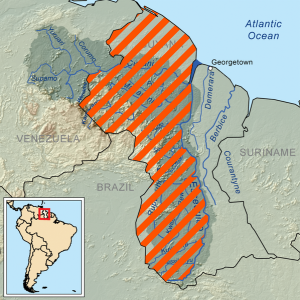
In mid-November, the South American nation of Guyana appealed for help to both the United Nations and the International Court of Justice, which just handed down a sternly worded finding on 12/1/2023 on the matter. Guyana, which shares its western border with Venezuela, became justifiably alarmed after Venezuelan dictator Nicolás Maduro’s government scheduled a public referendum for December 3, 2023, “asking” the Venezuelan people if they would be okay with annexing the Essequibo region from Guyana – which comprises some two-thirds of Guyana.


Map of Guyana Essequiba. The area lined in orange constitutes the area claimed by Venezuela. Credit: Karl Musser. CCA/3.0


So – what’s going on, and why should you care? In reverse order, the reasons you need to care about this are simple.

First, unlike the current wars in Ukraine and Israel, this is on the proverbial doorstep of the United States. Second, is that seemingly tired old problem: oil. Third, the very fact that this has even come up, is yet one more pointed demonstration of the abject and total failures of both the Biden administration, and the neo-con RINO’s desperately clinging to power inside the GOP, best described by GOP candidate Vivek Ramaswamy as “Dick Cheney in three inch heels”.

Venezuela and Guyana form part of the northern coast of South America. Any war in South America is of preeminent importance to the United States, because of the potential to spill onto the United States’ doorstep, in addition to all the other problems spilling over a border that the Biden administration apparently believes not to exist. A Venezuelan attempt to “flex” for imperialist territorial expansion would – and threatens to do so – lead to a much wider war, as Brazil’s territorial integrity is also threatened by Maduro’s actions.

The question is, why? The answer is simple: oil.

Venezuela has been tied into the global petroleum extraction network since the early 1900’s; indeed, the country was the world’s third largest producer of crude oil in 1940, and was the tenth largest producer in 2008. However, beginning in the mid-1970’s, a series of terrible decisions by successive governments nationalized the country’s oil industries. This resulted in the companies whose plants were confiscated politely refusing to continue to perform maintenance and upkeep on the systems…that should not have come as a surprise to anyone, but apparently did. And, as the oil infrastructure fell apart, Venezuela was unable to attract another other foreign companies to invest in their national oil fields, which – again – should have surprised no one.

As a result, the spiraling failures of Maduro’s increasingly socialism-driven economy and government has created a growing and increasingly desperate need to revive the country’s only remaining viable export industry, in his case, by bringing in Iranian technicians to try and get the nation’s oil industry back on its feet…If that sounds like a disturbing idea – Iranians flooding into a country within easy striking distance of the United States – that’s because it is.

So, how does this relate to Guyana?

In 2008, as Venezuela doubled down on excluding foreign companies from its oil industry, ExxonMobil (one of the companies forced out by Venezuela) began exploring the offshore region of Guyana, on the hunch that since the two countries were physical neighbors, there should have been a high likelihood that Guyana should possess exploitable reserves…and, in 2015, Esso (a subsidiary of ExxonMobil) hit paydirt, discovering the first of several rich offshore oil fields off Guyana’s Caribbean coastline. After a series of negotiations, on 19 September of 2023, Guyana authorized several oil companies – including ExxonMobil – to begin drilling in their offshore fields.

An increasingly desperate Maduro, seeing the continuing disaster of his party’s long-discredited Socialist policies, chose this moment to revive an old territorial dispute that Venezuela had chosen not to pursue, which laid a Venezuelan claim to some two-thirds of Guyanese territory…that part, or course, that contains most of the new oil fields.

For those readers of “a certain age”, if this sounds a little like 1981-1982 in the South Atlantic, you are not alone. Forty-odd years ago, another South American dictator sniffed rumors of oil in an area his country had long-claimed, and – with tensions mounting at home over disastrous economic policies and midnight death squads everywhere – Argentinean junta leader General Leopoldo Galtieri decided that the United Kingdom would not fight over the Falkland Islands, if not too much blood was spilled invading them. Turns out, he was very wrong.

Maduro’s “popular” referendum is a clear attempt to justify an invasion, one that is sickeningly lopsided, as the Guyanese military is barely 3% the size of Venezuela’s armed Forces…the ringer being, of course, being Brazil, whose armed forces outmatch Venezuela’s by at least double, if not triple…The possible consequences of a desperate Socialist country sparking a regional war that could disrupt not just oil production but commercial shipping in the Caribbean, in general, are something every American needs to be worried about.

But then, there is the last question: Why does Maduro think that he can get away with Saddam Hussein-levels of bad decisions? In a word – Joe Biden and the Democrat-Neo-Con alliance, which desires a weak United States, one that they think that they can rally to their side like FDR did in 1941.

That they cannot do so, because of the actions they have taken in public – not even bothering to hide it – have so soured their potential recruiting bases, that they cannot meet their manpower needs without reviving the Draft…which even their supporters in the deluded Left are stating a flat, hard-no to.

If this sounds pessimistic – it is. Expect shortages, if Maduro thinks his calculus is correct…which it might be, unlike Saddam’s.


Part 2 – Saying the Quiet Part Out Loud


But, on the other side of the world, another “Rumble in the Jungle” is brewing: Myanmar/Burma’s ruling military clique, the so-called “Tatmadaw”, is collapsing. In this, the only real question is if the radical Socialist junta will go down like the collapse of the Somoza regime of Nicaragua in 1979, and the following multi-sided civil war (encouraged, being fair to history, by the United States) or if it will go the way of Yugoslavia – violent and bloody, but mercifully short, in comparison.

Beginning in late October of 2023, a coalition of formerly rival ethnic/tribal groups in Myanmar united in a virtually unheard of alliance, to launch a massive, coordinated offensive across the country, swiftly overrunning several regime military bases along the Myanmar/Communist China border, and forcing the surrender of several military units in their entirety. This is causing a collapse in morale, both among troops and in their families, who are now being forced to pull security for their deployed husband’s military bases. In fact, the junta has begun mobilizing civil servants and local police as second-line military forces, to try and stem the tsunami of military defeat.


Map of Operation 1027, as of 7 November 2023. Credit: Clyde H. Mapping. CCA/4.0


Obviously, the Freedomist has been remarking on this situation for some time, mostly in the context of the 3-D printing revolution. The facts are that the world was content – again – to allow a brutal, dictatorial regime to make a mockery of civilized society, because the profit margin is so high.

For Communist China, however, Myanmar is far from a laughing matter. The ruling junta, the “Tatmadaw”, is a vital component in the CCP’s “Belt & Road Initiative”, and if their allies in the junta go the way of Somoza or Yugoslavia, their entire plan is in jeopardy. What Communist China chooses to do about this is anyone’s guess.


Part 3 – Where Do We Go From Here?


Functionally, the moves by Maduro’s Venezuela are far more important to the United States in the immediate short-term. The hopeful collapse of the Myanmar regime, while definitely of regional importance in the Indian Ocean region, is mostly of academic interest for the US. While that may sound harsh and uncaring, it is not. It is simply the recognition of global realities.

The United States – for good or ill – is committed to the support of both Israel and Ukraine. And, as it and its European allies have discovered, neo-con fever dreams mixed with deranged, far-Left utopian word-salad does not equate to valid battle calculus, even in the short term.

The world is racing towards a cliff, and the leaders of the nations most capable of preventing that from happening are too concerned with pet delusions to even start getting a handle on the problem.

2024 is looking pretty grim, at present.

You should take action to protect yourselves, and those you are responsible for, now.

Washington and London certainly aren’t.


The Freedomist — Keeping Watch, So You Don’t Have To

The American Foreign Legion – Revisited


Over a year ago, we discussed the possibility of an “American Foreign Legion”. This was a hypothetical idea, based on most of the US Armed Forces’ continual failure to meet their recruitment targets. Tangentially, about a month prior to this article, we discussed a possible “deep plan” (an idea that, admittedly, verged into raw “conspiracy theory”) that the disaster at the border, specifically in allowing ‘unfettered’ access to the nation for tens of thousands of “military-age males”, potentially allowing in a hostile army, an army that could be used for nefarious purposes against Americans in general, not simply that percentage of the population that is armed and very unhappy with the status quo in Washington, DC.

But – what if there is something else going on?

In writing that article this past September, there was a wrinkle that kept bothering this author, namely, that while the numbers of unaccompanied males entering the country was indeed dangerously large, it was not large enough to actually be a significant threat to the supposed target, that being those unhappy gun owners.

Something, some other point, was missing.

But then, a funny thing happened: Donald Trump, the 45th President of the United States, and the most likely contender for the Republican nomination for President in 2024, stated “categorically” that he would round up and deport every person currently being allowed over the border…

However, this doesn’t make a great deal of sense: how could such a thing be accomplished? Leaving aside the fact that such a program would certainly be fought tooth and nail at every step in Congress and the Courts, the problem is similar to “confiscating guns”: With no registry of firearms, police officers would have to raid and search every single building in the United States, to effectively “confiscate” privately-held firearms. Even assuming that absolutely no resistance to such a thing would occur – a notion that is, quite literally, “whistling past the graveyard” – there are simply not enough law enforcement officers available to conduct those searches. The idea is ludicrous.

But not when it comes to the flood of “migrants” crossing the border. The reason is that those crossing the line, while largely vanishing into the masses of large cities, are in fact on the radar of various agencies of the Federal government, not least because the governors of Texas and Florida are not doing all of the busing of those migrants to cities like Chicago and New York City. And this is over and above the “CBP One” app those migrants carrying smartphones are encouraged to place onto their phones. Those carrying such apps on their devices are loading tracking software that gives them a level of legitimacy to then file for status as refugees entitled to economic support with state and local agencies.

Assuming that Donald Trump were to win in 2024, and would attempt to make good on his campaign promise to deport illegal migrants, and, given the certain resistance to such an attempt, if presented with an option to “negotiate a middle ground”, would Donald Trump do so?

Given both the nature of his character, and factors we will look at below, such a negotiation is almost a given.

What is this “middle ground” approach? Simply put – join an “American Foreign Legion”, or face immediate arrest and deportation.

This is not idle speculation. In Issue 3 of Volume 53 of Parameters, the magazine of the US Army War College, there is an article from August of 2023, “A Call to Action: Lessons from Ukraine for the Future Force”, discussing the need to seriously rethink the Draft. Strident calls from the mainstream press’ gatekeepers to the contrary, this article is blunt, to the point that it is worth quoting:


“…These numbers cannot fill the existing gaps in the active force, let alone
any casualty replacement or expansion during a large-scale combat operation.
The implication is that the 1970s concept of an all-volunteer force has outlived
its shelf life and does not align with the current operating environment.
The technological revolution described below suggests this force has reached
obsolescence. Large-scale combat operations troop requirements may well
require a reconceptualization of the 1970s and 1980s volunteer force and
a move toward partial conscription.16…”


It is that superscript note that presents an issue, as at press-time, the referenced article, Was Fifty Years Long Enough? The All-Volunteer Force in an Era of Large-Scale Combat Operations, by Kent Park, is not available for review.

This is a direct and pointed statement that the US Armed Forces need to consider the likelihood that the government will have to resort to a new Draft to meet it’s operations needs.

But – why?

Simply put, both “Millennial’s” and “Gen-Z” have little interest in volunteering for military, despite eye-watering bonuses of up to $75,000, over and above issues such as chronic obesity and a medical screening process that eliminates up to 25% of potential recruits who do volunteer. Bland platitudes from military managers wearing stars to the contrary, this is situation is very likely to persist.

And yet – for good or ill, the United States needs to keep recruits flowing into its units…And a “negotiated solution” to the illegal immigrant crisis is a very attractive answer.

Speaking strictly hypothetically, such a force would be easily and quickly fielded. All that would be necessary would be deploying fingerprint scanners to recruiting offices, to verify whether the illegal immigrant had been arrested while in the United States before that point. If not, the illegal immigrant could be offered a minimal cash bounty for enlisting, considerably less than those currently being offered to citizens born here, along with a guarantee of amnesty and legitimized citizenship after a minimum of four years’ service.

This is a very attractive prospect to someone coming from a culture that respects and/or fears soldiers, and which neatly sidesteps the problem of a large percentage of bitter and bluntly un-patriotic teens and twenty-something’s who would absolutely not report to a Draft board if faced with the prospect…

…It’s almost as if it were a planned operation.

Five-D Chess”, indeed.


The Freedomist — Keeping Watch, So You Don’t Have To

Intentional Consequences – How A Cold War Warning Framed A 21st Century Battleplan


BACKGROUND


It should come as no surprise to anyone reading this, that there is something strange happening at the southern border of the United States…even NEWSWEEK magazine is talking about it. No one who claims to watch the news at any level of attention has failed to see the hysterical cries from all levels of society in New York City that the mainstream media bothers to pay attention to, that the “migrant crisis” has finally come home to roost in the self-declared “sanctuary cities”, who are now facing just a fraction of what tiny towns along the US-Mexico border have been dealing with on a weekly basis, and for decades.

But, it is considerably more than that. In fact, it is alarming in the extreme.

In previous decades, a significant proportion of the illegal aliens crossing the US-Mexico border were women and small children; indeed, despite breathless denunciations to the contrary, the phenomenon of the “Anchor Baby” is very real. Prior to 2020, many, if not most, of the illegal crossers were unaccompanied men, actual “economic refugees” from Mexico and other parts of Central & South America, who were coming north to seek work, because even making significantly less than American-born workers, they were still able to make enough to more than fully support their families back home.

However, beginning at some point in 2020, that mixture began to significantly shift.

Beginning, again, in 2020, more and more Africans began to be observed at the border, crossing in illegally. However, like Mexican illegals before them, significant proportions of the flow were women and children.

But, beginning in 2022, the numbers shifted again. Increasingly, unaccompanied men of “fighting ages” (17-45 years old) began to appear – not mixed in with families, but in very large – alarmingly large, in fact – proportions of crossing groups.

What follows is an analysis that may sound “conspiratorial”. Given the current rhetoric from certain organizations – it is most definitely something that needs to be taken seriously.


ACTORS IN PLACE


“Men fleeing their country to take refuge in a foreign land, bring their women and children with them.

Men invading a foreign land – do not.” – Anonymous


Nearly fifty years ago, now, 1974 was a strange time. It was the height of the Cold War; the Vietnam War was grinding to its bloody end; tensions between the United States and the Soviet Union were still very frosty, and getting more hostile as the political fallout from Richard M. Nixon’s resignation from the Presidency threw treaties and agreements into doubt.

In the midst of this turmoil, a small, 18-page study was presented to the Defense Advanced Research Projects Agency (DARPA) under contract number RDA-TR-4301-001. Its title?


“A SOVIET PARAMILITARY ATTACK ON U.S. NUCLEAR FORCES – A CONCEPT”


(HTML) (PDF)


The paper outlines the feasibility of an “asymmetric” (to borrow a phrase from the modern day) attack on the US’s “nuclear triad” by Soviet special forces teams inserted into the US by slipping them over the border, mixed in with the yearly flow of illegal migrant workers.

When viewed through a more modern lens, this study stands as a stark warning for the current situation at the border, with only minimal editing for the current situation: simply replace “Soviet” with “militant actor groups”, and “nuclear forces” with “civilian soft targets”.

This is not hyperbole – if the numbers remained as small as they once were, this view would, indeed, verge into paranoia. However, with even the low figures hovering around 10,000 people per week, and even being generous in estimating the numbers of actual refugees, that equates to the core cadre of an infantry division entering the United States each week.


BEANS, BULLETS & TRAITORS


Now, the above is a pretty heady statement to make. After all, how would such a hypothetical force be armed and supplied, to what purpose, and by whom?

If you, the Reader, think that we are about to go to a very dark place – you would be correct.

It has long been known that certain elements of the United States government’s apparatus have deliberately tread very carefully, lest they goad the c.100,000,000 private firearms owners in the country into doing something “rather rash”. Frequently, they even try to crack jokes about it – jokes which absolutely no one finds funny.

Those same elements, however, certainly seem hell-bent to inflict demented plans on not simply the US population, but on the populations of the wider world. The United States’ population, though, is unique as it has not simply the highest proportion of private firearms ownership per capita, but also the largest numbers overall…and a significant proportion of that number are military veterans, many with recent combat experience.

In fact, those elements are so concerned about this potential threat to their plans that they have been issuing increasingly strident warning calls about the situation since the mid-1990’s. Yet, for them, the “problem” remains.

But – how to mitigate that problem?

It is clear to these elements that deploying the actual US armed forces, or even police, against the citizens they are sworn to defend through “kinetic action” is not an option: far too many would almost certainly either desert outright, or might actually mutiny, taking their weapons and joining their fellow citizens who are being attacked. And this is all aside from the fact that those “regular” forces, even in concert with law enforcement officers, simply do not have the numbers to make “martial law” a viable option.

But…What if those forces were given an actual, hostile foreign target inside the United States? For that matter, what if those private firearms owners could be induced by circumstance to join the regular armed forces and law enforcement in an action to “defend America” against that force? Stentorian denials from the “right wing” on social media aside, this “Reichstag Fire” scenario would force self-proclaimed “2A supporters” into a Catch-22: Either support the direct defense of the nation – in concert with the armed forces and the police – or suffer consequences far worse than being exposed as fakes.


FMLN guerrillas, El Salvador, c.1980’s. Photographer Unknown.


However, as there has been no such credible threat inside the United States – because “Antifa” is not the threat many, including that group’s members, suppose it to be – such a force would have to be “imported”.

Hence: foreign, fighting-age men, flooding into the country in massive numbers – but numbers not sufficient to actually conquer the country, but certainly enough to cause a sufficiently large and alarming threat…a flood actively encouraged, by public policy.

Note that none of either the foregoing, or what follows, is even a possibility without the active collusion of large sections of the government apparatus in Washington, DC.

It is vital to understand that, even assuming that certain reporting, dismissed a decade ago as “deranged conspiracy theories” were to be true, such a potential hostile force cannot successfully seize control of any great portion of the United States – at least, not for any real length of time.

But – why?

Simply put, the potentially hostile forces that would act, would be extremely disjointed and lacking in any more than the most basic of direction, and outside the cities, would find themselves vastly outnumbered, outgunned and over-matched by the local population. Unlike other parts of the world where groups like these operate, the local population in the United States – overall, but most certainly in the more suburban and rural areas – are very well-armed, by current world standards, and are peopled with a high percentage of recent military veterans, most of whom are armed.

This does not mean that such hostile forces would be completely impotent. Indeed, current technology means that these forces could easily arm and equip themselves effectively, simply by raiding firearms dealers (making the publication of the personal information of firearms permit holders over the last few years…“interesting”) not simply for weapons and ammunition, but also for the information on the dealers’ Form 4473’s, as described in the famous scene from the original “Red Dawn” (1984). As well, functional support equipment could be constructed at reasonable speed, allowing this potential hostile force to cause a lot of “hate & discontent”, and all without a great deal of the typical heavy ordnance one would see in most of the conflicts of the last c.25 years…for a time, at least.

In the aftermath – if this strictly hypothetical plan were to be real – the surviving American citizens would be ready to fall in line behind a government professing to have “learned its lesson”, that would revitalize and regularize citizen “militias”…under strict government control and supervision, of course.


World Economic Forum Logo, 2008. CCA/3.0


IN THE COUNTRY OF THE BLIND


Is any of the foregoing true, though?

There are no “smoking gun” documents – that the author is aware of – that detail the above speculative plan as a real, deliberate and ongoing operation…That in no way means that it is impossible.

There is an overused saw in current vogue, to wit, that “history does not repeat – but it does rhyme”. In this case, real, fundamental manipulation of a population to a meaningful purpose they would otherwise not only have no interest in, but would actively oppose if said plan were enacted too quickly, is not a thing that can be achieved overnight. It is a process that takes years to plan and decades to implement.

Once again – 1974 was an odd time. Lot of plans were flitting around the literal swamp that Washington, DC perches in, like a vulture’s nest…Plans like “NSSM 200”.

You, the Reader, should reflect on that link.


The Freedomist — Keeping Watch, So You Don’t Have To

Main

Back FREEDOM for only $4.95/month and help the Freedomist to fight the ongoing war on liberty and defeat the establishment's SHILL press!!

Are you enjoying our content? Help support our mission to reach every American with a message of freedom through virtue, liberty, and independence! Support our team of dedicated freedom builders for as little as $4.95/month! Back the Freedomist now! Click here