April 18, 2026

Finance & Banking

War Economics in the Shadows


Wars require money, in some form. Combatants have to buy weapons, ammunition, food, vehicles, fuel, spare parts, lay down bribes for intelligence and suborning various people, and medical supplies, along with just simple tools…and that’s before we talk about whether they actually pay their fightersd.

In the shadowy realm of contemporary warfare, the most destructive conflicts are increasingly those where the combatants get their war chests filled by distant, foreign capitals. From Ukraine’s defense against Russian aggression to Yemen’s devastating civil war, proxy conflicts have become the preferred method of great power competition — offering what military strategists euphemistically callquick, relatively cheap and low-risk options for the continuation of policy aims“.

Proxy warfare has evolved from Cold War-era confrontations into a sophisticated financial enterprise that operates through complex networks of state sponsors, shell companies, and illicit economic activities. As Foreign Policy columnist Emma Ashford observed, proxy wars have become a preferred method of great power competition, allowing major powers to exert influence while maintaining plausible deniability. Understanding the financial mechanisms that sustain these conflicts is crucial for comprehending modern geopolitical dynamics and developing effective countermeasures.

Yet behind every proxy war lies a complex economic ecosystem that determines not just who fights, but how long they can sustain the violence. Understanding these financial networks reveals uncomfortable truths about modern warfare: conflicts are increasingly about economic endurance rather than battlefield tactics, and the nations writing the checks often have more control over outcomes than the soldiers pulling triggers.


The State Funding Model: Direct Government Support

The most straightforward financing mechanism involves direct state funding of proxy forces. President Vladimir Putin’s extraordinary admission in June 2023 revealed that “the financing of the entire Wagner group was fully ensured by the State,” with the Russian Defense Ministry pouring nearly $1 billion into Wagner operations from May 2022 to May 2023. This disclosure shattered decades of Kremlin denials and provided unprecedented insight into how major powers fund their proxy operations.

No nation has perfected the economics of proxy warfare quite like Iran. Tehran’s “Axis of Resistance” represents perhaps history’s most sophisticated proxy financing operation, with the Islamic Revolutionary Guard Corps-Quds Force managing an estimated budget exceeding $1 billion annually for terrorist financing. This staggering sum supports between 140,000 and 185,000 proxy fighters across Afghanistan, Gaza, Lebanon, Pakistan, Syria, and Yemen.
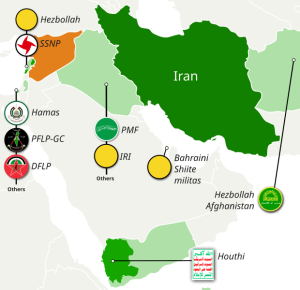
Groups that are part of the “Axis of Resistance”. 2024 image via Kaliper1. CCA/2.5

Iran represents perhaps the most systematic state-sponsored proxy financing network. The U.S. State Department estimated that Iran spent more than $16 billion supporting the Assad regime and its proxies between 2012 and 2020. In 2020 alone, Iran funneled more than $700 million to Hezbollah, while providing more than $100 million annually to Hamas and Palestinian Islamic Jihad. These massive transfers occur through Iran’s Islamic Revolutionary Guard Corps-Quds Force (IRGC-QF), which serves as Tehran’s primary mechanism for financing proxy operations across the Middle East.

The scale of Iran’s investment becomes clear when examining individual recipients. Hezbollah alone receives more than $700 million annually from Tehran, a sum that dwarfs the entire defense budgets of many small nations. As Hezbollah Secretary General Hassan Nasrallah candidly admitted in 2016: “Hezbollah’s budget, everything it eats and drinks, its weapons and rockets, comes from the Islamic Republic of Iran.

Iran’s proxy economics operate on multiple levels simultaneously. Beyond direct cash transfers, Tehran provides weapons manufacturing capabilities, enabling proxies to achieve self-sufficiency while maintaining plausible deniability. In Syria, Iran helped organize, train, and fund over 100,000 Shia fighters, demonstrating how proxy economics can scale to conventional warfare levels when strategic interests demand it.

The sophistication of Iran’s financial network became apparent in 2016 when Hezbollah leader Hassan Nasrallah publicly announced that “all of his organization’s funding comes directly from Iran,” emphasizing that “the budget of Hizbullah, its salaries, its expenses, its food, its drink, its weapons, and its missiles come from the Islamic Republic of Iran“. This funding bypasses traditional banking systems, with Nasrallah confirming that transfers occur directly, “not through banks and other financial institutions”.

The Iranian model reveals a crucial economic principle: proxy wars succeed when sponsors can provide “stable and ample funding” while maintaining political control over their assets. Tehran achieves this through what former CIA analyst Norman Roule describes as controlling “their weaponry, their funding and significant political relationships with their key leaders”.


Economic Integration and Development Funding

China has pioneered a more sophisticated approach through its Belt and Road Initiative (BRI), which launched in 2013 with the Silk Road Fund’s $40 billion initial capital. While ostensibly focused on infrastructure development, analysts worry that the BRI could be a Trojan horse for China-led regional development and military expansion. The program’s dual-use potential becomes apparent through [debt-trap diplomacy, where China allegedly uses unsustainable loans to gain leverage over debtor governments.

A 2021 study analyzed over one hundred debt financing contracts China signed with foreign governments and found that the contracts often contain clauses that restrict restructuring with the Paris Club, providing Beijing with significant leverage over partner nations. This economic influence can be converted into military access, as demonstrated by China’s naval base in Djibouti, which many observers see as the first of many potential military expansions.


The Technology Transfer Economy

Modern proxy warfare increasingly revolves around technology transfer rather than simple arms sales. The Iran-North Korea weapons pipeline exemplifies this evolution, with both nations sharing ballistic missile technology, submarine designs, and nuclear expertise. Iran’s Shahab-3 missile closely resembles North Korea’s Hawasong-14, while satellite imagery suggests Iranian technical expertise contributed to North Korean missile silo construction.

This technological cooperation creates self-sustaining proxy economies. Rather than remaining dependent on foreign suppliers, proxies gradually develop indigenous capabilities. Iran has mastered this approach, transferring not just weapons but “the means of production and modification to enable independent manufacturing” to its proxy network.

The economic advantages are compelling. Technology transfer builds redundancy of supply, reduces shipping risks, enhances deniability, and creates local employment that strengthens proxy loyalty. For sponsors, it represents a long-term investment strategy that pays dividends far beyond any single conflict.


The Ukrainian Counter-Model: Coalition Economics

Ukraine’s defense against Russian invasion illustrates a different proxy economic model—multilateral coalition funding. Rather than relying on a single sponsor, Ukraine has assembled a diverse funding coalition including the United States, European Union, individual NATO members, and unexpected participants like Japan and South Korea.

This approach offers both advantages and vulnerabilities. Coalition funding can provide massive resource flows — U.S. assistance alone has exceeded $350 billion according to various estimates. However, it also creates dependency on multiple political systems with different priorities and election cycles. As U.S. support becomes uncertain under changing administrations, the sustainability of coalition-funded proxy warfare faces its ultimate test.

Japan and South Korea’s involvement demonstrates how proxy economics extend beyond traditional security partnerships. Both nations provide substantial non-lethal aid while “replenishing U.S. weapons stocks, supplying the United States with artillery shells and thereby freeing up Washington’s ability to send shells to Ukraine.” This creates layered economic relationships where allies subsidize great power proxy warfare indirectly.


The Russian Adaptation: Sanctions and Substitution

Russia’s proxy economic strategy has evolved dramatically under international sanctions pressure. Traditional funding mechanisms disrupted, Moscow has increasingly relied on partnerships with China, Iran, and North Korea to sustain both its direct war effort and proxy relationships. China provides crucial economic support that enables Russia to withstand Western sanctions, while Iran supplies drones and North Korea provides ammunition and even troops.

This adaptation reveals how proxy economics adjust to pressure. When conventional funding channels close, sponsors develop alternative networks. Russia’s use of Wagner Group mercenaries represented an attempt to privatize proxy relationships, creating plausible deniability while maintaining operational control. The Wagner model failed primarily due to political rather than economic factors, but its brief success demonstrated the potential for corporate proxy structures.


Escalation Economics

Perhaps most concerning is how proxy war economics influence conflict escalation. Traditional deterrence theory assumes rational actors will avoid escalation due to increasing costs. However, proxy warfare inverts this logic. As former CIA analyst Norman Roule observes, Iran operates as “an arsonist that then subcontracts out to other arsonists”, empowering proxies with resources while maintaining strategic distance.

This creates moral hazard problems where proxies may escalate beyond their sponsor’s intentions, confident that economic support will continue. The October 7, 2023 Hamas attack on Israel exemplifies this dynamic—Iran provided the economic foundation enabling Hamas capability, but the timing and scale caught Tehran off-guard, demonstrating how proxy economics can enable conflicts that spiral beyond original parameters.


Resource Extraction and Illicit Trade

Proxy groups increasingly finance their operations through control of natural resources and illicit trade networks. The U.S. Treasury Department revealed in 2023 that Wagner Group entities in the Central African Republic, United Arab Emirates, and Russia engaged in illicit gold dealings to fund Wagner operations. These operations involve sophisticated shell company networks, with Wagner using companies like Midas and Diamville to convert CAR-origin gold into U.S. dollars.

The U.S. Treasury Department exposed a convoluted Iranian illicit financing scheme in 2018 where Hezbollah officials, working with Iranian operatives and Russian companies, facilitated shipment of millions of barrels of Iranian oil to the Assad regime. The Assad regime would then transfer hundreds of millions of U.S. dollars to the IRGC-QF, which distributed funds to Hamas and Hezbollah. In one documented transaction, a Hezbollah official confirmed receipt of $63 million as part of this oil-for-terror scheme.


The Sustainability Question

Ultimately, proxy war economics succeed or fail based on sustainability. Iran’s model works because oil revenues provide consistent funding streams relatively insulated from international pressure. Coalition models like Ukraine’s support depend on sustained political will across multiple democracies—a more fragile foundation.

The economic lessons are clear: modern conflicts are won by whichever side can maintain funding longest, not necessarily whichever side fights best. This reality transforms strategy from tactical to economic, making treasury departments as important as defense ministries in determining conflict outcomes. As proxy wars become the dominant form of great power competition, understanding their economic foundations becomes essential for anticipating tomorrow’s conflicts—and their likely victors.


Private Sector and Diaspora Financing

Proxy organizations also tap into private funding sources and diaspora communities. Hezbollah has relied on funding from the Shi’ite Lebanese Diaspora in West Africa, the United States, and the Triple Frontier region along the junction of Paraguay, Argentina, and Brazil. These networks often operate through legitimate businesses and charities that serve as fronts for money laundering operations.

The United States has sanctioned numerous charities and front companies for providing financial support to proxy groups, including the Holy Land Foundation, which was designated in 2001 for providing millions of dollars annually to Hamas. These sanctions have had limited effectiveness, as current U.S. sanctions have not significantly impacted Iran’s relationships with its proxies.


Banking and Financial System Exploitation

Modern proxy financing relies heavily on exploiting legitimate financial institutions. A C4ADS report on leaked Wagner documents showed that without legitimate financial institutions such as JP Morgan Chase and HSBC as intermediaries, the Wagner Group would not have been able to establish a foothold in Africa. In 2017, the Sudanese Mining company Meroe Gold, acting as a shell company for Wagner, used JP Morgan Chase to process payments to sellers in China.

Iran has developed sophisticated methods to circumvent banking sanctions. The U.S. designated Bank Saderat in 2006 for facilitating transfers of hundreds of millions of dollars annually to Hezbollah, Hamas, and Palestinian Islamic Jihad. However, new financial networks continuously emerge to replace sanctioned institutions.


Government-to-Government Contracts

Some proxy financing occurs through legitimate government contracts that provide plausible cover for military support. Putin revealed that Wagner received contracts worth billions of rubles, including payments from governments who hired Wagner services, such as the Malian government, which reportedly paid Wagner more than $10 million each month. These arrangements allow both parties to maintain the fiction that the services being provided are purely commercial rather than military.


A Brave, New World

The financing of proxy warfare presents significant challenges for international security and governance. As noted by RAND Corporation analysts, geopolitical drivers of proxy warfare can often be self-reinforcing, with states able to develop proxy warfare capabilities very quickly, within a couple of years. The financial networks supporting these capabilities are equally adaptable, evolving new methods to circumvent sanctions and detection.

Recent developments suggest that proxy warfare financing will continue to evolve with the global financial system. Cryptocurrency, digital payment systems, and new forms of economic integration provide both opportunities and challenges for states seeking to fund proxy operations while maintaining deniability.

The complexity of modern proxy war financing reflects the broader evolution of international conflict, where economic warfare, information operations, and traditional military action converge in ways that challenge conventional approaches to conflict resolution and accountability. Understanding these financial mechanisms is essential for policymakers seeking to address the root causes of contemporary global instability.

…Money makes the world go ’round – it also helps to burn it.


The Freedomist — Keeping Watch, So You Don’t Have To


Britain’s “Lost Decade” Economic Disaster & Its Impact On Global Security


The United Kingdom’s descent from its position as a leading global financial center into economic turmoil represents one of the most dramatic shifts in modern economic history. While the roots of this decline can be traced to the 2008 global financial crisis, the combined shocks of Brexit, the COVID-19 pandemic, and Britain’s steadfast support of Ukraine has accelerated what many analysts now term Britain’s “Lost Decade.”

The Foundation Cracks: 2008-2016

The 2008 financial crisis hit London particularly hard, given its out sized role in global banking and finance. While other nations gradually recovered, Britain’s recovery was notably sluggish. The Conservative-Liberal Democrat coalition government’s austerity measures, implemented under Prime Minister David Cameron, may have prevented a sovereign debt crisis (while some 70 potential defaults currently exist), but came at the cost of reduced public services and infrastructure investment.

During this period, Britain’s armed forces faced significant budget cuts. The 2010 Strategic Defence and Security Review disastrously led to significant reductions in personnel, the early retirement of the aircraft carrier HMS Ark Royal, and the scrapping of the Harrier jump-jet fleet. These decisions would later impact Britain’s ability to project power globally.


Brexit: The Self-Inflicted – With Help – Wound

The 2016 Brexit referendum marked a crucial turning point. The vote to leave the European Union triggered immediate economic consequences: the pound sterling plummeted, investment decisions were frozen, and London’s position as Europe’s financial capital began to erode. Major financial institutions started relocating operations to Dublin, Frankfurt, and Paris.

The protracted Brexit negotiations created years of uncertainty, depressing business investment and complicating trade relationships. The eventual Trade and Cooperation Agreement, while avoiding a “no-deal” scenario, still resulted in significant new barriers to trade with Britain’s largest market.

The reality was that Britain’s trade was significantly undermined by the European Union’s bitter and petty actions, as that body did not was to lose the major tax revenues that Britain was contributing, at a time when the EU was a whole was still reeling from the 2008 crisis. The “better option”, from the EU’s perspective, was to make it as hard for Britain as possible to “go it alone”.

What made these effects far worse, were a series of bungling failures by successive governments in London, from both sides of the political aisle. These poorly-considered actions have functionally flat-lined the British economy…and things are not improving.


Pandemic Paralysis

COVID-19 struck Britain particularly hard, both in human and economic terms. The UK experienced one of Europe’s highest death rates and deepest economic contractions. The government’s pandemic response, while unprecedented in scale, added substantially to national debt. The furlough scheme, while preventing mass unemployment, cost hundreds of billions of pounds.

The pandemic exposed and exacerbated existing economic weaknesses. Supply chain disruptions, combined with Brexit-related complications, led to shortages and inflation. The National Health Service, already strained by years of austerity, faced enormous pressure.

And, despite the government trying to “cook the books” by “revising” economic numbers, the British economy has still not recovered.

Ukraine Support and Energy Crisis

Britain’s robust support for Ukraine, while strategically important, has come at a significant economic cost. Military aid, combined with sanctions against Russia, contributed to spiraling energy costs and inflation. The situation has forced difficult choices between domestic spending and international commitments.

The energy crisis has highlighted Britain’s vulnerability to global supply shocks. Despite North Sea oil and gas resources, years of under-investment in energy infrastructure and storage capacity left the country exposed to price volatility.

Successive governments in London have learned the US government’s model of “borrow ’til you crash”, piling on mountains of debt to support Kiev’s flagging hopes of survival, as ‘victory’ is very much a malleable terms.

Impact on Global Security

Britain’s economic challenges have resulted in drastic and cascading effects on global security:

  1. Reduced Military Capability: Budget constraints have limited Britain’s ability to modernize its armed forces and maintain its traditional role in global security operations, something even the new Left-wing government of PM Keir Starmer could not ignore.
  2. NATO Implications: While Britain continues to meet NATO’s 2% GDP defense spending target, the declining value of the pound means this represents less actual military capability.
  3. Diplomatic Influence: Economic weakness has diminished Britain’s ‘soft power‘ and ability to influence global events through economic leverages.
  4. Intelligence Capabilities: Budget pressures have affected Britain’s renowned intelligence services, potentially impacting the “Five Eyes Alliance“.

Recruitment Crisis and Cultural Shift

The British military’s recruitment challenges reflect deeper societal changes. Traditional sources of military recruitment – working-class communities with strong patriotic traditions – have been eroded by demographic shifts, changing cultural attitudes and recently, the stunningly draconian response of the Starmer government to a sudden spate of riots initially linked – albeit wrongly – to racial violence. The Armed Forces’ 2022-23 recruitment targets were missed by approximately 40%, marking the worst recruitment crisis since the end of conscription in 1960, although recruiting numbers in the United Kingdom have been dropping steadily since at least 2010.

This recruitment crisis stems from multiple factors. Economic uncertainty has paradoxically reduced rather than increased military recruitment, as potential recruits seek more stable civilian careers. More significantly, surveys indicate a growing disconnect between younger Britons and traditional concepts of national service. The proportion of young people expressing “pride in being British” has declined significantly, particularly in urban areas, leading to even Left-leaning pundits to suggest that the British Left needs to “re-embrace patriotism”.


The military has attempted to address this through modernized recruitment campaigns, often focusing on personal development and technical skills rather than patriotic duty. However, these efforts have met with mixed success, as they compete against private sector opportunities and what military leaders describe as an “individualistic zeitgeist” among younger generations.

This staffing crisis has forced difficult choices about force structure and capabilities, significantly limiting Britain’s ability to maintain its global military commitments.

Economic Indicators

The scale of Britain’s economic challenges is reflected in key indicators:

  • Persistent low productivity growth
  • Declining real wages
  • Rising income inequality
  • Chronic trade deficits
  • High government debt-to-GDP ratio
  • Weakening pound sterling
  • Reduced foreign direct investment

Looking Forward

Britain’s path to economic recovery remains uncertain. The country retains significant advantages: a highly skilled workforce, world-class universities, and leadership in sectors like fintech and renewable energy. However, structural challenges persist:

  • Aging infrastructure
  • Regional economic disparities
  • Skills shortages in key sectors
  • Housing market instability
  • Trade relationship uncertainties
  • Energy security concerns


The implications of these issues for global security will depend largely on Britain’s ability to navigate these challenges while maintaining its international commitments and modernizing its military capabilities.

The real problem for British security, however, remains the same as in the United States Armed Forces: an increasing percentage of the primary recruiting demographic – the “under-30” age group – simply do not see the point in volunteering to serve their country in the military, if at all, as it seemingly offers no opportunities over the civilian world, and has demonstrated (as in the United States and Canada) a staggeringly callous attitude towards treating the long-term impacts of combat on the country’s veterans…And, also as in the United States, if this trend is not reversed, the alternatives are not things any government wants to consider.


The Freedomist — Keeping Watch, So You Don’t Have To
Global Shipping Container Rates Jump 29%


NewsBlurb

A new report shows that global container shipping rates have jumped some 29%, as of the end of April, 2024. While the Pentagon is confident that military actions against the Iran-back Houthi terrorists in Yemen are succeeding in tamping down attacks on shipping, the mess of port congestion around the world is also seriously impacting the shipping world, which will inevitably cause significant price increases on all imported goods.

Read more here, or watch here.


The Freedomist — Keeping Watch, So You Don’t Have To
Cox Communications Gets  Billion Reprieve from 4th Circuit

In 2019, a Virginia Jury awarded record companies $1 billion after finding Cox Communications’ customers guilty of committing 10,000 copyright violations. The ruling was overturned by the 4th Circuit Federal Appeals Court, which said the award was excessive and warranted a new trial to determine what the right amount should be.

Cox Communications wins order overturning $1 billion US copyright verdict – Reuters

Excerpt:

Cox Communications, the cable television and internet service provider, convinced a U.S. appeals court to throw out a $1 billion jury verdict in favor of several major record labels that had accused it of failing to curb user piracy, setting the stage for a new trial on the matter.

The 4th U.S. Circuit Court of Appeals in Richmond, Virginia, ruled on Tuesday that the amount of damages was not justified and that a federal district court should hold a new trial to determine the appropriate amount.

Read Full Article

Fed Won’t be Cutting Interests Rates Anytime Soon

Minutes from the Federal Reserve’s latest monetary policy committee meeting reveal there are no plans to cut interest rates in the near future.

Jerome Powell, in the meeting, suggested “We will need to see continuing evidence to build confidence that inflation is moving down sustainably to our goal.” The current Fed Rate at 5.25% -5.5% is the highest it’s been in 23 years, a rate that has remained unchanged since July of 2023.

Fed minutes confirm that no rate cuts are imminent | Economy and Business – english.elpais.com

Excerpt:

The minutes of the Federal Reserve’s monetary policy committee meetings are always revealed late. And when the economy is, as it is now, at a turning point, a three-week drag can be a long time. With that caveat, the minutes from its January 30-31 meeting confirm the message already delivered by Federal Reserve Chairman Jerome Powell: rates have peaked, their next move will be down, but that is not imminent. Add to each of these statements the adverb “foreseeably”.

Powell usually gives a good summary of the meetings, but their minutes add valuable nuance. On this occasion, most of the Fed’s message sounds familiar, but the minutes include an explicit warning against rushing too quickly into rate cuts: “Some participants noted the risk that progress toward price stability could stall, particularly if aggregate demand strengthened or supply side healing slowed more than expected. Participants highlighted the uncertainty associated with how long a restrictive monetary policy stance would need to be maintained. Most participants noted the risks of moving too quickly to ease the stance of policy and emphasized the importance of carefully assessing incoming data in judging whether inflation is moving down sustainably to 2%. A couple of participants, however, pointed to downside risks to the economy associated with maintaining an overly restrictive stance for too long.”

Read Full Article

IRS to Use AI to Expand Prosecution Net Against the “Wealth”, aka DNC-CCP Opposition

The Internal Revenue Service is deploying AI tools to help it deal with complex tax prosecution cases it could previously not manage with the resources it had. It is allegedly using this expensive toy to target the wealthy but given its capture by DNC-CCP anti-American revolutionaries, one has little doubt it will be used to contrive prosecutable cases to target the enemies of the cultist party this department now represents.

From the NY Times report:

The announcement on Friday demonstrated how a more muscular I.R.S. is using some of the $80 billion allocated through last year’s Inflation Reduction Act to target the wealthiest Americans and tackle the kinds of cases that had become too complex and cumbersome for the beleaguered agency to handle. The agency’s new funding is intended to help the I.R.S. raise more federal revenue by cracking down on tax cheats and others who use sophisticated accounting maneuvers to avoid paying what they owe. But the allocation has been politically contentious, with Republicans claiming that the I.R.S. will use the funding to harass small businesses and middle-class taxpayers.

Even the NY Times, one of the premier content marketing war machines of the DNC-CCP, knows in advance Americans (as opposed to progmericans, which are not Americans at all) will see right through this ruse and recognize it as the existential threat that it is. They couch Americanism under the brand Republican, a brand they were instrumental in polluting with the most egregious of sins for the woketarian, being racist and bigoted (though their term of racist just means “white people invented evil so they should be discriminated against,” and their term bigot just means “does not approve of the destruction of the family and human biological reality.”)

The resistance to the DNC-CCP’s efforts to dismantle the American republic and replace it with a systemic, pedo-enabling cult that bases its authority on the “lived experiences” of the approved classes of people is far broader than “Republicans,” or “conservatives.” The anti-woke “left” is just as fed up with this hateful ideology as the anti-woke “right” is, and many more who fall outside of those designations altogether are equally fed up.

A coalition of hope to combat the real hate, the DNC-CCP and its organs of terror, is forming, and it is only getting bigger with each human life the cult destroys.

That climate is not changing, and it is not ready to allow the IRS to continue to use such tools to destroy more American lives “for the good of the whole,” with the whole being the billionaire sponsors of the spread of this anti-American, anti-Christian, anti-human disease.

China’s Debt Economy Running Out of Options

 A Deputy Dean of the Shanghai Advanced Institute of Finance, Shu Ning, finally said the quiet part out loud when addressing the dramatic rise of the Chinese economy over the past 50 years and the dilemma it now faces. Ning said, “The traditional way of stimulating the economy, through a credit boom and leveraging, has reached an end.” The collapse of China’s property sector and the fast-approaching bankruptcy of its local governments is the fruit of this fact, that China’s days of gaming the system is over.

China’s reputation as a Communist nation is belied by its unwillingness and even ability to afford to provide government social safety nets. It is as if they took the worst parts of communism, spreading the lie that the social is more real than the individual, and therefore the state has a right, a duty to force citizens to align with the state’s definition of the proper social, and coupled it with the worst of “capitalism,” to be driven towards short-term-gain profits over the health, safety, and well-being of the people.

Chairman Xi calls social spending “welfarism,” which he eschews, fearing it will make the Chinese worker soft. Sounds like a stereotypical robber baron to me. He said in a speech two years ago, “Even in the future, when we have reached a higher level of development and are equipped with more substantial financial resources, we still must not aim too high or go overboard with social security, and steer clear of the idleness-breeding trap of welfarism.”

The billionaire elites that are currently mostly “in charge” in America should be paying very close attention to the model they are seeking to drive America into, a “mixed” economy that has all the authoritarian controls of communism and all the ruthless profit-taking of capitalism without morality, corporatism.

They want to continue to exploit the poor and needy through profit-taking while controlling their thoughts through the idealism of communism, the false idealism that creates an upside down cross, where the innocent against their will are sacrificed for the “good of the whole,” the sins of the elites.

The rise in dissent at some of the highest levels (measured though it might be, as in the case of the myth of the free speech warrior, Elon Musk) is a sign to this writer that at least some of the billionaire elites have figured out the China model isn’t the promise it was once thought to be, that, perhaps, preserving some measure of free will for the people will, in the end, help their long-term bottom line.

The China model is a cycle of accounting tricks that eventually collapses the whole system. This is what appears to be happening in China. It’s happening in America as well, but not so profoundly, for we still preserve some semblance of republicanism that has allowed some measure of transparency and accountability to still remain in our system, though the DNC-CCP is working hard to stamp those parts out, still fundamentally sold on the China model for its elite billionaires that fund its operations, and for whom the benefit of said operation rests most richly with.

U.S. Senate Confirms Trans-Fascist Woketarian to EEOC

By a vote of 49-47 the U.S. Senate confirmed the openly man and woman denying and woketarian devotee Kalpana Kotagal to serve on the Equal Opportunity Commission (EEOC), meaning the trans-racial ideologue will inject the anti-American ideology into the workplace by forcing businesses to follow the ungodly rules of the seditious left.

Republicans failed to grasp the full reality of a Senate that would confirm such a hateful bigot to such an impactful position in American culture, with Ted Cruz (R-TX) saying, “I’m incredibly concerned about Kalpana Kotagal’s record of support for radical transgender ideology.” He added, “The Equal Employment Opportunity Comission was created to combat racism and sexism in the workplace, but the woke Left is trying to use the EEOC to push its agenda on eomployers, and based on Kotagal’s record I think she will use her position to attack religious liberty and force her politics on Texas companies.”

The vote now gives the party sedition, the party of fear, the party of hate, the majority on the EEOC, meaning the perverse ideology this hateful woman holds is sure to be the new “standard” the now-fallen EEOC will adopt. Another American institution has fallen to the seditionists.

When will Republicans openly call the DNC the revolutionary party that seeks to destroy the American republic? When will Republicans represent America and defy openly the lawlessness of a political party that has gone totally rogue and is putting the entire country at risk of further destabilization from within and a weakening from without that is causing our enemies to lick their lips in anticipation of the feast the Democrats seem hellbent to deliver to them?

Again, this writer calls on GOP-controlled states to declare the Democratic party an anti-American revolutionary terrorist organization engaging in illegal activities that merit the seizure of DNC assets in their state, including DNC-controlled businesses, and the arrest of DNC leaders. The longer you wait, the more you assure the DNC will do to you what you still have the power to do to them.

Iger Pushes for Extended Stay as Disney CEO

Bob Iger allegedly wants to continue to be the CEO of Disney according to industry insiders. After Iger (the first Bob) handed over the reigns of Disney to Bob Chapek (the second Bob) during the Covid-19 plandemic, he returned a couple of years later ostensibly temporarily to attempt to shore up the failing Disney enterprise.

Upon taking the helm, the bleeding has continued with Disney, with the latest coming from mega budget films like Indiana Jones and the Dial of Destiny failing to make their money back, let alone make a profit.

Apparently, after continuing to drive Disney into the ground through embracing the systemic pedophilic ideology of the DNC-CCP, Bob Iger now wants to stay indefinitely as the head of the world’s largest child grooming media empire.

Iger’s contract expires this December. He hopes to extend it for years beyond that deadline, insiders report.

Main

Back FREEDOM for only $4.95/month and help the Freedomist to fight the ongoing war on liberty and defeat the establishment's SHILL press!!

Are you enjoying our content? Help support our mission to reach every American with a message of freedom through virtue, liberty, and independence! Support our team of dedicated freedom builders for as little as $4.95/month! Back the Freedomist now! Click here