The ultra-wealthy’s latest status symbol isn’t a super-yacht or private island — it’s a luxury survival bunker. From New Zealand’s exclusive retreats to underground complexes in Montana, billionaires are spending millions on fortified sanctuaries designed to weather civilization’s collapse. But these elaborate preparations reveal a fundamental misunderstanding of how disasters actually unfold and may create more problems than they solve.
While the idea of the “social construct” has been ballyhooed almost to death in the early 21st Century, it is a solid and verifiable doctrinal base. At the same time, the antithesis is also true…and in this context, the statement that “wealth is a social construct” is also a fundamental truth.
Although many people at the lower end of the economic spectrum may rage aginst the idea that they are taking part in a “social construct” from the moment they wake up in the morning, for the ultra-rich, the idea has been slowly growing that their wealth equates to them the level and aspects of medieval barons, that their wealth can insulate them from catastrophic events, events that result in a “Mad Max/Road Warrior” type of world. It is important to remember that the so-called “Robber Barons” of the late-19th Century in America and Europe may have been rapacious, but they were careful to cultivate actual loyalty among their guard forces.
For the modern mega-wealthy, such an attitude is what is known as “whistling past the graveyard“, a phenomenon best represented by the “luxury survival bunker“.
The modern luxury bunker industry promises the impossible: maintaining elite levels of comfort and safety while civilization burns above. Companies like Vivos and Rising S offer underground mansions complete with wine cellars, home theaters, and hydroponic gardens. The Survival Condo Project in Kansas converted a former missile silo into luxury apartments selling for millions, featuring a swimming pool, rock climbing wall, and armored vehicles. The implicit promise is that money can buy not just survival, but the preservation of pre-disaster lifestyle.
Underground World Home swimming pool built structure for the New York world’s Fair, 1964. Public Domain.
This approach fundamentally misunderstands disaster dynamics. Real catastrophes — whether economic collapse, climate disasters, or social upheaval — require adaptation, community cooperation, and practical skills, not isolation behind reinforced concrete. History shows that those who survive major disruptions are typically embedded in resilient communities with diverse skill sets, not isolated individuals hoarding resources.
Photo of the North Portal entrance to Cheyenne Mountain. Public Domain.
The bunker mentality creates several critical vulnerabilities for both survival and immediate security. First, these facilities become obvious targets once their existence becomes known. A luxury bunker essentially advertises its contents to anyone desperate enough to attempt breaching it. The very features that make them appealing — visible wealth, sophisticated systems, stockpiled resources — make them magnets for organized groups with nothing to lose.
Second, luxury bunkers require massive ongoing maintenance and technical expertise that their wealthy occupants rarely possess. Climate controls, water filtration, communications equipment, and power systems all demand specialized knowledge. When the contracted maintenance crews can’t or won’t reach the facility, these sophisticated systems become expensive liabilities. A billionaire who can’t repair a generator is far worse off than a farmer with a hand pump.
Third, the psychological toll of bunker life contradicts its luxury branding. Extended isolation, even in comfortable surroundings, creates mental health challenges that luxury amenities can’t address. Humans require social interaction, purpose, and connection to larger communities. A gold-plated prison cell is still a prison cell, and the mental deterioration that follows undermines the clear thinking necessary for actual survival.
The real self-defeating irony is economic. The resources spent on individual bunkers could create far more security if invested in community resilience, renewable infrastructure, or addressing the root causes of potential disasters. A billionaire who spent bunker money on local food security, renewable energy projects, or disaster preparedness for entire regions would be far safer than one hiding underground with a wine collection.
The bunker fantasy reflects the same thinking that created many of our current vulnerabilities, chiefly the belief that individual wealth can solve mass social inequality, and the fact that systemic risks require community-level responses, not individual escape plans. By definition, if society has collapsed enough to require bunker living, the economic systems that created that wealth no longer exist to maintain the bunker’s operations.
Genuine resilience comes from building robust, interconnected systems and communities capable of adapting to change. The wealthy would be better served by investing in the social fabric that sustains civilization — or which can at least “restart” it — rather than planning its abandonment. After all, if your survival plan assumes everyone else has failed, you’ve probably misunderstood both the problem and the solution.
True security isn’t found in isolation — it’s built through interdependence, community investment, and addressing challenges collectively rather than hiding from them individually.
But there is another psychological area to address: the delusion of “elite leadership.”
Leadership is only hard when you’re not humble…and getting into the category of being among the “ultra-rich” argues strongly against humility. “Humble” people do not vacation at Lake Como or along the Riviera on a yacht that costs more than a mid-sized city’s fire department engines. Consider the battle-hardened special-ops veterans the ultra-wealthy hire as “private security” (whether they actually know what “executive protection details” actually entail): As long as the world is intact, and the paychecks continue to flow, sure, they are happy to protect – even in lethal situations – the person and family of the person signing their checks.
But really – when everything goes to hell, who is that elite Operator going to put first: the tech-bro whose money is now so much vaporware, or their own family? Think about it.
All of the above being said, preparing for disasters – even “mega-disasters” – is not wrong. It is highly prudent and advisable. But don’t expect that burning your credit card limits on stuff will save you. Supplies are good. Training is vital. But should the worst ever happen, you are not a “lone wolf”, whether you have a family or not.
Act accordingly.
The Freedomist — Keeping Watch, So You Don’t Have To
Lurking in the digital wasteland of the internet’s darker corners, is a beast. A group so vicious, that they have hit on a novel way of undermining civilization…by directly targeting children, like a truly deranged version of Fagin, from Oliver Twist, joining up with Jack the Ripper.
You need to pay attention, and spread the word. Monitor what your children are doing online, because these animals want them dead…and you, as well, if they can make that happen.
The 764 Terror Network: The Growing Digital Threat to Children
The 764 terror network represents one of the most disturbing online terror organizations yet encountered by law enforcement, targeting vulnerable children worldwide, to the extent of being classified as a “Tier One” investigative matter by the FBI, and officially designated as a terrorist network by the U.S. Department of Justice. Named after the zip-code of its founder’s Texas hometown, this decentralized network has evolved from a localized online community into a global movement that the FBI now characterizes as involving “nihilistic violent extremists.”
Origins and Leadership
The group known as “764” was founded in 2021 by Bradley Chance Cadenhead, then a 15-year-old from Stephenville, Texas, who operated under the username “Felix” on Discord. A bullied teenager who had dropped out of school, Cadenhead retreated to his bedroom and created his new online persona, regularly posting shocking images and cultivating a following of like-minded individuals.
Since the launch of the initial 764 group, which garnered a couple of hundred Discord followers, 764 has become a global movement, with an array of offshoots and subgroups that often rebrand and change their names to help keep social media companies and law enforcement from tracking them. Detectives working on these cases have told authorities to treat 764 “more as an ideology” than as a specific group.
In March of 2023, Cadenhead pleaded guilty to nine counts of child pornography possession and was sentenced to 80 years in state prison, with the judge citing his self-described status as a “cult leader”.
The network draws ideological inspiration from the Order of Nine Angles (O9A), a satanic neo-Nazi terrorist organization, incorporating elements of Western esotericism, Satanism, and accelerationist ideology aimed at societal collapse.
The FBI Terror Network Overview
As a group, 764 is a decentralized, Satanic, neo-Nazi, transnational, “sextortion” network that is reportedly adjacent to the Order of Nine Angles, a far-right Satanic terrorist network. It is classified as a terror network by the United States Department of Justice (DOJ), and is considered a terrorist “Tier One” investigative matter by the Federal Bureau of Investigation (FBI). The FBI has more than 250 investigations underway into the network of violent predators known as “764,” making it the number one digital threat to children.
Operational Methods and Scope
764 operates primarily through gaming platforms like Roblox, Discord, and Telegram, methodically targeting minors aged 8-17, particularly those who are marginalized or struggling with mental health issues. The network follows a systematic approach: members befriend victims online, obtain compromising photos through social engineering or feigned romantic interest, then use blackmail to coerce increasingly disturbing acts including self-harm, animal abuse, and the production of child sexual abuse material.
Victims are frequently goaded into carving “764” or their abuser’s username into their bodies, sometimes “going down to the bone,” and these images become valuable currency within the network. The ultimate goal is often to push victims toward suicide, which is livestreamed for the entertainment of network members.
764 has been classified as a violent online network that seeks to destroy civilized society through the corruption and exploitation of vulnerable populations, which often include minors. The 764 network’s accelerationist goals include social unrest and the downfall of the current world order, including the U.S. Government. That’s why the FBI’s Counterterrorism Division and the Justice Department’s National Security Division are now looking at 764 and its offshoots as a potential form of domestic terrorism, even coining a new term to characterize the most heinous actors: “nihilistic violent extremists.”
764’s Connection to Mass Violence: A Growing Pattern
The clearest documented connection between the 764 network and school violence is the case of Solomon Henderson, the 17-year-old Antioch High School shooter who killed one student in January 2025. Henderson made specific references to 764 and similar groups in social media posts before his attack, and was found to be “mutuals” online with Madison, Wisconsin school shooter Natalie Rupnow.
Henderson’s 288-page diary revealed extensive engagement with 764 ideology, including tattoos of swastikas and “764” on his arm, and posts stating “I feel like God. I can decide who lives and who dies” after his rampage. Court documents consistently show that 764 members initially come to law enforcement attention through tips regarding planned mass violence, not just child exploitation charges.
European Violence Connections
In October 2024, a 14-year-old Swedish 764 member known as “Slain” livestreamed eight attacks and three stabbings in Hässelby after running an offshoot called “No Lives Matter“. These attacks were filmed, set to music, and shared online to inspire others to engage in violence, with the perpetrator becoming a “celebrity” within 764 spaces and his videos regularly circulated among members.
Ideological Framework for Violence
FBI officials report that 764 networks deliberately share violent content and glorify past mass-casualty attacks such as the 1999 Columbine shooting, while introducing victims to neo-Nazi and Satanist ideologies to “desensitize these young people so that nothing really disturbs them anymore“. The network actively encourages people suffering from mental health problems to “kill themselves on camera or commit mass shootings“.
Other documented cases include 764 member Aidan Harding, charged in February 2025 with possession of child pornography, who had also allegedly plotted a mass casualty event and possessed 20 guns. Similarly, 23-year-old Hugo Figuerola was arrested in Spain for threatening a mass shooting and bombing in Valencia.
The pattern suggests 764 functions not merely as a child exploitation network, but as an active radicalizing force that systematically pushes vulnerable individuals—many of them minors themselves—toward increasingly extreme acts of violence, culminating in real-world attacks that mirror the online violence they’ve been conditioned to celebrate.
Direct Connections Between Rupnow and Henderson
Extremism researchers have documented that both Natalie Rupnow (the Madison shooter) and Solomon Henderson (the Nashville shooter) were active in the same online networks that glorify mass shooters, and they had direct contact as “mutuals” on social media platforms. Moments before Rupnow opened fire, she posted a photograph showing a white supremacist hand gesture, and Henderson immediately responded “Livestream it“.
After the Madison shooting, Henderson became “fixated” on Rupnow, posting numerous times on X supporting her and boasting that they were “mutuals,” sharing posts like “i used to be mutuals with someone who is now a real school shooter“. Henderson later called her a “Saintress” (a term common in these networks), used her photograph as his profile picture, and said he scrawled her name and those of other perpetrators on his weapon and gear.
Rupnow’s social media accounts showed “interest in neo-Nazi ideology and neo-Nazi violence, as well as demonstrating interest and engagement in online forums venerating mass shooters,” including posts featuring images of Parkland shooter Nikolas Cruz and references to Columbine and other mass attacks. At the time of her attack, Rupnow followed just 13 users on X, two of which were accounts linked to Henderson.
The extremist networks both shooters inhabited include Terrorgram, 764, and “Com” communities that have engaged in activities leading to convictions for child sexual abuse materials, sexually exploiting children, and soliciting hate crimes and murder of federal officials. These networks are described [https://nashvillebanner.com/2025/01/25/online-extremism-networks-radicalizing-young-people/] as “an online subculture that celebrates violent attacks and radicalizes young people into committing violence”.
Shared Ideological Elements
Both teenagers inhabited online networks with “an array of influences, ideologies and aesthetics” including “white supremacist, antisemitic, racist, neo-Nazi, occult or satanic beliefs” – the same ideological framework that characterizes 764 and its affiliated networks.
While Rupnow wasn’t directly identified as a 764 member, she was clearly operating within the same ecosystem of extremist networks that overlap with and feed into 764’s recruitment and radicalization pipeline. The documented connections show how these interconnected online communities create pathways between different extremist groups, allowing individuals to move between various networks while being exposed to similar radicalizing content and encouragement toward violence.
Recent Law Enforcement Actions
The FBI first issued a public warning about 764 in September 2023, urging parents to monitor their children’s online activities closely. Multiple federal prosecutions have resulted in significant sentences, including a 30-year prison term for Richard Densmore (“Rabid”), who created “Sewer” communities on Discord specifically for recruiting and exploiting children.
Multiple arrests have occurred worldwide. In March 2024, Cameron Finnigan, a 19-year-old from Horsham, UK, known as “Acid”, was arrested, and in January 2025 pleaded guilty to encouraging suicide, possessing a terrorism manual, and possessing indecent images of a child. Finnigan was subsequently sentenced to six years in jail.
In April 2025, Leonidas Varagiannis, also known as “War,” 21, a citizen of the United States residing in Thessaloniki, Greece, and Prasan Nepal, also known as “Trippy,” 20, of North Carolina, were arrested and charged for operating an international child exploitation enterprise known as “764”. As alleged, the defendants engaged in a coordinated criminal enterprise and led a core subgroup within 764 known as 764 Inferno, which allegedly exploited at least eight minors, some as young as 13, and operated through encrypted messaging applications.
Unfortunately the network has, perhaps inevitably, spawned numerous offshoots including CVLT, Court, Kaskar, Harm Nation, and others, making it increasingly difficult for law enforcement to track and disrupt their activities.
Platform and Parental Awareness
Experts emphasize that 764 specifically targets children through popular gaming platforms, making parental awareness and monitoring of online activities crucial for protection. Mental health professionals note that the network specifically seeks out vulnerable children experiencing depression, isolation, or low self-esteem.
The 764 network represents a convergence of terrorist ideology, technological exploitation, and child abuse that challenges traditional law enforcement approaches, requiring coordinated international responses to protect vulnerable young people from what authorities describe as one of the most heinous online threats ever encountered.
Conclusion
The 764 network, without doubt, poses one of the most disturbing online threats to children since the opening of the Internet to the general public, combining elements of extremist ideology with systematic child exploitation. Law enforcement agencies worldwide are treating it as a top priority threat, deploying significant resources to combat its spread and protect potential victims.
The Freedomist takes this threat seriously, and is continuing its investigation, as of this writing. There may be a deeper situation at hand, but as of this article, we are still investigating that angle to avoid having to retract anything.
You should take this seriously, as well. This is an immediate threat to anyone reading this, as well as to their wider community.
The Freedomist — Keeping Watch, So You Don’t Have To
The late actor Andreas Katsulas, in his role on the TV show “Babylon5” as Ambassador G’Kar, delivered the line:
“…something is moving, gathering its forces, quietly, quietly, hoping to go unnoticed…” (Babylon 5, S2E2, “Revelations”)
In 2025, something out there, for real, is “…gathering its forces, quietly…hoping to go unnoticed…” This “something” has been doing so for at least two decades, as of this reporting, that is preparing for some event or possibly multiple events, beginning in 2030, something that may represent an existential threat to human civilization, as we know it. The Department of Defense (DoD) and the Department of Homeland Security (DHS) both know this, and have been quietly moving on a plan of mitigation, a plan that transcends petty political party squabblings.
A plan that definitely involves you.
The first glimmer of this appeared in 2012, when people began asking why the DHS and DOJ were buying so much ammunition, enough – so those agencies and their cheerleaders claimed – for every armed DHS agent to fire over 100 rounds per month, according to the Government Accounting Office (GAO). To put a fine point on it DHS, alone, let two identical contracts on the same day, totaling over 46 million rounds of – per the report – “.223, 30-06, .308, 12 gauge, .357, .38, .40, .45, 7.62, and 9mm”…The shooters reading this already see two oddities: both .308 and 7.62 ammunition, rifle rounds that are dimensionally identical, differing only in specific technical details.
A portion of GAO-14-119 (2014). Government Accounting Office. Public Domain.
Interesting, but not necessarily alarming…if you don’t know what you’re looking at.
That’s a LOT of ammunition.
How much is “a lot“? The Department of Defense was burning through c.1.8 billion rounds of small arms ammunition, per year, at the height of the fighting in Iraq, and was buying ammunition from Israel in an attempt to address the shortfall…and not even the GAO could hide the scale of the purchases, no matter how hard they tried.
…but hey, that’s just some weirdo, “Alex Jones” ravings, right?
Right?
Well…the US Army, out of nowhere, released a massively redacted procurement order on September 23, 2024, to purchase M60E4/E6 General Purpose Machine Guns (GPMG’s), with conversion/upgrade and training kits, for a total amount of $14,960,324.75. Some of the un-redacted portions of the purchase order are extremely interesting:
1. Technical Specifications:
M60E4/M60E6 variants with conversion kits
“Conversion kit upgrades any serviceable M60 receiver to M60E6/E4 configuration”
“Can convert and upgrade a serviceable M60 machine gun in fewer than 30 minutes”
2. Operational Requirements:
“Only One Responsible Source” – they specifically =need= M60s, nothing else will work
“No prior contract for this requirement was accomplished using Full and Open Competition”
“US Ordnance is the only known source that possesses the capability”
3. Customer Base Curiosities:
“M60E4 and M60E6 MGs are already currently in use by the [REDACTED] customers”
“Through its utilization for over two decades, [REDACTED] customers’ armed forces personnel have become very familiar with the M60 MG series”
4. Timeline Curiosity:
Five-year contract delivering through 2029
Company C, 1st Battalion 5th Marines machine gunner fires his M60 machine gun at an enemy position. February 1968, Hue City, Republic of South Vietnam. USMC photo. Public Domain.
Most curious. The culture of pedantic security tends to undo the intent of those most desperate to maintain it, because the extensive redactions, themselves, speak volumes…
The United States military – except for some very specialized units like the US Navy SEALS – hasn’t used the M60 in any numbers since about 2005. We supposedly “gifted” the African nation of Senegal some 2,500 M60’s (XLSX download) in 2002…Or – did we?
Certainly, Senegal got some older model M60’s from us, but in 2025 their total armed forces (army, navy and air force) currently stand at c.17,000 personnel – 2,500 GPMG’s would be one M60 for every 6.8 troops; in 2002, when this transfer supposedly happened, Senegal had all of 9,400 personnel, all-in…which would have been one M60 for every 3.76 troops. That is completely ludicrous – no one buys support weapons at that kind of loony ratio.
A portion of the 2014 spreadsheet on the Defense Security Cooperation Agency’s report on “Excess Defense Articles” (EDA’s) – Warning: Direct .xlsx download. Public Domain.
Very curious – what happened?
According to theDefense Security Cooperation Agency (DSCA): “…When items in the Department of Defense (DoD) inventory are no longer needed by any military service…they can be declared as excess equipment or Excess Defense Articles (EDA)”, but, “…Not all EDA are overseas; the majority will be in depots located in the continental United States, along with a few in Europe and one in Asia. EDA would only be overseas when in consolidated depot repair yards or where items are taken in-country as U.S. forces are leaving. In such cases, the host nation gets no preferential treatment with respect to EDA – unless Congress passes special legislation authorizing direct transfers in-country…”
So – where did those 2,500 M60’s actually go, in 2002? Are they still in US Government warehouses? The procurement model makes no logical sense, otherwise.
Most “land-force” infantry-type battalions have anywhere between twelve and twenty-25 GPMG’s, depending on their exact Table of Organization & Equipment (or, “TO&E”); this would include both the M60 and its replacement, the M240. The Pentagon’s near-$15 million order would field anywhere between 2,100 and 2,500 weapons, likely at the lower end. Assuming a median figure of 20 GPMGs to a battalion (600 – 1,000 people), c.2,100 GPMG’s are enough to outfit about 100battalions.
That is roughly 60,000 – 100,000 troops…Or is it?
You see, that number is based on only the “new-build” weapons in at US Army contract…What about the “conversion kits”? As specified, these kits can upgrade “older” M60 weapons to the E6/E4 standard “in less than 30 minutes“. There is no mission profile that requires that kind of conversion speed…no conventional (or even special operations) mission profile, that is.
As the purchase order specifically blanked out the numbers of both new weapons and conversion kits being ordered, the only reasonable conclusion is to assume a 1:1 ratio, of “new weapon:conversion kit”. Another reasonable assumption, based on the most commonly-quoted price for a new and complete M60E6, of some $6,000, is that a conversion kit likely runs around $1,000, each. Thus, using a figure of $7,000 for the combination of one new weapon and one conversion kit, that equates to 4,200 total weapons (4,274.3785 weapons, to be pedantic) for the near-$15 million purchase order.
In other words, they are reactivating old weapons, to be placed alongside the new ones.
At the above median of 20 weapons to a battalion-equivalent unit, that comes to 213.71 battalions…or – about the current size of the United States Marine Corps, when counting the low end of what constitutes a “battalion” (c.600 troops).
That’s a lot of battalions…Expressed differently, this would allow for some 20 or so battalion-equivalents of “security units” (essentially, Military Police) to be mobilized in all ten FEMA administrative regions.
FEMA Region Map, 2024. FEMA. Public Domain.
And, let’s not forget the fact that this order is for…M60 machine guns.
As noted above, except for a very few in use by highly specialized units like the US Navy SEALs, very few armed organizations use the M60 in any configuration or numbers, and the few who do, are mostly looking to replace their GPMG’s with something like a MAG-58/M240 or a Russian PK-series…So – who, exactly, are going to be getting up to 4,200 M60E6’s, enough to outfit a multi-division corps?
Given the level of redactions in the purchase order, we are forced into speculative territory, here, over who the likely recipients of this massive number of support weapons might be.
The only group that makes sense, in this context – as bizarre and extreme as it might sound – is the population of the United States, in the form of the Militia of the United States, as described in 10 USC 246of the US Code…
…I can already hear the howls of laughter – when you’re done, answer this question: Who else would be familiar with the M60 platform in such large numbers?
What most people do not realize about 10 USC 246, is that there is an exception to the 17 to 45 year old age limit: per 32 USC 313, referenced in 10 USC 246 above, all former active-duty Federal military personnel are subject to recall for Militia service – at any time, for any reason – until their 64th birthday.
So…why recall the gray-hairs, and what does this have to do with M60 machine guns?
Simply put: Any veteran of the United States Army or Marine Corps, who served between 1980 and 2000, will be highly familiar with the M60 – and even 25 to 30 years later, will remember how to operate and care for these weapons, with minimal “refresher” time…if given a weapon and a manual. In contrast, someone learning the M240, new, would take a week or so, at least, to learn to operate it safely.
While many people – even self-identifying “Patriots” – pay homage to the concept of “The Militia“, very few have any real idea of what would happen in an actual Militia call-up in 2025: Essentially, a gaggle of well-meaning people – some veterans, most not – would show up to a designated assembly point, most armed with rifles…and, giving credit where it is due, most of those individuals’ rifles will be both in better condition, and frankly just “better” overall, than anything in the hands of the regular military.
But…that’s all they will be: individuals – unorganized, largely untrained, with little in the way of supplies or support weapons…like the M60. That’s a no-win situation, one that has prevented actual militia call-outs for over a century. But it does bring up some interesting questions, chief among them:
If the government anticipates scenarios requiring militia activation, why isn’t there a systematic program already in place to ensure those militia units would be at least somewhat effective?
The M60 procurement suggests they expect to need these capabilities, but there’s no evidence of corresponding human resource development.
Back in 2023, we wrote about some potential scenarios requiring domestic militia activation. The recent procurement patterns, specifically concerning the M60, suggest the government may be preparing for exactly these contingencies, and more, but as of this writing there is no corresponding investment in the human side – while 10 USC 246 can certainly call up the “Militia of the United States“, it specifies no current mechanism for “musters”, unit establishment, or training for those it is designed to call forth…That is a fatal flaw which has existed for over a century, one which needs addressing, because armed people with no organization or command structure are a significant liability, not an asset. That’s something you, the Reader, might want to address by contacting your Representatives and Senators about modernizing 10 USC 246 implementation.
But we’re getting ahead of ourselves here.
Clearly, someone in Washington thinks that something is on the horizon. Between the massive ammunition purchases hand-waved off as “bulk buying of training ammunition“, and now a bizarre contract for a machine gun design some 20 years out of general issue, to meet completion in five years time, it is clear that something is afoot.
But, what, exactly? None of the logical and/or viable options are good.
While a certain sector of the “political fringe” is still on about an invasion of the United State by everyone from North Korea to Iran – which, given the failures of the Biden administration in 2021-2025 – is now a valid concern, not least because at least someone in the US Government has known about the threat for over 50 years, the reality is that “social” or “economic” collapse is not really a very realistic model requiring actual militia call-ups and martial law…but there are a few possibilities of concern, beginning in, or just prior to, 2030:
Beginning in 2029-2030, we will enter Solar Cycle 26, which is predicted to be a “Grand Solar Minimum“, leading to a major drop-off in global temperatures, potentially up-ending agricultural cycles around the world. It shouldn’t take a degree in Sociology or Psychology to see the levels of potential unrest that would result.
Then, at the end of 2032, there is the possibility of Asteroid 2024 YR4 impacting the Moon. While this probability is low – currently (mid-2025) standing at 4.3% – it is not zero. This matters, because such a Lunar impact would spew out a debris cloud that would pulverize most of the satellites in Low Earth Orbit, zeroing out payment processing, along with internet and cell service, for months at least…and virtually no store north of the Rio Grande is capable of ringing customers out using cash only…But don’t trust me – ask your local grocery store manager.
Then, there is the possibility of the Campi Flegrei supervolcano in Italy ‘waking up’. In addition to vaporizing the major world city of Naples, this could easily generate conditions similar to those that followed the eruption of Tambora, in 1815, which caused the “Year Without A Summer” in 1816, leading to the last great food subsistence crisis in North America.
And finally, there are the much-ballyhooed Iranian “sleeper cells” that Washington media Chicken-Littles are so terrified of, in the aftermath of President Donald Trump’s recent attacks on Iran’s nuclear program sites…However, refer to that “known threat” from above: the potential is certainly there, although the lack of action as of this writing tends to indicate that this threat is likely much overblown.
On balance, though, it is clear that right after the scheduled completion of the M60 contract, there are some potentially highly serious problems that could well actually require a “martial law” declaration, which, in turn would require the rapid mobilization of a Citizen militia force.
The signs are that the United States Government – or at least, entities =within= the government – have either known or strongly suspected that “something” was coming for at least two decades, and are worried enough about it, that they have now made an unprecedented public move to pre-position at least some of the tools necessary to make possible mitigation strategies work, tools that the people-at-large cannot realistically obtain on their own.
Whatever is going on, you – the Reader – need to stay ahead of the curve. If you are not sure what kind of preparations you need to take, you need to take action now to find out, and assess your situation…because, Militia or not, when everything goes sideways…
You are on your own.
The Freedomist — Keeping Watch, So You Don’t Have To
The ancient nation of Somalia occupied a pivotal position in the ancient Indian Ocean trading network during Roman times, serving as a crucial intermediary between the Mediterranean world and the riches of Asia. The Somali coast, known to classical geographers as part of the “Land of Punt” and later “Barbarikon“, provided essential ports of call for merchants navigating the monsoon winds between Roman Egypt and India.
Somali traders controlled access to valuable aromatic resins, particularly frankincense and myrrh, which were harvested from the Boswellia and Commiphora trees, respectively, both of which are native to the region. These precious commodities were in enormous demand throughout the Roman Empire for religious ceremonies, medical applications, and luxury consumption. The Periplus of the Erythraean Sea, a first-century maritime trading manual, describes numerous Somali ports including Malao, Mundus, and Mosylon, detailing the goods available and trading protocols.
Map of the routes of the Periplus of the Erythraean Sea (1st century CE). 2007 map by PHGCOM. CCA/4.0
Beyond aromatics, Somalia served as a transshipment point for goods flowing between Africa’s interior and Asian markets. Gold, ivory, and exotic animals from the African hinterland passed through Somali ports en route to Roman and Indian merchants, while manufactured goods, textiles, and spices from India and Southeast Asia were distributed along the East African coast. This strategic position made Somali city-states wealthy intermediaries in a trade network that connected three continents and sustained the luxury economy of the Roman Empire.
Somalia’s Italian Colonial Years (1889-1960)
Somalia’s Italian colonial period began in the 1880’s when Italy gradually secured much of the territory through a series of protection treaties, with formal control established in 1889 when the Ethiopian Emperor Menelik II and Italy signed the Treaty of Wuchale. In 1885, Italy obtained commercial advantages in the area from the sultan of Zanzibar and in 1889 concluded agreements with the sultans of Obbia and Caluula, who placed their territories under Italy’s protection.
Unlike other European colonial powers, Italy initially struggled to establish effective control over the vast, arid territory. Starting in the 1890s, the Bimaal and Wa’dan revolts near Merca marked the beginning of Somali resistance to Italian expansion, coinciding with the rise of the anti-colonial Dervish movement in the north. The most dramatic upheaval occurred in British Somaliland, where the uprising led by Mohammed ibn Abdullah Hassan (known to the British as the Mad Mullah) took two decades to suppress.
The colonial administration focused primarily on the southern agricultural regions, establishing banana and cotton plantations along the Shebelle and Juba rivers. Effective Italian control remained largely limited to the coastal areas until the early 1920s, and by the end of 1927, following a two-year military campaign against Somali rebels, Rome finally asserted authority over the entirety of Italian Somaliland.
Italian rule intensified under Fascist governance after 1922. A new era of conflict began in Somalia in 1923 with the arrival of the first governor appointed by Mussolini, when a vigorous policy was adopted to develop and extend Italian imperial interests. Under the first fascist governor Cesare Maria De Vecchi (1923–1928), the colonial state planned ambitious policies of agricultural and infrastructural expansion, with the goal of preparing for the military conquest of neighboring Ethiopia.
In 1936, the region was integrated into Italian East Africa as the Somalia Governorate, which lasted until Italy’s loss of the region in 1941 during the East African campaign of World War II. By February 1942, most of Italian Somaliland had been captured by the British, and Italian Somalia was under British administration until 1949.
Following the war, Italian Somaliland became a United Nations trusteeship known as the Trust Territory of Somalia under Italian administration from 1950 to 1960, with legislative elections held in 1956 and 1959. On November 21, 1949, the UN General Assembly adopted a resolution recommending that Italian Somaliland be placed under an international trusteeship system for 10 years, with Italy as the administering authority, followed by independence.
On July 1, 1960, the Trust Territory of Somalia united with former British Somaliland to form the Somali Republic, with Mogadishu as the nation’s capital. The Italian colonial legacy left lasting impacts on Somali society, including architectural influences visible in Mogadishu today, agricultural techniques, administrative structures, and the Italian language, which was an official language during the Fiduciary Mandate and in the first years of independence, with the majority of Somalis having some understanding of the language by 1952.
The Fall of Siad Barre
Beginning with the 1969 seizure of power by Siad Barre, the country spent some twenty-one years under his iron-fisted dictatorship, until growing resistance to his military junta during the 1980s, eventually boiling over into all-out civil war. From 1988 to 1990, the Somali Armed Forces engaged in combat against various armed rebel groups, including the Somali Salvation Democratic Front in the northeast, the Somali National Movement in the northwest, and the United Somali Congress in the south.
Major General Mohamed Siad Barre, c.1970. Public Domain.
The rebellion effectively began in 1978 following a failed coup d’état, when Barre began using his special forces, the “Red Berets,” to attack clan-based dissident groups opposed to his regime. The regime’s brutality intensified in 1988 with systematic human rights abuses and genocide against the Isaaq clan, resulting in up to 200,000 civilians killed and 500,000 refugees fleeing to Ethiopia.
In response to these humanitarian abuses, Western aid donors cut funding to the Somali regime, resulting in a rapid “retreat of the state,” accompanied by severe devaluation of the Somali Shilling and mass military desertion. On January 27, 1991, pressure from the United Somali Congress and other groups ultimately forced President Barre to flee Somalia, ending his dictatorship and plunging the country into civil war.
Operation Gothic Serpent and the Battle of Mogadishu
Following the United States’ 1992 intervention in Somalia in “Operation Provide Comfort“, to protect food distribution to the population, a shift began under the newly-elected Clinton administration, in mid-1993. This shift led to the United States leading what became known as “UNOSOM II” (United Nations Operation in Somalia II), an ill-advised attempt at forcible “nation-building“, with foregin nations attempting to impose “peace and unity” in an internally-warring nation at gunpoint.
Operation Gothic Serpent, launched in August 1993, represented the United States’ most significant military intervention in Somalia during the height of the civil war. The operation aimed to capture faction leader Mohamed Farrah Aidid, whose forces had killed 24 Pakistani peacekeepers and were disrupting humanitarian aid distribution.
The mission culminated in the October 3-4, 1993 Battle of Mogadishu, when U.S. Army Rangers and Delta Force operators attempted to capture key Aidid lieutenants in the city center. The operation went catastrophically wrong when two Black Hawk helicopters were shot down by rocket-propelled grenades, trapping American forces in hostile territory.
Members of Task Force Ranger under fire in Somalia, October 3, 1993 — the Battle of Mogadishu. U.S. Army Rangers Photo. Public Domain.
During the 15-hour firefight that followed, 18 American soldiers were killed and 73 wounded, while Somali casualties numbered in the hundreds. The graphic images of dead American servicemen being dragged through Mogadishu’s streets shocked the American public and led directly to U.S. withdrawal from Somalia in March 1994.
The incident profoundly influenced U.S. foreign policy for years, contributing to American reluctance to intervene in subsequent humanitarian crises, including the 1994 Rwandan genocide. The battle became emblematic of the challenges facing international intervention in failed states.
The Return of the Terror State
Somalia now stands on the precipice of complete state collapse as Al-Shabaab militants have encircled the capital of Mogadishu in what analysts are calling the most serious threat to the government since the height of the civil war in the 1990’s. The terrorist organization’s lightning offensive, launched in February 2025, has shattered the fragile gains made by international forces over the past decade and returned the specter of jihadist control to the Horn of Africa.
The scale of Al-Shabaab’s resurgence cannot be overstated. From launching coordinated attacks across multiple provinces to capturing strategic towns within 30 kilometers of Mogadishu, the group has demonstrated a tactical sophistication and operational capability that has caught both the Somali government and international partners off guard. What began as seemingly isolated assaults on February 20, 2025, has evolved into a systematic campaign to strangle the capital and force the collapse of the federal government.
The terrorists have employed a multi-pronged strategy combining conventional military tactics with asymmetric warfare, utilizing car bombs, infiltration operations, and terror attacks to maximize psychological impact while minimizing their own exposure to counterstrikes. Their capture of Adan Yabaal on April 16th marked a particular turning point, as this strategic town had served as a crucial staging area for government counteroffensives.
A Regional Terror Network
Al-Shabaab’s current offensive represents more than a localized insurgency; it exemplifies the group’s evolution into a transnational terrorist organization capable of projecting power far beyond Somalia’s borders. This transformation was starkly illustrated in the January 15, 2019 attack on Nairobi’s DusitD2 hotel complex, which demonstrated Al-Shabaab’s expanding operational reach and recruitment capabilities.
The DusitD2 attack, marking the rise of “Obiwan Nairobi“, was particularly significant as it marked a strategic shift in Al-Shabaab’s methodology. Unlike previous operations that relied heavily on ethnic Somali operatives, the five-man terrorist cell that carried out the Nairobi assault included Kenyan nationals of non-Somali descent, including a suicide bomber from the coastal city of Mombasa. The 20-hour siege resulted in 21 deaths and 28 injuries, representing Kenya’s worst terrorist attack in four years.
What made the DusitD2 attack particularly alarming for counterterrorism officials was the extensive planning involved. Security footage revealed that Al-Shabaab operatives had been conducting surveillance of the target since at least December 2016, demonstrating a level of operational security and long-term planning that suggested significant organizational sophistication. The attack also revealed the group’s ability to recruit from within Kenya’s security establishment, as one of the attackers was identified as the son of a Kenyan military officer.
The Collapse of International Strategy
The current crisis exposes the fundamental failure of the international community’s approach to Somalia over the past two decades. The transition from the African Union Mission in Somalia (AMISOM) to the African Union Transition Mission in Somalia (ATMIS), and subsequently to the African Union Support and Stabilization Mission in Somalia (AUSSOM), has created critical security gaps that Al-Shabaab has ruthlessly exploited.
The timing of Al-Shabaab’s offensive was no coincidence. Launched just weeks after the ATMIS-to-AUSSOM transition on January 1, 2025, the attacks capitalized on coordination problems, reduced troop levels, and uncertain funding for the new mission. The group’s ability to “launch around 50 percent more attacks per month in 2025 compared to its 2024 average” demonstrates how effectively they have exploited this institutional vulnerability.
Compounding these challenges is the reduction in U.S. support under the Trump administration. American assistance to Somalia’s elite Danab special forces has been curtailed, including the cessation of salary supplements that had doubled soldiers’ pay from $200 to $400 per month. This has severely impacted morale and combat effectiveness of the only units that had previously proven capable of matching Al-Shabaab in direct confrontation.
The Siege Strategy
Al-Shabaab’s current approach reflects lessons learned from recent insurgent successes worldwide, particularly the Taliban’s 2021 conquest of Afghanistan and the Syrian opposition’s rapid advance on Damascus in 2024. Rather than attempting a direct assault on Mogadishu that would allow government forces to concentrate their remaining strengths, the terrorists have opted for a siege strategy designed to slowly strangle the capital.
By controlling the major roads and supply routes into Mogadishu, Al-Shabaab can gradually increase pressure on the city’s three million inhabitants while conducting a psychological warfare campaign through bombings, mortar attacks, and assassination attempts. The March 18th bombing of President Hassan Sheikh Mohamud’s motorcade, which killed four people while narrowly missing the president himself, exemplifies this strategy of creating a climate of terror while systematically degrading government capabilities ([source]()).
International Response and Turkish Gambit
As traditional Western partners have reduced their commitments, Somalia has increasingly turned to Turkey for military assistance. Ankara has announced plans to nearly triple its deployment to 800 soldiers, including 300 commandos and 200 drone operators, while also securing lucrative contracts for port and airport operations in Mogadishu. This represents a significant shift in regional power dynamics as Turkey seeks to expand its influence in the Horn of Africa.
The new terminal of Aden Abdulle International Airport built by Turkish companies in Mogadishu, Somalia. January 25, 2015 AMISOM Photo by Ilyas Ahmed. CC0/1.0 Universal Public Domain.
However, Turkey’s intervention faces the same fundamental challenges that have plagued international efforts in Somalia for decades: the inability of foreign forces to address the underlying governance failures that have made the country vulnerable to extremist exploitation in the first place.
The Looming Catastrophe
Current trajectory suggests Somalia is heading toward a humanitarian catastrophe of unprecedented proportions. With nearly 6 million people already requiring humanitarian assistance and 4.6 million facing acute food insecurity, the collapse of government control in Mogadishu would create a crisis that could destabilize the entire Horn of Africa.
Al-Shabaab’s vision extends far beyond Somalia’s borders. The group has never concealed its ambition to establish a caliphate encompassing all of East Africa, making their current advance on Mogadishu not just a threat to Somalia but to regional stability. With their demonstrated capability to conduct sophisticated attacks like the DusitD2 operation and their growing recruitment networks across the region, Al-Shabaab’s success in Somalia could serve as a launching pad for expanded terrorism throughout East Africa.
The international community faces a closing window to prevent a complete collapse of the Somali state. Without decisive action to reinforce Mogadishu’s defenses and address the fundamental governance challenges that have enabled Al-Shabaab’s rise, the world may soon witness the emergence of the first jihadist-controlled capital in Africa since the Taliban’s return to Kabul.
Somalia may now be a failed state, but the global community is at least trying to backstop the country…for the moment. But, in the current calculus of war around the world, the possibility of Somalia collapsing to Al-Shabaab, like Afghanistan to the Taliban, the possibility exists of a return to the “old days” of Somali piracy, up until 2012. This time, however, there are no easy answers for Western nations who rely on commercial vessels passing Somalia, but who – unlike post-2012 – are unable to juggle all the necessary theaters, making ignoring Somalia a very attractive, short-term proposition, in spite of the potential levels of economic damage.
This is also known as “whistling past the graveyard.”
The Freedomist — Keeping Watch, So You Don’t Have To
Beginning on May 6, India launched what it calls “Operation Sindoor“, striking multiple targets in Pakistan that it claims are “terrorist infrastructure”, in retaliation for the April 22 attack on the Pahalgam resort are in Indian-controlled Kashmir. Radical Islamist jihadists massacred 26 men – 24 Hindus, one Christian, and one Muslim who tried to stop them – in front of their families. This has terrified the nations of the world, as both India and Pakistan have nuclear arsenals of ~180 warheads, each…and the potential for a nuclear exchange is very high.
The disputed Kashmir region, showing the sub-regions administered by India, Pakistan, and China. 2003 map by US Central Intelligence Agency (CIA). Public Domain.
As we reported in January, the “weakest link” in this equation remains Pakistan: Unable to maintain control of it’s creations – the Taliban in both Afghanistan and in Pakistan itself – as well as Lakshar-e-Taiba and its clone, The Resistance Front (TRF) (the group responsible for the Pahalgam attack), Pakistan is also losing control of its Balochistan province to regional separatists, as it struggles to contain multiple threats, mostly of its own making, while others – like the TRF – have now provoked India into military-scale violence.
The dispute over Jammu and Kashmir represents one of the most enduring territorial conflicts in modern history, entangling India and Pakistan in a complex web of historical, religious, and geopolitical tensions since their independence from British rule in 1947. Alongside this territorial conflict, the countries faced another critical challenge: sharing the waters of the Indus River system, ultimately resolved through the landmark Indus Waters Treaty of 1960.
Origins of the Kashmir Dispute
Colonial Roots and Partition (1846-1947)
The foundations of the conflict trace back to 1846 when the British East India Company, following their victory in the First Anglo-Sikh War, sold Kashmir to Gulab Singh, the Dogra ruler of Jammu, through the Treaty of Amritsar. This established the princely state of Jammu and Kashmir under Dogra rule, despite its Muslim-majority population.
View of the Pahalgam Valley, 2011. Photo by KennyOMG. CCA/3.0
When British India was partitioned in August 1947, the fate of its princely states, including Jammu and Kashmir, was left to their respective rulers. Despite having a Muslim-majority population, Jammu and Kashmir was ruled by Maharaja Hari Singh, a Hindu. Caught between accession to India or Pakistan, Singh initially sought independence. However, when tribal raiders from Pakistan’s Northwest Frontier Province invaded Kashmir in October 1947, the Maharaja signed the Instrument of Accession with India in exchange for military assistance.
This pivotal decision ignited the First Indo-Pakistani War (1947-48). The conflict ended with a UN-brokered ceasefire in January 1949, leaving Kashmir divided along what became known as the Line of Control (LoC). India controlled approximately two-thirds of the territory, including the Kashmir Valley, Jammu, and Ladakh, while Pakistan administered the remaining third, known as Azad (Free) Kashmir and the Northern Areas (now Gilgit-Baltistan).
The UN resolutions calling for a plebiscite to determine Kashmir’s final status were never implemented due to disagreements over the conditions for such a vote. India maintained that Pakistan must first withdraw its forces, while Pakistan insisted that India should reduce its military presence before any referendum.
Subsequent Conflicts and Changing Dynamics
The unresolved Kashmir issue led to further wars between India and Pakistan in 1965 and 1971, though the latter focused primarily on the independence of East Pakistan’s (now Bangladesh). The 1972 Simla Agreement established the LoC as the de facto border and committed both nations to resolve their differences peacefully.
The dispute took a darker turn in the late 1980’s with the emergence of an armed insurgency in Indian-administered Kashmir. Pakistan provided moral and material support to the separatist movement, while India deployed substantial military forces to counter it. The conflict became increasingly militarized, with accusations of human rights abuses on both sides.
The 1999 Kargil War, a limited conflict sparked by Pakistani infiltration across the LoC, further strained relations. The post-2001 era saw sporadic peace initiatives alternating with periods of heightened tensions, particularly following terrorist attacks in India allegedly linked to Pakistan-based groups.
Soldiers of the Indian Army depicted after capturing a hill from Pakistani forces during the Kargil War, 1999. Indian Army photo. GODL.
And then…there is Article 370.
Article 370: An Unnecessary Knife-Twist
Article 370 was a special provision in the Indian Constitution that granted Jammu and Kashmir significant autonomy within the Indian Union. Enacted in 1949 as a “temporary provision,” it allowed the state to have its own constitution, flag, and considerable independence in all matters except foreign affairs, defense, and communications.
The provision emerged from the unique circumstances of Kashmir’s accession to India. When Maharaja Hari Singh signed the Instrument of Accession in 1947, it was with the understanding that Kashmir would retain substantial autonomy. Article 370 formalized this arrangement, restricting the Indian Parliament’s legislative powers over the state and requiring consultation with the state government for extending constitutional provisions beyond the agreed domains.
Over time, Article 370’s implementation evolved. Through presidential orders, particularly in 1954, many provisions of the Indian Constitution were gradually extended to Jammu and Kashmir. Article 35A, introduced through this mechanism, allowed the state legislature to define “permanent residents” and grant them special privileges regarding property rights and government employment.
For seven decades, Article 370 remained a politically charged issue. Supporters viewed it as honoring India’s commitment to Kashmir’s distinct identity, while critics saw it as an obstacle to full integration and development.
On August 5, 2019, the Indian government, led by Prime Minister Narendra Modi, effectively nullified Article 370 through presidential orders and parliamentary legislation. The state was simultaneously reorganized into two union territories: Jammu and Kashmir (with a legislature) and Ladakh (without one). This dramatic constitutional restructuring fundamentally altered Kashmir’s relationship with the central government and remains deeply contested both domestically and internationally.
The Indus Waters Treaty: A Rare Success in Water Diplomacy…With Implications
Against this backdrop of territorial conflict, both countries faced another pressing challenge: sharing the waters of the Indus River system, which originates in Tibet and flows through both countries. The Indus and its tributaries are vital for agriculture, energy production, and water supply in both nations.
Facilitated by the World Bank, the Indus Waters Treaty was signed on September 19, 1960, by Indian Prime Minister Jawaharlal Nehru and Pakistani President Ayub Khan. The treaty allocated the eastern rivers (Ravi, Beas, and Sutlej) to India and the western rivers (Indus, Jhelum, and Chenab) to Pakistan, though India retained limited rights to use the western rivers for non-consumptive purposes, irrigation, and hydroelectric power.
The treaty established the Permanent Indus Commission to address disputes and facilitate communication on water-related issues. It also included provisions for the construction of replacement works to compensate Pakistan for the loss of water from the eastern rivers.
Remarkably, the Indus Waters Treaty has survived three wars and numerous crises in Indo-Pakistani relations until now. It stands as a testament to the potential for cooperation even amid broader conflicts, though it has faced increasing strain in recent decades due to growing water scarcity, climate change, and dam construction projects.
Legacy and Contemporary Challenges
The Kashmir dispute remains unresolved, with both countries maintaining their respective claims to the entire territory. The region’s strategic importance has only increased with China’s growing influence in parts of Kashmir controlled by Pakistan, creating a complex trilateral dimension to the conflict.
Meanwhile, the Indus Waters Treaty, despite its durability, faces mounting pressures. India’s construction of dams on the western rivers, though technically permissible under the treaty, has raised concerns in Pakistan about reduced water flow. Climate change threatens the Himalayan glaciers that feed the Indus system, potentially exacerbating water scarcity and heightening tensions over the existing allocation framework.
The intertwined histories of the Kashmir dispute and the Indus Waters Treaty illustrate both the challenges and possibilities of Indo-Pakistani relations—a narrative of persistent conflict alongside pragmatic cooperation necessitated by shared geographical realities.
Pakistan’s Political Instability: A Dangerous Variable
Pakistan is experiencing significant political instability, with 2024 being one of the most violent years in over a decade. The February elections failed to restore order and were marred by allegations of military manipulation to keep former Prime Minister Imran Khan and his party out of power. This contentious domestic political situation creates opportunities for militants to exploit local anger and makes it more difficult for the government to mount a unified challenge against these groups.
The Pakistan Democratic Movement (PDM) government faces multiple internal challenges, including skyrocketing commodity prices and difficulties finalizing deals with the International Monetary Fund to stop the devaluation of the rupee. This economic pressure has eroded public confidence in the current government.
In the security sphere, multiple groups are eroding Pakistan’s internal stability, with the “Pakistani Taliban” and ISIS-K, as well as a number of Balochi groups, are all vying to either carve out their own sections of Pakistan, or to seize outright control of the entire nation – and its nuclear arsenal. And all the while, the mainline Taliban are also sharpening their knives, looking to dismember the entire Pakistani state. In this, those groups have been greatly aided by the failures of the Biden administration in 2021, which left behind vast amounts of advanced military equipment for the taking.
Looking into 2025, Pakistan continues to grapple with a volatile political and economic environment characterized by political paralysis, fragmented coalitions, and increasing military influence that hinders effective governance. This combination of political fragmentation, economic crisis, and rising security challenges combined to create a volatile mix of factors with significant regional implications.
The Nuclear Dimension: Stakes at Their Highest
Both India and Pakistan have built up nuclear arsenals primarily designed to prevent wars, not start them. India maintains a “no first use” policy, meaning it will only use nuclear weapons in retaliation for a nuclear attack on Indian forces or territories. Pakistan, however, has a “full spectrum deterrence” policy aimed at using tactical nuclear weapons to counter both nuclear threats and conventional military attacks from India.
The BADGER explosion on April 18, 1953. Photo by of National Nuclear Security Administration / Nevada Site Office. Public Domain.
The nuclear stakes are enormously high – even a small nuclear exchange between India and Pakistan could kill 20 million people in a week. If such an exchange triggered even a minor “nuclear winter”, nearly 2 billion people in the developing world would be at risk of death by starvation.
The introduction of nuclear weapons in 1974 fundamentally changed the dynamic of the India-Pakistan conflict, raising the stakes of any confrontation. India’s first nuclear test that year triggered an arms race that eventually saw Pakistan develop its own nuclear capabilities two decades later.
Pakistan’s Defense Minister Khawaja Muhammad Asif recently stated that Pakistan would only use its nuclear weapons if “there is a direct threat to our existence.” However, he has also warned that Pakistan’s military has been reinforced because an Indian military incursion is “imminent” following the recent attack in Kashmir.
The Water Crisis: An Exitential Dimension to Conflict
The April 22, 2025 terrorist attack in the popular tourist destination of Pahalgam in Indian-administered Kashmir, killed 26 vacationing tourists. The attack was claimed by a group called The Resistance Front (TRF), which Indian authorities claim is closely linked to the Pakistan-based militant group Lashkar-e-Taiba.
Baisaran Valley near Pahalgam, site of the April 22 attack. 2017 photo by Srinu maripi. CCA/4.0
The Indus Waters Treaty suspension by India follows the recent terrorist attack in Pahalgam, Kashmir. Pakistan has deemed this suspension illegal, with significant implications for its agriculture and economy. About 80% of Pakistan’s cultivated land relies on the Indus river system.
In response to the attack, India announced the immediate suspension of the Indus Waters Treaty, something not done in the more than 60 years of the treaty’s existence. The Indian government stated the treaty will remain suspended “until Pakistan credibly and irrevocably abjures its support for cross-border terrorism.” India has closed its main land border with Pakistan at Attari and ordered Pakistani nationals in India to leave the country within 48 hours. India is also reducing diplomatic staff at both missions from 55 to 30 personnel and has expelled military advisors from Pakistan’s embassy in New Delhi…In effect, India has had enough of Pakistan supporting anti-Indian insurgents.
Pakistan has responded to India’s moves with its own countermeasures:
Pakistan has closed its airspace to all Indian airlines, and suspended all trade with India, including through third countries, and halted special South Asian visas issued to Indian nationals. Pakistan has also rejected India’s suspension of the Indus Waters Treaty, with officials stating that any attempt to stop or divert water belonging to Pakistan would be considered “an act of war”.
The Indus Waters Treaty suspension is particularly significant because the treaty gave Pakistan unrestricted access to the waters of the three western rivers—Indus, Jhelum, and Chenab—which account for nearly 70% of the total water flow in the Indus river system. Around 80% of Pakistan’s cultivated land, approximately 16 million hectares, depends on water from this vast river network.
Military Modernization: Raising the Stakes
Both India and Pakistan have acquired new military hardware since their last major clash in 2019, opening up new conventional strike options. India has inducted 36 French-made Rafale fighter jets with advanced capabilities, while Pakistan has acquired J-10 fighters from China. Both sides have also upgraded their air defense systems.
Donald Trump’s United States now faces the challenge of balancing its support for India with calls for restraint from Pakistan. With both nations holding nuclear weapons, the risk of escalation is high, and Washington will likely push for diplomatic solutions to de-escalate the crisis.
The current crisis represents the biggest breakdown in India-Pakistan relations since 2019, when a suicide bombing killed 40 Indian soldiers in Kashmir. The current situation follows a pattern where flare-ups between the countries have seen targeted attacks and reprisals, escalating slowly while giving each side the option to step back and defuse. However, the current nature of the strategic moves are of a severity not seen since 1971.
Conclusion
While both sides are desperate to moderate the fighting, the better to avoid the nuclear threshold, Pakistan’s internal instability implies the possibility that external forces in Afghanistan could take this moment to strike Pakistan from the opposite border. The potential impact is hard to model, but should a major land conflict arise, it is possible that Pakistan’s government could collapse, bringing control of its nuclear arsenal into question.
BREAKING Update: Operation Sindoor
On May 6, India launched “Operation Sindoor,” conducting missile strikes in Pakistan and Pakistan-administered Kashmir. Reports indicate there were at least 24 strikes across nine target locations, with explosions heard across Kashmir. These strikes were in direct retaliation for the April 22nd attack on a resort in Pahalgam, a picturesque town in the Himalayas of Indian-controlled Kashmir, which killed some 26 tourists, infront of their families.
The operation targeted six locations in Pakistani-administered Kashmir (Muzaffarabad and Kotli) and Pakistan’s Punjab province (Bahawalpur), crossing both the Line of Control and the international border. India describes the strikes as “focused, measured, and non-escalatory.”
The casualties and damage reported, to 5.7.2025:
Pakistan claims at least 26 civilians were killed and 46 injured by India’s strikes, including teenagers and children, with the youngest victim being three years old. Twelve civilians in Indian-administered Kashmir were also reportedly killed by Pakistani shelling from across the border.
The strikes hit what India calls “terrorist infrastructure” sites, some allegedly linked to the attack that killed 25 Hindu tourists and one local in Indian Kashmir last month. The name “Sindoor” is significant – it refers to the red powder Hindu women apply to their foreheads when married.
Pakistan’s response:
Pakistan has called India’s strikes an “act of war” and stated it would respond. Pakistani forces have already exchanged gunfire with Indian forces along the Line of Control.
As both countries’ leaders held crisis meetings, the UN Secretary-General has expressed “deep concern” over the strikes, and several nations including the US, UAE, China, and Japan have called for de-escalation.
This represents the worst fighting in more than two decades between these nuclear-armed neighbors. The situation is still developing rapidly, with Pakistan promising to retaliate “at a time, place and manner of its choosing.” Major airlines are now avoiding Pakistani airspace as tensions remain high.
The Freedomist is continuing to monitor events as they evolve.
Gas warfare – the deliberate use of chemicals as weapons in wartime – has long been recognized as one of the most terrifying tools of conflict, right next to nuclear weapons…Yet, both situations have been exceedingly rare – thankfully. What is not rare, is the dangers posed by the accidental (usually) cases where industrial chemicals and nuclear accidents have caused widespread devastation.
The peaceful applications of chemical and nuclear technologies have brought tremendous benefits to society, but their mishandling has occasionally led to disasters as devastating as military applications. From industrial accidents to amateur experimenters, these incidents highlight the fine line between technological advancement and catastrophe.
You, the Reader, likely do not think in these terms, unless you work in those industries. However, you are almost certainly living in a danger zone, and do not realize it.
By way of explanation, open your favorite mapping program, and locate your home. Go out five miles, and draw a circle: Is there an operating freight railroad, ‘hazardous cargo’ freeway, chemical plant or oil refinery within that circle? If so, you need to have a military-rated CBRN (Chemical, Biological, Radiological, Nuclear) “gas mask” for every person living in your home, especially children. This is because when accidents happen, local emergency responders begin evacuating people within a 0.25-mile radius of the accident – but that radius can quickly extend out to a 5 mile radius, depending on the chemicals involved, the wind direction and strength, and the specific details of the accident. What happens if you cannot evacuate? Or, worse, if you try to evacuate, and are stalled on the road, whether by breakdown or traffic jams? The chemical cloud is still coming.
You need a plan…But, why aren’t you being told this elsewhere? Simply put, news agencies do not want to be seen as “Chicken Little” – These accidents do happen, but they happen infrequently enough that both news agencies do not want to air advisories on preparing for them, and most municipal and county governments to not want to agitate their citizens about the dangers of the companies that provide a large percentage of local government revenues.
And yet – the danger is there. Every day.
The 2023 East Palestine, Ohio train derailment represents one of America’s most significant recent chemical disasters, highlighting the vulnerabilities in our hazardous materials transportation system. On February 3, 2023, a Norfolk Southern freight train carrying hazardous materials derailed, causing a massive fire and prompting authorities to conduct a controlled burn of vinyl chloride to prevent a potential explosion. This decision, while preventing an immediate catastrophic explosion, released phosgene and hydrogen chloride into the atmosphere – both highly toxic gases historically used as chemical weapons.
The incident forced the evacuation of approximately 2,000 residents and contaminated local waterways, with chemicals reaching the Ohio River watershed. Despite official claims of safety, residents reported persistent health issues including rashes, headaches, respiratory problems, and nausea months after returning home. The accident revealed critical gaps in railway safety protocols, emergency response planning, and environmental monitoring capabilities. The combination of toxic chemicals involved — including not just vinyl chloride but also butyl acrylate, ethylhexyl acrylate, and ethylene glycol monobutyl ether — created complex contamination scenarios that standard emergency protocols were ill-equipped to address, demonstrating how even in developed nations with extensive regulations, chemical disasters can affect communities with little warning.
Drone footage of the freight train derailment in East Palestine, Ohio, February 6, 2023. Photo by NTSB. Public Domain.
The modern era of chemical disasters began with the Great Smog of London in 1952. Though not an industrial accident in the traditional sense, this convergence of coal pollution and unusual weather killed an estimated 12,000 people and injured 100,000 more, demonstrating the lethal potential of chemical pollutants. This disaster eventually prompted the UK’s Clean Air Act of 1956, establishing a pattern that would repeat throughout history: catastrophe followed by regulatory reform.
London police officer during the Great Smog of 1952. Author unknown.
Industrial chemical accidents reached their nadir with the Bhopal disaster of December 3, 1984. A leak of methyl isocyanate gas from a Union Carbide pesticide plant in Bhopal, India immediately killed at least 3,787 people, with total related fatalities estimated between 15,000 and 20,000. The disaster, stemming from poor maintenance and safety procedures, continues to affect generations through birth defects and chronic illnesses. Bhopal fundamentally transformed chemical industry regulations worldwide and remains the worst industrial accident in history.
Less known but similarly devastating was Italy’s 1976 Seveso disaster, where a chemical plant released a dioxin cloud contaminating an area inhabited by 37,000 people. Though immediate fatalities were few, the long-term effects included elevated cancer rates and birth defects. The incident led to the European Union’s “Seveso Directive”, establishing classification systems for hazardous facilities that continue to govern chemical safety throughout Europe.
The field of radiological accidents presents different challenges but equally sobering lessons. The 1957 Kyshtym disaster at the Mayak nuclear facility in the Soviet Union contaminated an area inhabited by 270,000 people when a nuclear waste storage tank exploded. Long concealed by Soviet authorities, the accident released twice the radioactivity of the Chernobyl disaster and remains the third-worst nuclear accident in history.
While Chernobyl (1986) and Fukushima (2011) typically dominate discussions of nuclear accidents, smaller incidents reveal the persistent dangers of radiation mishandling. The 1987 Goiânia accident in Brazil occurred when scavengers dismantled an abandoned radiotherapy unit, finding a glowing blue substance (cesium-137) they distributed to friends and family. Four people died within weeks, and 249 were contaminated. The incident demonstrated how even orphaned medical equipment could create widespread contamination when handled by untrained individuals.
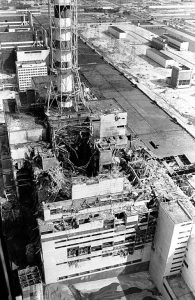
The destroyed Chernobyl reactor, one of four units operating at the site in Ukraine in 1986. No units operate today. (Chernobyl, Ukraine, 1986). Photo copyright IAEA Imagebank. CCA/2.0 Generic.
Perhaps the most remarkable case of amateur radiation exposure involves David Hahn, dubbed the “Radioactive Boy Scout“. In 1994, the 17-year-old attempted to build a breeder reactor in his mother’s shed in Michigan using materials extracted from smoke detectors (americium-241), camping lantern mantles (thorium), and clock dials (radium). His homemade neutron gun and crude reactor components significantly contaminated the property, eventually requiring intervention by the EPA and a hazardous materials cleanup. Though Hahn received only a modest radiation dose, his shed registered radiation levels 1,000 times above normal background.
Hahn’s case, while extreme, is not unique. In 2007, Richard Handl of Sweden attempted to split atoms in his apartment kitchen using materials purchased online. He only realized the potential illegality of his experiment when he contacted Sweden’s Radiation Safety Authority to ask if his activities were permitted. Unlike Hahn, Handl was arrested but later released when authorities determined his setup hadn’t reached truly dangerous levels.
The democratization of scientific knowledge and equipment access has made DIY nuclear experimentation increasingly accessible. Online forums devoted to amateur nuclear science host discussions on building Farnsworth fusors and other nuclear devices, though most participants emphasize safety and legality. The Nuclear Regulatory Commission and Department of Energy now actively monitor purchases of certain materials and equipment that could enable amateur experimentation.
These incidents, while varying in scale and circumstance, share common themes: the misunderstanding of invisible dangers, inadequate safety protocols, and the cascading consequences that extend far beyond immediate events. They demonstrate that the line between beneficial technology and catastrophe often depends not on the materials themselves, but on human systems of management, regulation, and education surrounding them.
So…Given the foregoing, what can you do to protect yourself?
Aside from the military-rated CBRN gas masks mentioned, the answer, unfortunately, is “not much“. However, gas masks are the best place to start, and do provide a huge degree of protection. While pricey, modern masks are far better than what was available 40 years ago. Gas masks should come with one or two filters, that are now universal-fit, fitting 40mm sockets in the mask that have been standardized since 2000. The key thing to look for in a mask, though, is whether it has a drinking attachment for a “NBC Canteen”; this is a vital concern when choosing a mask, as these masks get very hot, very fast, and with the stress of the situation, your water needs will vastly increase. “Package deals”, selling the mask, a filter or two, and one or two canteens with mask attachments, is what you want to look for.
For radiological accidents, in addition to the mask an canteen, the available option is potassium-iodide tablets. These protect the thyroid, which is the most vulnerable part of the body to nuclear contamination. Potassium-Iodide is commercially available, from all the common online retailers.
The last recommendation I will give you is to get a copy of Cresson H. Kearney’s standard work, “Nuclear War Survival Skills“. While a bit dated in places, this remains the best practical reference for civilians. The link here is to a PDF copy, but do try to find a print copy, if you can.
If the foregoing scared you – good. These threats are very real, no matter where in the world you live. The government (all governments), as East Palestine demonstrated, is not going to provide a lot of help in the short term, if at all.
You are on your own. Plan accordingly.
The Freedomist — Keeping Watch, So You Don’t Have To
As the ongoing war in Ukraine has demonstrated, low-cost drone warfare has arrived on the battlefield. While the modern use of armed drones began in 2000/early-2001, with the arming of an RQ-1 Predator drone with an AGM-114 ‘Hellfire’ missile, It was not until after the September 11 Attacks of that year that the armed Predators went into action.
Aside from large modern armies however, drone combat, as such, did not emerge until the rise of the Islamic State after 2014. In 2016, as the war began to turn against the IS, Iraqi forces started being struck by 40mm grenades dropped by modified civilian drones. Tiny, and very quiet, these drone were able to hover – or ‘loiter‘, to use the military term – over an area, and drop explosives on top of targets on command. This immediately raised alarms, as most armored vehiles, such as tanks, are very thinly armored on their top surfaces.
A Naval Forces of Ukraine Bayraktar TB2 from the Turkish company Baykar Defense; CCA/4.0 Int’l
While the use of civilian drones in combat had been noted previously, those instances only seemed to be in the realm of tactical surveillance and reconnaissance. After the IS ramped up its “micro-drone” campaign, though, “proliferation” began in earnest: expanding outside the Middle East, where Russian forces thwarted an attack on one of their bases in Syria in 2018, drug cartels in Mexico began deploying attack drones in earnest.
In Ukraine, drones for reconnaissance and attack have advanced to the point that the Ukrainians are deploying “bomber” drones carrying up to a 44lbs payload of explosives, while also scoring the first acknowledged air-to-air kill of an advanced fighter, in this case a Mig-29, by a kamikaze drone, via sympathetic detonation.
But the use of small drones has been overshadowed by the use of much larger platforms which, while still “drones”, are not really “tactical” weapons. Much has been made of large drones, such as those used by Azerbaijan in the 2020 Nagorno-Karabakh War, as well as uses by Houthi rebels attacking civilian cargo ships in the Red Sea. The problem with these types of attacks is that they more resemble the use of drones and missiles by major powers…What about the infantry-level use of this class of weapons?
Soldiers of Alpha Company, 1st Battalion, 4th Infantry), fire a M120 mortar during a combat operation in the Da’udzay Valley in the Zabol province of Afghanistan Oct. 23, 2007. US Army Photo. Public Domain.
The modern battlefield has seen remarkable technological advancement in the last 120 years, yet one of warfare’s oldest weapons — the mortar — continues to play a crucial role alongside cutting-edge unmanned aerial systems. Both provide indirect fire capabilities, but with significantly different characteristics, advantages, and limitations.
Mortars represent possibly the oldest form of artillery still in active military service, with designs dating back to the 14th century. These simple, high-angle weapons offer several enduring advantages. They’re relatively inexpensive, with basic systems costing under $20,000 and individual rounds priced at $50-$300 depending on sophistication. Modern infantry mortars like the U.S. 60mm M224 can be transported and operated by just two soldiers, providing immediate fire support without complex logistics chains.
The mortar’s high arc trajectory allows engagement of targets behind cover and in defilade positions—a capability that maintains its relevance in urban environments where direct fire weapons face significant limitations. Modern mortars can typically engage targets between 100-8,000 meters depending on caliber, with rounds impacting within 1-2 minutes of fire mission commencement.
In contrast, military drones represent a relatively recent development that has rapidly transformed battlefield dynamics. Systems like the Turkish TB2 Bayraktaror loitering munitions such as the Switchblade provide persistent surveillance capabilities combined with precision strike options. These platforms offer unmatched target observation capabilities, with operators able to positively identify targets before engagement and conduct battle damage assessment immediately after strikes.
Drones typically deliver smaller payloads than artillery systems but with significantly higher precision. Where a mortar might achieve a Circular Error Probable (CEP) of 30-100 meters depending on range and conditions, drones can often deliver munitions with accuracy measured in single-digit meters.
However, the comparative cost structure presents significant disparities. Even relatively inexpensive military drones cost hundreds of thousands to millions of dollars per platform, with sophisticated munitions adding tens of thousands per engagement. This cost difference becomes particularly relevant in sustained operations or against adversaries employing low-cost countermeasures.
The evolution of consumer drones into improvised weapons platforms has dramatically accelerated during the Ukraine conflict, with both sides developing increasingly sophisticated swarm tactics using modified commercial quadcopters and purpose-built FPV (First Person View) drones. These systems typically carry 40mm grenades, modified mortar rounds, or small thermobaric charges, creating an entirely new tactical capability at remarkably low cost.
Soldier with commercial Unmanned aerial vehicle, 2017. Photo by Scott Stewart. CCA/4.0 International.
The basic approach involves forward reconnaissance elements identifying enemy positions, followed by the deployment of drone teams equipped with 5 – 20 small, unmanned systems. These teams position themselves just beyond the range of enemy small arms (typically 1-2km from the target) and then launch multiple drones in rapid succession. Each operator controls a single drone, but their actions are coordinated through a tactical commander who prioritizes targets and sequences attacks.
What makes these swarms particularly effective is their combination of saturation and persistence. Unlike a traditional mortar barrage that might last 2-3 minutes, drone swarms can maintain pressure on a position for 30+ minutes as operators rotate through their inventory of systems. This creates both physical and psychological pressure that conventional indirect fire struggles to match.
The economics are particularly compelling. A basic FPV drone capable of delivering a grenade costs approximately $400 – $1,000, while the grenade itself might cost $50-200. Even accounting for losses, this means an engagement involving 10 drones and 20 munitions might cost less than $20,000 total – comparable to just a few mortar rounds from advanced Western systems.
From a tactical perspective, these drone swarms force defenders to make difficult choices. Activating electronic countermeasures reveals defensive positions and quickly depletes battery systems. Taking cover from aerial threats often exposes personnel to horizontal fire. Moving to alternate positions makes units visible to surveillance drones operating at higher altitudes.
The integration of these swarms with conventional forces represents a notable innovation. Infantry units can now advance with drone teams directly embedded in their formations, allowing for immediate fire support without the coordination delays associated with traditional artillery. When resistance is encountered, the formation pauses while the drone swarm engages, creating a dynamic reminiscent of ancient warfare where archers would soften positions before infantry assault – but with far greater precision and real-time assessment capability.
The Freedomist — Keeping Watch, So You Don’t Have To
For centuries, nations going to war usually tried to blockade, or “close off”, an enemy nation’s ocean ports, in order to damage their commerce, but usually to support a land attack to capture said ports. Sometimes, though, as with American Civil War, blockades would sometimes extend to every ocean port in an enemy nation. With the end of World War Two, however, the massive wars of the previous one hundred and fifty years, the idea of the naval blockade began to wane, with only those nations with vast naval establishments being able to enforce such strategies, usually in concert with all kinds of “soft” measures, such as economic and financial sanctions.
However, the ancient concept of naval blockade — one of the most basic strategies of maritime warfare — is experiencing a significant revival and transformation in the 21st century. While the fundamental purpose remains unchanged — denying an adversary access to maritime commerce and resources — both the methods of implementation and countermeasures have evolved dramatically, creating new strategic and legal challenges in an increasingly connected global economy.
Traditional blockades relied on the physical presence of warships creating a cordon around enemy ports. Today’s “modern blockade” operates across multiple domains simultaneously. The ongoing situation in the Red Sea demonstrates this evolution, with Houthi forces effectively creating a blockade-like effect despite possessing no significant naval forces. Using a combination of medium-weight helicopters, shore-based anti-ship missiles, unmanned explosive boats, and aerial drones, non-state actors can now threaten maritime traffic with capabilities previously limited to nation-states.
Modern Houthi attacks and Somali piracy operations share surprising tactical and strategic parallels with their Caribbean predecessors from the “Golden Age of Piracy” (1650-1730), despite the centuries and thousands of miles between them.
Like the Caribbean pirates who established bases in lawless territories such as Nassau and Tortuga, both Somali pirates and Houthi forces operate from ungoverned or weakly governed coastal regions. The Somalis launched out from the collapsed state’s coastline, while the Houthi rebels utilize Yemen’s western shores as launching points for maritime attacks.
The economic logic remains strikingly similar. Caribbean pirates targeted the Spanish treasure fleet system, focusing on predictable shipping lanes where valuable cargo was concentrated. Similarly, Somali pirates focused on the narrow Gulf of Aden transit, while Houthis target the Bab el-Mandeb Strait directly — both critical chokepoints where shipping is concentrated and vulnerable.
Photo of the Bab-el-Mandeb (the strait between the Red Sea and the Gulf of Aden), taken from outer space during ISS Expedition 62, February, 2020. NASA photo. Public Domain.
Where they differ significantly is in motivation. Caribbean pirates primarily sought economic gain, as did Somali pirates through their sophisticated ransom systems. Houthi attacks, while sometimes involving seizure of vessels, function primarily as political and strategic actions within a broader regional conflict framework, making them more akin to privateers — state-sanctioned maritime raiders — than purely profit-driven pirates, due to their open and acknowledged status as a proxy force of Iran.
This diffusion of anti-access capabilities has democratized blockade tactics. Advanced anti-ship cruise missiles with ranges exceeding 200 nautical miles allow even smaller nations to threaten shipping across vast areas without maintaining a substantial fleet. The Chinese DF-21D “carrier killer” missile and similar systems enable “blockade at a distance” strategies that would have been impossible in previous eras. Similarly, while older anti-ship missiles like the Chinese HY-2 “Silkworm” is no longer effective against modern warships, they are highly effective against civilian cargo vessels with no electronic counter-measures (ECM) defenses. More importantly, for non-state actors, these older weapons are cheap, and relatively available on the international arms black market.
“Haiying” No. 2 shore-to-ship missile, photographed at the Military Museum of the Chinese People’s Revolution. September, 2017. Photo by Tyg728. CCA/4.0 Int’l.
Cyber operations represent perhaps the most revolutionary development in blockade evolution. Naval strategists now consider port management systems, shipping logistics networks, and maritime communication channels as critical vulnerability points. A coordinated cyber attack could potentially halt port operations more effectively than physical presence, causing ships to be redirected or delayed without firing a shot. In 2017, the NotPetya malware attack against global shipping giant Maersk and Ukraine demonstrated how digital disruption could cause billions in shipping losses without a single warship deployment.
The legal framework governing blockades has struggled to keep pace with these technological developments. The traditional requirements under international law—including formal declaration, effectiveness, and impartiality toward neutral shipping—become ambiguous when applied to over-the-horizon missile threats or cyber disruptions. This creates dangerous gray zones where actions may have blockade-like effects without triggering the legal thresholds that would permit countermeasures.
These developments have prompted significant changes in how major naval powers prepare for both implementing and countering blockades. The U.S. Navy has invested heavily in both offensive and defensive capabilities, developing distributed maritime operations concepts that could sustain blockade operations despite adversary counter-targeting. Similarly, China’s naval expansion focuses on both area-denial systems to prevent blockade of its own ports and blue-water capabilities that could potentially blockade Taiwan or other regional adversaries.
Commercial shipping has also adapted. Insurance markets now incorporate blockade-like threats into their risk models, with specialized “war risk” policies for vessels transiting threatened regions. Major shipping companies have developed sophisticated contingency routing options and increased their resilience through distributed logistics networks.
For smaller maritime nations, this evolution presents particular challenges. Without robust naval capabilities or alternative supply routes, these countries remain vulnerable to both traditional and next-generation blockade tactics. Regional security organizations have increasingly focused on developing collective maritime security arrangements specifically addressing these asymmetric maritime threats.
Naval mines remain among the most cost-effective maritime weapons, offering asymmetric capabilities with significant strategic impact. Modern mines have evolved far beyond the contact mines of previous wars into sophisticated “smart” systems with advanced sensors, targeting algorithms, and activation mechanisms.
Today’s mines feature acoustic, magnetic, pressure, and seismic sensors that can identify specific vessel signatures, allowing them to selectively target certain ship classes while ignoring others. Advanced mines can lie dormant for months or years, activate on a predetermined schedule, or respond to remote commands. Some incorporate anti-handling features specifically designed to counter minesweeping operations.
Air-dropped mines represent a particularly flexible deployment method, a method in use since World War 2. Aircraft like the B-52, P-8 Poseidon, and various fighter platforms can rapidly seed large areas without risking surface vessels. The US Quickstrike series of air-delivered mines can be deployed from standoff ranges, allowing mining operations even in contested waters. The addition of JDAM kits to create the Quickstrike-ER has extended deployment ranges to over 40 nautical miles.
A B-29 of the 9th BG/313th BW drops two parachute-retarded Mark 26 aerial mines during Operation Starvation, 1944. Photo by United States Army Air Forces. Public Domain.
Countering these threats, modern mine countermeasure operations increasingly rely on unmanned systems rather than traditional minesweepers with human crews. Unmanned surface vessels (USVs) and underwater vehicles (UUVs) equipped with synthetic aperture sonar and other detection technologies can locate and map minefields with minimal risk. Once detected, neutralization occurs via ROV-delivered charges or specialized mine-hunting drones.
Despite technological advances in countermeasures, the fundamental asymmetry remains: mines are inexpensive to deploy but expensive and time-consuming to clear, making them particularly effective for sea denial strategies by smaller naval powers or non-state actors.
Perhaps most concerning is how these evolutionary developments have made naval blockades more attractive as “gray zone” operations—actions that remain deliberately below the threshold of conventional warfare while achieving strategic effects. A nation or non-state actor could significantly disrupt an adversary’s economy through blockade-like actions while maintaining plausible deniability or legal ambiguity.
As maritime commerce remains the backbone of global trade, with approximately 90% of international goods traveling by sea, the evolution of blockade tactics represents a significant security challenge for the international order. Nations must now prepare for blockade scenarios ranging from traditional warship deployments to sophisticated multi-domain operations combining kinetic, electronic, and cyber elements — a substantial evolution from the wooden ships that once enforced the traditional “close blockade” of previous centuries.
One of the features of the military world, in general, is that no one likes to talk about “logistics”. That is because the field of military logistics is always bout being “the party of NO” – Logistics is not about planning operations, but about telling the planners what their options are…or are not.
The old military adage that “amateurs talk tactics, professionals talk logistics” has never been more relevant than in today’s contested global environment. Military logistics — the complex art of moving, supplying, and maintaining forces — is experiencing its most significant transformation since the advent of the containerization revolution of the 1960’s, as a new generation of planners confront the reality that the mostly unchallenged supply lines of conflicts in recent decades are unlikely to exist in future wars.
For over two decades, Western militaries have operated in environments where, despite the tactical dangers of IED’s and ambushes, strategic supply lines have remained largely secure. Ships moved freely across oceans, cargo aircraft landed on established airfields, and the primary logistical challenge was the “last mile” delivery in hostile territory. This operational comfort has begun to evaporate as both near-peer competitors and non-state actors demonstrate both the capability and intent to target the entire logistics chain from factory to frontline.
The Russian invasion of Ukraine has provided a sobering case study in logistical vulnerability. Russian forces, operating merely 100 miles from their own borders, experienced catastrophic supply failures in the war’s opening phases. Vehicles ran out of fuel, troops lacked food, and sophisticated equipment sat idle for want of spare parts. This failure stemmed not from distance but from an inability to adapt to disruption — a warning for Western forces that have operated at far greater distances during recent conflicts against forces not considered in the “near-peer” category.
Similarly, the Houthi campaign targeting commercial shipping in the Red Sea has created ripple effects throughout global military supply chains, ripples that extend far beyond the immediate tactical challenges. Since late 2023, these attacks have forced a fundamental recalculation of military logistics planning across NATO and allied nations.
The most immediate impact has been the diversion of naval assets to escort operations, straining already limited fleet resources. Western navies, particularly the U.S. and British, have deployed destroyers and cruisers to the region that were scheduled for maintenance or other operational commitments. This reallocation has created cascading delays in naval readiness across multiple theaters.
For military logistics planners, the Red Sea crisis has exposed vulnerabilities in assumptions about secure maritime transit. Defense departments have relied heavily on commercial shipping for the movement of non-critical military supplies and equipment, with approximately 90% of military cargo traveling on commercial vessels during peacetime. The Houthi attacks against civilian shipping have forced a reassessment of this dependency, with military commands now requiring contingency routing for critical components.
The economic impact has been equally significant. Shipping insurance rates have increased by over 2,700% for Red Sea transit, dramatically raising costs for military-contracted shipments. These price spikes have strained defense budgets already under pressure from inflation in other sectors, to say nothing of slashing Red Sea transits by commercial vessels be over 60%. For European forces supporting operations in the Middle East and Asia, the forced rerouting around Africa adds 10-14 days to transit times, delaying equipment deliveries and increasing wear on existing frontline systems.
Perhaps most concerning for Western defense planners is the demonstration effect: a relatively small non-state actor, using low-cost weapons, has effectively disrupted global shipping lanes, providing a strategic template that other adversaries are almost certainly studying closely.
Additionally, although considered a remote possibility by many, a naval confrontation between Algeria and Morocco would severely disrupt Mediterranean civilian and military logistics chains beyond the immediate combatants. The Strait of Gibraltar, which handles approximately 300 vessels daily connecting the Atlantic and Mediterranean, would face restricted transit or complete closure during active hostilities. Military planners in Europe and the United States would be forced to route naval assets through the Suez Canal — itself already constrained by Red Sea security concerns, as noted above. The disruption would particularly affect NATO’s “southern flank” operations and force a reallocation of naval forces currently deployed elsewhere. Both countries’ proximity to critical European supply routes would likely trigger immediate diplomatic and possibly military intervention from NATO powers, particularly Spain and France, further complicating an already stressed regional security environment.
Modern resilient military logistics systems are being redesigned around several core principles. First is the concept of dispersal, moving away from the massive, centralized supply hubs that served as efficiency centers in Iraq and Afghanistan. Future supply networks will feature smaller, more numerous nodes that present less attractive targets and can continue functioning if some are destroyed.
Additive manufacturing, commonly known as “3-D printing“, represents another pillar of this transformation. The U.S. Marine Corps has already deployed Mobile Fab Labs capable of producing critical parts in forward areas, reducing dependence on vulnerable supply chains. Advanced systems now allow for printing in metals and composites, expanding the range of battlefield-repairable equipment.
Autonomous delivery systems form a third component of resilient logistics. Unmanned aerial vehicles for medical evacuation and resupply have moved from experimental to operational in multiple forces. The U.S. Navy’s “Sea Hunter” autonomous vessel program points toward a future where unmanned platforms may be able to maintain supply lines through contested waters without risking crew lives, which is a critical concern, given ongoing recruiting issues.
Energy resilience has emerged as a critical focus area, with significant vulnerabilities exposed in Ukraine. Modern militaries are once again exploring portable nuclear power (because that’s a good idea), advanced solar systems, and localized synthetic fuel production to reduce dependence on traditional fuel convoys, which have proven particularly vulnerable to attack.
Perhaps most significantly, artificial intelligence is being integrated into logistics planning. Predictive algorithms can anticipate supply needs before units request them, while automated inventory management reduces human error in critical supply tracking. These systems incorporate redundancy and operate on isolated networks to maintain functionality even during communication disruptions.
The shift toward resilient logistics also involves uncomfortable trade-offs between efficiency and redundancy. The just-in-time inventory systems that have dominated commercial and military logistics for decades optimize costs but prove brittle under stress. Military planners are now deliberately building inefficiency into systems—accepting higher costs and larger inventories to ensure functionality under attack.
This transformation extends beyond equipment to human capital. Specialized logistics personnel must now train to continue operations under electronic warfare conditions, with degraded or absent communications, and the constant threat of precision strikes. This represents a significant cultural shift for logistics units accustomed to operating from secure rear areas.
As military planners prepare for potential future conflicts with near-peer adversaries, the race to build resilient logistics systems has become as crucial as any weapons development program. The side that can maintain supply flows while disrupting their opponent’s will likely prevail, regardless of tactical superiority or advanced weaponry.
With all the craziness of the last six weeks, it’s easy to become enraptured by all the “glitz-bang-pow“, and to lose track of the truly important things…like internet access, for example.
Much of the crucial digital lifelines of the modern global economy lie largely unseen and unprotected beneath the oceans. Submarine cables — bundled fiber-optic threads wrapped in layers of protective materials — carry an estimated 99% of international data traffic, representing an estimated $10 trillion in daily financial transactions. Clearly, these cables are vital components of any national infrastructure…and, just as clearly, they are very high-priority targets in any war scenario. Despite their critical importance, these cables remain surprisingly vulnerable to both accidental damage and deliberate sabotage, creating an asymmetric vulnerability that security experts increasingly view as a critical national security concern.
Recent incidents have highlighted this vulnerability. In late 2023, and again in late 2024, multiple cables in the Baltic Sea were damaged within weeks of each other, including the Svalbard cable connecting Norway’s remote Arctic research station to the mainland. While officials initially cited “technical problems,” subsequent investigations pointed to deliberate actions, with suspicion falling on Russian vessels that had been tracked in proximity to the damaged sections. Similar incidents have occurred in the Mediterranean and Red Sea, where the timing and pattern of damage suggested coordinated action rather than accidental encounters with ship anchors or fishing equipment…which, given the immediate impacts, should be surprising to no one, as the war in Ukraine continues to rage.
The security implications extend far beyond temporary internet disruptions. Major financial centers like London, New York, and Singapore depend on millisecond-level transmission speeds for trading operations, with even brief outages potentially causing billions in economic damage. Military communications, intelligence sharing between allies, and diplomatic channels all rely on these same physical pathways, creating a strategic vulnerability that potential adversaries have clearly recognized.
Unlike traditional military targets, undersea cables present adversaries with an ideal gray-zone target. Damage can be plausibly denied as accidental, attribution is extremely difficult, and repairs can take weeks depending on the location and conditions. This provides hostile actors with the ability to cause significant disruption while remaining below the threshold of activities that would trigger conventional military responses.
The technical challenge of defending these cables is substantial. The global submarine cable network spans over 750,000 miles, often in international waters beyond territorial jurisdiction. Cable routes are publicly documented for maritime safety, making their locations easily accessible to potential saboteurs. Monitoring such vast distances presents an almost impossible surveillance challenge, especially in deep ocean areas where depths exceed 3,000 meters.
The “CS Dependable”, cable layer ship with a modern stern sheave design. Picture taken at the Port of Astoria, Oregon, 2006. CCA/3.0. Photo by Nsandel.
Of course, this has been happening since undersea cables were first laid in the 19th Century, most notably when the United States cut Spanish telegraph cables in both Cuba and the Philippines theaters of the Spanish-American War. During World War I, one of Britain’s first and most significant strategic moves came just hours after declaring war in August 1914, when the cable ship “CS Alert” severed Germany’s five transatlantic cables near the English Channel. This operation, codenamed Operation Telekom, effectively cut Germany’s direct communication links with the Americas and much of the world. Britain simultaneously took control of most neutral cable stations, forcing German diplomatic and military communications onto easily intercepted wireless channels or through cables that passed through British-controlled territory.
The British established “Room 40“, a specialized naval intelligence unit that interceded and decoded German messages, providing critical intelligence. The most famous success came with the interception and decryption of the Zimmermann Telegram in 1917, which revealed Germany’s attempt to entice Mexico into attacking the United States — a diplomatic catastrophe that helped bring America into the war.
In World War II, Britain expanded these capabilities with Operation ‘Cutting’. The Royal Navy again targeted German undersea cables, but added sophisticated tapping operations. Combined with the codebreaking work at Bletchley Park, these undersea operations provided crucial intelligence on German naval movements, particularly U-boat operations, significantly contributing to Allied victory in the Battle of the Atlantic.
Modern cable attacks no longer require crude methods like physical cutting. Advanced submersibles can quickly and silently install tapping devices without severing cables, allowing for collection without detection. Both the Russian and Chinese navies are known to operate specialized submarines and surface ships equipped for undersea operations near critical cable infrastructure, including the Yantar, a Russian “research vessel” observed loitering near critical cable junctions in the Atlantic.
These strategic vulnerabilities are magnified by the concentration of key connection points. Cable landing stations — where submarine cables connect to terrestrial networks — represent critical sea-based chokepoints, with certain locations in Egypt, Malaysia, and Sicily serving as hubs for dozens of major cables. A modern, coordinated attack on multiple landing stations could severely disrupt global connectivity in ways that would overwhelm the limited redundancy built into the system.
Despite the growing awareness of these vulnerabilities, international legal protections remain inadequate. The 1884 Convention for the Protection of Submarine Telegraph Cables provides limited safeguards, while the UN Convention on the Law of the Sea only offers general provisions against deliberate damage. Enforcement mechanisms are virtually non-existent in international waters, creating a legal gray zone that mirrors the operational one.
As tensions rise between major powers, enhancing resilience against cable disruption has become an urgent security priority. Proposed measures include increased naval patrols near critical infrastructure, enhanced monitoring through seabed sensors, diversification of cable routes, and hardening of physical infrastructure. However, the scale of the challenge means complete protection remains impossible, leaving this critical infrastructure as a persistent vulnerability in an increasingly contested global environment.
One thing people frequently fail to understand – an outgrowth of the increasing sociological separation of the civilian and military spheres – is that naval warfare is far more than dramatic gun battles at sea, determined amphibious assaults, and exciting launches of fighter planes from the decks of aircraft carriers.”War“, as such, has been a term too frequently applied outside of its true domain, diluting public understanding of its implications: Sure, “war” is scary and destructive in general, but there are plenty of avenues of attack that are certainly not part of the ‘war on poverty’. This is why the Imperial Japanese Navy shelled a beach in Santa Barbara, California in 1942…which came as a hell of a surprise to local residents, and which had some very unforeseen consequences that succeeded in damaging the United States – not enough to win the war, but enough to instill distrust, the more people thought about it.
People concerned for not only their physical, but financial, security, need to start relearning how militaries think, because while the civilian may not care much about warfare, warfare cares very much about you.
The Freedomist — Keeping Watch, So You Don’t Have To
Back FREEDOM for only $4.95/month and help the Freedomist to fight the ongoing war on liberty and defeat the establishment's SHILL press!!
Are you enjoying our content? Help support our mission to reach every American with a message of freedom through virtue, liberty, and independence! Support our team of dedicated freedom builders for as little as $4.95/month! Back the Freedomist now! Click here