February 16, 2026

Default

When Availability Beats Capability


From the days of the very first aircraft carriers, like the USS Langely (CV-1), until the 2009 retirement of the USS Kitty Hawk (CV-63), virtually all of the aircraft carriers in the United States Navy ran on some flavor of marine diesel fuel. Beginning in 1961, however, with the advent of the USS Enterprise (CVN-65), the Navy began transitioning all of its new aircraft carriers to nuclear power. The benefits appeared to be clear, as the nuclear powered aircraft carrier could cruise without refueling its nuclear power plant for up to 25 years.

But, just how clear was that advantage, over the conventionally engined carriers of the past? And – much more important – what were the downsides of completely shifting to nuclear power? These question came into needle-sharp focus on January 1st, 2026.

The United States Navy began 2026 with a problem that should alarm anyone paying attention to the global security of the United States: of the current fleet of eleven aircraft carriers, exactly two were deployable – the USS Gerald Ford (CVN-78), which was the center-point of the operation against Venzuelan dictator Nicolas Maduro, and the USS Abraham Lincoln (CVN-72), which was patrolling the South China Sea.

By early February, facing simultaneous crises from the sudden Iranian revolution, to the increasing instability in Communist China, the Navy emergency-scrambled two more carriers (the USS Theodore Roosevelt (CVN-71) and the USS George H. W. Bush (CVN-77)) to operational status — completing their Composite Training Unit Exercises COMPTUEX while already underway to their deployment zones.

Of the remaining carriers, only the USS Eisenhower (CVN-69) is undergoing “workups”, beginning the three or four month process to return to deployment. Every other nuclear carrier is either undergoing decommissioning (USS Nimitz (CVN-68)), or undergoing repair/overhaul/refueling. It is unclear exactly when a carrier other than the Eisenhower will be available for operations.

This isn’t a sign of extraordinary capability – it’s a symptom of a fleet in crisis.

The ten nuclear-powered Nimitz-class and the one Ford-class carriers represent remarkable engineering achievements. They can steam virtually forever without refueling. The USS Stennis, however, has been undergoing its mid-life nuclear refueling and overhaul since 2021 — a process now entering its fifth year. The USS Truman remains sidelined following collision damage, unable to deploy before its own – now-delayed, because there is only one refueling dock for nuclear carriers – refueling cycle. When you need carriers now, theoretical capabilities matter less than actual availability.

This brings up the uncomfortable question: what are we actually buying with nuclear propulsion for aircraft carriers?

The standard answer is “unlimited range” — carriers that never need to refuel their main engines. But carrier strike groups don’t operate in isolation. Their aircraft require JP-5 jet fuel continuously. Their escorts need bunker fuel. Even the carriers run backup diesel generators and require regular underway replenishment for aviation ordnance, food, and supplies. The nuclear reactor means the ship’s hull doesn’t need to refuel, but the mission absolutely does. The need for UNREP operations remain constant regardless of propulsion type.

Underway Replenishment (UNREP) operations in the Arabian Sea support of Operation IRAQI FREEDOM and Operation ENDURING FREEDOM. Pictured foreground-to-background are the USN Nimitz Class Aircraft Carrier USS RONALD REAGAN (CVN 76); the USN Military Sealift Command (MSC), Supply Class Fast Combat Support Ship USNS RAINIER (T-AOE 7) and the USN Arleigh Burke Class (Flight II) Guided Missile Destroyer (Aegis), USS McCAMPBELL (DDG 85). Undated US Navy phot by PH3 Aaron Burden, USN. Public Domain.

What nuclear propulsion does require is specialized infrastructure. Refueling and Complex Overhaul (RCOH) cycles take two to three years, normally, and demand nuclear-qualified facilities and workforce. The Navy has only one, single facility that can refuel nuclear aircraft carriers – which is why the USS Truman is currently riding at anchor, waiting for the Stennis to clear the dock, as the carrier fleet cannot use the same refueling docks as nuclear-powered submarines, due to size and configuration.

Budget cuts have also compounded the maintenance delays — the Obama administration’s sequestration-era budget reductions followed by COVID-related disruptions have created a cascading refueling backlog across the fleet. When institutional maintenance capacity is disrupted, nuclear carriers don’t degrade gracefully; they become tied to pier-side for years.

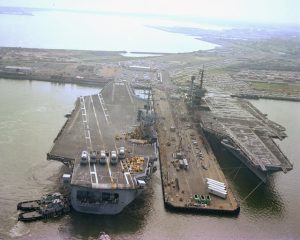
An aerial view of the nuclear-powered aircraft carrier USS DWIGHT D. EISENHOWER (CVN 69), right, being assisted into port at Pier No. 12 by large harbor tugs. The aircraft carrier USS AMERICA (CV 66) is tied up at the right. 1985 US Navy photo. Public Domain.

Diesel-powered carriers offered a different trade-off. Yes, they need refueling — something which is already done constantly for the rest of the carrier’s accompanying strike group. But they also eliminate multi-year RCOH cycles. Conventional powerplants can be serviced at standard shipyards around the world without nuclear certification requirements. Battle damage to diesel systems can be more easily repaired or replaced; damage to nuclear propulsion systems requires specialized facilities and extended timelines, if they are actually repairable at all – unlike World War Two, where rapid repair of severe combat damage was routinely accomplished in a few months, at most…But, as no nuclear powered carrier had yet to be seriously damaged in combat, we really have no idea if repair of a combat-damaged nuclear carrier is even possible. Construction timelines also shrink dramatically when you remove the nuclear certification requirements from the process.

The question isn’t whether nuclear carriers are impressive pieces of engineering. They are. The question is whether that impressive engineering serves strategic needs. Consider the Essex-class carriers of World War II and beyond — diesel-powered, mass-produced, and maintained in sufficient numbers to ensure availability. Twenty-four hulls provided persistent presence through Korea and Vietnam. Our current eleven-carrier nuclear fleet just demonstrated it can field four during a global crisis.

The Reagan administration’s 600-ship Navy called for fifteen carrier battle groups — emphasizing numerical presence across global theaters. President Trump has recently advocated for returning battleships to service, arguing their firepower and durability offer capabilities modern vessels lack.

Both proposals address real problems but miss the core issue: availability. Fifteen carrier groups – or eleven – mean nothing if chronic maintenance backlogs sideline half the fleet simultaneously. The proposed battleships — essentially huge missile platforms with armor — require crews of 1,500+ versus modern a destroyer’s c.300, while offering marginal advantages over “distributed lethality” concepts using existing hulls.

The actual requirement isn’t more carriers or bigger guns — it’s operational carriers and maintainable systems. Fifteen diesel-powered carriers with conventional maintenance cycles would provide far more deployable presence than fifteen nuclear carriers cycling through extended overhauls. Similarly, additional Arleigh Burke-class destroyers deliver sustained missile capacity without the proposed battleships’ manpower and maintenance burdens.

Strategic presence requires operational availability — not just impressive-looking platforms.

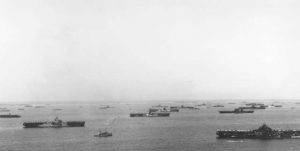
Ships of the U.S. Navy Pacific fleet anchored at Ulithi Atoll, Caroline Islands, February 1945.. The aircraft carrier USS Saratoga (CV-3) is in the right middle distance. There are at least eight Essex-class carriers present. 1945 US Navy photo. Public Domain.

Form should follow function. If the function is “project American power globally during crisis,” then presence matters more than theoretical endurance. A diesel carrier that’s actually there outweighs a nuclear carrier in year five of refueling. This isn’t about going backward technologically — it’s about being operational strategically.

The Navy faces a choice: continue investing in exquisite platforms that spend years unavailable for specialized maintenance, or diversify toward simpler systems that prioritize fleet availability. The Iranian crisis and Western Pacific tensions aren’t waiting for the Stennis to complete its overhaul. Neither will the next emergency. We need carriers that can steam now, not carriers that can theoretically steam forever.

Strategic availability isn’t a compromise…And in February 2026, it’s the actual requirement.


The Freedomist — Keeping Watch, So You Don’t Have To


freedomist banner


Knees To The Breeze…?


Mankind has always been fascinated by the idea of flight. The more rational thinkers realized that they had to find a way to land safely. In Europe, Leonardo Da Vinci designed a parachute – that worked – but didn’t really have a viable way to make it a “tactical system” (to borrow the modern term).

Later, in France, a balloon designed by the Montgolfier brothers was first flown successfully in 1783; luckily, the ‘aeronauts’ did not have to bail out in an emergency. In 1797, that was changed by André-Jacques Garnerin. Not exactly a “tactical” jump, but it worked.

The sight of thousands of paratroopers descending from the sky remains one of warfare’s most dramatic images. From the mass drops over Crete in 1941, and Normandy in 1944 to the 173rd Airborne’s combat jump into northern Iraq in 2003, airborne operations have captured military imagination for over eighty years. But, as anti-aircraft capabilities proliferate and modern warfare evolves, a hard question emerges: can massed parachute assaults above the battalion level still accomplish their mission in contemporary conflict, or have they become elaborate exercises in nostalgia?

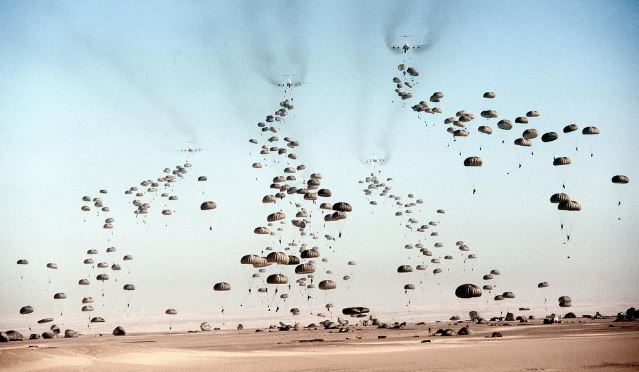
A 22-aircraft “freedom launch” took place Sept. 11, 2013, at Travis Air Force Base, Calif. Seven C-17 Globemaster IIIs, 11 KC-10 Extenders and four C-5B Galaxies from the 60th Air Mobility Wing lined up in what is historically referred to as an “elephant walk,” then launched consecutively over 36 minutes to take part in Air Mobility Command missions. (U.S. Air Force photo/Ken Wright)

The last major U.S. combat jump occurred over two decades ago when the 173rd Airborne Brigade dropped onto Bashur Airfield in northern Iraq — a deliberately uncontested drop zone that faced minimal air defense threat. Since then, American paratroopers have deployed worldwide, but only as elite infantry landed by aircraft that are delivered by aircraft landing at the field, rather than jumping from aircraft in flight. This isn’t coincidence or lack of opportunity; it reflects cold calculation about what modern air defenses can do to slow-moving transport aircraft packed with paratroopers.

The tactical problem is straightforward. A C-17 or C-130 transport aircraft flying at jump altitudes — typically 800-1,250 feet — presents an ideal target for modern air defense systems. Unlike fast-moving fighters that can employ countermeasures and evasive maneuvers, transports must fly straight and level at predictable – and slow – speeds during the actual drop. Man-portable air defense systems (MANPADS) like the Russian SA-24 Igla-S or American Stinger can engage targets up to 11,000 feet, well above jump altitude. More sophisticated systems like the Pantsir-S1 or Tor-M2 can simultaneously track and engage multiple aircraft, turning a mass drop into a massacre before the first paratrooper touches ground.

Historical precedent supports this concern. The 1956 Anglo-French drop on Port Said during the Suez Crisis faced minimal organized resistance and still suffered significant casualties during the drop phase. The Russian airborne assault on Hostomel Airport outside Kyiv in February 2022 — conducted by helicopter rather than parachute — was devastated by Ukrainian air defenses despite Russian air superiority claims. Transport helicopters are marginally more maneuverable than fixed-wing transports, and they still suffered catastrophic losses.

The infrastructure requirements compound the problem. A brigade-level parachute assault — roughly 3,000-4,000 personnel with equipment — requires somewhere between 40-60 transport aircraft flying in close formation. This aerial armada must be assembled, staged, and flown through potentially contested airspace to reach the drop zone. Suppression of enemy air defenses (SEAD) operations must precede the drop, requiring air superiority that itself demands significant resources. By the time you’ve secured the airspace sufficiently for a mass drop, you’ve likely already achieved the operational objectives that justified the drop in the first place.

The equipment limitations compound tactical vulnerabilities. Paratroopers drop with what they can carry — typically small arms, some types of crew-served weapons, and man-portable anti-tank systems. Heavy-drop platforms can deliver light vehicles like HMMWVs and 105mm howitzers, but these require separate aircraft, precise drop coordination, and recovery time before becoming operational. The U.S. M551 Sheridan light tank was specifically designed for airborne operations but proved too fragile for conventional combat and was retired in 1996. Its replacement, the Mobile Protected Firepower vehicle, won’t be air-droppable. Russia’s BMD series represents the most capable air-droppable armored vehicles globally, but even these sacrifice protection for air-transportability. This means airborne forces hit the ground significantly outgunned compared to even light mechanized forces, entirely dependent on air support and rapid linkup with heavier reinforcements. Without that linkup – or even a delayed linkup – an isolated airborne force becomes a besieged force, nearly guaranteed to be destroyed…as the British discovered at Arnhem in 1944.

Modern alternatives offer similar rapid deployment without the vulnerability. Air assault operations using helicopters provide tactical mobility with greater flexibility in landing zones and timing, the ill-planned and poorly-executed Hostomel assault notwithstanding. Air-landing operations — where aircraft actually land and offload troops — allow heavier equipment and supply delivery while reducing the time troops spend exposed during descent. Special operations forces conducting small-unit infiltrations can seize airfields for follow-on air-landing forces, the approach used successfully in Grenada and Panama.

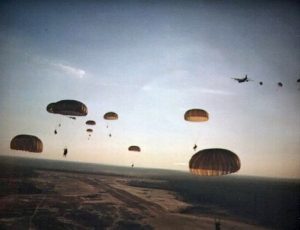
U.S. Army Rangers parachute into Grenada during Operation Urgent Fury. 1983 US Army photo. Public Domain.

Yet the massed airborne capability persists. The United States maintains the 82nd Airborne Division as a ready brigade combat team capable of deploying anywhere globally within 18 hours. Russia’s Airborne Forces (VDV) number roughly 45,000 personnel organized into divisions specifically for airborne operations. France maintains the 11th Parachute Brigade, while China has expanded its own airborne corps and continues developing heavy-drop capabilities for armored vehicles.

The retention suggests these forces serve purposes beyond massed combat jumps. Airborne units provide rapid-reaction forces for contingency operations, often deploying by air-landing rather than parachute. Their light infantry organization and expeditionary culture make them ideal for quick-response scenarios. The threat of airborne operations forces adversaries to defend potential drop zones across wide areas, tying down forces and resources. And in permissive or semi-permissive environments — humanitarian operations, disaster response, non-combatant evacuation — airborne forces provide capabilities no other units match.

The answer, then, appears to be both ‘yes’ and ‘no’. Against peer adversaries with modern integrated air defenses, massed parachute drops above battalion level represent unacceptable risks for uncertain gains. The operational requirements to make such drops feasible — comprehensive SEAD, air superiority, electronic warfare support — require resources that could achieve the desired objectives through less vulnerable means.

But against less sophisticated opponents, in denied areas where air-landing isn’t feasible, or in time-critical scenarios where hours matter, airborne operations retain relevance. The capability also serves as strategic deterrent and rapid-response option that justify maintaining the specialized training, equipment, and doctrine even if actual combat jumps remain rare.

The parachute remains in the arsenal, but it’s increasingly a tool for specific, narrow circumstances rather than a general-purpose solution. Sometimes, the most important capability is the one you maintain but rarely use — because its mere existence shapes adversary planning and preserves options when conventional approaches fail.


The Freedomist — Keeping Watch, So You Don’t Have To


freedomist banner


The M60 Tank’s Surprising Second Act


The war in Ukraine, once again, has revived the tired old saw about the armored combat tank being “obsolete” in warfare, because – drones…and, like every other time someone said something this silly, it has been proven categorically false. Not least, in the fact that older tanks – not simply older designs, but physical vehicles that are older than their crews…and sometimes, older than the entire crew, combined.

Both Russian and Ukrainian tank crews are driving the full panoply of ex-Soviet designs long considered not simply obsolescent, but absolutely obsolete. From T-54/55‘s, T-62‘s, T-72‘s and T-80‘s, these old warhorses still grind around the modern battlefields of Ukraine in large numbers, a function of the truly massive numbers of the vehicles produced during the Cold War.

But these vehicles also still fight in battles all over the world, as most of them were exported in large numbers to anyone aligning with Soviet ideology – honest or not – or, later, any state with very modest cash reserves.

In this, the 1990-1991 Gulf War – “Operation Desert Storm” – created some fundamental misunderstandings about old armor, “brain bugs” that have metastasized over the decades, creating truly insane levels of incompetence (but we’ll talk about “Force Design 2030” in a later article). Among those were the general idea that Soviet vehicles were grossly inferior to western designs, when the reality was abysmally poor training, logistics and leadership on the Iraqi side.

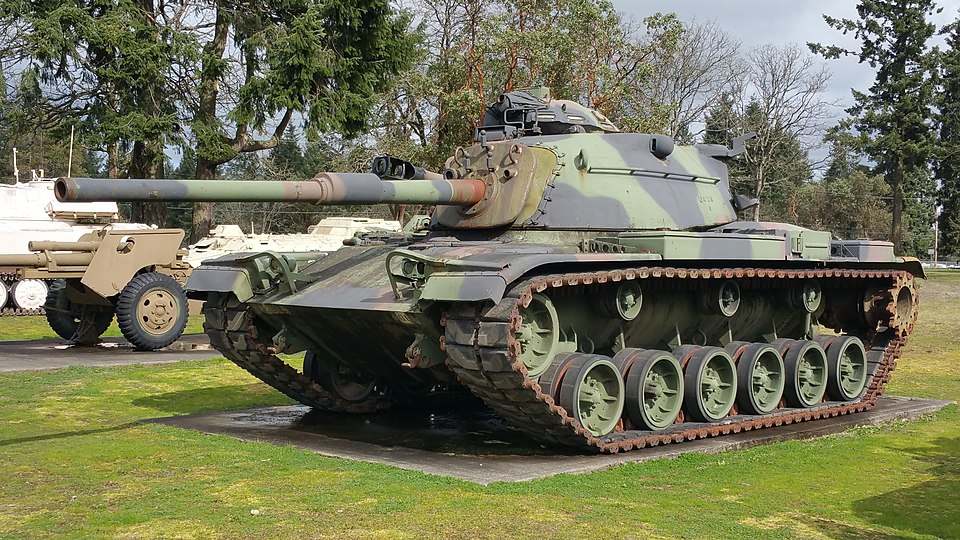
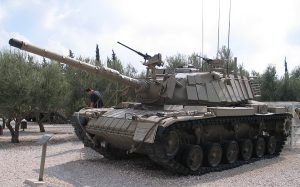
The M60A3 main battle tank was considered “old” during Desert Storm; only the US Marine Corps fielded them in that conflict, when the Marine Corps still had tank units (“Force Design 2030” Delenda Est). Even with hasty add-on “reactive armor“, the -60’s were viewed as being dangerously under-armored, going hand-in-hand with its 105mm main gun, which had been replaced in its successor, the 120mm cannon of the M1 Abrams.

Magach 6, an Israeli-upgraded M60A1 Patton with Blazer ERA in Yad la-Shiryon Museum, Israel. 2005 photo by Bukvoed. CCA/3.0

And yet – the United States still maintains M60A3’s in “deep storage”, in places like the Sierra and Anniston Army Depots, despite parking older-model M1’s in the same storage lots.

But – why?

When the United States retired its last M60 Patton tanks from front-line service in the 1990’s, conventional wisdom suggested this Cold War workhorse would fade into history alongside other relics of the Soviet-American standoff. Instead, something curious happened: nations around the world began investing serious money into modernizing their M60 fleets rather than replacing them with newer designs. From the deserts of the Middle East to the mountains of Taiwan, the M60 has been experiencing a quiet renaissance that tells us something important about practical defense economics.

The M60 entered American service in 1960 as a counter to Soviet tank development, eventually seeing production of over 15,000 units, in various models. It fought in multiple Middle Eastern conflicts, performed credibly in Desert Storm, and became one of the most widely exported tanks in history. By most measures, it should be obsolete — after all, its basic design is now 65 years old. The M1 Abrams replaced it in U.S. service decades ago, and even the Abrams is facing questions about its age in modern warfare.

Yet in 2023, Taiwan awarded a contract worth hundreds of millions to upgrade 460 M60A3 tanks with new fire control systems, improved armor packages, and 120mm main guns. Turkey has upgraded hundreds of M60s with indigenous modifications, creating the M60T “Sabra” variant, which have seen extensive combat in Syria. Egypt operates over 1,700 M60’s with ongoing modernization programs. Israel, which originally developed many of the upgrade packages now used worldwide, continues operating upgraded M60s alongside newer Merkava tanks. Even smaller nations like Bahrain, Jordan, and Morocco maintain modernized M60 fleets.

Magach 7, an Israeli-upgraded M60A1 Patton with the “Sabra” package, in Yad la-Shiryon Museum, Israel. 2005 photo by Bukvoed. CCA/3.0


The economics tell the story. A new main battle tank costs anywhere from $6-9 million per unit — and that’s for Russian or Chinese models. Western tanks like the M1A2 Abrams, Leopard 2A7, or British Challenger 3 run $8-15 million each. Comprehensive M60 modernization packages, by contrast, typically cost $2-4 million per tank. For a nation maintaining a battalion of 58 tanks, that’s the difference between a $120 million upgrade program and a $400-600 million replacement program, not including the necessary retraining and new logistics chains. When you’re not facing adversaries equipped with the latest Russian or Chinese armor, that cost differential becomes compelling.

But the financial argument only explains part of the M60’s longevity. The platform offers practical advantages that newer designs sometimes sacrifice. At roughly 52 tons combat weight, the M60 can cross bridges and operate on terrain that won’t support the 70-ton M1 Abrams. Its fuel consumption, while substantial, doesn’t approach the gas-turbine Abrams’ notorious thirst. The mechanical simplicity of its diesel engine means maintenance doesn’t require the specialized expertise that more sophisticated platforms demand — a critical factor for smaller militaries with limited technical infrastructure.

Modern upgrade packages address the M60’s original shortcomings remarkably effectively. New fire control systems with thermal imaging, laser rangefinders, and digital ballistic computers bring targeting capabilities close to contemporary standards – in an environment where “close” still counts. Explosive reactive armor tiles, cage armor, and composite armor packages significantly improve survivability against modern anti-tank weapons. Some variants mount 120mm smoothbore guns — the same main armament found on current M1A2 Abrams tanks. Engine upgrades improve power-to-weight ratios. The result is a platform that, while not matching the latest MBT’s in every parameter, provides legitimate armored combat capability at a fraction of the cost.

The strategic calculus matters too. Many nations employing M60s face threats from irregular forces, not peer militaries with modern tank armies. In counterinsurgency, urban warfare, or defensive operations, an upgraded M60 provides mobile protected firepower that is perfectly adequate to the mission. Turkey’s experience in Syria against Kurdish forces demonstrated that properly supported and employed, modernized M60s remain effective in contemporary combat environments — though they also verified the main battle tank’s well-known vulnerabilities when employed without adequate infantry support or air cover.

There’s a broader lesson here about defense procurement. The endless pursuit of cutting-edge capability often produces systems too expensive to acquire in meaningful numbers, too complex to maintain, and too precious to risk in actual combat. The M60’s ongoing renaissance suggests an alternative approach: proven platforms, continuously modernized, maintained in sufficient numbers to matter operationally. It’s not glamorous, and it doesn’t win promotions for procurement officers, but it might represent more actual combat power per defense dollar than many more modern and “sexier”, alternatives.

As so-called “hybrid warfare“, drone technology, and precision fires force reconsiderations of armored combat tactics, questions about the main battle tank’s future persist. But for nations prioritizing practical capability over theoretical performance, the upgraded M60 offers a pragmatic answer: sometimes the best tank for your situation isn’t the newest one — it’s the one you can afford to field in useful numbers, while still paying your soldiers, that will continue to get the job done.


The Freedomist — Keeping Watch, So You Don’t Have To


freedomist banner


The Emperor Who Quit


The Devil, they say, is in the details…and this is nowhere more true than with nation-states.


The Mists of Time

On August 6, 1806, Holy Roman Emperor Francis II performed an unprecedented act: he declared the Holy Roman Empire dissolved. Not abdicated — dissolved. In a single proclamation, he claimed to release all imperial estates from their obligations and declared the thousand-year-old state institution defunct.

But – did he actually have the legal authority to do so?

Map of the Holy Roman Empire in 1356. By Cameron Pauley, 2019. CCA/4.0 Int’l

The Holy Roman Empire had survived invasions, religious wars, and constitutional crises since its founding under Charlemagne. Its complex federal structure, codified most notably in the Golden Bull of 1356, distributed sovereignity among the Emperor and seven Electors who chose him. This wasn’t an absolute monarchy — it was a constitutional arrangement where the Emperor derived legitimacy from election, not divine right alone.

Francis faced genuine crisis in 1806. Napoleon’s war machine had crushed Austrian forces, and had forced most of the tiny German states into his Confederation of the Rhine, while threatening further action against the Empire if Francis maintained his imperial title. Francis, obviously, threw up his hands and simply quit, deciding to try and destory the empire he had inherited at the same time But duress doesn’t create constitutional authority. The question isn’t whether Francis felt compelled to act — it’s whether the act itself was legally valid.

Francis II, Holy Roman Emperor by Joseph Kreutzinger (1757–1829), c.1806. Public Domain.

Previous imperial abdications had followed a well established procedure. When Charles V abdicated in 1556, he transferred the crown to his brother Ferdinand, who was then elected by the Electors. The institution continued. Only the office transferred. Francis did something entirely different: he claimed the office itself ceased to exist.

But here’s the constitutional problem: nowhere in the HRE’s imperial law was there a mechanism for the Emperor to unilaterally “dissolve” the Empire. The Golden Bull and subsequent constitutional documents provided for succession, election, even deposition of inadequate emperors. But dissolution? That authority didn’t exist. The Empire was not the Emperor’s personal property to dispose of — it was a corporate entity with distributed sovereignty among hundreds of estates, seven Electors, and the Emperor himself.

Page from the Golden Bull manuscript of King Wenceslaus, c.1400. Austrian National Library. Public Domain.

Think of it this way: a modern Prime Minister can resign, but cannot abolish Parliament by their resignation. The institution exists independently of any single officeholder. Francis treated the Holy Roman Empire as if his abdication necessarily meant its termination, but the constitutional logic doesn’t support this.

The proper procedure would have been abdication, returning authority to the Electoral College. They could then either elect a successor, declare an interregnum while addressing the crisis, or — if they possessed such authority — negotiate formal dissolution. Francis bypassed this entirely. He acted ultra viresfar beyond his legal powers.

This is not merely an academic oddity. If Francis’s dissolution of the Empire was constitutionally defective, then the Empire was never properly terminated. It would still exist, in abeyance, awaiting constitutional resolution of the issue by competent authorities. The parallel to various royal restoration claims is direct: an improper termination of a state or ruling body does not create legitimacy through passage of time, if the original constitutional breach was fundamentally outside the scope of its parent document.

The Treaty of Westphalia and subsequent settlements treated the Empire’s constitutional arrangements as part of the international order. Francis’ unilateral action disrupted this without proper legal process. Yes, the Empire was functionally dead by 1806 — but “functionally dead” and “legally dissolved” are two very different things.

Okay, But…So What?

Why does this matter now? Europe is facing its own legitimacy crisis. The European Union struggles with democratic deficits, member state frustration, widespread Citizen anger and questions about sovereignty that echo the Empire’s earlier federal complexity. Recent events — Romania’s annulled election, chronic German governmental instability, and questions about republican/democratic institutional stability suggest arrangements once considered permanent might be more fragile than assumed, among many others — indicate that institutional arrangements once considered permanent might be more fragile than originally believed.

Germany’s security services are currently monitoring the various Reichsbürger movements intensely, precisely because these groups attract otherwise frighteningly competent people — elite military officers, civil servants, judges — seeking alternative frameworks to what they see as fundamentally failed institutions. To be clear, most Reichsbürger constitutional theories are deranged nonsense. But — a restoration claim based on Francis II’s procedural defect in dissolving the Empire would be constitutionally defensible in ways “sovereign citizen“-type arguments aren’t.

The Holy Roman Empire was multi-ethnic, federated, and legally complex — arguably a more functional proto-European union than what currently exists. Its constitutional traditions emphasized distributed sovereignty and limited central authority. For Europeans frustrated with Brussels’ centralized in insensitive bureaucracy, that historical model might seem increasingly attractive.

None of this requires believing that restoration is imminent, or even desirable. But it does require acknowledging that Francis II’s 1806 dissolution rested on questionable legal authority, and that constitutional irregularities — even centuries-old ones — don’t automatically become legitimate through time’s passage.

But – What would an attempt at legal restoration look like?

Any claimant would face immediate practical obstacles: no territory, no recognition, and likely harassment from modern German authorities nervous about monarchist movements. Yet the constitutional argument itself remains surprisingly robust. When Juan Carlos returned to Spain in 1975, he didn’t claim the throne by force — he accepted it through a constitutional process during institutional transition. A Holy Roman Empire restoration would require similar conditions: crisis’ severe enough to make a monarchical alternative attractive, yet orderly enough to permit constitutional rather than revolutionary change.

The most constitutionally defensible approach would mirror Francis II’s error in reverse: a claimant declaring themselves ‘Interim Emperor‘ pending the reconvening of the Electoral College. This acknowledges the procedural defect — no proper dissolution occurred — while avoiding claims to absolute authority. It’s restoration through constitutional humility, not monarchical assertion.

The Emperor dissolved his Empire. The question is whether he had the right to do so. And if he didn’t, what does that mean for the constitutional status of a thousand-year institution that may never have been properly put to rest?


The Freedomist — Keeping Watch, So You Don’t Have To


freedomist banner


Iran: The Superpower the U.S. Built — and Couldn’t Control


Background

Iran is an almost unimaginably ancient culture. Only Egypt comes even close in age.

Iran – also known as “Persia“, from the Greeks – played pivotal roles in both Greek and Jewish history. Iran was, for good or ill, the external unifier of the fractious Greek city-staes. It was also the saviour of the Jews, when Cyrus the Great not only freed the Jews from their Babylonian Captivity, but helped them to build the Second Temple (Isaiah 44:28, Isaiah 45:1, Ezra 1, and 2 Chronicles 36). Sasanid Persia was the state that went to war with the Eastern Roman Empire after the assassination of the Roman Emperor Maurice, inadvertantly making room for the rise of Muhammad and Islam.

But, Iran was never happy under Islam, not simply because the form of Islam in Iran – Shia – was at odds with mainstream Sunni Islam, but because it was adamantly opposed to being dominated by the Ottoman Empire. This back-and-forth situation continued into the 20th Century, until Reza Pahlavi overthrew the ruling Qajar dynasty, and was made Shah (“King“, approximately) in 1921.

Reza Pahlavi, as Reza I, was removed from power in 1941 by an invasion by Britain and the Soviet Union, because they wanted to use Iran as a supply route to the Soviet state, and were afraid that Reza I would remain neutral, if not actually ally with Nazi Germany. The two Allied powers sent Reza I into exile, and placed his young son, Muhammad Reza II, onto the throne.

Reza Shah, emperor of Iran, c.1931 in uniform. Public Domain.

This situation continued for the next thirty years, as the new Shah worked carefully to first secure his throne, then begin the slow and painful process of bringing Iran into the modern age…a process which was well on its way to success by 1978, building up Iran’s oil, manufacturing and electronics sectors, and becoming the most solid ally of the United States in the region, far more so than Israel…when it all went off the rails.


Power Play

When the Iranian Revolution erupted in 1978, Washington’s response puzzled many observers. The Carter Administration seemed strangely passive as Shah Mohammad Reza Pahlavi’s grip on power began to crumble. While historians typically attribute this to Carter’s “naive and kindly nature”, human rights concerns over the Shah’s perceived increasingly brutal crackdowns on internal dissent and diplomatic fumbling, a closer look at the Shah’s military ambitions reveals a much more complex story — one where America’s most reliable Middle Eastern ally had become something Washington never quite intended: a genuine regional superpower with its own agenda…and an existential threat to the Soviet Union.

By the late 1970s, the Shah had transformed Iran into a regional military colossus. The ruler openly declared he wanted the Iranian armed forces to become “probably the best non-atomic” military in the world, and he was well on his way to achieving that goal. Iran became the only foreign customer ever for the F-14 Tomcat, America’s most sophisticated fighter jet at the time, ordering 80 of the aircraft along with 714 AIM-54 Phoenix missiles in what was then the largest single foreign military sale in U.S. history.

But the F-14’s were just the beginning. The Shah sought to transform the Imperial Iranian Navy into not only the predominant force in the Persian Gulf but a naval force capable of patrolling the Indian Ocean. His vision extended far beyond defending Iran’s borders. He wanted power projection capabilities that would establish Iranian dominance from the Mediterranean to South Asia.

This was not mere vanity. The Shah had positioned himself as the guardian of Western interests in the region, and initially, Washington welcomed this role. Following Britain’s 1971 withdrawal from the Persian Gulf, the Nixon administration embraced Iran as the primary pillar of regional security, offering the Shah what amounted to a blank check for military purchases. Any non-nuclear weapons system Iran wanted, America would sell them.

Underlying this buildup, however, was a very simple psychological perspective: the Shah was bitter over his father’s fate, and how he came to power as a puppet-king. His relentless rearmament program was his hedge against that happening again.

Yet the very success of this policy created an uncomfortable paradox. Iran’s conventional buildup was turning it into the primary military power between Israel and India, and the Shah’s ambitions increasingly diverged from American strategic interests. Pakistan was a developing country while Iran had the world’s fifth-largest military, a strong industrial base, and was the clear regional superpower.

The Shah’s regional behavior began to quietly raise eyebrows in some sectors of Washington, D.C. He openly supported Pakistan in both the 1965 and 1971 wars against India, providing free fuel and military equipment. In June 1974, when asked if Iran would develop nuclear weapons like India had just tested, the Shah declared: “Without any doubt, and sooner than one would think” — before walking back the comment to placate international concerns.

Perhaps most significantly, Iran’s geographic position adjacent to Soviet Azerbaijan, combined with its growing strike capabilities, meant the Shah commanded theoretical leverage over Soviet oil infrastructure at Baku. This was a double-edged sword: useful for deterring Soviet aggression, but also giving Iran independent strategic options that could complicate U.S.-Soviet relations during an era of détente.


Azerbaijani-Iranian border, 1995. Map from Central Intelligence Agency. Public Domain.

But for the Soviets, their battle-planners saw the threat immediately: a capable Imperial Iranian Air Force could threaten the Soviet’s oil jugular: the port city of Baku, on the Caspian Sea – which in the 1970’s supplied some 30% of the Soviet Union’s oil reserve. A successful Iranian strike on Baku, especially if it came during a war in Europe with NATO, would result in complete defeat and capitulation to the West. As long as the Shah had a “toy army”, he was no threat to the Communist state.

The question was: Just how capable was the Shah’s military in the mid-1970’s?

In 1973, the Soviet’s got their answer.


The Dhofar Intervention: Iran’s Dress Rehearsal

Perhaps the clearest demonstration of Iran’s emerging regional power — and the strategic dilemma it posed — came not in the Persian Gulf itself, but on the Arabian Peninsula. Between 1973 and 1976, the Shah deployed over 4,000 Iranian troops to Oman to help Sultan Qaboos crush a Marxist insurgency in the Dhofar region. The operation, conceived entirely by the Shah himself, included an Iranian infantry brigade, sixteen jet fighters, naval support, and critical helicopter transport capabilities that proved decisive in the counterinsurgency campaign.

It was not simply the hardware, however. It was that Imperial Iranian forces showed in Dhofar that they actually knew how to employ the weapons and tools they Shah had supplied them with. In the military sphere, that scope of training and capability is far more important that the mere tools themselves.

A pair of IIAF F-14’s, refueling in-flight from a USAF KC-135. Date c.1977. Imperial Iranian Air Force photo. Public Domain.

 

The Shah justified this intervention by claiming he needed to defend the Strait of Hormuz from the threat of communist control. But the operation demonstrated something more profound: Iran now possessed the capability and will to project military power across the region independently. Iranian forces operated far from their borders, coordinated multi-domain operations, and effectively determined the outcome of a neighboring country’s civil conflict — all without requiring American permission or direct U.S. involvement.

For Washington, Dhofar was simultaneously reassuring and alarming. The Shah had proven himself a capable regional policeman willing to contain Soviet-backed insurgencies. Yet, he had also demonstrated that Iran’s military reach now extended well beyond merely defensive operations. The same expeditionary capabilities deployed against Marxist rebels in Oman could theoretically be used to pursue Iranian interests elsewhere — including objectives that might not align with American strategic goals.

For the Soviet Union the fact that Dhofar was “limited”, in a technical sense, was irrelevant. The Imperial Armed Forces had proven that they were good enough, that Soviet battle calculus had to recognize that the Shah had built the equivalent of a NATO field army on its southern frontier, an army that was capable of striking a fatal blow at the Soviet Union in a full-scale war.


Endgame

By 1978, American officials increasingly realized that they were facing a critical dilemma they had helped create. The Shah’s military modernization had proceeded so rapidly that Iranian aircrew simply couldn’t be trained fast enough to operate all the aircraft, with hardware literally piling up on docks. A Senate committee estimated Iran could not go to war without U.S. support on a day-to-day basis, yet the Shah was increasingly asserting his independence…yet the Iranian’s were not deficient in their training and readiness, and had proven themselves to be a capable and dangerous armed force with a regional reach.

Thus, when a Soviet-aided “revolution” threatened the Pahlavi regime, Carter’s response was notably restrained. The administration pressured the Shah to implement political reforms rather than crack down decisively on protesters. By November 1978, U.S. Ambassador William Sullivan alerted Washington that the Shah was “doomed”, yet the administration actively discouraged the Iranian military from launching a coup to save the monarchy.

The conventional narrative on the US failure to support the Shah usually blames this on Carter’s human rights idealism and/or poor and naive intelligence. But there’s another possibility worth considering: that after a decade of arming the Shah to the teeth, many in Washington now saw that an independent, militarily powerful Iran — one capable of threatening fundamental Soviet interests without American permission or dominating regional neighbors — might not serve U.S. interests as reliably as previously assumed.

Official portrait of Mohammad Reza Pahlavi, 1973. Public Domain.

The Shah had done exactly what Nixon and Kissinger had asked: he’d built a militarily capable regional superpower. The question Carter faced was whether that superpower would remain aligned with American objectives — or become a force unto itself. When the moment came to save the Shah’s regime, Washington hesitated. Whether that hesitation stemmed from human rights concerns, fear of failure, or quiet recognition that the United States had created a monster it would not be able to fully control, remains one of the revolution’s enduring questions.

Whatever the case, the Carter administration’s actions regarding the Shah’s declining health in his exile indicate that far darker maneuvers may have been in play.

In the end, the failure of Western support to the Shah resulted in five decades of horror, around the world. Whether that is about to come to an end or not, remains to be seen.


The Freedomist — Keeping Watch, So You Don’t Have To


freedomist banner

Israel’s Recognition of Somaliland May Have Just Killed the Post-War World Order…


Nation-states are odd things. They are not really “tribes”, and are “more” than cities. But, perhaps insensibly, the mass of people today self-identify with one nation or another. Things have been this way since long before the Egyptians duked it out with the Hittites at Kadesh.

But sometimes…things go sideways. Really sideways.

On December 26th, while most of the world was still digesting Christmas leftovers, Israeli Prime Minister Benjamin Netanyahu did something that might prove to be the most consequential geopolitical act since 1945: Israel became the first nation to formally recognize the Republic of Somaliland as an independent state.

Somaliland has been seeking international recognition since 1991 – and recently tried to entice the United States with a similar offer of basing rights as they offered to Israel – but has been rebuffed by the “international community” at every turn…until now.

Somaliland map. 2022 image by WikiUser Siirski. CCA/4.0 Int’l

This act by Israel immediately set off hysterical outcries throughout the United Nations (but not from Israel’s closest regional allies, Ethiopia and the United Arab Emirates (UAE), note), with the Security Council calling an emergency session on the matter. However, complaints were short-circuited by Tammy Bruce, the United States’ Ambassador to the UN, who pointed out that Israel’s action in recognizing Somaliland was in no way different than the UN’s own actions in recognizing a state – Palestine, in 2012 – that has a far better claim to “legitimacy” than either Palestine or Somalia itself.

If your reaction is “So what? Some breakaway African territory got recognized by Israel — big deal,” then you’re missing what just happened. This isn’t about Somaliland. This is about the deliberate destruction of the international order that’s governed the planet since World War II ended…and may be the death-knell for the 400-year old Treaty of Westphalia – which matters a very great deal.


What Westphalia Is, and Why It Matters

The Peace of Westphalia (1648) established the principle that sovereign states have exclusive authority over their territory and that external powers shouldn’t interfere in their internal affairs. After 1945, this was modified: the United Nations system added the idea that existing borders are sacrosanct and territorial integrity must be preserved. In practice, this meant that no matter how artificial, dysfunctional, or oppressive a state might be, its borders were frozen in place by “international consensus.”

This system has a name in international law — the “constitutive theory” of statehood — which holds that you’re only a legitimate state when other states recognize you. It supposedly replaced the older Montevideo Convention standard (but see below…), which holds that you’re a state if you have: a permanent population, a defined territory, a functioning government, and the capacity to conduct foreign relations. “Recognition” just acknowledged an existing fact; it didn’t create statehood.

The problem with constitutive theory that should be obvious after about sixty seconds of thought is: who recognized the first state? The whole concept is circular logic masquerading as international law.


The Hidden Crowbar

One of the leading opponents of Israel’s move – Slovenia – complained that it was a violation of a member-state’s sovereign territorial integrity…which is a very rich and ironic take on the subject, given that the former Yugoslavian state’s existence as a sovereign nation was confirmed by the 1991 Badinter Arbitration Commission, which – by the UN’s own rules – openly and nakedly violated Yugoslavia’s sovereign territorial claims.

Why is this important? Because of the Montevideo Convention on the Rights and Duties of States.

Signed in 1933, and ratified into law in the United States in 1934, this international legal agreement defines precisely what is required for a state to be a state, namely: a) a permanent population; b) a defined territory; c) government; and d) capacity to enter into relations with the other states.

But the Convention goes on to use significant specific language. It is worth quoting Article 3 in full:

“The political existence of the state is independent of recognition by the other states. Even before recognition the state has the right to defend its integrity and independence, to provide for its conservation and prosperity, and consequently to organize itself as it sees fit, to legislate upon its interests, administer its services, and to define the jurisdiction and competence of its courts. The exercise of these rights has no other limitation than the exercise of the rights of other states according to international law.”

This is seriously explosive stuff. Re-read that as many times as it takes, if there is an issue with understanding it.

Now, this might be seen as a simple artifact of political maneuvering, except that when Yugoslavia disintegrated in 1991 – which created Slovenia from that state’s remains, among others – the United Nations formed the Badinter Arbitration Commission to determine the future of the region. And, in deciding that the components of the former Yugoslavia were in fact independent nations, the Commission – while not directly citing the Montevideo Convention, even though no state involved had attended or signed it, cited all of its core principles – thus confirmed the Convention as a valid component of international law.

This is the actual basis for the UN recognizing Palestine, because Palestine is as much a “breakaway” part of Israel as Somaliland is of Somalia.

Why Somalia Matters (And Doesn’t)

Somalia has been a failed state since 1991. Somaliland — the former British protectorate portion of the region — declared independence that same year and has maintained effective self-governance, relative stability, and functional institutions for the last 34 years. By any objective measure, including using Montevideo criteria, Somaliland is more of a “real state” than Somalia, itself, which can barely control its own capital.

But under the post-1945 system, Somalia’s non-existent territorial integrity trumps Somaliland’s actual effective and long-standing peaceful and successful governance. Why? Because the “international community” decided so, and because African nations fear that allowing ethnic self-determination will open a Pandora’s box. Nigeria’s strident condemnation of Israel’s move isn’t about solidarity with Somalia — it’s about Biafra and the nightmare that their own artificial borders might be questioned.


The Real Game: Netanyahu vs. The World

Benjamin Netanyahu isn’t stupid, and he’s not doing this for humanitarian reasons. Israel has spent decades being targeted by the UN system, the International Criminal Court, and the entire apparatus of “international law” being wielded as a weapon by nations that want to delegitimize the Jewish state’s existence. In a very real way, the only component missing is red white and black swastika armbands.

By recognizing Somaliland, Netanyahu is making a declarative statement, in effect:

Effective control and governance create legitimacy, not UN votes or ‘international consensus.’ We’re reverting to the Montevideo protocol, exclusively. Israel exists because we hold a defined territory and govern it effectively — in the same way as Somaliland. You don’t get to vote us out of existence.


This isn’t about Somaliland. It’s about destroying the gatekeeping power of international institutions that have become weapons against Israeli sovereignty. And Netanyahu is using the Trump administration’s transactional indifference to global norms as cover to reshape the fundamental rules.


Qaddafi Called It (And Paid For It)

In 2009, Libyan leader Muammar Qaddafi gave a rambling speech at the UN where he called the Security Council the “Terror Council,” tore up a page of the UN Charter, and accused the entire system of being neo-colonial power dressed up as international law. He was dismissed as a ranting dictator.

Muammar Qaddafi, 2009. US Navy photo. Public Domain.

Two years later, NATO — operating under a UN resolution — regime-changed him, turning Libya from Africa’s highest HDI state into a failed state with open-air slave markets. Qaddafi had correctly identified that the post-1945 system was “political feudalism” where five permanent Security Council members could do whatever they wanted while smaller nations faced “consequences” for trying the same actions.

Muammar Qaddafi was a vile individual…but he was not wrong. And they killed him for saying it out loud.


The Cascade Effect

If this precedent holds, the implications are explosive:

  • Catalonia’s independence movement gains legal ammunition against Spain and the EU
  • Taiwan’s status becomes purely about effective governance, not Beijing’s claims
  • Kurdistan becomes viable if they can maintain control and get recognition
  • Every artificial post-colonial border in Africa and the Middle East becomes reviseable
  • Texas…well, the Republic of Texas has serious historical precedent

The African Union, Egypt, Turkey, and Nigeria aren’t panicking because they care about Somalia’s feelings. They’re panicking because most of their borders are artificial lines drawn by European colonial powers that trapped rival ethnic groups together and split coherent peoples apart. Sykes-Picot and the 1884-1885 Berlin Conference created states, not nations. The post-1945 order then froze these arrangements and declared them permanent.

Netanyahu just said: No, they’re not.


Does This Actually Make Things Worse?

Ten years ago, I’d have predicted this would cause a global bloodbath. But would it really? Pre-1945 wars were generally frequent but bounded: limited objectives, clear territorial stakes. Post-1945, we’ve had continuous conflict: Korea, Vietnam, endless Middle East wars, proxy conflicts across Africa and Latin America, Afghanistan, Iraq, Syria, Yemen, Libya. The UN system didn’t prevent wars; it just made them illegitimate, forcing them to become covert, proxy-based, or justified through elaborate legal fictions.

We traded occasional large wars for permanent medium-intensity conflict. That might actually be the worse deal.

If destroying the constitutive theory allows organic nations to form based on actual cultural and historical coherence rather than colonial mapmaking, the initial instability might be worth it for long-term viability.


The Bottom Line

Israel’s recognition of Somaliland isn’t about Red Sea access or Ethiopian port deals, although those certainly matter. It’s about one simple proposition: The post-World War II international order, as currently administered, is illegitimate and they’re not playing by those rules anymore.

And it’s the sole fault of the United Nations itself, as their 2012 recognition of the wholly non-existent and non-governed “state of Palestine” handed the United States and Israel all the excuse they needed to unilaterally recognize Somaliland.

Whether you think that’s catastrophic or overdue depends entirely on whether you believe the current system has been preventing conflict or perpetuating it (hint: it’s the latter). But either way, what happened on December 26th of 2025 in Jerusalem is going to reshape the world map in ways we’re only beginning to understand.

The post-1945 era might have just ended. Most people haven’t noticed yet.

But they will.


The Freedomist — Keeping Watch, So You Don’t Have To


freedomist banner


2025 – A Year In Review


So. We have come to the end of 2025. To say the least, it’s been a wild ride.


In the United States

The year started off with a bang, with a pair of terror attacks: a truck-ramming assault in New Orleans, Louisiana, and the still-mysterious explosion of a Tesla Cyber Truck in the parking foyer of the Trump International Hotel in Las Vegas, NV, both on January 1st.

Then, beginning on January 7, a series of massive fires began in the Los Angeles Basin, that would eventually destroy the town of Pacific Palisades. In this case, while the main fires began on January 7, an initial fire was intentionally started on January 1; the perpetrator was swiftly arrested, and his fire was thought to have been contained, before it reignited. The scale of the destruction – around 58,000 acres in total – and controversies about poor fire fighting infrastructure continue to simmer as the year closes.

Then, on the heels of the Tutsi M23 rebel group seizing the city of Goma, in the Democratic Republic of the Congo on January 27, the aircraft world saw four major crashes in as many days (January 28 – 31), making for a total of twenty-six fatal accidents, as of December 18th, including a still bizarre collision of a US Army UH-60 Blackhawk helicopter with a Bombadier CRJ700 (operating as American Airlines Flight 5342, under the American Eagle brand) over the Potomac River, near the Kennedy Center. Questions remain, circling the exact chain of events.

Then – to cap off January – Asteroid 2024 YR4 became the first object to trigger planetary defense procedures on January 30, when it was initially determined to have a 1.3% chance of hitting the Earth in 2032. While it was later determined that the asteroid will not, in fact, hit the Earth, there remains a greater than zero percent chance (about 4%) of hittig the Moon in 2032. If this happens on the face of the Moon facing Earth, the debris blown towards us would very likely cause severe damage to the constellations of satellites in Low-Earth Orbit, that our communications and payment processing systems depend on. Any large-scale disruption to this network would effectively shut down commerce for months, at least.

Meanwhile, Trump’s tariff war, and his relentless drive to secure ceasefire or outright peace agreements in several conflicts seem to be working, although with the caution that the agreements seem focused on securing the flow of rare-earth materials, more than securing actual “peace”.

And – an end to the war in Ukraine still eludes Trump’s continued efforts to get the two countries to at least start talking.


External events

Internationally, wars continue to simmer. While the Assad Family’s near-50 year reign over Syria ended at the end of 2024, fighting has continued, with Israeli intervention in southern Syria, and one of the largest bombing campaigns in recent memory; eventually, three US personnel were killed in December at a meeting in the Syrian city of Palmyra.

The collapse of the Assad regime triggered a sudden and startling collapse of Iranian influence in the region, as Iranian proxy forces like Hezbollah saw their support infrastructure critically damaged as a part of the phase of their war against Israel in support of Hamas, that began on October of 2023.

That particularly brutal conflict – beginning with the Hamas raids of October 7, 2023 – also sparked the Red Sea Crisis with the Houthi religious faction in Yemen launching relentless attacks on any commercial vessel with even the faintest connection to Israel – effectively, all commercial shipping in the world. In addition, the Houthis began firing Iranian-supplied ballistic missiles at anyone and anything within range.

Map of the of the 2023 Israel-Hamas War, 2023-present. 2023 image by Wikipedia Users Veggies and Ecrusized. CC0/4.0 International


These attacks resulted in a somewhat lackluster allied naval campaign to try and escort commercial vessels through the Red Sea, and ultimately to the Trump Administration launching a series of massive airstrikes throughout the region – sometimes support by, or in support of, Israeli strikes against the radical Islamic regime in Iran.

As the year closes, the region seems to be taking a breather. That won’t last.

Elsewhere, the civil war in Sudan continues to rage, with continued massacres conducted by both sides. And in Nigeria, religious massacres by Muslims against Christians suddenly elevated to the point where the Trump Administration openly called for a designation of “genocide”, and even hinted at possible military intervention.

In southern Africa, the persistent Islamic State-aligned insurgency in Mozambique continues on, threatening to turn the country into another Somalia.

In Asia, the civil war in Burma/Myanmar grinds on, with the ruling junta banking on continued massive support from Communist China…which may be a bad bet, as the Chinese economy continues to falter.

And finally, the Trump Administration continues with its”saber-rattling” at Venezuela, in an effort to force long-time dictator Nicolas Maduro from power. Whether this turns into an actual shooting war or a stunt, remains to be seen.


The Wrap

Overall, 2025 has seen some remarkable swings in the world situation…but there remains little indication of a true end to many of the persistent conflicts that remain ongoing. Economies are still adjusting to the reality of heavy US tariffs being imposed for the first time in decades, and wars continue apace.

Here’s to hoping things improve in 2026.


The Freedomist — Keeping Watch, So You Don’t Have To


freedomist banner


Yemen’s Inevitable Divorce


Nations are odd things. They are difficult to found and internally fractious, but resist splitting up again when irreconcilable differences happen. Moreover, international “clubs” – like the United Nations – are loathe to accept new nations, unless those nations navigate the wholly articial, Twister-like rules which those clubs set. Conversely, said clubs steadfastly refuse to accept any new nation declaring its existance, whether they have effective control and administration over their territory or not.

And, this is especially true when the state in question has absolutely no collective identity, but was artificially constructed by former European colonial masters who drew lines on a map in a smoking room in some European capital, ignoring what people lived where, caring solely for natural terrain features like rivers, lakes and mountains that required little effort to delineate, because those doing the drawing had a croquet match to attend at the lawn party outside.

The question isn’t whether Yemen will split into two countries again — it’s whether the international community will finally acknowledge what’s already happened on the ground. The entity we call “Yemen” exists primarily on maps and in UN resolutions, while the actual territory operates as separate political systems with different governments, currencies, and security forces. The reunification experiment that began in 1990 is effectively over. What remains for the “international community” is deciding how to make it official without looking like complete morons.

And it isn’t as though precedents do not exist for this sort of thing: The most successful modern national partition remains Czechoslovakia’s “Velvet Divorce” in 1993. Unlike Yugoslavia’s violent disintegration, Czech and Slovak leaders negotiated a peaceful split despite polls showing most citizens preferred staying united. The separation was orderly: assets divided, treaties apportioned, borders established without dispute. Both successor states joined NATO and the EU, maintaining close economic ties and visa-free travel. The key difference? Political leaders committed to negotiated settlement rather than violence, no external powers had strong interests in preventing partition, and both populations were relatively homogeneous within their territories. It remains the gold standard for how national separations should work — and how rarely they actually do.

Understanding why requires looking back at how these “two Yemens” came to exist in the first place, and why their marriage was probably doomed from the start.


The Original Split

Modern North Yemen emerged from the collapse of the Ottoman Empire, becoming an independent kingdom in 1918 under Imam Yahya. It remained a conservative, tribally-organized monarchy until a 1962 military coup sparked an eight-year civil war that eventually established the Yemen Arab Republic — backed by Egypt and the Soviet Union against Saudi-supported royalists. The north was predominantly Zaydi Shia in religious orientation, though more moderate than Iranian Twelver Shiism, with a strong tribal structure and conservative social organization.

Ahmad bin Yahya Hamidaddin (1891 – 18 September 1962) was the penultimate king of the Mutawakkilite Kingdom of Yemen from 1948 to 1962. Public Domain.

South Yemen followed a completely different trajectory. After the British withdrawal from Aden in 1967, Marxist revolutionaries established the People’s Democratic Republic of Yemen — the only officially Marxist state in the Arab world. It was militantly secular, Soviet-aligned, and attempted rapid socialist transformation. The South’s population was more Sunni, more urbanized – centered around the port city of Aden – and ideologically committed to state-directed modernization. The two countries even fought a brief war in 1979.

These weren’t minor cultural differences. They represented fundamentally incompatible visions of governance, society, and Yemen’s place in the world.


The Unlikely Marriage

Reunification in 1990 was driven more by desperation than genuine reconciliation. The Soviet Union was collapsing, cutting off South Yemen’s economic lifeline. North Yemen’s economy was struggling. Both governments faced internal dissent and saw unification as a solution to their separate crises. President Ali Abdullah Saleh from the north and Ali Salim al-Beidh from the south negotiated a merger that papered over fundamental incompatibilities with promises of power-sharing and federal governance.

It lasted exactly four years before armed conflict erupted. The 1994 civil war saw northern forces, backed by Saudi Arabia and conservative tribal militias, defeat southern separatists decisively. What followed wasn’t genuine reunification but northern domination. Saleh’s government systematically marginalized southern politicians, appropriated southern oil revenues, and installed northern military commanders in southern territories. Resentment festered for two decades.

Yemen’s government army entering Aden Goveronate during the civil war, July 1994. Public Domain.


The Breaking Point

The “Arab Springreached Yemen in 2011, forcing Saleh from power but leaving underlying tensions unresolved. The Houthi movement — a Zaydi revivalist group from northern Yemen with Iranian backing — capitalized on the chaos. By 2014, they had seized the capital of Sanaa. When they pushed south toward Aden in 2015, Saudi Arabia launched a military intervention that continues today.

The conflict crystallized existing divisions. The Houthis control most of the north, operating what is effectively a separate state with its own governance, military, and foreign policy — as demonstrated by their attacks on Red Sea shipping in solidarity with Hamas. The Southern Transitional Council (STC), formed in 2017, controls much of the south including Aden, with UAE backing. They issue their own currency, operate separate security forces, and openly advocate for southern independence.

The internationally recognized government, meanwhile, barely controls anything and operates primarily from Saudi Arabia. This is a government in name only.

The October 2000 bombing of the destroyer USS Cole in Aden harbor — killing 17 American sailors — illustrated Yemen’s role as a base for transnational extremism long before the current crisis. Al-Qaeda in the Arabian Peninsula (AQAP) thrived in the ungoverned spaces created by weak central authority and competing factions. The current fragmentation has only worsened this problem, with AQAP and ISIS affiliates operating in territories neither Houthis nor STC fully control.


Why This Matters Beyond Yemen

The Houthi campaign against Red Sea shipping has demonstrated that a Yemeni faction can significantly disrupt global commerce even without international recognition. Their anti-ship and ballistic missiles, as well as “kamaikaze” drones, supplied by the Islamic of Iran, have forced naval deployments by the United States and European powers. A formally partitioned Yemen wouldn’t change these capabilities — it would simply acknowledge political reality.

A map of the Houthi engagements with commercial ships from various countries during the Gaza War. 2023 Map by WikiUser Ecrusized. CC0/1.0

More intriguingly, international recognition of a southern Yemeni state could establish precedent for other de facto separations. Somaliland, which declared independence from Somalia in 1991 and has maintained stable governance for over three decades, has long sought international recognition. If the international community accepts Yemeni partition based on historical precedent (the pre-1990 states) and effective governance, Somaliland’s case becomes significantly stronger, creating a range of possible fallout scenarios. Both represent functional states with historical legitimacy denied recognition due to international community inertia and fear of encouraging separatism.


The Path Forward

The question facing policymakers isn’t whether Yemen should split — it already has. The question is whether maintaining the fiction of Yemeni “national unity” serves any useful purpose, or whether acknowledging reality might actually enable better governance, clearer accountability, and more effective international engagement with whoever actually controls Yemeni territory.

Saudi Arabia and the UAE already deal with separate Yemeni entities. The Houthis negotiate independently with international actors. The Southern Transitional Council administers its territory with minimal reference to the “official” government. At what point does pretending these are temporary arrangements become more destabilizing than simply accepting the divorce?

Yemen’s reunification was an experiment that failed. Acknowledging that failure might be the first step toward actually addressing Yemen’s crises rather than pretending a unified government will somehow reassert control over territories it never effectively governed.


The Freedomist — Keeping Watch, So You Don’t Have To


freedomist banner


Venezuela: On the Brink, or Just for Show?


President Trump’s recent comments about potential military action against Venezuela have sent ripples through diplomatic channels and defense planning offices alike, including Congress hysterically trying to invoke the “War Powers Act“. The question isn’t whether the United States could conduct military operations against the Maduro regime — the answer to that is obviously yes. The real questions are whether we should, what it would actually cost, and whether anyone in Washington has seriously thought through what happens on Day Two.

Venezuela presents a deceptively complex military problem wrapped in what looks like a simple regime-change operation. On paper, the Venezuelan military is a sad joke. The Bolivarian National Armed Force fields Soviet-era equipment in various states of disrepair, struggles with spare parts due to sanctions, and has been hollowed out by corruption and political purges. Their Russian Su-30 fighters are mostly grounded. Their navy is a coastal defense force at best. The country’s air defense systems are…”dated”…is a charitable term. In a conventional fight, U.S. forces would achieve air superiority within hours and could strike any target in the country with impunity.

But that’s where the easy part ends.

Venezuela isn’t Iraq in 2003. It’s a country of 28 million people with a long history of guerrilla warfare, sitting on top of the world’s largest proven oil reserves — an estimated 303 billion barrels, more than Saudi Arabia. The terrain ranges from Caribbean coastline to Amazonian jungle to urban sprawl. Caracas alone has a metropolitan population of 5 million packed into a valley surrounded by mountains and barrios — sprawling hillside slums that would make Sadr City look manageable especially compared to the favelas of Rio de Janeiro.

The military operation itself would be straightforward enough: establish air superiority, conduct precision strikes on regime leadership and military infrastructure, land forces to secure key facilities. The U.S. Southern Command has surely war-gamed this scenario dozens of times. We could decapitate the Maduro regime in a matter of days, possibly hours if we caught them by surprise.

But then what?

Venezuela’s economy has been in free-fall for a decade. Hyperinflation reached 130,000 percent in 2018. Basic services are collapsing. Over 7 million Venezuelans have already fled the country — the largest refugee crisis in Latin American history. The infrastructure is crumbling, the healthcare system barely functions, and the electrical grid fails regularly. This isn’t a country where you can remove the dictator, install a friendly government, and expect things to stabilize.

More problematically, Maduro isn’t universally despised. He’s incompetent and brutal, but he’s also built a patronage network through Colombian guerrilla groups, narco-trafficking operations, and the military officer corps. The colectivos — pro-government paramilitary groups — number in the tens of thousands and are heavily armed. Unlike Iraq’s Republican Guard, which evaporated when confronted with U.S. armor, these groups would likely melt into the population and wage an extended insurgency. They know the terrain, they have local support in certain areas, and they’ve got nothing to lose.

The logistics alone should give Pentagon planners nightmares. Venezuela shares borders with Colombia, Brazil, and Guyana. Securing those borders to prevent weapons flow and insurgent safe havens would require tens of thousands of troops and cooperation from neighbors who have no interest in hosting a U.S. occupation next door. Brazil, in particular, would likely oppose military intervention strongly — they’ve got their own political complexities and don’t want American forces operating on their northern border.

Then there’s the oil question. Venezuela’s petroleum infrastructure is a disaster after years of mismanagement and underinvestment. The heavy crude requires specialized refining. Simply occupying the oil fields doesn’t mean production magically resumes. You’d need to secure the various facilities, bring in real expertise, negotiate contracts, establish security for workers — all while dealing with potential sabotage and insurgent attacks. Iraq’s oil infrastructure, which was in far better shape, took years to fully restore after 2003.

The regional implications are equally messy. Every Latin American country remembers the history of U.S. military interventions — Guatemala (1954), Dominican Republic (1965), Grenada (1983), and Panama (1989). Even governments that despise Maduro would face domestic political pressure to condemn American military action. The Organization of American States would fracture. China and Russia, both of which have significant investments in Venezuela, would use the intervention as proof of American imperialism and work to undermine any post-conflict stabilization.

And here’s the fundamental question nobody seems to want to answer: what’s the actual U.S. national security interest that justifies the cost? Yes, Maduro is a thug. Yes, Venezuelan refugees are destabilizing neighboring countries. Yes, the humanitarian crisis is real. But none of that constitutes a direct threat to American security that requires military intervention. The oil? We don’t need it — the U.S. is now a net energy exporter.

Trump’s “Crazy Gaijin” act on the world stage has genuine strategic value—keeping adversaries uncertain about American responses can deter aggression. But there’s a difference between strategic unpredictability and backing yourself into a corner where you either have to act or lose credibility. If the rhetoric about Venezuela escalates much further, Trump may find himself facing exactly that choice.

And if Trump is anything, “unpredictable” fits the descriptive bill.


The question then becomes: is this administration prepared for what an actual shooting war with Venezuela would require? Not the easy part — the invasion. The hard part — the occupation, stabilization, and reconstruction that would consume American resources and attention for a decade or more.

Based on our track record in Iraq and Afghanistan, foolish optimism about anyone’s ability to honestly answer that question before the first shots are fired is not something that we should trust in.


The Freedomist — Keeping Watch, So You Don’t Have To


freedomist banner


The South China Sea Gambit


What’s old is new, apparently. Everyone wants more land…even if the have to build it themselves.

While American attention remains fixated on Chinese aggression in the South China Sea, as well as on Venezuela, a different story is unfolding beneath the surface in the Far East. Vietnam has been building artificial islands at a pace that should make Beijing envious, and the most remarkable aspect isn’t the construction — it’s China’s silence.

Since October of 2021, Vietnamese dredgers have created over 930 hectares of new land across the Spratly Islands, transforming 21 previously marginal outposts into fortified positions complete with ports, helipads, munitions depots, and the infrastructure for military runways. That’s roughly 70 percent of what Communist China built during its infamous “Great Wall of Sand” island-building campaign from 2013 to 2017. At the current pace, Vietnam will match China’s total reclaimed area within two years.

Map of the South China Sea, 1988. CIA image. Public Domain.

The scale is impressive, but the strategic implications are much more so. Take Bark Canada Reef — once barely above water, it now hosts 2.8 kilometers of reclaimed land with foundations laid for a 2,400-meter runway capable of handling military transport aircraft and bombers. Pearson Reef has expanded to nearly 1.3 square kilometers. Tennent Reef, Ladd Reef, South Reef — the pattern repeats across the archipelago: dredge through lagoons, pile sediment into sandbars, build infrastructure.

The construction follows a clear, “cookie-cutter” military logic: Each reef features identical clusters of buildings arranged around central courtyards, munitions depots surrounded by blast walls, and ports capable of servicing Vietnam’s Gepard-class frigates. These aren’t research stations or fishing outposts. They are naval forward operating bases, designed to extend Hanoi’s ability to sustain naval deployments far from the mainland. Ships can now resupply, refuel, and rotate crews without returning to the coast, dramatically extending patrol durations in contested waters.

Espiritu Santo base boat repair dock in World War 2, 1943. US Navy photo. Public Domain.

What makes this particularly interesting is China’s muted response. Beijing, which has spent years aggressively confronting the Philippines over far smaller provocations, has issued only perfunctory diplomatic statements about Vietnam’s construction. No coast guard harassment. No water cannon attacks. No military posturing. The contrast is stark: the Philippines controls just nine land formations in the Spratlys and faces constant Chinese pressure, while Vietnam fortifies 29 positions and Beijing mostly looks the other way.

Three factors explain this disparity. First: bandwidth — China is fixated on the Philippines, which has strengthened its defense ties with the United States, opened additional bases to American forces, and conducted recent joint exercises with Washington’s Pacific allies. Beijing opening a second front against Vietnam risks unifying ASEAN against Beijing, something Chinese strategists would rather avoid.

Second: historical precedent — Vietnam has been expanding in the Spratlys since the 1970s, even seizing a few formations from China itself during a bloody 1988 skirmish that killed 64 Vietnamese sailors. From Beijing’s perspective, Vietnam’s current expansion, while larger in scale, isn’t fundamentally new behavior. The Philippines’ recent pushback, by contrast, represents a more pressing challenge to Chinese dominance.

Third: strategic ambiguity — Vietnam maintains partner status in BRICS, attended Beijing’s Victory Day ceremony, and recently finalized an $8 billion arms deal with Russia. When the Trump administration imposed reciprocal tariffs on Vietnam, President Xi visited Hanoi and signed dozens of economic agreements. China remains Vietnam’s largest trading partner with $25 billion in bilateral trade and over $31 billion in cumulative foreign direct investment. Beijing calculates that Hanoi can be managed through economic incentives rather than confrontation.

But, there is obviously a lot of recent history behind this.

The 1988 incident was hardly the first time Vietnam and China had come to blows, however. In February 1979, China launched a punitive invasion of northern Vietnam with 200,000 troops, ostensibly to “teach Vietnam a lesson” for its invasion of Cambodia and alignment with the Soviet Union. The month-long war proved costly for both sides — China claimed 6,900 killed while Vietnam reported 10,000 casualties, though actual figures were likely higher on both sides. Chinese forces captured several provincial capitals before withdrawing, but the operation exposed serious deficiencies in the People’s Liberation Army, which hadn’t fought a major conflict since the Korean War. Importantly, it is vital to remember that in the 1979 conflict, Vietnam fought on two fronts, with c.150,000 troops in Cambodia, while holding off a c.200,000 man Comminust Chinese army — no mean feat, on its own.

More importantly, it established a pattern: Vietnam demonstrated it wouldn’t be intimidated by Chinese military pressure, while Beijing learned that forcibly changing Vietnamese behavior carried steep costs. This historical context helps explain today’s dynamic — China remembers that Vietnam, unlike the Philippines, has proven willing and able to inflict significant casualties in defense of what it considers its territory.

The difference in Beijing’s reaction is telling. While the Philippines has proven that it can certainly fight invaders defensively, it has never actually fought a large-scale war on its own. The largest battle Filipino forces have fought on their own was the five month long siege of Marawi in 2017 – an urban warfare, COIN operation against Islamic State-affiliated guerillas.

Vietnam’s island-building is only part of a broader military transformation. In April 2025, Hanoi finalized a $700 million deal with India to acquire BrahMos supersonic cruise missiles — both ground-based launchers and air-launched versions for its Su-30 fighter jets. The BrahMos represents a significant capability upgrade: it flies at Mach 2.8, carries a 300-kilogram warhead, and can strike targets up to 290 kilometers away, with precision guidance that makes it extremely difficult to intercept. The missile’s sea-skimming trajectory — flying just 3-4 meters above the water’s surface—and terminal maneuvering make it particularly lethal against naval targets. Former BrahMos Aerospace CEO A. Sivathanu Pillai noted that the missile’s high speed combined with its heavy weight makes it about 15 times more lethal than conventional anti-ship missiles: “Any other anti-ship missile will only leave a hole in the hull of the attacked ship, but the Brahmos missile will completely obliterate the target.” Combined with Vietnam’s reported acquisition of 40 Su-35 fighter jets from Russia, including advanced electronic warfare systems, these weapons transform Vietnam’s fortified islands into what military planners call “unsinkable aircraft carriers.”

Extended Range Version of BrahMos missile successfully launched from a Su-30 MKI. 2022 photo from the Government of India. GODL.

The strategy is clear: create facts on the water faster than China can react, hoping to shape a reality too costly for Beijing to reverse. Whether Beijing’s restraint holds, or whether Vietnam’s bet on “hard power” over diplomacy eventually triggers the confrontation both sides claim to want to avoid, remains to be seen.

So — Why should you care? You should care, because approximately $5.3 Trillion dollars worth of global trade — about 24% — flows through this area. If you are one of the few people who can legitimately say that you have nothing in your home that cam from overseas…this still impacts you, because the systems you rely on come off of trans-ocianic ships. And, a major disruption of trade in this area will up-end the carefully curated global system of trade that all nations — including the United States — now depend on. And if you don’t believe that, just refresh yourself about the global impact of the grounding of the container ship EVER GIVEN in 2021…and that was one ship.

For now, the South China Sea is being remade one dredger-load at a time…and not by the country everyone’s watching.


The Freedomist — Keeping Watch, So You Don’t Have To


freedomist banner


Main

Back FREEDOM for only $4.95/month and help the Freedomist to fight the ongoing war on liberty and defeat the establishment's SHILL press!!

Are you enjoying our content? Help support our mission to reach every American with a message of freedom through virtue, liberty, and independence! Support our team of dedicated freedom builders for as little as $4.95/month! Back the Freedomist now! Click here