May 29, 2026

Technology

Google’s AI Turns White History Black

Google’s AI imaging tool Gemini revealed the “woke” nature of its programming when it began to produce images of historic white figures as being anything but white.

Even Nazis were POC-washed by the “woke” machine, which Google has now taken offline to “correct” the natural consequence of the cancerous ideology of hate, fear, and fake hope, the ideology of the DNC-CCP that holds to the lie that white people invented evil, the ideology often referred to as “woke.”

Google AI refuses to show white people – americanmilitarynews.com

Excerpt:

Users slammed Google’s artificial intelligence tool, known as Gemini, as “woke” after it refused to show images of white people and created historically inaccurate images in the name of diversity. In response to the issue, Google announced the company is pausing the Gemini artificial intelligence image generation feature.

According to The New York Post, some examples of the artificial intelligence tool’s inaccurate creations when asked to generate images included a black man representing George Washington and an Asian woman dressed as the pope. The Verge reported another example of Google’s inaccurate artificial intelligence tool was discovered when it generated Asian and black Nazi soldiers from 1943.

Multiple social media users reported issues with Google’s artificial intelligence tool. One user shared inaccurate photos that were generated with the software in response to various prompts. The images featured black Vikings, black and Asian founding fathers, and “diverse” popes.

“We’re aware that Gemini is offering inaccuracies in some historical image generation depictions,” Google announced Wednesday.

Read Full Article

Tools of the Trade – If I Could Only Have One


As we head into February of 2024, the “wars and rumors of wars” have plateaued, for the moment: Israel’s campaign against the Hamas terror group is still grinding on; the Russian offensives against Ukraine continue to make progress, albeit slowly and painfully; the Chinese Communists are engaging in the time-honored Communist tradition of gutting their military leadership at the most inopportune times; United States and British naval forces continue to sporadically pound Houthi terrorist outposts in Yemen, although their effectiveness is somewhat in question, as the Indian Navy is engaging the occasional Somali pirate boat. Iranian mullahs continue to attempt to foment trouble around the world – no doubt helped by the $6 billion US Dollars sent to them by the Biden administration – even as the US flexes its bomber muscles in the region…And, speaking of that increasingly criminal organization, it seems to have blinked in its standoff with the US State of Texas over its criminal failure to execute the most basic of its duties under the United States Constitution – i.e., securing the US border against a literal invasion – even as it exposed itself, yet again, as holding the United States’ populace hostage to its desire to fund even more openly-criminal groups throughout the world.

In a word – things are on a low roar, at the moment. As a result, we’re going to take a look at something interesting and informative, as Freedomist/MIA doesn’t engage in the “fear-porn” popular in current media. When something develops in the arena of conflicts, we will cover it then, rather than keep terrifying you with spammy updates. That said…


Boomsticks

I usually make a conscious effort to avoid arguing for a “best rifle” (handguns are even more of a no-go in my recommendation department). Usually, I prefer to simply present you, the Reader, with a brief historical overview of a particular firearm that most people may not be familiar with, especially if the Reader might find themselves “going downrange”, in the modern vernacular.

In this case, however, I will make an exception. What follows, is strictly my own opinion – you can, of course, disagree with me…but you’ll still be wrong.

If I were forced to have only one, single “long gun” – either a rifle or a shotgun – what would that be? My answer, which has not changed in over twenty years, is the Simonov SKS rifle, and specifically, the Yugoslavian M59/66, made by Zavasta.


Yugoslavian M59/66 SKS variant, with folded bayonet and grenade launcher on the muzzle. CCA/4.0


…..‘Wut’?

The SKS rifle was designed in 1945 by Soviet weapons designer Sergei Gavrilovich Simonov. Chambered in the M43 cartridge designed in 1944, the SKS and its derivatives are semi-automatic rifles, firing from a fixed, ten-round magazine. The M43 cartridge – despite its similar appearance – has no ‘shared history’ with the German 7.92x33mm Kurz cartridge, used in the “first assault rifle”, the Sturmgewehr-44; the M43 is measurably more powerful than the German cartridge, being functionally equal, ballistically speaking, to the venerable .30-30 Winchester cartridge (pronounced “thirty-thirty”), which dates from 1895, and remains one of the most popular hunting cartridges in the world, often in the guise of the Winchester 1894 lever-action rifle. However, the M43 is much more space-efficient, being both shorter, overall, than the .30-30, but also in that it is a rimless cartridge, as opposed to the .30-30’s rimmed case, which makes loading into a vertical magazine not impossible, but it is problematic.

The SKS magazine usually feeds from a 10-round stripper clip, but – unlike the US-designed M1 Garand – stripper clips are not required to load the magazine; loading the magazine with loose rounds is certainly slower than with a strip-clip, but is far better than the M1’s en bloc system, since without an en bloc clip in place, the M1 rifle is simply a single shot rifle.


8-round en bloc clip for the M1 Garand rifle (left) and an SKS 10-round stripper clip. 2009. Public Domain.


An obvious question at this juncture would be the SKS’s relationship to the much better known AK-47 rifle. The answer is: not much. Aside from using the same cartridge, the two weapons are very different: the SKS uses a fixed (meaning, “non-detachable”) 10-shot magazine, while the AK uses detachable, 30-round box magazines. The only similarity is that the gas tubes look alike, although they function differently.

As a military weapon, originally, the SKS came with some features not usually found in civilian hunting weapons. In addition to its one-piece cleaning rod slotted under the barrel, the SKS was issued with a cleaning kit stored in its butt-stock. While this was a relatively common feature in military rifles, the SKS also featured an integral bayonet that folded around and under the barrel. While there has been a rash – yet again – of certain quarters declaring the bayonet to be dead (much like the tank), it is not, even though they are rare in the West; they are very likely more common in non-Western nations, but little in the way of technical details come out of those quarters.


SKS bayonet, folded (top) and unfolded. 2019. CCA/4.0


Another point in the SKS’s favor is that it has a greater range than the AK-47, with an effective range roughly 100 meters longer than Kalashnikov’s rifle, due to its longer barrel – in ballistics, size really does matter, up to a point.

Finally, the Yugoslavian M59/66 version incorporates a built-in launcher for the world-standard 22mm rifle grenades, which used to be a common feature on many of the world’s military rifles.

The SKS was adopted, in some military capacity, by at least seventy nations, and usually remained in service long after those nations had switched to other weapons, such as the AK47, the M-16 or something else. The SKS, in its many variants, can be found on battlefields around the world, to this day.


American soldier in a training session of rifle grenade launch. Blank grenade fitted in a M1 Garand rifle with the Rifle Grenade Launcher, M7. 1944. US Army photo.


So – after the above information, why would this be the rifle I would pick, if I could only have one rifle?

First, it checks the widest number of boxes: it is fully capable as a hunting rifle for virtually any game I would consider hunting; I have neither plans nor desires to go hunting for bears or moose…and were I to run into either – that’s why I have ten rounds.

Next, it is semi-automatic in operation. This is a real point, because as a semi-automatic, it automatically extracts, ejects and chambers a new cartridge on its own, until the magazine is empty. With other weapons, including lever-actions like the Winchester ’94, or bolt-actions like the Mauser, Enfield, Mosin-Nagant, Carcano, etc., manually working the action usually involves breaking the shooter’s grip on the rifle, forcing them to realigned their eyes to the sights. Semi-automatics like the SKS and M1 Garand eliminate this issue.

Next, is its cartridge. While any gaggle of shooters will argue endlessly over the merits of “this cartridge vs that”, no one can dispute the effectiveness of the M43 round, now over 75 years old, in both hunting and combat, and its ammunition is relatively common and “cheap-ish” for civilian buyers in the US to lay hands on (at least at the moment). While its range may not be the longest, 400 meters is perfectly sufficient for most uses. Then, there is its sheer simplicity: there are not that many parts to deal with when you need to take it apart, and none of those are particularly small, or easy to lose.


SKS rifle field stripped. 2009. Public Domain.


That pretty much sums up the civilian hunting – and “SHTF” (S*** Hits The Fan) – side of why this would be my go-to.

The other side, obviously, is whether it is still an effective weapon for “military-type” use. True, it is not selective-fire, as modern military rifles are. And, yes, it has “only” a ten-round magazine, versus the 30-round detachable magazines that modern military rifles use. And realistically, do you really need the extra weight of a bayonet, much less a grenade launcher?

So, let’s address the above questions.

First, selective fire rifles (i.e., rifles that can fire in the fully-automatic mode, similar to an actual machine gun) has long been understood to be virtually useless in individual combat rifles – outside of very narrow circumstances – because rifles are too lightweight to lay a predictable pattern of fire, which is what actual machine guns are designed for…“Fully Automatic Machine Gun Fun” is, well, fun, but that’s usually all it is.

Second, is the magazine. If the Reader were to buy, say, an AR-15 or a civilian-legal AK-47, each of those 30-round detachable magazines will run anywhere from (as of early 2024) $9 – $25, each, depending on what you’re buying…and you’re going to need at least three to five of them, because even just going to the range will get very annoying, very fast, if you only have one or two magazines. In contrast, the SKS’s 10-round stripper clips can be reloaded with commercial ammunition if you save the clips, and you can buy military surplus ammunition that comes in sealed “Spam-Cans”, with all of the rounds factory-loaded onto stripper clips.

There is also the relentless controversy over the dreaded “magazine spring ‘taking a set’” – the notion that leaving magazines stored fully loaded for too long will weaken their internal springs over time. Personally, I’ve never had this happen, but I can see the other side of the argument…all of which is irrelevant with the SKS: if its magazine spring is sticking or is weak – replace it.

Because of this, you can load whatever type of field rig you prefer with SKS stripper clips, and they will sit there happily and patiently, waiting for you to use them, until they are so old, they are corroding their cases.

As to the grenade launcher and bayonet? Well – I certainly hope that I never need to use either of those two features; if that has happened, world civilization has collapsed, and all bets will really be off…But, in the unlikely event that the world has been reduced to that state, I would far prefer to have those feature and not need them, than to need them and have them.

The SKS: You need Simonov’s simple rifle…just, please – don’t “Bubbify” it with Tapco gear.

Trust me, there.


Biden Signs XO Putting in Motion Plan to Use AI to Silence Dissent

The much-anticipated sweeping anti-constitutional, illegal AI executive order by the Mass Mailer President Joe Biden Committee known as Joe Biden was signed November 9, 2023, and it promises to use artificial intelligence to control dissent to the party of hate, fear, and fake hope, the Democratic Party, also known by this writer as the DNC-CCP.

The order itself warrants a close examination, and, if you’re subscribed to our monthly publication, Freedomist Intelligence Advisor (formerly McAlvany Intelligence Advisor), you can access the full report forthcoming in the December issue.

To understand the intention of this illegal executive order, one needs only look at the language that is used in this report, a seditious language that reflects anti-American principles to those who know what their sacred words mean, words such as “equity,” which is another way of saying race discrimination against whites and redistribution of wealth to the special Democrat-party voting classes. That language is used early on in the order: “Intelligence systems deployed irresponsibly have reproduced and intensified existing inequalities, caused new types of harmful discrimination, and exacerbated online and physical harms….Only then can Americans trust AI to advance civil rights, civil liberties, equity, and justice for all.”

Even a word like discrimination, which, before the rise of the DNC-CCP’s current justification for coercive power, “Social Justice,” “Critical Race Theory,” or, what it really is, “Identity Marxism,” was innocuous enough, and even reflected American values, that the majority cannot brutalize the minority. Now the word has come to mean, under the DNC-CCP’s guidance, that the minority, the disenfranchised, can brutalize the majority, and that’s just what has been happening already as this dark power strangles the liberty in this land.

Regulating AI is not something this writer would be inherently against, but giving this party of hate, fear, and fake hope that power is a direct threat to all of us, including the cowards, the psychopaths, the weak who count themselves as supporters of this dark ideology, for it is an all-consuming ideology that condemns all but the powerful few to a life of perpetual unforgiveable sin awaiting an accuser of the approved status to make such accusations, accusations that are convictions the moment they are uttered.

God has chosen to unleash hell on this land in the form of this “Presidency” and the anti-American party empowered by the thirst for blood, from abortion to the mutilation of children for the rainbow god this perverted party serves. They are the Babylonians, righteously raised up to punish a land that proved in this 2023 election their hunger for the blood of the innocents, as, thanks to their hunger for abortion, “Americans’ have chosen death over life, sexual license where only the unborn pay for the sins of the perverse over righteousness.

May God have mercy on this fallen land. May God deliver us from this hell.

Human-Trained AI Emotion-Driven Marketers Are Coming Your Way. Is Your Mind at Risk?

Actors not in the top tier of acting are finding life difficult economically as the SAF-AFTRA strike continues into its 5th month. Some have found work with Meta, the parent company of Facebook and Instagram, “training” AI through acting. While the actors have signed contracts that state their likenesses cannot be used for future endeavors, the language is written in such a way that perhaps, maybe, Meta has plenty of legal loopholes to betray that simple promise.

The actors were paid to participate in a study called the “emotion study,” which ran from Jul through September of this year. The study offered actors $150 per hour to “emote” for AI machines to analyze in the hope that AI can then be used to artificially “emote” in seamless ways to humans.

The irony of the work is not lost on the actors, who recognize they’re helping to train machines that might one day replace them, even if Meta “promises” not to use their image in any commercial way in the future.

Even though the actors are “acting,” the project claims it’s not “struck work” because Meta is not one of the employers the guild is striking against. As Duncan Crabtree-Ireland, SAG-AFTRA’s chief negotiator claims, “This isn’t a contract battle between a union and a company, It’s existential.”

Max Kalehoff, the VP of growth and marketing for the company running the study for Meta, said “The vast majority of our work is in evaluating the effectiveness of advertising for clients—which has nothing to do with actors and the entertainment industry except to gauge audience reaction.”

From technology review:

In addition to the job posting, MIT Technology Review has obtained and reviewed a copy of the data license agreement, and its potential implications are indeed vast. To put it bluntly: whether the actors who participated knew it or not, for as little as $300, they appear to have authorized Realeyes, Meta, and other parties of the two companies’ choosing to access and use not just their faces but also their expressions, and anything derived from them, almost however and whenever they want—as long as they do not reproduce any individual likenesses.

Some actors, like Jessica, who asked to be identified by just her first name, felt there was something “exploitative” about the project—both in the financial incentives for out-of-work actors and in the fight over AI and the use of an actor’s image.

Jessica, a New York–based background actor, says she has seen a growing number of listings for AI jobs over the past few years. “There aren’t really clear rules right now,” she says, “so I don’t know. Maybe … their intention [is] to get these images before the union signs a contract and sets them.”

While this writer does not support government laws prohibiting the use of Ai trained by humans to better manipulate humans to buy stuff they might not actually want or need, companies that choose to use this technology should be considered unethical, untrustworthy, not worth investing in or doing business with. Of course, being a realist, this writer realizes the ability to cut ourselves off from the companies that are already using these types of services is not very realistic, and won’t be until we self-steward minded people build our own institutions, institutions that would not deign to use such unethical practices to manipulate the masses for the sake of profit.

Political factions are sure to follow, if they aren’t already, which makes it all the more urgent for you, and me, to be self-stewarded people who steward our preferences and beliefs to guard our minds against such crafty manipulations.

AI is Tracking Your Child’s Online Activity for Public Schools to Monitor

Democratic Senators have sent a letter to the U.S. Secretary of Education Miguel Cardona expressing concern about the increasing use of AI to monitor students’ online activity by public schools. The Democrats seem to be focused mostly on how it affects their preferred elite class of humans, the LGBTQ and non-whites, but the concerns they bring up should be troubling to any and all Americans whether or not, for now, it disproportionately affects the preferred classes of humans the Democrats most exploit to justify their own acts of oppression in the name meeting the plea of their particular needy.

“As for the scoundrel, his devices are evil. He plans wicked schemes to ruin the poor even when the plea of the needy is right. But he who is noble plans noble things, and on noble things he stands.” – Isaiah 32:7-8

From the letter:

… in the year since the release of the White House Blueprint for an AI Bill of Rights (“Blueprint”), students have continued to experience harm through AI-driven technology, particularly in the area of civil rights.1 With the expansion of generative AI tools, student protections related to education technology are more urgent than ever. As you continue to implement the education-related priorities reflected in the Blueprint, we urge the Department to issue further guidance and take appropriate enforcement action concerning the application of civil rights laws to schools’ use of educational technology, including AI-driven technologies.

While the expansion of educational technology helped facilitate remote learning that was critical to students, parents, and teachers during the pandemic, these technologies have also amplified student harms. As recent research from the Center for Democracy and Technology (CDT) highlights, technologies that monitor student activity online, moderate and filter online content, and use predictive analytics raise serious concerns about the application of civil rights laws to schools’ use of these technologies. We are particularly concerned about the application of existing laws that protect students from discriminatory policies and outcomes related to sex, race, disability, and LGBTQ+ status.

As CDT’s research shows, two-thirds of teachers recently reported that a student at their school was disciplined due to AI-powered monitoring software, with disproportionate impacts for marginalized communities. Nineteen percent of LGBTQ+ students, for instance, reported they or someone they know was outed due to this software, and licensed special education teachers are more likely to report knowing students who have gotten in trouble and been contacted by law enforcement due to student activity monitoring.

Additionally, filtering and blocking software has recently been equated to a digital book ban, with one-third of teachers reporting that content associated with LGBTQ+ students and students of color is more likely to be restricted. And sixty percent of teachers report that their schools use algorithmic early warning systems that predict whether a student is dropping out of high school, some of which incorporate protected characteristics such as race, gender, and disability status. This research is particularly concerning due to linkages between school disciplinary policies and incarceration rates of our nation’s youth.

The letter was signed by Democratic congressmembers Lori Trahan, Sara Jacobs, Henry Johnson Jr, Bonnie Watson Coleman, and the paradigm of disinformation and totalitarian ideology, Adam Schiff.

As for the technology being used to check the content allowed in children’s public-school libraries, this writer has no issue with that. These Democrats seem to support child grooming, that is, sexually explicit material in public schools, and if the AI can be used to screen for that, so much the better. But expanding the use of AI to monitor the online activity of students, unless there is a warrant for such action (as in an actual plausible accusation is put forth that would warrant further investigation) this is a basic violation of human rights, and furthermore the actions condition children to accept authoritarianism as a normal course of action for the state, becoming inured to technological authoritarianism.

Where are the Republicans in calling out such a dystopian practice by state agencies (which government public schools are)? This writer supports the notion that children are not afforded the full rights of adults due to their inability to consent to all forms of action, such as sexual action (which these Democrats would most likely dismiss given their histrionics even in this letter in protest of children being given sexually explicit material, which most of the so-called pro-LGBTQ stuff turns out to be).

Yet, children should be afforded some basic rights, including the right to a fair trial, the right to due process, the right to protections against search and seizure without warrant, which this practice overtly violates.

We do not want to create a police state governed by AI, and we don’t want our children to be both guinea pigs of that Chinese Communist party reality nor the gateway through which the state inures not just our children to technological authoritarianism, but the adults as well.

Can Blockchain Save Us from Fake News? These Researchers Say Yes

A team of researchers from the University of Waterloo are building a blockchain system to publish news that is assured of being “truthful.” The researchers are developing the technology to combat “misinformation,” or “fake news,” which they say is threatening democratic institutions.

The technology has three elements, blockchain (which enables decentralized publication from transparent interests), human intelligence through a quorum of “validators,” and finally a check on validators through an “entropy-based incentive mechanism.” In essence, it boils down to “popular opinion,” though the researchers would be loath to describe it in that manner.

From techxplore:

Ultimately, the article would be validated as trustworthy on the platform only if most of the validators’ opinions align with the truth. As for the user who published the article in the first place, that person might then receive a reward using the entropy-based incentive mechanism. But if the article is exposed as fake news, the user who published it could be penalized. Meanwhile, this entropy measure would convey to the end-user the degree of uncertainty in the output.

At this point the researchers have built and are working with an early prototype. While initial test results are promising, their system is still in the development stage and needs a significant effort to make it usable in the real world. Even so, an industrial partner, Ripple Labs Inc.—a leading provider of crypto solutions for businesses—is part of the Waterloo research.

Chien-Chih Chen, one of the project’s lead researchers, said of the project “We are confident our system has the potential to be applied in practical situations within the next few years. We believe it can provide a robust solution to fake news. I hope my research can impact the world to make a positive difference.”

The use of the term “fake news,” the belief that “truth” is something popular opinion can calibrate shows the hubris behind this project, which some might categorize as fake news in and of itself. Promising a machine to assure truthfulness in news is fake news, right from the start. Whole philosophies have risen and fallen on such claims.

To emphasize my point, here is how the publication that perpetuated this fake news categorized examples of “fake news” that this project might debunk: The danger of disinformation—or fake news—to democracy is real. There is evidence fake news could have influenced how people voted in two important political events in 2016: Brexit, the exit of the United Kingdom from the European Union; and the U.S. presidential election that put Donald Trump in power. More recently the Canadian government has warned Canadians to be aware of a Russian campaign of disinformation surrounding that country’s war against Ukraine. Although big tech companies—including Facebook and Google—have established policies to prevent the spread of fake news on their platforms, they’ve had limited success.

First of all, the definition of democracy and the practice of democracy are as varied as the political factions that claim to be bastions of that term. Second of all, the notion that “disinformation” is a threat to democracy is fake news, once again. What is dangerous to some form of democratic spirit is the blocking of information under the name of protecting people from “disinformation.”

Totalitarians the world over, since totalitarian states have existed, have long used claims of misinformation to justify preventing the free and open exchange of information.

This project seems more like the nascence of a new method of governments to assure only their narrative is perpetuated, using a “disinformation-safe” machine that might be “de-centralized” on the platform itself, but the platform will be licensed by the state that builds it.

Protecting the people from fake news is not real, not possible, and no government actually wants to do that (for they would be undermining their own justifications for power). What is real is your ability to discern efforts to approach truth in reporting (for pure truth is not accessible even in the very language that we use, which has ambiguity, subjectivity unavoidably built into it), not the ability of any machine or aggregate of human committees to discern truth.

You don’t need to protect the world from disinformation. You need to equip humans to protect themselves from disinformation, imperfectly though that would be. No government (and these researchers are all dependent on that “government”) has any incentive to equip their citizens to discern approaches to truth from actual disinformation, for no government can stand, including the United States, without, in part, disseminating “fake news.”

The Forgotten Cold Warrior – The MAS 49/56


Unless you are a “gun person”, it is very likely that the reader has never heard of the MAS 49, much less its final iteration, the “49/56”…which is not surprising. However, this little-known weapon had a huge impact on world, not least because it remains in action on the world’s battlegrounds, into the current day.


The MAS  (Manufacture d’Armes de Saint-Étienne, formerly one of the weapons makers for the government of France) series of rifles were the result of the French military and government trying to learn from their (many) mistakes made during World War One.

During that war, France – like most nations, being fair – had found itself woefully unprepared for the conflict. One of the main lessons learned by all of the combatant nations was the sheer scale of wastage of all categories of weapons and equipment, especially small arms. As casualties began to quickly mount, national military establishments found it nearly impossible to keep ahead of the need for weapons to both arm new troops, and to rearm troops whose weapons had been lost, destroyed or worn out.

This proved a windfall for arms manufacturers in the rest of the world, who were uninvolved in the fighting. Indeed, Great Britain found itself in such dire need of small arms that its Royal Navy had to turn in its standard-issue SMLE’s, and rearm themselves with everything from Winchester level-action rifles to Japanese Arisaka’s. Even Imperial Russia bought extensively from anyone they could, including Winchester.

In the aftermath of the war, France found itself with literal piles of small arms of all descriptions, from countries and manufacturers from around the world, all using different ammunition and parts, most of which wasn’t made in France, and which could not be easily (nor cheaply) licensed for manufacture. As well, the standard French rifle and machinegun cartridge, the venerable 8mm Lebel, was not a very good cartridge, and needed to be replaced. As the 1920’s dawned, France seemed to have placed itself on the path to rearmament, with a realistic and well-thought out program to develop a broad spectrum of small arms and light infantry weapons for its armed forces.

The execution of that program, however, was an entirely different matter.

While the Chatellerault M1924/29 light machinegun and the MAS 36 rifle were both excellent weapons that worked very well, and were mostly on time in their development, France failed to get the weapons into production in enough numbers to completely rearm its forces. It would not be until World War 2 was almost upon Europe that France saw the danger, and began to ramp up production in earnest. Of course, it would be too little, too late.

The reasons for this are not difficult to understand. France, like most of the “winners” of the ‘war to end all wars’, was in financial ruin after the end of the war. With the advent of the Great Depression on the world, money for military-anything was in short supply, and for France, especially, having lost the better part of an entire generation of young men during 1914-1918, was spending much of what little money it had for defense on an alternative plan.

After France was overrun in 1940, the Various French arsenals were in German hands. While the Nazi forces kept some of the factories working to produce ammunition for captured weapons (“beutewaffe”), as German industrial capacity was simply incapable of meeting Hitler’s war needs, very little new work was done on the incomplete French designs, until the country was liberated in 1944.

Almost as soon as the Germans had been driven out of the various French state arsenals, their workers flooded back in, retrieved blueprints and designs that had been hidden for four years, and immediately got back to work, completing production on the MAS 36, quickly finalizing the first MAS 44 semiautomatic rifles and getting those first guns into production just as the war was ending.

The MAS 44, like most prototype designs, had a lot of issues. Although the design had been in its final stage of development when France was overrun, it had not been perfected, and was rushed into production primarily to show the resilience of French industry.  One critical flaw in the design – a flaw never corrected – was the rifle’s detachable magazine.

In the rush to complete the design, the decision was made to use tooling for the rifle receivers that was originally made for the bolt-action MAS 36. All that was modified for the MAS 44 was to remove the floorplate of the MAS 36’s fixed, five-shot magazine. The “magazine catch”, which locks a detachable magazine in place, was simply a ledge-shaped shelf milled into the outer-right side of the receiver. The rifle’s ten-round magazines were all fitted with a thumb latch on the magazine’s exterior, making it very awkward to try to fit two magazines into a pouch. For reasons unknown – but likely related to the magazine’s inability to safely hold the weight of additional ammunition – the magazines would remain at their ten-round limit throughout the rifle’s service life. However, the semiautomatic rifles would still retain their ability to be loaded via five-round strip-clips.


French rifle MAS 49. Photo Credit: Joe Loong. CCA/2.0


By 1949, enough lessons had been learned from the -44 that a new model began to make it out to the troops. The MAS 49 corrected several internal reliability issues (but not the magazine, nor the silly “spike” bayonet that the French arms industry was fascinated with), streamlined some aspects of the rifle to make it cheaper and faster to produce, and added a method to add a rifle grenade launcher, something the French infantry establishment had a long-standing love affair with.

It was this rifle that France would sell to many of its colonies (resulting in the so-called “Syrian Contract” rifles) and take into battle in Indochina, Algeria, and the Suez Crisis, all of which – in time-honored tradition – revealed where yet more improvements to the rifle could be made.

The result, developed in 1956 and deployed in 1957, was the rifle’s final form, as the “MAS 49/56”.

While retaining the overall look, feel and handling (and the magazine, still) as its predecessors, the stock was significantly changed, as was the rifle grenade system. As France had joined NATO, it was attempting bring its weapons in line with early NATO standards. The rifle grenade system was altered to use the NATO-standard 22mm grenades, which required the installation of a gas cut-off, to prevent damage to the rifle. This also resulted in a better sighting system for firing the grenades, as the grenade sight had to be raised, in order to disengage the gas system. Most importantly, this system was installed on all MAS 49/56 rifles. Another significant improvement was the incorporation of a scope mount milled into the left side of the rifle’s receiver, a feature also incorporated into every 49/56. And, because of the redesign, the rifle lost the spike bayonet, and received a proper knife-type pig-sticker.


MAS49-56 with APX Scope and Bayonet from personal collection of Wikimedia User TL-Wiz63. CCA/4.0


Despite some lingering problems, the matured design continued in service as France’s standard infantry rifle until 1979, when it was replaced by the FAMAS rifle), and remained in combat action until its complete replacement. The MAS semiautomatic rifles were mostly sent as aid to many armies in the newly-free states resulting from France’s abandonment of empire. Many of those rifles remain in combat as of this writing.

In an interesting twist to the end of this story, a good number of MAS 49 and 49/56 rifles are on the surplus market in the United States. Many rifles were sold into the American surplus market, beginning in the late 1980s. Some versions were modified to take 7.62x51mm, instead of the 7.5x54mm French round. As a word of warning, if those conversions were done in France, they most likely work well, but the ones converted in the US are known for gas-cycling issues.

Look into older firearms – they tend to have very long lives.


The Freedomist — Keeping Watch, So You Don’t Have To
Surgeon-Scientists Put on Endangered Professionals List

Surgeon-Scientists Put on Endangered Professionals List – “Experts” from University of Virginia Health are sounding an alarm to the medical industry that, due to a number of factors, the Physician-Scientist is becoming an endangered profession.

The reasons given don’t include the extra layer of filtering choking off professionals in all fields, DEI filtering for the proper progmerican, which is no American at all.

To be sure, outside of the DEI filtering, the problem here would be existential even without that standard now being layered into most institutions. The addition of the DEI filter, however, will accelerate the death of this essential profession to human development, never mind healthcare, which is significant enough in and of itself.

From SciTech Daily:

“Surgeons are struggling to find funding, and many of them are not able to obtain funding despite trying for 10 years. Surgeon-scientists have made many advances in biomedical research in fields such as transplantation, oncology, and diabetes,” said UVA Health surgery intern Adishesh K. Narahari, MD, PhD, the first author of the new scientific paper. “In short, surgeons need to apply for funding early and become proficient at navigating the biomedical research world. Otherwise, we may see a decrease in innovation and lack of new solutions to not only surgical problems but many areas of biomedical research.”

Improvised Sharks – A New Face of Shoestring Warfare


The genesis of this article came from a completely different angle, namely, the deployment of laser weapons to the battlefield. However, as things frequently go, that initial idea led to something of much more immediate interest.

Previously, the Freedomist has covered some aspects of “improvised warfare” that some seem to take as James Bond-like fantasy. Yet, as we progress through the third decade of the 21st Century, remotely controlled drones – available in most countries through their local Amazon store – capable of both conducting tactical combat surveillance, as well as tactical air support by dropping small fragmentation grenades, are serious and maturing battlefield threats, threats that military and security forces are struggling to counter.

“Improvised warfare” has been around since the first caveman grabbed the jawbone of his last dinner to bash in the noggin of another caveman trying to muscle in on the first one’s turf. Throughout military history, outside of the heroically vast and sweeping battles of storied yore, there has always lurked the “PBI” – the “Poor, Bloody Infantry” – struggling to make do with usually-substandard weapons and equipment, improvising on the fly, on the idea that “if it looks stupid, but works – it isn’t stupid.

This is also true in naval warfare. “Suicide boats,” in the form of “fire ships”, go back to at least the 3rd Century AD in China, and the 5th Century AD in the Mediterranean, and those dates are only the earliest we have on record. The use of fire ships in combat has always been problematic, as controlling the vessels after the skeleton crews abandoned them was impossible, and the abandoned vessels could easily come back on the attackers.


Chinese fire ships used by the navy as floating incendiaries, from the Wujing Zongyao military manuscript written in the year 1044 during the Song Dynasty. Public Domain.


As naval technology advanced however, fire ships, as such, disappeared, replaced by explosive-laden boats propelled by early steam engines. These boats had some advantages, not being as subject to winds as the old ships, and their explosive warheads were much more capable of inflicting serious, if not fatal, damage to large warships. Still, the inability to steer the boats remotely left their utility still strictly limited.

As with so many things in the military sphere, during World War 2, everything changed. The intersection of technologies with mass production and sincere desperation, allowed the first tactically useful guided weapons, not simply on land and in the air, but at sea, human control was still the primary aiming method until the last moment.

Post-WW2, the use of explosive motorboats continued, eventually evolving into actual “suicide boats”, where the crews rode the craft directly into their targets. While this was always a danger for the operators of these boats, very few navies outside of WW2 Japan set out with this as their operating profile. Beginning in the 1980’s, this began to change, first with the LTTE in Sri Lanka and with Iran in its “WW1, 2.0” war with Iraq. This is, in fact, what happened to the USS Cole (DDG 67) when it was attacked at anchor in October of 2000, as the suicide crew happily “saluted” the American crew before detonating their massive charge, nearly destroying the ship.

And then – another “sea change” (no pun intended) happened.

As the Soviet Union collapsed, and Communist China finally figured out how mix capitalism with a brutal, totalitarian governmental system, the West welcomed the Communist remnants into a burgeoning world trade system with open arms. As the global economy shifted and changed, the technology sector exploded in its own form of “business as war.” Technology once reserved only to the “Great Powers” became ‘democratized’, available at reasonable prices to the general public. While major nations certainly had far better and more capable – and much more expensive – systems, smaller states (and groups) suddenly had access to technology and manufacturing bases that significantly increased their capabilities versus local opponents (including their own citizens, but that’s another conversation, entirely).


Container port in operation. Credit: Piqsels.com. Public Domain.


All that was waiting was another spate of desperation to drive improvisation.

As the “Global War on Terror” (the “GWOT”) drove on in the aftermath of the 9/11 attacks, the many small, localized wars it spawned drove desperate innovation, once again. Various ethnic and religious factions around the world desperately sought some sort of advantage. This has led to everything from “homemade tanks”, to artillery, to ‘sci-fi’ weapons manufacture.

But now, desperation-induced technological innovation has caught up with the navies of the world.

On January 30, 2017, the Saudi Arabian frigate RSN Al Madinah (FG 702) was struck and seriously damaged by an explosive-laden speedboat. Initially, it was believed that the craft was a piloted suicide boat deployed by the Shi’a Islam Houthi rebels of Yemen, which country has been in its most recent civil war since 2014. Soon, though, it became apparent that the attack craft was actually a remotely- controlled craft.

Speculation immediately turned to Iran. Iran, in addition to being co-religionists to the Houthis, was already supplying the rebels with short-range ballistic missiles and combat drones. In this regard, Iran differs from Ukraine only in that they supply their craft externally.


Ukrainian naval drones, c.2022. Unknown author.


Given the rapid advances in remote-operations technology, it would be no great task to re-engineer common pleasure boats to function as drone attack craft; as well, the issue of a simplified, “standard issue” refit kit (similar in theory to an aircraft JDAM unit) is virtually guaranteed.

But ultimately – what does all this actually mean, in the grand scheme of things?

Simply, insurgents and guerrillas are now much more capable than they were in the past, as they are now capable to extend remote-controlled warfare into the nautical dimension. With the democratization of military training, this opens the ugly possibility of radical forces being capable of enforcing localized (if not regional) combined-arms dominance over all the most capable of national militaries.

The fact that this is an operational possibility worthy of consideration is not something that should alarm only strategic planners – it is something that average citizen needs to seriously consider.

Act accordingly.


The Freedomist — Keeping Watch, So You Don’t Have To
Discount War – How The ATGM Changed Everything


When the tank appeared on the battlefields of World War One, it sparked terror among armies, who had no answer to it at first. The Germans attempted to counter it with new artillery tactics and later, new artillery weapons to destroy the armored beasts, followed by their first attempt to copy the British behemoths. After World War One ended, all of the militaries involved (the professional ones, at least) reviewed their activities during the war, trying to learn what had gone right, and – more importantly – what had gone wrong.

Regarding the tank, it was found to be useful, certainly, but it suffered from all the ills of any prototype concept, being ridiculously unreliable, too large, too slow, and poorly armored by the end of the war. The next two decades saw continual developments in all of the nations who felt that they might well be on the front line of the next war which – platitudes and wishful thinking about the “war to end all wars” aside – knew was coming.

World War two proved to be the watershed in tank design that most militaries expected. Designs were refined, weapons were improved, and tactics were evolved by force. In general, the things that didn’t work were ruthlessly cast aside, in favor of what worked. This cycle, of course, worked in both directions.

Tanks have severe weaknesses. For the crews, the most important weakness was a painfully limited view. Sticking one’s head outside a tank in the middle of a fight was not conducive to long life, and the visions blocks inside the tank had severely limited fields of view (and still do), limiting the crews’ ability to see anything outside of their steel box. For this reason, specially trained infantry had to escort the tanks across the battlefield to protect them long enough to make it into contact with the enemy…whose infantry could be expected to be armed with whatever anti-tank weapons they had access to, usually in large quantities.

The infantry forces of the world were not about to concede the battlefield to the metal beasts, however.

From the beginning, in WW1, non-armored forces struggled to find countermeasures against the tank. By 1946, dedicated anti-tank artillery had been joined (albeit briefly) by anti-tank rifles. During the “interwar period”, anti-tank hand grenades were developed; while effective, the grenades were really desperation weapons, given how they had to be used. Another weapon was the anti-tank landmine. A very effective class of weapon, they are strictly defensive in nature, and could be problematic in use, as the mines themselves could not be easily re-positioned at need.

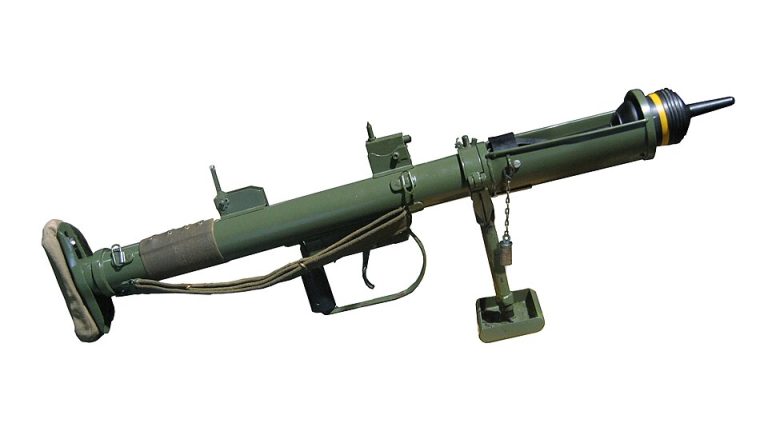
Then came the “bazooka”.

A combination of simple rocket technology pushing a small warhead based on the “Monroe Effect”, the first crude “bazookas” deployed by the US Army proved to be highly effective tools for the infantry. Their only real downside was their very short range, compared to tank cannons. Still it was a major advance.


Soldier holding an M1 “Bazooka”, 1943. US Army photo. Public Domain.


The American bazooka was copied directly by the Germans, in their “Panzerschrek” (or, “tank’s bane”), who had jump-started their own research program early in 1943 with their “Panzerfaust” (or, “armor-fist”), a one-shot weapon much like a conventional hand grenade. Both weapon concepts continue today, in a variety of models.

But, it was quickly recognized early on that a ‘middle ground’ was needed. Where conventional – if specialized – artillery was effective, the materials involved in building the dedicated weapons took away from more conventional artillery fire missions. At the same time, hand-held weapons – while also effective – were quickly being countered with better tank armor, and better coordination between enemy tanks and infantry.

In the aftermath of World War 2, the victorious states quickly divided into two mutually hostile camps, initiating the “Cold War”. And, like their fathers in the interwar period, continued the search for the middle ground.

To a great extent, anti-tank artillery disappeared after WW2, in a concession to realism, because the class of weapons was simply not dynamic enough to keep pace with the speed demands of a modern battlefield. It was here, however, that the next development arrived.

Although very crude versions of the “recoilless rifle” were developed in World War 1, the Second World War would see their mechanical maturity, and the first deployments in combat, in the hands of German paratroopers.


A U.S. Special Forces soldier fires a Carl Gustav Recoilless Rifle during a training exercise conducted in Basrah, Iraq, May 2, 2009. US Army Photo. Public Domain.


Resembling a conventional artillery tube, the recoilless rifle barrel is much thinner, for its caliber. Recoilless rifles work, basically, by firing a shell from a specially designed shell casing. This casing is perforated to allow a portion of the ballistic gases to vent to the rear, through a hollow breach. While not completely “recoil-less”, these weapons were a serious threat to tanks, as their warheads were fully capable of destroying a “main battle tank” of the day in one shot. And, while too heavy to be carried by hand, they were still light enough to be mounted in the back of a Jeep or pickup truck.


Mounted M40 Recoilless Anti-Tank Rifle. Photo credit: Vijay Tiwari. CCA/4.0


The recoilless rifle, in its turn, was sidelined by improvements to tank armor. Replacing it, however, was the ATGM. The Anti-Tank Guided Missile dawned in the early 1950’s. They were crude by modern standards, were hard to control in flight, and had a limited range, but technology was advancing rapidly, and the weapons improved dramatically in the 1960’s, especially in warhead technology.

The 1970’s dawned, and with it, the ATGM. In 1972, the US Army deployed the TOW Missile System to Vietnam, where it quickly began destroying tanks, being fired from helicopters. But this was just the proverbial ‘opening round’.

On October 6, 1973, the armed forces of Egypt invaded the Israeli-occupied Sinai Peninsula. The furious, three-week long battle that resulted fundamentally changed the landscape of war for the first time since World War 1.

The Israelis had built up a well-deserved reputation for military prowess, one that would hold true in 1973…but not without taking a severe bruising in the process.

When Egyptian forces crossed the Suez Canal and overran the Israeli defensive line, they halted and set up their own line, waiting for the Israeli counterattack. That should have been the first sign of trouble. Israeli tank commanders, however elected to not wait for more infantry to come up to support them, and attacked directly into the Egyptian line. The result was a bloodbath: the Israelis lost more than sixty tanks in a matter of minutes, as Egyptian ATGM troops cut the unsupported tanks to shreds.


An Israeli M60 Patton destroyed in the Sinai. Photo credit: Sherif9282. Public Domain.


The Israelis had met the Malyutka.

The 9M14 Malyutka (NATO Reporting Name : AT-3 ‘Sagger’), first produced by the Soviet Union in 1963, is probably the most-produced ATGM in history, a weapon still in both production and use as of this writing.


Serbian-made modified Malyutka wire-guided anti-tank missile on display at “Partner 2009” military fair. Photo credit: Kos93. CCA/4.0 Int’l.


A tiny weapon, the Malyutka/Sagger fits into a briefcase-sized carrier. Assembled at its launch sight, the missile has an effective range of 500-3,000 meters. Its warhead remains potent even today: although no longer effective against most tanks, it remains very effective against buildings and light vehicles. The weapon’s warhead is in the same general category as that of the RPG-7, but has a much longer range.

Armies – and other groups – took note.

Now, there are a wide array of ATGM’s prevalent throughout the world. From the European MILAN launchers mounted to Toyota Hilux pickup trucks in the Chadian desert, to American Javelin missiles destroying invading Russian tanks in Ukraine, lightweight military forces around the world have finally found the balance they need to meet heavier forces equally on the field.


U.S. Army paratrooper engages targets with Javelin shoulder fired anti tank missile during a live-fire exercise as part of Exercise Rock Sokol at Pocek Range in Postojna, Slovenia, March 9, 2016. U.S. Army photo by Paolo Bovo. Public Domain.


The dust these changes have stirred up have not fully settled as of 2023. Tanks remain dangerous actors on the battlefield, pundit declarations to the contrary aside. But, as we increasingly enter a period of “discount war”, high-powered weapons in the hands of light, fast-moving forces with tiny logistical footprints and easy-to-acquire and -operate combat vehicles is forcing a serious rethink of the scope of military action…

…At least, among those who pause long enough to reflect on the question.


The Freedomist — Keeping Watch, So You Don’t Have To
Main

Back FREEDOM for only $4.95/month and help the Freedomist to fight the ongoing war on liberty and defeat the establishment's SHILL press!!

Are you enjoying our content? Help support our mission to reach every American with a message of freedom through virtue, liberty, and independence! Support our team of dedicated freedom builders for as little as $4.95/month! Back the Freedomist now! Click here