April 3, 2026

Self-Reliance

World In Flames – The Guns of May Edition


It’s been a busy week. That is not a good thing.


Opening Round 1 – Iran


The President of Iran, Ebrahim Raisi, as well as Iran’s Foreign Minister, Hossein Amirabdollahian,  was killed in a very “sketchy” sounding helicopter crash in the far northwest of the country, in mountainous terrain near Iran’s border with Azerbaijan, in bad weather on May 19th.

The death of Raisi, a dedicated revolutionary hard-line cleric – responsible for the 1988 massacre of Iranian political prisoners, resulting in his nickname of “The Butcher of Tehran” – potentially opens the way for the Islamic Revolutionary Guard Corps (IRGC) to gain dominant power within the country, as they wield significant influence in choosing Raisi’s successor. The reason for this opening is that under the Iranian Constitution, a committee whose appointments are largely approved by the IRGC is responsible for confirming the eligibility of candidates for the Presidency, but is also responsible for selecting the country’s next “Supreme Leader” – the position originally taken by the Ayatollah Ruhollah Musavi Khomeini in the late 1970’s – which is now a critical juncture, as the current Supreme Leader, Seyyed Ali Hosseini Khamenei, is known to be in ill health, and could either die or retire at any time.

This is important, because the IRGC is now viewed as the main driver of the direct Iranian drone assault against Israel on April 13, in retaliation for Israel’s strike on the Iranian embassy in Damascus, Syria, on April 1st, which killed several senior IRGC officers.

Needless to say, the IRGC is also the driving force behind arming the Houthis in Yemen with advanced weapons, which that group has been using to both attack Israel, as well as sink, damage or pirate commercial shipping in the Red Sea, resulting in widespread disruption of the world’s vital shipping traffic, actions that directly impact you, the Reader.


Opening Round 2 – The DRC


Next up – Africa…but not the part of Africa you’re thinking.

Also on May 19th, there was an attempted coup d’état in the Democratic Republic of the Congo, which is neither “democratic” nor a “republic”. The coup was led by former DRC Army Captain Christian Malanga, who had been imprisoned for his opposition to the heavily disputed 2011 national elections; after his release, Malanga fled to the United States, and formed the “New Zaire Government in Exile” in 2017; it is unclear what course that movement will take, now that its leader is dead.

Also arrested in the coup’s aftermath were Malanga’s son, Marcel, and his friend, Benjamin Reuben Zalman-Polun, described as a “business associate”.

While this would-be comic opera revolution – which it would have been, had no one been killed or seriously injured – bears a striking resemblance to the attempted coup/kidnap “operation” Venezuela in 2020. More importantly, this marks an escalation in the ongoing instability in the DRC. The reason that this is important?

The computers and electronic devices you rely on in your daily life depend on a variety of “rare earth minerals”, many of which are only (barely) “commercially recoverable” in the DRC’s eastern regions. These metals, along with diamonds (both for industrial use, as well as in jewelry) are the source of both the continent’s wealth, but also one of the major drivers of war throughout Sub-Saharan Africa, which is also one of the driving factors of the region’s many recent coups d’état.

As a result, Western “developed” nations are as bound to the internal economics and politics of the region as the locals are, and neither has any reasonable option to counter the problems that have plagued Africa for over one hundred and fifty years.


Opening Round Three – West Taiwan Goes Full Patagonia


Rounding off the week – as of Friday the 24th – Communist China (a.k.a., “West Taiwan”) has upped its ante in saber rattling against the actual legitimate government of the ancient country, by staging a massive series of “punishment drills” around the island. In doing so, the Communist regime in Beijing has revealed both its “intentional arrogance” in dealing with the United States, but has also revealed its desperation.

Chinese Communist Party strongman Xi Jingpin – a person who makes Vladimir Putin look positively saintly in comparison – is increasingly becoming desperate. His regime is deeply unpopular in general, but especially because of the communists state’s flagging economy, seemingly unsolvable demographic crisis, and the fact that the world is quietly laughing at their comic-opera military. This is a dangerous combination.

In 1982, Leopoldo Galtieri, then the leader of the military junta ruling Argentina, was in a very similar position as Xi is now, and for many of the same reasons. With his nation’s economy falling apart – because military officers are not usually economic geniuses – Galtieri was desperate for an event that could distract his increasingly angry populace, and hopefully swing popular opinion in his junta’s favor…and what better way to do that, than to start a war that should be popular at home?

Right?

The result was the Falkland’s War, a war well worthy of study for every person reading this article, in which the armed forces of Great Britain showed that the British Lion still had some real fight left in it, smashed and humiliated the Argentinean military on a scale equivalent to what the US-led coalition would do to the Iraqi armed forces of Saddam Hussein some eight years later.

Now? It appears increasingly possible that Xi may be channeling Galtieri’s ghost, as the “battle calculus” in his head may be leading him to a decision that attacking – or at least trying to force a showdown with the “recalcitrant” province – Taiwan might be a good way to “kill multiple birds” with one stone.

As Freedomist/MIA has pointed out before, this would be tantamount to slaying the world’s economic goose, taking the Communist state with it.


What Is Happening?


There are many reasons behind why these scenarios are playing out the way they are at this moment in time, but the core reason is the same in all cases: the crippling weakness, on open display, of the United States under the regime around Joe Biden.

Now, I know that we tend to harp on this subject a lot, but it is absolutely true: nations and peoples around the world do not have to like us, but it is vital to the survival of the United States as a nation for those states to respect, if not fear us…and for more than thirty years, with the single four-year interregnum of Donald Trump’s administration, the world’s view of the United States as a powerful, even dominant, leading force in the world has steadily eroded. The reasons for this erosion are many, of course, but can be summed up as an increasingly incompetent and unreliable – if not incoherent – series of poor policy decisions has left the international reputation, image and impression of the United States in the gutter, far moreso than at any point between 1946 and 1990.

Xi feels free to threaten Taiwan at will, because of the induced weakness of the United States armed forces, who are so critically undermanned, it is becoming difficult to effectively crew sufficient warships (the ones that work, anyway), where the US Army had to admit defeat and reduce its official strength by some 24,000 troops, because it was consistently failing to meet its recruiting targets. Likewise, in both the Middle East and Africa, state actors increasingly recognize the United States as a non-consequential factor.

That is something you should very much be worried about, come November.


The Freedomist — Keeping Watch, So You Don’t Have To
Why Democrats Don’t Understand How To Do Colonialism


The rot inside Washington, D.C. has turned truly gangrenous.

Leaving aside the immediately abysmal series of disastrous decisions that have invalidated the Biden “administrations” actions that began with the June 2021 cancellation of the Keystone XL oil pipeline, costing the United States some 59,000 jobs and over $9 billion over a largely-finished system that would have sent an estimated 830,000 barrels of oil every day from the Canadian shale oil fields, to their handling of the COVID-19 crisis in releasing untested drugs on a desperate and unsuspecting public, to their limp-wristed “warnings” to Vladimir Putin’s Russia over invading Ukraine, displaying such a level of inability and incompetence, that not only has it confirmed the critical weaknesses in Western military structures that many suspected, it has also given Russia – and thus, Communist China – critical experience in learning how to deal with “cutting edge” western military technology, to the extent that Russia is now able to tweak the nose of the West, by staging a static display of captured western equipment in Moscow.

Now, as if to cap off what can only be described as a deliberate attempt to destroy the fundamental underpinnings of United States policy, worldwide, Biden’s “administration” continues to spew out pie-in-the-sky, “It’s Sunny In Philadelphia”© pronouncements about how fantastic it’s foreign policy initiatives are working, especially in Africa.

Really? Africa would disagree.

Doubling down on “Vice President” Kamala Harris’ “stunning and brave” – and utterly tone-deaf – finger wagging at as many African states as she could over a continent-wide rejection of pro-LGBTQ+ policies, the Biden “Teletubby” group in the District of Columbia struck Uganda from the African Growth and Opportunity Act (AGOA), which allows African countries to export selected products to the USA duty-free.

In doing so, the Biden group attempted to use open and naked “strong-arm” tactics to impose what amounts to colonial rule over African states that “behave all naughty-like”, believing that those states are too stupid, backward and crippled to do anything about it, and would thus be forced to “kowtow” to their demands.

Here’s the problem.


If you want to impose colonialist rule on a place, you have to be willing and able to impose it by military force. The reason for this simple dictum is that there are plenty of other countries in the world who have lots of money to invest in the countries you are trying to impose your will on…and the Biden group has failed so miserably at such a basic function of ‘realpolitik’, that even their nominal supporters are now referring to the elder abuse victim at 1600 Pennsylvania Ave. as “Genocide Joe”.

Case in point: Niger.

On July 26, 2023, Nigerien General of the Presidential Guard Abdourahamane Tchiani deposed the government of his chief executive, President Mohamed Bazoum, in a coup d’état. The reasons behind the coup are lost in the nitpicking common to most coups. The point here, however, is the foreign response.

France, the former colonial power that ruled what would become Niger from 1900 to 1958, was immediately humiliated, as it openly threatened a direct military invasion of the country – the junta installed by the coup’s response?

Go for it.

France was exposed as a paper tiger, because despite getting Niger’s neighbors to wage an economic war against civilians – a war crime, by definition – it could not muster any meaningful support for military action, even getting Algeria – which is critical of the coup in Niger – to ban French military flights over its territory, at least for a time.

As a result, French influence on the continent is in full retreat.

Apparently seeking to emulate the French, the United States also charged at the Nigerien junta like a blind picador on a three-legged horse with heart trouble. Sending in what apparently passes for their “best and brightest”, in the person of Molly Phee, the State Department’s top official for African affairs, Foggy Bottom’s Finest “laid down the law according to Biden”, managing to threaten and insult the junta’s appointed Prime Minister, Ali Mahaman Lamine Zeine, a formally-trained economist, by dictating from on high that Niger was to refrain from engaging with Iran and Russia in ways objectionable to Washington if Niger wanted to continue its security relationship with the United States. Zeine also said Phee had further threatened sanctions if Niger pursued a deal to sell uranium to Iran.

Niger’s response to the United States? Get out, and take your useless drone base with you.

And other states in Africa’s “Coup Belt” are watching closely.


African countries that have had coups between 2020 and 2023. By WikiMedia User Discombobulates. CCA/4.0


The few sane people left in “Sodom on the Potomac” are desperately trying to patch the holes in the sinking diplomatic boat that the Biden group keeps shooting holes in with Grandpa Joe’s double-barreled shotgun, but it is unclear if they can hold the line until the 2024 election, and much-hoped for return of Donald Trump to the White House.

Meanwhile, as should be expected, Russia is the proverbial “Johnny on the Spot”, moving in to replace the United States and France with its own “Africa Corps” (really, the jokes, while bitter, write themselves), to the extent of occupying parts of the drone base known as “Niger Air Base 201” near the Nigerien city of Agadez, a base which was first occupied by the US in 2016, and which began operating in 2019. Once US troops are fully out of the base, the Russians will have unfettered access to one of the most strategically vital military installations on the African continent…courtesy, of course, of a c.$100 million “investment” by US taxpayers (that would be you, the Reader)…

Ultimately, what does all this mean, in the “grand scheme of things”?

Essentially, the Democrat Party knows that it is about to go down in an epic, flaming defeat in November of 2024, a defeat that they cannot undo with any amount of “trumped up” (pun intended) court cases, nor ballot-stuffing.

The only logical conclusion to be reached in observing the insanity of the Biden group’s operations since 2021, is that they intend to burn down as many bridges as the possibly can before their defeat, which would force a second Trump Presidency to spend all of its time trying to get the country back to at least the same level it was at in 2017.

Think about that carefully in six months.


The Freedomist — Keeping Watch, So You Don’t Have To
Douglas MacArthur – Prototype of the Modern General…


To say that Douglas MacArthur was a controversial general officer would be making a massive understatement. While still lauded by many, and despite being awarded the United States Medal of Honor – the highest medal for valor in combat that can be awarded in the United States – there remains a large (and increasing) number of people who are not simply uncertain of MacArthur’s ultimate competence, but who actively reject it.

While this might appear to be a simple debate that is best restricted to staid academics in dusty rooms, it most certainly is not…because, like it or not, Douglas MacArthur is the prototype for the modern general officer. Let me explain.

Before MacArthur, there were basically four kinds of officers. According to German General Kurt von Hammerstein-Equord, the first type were the dashing, energetic and brilliant commander, the sort you could easily see leading a valiant charge across Pelennor Fields…or at least to relieve Vienna. The second type was the lazy, but brilliant officer, who could out-think and out-plan virtually anyone they were likely to face in battle. Then, there was the stupid and lazy officer; you couldn’t give them any job requiring dynamic and energetic thought, but they were useful in positions that weren’t critical, but that required an officer to be in command. But then…there was the fourth type: the officer who was stupid, but energetic.

That would be where Douglas MacArthur enters the picture.

An “Army Brat” (MacArthur’s father, Arthur MacArthur, Jr. had been a hero of the American Civil War, on the Union side, and had been the Military Governor of the Philippines from 1900-1901), had carefully stage-managed his career in the Army (stage managed by the ‘helicopter parenting’ of his mother). While performing decently as a battalion commander in the First World War, MacArthur spent the remainder of the “interwar period” alternating between acting as the Army’s spokesman, learning how the (comparatively) new technologies of radio and film could present the Army in a positive light (as well as burnishing his own personal image) to a public that had been exhausted by the “War To End All Wars”.

At the end of 1937, MacArthur “technically” retired from the United States Army, having already been named as Field Marshal of the Philippine Army. Although the Philippines was still technically a colonial territory of the United States, it had been decided to begin creating a Filipino armed forces establishment as a result of the 1934 Tydings-McDuffie Act, declaring that the Philippines would become fully independent on July 4, 1946. Also factoring into MacArthur’s appointment, were the rising tensions with Japan in the Pacific as the Interwar Period progressed.

MacArthur was recalled to active duty by the US Army on 26 July 1941, as a major general (and was promoted to lieutenant general the next day) and appointed as commanding general of United States Army Forces in the Far East (USAFFE). The results were…“not optimal” is probably the most polite term that can be used.

MacArthur was awarded the Medal of Honor in the aftermath of the disaster in the Philippines not because of his performance, but in spite of it: by early 1942, the United States was, to put it bluntly, getting its ass handed to it by a nation that US leaders and media organs frequently dismissed as “little yellow monkeys”. In that environment, the United States needed as many heroes as it could scrape together. Admiral Kimmel and General Short – the Navy and Army commanders, respectively during the Pearl Harbor attack – were already under investigation by their armed services, as well as by Congress, and the military did not need to disgrace someone who had been the face of the Army barely ten years before. Thus, MacArthur remained in charge.

Aided by the virtually bipolar staff he had assembled, one that vacillated between simpering toadying and rock-solid (if rather uninspired) brilliance, MacArthur was able to conduct a reasonably competent, if very uninspiring, campaign to march across the Pacific to liberate the Philippines from the stunning savagery of the Japanese occupation of the archipelago. Further feeding his narcissistic tendencies, after the surrender of Japan, MacArthur was appointed Supreme Commander for the Allied Powers (SCAP) and given command of all Allied Forces in Japan…In effect, he was made an Imperial Viceroy in all but name. More than that, Japan – previously a major world state – was essentially reduced to the status of being his personal plaything, to do with as he willed.

As part of his role as SCAP, one of MacArthur’s major functions was to be placed in charge of overseeing the defense of the newly liberated South Korean republic. Of course, the forces of Kim Il Sung’s North Korea – armed, equipped and trained by the Soviet Union – stormed across the border defined by the 38th Parallel on 25 June 1950. In a disturbingly similar repeat to what had happened in the Philippines some nine years before, South Korean forces – badly equipped and laughably under-trained – were swiftly overrun and destroyed, and the survivors – along with the equally poorly trained and equipped US advisors and troops sent to their immediate aid – rapidly pushed back into a tiny, Dunkirk-like perimeter centered on the port city of Pusan.

Then, with reinforcements beginning to arrive from the United States, as well as many member-states of the United Nations, MacArthur made the single gutsiest move of his entire career, by launching a breakout from the Pusan Perimeter, in direct concert with an amphibious assault at the port of Inchon, near the South Korean capital of Seoul well to the north, near the 38th Parallel. This caused the near-immediate collapse of the North Korean army, sending Kim’s forces into headlong retreat, all the way to the Yalu River.

Newly-Communist China (the Chinese Civil War had ended decisively in 1949) – not a combatant at this point – pointedly warned the US and UN leaders in early October of 1950 not to advance to the Yalu, as it would not tolerate such a massive armed force on its border. Advised (incompetently) by MacArthur, President Harry S. Truman decided that the Chinese were bluffing, and ordered his general’s offensive to continue.

The Chinese, however, were not bluffing.

The US-led UN forces were shattered and driven back below the 38th Parallel line. Entire regiments, brigades and divisions were shattered, if not completely annihilated; the 1st Marine Division (USMC) was specifically targeted for destruction (a decision that went rather badly…for the Chinese), but was able to successfully escape by sea evacuation. United Nations – and United States – forces were so badly beaten in this offensive, no serious attempt was ever made to recross the 38th Parallel in strength for the remainder of the war’s active phase. In fact, the Korean War has never ended; a ceasefire agreement was reached in 1953, and the conflict has been frozen in place ever since.

MacArthur’s response to the Chinese counter-attack was, to be frank, psychotically hysterical: MacArthur demanded an immediate wave of attacks using atomic bombs against targets throughout China…At this point, Truman had had enough, and recalled MacArthur to the United States, and into forcible retirement.

So – What was the point of the foregoing narrative?

The attitudes both of MacArthur, but also of the establishment that allowed him nearly free rein for almost five decades, despite extremely, if not catastrophically, substandard performance are still alive and well within the United States Armed Forces. As pointed out by authors Thomas Ricks in his book “The Generals”, and James Dunnigan and Albert Nofi in their book “Shooting Blanks: War Making that Doesn’t Work”, military leaders – particularly in the United States – are no longer “leaders”, as such, but more “managers”.

While this is certainly not a criticism in the world of civilian business, it is catastrophic in the military world. MacArthur was a reasonably good manager; however, his deep-seated narcissism made him an absolute disaster as a military leader.

There are very few – if any – currently serving general (or, “flag”) officers in the United States Armed Forces who can be confidently identified as “leaders”, much less “combat leaders”. With the world in the state that it is in, and the threats the United States is facing – both internally and externally – the time for “military managers” is long past. But, there is essentially no way, short of some miracle, for this problem to be fixed, short of all-out war.

And we’ve been down the “sudden, all-out war” path before – one would think that we would have learned our lesson, after the last “on the job training” exercise that we call “World War 2”, a war that cost the United States over a million casualties.
But, apparently not.

Thank You For Your Service” is a nice sentiment, but it is a poor substitute for endemically poor military leadership, in a country that supposedly prides itself in its civilian control over the military…especially when the children of the Reader are the first ones lined up to pay the price.


ADDITIONAL RESOURCES


Fighting For MacArthur, by John Gordon

The Generals, by Thomas Ricks

Shooting Blanks: War Making that Doesn’t Work, by James F. Dunnigan and Albert A. Nofi


The Freedomist — Keeping Watch, So You Don’t Have To
Why Do People Spy?


Spies. Unless one has been living under a rock for the last 50+ years, we’ve all seen a James Bond movie or two. Or, maybe you watched the classic Three Days of the Condor, or the Kevin Costner movie No Way Out from 1987, or any of hundreds of other spy movies from history. Or, alternatively, you’ve read any of hundred’s of books by authors like John le Carré, Frederick Forsyth, W.E.B. Griffin or Tom Clancy. Either way, you know what a “spy” is…Or do you?

Spying is as old as human civilization. One of the foundational duties of any government, as we understand the term, is to obtain information on potential threats to the community…because there are always threats. That’s just the way of the Universe.

Over time, of course, simple scouting evolved into what we think of as “espionage”. People volunteer to be spies for many reasons. They may be passionate patriots to their nation; they may be base and mercenary in nature, selling information to the highest bidder. Conversely, they could be traitors, operating against their own nation on behalf of a foreign power, for any of a number of personal reasons. The saddest figures are those entrapped into spying on their homeland, and not having the moral strength to go to their own government, turning in the enemy spies, and taking their licks for getting themselves into trouble.

Dedicated and loyal intelligence operatives – such as the fiction James Bond – whatever the nation or era, are recruited at relatively young ages, usually in their early-to-mid 20’s; frequently, they are military officers bored with their lives in the military. These recruits are almost always enticed by the ideas of excitement and adventure, but certainly not money – government spies are always just ‘government civil servants’, and are paid accordingly.

The reality that these officers face is that actually going “into the field”, or worse, “undercover” is invariably not only extraordinarily dangerous, but frequently unrewarding, as the dangers they put themselves (and sometimes, their families) into often result in no results, or even highly negative results…And that is before they have to face betraying local contacts to their fate, as happened in locating Osama bin Laden.

Traitors who spy against their own nations of their own accord (as opposed to those entrapped into espionage against their will) do so for many reasons, as well.

Sometimes, the willing traitor is outraged by their government’s actions of varying kinds. This was the case of Christopher John Boyce, who was outraged to discover – as an accident of his Top Secret clearance working with spy satellites for TRW – that the CIA was directly involved in undermining an Australian government that they did not like.


Seal of the C.I.A. – Central Intelligence Agency of the United States Government. Public Domain.


Likewise, Polish intelligence officer Michael Goleniewski – who also spied for the Soviet KGB on Polish intelligence – began spying for the West in 1959 after having, as he put it, a “Damascus-like” conversion event, where he realized how fundamentally wrong and evil the Communist system. Goleniewski revealed copious amounts of intelligence to the West on spies within the United States and British intelligence agencies. He was one of the most valuable spies for the West during one of the tensest periods of the Cold War. Unfortunately, claims persist that the CIA – for its own reasons – played enough “mind games” with Goleniewski that it drove him into mental instability, to the point where he is now primarily known for claiming to be the deceased Tsarevich Alexei, resulting in him being relegated to history as a crank.


Emblem of the KGB. Image credit: jgaray. Public Domain.


However a spy is recruited, if that officer is not a “field agent”, they are usually relegated to the ranks of “analyst”, or a specialist researcher, focusing on a particular nation, region, group, or even a particular individual. Frequently, this involves using OSINT tools (some of which can be quite advanced) to glean information. The work is usually interesting for a certain type of personality, but is not what most people would regard as “spying”…even though it most certainly is espionage.

Those personality types who enjoy that kind of activity generally stay with an agency for decades. The levels of knowledge and information that they can accumulate during their years of service make them veryhigh value targets” (HVT) for hostile agencies to recruit. “Turning” a long-time analyst – whether for purely mercenary reasons, for political ideology, or just the raw excitement of stepping outside their boring “bullpen” world – is frequently the crowning achievement of a field agent’s career…If the traitor is eventually caught, that may be unfortunate for the traitor, but that will not usually weight too heavily on the conscious of the case officer.

The “case officer” is the closest thing in an intelligence agency to a movie spy. They are skilled at illegally entering a foreign country and conducting all manner of intelligence activities, including “running” a local asset who has volunteered to spy against their home nation. Sometimes, the will operate as “paramilitary officers”, conducting high-risk protection and/or extraction (such as evacuating an embassy when military special operations units are too far away to assist), training foreign armed groups (whether for a foreign government, or a group trying overthrow a foreign government), and possibly rescuing an HVT who has been captured.


An Operational Detachment Alpha being lifted off the ground by a CH-47 Chinook helicopter during a training event Eglin Base Air Force Base, Fl., Feb. 05, 2013. U.S. Army photo by Spc. Steven Young. Public Domain.


There are also “legal spies”, who are placed within their nation’s embassy in a foreign nation, usually with an innocuous-sounding title, such as the “Second Assistant for Agricultural Relations”, or some such. These officers are usually the ones to receive communications from “walk-ins”, or locals wanting to offer to spy against their governments. They rarely, if ever, actually try to “run” a walk-in as an “asset”, merely evaluating whether the walk-in is worth the risk of assigning them to a case officer.

And, although no one wants to talk about it openly, allies frequently spy on each other, as happened with Israeli intelligence “running” CIA and US Navy intelligence analyst Jonathan Pollard in 1984-1985. The revelation of the Israeli operation caused an immediate frost in relations between the US and Israel, something that happens frequently when intelligence operations are exposed, or “blown”.

Spying is far from a “glamorous” life. It is, unequivocally, a dirty, nasty proposition at any level outside that of the analyst’s cubbyhole in an office bullpen…and many times, even that it is not a “sterile environment”, because an analyst’s work can set in motion operations that are very “down and dirty”.

Watch the path in front of you carefully.


The Freedomist — Keeping Watch, So You Don’t Have To
The ‘Combat Shotgun’ – The Ancient Weapon Still Punching Above Its Weight


Shotguns are ancient technology, as firearms go. It is no stretch to say that the first handheld firearms that we would recognize as such were, in fact, “shotguns” as they usually fired multiple projectiles at ranges within one hundred yards…assuming, of course, that the weapon did not explode in your face. Saint Barbara was devoutly venerated for a reason.

Over the centuries, as metallurgy and chemistry made firearms increasingly reliable (and safer), the shotgun remained the main personal firearm, through the use of ‘buck and ball’ rounds. These combined a large musket ball with a few smaller pellets, essentially a middle ground between the ‘bird load’ used in hunting, the modern “double-aught” general purpose round, and the modern hunting slug.

As rifled weapons developed and matured throughout the 1700’s and into the 1800’s, shotgun-type loads began to fade out in military use. With the development of the ‘Minié ball’ in 1846, shotguns virtually disappeared from world armies as anything more than ‘foraging guns’.

This did not make the shotgun obsolete, however – far from it. Civilian hunting shotguns kept pace with military innovation, albeit for different purposes, and law enforcement still used shotguns for everything from countering rioters to concealed firepower for discrete protection of political figures.

With the United States’ entry into World War 1, however, the shotgun returned to the battlefield, with a vengeance.

In the confused, dirty and brutal world of trench warfare, the common handguns and bolt-action military rifles of the day simply did not function very well, resulting in all manner of impressively ingenious – and extremely vicious – improvised weapons. The German solution to this problem was the invention of the submachine gun, in the form of the MP-18. The Americans, however, brought in shotguns.


Winchester Model 1897 “Trench Gun” with bayonet, 1921. Public Domain.


Largely consisting of Winchester Model 1897’s, American units were very familiar with the use of shotguns in recent combat, having used them during the Philippine-American War in 1899, and in the 1916 expedition into northern Mexico, to chase the bandit Pancho Villa. These rapid-firing, pump action shotguns quickly made their presence felt, to such an extent that the Imperial German General Staff – who had initiated modern gas warfare – issued a formal protest over the use of shotguns. When the United States reminded them of the shotgun’s history, and pointed out that the shotgun caused no more unusual damage than their own chemical weapons, the Germans threatened to execute any US soldier captured with a shotgun, or shotgun ammunition. In response, the United States threatened to execute any German soldier captured wielding flamethrowers or serrated bayonets. The Germans not only are never known to have executed any US shotgun troops, but apparently issued some captured 1897’s to their own ‘stormtroopers’ alongside the MP-18.

The Model 1987 Trench Gun, as it came to be called, continued in US military service until at least the 1950’s. As the Vietnam War heated up, however, US troops began to arrive with more modern weapons, such as the equally legendary Remington 870. With better ammunition technology – the old waxed paper or fully metal cased shells, having been replaced with the brass-plastic case ammunition – the modern combat shotgun was born.


A member of the Marine detachment from the nuclear-powered aircraft carrier USS THEODORE ROOSEVELT (CVN-71) takes aim with an M-870 12-gauge shotgun during boarding team training in 1991.


With the ability to deliver devastating close-range firepower, the combat shotgun is an intimidating weapon in the extreme. Most combat shotguns run with eight rounds in their tube magazine, with another round “up the spout” in the chamber. If loaded with double-00 buckshot, that means a combat shotgun can fire about seventy to eighty.32 projectiles at high speed. Few, if any, other weapons can equal this level of fire. Additionally, unlike both pistol-caliber submachine guns and military select-fire rifles, most shotgun loads do not “over penetrate”, or pass through all manner of wall and roof materials, endangering civilians on the other side of those barriers.

 

Mossberg M590 breacher shotgun, 2021. Netherlands Ministry of Defence. Public Domain.


In addition, shotgun shells have evolved over time to fire all kinds of strange loads, from flares to rubber bullets, “bean bag”, tear gas, and door breaching rounds. This flexibility, coupled to ease of use and a generally less alarming appearance to the public, have guaranteed the combat shotgun’s continued use by police, but has also made it a favorite for the military when units have to operate at close quarters.

Despite repeated flirtations with “assault shotguns”, there has never been much real interest in the idea, as no design submitted does any one task in an overly superior way to the combat shotguns currently in service, and any advances in ammunition design can usually be accommodated with minimal changes to the weapon itself.


The M26 Modular Accessory Shotgun System. 2018. DVIDS photo. Public Domain.


The shotgun has been used in combat for centuries – and it isn’t going anywhere, anytime soon. Good design works.


The Freedomist — Keeping Watch, So You Don’t Have To


Incident Command – What You Need To Know


Everyone has seen some form of disaster. Whether that disaster was a war, civil unrest or rioting, an earthquake, volcanic eruption, or some sort of sudden climatic disaster like a flood, almost everyone with an internet connection has experienced a disaster, even if they do so vicariously. But, unless the viewer is physically present in the disaster area, few people have any idea how “the authorities” are able to handle the disaster of the day, at any level of competence.

The answer, since 1968, has been the Incident Command System, or ICS.

Originally developed at a meeting of fire chiefs in Southern California, the ICS idea began as a development of command processes from the United States Navy. It was not, however, a smooth process. The failures in response management during the massive Laguna Fire of 1970 showed that methods of coordination and control were near-completely divorced from reality, and that a great deal of more work was required to develop a coherent and standardized response to emergencies. Beginning in 1973, with the creation of the FIRESCOPE program, what would evolve into the modern form of ICS began with the Tactical Field Control Operations section of FIRESCOPE, ICS quickly matured as Federal, State and local agencies adopted the idea as a standard system.

Seeing the utility of the idea, the Federal Emergency Management Agency (FEMA) eventually created a 20-hour long standard training course that would allow the creation of emergency management teams in any area that could assemble the requisite personnel and assets. Coupled to a much more basic training program for civilians to act in disaster operations, this combination has significantly helped bring order out of chaos in many real-world disaster situations.

In doing so, it is a shining example of what government can do when it gets something right.

However, lurking in the background was ICS’s genesis as a military-based command structure. In the US military of the 21st century, this is known as either “Battle Tracking” or “Command Post Operations”.

Because the situation in combat can completely change in a matter of minutes – or less – the idea of having a detailed, yet flexible, set of command protocols has been a very important feature of military operations for decades…And yet, the vast majority of civilians know little or nothing about the process of emergency management.

This is not really surprising, because despite their frequency, natural disasters and wars are very rare occurrences in the lives of most people. But, those dangers can present themselves at any time…and knowing at least something of the process – even if the reader never signs up for a course – will prove helpful should you ever find yourself in a disaster situation, by at least helping to understand at some level what is happening.


FEMA Incident Command organizational chart. 2008. By FEMA. Public Domain.


The above image depicts the standard notional organization of an Incident Command organization. It is a rather bland, “vanilla” organization, because it is intended to scale to any region, from a small town to the nation as a whole. It outlines the basic departments that would have to function in most emergencies. At the same time, it allows for expansion by adding specialist groups, should the situation call for it. This also allows for “on the spot” recruiting of survivors and volunteers to fill in holes.

A good overview of the process comes from the West Virginia Department of Education, which shows how a specific organization might use the basic ICS format to create its own specialized structure, based on what it deems are its unique needs.

But…How does this apply in any real depth to the individual – in a word, why should you actually care about this process?

To echo the beginning of this article, there are any numbers of dangers, natural and man-made, that can happen suddenly and without warning. There is a greater that 0% chance that you, the Reader, may find yourself in a sudden disaster situation – and help may not be on the immediate horizon. It may come down to you, to start getting things organized.

This is no encouragement to “Walter Mitty” fantasies. The fact that you may have never found yourself in such a desperate situation does not mean that you never will…and with the apparent trajectory of the world, as described by the news every day, the chances that you, personally, may have to either apply the ideas outlined above or step up to take part, is becoming a rapidly increasing possibility.

An article such as this is far too brief to do more than touch on the idea as a general concept. There are videos available that can give you a basic run-down, and the S2 Underground is a great place to start. But, while your author is usually loathe to recommend any government website for any practical purpose, in this case, the Reader should refer to the FEMA links provided above. Most counties in the United States offer some form of emergency management and response classes. Take at least a basic CERT course, to understand the tasks and challenges in responding to disasters – of whatever type – and to become better prepared for whatever might roll in your direction.

The world can be a scary place. But, it becomes significantly less scary if you understand the potential situations, and your options in those situations. You will not be able to learn these skills, nor establish connections with your friends, neighbors and fellow citizens through osmosis – you have to go out and acquire the necessary skills and contacts.

You and your family will appreciate it later.


The Freedomist — Keeping Watch, So You Don’t Have To
Tools of the Trade – If I Could Only Have One


As we head into February of 2024, the “wars and rumors of wars” have plateaued, for the moment: Israel’s campaign against the Hamas terror group is still grinding on; the Russian offensives against Ukraine continue to make progress, albeit slowly and painfully; the Chinese Communists are engaging in the time-honored Communist tradition of gutting their military leadership at the most inopportune times; United States and British naval forces continue to sporadically pound Houthi terrorist outposts in Yemen, although their effectiveness is somewhat in question, as the Indian Navy is engaging the occasional Somali pirate boat. Iranian mullahs continue to attempt to foment trouble around the world – no doubt helped by the $6 billion US Dollars sent to them by the Biden administration – even as the US flexes its bomber muscles in the region…And, speaking of that increasingly criminal organization, it seems to have blinked in its standoff with the US State of Texas over its criminal failure to execute the most basic of its duties under the United States Constitution – i.e., securing the US border against a literal invasion – even as it exposed itself, yet again, as holding the United States’ populace hostage to its desire to fund even more openly-criminal groups throughout the world.

In a word – things are on a low roar, at the moment. As a result, we’re going to take a look at something interesting and informative, as Freedomist/MIA doesn’t engage in the “fear-porn” popular in current media. When something develops in the arena of conflicts, we will cover it then, rather than keep terrifying you with spammy updates. That said…


Boomsticks

I usually make a conscious effort to avoid arguing for a “best rifle” (handguns are even more of a no-go in my recommendation department). Usually, I prefer to simply present you, the Reader, with a brief historical overview of a particular firearm that most people may not be familiar with, especially if the Reader might find themselves “going downrange”, in the modern vernacular.

In this case, however, I will make an exception. What follows, is strictly my own opinion – you can, of course, disagree with me…but you’ll still be wrong.

If I were forced to have only one, single “long gun” – either a rifle or a shotgun – what would that be? My answer, which has not changed in over twenty years, is the Simonov SKS rifle, and specifically, the Yugoslavian M59/66, made by Zavasta.


Yugoslavian M59/66 SKS variant, with folded bayonet and grenade launcher on the muzzle. CCA/4.0


…..‘Wut’?

The SKS rifle was designed in 1945 by Soviet weapons designer Sergei Gavrilovich Simonov. Chambered in the M43 cartridge designed in 1944, the SKS and its derivatives are semi-automatic rifles, firing from a fixed, ten-round magazine. The M43 cartridge – despite its similar appearance – has no ‘shared history’ with the German 7.92x33mm Kurz cartridge, used in the “first assault rifle”, the Sturmgewehr-44; the M43 is measurably more powerful than the German cartridge, being functionally equal, ballistically speaking, to the venerable .30-30 Winchester cartridge (pronounced “thirty-thirty”), which dates from 1895, and remains one of the most popular hunting cartridges in the world, often in the guise of the Winchester 1894 lever-action rifle. However, the M43 is much more space-efficient, being both shorter, overall, than the .30-30, but also in that it is a rimless cartridge, as opposed to the .30-30’s rimmed case, which makes loading into a vertical magazine not impossible, but it is problematic.

The SKS magazine usually feeds from a 10-round stripper clip, but – unlike the US-designed M1 Garand – stripper clips are not required to load the magazine; loading the magazine with loose rounds is certainly slower than with a strip-clip, but is far better than the M1’s en bloc system, since without an en bloc clip in place, the M1 rifle is simply a single shot rifle.


8-round en bloc clip for the M1 Garand rifle (left) and an SKS 10-round stripper clip. 2009. Public Domain.


An obvious question at this juncture would be the SKS’s relationship to the much better known AK-47 rifle. The answer is: not much. Aside from using the same cartridge, the two weapons are very different: the SKS uses a fixed (meaning, “non-detachable”) 10-shot magazine, while the AK uses detachable, 30-round box magazines. The only similarity is that the gas tubes look alike, although they function differently.

As a military weapon, originally, the SKS came with some features not usually found in civilian hunting weapons. In addition to its one-piece cleaning rod slotted under the barrel, the SKS was issued with a cleaning kit stored in its butt-stock. While this was a relatively common feature in military rifles, the SKS also featured an integral bayonet that folded around and under the barrel. While there has been a rash – yet again – of certain quarters declaring the bayonet to be dead (much like the tank), it is not, even though they are rare in the West; they are very likely more common in non-Western nations, but little in the way of technical details come out of those quarters.


SKS bayonet, folded (top) and unfolded. 2019. CCA/4.0


Another point in the SKS’s favor is that it has a greater range than the AK-47, with an effective range roughly 100 meters longer than Kalashnikov’s rifle, due to its longer barrel – in ballistics, size really does matter, up to a point.

Finally, the Yugoslavian M59/66 version incorporates a built-in launcher for the world-standard 22mm rifle grenades, which used to be a common feature on many of the world’s military rifles.

The SKS was adopted, in some military capacity, by at least seventy nations, and usually remained in service long after those nations had switched to other weapons, such as the AK47, the M-16 or something else. The SKS, in its many variants, can be found on battlefields around the world, to this day.


American soldier in a training session of rifle grenade launch. Blank grenade fitted in a M1 Garand rifle with the Rifle Grenade Launcher, M7. 1944. US Army photo.


So – after the above information, why would this be the rifle I would pick, if I could only have one rifle?

First, it checks the widest number of boxes: it is fully capable as a hunting rifle for virtually any game I would consider hunting; I have neither plans nor desires to go hunting for bears or moose…and were I to run into either – that’s why I have ten rounds.

Next, it is semi-automatic in operation. This is a real point, because as a semi-automatic, it automatically extracts, ejects and chambers a new cartridge on its own, until the magazine is empty. With other weapons, including lever-actions like the Winchester ’94, or bolt-actions like the Mauser, Enfield, Mosin-Nagant, Carcano, etc., manually working the action usually involves breaking the shooter’s grip on the rifle, forcing them to realigned their eyes to the sights. Semi-automatics like the SKS and M1 Garand eliminate this issue.

Next, is its cartridge. While any gaggle of shooters will argue endlessly over the merits of “this cartridge vs that”, no one can dispute the effectiveness of the M43 round, now over 75 years old, in both hunting and combat, and its ammunition is relatively common and “cheap-ish” for civilian buyers in the US to lay hands on (at least at the moment). While its range may not be the longest, 400 meters is perfectly sufficient for most uses. Then, there is its sheer simplicity: there are not that many parts to deal with when you need to take it apart, and none of those are particularly small, or easy to lose.


SKS rifle field stripped. 2009. Public Domain.


That pretty much sums up the civilian hunting – and “SHTF” (S*** Hits The Fan) – side of why this would be my go-to.

The other side, obviously, is whether it is still an effective weapon for “military-type” use. True, it is not selective-fire, as modern military rifles are. And, yes, it has “only” a ten-round magazine, versus the 30-round detachable magazines that modern military rifles use. And realistically, do you really need the extra weight of a bayonet, much less a grenade launcher?

So, let’s address the above questions.

First, selective fire rifles (i.e., rifles that can fire in the fully-automatic mode, similar to an actual machine gun) has long been understood to be virtually useless in individual combat rifles – outside of very narrow circumstances – because rifles are too lightweight to lay a predictable pattern of fire, which is what actual machine guns are designed for…“Fully Automatic Machine Gun Fun” is, well, fun, but that’s usually all it is.

Second, is the magazine. If the Reader were to buy, say, an AR-15 or a civilian-legal AK-47, each of those 30-round detachable magazines will run anywhere from (as of early 2024) $9 – $25, each, depending on what you’re buying…and you’re going to need at least three to five of them, because even just going to the range will get very annoying, very fast, if you only have one or two magazines. In contrast, the SKS’s 10-round stripper clips can be reloaded with commercial ammunition if you save the clips, and you can buy military surplus ammunition that comes in sealed “Spam-Cans”, with all of the rounds factory-loaded onto stripper clips.

There is also the relentless controversy over the dreaded “magazine spring ‘taking a set’” – the notion that leaving magazines stored fully loaded for too long will weaken their internal springs over time. Personally, I’ve never had this happen, but I can see the other side of the argument…all of which is irrelevant with the SKS: if its magazine spring is sticking or is weak – replace it.

Because of this, you can load whatever type of field rig you prefer with SKS stripper clips, and they will sit there happily and patiently, waiting for you to use them, until they are so old, they are corroding their cases.

As to the grenade launcher and bayonet? Well – I certainly hope that I never need to use either of those two features; if that has happened, world civilization has collapsed, and all bets will really be off…But, in the unlikely event that the world has been reduced to that state, I would far prefer to have those feature and not need them, than to need them and have them.

The SKS: You need Simonov’s simple rifle…just, please – don’t “Bubbify” it with Tapco gear.

Trust me, there.


Tropic Thunder: Echoes of Past Wars


Part 1 – In Your Face


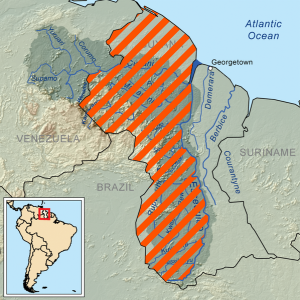
In mid-November, the South American nation of Guyana appealed for help to both the United Nations and the International Court of Justice, which just handed down a sternly worded finding on 12/1/2023 on the matter. Guyana, which shares its western border with Venezuela, became justifiably alarmed after Venezuelan dictator Nicolás Maduro’s government scheduled a public referendum for December 3, 2023, “asking” the Venezuelan people if they would be okay with annexing the Essequibo region from Guyana – which comprises some two-thirds of Guyana.


Map of Guyana Essequiba. The area lined in orange constitutes the area claimed by Venezuela. Credit: Karl Musser. CCA/3.0


So – what’s going on, and why should you care? In reverse order, the reasons you need to care about this are simple.

First, unlike the current wars in Ukraine and Israel, this is on the proverbial doorstep of the United States. Second, is that seemingly tired old problem: oil. Third, the very fact that this has even come up, is yet one more pointed demonstration of the abject and total failures of both the Biden administration, and the neo-con RINO’s desperately clinging to power inside the GOP, best described by GOP candidate Vivek Ramaswamy as “Dick Cheney in three inch heels”.

Venezuela and Guyana form part of the northern coast of South America. Any war in South America is of preeminent importance to the United States, because of the potential to spill onto the United States’ doorstep, in addition to all the other problems spilling over a border that the Biden administration apparently believes not to exist. A Venezuelan attempt to “flex” for imperialist territorial expansion would – and threatens to do so – lead to a much wider war, as Brazil’s territorial integrity is also threatened by Maduro’s actions.

The question is, why? The answer is simple: oil.

Venezuela has been tied into the global petroleum extraction network since the early 1900’s; indeed, the country was the world’s third largest producer of crude oil in 1940, and was the tenth largest producer in 2008. However, beginning in the mid-1970’s, a series of terrible decisions by successive governments nationalized the country’s oil industries. This resulted in the companies whose plants were confiscated politely refusing to continue to perform maintenance and upkeep on the systems…that should not have come as a surprise to anyone, but apparently did. And, as the oil infrastructure fell apart, Venezuela was unable to attract another other foreign companies to invest in their national oil fields, which – again – should have surprised no one.

As a result, the spiraling failures of Maduro’s increasingly socialism-driven economy and government has created a growing and increasingly desperate need to revive the country’s only remaining viable export industry, in his case, by bringing in Iranian technicians to try and get the nation’s oil industry back on its feet…If that sounds like a disturbing idea – Iranians flooding into a country within easy striking distance of the United States – that’s because it is.

So, how does this relate to Guyana?

In 2008, as Venezuela doubled down on excluding foreign companies from its oil industry, ExxonMobil (one of the companies forced out by Venezuela) began exploring the offshore region of Guyana, on the hunch that since the two countries were physical neighbors, there should have been a high likelihood that Guyana should possess exploitable reserves…and, in 2015, Esso (a subsidiary of ExxonMobil) hit paydirt, discovering the first of several rich offshore oil fields off Guyana’s Caribbean coastline. After a series of negotiations, on 19 September of 2023, Guyana authorized several oil companies – including ExxonMobil – to begin drilling in their offshore fields.

An increasingly desperate Maduro, seeing the continuing disaster of his party’s long-discredited Socialist policies, chose this moment to revive an old territorial dispute that Venezuela had chosen not to pursue, which laid a Venezuelan claim to some two-thirds of Guyanese territory…that part, or course, that contains most of the new oil fields.

For those readers of “a certain age”, if this sounds a little like 1981-1982 in the South Atlantic, you are not alone. Forty-odd years ago, another South American dictator sniffed rumors of oil in an area his country had long-claimed, and – with tensions mounting at home over disastrous economic policies and midnight death squads everywhere – Argentinean junta leader General Leopoldo Galtieri decided that the United Kingdom would not fight over the Falkland Islands, if not too much blood was spilled invading them. Turns out, he was very wrong.

Maduro’s “popular” referendum is a clear attempt to justify an invasion, one that is sickeningly lopsided, as the Guyanese military is barely 3% the size of Venezuela’s armed Forces…the ringer being, of course, being Brazil, whose armed forces outmatch Venezuela’s by at least double, if not triple…The possible consequences of a desperate Socialist country sparking a regional war that could disrupt not just oil production but commercial shipping in the Caribbean, in general, are something every American needs to be worried about.

But then, there is the last question: Why does Maduro think that he can get away with Saddam Hussein-levels of bad decisions? In a word – Joe Biden and the Democrat-Neo-Con alliance, which desires a weak United States, one that they think that they can rally to their side like FDR did in 1941.

That they cannot do so, because of the actions they have taken in public – not even bothering to hide it – have so soured their potential recruiting bases, that they cannot meet their manpower needs without reviving the Draft…which even their supporters in the deluded Left are stating a flat, hard-no to.

If this sounds pessimistic – it is. Expect shortages, if Maduro thinks his calculus is correct…which it might be, unlike Saddam’s.


Part 2 – Saying the Quiet Part Out Loud


But, on the other side of the world, another “Rumble in the Jungle” is brewing: Myanmar/Burma’s ruling military clique, the so-called “Tatmadaw”, is collapsing. In this, the only real question is if the radical Socialist junta will go down like the collapse of the Somoza regime of Nicaragua in 1979, and the following multi-sided civil war (encouraged, being fair to history, by the United States) or if it will go the way of Yugoslavia – violent and bloody, but mercifully short, in comparison.

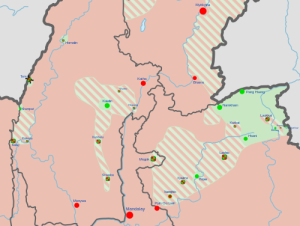
Beginning in late October of 2023, a coalition of formerly rival ethnic/tribal groups in Myanmar united in a virtually unheard of alliance, to launch a massive, coordinated offensive across the country, swiftly overrunning several regime military bases along the Myanmar/Communist China border, and forcing the surrender of several military units in their entirety. This is causing a collapse in morale, both among troops and in their families, who are now being forced to pull security for their deployed husband’s military bases. In fact, the junta has begun mobilizing civil servants and local police as second-line military forces, to try and stem the tsunami of military defeat.


Map of Operation 1027, as of 7 November 2023. Credit: Clyde H. Mapping. CCA/4.0


Obviously, the Freedomist has been remarking on this situation for some time, mostly in the context of the 3-D printing revolution. The facts are that the world was content – again – to allow a brutal, dictatorial regime to make a mockery of civilized society, because the profit margin is so high.

For Communist China, however, Myanmar is far from a laughing matter. The ruling junta, the “Tatmadaw”, is a vital component in the CCP’s “Belt & Road Initiative”, and if their allies in the junta go the way of Somoza or Yugoslavia, their entire plan is in jeopardy. What Communist China chooses to do about this is anyone’s guess.


Part 3 – Where Do We Go From Here?


Functionally, the moves by Maduro’s Venezuela are far more important to the United States in the immediate short-term. The hopeful collapse of the Myanmar regime, while definitely of regional importance in the Indian Ocean region, is mostly of academic interest for the US. While that may sound harsh and uncaring, it is not. It is simply the recognition of global realities.

The United States – for good or ill – is committed to the support of both Israel and Ukraine. And, as it and its European allies have discovered, neo-con fever dreams mixed with deranged, far-Left utopian word-salad does not equate to valid battle calculus, even in the short term.

The world is racing towards a cliff, and the leaders of the nations most capable of preventing that from happening are too concerned with pet delusions to even start getting a handle on the problem.

2024 is looking pretty grim, at present.

You should take action to protect yourselves, and those you are responsible for, now.

Washington and London certainly aren’t.


The Freedomist — Keeping Watch, So You Don’t Have To
EMPOWERMENT 101: Building A Sense Of Community

We propose that a most BASIC individual empowerment in our country MUST begin with an approach that restores the lost sense of community provided by faith, family, and mutual support, at least for those who desire freedom and who refuse to be limited, defined, or controlled by the present-day shot-callers in our civilization.

Most approaches to empowerment, which is you fulfilling your own God-given scroll of destiny and purpose and God’s best for your life, are either too esotoric and filled with buzzwords and catch-phrases or they lean on massive scale change through some form of collective activism. What they lack are both practical methods and attainable means. Citing some notion of getting in the flow of some energy or will of the universe is as useless to workaday people as wishing somehow to remake a city or country in your own image through collective action.

We aren’t arguing that none of these things are useful at all. They can be, and they can enhance and expand upon your own efforts to become empowered. But we are at “empowerment 101” here, not advanced empowerment where you want to dig deeper into your soul or where you want to help many other people find the same level of empowerment for themselves.

When I was in Mexico visiting friends who are like kin and saw how they approach life, and even how some live, mostly in close connection to an inner circle of people who have each other’s backs, I witnessed a lot of what I wrote about in terms of empowerment. Empowerment begins with an inner circle of people who care for each other as kin, as if the good of one is sought by all, and yet nobody’s individuality is subordinated to some weird collectivist hippy cult commune.

The end state of this stage for many may be something like I saw in Mexico, and which exists all over the world, basically a “family” estate which many members live in but which all resort to frequently for social and other purposes as the physical hub of their inner circle.

If we broaden the concept of family to include an innner circle of around 20-30 adult relatives and friends who are like family, with the nuclear family of a mom and dad with their children at the core, we begin to see what family can mean. Family is far more than a mom and dad with their children and dependents, and maybe an older parent who lives with them, but a collection of enough adult members so that most hazards and burdens can be handled internally and most needs can be meet, even if a few members are totally disabled or temporarily down and out.

The destruction of extended family groups like this, again not all members are related by blood or marriage, is a necessary precursor to creating economic and other forms of disempowerment because it makes the individual or a married couple and their children easy prey to almost any eocnomic or other pressure. The net effect is that you can’t pursue your dream, your vision, or your self-interest effectively outside of the limits, which others, even slightly more wealthy and/or influential people, set for you. Your energy and the fruits of your labor are spent at least partially in feathering someone else’s nest who doesn’t care a bit for you. For some, little of your energy and the fruits of your labor benefit you or your dreams very much at all.

In my experience, I witnessed a family group centered on one large house with multiple rooms and apartments, a sprawling and lively space with almost a perfect balance of public, semi-private (inner circle only), and private spaces where everyone could come together and where one could just as easily find solitude. Not everyone was a resident, and some residents were renters who nonetheless enjoyed access to some semi-private spaces and who were treated more or less like kin. The people who were part of this extended household included family and friends who lived on site, family and friends who didn’t live on site, but who were there a lot, and renters who lived on site.

This “villa”, in the heart of a historic Mexican city dating back over 400 years, was the central hub for multiple nuclear families and unmarried adults, complete with rentals to the public and even a few small shops right off the main street. Inside, one felt it was another world, set apart from the surrounding city, but not isolated from its life, and indeed very much a positive part of the city life. I was amazed at how little the people there realized the novelty of what to some sounds like an experiment in clustered living but which for them had been part of life more or less since the 1600’s, so obviously it is a workable model.

Due to respect for privacy, and because I wasn’t visiting there to compile a report for public consumption, I won’t share pictures or details. Suffice it to say, because I have a history with this family dating back to the 1990s, I was more or less treated as a member while there and experienced their life as if I had always lived there. It is a place I am happy to say that if I ever needed a respite or chose to leave my own country, where I would be welcome and fit in. My own desire to master Spanish is driven substantially by a desire to spend more time down there.

I may have been a Gringo to the outside world, but to these people I was like a relative visiting from abroad and “coming home”, and that will always be something I deeply cherish. That their instinctive, unplanned model of community tracks so well with my own planned and envisioned model of community doesn’t surprise me because I studied family and community models across many cultures and civilizations from the most ancient to the most modern times and discerned in them a pattern which very much looks like this Mexican family’s estate, both the phyical space and the people/relationships within it.

The ability to form a close-knit inner circle of local people who, inasmuch as they can, approximate this ideal, even if their only hub is a single house and none cluster together on one piece of real estate, is essential to the kind of empowerment that one doesn’t have to be rich to attain and that is stronger than most of the external pressures that often rob you of your empowerment today.

In Mexico, this family already had a ready-made community of people, but they have welcomed others in, such as myself. Perhaps you and your family and friends have a ready-made community and don’t realize it, but as many families are dispersed and live in different states and as many of our friends may be online, and as few neighbors know each other, the idea of trying to form some sort of “intentional estate” with 20-30 other local adults is daunting. Despite this, however, it is the ultimate necessity, though by no means does it have to begin there and, if you use these ideas, you can enjoy real benefits well before that ideal is achieved.

Family can form around a number of things including blood and marriage, some experience unique to your group (like veterans), religious and/or philosophical convictions about life and its meaning, or something we refer to as a form of “intentional nationhood.” The concept behind intentional nationhood is that there are multiple connection points between individuals whose strength is such that when people act in unity it is more a natural effect of their shared identity and purpose and requires little or no directed management from some “authority.”

Unlike blood and marriage kinship, nationhood is something people have to understand and adopt willingly, from the heart, because it just FITS who and what they are, which also means that when they find others of the same nationhood, there is a strong instant connection to build rapport and engagement around. Loosely similar to this, the fact I know this family’s history, try to speak the language, eat the same food, have the same essential beliefs, and the such, all allowed me to form a sort of nationhood with them, even to the point I have been given an adoptive name I use with them. A part of me is Mexican, even though by blood I have no Mexican ancestry, though my wife certainly does.

I should note also that the vision for a new globally distributed form of nationhood people can adopt to connect with a worldwide community of like-minded fellow travelers would easily fit within the “shared nationhood” that this extended family group seems to follow, even if they don’t use the term. I anticipate for many extended family groups in Mexico, adopting this global nationhood as part of their own nationhood will probably be easier than for many Americans, but that it is essential that Americans learn to do this, or something like it, if we are to restore the social fabric in this country.

Forming a sense of community with others can begin with a semi-formal agreement as to a set of ideals and principles and/or goals but also a pledge of mutual support through something like what we call “the four questions of fellowship”, namely:

Does anyone know of a praiseworthy example of success that we could benefit from learning and applying to our lives and our fellowship together?

Does anyone have an example of a cautionary tale or of failure we would do well to take cognizance of in our lives and in our fellowship together?

Does anyone have a problem or need or situation they cannot handle and for which they cannot get help or advice which we might assist them with or advise them regarding?

Does anyone need an introduction to some person of influence, wealth, or power who can advance their career, business, or situation which perhaps we might help them with?

If you found 5-10 people to get together on a regular basis and break bread over these four questions, you would naturally, organically, and without much fuss or hassle begin the experience the benefits of a what will feel more and more like an extended family group than just a few friends. This simple direction added to your fellowship together will add many new dimensions and open up opportunities for mutual advancement and advantage that nobody can predict or outline as some “program.”

In addition to these questions, there is a need for a pledge, we use the term “Pledge of Common Unity”, which is more detailed and specific, but basically comes down to you pledge to follow the same standards and norms among each other AND to do all in your power and means to support and protect one another to the degree you feel their well-being, happiness, and success is also essential to your own well-being, happiness, and success.

We detail ideals and principles which form the basis of our shared standards and norms and how we will mutually support one another as well as some of our shared goals, for instance outreach to help the needy and support for refugees. What is important is to essentially create a charter that acts as a pledge that is specific enough to be meaningful without being overwrought with formality and non-essentials. A loose pledge has no meaning or value because it doesn’t translate to action, but a narrow and too detailed pledge can become, frankly, controlling and cultish in its effect.

Starting to build a sense of community is as simple as that. But finding people who will take the plunge may be more difficult. It’s probably the hardest first step to define your community, e.g. beliefs and purposes, then to somehow reach people who see that and say, “I like that, it fits me.”

If you have close-knit family and friends already, find what is common to them, define your community on that basis, and ask them to participate in your periodic gatherings, using a meal and the four questions, for mutual support and benefit. If most of my closer kin moved near me, we would easily have a sense of community and could work toward building a family estate because in terms of religion, lifestyle, and philosophy, the adoption of the global nationhood I am promoting actually fits them well.

But in many cases, this isn’t possible. You may not have a church home, which can be a place where you find fellow travelers willing to participate in such an adventure, but you may not. You may live in an area where you know a few other people who you would be willing or able to become so connected to. In these cases, starting an online club around your idea and advertising, perhaps through fliers or even online ads, to find like-minded people around you may be all you can do. This may cost less than or around a few hundred dollars over time, but as soon as you find 5 or so people the chances are one or more of them will know other people they can recommend to join your club.

If you stay tuned in this space, we will have examples of charters, including how to use or adapt our Pledge of Common Unity and/or our Pledge of Peers, to form your own independent, Freedomist, or what we call Upadarian (new word alert: the name for a specific global Christian community), Communities. We are offering affiliation within our larger Freedomist and/or Upadarian frameworks, but the concepts, methods, and practices for forming community with others can be adapted easily to your own thing as well.

In conclusion, we posit the idea that if you seek empowerment to be able to follow your own path of destiny and purpose and to fulfill what you see as God’s best for your life, then “empowerment 101” for you should be to find and form your own inner circle who begin with shared standards and norms and at least the four questions of fellowship along with some sort of pledge for mutual support, assurance, and benefit that feels like kinship.

Unsung Heroes – The CUCV


No, not that! Don’t be juvenile.

Militaries around the world use vehicles. In the 21st Century, that should be obvious, but the range of the vehicles military forces – and their irregular counterparts – use covers a very wide spectrum. What usually makes the nightly news are vehicles like main battle tanks, various classes of APC’s, and small “tactical” vehicles that all look like they were given massive shots of steroids and testosterone.

More rarely, you may see military cargo trucks, carrying anonymous crates of “military stuff”, vaguely termed “cargo” or “supplies”. If you’re very lucky, you might see some sort of construction vehicle, similar to those you may see working on road repaid during your daily commute, albeit the military vehicles are probably painted in “Army Green”.

But, there is another class of vehicle, rarely spotted (or paid attention to) by news crews, humble little heroes that slog along in the background, mostly ignored because they appear so plain next to their more military-looking cousins…those are the COTS vehicles.

Military ground vehicles have unique requirements that civilian vehicles do not need. Military vehicles require at least some level of armor protection for their crews and passengers, as well as needing to be massively built to absorb both the recoil of heavy weapons and the impacts from bullets and shell fragments. Their drive-trains and suspension systems need to be far heavier and more robust than civilian vehicles, and their electrical systems need to be much larger, the better to handle the much heavier load of electronic equipment that most military vehicles carry – in militaries that plan for electronic and nuclear warfare, the electrical systems also need shielding against Electro-Magnetic Pulse (EMP) – to name just a few.

Clearly civilian vehicles require few, if any, of these very heavy and very expensive systems.

However, military bases (as we have pointed out previously) very much resemble small towns. As a result, in addition to all of the specifically military vehicles needed, there are a host of functions that require vehicles, but not vehicles requiring the heavy and expensive features outlined above.

When a military identifies such a need, the smart move is to turn to the civilian sector. This is concept is called “Commercial, Off-The-Shelf”, or C.O.T.S.

In the early 1970’s, as the Vietnam War ground to its conclusion, it became painfully clear to the United States military that its faithful little warrior, the much-loved “Jeep”, was nearing the end of its service life. Requirements were changing, and the little vehicles were simply no longer equal to the task. Thus, the Pentagon began development of a new light vehicle in 1970 that would eventually become the High Mobility, Multipurpose Wheeled Vehicle (HMMWV), now known as the “Hummer”.

The problem? The Hummer would not enter service for over a decade…but the M151 Jeeps would not last that long. A new idea was needed – and that idea was a COTS program to buy civilian pickup trucks as a “short-term” solution.

And thus, the CUCV was born.


Dodge M880 CUCV, 2006. Photo Credit: Mike Davidson. CCA/3.0


In 1976, the Pentagon began buying a “militarized” version of the Dodge D200 and W200 pickup truck models; eventually, the Pentagon would buy c.44,000 vehicles, designated the M880- (W200) and M890-series (D200); they were termed, in classical military lingo, “Civilian Utility Cargo Vehicles”, hence, “CUCV”. These early batches of vehicles were very basic civilian pickup trucks, essentially car-lot models painted “Army Green”. There were a few minor additions, however.

While most vehicles had a conventional 12-volt electrical system, some models added a 24-volt system to handle an increased electrical draw for more electrical equipment. That 24-volt addition came at a cost, however, because the 24-volt system took up the space needed for a power steering pump, making them rather difficult to drive in rough terrain and snow. Their engines were also gasoline-powered, in a military that ran mostly on diesel.

The M880/890 vehicles, all of them models from 1976 and 1977, have had a long – and continuing – service life, although the vast majority have long since been either scrapped or sold off as surplus, as more and more Hummers came online.

But, that wasn’t the end of the CUCV program. This was because the M880/890 series was so successful, the military wanted to make lightning strike twice…so, beginning in 1983, the Pentagon went to General Motors, and handed them a set of requirements based on its experience with the Dodge vehicles.

The result was the “M10XX”-series vehicles.


GMC M1009. 2011. Photo Credit: Joost J. Bakker. CCA/2.0 Generic


Starting with a standard Chevrolet K5 Blazer chassis, the M1008 and its derivatives were all uprated to a 1¼ ton capacity, or higher, and were equipped with the GM 6.2lt J6 Detroit Diesel V8 engine. The main modification, however, was a hybrid 12/24-volt electrical system, running two 12-volt batteries and two 12-volt/100 amp alternators. The vehicles also came equipped with a NATO-standard 24-volt slave cable jumper connection, to provide jumps for 24-volt vehicles. The Pentagon would eventually purchase over 70,000 of the M10XX-series, a vehicle count rivaled only by the M113-series APC.


View of a NATO Jumper cable slave receptacle on an M1009 CUCV, 2008. Credit: Wikimedia User CatCube. CCA/3.0


Beginning in 1987, the US Air Force began buying limited numbers of what became known as the CUCV II. These vehicles were all based on the Chevrolet C/K, Tahoe, and Suburban models, and were “militarized” in a manner similar to the previous M100XX-series. As well, following the adoption of U.S. Army Regulation 750-1, these vehicles all received the Chemical Agent Resistant Coating (CARC) coating, which provided enhanced protection against nuclear, biological and chemical threats; while some of the earlier types of CUCV were repainted with CARC material, most of the older models were surplused before receiving the updated paint.

Although produced from 1987 to 2000, the CUCV II vehicles were never procured in large numbers. Beginning in 2001, another small order was placed for a new CUCV-type program, called the Light Service Support Vehicle (LSSV).


Canadian Military Police Light Utility Vehicle Wheeled (LUVW)/LSSV truck. Public Domain.


The LSSV is a GM-built Chevrolet Silverado 1500, Chevrolet Silverado 2500 HD, Chevrolet Tahoe, or Chevrolet Suburban that are powered by a Duramax 6.6 liter turbo diesel engine. In 2005, LSSV production switched to AM General, a unit of MacAndrews and Forbes Holdings.

Like all of the CUCV models, the LSSV is intended for non-combat duties, like base services and maintenance, military police patrol, light cargo and monitoring functions. With the rise of the “combat technical”, however – and especially in light of the US Army’s awful infantry squad vehicle concept – the notion of possibly revisiting the CUCV concept as an active combat vehicle is not as outrageous an idea as it would have been fifteen or twenty years ago.

Sometimes, the dedicated military design process fails. When that happens, innovation will step in, if allowed…and, almost always, in a more cost-effective manner.


The Freedomist — Keeping Watch, So You Don’t Have To

Main

Back FREEDOM for only $4.95/month and help the Freedomist to fight the ongoing war on liberty and defeat the establishment's SHILL press!!

Are you enjoying our content? Help support our mission to reach every American with a message of freedom through virtue, liberty, and independence! Support our team of dedicated freedom builders for as little as $4.95/month! Back the Freedomist now! Click here