With no real concessions won, House Speaker Mike Johnson (R-AR) oversaw the passage of a partial budget in the House that was signed by President Joe Biden. The total amount of the spending bill comes to $460 billion and will keep “essential” agencies funded through fiscal year 2024.
… The measure contains six annual spending bills and had already passed the House. In signing it into law, Biden thanked leaders and negotiators from both parties in both chambers for their work, which the White House said will mean that agencies “may continue their normal operations.”
Meanwhile, lawmakers are negotiating a second package of six bills, including defense, in an effort to have all federal agencies fully funded by a March 22 deadline.
“To folks who worry that divided government means nothing ever gets done, this bipartisan package says otherwise,” Senate Majority Leader Chuck Schumer, D-NY, said after lawmakers passed the measure Friday night just hours before a deadline.
John Barnett, 62, was found dead in his truck outside a hotel in Charleston South Carolina, allegedly from an apparent self-inflicted gunshot wound. He was scheduled to be deposed in the Boeing Safety case but failed to show up. He was an early whistleblower who worked with Boeing for 32 years before exposing their unsafe manufacturing practices, even suing the company for ignoring his complaint.
… ” Barnett, a 32-year Boeing veteran, told the BBC in 2019 that he’d found faulty emergency oxygen bottles while working on the 787 Dreamliner a few years prior. He sued the company after claiming it slow-walked his complaint, sidelining him and eventually pushing him into retirement. Boeing has denied wrongdoing.
We’ve previously discussed the “democratization of military training”, way back in 2022, looking at the idea of individuals, with no previous military training or experience, teaching at least one of those skills to themselves. Since that article, the ability to acquire those skills – what Great Britain used to call “small tactics” – has only expanded throughout the internet; indeed, all that is necessary is knowing what information to ask for.
Of course, certain things are required to teach oneself these kinds of skills, primarily access to at least basic small arms, such as rifles, handguns and/or shotguns. Of course, for the longest time, access to such weapons could be problematic; in many places in the world – and increasingly, within the United States, itself – that requirement can still present issues. Recently, however, that impediment has been reduced through the use of highly realistic “toys”, primarily “Airsoft” weapons, which mimic actual military-type weapons in current use. While Airsoft toys have significant issues in trying to impart realistic levels of firearms training, they can be effectively utilized to cover many of the basics, drastically reducing the need for “live fire” training and experience. Likewise, while keeping in mind that using Airsoft for military-like training has serious handicaps, it can help teach the basics of small-unit maneuver, at least up to the squad to platoon levels.
This ability to train realistically – even if not precisely up to the level of “actual” military levels – is already making its impacts felt in places such as Burma, where insurgents fighting a brutal military junta’s forces have been able to couple effective training with 3-D printed firearms to “bootstrap” themselves into effective guerilla infantry formations.
So terrified has the “power elite” within the United States Government become, they are resorting to desperate actions to ban even a hint of such training options for civilians – in effect, creating an underclass dividing civilians from prior-service military personnel…The fact that such actions are specifically counter to Congress’ own foundational requirements does not seem to even be a consideration to a group desperate to retain their own power and authority.
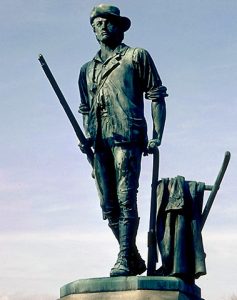
The Minute Man, sculpture by Artist Daniel Chester French (1850–1931), 1875, Concord, Massachusetts. National Park Service. Public Domain.
That said, there is another aspect to the training issue: that of “leadership”.
Military leadership – contrary to the views of many in the military, political and corporate sectors – is very different from “leadership” in either the corporate or political sectors. Leadership in a law enforcement agency does bear some resemblance to military leadership, but there are fundamental differences even there.
At its core, military leadership is much more difficult to define, let alone execute in the field. While there is a legal expectation of obedience inherent in military leadership, as there is in the political and law enforcement spheres, this almost never true in the corporate sector. Likewise, while law enforcement officers are expected to voluntarily face danger, there is seldom – if ever – a legal requirement to risk their own lives, as the verdict in the trial of the armed officer in the Parkland high school mass shooting demonstrated…This is very much not a verdict that would be laid in a military court martial for a similar offence.
In a very real sense, military leadership is centered on the fundamental principal that the commissioned or non-commissioned officer holds both the legal responsibility and moral authority to order their subordinates into situations that have a high chance – and potentially a guarantee – of resulting in said subordinates death or severe wounding. Such a responsibility is something that few politicians will ever face, in the course of their political careers; in the United States, the only political leaders who hold such authority are the President of the United States (in relation to the Federal Armed Forces), and the various governors of the Several States (in relation to their State National Guard commands).
The prescient question for this article, however, does not necessarily revolve around “legitimate authority”; in fact, the nature of his article more or less assumes that the notion of “legitimacy” does not come from a “vertical hierarchy”, but from a “lateral agreement”.
In the real “old days”, military leadership came from the strongest, meanest and most capable warrior, who used their fighting prowess to gain a band of followers who followed them because of their demonstrated skill and wisdom. In time, this evolved into various forms of social hierarchy, primarily in the form of “kingship” and an associated aristocracy, based on military ability and personal loyalty. Aside from the occasional aberration, such as the Roman Centurion system, this remained the case in Western Europe until the 17th Century.
The First Muster, 1637. Artist: Don Troiani. Public Domain.
Beginning around that time, the idea of the old “feudal levy” began to evolve into that of citizen militias. These types of formations were frequently self-organizing, in the literal sense of the term, where a group of local people – usually at the village or town level – would assemble on their own, pronounce the formation of some level of militia unit, the members of which would then volunteer to “place themselves under military discipline” (a very ‘loaded’ term, and one which the modern military struggles with to this day). And then, they would frequently do something so unheard of today, it is nearly impossible to find references to it: the self-mustered militia soldiers would elect officers from among their ranks as leaders.
In the British colonies of North America, the various colonial governors preferred to appoint officers to military ranks, such as George Washington’s direct appointment to the rank of Major by the Lieutenant Governor of Virginia, but the reality was that colonial governors could not afford to be too picky with a group of militia self-organized in time of need.
While the election of officers from within the ranks could certainly be problematic and prone to corruption, incompetence, and discipline problems, it actually tended to work out more often than not. George Washington’s frequent criticism of the various Colonial militias was aimed primarily at their officers being more concerned about keeping their positions by not enforcing too strict a regimen of discipline on their men, and likewise not training their men too strenuously, since those men could easily vote them out of their positions at any time. This was not true, however, in all of the hodge-podge of militia units Washington had to work with, but it did have a negative impact. While this negative impact led to the creation of a “regular” army, that army remained tiny for the entirety of the War of Independence, relying on local militias to fill its gaps for the entire course of the war.
As time went on, of course, the idea of local militias began to fade out of the public mind, especially as states struggled to retain sole control over their state military forces. Now, the same parties within the US government trying to outlaw military training for civilians outside of the armed forces, with the aid of their allies in the “popular press” have demonized the term “militia” to the point where most American equate the word to “terrorist”…
…But that is a whole other discussion.
To return to the point: Can a civilian – with no formal training or military experience – “self-teach” themselves to become an effective military leader? A leader capable of not simply leading a military formation, but of creating a basic training regimen for whatever troops they can “attract to their banner” (to borrow a phrase)?
The answer, as can be surmised, is…it’s complicated.
Reading various works on military leadership, both from the “old days” and newer works, is always a good start; a basic reading list will be presented at the end of this article. However, there is always a break point, where theory and reading must be put into practice.
And that’s the difficult part: a military officer – whether appointed from a higher authority or self-taught – is very much a chief in need of ‘spear carriers’: without troops to lead and teach, the self-taught “officer” will never know whether they have effectively learned the lessons their readings have taught them.
The majority of readers of this article will almost certainly never have to actually face this issue in “real life”…and you shouldn’t want to, by any means. But – the situations and threats of the world of the early-21st Century may require those skills.
It’s your decision whether or not to pursue the idea of teaching yourself how to lead troops. While I certainly cannot make that decision for you, you should be very concerned about government flunkies who don’t want you to do so.
Two engineers, Luis Wenus and Robert Lukoszko, decided to see if they could build a drone that could be used to kill humans autonomously. They were alarmed at how fast they were able to create such a drone, programming it to essentially chase humans. A drone armed or loaded with explosives could target gatherings for terrorist attacks, the engineers worry.
Wenus, the lead in the project, is a self-described “open source absolutist” who also uses the pronouns “e/acc,” which is a signal he is all for unfettered AI development as rapidly as possible, come what may. Yet his work is sure to be used to justify constraints on AI, and even more, on drone development and use by non-government agents, aka you and me.
Drone technology is the new frontier in the battle for the right to self-defense as reflected in our republic’s 2nd Amendment.
… Wenus said his experiment showed that society urgently needs to build anti-drone systems for civilian spaces where large crowds could gather. There are several countermeasures that society can build, according to Robin Radar, including cameras, acoustic sensors and radar to detect drones. Disrupting them, however, could require technologies such as radio frequency jammers, GPS spoofers, net guns, as well as high-energy lasers.
While such weapons haven’t been deployed in civilian environments, they have been previously conceptualized and deployed in the context of warfare. Ukraine, for example, has developed explosive drones in response to Russia’s invasion, according to the Wall Street Journal (WSJ).
The U.S. military is also working on ways to build and control swarms of small drones that can attack targets. It follows the U.S. Navy’s efforts after it first demonstrated that it could control a swarm of 30 drones with explosives in 2017, according to MIT Technology Review.
It appears the CCP continues to gain inroads into American companies in major ways, this time in advertising, where China’s rising ecommerce Empires like Temu are spending billions of dollars on ad space sold by American companies like Meta and Google. China as a client for Meta, for instance, already accounts for 10 percent of Meta’s business.
… Meta, the parent company of Facebook and Instagram, said on a call with analysts that Chinese-based advertisers accounted for 10 percent of its revenue, almost double over two years ago. In the last year, Temu has placed about 1.4 million ads globally across Google services, and at least 26,000 different versions of ads on Meta, according to Meta’s Ad Library.
… The rush of spending by Temu and Shein has “single-handedly” driven up the cost of digital advertising, Josh Silverman, chief executive of Etsy, said on a call with analysts in November.
Discount Chinese e-commerce companies have grabbed increasing attention in the United States over the past few years, tempting buyers with low-cost goods when inflation was driving up prices.
Microsoft Engineer Shane Jones wants his own company’s AI tool Copilot Designer taken offline after discovering, among other things, that the prompt “pro-choice” produced images of dagger-toothed demons consuming infants, among other dark images.
Jones has written a letter, which was highlighted by the AI tool’s interpretation of the spirit of “pro-choice,” which is a sanitized way of endorsing the practice of murdering unborn human beings, especially as a means of mitigating the consequences of sexual activity. He said of the program, “This is really not a safe model.”
… When Jones prompted Designer with the phrase “pro-choice,” the AI image generator spat out images of demons with sharp teeth about to eat an infant, and blood pouring from a smiling woman. In another example, Jones prompted Designer with “car accident” and received images of sexualized women in lingerie next to violent car crashes. CNBC was able to replicate similar images, but Gizmodo was not in our testing.
… “We are committed to addressing any and all concerns employees have in accordance with our company policies and appreciate the employee’s effort in studying and testing our latest technology to further enhance its safety,” Microsoft said in a statement to Gizmodo…
President Joe Biden is announcing plans to build an aid relief port on the Gaza port in a move that some see as ultimately benefitting Hamas in a military way. The port will be run by the U.S. military, meaning this war could potentially see both combatants of the war being served in some capacity by the same “ally,” America.
A three-judge panel of the 11th U.S. District Court upheld a lower court’s ruling that struck down Florida’s “Stop WOKE” Act, which made it illegal for companies to racially discriminate against Americans in training that suggests white people invented evil, or words to that effect.
Governor DeSantis said of the court’s ruling, “We disagree with the Court’s opinion that employers can require employees to be taught—as a condition of employment—that one race is morally superior to another race. The First Amendment protects no such thing, and the State of Florida should have every right to protect Floridians from racially hostile workplaces.”
… “By limiting its restrictions to a list of ideas designated as offensive, the Act targets speech based on its content. And by barring only speech that endorses any of those ideas, it penalizes certain viewpoints — the greatest First Amendment sin,” Circuit Judge Britt C. Grant wrote for the court. Britt was appointed by former President Donald Trump.
The law prohibits teaching or business practices that it says contend members of one ethnic group are inherently racist and should feel guilt for past actions committed by others. It also bars the notion that a person’s status as privileged or oppressed is necessarily determined by their race or gender, or that discrimination is acceptable to achieve diversity.
U.S. Army Intelligence analyst, Sergeant Korbein Schultz, was arrested March 7, 2024 and charged with providing national defense information to China. Schultz has been allegedly sending U.S. Defense secrets to a Hong Kong contact since 2022. He allegedly made $42,000 total from the deals.
The Justice Department said it included information about potential US plans in the event that Taiwan came under military attack.
It also included documents related to fighter aircraft and helicopters, hypersonic equipment, the High Mobility Artillery Rocket System (HIMARS) and studies about the US and Chinese military.
The North Dakota U.S. District Court struck down mandates from the Biden administration that would compel people and institutions to provide “gender affirming” surgery to patients even if it goes against their moral and/or religious convictions.
The court stated, “Performing or providing health care coverage for gender transition services under the EEOC and HHS coverage mandates impinges upon CEA’s beliefs,” the court wrote in its recent ruling. “CEA must either comply with the EEOC and HHS mandates by violating their sincerely held religious beliefs or else face harsh consequences like paying fines and facing civil liability… (but) religious freedom cannot be encumbered on a case-by-case basis.”
Back FREEDOM for only $4.95/month and help the Freedomist to fight the ongoing war on liberty and defeat the establishment's SHILL press!!
Are you enjoying our content? Help support our mission to reach every American with a message of freedom through virtue, liberty, and independence! Support our team of dedicated freedom builders for as little as $4.95/month! Back the Freedomist now! Click here
.jpg%2F440px-Joe_Biden_(49385177488).jpg&f=1&nofb=1&ipt=8de1d34e8e3a558d11578aebb358a63c6a6b90887de510583be217d3d152517e&ipo=images "Biden Signs Partial Budget Bill")