Michael Cessna is a former Active Duty United States Marine, a long-time personal protection specialist, security and defense analyst, military subjects instructor, general information researcher and amateur historian. He has been contributing security and defense writing since 2015.
In a pair of previous articles, we covered some oddities in weapons design, involving pneumatic/air pressure systems to propel projectiles, sometimes of significant weight. In contrast, this week, we will look at something simultaneously advanced, yet strangely kitschy and primitive:
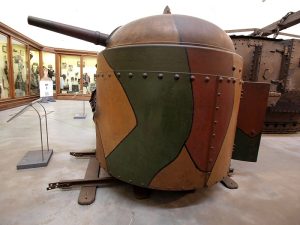
The patent for the Fahrbare Panzerlafette für leichte Geschütze (in English: movable armor carriage for light guns) was originally filed in Germany in 1880, although the patent would be approved until 1885 (1887 in the United States), by inventor Hermann Gruson. The Fahrpanzer (which is what it was quickly abbreviated to) was essentially a light artillery gun carriage. Gruson created a kind of “semi-mobile” (to use modern terminology) pillbox that could be quickly transported around the battlefield by a team of horses (like the other varieties of field artillery of the time), to strengthen local defenses.
Fahrpanzer at the Royal Military History Museum, Brussels, Belgium, 2010. Public Domain.
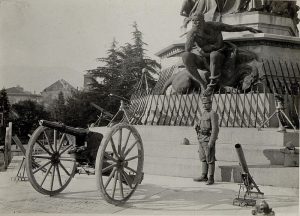
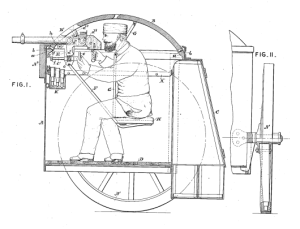
Gruson’s design was essentially an armored pillbox, with a rotating turret, accessed by a tiny armored “closet”-like box to the rear. The turret could mount either a Maxin-type machinegun, or a very lightweight 53- or 57mm cannon, also designed by Gruson, the Cannone da 57/25 Gruson.
An Italian Cannone da 57/25 Gruson captured by Austrian forces. May, 1916. Public Domain.
Gruson’s turret design was unique, in that rather than relying on a central column to support the weight of the turret, the Fahrpanzer’s turret rested on the upper portion of the inside of the turret, transferring its weight to the upper portion of the cylindrical casing via a set of roller bearings, which was rotated through a full 360° using a hand-crank wheel at the gunner’s station creating, in effect, a modern turret. This had the side effect of freeing up space on the floor of the fighting compartment to fix a rubber roller (made specifically of “Indian Rubber”, according to Gruson’s recommendation) in place to stabilize and cushion the 53- or 57mm gun’s mount, whose trunnions were placed behind the center of gravity of the mount. The gun, as well as the turret, could be adjusted internally by a hand-crank, but could also be elevated similarly, allowing for limited elevation of about –5° to +10°.
If the turret had any defect, it was that the turret was made of cast iron. The resulting brittle nature of the metal left the Fahrpanzer with acceptable protection against rifle fire, but a hit from any kind of artillery would rip through the turret like paper. However, on the plus side, the system’s design offered only a very small opening for the cannon and its sight, significantly reducing the danger of infantry fire to the crew.
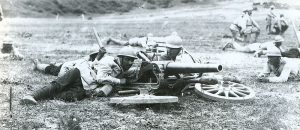
The gun itself, while an admitted lightweight, was no slouch: with a maximum range of c.5,500 meters it could drop a shell loaded with over 600 grams of black powder; that is not a charge a person would want to be next to. The gun was fast, quick and simple to move around the battlefield, and did very good work on its own, mostly throughout Europe and Russia, but also managing to find a home in the Chilean Navy.
Gruson 53 mm gun installed on a Romanian-built gun carriage, being prepared to fire by a Romanian army team at Lunca Dochiei in June, 1917. Public Domain.
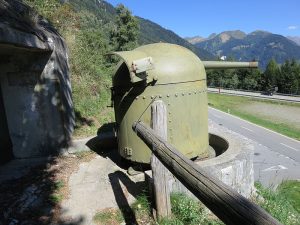
With about two thousand units ultimately being produced, Gruson’s mobile turret lasted in military service throughout the world, from the 1890’s to well after World War 1, finding use on early armored cars, as well as being fitted into permanent positions guarding critical points. Those turrets were hidden in small caves dug into mountainsides, in positions that offered a clear field of fire when the pint-sized turrets were run out for action, in a manner not dissimilar to the cannons of a warship of the Age of Sail.
Fahrpanzer in a mountain revetment, overlooking a highway, Forte Airolo, Airolo TI, Switzerland. Photo credit: Paebi. CCA/3.0
Ultimately, technological evolution passed the Fahrpanzer by. Later self-propelled vehicles would effectively duplicate the turret, to make the first real tanks; more effective models supplanted its gun; and finally, its armor – while cheap and effective for the 1880’s and 1890’s – was virtually worthless by 1914. While a few units survive in places, mostly in Greece and Bulgaria, most have long ago been either destroyed, sold for scrap, or rotted away on forgotten battlefields…
…But – you never know: someone might just decide to build a modernized version, because it’s not as hard a thing to do as one might suspect.
The Freedomist — Keeping Watch, So You Don’t Have To
“…While economics is a gun, politics is knowing when to pull the trigger…” – Caspian Report
In April of 2022, Imran Khan – the highly popular, 70-year old former international cricket player who had risen to the leadership of Pakistan, a state with one of the largest Muslim populations in the world, on a broadly “Populist” style platform – was removed from office as Prime Minister by a no-confidence vote, the first time such an action had happened in Pakistan’s history.
The no-confidence vote that led to Khan’s removal, on its own, had shady origins, and potential foreign interference. On March 27, 2022, following the first attempt at a no-confidence vote in Parliament had been dismissed, Khan pointedly accused the Biden Administration of interference in Pakistan’s internal affairs, in an affair now known as “Lettergate”, in which Khan stated publicly that he had received a letter via a diplomatic cable from Pakistan’s embassy in the United States, that he claimed threatened “horrific consequences” for Pakistan, if Khan was not removed as Prime Minister; Khan’s government reacted to the cable with a strongly-worded demarche. Khan was blocked from releasing the actual details of the cable in question by Pakistan’s Official Secrets Act of 1923, but stated that he was prepared to show the diplomatic cable to the Chief Justice of Pakistan.
For its part, the Biden Administration – reeling from the disastrous withdrawal from Afghanistan in August of 2021 – was clearly smarting from its demonstrated weaknesses at all levels of governance, and needed to do something to reinvigorate its failing image. Much like the so-called “Maidan Revolution” of 2014, the removal of Khan from power immediately began to decouple Pakistan from the PRC’s orbit, and threatens the Communist nation’s “Belt & Road Initiative”.
Major General Chris Donahue, commander of the U.S. Army 82nd Airborne Division, XVIII Airborne Corps, boards a C-17 cargo plane at the Hamid Karzai International Airport in Kabul, Afghanistan, 29 August 2021, becoming the last US soldier to leave Afghanistan. Photo by Jack Holt, US Central Command. Public Domain.
But – for the average American…so what? Why should American’s care about all of this maneuvering in a foreign country many American’s know or care very much about?
The reason the average American needs to pay attention is that the political crisis sparked in Pakistan by Khan’s removal has erupted again, with disastrous results.
Khan – who refused to go away quietly, leading protests in an attempt to hold a special election that would likely return him to power if it were held – appeared at the Islamabad High Court on 9 May 2023 to address corruption charges. After voluntarily appearing at the court, and while being processed, the courthouse was stormed by a unit of the Pakistan Rangers, a Federal paramilitary police force operating under orders from the National Accountability Bureau, who bizarrely arrested Khan, dragging him out of the courthouse, to an undisclosed location.
In the aftermath of this, large and violent protests and rioting erupted across the nation, with angry mobs attempting to storm both regional military headquarters, as well as the local headquarters of the ISI, the Pakistani version of the CIA. Despite calls for direct military force to be used to suppress the rioting, a wide array of military commanders in the nation refused, point-blank, to apply such force. This has led to an alarmingly confusing situation, including the removal of some military commanders.
This has raised alarming concerns as to who is actually in charge of Pakistan’s armed forces, as the raid to arrest Khan seems to have come at the orders of the Chief of Army Staff, General Asim Munir, with the support of Prime Minister Sharif. (The position of “Chief of Army Staff” is the Pakistani equivalent to the US Army’s “Chief of Staff” position.)
…But, again – why should this matter to Americans?
Simple: Pakistan is not Iraq; nor is it Sudan, Bolivia or Myanmar. Pakistan is different, because Pakistan is a nuclear-armed nation…a nation that shares a land border with another nuclear-armed state, with whom it has already fought several wars. And, although relations had begun to improve while Khan was in office, those have noticeably cooled since his replacement.
Pakistan has had a shaky internal situation for decades, and beginning in 2004, the internal situation deteriorated into an actual insurgency by multiple groups, some focused on religion, like the “Pakistani Taliban”, al-Qaeda and ISIL, but also inflaming and rejuvenating supporters of an independent Balochistan.
With the sudden deterioration of the situation in a nation of nearly 248 million people, some 96.5% of whom are Muslim, the world is now facing the distinct possibility of a multi-sided civil war in a nuclear-armed state, that could lead to the reality of nuclear terrorism, potentially including actual nuclear war, something long believed to have been buried, as many of the factions now swirling in Pakistan would have no issue with loosing nuclear fire onto India, if they were to secure nuclear weapons, which would naturally provoke an immediate response.
While no “smoking gun” evidence has been released that shows conclusive interference by the Biden Administration in Pakistan’s internal affairs, the possibility cannot be dismissed. The Biden Administration has demonstrated absolutely irrational and even self-destructive behavior since assuming power in the United States…and the results of those irrational and self-destructive behaviors are now coming home to roost.
If you’re not worried – you need to catch up.
The Freedomist — Keeping Watch, So You Don’t Have To
For over 75 years, the United States has been at war. American cities have been destroyed, entire states overrun, American citizens forced to live under the heel of a foreign occupier, U.S. brigades and divisions destroyed wholesale by an implacable enemy. It would not be until the mid-1980’s that the tide began to turn against the foe…the dreaded Circle Trigon State.
The preceding is real. It happened, and continues to happen – and you, the Reader, likely never knew anything about it…Because, while it was real, it was only “sort of” real.
In 1946, in the aftermath of World War Two, a board of general officers – those who had commanded forces of all types, in all theaters around the globe, during the largest war in recorded history – was “convened” (although, in reality, most of the generals were surveyed by mail), and asked what they thought had been done right, and what had been done poorly, prior to the war…Resoundingly, on the “bad” side, the generals called for more realistic training.
Prior to the war (c.1940-1941), “training” – especially for the infantry – had consisted of lining troops up on opposite sides, handing one side blue armbands and the other red armbands, and having the units go at each other in a glorified game of “capture the flag,” as adjudicated by umpires who wandered the training ranges, making largely arbitrary calls on who had been “killed” or “wounded”, and which side had “won.” Both sides used doctrines and tactics straight out of the same training manuals of the service – mostly based on First World War tactics – with only a sprinkling of speculation about how things like tanks would be used on the battlefield. Little thought was put in on how potential opponents fought, nor what attitudes, tactics and doctrines they might have used, despite detailed battlefield reports from military observers working out of U.S. embassies around the world.
As a result, US forces – and their commanders – generally performed terribly in the opening stages of the war. In fact, it would not be a stretch to suggest that U.S. forces would have been better off without the extensive – and expensive – field training, beyond the most basic of “entry-level” tactical training.
One of the most important measures adopted to correct this abysmal training gap, at least by the US Army at first, was a breathtakingly radical idea, and idea that has metamorphosed and grown into a detailed regimen that now extends well beyond the military sphere:
This was not like the thinly veiled names for potentially hostile nations that had been used for the famous color-coded war plans for the thirty-odd years preceding WW2. This was wholly different: the U.S. Army applied the same principles used by writers of popular fiction, to write what was essentially an “alternate history” of Europe at the end of WW2, a Europe that was partially reunited by a fictional Fascist political group. The scenario drew inspiration from the example of post-World War One Germany and the bodies of wandering troops known as the Freikorps, which had battled Communists across Germany in the chaotic aftermath of that war.
Freikorps in Berlin around 1919. Major a. D. F. W. Deiß. Public Domain.
In this scenario, the United States, Great Britain and the Soviet Union failed to establish positive control over the battered remnants of Europe and abandoned most of their heavy weapons and equipment on the continent in a rush to repatriate their troops home, to get them back into civilian industries. (The details of why this happened were not explored; it was simply assumed, in order to create the setting.)
Into this tumultuous morass, surviving Fascist leaders in various countries reunited in Franco’s Spain, and created a multinational movement, called the “Circle Trigon Party” (PDF link) – modeled on the lines of various fascist parties from the 1930’s and 40’s – that quickly incorporated the bulk of the wandering and leaderless troops in this alternate Western European setting, and welded them into a new force. These forces promptly seized the heavy equipment and weapons left behind by the withdrawing Allies and began planning a preemptive assault on the United States, as the new state’s leaders saw the U.S. as was the most dangerous enemy they would face in the short term.
This scenario – never thought of before, on anything like this scale – was implemented by designating certain special training units to various Army posts around the country and using surplus equipment and uniforms, dyed black, to form units of the “Aggressor Army” to train units locally, on-base. The uniforms themselves, while distinctly different from U.S. uniforms, also included a slate of awards and decorations, while the rank insignias were entirely American in origin, but were either turned upside down, or pinned on in non-U.S. arrangements.
Aggressor Force officers in the field. Yakima, WA, 1963. US Army photo.
But neither were these units organized along regular U.S. Army lines. Instead, an “Aggressor Army Command” (YouTube link) was created in a building at Fort Riley, Kansas, that developed tactics and doctrines unique to this mythical force…tactics and doctrines that were not shared with the actual U.S. Army units who would face this curious opponent. The units were issued a variety of training tools, including inflatable tanks, trucks and artillery pieces; similar tools were used in Europe during the preparations for the D-Day invasion of Normandy. Additionally, standard psychological warfare techniques were used against U.S. troops by the Aggressor forces – leaflet drops by aircraft, Jeeps with loudspeakers to broadcast propaganda, and even radio broadcasts.
But it didn’t stop there.
At this “Aggressor Army” headquarters at Fort Riley, KS, extensive records were maintained of thousands of wholly fictional officers and troops, in a format similar to U.S. personnel summary cards. These personas were “assigned” to various training units, and troops were issued identification cards in these names and ranks; if “captured” during an exercise, these were the ID’s the “enemy” forces would hand over.
Even more remarkably, the Aggressor state, according to its back-story, had adopted the “constructed language” of Esperanto – and the troops were at least partly trained in its use. The reason for this was two-fold: captured troops would do their best to only answer questions in Esperanto, forcing intelligence units to attempt various forms of interpreting, and that all radio transmissions between Aggressor units were in Esperanto, forcing radio interception teams to also attempt to interpret the signals.
As the various exercises at posts were carried out during the late 1940’s and into the 1950’s, the Aggressor Headquarters in Fort Riley kept a careful score of when operations happened where and when, and what the outcome was…And, while U.S. forces didn’t always lose, they lost enough times, that the nation could frequently be presented as being in dire peril. One stark example demonstrated for American citizens was 1952’s Operation Longhorn (YouTube link), in which the town of Lampasas, TX and its civilian population were “captured” by Aggressor forces, and the citizens were given a very mild demonstration of what European civilians had faced under Nazi occupation ten years before.
The aim of the Aggressor force and the Circle Trigons was to train U.S. forces for large-scale combat against a foe who used very different tactics, and who saw the battlefield in a completely different light than U.S. commanders. Little thought was placed into “guerrilla warfare,” which has never really been given a stable place within the training cycles of United States troops. Oddities such as the “Pentomic Army” aside, the Aggressor Nation concept performed remarkably well…
But, the concept is not gone, by any means.
During the post-WW2 period, a polite fiction was maintained, in that the Circle Trigons were constructed as a Fascist, Nazi, German-like group…but everyone involved knew that they were actually training to fight the Soviet Union and its allies, exactly as anyone who knew of the color-coded war plans knew that “War Plan Red” (YouTube link) was code for war with England, or that “War Plan Orange” was about war with Imperial Japan.
Beginning in 1979, with the opening of the National Training Center (NTC) in the California desert, the U.S. military revamped its concept of the “aggressor” training tool, renaming it “OPFOR” (“OPposing FORce”), and creating multiple nations – versus a single state – with not simply a Soviet influence, but with Western and Third World influences as well.
OPFOR Shirt and Shoulder Boards used to add realism during exercises, 2010. US Army photo.
The U.S. Army reactivated the 6th Battalion, 31st Infantry (“The Polar Bears“) from the 7th Infantry Division based at Fort Ord, California, and the 1st Battalion, 73rd Armor, redesignating the two units as the 177th Armored Brigade (Separate), to form the Center’s primary training unit. While maintaining their regular U.S. Army organization and training standards at one level, the 177th also “fought visiting” Army units by organizing and training itself to model a standard Soviet Motorized Rifle regiment (the fictional 32nd Guards Motorized Rifle Regiment, known jokingly as “the best armored regiment in the Soviet Army”). After the 9/11 Attacks, the brigade transitioned to training for counterinsurgency warfare training (along with a similar unit at Fort Polk, Louisiana) for units headed to Iraq and Afghanistan…And now, following Vladimir Putin’s Russia reminding the world that large-scale warfare is not, in fact, a thing of the past, the Center has switched back to training for major-scale warfare against a “near-peer” opponent.
An Operation-force Surrogate Vehicle (OSV) Representing a Soviet BMP at Fort Irwin, California (National Training Center), 2012. Photo credit: Mrkoww CCA/3.0
This model has worked so well as a training tool, both the U.S. Marine Corps (PDF link) and U.S. Air Force created similar training units of their own. So far, the U.S. Navy seems to be the only holdout.
U.S. Soldiers of the 1st Bn, 4th Infantry Regiment dressed in OPFOR uniforms, Hohenfels, Germany, July 2, 2013. US Army photo (SGT Caleb Barrieau).
For the casual reader, much of the background information and training materials are available online for free, courtesy of the U.S. Army, via its ODIN website, part of the Training & Doctrine Command (TRADOC), where you can explore the challenges of fictional nations like Atropia, or Olvana. (For an alternate wargame setting, based in a fictional Latin American country – once used by Great Britain as a wargame exercise – see the MapSymbs website.)
While notionally interesting, the foregoing history of recent developments in military training is something that people need to know. The gaming environment is not all about cartoon ‘first-person shooters’, played by bored kids in their parents’ basements. Wargaming simulations have been, and continue to be, one of the most valuable pieces in the training toolbox.
And this Marine doffs his cover to the Army, for getting that right.
The Freedomist — Keeping Watch, So You Don’t Have To
Previously here, we have reported on various aspects of warfare, both ancient and modern. The tools change all the time. Sometimes, the specific techniques to employ that technology changes, the better to employ the new sets of hardware that come out of inventor’s workshops and laboratories. But the basic rules, as the saying goes, do not change over time.
The proverbial “rag-tag band of rebels” – or revolutionaries, or guerrillas, as the reader prefers – have been a feature of warfare from the very beginning. In fact, a strong argument could be made that such groups were the very first “fighting forces” to appear on the battlefield; “organization” is the basic requirement for “organized warfare,” and that organization had to start somewhere.
But that is lost in the mists of eons.
Organized warfare, as such, waxes and wanes. The Mediterranean Basin and the European continent – south of the Danube, west of the Rhine, and north of Africa’s Mediterranean coast, and even extending into the Black Sea – was dominated by Rome and its army. This was, for the time, the best organized, regularly supplied and funded army in recorded history; the only real comparisons known are the armies of Sargon the Great and Alexander of Macedon…and yet, Rome “collapsed” (at least in Western Europe) in the 5th Century; the final destruction of Rome in the east – what is now better known as “Byzantium” – would take another thousand years.
That Rome collapsed (both times) was not the fault of either form of its armies (that’s a long discussion). There were numerous factors involved in both series’ of collapses; in both cases, the ultimate failures of the Roman armies were merely the final acts. Indeed, it is no stretch of the imagination to say that the highly professional, disciplined and minutely organized Roman and Byzantine armies are what kept their respective states alive as long as they did.
Infantry wins wars, and the more professional your infantry, the faster and more decisively you win, all other things being equal. But, continuing with this historical digression, the battle of Adrianople in 378AD ushered in a perception of the superiority of mounted horse cavalry over professional infantry; whatever the actual historical truth of the battle (the arguments of Oman and Burns aside), the perception held true, and those ideas would lead directly to the rise of the mounted knight as the main military component of the medieval period. Horse-using elites were certainly not new, but they were never truly decisive, no matter how diverse the mercantile and military (YouTube link) trade networks were.
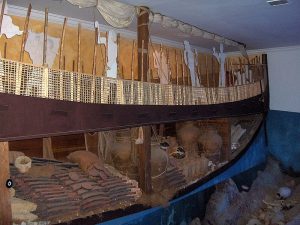
Full-size replica of the Uluburun shipwreck, St. Peter’s castle, Bodrum, Turkey, 2004. Photo credit: Georges Jansoone. CCA/3.0
In the aftermath of those Roman collapses, warfare reverted to a more localized and tribal form of organization. Even in the Levant, where the First Caliphate and the later Ottoman Sultanate largely ruled from the 7th Century onwards, government regulation and control were not what they had been under either Roman or Persian rule. Warfare was largely thrown back at least a thousand years, each time.
Technology played a large part in this seesaw. Spears, swords, bows and arrows, and metal armor are all relatively easy for a blacksmith to turn out. As long as armies were small, and some form of “hard tack” (to use the modern term) was set back in a castle of some sort, small armies could maneuver cross-country without too much trouble. Bands of what we would now call “guerrillas” could also maneuver easily, as they generally operated in their native areas, and knew where watering holes and useful resources were located.
The advent of gunpowder changed all of this, however. While developed in Song Dynasty China in the 9th Century AD (on the European calendar), the first use of the formula as a weapon dates to the early 10th Century, in use against Mongol tribes. Once gunpowder became dominant as an infantry weapon in Europe, in the late 15th to the early 16th centuries, the scales that had been tipping slowly back towards infantry dominance slammed down decisively on the infantry’s side: now, as gunpowder weaponry rapidly progressed from the matchlock through to the flintlock, it became comparatively cheap and easy to recruit and train infantry en masse to a level sufficient to return cavalry to their nominal roles of scouting and decisive shock action.
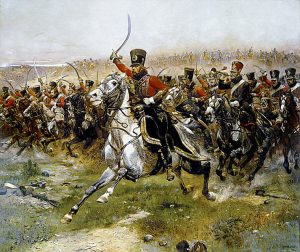
Vive l’Empereur!, 1891. Édouard Detaille (1848–1912). Charge of the 4th Hussars at the battle of Friedland, 14 June 1807. Public Domain
But, that tipping of the scales had consequences, as gunmaking was a very specialized skill, as its requirements were very different from making simple metal objects like blades or horseshoes.
Likewise, the advent of motor vehicles changed the factors of “battle calculus” yet again, by replacing the horse with the motor engine. While the automobile has a host of limitations, those drawbacks are minimal in comparison to those of horse cavalry…
Which brings us, at last, to our core topic: “Ersatz Armies.”
As noted above, “irregular” forces – rebels, guerrillas, etc – have frequently struggled to compete with better-organized and supported “regular” armies. Such groups have to improvise methods of supplying not simply weapons, but food, medicines and other basic needs of a military force. In the past, these services and products were generally stolen from an enemy government, or were supplied directly by a foreign government, supporting the guerrillas. More infrequently than is generally assumed, a guerrilla force might purchase arms from “black market” arms dealers; in those cases, the guerrilla forces were teetering dangerously on the edge of being a criminal gang, more than a “heroic band of fighters for the people.”
But, with the sudden and rapid anarchy taking place in Sudan, another factor has once again reared its head: a deliberately created ersatz army.
In 2003, the Sudanese government in Khartoum recruited a group of tribal militias that coalesced into what is now known as the “Janjaweed”. This grouping of tribal militias went on to commit a host of terrible crimes, encompassing all the worst categories of criminal activities. So bad were these events, both the Sudanese dictator of the time, as well as one identifiable leader of the group, have been formally indicted for war crimes.
In the aftermath of the worst parts of the Darfur Conflict, the Janjaweed was not paid off and stood down by the government of Omar al Bashir – instead, it was expanded, given better training and weapons, had its name changed to the “Rapid Support Force” (RSF) (YouTube link) and was then used a force of “shock troops” to fight in regional wars, such as Libya and Yemen, where they proved willing to do the dirty jobs no self-respecting and –disciplined military would touch.
In effect, al Bashir created his own version of Adolf Hitler’s SA or SS – a powerful armed force, separate from the regular military, willing to do whatever was asked of them. Unlike Hitler, however, al Bashir lost control of his non-Army force; this resulted in the RSF collaborating with the regular Sudanese military to remove him from power. And, as these things almost always do, this resulted in a falling out among thieves, leading to the current disaster in the country.
What makes the RSF different from similar groups in the past, however, is its size and equipment. The RSF is estimated to number around 100,000 men (YouTube link), and have been equipped comparatively cheaply, with the most basic of infantry weapons and gear, as well as the ubiquitous “technical” vehicles. A hundred thousand troops, even if poorly trained, is nothing to scoff at, even if you intend to engage them directly.
Sudan is not unique: while other states may not have armed groups to the extent of the RSF, it is a far cheaper thing to do, than most people think…But these types of forces – with little or no control, nor moral training, but with effective weapons and training – are growing in number.
Conflict monitoring is an odd field: You try to monitor the world, and eventually specialize out of necessity. The recent descent into chaos in Sudan, Africa’s third-largest nation by size, is no different.
Beginning on April 15th, a series of armed clashes began in Khartoum, the capital of the African nation. The opposing sides are the regular Sudanese Army, and a paramilitary force called the “Rapid Support Force (RSF)“. The two forces had united in 2019 to oust Omar al-Bashir, the country’s long-time dictator, in a military coup d’etat; two years later, in 2021, the two parties staged another coup to derail Sudan’s return to a democratically elected government.
The situation has deteriorated, in barely a single week, to the point that the United States and other powers (YouTube link) are rapidly deploying forces to Camp Lemonnier, located in the state of Djibouti, on the Red Sea coast, in preparation for a possible evacuation of various embassy’s and foreign nationals – a daunting prospect, given that Khartoum’s international airport is not currently usable, and because the capital city is nearly 800 miles inland.
The source of the current “lover’s quarrel” is the Regular Army dragging its feet over formally integrating the RSF into its force structure, as well as delays in payroll to the paramilitary force, with its leadership claiming that they want to return al-Bashir to power.
Who are the RSF?
In 2003, fighting erupted in Western Sudan as non-Arab (i.e., “black African”) tribes united against the al-Bashir government’s continued campaign of oppression and discrimination against them. The result was the Darfur War (sometimes called the “Land Cruiser War” because of the extensive used of ‘technicals’), a genocidal conflict that killed hundreds of thousands, and created between two and three million refugees.
Map of Darfur within Sudan, July 2011. CCA/3.0
The RSF began life as the so-called “Janjaweed”, a Sudanese Arab tribal militia assembled by al-Bashir’s government to suppress the Black African inhabitants of the region. Supporting this, were the remnants of Libyan dictator Muammar Gaddafi’s “Islamic Legion”, an openly racist and pan-Arab organization intended to unite the Saharan region by force.
As the Darfur war reached a stalemate (that would ultimately result in a nominal ceasefire agreement in 2020), al-Bashir’s government began using a now-experienced and capable Janjaweed – under their commander, Mohamed Hamdan Dagalo – as extra muscle throughout the region, especially in places where the dirtiest of atrocities were needed.
Oozing to life in 2013 as an outgrowth of the Janjaweed, the RSF was quickly used by al-Bashir as a kind of “expeditionary force”, sending significant numbers of troops into both Chad and Libya (in the latter case, supporting the Libyan National Army of Khalifa Haftar), and a stunning 40,000-strong corps-sized unit into Yemen to fight against the Iran-backed Houthi rebels. The main difference between the RSF and the Janjaweed, is in the level of formal support and arms provided to them by the Sudanese government, with uniform weapons and vehicles.
The RSF is not simply large, with over 100,000 men under arms, but is also highly mobile, with an estimated 10,000 ‘technical’ trucks (YouTube link)…and it has developed an impressive economic infrastructure to support itself, thanks to the business chops of its leader and his family.
Mohamed Hamdan Dagalo (known as “Hemedti“, locally), who dropped out of primary school in 3rd grade to work to support his family, started out as a well-respected camel herder in the Darfur region. As he positioned himself as the chief commander of first the Janjaweed, and then the RSF, he used the forces loyal to him to help is company, Al Junaid, to corner the gold mining industry within Sudan, as well as a host of other industries, ultimately controlling up to 40% of Sudan’s exports.
And, like most warlords with sufficient resources, he has made life well for his loyalists in the RSF, who now follow his orders without question, helped by him polishing his speaking skills. This, along with a “charm campaign” managed by Western public relations firms to improve Hemedti’s image, has combined to form a kind of “mercenary micro-state” of a type that is highly unusual in the modern day…In many ways, the RSF is the nightmare scenario that world security analysts have been dreading since the rise of the “corporate terror group” model, when al Qaeda appeared in the late-1990’s.
In a very real sense, the leader of the regular Sudanese armed forces and Hemedti’s rival in the power struggle, Lieutenant General Abdel Fattah al-Burhan, have created a monster they can no longer control.
But, ultimately…who cares? Why should you care?
The current fighting in Sudan will almost certainly determine who will be the next ruler of the nation. As well, major powers – both global powers, and up-and-coming regional states seeking to expand their influence – are all jockeying for position, and that kind of jockeying can swiftly lead to an expanding conflict.
And all of this is happening literally on the banks of the Nile, Africa’s ancient major river system. No matter who wins this conflict, this will pose significant issues to Egypt and its population of over 100 million, already alarmed over Ethiopia’s dam building project that seriously threatens the downstream ecology and climate of the region.
Lastly, is the serious potential for major-power involvement, up to and including combat: Russia’s Wagner Group mercenary company has significant ties to the RSF, and in the region, generally. The Wagner Group has been reportedly guarding some gold mining areas for the central government since at least 2019, with speculation that Wagner-defended gold is being using used to fund Russia’s war in Ukraine. Numerous foreign corporations have major investments throughout the region, and the expansion of the “private military company” market in the last twenty-five years means that there is little incentive to not hire lots of ex-military guns to guard their investments.
And, looming over the regular Western military commands’ psyches is the shadow of 1993’s “Battle of Mogadishu”, but on a far larger scale, with far fewer advantages for the Western powers.
The future does not look sunny.
The Freedomist — Keeping Watch, So You Don’t Have To
With the recent arrest of an Airman of the Massachusetts Air National Guard, the United States’ defence and intelligence establishments are once again under fire for apparently lax information security. In fact, this is the second time in less than a year that this has happened.
At first glance, this seems like a very bizarre thing…until you realize, sadly, that it is not.
Instead, incredibly – or, sadly, not so incredibly – the leaks were the result of rabid video game players trying to prove how cool and ‘edgy’ they were.
While some of the leakers may be older, this is the result of the programming of the so-called “Generation Z”. This is the first generation to grow up with social media as a main facet of their lives. When “social media” as we would now recognize it, first arose in 1997, no one had any real idea of what its impact would be. Whatever the imagined intent, what it has evolved into, is a sort of electronic version of an elementary school playground at recess, with no adults present to regulate it.
Where older generations who entered the various defense and intelligence services would never, in their wildest nightmares, have taken classified materials to their local watering hole and deliberately passed them around to score social points, this is becoming increasingly common for a deliberately infantalized generation of youth. While there certainly were, and are, spies and informants stealing and passing on information for money, ideology or “love”, those reasons were at least tangible and understandable. Scoring social media points is, to be blunt, pointless in the extreme.
Coupled to the insanity of the RESTRICT Act (deliberately misconstrued as the “TikTok Ban” bill), this works to sweep away all the foundations of legality of the Rule of Law, in the fleeting hope of gaining some sort of security.
And, like the hysterical attacks from the music industry against services such as Napster and Grokster, idiocies like the RESTRICT Act are guaranteed to have exactly the opposite effect, as outraged online activists will find ways to send out increasingly large amounts of classified material – not for the older reasons, nor even the newer reasons, but simply out of anger at such tight restrictions. The fact of facing heavy penalties for doing so, are irrelevant once the information is “out in the wild,” as the saying goes: the damage will have already been done.
But the above does not address the real question: Why are these kinds of leaks so dangerous?
For those not familiar with intelligence gathering, as a discipline, the short answer is that, in the “old days,” obtaining intelligence – meaningful intelligence – on a hostile target was hard…very hard. An intelligence agency – from East or West – had to insert “non-official” (or “illegal”) agents into the target country; those illegal agents would then have to either infiltrate a facility, or suborn an intelligence worker (assuming that they could identify them). Conversely, they could hang out in bars, nightclubs or restaurants (good for staging a honey trap) outside the gates of military facilities, or take menial jobs at establishments outside the gates such as working as a barber or as a waitress, in an attempt to glean nuggets of information from random conversations…Not very flashy, and not very James Bond, but such methods did work.
An example of a one-time pad. Credit: Mysid, 2007. Public Domain.
(My favorite intelligence warning in the mid-1980’s, was an order that came down, telling service personnel to stop…”liberating”…large bottles of Tabasco® sauce from restaurants outside base main gates in preparation for going to the field or “rapidly redeploy strategically”, to make the early Meals-Ready-to-Eat (MRE’s) at least somewhat palatable. The problem had gotten so bad, those base-local restaurants developed their own internal intelligence networks, and were suddenly “out of Tabasco” when they learned of a local unit deployment…thus giving hostile agents a dead giveaway that large unit movements were afoot.)
With the rise of online gaming and their associated forums and chat servers in the early 2000’s, however, intelligence agencies quickly grasped that their agents could sit behind Virtual Private Networks (VPNs), in the comfort and security of their home nations. They could then “lurk,” monitoring boards silently, while not communicating very often, waiting to pounce on discussions where people who should know better would often drop bits – or entire files – of classified data…and those agents wouldn’t even have to hound the leaker, because the rest of the forum or chat group would do that for them, unwittingly.
This kind of thing came naturally to intelligence agencies, as it was a form of OSINT [https://en.wikipedia.org/wiki/Open-source_intelligence]. OSINT, or “Open-Source Intelligence,” is a method, or discipline [https://en.wikipedia.org/wiki/List_of_intelligence_gathering_disciplines] of intelligence collection where a person meticulously (some might say, “obsessively”) scours every publicly available source of information on a subject they can find, and attempt to collate and boil-down the resulting information into a general picture.
OSINT differs from more expensive, technological or hazardous methods of information collection – like finding human sources of information, satellite reconnaissance, radio signal interception, etc. – in that it simply requires an illegal agent to buy multiple piles of newspapers and magazines, and inhabit libraries relentlessly. While also not very flashy, OSINT analysis often leads to very clear pictures of a nation’s defense strategies. As well, it lends itself very well to crowdsourcing [https://en.wikipedia.org/wiki/Crowdsourcing].
So…Where does this leave us, in mid-April of 2023?
Unfortunately, there are serious problems within the information security apparatus in the West, as a whole. With the need to bring in a new generation of intelligence workers, the West – as opposed to Russia and Communist China – is finding that the “Woke” agenda that has been allowed free rein over the last decade has badly polluted the potential recruiting pool, as people who have been raised in a culture where ephemeral “electronic cred” is as important, if not more important, than being a “quiet professional”.
And, as those who promoted that social context are discovering, there is no putting the toothpaste back in the tube.
The Freedomist — Keeping Watch, So You Don’t Have To
Unless something truly catastrophic happens, or you work in the industry, the average American doesn’t give a great deal of thought to railroads. Sure, they’re annoying when you get stuck at a crossing, as the seemingly never-ending parade of graffiti decorated cars slowly roll by, and sure, at some level the Average Joe or Jane Public understands that a great deal of America’s commerce is carried on them, but beyond that, railroads are just…well…railroads.
BNSF freight train passing to the northwest of Shallowater, Texas. Photo Credit: WikimediaCommons User “Leaflet”, 2009. CCA/3.0
But, there was a time, within living memory, when railroads were not simply the vital arteries of commerce, carrying massive amounts (the average freight train carries over four-thousand tons of freight) of goods across nations and continents, but were traversed and protected by terrifying engines of war…
Polish armored train “Danuta,” 1939. From the left: artillery wagon, infantry assault wagon, armoured locomotive, artillery wagon. Public Domain.
Shortly after railroads began to dominate overland transport in the early 19th Century, people began to think of how “weaponize” them – not simply as fast troops transports, but as actual weapons, like a kind of warship that was confined to iron rails, instead of the waters of the world.
Armored train Hurban. Zvolen, Slovakia, 2004. Photo credit: Martin Hlauka
As actual weapons, “armored” trains started out simply as “armed” trains. Early on, troops simply piled up some logs and maybe a few bags of animal fodder to build some improvised, “hillbilly armor” (to use the modern vernacular), that would provide some small measure of protection to troops firing out of the windows of passenger cars. With the coming of the American Civil War, however, “bombard cars” mounting massive mortars, came into use. To protect the gun crews, heavy armor made from railroad crossties and spare lengths of track were bolted around the wagon that mounted the artillery weapons, making them essentially bulletproof.
The Union’s Moving Battery armed with a siege mortar on the City Point Railroad during the Siege of Petersburg. 1864. Public Domain.
As time went on, and the use of trains as weapons expanded, tactics developed that governed the vehicles’ effective use in combat: engines were shielded with tempered-steel armor plates; car arrangements were worked out, placing armored or at least weighted cars in front of the engine, so that those cars would absorb fire intended for the engine; troop cars were designed that allowed light infantry to quickly dismount and counterattack ambushing forces, a practice that quickly extended to cavalry carried aboard the train. Frequently, a second train – or at least a few extra cars – followed the fighting train, carrying spare crossties and rails to repair tracks that had been torn up ahead (or behind) the train. The only long-term solution defending forces had against the massive, fast-moving monsters was to destroy bridges and collapse tunnels; but these were moves of absolute last resort, because such levels of infrastructure destruction would make it that much harder to mount an effective counterattack on the invaders.
World War One was the maturity and first mass deployment (YouTube link) of armored trains – which used purpose-designed armored cars as fighting platforms – that battled primarily on the wide-open steppes of Ukraine and Russia. In fact, the saga of the Czech Legion, made up of Austro-Hungarian Czech and Slovak prisoners freed by the fall of Russia’s Imperial government, as they battled their way across the vast expanse of Siberia, to escape Russia via the Pacific port of Vladivostok.
Checkoslovak legion’s armored train sporting an impressive array of various machineguns. 1918. Public Domain.
Armored train development in World War One expanded to highly specialized railcars, including command cars; signals units equipped with the new invention of wireless radio sets; hospital cars, including mobile surgical theaters; dedicated fighting cars, holding troops and machine guns; and artillery cars, armed with anything from machine guns to light artillery. The final word in the artillery class of railcars was the monstrous “railway guns”: massive artillery cannons – frequently surplus naval cannons, but eventually culminating in Germany’s terrifying “Paris Gun”, capable of throwing a 230lbs shell over seventy-five miles, and requiring a barrel so long (over 68ft in length) that it had to be braced.
The “Paris Gun” of World War One. Imperial War Museum photograph Q 65801A. Public Domain.
Armored trains did not go away with the end of the “war to end all wars”. When the Second World War erupted into life in 1939, armored trains served on all sides, in all theaters. This time, though, the armored trains faced a new threat: airplanes.
While aircraft had been generally slow and flimsy in 1918, by 1939, the scales were considerably different. Warplanes had become much faster and deadlier, carrying large weights of explosive bombs, and significantly large machine gun and automatic cannon armaments made all trains viable targets, including armored trains. Some of the most iconic images of the armored train era come from German examples operating in the Balkans, to Japanese trains operating in China.
Type 94 Armored Train of the Imperial Japanese Army. China, 1935. Public Domain.
After World War Two ended, armored trains began to fade from military use. Operating mostly in “third world nations”, armored trains – where they could be produced – continued in their traditional roles, as long as their operators learned the rules worked out in previous decades. But most of the major powers, enraptured by nuclear weapons, generally abandoned “fighting trains” by the mid-1960’s.
“Most”, however, is the key word. Russia – with few ocean coastlines – is dominated by vast expanses of land…land well suited to rail traffic. Indeed, the Trans-Siberian Railway system is a perfect example of how vital railways are to Russia. As a result, the Soviet Union, and later, the Russian Federation, maintained a few armored trains to maintain internal security. While a few attempts were drawn up on paper in he West by railroad companies desperate to maintain military relevance under the threat of expanding highway and heavy truck networks, the Soviet Union was the only power to actually deploy strategic nuclear weapons on railroad launchers.
RT-23 ICBM railroad-based complex in Saint Petersburg railway museum, 2006. Wikimedia User “Panther”. CCA/2.5
As the Cold War came to a close, it seemed that the armored train would be relegated to only a few narrow uses, like transporting dictators in a visible show of opulence and “flexing.” However – Russia did not forget the armored train.
Russia revived the fighting train during the war in Chechnya in 1999-2009, taking a page from the World War Two Red Army, using the train to patrol the rail lines ferrying supplies to the fighting units against raids by Chechen guerrillas during the 1999-2000 Battle of Grozny. And the Chechens learned, as had been discovered fifty-odd years prior, trains are not easy to derail, if they are handled properly.
The world got another lesson in this from Russia, when it invaded Ukraine in 2022, as Russia quickly deployed the Yenisai to secure the rear area rail lines transporting weapons, vehicles and equipment forward. Ukraine claims that the train was built up using captured Ukrainianrolling stock.
While there are many who insist that armored trains are pointless, given their “obvious” vulnerabilities against precision fires, the naysayers have not been very diligent in studying the survivability of railroad networks, nor of rolling stock. A modern concept of an armored fighting train could include very advanced anti-aircraft defenses (such as C-RAM and anti-aircraft and even anti-ship missile launchers), as well as functioning as a launch platform for theater- and strategic-level weapons.
Old concepts have a habit of sticking around for exactly as long as they remain useful…presuming, of course, that decision-makers grasp their function.
Last week, we discussed the Remington Rolling Block rifle, a weapon nearly forgotten outside of “gun-person” circles. To recap, the Rolling Block design equipped all or portions of the military forces of most of the nations on the planet, from the end of the American Civil War to World War One. Over a period of some fifty-odd years, the design had an impact out of all proportion to its simple design.
This week, we will look at the weapon that dethroned the Rolling Block – a weapon that is still being made, today. A rifle so iconic, it essentially stands as the image of “rifle” in the minds of most people.
A Mauser 1898, formerly of the Swedish Army. Photo: Swedish Army Museum. CCA/4.0
Imperial Germany had introduced the Gewehr 1888 to replace its Mauser Model 1871 (adopted as the Gewehr 71 or Infanterie-Gewehr 71, or “Infantry Rifle 71”) that had been designed by Mauser (originally Königlich Württembergische Gewehrfabrik (“Royal Württemberg Rifle Factory”)), of brothers Peter and Wilhelm.
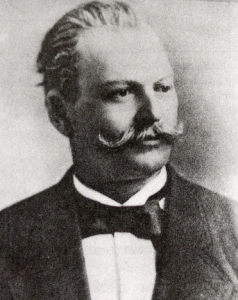
Paul Mauser (1838-1914). Public Domain.
Unlike as has happened many times in military history, this rapid series of rifle adoptions was not a simple case of lining someone’s pockets. On the contrary, it was a vital necessity, as technology was swiftly changing, and the First German Empire had to maintain at least parity with its French neighbor. France had developed smokeless powder in 1884, and swiftly fielded the Lebel Rifle in 1886 to use the new and ‘game changing’ propellant. Mauser’s Gewehr 71 – while a fine weapon, overall – fired a huge (for rifles) 11mm bullet propelled by the now completely outdated ‘black powder’. The Gewehr 1888 (called the “Commission Rifle,” as it was designed by the German Rifle Commission (pdf link)); as a result, the Gewehr 88 was very much literally “designed by committee”, and Mauser, still tied into producing the 1871 model, did not take part in the development of the Gewehr 88. When it became painfully evident that the Gewehr 88 was not the right rifle for the job, the Kaiser’s government turned back to the Mauser family.
The Mauser brothers had acquired the Königlich Württembergische Gewehrfabrik arms factory from the government of Württemberg in 1874; after a series of mergers and divestments that swirled in the highly dynamic environment of late-19th Century Germany, Mauser A.G. would be formed in 1897, under the direction of Paul Mauser.
When the German government turned to Mauser to design a better rifle than the committee-birthed Gewehr 88, Mauser A.G. quickly responded. Mauser had been perfecting a smokeless powder rifle in the decade where other companies were producing the lackluster Gewehr 88. In that decade, Mauser rifles had become a world standard for hunting weapons, renowned for their inherent accuracy and durability.
Rifle line on the march, Dresden, 1914.
The Gewehr 98’s design works, because it is simple, solid and robust. There is very little to go wrong in a Gewehr 98; short of running over it with a tank, or loading it with overpowered cartridges, the rifle just keeps working. It is, very much, the penultimate example of “German over-engineering.” The one real fault in the design of the Gewehr 98 is the fact that its bolt – the heart of the system – did not lend itself very well to the mass production technologies of them time, making the weapon take measurably longer to produce than comparable weapons. Likewise, from a strictly military point of view, the ergonomics of its bolt layout do not lend itself to fast operation; the British SMLE Lee-Enfield and Pattern 1914 rifles remain much faster-operating actions. The “limitation” of the Gewehr 98’s five-round magazine is more an academic issue than a tactical one, especially as its main competitor until 1945, the Lee-Enfield designs – while having a ten-round magazine – also fed from five-round strip-clips, as the 98 does.
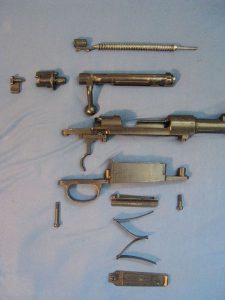
Partially disassembled Mauser Karbiner 98k action, with receiver in the middle, magazine well and magazine assembly below and disassembled bolt on top. Photo credit: wikimedia User “Mauseraction”, 2011. CCA/3.0.
The Gewehr 98 first saw action in 1898, in China, during the Boxer Rebellion, where it performed spectacularly well. By the outbreak of World War One in 1914, the German Army had well over 2 million of the rifles in their arsenals; by the end of the war, more than 7 million more would be produced.
After World War One ended, Germany took the lessons of that war, and produced a new version of the Gewehr 98 – the Karabiner 98k. Based on the same basic Gewehr 98 action, the 98k uses a much shorter barrel, a reduction in length that required the adoption of a new rifle cartridge to make the ballistics work without degrading the life of the barrels. The 98k, in a few models, were produced from 1935 to 1945; eventually producing over 14.6 million units…although records get spotty with many manufacturers towards the end of the war, meaning that the numbers are large – possibly significantly larger.
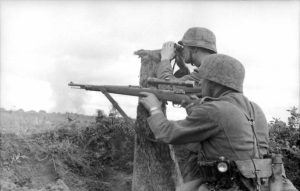
A German sniper armed with a Karabiner 98k with a Zeiss telescopic sight and spotter in position, observing at Voronezh, Soviet Unions, 1942. Photograph by Dieck. CCA/3.0/Germany.
After World War Two, the 98k would continue serving around the world. The Israeli “Haganah” begged, borrowed and stole as many 98k’s as they could lay hands on to arm the new Israeli Army; the Nationalist Chinese would produce their variant until 1949 – and those weapons remained in Chinese service. The 98k, among other “milsurp” bolt-action rifles like the Lee-Enfield and the Russian Mosin Nagant, remained in frontline combat service in many nations well into the 1970’s. Indeed, even today – in the 2020’s – a couple of hundred 98k’s would make for a respectable rebel army.
Graduation ceremony for artillery officers in the Israeli Army (IDF, Israel Defense Forces). The ceremony is taking place in the main basic training base, “Tsrifhim”. Public Domain.
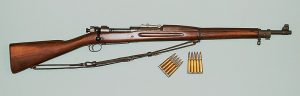
Of course, that is only up to 1945, and only covers weapons produced by Mauser and other German manufacturers. Mauser had let out licenses to many firms around the world to produce first the Gewehr 98, and then the 98k, manufacturers who happily produced millions more copies from China to South America. Indeed, the United States was so impressed by early versions of the 98 (the Mauser 1893) it encountered fighting Spanish troops in the Spanish-American War in 1898, it essentially copied the design outright, causing a lawsuit that resulted in the United States Government having to pay some $3,000,000 (over $45 million in 2023 money) to Mauser (the US Army Ordnance Corps has earned itself a very sketchy reputation over the decades).
Rock Island Arsenal U.S. Model 1903 Rifle, manufactured in 1906. CCA/3.0
The Mauser 98, in a variety of calibers, stock designs, and accessory packs, lives on, in the 21st Century, both as ceremonial rifles for formal military guards, military and police sniper weapons, as well as being the proverbial gold standard for hunting rifles – the Winchester Model 70, the “Rifleman’s Rifle,” is a Mauser 98 action – continues onwards, still being manufactured in many countries, by m several different manufacturers, and shows no signs of ending production anytime soon.
A pre-1964 Winchester Model 70 rifle. CCA/2.0
That’s pretty impressive, for a rifle designed before there was powered, heavier-than-air flight, and that has fought wars in three centuries.
Anyone with even a passing familiarity with modern firearms knows about the AK-47. In fact, we discussed it here, as part of another series. The AK-47 is so well known because it is so widespread, having been handed out at no- or low-cost to so many rifles, that they now appear on national flags and crests.
Flag of Mozambique, showing an AK-47 in the canton. Public Domain.
But the AK-47 was not the first weapon to have this kind of impact. This article is the first part of a two-part series on the rifles that had a similar impact to the AK-47. One of those is still all over the world. This one, however, is nowhere near as well known today.
Gevär m/1867, from the Armémuseum (The Swedish Army Museum) collection. CCA-4.0
As the American Civil War raged, weapons using metallic cartridges began to appear, both in the hands of civilians and on the battlefield. While flashy weapons like the Henry and its descendant from Winchester Repeating Arms are better known, those weapons’ use in the military sphere was very limited. Early cartridge revolvers because popular with cavalry, but the Winchester remained almost solely a civilian weapon.
Armies are conservative by nature. The reason for this is understandable, given the stakes – when a business gambles on new technology, and the new tech fails, that is a very inconvenient; it might even be sad, if it causes the company to fail and costs workers their jobs. In contrast, if an army gambles on new tech and it fails, the consequences can be catastrophic out of all proportion to the technology. Case in point, the mitrailleuse.
Muzzle view of a Mitrailleuse, Les Invalides, Paris. CCA/3.0
The mitrailleuse was supposed to be France’s ultimate war-winning weapons system, able to sweep the Republic’s enemies from the battlefield like wheat before the scythe…The problem? It was kept so secret, no one ever trained the French artillery to handle it, and thus no one ever realized what it really was: a simple volley gun that could be loaded moderately quickly, and didn’t have much better range than the regular French rifles.
When it came to rifles in the post-American Civil War era, militaries around the world weren’t stupid – they knew that breech loading, metal-case cartridge rifles were the wave of the future…but which one was the best to use? Many countries tried various designs from their arsenals. Many other nations, unable to afford the infrastructure to mass-produce their own internal design, did what states have always done:
They went shopping.
The Remington Company of Ilion, New York, had been making firearms and ammunition since 1816. While it was legendary for its staggering levels of management incompetence (it finally folded permanently in 2020, broken into several pieces), it managed to produce a long and majestic line of firearms. And its first real “smash hit” was the Rolling Block.
The single-shot Remington Rolling Block began in 1863 as a slightly different design. Modified to strengthen the breech mechanism, by 1867, the rifle had matured into a solid weapon. It was rugged, reliable, and – most importantly for armies – was the last word in “soldier-proof”: it literally cannot misfire during loading, and cannot fire unless the breech is fully closed. The action was so strong, it needed virtually no modification when smokeless powder was developed in 1884. The only real danger was the chance of a misfired cartridge “cooking off” while it was being removed from the breech.
Remington Rolling Block breech mechanism. CCA/3.0
Remington’s rifle was made in a vast array of calibers and chambering’s. Remington would happily cut barrels for any cartridge provided by the customer. Mechanically much more simple than some thing like a British Martini-Henry and vastly more reliable than the Prussian needle-fired Dreyse rifle, the Rolling Block quickly took the military world by storm.
Although the Rolling Block was never adopted in any great numbers by the United States (due to a very parsimonious Congress), it was adopted by at least forty-seven nations over its lifespan, a staggering achievement for a time (~1880) when there were only about fifty-five “nations” in the world recognized as such.
From the United Kingdoms of Sweden and Norway, to Peru, Qajar Persia and the Papal States (YouTube link), the Rolling Block fought wars, guarded walls and stood in parades for nearly fifty years. It was party to one of the oddities of the Spanish-American War (YouTube link), in 1898. Its last major war was actually World War One (YouTube link), where it served as a second-line rifle for rear area troops. It served countless hunters as far afield as Canada and the heart of Africa, and was “the other buffalo rifle,” next to the Sharps. The last version of the Rolling Block produced by Remington was the elegant “Number 7” target rifle (YouTube link), introduced in 1907.
But, as we will see next week, the Remington Rolling Block was buried in the public mind by a newly arrived competitor in the military rifle market, a rifle what would continue to serve for nearly a century in active military forces, a rifle so iconic, it will likely still be shooting when all the readers of this article will have passed beyond the Pale.
The Freedomist — Keeping Watch, So You Don’t Have To
However, there were other, smaller pneumatic artillery pieces used during the Spanish American War, primarily the 4-inch Sims-Dudley “Dynamite Gun”. The weapon received decidedly mixed reviews: while Frederick Funston, then an American officer advising Cuban guerillas, reported glowingly on it the weapon, Rough Rider commander Colonel (later US President) Theodore Roosevelt was decidedly not a fan.
Sims-Dudley 4 Inch Dynamite Gun on Field Mount, 1898. Public Domain.
But – these were not the first pneumatic weapons carried by US Forces.
Many Americans, confused by hysterical anti-gun propaganda, do not realize that the United States was on the cutting edge of military technology from its inception as an independent nation. From the first nation to issue breech loading, flintlock muskets (YouTube link) to flintlock machine guns (YouTube link), the United States armed forces rarely hesitated to embrace new technology, the American Civil War being the singular exception to the rule.
In 1803, French Consul (and soon-to-be Emperor) Napoleon Bonaparte sold the entirety of France’s “Louisiana” holding to the United States, a land deal that became known as the “Louisiana Purchase”, for $15 million (a paltry $337 million in today’s money), a price that amounted to about $0.03 per acre. Napoleon’s offer stunned the US diplomats sent to negotiate the deal, as they had expected to only buy the port and city of New Orleans. Napoleon offered the deal, as France’s hold over its North American territory was shaky, given that Napoleon was locked in an all-out war with great Britain, and trying to defend such a large territory, that France had never really capitalized on, was a headache he did not want.
It is important to understand the magnitude of this land deal: this massive purchase now comprises all or significant part of the states of Arkansas, Iowa, Missouri, Kansas, Oklahoma, Nebraska, Minnesota, Louisiana, New Mexico, Texas, North Dakota, South Dakota, Wyoming, Montana, Colorado, as well as parts of the Canadian provinces of Alberta and Saskatchewan. This is quite literally the central third of the “Lower 48” states.
A map of the acquired lands of the United States. US Government map. Public Domain.
The problem? No one in the United States really knew what was “out there”: there were only the scattered – and edited – reports of fur trappers and “Mountain Men”, most of whom had good reasons to “creatively edit” their reports. Thus, after the deal was done, President Thomas Jefferson ordered the commissioning of the “Corps of Discovery,” now better known as the “Lewis and Clark Expedition”. The “Corps of Discovery” set out in mid-1804, and returned a little over two years later, in 1806, returning with a wealth of detailed maps and information, that sparked the Western Expansion…
…But that was all in the future.
One of the items carried along with the Corps was a unique and little-known object: an Austrian-made Girandoni Air Rifle.
Various Austrian rifles; Girandoni Air Rifle at center. From the Heeresgeschichtliches Museum firearms collection, 2018. CCA/4.0.
The Girandoni (or “Girardoni,” in some spellings) Air Rifle took its name from its eponymous designer, on Bartolomeo Girardoni, who hailed from the Tyrol region. Very little is known for certain about Girandoni, nor about the development cycle for the rifle named for him; in fact, the date of the invention is not absolutely known, as it was apparently sometime in either 1779 or 1780.
Approximately 1,300 rifles are known to have been made, most of them used by the Austrian Empire. A small number, however, were sold commercially, which is apparently how the Lewis and Clark Expedition acquired their example.
The Girandoni, for the late-18th Century, is a stunningly impressive achievement in “firearms” design. It was a breech loading, lever-operated air gun, feeding from a twenty-round tubular magazine. While not silent, it was quieter than a musket, had no muzzle flash, and produced no smoke from firing, and all in a package that weighed in at just under ten pounds (4.5kg), and less than four feet long.
The air reservoirs were pressurized to between 750 and 1,000 psi (pounds per square inch), giving performances “downrange,” – out to ranges of c.100-125 yards – where the Girandoni’s projectiles would do about the same damage as a modern .38 Special cartridge, and possibly as much as a .45 ACP round, assuming that it was fired from a mostly-full air reservoir. The teardrop-shaped air bottle was screwed into place where the buttstock would normally be. As the rifle delivered almost no recoil to the shooter, the extra weight and mass of a normal stock was not necessary. The Girandoni’s rate of fire was around 20 to 30 shots per minute, depending on air pressure in the reservoir. The three air reservoirs provided with each rifle in Austrian service were refilled, initially, via a hand-pump, not unlike a modern bicycle pump; eventually, an automated pump was mounted in the bed of a small wagon, allowing air bottles to be refilled on the march.
Recreation of an Austrian Girandoni System Accouterments Bag, including spare air flasks, air pump, wrenches, bullet mold and ladle. Army Heritage Museum, U.S. Army. Public Domain.
The “firing mechanism” was almost the exact opposite of a conventional flintlock musket. After tipping the rifle up slightly (to drop a lead ball into position), the shooter would push a block protruding from the left side of the rifle to pull a ball from the tubular magazine into line with the bore. When the trigger was pulled, instead of the ‘cock’ (what we now call the ‘hammer’) falling and striking its flint against the frizzen (the latch over the powder pan) to strike a spark and ignite the powder charge, the Girandoni’s cock tripped an internal hammer that struck a pin; this pin pushed backwards, towards the shooter, and struck the head of a vale – not dissimilar to a trumpet valve – which depressed the valve just enough to release a blast of pressurized air. This burst of pressure struck the back of the ball in the chamber, and propelled it down the barrel. Because of the high pressure in the air bottle, the valve would snap shut almost instantly. The shooter would simply repeat the process, until either the ammunition tube was empty, or the air pressure in the reservoir had dropped too low to continue firing.
Needless to say, this seemed to be a definite revolution in military firearms. The Lewis & Clark Expedition made numerous comments in its reports about how impressed and intimidated the Native American tribes were when the Corps demonstrated the Girandoni to them.
The question, then, is: Why didn’t the Girandoni become the new dominant military rifle?
The Girandoni, for all its very impressive performance, was both an expensive and comparatively delicate weapon. Militaries of the time knew very well that when things “went sideways,” as they often do, troops needed a longarm that could withstand combat with bayonets, or be used as a very heavy club – actions that would shatter a Girandoni.
The Girandoni was very useful in the hands of well-trained, independent-minded skirmisher troops, but was not “soldier-proof” (to use the more polite modern phrase), and, even in the hands of well-trained troops, it did not provide enough of an advantage to justify its expense in even limited service.
As with many things, “newer” does not necessarily mean “better”. This is as true today, as it was c.120 years ago…
…Would that people in positions of responsibility would understand that idea more.
The Freedomist — Keeping Watch, So You Don’t Have To
Back FREEDOM for only $4.95/month and help the Freedomist to fight the ongoing war on liberty and defeat the establishment's SHILL press!!
Are you enjoying our content? Help support our mission to reach every American with a message of freedom through virtue, liberty, and independence! Support our team of dedicated freedom builders for as little as $4.95/month! Back the Freedomist now! Click here