
In the summer of 1907, four armored warships slid into the Danube at Galați, Romania, attended by the royal family, government ministers, and a crowd that understood they were witnessing something significant. The ships were monitors — low-hulled, heavily armored river warships carrying naval guns in purpose-built turrets — and their appearance on the lower Danube completed a quiet arms race that had been running for nearly four decades along one of Europe’s most contested river frontiers. Austria-Hungary had been building Danube monitors since 1871. Romania had watched, waited, and was now answering in kind. The weapons they were building were not improvised solutions. They were purpose engineered warships, designed from the keel up by naval architects with established shipbuilding industries behind them. Understanding what they were, and what distinguished them
from the tank boats that would appear on the same river thirty years later, begins with understanding why the Danube needed warships in the first place.
The River As A Frontier
The Danube in the late nineteenth century was not merely a river. It was a political boundary, a commercial artery, and a military problem of the first order simultaneously. For Austria-Hungary, the Danube connected Vienna to the empire’s Balkan frontier, running through Hungarian territory and then tracing the border with Serbia and Romania before it reached the Black Sea. A river that wide and that long required armed patrols — not to fight fleet actions, really, but to enforce sovereignty, project firepower along banks where roads were absent or unreliable, and deny the river to an enemy seeking to use it for their own movement.

The Habsburgs had recognized the military requirement for river warships long before the monitor era. What the wars of the mid-nineteenth century demonstrated, however, was that the kind of vessel the Danube demanded was specific: shallow enough in draft to operate in channels that would strand a seagoing warship, armored well enough to absorb shore fire, and armed well enough to answer it. The American Civil War’s river monitor campaigns on the Mississippi and its tributaries had provided a template that European naval architects were paying close attention to. What the Austro-Hungarian Navy took from that experience was the principle of the purpose built river fighting ship — not a gunboat improvised from a commercial hull, but a warship designed for riverine conditions from the outset.
The Austrian Solution: Leitha And Her Descendants
The SMS Leitha and SMS Maros, completed in 1872 and built at the Pest Flumaner Schiffbau yard in Budapest], were the first river monitors in Europe — a distinction that sometimes surprises readers who assume the type was purely an American invention. Naval architect Josef von Romako oriented his design along the American monitor principle but adapted it specifically for Danube conditions: twin screws driven by high-pressure steam engines, a draft of just 1.3 meters, and an armament of two 150mm guns behind an armored casemate, later refitted with a 120mm gun in a rotating mount. At 50.5 meters in length and 310 tons, the Leitha class was small enough to navigate the middle Danube’s shallower reaches while carrying firepower that no riverbank fortification could ignore. SMS Leitha fired the first shot of the class in anger against Ottoman forces in Bosnia in 1878, during the occupation that followed the Congress of Berlin — the same campaign that gave Austria-Hungary control of territories that would be burning with nationalist conflict by 1914.
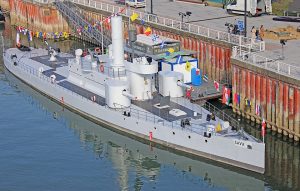
The Austro-Hungarian monitor program continued in measured pairs across the following decades, as was the parliamentary custom — one hull for each legislature to fund. The Körös class of 1892 represented a significant upgrade: 448 tons displacement, a twin 120mm gun turret forward, belt armor running to 50mm, and a complement of 77 men. Then came the Temes class, the most capable of the pre-war generation, carrying 120mm Škoda naval guns and 70mm belt armor on a hull long enough to project genuine firepower across any reach of the river. By 1914 the Austro-Hungarian Danube Flotilla deployed six monitors in various states of modernity, the oldest — Leitha and Maros, both over forty years in service at that time — still capable enough that they were kept in commission rather than scrapped. On the morning of July 29, 1914, the flotilla fired the first artillery shots of the First World War, bombarding Belgrade from the Sava River — the Temes and Bodrog opening up against Serbian positions while the diplomats in Vienna were still drafting their final messages.
Romania’s Answer
Romania’s relationship with the Danube was as foundational as Austria-Hungary’s, but its strategic geometry was different. Romania lay along the river’s lower reach, where the Danube defined the border with Bulgaria and provided the only practical avenue for projecting military force toward Ottoman and later Bulgarian territory — or, critically, for defending Romanian soil against forces crossing from the south. Romanian independence, formalized in 1878 after the Russo-Turkish War, brought with it Black Sea access through the Dobruja coast, but it also brought the long-term challenge of maintaining a credible military presence on a river that Austria-Hungary was actively arming.
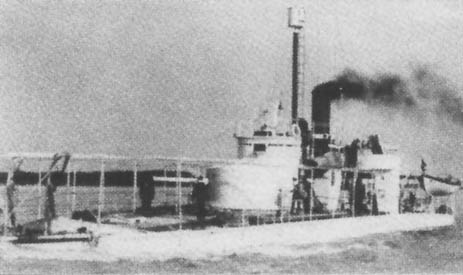
The Romanian Danube Flotilla had existed in some form since 1860, accumulating gunboats through the 1880s and 1890s — small, lightly armed craft adequate for patrol but not for battle against armored opponents. The monitor program of the early twentieth century was Romania’s answer to the regional arms environment, and it was ambitious. The four ships of the Bratianu class were built in sections by the Stabilimento Tecnico Triestino in Austria-Hungary, transported to Romania by rail, then assembled and launched at the Galați naval yard between 1907 and 1908 — an arrangement that reflected both Romania’s limited industrial capacity for major warship construction and the paradox of a state purchasing military hardware from the power it was quietly arming against.
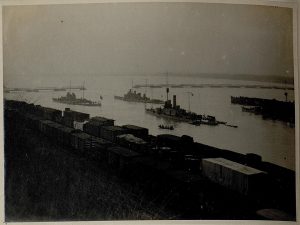
The result was formidable by river standards. At 680 tons displacement and 63.5 meters in length, the Bratianu-class monitors were larger than their Austro-Hungarian counterparts. They carried three 120mm Škoda naval guns in individual turrets arranged in a triangular pattern, along with 120mm howitzers for plunging fire against troops on the riverbanks — a weapons fit designed not just for ship-to-ship action but for the direct fire support of ground operations across the river. Belt armor ran to 70mm. At 13 knots they were faster than the older Austrian monitors they might one day face. When all four were commissioned in September 1907, Romania named them after the 19th-century statesmen who had shaped the nation’s independence: Ion C. Bratianu, Lascar Catargiu, Mihail Kogalniceanu, and Alexandru Lahovari — a deliberate statement that these were instruments of national sovereignty, not just naval hardware.
A Notable Footnote: Rozhestvensky On The Danube
Before the monitor era fully matured, the Danube theater attracted at least one figure whose later career would define the limits of nineteenth-century naval thinking. Admiral Zinovy Rozhestvensky, best known to history as the commander who led the Russian Baltic Fleet to catastrophic defeat at the Battle of Tsushima in 1905, spent the years 1883 to 1885 seconded to the newly formed Bulgarian Navy, organizing its nascent naval forces and designing a coastal defense scheme along the Black Sea — operating, that is, at the far end of the same river system where the monitor arms race was taking shape. The connection is oblique, but worth noting: the same geopolitical reorganization that followed the 1877–1878 Russo-Turkish War that created Romanian independence and redrew the Balkan map also created Bulgaria’s autonomy and the need for a Bulgarian naval force. Rozhestvensky, wiedly regarded as a fine naval officer, was one of Russia’s answers to that need — a gunnery specialist sent to instill European naval practice in a new state. That his career ended in the worst naval disaster since Trafalgar is, in this context, a footnote rather than the story. The story is the environment he moved through: a region of new states, contested rivers, and the urgent question of who controlled them.

What The Monitor Represented — And What It Didn’t
The pre-WWI Danube monitors were, in the fullest sense, genuine warships. They required established naval architecture, purpose-built shipyards, specialized gun mounts, trained crews, and supply chains for naval-grade ammunition that did not overlap with anything an army used. The Bratianu class’s Škoda naval guns were not the same weapons in any logistical sense as the Škoda field artillery serving Romanian or Austro-Hungarian ground forces — different mounts, different ammunition, different maintenance regimes, different institutional homes. This is precisely the distinction that the tank boat concept would later dissolve: the idea that a riverine fire support vessel had to be a warship in this full sense, drawing on naval industry and naval logistics, rather than a hybrid that reached sideways into the army’s supply chain.
Romania’s monitors demonstrated the strengths of the purpose-built approach during the First World War. During the Battle of Turtucaia in 1916, the monitors supported Romanian ground forces and evacuated the besieged Romanian 9th Infantry Division under fire — exactly the kind of combined-arms riverine operation that justified the investment in armored hulls and heavy guns. The Austrian monitors did the same on their side of the line, shelling Romanian positions and supporting river crossings. Both fleets performed as designed.
What neither fleet could do was be improvised quickly, or cheaply, or by a state without a shipbuilding tradition. The Soviet engineers who developed the bronekater in the early 1930s were not building monitors because they didn’t know what monitors were. They were building tank boats because they understood the monitor’s industrial prerequisites — and because post-civil-war Soviet Russia did not reliably possess any. The Danube monitors represent the high road of riverine warfare, the answer available to states with the industrial depth to build genuine warships. The tank boat represents the other road — the answer available to everyone else. The same river eventually saw both solutions at work, often within artillery range of each other, which is perhaps the most concise possible illustration of why the distinction matters.