
Last week, we looked at the M72 LAW – a 1963 American design that refused to die, and recently earned a genuine second act through Norwegian engineering ingenuity. This week, we look at the weapon on the other side of that Cold War equation: the RPG-7. Where the M72 is the more elegant solution – lighter, more sophisticated, but ultimately more expensive to produce – the RPG-7 is the Soviet answer to the same problem, while coming from a fundamentally different philosophy about what this sort of weapon system is supposed to be.
The weapon’s full designation is Ruchnoy Protivotankovy Granatomyot-7 – “Hand-held Anti-tank Grenade Launcher, Model 7” – though the English backronym “Rocket-Propelled Grenade” has stuck hard enough that most people have forgotten it was ever anything else. Development began in 1958, to replace its predecessor, the RPG-2 the weapon was formally adopted by the Soviet Army in 1961, and it has not stopped being produced or used since. Over nine million units have been manufactured. It has seen combat in more than 80 countries. It is, without serious competition, the most widely distributed anti-armor weapon in the history of warfare.
Design Philosophy
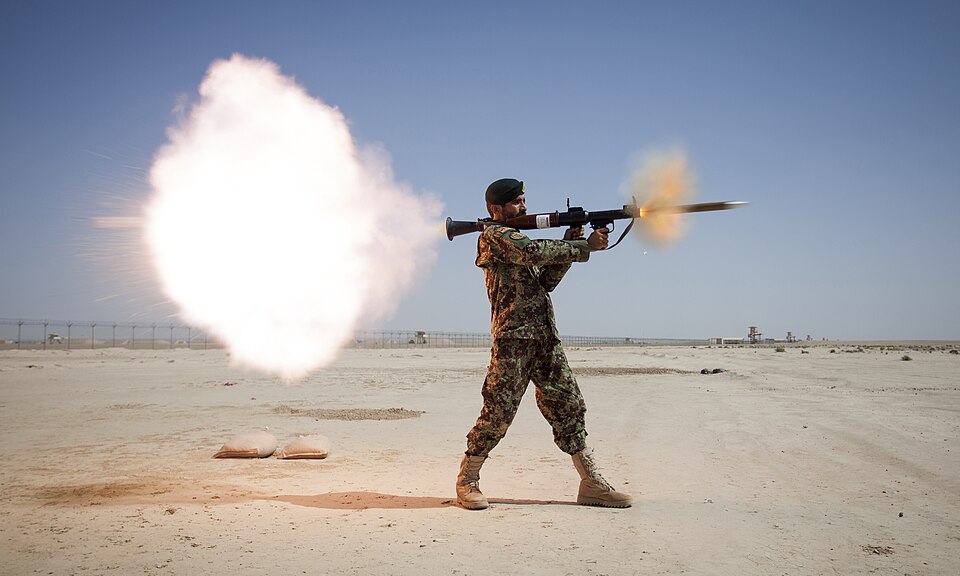
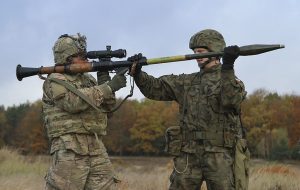
The RPG-7’s design lineage is still the same as the M72 – the US bazooka, and the German Panzerfaust, both attempting to solve the fundamental problem of giving infantry a fighting chance against armor at range – but the Soviet solution diverged sharply at the design level. Where the M72 is disposable and self-contained, like the Panzerfaust, the RPG-7 is reusable like the bazooka. The launcher tube – a 40mm steel tube, wood-wrapped for heat protection, weighing about 15 pounds – is a permanent asset. The rocket-propelled grenades are loaded separately at the muzzle, with the oversized warhead protruding forward of the tube in the weapon’s distinctive silhouette.
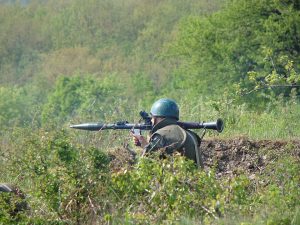
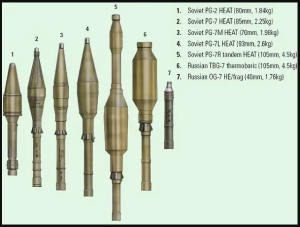
This reusability carries real tactical implications. A squad equipped with RPG-7s can carry multiple warhead types for the same launcher – anti-armor, anti-structure, thermobaric, fragmentation – and select the appropriate round for the target. The M72 gives you one round per tube. The RPG-7 gives you one launcher and as many rounds as your ammunition bearers can carry (typically three spare rounds per carrier). For conventional Soviet infantry doctrine, which envisioned massive combined-arms engagements against NATO armor in Central Europe, this made sense. One RPG-7 per motorized rifle squad (https://www.globalsecurity.org/military/library/report/1998/infantry-rpg.htm) was the standard Soviet assignment – a number that irregular forces consistently exceeded in practice, if at all possible.
The weapon does, however, present real limitations that deserve honest acknowledgment. A 1976 U.S. Army evaluation found that in an 11 km/h crosswind, a gunner firing at a stationary, tank-sized target could not expect a first-round hit more than 50% of the time at 180 meters. The backblast, while less dangerous than many Western counterparts in confined spaces – Soviet doctrine allowed firing from inside rooms with only two meters of standoff – is still substantial and signature-generating. And the weapon’s effective anti-armor range tops out around 300 meters against a moving target, limiting its utility as armor protection has advanced.
But its strengths are formidable, and they are the strengths that matter most in the environments where most of the world’s actual fighting gets done.
Combat Record
The RPG-7’s first confirmed combat use was during the Six-Day War in 1967, and it has barely paused since. In Vietnam, it became the primary tool of North Vietnamese and Viet Cong forces against American armor and, critically, helicopters – a use case the weapon was never designed for, but adapted to with lethal effectiveness. In Afghanistan during the Soviet occupation, the Mujahideen employed it as their weapon of choice against Soviet armor, APCs, trucks, and helicopters, averaging one RPG for every ten to twelve fighters in the field…or, roughly one RPG-7 per squad.
The Battle of Mogadishu in 1993 produced the RPG-7’s most famous moment in American military consciousness: Somali militiamen used the weapon to shoot down two U.S. Army MH-60 Black Hawk helicopters, triggering the events immortalized in the 1999 book and 2001 movie “Black Hawk Down“. The irony runs deep – the CIA had taught Afghan Mujahideen how to use the RPG-7 against Soviet helicopters during the 1980s, and the technique came back to haunt the US military.
In Chechnya, the weapon demonstrated what disciplined urban employment looked like. Chechen hunter-killer teams of three to four fighters – an RPG gunner, a machine gunner, and a sniper – simultaneously engaged single Russian armored vehicles from multiple elevations, including ground level, second and third stories, and basements, while the sniper and machine gunner suppressed supporting infantry. Russian armored columns in Grozny during the first Chechen war may have lost 100 tanks and 250 armored fighting vehicles. This is the tactical template that every urban army has had to study since.

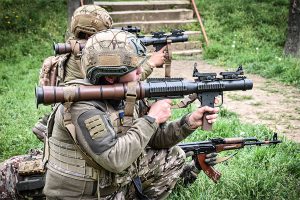
In Ukraine today, the weapon is in simultaneous use by both sides – Ukrainians firing Soviet-designed RPG-7s against Soviet-designed tanks, while Russian forces do the same. Texas-based AirTronic USA has supplied a modernized American variant, the PSRL-1, to Ukrainian forces – a US-built RPG-7 derivative, fighting Russian armor. The symmetry is almost poetic.
The Broader Point
The RPG-7 costs somewhere under $500 per launcher. Warheads run roughly $100 to $500 per round depending on type. A single M1 Abrams main battle tank costs approximately $10 million. The math here is not complicated, and it is precisely that math that drives procurement decisions in most of the world’s militaries – not the ones planning to fight peer adversaries across the Fulda Gap, but the ones planning to fight the wars that actually happen: insurgencies, urban battles, and asymmetric confrontations where the side with the RPG-7 does not need to win every engagement, only enough of them, among other modes of warfare.
The M72 and the RPG-7 are mirror images of the same Cold War problem, solved by two different industrial philosophies. One is elegant, lightweight, and disposable. The other is crude, heavy, reloadable, and has outlasted every attempt to declare it obsolete. Both are still operating on the world’s battlefields today.
Next time: the Carl-Gustaf — the recoilless rifle that splits the difference.