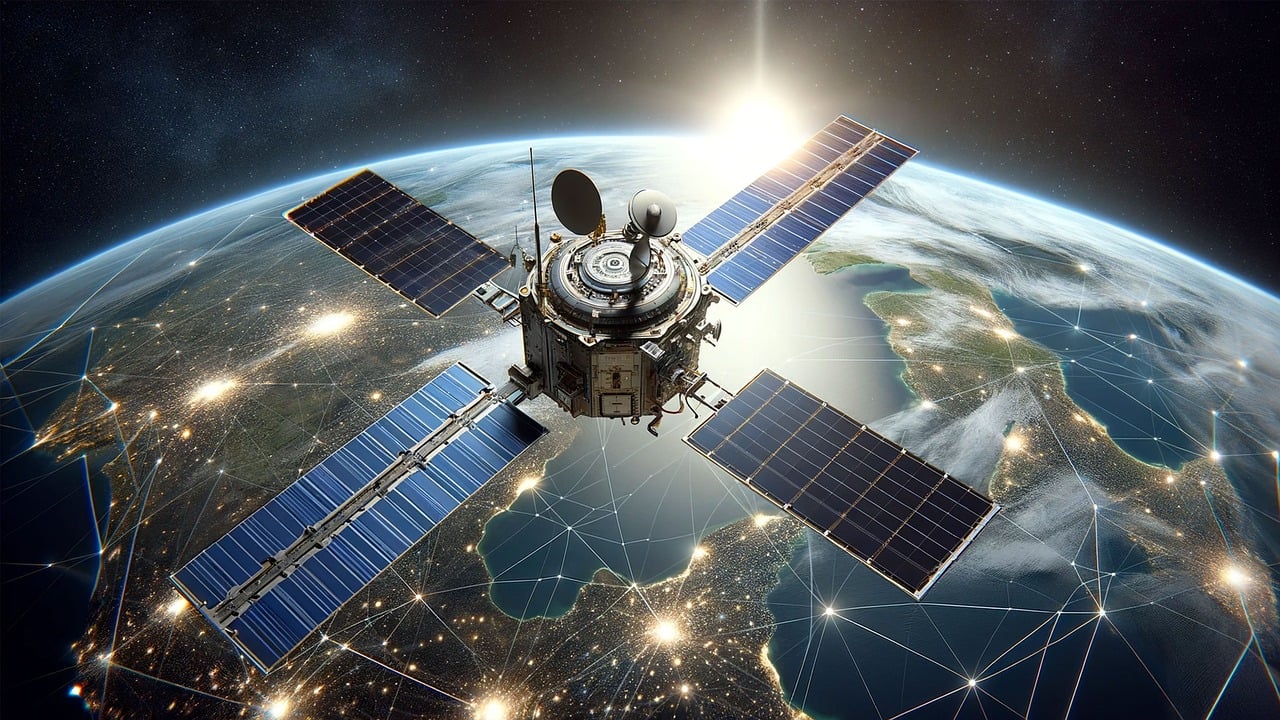

Not too long ago, access to satellite imagery was firmly relegated to the realm of spy movies and top-secret government agencies. Times have certainly changed. Today, anyone with an internet connection can access detailed satellite images of almost anywhere on Earth. This democratization of satellite intelligence is reshaping how we understand global events, conduct business, and even wage war.
From Military Secrets to Public Domain
Before roughly 2000, good- to high-quality satellite imagery was the exclusive domain of superpowers. The United States and the Soviet Union spent billions during the Cold War to launch spy satellites, gaining a bird’s-eye view of each other’s military activities. This open access to the ultimate “high ground” forced every national government that wanted to try and keep their secrets out of public view to become highly creative in hiding facilities. As advanced sensors developed, so too did methods of concealment. Fast-forward to the 21st Century, and companies like Planet Labs and Maxar Technologies are providing high-resolution satellite imagery to paying customers – be they governments, corporations, or even individuals. Not only that, but many of these high-quality are now finding their way into free-access platforms, such as Google and Bing Maps, but even such unlikely sites as NatureFocused – offer very high-quality maps featuring regular, street-type maps, but also very recent satellite imagery and highly detailed terrain maps.
This shift has profound implications. Suddenly, small countries, NGOs, citizen journalists – even terrorists – now have access to intelligence that was once the privilege of only the most powerful nations. It’s like giving everyone a seat at the geopolitical poker table and letting them peek at each other’s cards.
Changing the Game in Global Politics
So, how exactly is this changing the political landscape? For starters, it’s making it a lot harder for governments to hide their activities. Take the recent conflicts in Ukraine and the Middle East. Civilian satellites routinely capture troop movements, missile launches, and the aftermath of strikes, often before official sources confirm them. This frequently happens in real-time, with independent verification changing (and often confusing) how we understand and respond to global crises.
But it’s not just about conflict zones. Environmental groups are using satellite imagery to track deforestation, oil spills, and illegal fishing. Human rights organizations can now monitor refugee movements and verify claims of atrocities. While it may seem like having a “global watchdog” that never sleeps, there are issues of misinterpretation – both accidental and deliberate – that can and do muddy the waters, giving false impressions through outdated images, failures of interpretation, or any number of other issues, technical or human.
The Double-Edged Sword of Warfare
In the realm of warfare, easy and (mostly) free access to recent, high-grade satellite intelligence is a “game-changer”. Military strategists now have to assume that their movements are being watched not just by enemy governments, but also potentially by anyone with an internet connection. This transparency can act as a deterrent to aggression, but it also means that the element of surprise in military operations is becoming a thing of the past.
In the hoary old days of 1983, the Reagan administration launched “Operation Urgent Fury“, to invade the Caribbean island nation of Grenada, which had collapsed into chaos as different factions of the ruling party wrestled for control. This placed the safety of some 400-odd American medical students in question, and the Reagan administration – which had come to power at least partly as a result of the previous administration’s failure in dealing with the Iranian Hostage crisis – was not about to risk a repeat performance on its doorstep.
While there was never any doubt that the United States military would win a conflict in Grenada, it was discovered – much to the consternation of all planners – that there were no detailed maps of Grenada inside the US cartographic system. US Army planners were forced to purchase tourist maps of Grenada just outside the gates of their bases, hand-draw grid reference lines and the estimated locations of targets on those rudimentary maps, then photocopy those maps and hand those out to troop leaders.
The issue was that there were very few “recon birds” – the colloquial term for reconnaissance satellites – in orbit at the time, and those satellites were not easy to “re-task”. Grenada was so “off-the-radar” in the United States, some intelligence officers wondered why they were being ordered to plan an invasion of the city of “Granada” in Spain.
Humor aside, this was clearly a serious problem…and one that would not be replicated today, in any army in the world worthy of the name. Today, anyone with an internet connection can utilize free tools (often coming as “stock” programs with many computers) that the battle planners of “Urgent Fury” – or, for that matter, “Desert Storm” – could have dreamed of.
Unfortunately, that also includes terrorists.

The 2008 attack on Mumbai, India, by the terror group “Lashkar-e-Taiba“, were planned and directed in real-time using stock personal computers, an internet connection and tools like Google, to verify targets, observe news reports on the fighting in real-time, and to generate maps that were used for plotting the progress of their operations on target.
Likewise, there are now commercially available tools, like “ATAK“, that approach military and national intelligence agency tool-sets in quality. These free, or at least low-cost, programs are well within the reach of private individuals, to say nothing of terror groups and small governments and their military forces.
These realities have proven the wisdom of the United States Marine Corps’ “Small Wars Manual“, published in 1940, which warned that what the West now calls “Third World” forces were improving their abilities and acquiring more modern weapons and equipment, and that the result would be that “First World” forces would have to be willing and able to adapt and evolve faster than those forces could.

The Road Ahead
As we look to the future, it’s clear that easy access to satellite intelligence will continue to play an increasingly important role in shaping our world. We’re likely to see even more detailed imagery, combined with AI and machine learning to provide real-time analysis of global events.
This technology has the potential to increase transparency, hold powerful actors accountable, and provide crucial information in times of crisis. But it also risks further eroding both personal and start privacy, and potentially destabilizing delicate geopolitical situations in unforeseen ways.
One thing is certain: the “view from above” is here to stay, and it’s changing how we see our world, literally. As this technology continues to evolve, it will be up to all of us – governments, businesses, and citizens alike – to figure out how to use it responsibly and effectively.
In a world where everyone can be a satellite superpower, the challenge will be learning how to use this newfound vision wisely.