

Part 1 – What Does That Smudge Actually Say, Again?
Maps are funny things. As an old saying goes,
“When in doubt, look at a map – it will always tell you something. It may not be anything you don’t already know, but it will tell you something…”
As with most old sayings, though, this particular one is very nuanced in its meaning.
Maps, in a military or geopolitical sense, are usually a two-dimensional representation of a three-dimensional sphere. Modern computer systems can approximate an accurate 3-D picture of terrain, but those developments are relatively new. For thousands of years, the few maps that existed were very crude, verging into the abstract. Beginning only in the late 18th Century, did maps begin to add more accurate details and consistent distance scales.
Maps, then – as we understand the term – are a surprisingly recent phenomenon. But OH! The power and magic they convey! Depending on your point of view – and your immediate needs – maps can become works of holy writ, exuding an illusion of absolute truth. This is especially important when talking about borders, and where you intend to defend them. And, if you can find an old map whose details you can…“selectively interpret”…those maps can feed visions of military glory…
…Or offer desperate and failing governments a lifeline to motivate (they hope) a depressed and reactionary population.
This was the story in 1982, when the military junta of Argentina, led by General Leopoldo Galtieri, realized that national economies cannot be managed like a military budget, especially when their “security policy” was like some weird nightmare, left over from World War 2. What to do? Galtieri & Co. thought they found an answer in old maps.
There had been an old dispute with the United Kingdom over a group of islands two hundred odd miles east of Argentina, well into the Atlantic Ocean: the Falkland Islands.
The uninhabited, barren and windswept islands had been sort-of settled first by Spain…then England…then Spain again…the Argentina again, until the English returned and made their claim permanent by deporting the few Argentinean colonists back to the mainland, and establishing a colony devoted to sheep herding, maintaining a station for whaling ships, and later, a coaling station for the Royal Navy.
For about one hundred and fifty years, Argentina repeatedly tried to get England into talks to return the islands to them; England was never really interested in talking about anything of the kind, but were too polite to simply tell Argentina to go pound sand – the islands were England’s; English people had settled on the islands and actually developed them; and they had formed a part of England’s military strategies for decades. It just wasn’t going to happen.
But then…Britain’s colonial empire eroded into nothingness, replaced by a loose economic sphere of former colonies, that England didn’t really bother trying to control too closely. Empires, you see, are extremely expensive to create and maintain, and after the hellscapes of World Wars 1 and 2, the people of England more or less lost all interest in spending literal blood and treasure to maintain decisive control over colonies with unhappy and unruly populations, which produced – overall – very little to justify their expense. On top of this, eliminating the ability of people to elevate themselves into higher positions on the social standing tree meant that conquest was just another job that was hard, dangerous, and offered little to show for the effort.
To Galtieri and his junta, this seemed like a great time to “revisit the ownership” of the Falklands – after all, England’s main military and economic focuses were on Europe and the Mediterranean. Surely, they wouldn’t mind be relieved of the burden of paying for less than settlers at the literal opposite end of the earth.
This is the sort of “logic” that desperately unpopular and extremely unworldly people engage in, using the post-operative mantra, “Well, it seemed like a good idea at the time!”
Britain, it turned out, was done with giving away things. And, with the after-image of the Iranian Hostage Crisis in the very recent past, it was not about to give ‘hostile actors’ around the world the notion that the few remaining British territories were up for grabs.
The result – the Falklands War – was a dramatic reminder that even the remnants of empires can be extraordinarily dangerous to provoke. Now, if the Reader thinks that the Falklands War served as a teaching tool to petty dictators to not trust old maps, you would be sadly mistaken.
Cut to the last weeks of 2023.
Part 2 – Other People’s Money
The Communist dictator of Venezuela, Nicolás Maduro, has finally recognized that the policies begun by his predecessor, Hugo Chavez – policies that Maduro enthusiastically expanded on – have resulted – to borrow the immortal words of Margaret Thatcher, the British Prime Minister who determined that Britain would, indeed, fight for the Falklands – in Maduro “running out of other people’s money.”
Venezuela, which should be a ridiculously wealthy nation due to its vast oil reserves, has had its economy and business sectors so badly managed by the Chavez-Maduro regime, that the country is now one of the poorest nations on the planet. And this comes far ahead of any sanctions placed on the country by the United States or anyone else.
Because of the failing economy he is actively trying to destroy, Maduro has decided to revive an old map dispute on his eastern border. You see, Venezuela’s eastern neighbor – Guyana – is a former colony of Britain, about the size of Idaho, but with only half the population. In 1966, just prior to granting Guyana independence, Britain (speaking for Guyana) and Venezuela both agreed to arbitrate the border dispute in the International Court of Justice (ICA). Neither country really pulled out the stops to press negotiations, however, because there was no real need; like many such disputes, this one just laid around, gathering dust.

But now, the winds are blowing in different directions.
Maduro – like most totalitarian dictators – relies on the illusion of “the democratic process” to stay in power. In this case, no election since the ascension of Chavez has been “legitimate” – it’s an open secret, but as long as Maduro stayed within his own borders, no one outside of Venezuela – including successive Presidential administrations in the United States – really cared.
In 2015, however, oil was discovered off the coast of Guyana – in the area off the shore of the disputed region. And, in September of 2023, Guyana issued drilling licenses to various oil companies, including ExxonMobil (which had several oil facilities in Venezuela nationalized many years ago).
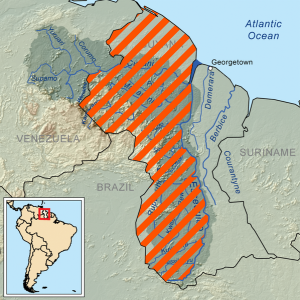
And in November of 2023, Maduro suddenly announced that his government would hold a referendum among the Venezuelan people, to see if they would mind their government annexing the disputed region, and telling the international courts to shove off. Surprising absolutely no one outside of the denizens of upscale café’s in Hollywood and New York – and, of course, Starbucks’ outlets – Venezuelans “voted overwhelmingly”, as in 95% of voters, that yes, their country should absolutely invade and dismember a neighbor that they have never fought a war with.
Now, it would wrong to assume that this situation is about oil, per se. Oil is a component in this situation, but it is actually not that far into Maduro’s wheelhouse. Maduro’s real problem is that he is up for reelection in 2024, and Venezuelans – like Argentineans before them – are getting fed up with the charade…and Maduro’s real fear is that Venezuelans may just “go all Romanian” on him.
That’s not a bingo card entry anyone wants.
Like Galtieri before him, Maduro is hoping that starting a war will make him popular enough at home to easily retain power – that’s known as “not changing horses in midstream.” The problem? Guyana, while it does not have a very large military, is not an island…Guyana and Venezuela share a border in the disputed region with a third nation: Brazil.
Brazil is a massive and powerful nation within the region. Even given the ludicrous and destructive policies of its current ruling party, the Brazilian economy is a powerhouse, regionally. As well, its armed forces are nothing to mess with; the Brazilian military – at all levels – seriously outclasses that of Venezuela. Maduro’s outlandishly comical “referendum” is so divorced from reality, not even a hardened Socialist leader like Lula da Silva can let such an idea go.
This is shaping into a potential three-way war, which could include a rarity, for the modern day: and actual naval battle. This is due to the geography of the region, with puts a large amount of the disputed region within range of naval forces’ fire support capabilities on the Caribbean coast, to say nothing of the extensive network of rivers that form the best highways in the interior.
In any shooting war, Venezuelan forces will be at a serious disadvantage if Brazil enters the fray.
This does, however, beg the question: What about the United States?
In the United States, the administration of Joe Biden is giving typically half-hearted and limp-wristed lip service to tell the kids in the south to calm down. The Swamp – or, if you prefer, “Sodom on the Potomac” – is far more concerned with events in Ukraine, Israel, and potentially in the Bab al-Mandeb, at the southern entrance to the Red Sea, to worry about a minor territorial squabble in South America. Functionally, refusing to take decisive action on its proverbial doorstep would be a foreign policy disaster on a scale with Jimmy Carter’s inability to deal with the Iranian hostage crisis.
…So – is there a “wild card” in this mess? Yes, there is: ExxonMobil.
Big Oil is not dead. Far from it. Venezuela long ago parted company with ExxonMobil and other foreign oil producers. And now, from ExxonMobil’s view, Maduro is trying to muscle in on their turf, yet again.
But ExxonMobil is “just a corporation,” right? What could they possibly do? Twenty years ago, that answer would have been simple: suck it up, count your losses, and find somewhere else…But that was twenty years ago, and a lot has happened since then.
There is absolutely nothing stopping ExxonMobil – especially in concert with other corporations – from fielding its own armed forces…including naval and air forces…to insert themselves into a potential Venezuela-Guyana war, if the potential returns are worth the risks. Guyana’s estimated 11 billion barrels (at the low end) is a pretty big incentive.
This last scenario would be no more than an interesting action-adventure story, if the players in Washington, DC, were not so incompetent and self-absorbed.
Happy voting.






What a wonderful thing! This piece of writing is just outstanding in every way. We are extremely grateful for the information that you have provided.