Last week, we discussed the Remington Rolling Block rifle, a weapon nearly forgotten outside of “gun-person” circles. To recap, the Rolling Block design equipped all or portions of the military forces of most of the nations on the planet, from the end of the American Civil War to World War One. Over a period of some fifty-odd years, the design had an impact out of all proportion to its simple design.
This week, we will look at the weapon that dethroned the Rolling Block – a weapon that is still being made, today. A rifle so iconic, it essentially stands as the image of “rifle” in the minds of most people.
That rifle is the legendary Mauser 98.

Imperial Germany had introduced the Gewehr 1888 to replace its Mauser Model 1871 (adopted as the Gewehr 71 or Infanterie-Gewehr 71, or “Infantry Rifle 71”) that had been designed by Mauser (originally Königlich Württembergische Gewehrfabrik (“Royal Württemberg Rifle Factory”)), of brothers Peter and Wilhelm.
Unlike as has happened many times in military history, this rapid series of rifle adoptions was not a simple case of lining someone’s pockets. On the contrary, it was a vital necessity, as technology was swiftly changing, and the First German Empire had to maintain at least parity with its French neighbor. France had developed smokeless powder in 1884, and swiftly fielded the Lebel Rifle in 1886 to use the new and ‘game changing’ propellant. Mauser’s Gewehr 71 – while a fine weapon, overall – fired a huge (for rifles) 11mm bullet propelled by the now completely outdated ‘black powder’. The Gewehr 1888 (called the “Commission Rifle,” as it was designed by the German Rifle Commission (pdf link)); as a result, the Gewehr 88 was very much literally “designed by committee”, and Mauser, still tied into producing the 1871 model, did not take part in the development of the Gewehr 88. When it became painfully evident that the Gewehr 88 was not the right rifle for the job, the Kaiser’s government turned back to the Mauser family.
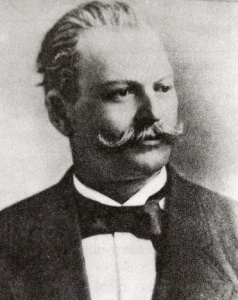
The Mauser brothers had acquired the Königlich Württembergische Gewehrfabrik arms factory from the government of Württemberg in 1874; after a series of mergers and divestments that swirled in the highly dynamic environment of late-19th Century Germany, Mauser A.G. would be formed in 1897, under the direction of Paul Mauser.
When the German government turned to Mauser to design a better rifle than the committee-birthed Gewehr 88, Mauser A.G. quickly responded. Mauser had been perfecting a smokeless powder rifle in the decade where other companies were producing the lackluster Gewehr 88. In that decade, Mauser rifles had become a world standard for hunting weapons, renowned for their inherent accuracy and durability.

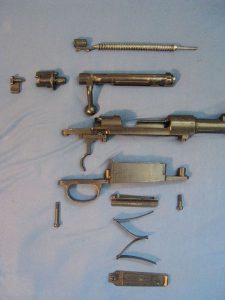
The Gewehr 98’s design works, because it is simple, solid and robust. There is very little to go wrong in a Gewehr 98; short of running over it with a tank, or loading it with overpowered cartridges, the rifle just keeps working. It is, very much, the penultimate example of “German over-engineering.” The one real fault in the design of the Gewehr 98 is the fact that its bolt – the heart of the system – did not lend itself very well to the mass production technologies of them time, making the weapon take measurably longer to produce than comparable weapons. Likewise, from a strictly military point of view, the ergonomics of its bolt layout do not lend itself to fast operation; the British SMLE Lee-Enfield and Pattern 1914 rifles remain much faster-operating actions. The “limitation” of the Gewehr 98’s five-round magazine is more an academic issue than a tactical one, especially as its main competitor until 1945, the Lee-Enfield designs – while having a ten-round magazine – also fed from five-round strip-clips, as the 98 does.

The Gewehr 98 first saw action in 1898, in China, during the Boxer Rebellion, where it performed spectacularly well. By the outbreak of World War One in 1914, the German Army had well over 2 million of the rifles in their arsenals; by the end of the war, more than 7 million more would be produced.
After World War One ended, Germany took the lessons of that war, and produced a new version of the Gewehr 98 – the Karabiner 98k. Based on the same basic Gewehr 98 action, the 98k uses a much shorter barrel, a reduction in length that required the adoption of a new rifle cartridge to make the ballistics work without degrading the life of the barrels. The 98k, in a few models, were produced from 1935 to 1945; eventually producing over 14.6 million units…although records get spotty with many manufacturers towards the end of the war, meaning that the numbers are large – possibly significantly larger.
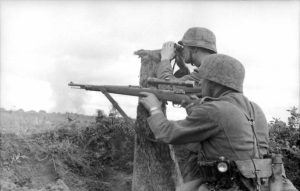
After World War Two, the 98k would continue serving around the world. The Israeli “Haganah” begged, borrowed and stole as many 98k’s as they could lay hands on to arm the new Israeli Army; the Nationalist Chinese would produce their variant until 1949 – and those weapons remained in Chinese service. The 98k, among other “milsurp” bolt-action rifles like the Lee-Enfield and the Russian Mosin Nagant, remained in frontline combat service in many nations well into the 1970’s. Indeed, even today – in the 2020’s – a couple of hundred 98k’s would make for a respectable rebel army.

Of course, that is only up to 1945, and only covers weapons produced by Mauser and other German manufacturers. Mauser had let out licenses to many firms around the world to produce first the Gewehr 98, and then the 98k, manufacturers who happily produced millions more copies from China to South America. Indeed, the United States was so impressed by early versions of the 98 (the Mauser 1893) it encountered fighting Spanish troops in the Spanish-American War in 1898, it essentially copied the design outright, causing a lawsuit that resulted in the United States Government having to pay some $3,000,000 (over $45 million in 2023 money) to Mauser (the US Army Ordnance Corps has earned itself a very sketchy reputation over the decades).
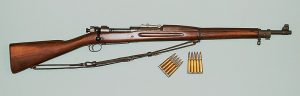
The Mauser 98, in a variety of calibers, stock designs, and accessory packs, lives on, in the 21st Century, both as ceremonial rifles for formal military guards, military and police sniper weapons, as well as being the proverbial gold standard for hunting rifles – the Winchester Model 70, the “Rifleman’s Rifle,” is a Mauser 98 action – continues onwards, still being manufactured in many countries, by m several different manufacturers, and shows no signs of ending production anytime soon.

That’s pretty impressive, for a rifle designed before there was powered, heavier-than-air flight, and that has fought wars in three centuries.
About Author

Michael Cessna
Michael Cessna is a former Active Duty United States Marine, a long-time personal protection specialist, security and defense analyst, military subjects instructor, general information researcher and amateur historian. He has been contributing security and defense writing since 2015.