
Mankind has always been fascinated by the idea of flight. The more rational thinkers realized that they had to find a way to land safely. In Europe, Leonardo Da Vinci designed a parachute – that worked – but didn’t really have a viable way to make it a “tactical system” (to borrow the modern term).
Later, in France, a balloon designed by the Montgolfier brothers was first flown successfully in 1783; luckily, the ‘aeronauts’ did not have to bail out in an emergency. In 1797, that was changed by André-Jacques Garnerin. Not exactly a “tactical” jump, but it worked.
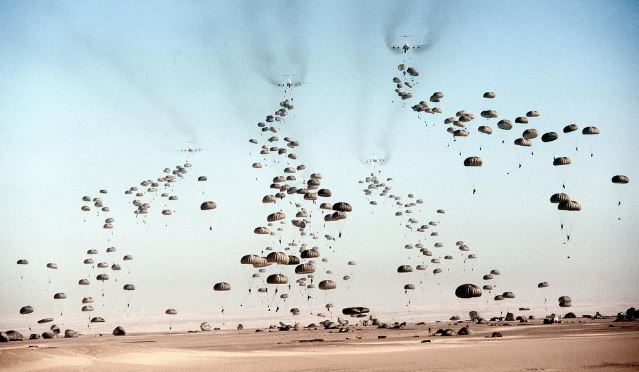
The sight of thousands of paratroopers descending from the sky remains one of warfare’s most dramatic images. From the mass drops over Crete in 1941, and Normandy in 1944 to the 173rd Airborne’s combat jump into northern Iraq in 2003, airborne operations have captured military imagination for over eighty years. But, as anti-aircraft capabilities proliferate and modern warfare evolves, a hard question emerges: can massed parachute assaults above the battalion level still accomplish their mission in contemporary conflict, or have they become elaborate exercises in nostalgia?

The last major U.S. combat jump occurred over two decades ago when the 173rd Airborne Brigade dropped onto Bashur Airfield in northern Iraq — a deliberately uncontested drop zone that faced minimal air defense threat. Since then, American paratroopers have deployed worldwide, but only as elite infantry landed by aircraft that are delivered by aircraft landing at the field, rather than jumping from aircraft in flight. This isn’t coincidence or lack of opportunity; it reflects cold calculation about what modern air defenses can do to slow-moving transport aircraft packed with paratroopers.
The tactical problem is straightforward. A C-17 or C-130 transport aircraft flying at jump altitudes — typically 800-1,250 feet — presents an ideal target for modern air defense systems. Unlike fast-moving fighters that can employ countermeasures and evasive maneuvers, transports must fly straight and level at predictable – and slow – speeds during the actual drop. Man-portable air defense systems (MANPADS) like the Russian SA-24 Igla-S or American Stinger can engage targets up to 11,000 feet, well above jump altitude. More sophisticated systems like the Pantsir-S1 or Tor-M2 can simultaneously track and engage multiple aircraft, turning a mass drop into a massacre before the first paratrooper touches ground.
Historical precedent supports this concern. The 1956 Anglo-French drop on Port Said during the Suez Crisis faced minimal organized resistance and still suffered significant casualties during the drop phase. The Russian airborne assault on Hostomel Airport outside Kyiv in February 2022 — conducted by helicopter rather than parachute — was devastated by Ukrainian air defenses despite Russian air superiority claims. Transport helicopters are marginally more maneuverable than fixed-wing transports, and they still suffered catastrophic losses.
The infrastructure requirements compound the problem. A brigade-level parachute assault — roughly 3,000-4,000 personnel with equipment — requires somewhere between 40-60 transport aircraft flying in close formation. This aerial armada must be assembled, staged, and flown through potentially contested airspace to reach the drop zone. Suppression of enemy air defenses (SEAD) operations must precede the drop, requiring air superiority that itself demands significant resources. By the time you’ve secured the airspace sufficiently for a mass drop, you’ve likely already achieved the operational objectives that justified the drop in the first place.
The equipment limitations compound tactical vulnerabilities. Paratroopers drop with what they can carry — typically small arms, some types of crew-served weapons, and man-portable anti-tank systems. Heavy-drop platforms can deliver light vehicles like HMMWVs and 105mm howitzers, but these require separate aircraft, precise drop coordination, and recovery time before becoming operational. The U.S. M551 Sheridan light tank was specifically designed for airborne operations but proved too fragile for conventional combat and was retired in 1996. Its replacement, the Mobile Protected Firepower vehicle, won’t be air-droppable. Russia’s BMD series represents the most capable air-droppable armored vehicles globally, but even these sacrifice protection for air-transportability. This means airborne forces hit the ground significantly outgunned compared to even light mechanized forces, entirely dependent on air support and rapid linkup with heavier reinforcements. Without that linkup – or even a delayed linkup – an isolated airborne force becomes a besieged force, nearly guaranteed to be destroyed…as the British discovered at Arnhem in 1944.
Modern alternatives offer similar rapid deployment without the vulnerability. Air assault operations using helicopters provide tactical mobility with greater flexibility in landing zones and timing, the ill-planned and poorly-executed Hostomel assault notwithstanding. Air-landing operations — where aircraft actually land and offload troops — allow heavier equipment and supply delivery while reducing the time troops spend exposed during descent. Special operations forces conducting small-unit infiltrations can seize airfields for follow-on air-landing forces, the approach used successfully in Grenada and Panama.
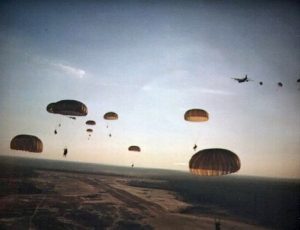
Yet the massed airborne capability persists. The United States maintains the 82nd Airborne Division as a ready brigade combat team capable of deploying anywhere globally within 18 hours. Russia’s Airborne Forces (VDV) number roughly 45,000 personnel organized into divisions specifically for airborne operations. France maintains the 11th Parachute Brigade, while China has expanded its own airborne corps and continues developing heavy-drop capabilities for armored vehicles.
The retention suggests these forces serve purposes beyond massed combat jumps. Airborne units provide rapid-reaction forces for contingency operations, often deploying by air-landing rather than parachute. Their light infantry organization and expeditionary culture make them ideal for quick-response scenarios. The threat of airborne operations forces adversaries to defend potential drop zones across wide areas, tying down forces and resources. And in permissive or semi-permissive environments — humanitarian operations, disaster response, non-combatant evacuation — airborne forces provide capabilities no other units match.

The answer, then, appears to be both ‘yes’ and ‘no’. Against peer adversaries with modern integrated air defenses, massed parachute drops above battalion level represent unacceptable risks for uncertain gains. The operational requirements to make such drops feasible — comprehensive SEAD, air superiority, electronic warfare support — require resources that could achieve the desired objectives through less vulnerable means.
But against less sophisticated opponents, in denied areas where air-landing isn’t feasible, or in time-critical scenarios where hours matter, airborne operations retain relevance. The capability also serves as strategic deterrent and rapid-response option that justify maintaining the specialized training, equipment, and doctrine even if actual combat jumps remain rare.
The parachute remains in the arsenal, but it’s increasingly a tool for specific, narrow circumstances rather than a general-purpose solution. Sometimes, the most important capability is the one you maintain but rarely use — because its mere existence shapes adversary planning and preserves options when conventional approaches fail.